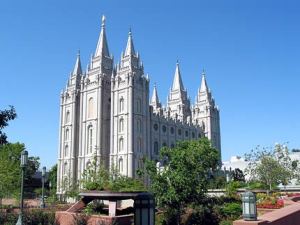
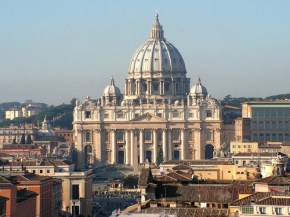
While we here at DefCon stand in opposition to what the Romish church teaches, I find it rather ironic that the early leaders in the LDS church were even more venomous in their attacks on the Vatican than Rome could ever accuse Luther or Spurgeon of being. That said, Salt Lake City shares more with Rome than Brigham or Joey Junior would ever want to admit. Here is part 2 in the series laying Mormonism alongside Romanism and comparing the two.
Besides what they have written in their official declarations, Mormonism and Papism share one other thing in common–they both know how to play the “It’s not official doctrine” card. What I mean is this: whether it’s the Catholic Pope or the Mormon Prophet/President, the authoritative voice of the respective religion (and the teaching arm thereof) will teach something over and over and over and over again, year after year after year, decade after decade after decade, century after century–but they will never publish it in any of their “Scriptures” (the Romish Catechism; the Mormon BOM/PGP/D&C). Therefore, since it is not “officially canonized”, whenever we bring this teaching to the attention of a Catholic/Mormon, they can reach into their wallet and pull out their trusty “They may have said that, but it was never an official teaching of the church“ card, stick out their tongue, and say…

So, let’s look at some more of the parallels between Mormonism and Catholicism.
They both teach that salvation is a result of the combined effort of God’s grace and our own vile, human works.
–The Roman Catholic Church teaches “grace plus works/merit”:
Council of Trent, Sixth Session, Canons Concerning Justification, Canons 11-12—“If anyone says that men are justified either by the sole imputation of the justice of Christ or by the sole remission of sins, excluding grace and charity which is poured into their hearts by the Holy Spirit and inheres in them, or also that the grace which justifies us is only the favour of God, LET HIM BE ANATHEMA. If anyone says that justifying faith is nothing else than confidence in divine mercy, which remits sins for Christ’s sake, or that it is this confidence alone that justifies us, LET HIM BE ANATHEMA.”
Council of Trent, Sixth Session, Canons Concerning Justification, Canon 24—“If anyone says that the justice received is not preserved and also not increased before God through good works, but that those works are merely the fruits and signs of justification obtained, but not the cause of its increase, LET HIM BE ANATHEMA.”
Council of Trent, Sixth Session, Canons Concerning Justification, Canon 32—“If anyone says that the good works of the one justified are in such manner the gifts of God that they are not also the good merits of him justified; or that the one justified by the good works that he performs by the grace of God and the merit of Jesus Christ…does not truly merit an increase of grace, and eternal life, provided that one dies in the state of grace, the attainment of this eternal life, as well as an increase in glory, LET HIM BE ANATHEMA.”
Catechism of the Catholic Church (CCC), paragraph 2027—“No one can merit the initial grace which is at the origin of conversion. Moved by the Holy Spirit, we can merit for ourselves and for others all the graces needed to attain eternal life, as well as necessary temporal goods.”
–Mormonism teaches the we are saved by grace “after all the we can do”:
Book of Mormon, 2nd Nephi 25:23-24—“For we labor diligently to write, to persuade our children, and also our brethren, to believe in Christ, and to be reconciled to God; for we know that it is by grace that we are saved, after all we can do. And, notwithstanding we believe in Christ, we keep the law of Moses, and look forward with steadfastness unto Christ, until the law shall be fulfilled.”
Continue reading →



 Christ Alone Wyoming