There is little doubt that many Roman Catholic doctrines simply aren’t in the Bible. They’ve been introduced by the Roman Catholic Church over the centuries. Much as Muslims make weak attempts to find prophecies about Muhammad in the Bible, Catholics grasp at straws to find support for their doctrines in the Bible.
I recently had a conversation with a couple of knowledgeable Catholics. I started by discussing the fact that the Bible blatantly contradicts some of their beliefs. Specifically, they claimed that atheists “of good will” could end up in heaven. There are dozens of verses that prove that line of thinking wrong, and I quoted a few to them. Their response was that they don’t care what I say about the Bible, because according to Catholic teaching, no one is able to interpret the Bible outside the authority of Rome.
This was the first time I’d heard that from a Catholic, and it turns out that it really is the standard teaching of Rome, and it’s based on a misinterpretation of 2 Peter 1:20. Later, they mentioned that there really is no infallible interpretation of this verse, so I’m not sure what authority they have to give any interpretation of that verse.
I showed them Acts 17:11, which describes how the Bereans were commended for scrutinizing Paul’s teaching with the Scripture. I asked them why the Bereans were able to verify Paul’s teaching with the Scripture, but today I am unable to verify Rome’s teaching with Scripture. They never directly answered my question. I gave up asking the question when the only “answer” provided was:
Why did Paul have to “check in” with the Apostles and have them lay hands on him to continue his ministry?
That has absolutely nothing to do with my question. Honest, knowledgeable answers generally don’t start with a “why” and end with a question mark.
They do think that I should verify the doctrines of Rome, but not by searching Scripture. I should determine the truth of Rome’s claims by verifying that their doctrines haven’t changed over the last 2,000 years, and I should do this by reading church fathers. (They were kind enough to give me a list of church fathers to check out.)
But this only leads to more questions. If I’m not trustworthy enough to interpret Scripture, why am I trustworthy enough to interpret the writings of church fathers? Why should I read the second generation (or later) of Christian beliefs when the Bible provides the first generation? If two church fathers disagree (there are many early “Christians” who were outright heretics), which one is trustworthy?
There is no good way to test the Catholic Church. Bottom line: I’m supposed to become a Catholic, because the pope says so.
Trust me.
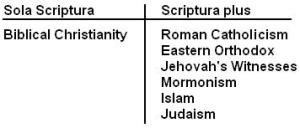
At the root of this disagreement is the epistemology of Catholics and Evangelicals. Evangelicals believe the Bible is the only source for absolute truth, and Catholics have the Bible plus their tradition. The problem is that the Bible is insufficient to arrive at modern Catholic doctrines (if not contradictory to those doctrines), and there is no other infallible, inerrant source to attest to Catholic doctrines. In order to buy into the teaching of Rome, you must take a blind leap of faith.

 If you take away God, you take away conscience, and thereby all measures and rules of good and evil. And how can any law be made when the measure and standard of them are removed? All good laws are founded upon the dictates of conscience and reason, upon common sentiments in human nature, which spring from a sense of God; so that as the foundation is demolished, the whole superstructure must tumble down. A man then could be a thief, a murderer, an adulterer, and could not in a strict sense be considered an offender. The worst actions could not be evil, if a man were a god to himself, a law to himself.
 Not content with being restricted to spreading their damnable false gospel on earth, the Vatican is now looking to the sky.
 Christ Alone Wyoming