
Christian Lady published an eye-opening piece on Youth Specialties: Free Resources, Tips and Ideas.
Although there’s much wrong with these tips and ideas, it’s what’s missing that’s most disturbing. Allow me to quote the original poster’s thoughts on this as she stated her concerns more eloquently than I could have:
I read through the 100 ideas for Youth Workers on the Youth Specialties web page and noticed words/terms/names not used at all in the list.
Missing are: God, Bible, Christ, Salvation, Sin, Faith, Death, Hell, Devotion(s), Jesus, Holy Spirit, Believe, Repent, Prayer
Not Missing: Church, Adult, MTV, Rolling Stone, Frisbee, Football, Surveys, Space, Phone Chain, Goals, Worship, Retreats
I’ve posted fifteen of their one hundred tips and ideas below for your examination. Visit their website to view them all.
Tip #2
Subscribe to a popular magazine like Rolling Stone or Teen that will help keep you on top of the current youth culture.
Tip #4
Use surveys and questionnaires to their best advantage. Find out what your young people are thinking on a regular basis.
Tip #10
Don’t meet in a room that is too big for your youth group. If your group is small, meet in a small room. This gives kids the feeling of being “packed” in. Always make sure your meeting place is casual and comfortable.
Tip #11
Have the young people in your group put together a “youth group yearbook” at the end of the year. It should include photos and articles about the past year’s activities. It will be a positive reminder of the good times shared by the group.
Tip #22
Develop programs that reflect the needs, interests and energy level of the young people in your group, not the adults who work with them.
Tip #25
Plan some early morning or late night activities. There will be few conflicts and the kids will enjoy the adventure.
Tip #39
Familiarize yourself with the music your students listen to. MTV’s weekly top videos countdown and some weekly radio programs will help you stay current. Periodically discuss the music with your kids in a positive way.
Tip #44
Put together a “skit closet” full of costumes, old clothes, and props for your drama productions or even last-minute illustrations. Ask people in the church to donate ridiculous looking clothing and other items. Your local thrift shop is a great resource, too.
Tip #59
Never use religious jargon and worn-out cliches. Say what you mean in words today’s youth can understand.
Tip #60
Build self-esteem in your students by affirming them both when they are alone and when they are with their peers. Over time make it a point to say something positive to each one.
Tip #73
Keep a supply of games and recreational items in the trunk of your car at all times. You never can tell when you’ll need a football, a Frisbee, or a few water balloons.
Tip #75
Always serve refreshments at meetings and activities. It’s a relatively easy thing to do and kids love it. It also keeps them around a little longer for personal contact.
Tip #84
Videotape the “big game” this year at your local high school and show it after the game on a wide-screen TV. Invite the whole school.
Tip #93
Use TV to your advantage. Tape and discuss good programs. Discuss and evaluate the programs that are most popular with your youth.
Tip #97
Put on a drama once a year. It gives more kids a chance to use their talents and be in the limelight.
Besides the idea and concept of a “youth pastor” being completely absent from the Scriptures, and besides the fact that too often the “youth pastor” has never raised kids of his own, knows too little about theology and too much about MTV, and in spite of the incredible failure rate of “youth pastors” (the false conversions abound), it still seems that “youth pastors” are all the rage in Laodicea. I wonder why that is . . .
To quote Paul Washer on the subject:
“What are most youth groups like? You get a real personable young leader who’s usually not married and a lot of mousse in his hair. And then he gets a lot of young people around him, and what do they become? According to Proverbs they become companions of fools. When you put young people with young people in this atmosphere of adolescence you have no growth to adulthood, you have no maturity, no elders are involved, no parents are involved. It can’t work because it’s not Biblical.”
For a related sermon on the problem with “youth pastors/leaders” see Voddie Baucham’s The Centrality of the Home.

 Your sermon of the week is part one and part two of Paul Washer’s message entitled Biblical Manhood. This concludes our four-week series on manhood leading up to Father’s Day.
  We continue with week three of our four-week series on Biblical manhood. This week’s sermon of the week is aptly entitled Biblical Manhood by Voddie Baucham. I trust that you will be blessed, challenged, convicted, and encouraged by both parts one and two.
 You must equip your children to function in a culture that has abandoned the knowledge of God. If you teach them to use their abilities, aptitudes, talents, and intelligence to make their lives better, without reference to God, you turn them away from God. If your objectives are anything other than “Man’s chief end is to glorify God and enjoy Him forever,” you teach your children to function in the culture on its terms.
 Hold onto your hats. Your sermon of the week is a scathing blow to the concept of government education by Voddie Baucham entitled
  Modern American dating is no more than glorified divorce practice. Young people are learning how to give themselves away in exclusive, romantic, highly committed (at times sexual) relationships, only to break up and do it all over again. God never intended for His kids to live like this. And instead of stepping in and doing something, many Christian parents simply view these types of relationships as a normal and necessary part of growing up. Unless your child is wiser than Solomon, stronger than Samson, and more godly than David (all of whom sinned sexually), they are susceptible to sexual sin, and these premature relationships serve as open invitations. . . . Being involved in such exclusive relationships before you are ready to be married is like shopping without any money; either you will leave frustrated, or you will take something that doesn’t belong to you.
 Many object to homeschooling or private Christian schools based on the fact that God has called us to be “salt” and “light” and to evangelize the world. Ironically, this is precisely why we chose homeschooling. The Great Commission states: “Go therefore and make disciples of all nations, baptizing them in the name of the Father and the Son and the Holy Spirit, teaching them to obey all that I command you” (Matthew 28:19-20, emphasis added). How is this likely apart from Christian education? How can I effectively “make disciples” of my children if I send them off to the government school forty-five to fifty hours per week? The Nehemiah Institute, The National Study of Youth and Religion, and the Barna Report have shown us clearly that our children do not even understand–let alone obey–all that the Lord has commanded. Moreover, how can our children evangelize our government schools if they don’t know what they believe and why they believe it? Not to mention that all of the evidence currently points to the fact that our children are the evangelized, not the evangelists, in our nation’s schools. They are the ones being carried away by every wind of doctrine. . . . The Nehemiah Institute continues to demonstrate year after year that Christian children in government schools who actually retain anything close to a biblical worldview are the rare exception and not the rule. . . . Let me be clear–I applaud men and women whom God has called to teach in government schools. These people are front-line warriors, and they need to be right where they are. However, there is a big difference between sending fully trained disciples into enemy territory and sending recruits [children] to our enemy’s training camp. If we do the latter, we shouldn’t be surprised when they come home wearing the enemy’s uniform and charging the hill of our home waving the enemy flag.
 It is not enough that we pray as private individuals in our closets; we are required to honor God in our families as well. At least twice each day, in the morning and in the evening the whole household should be gathered together to bow before the Lord parents and children, master and servant to confess their sins, to give thanks for God’s mercies, to seek His help and blessing. Nothing must be allowed to interfere with this duty: all other domestic arrangements are to bend to it. The head of the house is the one to lead the devotions . . . . Under no circumstances should family worship be omitted. If we would enjoy the blessing of God upon our family, then let its members gather together daily for praise and prayer.
 There are many passages that teach the need to shepherd, to train, to instruct, and to discipline your children. None of these passages has getting a child to pray the “sinner’s prayer” as its focus.
 I just completed the book Family Driven Faith by Voddie Baucham. Don’t let the name fool you; it has absolutely nothing to do with the purpose driven garbage being peddled by the seeker-friendly mega-churches. In fact, I doubt that this book would be well received at such social club churches.
 The Duggar’s have just welcomed their 18th child. If you do not know who the Duggar family is, I encourage you to check out
 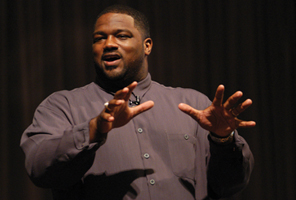 Our children are not falling away [from the Christian faith] because the church is doing a poor job—although that is undoubtedly a factor. Our children are falling away because we are asking the church to do what God designed the family to accomplish. Discipleship and multi-generational faithfulness begins and ends at home. At best, the church is to play a supporting role as it “equips the saints for the work of ministry” (Ephesians 4:12 ESV).
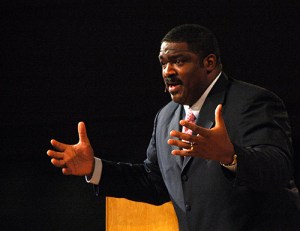 Your sermon of the week is The Centrality of the Home by Voddie Baucham. This is a must-hear for all church pastors, youth pastors, parents, expecting parents, kids, teens, and you! But be warned, Voddie steps on toes. You can download this message from Sermon Index by right clicking
  Christ Alone Wyoming