The Barley Harvest

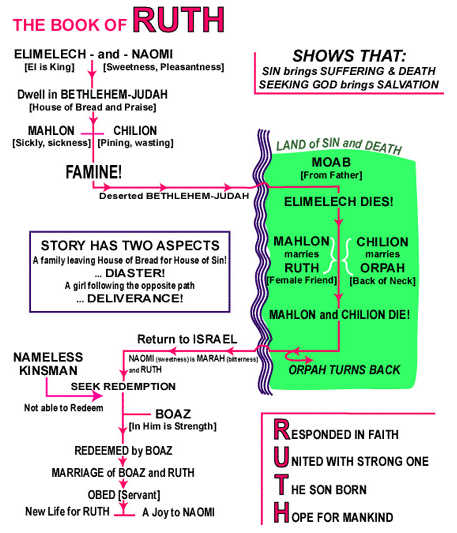
We’ve likely all read the book of Ruth. We just started a four-week visit to this small book and I cannot but post it here and plead with any visitors to give it a listen. 

What is the book of Ruth really about? This book is considered one of the most beautiful pieces of literature ever written, but is it more than just a beautiful story? In this introduction to our four week series on Ruth, Pastor Voddie gives a beautiful picture of the message contained in this book and how it should impact our lives.

You cannot comprehend the message in this book unless you take into account the biblical context. This introductory sermon provides that in an extraordinary fashion.

Another Big-Name “Pastor” Continues the Slide

In his book, Eternal Security – Can You Be Sure? Charles Stanley makes many of the errors common to the “Free Grace” movement. Perhaps the most glaring is in his analysis of the wedding feast parable in Matthew 22. Dr. Stanley tells us, “It certainly does not mean hell in the parable. How could a master throw a slave into hell? This phrase appears in a similar parable in chapter 22. In that parable an unwanted guest is bound and thrown out of a banquet hall into the “outer darkness” (see Matt. 22:13); it clearly refers to being thrown outside a building into the dark.”

Stanley further explains that this place of wailing and gnashing of teeth is an outer area of Heaven, not too close to the throne of Christ. Really?

That book was written years ago.

More recently, Stanley’s “In Touch” magazine, has featured an article encouraging Roman Catholic mysticism as a legitimate Christian endeavor. Ken Silva brings us the sad news in this story (repulsive video at the bottom of the page on Ken’s site).

May God have mercy and grant Dr. Stanley repentance – and his followers discernment.

IN TOUCH MAGAZINE OF CHARLES STANLEY PROMOTING CONTEMPLATIVE NEW MONASTICISM

By Ken Silva pastor-teacher on Jun 30, 2011 in AM Missives, Contemplative Spirituality/Mysticism, Current Issues, Features

While I make no claim to know when the Lord Jesus will return, I will say that it’s entirely possible we are living in a time where we are seeing the beginning of a great falling away.

And so a large part of our online apologetics and discernment labors Apprising Ministries is to document the New Downgrade within evangelicalism, which accelerated when its own mainstream made the fateful decision to more fully embrace the sinfully ecumenical Emergent Church aka the Emerging Church.

I’ve told you before that the EC has proven to be a Trojan Horse where Satan was able to off-load his ne0-Gnostic mystic corruption Contemplative Spirituality/Mysticism(CSM) right within the very heart of the church visible. It’s beyond question that this spurious CSM—the refried Roman Catholic mysticism “discovered” by Living Spiritual Teacher and Quaker mystic Richard Foster, and now perpetrated as supposed Spiritual Formation with an able assist from his spiritual twin SBC minister Dallas Willard, was a core doctrine in the EC right from its hatching in hell.

What’s vital for you to grasp is that, having kicked out the pillar of sola Scriptura, a now upgraded to the Emerging Church 2.0 is spreading its own new postmodern form of “big tent” Progressive Christianity—a Liberalism 2.0. However, at the same time foolish evangelical church leaders, desperate to fill their buildings, began having “alternative” worship services and using materials from EC leaders just filled with Counter Reformation teachings and spirituality in their Young Adult and Youth Groups. Some 10 years rolling down that track, we’re only now beginning to see the syncretism it’s been causing.

You might remember in Mainstream Evangelicalism Embracing Contemplative Mysticism I supplied you with tons of documentation showing that CSM has now deeply penetrated the mainstream of the allegedly Protestant evangelical community. It’s actually been slithering in for years now; so people like Purpose Driven Pope Rick Warren, unquestionably one of the most influential pastors in the Southern Baptist Convention, are becoming emboldened and no longer feel they need to hide their affinity for it. Now I’ll show you that Saddleback Church certainly isn’t the only SBC entity promoting CSM.

We turn to Contemplative Spirituality Lands on Charles Stanley’s In Touch Magazine . . . Again. This piece over at the blog of leading online apologetics and discernment work Lighthouse Trails Research begins:

Jonathan Wilson-Hartgrove is a writer, speaker, and activist who is a leader in the “New Monastic” movement. He lives in North Carolina at the Rutba House, a new monastic community.

Wilson-Hartgrove is most recently known for co-authoring Common Prayer: A Liturgy for Ordinary Radicals with new monastic activist Shane Claiborne. (Online source)

Resisting wrestling with the serpent, for now we leave aside the serious issues with Red Letter Christian—and disciple of Tony CampoloShane Claiborne. Mike Stanwood, the author of the Lighthouse post, tells us that Jonathan Wilson-Hartgrove (seen below) “was recently profiled in Charles Stanley’s In Touch magazine” as you can see here:


(Online source)

Stanwood continues:

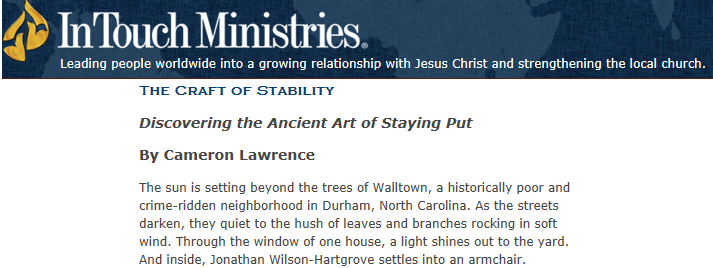
The January 2011 article called “The Craft of Stability: Discovering the Ancient Art of Staying Put” written by Cameron Lawrence highlights the “ intentional Christian community” at the Rutba House and their “daily prayer routine.”

The In Touch article states that Rutba House is an evangelical community rooted in the Protestant tradition, and that Wilson-Hartgrove is an ordained Baptist minister. The In Touch article also reports that Rutba’s community principles are borrowed from Benedictine monks and that all of their efforts are based on St. Benedict’s “rule of life.” (Online source)

Here we go mentally off-roading again into the postmodern Wonderland of Humpty Dumpty language. Stanwood is quite correct when he then points out:

However, these two statements are completely contradictory: A “Protestant tradition” and “principles” “borrowed from Benedictine monks” completely contradict each other if we are talking about a biblical tradition when we say “Protestant tradition.” The contemplative beliefs promoted by Wilson-Hartgrove are not biblical. (Online source)

This is yet another example of following one’s feelings rather than assessing “principles” by God’s infallible and inerrant Word in Holy Scripture. I’ll say it again, you need to recognize the kind of fruit that this refried Roman Catholic mysticism invariably produces. Lord willing, and should funding allow, I plan to document further for you what CSM does to those who persist in it. A good example can be seen in Peter Scazzero Bringing Rome Home To His Church; and Scazzero even comes recommended by the likes of Rick Warren and Tim Keller.

As I said before, your biggest clues are 1) as it spread through the antibiblical monastic traditions of the Church of Rome, CSM played a major role in producing apostate Roman Catholicism in the first place. And 2) just take a look at what it’s done to those in the Emerging Church like its iconic rock star pastor Rob Bell, who’s now openly arguing for Christian Universalism through his Love Wins mythology; and even though he adheres to postmodern neo-liberalism, he’s still considered an evangelical.

Why; because he’s a nice man and people feel that he must be following God; but Bell’s a neo-Gnostic with a different gospel as you’ll see when his mystic musings are Biblically tested in Rob Bell And Postmodern Neo-Liberalism. In closing this out, for now, above Mike Stanwood told us that this new monk Jonathan Wilson-Hartgrove—who’s a leading proponent of unbiblical neo-monasticism—co-authored the book “Common Prayer: A Liturgy for Ordinary Radicals with new monastic activist Shane Claiborne.”

The following two sections are from this book; first:


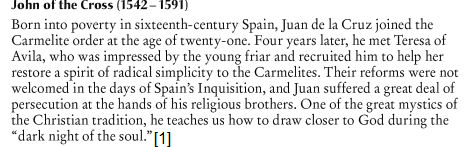
As you can see, there’s praise for this apostate Roman Catholic mystic, a disciple of the troubled Teresa of Avila; as well as for his teaching about some supposed dark night of the soul. To mystics this allegedly occurs to them as they begin to grow deeper in their practice the crown jewel of CSM, a form of meditation in an altered state of consciousness commonly known as Contemplative/Centering Prayer (CCP). Dr. Gary Gilley explains:

The phrase “dark night of the soul” has become, on a popular level, the description of a period of deep depression or dryness, but this is certainly not what St. John meant… He set out, during the time of the Catholic Counter-Reformation, to explain the life of the mystic and the mystical way.

Classical mysticism is composed of three parts: purgation, in which the senses and spirit are purged of all desires; illumination, in which God supernaturally floods the soul with His love while the individual remains passive; and union, in which the soul is united with God in perfection.

Such an individual will be able to skip purgatory since purgatory’s work has been completed in this life (pp. 107-108, 174). To this pursuit the medieval monks and hermits devoted their lives.

The mystical way is nowhere supported by Scripture, even though St. John makes many attempts to do so… Concerning purgation we are told that there is two stages: purgation of the senses (explained in book one) and of the spirit, the subject of book two.

The dark night is a description of these two levels of purgation. (Online source)

Then we’re given the wisdom of another apostate Roman Catholic monk, Thomas Merton, the Golden Buddha of CSM. Despite the fact that Merton’s life-long devotion to CCP, which would make him more like the Buddha than the Christ as you can see in Thomas Merton And The Buddhas, we are given Merton with the mystic gibberish below:

Finally, concerning the video interview below Stanwood is right that we’ll hear “Wilson-Hartgrove [as he] talks about the concepts in his book; the new monastic movement, desert vision, desert fathers, and redistribution of wealth.” In addition, the way he speaks about what Jesus did on the cross is quite consistent with mysticism’s and progressive/liberalism’s view that He chose to show us the way of love and to enter into human suffering by taking on the evil empire.

With this love of the self the lines blur further while such as these defecate upon the blood of the martyrs.

Defending, Contending – what?

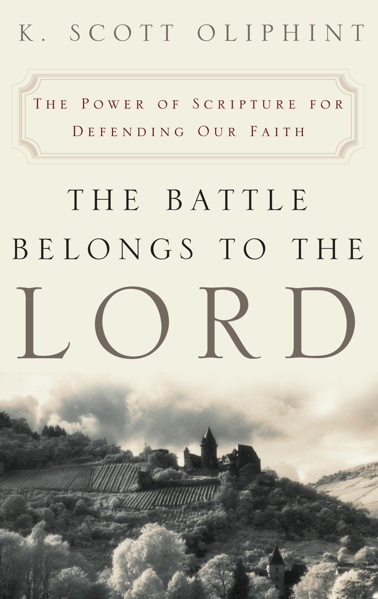
I recently started reading K. Scott Oliphant’s new book, The Battle Belongs to the Lord. Chapter 2 is an examination of the book of Jude and the author does an excellent job of explaining what we (those who are redeemed by the blood of Christ) are to defend and why we are to do so. He also describes the people and the motivation of those who “crept in unnoticed” and pose a danger to the church.

The exegesis of Jude in worth the price of the book. Here’s a taste for your condiseration:

“Jude’s description of the enemies who have made their way into the church is illuminating. He does not describe them as merely worldly people. … They [are people who] know the tradition and can “speak the language.” … The reference to Korah would have been particularly stunning to Jude’s readers (see Numbers 16 and 26.) … To put it (Korah’s rebellion) in New Testament terms, Korah used his leadership position in the church to exalt himself and his own agenda.”

Reading this chapter reminded me of a 28 minute message from a dear brother, introducing Jude. Listen to this message, buy the book. Then you will have a better understanding – perhaps an initial understanding – of why it is important to contend for the faith and what that faith is.

What’s The Big Deal on Creation?

Many Christians point out that the word “day” in Genesis chapter one can mean something other than a 24-hour day and, therefore, the scientific view that the world is billions of years old can be reconciled to the Scriptures.

But how does one determine when the Hebrew word “yom” means a 24-hour day and when it means an undetermined length of time? As with all interpretation, context is key.

And, as with all Scripture, understanding the authority of God as the ultimate rule of interpretation of His Word and His creation is foundational to everything else.


In this hour long free video from Answers in Genesis, you will see how dangerous it is to play fast and loose with the Word of God and be taught why the “yom” must mean 24-hour day in Genesis chapter 1.

May the Lord God of Heaven be our guide – and not any snake who relies on human “wisdom” to cause us to question His Word.

Is your Worldview based on the world?

Many professing Christians think man has more wisdom than God in determining how long the creation took. Of course, few people put it in those terms, but that is what it boils down to. Here’s an example.

What are the consequences of disbelieving in a literal 6 day creation? We deny the clear teaching of the Old and New Testament. Jesus taught (recorded in Mark 10:6) that man and woman were created in the beginning of creation – not after a long, long time.

And when we deny the clear teachings of the elementary things of Scripture, why should our children believe us or our pastors when they are taught about sin and deliverance from its consequences? If creation is reduced to a fairy tale, we have breached the foundation of God’s revelation to man. God stated out His special revelation to man with the words, “In the beginning, God created the heavens and the earth.” Creation is important to Him – it ought to be to us.

For a few days, you can download a 40 minute video in which Ken Ham describes the importance of believing God’s Word – for you and the next generation. In it you will find out:

The next generation is already calling it quits on traditional church. Next Sunday, look around, two thirds of the young people in your church are already disengaged from the message they are hearing. And it’s not just happening on the nominal fringe; it’s happening in the most solid “Bible-believing” churches.

In this important DVD, Ken Ham discusses the profound cultural changes taking place in our Western world, as God’s Word is rejected and man’s fallible ideas are welcomed. Ken relates some of the shocking statistics presented in the book Already Gone that reveal the reasons why young people are leaving church and abandoning the faith of their parents.

The church is failing to give children real answers to their questions. We are losing our kids long before college. But this is far from a hopeless situation. Ken explains how we can fight back for our children, and what we can do to ground our children in the faith and prepare them for the challenges of the secular world.

HT to my good friend at PurposeDrivel

It’s Time for Vacation Bible School! – Or Is It Time to Repent?

Vacation Bible School sounds innocent enough, it started with good intentions: Christians wanting to reach children with the good news of Jesus.

Christianity Astray reports:

Unofficially, it’s possible to trace the roots of VBS as far back as the 1870s, when the Methodist Episcopal Church offered summer Sunday school institutes to the general public near Lake Chautauqua, New York. In 1873, Bishop John H. Vincent proposed the movement should include educational and cultural programs, and soon other Christian groups across the country followed suit with their own summer retreats, many of them offering services for children.

Vacation Bible school as we know it today got its start more than 20 years later on New York City’s East Side. Mrs. Walker Aylette Hawes of the Epiphany Baptist Church noted a rapid increase in the number of immigrant children in the slums. In July 1898 she rented the only place available—a saloon—to run a Bible school for six weeks during the summer. Hawes structured her program around worship music, Bible stories and Scripture memorization, games, crafts, drawing, cooking, etc. The school caught on: Hawes was presiding over seven separate schools by the time she retired from her work in 1901.

Note – no effort to involve or reach out to the parents of these street urchins. A culturally relevant program that would be attractive to young children who were dead in their sins. (This remains the foundation of many church-based youth programs, a century later.) This approach not only extends the recent invention of adolescence, it encourages adults to behave as if they were small children. This year’s promotional materials from Lifeway are a prime example:

How did parents and the church train children before such hip, cool, fun, and unbiblical programs were developed? I’m glad you asked. Here’s a sample of one tool that was used from the 17th century and is still in use in some churches; it’s an extract of the Shorter Baptist Catechism:

Q. 43. What is the preface to the ten commandments?
A. The preface to the ten commandments is in these words, I am the Lord your God, who brought you out of the land of Egypt, out of the house of slavery.

Q. 44. What does the preface to the ten commandments teach us?
A. The preface to the ten commandments teaches us that because God is the Lord, and our God, and redeemer, therefore we are bound to keep all his commandments.

Q. 45. Which is the first commandment?
A. The first commandment is, You shall have no other gods before me.

Q. 46. What is required in the first commandment?
A. The first commandment requires us to know and acknowledge God to be the only true God, and our God; and to worship and glorify him accordingly.

Q. 47. What is forbidden in the first commandment?
A. The first commandment forbids the denying, or not worshiping and glorifying the true God as God, and our God; and the giving of that worship and glory to any other, which is due to him alone.

Q. 48. What are we specially taught by these words before me in the first commandment?
A. These words before me in the first commandment teach us that God, who sees all things, takes notice of, and is much displeased with, the sin of having any other god.

I ask you – which method of instructing children is God honoring?

3 Diagnostic Questions for the Christian

Every child of God ought to know what his Father desires for him. I seem to find three basic questions people ponder that leaves me with the impression that many who claim Christ struggle with the very idea of determining God’s will for their lives.

1.)      How do you determine the will of God for your life?  First – make sure you know and obey the revealed will of God, those things He has made clear for each of us.  For example: 1 Thessalonians 4:3 – 7, 1 Thessalonians 5:16 – 22, and 1 Peter 2:13 – 17.  His first priority for each of His children is to conform us to His Son (Romans 8:28 – 30).

Beyond God’s revealed will, theologians categorize the will of God as providential – pleasing to Him because it aligns with His revealed will.  How does one determine God’s providential will?  First, study, know, and obey God’s revealed will, paying attention to principles found in Scripture on the topic at hand.  Secondly, ask the Lord for wisdom – for He loves to give such to His children, and He is wiser than we.  Thirdly, get godly counsel.  Fourthly – decide.  If we live believing God’s will for our mate, job, vacation, car, or dinner is a unique choice that He has hidden from us, we will be frustrated.  Knowing His character and living in humble obedience to Him – as we study His revealed will – will equip us to make choices that please Him, as we exercise His providential will.

When we make what seem to us as stupid choices – we should review how we made the decision.  If we were aligned with the Lord, we can be assured it was right and we now face decisions on how to respond.  If you marry “the wrong woman”, know and obey God’s revealed will for how to live with your wife.

2.)      Can anyone have assurance of salvation?  Before having assurance of salvation, a man should make sure he is redeemed.  Scripture tells us we can know we are in Christ (1 John 5:13). and Scripture also tells us how to know: we keep His commands – 1 John 2:3 – 6; love the brotherhood – 1 John 2:9 – 11, 1 John 3:10, and 1 John 5:1 – 3; love not worldly things – 1 John 2:15 – 17; believe in the Lord Jesus – 1 John 5:10 – 12; confess Him as Savior – 1 John 4:13 – 15; love God – 1 John 4:16; keep ourselves from wickedness – 1 John 5:18 – 21.  We cannot do these things to be saved – we diagnose our spiritual condition by examining if and how we do them.

3.)      Is every Christian supposed to witness?  Many people look to Ephesians 4:11 and think only those called to be an evangelist are required to witness, to proclaim the gospel.  What does Scripture say?  As we saw from 1 John 4:13 – 15, one mark of a Christian is that he testifies (V 14) and confesses (v 15) Christ to be the Son of God.  To testify means “to bear record of”, “to give witness of”; to confess, in this context, means “something said, a reasoned statement, an account or communication, preaching”.  In John 10:22 – 25, Jesus told the Jews that His works bore witness of Him.  Since we are the workmanship of Christ, we ought to willingly be witnesses of Him.  We see Peter and John, in Acts 4, unable to keep from telling people of Jesus, even in the face of threats from the government (Acts 4:19 – 20).  We need to keep in mind that it’s not our job to convince people to save themselves – which we can’t do and neither can they.  Salvation is the work of the Holy Spirit and since He abides in every Christian, He will do His work when we are witnesses of Jesus.  Every Christian can do this work and every Christian should do this work.  In the Great Commission, the Lord first tells us to “Go and teach all nations”.  The only rational conclusion is that those to be taught must first be witnessed to and redeemed before they can be taught.  So don’t think this commission doesn’t apply to you if you aren’t a teacher.  Finally, look to the reward we gain by being faithful in this ministry – Revelation 12:11 shows martyrs recognized by God for their testimonies of Him.  It’s always good for the Lord of Creation to approve your work – even if it’s as simple as telling people about Jesus.

4.)      A bonus question, as follow-up.  What is “the Gospel”, beyond simply being “good news”?  Paul tells us (Romans 1:16) “it is the power of God unto salvation to every one that believeth; to the Jew first, and also to the Greek.”  In 1 Corinthians 1:17 – 18,  we see that the Gospel is about the cross: “For Christ sent me not to baptize, but to preach the gospel: not with wisdom of words, lest the cross of Christ should be made of none effect. For the preaching of the cross is to them that perish foolishness; but unto us which are saved it is the power of God.”  Further in this passage, we see that it’s also foolishness and a stumbling block to men – so no man can win a soul to Christ by force of intellect or smooth speech.  We find in 1 Corinthians 15 what is perhaps the best summary of the Gospel of Jesus: “Moreover, brethren, I declare unto you the gospel which I preached unto you, which also ye have received, and wherein ye stand;

By which also ye are saved, if ye keep in memory what I preached unto you, unless ye have believed in vain.  For I delivered unto you first of all that which I also received, how that Christ died for our sins according to the scriptures;  And that he was buried, and that he rose again the third day according to the scriptures:  And that he was seen of Cephas, then of the twelve:  After that, he was seen of above five hundred brethren at once.”

The Gospel declares that Christ died as prophesied and required by the law as punishment for our sins.  Man is wicked and sinful and in desperate need of a savior – Christ is the One.  He was buried and raised from dead – as foretold in Scripture – though man tried everything to obscure the Truth of the resurrection.  And Christ was seen by hundreds of people who were still alive when Paul wrote this, meaning they could have called him a liar to his face – if the Gospel was false.  Your personal testimony is good news, but it’s not the Gospel of Jesus Christ and it won’t save anyone.  Your walk of obedience is pleasing to the Lord, but your lifestyle is not the Gospel of Jesus Christ and it won’t save anyone.  Trust God when he says “the Gospel of Jesus is the power of God unto salvation to every one that believes.

It Gets Worse for John Piper

Several posts at DefCon have detailed many of the concerns any Christian ought to have with the public behavior and pronouncements made by John Piper – here’s a search page showing them.

It keeps getting worse, as John Piper pursues public friendships with people who know not the gospel of Jesus Christ yet call themselves ministers of the gospel. People like Rick Warren.

What follows is an excerpt from a post from Ken Silva at Apprising.org at this page.

People of the living God – pay attention to the teaching you receive. Do not take anything from any man without testing it in light of the Word of God. Give no minister a pass on essential issues of the Christian faith, for many are deceived and many more will be. Mark those walk contrary to the Word of God and have nothing to do with them.

Here is part of Ken’s message – read the whole thing.

This was a Trojan Horse that squishy evanjellyfish leaders would bring into their own camp and then proved to be the vehicle from which this spurious spirituality, a romanticized version of the Counter Reformation (hello) spirituality of the apostate Roman Catholic Church, would be unloaded into the mainstream of the visible church, which such as these have been pawning off for years now as so-called Spiritual Formation. I’ve also pointed out it’s an incontrovertible fact that the main purveyors of CSM would be the Living Spiritual Teacher and Quaker mystic Richard Foster, along with Southern Baptist minister Dallas Willard; who is quite literally Foster’s spiritual twin.

In additon, in no uncertain terms I told you that it’s well past time for recognizing the inclusive, and increasingly universal, fruit of the Emerging Church and the spiritual skubalon of Foster-Willardism. Ok, but what does this have to do with John Piper? I’m glad you asked. Dr. Piper’s choice to advance Rick Warren into the Reformed camp has had the rippling effect of people, even outside of any discernment ministries, beginning to look a little closer at his theology, educational background, and associations; e.g. his charismatic bent, his connection to Fuller Theological Seminary, and with the late Ralph Winter.

I had received a tip from a source back in June of this past year; and as I followed up on it, it would eventually lead me to discover some disturbing information which I orginally began sharing in Questions Concerning Dr. John Piper and Dr. John Piper And Unanswered Questions. As I told you earlier this year in Mark Driscoll, Acts 29 Network, & The Emerging Church I have some serious reservations about so-called New Calvinism. And there’s very good reason for such concern as Mark Driscoll and his Acts 29 Network are growing in popularity and influence within the younger sector of the Reformed Camp; being blessed as they are by Dr. John Piper, who’s seen as a father of this New Calvinism.[3]

Christ – our example, submission to authority

Here is the last of 6 messages from Pastor Conrad Mbewe, from Zambia in Africa, on the subject of biblical submission and exercising authority. You can find links to the previous messages here. Each of these 6 messages will convict you – as all humans have some rebellion in their flesh. Do not lose sight of the limits of earthly authority – but do not erect unbiblical limits on your submission thereto. Both ditches are dangerous to your soul.

This last message focuses on the example of the Lord Jesus – Who humiliated Himself to take on flesh and live as a human and submitted Himself in all things He said and did to our Heavenly Father. While the main point of the Lord’s earthly life is not merely to serve as an example (that is the main error of the emergents and myriad gnostics), He does shows us how to honor God with obedience.

The main point of Christ’s life was to earn his right to be the propitiation for the sin of the elect and keep Himself from sin and be raised from the dead. All to bring glory to His Father and redeem those chosen before the foundation of the world.

He desires obedience more than sacrifice – obedience can only come by the indwelling of the Holy Spirit – and not by the effort of any flesh. As the taxpayer in Luke 18, let each of us cry out to God for mercy and rely not at all on the flesh.

Authority in the Church

We now turn to the fifth message in Pastor Mbewe’s 6-part series on biblical Submission and authority, based on 1 Peter. You can find the previous posts here. As way of reminder, Pastor Mbewe is  the current pastor of Kabwata Reformed Baptist Church in Lusaka, Zambia, Africa. He is widely regarded as the African Spurgeon. KBC is presently overseeing the establishment of ten new Reformed churches in Zambia and Botswana. Conrad is the editor of Reformation Zambia magazine and writes three columns in two weekly national newspapers. His most recent contribution to a book is found in Dear Timothy—Letters on Pastoral Ministry, published by Founders Press. He is also the principal of the Reformed Baptist Preachers College in Zambia. He blogs at A Letter from Kabwata.

Today’s message is about the biblical model for the exercise of and submission to authority within the church. May everyone professing Christ as Savior submit to the Word of God – for the good of His people and the glory of His name.

Submission and Authority in the Home

Conrad Mbewe continues his exposition of biblical submission and exercise of authority, based on 1 Peter. This message – #4 of 6 – focuses on the family. We see here that rebellion against parents is not a narrow issue which one can work around. As with proper teaching about the broad intent and application of the 10 Commandments, biblical instruction about our responsibility to submit to God’s Word is comprehensive and our ability to obey is wretched. Hence, the Word convicts us of our need of Christ, in every area of our lives.

Messages 1 – 3 can be found here.

Submission in the Workplace

In our third installment of Pastor Conrad Mbewe’s teaching from 1 Peter, this dear servant of the Lord continues to meddle in our business! Not only have we been taught the basic biblical principles of submission and authority, and why and how to submit to political authority, Pastor Mbewe now invades our inner sanctuary of the workplace!

The biblical principles of submission to proper authority and how to properly exercise authority do not change with circumstances. Just because your boss doesn’t see things your way does not give you – or me – an excuse to work against him.

In today’s segment, let the Word of God continue its work in your life – breaking down strongholds of sin and conforming you to the Christ.

The Power of the Word of God

Several years ago, I had a very good boss where I work. She was professional, congenial, and honest. She was a cradle Roman Catholic, having been raised in that cult and believing it to be the church of the Lord Jesus Christ. I never once told her the truth about her cult. Yet I prayed for her – to see the light, to have wisdom in business decisions – and told her I was praying for her. I gave her written and spoken encouragement and exhortations from Scripture. She was always gracious and thankful, but never showed one iota of being born again. 

Then she was diagnosed with breast cancer and left work for many months, with treatment and recuperation. While at home, a neighbor called occasionally, to bring a meal and so forth – and to witness Christ to her.

When she finally came back to work, my boss excitedly called me to conference to announce with a huge smile that split her face open – she was a baby Christian! I asked what she meant and she told me that while in her bed those many months, she began to read the Bible and ponder the things her neighbor and I had told her. She told me that the Roman cult discouraged their folk from reading the Bible! She told me that the Bible contained many wonderful truths about our savior that the cult of Rome never taught. She said that she didn’t know why the Lord had waited until she was 51 to save her, but she was sure that the blood of Christ – shed one time – covered her sins and wanted to know what Bible to buy and how to study it.

She left the Roman church, devoured the Bible, joined an evangelical church, and began to witness to her family.

Then she died of the cancer.

Brothers and sisters – we know not who the elect are. We are commanded to proclaim Christ to spiritually dead people everywhere, trusting God to save those He has chosen. He will do His job – even we do not. But, having faith in God, we ought to be more than willing to join in on the eternally glorious task of serving God in this manner.

Do not analyze who is likely to be saved. Neither you nor I were likely candidates. Have faith in God – He will keep His promises.

Submission to Political Authority

It’s easy – regardless of one’s given political bent – to look at any government and take offense. And develop a hard attitude of rebellion against it. Some go beyond and engage in acts of rebellion.

Christians are reminded in myriad Scriptures, clearly in Romans 13 and 1 Peter 2, that we are to obey earthly governments, as there are NONE which are not established by Him. And Scripture tells us God considers rebellion against legitimate authority as witchcraft in 1 Sam 15.

Let us not, then, be too quick or casual in developing a rebellious attitude towards our government – though we may have serious, well thought-out reasons for disagreement. Our first aim is to honor God. As He put it in 1 Peter 2 – “Honour all men. Love the brotherhood. Fear God. Honour the king.”

With that set-up, here is the second in a series of six messages from Conrad Mbewe from 1 Peter on Submission and Authority. The first message is here: http://defendingcontending.com/2011/04/11/submission-and-authority/.

Sin Management – playing with fire

GRIZZLY FACTS!

  • Grizzlies can run up to 41 mph.
  • Grizzlies can smell carrion nine miles away.
  • Alaskan grizzlies can weigh more than 1,200 lbs and stand 8 feet tall.
  • Grizzlies eat both plants and meat.

Grizzly People founder Timothy Treadwell had lived peaceably without weapons or fire among wild Alaskan grizzlies since the late 1980’s.  From late spring to autumn he immersed himself in these creatures, fascinated by their fearsome power and life patterns.

Treadwell was known for his confidence around bears.  He often touched them, and gave them names. Once he was filmed crawling along the ground singing as he approached a momma bear and two cubs.  Over the years, Park Service officials, biologists and others expressed concern about his safety and the message he was sending. “At best he’s misguided,” Deb Liggett, superintendent at Katmai, told the Anchorage Daily News in 2001.  That same year Treadwell was a guest on the “Late Show with David Letterman,” describing Alaska brown bears as mostly harmless “party animals.”

“You know how people accuse animal rights activists of liking animals better than people?” Treadwell asked. “Well, these bears are so much better than people. They are better than us. They make up a perfect ecological system. They do no damage, they are amazing and beautiful. They are basically peaceful and I would have no life without them.  If Taffy were in danger, I would shield her with my body.”

Could it be said that Mr. Treadwell idolized these bears?

Oct. 9th 2003, ANCHORAGE, Alaska (AP) – The graphic sounds of a deadly bear attack in the Alaska wilderness were captured on tape, revealing a wildlife author’s final, frantic screams as he tried to fend off the beast.  The remains of Treadwell, 46, and Huguenard, 37, both of Malibu, Calif., were found last month at Katmai National Park and Preserve on the Alaska Peninsula.

Rebecca Dmytryk, who oversees an animal rescue organization in Malibu, recalled video footage of Treadwell before his death that showed him in a stream bed near an older bear he nicknamed “Quincy.”

“Quincy, do you remember when you stood over me? You were so hungry, and you should have eaten me, but you didn’t. Thanks for not eating me . . . ”

Timothy Treadwell failed to see the reality of his situation.  He thought he was playing with rationale animals that were better than men.  All the while he was playing with a wild, dangerous creature that could not be tamed.  The result was his death – and the death of his friend.

The warning: (1 Peter 5:8) Be sober, be vigilant; because your adversary the devil, walks about as a roaring lion, seeking whom he may devour.  Note that Treadwell’s folly cost his companion her life as well.  So a man openly pursuing sin will cost others openly, while a man pursuing sin privately may cost his loved ones openly as well as privately.  The price is high.

Any man not in Christ is prey for Satan, himself a spiritual son of Satan and doomed for a horrible death.  But praise God, for there is hope for such a man!  (Romans 5:8) But God commendeth his love toward us, in that, while we were yet sinners, Christ died for us.

Yet we who are in Christ are continually susceptible to the lust of the flesh – be it sexual, power, ego, fame, or fortune.  (James 1:14-15) each one is tempted when, by his own evil desire, he is dragged away and enticed. Then, after desire has conceived, it gives birth to sin; and sin, when it is full-grown, gives birth to death.  As with Timothy Treadwell and the bears, when you and I try to tame our sin and live with it in peace, we are drawn aside into a vulnerable situation of continual conflict, assuming God’s role and thinking we can manage that which would always destroy us – all the while held fast by Christ (John 10:28) I give unto them eternal life; and they shall never perish, neither shall any man pluck them out of my hand.  Mark this – it is the hand of God that holds you, not your own feeble grip.  If it were you and I holding on, we would perish.

And praise the Lord, He provides everything you and I need for life.  (Ephesians 1:3) Blessed be the God and Father of our Lord Jesus Christ, who hath blessed us with all spiritual blessings in heavenly places in Christ.  Along with a caution and a declaration (Colossians 2:8-10) Beware lest any man spoil you through philosophy and vain deceit, after the tradition of men, after the rudiments of the world, and not after Christ. For in him dwelleth all the fulness of the Godhead bodily.  And ye are complete in him, which is the head of all principality and power.

As you consider yourself or a friend who is caught in sin, there are two admonishments that need to comprehended:

1           Let there be no “pass”, no easy escape without confession or repentance.  Every man is responsible to be the spiritual leader and, as such, has greater responsibility to be true to his calling.  There can be no excuses, no denial when a sacred trust has been destroyed.  If there is love for Christ in you, repentance is required.  (Jeremiah 13:15) Therefore this is what the LORD says: “If you repent, I will restore you that you may serve me.  Also, without repentance, one may convince himself that his actions were not all that bad.  This is self-deception and yet another sin.  (1 John 1:8) If we claim to be without sin, we deceive ourselves and the truth is not in us.

2           Let there be no judgment passed on the brother caught in sin.  In truth, none of us is far from the point of departure into the sin of our brother.  (1 Corinthians 10:13a) No temptation has seized you except what is common to man.  This means that our brother’s temptation is common, not far from you and I.

Because of His knowledge of our sinful tendencies, our heavenly Father tells us take actions

  • As individuals: (Proverbs 4:23) Above all else, guard your heart, for it is the wellspring of life.
  • With a couple of brothers: (James 5:16a) Confess your faults one to another, and pray one for another, that ye may be healed.
  • And corporately, as part of the larger body of Christ: (Hebrews 10:23-25) Let us hold fast the profession of our faith without wavering; (for he is faithful that promised;) And let us consider one another to provoke unto love and to good works: Not forsaking the assembling of ourselves together, as the manner of some is; but exhorting one another: and so much the more, as ye see the day approaching.

If your heart is broken over anything, pray that it be broken over your own sin more than anything else.  We are encouraged to put serious effort into forsaking our sin and focusing on Christ, as Christ forsook the myriad temptations Satan brought before Him and focused on doing the will of our heavenly Father.

(Hebrews 12: 1b-2) let us lay aside every weight, and the sin which doth so easily beset us, and let us run with patience the race that is set before us, Looking unto Jesus the author and finisher of our faith; who for the joy that was set before him endured the cross, despising the shame, and is set down at the right hand of the throne of God.

Know this – if your heart be hardened toward your own sin, you cannot please God (Romans 8:6-8) The mind of sinful man is death, but the mind controlled by the Spirit is life and peace; the sinful mind is hostile to God. It does not submit to God’s law, nor can it do so.  Those controlled by the sinful flesh cannot please God.

And though you get tired of resisting the flesh – for it never gives up until it dies – do not give up.  (Hebrews 3:13) exhort one another daily, while it is called today; lest any of you be hardened through the deceitfulness of sin.

So let us not focus on another’s sin and let us not belittle our own sin.  And let us not be led astray once again by focusing on our sin – for to focus on your sin is to be drawn to it like a moth to a flame.  Let us focus only on Christ, for in Him is life and freedom from sin.  (Galatians 5:16) live by the Spirit, and you will not gratify the desires of the sinful flesh.  When you fail and become disappointed in yourself, recall these words from Randy Alcorn’s novel, “Edge of Eternity” – “To be disappointed in oneself means you have put confidence in one undeserving of it.  Trust the King, not your ability to follow Him.”

Let the story of Timothy Treadwell  be a warning – a wake-up call for you and I to be ruthless with our sinful desires.  Sin is a wild beast that cannot be tamed.  Like the Grizzly bear, it can appear cute and innocent – it will let you hold it close and get comfortable.  But, like the Grizzly bear, it will one day – without warning – turn on you and devour you.  Sin management is a fantasy.  The truth is you – and I – can’t handle sin.  Sin masters and enslaves those who draw close to it.  Draw close to Christ, for He alone is the master of sin and He alone is able to keep you from being destroyed.

 Honor all men.  Love the brotherhood.  Fear God.

Biblical perspective on Alcohol

Many folk will tell you the Bible condemns the consumption of alcohol.  Many churches have taught for years that drinking is a sin.  Some teach that the wine in the Bible was really grape juice, not a fermented alcoholic drink.  Right up front, I tell you drinking is sinful – for some, but not for all.  And no, the wine in the New Testament is not grape juice, it’s wine.  Let’s see, in part, what the Bible tells us – as saints of God.

The English word “wine” occurs 37 times in the New Testament (KJV).  33 of those (scattered throughout the 4 Gospels, Romans, Ephesians, 1 Timothy, Titus, 1 Peter, Revelation) are the Greek word oinos, which is a direct derivative of the Hebrew word for intoxicating wine, yayin.  2 more occurrences are found in Paul’s pastoral epistles to Timothy and Titus, wherein the qualifications of Bishop are given – a double use of a Greek word, paroinos, which is a compound word taken from para (to be near) and oinos. One of the other 2 occurrences of the English word is inferred by the scribes to make the sentence make sense in English – Luke 5:39 and the other is in Acts 2:13, where the term “new wine” refers to a more intoxicating wine (gleukos) than oinos.

Note – all of the New Testament references to wine warn about being drunk and advise us not to abuse it nor our freedom to consume it.  These warnings are because our Maker knows our frailties.  How many people do you know who “can’t handle their liquor”?  Many people abuse alcohol and don’t think they do – just like folks who swear.  But that’s a whole ‘nother topic.

Note also that in John 2, where Jesus performed His first recorded miracle, people were getting drunk when the wine ran out.  They weren’t drinking grape juice.  When He turned the water into wine, it was declared by the wine steward to be the best wine of the evening – whereas most hosts served cheap stuff once people were under the influence.

Thirdly, note that folks had no refrigeration and grape juice would ferment quickly if left in its natural juice state.  Wine, fermented on purpose, would keep much longer.

Here are some scripture passages that reveal God’s will on this topic, based on a review of the word, “drink”:

Leviticus 10:8 – 11    God forbids priests who are performing ministry to drink wine or strong booze during the time they are ministering.  The big unspoken implication is that they could drink these when not performing their ministerial duties; else the Word would not have made this specific prohibition.

Judges 13:1 – 7    God details the prohibition of drinking alcohol for Nazerites.  Again, if the non-abusive drinking was prohibited to all God’s people, He would not have made this specific prohibition.

Song of Solomon 8:1 – 3    In this love song, God shows the proper use of alcoholic wine.  Note the Hebrew word for wine in this verse is yayin, which means “wine (as fermented); by impl. intoxication:–banqueting, wine” and not merely grape juice as some say.

Isaiah 5:21 – 22 and 29:9 – 14    God shows that drinking booze can be a trait of proud, arrogant men.

Amos 9:11 – 15    God promises to bless His people and one of the blessings bestowed upon them is the wine of the vineyards He will give them; and they will drink the wine.

Romans 14:19 – 23    God shows us to be careful in what we do – including drinking – as regards our weaker brothers and sisters in Christ.  But this is not a general prohibition against drinking alcohol.

1 Timothy 5:23    This is the famous verse where Timothy is advised to drink a little wine (goes back to the same Hebrew word used in the Song) for his stomach.

Now here are some more scripture, based on the word, “wine” (always using yayin):

Genesis 9:20 – 24    God shows how wine can be abused and man suffers the consequence.

Genesis 14:17 – 20    The high priest Melchizedek set forth bread and wine (yayin) before weary travelers.

Exodus 29:38 – 41    God prescribes the use of wine (yayin) as part of a required sacrifice.  He would not use something in this manner if the thing (wine) was sinful in all its use.

Leviticus 23:10 – 14    God again requires wine be a part of a sacrifice.

Numbers 6:18 – 21    Once a Nazerite has completed his service, he may drink wine.

Numbers 28:7    God requires wine and strong drink be used in sacrifice.

Psalms 104:14 – 15    God gives us wine to give us happiness.

Proverbs 20:1    Booze is to handled with great care, as many will be taken into excess.

Ecclesiastes 9:4 – 7    Wine is to be enjoyed as part of the fruit of our work.

John 2:1 – 10    Jesus creates wine for a wedding celebration.  Why would He do this if the reasonable consumption of wine was sinful?

Ephesians 5:17 – 21    The famous verse tells us not to be drunk with wine, but filled with the Holy Spirit.  This shows that it is being drunk that is sinful, rather than merely drinking a glass of wine.

1 Timothy 3    Qualifications for bishops and deacons – don’t be a drunkard.  Again – not a word about “do not drink”.

There are many verses that warn about the dangers of excessive drinking.  These ought to make every saint careful about drinking.  But it’s the heart – have a drink to enjoy life, don’t drink to excess nor allow the alcohol to influence you or make a brother stumble.  See Romans 14:14 – 23.  And back up to Romans 14:1 – 13 to see how we should not look down on a brother who has a different view on eating or drinking.  A shorter view of this point is found in Colossians 2:16 – 17.

Let the Word of God be your guide about this – and every subject; not the word of any man.  Life is too important to rest on man’s opinion.  We have the word of God and the mind of Christ.  Let us live in such a way as to make this present world know we don’t belong to it – we belong to Jesus!

In His grip,

Submission and Authority

My church hosted a small conference this past weekend, featuring Pastor Conrad Mbewe from Zambia. Pastor Mbewe is  the current pastor of Kabwata Reformed Baptist Church in Lusaka, Zambia, Africa. He is widely regarded as the African Spurgeon. KBC is presently overseeing the establishment of ten new Reformed churches in Zambia and Botswana. Conrad is the editor of Reformation Zambia magazine and writes three columns in two weekly national newspapers. His most recent contribution to a book is found in Dear Timothy—Letters on Pastoral Ministry, published by Founders Press. He is also the principal of the Reformed Baptist Preachers College in Zambia. He blogs at A Letter from Kabwata.

Here is the first of six messages delivered on the broad subject of Submission & Authority, from the book of 1 Peter. I will post the remaining messages every couple of days and pray the Lord opens your understanding of His sovereignty and provision.

Covenantal Dichotomism

Late last year I stumbled across a Baptist Reformed blog discussion about a new book that was aimed at refuting infant baptism. With no malice towards those who practice infant baptism, the author of the book explained his aim as that of examining the presuppositions that led to this view with the objective being to convince Baptist to stay Baptist. This turned out to be a fairly comprehensive look at covenant theology, explaining clearly and biblically the differences in how Baptist and Presbyterians look at things.

I am most thankful for the blog, with comments from both sides – including the author of the book; and for the book – which is not high-minded nor overly intellectual. Not only is it a solid defense of credo-baptism, it is a wonderful walk through Covenantal Theology. What follows is a summary I’ve taken from Part 2 of the book, which takes some examples and explains the view of the author; which I am in agreement with.

Read the other blog here: http://reformedbaptist.blogspot.com/2010/05/fatal-flaw-of-theology-behind-infant.html

Covenantal Dichotomism

From Part 2 of The Fatal Flaw of the Theology Behind Infant Baptism, by Jeffrey D. Johnson:

Without an accurate view of the Abrahamic Covenant, it is nearly impossible to understand the relationship between the various covenants of the Bible. The Abrahamic Covenant included at least four major promises:

  • A seed
  • A land of rest
  • That Abraham would be the father of many nations
  • And, ultimately, that Abraham’s children would be the “People of God”

The key to understanding these promises is distinguishing their two-prong fulfillment. That is, there is a dual nature to the Abrahamic Covenant. By studying the Old and New Testaments, we learn there is a physical and spiritual fulfillment to each of these promises.

Included in the physical fulfillments were:

  • A natural seed (Gen 17:7 & 10)
  • Types and shadows
  • A condition

Included in the spiritual fulfillments were:

  • A spiritual seed (Gal 3:16 & 29)
  • Spiritual realities
  • An unconditional guarantee

The nation of Israel was God’s outward people, analogous to the visible church – distinctly different from the “true Israel of God”, His inward people.

John Bunyan’s The Doctrine of Law and Grace Unfolded makes the case for one covenant with Abraham that has two parts; including law and grace. On the one hand, its condition was fulfilled by the work/righteousness of Christ. This made it a covenant of works. On the other hand, it provides grace without works to those who are in Christ by faith. In this sense, it is a covenant of grace. Like a coin, it is a singular covenant with two sides – including Gen 12 and Gen 17. For Abraham and his spiritual seed, it was an unconditional covenant of grace. For Abraham’s natural seed, including Christ Jesus, it was a covenant of works.

The Mosaic covenant, unlike the Abrahamic covenant, had no dual nature: it was strictly a covenant based upon works – Exodus 19:5 – 8. It contained 1.) an outward and visible seed, 2.) various types and shadows, and 3.) condition based on works. It promised blessings and curses; it was not established with the physical seed of Abraham to make them righteous, but to show them their sins and point them to Christ.                

Not only did Christ fulfill the natural and conditional aspects of the Abrahamic and Mosaic Covenants, He fulfilled the spiritual and unconditional aspects of Abrahamic Covenant.