Quotes (626)

Rome never changes. Rome will never admit that she has made mistakes. She burned our English Reformers 300 years ago. She tried hard to stamp out by violence the Protestantism which she could not prevent spreading by arguments. If Rome had only the power, I am not sure that she would not attempt to play the whole game over again.

– J.C. Ryle

1816 – 1900

Quotes (613)

James warns us there is such a thing as a dead faith—a faith which goes no further than the profession of the lips, and has no influence on a man’s character (James 2:17). . . . The only safe evidence that we are one with Christ, and Christ in us, is holy life.

– J.C. Ryle

1816 – 1900

Quotes (598)

ryle.jpg The Reformation found Englishmen steeped in ignorance and left them in possession of knowledge. It found them blind and left them seeing. It found them without Bibles and left them with a Bible in every parish. It found them priest-ridden and left them enjoying the liberty which Christ bestows. It found them strangers to saving faith, and grace, and holiness and left them with the key to those things in their hands. It found them slaves and left them free.

– J.C. Ryle

1816 – 1900

Quotes (577)

ryle.jpg I believe there is far more harm done by unholy and inconsistent Christians than we are at all aware of. Such men are among Satan’s best allies. They pull down by their lives what ministers build up with their lips. . . . I fear that Christ’s name is too often blasphemed because of the lives of Christians.

– J. C. Ryle

1816 – 1900

Quotes (562)

ryle.jpg Our Lord’s strong language about the false teachers of the Jews ends here. Those who think that unsound ministers ought never to be exposed and held up to notice, and men ought never to be warned against them, would do well to study this passage. No class of character throughout our Lord’s ministry seems to call forth such severe denunciation as that of false pastors. The reason is obvious. Other men ruin themselves alone: false pastors ruin their flocks as well as themselves. To flatter all ordained men, and say they never should be called unsound and dangerous guides, is the surest way to injure the Church and offend Christ.

– J.C. Ryle

1816 – 1900

HT: Apprising Ministries

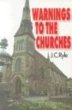
Book Review: “Warnings to the Churches” by John Charles Ryle.

warnings-to-the-churches I read this book a couple years ago and found it to be an incredible warning to the churches. It also was part of several things God used to draw me out of the lukewarm, mile-wide, inch-deep “churches” that I was attending.

The back of the book sums it up succinctly:

Some of Ryle’s most pungent writings have hitherto tended to be lost in his larger volumes. This book brings together eight addresses with a common theme. Together they sound a prophetic and much needed warning to the churches.

I stumbled across this book by accident (divine providence) on Ebay. I believe this book is currently out of print but you can purchase it here on Amazon, and you can get its modern edition entitled Churches Beware here on Amazon.

If you can find yourself a copy, I strongly recommend you get it. This 171 page volume is a must-have for all Ryle fans and those who are dissatisfied with the current shameful state of the Church.

Here’s one review from Amazon:


5.0 out of 5 stars Churches Beware, Indeed!, August 4, 2007

Outstanding teaching from an old source, demonstrating the need for discernment in the Church today. Ryle tells us how we can avoid false teachings, by not even accepting a little error any more than we would accept a little poison. Well worth the reading for discerning Christians.

Quotes (499)

ryle.jpg To say that reunion with Rome would be an insult to our martyred Reformers is a very light thing; it is far more than this: it would be sin and an offense against God!

– J.C. Ryle

1816 – 1900

Quotes (468)

At our best we shall find in ourselves daily cause for humiliation, and discover that we are needy debtors to mercy and grace every hour. The more light we have, the more we shall see our own imperfection. Sinners we were when we began, sinners we shall find ourselves as we go on; renewed, pardoned, justified—yet sinners to the very last.


– J.C. Ryle

1816 – 1900

Quotes (442)

ryle.jpg While some are satisfied with a miserably low degree of attainment, and others are not ashamed to live on without any holiness at all—content with a mere round of churchgoing and chapel-going, but never getting on, like a horse in a mill—let us stand fast in the old paths, follow after eminent holiness ourselves, and recommend it boldly to others.

– J.C. Ryle

1816 – 1900

Quotes (415)

ryle.jpg Many, it may be feared, appear moved and touched and roused under the preaching of the gospel, while in reality their hearts are not changed at all. A kind of animal excitement from the contagion of seeing others weeping, rejoicing, or affected is the true account of their case. . . . Reaction, after false religious excitement, is a most deadly disease of [the] soul.

– J.C. Ryle

1816 – 1900

Quotes (412)

ryle.jpg What could an unsanctified man do in Heaven, if by any chance he got there? . . . No man can possibly be happy in a place where he is not in his element, and where all around him is not congenial to his tastes, habits, and character. When an eagle is happy in an iron cage, when a sheep is happy in the water, when an owl is happy in the blaze of the noonday sun, when a fish is happy on the dry land—then, and not till then, will I admit that the unsanctified man could be happy in Heaven.

– J.C. Ryle

1816 – 1900

Quotes (396)

ryle.jpg Sanctification, again, is a thing which does not prevent a man having a great deal of inward spiritual conflict. By conflict I mean struggle within the heart between the old nature and the new, the flesh and the spirit, which are to be found together in every believer. . . . A true Christian is one who has not only peace of conscience, but war within. He may be known by his warfare as well as by his peace.

– J. C. Ryle

1816 – 1900