Sermon of the week: “A Discerning Family” by Akash Sant Singh.

Your sermon of the week is A Discerning Family by Akash Sant Singh. This is another fantastic sermon as Akash delves into 1 Thessalonians 5:19-22, covering such subjects as:
– Do not despise prophecies.

– Test everything.

– Hold fast to what is good.

– Abstain from every form of evil.

Akash covers such topics as what prophecy is and who prophets are, and what the ultimate goal is for those exercising discernment.

This is a message I recommend to DefCon readers and contributors.


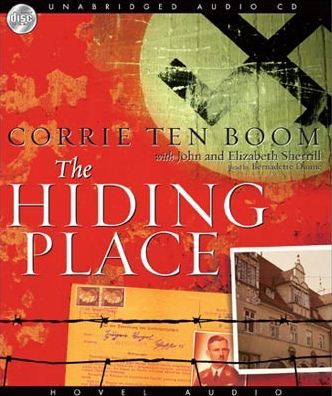
Book recommendation: “The Hiding Place” by Corrie Ten Boom.

I recently finished Corrie Ten Boom’s The Hiding Place (the audiobook version) and was left shaken.

From the depths of human depravity to the heights of human compassion, the love of God and the gospel of Christ permeates our fallen world but we oftentimes fail to see it until we are under intense suffering (and even then we often miss it).

This book is bursting at the seams with biblical truths. One example is when Corrie refuses to accept her sister Betsie’s admonition from 1 Thessalonians 5 (to give thanks in all things) when it came to the fleas infesting their prison camp barracks. Corrie simply could find no reason to be thankful to God for the biting insects. That was until she discovered that the Nazi guards refused to step into their barracks because of the fleas, providing them the ability to hold daily Bible studies with the other prisoners without fear of being discovered.

The fact that this book is a true story makes it even more powerful. I was moved by it and enjoyed it even more than The Diary of Anne Frank. I highly recommend The Hiding Place and it is now on my required reading list for my children.

My only regret is that I never read this book earlier in my life.

Quotes (908)

voddie-baucham How does a mother build biblical truth into her daughter’s life, nurture her, guard her, and encourage her toward the application of that truth, then send her into an environment that will oftentimes by its very nature be hostile or at least ambivalent toward that truth? How does a father raise his son to respect young women and protect their purity only to send them off to the youth building with exposed midriffs, low-cut tops, and skin-tight jeans?

– Voddie Baucham

Too little too late.

Why is it that today’s “prophets” always tell you about their visions after the events occur and never before? In the following case, Jim Bakker tells viewers on August 12, 2011, that he predicted 9/11.

He was only a decade late in mentioning it.

HT: Slaughter of the Sheep

Quotes (907)

  Christ’s death is the Christian’s life. Christ’s cross is the Christian’s title to heaven. Christ “lifted up” and put to shame on Calvary is the ladder by which Christians “enter into the holiest,” and are at length landed in glory. It is true that we are sinners–but Christ has suffered for us. It is true that we deserve death–but Christ has died for us. It is true that we are guilty debtors–but Christ has paid our debts with His own blood. This is the real Gospel! This is the good news! On this let us lean while we live. To this let us cling when we die. Christ has been “lifted up” on the cross, and has thrown open the gates of heaven to all believers.
– J. C. Ryle

1816 – 1900

HT: JC Ryle Quotes

Sermon of the week: “Reforming Modern Youth Evangelism and Discipleship” by Paul Washer.

Paul Washer pulls no punches as he exhorts the church to evangelize youth the biblical way. Some of the things Washer says in this sermon, Reforming Modern Youth Evangelism and Discipleship, may surprise you.

I encourage all youth evangelists, preachers, and pastors to listen to this message with an open mind; leaving your preconceived notions about youth ministry (and youth ministry abolitionists) at the door.

Where have I read that before?

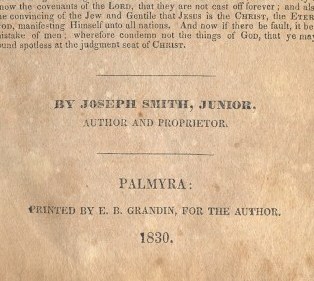
The origin of the Book of Mormon is a fascinating subject as there is clear evidence that its source was not divine, but was actually conjured up in the imagination of Joseph Smith, inspired by similar stories circulating around his time.

It’s precisely because the Book of Mormon was drafted by Joseph Smith (a “poor farm boy” as Mormons like to refer to him) and not divinely inspired, that we’re not surprised to see the almost 4,000 changes, alterations, and corrections to the Book of Mormon since its first publication.

And it doesn’t shock us that many parts of the Book of Mormon are simply plagiarisms from the King James Version of the Bible, including the use of King James English long before there was King James English (just one of the many anachronisms found in the Book of Mormon).

And we’re not stunned that absolutely none of the huge cities and civilizations described in the Book of Mormon have ever been found.

And we’re not astounded that there’s no historical, archeological, or anthropological support for the claims of the Book of Mormon.

And we aren’t astonished that DNA science has actually proven the claims of the Book of Mormon to be false.

And we aren’t beside ourselves that there’s not even one ancient manuscript to support the validity of the Book of Mormon (like the over 25,000 ancient manuscripts that support the Bible). 

These are some of the many problems that we’d expect to see from a book created by finite man, not from an inspired work by an infinite God.

So where did this “poor farm boy” get his ideas and inspiration for the Book of Mormon?

Continue reading

The stranger.

The Stranger

(Author Unknown)

A few months before I was born, my dad met a stranger who was new to our small town. From the beginning, dad was fascinated with this enchanting newcomer, and soon invited him to live with our family. The stranger was quickly accepted and was around to welcome me into the world a few months later.

As I grew up I never questioned his place in our family. Mom taught me to love the word of God, and dad taught me to obey it. But the stranger was our storyteller. He could weave the most fascinating tales. Adventures, mysteries and comedies were daily conversations. He could hold our whole family spell-bound for hours each evening.

If I wanted to know about politics, history, or science, he knew it all. He knew about the past, understood the present, and seemingly could predict the future. The pictures he could draw were so life like that I would often laugh or cry as I watched.

He was like a friend to the whole family. He took Dad, Bill and me to our first football game. He was always encouraging us to see the movies and he even made arrangements to introduce us to several movie stars.

The stranger was an incessant talker. Dad didn’ t seem to mind but sometimes mom would quietly get up while the rest of us were enthralled with one of his stories of faraway places and go to her room, read her Bible and pray. I wonder now if she ever prayed that the stranger would leave.

You see, my dad ruled our household with certain moral convictions. But this stranger never felt obligation to honor them. Profanity, for example, was not allowed in our house–not  from us, from our friends, or adults. Our longtime visitor, however, used occasional four letter words that burned my ears and made dad squirm. To my knowledge the stranger was never confronted. My dad was a teetotaler who didn’t permit alcohol in his home–not even for cooking. But the stranger felt like we needed exposure and enlightened us to other ways of life. He offered us beer and other alcoholic beverages often.

He made cigarettes look tasty, cigars manly, and pipes distinguished. He talked freely (too much too freely) about sex. His comments were sometimes blatant, sometimes suggestive, and generally embarrassing. I know now that my early concepts of the man-woman relationship were influenced by the stranger.

As I look back, I believe it was the grace of God that the stranger did not influence us more. Time after time he opposed the values of my parents. Yet he was seldom rebuked and never asked to leave.

More than thirty years have passed since the stranger moved in with the young family on Morningside Drive. He is not nearly so intriguing to my Dad as he was in those early years. But if I were to walk into my parents home today, you would still see him sitting over in a corner, waiting for someone to listen to him talk and watch him draw his pictures.

His name?…..We always just called him…TV

See also The Stranger sermon by Pastor Tim Conway.

Sermon of the week: “The Rich Man and Lazarus” by John MacArthur.

Your sermon of the week is on the subject of Hell in the sobering message The Rich Man and Lazarus by John MacArthur.

This sermon is a follow-up to this previous message by MacArthur. I encourage you to listen to them both.

Christian Book Distributors now selling the Koran.

If you want to purchase the Islamic Koran you can now turn to the nation’s leading Christian bookselling website. That’s right, you can now buy the Koran from Christian Book Distributors (CBD).

And CBD is even encouraging the mass distribution of this book (that fuels the terrorism that’s raging around the world and which calls for Jews and Christians to be put to death) by offering a discount of fifty cents per Koran if you order forty or more.

Isn’t this like selling your axe to the executioner as you’re laying your head on the chopping block?

CBD also offers Introducing the Qur’an: For Today’s Reader and Islam: A Short Guide to the Faith

The pied pipers of Universalism (and those wishing to eradicate Christians from the face of the earth) get one more voice of solidarity and support from within our own camp.

 I suppose there’s no better time to revisit two questions I posed back in 2008: Are Christian bookstore owners responsible for what they sell? and Do you support your local Christian bookstore?

A visit to a megachurch.

Here’s an article by Chris Dunn on his recent experience of visiting a megachurch.

It’s not pretty.

Last Sunday I went to a megachurch.  Normally I attend small churches with a gathering of local believers who strive to live according to the Bible.

Having already attended countless churches from many denominations and faiths, I was eager to see what the average parishioner experienced at one of these stadium-sized complexes.

It was horrific.  Megachurches like this one can have almost nothing to do with biblical Christianity and may actually do violence to the ‘Word of God.’

Continue the article from Collegiate Times here.

HT: The Cross and the Lamb

Sermon of the week: “The Sufficiency of Scripture and the Gospel” by Paul Washer.

We who home educate, oppose youth ministries, believe Christians should dress modestly, etc. are often accused of believing this way of life makes one a Christian and makes one holy. And of course, we deny those baseless charges of “legalism” but nevertheless, the accusations are still hurled at us.

This is why I’m pleased to present this Thursday’s sermon of the week entitled The Sufficiency of Scripture and the Gospel. Paul Washer (a home education proponent and youth ministry abolitionist himself) proves that not everyone in this camp is a legalist, and to those in this camp who may tend to lean that way, he does for them in this sermon as he did for the lukewarm in his famous Shocking Sermon from 2003 (found here).

Paul Washer addresses the notion that these wonderful family oriented ideals (along with manners, modesty, etc.), albeit beautiful and virtuous and good, they in and of themselves do nothing to save a man’s soul. And he did this at a conference sponsored by the National Center for Family Integrated Churches.

This is classic Paul Washer.

Quotes (905)

 Never are men’s hearts in such a hopeless condition, as when they are not sensible of their own sins. He that would not make shipwreck on this rock, must beware of measuring himself by his neighbors. What does it signify that we are more moral than other men? We are all vile and imperfect in the sight of God. “If we contend with Him, we cannot answer him one in a thousand” (Job 9:3). Let us remember this. In all our self-examination let us not try ourselves by comparison with the standard of men. Let us look at nothing but the requirements of God. He that acts on this principle will never be a Pharisee.

– J. C. Ryle

1816 – 1900

HT: JC Ryle Quotes

Sermon of the week: “How Can God Love Sinners?” by Akash Sant Singh.

The glorious doctrine of propitiation is the subject of your sermon of the week, How Can God Love Sinners? by Akash Sant Singh.

In this evangelistic-minded message that you don;t want to miss, Pastor Akash expounds on what propitiation is and does:

1. Propitiation is a sacrifice.

2. Propitiation averts God’s wrath.

3. Propitiation expiates our sin.

4. Propitiation cancels our guilt.

It’s the same thing.

Not one to shy away from controversy, I present the following short video that I can only describe as sobering, shocking, and disturbing. This video depicts one of the arguments I’ve made for years in the abortion debate, and now that argument is effectively visual.

I wholeheartedly believe this video needs to be seen (truth should never be hidden), but I strongly urge caution for younger viewers. It’s one of the most powerful videos I’ve seen in quite a while (first viewing left me speechless, second viewing brought me to tears). Its impact will leave you shaken.

Viewer Discretion is Advised

HT: Hope For the Helpless

College conspiracy.

Many have lamented the perils of sending kids to liberal, anti-theist colleges (and rightly so), but the following video opposes sending kids to college for entirely different reasons (the same reasons John Stossel discusses in his article The College Scam). Even though these reasons are secular in nature, they’re still very eye-opening.