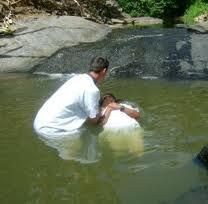
Did the Lord’s Churches Baptize by Immersion Before the 17th Century?

Did the Lord’s Churches Baptize by Immersion Before the 17th Century?

By Thomas WilliamsonBaptism

http://thomaswilliamson.net/

All correspondence concerning this article should be directed to
Thomas Williamson, 3131 S. Archer Avenue, Chicago, Illinois 60608.

The owner of the copyright on this article hereby waives all copyright protections for all English and Spanish articles posted on this site, and gives permission for them to be reprinted or reproduced in any form, in whole or in part, including print media and Internet, as long as the wording is not changed and credit is given for authorship.


In most Protestant and denominational Baptist colleges and seminaries today, it is commonly taught in the Church History departments that there were no churches on earth that baptized by immersion prior to the 17th Century.

This is just another way of saying that there were no Baptist churches and no true New Testament churches prior to the 17th Century. Supposedly, at some point in the Middle Ages, all true churches vanished from the face of the earth. and the institution of the local church had to be restored later.

As BMA Baptists, we have never accepted such teaching. Point 17 of the 1950 BMA Doctrinal Statement affirmed belief in the “Perpetuity of Missionary Baptist Churches from Christ’s day on earth until His second coming.” This means that there have always been true churches on earth, baptizing by immersion, for the last 20 centuries.

Section 10. C. of the 1988 BMA Doctrinal Statement reads: “The Perpetuity of the Church Instituted by Jesus during His personal ministry on earth (Matt. 16:18, Mark 3:13-19; John 1:35-51), true churches have continued to the present and will continue until Jesus returns (Matt. 16:18, 28:20).”

However, in the last century, some church history scholars have come to the conclusion that the Anabaptists and other evangelical groups prior to the 17th Century baptized exclusively by pouring rather than by immersion, which would mean that those “churches” were not true churches. (Section 10. D. of our Doctrinal Statement requires baptism by immersion).

Some scholars have even pointed to the year 1641 as the date when Baptists recovered the apostolic practice of immersion, stating that Baptists and all other evangelical groups baptized only by pouring prior to that date.

If these scholars are correct, then our BMA Doctrinal Statement is mistaken, and our traditional belief in the perpetuity of the church is also mistaken.

So which is it?

To prove that no one, through the Middle Ages up to 1641, baptized by immersion, would be extremely difficult, requiring a degree of omniscience possessed only by God Himself. But if we can show that there were at least some evangelical groups that were immersing prior to 1641, then we will have successfully defended our conviction that there have always been true churches on earth, and that the gates of hell have not prevailed against the institution of the Lord’s Church.

The notion that there was no baptism by immersion before 1641 can be quickly disposed of. In 1614 (27 years earlier), Leonard Busher, a Baptist of London. in a petition to King James I, stated that Christ “commanded” those who “willingly and gladly” received “the word of salvation to be baptized in the water, that is, dipped for dead in the water.” (Armitage, History of the Baptists, p. 440).

In 1644. Dr. Featley, an opponent of the Baptists, complained that “They flock in great multitudes to their Jordans, and both sexes enter the river, and are dipt after their manner…. This venomous serpent … is the Anabaptist, who, in these latter times, first showed his shining head, and speckled skin, and thrust out his sting near the place of my residence, for more than 20 years.” (Armitage. p. 441), In other words. Baptists were immersing near Dr. Featley’s home prior to 1624. There is no hint that this was a totally new practice among Baptists, only that they started using a stream near Featley’s home around 1624.

In 1656, Henry Denne, a Baptist, defended the practice of immersion by reminding Anglicans that immersion was the ancient practice of their church: “Dipping of infants was not only commanded by the Church of England. but also generally practiced in the Church of England till the year 1606; yea, in some places it was practiced until the year 1641, until the fashion altered…” (Armitage, p. 443).

In the Roman Catholic Church, most baptisms were by immersion until the 14th Century: “Thomas Aquinas, the chief of the schoolmen, who flourished about the year 1250, says, in his theology, that while immersion is not essential to the validity of baptism, still, as the old and common usage, it is more commendable and safer than pouring.” (Everts, The Church in the Wilderness, p. 37).

The 19th Century German Catholic scholar Doellinger stated that “Baptism by immersion continued to be the prevailing practice of the Church as late as the 14th Century.” (Graves, John’s Baptism, p. 207). Baptism by pouring, while occasionally practiced, was not sanctioned by the Roman Catholic Church until the Council of Ravenna in 1311. “Synods, as late as the synod of Tarragona, 1391, spoke of the submersion of children in baptism.” (Schaff, History of the Christian Church, v. 5, p. 712).

“It is equally clear that the form of baptism was immersion. This was at the time, the practice of the whole Christian world. The great Roman Catholic writers affirm that immersion was the proper form of baptism. Peter the Lombard, who died A.D. 1164, declared without qualification for it as the proper act of baptism.” (Christian, History of the Baptists, vol. 1, p. 81).

The Catholic Encyclopedia, in its article on “Baptism,” says, “The most ancient form usually employed was unquestionably immersion. This is. . . evident from the writings of the Fathers and the early rituals of both the Latin and Oriental churches…. In the Latin Church, immersion seems to have prevailed until the 12th Century. After that time it is found in some places even as late as the 16th Century.”

St. Jerome, early 5th Century, taught that “we are thrice dipped in the water” and Pope Leo the Great. in the 5th Century. wrote: “The trine immersion is an imitation of the 3 days’ burial” while Pope Gregory the Great in the following century stated that “The reason why we use 3 immersions at Rome is to signify the mystery of Christ’s 3 days’ burial.” (Cramp, Baptist History, p. 35).

Tertullian, in the 3rd Century. described the rite of baptism in detail, showing that it was done by immersion at that time. Martin Luther, 13 centuries later, taught that “baptism, in which the minister dips the child in the water, is a symbol of death and resurrection, and Luther therefore preferred total immersion.” (Latourette, History of Christianity, p. 713).

While Catholics, Episcopalians and other Protestants have, for the most part, abandoned the practice of immersion, the Eastern Orthodox Church has always baptized by immersion throughout its history, and still does so today.

St. John Chrysostom, Orthodox Bishop of Constantinople, baptized 3,000 new members by immersion on Easter Sunday, 404 AD. Chrysostom taught that “Baptism is an immersion, and then an emersion. When our heads enter the water as a tomb, the old man is buried, and plunging down is wholly concealed all at once.” (Graves. pp. 201. 203).

The 18th Century church historian Robert Robinson wrote about Baptists in the 5th Century. “At the beginning of the 5th Century, when infant baptism first came up, there were in Africa at least 400 hundred congregations of Anabaptists, called from Donatus, the name of 2 of their most eminent teachers, Donatists. . . . The Romans baptized by dipping on a profession of faith. The Donatists baptized by dipping on a proof of virtue accompanied with a general profession of Christianity; and as they thought the Romans had ceased to be Christian churches on account of their immorality, they did not hold their baptism valid, and they rebaptized every one that quitted the Roman communion to join theirs.” (Robinson, Ecclesiastical Researches, pp. 7-8). Note that according to Robinson, both the Donatists and the Roman Catholics were immersing at that time.

Through the Middle Ages, the Catholics and Orthodox were baptizing by immersion, yet we are expected to believe that there were no Baptists or evangelicals who baptized by immersion during this period! Where is the proof of this?

In 1590 the Italian Roman Catholic Cardinal and nephew of the Pope, Robert Bellarminc, wrote: “Ordinarily, baptism is performed by immersion, and that to represent the burial of Christ.” (Graves. p. 207). During the 16th Century, many Catholic, Lutheran and Anglican baptisms, and all Orthodox baptisms, were performed by immersion. It is very hard to believe that no Baptists or evangelicals were baptizing by immersion at that same time.

The Waldenses. who spread from their mountain strongholds of France and Italy into most regions of Europe, were Baptists who practiced immersion. “‘The Waldenses were Baptists in that they practiced only immersion. . . .,’ Mezeray says, ‘In the 12th Century they [Waldenses] plunged the candidate in the sacred font..'” (Jarrel, Baptist Perpetuity, pp. 162-163).

“The contemporary writers, Eberhard and Ermengard, in their work, ‘contra Waldenses’ written toward the close of the 12th Century, repeatedly refer to immersion as the form of baptism among the Waldenses.” (Christian, pp 81-82).

Concerning the 15th Century Bohemian Waldenses, Broadbent says. “One of the first things they (the Czech Brethren) did was to baptize those present, for the baptism of believers by immersion was common to the Waldenses and to most of the brethren in different parts, though it had been interrupted by pressure of persecution.” (Broadbent, The Pilgrim Church, p. 130).

“No historian has ever charged the ancient Waldenses with the practice of sprinkling and pouring for baptism. We may consider it a point generally admitted that the ancient Waldenses possessed the Baptist peculiarity of holding the burial in baptism of those who are dead to sin.” (Ray, The Baptist Succession, p.331).

Prior to the 17th Century, the Baptist practice of immersion was not brought up against them by their persecutors, because the Catholics and other denominations were also immersing at that time, so the mode of baptism was not a point of controversy.

An unbiased look at the historical evidence shows that our BMA confession of faith is correct in teaching Baptist perpetuity. The practice of baptism by immersion is certainly an essential element of Baptist perpetuity.

The purpose of citing the practices of other denominations is not to hint that they were the mother churches of the Baptists – they were not. Rather, it is to show how absurd it is to believe that there were no immersionist Baptists prior to the 17th Century, at a time when most other religious societies were baptizing by immersion.


Redemptive Historical Perspective

From Dispensationalism Today, Yesterday, and Tomorrow by Grover Gunn Scripture_cross

In Reformed interpretation, the unifying theme that is the key to understanding the development of redemptive history is the saving work of Jesus Christ. God created Adam and gave him the earth to rule and to subdue. Because of Adam’s fall into sin, the earth was cursed and man became a servant of sin and Satan. God immediately promised a coming Seed of woman who would overcome Satan and reverse the effects of the fall. The rest of redemptive history is the developing story of the restoration of fallen man’s earthly inheritance and authority through the work of the Seed Redeemer on behalf of His people. The theocracy of Old Testament Israel fits into this redemptive drama as a localized pledge and prefiguration of the coming perfect kingdom rule and everlasting earthly inheritance that the Christ will establish for His people and as the national means through which the Christ was brought into the world. Through the historical work of Jesus Christ, Satan was defeated and Jesus of Nazareth, who is fully man as well as fully God, was exalted to the place of all authority in heaven and on earth. In this age, Christ is exercising His authority, the nations are being discipled, and Christ’s universal rule over men is being extended to the uttermost parts of the earth. The drama of redemption will find its ultimate and final fulfillment in the glorified new earth of Revelation 21 after Christ returns.

Blasphemy in Song

For those who know the background or meaning of the Battle Hymn of the Republic, the following is a public service announcement.

Blasphemy in Song

by Laurence M. Vance
by Laurence M. Vance

This past weekend, since it was the closest weekend to the Fourth of July holiday that we observe today, churches all across America resounded with patriotic songs. Although the wisdom of singing patriotic songs in church is itself a debatable proposition, there should be no debate in any church about uttering words of blasphemy, whether spoken or sung. Yet, the patriotic song that is perhaps the one most frequently sung in the churches of America — for the Fourth of July or otherwise — is the “Battle Hymn of the Republic.” But this so-called hymn is no Christian hymn at all — it is blasphemy in song.

Most Americans are familiar with the words of this “hymn”:

Mine eyes have seen the glory of the coming of the Lord:
He is trampling out the vintage where the grapes of wrath are stored;
He hath loosed the fateful lightning of His terrible swift sword:
His truth is marching on.
Chorus
I have seen Him in the watch-fires of a hundred circling camps,
They have builded Him an altar in the evening dews and damps;
I can read His righteous sentence by the dim and flaring lamps:
His day is marching on.
Chorus
I have read a fiery gospel writ in burnished rows of steel:
“As ye deal with my contemners, so with you my grace shall deal;
Let the Hero, born of woman, crush the serpent with his heel,
Since God is marching on.”
Chorus
He has sounded forth the trumpet that shall never call retreat;
He is sifting out the hearts of men before His judgment-seat:
Oh, be swift, my soul, to answer Him! be jubilant, my feet!
Our God is marching on.
Chorus
In the beauty of the lilies Christ was born across the sea,
With a glory in his bosom that transfigures you and me:
As he died to make men holy, let us die to make men free,
While God is marching on.
Chorus
He is coming like the glory of the morning on the wave,
He is wisdom to the mighty, He is succour to the brave,
So the world shall be His footstool, and the soul of Time His slave,
Our God is marching on.
Chorus

The chorus is, of course, as follows:

Glory, glory, hallelujah!
His truth is marching on.

Although most Americans who are familiar with this “patriotic anthem” rightly connect it with the so-called Civil War, many probably don’t know who wrote it, and even fewer know anything about how it came about.

The author of the “Battle Hymn of the Republic” was the abolitionist and social activist, Julia Ward Howe (1819—1910). The song first appeared, minus the last verse, on the front cover of The Atlantic Monthly for February 1862. That it originally had six verses can be seen by looking at her first draft, which was written on a scrap of Sanitary Commission paper. Christian hymnbooks that contain this song only include verses one, two, four, and five. The words as it was first published are slightly different than her original draft, which is transcribed here.

The tune is from a camp-meeting song with a “Glory Hallelujah” refrain by William Steffe, written about 1856. This tune was in turn used for what became the Union marching song, “John Brown’s Body,” the first verse of which begins by repeating three times: “John Brown’s body lies a-mouldering in the grave,” and ends with: “His soul goes marching on!” Other lines read: “They will hang Jeff. Davis to a sour apple tree!” and “Now, three rousing cheers for the Union.”

Read the remainder of this article here.

Is the Mosaic law tripartite?


Is the Mosaic law tripartite?

By Maël

Introduction

During my last semester at SEBTS, I took a Christian Ethics class. It seems customary, when studying Christian ethics, to assume that the Mosaic law is tripartite, which means that the Old Testament law is assumed to be divided into three parts: moral, ceremonial, and civil/judicial. Following that assumption, the New Testament believer is to assume that the moral law is still valid in the believer’s life, while the last two parts have passed away with the coming of Christ.

The problem is that while ethicists often hold to this view, it seems that New Testament and Old Testament scholars do not agree with them. For example, R. T. France, in his commentary on Matthew, states:

It is sometimes suggested that Matt 5:17-20 is concerned only with the moral law, not with ceremonial and civil laws of the OT. But this convenient distinction of the law in three categories has no biblical basis, cannot be traced back earlier than the Middle Ages. Moreover, such a selective approach is difficult to square with Jesus’ insistence on the importance of the smallest details of the law (v. 18) and the ‘smallest commandments’ (v. 19).[1]

Hays states that the tripartite division of the law “suffers from three major weaknesses: It is arbitrary and without any textual support, it ignores the narrative context, and it fails to reflect the significant implications of the change from Old Covenant to New Covenant. This approach, therefore, is inadequate as a hermeneutic method for interpreting and applying the Law.”[2] Barrick bluntly states that “no one can justly separate the moral, civil, and ceremonial parts of the Law from each other: it is a unit.”[3] These are only a few of the objectors and of the objections to the tripartite division of the law.

In the next sets of posts, I will try to look at the validity of such a division of the law through a historical and theological approach. In the meantime, what are your thoughts? Is a tripartite division of the law valid?

[1] R. T. France, The Gospel of Matthew, NICNT (Grand Rapids: Eerdmans, 2007), 180n. Unfortunately, France does not document this statement.

[2] J. Daniel Hays, “Applying the Old Testament Law Today,” Bibliotheca Sacra 158 (Jan-Mar 2001): 30.

[3] William D. Barrick, “The Mosaic Covenant,” TMSJ 10/2 (Fall 1999): 213.


Historical Overview

As was mentioned in the previous post, according to R. T. France, evidence for such a tripartite division of the law “cannot be traced back earlier than the Middle Ages.”[1] However, there might be some evidence that at least a dichotomy between ceremonial works and the works of the law existed at the time of Jerome. According to Luther, Jerome had introduced “notable error and ignorance” in the understanding of Rom 3:19-20 when he suggested that Paul was here calling ceremonial works, works of the law.[2] A possible bipartite understanding of the law also could have existed at the time of Augustine, for Luther claimed that Augustine resisted Jerome,[3] and Aquinas stated that in Contra Faust, Augustine held “that in the Old Law there are ‘precepts concerning the life we have to lead, and precepts regarding the life that is foreshadowed.'” Aquinas then related these precepts to moral, ceremonial, and judicial principles by arguing that both moral and judicial principles fall under the “life we have to lead” category. [4]

Fast forwarding to the Middle Ages, in Summa Theologica, Thomas Aquinas himself discussed the law (which he referred to as precepts) and its three parts (moral, ceremonial, and judicial) in his section entitled “Treatise on the Law” and more specifically in questions 99-105. Of interest is the fact that in his writings, Aquinas did not just assume this partition of the law, he actually developed an argument for the existence of these three parts. A future post will deal with Aquinas’ position in detail, but now let us continue our historical overview.

Jumping to the time of the reformers, Luther seemed to accept at least a dualism of the law when, in The Bondage of the Will, he referred to “the civil or moral law.”[5] Calvin, in book two of Institutes of the Christian Religion, presented a bipartite view when he discussed the law, emphasizing the moral and ceremonial aspects of it,[6] but later, in book four of the Institutes, when he discussed civil government, he presented a clearly tripartite view of the law when he stated: “the well known division which distributes the whole law of God, as promulgated by Moses, into the moral, the ceremonial, and the judicial law.”[7] While Calvin did not present a logical defense of the tripartite division of the law as Aquinas did, his use of this tripartite division to justify the abrogation of only part of the law and his interactions with and citations of a variety of Scriptures are also of interest to the question at hand.

After the reformation, the tripartite division of the law seemed to slowly solidify as an accepted concept. Some still held, as John Owen stated in his Two Short Catechisms, that “the whole law [was] moral and ceremonial,” pointing to a bipartite view of the law,[8] but ultimately, the tripartite view was propagated and popularized by the Westminster Confession (1646), which was the basis for a variety of other confessions of faith, including the 1689 Baptist Confession of Faith. In the 1689 Baptist Confession, the tripartite division of the law is clearly seen in the chapter on the law of God (Ch. 19), where it reads: “besides this law, commonly called moral, God was pleased to give to the people of Israel ceremonial laws, containing several typical ordinances, partly of worship” and that “to them also he gave sundry judicial laws, which expired together with the state of that people.”[9] While the 1689 Baptist Confession did not provide an argument for its views, but simply stated the belief of its signatories, as is customary for confessions, it did however substantiate its articles with a variety of Scripture references which are also of interest to the quest at hand.

Looking at contemporary times, it is interesting to note that the Baptist tradition found in the 1689 confession has not survived in the Baptist Faith and Message 2000, where no mention of the tripartite law is made. Some current thoughts and discussions on the issue of the law and the gospel are summarized in Five Views on Law and Gospel, first published by Zondervan in 1993. In this book, the reader is presented with the following five views: the reformed perspective, the theonomic reformed approach, the evangelical (holiness code) approach, the dispensational view, and the modified Lutheran view.[10] The first three have to maintain that the law is at least bipartite, if not tripartite for their approach. The last two do not have to hold to any division of the law.

As we continue this discussion, we will next tackle Aquina’s arguments for a tripartite division of the law. In the meantime, do you know of any other historical figures that might have convincingly argued this position?

[1] R. T. France, The Gospel of Matthew, NICNT (Grand Rapids: Eerdmans, 2007), 180n. Unfortunately, France does not document this statement. Based on the research done, it is assumed that France’s reference to the Middle Ages is a reference to the work of Thomas Aquinas.

[2] Martin Luther The Bondage of the Will CXLIII. References to classical, medieval, and renaissance works will be cited as per section 17.5.1 of the 7th edition of Kate L. Turabian’s A Manual for Writers.

[3] Ibid.

[4] Thomas Aquinas Summa Theologica FS.Q99.A4.

[5] Luther Bondage CXLVI.

[6] John Calvin Institutes of the Christian Religion 2.7, 2.8.31.

[7] Ibid., 4.20.14.

[8] John Owen Two Short Catechisms XIV.Q2.

[9] Samuel E.Waldron, A Modern Exposition of the 1689 Baptist Confession of Faith, 3rd ed. (Webster: Evangelical Press, 1999), 232-33.

[10]Greg L.Bahnsen et al., Five Views on Law and Gospels (Grand Rapids: Zondervan, 1999), 5.


Analyzing Aquinas’ Arguments.

The question that now begs to be answered is: are the arguments given in favor of a tripartite law acceptable, after all, the mere fact that many have accepted this division as a fact since the Middle Ages does not justify its acceptance. Therefore, to understand if it is appropriate to divide the law into three parts, I will analyze the arguments offered by the proponents of such a perspective, starting with Aquinas.

In his six article approach to “Of the Precept of the Old Law” (Q99), Aquinas started by defending that the law is made up of many precepts and not of only one precept. He did so by pointing to the plural “ordinances” used by Paul in Eph 2:15 when he wrote about the law of commandments.[1] This point is well presented and defended. The only comment that can be made about this point is that he could be accused of using Eph 2:15 selectively to prove his point of multiple precepts while ignoring the implications of Eph 2:15 when it comes to the wholeness of the law. While the author would agree with Aquinas, that Scripture here refers to “ordinances” plural, the author would also agree with Hoehner, in his commentary on the book of Ephesians, when he points out that the “term o nomo” must refer to the whole Mosaic law and not just the ceremonial law as some suggest,” and as such, he argues that “it is a false dichotomy to distinguish between the moral and ceremonial laws, making only the ceremonial laws inoperative.”[2]

Aquinas then proceeded to point to the Decalogue to support his claim that the Old Law contains some moral precepts because moral precepts are necessary to make man become good, so that he can be in friendship with God who is supremely good. He thus argued that “it was necessary for the Old Law to include precepts about acts of virtue: and these are the moral precepts of the Law.” [3] As we saw in the previous post, some disagree with Aquinas about the statement that the Old Law contains only “some” moral precepts, but with that exception, one cannot fault his position just yet. Some discomfort is felt by the modern evangelical when Aquinas augmented his argument with a philosophical argument for the need of moral principles in the Old Law. To do so, he used the apocryphal book of Ecclesiasticus[4] to maintain that God cannot have a friendship with man “unless man become good.”[5] This latter argument can be seen as unnecessary, and its use of apocryphal literature makes it more suspicious to the modern evangelical. But, if one ignores this part of the argument, the claim that the Old Law contains moral precepts is a valid one.

Aquinas continued by seeking to prove that there are precepts which are not moral, but ceremonial. He did so by looking at Deut 4:13, 14, where Moses stated that God declared to Israel His covenant, that is the Ten Commandments, and that the LORD commanded Moses to teach the Israelites statutes and judgments, that they were to observe. Aquinas is translated here as using the phraseology “ceremonies and judgments,” instead of the NKJV’s terminology, “statutes and judgments,” and this is where he seems to get the term ceremonial law.[6] The Hebrew term used here is qx, which BDAG defines as “something prescribed, a statute or due,” or as an “enactment, decree, ordinance,” or a “law in general.”[7] This same term is used in the next chapter of Deuteronomy when the Decalogue is introduced with: “Hear, O Israel, the statutes and judgments which I speak in your hearing today, that you may learn them and be careful to observe them. … You shall have no other gods before Me ….” (Deut 5:1-7, NKJV, emphasis mine). Therefore Aquinas’ insistence on the use of qx as meaning ceremonies[8] is deemed not to be well founded since the Decalogue (the commands associated with the moral law according to Aquinas) are introduced with the same term that Aquinas wants to use to identify ceremonial laws. Frame, a proponent of the tripartite law, further furnishes a critique of Aquinas’ use of the ceremonial term when he writes,

It is misleading to define “ceremonial” etymologically as “laws pertaining to ceremonies.” Many of the laws commonly grouped under the “ceremonial” category, such as dietary laws [and] clothing laws, have nothing to do with “ceremonies.” And some laws having to do with ceremonies, such as the “regulative principle” and other doctrines concerning public worship, are commonly described as moral rather than ceremonial laws.[9]

It would therefore seem that Aquinas’ argument for the presence of ceremonial decrees is invalid on many fronts. In addition to this, when Aquinas replied to the objection[10] that “human actions are called moral, … therefore it seems that the Old Law given to men should not comprise other than moral precepts,” he simply answered that “human acts extend also to the Divine worship: and therefore the Old Law given to man contains precepts about these matters also.”[11] This is circular reasoning; instead of defending his statement that Divine worship is not a moral concept, he arbitrarily put it in a different category and then used its being in that category to justify the existence of that category. In this same section, Aquinas admitted in the reply to another objection that “to worship God, since it is an act of virtue, belongs to a moral precept,” but he then differentiated the worship of God from the precepts prescribing the worship of God, which are in themselves not moral, but ceremonial.[12] Here again, Aquinas seemed to change categories without substantial justification. He conveniently created a new category, but did not justify its existence.

Aquinas next proceeded to argue for judicial precepts by looking at Deut 6:1. Here he interpreted the words commandment, statutes, and judgments as referring to moral, ceremonial, and judicial law.[13] This is the same terminology used in Deut 4 and Deut 5 (as seen above) and Aquinas here used a similar weak reasoning with judicial precepts as he used above with moral precepts: he again conveniently created a new category, but did not justify its existence. In addition, he augmented his argument by pointing to Rom 7:12, “therefore the law is holy, and the commandment holy and just and good,” as additional substantiation of his tri-partition. Here he related “just” with the judicial precepts, “holy” with the ceremonial precepts, and “good” with the moral precepts.[14] Moo, in his commentary on Romans, does not allow for such an interpretation, for he says that “Paul brings together as essentially parallel terms ‘law’ and ‘commandment’; both referring to the Mosaic law, the former as a body, the latter in terms of specific commandments that Paul has cited in v. 7 as representative of the whole.”[15] If Moo is correct, then the term “holy,” associated with the entire law in the first part of the verse, cannot in the next breath refer only to ceremonial laws, as Aquinas purported it does. Here again, Aquinas admitted that the “act of justice, in general, belongs to the moral precepts,” but then, in a similar manner as with ceremonial precepts, he differentiated between the determination of the acts and the acts themselves, concluding that the determination of the acts belongs to the category of judicial precepts.[16] Just as with ceremonial acts, it must be stated that this change of category is not substantiated. Ultimately, it is very interesting that Aquinas himself agreed that the ceremonial and judicial precepts have their basis in the moral law, and yet he worked very hard to separate them into different categories from the moral law.

Aquinas finished his defense of the tripartite law with his fifth article, in which he investigated the possibility of the presence of a fourth division of the law. His arguments against a fourth division are similar to the ones made above and do not add much to the discussion of this blog series. Some more discussion is found in questions 100-108 of the Summa. In these questions, Aquinas continued to develop his ideas about the tripartite law and specifically postulates arguments on the duration of each kind of precept. Aquinas believed that “the precepts of the Decalogue cannot be changed by dispensation,”[17] and yet he also believed that when Christ came, a change had to have happened in the law for, according to Aquinas: the New Testament law is different from the Old Testament law;[18] “the judicial precepts are no longer in force”;[19] and that “the Old Law is said to be ‘for ever’ simply and absolutely, as regards its moral precepts; but as regards the ceremonial precepts it lasts for ever in respect of the reality which those ceremonies foreshadowed.”[20]

In the next post, I will look at Calvin and his defense of a tripartite law. In the meantime, what do y’all think. Are Aquinas’ arguments valid? Am I being too severe with him? Did I miss something?

[1] Aquinas Summa FS.Q99.A1.

[2] Harold W. Hoehner, Ephesians – An Exegetical Commentary (Grand Rapids: Baker, 2002), 375-6.

[3] Aquinas Summa FS.Q99.A2.

[4] Aquinas referred to Ecclesiasticus almost 250 times in his Summa, often using the introduction “it is written.”

[5] Aquinas Summa FS.Q99.A2.

[6] Ibid., FS.Q99.A3.

[7] Francis Brown, S. R. Driver, and Charles A. Briggs, The Brow-Drivers-Briggs Hebrew and English Lexicon (Peabody, MA: Hendrickson, 2004), 349. The author takes this occasion to point out that he is not a Hebrew scholar, and therefore some of the nuances of the language might have escaped him as he makes arguments based on the Hebrew text.

[8] It should be noted that the insistence on the word ceremonial which transpires in the English translation, might, or might not be as strong in the original Latin, but no matter what term was used in the original, it is hoped that the translators represented Aquinas’ ideas correctly, as it is with these ideas that the author is interacting.

[9] John M. Frame, “Toward a Theology of the State,” Westminster Theological Journal 51 no 2 (Fall 1989): 204n.

[10] The format of the Summa starts with a series of objections to his article, followed by the defense of his article and answers to the objections aforementioned.

[11] Aquinas Summa FS.Q99.A3.

[12] Ibid.

[13] Ibid., FS.Q99.A4.

[14] Ibid.

[15] Douglas Moo, The Epistle to the Romans, NICNT (Grand Rapids: Eerdmans, 1996), 440.

[16] Aquinas Summa FS.Q99.A4.

[17] Ibid., FS.Q100.A8.

[18] Ibid., FS.Q107.A1.

[19] Ibid., FS.Q104.A3.

[20] Ibid., FS.Q103.A3.


Analyzing Calvin’s Arguments.

As for Calvin, he stated that he gathered his tripartite view of the law from the “ancients who adopted this division, though they were not unaware that the two latter classes [judicial and ceremonial laws] had to do with morals.”[1] Therefore, like Aquinas, Calvin admitted that the laws which he called ceremonial and judicial had to do with morals, even so he, like Aquinas, adopted, defined, and used different categories for them. Unlike Aquinas, who tried to justify his reasoning through logic and some Scriptural exegesis, Calvin seemed to have relied on the wisdom of the ancients. It is of interest to note that Calvin did not say that the ancients justified this tripartite division of the law with solid Biblical arguments, but only that they “did not give them the name of moral, because they might be changed and abrogated without affecting morals.”[2] It is almost as if he assumed that the motivation of the ancients was derived by a need to fit their purpose, instead of being derived by the clear teaching of Scripture. Since this abrogation pattern is clear in Aquinas, could it be that Calvin suggested that this tension between the Decalogue’s not being changed and the changing work of Christ was the motivation for Aquinas’ arguments trying to justify a tripartite law? Possibly, but we have no proof of it.

In Calvin’s theology, the law ultimately was divided as follows:

The moral law, … is the true and eternal rule of righteousness prescribed to the men of all nations and of all times, who would frame their life agreeably to the will of God. … The ceremonial law of the Jews was a tutelage by which the Lord was pleased to exercise, as it were, the childhood of that people, until the fullness of the time should come when he was fully to manifest his wisdom to the world, and exhibit the reality of those things which were then adumbrated by figures (Gal. 3:24; 4:4). The judicial law, given them as a kind of polity, delivered certain forms of equity and justice, by which they might live together innocently and quietly. And as that exercise in ceremonies properly pertained to the doctrine of piety, inasmuch as it kept the Jewish Church in the worship and religion of God, yet was still distinguishable from piety itself, so the judicial form, though it looked only to the best method of preserving that charity which is enjoined by the eternal law of God, was still something distinct from the precept of love itself. Therefore, as ceremonies might be abrogated without at all interfering with piety, so, also, when these judicial arrangements are removed, the duties and precepts of charity can still remain perpetual.”[3]

Therefore the moral law found in the Decalogue is timeless, but the ceremonial law and the judicial law are not. In this description, Calvin quotes Gal 3:24 as a supporting Scripture for his treatment of the ceremonial law. This passage, which in the letter to the Galatians comes at the end of a section on the purpose of the law, states: “Therefore the law was our tutor to bring us to Christ, that we might be justified by faith” (Gal 3:24 NKJV). It is hard to envision that this passage, written to a predominantly gentile church, was referring only to the Jewish nation, as Calvin would have it seem.[4] Also, the context of the passage does not seem to allow for a purely ceremonial understanding of “the law,” but to a more holistic understanding of the law. Therefore it is hard to agree with Calvin’s definition of the ceremonial law based on this passage. As a matter of fact, if this passage is read in light of verse 25, where Paul writes: “But after faith has come, we are no longer under a tutor” (Gal 3:25 NKJV), one could understand this section of Scripture as arguing for a view where we are no longer under a tutor for the “whole” law, and therefore one does not need to hold to a tripartite division of the law.

In the next post, I will look at some more modern uses of the tripartite law, and their justification, or lack there of, for using it. In the meantime, if you are better acquainted with Calvin and his writings, do you know of anywhere else where Calvin does a better job of defending the tripartite division of the law?

[1] Calvin Institutes 4.20.14.

[2] Ibid.

[3] Ibid., 4.20.15 (emphasis mine).

[4] In all fairness, one must at least consider the possibility that Paul here could have been using the term “we” to refer to his Jewish heritage rather than to him and his audience. While this interpretation would be more in line with Calvin’s thought, it does not seem to square with the general sense of the passage and the specific use of “all” in verse 22.


Two More Historical Views.

To finish the historical analysis, I would like to look at two more instances: the 1689 Baptist Confession and a recent book on the topic.

Looking at the 1689 Baptist Confession, we see again that like Calvin and Aquinas, the authors of the confession related ceremonial laws with moral duties when they stated: “ceremonial laws [which] … also gave instructions about various moral duties.”[1] But, basing themselves most probably on the thoughts of Calvin, they also used these created categories. Since this is a confession of faith, as stated above, we should not expect to have a defense of the tripartite division of the law; instead we have Scripture references listed in support of their statement. In support of the ceremonial law, the following Scriptures are cited: Heb 10:1, Col 2:16-7, Eph 2:14-6. Yet again, the understanding of these Scripture hinges on the use of the terms for the law. As mentioned before by Moo and Hoehner, there is little to no indication that these are referring only to ceremonial laws, and therefore are deemed not to be sustentative proof for a tripartite division of such laws.

When reading modern theologians of the reform variety, the tripartite division of the law is also often assumed and rarely explained. In his presentation of the reformed perspective in the Five Views on Law and Gospel book, VanGemeren assumes the traditional tripartite division of the law when he states: “The laws of the Old Testament have also been commonly categorized as moral, ceremonial, and civil. Each one of the Ten Commandments expresses the moral law of God, whereas most laws in the Pentateuch regulate the rituals and ceremonies (ceremonial laws) and the civil life of Israel as a nation (civil laws).”[2] What VanGemeren fails to do, is to defend his view Biblically. Instead, he points to Calvin and the Westminster Confession, who themselves had accepted the tripartite view from earlier sources. This deserved Moo’s criticism that VanGemeren assumed his tripartite position “without arguing the case. [Even though] this distinction, vital to his whole argument, is nowhere clearly stated in the Bible.”[3]

In the next post I will start looking at generic arguments for flaws in the tripartite assumption. In the meantime, do you know of anybody else who tries to defend the tripartite division of the law?

[1] Samuel E.Waldron, A Modern Exposition of the 1689 Baptist Confession of Faith, 3rd ed. (Webster: Evangelical Press, 1999), 232-3.

[2] Greg L.Bahnsen et al., Five Views on Law and Gospels (Grand Rapids: Zondervan, 1999), 30.

[3] Ibid., 85. To be fair to VanGemeren, it seems very common for modern reformed theologians to rely on the formulations of Calvin and the Westminster Confession.


Generic Arguments for Flaws in the Tripartite Assumption.

Having interacted with some of the main proponents of the tripartite division of the law throughout history, and having interacted with some of their thoughts, we shall now entertain generic arguments for flaws in the tripartite assumption. As seen already, the tripartite approach is often accused of being arbitrary in its identification of the various categories of laws. This is because, by their own admission, the different precepts/law categories are not neatly divided, but intertwined. For example, reformed theologian Willem A. VanGemeren states,

The book of the Covenant (Ex. 20:22-23:33) – with its regulations for worship (20:22-26; 23:14-19) and its civil laws (21:1-23:13) – extends the Decalogue in three directions. First, there is the complex development of case law. … Second, the criminal laws specify the penalty for breaking the commandments. … Third, the book of the covenant reveals the complexity of Israelite law. The moral laws (i.e., those reflected in the Decalogue) are intertwined with the civil laws, penal code, and ceremonial laws.[1]

To demonstrate this, he then proceeds to use Ex 22:19-29 as an example. In this passage, he shows that the topics covered vary from moral precepts, to penal precepts, to casuistic/civil precepts, back to moral precepts, and finally to ceremonial precepts, all intertwined in one passage. Reformed Professor John M. Frame is even more candid in his admission that the division between the supposed three parts of the law is not cut and dry. He tells us,

The law does not, of course, come to us with the labels “moral,” “ceremonial” and “civil” attached to its provisions. What we call “moral” laws are mixed together in the texts (almost randomly, it seems) with “civil” and “ceremonial” laws, and we must sort them out by determining their meaning and current applicability. Those that apply most literally today we call “moral,” those which apply least literally we call “ceremonial.” “Civil” is a different kind of category, based not on applicability but upon function, and these would be divided between “ceremonial” and “moral” depending on their applicability. Remember too, that literal and non-literal applicability is a matter of degree, so we may expect some “gray areas,” some laws that do not fit neatly into either “ceremonial” or “moral” categories.[2]

His sorting process is quite different from the traditional assumption that only the Decalogue is the depository of moral laws, and after reading his decision making process, one is left to wonder if “applicability” is really a Biblical identification of morality. As can be seen, the lack of clear distinction between the three parts of the law does point to a lack of credibility for the tripartite division of the law.

Barrick picks up on this and stipulates that the,

Division into three categories of law is unmasked as a fallacy by the testimony of the Book of Deuteronomy alone. Moses’s second exposition (4:44—26:19) presented the Decalogue and then illustrated each of the Ten Commandments by means of various legal stipulations. Such an arrangement demonstrates that the so-called civil and ceremonial stipulations are inextricably interwoven with what are considered to be the moral laws. Violation of any of the stipulations is a breach of the Decalogue.[3]

Another Old Testament text that does not square with the tripartite division of the law is Jer 31:31-2. Here God states that “Behold, the days are coming, says the LORD, when I will make a new covenant with the house of Israel and with the house of Judah– not according to the covenant that I made with their fathers in the day that I took them by the hand to lead them out of the land of Egypt, My covenant which they broke, though I was a husband to them, says the LORD” (Jer 31:31-2 NKJV). If God has made a New Covenant which is not like the covenant at Sinai, is it acceptable for us to say that only parts of the Old Covenant have changed? There is nothing in this passage that allows the reader to accept that this is a renewal of the Old Covenant. After all, the term used here has a primary definition of “new,” not “renew,” and the text speaks of a New Covenant, not like the Old Covenant. It is hard to imagine that this would imply any kind of continuity with the Old Covenant. There is also nothing which substantiates the Calvinistic position that this is a reformatting of the Old Covenant, or even that it is a hyperbolic statement, for again, the promise is of a New Covenant, not just a new medium.[4] Adeyemi also points out that “since the Old Covenant will be abolished, so will its Torah which cannot be divorced from it. … This view accords with several statements in Isaiah about a Torah other than the Mosaic Law being given by Yahweh when Israel is in her land and Messiah is reigning.”[5]

Both Moo and Strickland also offer the Sabbath commandment as an exemplary test case of the abrogation of the Decalogue, and therefore as proof that if the Decalogue is the depository of God’s immutable moral law, then even the moral law has changed. The argument goes like this: reformed theologians claim that the Decalogue is the eternal moral law. If that is the case, then all of the Ten Commandments should still be valid for New Testament believers. But the fifth commandment states that rest should be pursued on the seventh day, and since it is in the Decalogue, the lack of observance of the Sabbath in this way is a moral matter. Believers, including ones in the reformed tradition, have been meeting on the first day of the week since New Testament times, because it is sanctioned in the New Testament. Does that then mean that the eternal moral precepts are subject to revision and that God’s nature has changed?[6] Aquinas would not agree that God’s nature has changed,[7] neither would Calvin,[8] and most probably, neither would modern reformed theologians.

Finally, looking at the use of the law in the New Testament, Moo argues that “Jesus and the New Testament authors treated the Mosaic law as a whole,” and that “Jewish theology refused to allow a ‘picking and choosing’ among the commandments of the law.” He also argues, by looking at Matt 23:23, that even though Jesus possibly followed a Jewish tradition of categorizing the law, he insisted that “even the ‘light’ commandments still must be done.” He further points to Gal 5:3 and James 2:8-1, and their message of keeping or breaking the whole law, to suggest that the same perspective was adopted by the New Testament community. [9] Barrick picks up this same theme when he states that “to be disobedient to any one of the stipulations of the Mosaic Covenant is to be guilty of disobedience to all of the stipulations of the covenant (Jas 2:10).”[10] Ultimately, Moo also analyzes Paul’s use of the terms for the law and the reformed tradition’s varied, and apparently arbitrary, interpretation of which laws Paul is referring to (moral or ceremonial law) and does not find any substantiation for their interpretations.[11]

If the historical arguments for the tripartite law are flawed and if Scripture does not seem to support this idea, why is it so popular?

[1] Ibid., 30-1.

[2] Frame, 203-4.

[3] Barrick, 229.

[4] Femi Adeyemi, “What is the New Covenant ‘Law’ in Jeremiah 31:33?” Biblioteca Sacra 163 (July-September 2006): 315-9.

[5] Ibid., 320-1.

[6] Bahnsen et al., 81-2, 88.

[7] Aquinas Summa FS.Q100. A8.

[8] Calvin Institutes 4.20.15.

[9] Bahnsen et al., 85.

[10] Barrick, 231.

[11] Bahnsen et al., 85-6.


HT: http://maelandcindy.blogspot.com/2008/06/is-mosaic-law-tripartite.html

The Sabbath Complete

THE SABBATH COMPLETESabbath

a review by Stuart Brogden

The latter half of the 20th century has brought a growing interest in Reformed Theology, in striking contrast to the growing apostasy that has gripped many evangelical denominations. Many of my fellow Baptists aggressively and happily embraced the doctrines of grace and the great theological truths about God’s sovereignty and man’s true nature. I am a grateful Baptist who was introduced to this theological construct in the ‘90s and have come to see as foundational to the Christian faith the doctrines of the Reformation, especially the reliance on Scripture Alone for all things having to do with life and godliness and For the Glory of God Alone to keep us focused rightly in all we think, say, and do. And the mostly forgotten doctrine of our forefathers – Semper Reformanda – Always Reforming, because none of has it all together nor will we get it all together while we inhabit these tents of flesh. This brings me to this remarkable book – The Sabbath Complete, by Terrence D. O’Hare. This book is the result of our author “attending an Orthodox Presbyterian Church where various Sabbath-keeping applications were stressed.” (page xi) Prompted by his pastor, who urged his congregation to examine personal motives in religious practice, he decided to study the concept of the “Christian Sabbath”, which is widely popular in churches which hold to 17th century confessions such as the Westminster Confession of Faith and the 1689 London Baptist Confession. O’Hare’s study lasted as decade, producing this comprehensive analysis of this contentious issue. His desire, and mine, is that people on both sides of this issue acknowledge the human tendency to cling to traditions (some of which, he shows, are fine and biblical), which can lead to traditions displacing true worship of God and Christ. The thesis of this book is “that Sabbatarianism is a form of traditional pietism and that the acceptance of the fully ceremonial nature of the Sabbath, though shocking to some, is actually Christ-honoring.” (page xiii)

The Sabbath Complete is organized into 12 chapters which examine various aspects of the Sabbath – prototypes, initial practice, law, feasts; how it prefigures Christ in the rest He earned, the Gospel He preached, His resurrection; and a historical review of the practice which has come to be known in the confessions as the “Christian Sabbath.” Coming in at more than 350 heavily footnoted pages, this book is thorough, enlightening, and thought provoking. It is my prayer to whet your appetite enough so that you will buy this book and study it. May the Lord be our wisdom and His glory our goal.

In his examination of the Sabbatic prototypes given to us in Genesis, O’Hare observes (page 1) that “God’s provision for our physical rest is but a token of a more transcendent remedy for our spiritual privation” and follows up (page 6) thusly: “Though God’s rest after creation is a type of everlasting rest yet to come, it is more certainly a type of Jesus Christ, who has come, in whom the faithful rest in salvation.” This snippet shows O’Hare’s focus on Christ – His provision and sufficiency, which is a constant, welcome, perspective throughout this book. As an expression of God’s sovereignty and redemptive revelation, our author reminds us (page 7), “Jonah did not just happen to be engulfed by a great fish and later ejected as a random biological event, but this occurred as designed by the Lord to shadow forth the death, burial, and resurrection of our Lord. Likewise, the seventh day rest was not a random terminus of creation but a purposed end point to shadow forth the inevitable results of God’s work in redemption.” This sets the stage for a book that is best read slowly, with an open Bible and notepad.

In addition to each Christian studying the Bible for himself, learning from credible sources of church history is very helpful as this sheds light on when and by whom our beloved traditions were started. O’Hare has helpful advice in chapter 9, wherein he reviews the shift to calling Sunday the “Christian Sabbath.” One of the earliest post-apostolic apologists, Justin Martyr, sheds light on the common-place view of Christians in the second century:

And on the first day called Sunday, all who live in cities or in the country gather together in one place, and the memoirs of the apostles or the writings of the prophets are read…But Sunday is the day on which we all hold our common assembly, because it is the first day on which God, having wrought a change in the darkness and matter, made the world; and Jesus Christ our Savior on the same day rose from the dead.”

For this most ancient brother, the Lord’s Day was on the first day not as a new instance of the Jewish Sabbath, but in concert with a remembrance of God’s creation and Christ’s resurrection – wherein we have the promise of having our decaying bodies made new like His. Our author laments how Christian traditions were often started not on the Lord’s revelation to us as New Covenant saints, but by imagining connections to Jewish traditions – “such as circumcision giving way to baptism and the Lord’s Supper approximating the Passover, came the forced and fanciful system of religious holidays common in the Roman Catholic Church.” (page 222) He then provides a lengthy quote from famous Roman Catholic Thomas Aquinas, explaining his support for these practices and then comments (page 223), “This teaching blurred the differences between the old and new covenants and paved the way for works orientation. … It was fitting for a better covenant to have fewer ordinances: one, performed only once that identifies the child of God as an heir to the kingdom, and the second, a recurring and sustaining ordinance of remembrance of the life and work of Jesus Christ. Again, similarity does not connote identity. Baptism is not a Christian circumcision, and communion is not a Christian Passover, neither is the Lord’s Day a Christian Sabbath. This is as absurd as calling the new covenant the “Christian old covenant.”” Did I mention that a Presbyterian wrote this book? He goes on to say, “It is plain that the circumcision of the Christian is spiritual and not ritual, and that it is actually the death of Christ, which was His circumcision, into which we were spiritually baptized.” In response to several sabbatarian authors (such as Walter Chantry) who press the “Christian Sabbath”, in part, as a means to restrain evil and provoke (coerce?) Christian worship, O’Hare rightly observes (page 225), “If Christ can raise up rocks to sing His praises (Matt 3:9), why would it be so difficult for Him to raise up His beloved, who are indwelt by the Holy Spirit, to worship at the appointed time (Ps 116:18-19, 122:1-2)?” Amen! Saints of the living God don’t need a command to gather together for worship and fellowship – we, by definition, love Him, are drawn to Him, and we love the brotherhood!

Each chapter of this book delves into history and Scripture to determine the meaning and origin of the various aspects mentioned in the first paragraph. Each is compelling and enlightening. Chapter 4 – Sabbath Law, examines the Jewish laws and traditions tied to their Sabbath and points out inconsistencies in the practice of modern Christian sabbatarians. In nearly every chapter, the diligent reader will be awed by the realization of how detailed the Jewish religion is as given to them by God and how it is much, much more than merely a quaint religion for those people long ago. The Jewish religion, as the book of Hebrews tells us, is mainly a means of communicating God’s eternal plan of redemption to the people He called out of the pagan nations, to protect the promised seed and make His name known around the world. These two priorities – to glorify the Lord and declare the gospel – are consistently the highest order for us humans. This becomes more and more clear as each chapter is consumed.

To keep this review from running 20 pages or more, I will restrict myself to chapter 10 – The Sabbath in Church History. This will put the “Christian Sabbath” practice so aggressively promoted and protected into its proper context. My desire aligns with the author’s – to have readers of this book see the first day of the week in its biblical context, stripped of the accumulated baggage of 20 centuries of religion.

Chapter 10 begins with the apostolic teaching, with O’Hare stating (page 244), “There are three crucial distinctions between Christianity and its roots in Judaism: holy things, the law, and the customs.” He sees some continuity and some discontinuity in the connection between the old religion and the new, acknowledging the law is good, and “Yet these ceremonial laws isolated the Jews from their pagan neighbors, became the point of contention and ridicule, and represented a wall of separation between the two peoples. This was meant by God to display the isolation between sinners and Himself – the Jew included – so when Christ abolished the ceremonies of Judaism, the gospel of peace and the law of moral commandments would become the unifying theology and practice for Jew and Gentile alike (Eph 2:14-16). … At the beginning of the Christian Church, it was a stumbling block to require Gentiles to observe Jewish rituals: “to whom we gave no commandment.” (Acts 15:24)”

The review of the Didache (50 – 120 AD) reveals no evidence of Sabbath-keeping by Christians; the review of Ignatius’ writings (page 247) shows “he clearly distinguishes between Jewish conduct on the Sabbath and Christian conduct on the Lord’s Day, to indicate the superiority of being a disciple of Christ.” He walks us through the records of Mathetes (130 AD), Justin Martyr (114 – 165 AD), Irenaeus (120 – 202 AD), Tertullian (160 – 225), Origen (185 – 254), Eusebius (265 – 340), Sylvester, Bishop of Rome (314 – 335), the council of Laodicea (364); all of which provide no support for the “Christian Sabbath” and often denounce the idea as being a Jewish encroachment in the church.

By the time Gregory I was installed as pope of the then-emerging Roman Catholic Church, traditions now associated with that religion “were already taking root, such as the liturgical mass, a monastic life, symbolic outfits, ecclesiastical hierarchy, and declaration of days to honor saints.” (page 261) O’Hare provides a lengthy excerpt from a letter to Roman citizens in which Gregory I calls those who forbid work on Sunday (which he called the Sabbath day) “preachers of Antichrist” and sums up: “Gregory’s core understanding is that the Sabbath is a fulfilled ceremonial law that should no longer be literally applied.” (page 262) O’Hare quotes R.J. Bauckham’s claim that Peter Comester (a contemporary of Aquinas and Chancellor of Notre Dame in Paris) was the “first exegete to apply the Sabbath commandment literally to Christian observance of the first day”. (page 263) Our author reminds us (same page) that “While it is helpful to acknowledge the scattered, yet progressive, acceptance of a physical rest on Sunday, it is more important to understand the bases for these practices in empiricism and religious authoritarianism.” History tells us what happened and provides evidence as to motives. The Roman Catholic Church explored ways and means to better influence her subjects, working with the legal authorities to provide a day off work and advocating Christian observance of Sabbath principles. “Their expectation that all citizens attend Mass in this church-state led to the need to force compliance through the appeal to Sabbath law.” Thomas Aquinas further developed this line of thought, “asserting that the old law contains moral (emanating from natural law), judicial (laws regarding justice among men), and ceremonial (laws touching on worship, holiness, and sanctification) precepts; and that these three can be distinguished in the Decalogue as well.” (page 264) This appears to be the first teaching of what is now cherished reformed doctrine – that the Law of Moses can be separated into these three categories and dealt with appropriately for new covenant saints. There should be no denying these three elements are found in the Law of Moses, but, as O’Hare shows us with Aquinas, determining what is ceremonial and what is moral is the rub. Aquinas recognized a moral teaching in the Sabbath commandment – people should worship God; he also recognized the ceremonial component, specifically the date upon which such worship is to be given. “At this juncture, Aquinas took the first step toward Sabbatarianism by moralizing a ceremonial command” by asserting the moral necessity of giving time to God. (page 265) Aquinas agreed with Augustine that moral laws are revealed by nature, so all men are without excuse. But in order to get man to be at mass and give to the church due obeisance, Aquinas saw value in elevating that which had been rightly considered ceremonial to moral status.

We will step quickly through the early reformers to show how this idea progressed. Philip Melancthon is quoted as saying, in 1530, “Those who consider the appointment of Sunday in place of the Sabbath as a necessary institution are very much mistaken, for the Holy Scriptures have abrogated the Sabbath and teach that after the revelation of the Gospel all ceremonies of the old law may be omitted.” (page 274) “Luther vacillates between his definitions of the Sabbath as a ceremonial law bearing no external application for Christians and a binding law incurring God’s judgment if disobeyed.” (page 279) John Calvin also had trouble being consistent in his view on this matter. In asserting “that the Sabbath was ceremonial and is moral leaves us open to problems concerning the nature of its existence – it is both abrogated and legally binding. This was further complicated by the church-state relationship that sought to mimic a theocratic Israel and by Calvin’s misconception that the biblical Sabbath required all Israelites to assemble at the synagogue.” (page 281) In his commentary on the Heidelberg Confession, written in 1563, O’Hare lists eight failures on the part of reformers that led them to embrace the “Christian Sabbath” (page 288):

  • Failure to familiarize themselves with the teachings of the early church fathers regarding the Sabbath.

  • Failure to expand the understanding of how the Lord’s advent fulfilled each specific Sabbath command beyond “resting from one’s sins.”

  • Failure to be consistent in the treatment of ceremonial laws and types.

  • Failure to satisfactorily explain why the ceremonial Sabbath was placed with the body of the Ten Commandments.

  • Failure to recognize the limitations of the Ten Commandments as a means to inculcate Christian ethics.

  • Failure to differentiate the biblical Sabbath from the tradition of the synagogue.

  • Failure to emphasize the authority of the apostles under the inspiration of the Holy Spirit to institute a new order of congregational worship.

  • Failure to distinguish the Sabbath from the Lord’s Day.”

In what may be the keystone paragraph in the entire book, O’Hare explains the meaning of the Sabbath commandment (page 289).

The Mediator is on the first table (of the Decalogue) because, unlike Moses, Christ truly comes from God and is fully God. Yet Christ, by becoming fully man, joins with man to make him complete. Man cannot become complete simply by keeping the law, but he must experience through faith a life-altering union with Christ. The ceremonial Sabbath is the evangelion within the Ten Commandments that addresses the redemption of man. It is Christ Himself who takes the place of the Sabbath in the Decalogue. The Lord’s Day is not a continuum of the Sabbath or its replacement; it is a fresh ordinance for the church of God based upon the completion of redemption that was twice sealed by the Lord, first by His resurrection and second by the descent of the Holy Spirit.”

This puts the Decalogue in the absolute best light for new covenant saints to understand it and relate to it. (Scripture never calls the Decalogue “The Ten Commandments”, but only and always “the ten words” – hence the term Decalogue. But “Ten Commandments” are much weightier in the mouths of religious overlords than are “ten words”. I would have liked O’Hare to address this aspect of the creeping incrementalism of religious lordship in the church.)

It was during this time that the early reformers also broke with the clear teachings of Scripture and the church fathers by beginning to teach the Sabbath as the product of a creation ordinance. This was taught by Ursinus who “may have adopted the theory of the Reformed Englishman John Hooper, who, in his widely published book, Declaration of the Ten Holy Commandments (1548), claimed that God instituted the Sabbath from creation. … So, only 300 years after Aquinas and fifty years after Luther, the admixture of the Sabbath and Lord’s Day developed into a general concept that the Lord’s Day is the Sabbath, fostering the idea that the Sabbath remains a viable force in Christian living.” (page 290) This creation-ordinance based “Christian Sabbath” was a major element used by state-churches on both sides of the Atlantic to coerce Sunday worship – just as Rome had learned to do, using the same unfortunate logic.

In 1973, the Orthodox Presbyterian Church published a report from a committee that had been formed to study the relationship of the Westminster Confession of Faith to the fourth commandment. In part, the committee reported:

The weekly Sabbath is an eschatological sign. This truth, central to the teaching of Hebrews 3:7 – 4:13 as well as fundamental to the entire biblical revelation concerning the Sabbath, does not find expression in the Westminster Confession of Faith and Catechisms. The reason for this would appear to be that the Standards mention the Sabbath commandment primarily in terms of its bearing on the more specific matter of public and private worship.”

The Westminster Confession of Faith was not changed to reflect the eschatological import of the fourth commandment. O’Hare, having taught in this book the nature of moral law (unchanging and universal), observes “If the Sabbath is not ceremonial or typological, it is not eschatological.” “Where”, he asks, “”can it be shown that the Ten Commandments summarize the moral law given to Adam? Where can it be demonstrated that the Sabbath commandment is purely moral?” (page 291) “Was the fourth commandment, as God gave it to Israel, about the Christian Sabbath or the Jewish Sabbath? Was there anything else in the fourth commandment that was abrogated than merely the day of the week on which it fell? Where can it be shown that God abrogated the Jewish Sabbath and installed a Christian Sabbath in its place? … So, besides omitting fundamental truths about the Sabbath, the Westminster codified interpretive errors that budded with Aquinas and blossomed with early Reformers.” (page 292)

In closing this very provoking chapter, O’Hare shows us that the fourth commandment not only commanded rest, it commanded work for six days. The Hebrew word in this commandment is in the Qal imperfect tense, which implies an on-going action – “you work”. “But, if the fourth commandment moralizes the example of God for man to obey, then it is as much a sin to work on the day of rest as it is to rest on the days of work. … if someone completes their (sic) work in three days and does nothing more for three more days, what exactly are they ceasing from on the seventh day?” He instructs us on two types of rest: “1) God’s rest signifies the promise of eternal life, and 2) Israel’s rest signified her faith in God alone. God’s work is redemptive, so man’s work is meaningless apart from that redemption.” (page 309)

The early church correctly believed that the Sabbath was a ceremonial command and welcomed the ordination of the Lord’s Day as a commemoration of the Lord’s resurrection. However, the ascension of church power through the state and the influence of rationalism allowed the medieval church to begin to associate the fourth commandment with the Lord’s Day. The Reformed church, by perpetuating the error of Aquinas, eventually expanded the scope of applications of Sabbath law and increased its moral muscle, forcing the church to practice Sunday Sabbatarianism.” (page 311)

He gives us eight conclusions which are supported by Scripture and history (page 311):

  • The creation account is not about the Sabbath. It is about the primal peace with God that was lost through sin because of a lack of faith. The pattern of creation – six days of God’s work and the ensuing rest – reverberates through Scripture to demonstrate God’s sovereignty in effecting the work of redemption by grace through the faith of man.

  • When Israel left Egypt they were given the Feast of Passover; a few weeks later in the wilderness they were given the Sabbath. At Mount Sinai, Israel received her full calendar of feasts. The Lord devised this new system of shadow laws to prefigure the person and work of the Messiah.

  • The Ten Commandments are a summary of the Mosaic laws and therefore contain both moral and ceremonial laws.

  • Christ in His earthly ministry was born under the law and obeyed the ceremonial laws as well as the moral laws.

  • Christ is the end of the law for righteousness. His work of redemption – His incarnation, death, burial, and resurrection – is the fulfillment of all shadow laws, even though some of them are yet to be manifested in their entirety.

  • The redemption of Jesus Christ initiated the new covenant. It is the fulfillment of what the former covenants forecasted.

  • The apostles had divine warrant to establish first-day worship. Scripture unfolds the transition from things Jewish to things Christian. First-day weekly worship was the normative practice of the early church, it did not move the Sabbath to Sunday.

  • While there is no explicit scriptural mandate for this transition, we have scriptural foreshadowing and history of first-day significance, and rationale. Christ’s resurrection and the inaugural descent of the Holy Spirit – the most important events of the church age – occurred on the first day of the weeks in fulfillment of Israel’s shadowy calendar laws.”

There is much, much more in this book than I can even hint at in these few pages – which are too many for most, I fear. Buy the book. Study the topics, challenge the author (I found a few places where I consider him to be in error), challenge yourself – for none of us has arrived any more than did any of the Reformers.

At the end of it all, why doesn’t this book, or anyone else, show from Scripture why the Jewish Sabbath command is not meant for the new covenant church? This is the wrong starting point. We look to Scripture to see what is, what God has revealed to us; not to prove a point. What we see in Scripture about the Decalogue is that is was an integral part of the Mosaic Covenant and the testimony or witness of that covenant (Ex 31:18, 32:15, 34:27 – 29). This key aspect of the Decalogue being a testimony of God’s covenant with Israel is further developed in Ex 25 and 26, with the ark being the “ark of the testimony” (see Ex 25:22 for emphasis). This is reminiscent of Ex 16:33 – 34 when Moses was commanded to put manna in a jar as a testimony God’s promise of provisions, seen in Ex 16:4 – 5. These are the most (only?) explicit statements in the Bible regarding the reason and purpose for the tablets and the ark – as a testimony of God’s covenant with Israel made on Mt. Sinai. Ezekiel 20:12 tells us the Sabbath is a sign between God and the Hebrews – marking their exodus from Egypt. It is not listed as a sign for the church, any more than water baptism is a sign and seal of that New Covenant. The burden is on the backs of those who say the Jewish Sabbath was, as the confessions say, abolished and re-established on the first day of the week, given to the church as the “Christian Sabbath.” That assertion, is found in paragraph 22.7 of the Second London Baptist Confession, yet established by no Scripture. Yet we do see in God’s Word the admonition for Christians to be understanding and accepting of brothers who lean on the practice of old religion (Romans 14 and 1 Cor 8) as well as stern rebukes for those who want Christians to practice old religion as a requirement (Acts 15).

The Sabbath Complete provides a comprehensive review and analysis of myriad aspects of the Decalogue and the Sabbath; examining the Word of God, the languages, and the historical context. Let the reader humbly go before Holy God and plead for understanding rather than rely on his own “wisdom” or unexamined presuppositions that we all hold too closely. Remember those who went before us – they knew they were fallible, yet many of them acted as if they were complete in their understanding of God’s Word. Yet they stood under the banner of Sufficiency of Scripture and all for the glory of God – as we must. But let these slogans of an bygone era be not merely nifty phrases we use to show our credentials, let each of us also acknowledge that we must be reformed and reforming for the glory of God, for He alone sees and understands perfectly.

This book is available on Amazon and directly from the publisher, at a competitive price.

Who is This Man Who says he is God?

Luke 4:31-44  the-gospel-of-luke

And he went down to Capernaum, a city of Galilee. And he was teaching them on the Sabbath, and they were astonished at his teaching, for his word possessed authority. And in the synagogue there was a man who had the spirit of an unclean demon, and he cried out with a loud voice, “Ha! What have you to do with us, Jesus of Nazareth? Have you come to destroy us? I know who you are—the Holy One of God.” But Jesus rebuked him, saying, “Be silent and come out of him!” And when the demon had thrown him down in their midst, he came out of him, having done him no harm. And they were all amazed and said to one another, “What is this word? For with authority and power he commands the unclean spirits, and they come out!” And reports about him went out into every place in the surrounding region. And he arose and left the synagogue and entered Simon’s house. Now Simon’s mother-in-law was ill with a high fever, and they appealed to him on her behalf. And he stood over her and rebuked the fever, and it left her, and immediately she rose and began to serve them. Now when the sun was setting, all those who had any who were sick with various diseases brought them to him, and he laid his hands on every one of them and healed them. And demons also came out of many, crying, “You are the Son of God!” But he rebuked them and would not allow them to speak, because they knew that he was the Christ. And when it was day, he departed and went into a desolate place. And the people sought him and came to him, and would have kept him from leaving them, but he said to them, “I must preach the good news of the kingdom of God to the other towns as well; for I was sent for this purpose.” And he was preaching in the synagogues of Judea.

Click here for a sermon from the 4th chapter, examining the question – Who is this Man Who says He is God?

Jesus is our Hiding Place

Matthew Smith is a young musician who takes lyrics from old folk songs and hymns, modifies them if need be, and a0375493876_2puts them to his music. Here is a wonderful hymn from a Baptist hymnal printed in 1776.

Listen to this song, free, here. Then buy lots of his work.

Hiding Place

Against the God who rules the sky
I fought with hand uplifted high
Despised the mention of His grace
Much too proud to seek a hiding place

Wrapped in shadows of the night
Fond of darkness more than light
Blind, I ran the sinful race
I felt no need for a hiding place

But then the eternal council ran
“Almighty love, arrest this man!”
I felt the arrows of distress
And found I had no shield, no hiding place

Holy justice stood in view
To Sinai’s fiery mount I flew
But justice cried with frowning face
“This mountain is no hiding place”

But then a heavenly voice I heard
And mercy for my soul appeared
She led me on with gentle pace
To Jesus as my hiding place

Should seven storms of vengeance roll
And shake this earth from pole to pole
No thunderbolt shall daunt my face
While Jesus is my hiding place

On Him almighty vengeance fell
Which would have sunk this world to Hell
He bore it for a sinful race
To make Himself our hiding place

Futureville – A Bridge Too Far

Futureville – A Bridge Too Far

A review by Stuart Brogden

The premise behind Skye Jethani’s book, Futureville, is a good one – “What we think Futurevilleabout tomorrow matters because our vision of the future is what determines how we understand the present.” (page 3) Chapters 3 and 4 serve to provide common, but flawed, views of the created order and how it will be in the next age. In each of these, roughly showing the unrealistic golden age embraced by post-millennials and the pessimistic end of the world embraced by dispensationalists, the author provides historical and biblical support for his view of the flaws in each. In chapter 5, Jethani tells us what, in his opinion, the proper view of tomorrow is, with the remainder of the book examining various aspects of our lives that are impacted by our world view.


Chapter 2 begins a scene describing the 1939 New York World’s Fair, describing the image of the future presented by the mythical community of Pleasantville. The author uses this as a springboard to call the Christian focus of “last things” Futureville. This term is the title of the book, of course, and it becomes – for me – a tiresome term that is over-used. He contrasts the end of the age with the beginning – the Garden. In doing so, Jethani does well to explore the nature and meaning of the Garden of Eden, making very credible and solid connections with the New Earth. He tends to stretch points too far and does so with this statement (page 25): “Scripture affirms that humans require beauty to thrive. Beauty nourishes our spirit the way food nourishes our bodies.” He provides no footnote, no Scripture reference. The Bible tells me music has value but that only Christ can satisfy and nourish our souls. There is no substitute.


In keeping with his pattern of coming up with unusual terms for well known biblical concepts, Jethani calls the post-millennial view evolution and dispensationalism is evacuation. His descriptions of the effects of each of these views are well presented. Of the evolutionary view, he says (page 46) “The belief that we are responsible for the creating Futureville fueled many ministries and Christian initiatives.” Indeed, if we think we are to bring in “the golden age of Christianity”, we will behave far differently than if we believe it will all burn and nothing is worth saving. Jethani’s thesis is that a solidly biblical view of end times – where the heavens and earth (all that God created) will die in God’s judgment as Peter describes it. But as the body of Christ lie in the grave for three days and was resurrected in far better shape, so will the created order. That which was cursed by God as a result of Adam’s sin groans in anticipation of this resurrection.


The balance of the book covers his view of the resurrection of the earth and what that means, as well as our vocations, the order of God’s creation, the beauty and abundance thereof, finishing up with our hope – which is rightly rooted in the resurrection of the Lord Jesus. Jethani’s case for the resurrection of the earth, rather than the total annihilation of it, is credible and convincing. The conclusions he draws in these last chapters are less so. He refers to the God-declared beauty of the Garden of Eden and the God-ordained beauty of the tabernacle and then extrapolates that to thinking what man does is likewise valuable. He agrees with Richard Mouw that of “the artifacts and creations of pagan cultures, God will instead purify and redeem them for use in Futureville for his glory.” (page 95), going so far as to say, “In Futureville, King David may someday admire Michelangelo’s status of himself” (page 96). He comes too close to a post-millennial view in telling us “We have a role to play in God’s plan to unite heaven and earth, to advance the story of of the world to culmination, and to see the earth cultivated into the garden city.” (page 97) Jethani’s case for thinking the work of the unredeemed will be purified and used by God in “Futureville” is contrary to what the Bible tells us about those people and their “righteous acts”. Not all the works of Christians will pass through God’s judgment – why would anyone think some of the works of reprobates will? The trees in the garden and the tabernacle in the wilderness were God’s handiwork – He caused the Egyptians to give their wealth to the Hebrews, He gave the plans for the tabernacle to Moses, He gave wisdom and skill to various workers to build it. No work of man has these critical attributes – it is a bridge too far to say pagan art can be pleasing to God; that art generated by those who hate Him and are the objects of His wrath.


In describing the importance of social work and relieving the suffering of people, Jethani tells us there should be no tension between social justice and gospel evangelism – they are both vital (pages 122 – 124). In his discussion of this concept, he falls into the same pit many others have – putting more emphasis on that which can be measured, while claiming to extol evangelism equally; apparently forgetting the biblical injunction that godliness is a higher priority for the Christian than physical wellness or fitness (1 Tim 4:6-16). His post-millennial view shows up again (page 131) when he says “The Communion table looked forward to the coming day when all injustice would be made right in the garden city of God.” While the Corinth church was a hot-bed of selfishness and other problems, the message in 1 Cor 11 about the Lord’s Supper is a reminder that they who are in Christ are equal, without social standing or rank differences; a reminder that Christ earned His standing as the Lamb of God and bought us with His blood; a reminder that He has gone to His Father and will return to take us home. Being with Jesus where there is no sin or temptation thereto – that is what the table declares to us. It puts the sacrifice of Christ and our eternity with Him in terms of human value to claim Communion is about injustice coming to an end.


All in all, this book has much to recommend. But there is just as much to be wary of. It is a good thing if one wants to be properly oriented to the future so he will live rightly today. A better, more biblical approach would be to study the Idealist or Optimistic Amillennial perspective, using a good guide to Revelation such as Dennis Johnson’s Triumph of the Lamb. God’s people need to better understand His Word – for in it alone He has given us what we need for godly life and true worship of Him. And to bring Him glory is our highest aim in life – as it is for all creation.

A True Believer in Christ – Part 3

Comes now the final chapter in this short series. I pray you have been convicted, encouraged, edified, reproofed, and True Believerdrawn closer to the Lord who shed His blood to redeem those the Father chose before time as His. As I noted in my remarks on part 2, when one is healed from spiritual death by the Holy Spirit, there will be signs of life just there are when a child is born of the flesh.

Part 3 is here.

A True Believer in Christ – Part 2

With so many professing Christians who, by their lives, deny the truth of the gospel, these messages are good for all!True Believer While no human is without sin until he dies or Christ returns, there is no basis for comforting a soul as being in Christ if there is NO mark of being a new creature in Christ.  There is no litmus test to prove one is redeemed, there will be signs of life in everyone who has been born of the Spirit of the Living God!

Part 2 is here. 

Noah’s Ark

NOAHS ARKlimited_atonement

By Edward Griffin
(1770—1837)

Edward Griffin AUDIO gems

With all the hoopla about the movie (which I recommend you don’t spent time or money on), this article could not be timed better.

“By faith Noah, when warned about things not yet seen, in holy fear built an ark to save his family. By his faith he condemned the world and became heir of the righteousness that comes by faith.” Hebrews 11:7

The ark is admitted by the apostle to have been a distinguished type of Christ.

“HE wiped out every living thing that was on the surface of the ground, from mankind to livestock, to creatures that crawl, to the birds of the sky, and they were wiped off the earth. Only Noah was left, and those who were with him in the ark!” Genesis 7:23

In that period before the flood, when the age of man was more than 900 years, the temptation to put death out of view was great. A Church there was—but by intermarrying with the wicked world it had become corrupt, and at last almost extinct. This was the first illustration of the fatal consequence of too close a connection between the Church and the world. By these means the Spirit of God was provoked to depart, and general licentiousness ensued. The Church became reduced to a single family, and the rest of the world sunk into infidelity and vice. “The LORD saw how great man’s wickedness on the earth had become, and that every inclination of the thoughts of his heart was only evil all the time.” Genesis 6:5

Thus the universal and complete effect of the fall was publicly ascertained. This done, God determined to cast away the world as ruined, and to make a new beginning on the foundation of grace, commencing a new stock in the family which included the whole church. This rejection of the world is expressed in the following strong eastern figure, “The LORD was grieved that he had made man on the earth, and his heart was filled with pain! So the LORD said, “I will wipe mankind, whom I have created, from the face of the earth—men and animals, and creatures that move along the ground, and birds of the air—for I am grieved that I have made them.” Genesis 6:6-7

For a hundred and twenty years, “God waited patiently in the days of Noah while the ark was being built. In it only a few people, eight in all, were saved.” The history leads us to suppose that the whole of this period was taken up in building the ark. In the infancy of the ‘building arts’ such a vessel must have cost immense labor, and it was so unpopular an undertaking, that few if any besides the family of Noah would be induced to engage in the the work. His sons were born about twenty years after the building commenced, and for a long time they could afford him no assistance. Cheered by the society and counsel of his venerable father and grandfather, he wore out the hundred and twenty years in patiently waiting for the fulfillment of the prediction. When the ark was finished, God brought all the creatures into it and shut Noah and his family inside.

The old world is devoted to destruction. The waters are to rise and rage above the highest mountains. No vessel had yet been invented to ride the waves. How can any escape? God only can find out the way. He causes an ark to be constructed, in which his friends find refuge, while the waves of wrath sweep away a wicked world. Who that turns his eye towards this frightful scene, is not reminded of that spiritual ark in which the friends of God are sheltered while the floods of vengeance sweep away an unbelieving world?

This prepares the way for us to meditate on the conduct of Noah while laboring for that refuge, and the conduct of that profligate generation who cast contempt on him. The things most worthy of notice in respect to Noah, are his faith, his obedience, his patience, his self-denial, and his fortitude.

(1.) Noah’s FAITH. While he sat at rest in his house, pursuing a life of devotion, and mourning over the abounding wickedness of the times, he heard a voice—a voice declaring that the end of all flesh was at hand—a voice which fixed the event and the manner, but concealed the time. The voice assured him that the wicked would be destroyed, and that the only safety for him was in an ark, which he must at once set about preparing. All this was strange, and different from anything he had experienced. Yet the patriarch believed God. He did not doubt because he had never seen such a thing before, nor because the events predicted might be at a considerable distance. He admitted a realizing belief that the wicked would be destroyed, and that his only safety was in an ark. His faith was sufficient to influence his conduct and to lead him to the labor of 120 years. Not knowing how near the deluge might be, and contemplating so vast a work before him, he saw that he had no time to lose. He felt the urgent call for haste, apprehending that if he delayed, the deluge might come before he was ready; at the same time trusting in God that if he was diligent, that the judgment would be deferred until he was prepared. Here were all the trials of faith which good men experience now. O that they could as fully believe the threats and promises of God; and while they feel the pressing need of haste, could trust in him to connect their diligence with the promised salvation. Let them not doubt because the events foretold differ from their past experience, nor because they are many years distant.

Noah believed God, because his mind was not blinded by sin; but his contemporaries were blinded. This was the difference between them. He believed God’s threatenings and promises, and they believed not. Hence he could consume the labor of 120 years in building an ark, and they could spend that solemn time in mocking at his sacred toil. They could not have acted thus, had they really believed that a flood was coming on the world. This is the difficulty with sinners now. Though God has foretold the destruction of the wicked—they do not really believe it. Did they truly believe that the destruction would come, and that there is no safety but in the spiritual ark—they could not thus reject a Savior, and sleep out life in worldliness and vain security!

(2.) Noah’s OBEDIENCE. God ordained him to provide for his safety by constructing an ark; he did not hesitate a moment—he entered on the work at once, and consumed 120 years in one unbroken course of obedience. And let us who are commanded to secure the spiritual ark, obey, and devote our whole lives to the attainment of this end.

(3.) Noah’s PATIENCE. Consider his patience under labors and sufferings, the length of which he could not foresee. There is no account of his impatience under the hardships of 120 years, nor of his complaining that the time was long, though it probably proved much longer than he had expected. Possibly at no time during the whole period did he look upon the flood as far distant; and yet deliverance continued to fly. But his patience never failed. O that Christians could now as patiently submit to the labors and trials of the spiritual warfare half as long, without complaining that their hardships have no end.

(4.) Noah’s SELF-DENIAL. He possessed great wealth, or he could not have built such an immense ark. Before this command came, he was probably engaged in extensive business, and found his wealth flowing in from every quarter. But at the command of God he gave up all other employments, and consumed his wealth upon that immense building, which could be of no other use than to save him and his family and the animal tribes from the threatened destruction. He forsook all, and was content to wait for his remuneration in the new world—in the world that followed the flood. This was as great a self-denial as for Christians now to abandon all their possessions for Christ, and to wait for the recompense of the eternal world.

(5.) Noah’s FORTITUDE. Except for his father and grandfather and the rest of his own family, he stood aloneagainst a frowning world. It is hard for Christians now, with millions on their side, to stem the torrent of angry opposition, especially in places where that opposition triumphs. How hard then for the patriarch, who had all the sensibilities of a man—to encounter, single-handed, a contending and ridiculing world. He submitted to the scoffs of his acquaintances, his superiors in rank and fortune, his inferiors, his relations, and his enemies! He heard, undismayed, their endless charges of bigotrysuperstitionintolerance, and the like. He was a preacher of righteousness; but he preached without success, and drew taunts instead of tears. He never seems to have made a single convert in 120 years! The uniform tenor of his address must have been that of warning and condemnation. The case admitted of no other.

His daily labor upon the ark carried also the strong language of reprobation, “By his faith he condemned the world.” He constantly proclaimed the approaching destruction of the world, for their wickedness.

Such an unheard of enterprise as the construction of an enormous vessel to ride the waves—the construction of it in the midst of the dry land—under the idea that a flood was coming upon the world—was an oddity abounding with apparent folly, and calculated to excite men’s scorn as well as their anger; and could not fail to call forth the highest contempt and indignation from the ungodly world. How often was he called a madman and a fool! Those who passed by, would insultingly wag their heads. Others would curse him. The children would mock at him as he walked the streets, and load him with the epithets which they had heard their parents use. All the wit and raillery of the age would be leveled against him! The news of his foolish undertaking would travel to remote nations—and from all quarters derision and reproaches would come in.

All this time he had no man beyond the bounds of his own family to whom he could impart his cares, or on whose bosom he could repose. He could ask no counsel. He could go no where, he could look no where, without meeting theblasting frown of the ungodly world. His character and reputation were totally ruined with every person on earth, except his own family. He was shut out from all society, except what he found at home. The question would often be asked, “Who made YOU wiser and better than all of us?” That question, had he not been supported by faith as well as fortitude, would have crushed him. Losing sight of the divine testimony and commission, and looking only at himself, he would shrink into nothing, and say, “Who am I—to be the reprover of the whole world?”

But faith joined to fortitude, supported him. His unconquered mind rose above the opinion of the united ungodly race. He would not think that sterling which all men approved, nor that vile which all men condemned. He rested on a higher decision.

The reproaches of the wicked would become more and more triumphant and insufferable, the longer the event wasdelayed! To see ‘the madman’, as they would call him, foretelling destruction year after year, without any prospect of a fulfillment; to see him laboring to build an enormous vessel for ten, twenty, forty, eighty, a hundred years, without any sign of a deluge, though he might have expected it long before, and might have intimated that expectation; how great must their contempt and triumph have arisen! How often would they load him with the titles of ‘false prophet’, ‘impostor’, and ‘liar’! How often would they tauntingly ask, “Where is the destruction which you have so long foretold? Why, as far back as anyone can remember, everything has remained exactly the same since the world was first created!” But this heroic saint, far from being conquered by reproaches, resolved to believe and obey God, rather than man. With astonishing fortitude, he held fast his integrity for 120 years.

At length, the long expected day arrived which was to show that his labors and hopes were not in vain—which was to put an eternal end to the scoffs and exultations of his enemies.

Finally, the frightful morning began! The heavens gathered blackness. Angry tempests conflicted in the skies. The lightnings flashed in the skies! Word was spread, that Noah and his family had entered into the ark. The ungodly then began to fear!

Before long, floods of water poured from the sky. Some now began to turn their eyes towards the ark; others stood doubting; others still dared to scoff!

The waters go on to increase. The rivers fill—and start to overflow. The waters begin to rise in the streets. Some flee into their houses; others, more intimidated, hasten to the hills! Others are now convinced, and with dreadful fright, are seen wading towards the ark!

The fountains of the great deep are now broken up. The waters rise more rapidly, and begin to rush with impetuous force. With difficulty they stand against the stream. They struggle for their lives to reach the ark! Thousands come—some wading, some swimming, some sinking, some hanging onto the ark with the grasp of death—all screaming for admission!

But it is too late! Time was, when the ark was open and they might have entered in—but that time is past! Where are now those tongues which derided the enormous vessel and the man who built it? Now what do you think of him—who for more than a century has borne the character of a fool and madman! They would give a thousand worlds—to be in his condition now!

Those nearest to the ark, cry and plead for admission, but in vain! The waters roar! The ark is lifted up! They sink and are seen no more!

By this time, every wretch on earth is thoroughly convinced. Hear their cries from the tops of the houses, which are answered by wails from those on the hills. See the multitudes who have fled to the mountains. How like frightened sheep they crowd together! Now the waters, roaring and foaming, have reached their feet! They flee up to the highest ridge—but the floods pursue them there! Some are able to climb the lofty oaks—and the waves overtake them there! They flee to the highest branches, and for a moment have time to reflect on their former madness: “How could I disbelieve the Lord’s prophet? Where is now the ark which I scorned? Where am I going? O eternity! eternity! What a dreadful God have I despised!” On the topmost bough, the impetuous torrent sweeps them. Their hold is broken—and they sink to rise no more!

The ark floats by—and sails over the heads of the revilers and persecutors! Only that blessed family in the ark, are safe!

The same terrors will seize an unbelieving world when Jesus comes again! “As it was in the days of Noah, so it will be at the coming of the Son of Man. For in the days before the flood, people were eating and drinking, marrying and giving in marriage, up to the day Noah entered the ark; and they knew nothing about what would happen until the flood came and swept them all away! That is how it will be at the coming of the Son of Man!” Matthew 24:37-39

When we reflect on the wretched antediluvians, we perceive their folly in not believing God, and are ready to say with the Jews, “If we had lived in their days—we would not have done thus!” But sinners repeat the same folly now! God has told them that he will destroy the world—that shortly, all the wicked of the present generation shall be overwhelmed in a flood of wrath! To convince them that the destruction is coming, he has set forth a spiritual ark. He has sent out preachers of righteousness to warn them. Every circumstance is the same. The destruction is ascertain—it is as near—and there is no escape but in the ark! But sinners will not believe. They spend their time perhaps in scoffing at the serious apprehensions of Christians, and in despising the ark. Greater madness never existed before the flood!

The time is coming when Christians will not be deemed mad men for their concern to secure a saving interest in Christ; when it will appear that they did not believe and labor and bear reproaches in vain. The time is coming when those who are now as secure, as healthy, as those foolish wretches before the flood, would give ten thousand worlds—for the place of the lowest Christian whom they now despise. When the door of the kingdom shall be shut, and there is no more entering in; when they shall stand outside and say, “Lord, Lord, open to us!” and he shall answer, “I never knew you!” when the sluices of infinite vengeance shall be unstopped; when the heavens shall be on fire above their heads, and the earth shall rock beneath their feet; when the sea shall rage and rise and flood the distant land; when all the elements shall make war on man; when they shall flee from the waves—and the flames shall devour them; when they shall flee from the wonders in the heavens—and the opening earth shall engulf them; when they shall stretch out their hands to God—and find him only a consuming fire; when more piteous shrieks shall be heard from every quarter—than were heard in the days of the flood; when they shall see the Noahs whom they despised riding above their heads—and themselves sinking in an ocean of fire!

Ah, what will be their dread then!

O sinners—believe God’s Word! Now is your time to avoid the terrors of that dreadful day. Enter the ark—Jesus Christ! By all the solemnities of that coming scene—I entreat, I beseech you to hasten into the ark! Come, for the floods are rising! Come quickly, or the next hour may be too late!

“As it was in the days of Noah, so it will be at the coming of the Son of Man. For in the days before the flood, people were eating and drinking, marrying and giving in marriage, up to the day Noah entered the ark; and they knew nothing about what would happen until the flood came and swept them all away! That is how it will be at the coming of the Son of Man!” Matthew 24:37-39

Brought to you by Grace Gems


Declaration of the Faith and Practice of the Church of Christ

A Baptist perspective on how to do church, from the mid-1600s.Clipboard01

Declaration of the Faith and Practice of the Church of Christ,

in Carter-Lane, Southwark, under the Pastoral Care of Dr. John Gill, Read and assented to, at the Admission of Members.

HAVING been enabled, through divine grace, to give up ourselves to the Lord, and likewise to one another by the will of God, we account it a duty incumbent upon us, to make a declaration of our faith and practice, to the honour of Christ, and the glory of his name; knowing, that as with the heart man believeth unto righteousness, so with the mouth confession is made unto salvation; (Rom. 10:10) a which declaration is as follows, viz.,

I. We believe, That the Scriptures of the Old and New Testament, are (2 Tim. 3:15-17; 2 Peter 1:21) the word of God, and the only (John 5:39; Acts 17:11; 2 Peter 1:19, 20) rule of faith and practice.

II. We believe, That there is but one (Deut. 6:4; 1 Cor. 8:6; 1 Tim. 2:5; Jer. 10:10) only living and true God: that there are (1 John 5:7; Matthew 28:19) three persons in the Godhead, the Father, the Son, and the Holy Ghost, who are equal in nature, power, and glory; and that the Son ((John 10:30; Phil. 2:6; Rom. 9:5; 1 John 5:20) and the Holy Ghost (Acts 5:3, 4; 1 Cor. 3:16, 17; 2 Cor. 3:17, 18) are as truly and properly God as the Father. These three divine persons are distinguished from each other, by peculiar relative properties: The distinguishing character and relative property of the first person is begetting; he has begotten a Son of the same nature with him, and who is the express image of his person; (Ps. 2:7; Heb. 1:3) and therefore is with great propriety called the Father: The distinguishing character and relative property of the second person is that he is begotten; and he is called the only begotten of the Father, and his own proper Son; (John 1:14; Rom. 8:3, 32) not a Son by creation, as angels and men are, nor by adoption, as saints are, nor by office, as civil magistrates; but by nature, by the Father’s eternal generation (Ps. 2:7) of him in the divine nature; and therefore he is truly called the Son: The distinguishing character and relative property of the third person is to be breathed by the Father and the Son, and to proceed from both, (Job 33:4; Ps. 33:6; John 15:26 and 20:26 and 20:22; Gal. 4:6) and is very Properly called the Spirit, or breath of both. These three distinct divine persons, we profess to reverence, serve, and worship as the one true God. (1 John 5:7; Matthew 4:10)

III. We believe, That before the world began God did elect (Eph. 1:4; 1 Thess. 1:4 and 5:9; 2 Thess. 2:13; Rom. 8:30; Eph. 1:5; 1 John 3:1; Gal. 4:4, 5; John 1:12) a certain number of men unto everlasting salvation whom he did predestinate to the adoption of children by Jesus Christ of his own free grace, and according to the good pleasure of his will; and that in pursuance of this gracious design, he did contrive and make a covenant (2 Sam. 23:5; Ps. 89:2, 28, 34; Isa. 42:6) of grace and peace with his son Jesus Christ, on the behalf of those persons; wherein a Saviour (Ps. 89:19; Isa. 49:6) was appointed, and all spiritual (2 Sam. 23:5; Isa. 55:3; Eph. 1:3) blessings provided for them; as also that their (Deut. 33:3; John 6:37, 39 and 10:28, 29; Jude 1) persons, with all their grace (2 Tim. 1:9; Eph. 1:3; Col. 3:3, 4) and glory, were put into the hands of Christ, and made his care and charge.

IV. We believe, That God created the first man, Adam, after his image, and in his likeness, an upright, holy, and innocent creature, capable of serving and glorifying him: (Gen. 1:26, 27; Eccl. 7:29; Ps. 8:5) but he sinning, all his posterity sinned in him, and came short of the glory of God; (Rom. 5:12 and 3:23) the guilt of whose sin is imputed; (Rom. 5:12, 14, 18, 19; 1 Cor. 15:22; Eph. 2:3) and a corrupt nature derived to all his offspring descending from him by ordinary and natural generation: (Job 14:4; Ps. 51:5; John 3:6; Ezek. 16:4-6) that they are by their first birth carnal and unclean; averse to all that is good, incapable of doing any, and prone to every (Rom. 8:7, 8 and 3:10-12; Gem 6:5) sin: and are also by nature children of wrath, and under a sentence of condemnation; (Eph. 2:3; Rom. 5:12, 18) and so are subject, not only to a corporal death, (Gen. 2:7; Rom. 5:12, 14; Heb. 9:27) and involved in a moral one, commonly called spiritual; (Matthew 8:21; Luke 15:24, 32; John 5:25; Eph. 3:1) but are also liable to an eternal death, (Rom. 5:18 and 6:23; Eph. 2:3) as considered in the first Adam, fallen and sinners; from all which there is no deliverance, but by Christ, the second Adam. (Rom. 6:23 and 7:24, 25 and 8:2; 2 Tim. 1:10; 1 Cor. 15:45, 47)

V. We believe, That the Lord Jesus Christ, being set up from (Prov. 8:22, 23; Heb. 12:24) everlasting as the Mediator of the covenant, and he having engaged to be the (Ps. 49:6-8; Heb. 7:22) Surety of his people, did In al. 4:4; Heb. 2:14, 16, 17) human nature, and not before, neither in whole, nor in part; his human soul being a creature, existed not from eternity, but was created and formed in his body by him that forms the spirit of man within him, when that was conceived in the womb of the virgin; and so his human nature consists of a true body and a reasonable soul: both which, together and at once the Son of God assumed into union with his divine person, when made of a woman, and not before; in which nature he really suffered, and died (Rom. 4:25; 1 Cor. 15:3; Eph. 5:2; 1 Peter 3:18) as the substitute of his people, in their room and stead; whereby he made all that satisfaction (Rom. 8:3, 4 and 10:4; Isa. 42:21; Rom. 8:1, 33, 34) for heir sins, which the law and justice of God could require; as well as made way for all those blessings (1 Cor. 1:30; Eph. 1:7) which are needful for them both for time and eternity.

VI. We believe, That eternal Redemption which Christ has obtained by the shedding of his blood (Matthew 20:28; John 10:11, 15; Rev. 5:9; Rom. 8:30) is special and particular: that is to say, that it was only intentionally designed for the elect of God, and sheep of Christ, who only share the special and peculiar blessings of it.

VII. We believe, That the justification of God’s elect, is only by the righteousness (Rom. 3:28 and 4:6 and 5:16-19) of Christ imputed to them, without the consideration of any works of righteousness done by them; and that the full and free pardon of all their sins and transgressions, past, present, and to come, is only through the blood of Christ, (Rom. 3:25; Eph. 1:7; Col. 2:13; 1 John 1:7, 9) according to the riches of his grace.

VIII. We believe, That the work of regeneration, conversion, sanctification, and faith, is not an act of (John 1:13; Rom. 9:16 and 8:7) man’s free will and power, but of the mighty, efficacious, and irresistible grace (Phil. 2:13; 2 Tim. 1:9; James 1:18; 1 Peter 1:3; Eph. 1:19; Isa. 43:13) of God.

IX. We believe, that all those, who are chosen by the Father, redeemed by the Son, and sanctified by the Spirit, shall certainly and finally (Matthew 24:24; John 6:39, 40 and 10:28, 29; Matthew 16:18; Ps. 125:1, 2; 1 Peter 1:5; Jude 24; Heb. 2:13; Rom. 8:30) persevere; so that not one of them shall ever perish, but shall have everlasting life.

X. We believe, That there will be a resurrection of the dead; (Acts 24:15; John 528, 29; Dan. 12:2) both of the just and unjust; and that Christ will come a second time to judge (Heb. 9:28; Acts 17:31; 2 Tim. 4:1; 2 Thess. 1:7-10; 1 Thess. 4:15-17) both quick and dead; when he will take vengeance on the wicked, and introduce his own people into his kingdom and glory, where they shall be for ever with him.

XI. We believe, That Baptism (Matthew 28:19, 20; 1 Cor. 11:23-26) and the Lord’s Supper are ordinances of Christ, to be continued until his second coming; and that the former is absolutely requisite to the latter; that is to say, that those (Acts 2:41 and 9:18, 26) only are to be admitted into the communion of the church, and to participate of all ordinances in it, (Mark 16:16; Acts 8:12, 36, 37 and 16:31-34 and 8:8) who upon profession of their faith, have been baptized, (Matthew 3:6, 16; John 3:23; Acts 8:38, 39; Rom. 6:4; Col. 2:12) by immersion, in the name of the Father, (Matthew 28:19) and of the Son, and of the Holy Ghost.

XII. We also believe, That singing of psalms, hymns, and spiritual songs vocally, (Matthew 26:30; Acts 16:25; 1 Cor. 14:15, 26; Eph. 5:19; Col. 3:16) is an ordinance of the Gospel, to be performed by believers; but that as to time, place, and manner, every one ought to be left to their (James 5:13) liberty in using it.

Now all and each of these doctrines and ordinances, we look upon ourselves under the greatest obligation to embrace, maintain,, and defend; believing it to be our duty (Phil. 1:27; Jude 3) to stand fast in one spirit, with one mind, striving together for the faith of the Gospel.

And whereas we are very sensible, that our conversation, both in the world and in the church, ought to be as becometh the Gospel of Christ; (Phil. 1:27) we judge it our incumbent duty, to (Col. 4:5) walk in wisdom towards them that are without, to exercise a conscience (Acts 24:16) void of offence towards God and men, by living (Titus 2:12) soberly, righteously, and godly in this present world.

And as to our regards to each other, in our church-communion; we esteem it our duty to (Eph. 4:1-3; Rom. 12:9, 10, 16; Phil. 2:2, 3) walk with, each other in all humility and brotherly love; to watch (Lev. 19:17; Phil. 2:4) over each other’s conversation; to stir up one (Heb. 10:24, 25) another to love and good works; not forsaking the assembling of ourselves together, as we have opportunity, to worship God according to his revealed will; and, when the case requires, to warn, (1 Thess. 5:14; Rom. 15:14; Lev. 19:17; Matthew 18:15-17) rebuke, and admonish one another, according to the rules of the Gospel.

Moreover, we think ourselves obliged (Rom. 12:15; 1 Cor. 12:26) to sympathize with each other, in all conditions, both inward and outward, which God, in his providence, may bring its into; as also to (Rom. 15:1; Eph. 4:12; Col. 3:13) bear with one another’s weaknesses, failings and infirmities; and particularly to pray for one another, (Eph. 6:18, 19; 2 Thess. 3:1) and that the Gospel, and the ordinances thereof, might be blessed to the edification and comfort of each others souls, and for the gathering in of others to Christ, besides those who are already gathered.

All which duties we desire to be found in the performance of, through the gracious assistance of the Holy Spirit whilst we both admire and adore the grace, which has given us a place, and a name in God’s house, better than that of sons and daughters. (Isa. 56:5)

All Hail the Pope!

At least that’s what Rome would have ya do. Here’s more heresy from Rome, from a 19th century article. The following is taken from Ferraris’ “EcclesiasticalPope Dictionary” (Roman Catholic), article “Pope.” The latest edition of this book was issued from the Press of the Propaganda at Rome in 1899, which shows that it has the approval of the Roman Catholic Hierarchy. “The Catholic Encyclopedia” (Volume VI, page 48) speaks of it as “a veritable encyclopedia of religious knowledge,” and “a precious mine of information.”

“The pope is of so great dignity and so exalted that he is not a mere man, but as it were God, and the vicar of God.”

“The pope is of such lofty and supreme dignity that, properly speaking, he has not been established in any rank of dignity, but rather has been placed upon the very summit of all ranks of dignities.”

“Hence the pope is crowned with a triple crown, as king of heaven and of earth and of the lower regions.”

“Moreover the superiority and the power of the Roman pontiff by no means pertain only to heavenly things, to earthly things, and to things under the earth, but are even over angels, than whom he is greater.”

“So that if it were possible that the angels might err in the faith, or might think contrary to the faith, they could be judged and excommunicated by the pope.”

“The pope is as it were God on earth, sole sovereign of the faithful of Christ, chief king of kings, having plenitude of power, to whom has been entrusted by the omnipotent God direction not only of the earthly but also of the heavenly kingdom.”

“The pope can modify divine law, since his power is not of man but of God, and he acts as vicegerent of God upon earth with most ample power of binding and loosing His sheep.”

Discussing Free Will – Part 4

In this four-part series (audio is about an hour long), Jim McClarty and his friend Alex Franzone images (1)discuss various aspects of free will. What is it and – most importantly – what does the Bible say about it?

Here’s the fourth and last part.

Listen and talk among yourselves.

I pray this short series has been edifying.

Discussing Free Will – Part 3

In this four-part series (audio is about an hour long), Jim McClarty and his friend Alex Franzone images (1)discuss various aspects of free will. What is it and – most importantly – what does the Bible say about it?

Here’s part three.

Part four in a few days.

Listen and talk among yourselves.