You Versus God: Who’s View is More Important?

What is more important? What you think of yourself, or what God thinks of you? In our current culture, how we view ourselves is considered of the utmost importance. In fact, many believe that the single greatest thing that we can do for ourselves is to perfect our self image. The greater and more positively we view ourselves, the more likely we will be successful in life. The more negatively we view ourselves, the less likely we will be able to cope with life’s difficulties. On the surface this sounds very compelling. When there are so many people and events that attempt to make us feel like we are worthless or failures, thinking positively seems to make sense so that we can avoid the inevitable depression that would come. Looking at all the positive aspects of our lives, seeing ourselves as good people in the midst of difficult circumstances, would seem to help us because we are not dwelling on the negatives. We are not being drug down emotionally, but we are able to keep our minds free and clear. Thus, it is argued, self image is far more important that anything else.

However, there is an aspect to this that is rarely considered. Self image addresses our perceived needs in the here and now. It concerns itself with how we feel at this moment, how we perceive ourselves in the present. While self image does claim to look back at past mistakes to learn from, and makes the additional claim that it benefits for future life decisions, it primarily concerns itself with our life in this world, at this moment in time. It does not, in fact cannot, deal with what comes after. It can only address how we exist in this life. So, if there is a life yet to come, one which God has much to say about, does it not conclude that solely concerning ourselves with how we feel about ourselves excludes a major aspect of our existence? And if it is how God perceives us that determines our eternal existence, then focusing solely on how we feel in the here and now could well prove detrimental to us. For if we concern ourselves with only how we view our life, then we could well neglect God’s view of us and, by natural extension, live in such a way that brings us into conflict with Him.

We are God’s creation. When God made the universe (see Genesis 1-2) He designed it to declare His glory and majesty (Psalm 19:1). But to whom did it declare? On day 6, God made man. Man was created in God’s image. He was created with the unique breath of life, the awareness of himself, the ability think and perceive outside of basic animal instinct. Man was created with the unique opportunity to understand he was created by God, to be in fellowship with God, to worship and obey God. Man, being God’s unique creation in the universe, finds his being and purpose in loving and worshipping his Creator alone. However, it was in chapter 3 of the book of Genesis where man turned that purpose on its head. At that time, man chose to seek his own purpose, to determine for himself what was right and wrong. In that moment, when man ate of the forbidden fruit, he actively chose to place his desires, his own feelings, over that which God had designed man for. In that moment, man chose how he felt about himself and forever changed his standing before God.

SInce that time, mankind has lived in a state of rebellion against God. Every thought, every word and deed, has been tainted by this desire to satisfy one’s self. And while man does often demonstrate an ability to show mercy, kindness and even love, it is all affected ultimately by the self centered sinfulness that first manifested itself in the garden. If you doubt it, then ask yourself this: who among us can ever say that they have never lied? How about theft, and the value of the stolen item is not the issue. The willful taking of that which is not yours, the depriving of another’s property, ideas or livelihood is theft. What about lust? Some may say that lust is what drives mankind’s ability to reproduce. But is also a demonstration of one’s inability to control the emotional and hormonal drives that God gave us to be used for our spouses alone. The inability to simply bring our thoughts under control when we look at another person again demonstrates how far we are in bondage to sin. What about how we view God? All one must do is look around at the various world religions to realize mankind has failed to acknowledge God as He truly is. From Buddhism to Islam to Catholicism and all points in between, mankind has designed “gods” that resemble the desires of its own heart. Every world religion establishes as system of “good works” that can appease its “god,” hopefully to the point of atoning for the very sins we just looked at. Yet, this demonstrates the fallen nature of man for it demonstrates a “god” that can somehow be bribed or cajoled into ignoring the guilt men have when they sin.

The point of all this is to say that God designed us to be in loving fellowship with Him, yet we have rebelled against Him. Our Creator is now not just the loving God who made us, but He is also the righteous judge who must hold us accountable for the sins we have committed against Him. Where we were once to be ushered into a beautiful, eternal existence with God, we are now barred from such a paradise. Where we were once in a state of being children of the King, we are now condemned criminals, traitors against our sovereign Lord. God cannot view us as positively as we hope to view ourselves. We were created to worship Him, but we have chosen a life of sin against Him.

So we come back to our original question: what is more important, our view of ourselves, or God’s view? If we only were ever to exist in this life, we could say that how we viewed ourselves was very important. But we were created by a being who exists outside of all space and time. We were created to love, honor and worship Him alone, yet we have sinned against Him. The end result is that, when this life ends, we will stand before that Creator, and he will be our Judge. The books of our lives will be opened and every sin we have ever committed will be judged. And like any good judge, God will find us guilty, condemning us to an eternal torment that justly fits our crimes. So the answer is simple, yet very profound, it is God’s view of us that has the greatest importance. And no matter how positively we view our own life, God sees it as utter rebellion. It is not a positive ending we are headed for, but one of eternal suffering.

So, we now ask, if man cannot appease God, cannot atone for himself, what do we do? Should we just “eat, drink and be merry, for tomorrow we die?” If we are honest, we have to admit it would seem that if we are to be condemned, should we not just “live it up?” If that were the end of the story, perhaps that would be the answer. But it is not. Remember, God made us to be in fellowship with Him. It is our sinful nature that keeps that from happening, Therefore, God made the way for that fellowship to be restored. We cannot make ourselves “un-guilty” of our sins, Nor can we convince God to simply “forget about it.” So, the only possible means of addressing the consequences of sin was for God to pay the price for it Himself!

Jesus Christ, the Son of God, second Person of the triune God, fully God and fully Man, came to this world approximately 2,000 years ago and did what we could never do. He lived a perfect life, free of sin in every aspect. He perfectly obeyed the will of His Father in every single moment of His life. Then, despite His being innocent of any offense, He willingly, voluntarily placed Himself in the hands of sinful man, endured an unfair trial, was humiliated, beaten and tortured. All the while, He could have called down legions of angels to rescue Him, yet He remained silent and received it all. Then Jesus allowed Himself to be placed on the cross, an instrument of cruel execution. He suffered and died, all the while being reviled by those He came to save. In doing so, He took upon Himself the punishment due for all our sins. The perfect, sinless Son of God took on the righteous and holy wrath of the Father so that the perfect law could be satisfied. We have earned eternal death from God, but the eternal Son died in our place. Then, on the third day after His death, Christ rose Himself from the grave. In doing so, Jesus proved that He had defeated sin and death. His own death paid the price for us, His resurrection secured life for us.

Today, that forgiveness of sins and promise of eternal life is available to us, but there is only one means by which it is obtained. We must acknowledge our that our life is one of wretched sinfulness, and is deserving of the judgment of God. We must turn away from that life of sin and commit ourselves to a life that is pleasing to the Lord. We must trust in the finished work of Jesus Christ alone, knowing that no work we could ever do would satisfy the law of God. Having total and complete faith that Christ has paid that price and devoting our lives to Him alone.

The question was who’s view of us was more important, our’s or God’s. Clearly, God’s view is the supreme view we must submit to. Yet, God’s view of His own Son is one of perfection and righteousness. If we will humble ourselves, repent of our sins and trust in the death and resurrection of Jesus, then God’s view of Christ is placed on us, rather than his view of of our sins. Place yourself in the hands of Christ. Trust not in your view of who you are, but trust in the holy and righteous God alone for salvation.

Original article posted here.
Please Pray for Michael

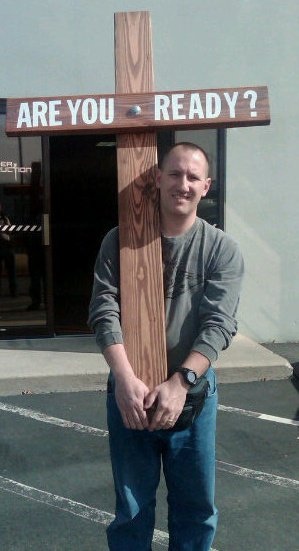
When I am not busy working, raising my family or blogging, God allows me to share the gospel with people in evangelistic endeavors. One such effort was inspired by Tony Miano of Living Waters (who has recently been blogged about here and here). In the picture you see here, I constructed a cross with the words “Are You Ready?” on it. The original intent of Mr. Miano had been to use such a cross in his town as yet another tool to share the gospel. Many other evangelists, including myself, made similar crosses and a small but growing group has been taking the gospel to the streets in this unique manner. But the point of this article is not to brag on our evangelism technique.

Meet Michael. He is the point of this article. I met Michael today on a street corner in my home town where I was out with the cross trying to evangelize. As you can see, Michael spends a lot of time walking the roads and sleeping in the outdoors. When I saw Michael walking down the street towards me, I prepared to hand him a gospel tract, but I doubted he would be willing to stop and talk with me. I was quite surprised when he stopped directly in front of me and asked “Are you a crosswalker?” I explained to him that I was attempting to share the gospel of Jesus Christ with people. What followed next was a half hour conversation where Michael explained he had become disillusioned with the “physical processes of life” and was looking to determine if he was something more than a biological machine that simply existed for itself and then died.

I was blessed to be able to share with Michael that he had been created for God’s glory. That because of his sin, Michael stood guilty before God and would be condemned to Hell. Yet, God in His mercy, poured His wrath out on Jesus Christ so that the righteous law of God could be satisfied. I explained that through repentance and faith in Jesus Christ, Michael could receive salvation and spend eternity with the God who created him. I explained that God created him so that God Himself could be glorified by redeeming him out of his sinful state. While Michael did not immediately repent and place his faith in Christ, he stated he was very glad to hear that redemption was possible.

After talking for a half hour, Michael and I had to part ways. It was such a blessing to talk with Michael. It was a reminder of how desperately the world needs to hear the gospel of Jesus Christ, that forgiveness is indeed available to wretched and vile sinners. So often we get caught up in discerning false religions and teachers, or we get caught up in the political machinations of the government to shut down the church’s influence, or even in discussing the watering down of the Word that is going on in evangelicalism. And while those can be worthwhile endeavors, the first and primary effort of every Christian is to share the gospel. The souls of people like Michael depend on our daily obedience to the command of Christ to go forth and preach the gospel to every creature. Let us not fail in this, but let us make every possible effort to share gospel with people so that souls might be saved.

Please pray for Michael. Pray that God would keep him safe as he continues to walk the roads and pray that God would lead him to true repentance and faith. Pray that we will one day meet Michael in Heaven.

A Call to Greater Maturity: Study for Your Open-Airs (from onthebox.us)

The following blog article was originally published by Tony Miano of Living Waters. I found it to be a very edifying, and highly convicting, article. I pray that those of you engaged in evangelism will take this matter to heart:

“For Ezra had set his heart to study the Law of the LORD, and to do it and to teach his statutes and rules in Israel” (Ezra 7:10).

“Do your best to present yourself to God as one approved, a worker who has no need to be ashamed, rightly handling the word of truth” (2 Timothy 2:15).

One of the greatest joys and privileges in my life is to fellowship and serve with, disciple, encourage, and learn from other biblical open-air preachers. I care a great deal for this relatively small subculture within the Body of Christ. They are my spiritual fathers, brothers, and sons. They are my comrades in arms. They are my patrol car partners. I know that many in this family would do anything for me; and I would do anything for them. I love these folks.

I want to do something for them, now. I want to call them to a greater level of maturity.”

Read the the remainder of the article here.

What Are We Known For?

Some time ago, I wrote about Christians’ involvement in politics. My conclusion was that Christians can and should be involved in politics, but we should be far more involved in the proclamation of the gospel. Yet, as I continue to watch our culture unfold, I see a trend that just won’t stop. Christians continually involve themselves in politics, culture wars, boycott efforts, just about anything that is not true gospel proclamation.

Turn on the evening news and whenever there is a cultural battle being fought, you will find a news commentator talking to a Christian pastor, or protestor with a sign, and they are talking about rescuing or reclaiming America. As if the mandate from our Savior was about returning constitutional authority to the nation rather than the saving of souls. And if it isn’t the conservative pundits calling on our evangelical leaders, then it is the liberal media that has found preachers in the pulpits condemning homosexuals to fenced off areas to eventually die off. Everywhere we go, evangelicalism has wound its way into every facet of the political wars, but nary a sign of the gospel is seen. Conservative Christians are seen only as an extension of right-wing extremism and, honestly, we only have ourselves to blame.

When the early church was formed, it was said of the believers that they had “turned the world upside down,” by the preaching of the gospel (Acts 17:6). Jews, Romans, and virtually every nation persecuted and chased Christians everywhere. And in each place they settled, the church spread and grew. Was it because they infiltrated government or had laws passed that were favorable to them? Absolutely not. It was because they were proclaiming the glorious gospel of our Lord Jesus Christ! Hearts were changed and churches grew because Christians obeyed the command of our Lord to preach the gospel, and only the gospel. As Paul said, “For I determined not to know anything among you except Jesus Christ and Him crucified,” (1 Cor. 2:2). It wasn’t politics that they spread, is was Jesus Christ. Christians were not known for their political affiliations, they were known for the love for Jesus!

Today, modern American Christianity is not known for its gospel proclamations, so much as its political affiliations. Yet, there are many groups whose efforts at evangelism are widely known. There are the cults of the Jehovah’s Witnesses and Mormons who are almost exclusively known for their door knocking ministries. Most churches today might mail out a flier letting the “unchurched seekers” know a new country club….I mean “church” has opened in their neighborhood, but it is the cults who are out making personal evangelism efforts and sharing their doctrines door to door.

Out on the streets, there are the legalistic, sign waving, hate mongering, turn or burn “christians” making their efforts at evangelism. They scream into the megaphones and tell people how wicked they are. They perceive themselves as the arm of God’s wrath and yet act as though they are innocent of any rebellion against the Lord. Truth be known, many of us have likely cringed when we see a team of Christians preaching in the open air, worrying at the thought of what they might be saying. This is such a prevalent view that, even though there are many folks out there preaching the true gospel (see the spotlight video on Tony Miano as an example), most people associate open air preaching and sign wavers with folks like the Westboro Baptists, James Lyman and others.

So as I said before, the American church is known far more for our political affiliations instead of our gospel proclamations. And where we should be known for our evangelism, cults and hate mongers have asserted themselves far more than we ever do. So what we shouldn’t be known for, we are. And what we should be known for, others have stolen away.

What a sad and pathetic blight on the modern American church. It should not be, and it needs to change, now! I am blessed to be affiliated with solid gospel ministries like Living Waters. Thanks to the efforts of many such ministries, a small, but vocal army of evangelists are spreading all around the country and the gospel is being proclaimed. Everyday, they commit themselves to the preaching of the precious elixir of the gospel to heal the lost and condemned souls surrounding them. So what I am asking is this: are you content to only be known for who you vote for? Are you content to sit back and watch false preachers pound out a false gospel? Are you content in rejecting the command of your Savior to preach the gospel unto every nation? Are you willing to let the country be won only to see souls be lost?

If not, then let us change the direction of the American church now! If we are to reclaim something, let us reclaim the preaching of the gospel! Let it be us, under the guidance and authority of our local churches, knocking on doors and preaching on the streets! Let it be us who biblically and compassionately proclaim what is sin and that a judgment that is coming. Let it be us who acknowledge that we too were once under the same condemnation, yet Christ saved us, not under any merit of our own, but because He was gracious to show us mercy. Let it be us who preach that Christ alone is the only way of salvation and there is no other!

Christians, if we are to be known for something, let it be for the love we have for our fellow neighbors who are en route to Hell. A love that drives us to share the truth of the gospel with them, even if they hate us for it. A love that drives us to care far less about the political landscape, but to care about the souls of those who are making our country into a modern day Sodom and Gomorrah. Let that love cause us not to be angry with, or even hate those who are promoting the sins that are causing the moral decay we see, but let it cause us to desperately preach the gospel to them, making every effort to save them from the judgment that is coming upon them.

Brethren, let us not be known by who we vote for. Let us be known as those who desperately love the lost souls of our nation and who would risk all so that they might be saved. Let us be the ones known for the loudest and most compassionate gospel pleas and let the cults and false teachers be driven from the public place they once occupied. And may this all be done for the glory of God alone.

A True Roman Catholic Miracle!

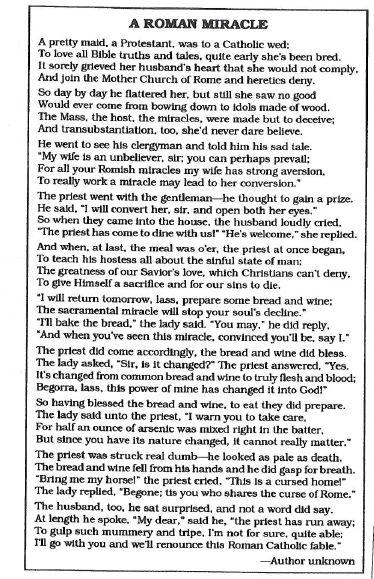
I ran across this poem while reading about the difference between the biblical gospel and the false gospel of the cult of Rome, revealing a bonafide miracle! Don’t discount miracles within the Roman cult until you read this, taken from a pamphlet written by Richard Bennett. You can read more from this kind gentleman here: http://www.bereanbeacon.org/

Sunday’s Resurrection Celebration – The First Fruits of the Harvest

Sunday, we celebrate the Resurrection of Christ, our Lord. He is risen, He is risen indeed. We celebrate for several reasons: because he came (God in flesh), because his death has redeemed man and reconciled us to God, and because he rose again giving us hope in the eternal life to come. Paul describes it in 1 Corinthians 15:16-24 as the “First Fruits”. Christ’s resurrection is the First Fruits of the harvest were the saints are resurrected:

“[16] For if the dead are not raised, not even Christ has been raised. [17] And if Christ has not been raised, your faith is futile and you are still in your sins. [18] Then those also who have fallen asleep in Christ have perished. [19] If in Christ we have hope in this life only, we are of all people most to be pitied. [20] But in fact Christ has been raised from the dead, the firstfruits of those who have fallen asleep. [21] For as by a man came death, by a man has come also the resurrection of the dead. [22] For as in Adam all die, so also in Christ shall all be made alive. [23] But each in his own order: Christ the firstfruits, then at his coming those who belong to Christ. [24] Then comes the end, when he delivers the kingdom to God the Father after destroying every rule and every authority and power.”1 Corinthians 15:16-24 (ESV)

I think this quote from George Eldon Ladd helps us ponder the glorious mystery of the resurrection and explains it in a what that brings great joy and celebration:

“Jesus’ resurrection belongs to a new and higher order: to the order of the Age to Come, of eternal life. This witness of the gospels is reinforced by Paul’s discussion of the resurrection in 1 Corinthians 15. While Paul is here concerned with the eschatological resurrection of saints at the parousia, this eschatological resurrection is inseparable from the resurrection of Jesus because he describes these two resurrections as two parts of a single event. The resurrection of Jesus is the first fruits of the eschatological resurrection (1 Cor 15:20). All who are in Christ stand in solidarity with him as all men in Adam stand in solidarity with Adam. All in Adam share Adam’s death, so all who are in Christ will share Christ’s life. “But each in his own order: Christ the first fruits, then at his coming those who belong to Christ” (1 Cor 15:23).

The resurrection of Christ and the resurrection of those who belong to Christ constitute two parts of a single entity, two acts in a single drama, two stages of a single process. The temporal relationship is unimportant. It matters not how long an interval of time intervenes between these two stages of the resurrection. This does not affect the logical relationship or, it would be better to say, the theological relationship. Jesus’ resurrection is the “first fruits” of the eschatological resurrection at the end of the age. First fruits were common in Palestinian agriculture. They were the first grain of the harvest, indicating that the harvest itself was ripe and ready to be gathered in. The first fruits were not the harvest itself, yet they were more than a pledge and promise of the harvest. They were the actual beginning of the harvest. The act of reaping had already begun: the grain was being cut.

Jesus’ resurrection is not an isolated event that gives to men the warm confidence and hope of a future resurrection; it is the beginning of the eschatological resurrection itself. If we may use crude terms to try to describe sublime realities, we might say that a piece of the eschatological resurrection has been split off and planted in the midst of history. The first act of the drama of the last Day as taken place before the Day of the Lord.” (G.E Ladd, A Theology of the New Testament, Eerdmans, 1975, Page 328)

So, this Sunday, celebrate that the resurrection we look forward and have great hope in as Paul talks about in his first letter to the Corinthians is part of the same harvest from which Jesus’ resurrection has come.as Ladd says in this quote, Christ’s resurrection is a piece of the eschatological resurrection broken off and place in time and space, in human history.

Celebrate…He is Risen.

[20] He was foreknown before the foundation of the world but was made manifest in the last times for the sake of you [21] who through him are believers in God, who raised him from the dead and gave him glory, so that your faith and hope are in God. – 1 Peter 1:20-21 (ESV)

The Church – Why Bother?

I was privileged to be able to read this book before it went to print. My short review is below, but first – here is a short promotional video from the author, for the book which can be purchased here: http://www.freegracepress.org/?p=1050

Review of Jeffery D. Johnson’s THE CHURCH: WHY BOTHER?

By Stuart L. Brogden, Jan 2012

The table of contents highlights key areas of ecclesiology that gives the reader high hopes from the beginning. In his Introduction, Johnson rightly begins with a contrast between “easy-believism” and “Lordship salvation”, describing the link between one’s view of soteriology and ecclesiology. A low view of God brings about easy-believism and a hatred for the sovereignty of God. In his discussion of Lordship salvation, the author explains the biblical view of this transaction – such that no one reading would be able to keep their straw-man view of Lordship salvation (professing it is works-based) in hand. Grace alone accompanied by repentance – a stark contrast to the normal process of decisional regeneration. The Introduction comes to a satisfying close by telling us the reason for the book: to “show how a high view of God and a low view of man should shape our understanding of the nature, purpose and functions of the local church.” To that end, Johnson has review questions at the end of each chapter, for group discussions. Furthermore, each chapter has a sub-title, providing insight to what lies ahead.

Chapter 1 (“Wow, What Nice Facilities You Have”) focuses on the nature of the church; Johnson provides a solid, biblical portrayal of the New Testament church, as a Truth bearer comprised of justified, sanctified believers who are united for the life of the brotherhood and proclamation of God’s Word. Frank Viola should read this book 🙂 Chapter 2 (“Church, Why Are We Here?”) is all about the purpose of the church – to glorify God by upholding the Truth, bringing the saints to maturity, and to evangelize the lost. This is accomplished by standing firm on the whole counsel of God’s Word, fostering holiness in its members. Chapter 3 (“Culturally Acceptable, I Mean ‘Relevant’”) then tells us the nature of the church. Johnson draws a clear line between God’s prescription and description of the church and natural man’s view with this piercing analysis: “When the line between a holy church and secular world is blurred, undoubtedly the church will become anthropocentric (man-centered) rather than Christocentric (Christ-centered).” The chapter is a fine description of both sides of this issue, leaving no doubt where Truth lies – the church must reflect Christ if it to bring glory to God or be any good to man.

Next, in chapter 4 (“Programs, Programs, Programs”), the author reviews the activities of the church. Rather than embracing myriad programs of all stripes to reach the culture, the church has 5 basic activities for use in fulfilling the first and most important part of its two-fold mission(to glorify God): to worship God 1) by preaching the Word; 2) through prayer; 3) through fellowship; 4) through the ordinances; and 5) through song. There may be other activities in a church, but they must not be permitted to overshadow these 5 or push them aside. This leads to the next chapter (#5 – “Hey God, Look at Me Worship”), which covers worship. Johnson provides 6 aspects of right worship – all of which are from, through, and to God and Christ. He then defends “Biblical Regulated Worship” with 6 principles, including a detailed examination of the need for holiness and demand that it not be sensual. His 5th principle is one that would benefit many in the home-church movement – worship must be orderly. Lastly, he re-emphasizes the reality that any worship of God that does not come from His Holy Word is the product of man’s imagination and not fit for use in His body; the church does not have the authority to be creative in worship.

Chapter 6 (“Drive-thru Membership”) is about membership, emphasizing the importance of belonging – in contrast to the cultural concept of association by convenience. Johnson describes the terrible impact of post-modern, self-absorbed thinking which reduces membership to a social experiment. He moves on to describe the spiritual union enjoyed by those in the local church, which is the result of the Holy Spirit working therein. This chapter has a rather long and beneficial description of the necessity, seriousness, responsibilities and privileges, and terms of church membership. The section on responsibilities and privileges details responsibilities toward God, one another, church leadership and those outside the church. This leads naturally to the discussion in chapter 7 (“Church Discipline, What’s That?”) on church discipline, starting with this: “The church must deal with the leaven before it contaminates the spiritual integrity of the whole church (1 Cor 5:7-8).” The author provides 5 steps of church discipline; describes the attitude of church discipline; the purpose, authority, and efficacy of church discipline. All of this is founded on Scripture and reasoned faithfully.

Authority within the church is the subject of chapter 8 (“The Survey, ‘Says’”), in which Johnson begins by summarizing the nature of the church (covered in chapter 1) and quickly moves to a short examination of cultural influences that undermine the authority God has given each church; summing it thusly: “The church abrogates its authority by putting the potential visitor in charge.” He then provides a concise review of the biblical authority in each church followed by a good review of the basic government thereof. The chart comparing qualifications for elders and deacons is very helpful to anyone studying the two offices of the church. A large bit of this chapter is devoted to describing the pastor – he is called by God, called to be shepherds, called to serve, called to preach, called to counsel, and called to live an exemplary life. Our author then provides a short summary the responsibilities of elders and of church members (using the unfortunate term “laity”). This chapter is packed with much good information not found nor discussed in many churches, as so many are allergic to spiritual authority.

Chapter 9 (“We Need Concession, Not Confessions”) – the last chapter of the book – discusses doctrinal standards within the church. Johnson begins by examining how many churches have abandoned confessions in favor of vague, ambiguous statements motivated by (1.) indifference, (2.) ignorance, (3.) pragmatism, and (4.) mysticism. This chapter is focused on mysticism, as the author believes it to be the root of the others. He gives short reviews of the first 3 rationales and moves to a somewhat longer review of mysticism, describing its nature, its influence, and the corrective action. Johnson admits some parallels between Christianity and mysticism, acknowledging the saving knowledge one has of Christ cannot be communicated to others; knowing Christ is a gift from God to each one called. Yet God is – within limits He established – knowable by man in general and in a saving way by the elect. This is the conflict with mysticism, which is founded on the presumption of the ultimate unknown being that which is sought. The fact that man cannot know God completely does not make mysticism correct, as God is known by many and can be known. Johnson uses this confusion in the ranks as a platform to encourage the use of confessions – to equip the saints with biblical truth upon which their experiences and emotions are rooted. That of God which is knowable is summed up in a good confession and this provides a useful tool to defend against mindless chatter about “just being biblical” or “all I need is Jesus”. We do need to be biblical and Christians do need Jesus – but we must be equipped by the biblical revelation, not led astray by human ignorance.

Not to be overlooked is the appendix, which provides excellent tools helpful in generating a church membership agreement, outlining responsibilities of church and members.

Those churches which have neglected the serious aspect of membership would benefit greatly from a close study of this entire book, including the appendix. For a short book, this book is a great resource for any pastor or church member who wants to better understand what the Word of God says about His church. It is easy to grasp the author’s message and short enough for even the post-modern ADHD adult to get through. It will benefit the soul of anyone who reads it. May God use this book for His glory and the good of His people.

Planned Parenthood’s propaganda machine would make Goebbels jealous.

This very disturbing cartoon churned out by Planned Parenthood of San Francisco is the type of propaganda that’s reminiscent of Nazi Germany (not counting their similar goals of the mass killing of innocent, defenseless human beings).

Hitler would be so proud of what Planned Parenthood has accomplished, after all, they’ve picked up where he left off and they’ve exterminated more human beings (specifically minorities) than he ever could have ever dreamed of doing.


Come on, everybody say: God’s Big!

Description of the video by its editor:

“Narcigesis” is a term I recently heard to describe the sermons being pumped out of many Christian churches these days. It’s short for narcissistic eisegesis which is when a pastor reads his own ideas into the text with a primary focus on the self, rather than God. This is a perfect example from a Joel Osteen style pastor by the name of Kevin Gerald.

As far as I know, Ken Silva coined the term, “narcigesis” – I think it’s highly descriptive of what passes for preaching in far too many churches.

May God have mercy on the people sitting and listening to this man.

Thabiti Anyabwile on multi-site churches.

Something for you to consider (and discuss) from the article, Multi-Site Churches Are from the Devil:

“. . . I think the kind of multi-site churches (realizing there are a few different approaches) that feature one pastor being beamed into several sites around a region—and in some cases around the country or world—is simply idolatry.  It’s certainly cult of personality multiplied and digitized for a consumer audience.  As a brilliant young man remarked to me this morning, ‘The pastor now becomes the new icon in the midst of the Protestant worship service.’  I think that’s well said.  Video multi-site tends to idolatry, pride, and self-promotion—even where the ambition of spreading the gospel is genuine.”

Read the entire article from Thabiti Anyabwile here.

The Death of Christopher Hitchens

Renown speaker, author and self avowed atheist Christopher Hitchens died at age 62 yesterday. Mr. Hitchens was perhaps most well-known for his atheism and consistent attacks against religion, primarily Christianity. He was previously diagnosed with esophageal cancer and underwent medical treatment, including chemotherapy, to treat the disease. Ultimately he succumbed to pneumonia as a complication of the cancer and died. Prior to his death, many Christians prayed for Mr. Hitchens, for his healing and for God to save his soul. Mr. Hitchens found this to be interesting, but assured the public that any stories of his deathbed conversion would be fabricated.

The question that stands before us today of course, is where is Christopher Hitchens today. According to Mr. Hitchens, he simply ceased to exist, nothing more. But for the Christian, we know that we exist for eternity once this mortal body ceases functioning. There are only two possibilities as to where, Heaven or Hell. As Mr. Hitchens was created by God, and was bound to God’s laws, as we all are, he can only be in one of those two places. At first, it may seem quite easy to figure it out. He denied God, spoke vehemently against the Christian faith, and was often hateful and vitriolic in his speech regarding it. Considering that he made the statement there would be no deathbed conversion, it would be a simple thing to declare God sent him to hell. However, the truth is, we simply do not, and cannot know.

It is clear that Mr. Hitchens made a career of hating the very idea of God. But it is also clear that he was a common sinner just like the rest of us. He had a conscience, he was aware of right and wrong. He, like the rest of us, committed acts that were in violation of that conscience. We know that our consciences are God’s laws written upon our hearts. When we violate our conscience, we are violating God’s laws. Additionally, Mr. Hitchens debated with many Christians, he had heard the gospel presentation many times. There is little question that by the time of his death, Mr. Hitchens knew what God required of him. It is that time just prior to his death that we cannot know about. Is it at least possible, that as he faced those last moments, knowing death was coming that he considered those sins he committed, that he contemplated the gospel he had denied so many times, that he just might have repented and trusted Christ. If we are intellectually honest, we must say that it is possible. And since we cannot know, we hope that is what happened. We hope that we will find Mr. Hitchens in Heaven one day, for we do not wish the wrath of God on any man.

But we must also be honest say that he may not have repented. It is entirely possible that Mr. Hitchens held on to his rejection of God all the way into death. If so, Mr. Hitchens now stands before God in judgment for his sins. And not just for his atheism. As said before, our consciences are merely God’s law written on our hearts. When any man or woman breaks those laws, through lying, stealing, coveting, lusting, or blaspheming, they have sinned against a holy and righteous God. It is not just because he was an atheist that Mr. Hitchens may have stood condemned, it is because, as we all are, he was a sinner against the God who created him. And if that indeed is what occurred, even we Christians must mourn his death, for we do not wish Hell on any man. But we also rejoice that God is glorified, because His justice is perfect.

So what does that mean for the Christian? First, let us not run around proclaiming we know where Christopher Hitchens is, only God knows that. Let us share with people the truth, that if he repented and trusted Christ (which is our hope), he is in Heaven. But if he remained in his sins, he was condemned (as we all deserve). Let us not rejoice that another atheist voice is silent, that presents us as unkind and unloving. But let us not ignore that what he taught was blasphemous. As we engage in coversation with others on this, let us remember that, whatever Mr. Hitchens fate was, all of us face the same date with death. All of us will one day die and stand before the Lord. Let that motivate us to share the gospel with everyone we meet. Let his death stand as a reminder that our lives are but a vapor, our next breath is not guaranteed. Thus, it is imperative that we share the gospel, the good news that Jesus Christ died for sinners, and that salvation is available through Him alone. Christians, let us be about our Father’s business of proclaiming this good news.

“Daddy, I Don’t Think God is Real!”

I had what was perhaps the most interesting theological conversation I’ve ever had last night, and it was with my seven year old son. It started with overhearing him tell his younger brother that they had to be “normal” by obeying us parents and to quit “acting up.” When I asked what he meant by “normal” my son explained that being obedient was normal, disobedience was not. I told him that, while we were teaching he and his brother to be obedient, to do so all day every day was not possible. In fact, what is normal is to be disobedient. That was why we spend time teaching them about Jesus Christ. That only by submitting to Him, in repentance and faith, would God make us a new creation that desires to obey Him. That was when the conversation got interesting. My seven year old son looked at me and said, “I don’t know if I believe in God, I think He’s made up.”

Like many parents would understandably feel at that point, there was a moment of panic that set in. “I have a seven year old atheist!!” ran through my mind. But what followed was a series of questions from my wife and I that patiently and lovingly asked why he felt that way and trying to explain, biblically why we could believe God was real and why we could trust his promises. In the end, this conversation only lasted about fifteen minutes and, while we could see his young mind was still trying to process what we said, we could tell he was really considering it. It was perhaps my proudest moment as a father. Not because I skillfully answered his questions, trust me, I’m not that smart. But because my son, at seven years old was wrestling with the hard questions of faith and was seeking genuine answers. He wasn’t just blindly accepting what mom and dad said, he wanted real life explanations that made sense. And it was the blessing of God to allow my wife and I to be the ones to explain it to him.

Now there is a very real reason why I have relayed this touching family moment. It was only a few months ago that I had picked my kids up in Sunday School one day. As I entered the class, I overheard the teachers leading the children through a “sinner’s prayer” and welcoming them to the Christian family. While this post is not intended to decry Sunday Schools in general, I remember the sense of genuine concern I had over this. Christians are not made because someone lead another in a prayer or had them sign a card. People become Christians because they have been humbled by the understanding of their wretched sinfulness and, in repentance and faith, turn to the only possible means of salvation, Jesus Christ. While a later conversation with the Sunday School teacher addressed this issue, I could not help but think of it again last night.

In our current evangelical culture, my kids would have been declared saved and no one would have ever been allowed to question that. Never mind we are repeatedly called in Scripture to examine ourselves and see if we are in the faith. Never mind the parable of the sowers which describes what false converts look like. None of those things are considered, only that they said the sinners prayer. Yet, last night in my son, I saw the doubts and questions often used by many to deny the existence of God. While this is not proof of a definitive lack of salvation, neither should it ignored as a possible indication he has not yet been made new. In most churches and Sunday Schools today, these serious and reasonable questions go unanswered. Many times, churches erroneously assume young kids simply can’t understand these big concepts. They teach them Bible stories and figure that is enough. But even well meaning churches, who teach solid biblical truths, only have a couple hours per week to teach the answers these kids desperately need. A couple hours against a full week of secular humanist onslaught is often simply not enough.

So what is the answer? In a word, us. We parents are the ones God has assigned over our children. He has given the responsibility and the authority to raise them up in the fear and admonition of the Lord. It our duty, not our option, to be the primary source of biblical instruction in their lives. It is we, not school, not friends, and certainly not television, that should be forming the worldview that they will one day live by. And that worldview should be grounded solely in the good news of the gospel. That means we, as parents, must be prepared to answer some of the hardest questions we will ever encounter. That means we need to know our Bibles. That means we need to understand at least a basic level of apologetics. It means we have to understand the difference between the unbiblical concepts of evolution and the Bible’s teaching on Creation. It means we cannot be lazy. It means we have to work hard. It means giving up our time and our pursuits so that we can train up our children to love the Lord and commit their lives to Him.

Some may see this as an overwhelming task. They may think, “I’m just not smart enough,” or “I’m not equipped to teach like that.” If you have children, God has equipped you to teach. The Bible never attempts to persuade us that teaching our kids might be a good idea. It commands us to. And if you have commanded, you have been equipped. If you don’t feel intellectually capable, change it. The resources out there to provide Christians with this ability are numerous. Ministries such as Answers in Genesis and CARM exist for the express purpose of providing apologetics training. Numerous sound biblical preachers such as John MacArthur, R. C. Sproul, and Voddie Baucham have websites and audio messages that can assist you as you study the bible. But the single most important things you can do are pray, read your bible and spend time with your kids talking about the things of God.

Truly we parents have no greater ministry than the training up of our children to fear and love the Lord. This is not anyone else’s responsibility, it is ours. Let us not abdicate it to anyone or anything else. Oh, and the second proudest moment of being a parent happened to me this morning. My son came up to me and said, “Now I know God exists, because if he didn’t I wouldn’t be here.” Excuse me, I think I have some grit in my eyes I need to wipe away, because I can’t explain these tears any other way.

Should Christians Try to Win Morality Through Legislation?

In our current culture, especially as we are heading into the next election cycle, moral questions are being hotly debated and people are looking to to political leaders to solve these problems. For example, perhaps the two mostly controversial subjects are the definition of marriage and the issue of abortion. Everyday, we hear news reports of organizations petitioning political leaders for changes to these laws. Everyday, state governments pass, or attempt to pass, a law that will define marriage as either traditional, being between one man and one woman, or redefining it to include same sex couples. Abortion laws continued to be hotly contested as states pass laws that require women be informed of a baby’s development or the use of ultrasound to show them the child. Yet, efforts to extend personhood rights are being denied due to political machinations.

As we see cultural diversity, political correctness, pluralism, post-modern and secular humanism spread throughout, and erode, the culture, Christians rightly see the damage this does to the understanding of the word of God. Additionally, because these concepts demand that Christians capitulate their exclusivist position, which we are often unwilling to do, Christians are often seen as obstacles to unity within the culture. We recognize that the culture is moving to a point where Christianity could conceivably be seen as a threat. The further the culture takes this perception, the greater the possibility that one day Christianity could be outlawed. Therefore, Christians are rightly seeing a growing threat to the practice of our faith and, ultimately, the moral degradation of a country in rebellion to God.

So the question becomes, how does the Christian contend with this? Do we fight fire with fire, establishing political action committees, petitioning political leaders, fighting for more moral laws, putting Christians in political offices, and so forth? Or do we view the onslaught of the culture against Christianity as insurmountable and retreat into secluded enclaves where we can practice our faith in peace? Is there a balance between the two extremes? Is there a biblical answer to this? I believe there is and it may be what the vast majority of the church has ignored for some time.

In the 1960’s we saw one of the most public attacks on the Christian faith when a Supreme Court case determined that a wall existed between the Church and the State. From that day forward, political representations of anything remotely Christian were prohibited. In response to this governmental decree, Christians began fighting through politics and legislation, attempting to reclaim that lost ground. Since that time, we have seen the establishment of the “Moral Majority” and Christian lobbyist committees. Religious groups have examined candidates with fine tooth combs, ensuring they would support biblically based laws. Additionally, legal groups have formed, fighting for Christian values in Courtrooms around the country. And, at first, it seemed we had the right idea. Good, moral laws got passed. Conservative politicians sought the support of the evangelical right. But, it did not last long.

By the 1990’s we began to see political correctness and post-modernism redefining how the culture thought and acted. Slowly, incrementally, how we understood morality, the definitions of right and wrong had been changing in the culture. Now, the greatest moral taboo wasn’t doing what the Bible called sin, it was to tell anyone that what they believed was wrong. Truth was now relative, everyone’s perceptions were equally valued, whether they had a basis in fact or not. To tell someone that their sincerely held beliefs were wrong was tantamount to treason. And by the time we had reached the turn of the century, this system had permeated our entire culture. Now, laws that Christians had fought long and hard for were seen as unfair, immoral, and unconstitutional. After all, if someone’s beliefs on sexual lifestyles, their desire to have abortion on demand or their definition of marriage was as equally valid as anyone else’s, then these laws were depriving them of the freedoms guaranteed in our Constitution. The very fabric of the “Moral Majority” had begun to unravel.

Because of the almost viral like effect of political correctness and post-modernism, Christians have even found fighting within our own ranks. How many churches have we heard of today that actually support abortion or homosexual marriage? This is the key to understanding why Christianity is finding itself bullied into a corner today. See, while the church was busy fighting the political battles, secular humanism was establishing its very foundations. Those that sought to change the culture weren’t busying themselves with politics, yet. They were fighting for the hearts and minds of the culture. While we were protesting, they were proselytizing. In time, those whose hearts had been won to this way of thinking were growing up and taking their ideas into everything they do.

Christians, this is were we have failed. Our primary task, the one given to us by Christ Himself is to “Go into all the world and preach the gospel to every creature” (Mark 16:15 NKJV), and to “…make disciples of all the nations, baptizing them in the name of the Father and of the Son and of the Holy Spirit,” (Matthew 28:19 NKJV). In other words, we are to be proselytizing to everyone we meet. See, somewhere along the way, maybe because we had become an affluent and prosperous nation, we forgot that we aren’t blessed by God because we are Americans. We are blessed because we have humbled ourselves before God, broken by our sins, repentant and trusting in the Savior, Jesus Christ. But we began to see our wealth, prosperity and power as evidence that God loved us. That somehow, we were deserving of it. Yet, when adversity began to rear its head, we did not look to ourselves, to see if we had lost our way. We just assumed we were on the right path and no one was going to take away God’s blessings without a fight! So we fought it on the world’s terms, trying to get OUR rights and OUR blessings back. Along the way, we forgot about those unregenerate and lost souls on their way to hell.

Like we were once, our country is populated with literally millions of sin bound souls, hearing only the call of their flesh. Post-modern humanist driven leaders exploited that. They preached a false gospel of unity, peace and self-gratification. Those souls that we were not evangelizing to greedily ate it up. In time, our children, fed well on a steady diet of tolerant pluralism looked at us and saw hypocrisy. Sure, we fought for conservatism and “morality,” but not everyone believed in what we did. In fact, we really didn’t believe in it ourselves. We worshipped our wealth and prosperity. We made out lives comfortable and pleasant. Yet, we ignored those around us that desperately need to hear the healing gospel. We left the work of preaching and teaching to the already over-worked preachers on Sunday morning. The hearts of the next generations belonged firmly to the world. For all our moral battle cries and politicizing, we had lost. Our culture is on a downhill slope and is picking up steam fast.

So what are we to do? Exactly what Christ called us to do, preach the gospel! This is the beauty of our faith! God’s word does not return void. Christians, brothers and sisters, hear this. If today, we will go forth and preach the word of God – that glorious gospel that teaches that we are wretched sinners deserving of damnation, yet, in His mercy Christ died for us, and that through repentance and faith we can receive forgiveness of sins – if we go out into our country and preach this word, souls will be saved. If we repent of our sin of trying to win this battle on our own, if we humble ourselves and pray over the lost and dying sinners walking the streets, if we raise our families to love and praise our Savior, souls will be saved! And as those souls are filled with the power of the Holy Spirit, they will be led to preach the same gospel! And, maybe, just maybe, we might actually see a real revival, not one of those charades that get scheduled on TBN every night.

Now, here is the interesting part. If a nation were to break out in genuine revival, if hearts were convicted of the sins our nation currently exalts, and if they were truly led of the Spirit, what happens? It begins to love the law of God and practice it without having to be forced through legislation!! See, all those laws and political machinations we are trying to win won’t need to have so much effort, because people will desire to obey God out of their sincere love and gratitude toward Him. I’m not advocating preaching the gospel just to get a better society, not one bit. I’m saying that if we actually love the Lord as we ought to and preach His gospel, because it is truly the best thing we have to offer (honestly, we are talking about the forgiveness of sins and eternal life here), then all the other things we keep fighting for will get won because God Himself will be fighting the battle.

Does this mean we surrender the political fight and never get involved? No. But this is where the balance must come into play. We are blessed to live in this country, so we must thank God by honoring our duties to care for and protect it. We must stand up against evil when it arises and vote in a manner that is consistent with biblical principles. But, at the forefront must always be the gospel! When we defend morality, it is not because “it is better for society,” it is because to allow the immoral to stand is to allow untold numbers of souls to believe sin is not sin and God will not judge it. We must proclaim sin to be sin and compassionately lead those who will hear us to the cross at Calvary to be forgiven. Always must this be the reason why we vote the way we do, and for no other reason.

Brothers and sisters, I have heard so many Christians speak vehemently over which candidates to vote for, which parties to back, and which laws to support. Yet, I hear so very little of that passion when it comes to speaking forth the truth of the gospel to the lost. Please, let us change that. Let’s end the notion we can win this world by worldly means. Let us, with one accord, proclaim the glorious gospel of our risen Savior for the salvation of souls and let us see what the Lord might do with our nation then.

Should Christians Boycott?

Every year, especially around this time, a huge outcry comes from the American Christian church. It basically amounts to, “If you don’t call it Christmas, we will boycott you”! On the surface, this seems like a pretty straightforward issue. December 25 has been the long celebrated, if not very accurate, date of the birth of Jesus Christ in this world. Now there are many debates about whether Christians should even celebrate this particular holiday, but I am setting aside that issue for now and am asking my readers to do the same. The issue I want to address is the issue of boycotting those companies that choose not to recognize this specific holiday as they cater to the consumer market. The question that needs to be asked is, should Christians participate in this?

In addressing this matter, let us first consider what Christmas is. For the Christian, it is a celebration of the time when God entered into humanity through the Incarnation. When the promise of Isaiah 9:6-7 came to fulfillment, “For unto us a Child is born, Unto us a Son is given; And the government will be upon His shoulder. And His name will be called Wonderful, Counselor, Mighty God, Everlasting Father, Prince of Peace. Of the increase of His government and peace There will be no end, Upon the throne of David and over His kingdom, To order it and establish it with judgment and justice From that time forward, even forever. The zeal of the Lord of hosts will perform this.” When the Holy Spirit overshadowed a young virgin and Jesus became fully God and fully Man. When the Creator of all the universe took on humanity and became as one of us.

Unquestionably, the single most important aspect in history occurred on the hill of Calvary. Without the death, and subsequent resurrection, of Jesus Christ, there is no Christianity, as there is no forgiveness for sin. Yet, Calvary happened because a Child was born in Bethlehem, born in a filthy stable to a poor couple who were outcasts because there were questions about the how Mary really got pregnant. A Child that the local thieves…um, make that local shepherds ran through the streets announcing. A Child that, it seemed, very few people really cared about came into this world, but upon whom all of history would be affected. The very point of the celebration of Christmas centers then around the birth of the single most important figure in all of history, and the the ultimate fulfillment of why He came.

Fast forward to the year 2011 and the celebration of Christmas in America. Thanks to many traditions added over the years, trees and lights adorn our homes. Presents are exchanged in celebration of the season. Families gather together to sing carols and a traditional reading of the birth of Christ. Well, in some homes anyway. The growth of pluralism, post-modernism and political correctness have taught us that not everyone cares to celebrate this time of year because of Jesus’ birth. We are told that alternative beliefs, or even lack of beliefs, are just as important as the birth of Christ. In fact, since the Christian faith is so “intolerant” of other beliefs, it is actually important to denounce the central tenet of this celebration, or at least seriously downplay it, so that others can feel less disenfranchised and enjoy themselves more. After all, the purpose of the season is about love and joy to all mankind.

It did not take long for retailers to recognize that if they wanted to continue to make money from consumers, they had to buy into this system. Since not every person buying gifts was a Christian, they had better go to great lengths to make them feel included. Refusing to transition into this new age of pluralistic celebrations could mean that customers would feel offended and take their business to a more “inclusive” store. “Merry Christmas” became “Happy Holidays” or “Seasons Greetings”. Christmas decorations became Holiday decorations. Stores sanitized themselves of anything remotely “Christian” in order to attract potential customers, thus increasing their bottom line.

It did not take long for Christians to recognize they were being pushed aside in this wave of commercial political correctness. Bumper stickers and signs began popping up which stated “Keep Christ in CHRISTmas” or “Remember the Reason for the Season”. Rather innocuous and harmless efforts to return people’s minds back to the central figure of Christmas (yet rather ineffective given the lack of a true gospel presentation, but I digress). Along the way, someone struck upon an idea. If a store doesn’t want to acknowledge Christ and Christmas, then why spend their money there? After all, if Christians aren’t worth catering to, why bother shopping at that store. In true Christian fashion, the worldly concept of boycotting caught on like wildfire. Before long, Christian organizations began to keep track of who did or did not say “Merry Christmas”. Christians were encouraged to avoid shopping at stores that were not “Christian friendly”. Terse letters were forwarded to companies with dire warnings that unless they changed their ways, Christians would withhold the money expected that year. It is now an annual event for Christians to celebrate the birth of our Savior by threatening companies with boycott unless they play ball our way.

Now, readers are probably catching on at this point where am I going with this, but I would like you to hear me out. How often have you read an article or seen a news report where a small business, run by a Christian, made a business decision that was informed by their beliefs that conflicted with a “protected class” and a boycott/lawsuit ensued. Have you not, rightly, declared, “How dare they? They’re just bullying them into doing what they want”! We have all seen it happen, perhaps you have even heard of a business or organization being shut down because they could not handle the legal costs involved. When we see it being doled out against other Christians, we realize just how cruel the concept is. If someone doesn’t do it their way, you either tow the line or you’re outta here!

So the question for the Christian is, what are we thinking?? At what point did Christ call upon us to use the cruel and mean ways of the world to promote His Name? At one point did we forget that our celebration of Christ was not which stores we would shop at, but to celebrate that promised Messiah, born of a virgin, in a poor household, with parents who were gossiped about, but would turn history on its head because of His death and resurrection for the sins of mankind? When did we forget that His story would not be told on store banners and catalogs, but when we would boldly proclaim the gospel to all those we meet? Did Christ command us to tersely warn people to make sure they celebrate Christmas, or did He call us to lovingly proclaim His gospel so that people would repent and trust in Him for salvation?

It is my suggestion that rather than partake in worldly methods, so we can feel comfortable shopping at stores where we can get the best deal, we take this time to go out into the world and share the glorious gospel of salvation through grace. See, this time of year is important to remember, but not so we can get good deals on presents. It is important for the reason I stated before, without Bethlehem, there is no Calvary. Without Calvary, there is no salvation. Without salvation, there is no hope. Please Christians, stop worrying if the stores are promoting Christmas, it’s not their job. It is ours. Let us spend our energies proclaiming Christ’s birth, life, death and resurrection. That is the one gift you can give to every single person you meet that really matters anyway.

Joel Osteen–“Mormons are Christians” (Part 1,382)

As if we needed yet more proof that Joel Osteen is a wishy-washy, milquetoast, “let’s all get together for milk and cookies” false teacher. In an interview with the Washington Times, here we have him saying (yet again) that Mormons are Christians. this is not the first time that Joel Osteen has embraced the cult of Joseph Smith. He did the same in a 2007 interview with FOX News’ Chris Wallace.

Here are the two videos that show he has not learned to discern between the truth and the lie:

2007:

2011:

While it’s easy to sit back and smirk and say, “Well, there he goes again,” there is a bigger picture we must see:

1) This is a man who has influence over thousands and thousands of people who profess to know the TRUE Christ. People who go through the day thinking they know the One who called Himself “The Way, the Truth, and the Life.” And yet they are being deceived by this man.

2) This is a man who claims to be preaching the word of God. He stands on a grand stage every week, peddling his brand of feel-good philosophy, promising everyone they can have their “Best Life Now®”, and telling you how to “Become a Better You®”, and how to make “Every day a Friday®”. And yet he will not tell his audience how to avoid sin, how to be pleasing to God, or how to avoid His wrath and judgment. And now, he is teaching his followers to embrace the henotheistic, works-based false gospel of the flesh-peddler Joseph Smith.

3) He is, by the same token, comforting Mormons who are deceived by their elders and “prophets”. By giving Mormonism his support, Osteen is telling the Mormon who is placing his/her hope for salvation in their own works (along with a little help from Jesus), he is letting them be comfortable in their deception, showing them how to have a smile on their face and a full belly all the way to Hell.

This man is unbiblical in his approach to preaching, avoiding the hard truths. He embraces false religions. Of his followers, Paul wrote well when he said, rather prophetically, that “You happily put up with whatever anyone tells you, even if they preach a different Jesus than the one we preach, or a different kind of Spirit than the one you received, or a different kind of gospel than the one you believed” (2nd Corinthians 11:4, New Living Translation). I beg you, if you follow this man, avoid him.

Romans 16:17-1817 Now I urge you, brethren, note those who cause divisions and offenses, contrary to the doctrine which you learned, and avoid them. 18 For those who are such do not serve our Lord Jesus Christ, but their own belly, and by smooth words and flattering speech deceive the hearts of the simple.

Galatians 1:8-98 But even if we, or an angel from heaven, preach any other gospel to you than what we have preached to you, let him be accursed. 9 As we have said before, so now I say again, if anyone preaches any other gospel to you than what you have received, let him be accursed.

Jeremiah 23:1-31 “Woe to the shepherds who destroy and scatter the sheep of My pasture!” says the LORD. 2 Therefore thus says the LORD God of Israel against the shepherds who feed My people: “You have scattered My flock, driven them away, and not attended to them. Behold, I will attend to you for the evil of your doings,” says the LORD.

What Vine are you Abiding In? (Part 3)

What Vine Are You Abiding In?(Part 3) – Why does Christ tell us these things?

If you haven’t had a chance to read Parts 1 and 2 about John 15, please take time and review them and ask yourself this tough question: What vine am I abiding in? Find Part 1 here. And we need to examine our own hearts and our own faith by asking the tough question: What fruit am I bearing? Find Part 2 here.

Let’s dive back into John 15 and look into the next part…

Why does Christ tell us that he is the true vine? Why does he stop with the disciples late on the night he will be arrested to teach the disciples proper gardening techniques? Is it so that they can start working in their lives and to start bearing fruit? Is it so that we will know how to produce noticeable fruit in our lives? No. Absolutely not. We are not able to bear fruit on our own; it is not up to us! God produces the fruit and he only produces it when we abide in Christ. Our job is to abide and he will  bear the fruit in our life. The amazing thing about fruit is that you’ll always know where it comes from. An apple tree will not bear oranges, so if it is, it isn’t an apple tree. So where are we abiding? Are we abiding in Christ? Or are we abiding in our attempts to bear fruit? Are we abiding in something other than Christ and thus we have to Velcro fake fruit to us to keep up appearances?

Here are three reasons why Christ teaches about the fruit that comes from abiding:

1. First, look at v 8:

“…by this my Father is Glorified, that you bear much fruit and so prove to be my disciples.”

We will be seen as Christ’s disciples by our fruit. Our fruitfulness glorifies God. It is about God! Our fruit in the form of good works, love, joy, peace, patience, and and the like are to glorify God – to the glory of God alone. It’s His fruit after all. We prove to be his disciples meaning that it is evident that we are not of this world, but that we are members of the family of God…it is a family resemblance to the ultimate fruit bearer.

2. Christ’s second reason…verse 11:

John 15:11

11 These things I have spoken to you, that my joy may be in you, and that your joy may be full.

Continue reading

What Can Make People Do a Complete 180 on Abortion?

The ministry of Living Waters has just released the following video that has the potential to drastically change the culture’s view on abortion and to save souls. Please take the time view this important video:

As you share this video with people, please suggest they go to www.180movie.com for additional information.

What Vine are you Abiding In? (Part 2)

What Vine are you Abiding In? (Part 2)

Please take some time and read What Vine are you Abiding In? (Part 1). In Part 1, we looked at the context and background for our passage John 15:1-11 and Jesus’ teaching regarding the vine and the branches. We also had to face the tough question: “What vine are you abiding in? Jesus, the true vine? Or one that is untrue?

Now, in Part 2, we’ll ask another tough question: “What fruit are you bearing?”

BEARING FRUIT

Let’s jump back into our passage from John 15:

John 15:4 “…As the branch cannot bear fruit by itself, unless it abides in the vine, neither can you, unless you abide in me. 5 I am the vine; you are the branches. Whoever abides in me and I in him, he it is that bears much fruit, for apart from me you can do nothing.

So, what kind of fruit are you bearing? Are you bearing any fruit at all? Surely you are bearing fruit…its either good fruit or its bad fruit.

The purpose of the branch is to bear fruit. It is completely useless if it does not bear fruit. Notice how, from Part 1, the branches are pruned, cut off, and taken away, but the vine is never pruned or cutoff. There is no other purpose for the branch than to bear fruit. In order to bear fruit the branch must be fully connected to the vine. The branch gets all its sustenance from the vine. All the water and nutrients come from the roots to the vine to the branches in order to bear fruit. If the branch is disconnected or partially connected, it will NOT bear fruit…and we know what happens to that branch.

Jesus mentions “FRUIT” 6 times in this passage, do you think he is serious about it?

BAD FRUIT

Are you abiding in one of these unTRUE vines? One of these FALSE vines described earlier which makes you bear BAD FRUIT? False fruit? What does bad fruit look like? Let’s consider several passages from the Apostle Paul:

Romans 1:28-32

And since they did not see fit to acknowledge God, God gave them up to a debased mind to do what ought not to be done. 29 They were filled with all manner of unrighteousness, evil, covetousness, malice. They are full of envy, murder, strife, deceit, maliciousness. They are gossips, 30 slanderers, haters of God, insolent, haughty, boastful, inventors of evil, disobedient to parents, 31 foolish, faithless, heartless, ruthless. 32 Though they know God’s decree that those who practice such things deserve to die, they not only do them but give approval to those who practice them.

Any of these sound familiar? Recognize any of those fruits in your life? How about these: Continue reading