

Catholic
A Catholic Leap
There is little doubt that many Roman Catholic doctrines simply aren’t in the Bible. They’ve been introduced by the Roman Catholic Church over the centuries. Much as Muslims make weak attempts to find prophecies about Muhammad in the Bible, Catholics grasp at straws to find support for their doctrines in the Bible.
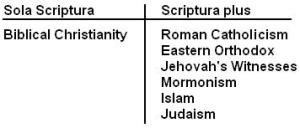
I recently had a conversation with a couple of knowledgeable Catholics. I started by discussing the fact that the Bible blatantly contradicts some of their beliefs. Specifically, they claimed that atheists “of good will” could end up in heaven. There are dozens of verses that prove that line of thinking wrong, and I quoted a few to them. Their response was that they don’t care what I say about the Bible, because according to Catholic teaching, no one is able to interpret the Bible outside the authority of Rome.
This was the first time I’d heard that from a Catholic, and it turns out that it really is the standard teaching of Rome, and it’s based on a misinterpretation of 2 Peter 1:20. Later, they mentioned that there really is no infallible interpretation of this verse, so I’m not sure what authority they have to give any interpretation of that verse.
I showed them Acts 17:11, which describes how the Bereans were commended for scrutinizing Paul’s teaching with the Scripture. I asked them why the Bereans were able to verify Paul’s teaching with the Scripture, but today I am unable to verify Rome’s teaching with Scripture. They never directly answered my question. I gave up asking the question when the only “answer” provided was:
Why did Paul have to “check in” with the Apostles and have them lay hands on him to continue his ministry?
That has absolutely nothing to do with my question. Honest, knowledgeable answers generally don’t start with a “why” and end with a question mark.
They do think that I should verify the doctrines of Rome, but not by searching Scripture. I should determine the truth of Rome’s claims by verifying that their doctrines haven’t changed over the last 2,000 years, and I should do this by reading church fathers. (They were kind enough to give me a list of church fathers to check out.)
But this only leads to more questions. If I’m not trustworthy enough to interpret Scripture, why am I trustworthy enough to interpret the writings of church fathers? Why should I read the second generation (or later) of Christian beliefs when the Bible provides the first generation? If two church fathers disagree (there are many early “Christians” who were outright heretics), which one is trustworthy?
There is no good way to test the Catholic Church. Bottom line: I’m supposed to become a Catholic, because the pope says so.
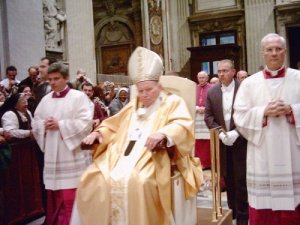
Trust me.
At the root of this disagreement is the epistemology of Catholics and Evangelicals. Evangelicals believe the Bible is the only source for absolute truth, and Catholics have the Bible plus their tradition. The problem is that the Bible is insufficient to arrive at modern Catholic doctrines (if not contradictory to those doctrines), and there is no other infallible, inerrant source to attest to Catholic doctrines. In order to buy into the teaching of Rome, you must take a blind leap of faith.
One who gets it . . . one who doesn’t.
A sobering reminder to beware of false prophets.
Catholicism: Crisis of Faith.
All roads may not lead to Rome, but according to the pope, only Rome leads to Heaven.
 Someone needs to report this to the Tolerance Police, the Federal Bureau of Religious Unity, and the Ecumenical One World Religion Patrol.
In this day and age of unity at all costs and ultra-tolerance at the cost of truth, the pope is not very “tolerant” of other beliefs. Pope Benedict XVI has affirmed that Christian Churches are defective, not true Churches, and that the only road to salvation goes through Rome. Sounds like someone needs to attend state-sponsored sensitivity training classes for the purpose of re-education.
In spite of this, however, I have to give him credit. At least he was sticking to his guns when he affirmed his position (no matter how in error he is). It is refreshing to see someone not completely cower under the influences of compromise and one world religious unity, (even if he is an enemy to the real Christian Church).
From the Fox News article:
“Pope Benedict XVI reasserted the primacy of the Roman Catholic Church, approving a document released Tuesday that says other Christian communities are either defective or not true churches and Catholicism provides the only true path to salvation.”
Read more here.
I wonder what the pied pipers of ecumenicalism from this post (Tom and Ricky) have to say about this.
Source: Social Hazard
It’s all about Mary?
Fact or Fiction; Scripture or Tradition?
The following is an examination of fifteen of the most often used arguments by Roman Catholic adherents in their defense of their near deification of Mary, (along with a brief response to each argument). Each of the pictures in this post can be clicked on to enlarge.
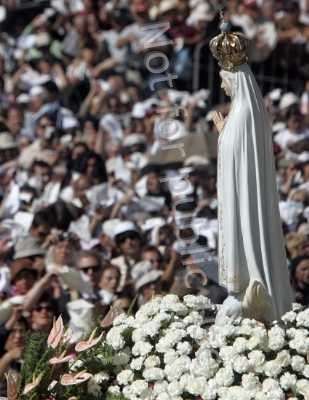 Argument 1). Mary was blessed among women: FACT
Mary was blessed, however, so is every Believer. To make the leap that because Mary was blessed she should receive the adoration/veneration/worship that she’s given is not Scripturally logical. In fact, Scripture records the way Jesus handled the first attempt to elevate Mary’s status. In Luke 11:27-28 a woman in the crowd tried to draw attention away from Christ and to Mary (what the RCC has perfected) but Jesus corrected her saying, “On the contrary, blessed are those who hear the word of God and obey it. “ (Luke 11:27-28). Also, Mary wasn’t/isn’t the only person blessed. See the Sermon on the Mount for a list of others who are “blessed” (Matthew 5:3-11).
 Argument 2). Mary is worthy of/deserves our adoration and veneration: FICTION
No human is worthy of any amount of veneration or worship because we are all sinners (Psalm 14:3, Romans 3:23); we are to worship God and serve Him only (Matthew 4:10); and God will not give His Glory to another (Isaiah 42:8, 48:11).
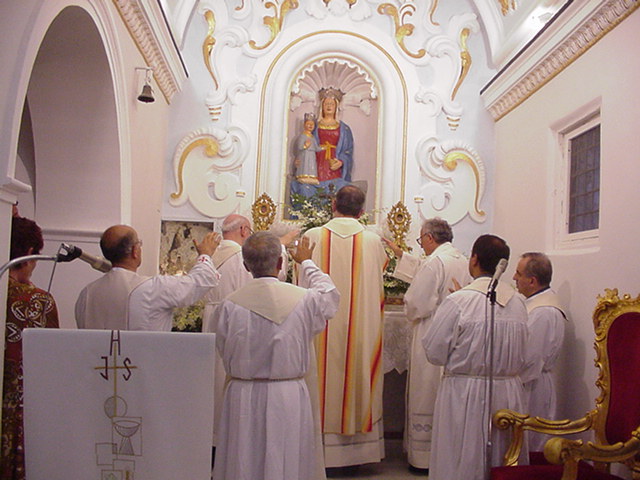 Argument 3). It is permissible and acceptable to pray to Mary: FICTION
Mary was a human being and suffered the wages of sin–death (Romans 6:23) like everyone else. Scripture prohibits contacting, seeking out, consulting, and/or praying to the dead (Deuteronomy 18:11). It is called necromancy and it detestable to God (Deuteronomy 18:9, 12). Additionally, spiritists, sorcerers, and mediums (who seek to contact the dead) are also condemned by God
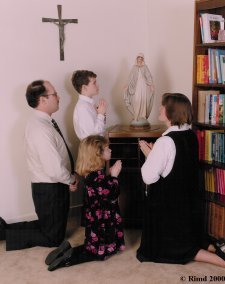 Argument 4). By bowing down and praying to Mary, Catholics are not worshipping her, just venerating her. In fact it is also permissible to make statues of her and bow down to them too: FICTION
The “veneration” and bowing down to statues is forbidden. It does not matter what you want to call something to make it more palatable, what matters is what God calls it. We can trivialize sin all day long (humans do it all the time) but God has made His commands very clear. I urge you to review all the pictures in this post (click on them to enlarge) and compare what you see—not with what you think and feel—but with what has been revealed in God’s eternal Word. I recommend starting with the 1st and 2nd Commandments found in Exodus 20:4-5.
 Argument 5). Mary pleads our case to Jesus who would listen to His mother above us: FICTION
This same Jesus that supposedly obeys Mary’s petitions is the same Jesus who when told by Mary that “they have no wine” replied, “Woman, what does that have to do with us?” (John 2:3-4). She then tells the servants to do whatever Jesus commands.
The Scriptures paint an entirely different picture of the Jesus that supposedly can’t understand us mere humans, thus requiring Mary’s petitions. Hebrews 2:17-18 shows us of a merciful Christ who—being made like man—is able to the come to our aid because He too experienced the same temptations we do. Furthermore, it is Jesus who is our advocate with the Father (1 John 2:1-2), not Mary.
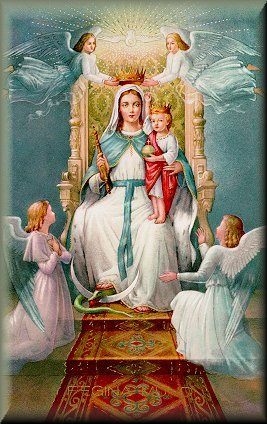 Argument 6). Mary is our Mediatrix, our co-redeemer with Jesus: FICTION
This RCC concept didn’t even emerge until the proclamation from Pope Benedict XV in 1922. But the date of its introduction matters little in contrast to how utterly blasphemous it is to even suggest this, let alone teach as if it’s the truth of God. This idea is in direct violation of God’s Word; Jesus is our advocate (1 John 2:1-2) and “there is one God, and one mediator also between God and men, the man Christ Jesus . . .” (1 Timothy 2:5) not Mary.
 Argument 7). Mary was conceived without sin: FICTION
The idea of the “Immaculate Conception” proclaimed by Pope Pius IX in 1854 has absolutely no foundation in the Scriptures. Even King David (a man after God’s own heart) proclaimed that He was conceived in sin and he was brought forth with iniquity (Psalm 51:5) just like every person ever born.
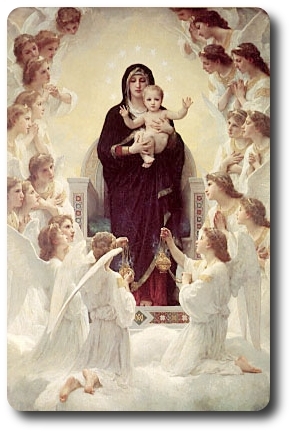 Argument 8). Mary remained sinless her entire life: FICTION
Those who say they have no sin are liars (1 John 1:8); no one does good, not even one (Psalm 14:3); each of us has turned to our own way (Isaiah 53:6); all have sinned (Romans 3:23). This includes Mary. There’s nothing found in Scripture to suggest otherwise. Anyone who claims Mary was sinless is basing this off of their opinion grounded in the purely mythical tradition of man.
Mary proved she was like everyone else (a sinner) when she brought her offering to the temple (Luke 2:24). This was a sin offering that Mary would not have been required to bring had she been sinless (Leviticus 5:11, 12:8). Mary also acknowledged that God was her Savior (Luke 1:47). A sinless person does not need a savior.
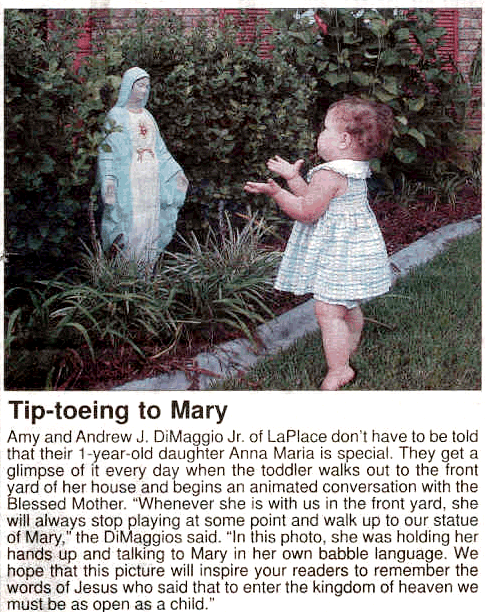 Argument 9). Mary remained a virgin her whole life (perpetual virginity): FICTION
This is not only beyond reason, but it is contradictory to the revealed Word of God, the holy Scriptures. Joseph kept Mary a virgin until Jesus was born (Matthew 1:24-25). This means that after the birth of Jesus, Joseph no longer kept Mary a virgin. Mary and Joseph had other children, the half-brothers and half-sisters of the Messiah. This can be seen in Matthew 12:46-50, Matthew 13:55-57, Mark 6:3-4, John 2:12, John 7:3, 5, 10, Acts 1:14, 1 Corinthians 9:5, and Galatians 1:19. (Before you say, “This was brothers and sisters in the Lord” I suggest you read the context of these passages.)
Additionally, Mary withholding sex from Joseph would have not been in accordance with God’s plans for mankind: “Be fruitful and multiply . . .” (Genesis 1:28); “Do not deprive each other except by mutual consent and for a time, so that you may devote yourselves to prayer. Then come together again so that Satan will not tempt you because of your lack of self-control” (1 Corinthians 7:5).
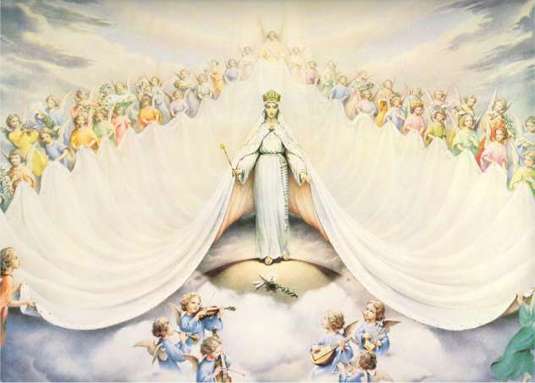 Argument 10). Mary ascended into Heaven: FICTION
The assumption of Mary into Heaven wasn’t even introduced into the RCC until 1950 by then Pope Pius XII, and there is absolutely no Scriptural support for this, not even a hint of it in Scripture.

Argument 11). Mary was the greatest among all born evidenced by the fact that she was “chosen” by God to birth the Messiah: FICTION
If anyone was the greatest ever born it would have been John the Baptist, not Mary. Why? Because Jesus said so. Jesus declared of John the Baptist that of those born among women there is no one greater than John (Luke 7:28). Following the logic of the RCC which drives their adoration/veneration/worship of Mary, one would expect that their devotion to Mary would only be eclipsed by their devotion to John the Baptist, however, this is not the case.
Furthermore, the emphasis put on Mary by the RCC is grossly out of proportion to the emphasis she receives from the Bible. Mary–the earthly mother of Jesus– is never mentioned again in the Bible after Acts 1:14. This means that of the 27 books of the New Testament, only five of them (Matthew, Mark, Luke, John, Acts) contain any reference to Mary. Not what one would expect when one looks at the current deification of her by the RCC. Even when one would expect to find her name among those mentioned in Hebrews 11, (commonly known as the great Hall of Faith), Mary and any reference to her is strangely absent.
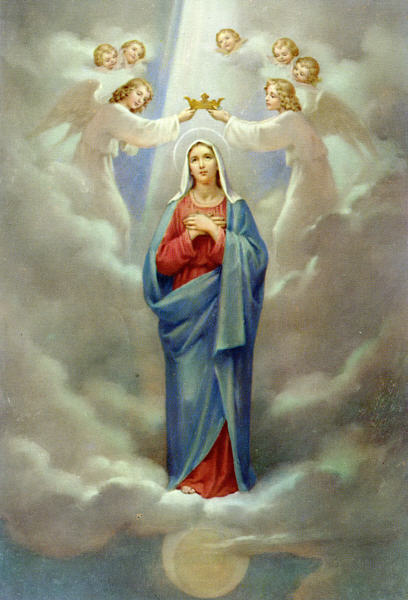 Argument 12). Mary is the Queen of Heaven: FICTION
There is no Queen of Heaven. In fact, the only mention in Scripture of a “Queen of Heaven” (a false god) is in Jeremiah 7:18 in which those who are making cakes to her (and those pouring out drink offerings to other gods) will have the wrath of God poured out on them (Jeremiah 7:20).
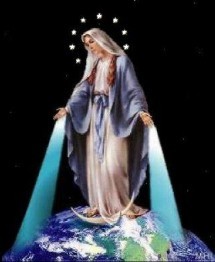 Argument 13). Marian Apparitions are genuine and legitimate: FICTION
Again, no such teaching, example or precedent for this is found in the Scriptures. However, we are told “Marvel not, for even Satan can disguise himself as an angel of light” (2 Corinthians 11:14).
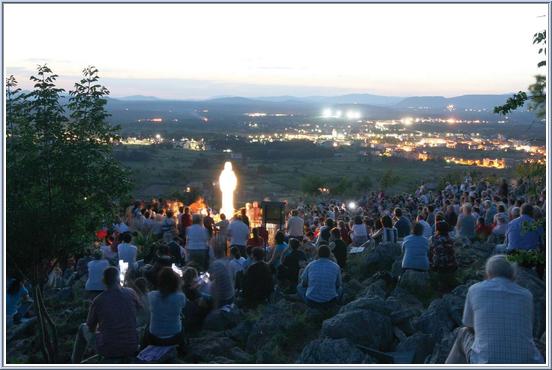
Argument 14). Marian apparition messages are true and from God: FICTION
“You will never be alone. My immaculate heart will be your refuge and the way which will lead you to God.” – Mary Apparition in Fatima
“I alone am able to save you from the calamities that approach. Those who place their confidence in me will be saved.” – Mary Apparition in Akita
“You have seen hell where the souls of poor sinners go. To save them, God wishes to establish in the world devotion to my immaculate heart. If what I say to you is done, many souls will be saved and there will be peace.” – Mary Apparition in Fatima
“. . . I call upon you to open yourselves completely to me so that through each of you I may be enabled to convert and save the world . . .” – Mary Apparition in Medjugorje
The messages of this entity claiming to be Mary ultimately lead people’s attention away from Christ and to herself (itself), not Christ. The Apostle Paul sought to know nothing but Christ and Him crucified (1 Corinthians 2:2). Furthermore, the Apostle Paul warned us that if anyone, even an angel from Heaven, preached a gospel contrary to what was already preached, he/she/it is to be cursed (Galatians 1:6-9).
 Argument 15). Roman Catholic Church (RCC) tradition has provided us the doctrines on Mary: FACT
This is true. The RCC consisting of sinful, fallible, fallen human beings has given the world these traditions of men, but the holy revealed Word of God—given to the prophets by inspiration and by which will never pass away—does not support these legends, myths, and downright heretical false doctrines.

Conclusion:
As noted above, Mary is never spoken of in the history of the Church or the letters (Epistles) to the Church (except in Acts 1:14 where a brief mention of her is made). Nowhere in all the instruction of conduct, examples of operation, and direction given to the early church for its operation and function is Mary ever mentioned, yet today you couldn’t walk into a Roman Catholic Church without bumping into something to do with Mary, and you’d be hard-pressed to find a member of the RCC that would deny Mary as being a pivotal or important part of their life in the mother church. This devotion and near-deification of Mary is something you cannot find anywhere in the early Church. The silence of the Scriptures alone speaks volumes against the RCC’s current obsession with Mary.
“For there is one God, and one mediator also
between God and men, the man Christ Jesus . . .”
1 Timothy 2:5
~~~~~~~~~~~~~~~~~
See the following related posts:
Conversations with a nun in the unlikeliest of places
Mary-Virgin, Virtuous, not to be Vaulted above her position
Was the Apostle Peter the first pope?
The written Word of God and Roman Catholicism
Conversation with a biblically illiterate Roman Catholic.
Veronica, (a member of Jim McGhee’s Catholic church), talks to Trish about what she “feels,” “hopes,” “thinks,” and “believes.” Veronica may sleep well at night having convinced herself of her version of “truth” derived from her opinions (but definitely not Scripture), but she will one day face a righteous, just, and holy God who will not simply overlook sin or anyone’s willful ignorance of His revealed triuth.
It is for the profound biblical ignorance displayed in this video that this blog is in existence.
Let the idols hit the floor!
This is mild compared to what God is going to do to all the false idols of man. Anxiously waiting for the day when all idols are smashed!
 Christ Alone Wyoming


