Why is it that today’s “prophets” always tell you about their visions after the events occur and never before? In the following case, Jim Bakker tells viewers on August 12, 2011, that he predicted 9/11.
He was only a decade late in mentioning it.

Why is it that today’s “prophets” always tell you about their visions after the events occur and never before? In the following case, Jim Bakker tells viewers on August 12, 2011, that he predicted 9/11.
He was only a decade late in mentioning it.
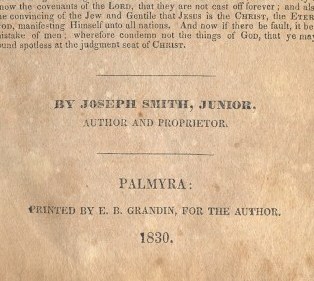
The origin of the Book of Mormon is a fascinating subject as there is clear evidence that its source was not divine, but was actually conjured up in the imagination of Joseph Smith, inspired by similar stories circulating around his time.
It’s precisely because the Book of Mormon was drafted by Joseph Smith (a “poor farm boy” as Mormons like to refer to him) and not divinely inspired, that we’re not surprised to see the almost 4,000 changes, alterations, and corrections to the Book of Mormon since its first publication.
And it doesn’t shock us that many parts of the Book of Mormon are simply plagiarisms from the King James Version of the Bible, including the use of King James English long before there was King James English (just one of the many anachronisms found in the Book of Mormon).
And we’re not stunned that absolutely none of the huge cities and civilizations described in the Book of Mormon have ever been found.
And we’re not astounded that there’s no historical, archeological, or anthropological support for the claims of the Book of Mormon.
And we aren’t astonished that DNA science has actually proven the claims of the Book of Mormon to be false.
And we aren’t beside ourselves that there’s not even one ancient manuscript to support the validity of the Book of Mormon (like the over 25,000 ancient manuscripts that support the Bible).
These are some of the many problems that we’d expect to see from a book created by finite man, not from an inspired work by an infinite God.
So where did this “poor farm boy” get his ideas and inspiration for the Book of Mormon?
 The Stranger
(Author Unknown)
A few months before I was born, my dad met a stranger who was new to our small town. From the beginning, dad was fascinated with this enchanting newcomer, and soon invited him to live with our family. The stranger was quickly accepted and was around to welcome me into the world a few months later.
As I grew up I never questioned his place in our family. Mom taught me to love the word of God, and dad taught me to obey it. But the stranger was our storyteller. He could weave the most fascinating tales. Adventures, mysteries and comedies were daily conversations. He could hold our whole family spell-bound for hours each evening.
If I wanted to know about politics, history, or science, he knew it all. He knew about the past, understood the present, and seemingly could predict the future. The pictures he could draw were so life like that I would often laugh or cry as I watched.
He was like a friend to the whole family. He took Dad, Bill and me to our first football game. He was always encouraging us to see the movies and he even made arrangements to introduce us to several movie stars.
The stranger was an incessant talker. Dad didn’ t seem to mind but sometimes mom would quietly get up while the rest of us were enthralled with one of his stories of faraway places and go to her room, read her Bible and pray. I wonder now if she ever prayed that the stranger would leave.
You see, my dad ruled our household with certain moral convictions. But this stranger never felt obligation to honor them. Profanity, for example, was not allowed in our house–not from us, from our friends, or adults. Our longtime visitor, however, used occasional four letter words that burned my ears and made dad squirm. To my knowledge the stranger was never confronted. My dad was a teetotaler who didn’t permit alcohol in his home–not even for cooking. But the stranger felt like we needed exposure and enlightened us to other ways of life. He offered us beer and other alcoholic beverages often.
He made cigarettes look tasty, cigars manly, and pipes distinguished. He talked freely (too much too freely) about sex. His comments were sometimes blatant, sometimes suggestive, and generally embarrassing. I know now that my early concepts of the man-woman relationship were influenced by the stranger.
As I look back, I believe it was the grace of God that the stranger did not influence us more. Time after time he opposed the values of my parents. Yet he was seldom rebuked and never asked to leave.
More than thirty years have passed since the stranger moved in with the young family on Morningside Drive. He is not nearly so intriguing to my Dad as he was in those early years. But if I were to walk into my parents home today, you would still see him sitting over in a corner, waiting for someone to listen to him talk and watch him draw his pictures.
His name?…..We always just called him…TV
See also The Stranger sermon by Pastor Tim Conway.
 If you want to purchase the Islamic Koran you can now turn to the nation’s leading Christian bookselling website. That’s right, you can now buy the Koran from Christian Book Distributors (CBD).
And CBD is even encouraging the mass distribution of this book (that fuels the terrorism that’s raging around the world and which calls for Jews and Christians to be put to death) by offering a discount of fifty cents per Koran if you order forty or more.
Isn’t this like selling your axe to the executioner as you’re laying your head on the chopping block?
CBD also offers Introducing the Qur’an: For Today’s Reader and Islam: A Short Guide to the Faith
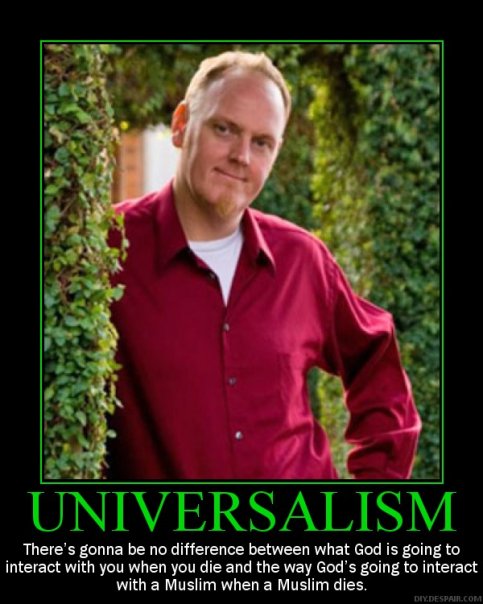
The pied pipers of Universalism (and those wishing to eradicate Christians from the face of the earth) get one more voice of solidarity and support from within our own camp.
I suppose there’s no better time to revisit two questions I posed back in 2008: Are Christian bookstore owners responsible for what they sell? and Do you support your local Christian bookstore?
 Here’s an article by Chris Dunn on his recent experience of visiting a megachurch.
It’s not pretty.
Last Sunday I went to a megachurch. Normally I attend small churches with a gathering of local believers who strive to live according to the Bible.
Having already attended countless churches from many denominations and faiths, I was eager to see what the average parishioner experienced at one of these stadium-sized complexes.
It was horrific. Megachurches like this one can have almost nothing to do with biblical Christianity and may actually do violence to the ‘Word of God.’
Continue the article from Collegiate Times here.
Classic!

You can purchase a similar version of this bumper sticker here, and you can read a blistering article on the foolishness of the Coexist sticker here.
HT: 4 Simpsons
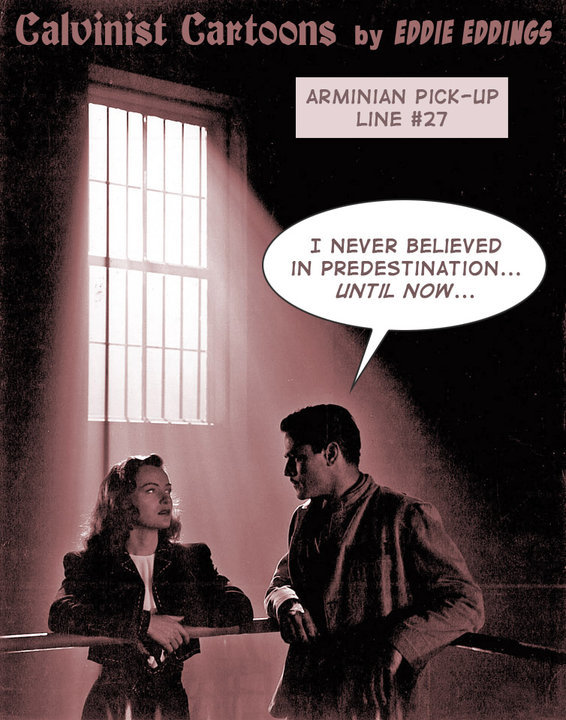 The following is from the Disciple Man blog:
You Might Just Be A Calvinist If….
If you have a Martin Luther Jell-O mold… you just might be a Calvinist.
If your DVR has over 25 episodes of Wretched With Todd Friel recorded on it… you just might be a Calvinist.
If your child’s first word was “Westminster”… you just might be a Calvinist.
If your 4 year old can explain what the word “propitiation” means… you might just be a Calvinist.
If you send your mother tulips on Mother’s Day… you might be a Calvinist.
If your passion for evangelism blows away your Arminian friends… you might just be a (true) Calvinist.
If you hate rap music BUT you listen to Lecrea, The Cross Movement, Flame or D.A. T.R.U.T.H. because of the lyrics and theology… you might be a Calvinist.
If quotes from Pink, Spurgeon, Luther, Piper, and McArthur make up 90% of your Facebook statuses…you might be a Calvinist.
The following is an interesting article from an unlikely source.

What most LDS have been taught in church and believe as truth.
The name of the angel that visited Joseph Smith three times on the night of Sept. 21, 1823 was named Moroni. The name of the angel is mentioned several times in many LDS publications and he has always been referred to as Moroni.
Significant details & problems that most LDS are not aware of.
This angel is the one who told Joseph Smith where the gold plates were buried and can be seen on top of most LDS temples. However, a close examination of early church history tells a different story. Some early LDS sources which say that the angel’s name was actually Nephi are as follows:
Keep reading here.
 I recently published an article on one of Mormonism’s wild claims about big, black, hairy Cain still roaming the earth in the post Mormon Prophet Lends Credibility to a Wild Claim. And, of course, the first response that post received from a Mormon apologist was:
The real shame is that it is simply a waste of time as no self-respecting person would really care enough to take the time to right [sic] about such meaningless prattle. Such a pity.
This was an interesting response considering the fact that it was important enough to Mormon President Spencer W. Kimball to write about it in his book The Miracle of Forgiveness. Evidently it’s only prattle when a non-Mormon discusses the matter.
And apparently one Mormon didn’t get the memo because he’s still talking (and writing) about the Cain/Bigfoot (and racism) matter. Blogger Doug Gibson has risked not being self-respecting because he’s been wasting his time by writing about such prattle when he recently published the post Awareness of Racism Eased Mormon Folk Tales Regarding Cain, Bigfoot. According to Gibson’s article, President Kimball wasn’t the only one in Mormon history to report claims of Cain/Bigfoot sightings.
Although some Mormon apologists would have you ignore such “prattle,” I highly encourage you to read Gibson’s article. And be sure to read all the enlightening comments afterward, like this sample from a commenter named Mikeasell:
Here is the deal: the church likes to teach what they call unchanged, revealed doctrine. When said doctrine becomes unpopular and threatens the church financially, the doctrine gets downgraded quickly to a “teaching” or a “guideline”, then a further downgrade to a “practice”, it is then removed from manuals and books (hence why people of different generations heard or did not hear the stories). Then the practice can simply be “discontinued”. They begin with the Lord has said X because Y is a true principle, live by it or go to hell, then they begin saying well we have been taught in the past that X=Y, then they begin with the “we don’t understand, but we are sure there is a mysterious purpose as to X is somewhat related to Y, but it is not for us to question the Lord”, then the blatant downgrade: we no longer “practice X, X practice has been discontinued, it is not really tied with Y”.
The reality is that the LDS church had inclusion criteria based on race. When it became apparent that the NCAA would allow teams like Stanford to avoid playing BYU and therefore the Church was having their non-profit status reviewed by the IRS, then suddenly (within a month) God changed his mind. Same with polygamy, it went from we will die before we give it up, we will break the law cuz God is a higher law, to sending ppl to Mexico to practice it to eventually pretending it really did not happen for that long or that it was because it was just a trial, there were too many men, etc. . . . .It is amazing to me, shocking really, that people are gullible enough to believe that a never changing restored gospel needs changing all the time, and surprisingly to accommodate cultural pressures. I cannot believe that people that believe in prophets can also believe that those prophets can not agree on basic doctrine, to the point that Joseph Smith, if he were to come back, would be excommunicated from the church he founded because of his beliefs and practices.
 An article from Mormon Coffee offers the following six things you’d expect to see if Mormonism were true. You can read the entire article here.
____________________________________
If Mormonism were true…
1. … Joseph Smith would have been able to consistently, accurately, remember his visit from two separate supernatural beings, God the Father and Jesus the Son. We now know that is not the case (for more info, see here, here, and here).
2. …the LDS “truth” that there are at least two gods, our Heavenly (spirit) Father, whose name is Elohim, and Jesus (Elohim’s son), whose spirit-name is Jehovah, would have been consistent since Mormonism’s beginnings. Instead, the Book of Mormon, Joseph Smith’s first work, preaches that there is only one (modal) God (see Alma 11:26-31, 2 Nephi 31:21, Mosiah 15:1-5 for example). Joseph Smith originally taught that Jesus’ father’s name was Jehovah, and Brigham Young, Mormonism’s second prophet, taught that Heavenly Father was actually Adam, the first man on earth. Joseph also originally taught that of the three members of the “Godhead,” only Jesus had a body. That of course is no longer Mormon belief.
3. …the Book of Mormon, a book that is supposed to contain the “fulness of the gospel,” would teach on the plurality of gods, man’s potential for godhood, eternal marriage in Mormon temples, baptism for the dead, three degrees of heaven, and the other beliefs that separate Mormonism from orthodox Christianity. Not only does the Book of Mormon not teach these things, it and the other LDS scriptures frequently contradict current Mormon truths, and each other.
4. …there would be evidence of a large battle on or around the Hill Cumorah in New York, and other archeological evidence to support the notion of Book of Mormon life on this continent. Instead, LDS apologists are still struggling to locate and identify possible Book of Mormon geography sites (see also here and here).
5. …the Book of Mormon would not contain Greek and French words like “adieu” and “Jesus” and “Alpha” and “Omega.” It would not speak of things that had not yet been invented. It would not contain quotes from the KJV Bible, including KJV mistakes. It would not abuse the phrase “it came to pass” in all of its books but two. It would not contain country-boy vernacular. But it does.
6. …when portions of the papyri used to create the Book of Abraham were recovered and translated, the text would be very similar to what Joseph had written. Instead, just as you would expect if Joseph Smith had bought merely a couple of random mummies that had been found in an ordinary catacomb from a man with many mummies and scraps to sell, the papyri has been discovered to be common Egyptian funerary documents.
 You hear Mormons say it all the time whenever you challenge any of their doctrines: “We never attack other faiths.” Or, “We never disparage other religions.” Or, “We’re too busy sharing the gospel to be negative about other people’s beliefs.”
For those who know better, these words are usually uttered out of either a profound ignorance of their own religion or a desperate attempt to get you off topic and put you on the defensive.
It is a fact that Mormonism has attacked, disparaged, ridiculed, and spoken negatively about the Christian faith (anyone who knows Mormon history knows this; it’s not even debatable).
The very Mormon organization is founded on a preemptive attack of Christianity. Mormonism’s founder, Joseph Smith, claimed that all of Christianity was apostate. Without his assault on the Christian faith, the impetus for Joseph Smith’s religion is removed and there would be no need for Mormonism.
Simply put, Mormonism’s very existence is predicated on the lie that Christianity is apostate, the Bible is mistranslated, Christ’s sacrifice was insufficient, and “The Christian God is the Mormon’s Devil.”
And other early Mormon leaders were not shy with divulging their disdain for our faith. See this article to read some of the mean, nasty and downright hateful things uttered about Christians by Mormon prophets, leaders, and apologists.
And inevitably there will be Mormons who claim, “We don’t teach that anymore” as if truth one day is a non-truth the next (and notice that they rarely ever say, “We don’t BELIEVE that anymore“). If they were honest they’d say, “We’re just more subtle about it now.”
The below video from the June 2011 Manti Pageant reveals that the well-hidden derogatory sentiment against Christians by the Church of Jesus Christ of Latter-day Saints (and some not so hidden) is still alive and well.
Thanks to Mormon Coffee for posting the video and astutely observing:
In this short clip, the Mormon Church pageant makes fun of the Christian doctrines pertaining to the nature of God and eternal punishment, portrays Christian pastors as being unwilling or unable to answer the most basic of life’s questions, and misrepresents the “fervor of religious revival” with “the exhortations of contending preachers, each proclaiming his own church the only avenue of escape from the horrors of a burning hell.” The narrator jeers, “Amen, Hallelujah”; one of three pontificating preachers drones, “It is only here that you will find salvation. Only here,” while churchgoers dismiss the play’s sincere truth-seekers, Mary and Robert, with an annoyed sweep of their arms.

“Will you love your brothers or sisters likewise, when they have committed a sin that cannot be atoned for without the shedding of their blood? Will you love that man or woman well enough to shed their blood?”
– Brigham Young as recorded in Journal of Discourses Volume 4 Page 219
“If you want to know what to do with a thief that you may find stealing, I say kill him on the spot, and never suffer him to commit another iniquity.”
– Brigham Young as recorded in Journal of Discourses Volume 1 Page 108
“Men, who have been warned and forewarned, but who will associate with the wicked and take a course to commit whoredom, and will strive to lead our daughters and our wives into the society of poor, wicked curses, with a view to gratify their cursed passions; we will take them and slay them before this people.”
– Heber C. Kimball as recorded in Journal of Discourses, Volume 4, Page 173
As the debate among Christians continues on whether or not they would (or should) vote for a Mormon for president, and whether or not a Mormon president would be a good thing for our nation, there is a concern that has gone virtually unmentioned that I’d like to bring to your attention.
During the early years of The Church of Jesus Christ of Latter-day Saints (LDS), a doctrine was taught (and practiced) that essentially gave Mormons the divine right to take another man’s life, believing not only that it was sanctioned by God, but that by doing so they were doing the victim a favor.
“There are sins that men commit for which they cannot receive forgiveness in this world, or in that which is to come, and if they had their eyes open to see their true condition, they would be perfectly willing to have their blood spilt upon the ground, that the smoke thereof might ascend to heaven as an offering for their sins; and the smoking incense would atone for their sins, whereas, if such is not the case, they will stick to them and remain upon them in the spirit world. I know, when you hear my brethren telling about cutting people off from the earth, that you consider it is a strong doctrine; but it is to save them, not destroy them.”
– Brigham Young as recorded in Journal of Discourses Volume 4 Page 53
This Mormon doctrine, known as Blood Atonement, calls for the murder of those who commit sins that the blood of the Mormon Jesus can’t cleanse.
“It is true that the blood of the Son of God was shed for sins through the fall and those committed by men, yet men can commit sins which it can never remit.”
– Brigham Young as recorded in Journal of Discourses Volume 4 Page 54
Mormons actually believed that they were doing what Christ could not do; namely, saving a sinner’s soul. In this upside down world of Mormon atonement—which is completely antithetical to God’s plan of redemption as revealed in the Bible—even King David was unable to be fully forgiven by God for his sins and had to pay for his own sins in Hell.
According to Mormonism, even the sin of adultery could not be atoned for by God’s Son, and was cause for men and women needing their own blood shed:
“Suppose you found your brother in bed with your wife, and put a javelin through both of them, you would be justified, and they would atone for their sins and be received into the kingdom of God. I would at once do so in such a case; and under such circumstances, I have no wife whom I love so well that I would not put a javelin through her heart, and I would do it with clean hands. . . . There is not a man or woman who violates the covenants made with their God, that will not be required to pay the debt. The blood of Christ will never wipe that out, your own blood must atone for it.”
– Brigham Young as recorded in Journal of Discourses Volume 3 Page 247
Not surprisingly, like many early Mormon teachings that later Mormon leaders felt were politically expedient to downplay, deny, or reverse (like racism, Adam was God, polygamy, the Mormon god’s sexual encounter with Mary, spiritual vegetables, people living on the moon, people living on the sun, etc.), their doctrine of Blood Atonement eventually just went away.
So, what bearing does this have on whether or not a Mormon is elected president? And how is the doctrine of Blood Atonement that’s no longer practiced (at least by the mainstream denomination of Mormonism) germane to American politics? And why should we be concerned about it now?
The answer lies in the reason they don’t practice it.
Mormon apologists claim they no longer practice Blood Atonement because it can only be practiced when the power of the government and the power of the church are in the same hands:
“This doctrine can only be practiced in its fulness in a day when the civil and ecclesiastical laws are administered in the same hands. It was, for instance, practiced in the days of Moses, but it was not and could not be practiced in this dispensation . . . .”
– Bruce R. McConkie as recorded on page 93 of his book Mormon Doctrine (1966 edition)
If either Mormon presidential candidate Romney or Jon Huntsman is elected president of the United States, then the civil and ecclesiastical laws will be in the same hands of the LDS organization, thus, there would be nothing preventing them from lifting their moratorium on shedding the blood of sinners. And, after all, they would be doing a great service to those caught up in sins that the Mormon Jesus simply can’t redeem them from.
But there is one thing that will stop them from following through with the words of their own prophets concerning Blood Atonement: Their insatiable appetite to protect the façade that they’re actually Christians.
Should a Mormon be elected president, the largest obstacle to their reinstitution of Blood Atonement would be that it would gravely hurt their proselytizing efforts. And as anyone who’s studied Mormon history knows, modern mainstream Mormonism will sacrifice their former principles and doctrines anytime it becomes politically expedient to do so. When times change, so does the mind of Mormonism’s god.
Modern Mormons have worked too hard to distance themselves from the uncomfortable teachings of their past prophets, while simultaneously (and ironically I might add) tirelessly working to reinvent themselves to appear to the unsuspecting and undiscerning as Christians, (the very Christians—and Christian faith—they consider apostate).
If the LDS organization loses converts it loses money. I don’t believe that the current LDS propaganda machine would do anything to jeopardize their new mainstream image, but with the “civil and ecclesiastical laws” being “administered in the same hands” the ban from practicing Blood Atonement would be gone, and that is a more frightening prospect than a promised tax hike.
To learn more about Blood Atonement, see:
The Mormon doctrine of Blood Atonement as taught by Brigham Young
The Doctrine of Blood Atonement as taught by the Mormon organization
“The wickedness and ignorance of the nations forbid this principle’s [sic] being in full force, but the time will come when the law of God will be in full force. This is loving your neighbour [sic] as ourselves; if he needs help, help him; and if he wants salvation and it is necessary to spill his blood on the earth in order that he may be saved, spill it. Any of you who understand the principles of eternity, if you have sinned a sin requiring the shedding of blood, except the sin unto death, would not be satisfied nor rest until your blood should be spilled, that you might gain that salvation you desire. This is the way to love mankind.”
– Brigham Young as recorded in Journal of Discourses Volume 4 Page 220
 4Mormon.org provides the following quick-reference chart and asks the question: “If Mormonism has ‘restored’ the Aaronic and Melchizedek Priesthoods, why is its version different from the Biblical version?“
|
Mormon Priesthood
|
Biblical Priesthood
|
|
All LDS males are ordained to the Aaronic Priesthood
|
Must be of the Lineage of Aaron (Num. 3:6, 10; Heb. 7:5, 11-14)
|
|
Deacons are 12 year old boys
|
Deacons are husbands (I Tim. 3:8)
|
|
Males with Defects are Accepted (Joseph Smith had a leg defect)
|
Must Be Physically Blameless (Leviticus 21:1-23)
|
|
Priests do not perform blood sacrifices, nor follow biblical rites
|
Priests perform blood sacrifice and special rites (Leviticus 8)
|
|
Many “High Priest” Bishops
|
One legal “High Priest” at a time
|
|
Many LDS Males receive the Melchizedek Priesthood
|
Only Jesus qualified for office of Melchizedek (Heb. 7:1-4, 23-28)
|
|
LDS Males transfer to others the Melchizedek Priesthood
|
Melchizedek Priesthood is non- transferable (Hebrews 7:23-24)
|
If only he stopped talking at the 40 second mark . . . if only.

“A Letter to Paul the Apostle”
The Trinity Review, July, August 1988
Copyright (C) 2003
_______________________________________________________
Charles Phinney
Presbyterian Church in Asia Minor
Committee on Missions
Paul the Apostle
c\o Aquila the Tentmaker
Corinth, Greece
Dear Paul:
We recently received a copy of your letter to the Galatians. The committee has directed me to inform you of a number of things, which deeply concern us.
First, we find your language to be somewhat intemperate. In your letter, after a brief greeting to the Galatians, you immediately attack your opponents by claiming they “want to pervert the gospel of Christ.”
You then say that such men should be regarded as “accursed”; and, in another place, you make reference to “false brethren.” Wouldn’t it be more charitable to give them the benefit of the doubt—at least until the General Assembly has investigated and adjudicated the matter?
To make the situation worse, you later say, “I could wish those who trouble you would even cut them selves off!” Is such a statement really fitting for a Christian minister? The remark seems quite harsh and unloving.
Read the entire letter here.
HT: Flock Alert
 If the Apostle Paul’s letter to the Church in Galatia had been published in the magazine Christianity Today how would it be received? Well, what follows is a dramatization of letters received from readers in response to Paul’s inspired Epistle.
(Source: Sacred Sandwich)
Dear Christianity Today:
In response to Paul D. Apostle’s article about the Galatian church in your January issue, I have to say how appalled I am by the unchristian tone of this hit piece. Why the negativity? Has he been to the Galatian church recently? I happen to know some of the people at that church, and they are the most loving, caring people I’ve ever met.
Phyllis Snodgrass; Ann Arbor, MI
————————————————————————
Dear Editor:
How arrogant of Mr. Apostle to think he has the right to judge these people and label them accursed. Isn’t that God’s job? Regardless of this circumcision issue, these Galatians believe in Jesus just as much as he does, and it is very Pharisaical to condemn them just because they differ on such a secondary issue. Personally, I don’t want a sharp instrument anywhere near my zipper, but that doesn’t give me the right to judge how someone else follows Christ. Can’t we just focus on our common commitment to Christ and furthering His kingdom, instead of tearing down fellow believers over petty doctrinal matters?
Ed Bilgeway; Tonganoxie, KS
————————————————————————–
Dear CT:
I’ve seen other dubious articles by Paul Apostle in the past, and frankly I’m surprised you felt that his recurrent criticisms of the Church deserved to be printed in your magazine. Mr. Apostle for many years now has had a penchant for thinking he has a right to “mark” certain Christian teachers who don’t agree with his biblical position. Certainly I commend him for desiring to stay faithful to God’s word, but I think he errs in being so dogmatic about his views to the point where he feels free to openly attack his brethren. His attitude makes it difficult to fully unify the Church, and gives credence to the opposition’s view that Christians are judgmental, arrogant people who never show God’s love.
Ken Groener; San Diego, CA
—————————————————————————-
To the Editors:
Paul Apostle says that he hopes the Galatian teachers will cut off their own privates? What kind of Christian attitude is that? Shame on him!
Martha Bobbitt; Boulder, CO
—————————————————————————-
Dear Christianity Today:
The fact that Paul Apostle brags about his public run-in with Peter Cephas, a well-respected leader and brother in Christ, exposes Mr. Apostle for the divisive figure that he has become in the Church today. His diatribe against the Galatian church is just more of the same misguided focus on an antiquated reliance on doctrine instead of love and tolerance. Just look how his hypercritical attitude has cast aspersions on homosexual believers and women elders! The real problem within the Church today is not the lack of doctrinal devotion, as Apostle seems to believe, but in our inability to be transformed by our individual journeys in the Spirit. Evidently, Apostle has failed to detach himself from his legalistic background as a Pharisee, and is unable to let go and experience the genuine love for Christ that is coming from the Galatians who strive to worship God in their own special way.
William Zenby; Richmond, VA
——————————————————————————
Kind Editors:
I happen to be a member of First Christian Church of Galatia, and I take issue with Mr. Apostle’s article. How can he criticize a ministry that has been so blessed by God? Our church has baptized many new members and has made huge in-roads in the Jewish community with our pragmatic view on circumcision. Such a “seeker-sensitive” approach has given the Jews the respect they deserve for being God’s chosen people for thousands of years. In addition, every Gentile in our midst has felt honored to engage in the many edifying rituals of the Hebrew heritage, including circumcision, without losing their passion for Jesus. My advice to Mr. Apostle is to stick to spreading the gospel message of Christ’s unconditional love, and quit criticizing what God is clearly blessing in other churches.
Miriam “Betty” Ben-Hur; Galatia, Turkey
——————————————————————————-
EDITOR’S NOTE: Christianity Today apologizes for our rash decision in publishing Paul Apostle’s exposé of the Galatian church. Had we known the extent in which our readership and advertisers would withdraw their financial support, we never would have printed such unpopular biblical truth. We regret any damage we may have caused in propagating the doctrines of Christ.
 The following is from Flock Alert:
“Many are honestly confused about the Federal Vision, and are looking for a quick, basic understanding of it. As such, here we offer a crash course about this enormously influential movement.
“The following resources demonstrate that the Federal Vision is indeed a heresy of the worst kind, and perverts almost every doctrine related to salvation. It is [sic] has much in common with N. T. Wright’s theology, and is essentially a form of Roman Catholicism in sheep’s clothing. It denies justification by faith alone, Christ’s active obedience, and perseverance of the saints, and holds to salvation by works (for instance, the soul damning heresy of baptismal regeneration).”
Read the entire article here.
Source: Just Stop And Think
As a follow-up to What did C.S. Lewis really believe? I offer this video from Todd Friel of Wretched Radio.
 Christ Alone Wyoming