 He that seems righteous toward men, and is irreligious toward God, is but an honest heathen; and he that seems religious toward God, and is unrighteous toward men, is but a fake Christian.
– George Swinnock
1627 – 1673

He that seems righteous toward men, and is irreligious toward God, is but an honest heathen; and he that seems religious toward God, and is unrighteous toward men, is but a fake Christian.
– George Swinnock
1627 – 1673
First came the Rubber Ducky Nativity, now here’s this gem depicting the birth of Christ. Nothing says Christmas like psychedelic frogs, eh?

 Far too much of today’s evangelical world has been swept up in the powerful magnetic field of the secular popular culture. Thinking they’re doing God’s work behind enemy lines of the atheistic popular culture, they’ve gradually and inadvertently taken on many more characteristics and attitudes of the enemy than they realize. That’s why, when I drive my car and turn on the radio, it sometimes takes several minutes before I can figure out whether I’m listening to a regular, secular rock song or a Christian rock song. They often sound uncannily the same–the Christian song being a virtual clone of the secular. In turn, the powerful popular culture ridicules evangelicals for their lame imitation of the real thing.
– David Kupelian
Benny Hinn attempts to defend himself . . . he doesn’t do such a good job.
From Justin Taylor:
Just in case you need a refresher on the numbers, here’s some of what they found on an expense report:
- cost of his 7,000 sq-ft house: $10-million
- amount spent per month for his private jet: $112,000
- price of his two cars: $80,000 each
- cost per night for staying at 5,400 sq ft luxury hotel room during a “layover”: $10,800 per night paid
- tips for a 3-day period: $4,500.
 Your sermon of the week is Sola Scriptura: The Supremacy of Scripture by Brian Borgman. This is part four of a thirteen-part series entitled Introduction to the Reformed Faith that Pastor Borgman gave in 1998. Look for the each additional installment (in order) every couple weeks. See the last installment here.
 It’s that wonderful time of the year again–the Christmas season. But unfortunately, along with the fresh snow, smell of baked goods, time spent with family and friends, and joyous holiday memories in the making, this time of the year also comes with an unavoidable annoyance. No, not fruitcake. I’m referring to all the keep Christ in Christmas campaigns with their bumper stickers and yard signs, and it’s Ok to wish me a Merry Christmas car magnets and buttons.
Do I have a problem with Christ being remembered as the reason Christians celebrate Christmas? Absolutely not. Am I happy with the removal of Christ from the very holiday that’s supposed to be celebrating His birth? No way. Do I think the secularization of Christmas is a positive trend? Certainly not. Am I pleased with the mass consumerism that Christmas has become? Never. Is this post about whether or not Christians should even celebrate Christmas? Nope.

This post is about my issue with the yearly keep Christ in Christmas campaigns accompanied with all their recommended boycotts of stores that choose “Happy Holidays” over “Merry Christmas.” My issue with these campaigns, however, is not in the substance of their arguments (stopping the expunging of Jesus Christ from Christmas), but my issue is in their misapplied efforts to correct what they deem as a sin almost equivalent to Judas’ betrayal of Christ. These folks with the best of intentions have grossly misdiagnosed the problem: It’s not them (the world), it’s us (the church).
Before I continue I want to acknowledge that it’s true, Christmas’ origins aren’t even Christian and most of the Christmas traditions we cherish today (Christmas trees, candy canes, tinsel, bulbs, stockings, mistletoe, yule logs, eggnog, etc.) cannot be supported by Scripture. Although I understand that there are many who want to argue against Christmas on those points, this is not what this post is about. The basis of this post can be summed up by these two points:
1. – Many of the most vocal opponents of the secularization of Christmas make nary a peep all year long to the secularization taking place within the church itself.
2. – These same folks fail to recognize that the true source of the removal of Christ from Christmas is only a result of the removal of Christ from our culture due to the removal of Christ from our churches; something that began a long time ago (long before secular retailers opted for “Happy Holidays” over “Merry Christmas”).
The secularization of Christmas is just a visible sore caused by the underlying affects of a cancer that’s ravaging the church. Trying to “save Christmas” while the bigger issue looms over us is like baling out a sinking boat with a thimble or putting a band-aid on a bullet wound. Your efforts may make you look busy and cause you to feel that you’re doing some good, but in reality they’re both just a waste of time against the tidal wave of the inevitable. Additionally, your efforts also adversely serve as a diversion from the real problem.
I am convinced that the efforts of these social-conscious Christians is not only futile, but distracting. You only hear from these Christians around the Christmas season bemoaning the secularization of the holiday while they remain passive to the secularization that’s crept into their churches all year long with its deadly poisons of lukewarmness and rank heresy.
So what’s my solution? Am I complaining just to complain and be a Scrooge? Not this time.
 My recommendation is that first, these seasonal activists recognize that the world is acting like the world. We wouldn’t expect a goldfish to act like a tiger, so why do we expect unregenerate sinners to act like Christians during Christmas time, or at any other time for that matter?
Those of the flesh are hostile toward God. Forcing them to keep Christ in Christmas accomplishes nothing but provides them with a false sense of religious security: “But God, I went to church every Christmas.”
Secondly, stop holding Target, Starbucks, Wal-Mart, and GAP responsible for the spiritual stagnation of your community, church, and family, and start holding your pastors responsible! When your pastor preaches cutesy little candy-coated, Osteenesque-type, esteem-building, Christ-less lectures about your best life now, protest that!
Finally, teach your children the true meaning of why we celebrate Christmas. Emphasize the real reason Christ stepped from Heaven to be born among men. Be faithful to your calling as parents to teach your children the faith, and don’t abdicate that responsibility to some biblically illiterate youth pastor.
Never let your kids for one moment think that the real story of Christ’s incarnation is about anything other than Christ and Him crucified. The whole point of Christ’s birth was not for gift exchanges and office parties, it was about God making Him who knew no sin to become sin on our behalf so that we might become the righteousness of God in Him (2 Corinthians 5:21).

So here’s my question: If these proponents of keeping Christ in Christmas prevailed today, and everybody put Christ back in Christmas tomorrow, in the realm of eternity, what will they have actually accomplished? Would they have not successfully created a throng of hypocrites who honor God with their lips but whose hearts are far from Him?
Continuing to bemoan the absence of Christ from Christmas while remaining quiet on the absence of Christ in our pulpits is like complaining about the smoke burning your eyes while your house is burning down with your family trapped inside.
Have a Merry Christmas.
 Too many Christians, just like their unsaved counterparts, are impressed by appearances rather than structure; are seeking thrills and excitement rather than substance; are more apt to respond to emotional manipulation than a rational discourse. How does a church compete in this rather crowded marketplace? If entertainment has become the standard way of life (as some are suggesting) then how can the churches vie unless they become a bastion of entertainment? But if it gives way to this powerful temptation has not the church been transformed into something other than the church?
– Garry Gilley
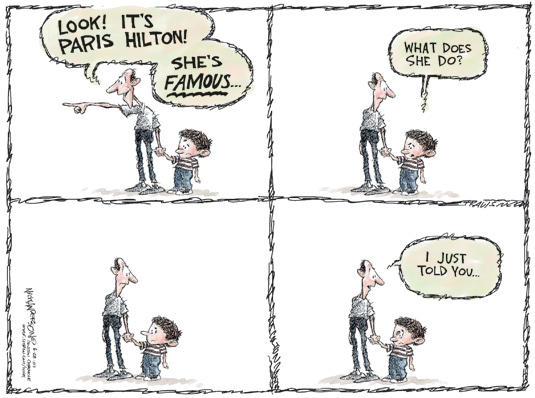
Paul Proctor has written a much needed piece on the idolatry of celebrity worship, something that has taken our culture by storm. Here’s a quote from the article:
Under their exploited influence, our envy and infatuation often bypasses logic, reason and sound judgment, persuading us to listen and follow their lead even though they don’t know us and we don’t know them beyond the manufactured and well-guarded image we see and hear in the media.
This is the mysterious power of celebrity – a seductive and intoxicating force that too many covet and too few fear – a form of inebriation and delusion, and at times, insanity that incites brazen and bizarre behavior from those who fawn at the feet of fame, making them say and do things they would not otherwise.
The next time you happen to be anywhere near a celebrity, don’t watch them – watch the people around them and you’ll better understand what I’m talking about. Hopefully, what you see and hear will be offensive enough to keep you from being brought under the celebrity’s spell.
Proctor also addresses this same phenomenon within the church as he cites one pastor’s starry-eyed infatuation with the universalist Billy Graham. To read Proctor’s entire article, click here.

Within fifty years of the death of the last of the apostles, so far as we can now learn, the Gospel of God’s grace almost ceased to be preached. Instead of evangelizing, the preachers of the second and third centuries gave themselves to philosophizing. Metaphysics took the place of the simplicity of the Gospel. Then, in the fourth century, God mercifully raised up a man, Augustine, who faithfully and fearlessly proclaimed the Gospel. So mightily did God empower both his voice and pen that more than half of Christendom was shaken by him. Through his instrumentality came a Heaven-sent revival. His influence for good staved off the great Romish heresy for another century. Had the churches heeded his teaching, popery would never have been born. But they turned back to vain philosophy and science, falsely so-called. Then came the Dark Ages, when for centuries the Gospel ceased to be generally preached. Here and there feeble voices were raised, but most of them were soon silenced by the Italian priests. It was not until the fifteenth century that the great Reformation came. God raised up Martin Luther, who taught in no uncertain terms that sinners are justified by faith and not by works.
– A.W. Pink
1886 – 1952
 Our purest works are no better than filthy rags, when tried by the light of God’s holy law. . . . Our best things are stained and tainted with imperfection. They are all more or less incomplete, wrong in the motive or defective in the performance.
– J.C. Ryle
1816 – 1900
 Your sermon of the week is another good one from Randall Easter entitled Our Identity in Christ. Again, pastor Easter steps on toes as he preaches the Word without compromise.
HT: The Bororean
 Error is like leaven of which we read, a little leaven leaveneth the whole lump. Truth mixed with error is equivalent to all error, except that it is more innocent looking and, therefore, more dangerous. God hates such a mixture! Any error, or any truth-and-error mixture, calls for definite exposure and repudiation. To condone such is to be unfaithful to God and His Word and treacherous to imperiled souls for whom Christ died.
– Harry Ironside
1876 – 1951
 You know there are two great plagues that have distressed the church of Christ and it will never be quite free from them; a multitude of hypocrites on a fair day, and a multitude of apostates on a foul day.
– Robert Traill
1642 – 1716
 The following Q & A with Voddie Baucham is from Unashamed Workman.
1. Where do you place the importance of preaching in the grand scheme of church life?I believe preaching is central to the grand scheme of church life (see Acts 2:42ff). Preaching/teaching sets the tone and the parameters for all other functions of the church. Our understanding of fellowship, evangelism, discipline, worship, etc., all arise out of our understanding of God’s word. Without sound preaching and teaching, all else will falter. Hence, preaching is of seminal importance in the grand scheme of church life.
2. In a paragraph, how did you discover your gifts in preaching?As a young college student, I went on a preaching mission with several teammates of mine. I was a relatively new believer and had no experience sharing God’s word. Two of my mentors guided me through the week and helped me discover my gifts in preaching for the first time. I felt as though something in me was awakened for the first time. I’ve been preaching ever since.
3. How long (on average) does it take you to prepare a sermon?
When we start a series (preaching through a book or section), it can 15-20 hours or more. However, once we are in the midst of the text much of the background work builds upon previous studies and cuts the time dramatically. Nevertheless, crafting the message, adding illustrative material and mining the text for that last nuance, is a process that never really ends until the preaching moment. That’s the only time I can truly say I am finished preparing the sermon.4. Is it important to you that a sermon contain one major theme or idea? If so, how do you crystallise it?
Absolutely! I am always looking for the central theme in a passage. There may be more than one, but I have come to realize that I am most effective when I limit myself to the main idea. I find that idea by analyzing the paragraph, then the broader context of the section, then the book as a whole, then its place in the broader revelation. Then I go through the process in reverse back down to the passage in question.
5. What is the most important aspect of a preacher’s style and what should he avoid?
The most important aspect of a preacher’s style is authenticity. When I started preaching, I thought my ‘style’ had to fit a certain category. As a result I mimicked some of my favorite preachers. I was constantly reinventing myself. Ultimately, I had to find my own ‘style’ and stick with it. That meant there was one less thing I had to manufacture. I had to realize that God gave me a unique personality and he intended to use it in unique ways. God gave us four gospels written by four unique men, from four different perspectives. I had to remind myself that it is as much of a travesty for me to try to be Tony Evans as it would have been for John to try to be Matthew.
A Christian, if he has not a care, may be proud of his very humility. It is hard starving this sin, because it can live on almost nothing. . . . Be much in meditation on death and judgment. A serious and frequent meditation on death will be a means to kill pride. Ask yourself: “What is man, but a little living lump of clay? And what is his life, but “a vapor, that appeareth for a little time, and then vanisheth away?”
– Richard Mayo
1631 – 1695
 I believe one of the greatest crutches in the church is the nursery. Parents who have neglected to train their children have very little encouragement to do so when there is a place to hide them. The father who should be up in arms by the time he gets home from church because of the embarrassment to which his child subjected him ends up going home with a clear conscience while the nursery worker takes a handful of aspirin.
– Voddie Baucham
 Now I should like to know whether your soul, tired of it’s own righteousness, is learning to be revived by and to trust in the righteousness of Christ. For in our age the temptation to presumption besets many, especially those who try with all their might to be just and good without knowing the righteousness of God which is most bountifully and freely given us in Christ. They try to do good of themselves in order that they might stand before God clothed in their own virtues and merits. But this is impossible…Therefore, my dear brother, learn Christ and Him crucified. Learn to pray to him and, despairing of yourself, say, “Thou, Lord Jesus, art my righteousness, but I am thy sin. Thou hast taken upon thyself what is mine and hast given to me what is thine. Thou have taken upon thyself what thou wast not and hast given to me what I was not.” … For why was it necessary for him to die if we can obtain a good conscience by our own works and afflictions? Accordingly you will find peace only in him and only when you despair of yourself and your own works. Besides, you will learn from him that just as he has recieved you, so he has made your sins his own and made his righteouness yours.
– Martin Luther (From a letter to George Spenlein)
1483 – 1546
 Catholics are totally dependent upon priests for their salvation. It is the priest who is said to cause regeneration and justification in baptism (CCC 1992, 1213); absolve mortal sins in the confessional; dispense the body and blood of Jesus in the Eucharist; impart the Holy Spirit in the sacrament of Confirmation; and offer the sacrifice of the Mass for souls suffering in purgatory. It is no wonder why Catholics trust their religion and their priests as mediators to usher them into Heaven.
– Mike Gendron
For those familiar with Paul Washer’s “Shocking Sermon” (featured on DefCon here), you will want to check out the following eleven-minute interview piece in which Paul Washer explains the circumstances preceding his delivery of that sermon to 5,000 youth.
You can watch the interview below, or download the audio by right-clicking here.
 Christ Alone Wyoming