What Vine are you Abiding In? (Part 1)

One of my favorite passages in scripture is Jesus’ teaching on the vine and the branches. Let’s look at what it means for Christ to be the vine and for the believer to be the branch.

John 15:1-11
15:1 “I am the true vine, and my Father is the vinedresser. 2 Every branch in me that does not bear fruit he takes away, and every branch that does bear fruit he prunes, that it may bear more fruit. 3 Already you are clean because of the word that I have spoken to you. 4 Abide in me, and I in you. As the branch cannot bear fruit by itself, unless it abides in the vine, neither can you, unless you abide in me. 5 I am the vine; you are the branches. Whoever abides in me and I in him, he it is that bears much fruit, for apart from me you can do nothing. 6 If anyone does not abide in me he is thrown away like a branch and withers; and the branches are gathered, thrown into the fire, and burned. 7 If you abide in me, and my words abide in you, ask whatever you wish, and it will be done for you. 8 By this my Father is glorified, that you bear much fruit and so prove to be my disciples. 9 As the Father has loved me, so have I loved you. Abide in my love. 10 If you keep my commandments, you will abide in my love, just as I have kept my Father’s commandments and abide in his love. 11 These things I have spoken to you, that my joy may be in you, and that your joy may be full.

BACKGROUND AND CONTEXT
Before we get into the meat of this passage we need to consider the context and set the stage a bit. Just two chapters previous to our passage, we see Jesus and the disciples entering the upper room to celebrate the Passover together. This was likely just a few hours before Jesus teaches on the vine and the branches. In the upper room, Christ knows he is on his way to the cross his time has come. While in the upper room during the Last Supper, we see Jesus teach his disciples these humongous truths:

(a)  Jesus washes the feet of the disciples and introduces servant leadership – to love one another (John 13:1-17)
(b)  Jesus tells of a disciple who will betray him. (John 13:18-30)
(c)  Jesus introduces communion – (Mat 26:26-29)
(d)  Jesus introduces the new covenant of his blood (Luke 22:20)
(e)  Jesus introduces a new commandment – love one another (John 13:31-35)
(f)  Jesus foretells of Peter’s denial (John 13:36-38)
(g)  Jesus drops the deity bomb by declaring that He is the Way, the Truth, and the Life and no one comes to the Father except through him…and if you have seen him you have seen the father. (John 14:1-14)
(h)  Jesus promises the coming of the Holy Spirit (John 14:16)

Christ, after casually dropping these huge topics on his unsuspecting disciples during this  dinner, he says in  John 14:31: “Rise and let us go from here!” The disciples, I’m sure, are sitting at the table looking at each other a bit shell shocked asking, “What did he say? Another is coming? A Helper? Who? What was that about eating his body? Blood what? Hey, what about the blood?” As Jesus gets up and moves on…probably leaving the disciples at the table scrambling to catch up with him.

I AM THE VINE AND YOU ARE THE BRANCHES
Christ and the disciples leave the upper room that evening, likely dark by then, and make their way towards the Garden of Gethsemane. It is sometime during this walk that Jesus teaches on the Vine and the Branches. According to various commentaries, there are a couple of possible reasons why Christ compares himself to a vine and defines himself as the TRUE Vine.

Continue reading

Christian Book Distributors now selling the Koran.

If you want to purchase the Islamic Koran you can now turn to the nation’s leading Christian bookselling website. That’s right, you can now buy the Koran from Christian Book Distributors (CBD).

And CBD is even encouraging the mass distribution of this book (that fuels the terrorism that’s raging around the world and which calls for Jews and Christians to be put to death) by offering a discount of fifty cents per Koran if you order forty or more.

Isn’t this like selling your axe to the executioner as you’re laying your head on the chopping block?

CBD also offers Introducing the Qur’an: For Today’s Reader and Islam: A Short Guide to the Faith

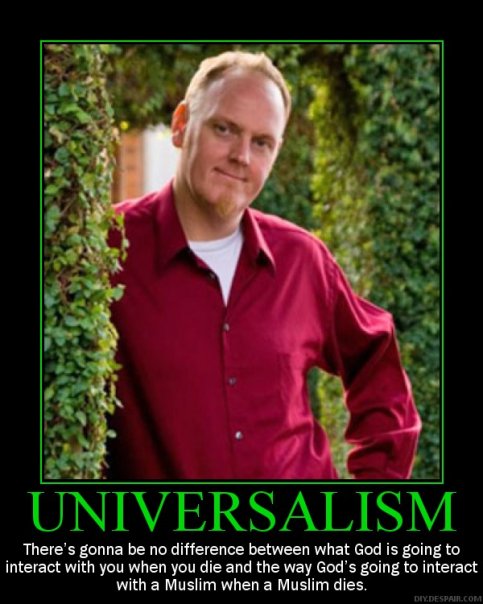
The pied pipers of Universalism (and those wishing to eradicate Christians from the face of the earth) get one more voice of solidarity and support from within our own camp.

 I suppose there’s no better time to revisit two questions I posed back in 2008: Are Christian bookstore owners responsible for what they sell? and Do you support your local Christian bookstore?

A visit to a megachurch.

Here’s an article by Chris Dunn on his recent experience of visiting a megachurch.

It’s not pretty.

Last Sunday I went to a megachurch.  Normally I attend small churches with a gathering of local believers who strive to live according to the Bible.

Having already attended countless churches from many denominations and faiths, I was eager to see what the average parishioner experienced at one of these stadium-sized complexes.

It was horrific.  Megachurches like this one can have almost nothing to do with biblical Christianity and may actually do violence to the ‘Word of God.’

Continue the article from Collegiate Times here.

HT: The Cross and the Lamb

The Spirit of the Age

I was going to post this as a response to this: http://defendingcontending.com/2011/02/17/inner-promptings/ but decided it warrants its own post.

New window
Print all
Many people have been misled by folk about how to find out the will of God – as if He’s hidden it from us and left us to our own devices. Throughout human history, folks have neglected the Word of God and relied on human wisdom to determine “god’s will” for things that the Bible tells us nothing about – where to live, where to work, whether to be a missionary to the Marshall Islands, and on and on.Listen to this message (preached by Voddie Baucham, taken from Romans 12:2) and see if you – like so many others – have been misled. Let us repent of none-sense and – by the Holy Spirit of the living God – pursue knowledge of Him and be content to let our future be in His capable hands.
There is another spirit operating among us and we must be able – and willing – to discern between the two and, if born again in Christ Jesus, choose that which is True.

Navigating Through Life

A couple of words have been rattling around in my head the past few days.  This all started with all the hype over the new “i” device from Apple Computer – the iPhone.  People have gone mad over this $500 phone, just as they have gone mad over the latest game systems.  We’ve had the iPod, iPhone, and the iPad – and several iterations of each.  Is your life marked by the madness we’ve seen over these things?  Perhaps you’re like me – I don’t like cell phones and I access the Internet the old fashioned way, with a computer.  Whatever our particular likes and dislikes, each of us – I dare say – have things of this world that have attached themselves to our affections in ways that reduce our effectiveness as disciples of Christ.

The two words that have been rattling around in my head are “indifferent” and “intentional”: opposite ends on the scale of attitude of the first person – “I”.  Here’s my theory: the degree of intentionality we have towards the world increases the indifference we have towards God.  I hold that the corollary is true as well: the degree of intentionality we have towards the Lord increases the indifference we have towards the world.  I call this the “I continuum” – you heard it here first!  You cannot be intentional towards God and indifferent to Him at the same time.  Nor can you be intentional towards God and the world at the same time.  I’m not saying we should be unconcerned about the world – we are told to be good stewards of the planet and to be proclaiming Christ to the human creatures.  But the value system of the world is another matter – that’s an evil that we all too often provide open access into our soul.

The Bible tells us “Ye Adulterers and adulteresses! Do you not know that friendship with the world is enmity with God? Whoever therefore wants to be a friend of the world makes himself an enemy of God.”  (James 4:4) and in 1 John 2:15 – 17 “Love not the world, neither the things that are in the world. If any man love the world, the love of the Father is not in him.  For all that is in the world, the lust of the flesh, and the lust of the eyes, and the pride of life, is not of the Father, but is of the world.  And the world passeth away, and the lust thereof: but he that doeth the will of God abideth for ever.”  The world is not our friend and it is not the standard of what is right and good.  When the world tells you to acquire stuff to satisfy your deepest longings, you’re being told to buy bread that leaves you poor and hungry, you’ll be led down paths of regret and defeat.

We also read in the Bible “the flesh lusteth against the Spirit, and the Spirit against the flesh: and these are contrary the one to the other” and “the works of the flesh are manifest, which are these; Adultery, fornication, uncleanness, lasciviousness, Idolatry, witchcraft, hatred, variance, emulations, wrath, strife, seditions, heresies, Envyings, murders, drunkenness, revellings, and such like “ (Gal 5:17 & 19 – 21).  Our flesh is not our friend and it is not the standard of what is right and good.  Our flesh is in league with the world!  This is why the world’s methods work so well on us.  We cannot trust our flesh – the Bible tells we cannot even know our own heart (Jer 17:9).

Thirdly, we see in Scripture another enemy of the cross – Satan.  The Lord Jesus was having a coffee talk with the local church leaders of the day.  John records the discourse in chapter 8 of his gospel: “I know that ye are Abraham’s seed; but ye seek to kill me, because my word hath no place in you.  I speak that which I have seen with my Father: and ye do that which ye have seen with your father.  They answered and said unto him, Abraham is our father. Jesus saith unto them, If ye were Abraham’s children, ye would do the works of Abraham.  But now ye seek to kill me, a man that hath told you the truth, which I have heard of God: this did not Abraham.  Ye do the deeds of your father. Then said they to him, We be not born of fornication; we have one Father, even God.  Jesus said unto them, If God were your Father, ye would love me: for I proceeded forth and came from God; neither came I of myself, but he sent me.  Why do ye not understand my speech? even because ye cannot hear my word.  Ye are of your father the devil, and the lusts of your father ye will do. He was a murderer from the beginning, and abode not in the truth, because there is no truth in him. When he speaketh a lie, he speaketh of his own: for he is a liar, and the father of it.  And because I tell you the truth, ye believe me not.”  (John 8:37 – 45)  Satan is not our friend and he is not the standard of what is right and good.  He wants to kill and destroy you and me.

So we see from God’s Word that there are three powerful forces aligned against us: the world, our flesh, and Satan.  They work in near perfect harmony to lure us aside from righteousness and into sin – however small the departure and slight the sin; it’s a foothold that can quickly grow into a stronghold.  Every time you and I sin, we befriend the world, esteem the flesh, and honor Satan – and we dishonor holy God and His sacrifice.  Do we see sin in such a way?  Or is it merely a bad habit that needs to be replaced with a good one?

Since we are opposed by this “Axis of evil”, to coin a phrase, how can we navigate through life without making a mess of everything?  Fortunately for the Christian, there are three who are on our side and they are more powerful than the “Axis of evil.”  The God of Heaven and Earth has given us all we need (2 Peter 1:2 – 3 “Grace and peace be multiplied unto you through the knowledge of God, and of Jesus our Lord, According as his divine power hath given unto us all things that pertain unto life and godliness, through the knowledge of him that hath called us to glory and virtue”); all we need do is move from indifferent to intentional towards the Lord and follow the One who called us to new life and holds us in His grip of grace.

To navigate through life, we need a guide, a map and a compass.  All must be credible.  There is only one trustworthy guide – Christ Jesus.  There is only one trustworthy map – the Bible.  There is only one trustworthy compass – the Holy Spirit.  The Guide God sent to us is not charismatic or interested in anything beyond leading and carrying us to the proper destination.  He will not pander your flesh nor entice you with worldly things.  The map God provides is not flashy in appearance and does not contain tips on cheap hotels or entertaining stops along the way.  The Bible is only intended to show one how lost he is and show him the way home once he is found.  The Compass God gives us is not like the one held by Captain Jack Sparrow – always pointing to what he wants the most.  The Holy Spirit convicts us of sin and points us to repentance and obedience.

But if you want none of that, if you wish to be indifferent towards God and intentional towards the world, here’s a quick “top-10” list to guide you along the way to perdition:

 Ten Steps to Carnal Living*

(from pages 171 & 172 of At the Altar of Sexual Idolatry by Steve Gallagher)

  1. Spend as much time watching secular television as possible.  You owe it to yourself.
  1. Eat sweets as often as you possibly can and give in to every craving for food immediately.
  1. Worry about loving yourself more, and God and other less.
  1. Fill your life with fun things and avoid adversity at all cost.
  1. Be a taker, not a a giver; after all, you already paid taxes!
  1. Never do anything that anyone would construe as fanaticism; you do have an image to uphold!
  1. You need not worry about having daily devotions; you do not have time!
  1. When you are confronted with sin in your life, go directly into delusion.
  1. Anytime you have a problem, always refer to a psychology book; psychologists know much more about life than God.
  1. Give in to every sexual urge; after all, God created them in you.

From the opposite end of the “I Continuum”:

Instructions for daily conduct (John Mason)

For you know what instructions we gave you by the authority of the Lord Jesus.” 1 Thessal. 4:2

1. Make the word of God the rule of all you do.

2. Whatever you do, do it in the strength of Christ. Without Christ, you can do nothing. Of yourself, you cannot even think a good thought; but you may do all things, through Christ strengthening you. Nature is a dry root–no gracious actions spring from it. Grace depends on continual supplies from Christ–as of sap from the root. Be strong in the Lord, and in the power of His might, and then nothing shall be too hard for you. All things are possible to him who believes and relies upon Christ’s power.

3. As we are to act by the power of Christ, so we are to present our services for acceptance in the name of Christ. The best we can do–needs His intercession, blood, and merits–to render it acceptable to God. In the Lord alone–we have righteousness and strength.

4. Whatever you do, do all to the glory of God. Selfishness is the natural idolatry of the human heart. The design and tendency of piety is to take the heart off self–and set it upon God. That duty which does not begin and end with God is no part of godliness. Self must be cast down–and God alone exalted.

5. To spend every day well, let your waking thoughts be with God;  let your fervent prayers ascend in the name of Christ; let the Word of God be your counselor; let the fear of God be always before your eyes. In all your actions, let integrity and uprightness preserve you. Set a watch over your lips, and a guard upon your spirit, that you be not provoked to anger, nor speak unadvisedly with your lips.

6. At night, review the actions of the day. Give to God the glory of what has been good; take shame to yourself for what has been evil. Review the dispensations of God’s providences–and consider their special meaning and application. Acknowledge the mercies of God received through the day. Submit to the afflictions laid upon you. Commit yourselves afresh to the mercy and protection of God, through Jesus Christ–that you may be preserved through the slumbers of the night, and be permitted to wake in peace–whether it be in earth or heaven.

By these points let every action be examined–
By whose rule have I acted?
In whose strength have I acted?
In whose name have I acted?
For whose glory have I acted?
What faith, humility, self-denial, love to God
and Christ, have there been in my actions?

Parting thoughts:

For to be carnally minded is death; but to be spiritually minded is life and peace.” Romans 8:6

(John Owen) Let a man profess what he will–if his thoughts are generally conversant about earthly and worldly things–he has an earthly and worldly mind. And if his thoughts are generally conversant about sensual things–he has a sensual and carnal mind. “For as he thinks in his heart–so is he.” Proverbs 23:7


D.A. CARSON SERMON ON HEAVEN AND HELL

DR. D.A. CARSON SERMON ON HEAVEN AND HELL

By on Jul 27, 2011 in Current Issues, Emergence Christianity, Emergent Church, Features, Rob Bell, Youth Ministry

As a leading online apologetics and discernment work Apprising Ministries has been warning you for a long time about the toxic teachings the Emerging Church rock star pastor Rob Bell, co-teaching pastor at Mars Hill Bible Church along with his good friend Shane Hipps.

Those not under the spell of Rob Bell, who’re willing to look at the evidence, will see he’s long been practicing the critical thinking skills-numbing corrupt Contemplative Spirituality/Mysticism (CSM), such as that taught by Living Spiritual Teacher and Quaker mystic Richard Foster along with his spiritual twin and Southern Baptist minister Dallas Willard.

You can see for yourself in AM articles like Through Rob Bell “The Great Enlightened Ones” Tell Us Man Has Divine Greatness and Rob Bell And Shane Hipps Teaching Mysticism and Rob Bell On His Practice Of “Militant Mysticism”.

This has much to do with Rob Bell Defending His Love Wins Mythology and his intimate involvement with the sinfully ecumenical neo-liberal cult of the Emergent Church aka the Emerging Church with its quasi-universalism in a new version of postmodern Progressive Christian theology under their spiritual circus “big tent” of empty Emergence Christianity.

I’m pleased now to bring you some proper Biblical teaching below by Dr. D. A. Carson. In the video following Carson “explores the Bible’s teaching on heaven and hell, God’s loving mercy and just wrath, in this lecture at The Gospel Coalition’s 2011 national conference.” Carson does a great job explaining universalism and debunking it; a must listen:

God: Abounding in Love, Punishing the Guilty (Carson Lecture) from The Gospel Coalition on Vimeo.

See also:

ROB BELL AND POSTMODERN NEO-LIBERALISM

IS ROB BELL EVANGELICAL?

ROB BELL ON THE RECORD CONCERNING SCRIPTURE

My thoughts on youth ministry and Vacation Bible School.

Summertime means BBQ, swimming pools, fireworks, and lemonade. But it also means sweltering heat, mosquitoes, and Vacation Bible School.

For many Christians this is the time of the year when they’re all abuzz about the wildly popular week-long evangelical event known as Vacation Bible School (commonly referred to by its acronym, VBS).

In terms of the high level of anticipation, collective excitement, Madison-Avenue-style marketing, and pulpit-driven hype, this event has vaulted in importance within Christendom to rival that of Christmas and Easter. If there are only three events on the Christian calendar that get highlighted every year, VBS is certainly one of them.

Because of Vacation Bible School’s prominence in the church, I wanted to take this opportunity to make some observations about this annual cultural Christian phenomenon and (by extension) youth ministry as a whole.

Before we begin, allow me to be brutally honest.

First let me say that it is no secret to the readers of this blog (and those who know me personally) that I am a youth ministry abolitionist. I am passionate about this subject and I’ve pulled no punches in my conversations and my treatises about it, but at the same time I do recognize that many involved in these types of ministries are well-meaning and have the best of intentions. Unfortunately, pure motives and best intentions do not excuse or justify the wholly destructive nature of the extra-biblical model of youth ministry (and VBS).

I also want to make it abundantly clear that I do not believe those engaging in various forms of youth ministry are in danger of Hell-fire because of their involvement or participation (for salvation is by grace alone through faith alone in Christ alone). I also have dear Christian brothers who are involved in youth ministry (in fact one of them leads such a God honoring and holy life that I feel like a heathen next to him and despair that I will never reach his level of love, grace, and sanctification) and although I adamantly disagree with them on this subject, I can still have meaningful fellowship with them.

But I would appreciate the reciprocal consideration from youth ministry proponents regarding their misrepresenting and making a caricature out of those who oppose youth ministry (and those who encourage others to return to the biblical and traditional church model of raising and teaching children) as is so often done.

In their efforts to preserve youth ministry, critics of family integrated worship and family integrated churches (FICs) often defend their position by warning that proponents of family integration run the risk of becoming overbearingly patriarchal, Pharisaical, legalists who erroneously believe that worshiping together as a family ensures their children’s salvation, who refuse to evangelize anyone outside of their immediate family, and who place their family in higher regard than the Bride of Christ.

These are unfair depictions that I keep hearing levied against those who reject youth ministry for family based worship, yet these critics have failed to cite one example of these extreme wayward families they keep warning about (or claimed to have even met one).

Ironically, even though they reject the FIC model because they believe it has potential to be taken to extremes, youth ministry proponents overlook, make excuses for, or simply dismiss the problems inherent with youth ministry. These are not rare exceptions, they are very common and almost the standard. The mountain of dysfunctionality seen in so many youth groups can be cited (and many have been featured on this very blog) as well as the mind-numbing statistics that have proven the utter failure of youth ministry.

I have yet to become or meet even one of these types of families that youth ministry proponents keep warning that we have a great potential to become. Is it likely that there are some families out there who do fit that caricature? I’m sure there are, but these are the exception, whereas it seems to be the norm to see utter foolishness exhibited in youth ministries; so many of which resemble a scene out of William Golding’s Lord of the Flies.

I sincerely do not write this missive (some would call it a tome) with the intention to cause division or create animosity among my brothers and sisters in the Lord. I pray that this is not received as derision, but as a thoughtful critique; prompting us to examine why we do what we do. It is meant to shed light on a practice that many promulgate without ever examining or even considering what the results (or ramifications) are. I also hope that this will serve as a clarion call for readers to eventually abandon this practice and return to the biblical model of raising and teaching our children in the Lord. But to those who do not, I will still love you, still fellowship with you, and still consider you my brothers and sisters in the Lord.

Continue reading

A letter to the Apostle Paul.

Justification

“A Letter to Paul the Apostle”
The Trinity Review, July, August 1988
Copyright (C) 2003
_______________________________________________________

A Letter to Paul the Apostle

Charles Phinney

Presbyterian Church in Asia Minor

Committee on Missions

Paul the Apostle

c\o Aquila the Tentmaker

Corinth, Greece

Dear Paul:

We recently received a copy of your letter to the Galatians. The committee has directed me to inform you of a number of things, which deeply concern us.

First, we find your language to be somewhat intemperate. In your letter, after a brief greeting to the Galatians, you immediately attack your opponents by claiming they “want to pervert the gospel of Christ.”

You then say that such men should be regarded as “accursed”; and, in another place, you make reference to “false brethren.” Wouldn’t it be more charitable to give them the benefit of the doubt—at least until the General Assembly has investigated and adjudicated the matter?

To make the situation worse, you later say, “I could wish those who trouble you would even cut them selves off!” Is such a statement really fitting for a Christian minister? The remark seems quite harsh and unloving.

Read the entire letter here.

HT: Flock Alert

If Paul’s epistle to the Galatians was published in Christianity Today.

If the Apostle Paul’s letter to the Church in Galatia had been published in the magazine Christianity Today how would it be received? Well, what follows is a dramatization of letters received from readers in response to Paul’s inspired Epistle.


(Source: Sacred Sandwich)


********************************************************

LETTERS TO THE EDITOR

Dear Christianity Today:

In response to Paul D. Apostle’s article about the Galatian church in your January issue, I have to say how appalled I am by the unchristian tone of this hit piece. Why the negativity? Has he been to the Galatian church recently? I happen to know some of the people at that church, and they are the most loving, caring people I’ve ever met.

Phyllis Snodgrass; Ann Arbor, MI

————————————————————————

Dear Editor:

How arrogant of Mr. Apostle to think he has the right to judge these people and label them accursed. Isn’t that God’s job? Regardless of this circumcision issue, these Galatians believe in Jesus just as much as he does, and it is very Pharisaical to condemn them just because they differ on such a secondary issue. Personally, I don’t want a sharp instrument anywhere near my zipper, but that doesn’t give me the right to judge how someone else follows Christ. Can’t we just focus on our common commitment to Christ and furthering His kingdom, instead of tearing down fellow believers over petty doctrinal matters?

Ed Bilgeway; Tonganoxie, KS

————————————————————————–

Dear CT:

I’ve seen other dubious articles by Paul Apostle in the past, and frankly I’m surprised you felt that his recurrent criticisms of the Church deserved to be printed in your magazine. Mr. Apostle for many years now has had a penchant for thinking he has a right to “mark” certain Christian teachers who don’t agree with his biblical position. Certainly I commend him for desiring to stay faithful to God’s word, but I think he errs in being so dogmatic about his views to the point where he feels free to openly attack his brethren. His attitude makes it difficult to fully unify the Church, and gives credence to the opposition’s view that Christians are judgmental, arrogant people who never show God’s love.

Ken Groener; San Diego, CA

—————————————————————————-

To the Editors:

Paul Apostle says that he hopes the Galatian teachers will cut off their own privates? What kind of Christian attitude is that? Shame on him!

Martha Bobbitt; Boulder, CO

—————————————————————————-

Dear Christianity Today:

The fact that Paul Apostle brags about his public run-in with Peter Cephas, a well-respected leader and brother in Christ, exposes Mr. Apostle for the divisive figure that he has become in the Church today. His diatribe against the Galatian church is just more of the same misguided focus on an antiquated reliance on doctrine instead of love and tolerance. Just look how his hypercritical attitude has cast aspersions on homosexual believers and women elders! The real problem within the Church today is not the lack of doctrinal devotion, as Apostle seems to believe, but in our inability to be transformed by our individual journeys in the Spirit. Evidently, Apostle has failed to detach himself from his legalistic background as a Pharisee, and is unable to let go and experience the genuine love for Christ that is coming from the Galatians who strive to worship God in their own special way.

William Zenby; Richmond, VA

——————————————————————————

Kind Editors:

I happen to be a member of First Christian Church of Galatia, and I take issue with Mr. Apostle’s article. How can he criticize a ministry that has been so blessed by God? Our church has baptized many new members and has made huge in-roads in the Jewish community with our pragmatic view on circumcision. Such a “seeker-sensitive” approach has given the Jews the respect they deserve for being God’s chosen people for thousands of years. In addition, every Gentile in our midst has felt honored to engage in the many edifying rituals of the Hebrew heritage, including circumcision, without losing their passion for Jesus. My advice to Mr. Apostle is to stick to spreading the gospel message of Christ’s unconditional love, and quit criticizing what God is clearly blessing in other churches.

Miriam “Betty” Ben-Hur; Galatia, Turkey

——————————————————————————-

EDITOR’S NOTE: Christianity Today apologizes for our rash decision in publishing Paul Apostle’s exposé of the Galatian church. Had we known the extent in which our readership and advertisers would withdraw their financial support, we never would have printed such unpopular biblical truth. We regret any damage we may have caused in propagating the doctrines of Christ.

Youth ministry annoyances.

Pastor Brian Borgman reveals three of his pet-peeves when it comes to youth ministry:

Sunday School and VBS curriculum which trivializes and moralizes the Bible.

Children’s Church which substitutes for Church.

Sending the kids out right before the sermon.

Read the entire post here.

Also be sure to listen to Borgman’s fantastic sermon Children in Worship found here.

The Invention of Adolescence.

An interesting article on the invention of adolescence by Otto Scott.

Adolescence is now accepted by most Americans as a strange and difficult period marked by wild swings of mood, outbursts of temper, rudeness, rebelliousness, and personality changes — all involuntary. They would be surprised to learn that this period was unknown, unrecognized, and unseen in every previous civilization, culture, and society throughout the immensely long history of humanity. It is, even today, unknown in large areas of the inhabited world.

Read the entire article here.

Is Federal Vision heresy?

The following is from Flock Alert:

“Many are honestly confused about the Federal Vision, and are looking for a quick, basic understanding of it.  As such, here we offer a crash course about this enormously influential movement.

“The following resources demonstrate that the Federal Vision is indeed a heresy of the worst kind, and perverts almost every doctrine related to salvation.  It is [sic] has much in common with N. T. Wright’s theology, and is essentially a form of Roman Catholicism in sheep’s clothing.  It denies justification by faith alone, Christ’s active obedience, and perseverance of the saints, and holds to salvation by works (for instance, the soul damning heresy of baptismal regeneration).”

Read the entire article here.

Poking Each Other in the Eye

Imagine for a moment that you are talking to a friend face-to-face, discussing something important. As you are talking you notice something floating in his eye. I would imagine that you would say, “Do you see that? “Doesn’t that bother you? Does it hurt?”

“What? See what?” They ask.

“Well, that thing in your eye. Can’t you feel it?”

“No, I don’t feel anything.” They reply, “I’m fine.” But they aren’t fine because this thing in their eye will eventually cause pain and damage. You feel compelled to help them.

“Come on; let me get that out for you.”

How quickly are you going to let a friend put their finger in your eye and pull something out? I know I wouldn’t be comfortable with it. My eye is incredibly sensitive. If your friend agreed to let you help and you were to pick this speck out of his eye, how would you do it?

I think it is safe to say that we would all be exceedingly gentle. We’d wash our hands, have the person lie down or sit in a chair, then we’d get an extra light so we could see better, then gently hold their eye open with one hand and with the gentlest touch possible you try to get the speck without poking your dear friend in the pupil causing pain and possibly more damage. You patiently try and try again with equal gentleness until the speck is out.

Now, imagine this scene again, except this time you have a patch on one eye and blurred vision in the other. Can you still get the speck? Or what if you just jump him in mid-conversation, peel his eyelid back rubbing, picking, and poking his eye until the speck is out? This would leave him in shock, pain, and stress. Would you do it this way or the first way? Does it matter? I think it matters greatly. Let’s look at some scripture inspiring this scene.

Matthew 7:1-5
1 “Judge not, that you be not judged. 2 For with the judgment you pronounce you will be judged, and with the measure you use it will be measured to you. 3 Why do you see the speck that is in your brother’s eye, but do not notice the log that is in your own eye? 4 Or how can you say to your brother, ‘Let me take the speck out of your eye,’ when there is the log in your own eye? 5 You hypocrite, first take the log out of your own eye, and then you will see clearly to take the speck out of your brother’s eye.

We know this passage of scripture from Jesus’ Sermon on the Mount in regard to judging others and pointing out hypocrites. But, have we ever considered what it takes to actually get the speck out of our brother’s eye? Have we ever thought about the gentleness and sensitivity that it takes? Did Jesus use the eye here because of how sensitive our eyes truly are? So often we like to focus on not being “hypocritical” when pointing out the speck in your brother’s eye and forget about our methods. We’ll use this passage when feeling defensive: “you can comment on my sin when you get that gigantic beam out of your own eye!” Rarely do we even consider taking special care in how we “take the speck out of your brother’s eye.” Isn’t this level of gentleness and sensitivity the primary goal?

Continue reading

Jesus IS Lord in Ephesians and Philippians

Ephesians 1:1-3Paul, an apostle of Jesus Christ by the will of God, To the saints who are in Ephesus, and faithful in Christ Jesus: Grace to you and peace from God our Father and the Lord Jesus Christ. Blessed be the God and Father of our Lord Jesus Christ, who has blessed us with every spiritual blessing in the heavenly places in Christ.

Ephesians 1:15-17Therefore I also, after I heard of your faith in the Lord Jesus and your love for all the saints, do not cease to give thanks for you, making mention of you in my prayers: that the God of our Lord Jesus Christ, the Father of glory, may give to you the spirit of wisdom and revelation in the knowledge of Him.

Ephesians 3:11-15According to the eternal purpose which He accomplished in Christ Jesus our Lord, in whom we have boldness and access with confidence through faith in Him. Therefore I ask that you do not lose heart at my tribulations for you, which is your glory. For this reason I bow my knees to the Father of our Lord Jesus Christ, from whom the whole family in heaven and earth is named.

Continue reading

Another Big-Name “Pastor” Continues the Slide

In his book, Eternal Security – Can You Be Sure? Charles Stanley makes many of the errors common to the “Free Grace” movement. Perhaps the most glaring is in his analysis of the wedding feast parable in Matthew 22. Dr. Stanley tells us, “It certainly does not mean hell in the parable. How could a master throw a slave into hell? This phrase appears in a similar parable in chapter 22. In that parable an unwanted guest is bound and thrown out of a banquet hall into the “outer darkness” (see Matt. 22:13); it clearly refers to being thrown outside a building into the dark.”

Stanley further explains that this place of wailing and gnashing of teeth is an outer area of Heaven, not too close to the throne of Christ. Really?

That book was written years ago.

More recently, Stanley’s “In Touch” magazine, has featured an article encouraging Roman Catholic mysticism as a legitimate Christian endeavor. Ken Silva brings us the sad news in this story (repulsive video at the bottom of the page on Ken’s site).

May God have mercy and grant Dr. Stanley repentance – and his followers discernment.

IN TOUCH MAGAZINE OF CHARLES STANLEY PROMOTING CONTEMPLATIVE NEW MONASTICISM

By Ken Silva pastor-teacher on Jun 30, 2011 in AM Missives, Contemplative Spirituality/Mysticism, Current Issues, Features

While I make no claim to know when the Lord Jesus will return, I will say that it’s entirely possible we are living in a time where we are seeing the beginning of a great falling away.

And so a large part of our online apologetics and discernment labors Apprising Ministries is to document the New Downgrade within evangelicalism, which accelerated when its own mainstream made the fateful decision to more fully embrace the sinfully ecumenical Emergent Church aka the Emerging Church.

I’ve told you before that the EC has proven to be a Trojan Horse where Satan was able to off-load his ne0-Gnostic mystic corruption Contemplative Spirituality/Mysticism(CSM) right within the very heart of the church visible. It’s beyond question that this spurious CSM—the refried Roman Catholic mysticism “discovered” by Living Spiritual Teacher and Quaker mystic Richard Foster, and now perpetrated as supposed Spiritual Formation with an able assist from his spiritual twin SBC minister Dallas Willard, was a core doctrine in the EC right from its hatching in hell.

What’s vital for you to grasp is that, having kicked out the pillar of sola Scriptura, a now upgraded to the Emerging Church 2.0 is spreading its own new postmodern form of “big tent” Progressive Christianity—a Liberalism 2.0. However, at the same time foolish evangelical church leaders, desperate to fill their buildings, began having “alternative” worship services and using materials from EC leaders just filled with Counter Reformation teachings and spirituality in their Young Adult and Youth Groups. Some 10 years rolling down that track, we’re only now beginning to see the syncretism it’s been causing.

You might remember in Mainstream Evangelicalism Embracing Contemplative Mysticism I supplied you with tons of documentation showing that CSM has now deeply penetrated the mainstream of the allegedly Protestant evangelical community. It’s actually been slithering in for years now; so people like Purpose Driven Pope Rick Warren, unquestionably one of the most influential pastors in the Southern Baptist Convention, are becoming emboldened and no longer feel they need to hide their affinity for it. Now I’ll show you that Saddleback Church certainly isn’t the only SBC entity promoting CSM.

We turn to Contemplative Spirituality Lands on Charles Stanley’s In Touch Magazine . . . Again. This piece over at the blog of leading online apologetics and discernment work Lighthouse Trails Research begins:

Jonathan Wilson-Hartgrove is a writer, speaker, and activist who is a leader in the “New Monastic” movement. He lives in North Carolina at the Rutba House, a new monastic community.

Wilson-Hartgrove is most recently known for co-authoring Common Prayer: A Liturgy for Ordinary Radicals with new monastic activist Shane Claiborne. (Online source)

Resisting wrestling with the serpent, for now we leave aside the serious issues with Red Letter Christian—and disciple of Tony CampoloShane Claiborne. Mike Stanwood, the author of the Lighthouse post, tells us that Jonathan Wilson-Hartgrove (seen below) “was recently profiled in Charles Stanley’s In Touch magazine” as you can see here:


(Online source)

Stanwood continues:

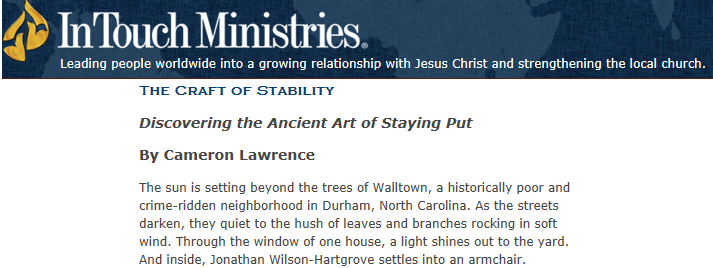
The January 2011 article called “The Craft of Stability: Discovering the Ancient Art of Staying Put” written by Cameron Lawrence highlights the “ intentional Christian community” at the Rutba House and their “daily prayer routine.”

The In Touch article states that Rutba House is an evangelical community rooted in the Protestant tradition, and that Wilson-Hartgrove is an ordained Baptist minister. The In Touch article also reports that Rutba’s community principles are borrowed from Benedictine monks and that all of their efforts are based on St. Benedict’s “rule of life.” (Online source)

Here we go mentally off-roading again into the postmodern Wonderland of Humpty Dumpty language. Stanwood is quite correct when he then points out:

However, these two statements are completely contradictory: A “Protestant tradition” and “principles” “borrowed from Benedictine monks” completely contradict each other if we are talking about a biblical tradition when we say “Protestant tradition.” The contemplative beliefs promoted by Wilson-Hartgrove are not biblical. (Online source)

This is yet another example of following one’s feelings rather than assessing “principles” by God’s infallible and inerrant Word in Holy Scripture. I’ll say it again, you need to recognize the kind of fruit that this refried Roman Catholic mysticism invariably produces. Lord willing, and should funding allow, I plan to document further for you what CSM does to those who persist in it. A good example can be seen in Peter Scazzero Bringing Rome Home To His Church; and Scazzero even comes recommended by the likes of Rick Warren and Tim Keller.

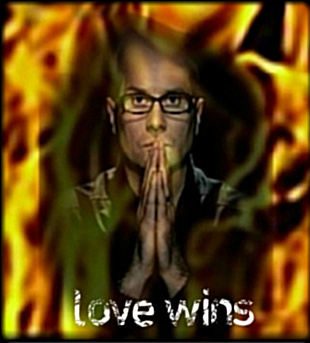
As I said before, your biggest clues are 1) as it spread through the antibiblical monastic traditions of the Church of Rome, CSM played a major role in producing apostate Roman Catholicism in the first place. And 2) just take a look at what it’s done to those in the Emerging Church like its iconic rock star pastor Rob Bell, who’s now openly arguing for Christian Universalism through his Love Wins mythology; and even though he adheres to postmodern neo-liberalism, he’s still considered an evangelical.

Why; because he’s a nice man and people feel that he must be following God; but Bell’s a neo-Gnostic with a different gospel as you’ll see when his mystic musings are Biblically tested in Rob Bell And Postmodern Neo-Liberalism. In closing this out, for now, above Mike Stanwood told us that this new monk Jonathan Wilson-Hartgrove—who’s a leading proponent of unbiblical neo-monasticism—co-authored the book “Common Prayer: A Liturgy for Ordinary Radicals with new monastic activist Shane Claiborne.”

The following two sections are from this book; first:


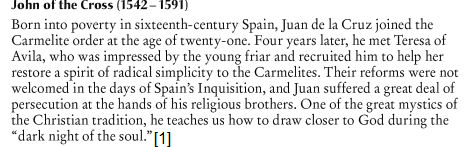
As you can see, there’s praise for this apostate Roman Catholic mystic, a disciple of the troubled Teresa of Avila; as well as for his teaching about some supposed dark night of the soul. To mystics this allegedly occurs to them as they begin to grow deeper in their practice the crown jewel of CSM, a form of meditation in an altered state of consciousness commonly known as Contemplative/Centering Prayer (CCP). Dr. Gary Gilley explains:

The phrase “dark night of the soul” has become, on a popular level, the description of a period of deep depression or dryness, but this is certainly not what St. John meant… He set out, during the time of the Catholic Counter-Reformation, to explain the life of the mystic and the mystical way.

Classical mysticism is composed of three parts: purgation, in which the senses and spirit are purged of all desires; illumination, in which God supernaturally floods the soul with His love while the individual remains passive; and union, in which the soul is united with God in perfection.

Such an individual will be able to skip purgatory since purgatory’s work has been completed in this life (pp. 107-108, 174). To this pursuit the medieval monks and hermits devoted their lives.

The mystical way is nowhere supported by Scripture, even though St. John makes many attempts to do so… Concerning purgation we are told that there is two stages: purgation of the senses (explained in book one) and of the spirit, the subject of book two.

The dark night is a description of these two levels of purgation. (Online source)

Then we’re given the wisdom of another apostate Roman Catholic monk, Thomas Merton, the Golden Buddha of CSM. Despite the fact that Merton’s life-long devotion to CCP, which would make him more like the Buddha than the Christ as you can see in Thomas Merton And The Buddhas, we are given Merton with the mystic gibberish below:

Finally, concerning the video interview below Stanwood is right that we’ll hear “Wilson-Hartgrove [as he] talks about the concepts in his book; the new monastic movement, desert vision, desert fathers, and redistribution of wealth.” In addition, the way he speaks about what Jesus did on the cross is quite consistent with mysticism’s and progressive/liberalism’s view that He chose to show us the way of love and to enter into human suffering by taking on the evil empire.

With this love of the self the lines blur further while such as these defecate upon the blood of the martyrs.

Is your Worldview based on the world?

Many professing Christians think man has more wisdom than God in determining how long the creation took. Of course, few people put it in those terms, but that is what it boils down to. Here’s an example.

What are the consequences of disbelieving in a literal 6 day creation? We deny the clear teaching of the Old and New Testament. Jesus taught (recorded in Mark 10:6) that man and woman were created in the beginning of creation – not after a long, long time.

And when we deny the clear teachings of the elementary things of Scripture, why should our children believe us or our pastors when they are taught about sin and deliverance from its consequences? If creation is reduced to a fairy tale, we have breached the foundation of God’s revelation to man. God stated out His special revelation to man with the words, “In the beginning, God created the heavens and the earth.” Creation is important to Him – it ought to be to us.

For a few days, you can download a 40 minute video in which Ken Ham describes the importance of believing God’s Word – for you and the next generation. In it you will find out:

The next generation is already calling it quits on traditional church. Next Sunday, look around, two thirds of the young people in your church are already disengaged from the message they are hearing. And it’s not just happening on the nominal fringe; it’s happening in the most solid “Bible-believing” churches.

In this important DVD, Ken Ham discusses the profound cultural changes taking place in our Western world, as God’s Word is rejected and man’s fallible ideas are welcomed. Ken relates some of the shocking statistics presented in the book Already Gone that reveal the reasons why young people are leaving church and abandoning the faith of their parents.

The church is failing to give children real answers to their questions. We are losing our kids long before college. But this is far from a hopeless situation. Ken explains how we can fight back for our children, and what we can do to ground our children in the faith and prepare them for the challenges of the secular world.

HT to my good friend at PurposeDrivel

Gin and juice missionaries.

Here’s the opening to a great little article on a matter we’ve been lamenting for years:

Many Christians tend to hang out a lot with unsaved friends for the sake of  “winning” them to Christ. (Unsaved girlfriends, boyfriends, club-buddies, former smokin’-buddies, co-workers, etc.) They often say that their plan is to “let their light shine”.

They say that’s the reason why they meet co-workers at the sports bar; That’s the reason why they share shots.

I sincerely doubt that.

In all honesty,  I’ve seen very little gospel sharing. Just a whole lot of chillin’ and jokin’ around. But, if you ask a “gin & juice missionary” to  reconsider their approach, they’ll quickly quip:

Stop being religious! Didn’t Christ eat with tax-collectors and sinners??

Read the entire article here.