
I would like to put up an excellent series from the Reformed Baptist Seminary. This first video lecture comes from Bob Selph. I believe that every person who aspires to the ministry should listen to this series. Please enjoy and may the Lord be glorified in each of our ministries.
Preaching
The Primacy of the Abrahamic Covenant
Why does it matter how one views the covenant with Abraham? Are there actually different views  on it? My experience leads me to believe that most folks don’t really think too much about such things. Yet this singular item is, in fact, the biggest wedge between Reformed Baptists and our Presbyterian brothers.
As pointed out in this book review, the matter of covenants in the Bible and how one looks at and considers them makes a huge difference in myriad other doctrines that sprout forth. To help understand this issue further, I commend this sermon by Jeffrey Johnson, on the topic of the Abrahamic Covenant.
In addition to Johnson’s wonderful book, I recommend this new addition to anyone’s library.
Responsibility of Elders
My church held a conference on church membership last fall. We had several well known speakers, 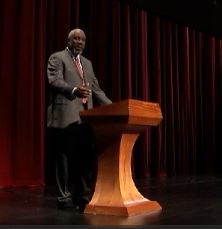 including Michael Horton, our own Voddie Baucham, Ken Jones, and Thabiti Anyabwile from Grand Cayman.
Here is Thabiti’s most excellent message on the responsibilities of those who serve the local church as elders: Responsiblity of elders
THE POWER OF THE CHURCH
He is the radiance of the glory of God and the exact imprint of his nature, and he upholds the universe by the word of his power. (Hebrews 1:3) 
The true power of the church lies in Christ personally. You may have all the stars that ever made bright the Milky Way with their combined sheen, but there is no power in them to kill evil or conquer sin
The stars of the church shine because God makes them shine. Their shining is not their own: it is a borrowed light with which they are radiant. But the power that overcomes evil, wounds the heart, pierces the conscience, and kills reigning sin is of the Lord alone.
“Out of his mouth went a sharp two-edged sword” (Revelation 1:16). Glory not, therefore, in men; for power belongs unto God. The power lies in Christ’s Word. “Out of his mouth went a sharp two-edged sword.”
“He that hath my word, let him speak my word faithfully…saith the LORD” (Jeremiah 23:28). People are disturbed and troubled by the real gospel: under the false gospel they can sleep unto destruction. Bring out the sword: it is made to wound; let it exercise its salutary sharpness.
The gospel has two edges so that none may play with it. When they think to run their fingers along the back of it, they will find themselves cut to the bone. Whether we regard its threats or its promises, it cuts at sin.
Let us therefore know that the power of the church does not lie anywhere but in the Word as Jesus himself speaks it. Let us keep to his own pure, unadulterated, unblunted Word, and let us pray him to send it forth with power out of his own mouth into the hearts and consciences of men.1
Charles Spurgeon
[1] Charles Spurgeon, At the Master’s Feet [Grand Rapids: Zondervan, 2005], January 27.
Hat tip to http://apprising.org/
Made Sufficient: A Theology of Preaching
 Made Sufficient: A Theology of Preaching
INTRODUCTION
Life in our culture today has one very common personal philosophy that will be heard anywhere you go: “You can be anything you set your mind to.” Our school systems, parental urgings, and media culture all cheer us on with shouts of “be all we can be, “just do it,” and “you can make friends and influence people!” We live in a world of driven and purposeful self-sufficiency. If you are a doctor and you find a new condition you are not familiar with, you study, research, prepare, and build the knowledge base and skill set within yourself to accomplish the task. You work hard to achieve the skills required for the task. If an engineer is faced with a new complicated project, they also turn to the books and the training. Study, prepare, practice, test, do all things to develop the personal skills to become competent and capable.
Coming to scripture with this worldview is dangerous enough for the average Christian, but it’s a death wish for those aspiring to the pulpit. In so many ways, our career success cultural handicap has created “you can achieve anything you set your mind to” preaching. Young men feeling the call to preaching start with the philosophy that hard work and personal development of precise skills is all that is needed to assume the pulpit and to receive the celebration and cheers of men. This is why Paul’s words to the Corinthians regarding the ministry of the New Covenant is so shocking.[1] You can just about hear the needle scratching across the record as our culture engages with Paul’s words from 2 Corinthians 2:16b-17,
…who is sufficient for these things? For we are not, like so many, peddlers of God’s word, but as men of sincerity, as commissioned by God, in the sight of God we speak in Christ[2]
and 2 Corinthians 3:5-6,
Not that we are sufficient in ourselves to claim anything as coming from us, but our sufficiency is from God, who has made us sufficient to be ministers of a new covenant, not of the letter but of the Spirit.
The World’s response to Paul is: “Who is sufficient for these things? I am of course! I can do anything I set my mind to. I will work hard and become sufficient to preach.” This response, whether voiced or felt secretly deep in our heart is the issue at hand. The biblical act of preaching is not a calling that can be professionalized. Preaching is not something that can be undertaken or mastered by sheer personal will. Preaching is an act like no other. Preaching is not a career choice. Preaching is a supernatural calling to proclaim God’s Word as a reconciled ambassador for Christ. It is only through God that we are made sufficient to speak on His behalf.
MADE SUFFICIENT
Preaching the Word of God is every bit as challenging as walking a tightrope hundreds of feet above the ground. Lean too far in one direction and you fall to a certain death. Overcorrect and lean too far the other direction and you experience the same results. One missed step and you are in great danger. Preaching is similar, not in physical balance and concentration, but in spiritual balance and humility. On one side we can fall into the certain dangers of self-sufficiency and on the other, the certain peril of lazy unpreparedness. The rope itself, on which we safely traverse to the other side, is humility grounded in the knowledge that we are not sufficient to accomplish this task in our own strength and skills, but we are made sufficient by the power of the one of whom we speak. To make the point of how God accommodates our weakness by providing preachers to speak on His behalf, Peter Adam[3], in his little book, Speaking God’s Words, quotes John Calvin, from his Institutes, on the power of God in preaching through the man, rather than the power coming from the man himself:[4]
it forms a most excellent and useful training to humility, when he accustoms us to obey his word though preached by men like ourselves, or, it may be, our inferiors in worth. Did he himself speak from heaven, it were no wonder if his sacred oracles were received by all ears and minds reverently and without delay. For who would not dread his present power? Who would not fall prostrate at the first view of his great majesty? Who would not be overpowered by that immeasurable splendour? But when a feeble man, sprung from the dust, speaks in the name of God, we give the best proof of our piety and obedience, by listening with docility to his servant, though not in any respect our superior. [5]
All men would fall on their faces in reverence if God came down from Heaven and preached to us. However, God chose to use feeble broken men sprung up from the dust to deliver His message to the World (Ex 4:10-12, 1 Cor 1:17-21,1 Thes 2:1-4, 1 Tim 1:12-15). To understand how this feeble, unremarkable, inferior man can faithfully represent the infinite, holy, omnipresent God of the universe, we must understand the theology of preaching.
 Christ Alone Wyoming