The Tragedy of American Compassion

The Tragedy of American Compassion – Marvin Olasky

Reviewed by Stuart Brogden, 30 Oct 2011

Tragedy and Compassion – two words that we don’t normally associate together. How could compassion be tragic? While we likely have different levels of bad news in mind when think of tragedy, we are all in agreement that tragedy is bad and something ought to be done. Although I think the TV news industry is working hard to widen the definition to include hangnails.

Compassion is a bit more complicated. We tend to think of compassion from the ame perspective that we think of love – the unbiblical, Greco-Roman emotional view. Americans view compassion today differently than we did 250 years ago. We want to “relieve suffering” but don’t stop to think about the proper way of doing this, or even if there is such a thing. There are some issues – life threatening, for example – for which rapid elimination of the threat is proper. But there are many life issues that are the accumulation of bad decisions for which there is no proper quick relief. We can look at G.W. Bush’s policy in the Middle East, thinking the solution there was to quickly implant democratic governments. People will not value the liberty a representative government of laws brings until they realize their need of it. Small children will not realize the value of math if mom tells them the answers rather than teaches and asks diagnostic questions.

Biblical compassion is based on biblical love – wanting the best (as God defines it) for the person and to honor God. As we’ve been taught, good deeds must incorporate right motive, right method, right attitude, and right objective. So biblical compassion must be based on a biblical view of God and of man. Our goal is not to bail a man out – it is to set him on his feet, exposed to the gospel, equipped to provide for his family.

It is this framework that Olasky has done a masterful work outlining in this book. The Puritans had a reformed view of man: he is depraved and will avoid that which is unpleasant (work) if at all possible. This perspective, encoded in the laws of the late 17th century, was evidenced by giving time rather than treasure, requiring “decent living” of those being helped, punishment for wrongdoing – which included slothfulness. A key attribute of this perspective was the personal knowledge and connection between the better-off and the poor. Works-testing was required, so that a man or woman who was able to work would be put to work in order to secure food and shelter. “This social policy was based upon the theological view that stressed man’s sinfulness, which only God’s grace could change.” (pg 10) Further, “nothing that could contribute to the breakup of families, or to the loss of the family’s central role as support of its members was encouraged.” (pg 11) So a three-legged stool of family, church, and neighborhood was in place. The goal was not equal treatment of all who were in need, but personal attention to each with the aim of building responsibility and morality.

Poverty – caused by circumstances such a illness or death – was seen differently than pauperism, a lifestyle of living off others with no regard for personal responsibility. Ten causes of pauperism were identified: ignorance, idleness, intemperance (personal character), “want of economy”, imprudent and hasty marriages (circumstances), lotteries, pawnbrokers, brothels, and gambling houses (institutions). Last on the list were charities that gave away money too freely.

A key aspect of being responsible toward the poor was trying to discern between those stricken by poverty and those trying to “game the system”. “Their goal was not to weed out people – for they saw all as created after God’s image, and thus very different from weeds – but to require self-confrontation” and admission of their need. “The poverty which proceeds from improvidence and vice ought to feel the consequences and penalties which God annexed.” No one, however, was left to starve. “Tough love”, as it was called not too long ago. “When anyone asked for relief, the appropriate deacon investigated in order to discriminate and beneficially assist the really necessitous and deserving poor.” Your deacons have studied this aspect of benevolence, and have been encouraged by Job’s view of this activity: Job 29:15 – 16: I was eyes to the blind and feet to the lame. I was a father to the needy, and I searched out the cause of him whom I did not know.

These methods, motives, means, and aims resulted in changed lives. Those predestined by God to new life were saved, others found meaning in the moral goodness of working for their food. As cities grew and problems more evident, agencies emerged to take advantage of economies of scale. Yet “charity leaders believed that few would volunteer many hours each week of they did not see themselves as soul-savers and not just bread-providers.” (pg 30) In the mid 19th century, Charles Brace, who had hoped for political change to help poor folk, quickly realized that “high taxes that supported a corrupt city administration were part of the problem, not a road to solution.” (pg 31) Brace tried direct material distribution to needy children (bypassing families and churches) but learned “if you put a comfortable coat on the first idle and ragged lad who applies, you will have fifty half-clad lads, many of who possess hidden away a comfortable outfit leaving their business next day, to get jackets for nothing”. He learned that spiritual reform must go hand-in-hand with material reform. This Christian view of man and compassion took care of what modern folk have called “human debris” – those folk without normal capacities of thought or emotional relationships, which governments tend to put away.

And while this country was in pursuit of this God-honoring perspective, Benjamin Franklin saw in London, in 1766, the destruction wrought by the British welfare act: “There is no country in the world in which poor are more idle, dissolute, drunken and insolent. The day you passed that act you took away before their very eyes the greatest of all inducements to industry, frugality and sobriety, by giving them a dependence on somewhat else than a careful accumulation during youth and health for support in age and sickness … Repeal that law and you will soon see a change in their manners. St. Monday and St. Tuesday will cease to be holidays. In this country, such welfare was widely hated and seen for the danger it was. Charities continued to see two categories of deserving poor people – the impotent poor, who could not help themselves (due to age, illness, etc.) and the able poor, who could work and would be required to do so. Being poor carried some measure of shame, seen as a deterrent to the attraction of pauperism.

Continue reading

Book recommendation: “Dangers of the Invitation System” by Jim Ehrhard

I recently finished this short  booklet, Dangers of the Invitation System, that I simply can’t recommend enough.

In about 30 pages, Jim Ehrhard reveals the utter folly of the modern evangelical practice of the altar call.

If you know someone (friends, family, evangelist, pastor, etc.) who employs the altar call in their presentation of the gospel, you need to get this booklet into their hands.

This booklet regularly retails at $2.95 but is currently part of the one cent sale at CCWOnline where you can get up to twenty copies for only a penny each.

Book recommendation: “The White Dove” by Christoph Von Schmid

I recently read this wonderful story to my kids. The White Dove is another great book from Christoph Von Schmid, the author of The Basket of Flowers

And although I believe Von Scmid’s The Basket of Flowers was better than The White Dove (in fact I consider The Basket of Flowers my favorite piece of Christian literature, even above that of  John Bunyan’s Pilgrim’s Progress), Von Schmid did not fail to deliver another great tale steeped in Christian truths.

This book, written in 1841, is filled with Scripture, and is a testament to God’s sovereignty (both of which is rare to find in today’s modern Christian literature market).

You can find The White Dove here at Lamplighter Publishing where they describe the book as:

“Filled with the intrigue of knights and nobles, thieves and robbers, this is a story of friendship and sacrifice. A little girl agrees to give up her precious white dove to prove her friendship, and lives are miraculously saved.”

And here are some reviews:

White Dove
I just wish the book was longer. Thats how good it is.
– Deborah Ong, CA
We read it in one sitting!
I wondered that my eight-year-old wasnt understanding the plot with the rich language of the writing, but she could recite it all back to me. We both loved this book! It was so full of Gods love and promises to us. I highly recommend it!
– Daphene, NC
Friendship and Love
This is a tender story of love, friendship, and Gods faithful provisions. My children begged for another chapter. A beautiful story.
– Becky Emerick, IN
Gods Great Providence
When Agnes finds a dove she mercifully spares its life and in turn it saves her and her entire family. This is a book about sacrifice, mercy, compassion, selflessness, love, and adventure.
– A. Ray, NC

Book recommendation: “Deceived on Purpose” by Warren Smith.

I recently finished the book Deceived on Purpose by Warren Smith. Smith, a former New Ager turned Christian, wrote this heavily footnoted book after reading Rick Warren’s Purpose Driven Life and seeing the many New Age parallels throughout Rick Warren’s bestseller.

Warren Smith chronicles these familiar New Age teachings found in The Purpose Driven Life in his book Deceived on Purpose.  

Warren Smith also goes into detail about Rick Warren’s ties to Robert Schuller. And once Warren Smith begins connecting the dots between Rick Warren, Robert Schuller, Bruce Wilkinson, Eugene Peterson and many well known New Agers like Neale Donald Walsch, Bernie Siegel, Benjamin Creme, and others, you will never look at Rick Warren the same way again and you will be even more disturbed as to why John Piper is willing to link arms with Rick Warren.

You can purchase the paperback version of the book here, or the e-book version here.

“As a self-proclaimed ‘change agent,’ it seemed that one of Rick Warren’s unstated purposes was to mainstream Robert Schuller’s teachings into the more traditional ‘Bible-based’ wing of the Church. Many believers who seem to trust Rick Warren, ironically, do not trust Robert Schuller. Rick Warren’s ‘magic’ seems to be able to make the teachings of Robert Schuller palatable to believers who would have otherwise never accepted these same teachings had they come directly from Schuller himself.”  Deceived on Purpose Page 113

Book recommendation: “The Hiding Place” by Corrie Ten Boom.

I recently finished Corrie Ten Boom’s The Hiding Place (the audiobook version) and was left shaken.

From the depths of human depravity to the heights of human compassion, the love of God and the gospel of Christ permeates our fallen world but we oftentimes fail to see it until we are under intense suffering (and even then we often miss it).

This book is bursting at the seams with biblical truths. One example is when Corrie refuses to accept her sister Betsie’s admonition from 1 Thessalonians 5 (to give thanks in all things) when it came to the fleas infesting their prison camp barracks. Corrie simply could find no reason to be thankful to God for the biting insects. That was until she discovered that the Nazi guards refused to step into their barracks because of the fleas, providing them the ability to hold daily Bible studies with the other prisoners without fear of being discovered.

The fact that this book is a true story makes it even more powerful. I was moved by it and enjoyed it even more than The Diary of Anne Frank. I highly recommend The Hiding Place and it is now on my required reading list for my children.

My only regret is that I never read this book earlier in my life.

A Beautiful Picture of the Early Church

There is so much error in the record of Christian history, due to various factors – not the least of which is the temporal supremacy of the Roman Catholic “Church” for many years. Yet truth will not be wiped off the face of the Earth any more than God’s remnant – for He preserves His people and their story. 

I highly recommend Andrew Miller’s Church History for an in-depth look at centuries of how God kept His people.

But I want to draw your attention to a quote from another on-line book of Christian history, this one looking at us who call ourselves Baptists. From Provident Baptist Ministries in my home state of Texas, comes this snippet from John T. Christian’s book A History of the Baptists. This paragraph, from chapter 2, gives all Christians many rich peeks into the lives of simple folk who had been redeemed by Christ and lived in a wicked country. May we consider how we live!

The Christians are not distinguished from other men by country, by language, nor by civil institutions. For they neither dwell in cities by themselves, nor use a peculiar tongue, nor lead a singular mode of life. They dwell in the Grecian or barbarian cities, as the case may be; they follow the usages of the country in dress, food, and the other affairs of life. Yet they present a wonderful and confessedly paradoxical conduct They dwell in their own native lands, but as strangers. They take part in all things, as citizens; and they suffer all things, as foreigners. Every foreign country is a fatherland to them, and every native land is a foreign. They marry, like all others; they have children; but they do not cast away their offsprings. They have the table in common, but not wives. They are in the flesh, but do not live after the flesh. They live upon the earth, but are citizens of heaven. They obey the existing laws, and excel the laws by their lives. They love all, and are persecuted by all. They are unknown, and yet they are condemned. They are killed and made alive. They are poor and make many rich. They lack all things, and in all things abound. They are reproached, and glory in their reproaches. They are calumniated, and are justified. They are cursed, and they bless. They receive scorn, and they give honor. They do good, and are punished as evil-doers. When punished, they rejoice, as being made alive. By the Jews they are attacked as aliens, and by the Greeks persecuted; and the cause of the enmity their enemies cannot tell. In short, what the soul is to the body, the Christians are in the world. The soul is diffused through all the members of the body, and the Christians are spread through the cities of the world. The soul dwells in the body, but it is not of the body; so the Christians dwell in the world, but are not of the world. The soul, invisible, keeps watch in the visible body; so also the Christians are seen to live in the world, for their piety is invisible. The flesh hates and wars against the soul; suffering no wrong from it, but because it resists fleshly pleasures; and the world hates the Christians with no reason, but they resist its pleasures. The soul loves the flesh and members, by which it is hated; so the Christians love their haters. The soul is enclosed in the body. but holds the body together; so the Christians are detained in the world as in a prison; but they contain the world. Immortal, the soul dwells in the mortal body; so the Christians dwell in the corruptible, but look for incorruption in heaven. The soul is the better for restriction in food and drink; and the Christians increase, though daily punished. This lot God has assigned to the Christians in the world; and it cannot be taken from them (Epist. Ad Diognetum, C. 5 and 6 p.69 sq. Otto. Lips., 1852).

Defending, Contending – what?

I recently started reading K. Scott Oliphant’s new book, The Battle Belongs to the Lord. Chapter 2 is an examination of the book of Jude and the author does an excellent job of explaining what we (those who are redeemed by the blood of Christ) are to defend and why we are to do so. He also describes the people and the motivation of those who “crept in unnoticed” and pose a danger to the church.

The exegesis of Jude in worth the price of the book. Here’s a taste for your condiseration:

“Jude’s description of the enemies who have made their way into the church is illuminating. He does not describe them as merely worldly people. … They [are people who] know the tradition and can “speak the language.” … The reference to Korah would have been particularly stunning to Jude’s readers (see Numbers 16 and 26.) … To put it (Korah’s rebellion) in New Testament terms, Korah used his leadership position in the church to exalt himself and his own agenda.”

Reading this chapter reminded me of a 28 minute message from a dear brother, introducing Jude. Listen to this message, buy the book. Then you will have a better understanding – perhaps an initial understanding – of why it is important to contend for the faith and what that faith is.

The Monstrosity of a Faith that is Alone

I am currently reading John Murray’s Redemption Accomplished and Applied published in 1955 by Eerdmans Publishing Company. This little book (180 pages) is an amazing dissertation on the meaning of the atonement, how it was accomplished, and how it is applied to sinful man. Murray, a Scottish theologian who died in 1975, spent most of his career at Westminster Theological Seminary in Philadelphia.

In Part 2 of this book, Murray explains what he sees as a Biblical sequence, or order, of application of redemption. I highly recommend this little book.

He walks the reader through each of these sequential steps and explains how one follows the other with Biblical evidence. I was particularly struck with this section in the chapter under Justification and wanted to share with you and explain it further.

Quoted from page 131: “It is an old and time-worn objection that this doctrine ministers to license and looseness (he is speaking of the doctrine of justification by faith in Christ alone). Only those who know not the power of the gospel will plead such misconception. Justification is by faith alone, but not by a faith that is alone.”

This is an argument we often hear and Murray challenges it strongly by claiming those who make this claim do not know the power of the gospel. Those who say that justification by faith alone will lead to a life of looseness, continued living in sin, and an attitude of living free have a point, but it is short sided in that they do not know how this same justifying faith powerfully changes the person.

Continuing with his quote: “Justification is not all that is embraced in the gospel of redeeming grace. Christ is a complete Savior and it is not justification alone that the believing sinner possesses in him. And faith is not the only response in the heart of him who has entrusted himself to Christ for salvation.”

So, the believer puts his faith and trust in Christ and then he is done?

Is he complete? Is his work finished or is more expected? Is there more to the story?

Murray points to the fact that there is more to the response of faith than just believing.

Will we go on sinning? Or will our lives be different?

Our faith cannot be alone, there must be a response of holiness and works of the faith along with their belief (James 2:17-20). But then does that mean we are saved by works? Not even close.

Continuing with the quote: “Faith alone justifies but a justified person with faith alone would be a monstrosity which never exists in the kingdom of grace. Faith works itself out through love (Gal. 5:6). And Faith without works is dead (James 2:17-20).”

The so called believer who has faith without works is a MONSTROSITY that can’t exist in the kingdom. Faith comes with works. Fruit will follow faith.

Are we without the response of holiness, service, and works of the faith?

Are we a deformed monster that is not actually part of the kingdom since faith cannot exist alone?

Are we living a lie?

Has there been a fruitful response to our belief?

More from Murray: “It is living faith that justifies and living faith unites to Christ both in the virtue of his death and in the power of his resurrection. No one has entrusted himself to Christ for deliverance from the guilt of sin who has not also entrusted himself to him for deliverance from the power of sin. What shall we say then? Shall we continue in sin, that grace may abound? God forbid. How shall we, that are dead to sin, live any longer therein?”

Wow, do you hear that? No one has entrusted themselves to the deliverance of the GUILT of sin (i.e. forgiveness of sins through faith in Christ) who has not also entrusted themselves to the POWER OVER SIN…or in other terms the power given to us through our faith to NOT SIN. This is awesome. Shall we live in sin then since we are free not to? God forbid! Let it not be so! We must embrace and trust the power we have over sin that comes with our faith and justification in the eyes of God. Because we have faith we will fight the temptations that come and we will wage good warfare against sin (1 Tim 1:18-19). We will also love others, serve others, die to self, and give sacrificially because of our faith. We possess these things as an integral part of our faith. It is the natural response to our faith.

Examine yourself as I examine myself. Are we mutant Christians who have a dead faith because it is without works? Are you a monstrosity in the kingdom of God?

Covenantal Dichotomism

Late last year I stumbled across a Baptist Reformed blog discussion about a new book that was aimed at refuting infant baptism. With no malice towards those who practice infant baptism, the author of the book explained his aim as that of examining the presuppositions that led to this view with the objective being to convince Baptist to stay Baptist. This turned out to be a fairly comprehensive look at covenant theology, explaining clearly and biblically the differences in how Baptist and Presbyterians look at things.

I am most thankful for the blog, with comments from both sides – including the author of the book; and for the book – which is not high-minded nor overly intellectual. Not only is it a solid defense of credo-baptism, it is a wonderful walk through Covenantal Theology. What follows is a summary I’ve taken from Part 2 of the book, which takes some examples and explains the view of the author; which I am in agreement with.

Read the other blog here: http://reformedbaptist.blogspot.com/2010/05/fatal-flaw-of-theology-behind-infant.html

Covenantal Dichotomism

From Part 2 of The Fatal Flaw of the Theology Behind Infant Baptism, by Jeffrey D. Johnson:

Without an accurate view of the Abrahamic Covenant, it is nearly impossible to understand the relationship between the various covenants of the Bible. The Abrahamic Covenant included at least four major promises:

  • A seed
  • A land of rest
  • That Abraham would be the father of many nations
  • And, ultimately, that Abraham’s children would be the “People of God”

The key to understanding these promises is distinguishing their two-prong fulfillment. That is, there is a dual nature to the Abrahamic Covenant. By studying the Old and New Testaments, we learn there is a physical and spiritual fulfillment to each of these promises.

Included in the physical fulfillments were:

  • A natural seed (Gen 17:7 & 10)
  • Types and shadows
  • A condition

Included in the spiritual fulfillments were:

  • A spiritual seed (Gal 3:16 & 29)
  • Spiritual realities
  • An unconditional guarantee

The nation of Israel was God’s outward people, analogous to the visible church – distinctly different from the “true Israel of God”, His inward people.

John Bunyan’s The Doctrine of Law and Grace Unfolded makes the case for one covenant with Abraham that has two parts; including law and grace. On the one hand, its condition was fulfilled by the work/righteousness of Christ. This made it a covenant of works. On the other hand, it provides grace without works to those who are in Christ by faith. In this sense, it is a covenant of grace. Like a coin, it is a singular covenant with two sides – including Gen 12 and Gen 17. For Abraham and his spiritual seed, it was an unconditional covenant of grace. For Abraham’s natural seed, including Christ Jesus, it was a covenant of works.

The Mosaic covenant, unlike the Abrahamic covenant, had no dual nature: it was strictly a covenant based upon works – Exodus 19:5 – 8. It contained 1.) an outward and visible seed, 2.) various types and shadows, and 3.) condition based on works. It promised blessings and curses; it was not established with the physical seed of Abraham to make them righteous, but to show them their sins and point them to Christ.                

Not only did Christ fulfill the natural and conditional aspects of the Abrahamic and Mosaic Covenants, He fulfilled the spiritual and unconditional aspects of Abrahamic Covenant.

“Inner Promptings”

I’ve recently read a most excellent book about how to determine the will of God, titled Just Do Something: How to Make a Decision Without Dreams, Visions, Fleeces, Open Doors, Random Bible Verses, Casting Lots, Liver Shivers, Writing in the Sky, etc.

Available here  http://shop.churchandfamilyreformation.org/Just-Do-Something-BKJDSKD.htm and at Amazon and other places.

About which, this observation by the publisher:

Hyper-spiritual approaches to finding God’s will don’t work. It’s time to try something new: Give up.

Pastor and author Kevin DeYoung counsels Christians to settle down, make choices, and do the hard work of seeing those choices through. Too often, he writes, God’s people tinker around with churches, jobs, and relationships, worrying that they haven’t found God’s perfect will for their lives. Or—even worse—they do absolutely nothing, stuck in a frustrated state of paralyzed indecision, waiting . . . waiting . . . waiting for clear, direct, unmistakable direction.

But God doesn’t need to tell us what to do at each fork in the road. He’s already revealed his plan for our lives: to love him with our whole hearts, to obey His Word, and after that, to do what we like.

No need for hocus-pocus. No reason to be directionally challenged. Just do something.

I cannot recommend this book strongly enough – as I’ve seen people wreck their lives following mystic and gnostic methods of trying to determine who to marry, divorce, etc.

With that current backdrop, here’s a look back at the Great Revival and how George Whitefield learned the hard way what Kevin DeYoung would have us learn the easy way.

The following is from http://www.oldtruth.com/blog.cfm/id.2.pid.234

Continue reading

Changed by God

David Brainerd (1718-1747) was a missionary to the American Indians in New York, New Jersey, and eastern Pennsylvania. Born in Connecticut in 1718, he died of tuberculosis at the age of twenty-nine.  Many people know of his work among the Indians, but in reading his diary (as edited by Jonathan Edwards), I was most struck with the work the Lord did in David Brainerd. 

Early in his short life, Brainerd admits, in his fallen state, to being irritated by 4 specific doctrines of God (pgs 64 & 65):

  1. The strictness of the divine law.  “I found it condemned me for my evil thoughts and sins of my heart, which I could not possibly prevent.
  2. Salvation is by faith alone.  “God would not come down to lower terms and He would not promise life and salvation upon my sincere and heart prayers and endeavors.
  3. As one dead in sin, he did not understand saving faith.  “I read the calls of Christ to the weary and heavy laden; but could find no way that He directed them to come in.
  4. The Sovereignty of God.  “I could not bear that it should be wholly at God’s pleasure, to save or damn me, just as He would.  That passage, Romans 9:11-13, was a constant vexation to me, especially verse 21.”

In all his vexation at his condition, Brainerd records that he “never once prayed from any respect to the glory of God.” (pg 68)  All of his religion had been “nothing but self-worship, and a horrid abuse of God.” (pg 69)

A short time later, having been saved and experiencing manifold witnesses of the Lord working in his life and those of the Indians, he had learned to trust God: “I have been too much laboring for spiritual life, peace of conscience, and progressive holiness, in my own strength; but now God showed me, in some measure, the arm of all strength, and fountain of all grace.” (page 194)

We also see a helpful attitude towards his work and that of God: “Although I could not but continue to use the means by which I thought proper for the promotion of the work, yet God seemed, as I apprehended, to work entirely without them. … I found myself obliged and delighted to say, “Not unto us,” not unto instruments and means, “but to thy name be glory.””  And, “Thus God has begun, thus He has hitherto surprisingly carried on a work of grace amongst these Indians.  May the glory be ascribed to Him, who is the sole Author of it!” This is a man who has found the peace of working with his whole heart and soul for the right reason, trusting wholly in God for the work only He can do.

As one reads about the short life of David Brainerd, we see the young man maturing, yet always falling short.  Progressive sanctification, this is called.

And we see, a few months before his death, a deep understanding of the doctrines of grace that once caused him to hate God. He, weak in body, “Discoursed before the administration of the sacrament from John 1:29 – Behold the Lamb of God, that taketh away the sin of the world.” Where upon he considered three points that are well our attention:

I.                    In what respects Christ is called the Lamb of God and is so called (1) from the purity and innocency of His nature; (2) from His meekness and patience under sufferings; (3) from His being that atonement which was pointed out in the sacrifice of lambs, and in particular by the paschal lamb.

II.                 How and in what sense He “takes away the sin of the world: not because all the world shall actually be redeemed from sin by Him, but because (1) He has done and suffered sufficient to answer for the sins of the world, and so to redeem all mankind; (2) He actually does take away the sins of the elect world.

III.               How we are to behold Him in order to have our sins taken away: (1) not with our bodily eyes; nor (2) by imagining Him on the cross; but (3) by a spiritual view of His glory and goodness, engaging the soul to rely on Him.

Would that you and I saw such wondrous Truth in such a simple verse! This is a mark that God has changed the man. No one can be saved and left without a mark from this mighty work of His Spirit. Let the Christian examine himself and see if there be any marks from of the saving grace of Holy God in his life and on his soul. If you be in Christ, rejoice! And know that it is God Himself that wills and performs His good pleasure in and through you – for the glory of His name.

Book recommendation: “Radical” by David Platt.

When I picked up this book to read it I told myself that no matter how good any part of it was, I would not post any portion of it as a quote on DefCon (because time is so little of what I have lately). Well, that ambition didn’t last very long (like here and here, for example, with more quotes to come).

I was just putting the finishing touches on my controversial Christmas post when I began reading this book. Although Platt never mentions Christmas in the book, it did confirm my personal conviction about refraining from celebrating the holiday. But that’s another whole issue.

In brief, David Platt presents a scathing critique of self-indulgent American Christianity (specifically in relation to world missions) and its negligence of the poor and those without the gospel, then offers his advice on how to change this glaring deficiency in our own lives.

I would liken this book to a cross between K.P. Yohannan’s Revolution in World Missions and Francis Chan’s Crazy Love (the good parts, of course). And–as with both of those other books–the reader will find some points of disagreement within Radical, but when all things are considered, this book will not leave you unmoved (in a good way, of course).

This is a must-read for every Christian living in the West (America, Britain, Australia, Canada, etc.). I have personally ordered several copies to give away for free (as the Desert Pastor was gracious enough to provide me with my copy for free) and I’ve already given away my first copy this past week!

You will not be disappointed in reading this book . . . unless, of course, you don’t want to be challenged, you don’t want to be convicted, and if you’re not ready–as the subtitle says–to take back your faith from the American dream.

Book recommendation: “Terror at Beslan” by John Giduck.

“For a single religion to spawn so much hatred, so much inhuman capacity to commit violence against the innocent–even if those innocent are the citizens of a perceived enemy nation or culture–there must must be a cause. That cause cannot be the preaching of tolerance and peace so often ascribed to it.”

Terror at Beslan (page 376)

John Giduck of the Archangel Group wrote a shocking and terrifying book on the terror attacks that took place on September 1, 2004 on a school in Beslan, Russia. Not only shocking and terrifying because of his detailed portrayal of what took place, but also because this same type of attack has been promised to come to America, and that Beslan was only a dress rehearsal for what we are to experience.

I don’t read many secular books but this is one that I highly recommend. Giduck details the history of conflict in Russia that led up to the horrific attack on the innocent men, women, and children at the Beslan school on that fateful day. He also details the initial attack as well as the counter-attack by Russian forces. Giduck even chronicles the history of Islam, including the laundry list of terrorist acts perpetrated by the “Religion of Peace” on innocents around the world. Giduck also gives warning to those in America’s schools, law enforcement, and private sector of what to look out for, because it’s not a  matter of if, but when a similar attack occurs on our soil; the terrorists have made this clear, including Bin Laden.

Here’s what others are saying about the book:

“Don’t just read this book, study it and apply it.” – Lt. Col. Dave Grossman

“This should be required reading for law enforcement and school officials alike.” – Connie Bond, Editor of The Police Marksman Magazine

“An explosive expose of Russian failure and what America must do to protect its children.” – John A. Anderson, Retired Sgt. Major U.S. Army Special Forces

“Without doubt, in my 37 years of law enforcement the Beslan tragedy . . . makes for one of the most chilling analyses and accountings of any event I have ever experienced. Only 9/11 was more appalling to me.” – Ed Ray, Director of Security, Denver Public Schools

You can purchase this book on Amazon where currently it is rated at 5 out of 5 stars.

Warning, the books contains graphic descriptions and images. The book also contains profanity on page 238.

I’ve included the following video to acquaint you with what this book is about.

Finally, here’s another great video and a great detailed review of the book.

“With our destruction as the common goal that has brought them [terrorists] together, how is it that our survival has not yet served as the common goal necessary to bring us together?”

Terror at Beslan (page 327)

Homosexuals and Hypocrites

Jeremiah, a man who claims to be a homosexual Christian, left a comment on my blog making his case for why homosexuality is not a sin. I’ve recently learned quite a bit from reading Same Sex Controversy by James White and Jeffrey D. Niell. Without a doubt, the Bible calls homosexuality a bona fide sin.

Jeremiah had two main points:

  • The Bible is vague in regard to homosexuality. Jeremiah reviewed six passages that discuss homosexuality in the NIV. I like the NIV, but it was translated by humans, leaving room for error. There are some odd word choices in a couple verses. For example, most translations use the word “homosexual” in 1 Timothy 1:8­–10, but the NIV uses the word “perverts.” In 1 Corinthians 6:9–10, the same Greek word as in 1 Timothy 1:8–10 is used, but the NIV translates it as “homosexual offender.”Using the NIV, Jeremiah ignored 1 Timothy 1:8–10 (since it doesn’t contain the word “homosexual”), and made the argument that 1 Corinthians 6:9–10 is referring to the older men who pay young, pagan, male prostitutes for sex. His point was that the Bible isn’t clear enough on this point to call a loving monogamous homosexual relationship sin.

    However, a look at the original biblical lanaguage gives us a different interpretation. The Greek word “arsenokoites” is the word in question in both 1 Timothy 1:8–10 and 1 Corinthians 6:9–10. Paul is the first person to use this word in writing. It is possible that Paul coined this term. We can know exactly what it means and where it came from by examining the text. Paul used the Greek Old Testament (aka the LXX or Septuagint), as he was the apostle to the gentiles, and Greek was the language of the day.

    In the LXX, Leviticus 20:13 reads: hos an koimethe meta arsenos koiten gunaikos.

    In English, Leviticus 20:13 says, “If a man lies with a man as one lies with a woman, both of them have done what is detestable. They must be put to death; their blood will be on their own heads.”

    There is no ambiguity in Leviticus 20:13. It calls homosexuality a sin regardless of whether it is in a monogamous, loving relationship or not.

    The word “arsenokoites” is simply a contraction of “arsenos” and “koiten.” “Arsenos” means man, and “koiten” means intercourse or to lie with sexually. When Paul uses the word “arsenokoites,” he is referring to men who lie together sexually, or homosexuals. He is referencing the passages in Leviticus that clearly condemn homosexuality.

    That is especially clear in 1 Timothy 1:8–10 as it is a discussion of the proper use of the law. What law could Paul be referring to other than the Old Testament law? The proper use of the law was to convict homosexuals of their sin in the hope that they would be humbled and prepared to hear the gospel.

    Jeremiah’s principal tactic is to obscure the plain teaching of these verses just enough to cause us to doubt our interpretation, and therefore, render us unable to boldly call homosexuality a sin. But these verses simply aren’t vague. They are crystal clear in calling homosexuality a sin.

  • Christians are willing to ignore many verses rather than change their lifestyles. We shouldn’t be so eager to enforce the letter of the law against homosexuals, Jeremiah says, when we’re willing to compromise for our pet sins. He used divorce as an example. Jesus was very much against divorce, yet Jeremiah knows of Christians who are willing to overlook that sin.I think we can all take Jeremiah’s observation as an encouragement to examine ourselves and make sure that our words and deeds line up with even the most difficult teachings of Jesus.

    However, I think he completely misses the point. All our sins are ultimately between each of us individually and God, who is perfectly just. The homosexual cannot point to the hypocrisy of others as justification for his own sin. Neither can the thief, the liar, the heterosexual adulterer, the murderer or anyone else. True Christians are marked by humble repentance. Only a proud unbeliever could go on living in unrepentant rebellion after being confronted with sin.

    It is clear that Jeremiah is unwilling to repent of his homosexuality. He doesn’t like it when people claim to be Christians but make excuses for being disobedient to the Bible, but that is exactly what he’s doing with his sexual sin. To me, it seems as though he’s offering to wink and nod at the sin of others if they’re willing to wink and nod at his.

    I would remind him that Jesus said that if our eye causes us to sin, we should pluck it out. If our hand causes us to sin, we should cut it off. It is better to go to heaven maimed than to go to hell intact. I would advise Jeremiah to pay whatever price is necessary to leave his homosexuality behind. There is forgiveness in Jesus Christ.

You can check out Jeremiah’s comment on my blog.  (He copied and pasted it from his blog, which I wouldn’t recommend as there are some inappropriate pictures.)

Book review: “The Marketing of Evil” by David Kupelian.

The Marketing of EvilI just completed a page-turner that I highly recommend to the readers of DefCon. David Kupelian’s provocative missive The Marketing of Evil: How Radicals, Elitists, And Pseudo-Experts Sell Us Corruption Disguised As Freedom, takes you behind the scenes of how the media, entertainment, and politicians drive the culture and how they not only shape how the masses think, but also what to think.

If you ever wanted to know how sodomy went from a commonly shunned taboo (i.e. a sin) to now not only being accepted as normal, but those who dare to speak against it considered the new outcasts of society, you have to read this book.

If you ever wanted to know how our society can decry the atrocities of the Nazi Holocaust while simultaneously accepting and condoning the barbaric dismemberment of their own children under the guise of “freedom of choice,” you have to read this book.

Recommended to me by a friend, I found this book to be shocking, riveting, compelling, and impossible to put down.

Although I can’t recommend this book enough, I do caution some readers that the material dealt with can be disturbing at times and even profanity is present in the section dealing with the hip-hop culture’s grasp on our youth.

Well over 200 reader reviews have been done on this book on Amazon.com with an overall rating of 4.5 out of 5 stars. Click here to read the reviews on Amazon.


Book review: “Why Johnny Can’t Preach” by T. David Gordon.

Why Johnny Can't PreachI just completed the book Why Johnny Can’t Preach by T. David Gordon. It is a well thought-out thesis addressing the source of the problem with the ineffective preaching in most Christian churches in the West.

Gordon highlights some of the reasons why preaching in the West is a failure (and consequently some of these are the very reasons why people like Osteen, Warren, Driscoll, Schuller, Noble, and the likes are so popular).

Gordon advances the (lost) notion that preaching from the pulpit should be Christ-centered (it’s sad he has to even mention that which should be a foregone conclusion). His call is reminiscent of a similar call I was sounding back in 2007 with a short post entitled A Sobering Call To Pastors, Preachers, And Teachers.

Christ-centered preaching is the New Testament way of advancing the Gospel that has sadly been hijacked by the hirelings and replaced with preaching such as Moralism messages, How-To lectures, Introspective talks, and the ever popular Culture War sermons.

These things, Gordon says, are valid as “occasional secondary results of Christ-centered preaching” (save the How-To lectures), but they should never be the purpose of preaching.

Gordon also directs us to Robert Lewis Dabney’s seven Cardinal Requisites of preaching; the seven things every sermon should contain to be effective that unfortunately most American sermons are missing on a regular basis.

Why Johnny Can’t Preach is a book that every preacher, pastor, and teacher who’s serious about their call to feed the flock should read. It will undoubtedly help to make the bad preacher (bad not by his doctrine but by his delivery) good, and the good preacher better in his proclamation of the only thing that matters: Christ and Him crucified!

Here’s a quote from the book:

Several of the more incompetent preachers I’ve heard have jumped on the emergent bandwagon, and their ministerial careers are undergoing a resurgence now, as people flock to hear their enthusiastic worship leaders and to ogle their PowePoint presentations. Their churches are no longer moribund, but then the annual carnival isn’t either–it, too, is full of enthusiasm, activity, and lively entertainment. But I’m not sure these emergent activities have any more spiritual effect than the pig races at the carnival.

Here’s another quote:

While it is not my purpose here to present an in-depth discussion of the so-called contemporary worship that has crept across the Christian landscape like a plague, I must observe here how profoundly trite it ordinarily is. Pop music, as an idion, simply cannot address that which is weighty . . . its idiom itelf is faddish, glib, superficial. Therefore, serious lyrics don’t fit in this idiom (nor does there appear to be any effort to accomplish this). Though lamentale, it is not at all surprising to me that the church in a trivial culture becomes a trivial church with trivial liturgy. I am fairly seriously considering following this book with another: Why Johnny Can’t Sing Hymns.

You can purchase this book here at the Westminster Seminary Bookstore.

Book review: “The Stranger on the Road to Emmaus” by John Cross.

The Stranger From the author of The Lamb comes The Stranger on the Road to Emmaus. This book explains the gospel of Jesus Christ in the most detailed yet simple way that I have ever read. This easy-to-read book is full of illustrations and details the gospel beginning all the way back in creation. It shows the many foreshadowing events that point to the Messiah from the animal sacrifice to cover Adam and Eve, to the Passover Lamb, to the bronze serpent on the pole, etc.

If you’re looking for an easy-to-read book that thoroughly explains the gospel of Jesus Christ look no further. Whether you’re someone who’s been in the faith for a while or if you’re someone who knows absolutely nothing about the Bible, this book is for you.

From ChristianAnswers.net:

A breakthrough book for sharing a chronological approach to the Bible with unsaved friends and family in a reasonable amount of time. This can be read through in about eight hours.
A great evangelistic tool.

From the publisher:

What if there was a tool that could not only make sharing your faith less intimidating, but also help give you a better grasp of what you believe? A way to communicate the gospel in such a way that as you shared it, people’s eyes would light up with an understanding of what Jesus Christ did for them? Something that you could walk through with them as a Bible study or simply give to a friend to read? A way to make what many see as a dusty old book come alive with meaning in their lives? . . .This fully illustrated, 304-page book is written for adults and teens who know little or nothing about the Bible. It explains in a straightforward way the greatest themes of the Bible, step by step creating an understanding of sin, substitution and atonement. You yourself may be asking the meaning of these terms, words you’ve heard many times but never quite grasped the full meaning of. These truths are woven through the text as each chapter builds on the previous. By the end, the reader has the foundation needed to understand the importance of Christ’s death and resurrection. The logical teaching of truth from creation to the cross makes for a clear understanding of what the Bible is all about.

Currently www.FamilyFaithBooks.com is offering the accompanying workbook free with the purchase of the book.

Book Review: “The Basket of Flowers” by Christoph von Schmid.

the-basket-of-flowersWhat can I say about this book other than I absolutely loved it. This was the very first book published in the Lamplighter series and was the Lamplighter series “book of the year” in 1996. This continues to be my favorite Lamplighter book (see all Lamplighter books here) and is easily one of my favorite books of all time. I couldn’t put it down and now I can’t stop raving about it.
I was skeptical at first–reading a book first published in 1878 with the title The Basket of Flowers tends to lead one to believe it’s chick-lit (for lack of a better term). However, was I very, very surprised.

This is Christian literature at its finest. Each chapter imparts lifelong lessons and leaves you feeling like you just received a doctrinally sound sermon. The gripping story drives home the lesson to remain faithful and thankful to God even in the midst of great trials and especially when standing in the face of false accusation and persecution for crimes you didn’t commit. I cannot recommend this book enough for the Christian reader and even Dr. Tedd Tripp (who wrote Shepherding a Child’s Heart) wrote an endorsement for the book on page 4.

This book needs to be on the bookshelf in every Christian home and read by young and old, boy and girl, mother and father. You and your family will not be disappointed.

The publisher says:

This first book of the Lamplighter Rare Collector Series continues to be a best-seller. James, the king’s gardener, teaches his 15-year-old daughter Mary all the principles of godliness through his flowers. She is falsely accused of stealing, and the penalty is death. Mary remembers what her father had taught her: that it is better to die for the truth than to live for a lie, and that the worst pillow to sleep on is the pillow of a guilty conscience! This story will change your life forever!

Vision Forum says:

Within this simple, unassuming book is an inspirational story for young ladies not to be rivaled by any of the novels currently circulating in Christian bookstores. Set in Germany 100 years ago, The Basket of Flowers is the tale of a godly young woman and her father who wrongly suffer great persecution, but who learn to trust the sovereign hand of God through every difficult circumstance. My wife was so transfixed by this story that she read it in one sitting.

Other reviews:

“I am giving The Basket of Flowers to my grandchildren. I have no doubt they will devour it.” -Elisabeth Elliot

“I would like to express my thanks for printing The Basket of Flowers. It is a wonderful book with many virtues we need today in this world. The The Basket of Flowers has given me a new perspective of the Bible and at the same time making a better Christian out of me and my family. Thank you so much!” -Carissa

This is the touching story of a young girl and her father. Originally written by a french author, and later translated into english, this is a book that is sure to be passed down from generation to generation. I am 12 years old and my mother just recently purchased this book for me. I wish every girl could have a copy of this book!Also recommended: The Elsie Dinsmore Series, any books by Martha Finley, any books by Oliver Optic, C.H. Pearson, or Horatio Alger Jr. Please, if you want your daughter to read wholesome, enjoyable, thought-provoking, and character building books I suggest you purchase A Basket of Flowers immediately! (Reviewer unknown)

When I fist read this book I was only 9. Having been taught to read by my great grandfather, who embodied education. This was one of his favourite books. I found it very sad and at times depressing however, it teaches one that goodness always prevails even in the shadows of death. One learns courage and the depths of love that one can have for their family. This is a book that I will forever share with my great grandfather even though he has left this earth 13 years ago. I could still smell the old hard cover text with the neat engraving on a small basket of flowers. ( I had a very old version). It’s a book that I will always cherish. – Andrea Paul McPherson

I found this book on the library shelf. It caught my eye because it was small and old looking. (I like vintage things) The first chapter into this book I instantly knew it was going to be one of my few favorites!
This tale is about a father teaching his daughter about her Heavenly Father. I am seventeen and found this book as intriguing as my favorite classic Pride and Prejudice.
What this book has to offer is character building, and a learning passion for the Lord our Father in Heaven, who always hears our prayers and cares for us far beyond our understanding! – Alli

You can purchase this book at Family Faith Books by clicking here.

Book Review: “The Robber’s Cave” by Charlotte Maria Tucker.

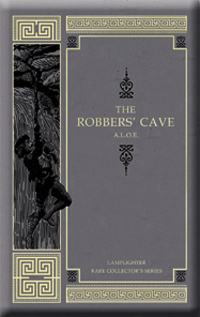
the-robbers-cave Yet another fine book from the Lamplighter Series of Rare Books. Written in 1887 by Charlotte Maria Tucker under the alias of A.L.O.E. (A Lady of England), The Robber’s Cave is a good read for all ages. It is suspenseful, reflective, and entertaining. Furthermore, Tucker is not afraid to show Roman Catholicism (the religion practiced by the book’s antagonists) as the idol-dependent false religion that it is.

The hills of Calabria, Italy are home to bands of nefarious thieves, but a single light can shine so brilliant in the darkest places. Why would a talented, skilled, and very innocent believer dwell purposefully with the cruelest villains? Perhaps you will learn the answer as you get to know Rafael, the Improvisatore. Ungrateful Horace Cleveland gains the answer to this question under the harshest of circumstances. The unfortunate opportunity is given to young Horace to learn the true value of things lost that he had taken so much for granted.

You can purchase this book at Family Faith Books.

Book review: Evangelism in the New Testament: A Plea for Biblically Relevant Evangelism by Jon Speed

evang-book2This book, short and sweet at only about 40 pages, makes an irrefutable case that the vast majority of evangelism that took place in the New Testament was among strangers. This goes directly against the idea that friendship evangelism is the ideal way to evangelize.

Personally, I’ve come to the belief that if you want to do friendship evangelism, or make balloon animals and pass them out and tell people Jesus loves them, you should go for it. However, be sure that you’re not discouraging those who are practicing confrontational (intentional witnessing to strangers) evangelism, because there’s a much better biblical case for this type of evangelism than for friendship evangelism.

On page 39, the author provides guidelines for what your church can do to become an evangelistic church.

  • Provide biblical, effective evangelism training.
  • Provide a wide variety of confrontational evangelism opportunities.
  • Encourage and work with those promoting Biblical evangelism in the congregation.
  • Have an evangelism budget.
  • Provide creative evangelistic outreaches for church members to invite unsaved friends to (ladies teas, sportsman dinners, career focused dinners, etc.).
  • Mention personal evangelistic opportunities in lessons and sermons.
  • Mention evangelistic prayer requests in appropriate settings.
  • Announce confrontational and invitational evangelistic opportunities and encourage and model involvement.
  • Invite guest speakers who specialize in evangelism.
  • Challenge one another to be intentionally evangelistic.
  • Pray the Lord of the harvest to raise up workers for the harvest (Matthew 9:38).

I think my wife is giving a lot of benefit of the doubt when she says our church does five of the eleven items. If we go to the most evangelistic church in our small town, and still don’t get a passing grade, what does that tell you about how good the church in America is at evangelism?

I encourage everyone who’s interested in the topic to to purchase the book, which is available here.