Is Your Wife Your First Ministry?

Is Your Wife Your First Ministry?

At DefCon, we holistically support men who support their families. Men who make discipleship and love a priority for the home. The home is one of the central building blocks for a society, and the marriage is the sun by which everything in the home orbits. Having said this, there are many priorities that pastors, open air preachers, and everyday christian men have that may sometimes burden us. We can become anxious, stressed, and overwhelmed with the multiple obligations that we are to tend to. And yes, wives are included in this list of feelings. And the one thing that is not helpful are Christian cliches like, “Your wife is your first ministry.” It has a nice ring to it, and for the most part it is well meaning, but it does not properly convey the responsibilities and obligations a Christian may face on a day to day basis. It has also been abused by certain preachers that wish to exclude certain men from ministry.

I have attached a blogtalk episode that I and a pastor friend of mine recorded about this topic. My hope is that we would all take into consideration the biblical model of men not just in ministry, but just being men in general. All the material discussed in this episode may or may not reflect all the views of contributing bloggers here at DefCon. Here is the narrative and link of the episode below.

“On this exciting episode of G220 radio, George will be joined by Pastor Tom Shuck from Pilgrim Bible Church. Pastor Shuck is a graduate of Master’s Seminary and Columbia Evangelical Seminary and was a missionary to India for 12 years. He holds both a Masters of Divinity (MDiv.) and a Doctorate of Ministry (DMin.). He has been a pastor of Pilgrim Bible Church for 4 years and helped start a seminary in India as well as planted a church there. He enjoys sports, music, family trips, and George’s personal favorite, linguistics. He has evangelized in cities like Oakland, Orlando, Mumbai, Pune training believers how to evangelize, preach the gospel, and make disciples. His wife is Lisa Shuck and two children.”

“This episode we’ll explore the cliche “Your wife is your first ministry.” Is it Scriptural? Are there other primary biblical responsibilities? Can you make ministry your idol or mistress? What should a man who is called to preach do with this kind of cliche? What about missionaries and evangelists of old that we look up to that sacrificed much, even their marriages, for the gospel? What about Matthew 22:35-40, 1 Corinthians 7:32-34, Ephesians 5:22-33, and 1 Timothy 3:5?”

http://www.blogtalkradio.com/g220radionetwork/2016/05/10/ep-157-is-your-wife-your-first-ministry

-Until we go home


If No Commission Was Given

If No Commission Was Given

Imagine if Jesus never commanded us to make disciples of all nations. Imagine if no explicit declaration was given. If no “go” was uttered and no commission was discharged. Would it change the necessity of the message to be preached? Would it alter, in any way, the reality that it must be preached?

There is something called implication and presupposition which is part of the internal structure of language. They influence the way we view and interpret one another’s speech. If the gospel is a message that says that all men are sinful, and that through faith in Christ are we justified. And that if we do not trust in Him we remain guilty because we have sinned against God and His wrath abides upon us. My question is, “How could anyone keep that to themselves?” A more positive side to this is, if the message contains the truth that eternal life is free, and that Jesus Christ bore God’s wrath on our behalf as a subsitutionary payment to appease God’s wrath and to satisfy the demands of justice concerning the crimes we committed against Him, and by His grace we receive acquittal for our crimes, and that He rose from the dead – defeating death, sin, and hell. Once again, “Why would anyone want keep that to themselves?”

It’s preposterous to think that a person who was pushed out of the way of a bus that was about to hit them would just walk away indifferently, chaining up the story concerning what happened, meanwhile not warning others of the same danger. It would be absolutely insulting to think that a man who was resuscitated from the dead would not be thankful toward the person who accomplished the work, and not publicly praise and declare to others of this person. Then why would some, professingly believing the gospel, not share it with others, seeing that we too were dead in our trespasses and sins and in danger of God’s wrath, and since Jesus revived us and took the punishment in our place? Here’s one idea. Those people never really experienced God’s grace in the first place.

Within the gospel is the commission to go preach. The message in and of itself implies and presupposes our responsibility to be a faithful witness. Even if Jesus never uttered a single command to be a witness to the nations, part of the inner workings of the message is that we automatically make disciples of others. Of course, the Great Commission in Matthew and Luke goes into particular details concerning how disciples are made. But nevertheless, if those details were never presented, the lack of effort and motivation that most have to even tell someone the good news is completely contrary to the message they profess to believe. 

But I already hear one rebuttal. If the gospel implies the commission, then why would Jesus command us nevertheless in Matthew? Answer: Because it was His sovereign will to do so! Also, consider how even when Christ told people to keep their mouths shut concerning His miracles (Mark 7:36), that they still proclaimed it even more! I wonder why they felt compelled to do such a thing? Was it a sin to have disobeyed our Lord at that time? Some say yes. But, once again, how could you keep the good news to yourself? Isn’t regeneration one of the greatest miracles that God does to man’s heart?

Let’s compound this a little more by adding one of the reasons the Holy Spirit was given in the first place. The Scripture teaches that it was in order for us to be witnesses (Acts 1:8). In essence, so that we would have the spiritual power to preach the gospel. If no command to preach the gospel was ever given by Jesus, and the message implies the commission, and indeed, the Holy Spirit dwells within us to empower us to be witnesses, then one on hand, if no command was ever given, we would still have all the motivation we need. On the other hand, since the command has been given, if you are sluggish to behave accordingly, you are either sinning, or you’re not born again.

Whether you are behaving apocitically or not, this one thing is sure. We have the gospel entrusted to us as believers, and we have been made ambassadors in this world. How much more do you need than what you’ve already been given to be a faithful preacher of the good news of Jesus Christ? Why does it require so much energy for you to make disciples in the world? If not you, then your fellow believer in your local assembly? Or your pastor? If you’re a pastor, then why your congregant? I’m not being nasty. I am heart broken. Why? If this is such good news, then why? If Jesus really rose from the dead, then why? If you’ve truly been taken from darkness into light, why? If the Holy Spirit has saved you and dwells within you, then why? Why cast aside the most comprehensible of God’s commands?

It is my prayer that we all grasp the urgency of what we profess and diligently seek to make disciples through gospel proclamation in our local areas.

-Until we go home

Faith and Justification

faith alone

There was a man who had made his way in the world. He lived by himself, for himself; spent much of his time in his nice condominium on the 5th floor of a nice building, away from the fray and cares of the world. One day a fire broke out in his building, on his floor. By the time he noticed the danger, the way out was impassible. Fire was breaking into his condo, causing the roaches and other vermin that had lived out of sight to seek escape in the open rooms. Desperation was setting in on the man, as he was seeing the stuff of his life consumed and his hidden companions revealed.

Through the open window he heard people yelling. On the ground below he saw men from the fire department, holding a net and yelling for him to jump. But jumping would not save him unless the firemen caught him. If he missed the net, if the net failed, if the men couldn’t hold it or cruelly moved out of the way; he would die. His jump would not save him. The fire had revealed the passing nature of his life trophies and the hidden pests he had been sharing his home with. But the fire could not save him – it only revealed the condition he was in and threatened his safety.

Do you see the spiritual lesson? The fire represents law, which reveals sin. While we Gentiles were never under the Mosaic Law, we were a law unto ourselves before Christ saved us and we were convicted by our own consciences that we were guilty. Unless we are made aware of this danger, we won’t notice it – man is naturally blind to spiritual truth. Jumping represents faith, a necessary component of our salvation, but not the entire scope. Faith in the firemen and their net wouldn’t save our man but it would get him to the safety they could provide. The firemen called the man, he jumped, the net held. Creator God calls men to Himself, (just as He did Lazarus) and they come to Him and are saved. Far more trustworthy than mere men and their net, our Savior is certain to save His elect. Our anchor holds!

Let’s take a closer look at faith and its part in our salvation. Ephesians 2:8 tells us, by grace you have been saved through faith. And this is not your own doing; it is the gift of God. As a footnote, I want to remind us that this faith is itself a gift from God, not something we contribute. Salvation is monergistic – all God and none of man. We also know that without faith no man can please God (Hebrews 11:6) and that not all men have such faith (2 Thessalonians 3:2). And lastly, we know that demons have some sort of faith which does not save them (James 2:19). This faith that God gives so that we can answer His call to “repent and believe” is special, necessary, and always present in the Christian’s life. This faith is not present in the lost person and the lack thereof keeps him from knowing and loving Christ Jesus.

1 Corinthians 2:14 The natural person does not accept the things of the Spirit of God, for they are folly to him, and he is not able to understand them because they are spiritually discerned.

This verse describes people who do not have the Spirit and do not believe in Christ: “the natural man.” This question must be asked: What work of the Holy Spirit is lacking? Does the unbeliever simply need a non-saving form of illumination (which would support faith preceding regeneration) or does he need regeneration itself (which would demand regeneration preceding faith) to overcome his deficiency? Stated plainly, can one who is classified as dead in sins and trespasses be illumined, given faith, without being regenerated?

Natural or unregenerate man is darkened in his understanding (Eph 4:17), hostile to God (Rom 8:7), incapable of pleasing or trusting God (Rom 8:7–8), and dead (Eph 2:1–5; Col 2:13). This is his nature, and he always discerns, evaluates, and chooses in keeping with this nature. The only satisfactory solution to this condition is for him to be given a new nature and become a spiritual man, a man with the indwelling Spirit—he must be regenerated before he can be illuminated with spiritual understanding that comes with faith. (Mark A. Snoeberger)

As important as faith is, to rightly comprehend its meaning and use, we must understand its role in our salvation. For how a man gets saved is the most important thing we can comprehend.

While faith is important, it is not most important. Faith is not what turns away the wrath of God, the blood of Christ does that. Although by faith we have peace with God, faith does not save us; the finished work of Christ dos that. We cannot be saved without faith, but faith cannot save us. And while the righteousness of God comes to us by faith (Romans 3:22), it is Christ’s righteousness that grants us God’s favor: For our sake he made him to be sin who knew no sin, so that in him we might become the righteousness of God. (2 Cor 5:21) Reconciliation with holy God is possible because we become His righteousness by having been bought by the blood of His Son.

Therefore, in everything we do; Bible study, evangelism, personal devotions, discipleship; Christ Jesus and His glory is to be our focus. The gospel is the proclamation of His sinless life and atoning death. The redemptive plan of God is revealed as the core theme of Scripture from Genesis to Revelation. Once we are born again by the Holy Spirit, we are no longer the carnal human we used to be – drawn and driven by the sinful desires of our flesh; we are new creatures in Christ, no longer regarding one another “in the flesh” but seeing all things through spiritual eyes of faith.

If we have been saved, we walk by faith and not by sight. We are no longer hostile towards God but anxious to know and please Him. While some would tell us sin is no big deal – we’ve been forgiven! – Scripture tells us that if one’s mind is set on the flesh, he is a dead man:

For those who live according to the flesh set their minds on the things of the flesh, but those who live according to the Spirit set their minds on the things of the Spirit. 6 For to set the mind on the flesh is death, but to set the mind on the Spirit is life and peace. 7 For the mind that is set on the flesh is hostile to God, for it does not submit to God’s law; indeed, it cannot. 8 Those who are in the flesh cannot please God.  9 You, however, are not in the flesh but in the Spirit, if in fact the Spirit of God dwells in you. (Romans 8:5-9)

If you and I have been redeemed by the blood of the Lamb, His Spirit does dwell in us and we are pleasing to God for the righteousness of Christ is imputed to us; we are justified by his grace as a gift, through the redemption that is in Christ Jesus, whom God put forward as a propitiation by his blood, to be received by faith. (Romans 3:24 & 25) We are justified and redeemed, by grace alone received by faith alone in Christ alone.

Some teach that justified means “just as if I’d never sinned.” If you say it just right, it sounds really cool. But that catchy phrase does not begin to describe the depth of our need nor the scope of Christ’s provision. The truth of our situation is that we were dead in sins and trespasses and Christ died for us while we were His enemies. A Man of sorrows, He stood in our place, having no sin of His own. His blood paid the price we could not pay. We were great sinners who were even more greatly forgiven by our great and holy God. We are forgiven, redeemed, ransomed, and reconciled – by the blood of Christ; to be shielded from the wrath of God and the Lamb on that great Day of Judgment. Are we to consider ourselves as if we’d never sinned? God forbid! Such a view does violence to the cross and the ongoing intercession our Lord provides. Our sin debt was not merely dismissed as a bad grade on an elementary school report card. Jesus hung on the cross and suffered the wrath of God on our account and there is now no condemnation for those who are in Christ Jesus!

The haunting lyrics of Matthew Smith’s rendition of “All I Owe” portrays how the sinner praises Christ for His sacrifice:

And all I owe you paid for me
From all I owe I’ve been set free
And all I owe proves your great mercy to me

We were bought at a price, we do not belong to ourselves any longer. The Spirit of the living God dwells within us, so we are to glorify God in our bodies (1 Cor 6:20). Paul went on to tell us (Gal 5:16-25) to walk by the Spirit, and you will not gratify the desires of the flesh. He contrasts the fruit of the natural man with the fruit of the spiritual man and finishes with an exhortation: And those who belong to Christ Jesus have crucified the flesh with its passions and desires. If we live by the Spirit, let us also keep in step with the Spirit. This is a life of faith; we struggle against sin, take measures to avoid sin, keep our focus on the unseen realm where we are seated with Christ. We are to be heavenly minded so we can be of earthly good. We won’t walk perfectly, for the flesh will always be tempted and sin too often; which is why no flesh can inherit the kingdom of God. But we have not been left to walk this path alone. We have the Holy Spirit within us, working in us to will and to do that which pleases Him (Phil 2:13). And we have an advocate, the Lord Jesus, Who is ever interceding on our behalf!

Walking in Spirit means we are sensitive to the sinful desires of our flesh and repent from those things that grieve Him (Ephesians 4:30). It also means our focus is to cooperate with Him and do, speak, and think things that please Him.  We have been translated from the kingdom of death to the kingdom of life!

Justification and Regeneration, Charles Leiter

Page 34 – 35: There is nothing in man that causes God to justify him, including his repentance and faith. Repentance does not pay for sin. A criminal’s remorse for his crimes does not satisfy the just demands of the law. Neither does faith pay for sin! Only the blood of Jesus can pay for sin! Justification is based on the blood of Christ.

This explains why a person can have a very weak faith and still be justified. Imagine two bridges crossing a chasm: One is very weak and untrustworthy; the other is very strong. A man may have a very strong faith in the weak bridge and confidently step out onto it. His strong faith will not keep him from plunging to his death. On the other hand, a man may have a very weak faith strong bridge and only barely manage with fear and trembling to venture forth upon it. The bridge will hold him securely, regardless of his weak faith. All that is necessary is for him to have enough faith to get him onto the bridge! When someone told Hudson Taylor that he must be a man of great faith, he replied, “No, I am a man of very little faith in a very great God.”

This little snippet reveal something else about faith that we must understand. The object of our faith is what is important. As the strong bridge in the story was essential, so the right Jesus for us. This is why the Roman Catholic Church is a synagogue of Satan: they have an unbiblical Jesus who cannot save. One can have all the faith in the world in a false savior and be certain of doom. As 1 Corinthians 15 declares, Christ Jesus dies for our sins according to the Scriptures; was crucified according to the Scriptures; He was resurrected according to the Scriptures. The Jesus Who saves is the Jesus of the Scriptures, not of man’s imagination!

Colossians 3:1-3 (ESV) If then you have been raised with Christ, seek the things that are above, where Christ is, seated at the right hand of God.  Set your minds on things that are above, not on things that are on earth.  For you have died, and your life is hidden with Christ in God.

Beloved, we who have been bought by the blood of Christ have died to self and this world, our life is hidden from the world because we are in Christ and they cannot see Him unless they are born again (John 3:3). Our citizenship is in heaven (Phil 3:20), we are seated with Christ in the heavenly places (Eph 2:6), crucified to the world (Gal 6:14). It is only our mortal body, our flesh, which has not been redeemed; that and our mission of reconciliation is all that ties us here. We are to put to death our members that are upon the earth (Col 3:5) and present our bodies as a living sacrifice unto our God (Rom 12:1). We are to resist being conformed into the pattern of the world and instead be transformed by the renewing of our minds on the word of God so we will know discern that which pleases Him (Rom 12:2).

This is the life of faith! Having been raised to new life in Christ, we are able and will want to be people who bring honor and glory to Him. He alone is worthy of all praise and we are those living stones He raise up to be His temple and to sing His praises now and throughout eternity!

John’s apocalyptic view of the end of this age (Revelation 5:1-9):

Then I saw in the right hand of him who was seated on the throne a scroll written within and on the back, sealed with seven seals. And I saw a mighty angel proclaiming with a loud voice, “Who is worthy to open the scroll and break its seals?” And no one in heaven or on earth or under the earth was able to open the scroll or to look into it, and I began to weep loudly because no one was found worthy to open the scroll or to look into it.  And one of the elders said to me, “Weep no more; behold, the Lion of the tribe of Judah, the Root of David, has conquered, so that he can open the scroll and its seven seals.” 

And between the throne and the four living creatures and among the elders I saw a Lamb standing, as though it had been slain, with seven horns and with seven eyes, which are the seven spirits of God sent out into all the earth. And he went and took the scroll from the right hand of him who was seated on the throne. And when he had taken the scroll, the four living creatures and the twenty-four elders fell down before the Lamb, each holding a harp, and golden bowls full of incense, which are the prayers of the saints. And they sang a new song, saying,

“Worthy are you to take the scroll

and to open its seals,

for you were slain, and by your blood you ransomed people for God

from every tribe and language and people and nation,
 and you have made them a kingdom and priests to our God,

and they shall reign on the earth.”

What a glorious Lord and Savior is Christ Jesus! He conquered hell and death and sin; He is the author of life and holds the keys of David. By His obedient life He earned the privilege to open the scrolls that spell out God’s consummation of history. The Lamb Who suffered and died, rules all of creation and will judge the quick and the dead. He is worthy of our praise, our devotion, our lives. And He is faithful even when we are faithless and tempted by the devil.

When Satan tempts me to despair

And tell me of the guilt within,

Upward I look and see Him there

Who made an end of all my sin.

Because the sinless Savior died

My sinful soul is counted free,

For God, the Just, is satisfied

To look on Him and pardon me.

(Charitie L. Bancroft)

What Is Evangelism?

(This is from the last section in the book I am writing on Baptist theology and practice.)

One of the major purposes we are left on this planet after being raised from spiritual death is to Evangeltake the gospel to every nation, tongue, and tribe; being evangelists and ambassadors of reconciliation. We need to clarify what evangelism is and will begin by identifying a couple of popular practices that are not biblical evangelism. First is the notion that inviting lost people to church is evangelism. This reflects the false notion that evangelism is for the “professionals” and it also lets those who are ashamed of or disinterested in Christ Jesus off the hook of being familiar with His message. 1 Corinthians 14:23-25 shows that unbelievers are welcome but not the focus or even normal attendees in the regular worship of the local church. Ephesians 4 teaches that the local church is to be equipped so the sheep will not be tossed about by the wiles of men. Contrary to the idea of inviting lost people to church, YHWH tells us, So Jesus also suffered outside the gate in order to sanctify the people through his own blood. Therefore let us go to him outside the camp and bear the reproach he endured. (Hebrews 13:12-13). By this, God means we are to go therefore and make disciples of all nations (Matthew 28:19); making disciples of those that have answered the call. About that, more later.
Secondly, many church leaders put emphasis on the personal testimony of those witnessing, rather than making sure they can communicate the gospel. Some even acknowledging that the reason for doing so is because no one can argue with your personal testimony, as it is subjective, whereas the gospel is objective and demands a response. They might argue about the content and the demand of the gospel, but not about what God did for you. This is post-modern thinking and goes directly against the biblical instruction we have as ambassadors of our Lord and Savior (2 Corinthians 5:16-21).

The essential element in all evangelism is proclaiming the biblical gospel (this was covered in some detail in Chapter 8). By doing so, we take the pressure of our performance and insure we don’t contribute to false converts, and we also get confidence in the Word and Spirit of God as we see them do the work that only they can do. Being familiar with the Scriptures will embolden us as we see YHWH has gone before us preparing the soil for the seeds we sow, insuring a good return for His kingdom; see Mark 4:1-9 and:

For as the rain and the snow come down from heaven

and do not return there but water the earth,

making it bring forth and sprout,

giving seed to the sower and bread to the eater,

so shall my word be that goes out from my mouth;

it shall not return to me empty,

but it shall accomplish that which I purpose,

and shall succeed in the thing for which I sent it.

(Isaiah 55:10 & 11)

It is His Word, sent out as He intended, that will not return void, not the 3 minute summary of our personal testimony or a twisted version that He has not commissioned.

As we go about faithfully proclaiming our Lord’s message, we would do well to bear in mind that there are two calls involved in evangelism: we give a general call to every creature (Mark 16:15) and God gives an effective call to His elect (John 6:44). Our call is universal, general, and outward, as we do not know who He has chosen to save. His call is specific, effectual, and internal, as He alone knows those chosen before time to be His adopted children (Ephesians 1:3-10) and He will give ears to hear to His elect. We see this graphically portrayed in Scripture in several places, including the scene wherein Paul and Barnabas had been preaching Pisidia and gained the attention of many people.

The next Sabbath almost the whole city gathered to hear the word of the Lord. But when the Jews saw the crowds, they were filled with jealousy and began to contradict what was spoken by Paul, reviling him. And Paul and Barnabas spoke out boldly, saying, “It was necessary that the word of God be spoken first to you. Since you thrust it aside and judge yourselves unworthy of eternal life, behold, we are turning to the Gentiles. For so the Lord has commanded us, saying,

“‘I have made you a light for the Gentiles,

that you may bring salvation to the ends of the earth.’”

And when the Gentiles heard this, they began rejoicing and glorifying the word of the Lord, and as many as were appointed to eternal life believed. And the word of the Lord was spreading throughout the whole region. But the Jews incited the devout women of high standing and the leading men of the city, stirred up persecution against Paul and Barnabas, and drove them out of their district. But they shook off the dust from their feet against them and went to Iconium. And the disciples were filled with joy and with the Holy Spirit. (Acts 13:44-52)

The message preached is found in verses 16 – 41. Gentiles and Jews heard the same general call, bringing them the good news that what God had promised to the Fathers He had fulfilled by raising Jesus from the dead. The seed fell on some rocky and thorny soil, but it fell on some good soil that had been prepared in advance by the good husbandman (John 15:1). As we see in the well-known road to Emmaus scene, it is YHWH Who keeps them from seeing or understanding until the right time (Luke 24:15 & 16; 30 & 31).

Jesus gave this general call in Matthew 11:28 and John 7:37, as people without respect to their persons were called to come to Him and find rest, to come to Him and satisfy their thirst. This is also the context of Peter’s sermon recorded in Acts 2, as men from myriad countries and religious beliefs (verses 9-11) were called to repent and be baptized (as a sign of their belief). The problem with this call is the same problem the Jews had with their Law: neither one can save or enable the hearer to be saved. People can claim to obey the law (Luke 18:18-23) and they can ignore or refute the words of men (Luke 14:15-24).

The general and effectual calls are likewise revealed to us explicitly in Acts 16, wherein we see Paul, Timothy, and Silas making a journey which finds them in Philippi where they stayed for a while. And on the Sabbath day we went outside the gate to the riverside, where we supposed there was a place of prayer, and we sat down and spoke to the women who had come together. One who heard us was a woman named Lydia, from the city of Thyatira, a seller of purple goods, who was a worshiper of God. The Lord opened her heart to pay attention to what was said by Paul. And after she was baptized, and her household as well, she urged us, saying, “If you have judged me to be faithful to the Lord, come to my house and stay.” And she prevailed upon us. (verses 13 – 15) A good number of women who were somewhat aware of God had gathered at the river and all had heard Paul’s gospel message as the general call went out without restriction. At least this one had her heart opened by YHWH so that she heard the effectual call and was obedient to follow in believer’s baptism.

There are some who think the Law ought to be a part of the gospel, as people need to be convicted of their sin before they can see the need of grace. The law provokes us and reveals sin in us, but cannot grant eternal life. John Bunyan is thought to have written this little poem, showing us with memorable lines the difference between the Law and the Gospel:

Run, John, Run! The Law commands;

But gives me neither feet nor hands.

Far grander news the gospel brings;

It bids me fly and GIVES ME WINGS!

Our Savior has said something similar, in Paul’s Roman epistle: For God has done what the law, weakened by the flesh, could not do. By sending his own Son in the likeness of sinful flesh and for sin, he condemned sin in the flesh, in order that the righteous requirement of the law might be fulfilled in us, who walk not according to the flesh but according to the Spirit. (Romans 8:3 & 4)

The gospel is the good news of what Jesus has done to save sinners; refer to the Biblical Gospel in chapter 8. Our focus must be on that message, not 4 spiritual laws or any other nifty scheme man may have invented to make witnessing easy. We are not called to a life of ease; we are called to obedience. We are ambassadors of His message of reconciliation, not a one-off message of our own making. While the Law may rightly be used to show a self-righteous religious man his sin; it is not part of the gospel that every spiritually dead person must hear. Seeing the holiness of God in Christ, even in part, will do more to crush self-righteousness (as in the opening scene in Isaiah 6) than all the heavy yoke of the Law can bring to bear for the one who is being called to new life by the Spirit of the living God.

Much of the activity in a local church under the flag of evangelism takes place in what are called revivals. This is a logical progression under the previously mentioned idea that evangelism is bringing lost people to church. It appears that there is a belief that a specially called meeting with an out-of-town preacher will create an environment for sinners to be saved. I cannot commend revival meetings because I do not find them revealed or recommended in Scripture; I do not find them practiced by the early church; they presume man can schedule the work of the Holy Spirit; they rely on someone other than the shepherd of the local flock to feed them; and they influence many to chase numbers rather than spiritual growth. A century ago, a brother sounded a warning to the church regarding this practice:

The modem “revival,” the work of the “revivalist” who comes under the title of an evangelist, but works as a religious promoter in the organized church, is unexpected in Scripture, except as the word “revival” is used to denote a forward movement in the spiritual life of the church, without including the idea of attempting to regain some spiritual position once held, but now lost. The use of the word usually means, however, a getting up after having fallen down, or a waking after sleeping, or a coming to strength after a period of weakness; while, on the other hand, the Scripture pre-supposes a continual erect, wakeful and aggressive position for service on the part of every Christian (Eph. vi. 10-17). Thus, it may be seen, a “revival” is abnormal rather than normal. It may have a function when needed, but in no way should become a habit, much less a sanctioned method of work. Having regained vitality, believers are not warranted in habitually returning to an anaemic state. … The fact that a “revival” is planned for is a confession on the part of a church of a condition which would render the normal movements of the Spirit in salvation impossible. The call for the evangelist, under those conditions, also reveals the fact that the expectation of the church, to a great extent, is toward the man that is invited, rather than toward the Holy Spirit and His appointed ministry through the church itself. (True Evangelism, Lewis Sperry Chafer, epub, position 38.6 & 40.4, emphasis mine)

Evangelism, like all kingdom work, must be in accordance with the instructions and principles clearly given to us by our God. As discussed in chapters 5 and 6, regarding the nature and use of Scripture, when we use what man has developed to further kingdom work rather than what God has given us, we are betraying a greater trust in man than we have in our Creator. And this should never be the case for people of the Book! God is a jealous God and He will not give His glory to another. There is safety in our standing on and under the Word of God; it is His authority and revelation to us. History aligns with Scripture in bearing this out, as this short extract from an early debate between the reformers and Rome reveals:

Charles Eck had been sent by Rome to Germany to refute what Luther, Melanchthon and others had written in the Augsburg Confession; a document intended to declare essential doctrines and not to be the handmaid or rival to the Word of God. The Duke of Bavaria was the judge. After listening to the reaction to the confession, he asked Rome’s defenders, “can you refute by sound reasons the Confession made by the elector and his allies?” – “With the writings of the apostles and prophets – no!” replied Eck; “but with those of the Fathers and of the councils – yes!” (J.H. Merle D’Aubigne, History Of The Reformation Of The Sixteenth Century, Volume IV, page 187, Sprinkle Publications, 2003) As was pointed out in chapter 7 regarding the use of confessions, this peek into history reveals the absurdity of using man’s documents to defend Christian disputes. If we cannot, by sound reason, defend our beliefs and practices by the writings of the apostles and prophets, we have no business expounded them as Christian doctrine or practice.

When man claims to accomplish by the flesh what only God can do, we steal glory from God and He will not allow that to continue. It is His work to raise sinners to life, as He breathed life into Adam, as He gave life to 4-days dead Lazarus by calling him forth. Let us abandon the false hope that we can defer to pastor-man or that we can cause God to respond to our schedule and schemes. His kingdom, His Word, His temple; He is building the New Jerusalem with spiritual stones that He gathers from every nation, tribe, and tongue. We can work with Him or against Him. ‘Tis a far better thing for professing Christians to work with God than in opposition to Him. May it be so with us, as we herald His glorious name throughout the world.

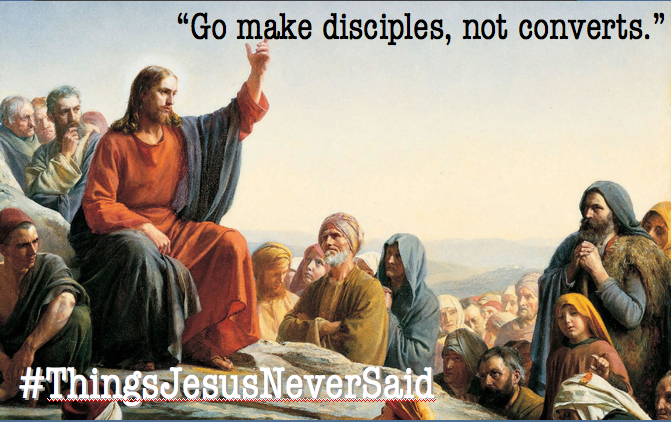
Make Disciples, Not Converts? Really?

Screen shot 2016-04-27 at 12.21.33 PM

Cliches are normal in any language. Sometimes they are able to capture a snippet of thought accurately, other times they muddy the waters of theological judgment. Of course, the impact of any cliche is purely subjective, but it seems that western Christianity is full of cliches that are just not biblically supported. Obviously from the title, you know which one I have in mind so I won’t waste time getting to the point.

Where in the bible do we even find a hint that a convert of Jesus Christ IS NOT a disciple? For the most part, I get it. I get that the idea here is that we focus on making true disciples rather than just a mere decision to follow Christ. However, the reality of the matter is, when a person repents of their sin and trusts in Jesus’ finished work to save them from their sin, if their regeneration is from the Holy Spirit and they exhibit a life that bears fruit and perseverance in Christian character and godliness, that person is not only a convert, but a disciple of Jesus Christ. The moment anyone is saved from their sin, they become a disciple. A follower of Jesus. A convert of Christ. The idea that we can gain a convert but not a disciple is not only unbiblical, but absurd.

One of the ways this cliche gains ground is from the Carnal Christian doctrine and Decisionism. Although they are distinct in some ways, both feed off each other. They propose that a person can become a Christian, yet still live carnally. Also, they teach that a person can have Jesus as Savior, but not as Lord. Furthermore, you can make a decision to follow Christ, but still be a babe or carnal for most, if not all, of your christian life. If such a thing is believed and taught in your church, run.

For the most part, a person may have good intentions when stating this cliche, or they are ignorant of its presupposition. That happens. We want to try and provide someone with the benefit of the doubt as much as possible. Also, not everyone that states this cliche may come from a Carnal Christian perspective (at least not knowingly). But the main thrust here is to challenge even the possibility that someone can become a true convert to Christ, but not be a disciple. They may be a young disciple, a new disciple, or even a false disciple if they fall away. But, in the mean time, they are disciple nevertheless until proven otherwise. The same goes for the word convert. They are semanitcally interchangeable.

In Acts 3:19 Peter preached repentance and conversion. In Acts 15, Paul and Barnabas described to the Phoenicians and Syrians the conversion of the Gentiles. In Psalm 51, David mentioned teaching transgressor God’s ways and converting them (sounds like the Great Commission in a nutshell). In Acts 6:1 it mentions how disciples were multiplying. Acts 14 also mentions making many disciples, and they just started in the faith. And even verses that don’t use the words translated as “convert” or “disciple” in both old and new testaments still semantically explain what conversion and being a follower of Jesus/God is, and are an inclusive list which helps us to systematically understand that to turn from sin and turn to God is conversion and discipleship. Sure, it involves lifetime dedication, devotion, repeated repentance, and obedience to the one you profess to know and love. But it is still conversion and discipleship nevertheless. And to throw a wrench in this whole matter, even Judas was called a disciple when, in reality, he was not.

It would necessitate a bible study of multiple passages and words that would help illustrate my point further. Nevertheless, it is my hope that we grasp that this cliche doesn’t really demonstrate a biblical understanding of a follower of Christ. No matter how you slice it, a disciple is a convert and a convert is a disciple. They can be used interchangeably. And that is the beauty of language and words within language. There may be times when using the word “convert” describes an entry level understanding of just coming to faith in Christ, and other times when someone calls you a convert of Christ and you have been in the faith for years. The same goes for disciple. Some can call you a disciple of Christ and you just got saved yesterday, and you can be called a disciple after years of obedience to Him. It depends on the context and how the word is used. And Scripture illustrates this fact.

Therefore, if the Holy Spirit has indeed saved you, regenerated you, called you out of darkness into light, and you drop your nets, repent, and follow Christ, from that point forward you are a disciple and a convert to Christianity. However, remember that you can be a professing disciple/convert, but not truly be one. I pray the Lord opens our eyes to this truth.

-Until we go home

The Origins of the KJV

I’ve been told by some KJV-only advocates that one reason they believe the KJV to be THE KING-JAMES-ONLY-115396838242English Bible is that they claim it has been purified 7 times and the Bible prophesied it would be so! Here’s one web site that explains their position. And their summary is:

The seven English versions that make the English Bibles up to and including the Authorized Version fit the description in Psalm 12:6 of the words of the Lord being “purified seven times” are Tyndale’s, Matthew’s, Coverdale’s, the Great Bible (printed by Whitechurch), the Geneva Bible, the Bishops’ Bible, and the King James Bible.

The Wycliffe, Taverner, and Douay-Rheims Bibles, whatever merits any of them may have, are not part of the purified line God “authorized,” of which the King James Authorized Version is God’s last one — purified seven times.

They allude to but do not explain how they made these determinations, but conclude that the 1611 KJV is YHWH’s purified Word. I do find it curious that only English Bibles are included in their lineage of purified Bibles. What does the non-English speaking world do? As for the lineage of the KJV, there is no basis for argument. Here’s how HCSB: Navigating the Horizons in Bible Translations records it:

When in 1604 King James authorized a committee of scholars to publish a new Bible, he directed them to start with the Bishop’s Bible and retain what was already accurate and elegant and excellent, while consulting the original language sources to see if any modifications were necessary. In the introduction, Miles Smith states,

Truly (good Christian Reader) we never thought from the beginning, that we should need to make a new Translation, nor yet to make of a bad one a good one . . . , but to make a good one better, or out of many good ones, one principal good one, not justly to be excepted against; that hath been our endeavor, that our mark.

So the KJV, strictly speaking, is not a translation but a revision. In fact, it is a revision of a revision (Bishop’s Bible) of a revision (Great Bible) of a revision (Matthew’s Bible) of a revision (Coverdale’s Bible) of Tyndale’s translation. “A great deal of praise, therefore, that is given to it belongs to its predecessors. For the idiom and vocabulary, Tyndale deserves the greatest credit; for the melody and harmony, Coverdale; for scholarship and accuracy, the Geneva version.”

Yet the authorized version continued to undergo change. From the same book:

By the time the 1762 Cambridge and 1769 Oxford editions were printed, English spelling was standardized. There were nearly 24,000 changes from the 1611 editions.

Advocates of the KJV argue that the only changes were punctuation, spelling, and correction of printers’ errors. Even that would qualify as an “update.” However, also included in the 24,000 changes were around 1,500 significant changes.

Something I was unaware of is that many English Bibles relied on Latin rather than source language sources for most of the Old Testament:

in the chain of revisions from Tyndale’s Bible to the KJV, the last 34 books of the Old Testament were never translated from the Hebrew and Aramaic! Tyndale only translated the Pentateuch before he was martyred, and Coverdale translated the rest of the Old Testament from the Latin. Therefore, technically, even the RV, ASV, RSV, and ESV contain 34 books of the Old Testament that were originally translated from the Latin and then “carefully compared” to the Hebrew and Aramaic. (ibid)

With the recent availability of ancient manuscripts such as the Dead Sea Scrolls we have access to more and older manuscripts for nearly all of the Old and much of the New Testament. Part of the main goal of accuracy in translation deals with the target language; how can the idea given by God in Greek, Aramaic, or Hebrew be best translated into today’s English? Advances in translation techniques and software in the late 20th century had given translators the best tools yet to ensure English Bibles deliver the meaning of the inspired texts given to His prophets and apostles.

Those who think English forms of speech from 500 years ago and the faulty sources used by the KJV, it is difficult for me to comprehend why some Christians think the KJV is the best and/or only English Bible we should use. It is a good English Bible, but it is not inspired. Once more from Hcsb: navigating the horizons in bible translations:

The first words of Pr 26:23 were always taken as “silver dross,” and it was hard to understand the sense of the verse. Then starting in the late 1920’s thousands of clay tablets were unearthed at Ras Shamra. The language turned out to be Ugaritic, and the tablets greatly increased our knowledge of Near Eastern poetry, Canaanite mythology, and Semitic vocabulary. The Ugaritic word spsg was discovered, which means “glaze.” By dividing the Hebrew differently, the first line can be translated, “Like glaze on an earthen vessel,” which is an apt comparison to “flattering lips with an evil heart.”

As archaeology and linguistics improve our understanding of the language and culture of the ancient Near East, at some point it becomes incumbent upon the English-speaking church to produce a new translation of God’s Word.

May God grant us wisdom to truly seek the meaning of His message to His people, and avoid treating any translation as a religious relic to be revered.

As a postscript, because some people commenting are mistaken in believing the KJV to be supreme, here is a short article examining errors in the KJV. It’s a good translation, but it is the product of man.

Every Christian Believes Election

Every Christian Believes Election

Not everyone consciously affirms the doctrine of election. The reasons for this vary and are definitely outside the scope of this particular article. But whether you don’t like it, don’t agree with it, or are simply neutral about it for the time being, predestination and election are concepts in Scripture that every believer will be confronted with. Even if you choose not to deal with it, the unbelieving world still has heard about it, learned it when they were in church as a kid, and/or logically deduces it through the knowledge that God knew before hand that man would fall, and yet still created us. So even if we bury our head in the sand and ignore this, the world will not let us. And, if we have faithful pastors and brethren in Christ who challenge, edify, and provoke us in godliness through the word of God, they won’t let us ignore this topic either.

Although you may hold to a more unique position concerning predestination and election, you will probably sympathize with either of these two views:

  1. God chose to save some out of His own free will, without regard to their future faith in Him.
  2. God chose to save some out of His own free will, but with regard to their future faith in Him.

I hate to be overly simplistic, but this is really the pivot point of almost every predestination conversation. Regardless of whether or not you believe man’s will is totally free or a slave, whether man can fall away from grace, or that man has the ability to resist God’s grace, this is where the starting line is painted.

Does God choose men from before the foundation of the world in accordance with man’s future faith? Or does God do this freely from His own volition without regard to who He knew would choose Him? This may sound a little extreme, but I propose that, although this conversation is important, and that I lean toward God choosing of His own volition without regard to our future faith, in the grand scheme of things, both are essentially saying the same thing, just with different emphasis. Here’s what I mean.

Whenever I get into a conversation with someone that strongly insists that God foreknew who would choose Him, and therefore chose who would be saved from that, my normal reaction is not to exegete Romans 8:29 properly (although certain contexts may allow for it). Nor do I fret when someone dogs election and predestination when they make mention of how God is a tyrannical, diabolical, evil, etc., for electing some to salvation while choosing others also to hell (which is often a straw man, misunderstanding, misinterpretation, ad hominem, and most of the time, a deliberate negligence to comprehend the doctrine of reprobation. Meanwhile wrongly attributing predestination to double predestination). I just simply ask if they believe God is omniscient. That’s all. Here’s why.

If God is omniscient, then that means He knew even before all of us were born who would be saved. God still possessed this knowledge of whom He would choose, and He had it without our permission. How we see God working this out from Scripture can be debated, but it can still be a bit of a red herring sometimes to discuss in my opinion. Because since God is omniscient, He knew from the foundation of the world who was destined to salvation. Understanding this, if God knew who would be saved, even before we were born, how does the fact that He chose based off our faith change the reality that God was in the beginning sovereignly deciding who would be saved? Did you catch that? Let’s say it another way. Even if God did indeed choose to save some based off of who would trust Him, and He foreknew who would believe Him, and from that decided, how does that negate the fact that He decided before we were even born? Even before we were even able to exercise that faith? We still didn’t have a say in the matter!

My intent here is not to rouse strife for shock and awe. I developed this in order to establish some peace in a conversation as well as some logical agreement. If you are a Christian, and you believe that God is omniscient, by default you implicitly ascribe to predestination and election, although unadmittedly. You may not believe that God elected and predestined some despite their faith, but you must logically deduce and concede to the fact that God’s omniscience alone makes election at least plausible. And by simply trying to soften the blow of election in saying that God chose some to be saved in accordance with our faith, one must admit that it doesn’t sweep away the problem at hand –  that man’s problem with God is His sovereignty and free will to do as He pleases way before we were even born! A problem that even most professing Christians today have contention with. But if we are honest, we have no choice but to affirm this if we believe God is omniscient.

I hear the marching drum pounding with an army of rebuttals. One rebuttal is that even though God is omniscient, that doesn’t mean men are not accountable for their sin. I agree. Often Calvinists are attacked because others believe that in the doctrine of election that man can’t be held responsible for their sin. This of course is not true, but once again outside the scope of this article. Another rebuttal is that God’s omniscience is not the same as God choosing some to be saved. I agree again. But His omniscience alone approves of His will to choose because it was already in His nature to know and do as He pleases. So while the act of knowing and choosing may be distinct, they are in harmony with each other. Because how does God know who will be saved, and yet, decide against it? And if He did change His mind, and like man wavered between choosing (which I don’t believe), it still leaves us with the same conclusion.

Let’s say you’re still not convinced. For argument sake, let’s say you’re not persuaded that God’s omniscience does not equal affirming predestination and election, and that election (where God chooses of His own will and pleasure without regard to who would choose Him) still presents an evil, unbenevolent God. Philosophically speaking, you cannot have mercy without judgment, can you? Can you have evil without good? Can you understand salvation without sin? At base level, if you didn’t believe in double predestination (the idea that God chooses some to heaven as well as hell), or even predestination (God elects some to be saved meanwhile passing over others), you still would have to conclude that God knew from the beginning who would go to hell and to heaven. Unless you believe in universalism where God saves everyone eventually, or affirm a pelagian/deistic god who purposefully limits His own knowledge of the future so as to not infringe upon the will of man (both are heresy by the way), you must believe, as a Christian, that some will inevitable go to heaven or hell in the end. And God knew it! This isn’t fun to talk about out loud. I know. But it is still reality. Regardless of which side of the fence you stand on, you must, I repeat, you must submit to the idea that God knew from the beginning who would eventually go to heaven or hell. It’s not about whether or not God is evil or good, or making Him more or less benevolent. It’s about accurately representing God and His word without conceding to man’s ideas of how they feel God should act.

I don’t say any of this without grace. It took me a long time to come to these realizations, and I trust that many readers will find what I have said offensive. Meanwhile others are perhaps still trying to comprehend such a deep theological issue. Trust me, I sympathize. I only wish to make plain that in arguing for whether or not God chose in accordance with man’s will or His own, that we don’t cower from it simply because some have issues with it. And whatever the motive someone has to propagate that God chose because He knew who would have faith in Him, it doesn’t really change anything in light of God’s omniscience. Because if God is omniscient, He still knew, before we were born, who would be saved. And He still acted, prior to our birth, based upon His own will and good pleasure and consulted no one in process!

In essence, we will always end up back to square one regarding the most classic question ever asked by man: “If God knew man would fall, why did He create us in the first place.” The answer may vary depending on your theology, but it doesn’t do away from the inescapable truth that God, if He is truly that, has already determined who would be saved, based off of the good pleasure of His will, and the benevolence of His person. And that it will be through the sacrifice of Jesus Christ – Son of God, 2nd person of the Trinity, fully God fully man – that this salvation is attainable. Because, if you think about it, God didn’t have to save anyone. None! We all deserve hell. Period. If God saved one person, it would be the most gracious and loving act that God could have bestowed upon a human being, and God would be perfectly justified in sending the rest to eternal torment. But since God is infinitely more gracious than we could imagine, He has chosen to save millions to date (by my puny estimation). If man wants to secure his free will and be a contributor to their salvation, they can have it. So as long as God gets to keep His free will and do as He pleases without obligation to any man’s volition.

-Until we go home

False Teachers

Three Common Errors of False Teachers

by Mike Gendron

November 9, 2015

  •  Since we are now living in the age of religious tolerance and ecumenical unity, there are some people who will immediately call this article unloving and divisive. Others will ask, “What right do you have to judge another religion?” The answer is given in Scripture. All God-fearing people are called to make right judgments, judgments that have already been established by the objective principles of God’s Word (John 7:24). There may be nothing more important than warning people who are being deceived about their eternal destiny. If we do not lovingly confront them with God’s Gospel, they may never know how to escape the eternal fire of God’s punishment. Clearly, the most unloving thing we can do is to ignore them and let them continue down the road to destruction. For this reason, I am always willing to offend people with the offense and exclusivity of the Gospel in the hopes that God may grant some of them repentance leading to a knowledge of the truth (2 Tim. 2: 25). Let us look at three fatal errors of false prophets and how to handle them.


False Teachers Usurp the Authority of God

  •  The supreme authority of the Bible is established both by its divine origin and inspiration (2 Pet. 1:21). It is the infallible Word of God, and it will accomplish God’s purpose (Isaiah 55:11). It is the very foundation upon which all Christian truths rest. For followers of the Lord Jesus Christ, the Bible is the final court of appeal in all matters pertaining to faith and godliness. “All Scripture is God-breathed and is useful for teaching, rebuking, correcting and training in righteousness” (2 Tim. 3:16). The divine authority of Scripture corrects and rebukes all false teaching because there is no higher authority or infallible source in which to appeal. It is the Word of God, and God cannot lie, cannot break His promise and cannot deceive.
  •  People fall into serious error and sin when they exalt their own authority over God’s authority or when they suppress the truth of God’s Word to promote their own self-serving agendas. The Roman Catholic religion has done this by establishing its traditions and teachings to be equal in authority with Scripture (Catechism of the Catholic Church [CCC] par. 82). In doing so, it has usurped the supreme authority of our sovereign God who alone has the right to rule and determine the eternal destinies of men. This fatal error has opened the flood gates to numerous other deadly heresies including: the preaching of another gospel, the worship of a counterfeit Jesus, the buying and selling of God’s grace through indulgences, the creation of a fictitious place called purgatory, the establishment of other mediators and praying to and for the dead. These errors are fatal because anyone who is embracing them when they take their last breath will experience eternal death.
  •  Catholics who are being deceived by these fatal errors must be told that the world has known only one infallible teacher. He is the Lord Jesus Christ, who was the personification of truth and every word He spoke was truth (John 14:617:17). Those who are seeking the truth need to look only to Christ and His Word. The Catholic religion has become corrupt the same way Judaism became corrupt – by following the traditions of men instead of the Word of God (Mark 7:13). The Pharisees taught much truth, but by mixing it with error, they “made the word of God of no effect.” We must never forget that the Bible is what God says and religion is what man says God says.

False Teachers Distort the Person of Christ

  •  Jesus Christ is God’s perfect man and man’s perfect God. He is the perfect High Priest who offered Himself – the perfect sacrifice – once for the sins of His people. This one sin offering has perfected for all time those who are sanctified (Heb. 10:14). For this reason there are no more offerings for sin (Heb. 10:18). The believer’s eternal sin debt was paid in full and their redemption was secured when God raised Jesus Christ from the dead (Rom. 4:25). Would there be false teachers who would deny this and steal away the honor and glory of our Savior?
  •  Yes, Paul even warned us that some would come preaching another Jesus. They will offer a counterfeit Jesus “whom we [the apostles] have not preached” (2 Cor. 11:4). Many of these false teachers are Roman Catholics who preach a “Jesus” who does not save sinners completely and forever. They say Catholics must do their part by expiating and making satisfaction for their own sins through penance (CCC, 1459). In this way they attain their own salvation through good works (CCC, 1477). The Catholic Jesus offers conditional life, not eternal life (CCC, 1035). This counterfeit Christ is said to return physically to Catholic altars over 200,000 times each day to be a sin offering for the living and the dead (CCC, 1367).


  •  Catholics must be warned of the consequences for not knowing and believing the true Jesus. This was made clear by Jesus when He said: “unless you believe that I am He, you shall die in your sins” (John 8:24). Whenever religion rejects God’s authority, it creates “another Jesus” which always leads to “another gospel.” Why? Because whenever the sufficiency of Christ is denied, another gospel must be concocted to instruct people what they must do to be saved.


False Teachers Pervert the Gospel of Christ

  •  The Gospel is the joyous proclamation of God’s redeeming work through Jesus Christ which saves His people from the punishment, power and ultimately, the presence of sin. It is the one and only message of redemption and the same message for every generation (Eph. 4:4-6Rev. 14:6). Since the Gospel is about one Savior, it is exclusive and thus declares that all other faiths and religions are false (John 14:6Mat. 7:13-14). This glorious Gospel declares that salvation is entirely of grace and those who add anything to it stand condemned (Gal. 1:6-9). It comes as no surprise that the most popular perversion of the Gospel is the fatal lie that good works or inherent righteousness are necessary to appease a holy God. Every religion in the world perpetrates this lie of the devil. However, Satan’s oldest and most deadly lie is “You surely shall not die” (Gen. 3:4). This lie is still spread in Catholicism (CCC, 1863).
  •  Why would any religious leader want to distort the glorious Gospel of grace? The primary reason is to control people by holding them captive in legalistic bondage. It is for this reason the Lord Jesus gave the mark of a true disciple. He said, “If you abide in My word…and you shall know the truth, and the truth shall make you free” (John 8:31-32). People in religious bondage can only be set free when they come to a knowledge of the truth found in Scripture.


  •  Roman Catholicism is not alone in perverting the Gospel of God. There are many cults and Protestant sects which do the same. Catholicism, however, not only deceives its people with a false gospel, but foolishly condemns those who believe the true Gospel. Over 100 condemnations from the Council of Trent are pronounced on Christians who believe the Lord Jesus is sufficient to save sinners completely and forever. The Catholic “gospel” emphasizes what man must DO to be saved instead of what Christ has DONE. This would include the necessity of doing good works (CCC, 2016), receiving sacraments (1129), attending meritorious masses (1405), keeping the law (2068), buying indulgences (1498) and purgatory (1030).


False Teachers Must Be Confronted

  •  We must never let doctrinal error go unabated because it dishonors God and deceives the unsuspecting. It defiles the conscience, corrupts the heart and destroys the soul. According to Scripture, that which flows from the lips of false teachers includes: “strange doctrines,” “commandments of men,” “doctrines of devils,” “damnable heresies,” “traditions of men,” “lies,” “falsehood,” “vain deceit” and “deceptive philosophy.” Lying lips are an abomination to the Lord at all times and in all cases (Prov. 12:22). Knowing the fruit of false teachers, we must earnestly contend against them. Peter and Paul said false teachers cause believers to fall from their steadfastness and pure devotion to Christ (2 Pet. 3:172 Cor. 11:3). They disagree with the words of Jesus and bring constant friction within the church (1 Tim. 6:4-5). They give rise to speculation and fruitless discussion which hinder the purposes of God (1 Tim. 1:4-6).


  •  Many who profess Christ are no longer embracing sound doctrine because they want their ears tickled and are seeking teachers who will do just that (2 Tim. 4:2). Using the Word of God, we must be ready to reprove, rebuke and exhort with great patience and instruction. Those who have been entrusted with the truth must take a stand against those who try to lead men astray. Even when Peter was not straightforward about the truth of the Gospel, Paul withstood him to his face, and rebuked him sharply (Gal. 2:11-14). Jude exhorted us to “earnestly contend for the faith once delivered to the saints” (Jude 3). Those who refuse to defend God’s truth are demonstrating their lack of passion for the truth. We must love the truth and hate every false way (Ps. 119:104). Let us never be intimidated by false teachers because “the fear of man brings a snare” (Prov. 29:25).


The Battle for Truth

  •  Let us be mindful of the words of A.W. Tozer, who wrote: “So skilled is error at imitating truth that the two are constantly being mistaken for each other. It is therefore critically important that the Christian take full advantage of every provision God has made to save him from delusion – prayer, faith, constant meditation of the Scriptures, obedience, humility and the illumination of the Holy Spirit” (That Incredible Christian).
  •  We need to ask God for courage and boldness as we rely on the power of His Word. May we all become more like the apostles who were strong, bold, fearless, dogmatic, unaccommodating of error, courageous, intolerant of sin, inflexible concerning the Gospel, controversial, willing to die for the truth and fully devoted to Christ. We are no longer to be children, tossed here and there by waves and carried about by the trickery of men, by craftiness in deceitful scheming (Eph. 4:14). During these times of great deception, the Body of Christ must respond with a theological, biblical worldview that defends the glory and honor of our Lord Jesus Christ. We must protect the purity of His Gospel for the sake of His elect.
Love the Sinner, Hate the Sin Redeemed

Love the Sinner, Hate the Sin Redeemed

lovehate1-750x400

If you’re like me, you cringe when you hear the trite phrase, “love the sinner, hate the sin.” Depending on who who says and hears this, this can be interpreted a multitude of ways. A liberal leaning might mean it as, “love the sinner, accept the sin.” Another way that someone might take this is “love the sinner, accommodate/tolerate the sin.” Of course, whenever this subject comes up with professing Christians, it tends to lean more toward, “love the sinner, don’t talk about the sin.”  In other words, love them as they are, and simply share the love of Christ (whatever that looks like these days). But then you have the more dreaded extreme by which certain people love the sinner, by showing the maximum amount of hatred toward the sin. That is, they show that they “love” the sinner through harshly expressing their extreme hatred for the sin.

Other than this phrase becoming a mantra for pragmatic church goers who don’t really understand the gospel, and the relationship between God’s wrath and His grace, one of the greatest reasons why this phrase should be offensive to any Christian is that it is attributed to God. Before this idiom was clipped into a nifty little catch phrase for practical application in talking to homosexuals, prostitutes, drug addicts, etc., it was originally stated that “God loves the sinner, but hates the sin.” Meaning that when God looks at a person, His love for them seems to be disconnected from their crime. In essence, God loves the criminal, but only hates the crime.

I would love to go into why the Bible doesn’t truly say this about God. But this subject has been greatly dealt with by mainstream writers. My intent here is to ask another question. “Can this phrase be redeemed?” Regardless of how people may feel about this phrase (myself included), is there a way in which we can twist this quaint phraseology to our advantage to start a biblical conversation and get down to the nuts and bolts of what the gospel is really about? I think we can.

I attended a men’s Bible study about two weeks ago with my church. We were discussing a chapter in Jerry Bridges’ book, The Joy of Fearing God, and this subject of love the sinner hate the sin was brought up. I thought this would go in the direction it usually goes. People getting offended and drawing strong pragmatic lines, and eventually parting ways. However, that was not the case. Every man at that table delivered some pretty informative concepts concerning the kind of theology this tiny phrase insinuates, and the cautious approach we need to have in accepting/stating this phrase. The most interesting part was how we were able to dissect the phrase in our favor to discuss the biblical model of how God, and how we, should deal with sin. Although this was not their intention in the discussion, it opened up my eyes to the possibility that I can now use this phrase in my favor to preach the gospel.

As I mentioned above, when people use “love the sinner, hate the sin” it can mean several things to different people in various contexts. But from this point on, if someone tells me “love the sinner, hate the sin” I will respond in one of three ways:

1. Yes but, do you really love the sinner? If you do, then why won’t you talk to them about their sin so that they might know about salvation. Jesus, Peter, Paul, James, and all Christians in church history mentioned, exposed, and unashamedly condemned sin when they preached the love, mercy, and grace of Jesus Christ and His redemptive work on the cross. And they didn’t just lightly gloss over it. So if you really love the sinner, but hate the sin, then you should at least talk about their sin(s) so that they might come to know Jesus, and why they must be born again!

2. But do you really hate the sin? Think about this, if you really hated the sin, you would talk about it. People are prone to talk about what they are emotionally pleased and disgusted with. This doesn’t mean we turn Westboro Baptist on someone when we preach the gospel, but it is a valid question to ask someone if they lob this phrase at you. If you truly hate the sin, and know that sin is the reason for which Christ died, don’t you think God hated it too? So much so that Christ endured the wrath of God so that guilty sinners can be set free?

3. Love the sinner, hate the sin? Only if it’s biblical. This was one of my favorite points in our men’s meeting (my most favorite is below). If a professing Christian tries to persuade me that I should be more loving toward the sinner, and simply express hatred toward the sin, I would then simply respond, “only if it’s biblical.” This will hopefully spark a conversation about how God both loves and hates the sinner, and that He expresses both anger/wrath just as much as He does mercy/grace. Only God is able to love and hate sin and sinners, and do so equitably, with balance, and without contradiction. I would love to show how the work of election is a crucial puzzle piece that helps us to understand this concept of God’s love/hatred better, but that is beyond the scope of this article. For now, “only if it’s biblical” is a great way to retort in order to get a discussion going.

I might not have been able to “redeem” this phrase, but responding in one of these three ways is best when someone decides to press this practical dogma against you. Regardless of how we respond, the idea that we must grasp is that asking the right question(s) about what someone means when they say “love the sinner, hate the sin” will hopefully lead to a conversation about the gospel and God’s greatness to redeem criminals to Himself. God’s hatred and love were both fully expressed on the cross when Christ was being punished on our behalf for sin. God unleashed His holy fury on Christ, who became sin for us. His love was equally poured out by demonstrating in that while we were still sinning, Christ died for us. If we trust in that sacrifice, and repent of our sin, God’s holy hatred and wrath that abides upon us, is propitiated. And although God loves us in the general sense that we are His creation, only His beloved, those that are born again, experience the fullness of His grace, love, and mercy.

As I hinted at above, there is a statement that better expresses what should be our reaction toward the lost, and has become my new, favorite rebuttal. If you are a Christian, and you know the true, unadulterated gospel, let this be your mantra: Love the sinner, preach the gospel. (Thank you Sam Young for this quote).


– Until we go home

Fifty Years in the Chuch of Rome

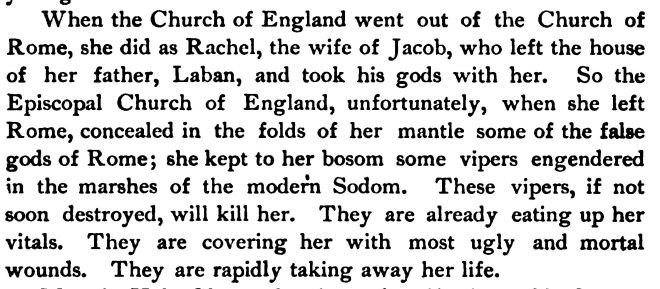
Most magisterial reformers took only a half-step from Rome. Much of what protestant churches hold to was learnt from Rome. Certain doctrines and practices clung to men like the sin that so easily entangles us. The following is from Charles Chiniquy’s book, Fifty Years in the Church of Rome, chapter 30; published in 1886.
Half-step from Rome
Later in the book, after describing the horrors women experienced in having their most secret sins pried from them by expertly crafted questions, the author reveals one of the vipers mentioned above.
586

A Testimony of Faith

A poem written during the nascent days of The Reformation.

By Margaret of Valois, duchess of Alencon, France,th

sister of King Francis I, a persecutor of The Reformers.

Is there a gulf of ill, so deep and wide

That can suffice but e’en a tenth to hide

Of my vile sins?

Well do I fell within me is the root,

Without are branch and foliage, flower and fruit.

My God, thou hast come down on earth to me, –

To me, although a naked worm I be.

Word Divine, Jesus the Salvator,

Only Son of the eternal Paer,

The first, the last; of all things renovator,

Bishop and king, and mighty triumphator,

From death by death our liberator.

By faith we’re made the sons of the Creator.

Though poor, and weak, and ignorant I be,

How rich, how strong, how wise I am in Thee!

In spirit noble, – but in nature slave;

Immortal I am, -tending to the grave;

Essence of heaven, – and yet of earthly birth;

God’s dwelling place, – and yet how little worth.

The Phantom Gift of Hospitality…


givinggift

This may seem silly to bring up, but there is a point concerning a specific “spiritual gift” (which is really not a spiritual gift) that many not only claim they have, but they also misapply! It is not only a phantom gift, but it’s supposed application is misdirected. I have searched far and wide for this gift for many years. At this point, it is safe to assume that it is at the end of a theological rainbow. And the only ones that find it are those that are taught that it exists. What is it? Nothing but the “gift” of hospitality.

Let’s begin on where they get this idea comes from. 1 Peter 4:9 says we are to show one another hospitality without grumbling. Sounds pretty straight forward. The grammatical construction implies, though, that it is following from the commands in verse 7. That means amongst other things like being watchful and sober in our prayers, and having fervent love for one another, we are to be hospitable to one another without complaining. Once again, pretty straight forward. But where someone infers from this verse that God endows us with a spiritual gift in order to be gifted in hospitality is confusing. I can see how maybe some make the mistake of reading verse 10 into verse 9 since it mentions “gifts,” but nevertheless cannot see how they can be confident about their conclusion. The list of gifts in Peter starts in verse 10, not 9. But there’s more. Romans 12 has a similar situation.

This is another popular passage cited to didactically reveal spiritual gifts. In Romans 12:6, the apostle Paul explicitly mentions “gifts differing according to the grace that has been given to us.” However, that list terminates at verse 8. Once again, the construction is in such a way that verse 9 begins a new didactic exhortation, and verse 13 is where we see hospitality cited. In context, along with Peter, we must understand that this is not referencing some special ability that the Holy Spirit gives us. In some indirect sense, once we are born again, God gives us a new heart for fellowship with believers and a love for evangelism that causes us to love the unsaved. But that is not what the “gift of hospitality” teachers assume. The believer of the hospitality gift must understand that the exhortations to use gifts differing according to grace terminates at verse 8. Then, verse 9 begins a separate set of exhortations.

So why harp on this? Why pluck this string? Two reasons: excuses and exegesis.

One the one hand, there is always someone that will misapply a verse, gift, theology, etc., to their advantage in order excuse their responsibilities (or sin) in other areas of their Christian life.  For example, they won’t evangelize because their gift is to open up their home (hospitality) to bible study. While that is good and necessary at times, this is not a substitute for any discpline the Christian is called to. And, hospitality in the Bible has more application toward persecuted and traveling believers whom have been banished from their homes, or are on evangelistic journeys. Sure opening your home is hospitable, and can be a fulfillment of Scriptural hospitality depending on the situation. But we must remember that is still not a spiritual gift.

On the other hand, basic exegesis concerning how words and theological concepts are used in their context cannot be stressed enough. The main point I’m trying to make here is that while this phantom gift is microscopic in the grand scale of heretical dogma being preached in the world, a misapplication or misunderstanding like this has avoidable consequences on a your thinking and behavior. If this simple thing cannot be grasped, exegeted, and applied correctly, what can be said of our attitude toward the basics of the gospel, or even biblical discernment? I’m not trying to make a mountain out of a mole hill, but there is something to be said about such a loose approach to Scripture. Of course, this is not a new problem, but I’m attempting to use this phantom gift to shed light on an age-old issue. The issue being the lack discernment for practical thelogy. And it is my hope that we continue to discern from where our othropraxy flows.


– Until we go home

The Man Upstairs?

manning-bud-628

“I’m going to drink a lot of Budweiser tonight, Tracy, I promise you that,” he added. “I’m going to take care of those things first and definitely going to say a little prayer and thank the man upstairs for this great opportunity.” (emphasis added)


This is what all star football quarterback, Peyton Manning, said after he won Super Bowl 50 this past Sunday. Some congratulated him for sharing his “faith” in national television. However, what is the man upstairs supposed to mean? Or better yet, whom is he referencing?

I have been personally annoyed by this statement for many years. When someone calls God the man upstairs, it is a telling sign that they don’t know Him. Think about it this way. If my mother lived upstairs in my two-floor apartment building, and I referred to her as the woman upstairs, what does that infer about the relationship that we have? From a linguistic standpoint, it could just be a cultural phrase, and it’s semantic intention is purely arbitrary. However, throughout history, Christianity is defined by Christ dying for sinners, then regenerating and adopting them as His children. From there we continually cry out, “Abba, Father” (Romans 5:15). We are made sons and daughters by His will (John 1:13), and are no longer called children of wrath (Ephesians 2:3-6). At what point in Scripture or history among God’s people do we find such distancing language to describe God?

I am not too upset over Peyton’s choice of words. In part, I’m glad he said it. Because maybe now we can discuss how a true believer ought to address God among the heathen. If He is our God, why choose language that infers a gap in the relationship? This kind of speech is typically used by those that do not have a meaningful relationship. By that I mean, usually, none at all. If I called my wife “the woman upstairs,” there would be some indication that the relationship is straining, unless there’s an obvious sign I was joking.

But many aren’t joking when they use this trite slogan. To some, this is most recognition they will give God, and that is enough for them. To others, this is a hat tip of humble reverence. Whether it is done ignorantly, or with purpose, those that say that they know Him should not (dare I say will not) bow to this kind of speech. If eternal life, as defined by Christ, is knowing God, and His son whom He sent (John 17:3), I can’t see how a truly regenerated believer would allow such catchphrases to dwell in their vocabulary.

On one hand, I am saying that Christians need to rethink such pithy slogans to describe their God. On the other hand, I believe that this phrase is a penalty flag, that could be a sign that the person does not know Jesus. In other words, I believe anyone who uses “the man upstairs” has never actually met the Man (Christ Jesus; 1 Timothy 2:5). But who am I kidding? Could someone be a true believer and mistakenly utilize such ignorance? I have to consent to the possibility. But more often than not, specifically in my experience, whenever I hear “the man upstairs” come out of someone’s mouth, what follows after, whether in word or deed, as just as atrocious.

Pray for Peyton Manning.


– Until We Go Home

Teach Your Children Well

Little children parade to the front during worship service to toss money into an offering plate as quote-Anita-Baker-applause-felt-like-approval-and-it-became-94311music is played. As they march out to children’s church, people clap.

“Beware of practicing your righteousness before other people in order to be seen by them, for then you will have no reward from your Father who is in heaven. “Thus, when you give to the needy, sound no trumpet before you, as the hypocrites do in the synagogues and in the streets, that they may be praised by others. Truly, I say to you, they have received their reward. But when you give to the needy, do not let your left hand know what your right hand is doing, so that your giving may be in secret. And your Father who sees in secret will reward you.” (Matthew 6:1-4)

What are these children being taught?

Robert Haldane on Mortifying Sin

Robert Haldane quoting William Romaine in his commentary on the book of Romans: Haldane

True spiritual mortification does not consist in sin not being in thee, nor in its being put on the cross daily, nor yet in its being kept upon it. There must be something more to establish perfect peace in thy conscience; and that is the testimony of God concerning the body of sin. He has provided for thy perfect deliverance from it in Christ. Everything needful for this purpose was finished by Him upon the cross. He was the Surety. He suffered for thee. Thy sins were crucified with Him, and nailed to His cross. They were put to death when He died: for He was thy covenant-head, and thou wast legally represented by Him, and art indeed dead to sin by His dying to sin once. The law has now no more right to condemn thee, a believer, than it has to condemn Him. Justice is bound to deal with thee, as it has with thy risen and ascended Savior. If thou dost not thus see thy complete mortification in Him, sin will reign in thee. No sin can be crucified either in heart or life, unless it be first pardoned in conscience; because there will be want of faith to receive the strength of Jesus, by whom alone it can be crucified. If it be not mortified in its guilt, it cannot be subdued in its power. If the believer does not see his perfect deadness to sin in Jesus, he will open a wide door to unbelief; and if he be not persuaded of his completeness in Christ, he gives room for the attacks of self-righteousness and legal tempers. If Christ be not all in all, self must still be looked upon as something great, and there will be food left for the pride of self-importance and self-sufficiency; so that he cannot grow into the death of Christ in sensible experience, further than he believes himself to be dead to sin in Christ. The more clearly and steadfastly he believes this, as the Apostle did–I am crucified with Christ–in proportion will he cleave to Christ, and receive from Him greater power to crucify sin. This believing view of his absolute mortification in Christ, is the true Gospel method of mortifying sin in our own persons. Read the sixth of Romans, and pray for the Spirit of revelation to open it to thee. There thou wilt discover the true way to mortify sin. It is by believing that thou art planted together with Christ in His death; from thence only thy pardon flows, from thence thy daily victory is received, and from thence thy eternal victory will be perfected. –

In Robert Haldane, An Exposition of The Epistle to the Romans, 253-254

Polka Worship?

Polka WorshipSaw this sign on a Lutheran church building in Austin a while back. It could have been on the

building of most any denomination. The questions that popped into my head are:

a.) Is polka being worshipped?

b.) Is polka worshipping a god?

c.) Is polka the means of worship?

Answers to any of these questions fail to satisfy. I cannot help but think of the sons of Aaron and Eli, four of which were killed by YHWH for approaching Him in worship in ways He had not approved of.

Do these people think before they do foolish things? It appears not.


Biblical Covenants – Baptist Perspective

Covenant chart color 768x400

The diagram above is my attempt to show the relationship between the various covenants between God and man discussed below. The covenants with Adam and Noah were with mankind and all the created order. Adam fell and we all are dead in him, our federal head; so too all of creation was cursed because of Adam’s sin.

From the dust of men, YHWH called out a people for Himself, to be custodians of His Word, to shine forth His glories in the wicked world, and to preserve the promised seed as it was carried through the generations from Adam to Christ Jesus. National Israel inhabited what is shown as the Old Covenant. Gentiles are not in the Old Covenant.

If all men are not in Adam’s Covenant, then all men could not die in Adam. But since all men die in Adam, we must see those that God formed into the Hebrew nation were born dead in Adam. The covenant of circumcision and the Mosaic covenant applied to them as God’s temporal people, but in Adam they all died. Some of them were redeemed by faith in the promised Christ and were bought out of the Adamic covenant into the covenant of redemption, to be sealed in Christ in the fullness of time. While they lived in the flesh, they were in the Mosaic Covenant as God’s temporal people. So all national Israel was at all times members of two covenants – one determining their spiritual condition (in Adam or in Christ), the other identifying them as God’s temporal people.

The eternal covenant called out in Hebrews 13 was a prelapsarian agreement within the holy trinity. It was revealed progressively until it was fulfilled by Christ and the issuing of the New Covenant. What the eternal covenant does is provide redemption for sinners (Ephesians 1 and others). 2 Timothy 1 shows us that our redemption was effected before the foundation of the world. I consider this covenant to be the guardian for the elect through redemptive history, until the New Covenant was issued, as was the Old Covenant for national Israel. Hebrews tells us the Old Testament saints waited until Christ came to get their full reward – while saved looking forward to the promised seed, “they did not receive that which was promised (temporal rest), since God had provided something better for us, so that they would not be made perfect without us.”

Both the Hebrew people and Gentiles have Adam as their spiritual father; only by being given new life in the last Adam do we become children of Abraham according to the promise. This gives us standing with Creator God as His children through the adoption of sons.

The covenant with Noah is outside the redemptive chain, as it is an unconditional promise of God to provide for man and beast seedtime and harvest, cold and heat, summer and winter, day and night until the end of the age. It is included to remind us of God’s kind provision even to those whose best life is now. It mitigates the wrath of God for those in Adam while this age winds down. The shaded oval is labeled “Old Covenant” and represents God’s relationship to national Israel. It includes the three major covenants contained therein, although the Abrahamic Covenant has only one side in this arena. This line of covenants began as YHWH called people from Adam’s line to form His temporal people, and began to close with the Davidic Covenant, coming to a final close when the son of David who was his Lord fulfilled all the requirements of Moses and the prophets and cut the New Covenant (Galatians 3:24). The Covenant of Promise was revealed to man as God cursed the serpent, recorded in Genesis 3:15 and fulfilled in the New Covenant, being revealed with increasing clarity as redemptive history unfolded.

The Adamic Covenant runs parallel to the Old Covenant, and does not expire until the end of the age. All people in history are ruled by this covenant, with God’s universal law at work in the nations; the works of which are written on the hearts of these people (Romans 2:12-16). Those who are in the First Adam remain in this covenant unless, in time, God redeems them. From God’s covenant with Abraham come children of the flesh (being held captive by the Law of Moses – Galatians 4:21 – 25) and children of promise (being set free by faith in the promised seed – Galatians 3:29 & 4:26 – 31). This ever-increasing family gathers members from all races, creeds, and covenants. Sons of Adam who are redeemed have Abraham as their spiritual father (Galatians 3:29) Jesus is the promised son of David (Acts 2:22 – 39), being born under the law and its curse (Galatians 3:10 – 14), and giving Himself as a ransom to buy the elect (John 6:37 – 40). His work of redemption fulfilled the demands of the Old Covenant and all the types that pointed to His coming. This work made the Old Covenant obsolete and introduced the New Covenant which displays the glories of Christ in the lives of the redeemed (Hebrews 8).

With Noah as our federal head, we have so-called common grace from our Creator, both man and creation. The curse of Adam remains throughout this age, conquered but not eliminated, as we wait for the age to come; so the blessings through Noah remain throughout this age, to be made all the more glorious in the age to come.

What does Pastor Saeed believe?

It is very comforting to know that Pastor Saeed is no longer in harms way of the Iranian government. Many have already spread the good news via social media and other outlets. But while we stand by and praise God for this man’s safety, do we know what he believes? Have Christians not made the same mistake before in standing by certain preachers, politicians, celebrities, or movement leaders only to have a black eye later on because we did not endeavor to know their doctrinal stance?

This article is not assuming to know what Pastor Saeed believes. As far as I know, there are no public statements that have been posted concerning this topic. However,  there is background information that may give some indication to the kind leanings that Saeed may have. DISCLAIMER: This is not a condemning post! I repeat. This is NOT a condemning post. This is purely informational, although I have my personal concerns. I do not believe that Saeed is not Christian. I do not have any evidence to make such a conclusion at this time. I am merely challenging us to always consider who we are supporting and ask ourselves if our own convictions will allow us to do so. The following is just a series of links I discovered when trying to figure out what Pastor Saeed believes. Although I found nothing on Saeed, did find other somewhat relevant information.

Pastor Saeed is an ordained minister from the American Evangelistic Association (AEA)
http://www.cbn.com/cbnnews/world/2012/december/aclj-calls-on-iran-to-free-american-pastor/?mobile=false

AEA was started by John E. Douglas Jr in 1954 and several other pastors who became independent in order to form this organization. http://wordpress.aeaministries.org/history/

What AEA believes can be found here: http://wordpress.aeaministries.org/this-we-believe/

It is possible that many of the pastors could have been affected by the “Latter Rain Movement” in the 1940’s as well as preacher A.A. Allen.

  1. http://www.encyclopedia.com/article-1G2-3274100062/other-pentecostals.html (Scroll down, find “American Evangelistic Association,” and click link)
  2. https://books.google.com/books?id=_Qtv7gJMIFUC&q=American+Evangelistic+Association#v=snippet&q=American%20Evangelistic%20Association&f=false (if link does not work when you click on it, copy and paste to the URL box)

Source 2 above reveals that Douglas Jr. was a convert of A.A. Allen who was one of the more popular “faith healers” of his day and a very controversial figure.

The “Latter Rain Movement” was one of the many baseline movements for the modern charismatic chaos witnessed today.

Douglas Jr. hired John Douglas Sr. to be radio spokesperson for AEA and started the international ministry World Missionary Evangelism (WME). http://wordpress.aeaministries.org/history/

WME is now overseen by John G. Cathcart in Dallas. Some of his writings can be read here: https://wmedallas.wordpress.com/

The Statement of Faith for WME can be found here: http://www.wme.org/statementoffaith.html

Before Douglas Jr. died, John Rienhold was made CEO and President of AEA ministries. http://wordpress.aeaministries.org/history/

Rienhold has been working with Iranian evangelistic ministry “ELAM” and believes that God is not just working through their evangelistic efforts, but is also taking “shortcuts” because of Iranians seeing “visions” of Christ. http://www.charismamag.com/site-archives/218-peopleevents/news/2373-iranian-church-growth-mind-boggling

What ELAM believes as a ministry can be seen here: http://www.elam.com/page/statement-faith And their endorsers are here: http://www.elam.com/page/endorsements

Once again, all these links are not to insinuate that Pastor Saeed is not a Christian. It is good to know those that labor among us, especially if we plan to support them. This is purely informational and is meant to bring awareness to the kinds of beliefs Pastor Saeed may hold. While I am happy Saeed is freed, I am tired of professing Christians making the same mistake over and over again and not doing their homework.

Until we go home.

The Pastor – Chapter 8, Conclusion

If you have listened to this book, you know the author desires only to please YHWH and help Solaequip His people so we will not be tossed about by the whimsy of man. Here’s his wrap for the last chapter:

Having published this book, I know I shall be accused of denigrating both the biblical work of the gospel minister, and the man himself. Indeed, I knew it before I began. But I didn’t agree with it then, and I don’t agree with it now. Yet, if such a critique of an unscriptural title really has undermined what many regard as ‘the ministry ’, then something is seriously wrong with what we think of as ‘the ministry ’. And the sooner we find it out the better. In the 16th century, men like Thomas Cartwright and Robert Browne came to realise that the warrant to preach does not depend on a magistrate’s licence, and they had the courage to destroy the noxious bits of paper which pretended to make a man into a minister. We must show the same courage and the same spirit in our day. If an elder’s authority depends on the invention of an office, on Humpty Dumpty’s misuse of biblical words, or on the use of a title, we ought to recognise where we are – and the consequences of it. To accommodate the words of the Independent, Henry Jacob: A teacher in Christ’s church has a far ‘better original’ than calling him ‘Pastor’; or ought to have! Of course, we must honour all men to whom honour is due (Rom. 13:7). In particular, as I have repeatedly stressed, we should ‘respect’ our elders ‘who work hard among [us], who are over [us] in the Lord and who admonish [us]’, and we should ‘hold them in the highest regard in love
because of their work’ (1 Thess. 5:12-13), but this does not mean we should give them a title.
While we must not undervalue the gifts of Christ to his church, pastor-teachers among them, neither must we make little popes of them! Or big!

Chapter 8 is here.

Chapter 7 can be found here.