Book recommendation: “How Do You Kill 11 Million People?” by Andy Andrews.

So exactly how did the Nazis get so many people to cooperate with them in marching toward their deaths without resistance?

This book tells you.

This was an eye-opening read and my only criticism is that its extremely short in length. I felt the author could have gone on and provided more examples and more insight, but even for its short length (you can read it in less than an hour), I was still hit by the truths presented in it. 

Watching current events unfold, this book may not only be about history, but it may very well be a warning for what’s about to come to America; and the author does not hold back from suggesting that grave possibility.

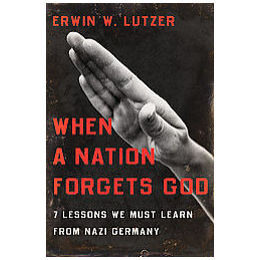
Book recommendation: “When a Nation Forgets God: 7 Lessons We Must Learn from Nazi Germany” by Erwin W. Lutzer

This is a fantastic book on the parallels between today’s society in America and that of Nazi Germany.

The author takes a chilling look into the similarities between the life, culture, politics, and mindset of the populace in Nazi Germany and how we are seeing history begin to repeat itself (as it often does) today. 

Here’s the book’s description:

“According to Dr. Lutzer, the German people’s progression from civility to barbarity was not extraordinary yet the Nazi regime will forever serve as an example of brutality and extreme racism run amok. More than a few benchmarks from their transition can be observed in present day American society. This book does not suggest the United States is definitely marching toward authoritarian oblivion, but that we — especially we believers — must take note of these lessons from history and be vigilant in our stand for truth, justice, and righteousness.”

This book serves as not only a history lesson, but as a warning for where we’re headed. Here is a quote from the book:

. . . [L]aws making education in public schools compulsory have historically been found in the most totalitarian of governments where state-sponsored indoctrination was a major goal of the educational system. Although it is still legal to homeschool children in America, we can’t assume that freedom will continue. . . . The children in [Nazi] Germany were subjected to films that presented the Nazis’ view that the Jews were subhuman and that they were an unnecessary burden on society. Darwin’s evolutionary notions were also presented in the classroom to extol the virtues of the Aryan race (the Germans) and that the evolutionary idea of survival of the fittest could be hurried along by the extermination of the weak. Since only the fittest survive it makes good sense that “might makes right.” Hitler asked, “Why can’t we be as cruel as nature?”

And here is another quote from the book:

When Hitler starved children, he called it putting them on a “low-calorie diet.” And the extermination of Jews was called “cleansing the land.” Euthanasia was referred to as “the best of modern therapy.” Children were put to death in “Children’s Specialty Centers.”

Hitler’s cronies seldom said they were going to kill people; even when plans were made to exterminate millions, the leaders spoke only in abstract slogans such as “the final solution.” Sanitized terms were used to camouflage unspeakable crimes. Planned massacres were spoken of in clinical terms to mislead the naïve and to assuage the conscience of the perpetrators.

We do the same, of course. No one speaks of killing preborn infants. Rather, pregnant women are only removing “a product of conception” or a woman is simply “terminating a pregnancy.” Politicians speak of being in favor of “a woman’s right to choose . . .” but they seldom complete the sentence. Somehow to say they are in favor of a woman’s right to choose to kill her preborn infant, is too honest, too clear—we might add, and too chilling.

Homosexual behavior turns out to be nothing more than “an alternate lifestyle.” And adultery is reduced to the more innocuous word: affair. Schools that demean religion and promote immorality are said to be “value free” and laws which deny religious speech are promoted as “the fairness doctrine” or simply promoting “localism.” Historically, horrendous crimes have been committed in the name of liberty.

After reading this book (and previously posting a quote from it), I was informed that the author holds to the idea of easy believeism. I did not see this presented in the book as the author dealt mostly with how history is repeating itself in politics and culture, so the book is safe for consumption in that regard.

Quotes (918)

. . . [W]e must restore to the family the responsibility of ministering to youth. In many churches–but by no means all–the purpose of the youth group is founded on premises that are an impediment to the training of godly children. Some of these false premises are: 1) That young people need a place where their problems are understood–where others of the same age share the same struggles; 2) that as it is often difficult for parents to communicate with and understand their teenagers, a youth leader who can identify with the young people is needed; 3) that it is important for young people to have fun and to see that “church people” have fun too; 4) that a youth group is needed to reach unsaved youth, and by getting them involved in fun activities, they will be more receptive to the presentation of the gospel.

Following the trends of secular culture, age-segregated groups have been established in church educational programs. Christopher Schlect, in his book Critique of Modern Youth Ministry, explains that the “divisions breed immaturity because they hinder younger people from associating with and learning from their elders.” The group can become the source of authority, thus diminishing the authority of the father and mother.

– William & Colleen Dedrick

From: The Little Book of Christian Character & Manners

The lady in the rose garden.

Lady in the Rose Garden

A lesson for all of us to consider from the puritan Joseph Meade:

I once walked into a garden with a lady to gather some flowers. There was one large bush whose branches were bending under the weight of the most beautiful roses. We both gazed upon it with admiration. There was one flower on it which seemed to outshine all the rest in beauty. This lady pressed forward into the thick bush, and reached far over to pluck it. As she did this, a black snake, which was hid in the bush, wrapped itself round her arm. She was alarmed beyond all description; she ran from the garden, screaming, and almost in convulsions. During all that day she suffered very much with fear. Her whole body trembled, and it was a long time before she could be calmed. That lady is still alive. Such is her hatred now of the whole serpent race, that she has never since been able to look at a snake, even a dead one. No one could ever persuade her to venture again into a cluster of bushes, even to pluck a beautiful rose.

Now this is the way the sinner acts who truly repents of his sins. He thinks of sin as the serpent that once coiled itself around him. He hates it. He dreads it. He flees from it. He fears the places where it inhabits. He does not willingly go into the haunts. He will no more play with sin than this lady would afterwards have fondled snakes.

Liberian elections.

For those who have been praying for Liberia, I wanted to bring your attention to some news coming out just before the election coming up this Tuesday in the West African country. Less than a week before the election the current president, Ellen Johnson Sirleaf, was just awarded the Nobel Peace Prize. This could only be in her favor for reelection.

Liberia has been slowing rebuilding its infrastructure after emerging from the civil war a few years ago and the Liberian Christians I spoke with seemed to be happy with the peace and progress they’ve experienced under President Sirleaf.

There is fear, however, that if Sirleaf’s opponent is elected, the religious freedom that Liberia is now enjoying may very well be stifled and the country could be cast into more civil unrest. This, obviously, would affect missionary efforts on the ground in that country.

Please commit this matter to prayer and pray that God’s will to be done in this upcoming election and continue to pray for the work being done in Liberia.

Too little too late.

Why is it that today’s “prophets” always tell you about their visions after the events occur and never before? In the following case, Jim Bakker tells viewers on August 12, 2011, that he predicted 9/11.

He was only a decade late in mentioning it.

HT: Slaughter of the Sheep

You might be a Calvinist . . .

The following is from the Disciple Man blog:

You Might Just Be A Calvinist If….

If you have a Martin Luther Jell-O mold… you just might be a Calvinist.

If your DVR has over 25 episodes of Wretched With Todd Friel recorded on it… you just might be a Calvinist.

If your child’s first word was “Westminster”… you just might be a Calvinist.

If your 4 year old can explain what the word “propitiation” means… you might just be a Calvinist.

If you send your mother tulips on Mother’s Day… you might be a Calvinist.

If your passion for evangelism blows away your Arminian friends… you might just be a (true) Calvinist.

If you hate rap music BUT you listen to Lecrea, The Cross Movement, Flame or D.A. T.R.U.T.H. because of the lyrics and theology… you might be a Calvinist.

If quotes from Pink, Spurgeon, Luther, Piper, and McArthur make up 90% of your Facebook statuses…you might be a Calvinist.

Continue reading

Sermon of the week: “The Great White Throne Judgment” by Steve Lawson

Wow. Your sermon of the week, The Great White Throne Judgment by Steve Lawson, is a riveting reminder of what’s to come for the unrepentant, and why it’s so imperative that we never tire of sharing the gospel with the unsaved, because it will be an incredibly terrifying thing to fall into the hands of the living God (Hebrews 10:31).

Saturday Sermon Series: “The Fear of God” (Parts 7 – 9) by Albert Martin.

Today DefCon wraps up our Saturday Sermon Series by Albert Martin on the fear of God. This timeless message was delivered in 1970 and is as needed to be heard by the church today as it was 41 years ago.

To listen to the previous two installments (the previous six messages) please see parts 1 – 3 here and parts 4- 6 here.

The Fear of God – Part 7  (Relationship to Conduct, Part 1) 

The Fear of God – Part 8  (Relationship to Conduct, Part 2)

The Fear of God – Part 9  (How to Maintain & Increase) 


HT: Abiding Through Grace

Saturday Sermon Series: “The Fear of God” (Parts 4 – 6 of 9) by Albert Martin.

DefCon continues its Saturday Sermon Series by Albert Martin on the fear of God. Today you can download parts 4 through 6. You can download the first three messages from this series here.

We will conclude with the final three parts next Saturday (one week from today).

The Fear of God – Part 4  (Ingredients, Part 2)  

The Fear of God – Part 5  (Ingredients, Part 3)

The Fear of God – Part 6  (Source)  

HT: Abiding Through Grace

If Paul’s epistle to the Galatians was published in Christianity Today.

If the Apostle Paul’s letter to the Church in Galatia had been published in the magazine Christianity Today how would it be received? Well, what follows is a dramatization of letters received from readers in response to Paul’s inspired Epistle.


(Source: Sacred Sandwich)


********************************************************

LETTERS TO THE EDITOR

Dear Christianity Today:

In response to Paul D. Apostle’s article about the Galatian church in your January issue, I have to say how appalled I am by the unchristian tone of this hit piece. Why the negativity? Has he been to the Galatian church recently? I happen to know some of the people at that church, and they are the most loving, caring people I’ve ever met.

Phyllis Snodgrass; Ann Arbor, MI

————————————————————————

Dear Editor:

How arrogant of Mr. Apostle to think he has the right to judge these people and label them accursed. Isn’t that God’s job? Regardless of this circumcision issue, these Galatians believe in Jesus just as much as he does, and it is very Pharisaical to condemn them just because they differ on such a secondary issue. Personally, I don’t want a sharp instrument anywhere near my zipper, but that doesn’t give me the right to judge how someone else follows Christ. Can’t we just focus on our common commitment to Christ and furthering His kingdom, instead of tearing down fellow believers over petty doctrinal matters?

Ed Bilgeway; Tonganoxie, KS

————————————————————————–

Dear CT:

I’ve seen other dubious articles by Paul Apostle in the past, and frankly I’m surprised you felt that his recurrent criticisms of the Church deserved to be printed in your magazine. Mr. Apostle for many years now has had a penchant for thinking he has a right to “mark” certain Christian teachers who don’t agree with his biblical position. Certainly I commend him for desiring to stay faithful to God’s word, but I think he errs in being so dogmatic about his views to the point where he feels free to openly attack his brethren. His attitude makes it difficult to fully unify the Church, and gives credence to the opposition’s view that Christians are judgmental, arrogant people who never show God’s love.

Ken Groener; San Diego, CA

—————————————————————————-

To the Editors:

Paul Apostle says that he hopes the Galatian teachers will cut off their own privates? What kind of Christian attitude is that? Shame on him!

Martha Bobbitt; Boulder, CO

—————————————————————————-

Dear Christianity Today:

The fact that Paul Apostle brags about his public run-in with Peter Cephas, a well-respected leader and brother in Christ, exposes Mr. Apostle for the divisive figure that he has become in the Church today. His diatribe against the Galatian church is just more of the same misguided focus on an antiquated reliance on doctrine instead of love and tolerance. Just look how his hypercritical attitude has cast aspersions on homosexual believers and women elders! The real problem within the Church today is not the lack of doctrinal devotion, as Apostle seems to believe, but in our inability to be transformed by our individual journeys in the Spirit. Evidently, Apostle has failed to detach himself from his legalistic background as a Pharisee, and is unable to let go and experience the genuine love for Christ that is coming from the Galatians who strive to worship God in their own special way.

William Zenby; Richmond, VA

——————————————————————————

Kind Editors:

I happen to be a member of First Christian Church of Galatia, and I take issue with Mr. Apostle’s article. How can he criticize a ministry that has been so blessed by God? Our church has baptized many new members and has made huge in-roads in the Jewish community with our pragmatic view on circumcision. Such a “seeker-sensitive” approach has given the Jews the respect they deserve for being God’s chosen people for thousands of years. In addition, every Gentile in our midst has felt honored to engage in the many edifying rituals of the Hebrew heritage, including circumcision, without losing their passion for Jesus. My advice to Mr. Apostle is to stick to spreading the gospel message of Christ’s unconditional love, and quit criticizing what God is clearly blessing in other churches.

Miriam “Betty” Ben-Hur; Galatia, Turkey

——————————————————————————-

EDITOR’S NOTE: Christianity Today apologizes for our rash decision in publishing Paul Apostle’s exposé of the Galatian church. Had we known the extent in which our readership and advertisers would withdraw their financial support, we never would have printed such unpopular biblical truth. We regret any damage we may have caused in propagating the doctrines of Christ.

Saturday Sermon Series: “The Fear of God” (Parts 1 – 3 of 9) by Albert Martin.

In addition to DefCon’s weekly sermon of the week (posted every Thursday), we occasionally feature a Saturday Sermon Series.

For the next three Saturdays we are pleased to present a nine-part series (three parts a week) by Albert N. Martin on the fear of God.

This is a powerful message that every Christian can benefit from.

The Fear of God – Part 1  (Predominance in Biblical Thought)

The Fear of God – Part 2  (Definition, Part 1)

The Fear of God – Part 3  (Definition, Part 2; Ingredients Part 1)

HT: Abiding Through Grace

Is Federal Vision heresy?

The following is from Flock Alert:

“Many are honestly confused about the Federal Vision, and are looking for a quick, basic understanding of it.  As such, here we offer a crash course about this enormously influential movement.

“The following resources demonstrate that the Federal Vision is indeed a heresy of the worst kind, and perverts almost every doctrine related to salvation.  It is [sic] has much in common with N. T. Wright’s theology, and is essentially a form of Roman Catholicism in sheep’s clothing.  It denies justification by faith alone, Christ’s active obedience, and perseverance of the saints, and holds to salvation by works (for instance, the soul damning heresy of baptismal regeneration).”

Read the entire article here.

Sermon of the week: “Closet Calvinists – Why Arminians Pre-Suppose the Doctrines of Grace” by Phil Johnson.

Are Arminians really closet Calvinists? Find out in your sermon of the week is Closet Calvinists – Why Arminians Pre-Suppose the Doctrines of Grace by Phil Johnson.

HT: Desert Pastor

Quotes (895)

[Jonah] was exceedingly displeased and even very angry (Jonah 4:1) because Nineveh had been spared from destruction. Jonah was far more deeply concerned with the fate of a single plant than he was with perhaps a million or more never-dying souls who had just turned to the living and true God.

What a lesson for us today. How many of us are far more deeply concerned over our gardens and our clothes, our houses and our businesses, our cars and our gadgets, than we are with the millions of perishing–yet never-dying–souls all around us. How many of us are “exceeding[ly] glad” for something that adds a little more to our own comfort and ease and luxury, but we are utterly unconscious and without a care or a thought as to whether there is joy, exceeding joy, in Heaven over one sinner who repents (Luke 15:10).

Furthermore, like Jonah, we are “exceedingly displeased” and even “angry” if anything happens to disturb our comfort and upset the course of our day. The unsaved in their blindness may bow down to wood and stone, for all we care, provided the worms do not get into our gourds and the hot east wind does not blow upon us.

– G. C. Willis

Sermon of the week: “Thou Shalt Not Covet” by Phil Johnson.

Your sermon of the week is Thou Shalt Not Covet by Phil Johnson. This is the next installment of Johnson’s series on the Ten Commandments that is being featured on DefCon every other week as your Sermon of the Week (on Thursdays).

Quotes (891)

Holiness has a mighty influence upon others. When this appears with power in the lives of Christians, it works mightily upon the spirits of men; it stops the mouths of the ungodly . . . . I am sure we have found, by woeful experience, that in these debauched times, when religion is so bespattered with frequent scandals, yes, a general looseness of professors, it is hard to get any to come into the net of the Gospel. . . . If they were but holy and exemplary, they would be as a repetition of the preacher’s sermon to the families and neighbors among whom they converse, and would keep the sound of his doctrine continually ringing in their ears.

– William Gurnall

1617 – 1679

Worship Songs Compared.

DefCon touches on the issue of music and the Church from time to time; thanks to a recent article from The Watchman’s Bagpipes, this is one of those times.

Yesterday in church we sang some contemporary “worship” songs at the opening of service and closed with a traditional hymn.  Our church often mixes the old and the new, the trite and the meaty.  I want to show you the difference for what passes as “worship” songs today, compared to what used to be standard fare.  I will give them in the order we sang them, and I want you to read the lyrics with a discerning eye.

Read the entire article here.