 “John Huss (Jan Hus) was born at Hussenitz, a village in Bohemia, about the year 1380. His parents gave him the best education their circumstances would admit; and having acquired a tolerable knowledge of the classics at a private school, he was removed to the university of Prague, where he soon gave strong proofs of his mental powers, and was remarkable for his diligence and application to study.
In 1398, Huss commenced bachelor of divinity, and was after successively chosen pastor of the Church of Bethlehem, in Prague, and dean and rector of the university. In these stations he discharged his duties with great fidelity; and became, at length, so conspicuous for his preaching, which was in conformity with the doctrines of Wickliffe, that it was not likely he could long escape the notice of the pope and his adherents, against whom he inveighed with no small degree of asperity.
The English reformist, Wickliffe, had so kindled the light of reformation, that it began to illumine the darkest corners of popery and ignorance. His doctrines spread into Bohemia, and were well received by great numbers of people, but by none so particularly as John Huss, and his zealous friend and fellow martyr, Jerome of Prague.
The archbishop of Prague, finding the reformists daily increasing, issued a decree to suppress the further spreading of Wickliffe’s writings: but this had an effect quite different to what he expected, for it stimulated the friends of those doctrines to greater zeal, and almost the whole university united to propagate them.
Being strongly attached to the doctrines of Wickliffe, Huss opposed the decree of the archbishop, who, however, at length, obtained a bull from the pope, giving him commission to prevent the publishing of Wickliffe’s doctrines in his province. By virtue of this bull, the archbishop condemned the writings of Wickliffe: he also proceeded against four doctors, who had not delivered up the copies of that divine, and prohibited them, notwithstanding their privileges, to preach to any congregation. Dr. Huss, with some other members of the university, protested against these proceedings, and entered an appeal from the sentence of the archbishop.
The affair being made known to the pope, he granted a commission to Cardinal Colonna, to cite John Huss to appear personally at the court of Rome, to answer the accusations laid against him, of preaching both errors and heresies. Dr. Huss desired to be excused from a personal appearance, and was so greatly favored in Bohemia, that King Winceslaus, the queen, the nobility, and the university, desired the pope to dispense with such an appearance; as also that he would not suffer the kingdom of Bohemia to lie under the accusation of heresy, but permit them to preach the Gospel with freedom in their places of worship.
Three proctors appeared for Dr. Huss before Cardinal Colonna. They endeavored to excuse his absence, and said they were ready to answer in his behalf. But the cardinal declared Huss contumacious, and excommunicated him accordingly. The proctors appealed to the pope, and appointed four cardinals to examine the process: these commissioners confirmed the former sentence, and extended the excommunication not only to Huss but to all his friends and followers.
From this unjust sentence Huss appealed to a future Council, but without success; and, notwithstanding so severe a decree, and an expulsion in consequence from his church in Prague, he retired to Hussenitz, his native place, where he continued to promulgate his new doctrine, both from the pulpit and with the pen.
The letters which he wrote at this time were very numerous; and he compiled a treatise in which he maintained, that reading the books of Protestants could not be absolutely forbidden. He wrote in defence of Wickliffe’s book on the Trinity; and boldly declared against the vices of the pope, the cardinals, and clergy, of those corrupt times. He wrote also many other books, all of which were penned with a strength of argument that greatly facilitated the spreading of his doctrines.
In the month of November, 1414, a general Council was assembled at Constance, in Germany, in order, as was pretended, for the sole purpose of determining a dispute then pending between three persons who contended for the papacy; but the real motive was to crush the progress of the Reformation.
John Huss was summoned to appear at this Council; and, to encourage him, the emperor sent him a safe-conduct: the civilities, and even reverence, which Huss met with on his journey were beyond imagination. The streets, and sometimes the very roads, were lined with people, whom respect, rather than curiosity, had brought together.
He was ushered into the town with great acclamations, and it may be said that he passed through Germany in a kind of triumph. He could not help expressing his surprise at the treatment he received: “I thought (said he) I had been an outcast. I now see my worst friends are in Bohemia.”
As soon as Huss arrived at Constance, he immediately took logdings in a remote part of the city. A short time after his arrival, came one Stephen Paletz, who was employed by the clergy at Prague to manage the intended prosecution against him. Paletz was afterwards joined by Michael de Cassis, on the part of the court of Rome. These two declared themselves his accusers, and drew up a set of articles against him, which they presented to the pope and the prelates of the Council.
When it was known that he was in the city he was immediately arrested, and committed prisoner to a chamber in the palace. This violation of common law and justice was particularly noticed by one of Huss’s friends, who urged the imperial safe-conduct; but the pope replied he never granted any safe-conduct, nor was he bound by that of the emperor.
While Huss was in confinement, the Council acted the part of inquisitors.
They condemned the doctrines of Wickliffe, and even ordered his remains to be dug up and burned to ashes; which orders were strictly complied with. In the meantime, the nobility of Bohemia and Poland strongly interceded for Huss; and so far prevailed as to prevent his being condemned unheard, which had been resolved on by the commissioners appointed to try him.
When he was brought before the Council, the articles exhibited against him were read: they were upwards of forty in number, and chiefly extracted from his writings.
John Huss’s answer was this: “I did appeal unto the pope; who being dead, and the cause of my matter remaining undetermined, I appealed likewise unto his successor John XXIII: before whom when, by the space of two years, I could not be admitted by my advocates to defend my cause, I appealed unto the high judge Christ.”
When John Huss had spoken these words, it was demanded of him whether he had received absolution of the pope or no? He answered, “No.” Then again, whether it was lawful for him to appeal unto Christ or no? Whereunto John Huss answered: “Verily I do affirm here before you all, that there is no more just or effectual appeal, than that appeal which is made unto Christ, forasmuch as the law doth determine, that to appeal is no other thing than in a cause of grief or wrong done by an inferior judge, to implore and require aid at a higher Judge’s hand. Who is then a higher Judge than Christ? Who, I say, can know or judge the matter more justly, or with more equity? when in Him there is found no deceit, neither can He be deceived; or, who can better help the miserable and oppressed than He?” While John Huss, with a devout and sober countenance, was speaking and pronouncing those words, he was derided and mocked by all the whole Council.
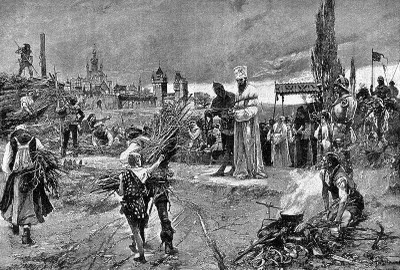 These excellent sentences were esteemed as so many expressions of treason, and tended to inflame his adversaries. Accordingly, the bishops appointed by the Council stripped him of his priestly garments, degraded him, put a paper miter on his head, on which was painted devils, with this inscription, “A ringleader of heretics.” Which when he saw, he said: “My Lord Jesus Christ, for my sake, did wear a crown of thorns; why should not I then, for His sake, again wear this light crown, be it ever so ignominious? Truly I will do it, and that willingly.” When it was set upon his head, the bishop said: “Now we commit thy soul unto the devil.” “But I,” said John Huss, lifting his eyes towards the heaven, “do commend into Thy hands, O Lord Jesus Christ! my spirit which Thou has redeemed.”
When the chain was put about him at the stake, he said, with a smiling countenance, “My Lord Jesus Christ was bound with a harder chain than this for my sake, and why then should I be ashamed of this rusty one?”
When the fagots were piled up to his very neck, the duke of Bavaria was so officious as to desire him to abjure. “No, (said Huss;) I never preached any doctrine of an evil tendency; and what I taught with my lips I now seal with my blood.” He then said to the executioner, “You are now going to burn a goose, (Huss signifying goose in the Bohemian language:) but in a century you will have a swan which you can neither roast nor boil.” If he were prophetic, he must have meant Martin Luther, who shone about a hundred years after, and who had a swan for his arms.
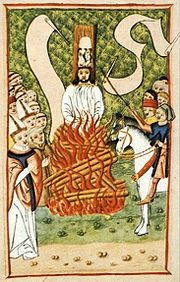 The flames were now applied to the fagots, when our martyr sung a hymn with so loud and cheerful a voice that he was heard through all the cracklings of the combustibles, and the noise of the multitude. At length his voice was interrupted by the severity of the flames, which soon closed his existence.
Then, with great diligence, gathering the ashes together, they cast them into the river Rhine, that the least remnant of that man should not be left upon the earth, whose memory, notwithstanding, cannot be abolished out of the minds of the godly, neither by fire, neither by water, neither by any kind oof torment.”
Full text from: John Foxe. Fox’s Book of Martyrs. Edited by William Byron Forbush. ttp://www.ccel.org/ccel/foxe/martyrs/files/martyrs.html [Accessed: 11.01.2009]

 Consider your Lord and Master, you that call yourselves [Christ’s] disciples. Many look upon you that will not look unto [His] Word, and will judge [Jesus] by your practices. Do not damage [Him], by misrepresenting [Him]; as if [He] allowed those evils which you allow yourselves. Why should [He] be “wounded in the house of My friends” (Zech. 13:6). Why should you crucify [Him] afresh, and put [Him] to an open shame?
 It takes an incredible amount of effort and energy on the part of the news media to maintain such an obviously outrageous suspension of reality. But what would happen if the press reported accurately, objectively, and courageously on the Middle East conflict? Media reports would reflect, truthfully, that Israel is a Western democracy surrounded by dozens of backward, repressive, terror-supporting Arab police states dedicated to Israel’s annihilation. They’d show that the Nobel Peace Prize-winning
 The most successful arm of the evangelical church in recent years, in terms of growth, money, and prestige, has been the market-driven (seeker-sensitive, new-paradigm, user-friendly) church. Because of this success these churches are being mimicked all over the country, and indeed, the world. But is this church fully dressed? Is she outfitted in the biblically prescribed robes of evangelism, edification, worship, and instruction? Or is she wrapped in rags composed of empty human philosophy stitched together with bits and pieces of truth? If the latter is true, why have so few seemed to notice?
 Your Wednesday sermon of the week is another must-hear.
 One of our problems today is that we no longer do our own thinking. Newspapers do it for us, the people interviewed on Radio and Television do it for us, and we sit back and listen. That is one of the manifestations of the breakdown of self-discipline. We must learn to discipline our minds!
 You shall not hate your fellow countryman in your heart; you may surely reprove your neighbor, but shall not incur sin because of him. Leviticus 19:17
 Your sermon of the week is
  The most spiritual attainment of a Christian in the world, the most spiritual, evangelical mourning and repentance that can be done by a Christian, is a mourning over his unbelief; that the Word of the Lord is not more precious to him; that he cannot trust God’s Word naked without props; that he doubts it so often, when darkness comes on; and that he lets go of this great rock, the faithfulness of God.
 You simply must download and listen to this speech,
  From the standpoint of the redeemed, the punishment of the wicked is an act of unspeakable mercy. How dreadful would it be if the present order of things should continue forever, when the children of God are obliged to live in the midst of the children of the Devil. Heaven would at once cease to be Heaven if the ears of the saints still heard the blasphemous, filthy language of the reprobate. What a mercy that in the New Jerusalem “there shall in no wise enter into it any thing that defileth, neither whatsoever worketh abomination” (Revelation 21:27)!
 Learn to apply Scripture. Take every word as spoken to yourselves. When the Word thunders against sin, think thus: “God means my sins.” When it emphasizes any duty, “God intends me in this.” Many put off Scripture for themselves, as if it only concerned those who lived in the time when it was written; but if you intend to profit by the Word, bring it home to yourselves: a medicine will do no good, unless it is applied.
 As a follow up to last week’s sermon on Isaiah 53 by J. Randall Easter (
 He that says he will be good tomorrow, says he will be wicked today.
 Christ Alone Wyoming