
 Albert Martin gives us encouragement and admonition in this decades-old message entitled Family Worship and the Use of TV.
Jesus
Sermon of the week: “Atonement and Justification – The Pharisee and the Tax Collector” by John MacArthur.
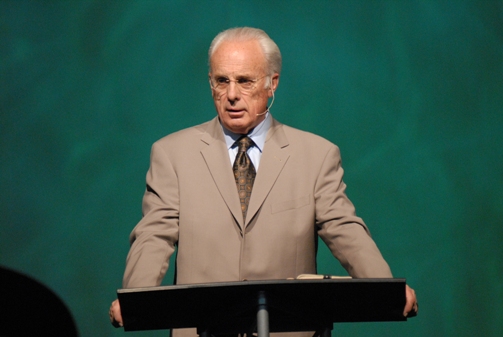 Your sermon of the week is Atonement and Justification: The Pharisee and the Tax Collector by John MacArthur.
A great message from a great portion of Scripture.
Quotes (909)
 We are giving in to the dangerous temptation to take the Jesus of the Bible and twist him into a version of Jesus we are more comfortable with. A nice, middle-class, American Jesus. A Jesus who doesn’t mind materialism and who would never call us to give away everything we have. A Jesus who would not expect us to forsake our closest relationships so that he receives all our affection. A Jesus who is fine with nominal devotion that does not infringe on our comforts, because, after all, he loves us just the way we are. A Jesus who wants us to be balanced, who wants us to avoid dangerous extremes, and who, for that matter, wants us to avoid danger altogether. A Jesus who brings us comfort and prosperity as we live out our Christian spin on the American dream. But do you and I realize what we are doing at this point? We are molding Jesus into our own image. He is beginning to look a lot like us because, after all, that is whom we are most comfortable with. And the danger now is that when we gather together in our church buildings to sing and lift up our hands in worship, we may not actually be worshiping the Jesus of the Bible. Instead we may be worshiping ourselves.
– David Platt
That’s where I’ve read that before!
 The following is a great chart from 20 Truths About Mormonism showing the “similarities between the Book of Mormon and View of the Hebrews as summarized by [Mormon] Elder B. H. Roberts.”
This is a followup to Where Have I Read that Before?
| Book of Mormon | View of the Hebrews |
| Gives an Israelitish origin of the American Indian. | Pleads for an Israelitish origin of the American Indian on every page. |
| Deals with the destruction of Jerusalem and the scattering of Israel. | Deals with the destruction of Jerusalem and the scattering of Israel. |
| Deals with the future gathering of Israel and the restoration of the ten tribes. | Deals with the future gathering of Israel and the restoration of the ten tribes. |
| Emphasizes and uses much of the material from the prophecies of Isaiah, including whole chapters. | Emphasizes and uses much of the material from the prophecies of Isaiah, including whole chapters. |
| Makes a special appeal to the Gentiles of the New World–esp. the people of the United States to become nursing fathers and mothers unto Israel in the New World, holding out great promises to the great Gentile nation that shall occupy America, if it acquiesces in the divine program. | Makes a special appeal to the Gentiles of the New World–esp. the people of the United States to become nursing fathers and mothers unto Israel in the New World, holding out great promises to the great Gentile nation that shall occupy America, if it acquiesces in the divine program. |
| The peopling of the New World was by migrations from the Old World. | The peopling of the New World was by migrations from the Old World. |
| Migrating Jaredites are taken into “that quarter where there never had man been”. | Its migrating people are taken into a country where “never man dwelt”. |
| The colony enters into a valley of a great river. Peoples journeyed northward and encountered “seas” of “many waters” in the course of their long journey. The motive of their journey was religious. Ether is prominently connected with recording the matter. | The colony enters into a valley of a great river. Peoples journeyed northward and encountered “seas of many waters” in the course of their long journey. The motive of their journey was religious. Ethan is prominently connected with recording the matter. |
| Nephites divide into two classes, the one civilized, the other followed a wild hunting and indolent lifestyle that ultimately led to barbarism. | The lost tribes divide into two classes, the one fostering the arts that make for civilization, the other followed a wild hunting and indolent lifestyle that ultimately led to barbarism. |
| Long and dismal wars break out between the Nephites and Lamanites. | Long and dismal wars break out between the civilized and barbarous divisions of people. |
| The Lamanites utterly exterminate the Nephites. (The same thing occurs with the Jaredite peoples in the exact place the Nephites would later be exterminated). | The savage division utterly exterminates the civilized one. |
| Civilized people develop a culture of mechanic arts; of written language; of the knowledge and use of iron and other metals; and of navigation. | Civilized people develop a culture of mechanic arts; of written language; of the knowledge and use of iron and other metals; and of navigation. |
| Unity of race–the Hebrew race and no other is assumed for the inhabitants of ancient America. | Unity of race–the Hebrew race, and no other is assumed for the inhabitants of ancient America. |
| Book of Mormon peoples are assumed to occupy the whole extent of the American continents. | With the possible exception of the Eskimos of the extreme north, this race of Hebrew peoples occupied the whole extent of the American continents. |
| The original language of the people was Hebrew. | The Indian tongue had one source–the Hebrew. |
| Joseph Smith used an instrument in translating the Book of Mormon called Urim and Thummim which he described as two stones and a breastplate. | View of the Hebrews describes an instrument among the mound finds comprising a breast plate with two white buckhorn buttons attached, “in imitation of the precious stones of the Urim.” |
| Admits the existence of idolatry and human sacrifice. | Admits the existence of idolatry and human sacrifice. |
| Prophets extol generosity to the poor and denounce pride as a trait of the people. Polygamy is denounced under certain conditions as in the practices of David and Solomon. | Generosity to the poor is extolled and pride is denounced as a trait of the American Indian. Polygamy is denounced |
| Lost sacred records would be restored to the Lamanites along with the return of their lost favor with God in the last days. | Indian traditions of a “Lost Book of God” and the promise of its restoration to the Indians, with a return of their lost favor with the Great Spirit are quoted. |
| Sacred records were hidden or buried by Moroni, a character that corresponds to this Indian tradition in the Hill Cumorah. | Ethan Smith’s sacred book was buried with some “high priest,” “keeper of the sacred tradition.” |
| Reports of extensive military fortifications erected throughout large areas with military “watch towers” here and there overlooking them. | Reports of extensive military fortifications linking cities together over wide areas of Ohio and Mississippi valleys, with military “watch towers” overlooking them. |
| Reports of prayer or sacred towers. | Describes sacred towers or “high places,” in some instances devoted to true worship, in other cases to idolatrous practices. |
| Some Book of Mormon people effect a change from monarchial governments to republican forms of government. | Part of Ethan Smith’s ancient inhabitants effect a change from monarchial governments to republican forms of government. |
| Civil and ecclesiastical powers are united in the same person in Book of Mormon republican people. | Civil and ecclesiastical powers are united in the same person in Ethan Smith’s republics. |
| Lehi, first of Nephite prophets taught the existence of a necessary opposition in all things–righteousness opposed to wickedness–good to bad; life to death, and so following. | Some of Ethan Smith’s peoples believed in the constant struggle between the good and the bad principle by which the world is governed. |
| The gospel was clearly preached among the ancient inhabitants of Americas. | Ethan Smith’s book speaks of the gospel having been preached in the ancient America. |
| The Book of Mormon brings the risen Messiah to the New World, gives him a ministry, disciples and a church | Ethan Smith’s book gives, in considerable detail, the story of the Mexican culture-hero Quetzalcoatl–who in so many things is reminiscent of the Christ. |
They conclude this list with the following quote from Mormon apologist, historian, and member of the LDS general authority, B.H. Roberts, from his work Studies of the Book of Mormon, (University of Illinois Press, 1985, p. 242):
“Can such numerous and startling points of resemblance and suggestive contact be merely coincidence?”
And 20 Truths About Mormonism also reveals:
“Joseph even appears to have plagiarized his father. For many years his mother cherished the details of several of her husband’s dreams, and one of these was incorporated wholesale into the Book of Mormon as a vision by Lehi, the father of Nephi.”
| The Vision of Lehi (Book of Mormon (1830), pp. 18-20) |
Dream of Joseph Smith, Sr. (Lucy Smith: Biographical Sketches, pp. 58-59) |
| …me thought I saw a dark and dreary wilderness… | I thought I was traveling in an open and desolate field, which appeared very barren… |
| I beheld a tree, whose fruit was desirable, to make one happy…most sweet, above all that I ever had before tasted…I began to be desirous that my family should partake of it also… | …a tree, such as I had never seen before…I found it delicious beyond description. As I was eating, I said in my heart, “I cannot eat this alone, I must bring my wife and children.”… |
| And I beheld a rod of iron; and it extended along the bank of the river, and led to the tree… | I beheld a beautiful stream of water, which ran from the east to the west…I could see a rope running along the bank of it… |
| …a great and spacious building…filled with people, both old and young, both male and female; and their manner of dress was exceeding fine, and they were in the attitude of mocking and pointing their fingers towards those which had come at, and were partaking of the fruit. | I beheld a spacious building…filled with people, who were very finely dressed. When these people observed us in the low valley, under the tree, they pointed the finger of scorn at us. |
Forsake everything and preach Christ to the Arabic world.
Isn’t it ironic?
 The Westboro “Baptist Church” is planning on protesting another funeral. What makes this different than the dozens of other funerals they picket? This one is not of a fallen soldier, but of Steve Jobs.
And here’s the kicker from NBC News:
“Westboro Baptist Church, the Kansas-based congregation infamous for picketing the burials of slain soldiers, said it will demonstrate at Apple founder Steve Jobs’ funeral – and made the announcement using an iPhone. Margie Phelps, daughter of pastor Fred Phelps, tweeted that the church will attend Jobs’ so far unannounced funeral. Apparently unaware of the irony, Phelps used an iPhone to issue the Twitter message, reported Web pro News.”
You can read the whole article here.
Liberian elections.
 For those who have been praying for Liberia, I wanted to bring your attention to some news coming out just before the election coming up this Tuesday in the West African country. Less than a week before the election the current president, Ellen Johnson Sirleaf, was just awarded the Nobel Peace Prize. This could only be in her favor for reelection.
Liberia has been slowing rebuilding its infrastructure after emerging from the civil war a few years ago and the Liberian Christians I spoke with seemed to be happy with the peace and progress they’ve experienced under President Sirleaf.
There is fear, however, that if Sirleaf’s opponent is elected, the religious freedom that Liberia is now enjoying may very well be stifled and the country could be cast into more civil unrest. This, obviously, would affect missionary efforts on the ground in that country.
Please commit this matter to prayer and pray that God’s will to be done in this upcoming election and continue to pray for the work being done in Liberia.
Pot meet kettle.
 Not able to leave people well enough alone, anti-theists are at it again.
This time a national anti-theist organization is targeting a dot-on-the-map town in Tennessee for having the audacity to display a cross atop their water tower.
Now there’s nothing overtly newsworthy about this story, as Atheists have been bullying their way into building a godless utopia for years one litigious threat at a time. But what makes this particular instance intriguing, as reported by Fox News, is what celebrity anti-theist Dan Barker said. In this article Barker is actually quoted accusing the town’s mayor (who is in favor of the cross remaining) of being the one that’s “against religious freedom.”
Sermon of the week: “A Discerning Family” by Akash Sant Singh.
 Your sermon of the week is A Discerning Family by Akash Sant Singh. This is another fantastic sermon as Akash delves into 1 Thessalonians 5:19-22, covering such subjects as:
– Do not despise prophecies.
– Test everything.
– Hold fast to what is good.
– Abstain from every form of evil.
Akash covers such topics as what prophecy is and who prophets are, and what the ultimate goal is for those exercising discernment.
This is a message I recommend to DefCon readers and contributors.
Quotes (908)
 How does a mother build biblical truth into her daughter’s life, nurture her, guard her, and encourage her toward the application of that truth, then send her into an environment that will oftentimes by its very nature be hostile or at least ambivalent toward that truth? How does a father raise his son to respect young women and protect their purity only to send them off to the youth building with exposed midriffs, low-cut tops, and skin-tight jeans?
– Voddie Baucham
Too little too late.
Why is it that today’s “prophets” always tell you about their visions after the events occur and never before? In the following case, Jim Bakker tells viewers on August 12, 2011, that he predicted 9/11.
He was only a decade late in mentioning it.
Quotes (907)
 Christ’s death is the Christian’s life. Christ’s cross is the Christian’s title to heaven. Christ “lifted up” and put to shame on Calvary is the ladder by which Christians “enter into the holiest,” and are at length landed in glory. It is true that we are sinners–but Christ has suffered for us. It is true that we deserve death–but Christ has died for us. It is true that we are guilty debtors–but Christ has paid our debts with His own blood. This is the real Gospel! This is the good news! On this let us lean while we live. To this let us cling when we die. Christ has been “lifted up” on the cross, and has thrown open the gates of heaven to all believers.
– J. C. Ryle
1816 – 1900
HT: JC Ryle Quotes
Sermon of the week: “Reforming Modern Youth Evangelism and Discipleship” by Paul Washer.
 Paul Washer pulls no punches as he exhorts the church to evangelize youth the biblical way. Some of the things Washer says in this sermon, Reforming Modern Youth Evangelism and Discipleship, may surprise you.
I encourage all youth evangelists, preachers, and pastors to listen to this message with an open mind; leaving your preconceived notions about youth ministry (and youth ministry abolitionists) at the door.
Where have I read that before?
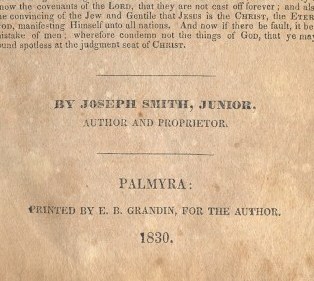
The origin of the Book of Mormon is a fascinating subject as there is clear evidence that its source was not divine, but was actually conjured up in the imagination of Joseph Smith, inspired by similar stories circulating around his time.
It’s precisely because the Book of Mormon was drafted by Joseph Smith (a “poor farm boy” as Mormons like to refer to him) and not divinely inspired, that we’re not surprised to see the almost 4,000 changes, alterations, and corrections to the Book of Mormon since its first publication.
And it doesn’t shock us that many parts of the Book of Mormon are simply plagiarisms from the King James Version of the Bible, including the use of King James English long before there was King James English (just one of the many anachronisms found in the Book of Mormon).
And we’re not stunned that absolutely none of the huge cities and civilizations described in the Book of Mormon have ever been found.
And we’re not astounded that there’s no historical, archeological, or anthropological support for the claims of the Book of Mormon.
And we aren’t astonished that DNA science has actually proven the claims of the Book of Mormon to be false.
And we aren’t beside ourselves that there’s not even one ancient manuscript to support the validity of the Book of Mormon (like the over 25,000 ancient manuscripts that support the Bible).
These are some of the many problems that we’d expect to see from a book created by finite man, not from an inspired work by an infinite God.
So where did this “poor farm boy” get his ideas and inspiration for the Book of Mormon?
Sermon of the week: “The Absurdity of Injustice” by R.W. Glenn.
 Your sermon of the week is a great one by R.W. Glenn entitled The Absurdity of Injustice. This evangelistic-minded message from passages in Ecclesiastes is one that you don’t want to miss. In fact, I enjoyed it so much I listened to it twice.
Sermon of the week: “The Rich Man and Lazarus” by John MacArthur.
Your sermon of the week is on the subject of Hell in the sobering message The Rich Man and Lazarus by John MacArthur.
This sermon is a follow-up to this previous message by MacArthur. I encourage you to listen to them both.
Christian Book Distributors now selling the Koran.
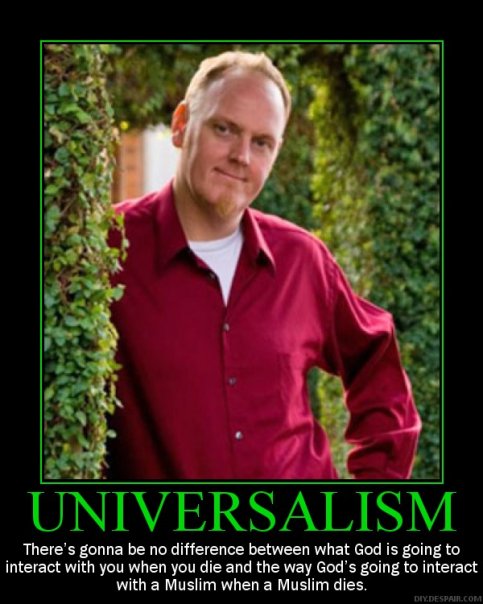 If you want to purchase the Islamic Koran you can now turn to the nation’s leading Christian bookselling website. That’s right, you can now buy the Koran from Christian Book Distributors (CBD).
And CBD is even encouraging the mass distribution of this book (that fuels the terrorism that’s raging around the world and which calls for Jews and Christians to be put to death) by offering a discount of fifty cents per Koran if you order forty or more.
Isn’t this like selling your axe to the executioner as you’re laying your head on the chopping block?
CBD also offers Introducing the Qur’an: For Today’s Reader and Islam: A Short Guide to the Faith
The pied pipers of Universalism (and those wishing to eradicate Christians from the face of the earth) get one more voice of solidarity and support from within our own camp.
I suppose there’s no better time to revisit two questions I posed back in 2008: Are Christian bookstore owners responsible for what they sell? and Do you support your local Christian bookstore?
A visit to a megachurch.
 Here’s an article by Chris Dunn on his recent experience of visiting a megachurch.
It’s not pretty.
Last Sunday I went to a megachurch. Normally I attend small churches with a gathering of local believers who strive to live according to the Bible.
Having already attended countless churches from many denominations and faiths, I was eager to see what the average parishioner experienced at one of these stadium-sized complexes.
It was horrific. Megachurches like this one can have almost nothing to do with biblical Christianity and may actually do violence to the ‘Word of God.’
Continue the article from Collegiate Times here.
Sermon of the week: “The Sufficiency of Scripture and the Gospel” by Paul Washer.

We who home educate, oppose youth ministries, believe Christians should dress modestly, etc. are often accused of believing this way of life makes one a Christian and makes one holy. And of course, we deny those baseless charges of “legalism” but nevertheless, the accusations are still hurled at us.
This is why I’m pleased to present this Thursday’s sermon of the week entitled The Sufficiency of Scripture and the Gospel. Paul Washer (a home education proponent and youth ministry abolitionist himself) proves that not everyone in this camp is a legalist, and to those in this camp who may tend to lean that way, he does for them in this sermon as he did for the lukewarm in his famous Shocking Sermon from 2003 (found here).
Paul Washer addresses the notion that these wonderful family oriented ideals (along with manners, modesty, etc.), albeit beautiful and virtuous and good, they in and of themselves do nothing to save a man’s soul. And he did this at a conference sponsored by the National Center for Family Integrated Churches.
This is classic Paul Washer.
“I Hope You Rot in Hell!”
 Yesterday, a terrible tragedy struck Northern Nevada. Many of you have probably seen the news about a man who fired on several people, ultimately killing four of them, before taking his own life. Five of the people who were shot were Nevada Army National Guardsman, three of which died. Many find themselves utterly dumbfounded by this evil act. Of course, compounding the issue is that, with the death of the shooter, we may never know why he did it. There is a tremendous sadness, and even anger over this tragedy. In fact, one commenter on a news website summed his anger toward the shooter by stating, “I hope God doesn’t show you mercy. I hope you rot in Hell.”
I have found myself thinking about that phrase over the last twenty-four hours. What should we think of someone who has committed such an atrociously evil act? Should we truly desire for someone to “rot in hell?” Should we really desire that God never show that person mercy? Ultimately, I believe the answer is no.
Why should I make such a statement? Isn’t God just? Doesn’t He say that He will punish evil? Yes, God is just, and yes, He does punish evil. In fact, I think we should be grateful that God will punish the great evils committed in this world, that no deed done in darkness will escape His sight. But I also believe that very same justice should make us fear and tremble.
 Christ Alone Wyoming