The Reformation View of Roman Catholicism

From the works of Martin Luther (1483-1546)

What is the whole papacy but a beautiful false front and a deceptively glittering holiness under which the wretched devil lies in hiding? The devil always desires to imitate God in this way. He cannot bear to observe God speaking. If he cannot prevent it or hinder God’s Word by force, he opposes it with a semblance of piety, takes the very words God had spoken and so twist them as to peddle his lies and poison under their name. (What Luther Says, II: 10007)

Since the papal church not only neglects the command of Christ but even compels the people to ignore it and to act against it, it is certain that it is not Christ’s church but the synagogue of Satan which prescribes sin and prohibits righteousness. It clearly and indisputably follows that it must be the abomination of Antichrist and the furious harlot of the devil. (What Luther Says, II: 1019)

The negotiation about doctrinal agreement displeases me altogether, for this is utterly impossible unless the pope has his papacy abolished. Therefore avoid and flee those who seek the middle of the road. Think of me after I am dead and such middle-of-the-road men arise, for nothing good will come of it. There can be no compromise. (What Luther Says, II: 1019)

Read the rest of the article here.

Scott Hodge and his hodge-podge of Roman Catholic meditative monastic heresy.

Chris Rosebrough is tackling an unbelievable issue that has crept into the church: The continued march backward into Romanism by supposed Evangelicals (some of which are the golden calves of Americanized Christianity) through the use of monastic meditation practices. He addresses this in his post Purpose-Driven Roman Catholic Monastic Mysticism (which is where I obtained the quotes below).

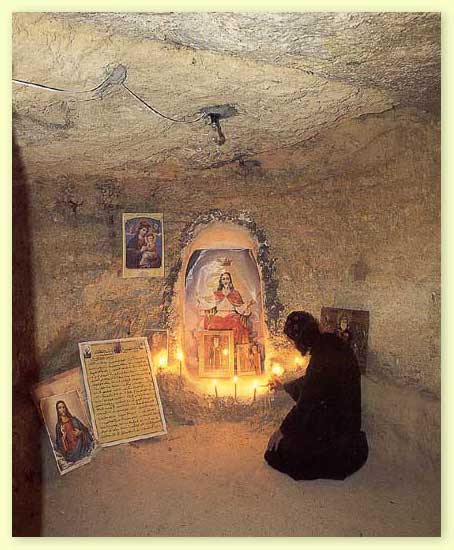
Roman Catholic Monastic Mysticism is becoming all the rage among innovative post-modern purpose-driven pastors. Practices developed by Roman Catholic Monks such as the Lectio Divina, The Practice of the Presence of God and the Prayer Examen which was created by on [sic] of the arch enemies of the Protestant Reformation, Ignatius Loyola are openly being promoted by an alarming number of seeker-driven / Purpose-Driven pastors. These so-called ’spiritual disciplines’ are being featured at Willow Creek, Saddleback, and Mars Hill to name just a few.

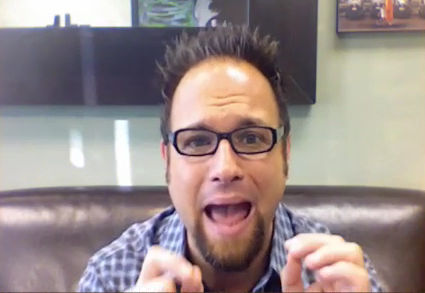
Rosebrough examines an absolutely astonishing sermon from seeker-sensitive pastor Scott Hodge who teaches his whole congregation that practicing the mystical Lecito Divina (like eating at a five-star restaurant) is somehow better than reading the Scriptures for yourself without the magical formula (like eating McDonalds). This is unbelievable when you consider Hodge is considered an evangelical protestant. What in the world did Luther break from Romanism for if this guy is directing his people to place the yoke back upon their necks and return to the bondage of Rome’s dead religion?

Let me be clear here, Pastor Scot Hodge is not promoting meditative practices similar to Lecito Divina, he’s promoting Lecito Divina itself. He spends the overwhelming majority of his sermon singing its praises and he even walks his whole congregation through a Lecito Divina session that will make your hair stand on end (for those familiar with Eastern mysticism and New Age practices).

To hear this unbelievable “sermon” and Rosebrough’s commentary with it, you can download it by right clicking here. It starts at 1:08:08 into the podcast.

While listening to this sermon, keep in mind that this Roman Catholic mystical practice was developed by men who did not believe in salvation by grace alone through faith alone by Christ’s work alone. These monks were trying to earn their salvation through their monkery. These practices are not taught in the scriptures. Neither Jesus, his disciples, the prophets nor the patriarchs practiced Lectio Divina. This Roman Catholic practice is pure monastic mythology and spiritual fantasy and rather than helping you experience God, it is more likely that you will experience self deception or demonic spirits.

For those unfamiliar with Scott Hodge, DefCon dealt with him back in 2007 when his video mocking the sacred ordinance of baptism was making its rounds on the internet. You can check out our previous post on Scott Hodge in the post Narcissism Gone Wild.

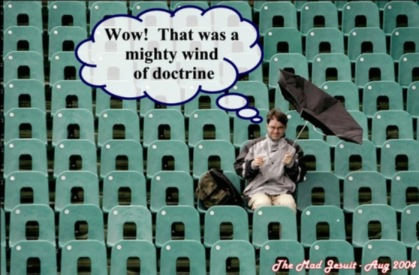
The fact that seeker-driven and Purpose-Driven pastors are adopting Roman Catholic Monastic practices in droves proves beyond a shadow of a doubt that chasing after relevance has caused them to abandon Biblical truth and they are now being blown about by every wind of false doctrine. (Eph. 4:7-19) Sadly, this is what happens when you try to marry the church to the ’spirit of the age’.

The peddler of false assurance.

Recently my grandfather was in the hospital for a week (it was looking pretty serious). On one of my visits to the hospital with my grandmother present, a nice white-haired man in a dress shirt and a tie entered the room. He introduced himself as a Eucharist Minister (I saw where this was going).

He was “doing his rounds” throughout the hospital visiting those who listed themselves as Roman Catholics on their intake papers and wanted to know if my grandfather wished to take (the heretically distorted version of Rome’s) holy communion. Of course both my grandparents were anxious to do so and stopped their profanities, taking of God’s name in vain, and all their other pet sins long enough to be good Catholics for a moment in the presence of such a holy man.

This man asked if we were all Roman Catholics and after my grandparents said yes, I said, “No, I’m a Christian.” Immediately realizing that his response was inevitably going to be “we’re all Christians,” I cut him off before he had a chance to tell that lie and I added, “Protestant,” for clarification.

My grandfather jokingly replied, “We won’t hold that against you.And of course this stranger representing Rome agreed, confirming they don’t hold anything against anyone. (How kind of him.)

Because challenging this man in front of my grandparents would do more harm than good, I bit my tongue. He then wasted no time as he leapt into ecumenical action requesting that since we were all Christians “let us pray to God together.”

I stood and watched as this man who knows nothing about my grandparents, their lives, their sins, their struggles, or even their current relationship with God, blasphemously stood in the place of the Lord Jesus Christ as their mediator and prayed for them to be forgiven of their sins.

And what sin of my grandparents did this stranger clairvoyantly hone in on as their biggest sin, requiring special emphasis and forgiveness from? Why, none other than their needing to be forgiven of their sin of not realizing how close God is to them and that God is near to them at all times.

After this feel-good prayer of pseudo-repentance while avoiding the real issues of their sin nature in all its abhorrent wretchedness and hostility toward God, we were now ready for communion! (If only the hospital was this quick with their formalities before moving on to administer care and medicine.)

The man then reached into the pocket of his slacks and pulled out a round object. It was very similar to an Altoid tin. This man then opened the lid to reveal a bunch of white squares resembling Chiclets gum. He removed one of the squares, and holding it between his two fingers, held it in front of him so that my grandparents could see it. He then presumptuously announced, “This is the Lamb of God.” I could endure no more and removed myself from the room with an exhale that I’m certain he heard.

This false teacher peddling his false assurance had the audacity to call a little piece of food the very Lamb of God; what utter blasphemy. Yet my grandparents clung to every word of this fork-tongued tool of Satan, and now had clean consciences to continue about their normal lifestyles of rampant and impenitent sin.

Sadly, late at night while I sat alone by my grandfather’s bedside trying desperately to convey the gospel of Jesus Christ to him (Law first), he remained completely averse to it. After all, the nice priestly mediator already prayed for him and he took communion, so what need does he have of a propitiation for his sins?

Not even his brush with death that put him in the hospital could rouse him from his spiritual slumber. My grandfather opined that God understands that he’s just a human, and with a nice condescending pat on my arm he assured me that all will be well . . . all will be well.


“They have healed the brokenness of My people superficially, Saying, ‘Peace, peace,’ But there is no peace.” – Jeremiah 16:14


Roman Catholics copying Evangelicals?

A sad trend as of late is that many supposed professing Christians are unifying with and even returning to Rome (like a dog to its vomit) and taking many of the undiscerning with them.

But what I find ironic is that while an exodus out of Biblical Christianity and into Roman Catholicism is taking place (i.e. A great falling away), simultaneously the church of Rome appears to be borrowing from evangelicalism the very pragmatic methodologies that’s killing evangelicalism.

After watching the following video it seems that Rome is trying to model the same seeker-sensitive, feely-touchy, charismatic, man-made methodology that has left so many evangelicals disenfranchised with Christianity and is the impetus behind why so many are running into the arms of the Romish organization.

Here’s the Roman Catholic Life Teen promo video chalk full of images explicitly Romish along with images indistinguishable from modern Churchianity, devotion to a dead woman, and typical Romish heresy.

Quotes (679)

http://easterpeople.wordpress.com/2009/07/23/im-a-charismatic-baptist-reformed-calvinist/

The most excellent study for expanding the soul is the science of Christ and Him crucified and the knowledge of the Godhead in the glorious Trinity.

– Charles Spurgeon

1834 – 1892

A Roman Catholic with univeralist leanings vs. an Atheist on the topic of Christmas.

I found this short and interesting video debate between a Roman Catholic (who includes Evangelicals, Catholics, and Mormons under the umbrella of “Christian”) and an Atheist on the subject of Christmas.

The Roman Catholic is a Foxnews anchor, and the Atheist is from the Freedom From Religion Foundation. Yes, the same Freedom From Religion Foundation that honors the bloodthirsty racist Margaret Sanger as a great “Free Thinker.”

All in all, a very entertaining video.


A Public Rebuke to the Mahnattan Declaration Signers

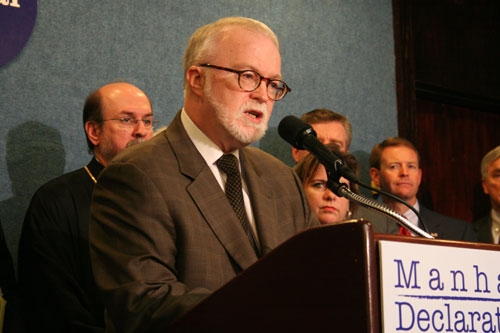
Timothy George, Co-Author of Manhattan Declaration

From: Ralph Ovadal, Pastor of Pilgrims Covenant Church, Monroe, Wisconsin.

The Manhattan Declaration is an ungodly manifesto, contemptuous of the blood and righteousness of the Lord Jesus Christ. It is an ecumenical treatise, complete with a Romish gospel and shot through and through with popish error. Those evangelicals who have authored this document and who have led the way in signing it show themselves to be in rebellion to God. It is, in their case, a brazen manifesto of treason against the Lord Jesus Christ. And they are not friends but rather are enemies of Christian liberty in that they disobey and provoke the Author of liberty with their spiritual fornication, even wresting His word and corrupting His blood-bought church. It is the biblical duty of all faithful Christian pastors to stand against the evangelical authors of the Manhattan Declaration and all evangelicals who sign it or promote it in any way. Such betrayers of Christ and His church must be separated from and called to account by all faithful Christian ministers and people.

For a message speaking to this much needed, very strong public rebuke to the evangelical signers of The Manhattan Declaration, please listen here

Quotes (651)

Catholics are totally dependent upon priests for their salvation. It is the priest who is said to cause regeneration and justification in baptism (CCC 1992, 1213); absolve mortal sins in the confessional; dispense the body and blood of Jesus in the Eucharist; impart the Holy Spirit in the sacrament of Confirmation; and offer the sacrifice of the Mass for souls suffering in purgatory. It is no wonder why Catholics trust their religion and their priests as mediators to usher them into Heaven.

– Mike Gendron

Quotes (648)

J. D. WatsonRoman Catholicism is the most evil perversion of Christianity Satan could devise. It is pagan, wicked, and deceptive. It is a works-oriented system that perverts the works of Christ in many blasphemous ways (the papacy being one) and was the reason the Protestant Reformation was necessary. How sad it is that many “evangelicals” today are trying to undo it.

– J.D. Watson

Martyrdom of John Calas

CalasDeath

We pass over many other individual maretyrdoms to insert that of John Calas, which took place as recently as 1761, and is an indubitable proof of the bigotry of popery, and shows that neither experience nor improvement can root out the inveterate prejudices of the Roman Catholics, or render them less cruel or inexorable to Protestants.

John Calas was a merchant of the city of Toulouse, where he had been settled, and lived in good repute, and had married an English woman of French extraction. Calas and his wife were Protestants, and had five sons, whom they educated in the same religion; but Lewis, one of the sons, became a Roman Catholic, having been converted by a maidservant, who had lived in the family about thirty years. The father, however, did not express any resentment or ill-will upon the occasion, but kept the maid in the family and settled an annuity upon the son. In October, 1761, the family consisted of John Calas and his wife, one woman servant, Mark Antony Calas, the eldest son, and Peter Calas, the second son. Mark Antony was bred to the law, but could not be admitted to practice, on account of his being a Protestant; hence he grew melancholy, read all the books he could procure relative to suicide, and seemed determined to destroy himself. To this may be added that he led a dissipated life, was greatly addicted to gaming, and did all which could constitute the character of a libertine; on which account his father frequently reprehended him and sometimes in terms of severity, which considerably added to the gloom that seemed to oppress him.

On the thirteenth of October, 1761, Mr. Gober la Vaisse, a young gentleman about 19 years of age, the son of La Vaisse, a celebrated advocate of Toulouse, about five o’clock in the evening, was met by John Calas, the father, and the eldest son Mark Antony, who was his friend. Calas, the father, invited him to supper, and the family and their guest sat down in a room up one pair of stairs; the whole company, consisting of Calas the father, and his wife, Antony and Peter Calas, the sons, and La Vaisse the guest, no other person being in the house, except the maidservant who has been already mentioned.

It was now about seven o’clock. The supper was not long; but before it was over, Antony left the table, and went into the kitchen, which was on the same floor, as he was accustomed to do. The maid asked him if he was cold? He answered, “Quite the contrary, I burn”; and then left her. In the meantime his friend and family left the room they had supped in, and went into a bed-chamber; the father and La Vaisse sat down together on a sofa; the younger son Peter in an elbow chair; and the mother in another chair; and, without making any inquiry after Antony, continued in conversation together until between nine and ten o’clock, when La Vaisse took his leave, and Peter, who had fallen asleep, was awakened to attend him with a light.

On the ground floor of Calas’s house was a shop and a warehouse, the latter of which was divided from the shop by a pair of folding doors. When Peter Calas and La Vaisse came downstairs into the shop, they were extremely shocked to see Antony hanging in his shirt, from a bar which he had laid across the top of the two folding doors, having half opened them for that purpose. On discovery of this horrid spectacle, they shrieked out, which brought down Calas the father, the mother being seized with such terror as kept her trembling in the passage above. When the maid discovered what had happened, she continued below, either because she feared to carry an account of it to her mistress, or because she busied herself in doing some good office to her master, who was embracing the body of his son, and bathing it in his tears. The mother, therefore, being thus left alone, went down and mixed in the scene that has been already described, with such emotions as it must naturally produce. In the meantime Peter had been sent for La Moire, a surgeon in the neighborhood. La Moire was not at home, but his apprentice, Mr. Grosle, came instantly. Upon examination, he found the body quite dead; and by this time a papistical crowd of people were gathered about the house, and, having by some means heard that Antony Calas was suddenly dead, and that the surgeon who had examined the body, declared that he had been strangled, they took it into their heads he had been murdered; and as the family was Protestant, they presently supposed that the young man was about to change his religion, and had been put to death for that reason.

The poor father, overwhelmed with grief for the loss of his child, was advised by his friends to send for the officers of justice to prevent his being torn to pieces by the Catholic multitude, who supposed he had murdered his son. This was accordingly done and David, the chief magistrate, or capitol, took the father, Peter the son, the mother, La Vaisse, and the maid, all into custody, and set a guard over them. He sent for M. de la Tour, a physician, and MM. la Marque and Perronet, surgeons, who examined the body for marks of violence, but found none except the mark of the ligature on the neck; they found also the hair of the deceased done up in the usual manner, perfectly smooth, and without the least disorder: his clothes were also regularly folded up, and laid upon the counter, nor was his shirt either torn or unbuttoned.

Notwithstanding these innocent appearances, the capitol thought proper to agree with the opinion of the mob, and took it into his head that old Calas had sent for La Vaisse, telling him that he had a son to be hanged; that La Vaisse had come to perform the office of executioner; and that he had received assistance from the father and brother.

As no proof of the supposed fact could be procured, the capitol had recourse to a monitory, or general information, in which the crime was taken for granted, and persons were required to give such testimony against it as they were able. This recites that La Vaisse was commissioned by the Protestants to be their executioner in ordinary, when any of their children were to be hanged for changing their religion: it recites also, that, when the Protestants thus hang their children, they compel them to kneel, and one of the interrogatories was, whether any person had seen Antony Calas kneel before his father when he strangled him: it recites likewise, that Antony died a Roman Catholic, and requires evidence of his catholicism.

But before this monitory was published, the mob had got a notion that Antony Calas was the next day to have entered into the fraternity of the White Penitents. The capitol therefore caused his body to be buried in the middle of St. Stephen’s Church. A few days after the interment of the deceased, the White Penitents performed a solemn service for him in their chapel; the church was hung with white, and a tomb was raised in the middle of it, on the top of which was placed a human skeleton, holding in one hand a paper, on which was written “Abjuration of heresy,” and in the other a palm, the emblem of martyrdom. The next day the Franciscans performed a service of the same kind for him.

The capitol continued the persecution with unrelenting severity, and, without the least proof coming in, thought fit to condemn the unhappy father, mother, brother, friend, and servant, to the torture, and put them all into irons on the eighteenth of November.

From these dreadful proceedings the sufferers appealed to the parliament, which immediately took cognizance of the affair, and annulled the sentence of the capitol as irregular, but they continued the prosecution, and, upon the hangman deposing it was impossible Antony should hang himself as was pretended, the majority of the parliament were of the opinion, that the prisoners were guilty, and therefore ordered them to be tried by the criminal court of Toulouse. One voted him innocent, but after long debates the majority was for the torture and wheel, and probably condemned the father by way of experiment, whether he was guilty or not, hoping he would, in the agony, confess the crime, and accuse the other prisoners, whose fate, therefore, they suspended.

Poor Calas, however, an old man of sixty-eight, was condemned to this dreadful punishment alone. He suffered the torture with great constancy, and was led to execution in a frame of mind which excited the admiration of all that saw him, and particularly of the two Dominicans (Father Bourges and Father Coldagues) who attended him in his last moments, and declared that they thought him not only innocent of the crime laid to his charge, but also an exemplary instance of true Christian patience, fortitude, and charity. When he saw the executioner prepared to give him the last stroke, he made a fresh declaration to Father Bourges, but while the words were still in his mouth, the capitol, the author of this catastrophe, who came upon the scaffold merely to gratify his desire of being a witness of his punishment and death, ran up to him, and bawled out, “Wretch, there are fagots which are to reduce your body to ashes! speak the truth.” M. Calas made no reply, but turned his head a little aside; and that moment the executioner did his office.

The popular outcry against this family was so violent in Languedoc, that every body expected to see the children of Calas broke upon the wheel, and the mother burnt alive.

Young Donat Calas was advised to fly into Switzerland: he went, and found a gentleman who, at first, could only pity and relieve him, without daring to judge of the rigor exercised against the father, mother, and brothers. Soon after, one of the brothers, who was only banished, likewise threw himself into the arms of the same person, who, for more than a month, took every possible precaution to be assured of the innocence of the family. Once convinced, he thought himself, obliged, in conscience, to employ his friends, his purse, his pen, and his credit, to repair the fatal mistake of the seven judges of Toulouse, and to have the proceedings revised by the king’s council. This revision lasted three years, and it is well known what honor Messrs. de Grosne and Bacquancourt acquired by investigating this memorable cause. Fifty masters of the Court of Requests unanimously declared the whole family of Calas innocent, and recommended them to the benevolent justice of his majesty. The Duke de Choiseul, who never let slip an opportunity of signalizing the greatness of his character, not only assisted this unfortunate family with money, but obtained for them a gratuity of 36,000 livres from the king.

On the ninth of March, 1765, the arret was signed which justified the family of Calas, and changed their fate. The ninth of March, 1762, was the very day on which the innocent and virtuous father of that family had been executed. All Paris ran in crowds to see them come out of prison, and clapped their hands for joy, while the tears streamed from their eyes.
voltaireThis dreadful example of bigotry employed the pen of Voltaire in deprecation of the horrors of superstition; and though an infidel himself, his essay on toleration does honor to his pen, and has been a blessed means of abating the rigor of persecution in most European states. Gospel purity will equally shun superstition and cruelty, as the mildness of Christ’s tenets teaches only to comfort in this world, and to procure salvation in the next. To persecute for being of a different opinion is as absurd as to persecute for having a different countenance: if we honor God, keep sacred the pure doctrines of Christ, put a full confidence in the promises contained in the Holy Scriptures, and obey the political laws of the state in which we reside, we have an undoubted right to protection instead of persecution, and to serve heaven as our consciences, regulated by the Gospel rules, may direct.


End Notes

Full text from: John Foxe. Fox’s Book of Martyrs. Edited by William Byron Forbush. ttp://www.ccel.org/ccel/foxe/martyrs/files/martyrs.html [Accessed: 11.08.2009]

A Nun’s Story

Jacqueline Kassar spent twenty-two years as a nun in an enclosed convent dedicated to adoration, reparation and suffering, trying to appease the wrath of God. She believed it was a nun’s calling to be a miniature savior of the world like unto Jesus Christ. Now, on camera, in her apartment into Brooklyn NY, she tells her story with compassion and care for sincere Catholics who truly live Catholic teaching. [Text from YouTube video posting]

To learn about Jacqueline’s experience, please watch the video below.


E.T. phone Rome.

Vatican E.T. Not content with being restricted to spreading their damnable false gospel on earth, the Vatican is now looking to the sky.

Four hundred years after it locked up Galileo for challenging the view that the Earth was the center of the universe, the Vatican has called in experts to study the possibility of extraterrestrial alien life and its implication for the Catholic Church.

“The questions of life’s origins and of whether life exists elsewhere in the universe are very suitable and deserve serious consideration,” said the Rev. Jose Gabriel Funes, an astronomer and director of the Vatican Observatory.

Funes, a Jesuit priest, presented the results Tuesday of a five-day conference that gathered astronomers, physicists, biologists and other experts to discuss the budding field of astrobiology — the study of the origin of life and its existence elsewhere in the cosmos.

Today top clergy, including Funes, openly endorse scientific ideas like the Big Bang theory as a reasonable explanation for the creation of the universe. The theory says the universe began billions of years ago in the explosion of a single, super-dense point that contained all matter.

Earlier this year, the Vatican also sponsored a conference on evolution to mark the 150th anniversary of Charles Darwin’s “The Origin of Species.”

The event snubbed proponents of alternative theories, like creationism and intelligent design, which see a higher being rather than the undirected process of natural selection behind the evolution of species.

Read the entire article here.

Quotes (644)

Rev John DownlingThe blessed founder of Christianity chose to make his advent among the lowly and the despised. This was agreeable to the spirit of that Holy Religion which he came to establish. There was a time when a multitude of his followers, astonished and convinced by the omnipotence displayed in his wondrous miracles, were disposed to” take him by force to make him a king,” but so far from encouraging their design, the inspired historian tells us” that he departed again, into a mountain himself alone.” (John vi., 15.) In reply to the inquiries of the Roman governor, he uttered those memorable words, “MY KINGDOM IS NOT OF THIS WORLD,” and his whole conduct from the manger to the cross, and from the cross to the mount of ascension, was in strict accordance with this characteristic maxim of genuine Christianity.

In selecting those whom he would send forth as the apostles of his faith, be went, not to the mansions of the great or to the palaces of kings, but to the humble walks of life, and chose from the poor of this world, those who, in prosecuting their mission, were destined like their divine master, to be despised and rejected of men. In performing the work which their Lord had given them to do, the lowly but zealous fisherman of Galilee, and the courageous tent-maker of Tarsus, with their faithful fellow-laborers, despising all earthly honors and worldly aggrandizement, were content to lay every laurel at the foot of Christs cross, and to” count all things but loss for the excellency of the knowledge of Christ Jesus, their Lord,” for whom they had “suffered the loss of all things” (Philippians, iii., 8.)

A few centuries afterward, we find the professed successor of Peter the fisherman [i.e. the Pope], dwelling in a magnificent palace, attended by troops of soldiers ready to avenge the slightest insult offered to his dignity, surrounded by all the ensigns of worldly greatness, with more than regal splendor proudly claiming to be the sovereign ruler of the universal church the Vicegerent of God upon earth, whose decision is infallible and whose will is law. The contrast between these two pictures of Primitive Christianity in the first century, and Papal Christianity in the seventh or eighth, is so amazing, that we are irresistibly led to the inquiry, can they be the same? If one is a faithful picture of Christianity, can it be possible that the other is worthy of the name?

John Dowling (Source: Dowling, John (1845). The History of Romanism: from the Earliest Corruptions of Christianity to the Present Time)

Birthdate & date of death unknown


Persecution of John Huss

200px-Jan_Hus“John Huss (Jan Hus) was born at Hussenitz, a village in Bohemia, about the year 1380. His parents gave him the best education their circumstances would admit; and having acquired a tolerable knowledge of the classics at a private school, he was removed to the university of Prague, where he soon gave strong proofs of his mental powers, and was remarkable for his diligence and application to study.
In 1398, Huss commenced bachelor of divinity, and was after successively chosen pastor of the Church of Bethlehem, in Prague, and dean and rector of the university. In these stations he discharged his duties with great fidelity; and became, at length, so conspicuous for his preaching, which was in conformity with the doctrines of Wickliffe, that it was not likely he could long escape the notice of the pope and his adherents, against whom he inveighed with no small degree of asperity.

The English reformist, Wickliffe, had so kindled the light of reformation, that it began to illumine the darkest corners of popery and ignorance. His doctrines spread into Bohemia, and were well received by great numbers of people, but by none so particularly as John Huss, and his zealous friend and fellow martyr, Jerome of Prague.

The archbishop of Prague, finding the reformists daily increasing, issued a decree to suppress the further spreading of Wickliffe’s writings: but this had an effect quite different to what he expected, for it stimulated the friends of those doctrines to greater zeal, and almost the whole university united to propagate them.

Being strongly attached to the doctrines of Wickliffe, Huss opposed the decree of the archbishop, who, however, at length, obtained a bull from the pope, giving him commission to prevent the publishing of Wickliffe’s doctrines in his province. By virtue of this bull, the archbishop condemned the writings of Wickliffe: he also proceeded against four doctors, who had not delivered up the copies of that divine, and prohibited them, notwithstanding their privileges, to preach to any congregation. Dr. Huss, with some other members of the university, protested against these proceedings, and entered an appeal from the sentence of the archbishop.

The affair being made known to the pope, he granted a commission to Cardinal Colonna, to cite John Huss to appear personally at the court of Rome, to answer the accusations laid against him, of preaching both errors and heresies. Dr. Huss desired to be excused from a personal appearance, and was so greatly favored in Bohemia, that King Winceslaus, the queen, the nobility, and the university, desired the pope to dispense with such an appearance; as also that he would not suffer the kingdom of Bohemia to lie under the accusation of heresy, but permit them to preach the Gospel with freedom in their places of worship.

Three proctors appeared for Dr. Huss before Cardinal Colonna. They endeavored to excuse his absence, and said they were ready to answer in his behalf. But the cardinal declared Huss contumacious, and excommunicated him accordingly. The proctors appealed to the pope, and appointed four cardinals to examine the process: these commissioners confirmed the former sentence, and extended the excommunication not only to Huss but to all his friends and followers.

From this unjust sentence Huss appealed to a future Council, but without success; and, notwithstanding so severe a decree, and an expulsion in consequence from his church in Prague, he retired to Hussenitz, his native place, where he continued to promulgate his new doctrine, both from the pulpit and with the pen.

The letters which he wrote at this time were very numerous; and he compiled a treatise in which he maintained, that reading the books of Protestants could not be absolutely forbidden. He wrote in defence of Wickliffe’s book on the Trinity; and boldly declared against the vices of the pope, the cardinals, and clergy, of those corrupt times. He wrote also many other books, all of which were penned with a strength of argument that greatly facilitated the spreading of his doctrines.

In the month of November, 1414, a general Council was assembled at Constance, in Germany, in order, as was pretended, for the sole purpose of determining a dispute then pending between three persons who contended for the papacy; but the real motive was to crush the progress of the Reformation.

John Huss was summoned to appear at this Council; and, to encourage him, the emperor sent him a safe-conduct: the civilities, and even reverence, which Huss met with on his journey were beyond imagination. The streets, and sometimes the very roads, were lined with people, whom respect, rather than curiosity, had brought together.

He was ushered into the town with great acclamations, and it may be said that he passed through Germany in a kind of triumph. He could not help expressing his surprise at the treatment he received: “I thought (said he) I had been an outcast. I now see my worst friends are in Bohemia.”

As soon as Huss arrived at Constance, he immediately took logdings in a remote part of the city. A short time after his arrival, came one Stephen Paletz, who was employed by the clergy at Prague to manage the intended prosecution against him. Paletz was afterwards joined by Michael de Cassis, on the part of the court of Rome. These two declared themselves his accusers, and drew up a set of articles against him, which they presented to the pope and the prelates of the Council.

When it was known that he was in the city he was immediately arrested, and committed prisoner to a chamber in the palace. This violation of common law and justice was particularly noticed by one of Huss’s friends, who urged the imperial safe-conduct; but the pope replied he never granted any safe-conduct, nor was he bound by that of the emperor.

While Huss was in confinement, the Council acted the part of inquisitors.

They condemned the doctrines of Wickliffe, and even ordered his remains to be dug up and burned to ashes; which orders were strictly complied with. In the meantime, the nobility of Bohemia and Poland strongly interceded for Huss; and so far prevailed as to prevent his being condemned unheard, which had been resolved on by the commissioners appointed to try him.

When he was brought before the Council, the articles exhibited against him were read: they were upwards of forty in number, and chiefly extracted from his writings.

John Huss’s answer was this: “I did appeal unto the pope; who being dead, and the cause of my matter remaining undetermined, I appealed likewise unto his successor John XXIII: before whom when, by the space of two years, I could not be admitted by my advocates to defend my cause, I appealed unto the high judge Christ.”

When John Huss had spoken these words, it was demanded of him whether he had received absolution of the pope or no? He answered, “No.” Then again, whether it was lawful for him to appeal unto Christ or no? Whereunto John Huss answered: “Verily I do affirm here before you all, that there is no more just or effectual appeal, than that appeal which is made unto Christ, forasmuch as the law doth determine, that to appeal is no other thing than in a cause of grief or wrong done by an inferior judge, to implore and require aid at a higher Judge’s hand. Who is then a higher Judge than Christ? Who, I say, can know or judge the matter more justly, or with more equity? when in Him there is found no deceit, neither can He be deceived; or, who can better help the miserable and oppressed than He?” While John Huss, with a devout and sober countenance, was speaking and pronouncing those words, he was derided and mocked by all the whole Council.

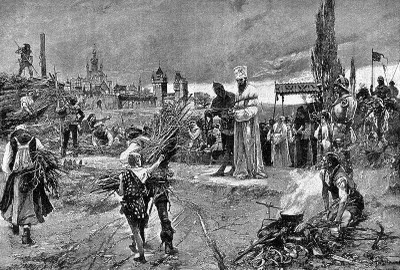
husBurningThese excellent sentences were esteemed as so many expressions of treason, and tended to inflame his adversaries. Accordingly, the bishops appointed by the Council stripped him of his priestly garments, degraded him, put a paper miter on his head, on which was painted devils, with this inscription, “A ringleader of heretics.” Which when he saw, he said: “My Lord Jesus Christ, for my sake, did wear a crown of thorns; why should not I then, for His sake, again wear this light crown, be it ever so ignominious? Truly I will do it, and that willingly.” When it was set upon his head, the bishop said: “Now we commit thy soul unto the devil.” “But I,” said John Huss, lifting his eyes towards the heaven, “do commend into Thy hands, O Lord Jesus Christ! my spirit which Thou has redeemed.”
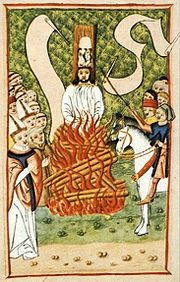
 When the chain was put about him at the stake, he said, with a smiling countenance, “My Lord Jesus Christ was bound with a harder chain than this for my sake, and why then should I be ashamed of this rusty one?”

When the fagots were piled up to his very neck, the duke of Bavaria was so officious as to desire him to abjure. “No, (said Huss;) I never preached any doctrine of an evil tendency; and what I taught with my lips I now seal with my blood.” He then said to the executioner, “You are now going to burn a goose, (Huss signifying goose in the Bohemian language:) but in a century you will have a swan which you can neither roast nor boil.” If he were prophetic, he must have meant Martin Luther, who shone about a hundred years after, and who had a swan for his arms.

180px-Jan_Hus_at_the_StakeThe flames were now applied to the fagots, when our martyr sung a hymn with so loud and cheerful a voice that he was heard through all the cracklings of the combustibles, and the noise of the multitude. At length his voice was interrupted by the severity of the flames, which soon closed his existence.

Then, with great diligence, gathering the ashes together, they cast them into the river Rhine, that the least remnant of that man should not be left upon the earth, whose memory, notwithstanding, cannot be abolished out of the minds of the godly, neither by fire, neither by water, neither by any kind oof torment.”

Full text from: John Foxe. Fox’s Book of Martyrs. Edited by William Byron Forbush. ttp://www.ccel.org/ccel/foxe/martyrs/files/martyrs.html [Accessed: 11.01.2009]

The more Rome changes, the more it stays the same.

You can tell a man by the friends he keeps and likewise you can tell a church by the associations it keeps. So this Reformation Day, let us take a stroll through the halls of Roman Catholicism’s past and present as a simple reminder why true Biblical Christianity will never be at peace with the false religious system and counterfeit Christian organization of Rome.

torture_inquisition

inquisition

catholic_iquisition_torture

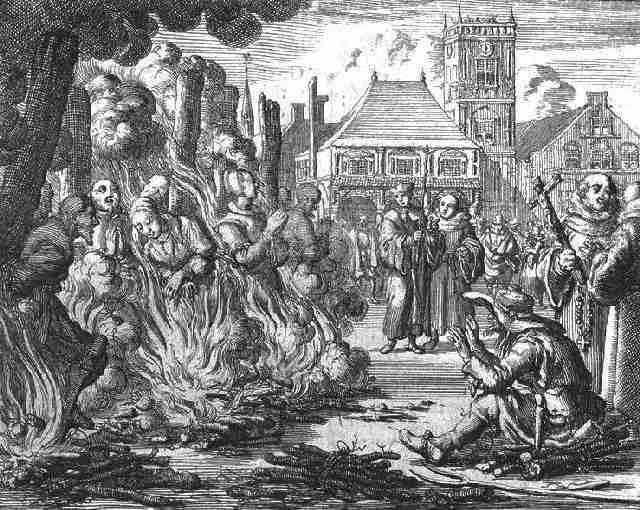
burned_at_the_stake

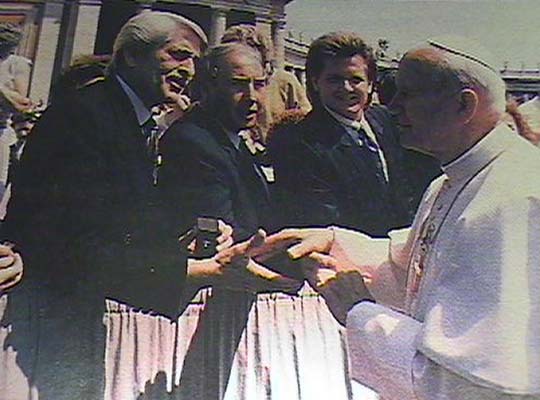
Pope and false religion

priests-salute

NaziPriestsSaluteHitler

Hitler-with-Muller

hitler_cardinal4

Pope and Castro

Obama Vatican

Pope and TBN

Pope and Dali Lama

Pope and Islam

Pope and Yassir Arafat

Catholicism and Islam

Pope and Arafat Greet

Arafat and Pope

Paul John Paul II Kissing the Koran

Pope and Chavez

VATICAN SAUDI KING

INterfaith

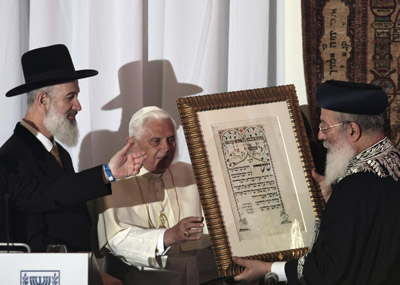
Pope Jewish

Pope Mosque

Interfaith Pope

Ecumenical Pope

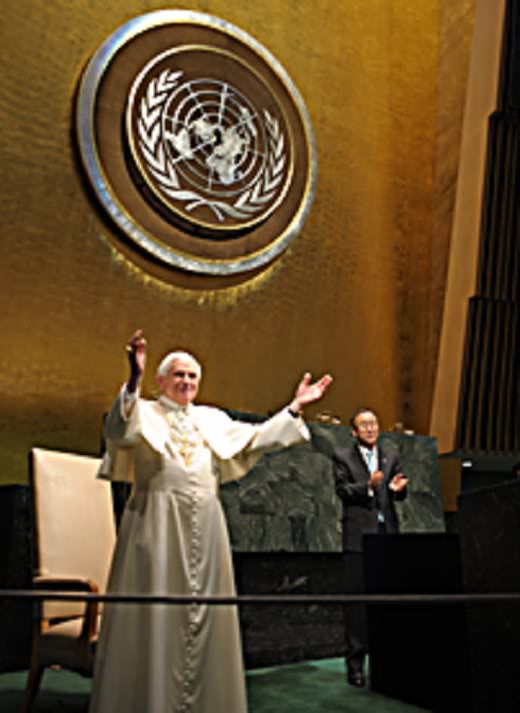
Pope UN

The Pope’s Plans on Organizing Political, Economic, and Religious Activities Worldwide

From Richard Bennett at Berean Beacon.

Dear Friend, The Pope’s latest encyclical can read like an ideological bombshell. However, when we study papal history with its obsession forRatUN global power, it is not so shocking. The Papacy has an agenda for the United Nations, economic institutions, and international finance organizations. The Pope has called for the crafting of a new governmental body above these groups and intends that the new body be equipped with enforcement power on a startling scale. Much more sobering is the detailed body of Roman Catholic social doctrine on which the encyclical is built and which the Papacy is in the process of instituting secularly. These documents need to be analyzed and rejected before nations and peoples unwittingly concede both temporal and religious control to the Vatican. We have outlined the heart of the major tactics found in the body of Roman Catholic social doctrine, which includes the Pope’s latest encyclical. Our article is called, The Pope’s Plans on Organizing Political, Economic, and Religious Activities Worldwide. If you wish to get the article as a Microsoft Word document, just request it and it will be sent to you. We consider this to be one of the more important appraisals we have done.

Rick Warren, Tony Blair & The Vatican Agenda

 Source: Chris Pinto with Adullam Films

Spurgeon

Essence of lies, and quintessence of blasphemy, as the religion of Rome is, it nevertheless fascinates a certain order of Protestants, of whom we fear it may be truly said that they have received a strong delusion to believe a lie, that they may be damned. Charles H. Spurgeon, “The Sword and the Trowel,” Jan. 1873

The above quote from Charles Spurgeon (the “Prince of Preachers”) is very pertinent to the time in which we live. Many believers are familiar with Spurgeon but are unaware that one of his mottos was “No peace with Rome.”

For the past two years, Adullam Films has been developing a new documentary titled, “A Lamp in the Dark: The Untold History of the Bible.” Thank the Lord, the first edited draft of the work is complete and should be ready for duplication by next week, once the final touches have been made. Our new film records events from the first century onward, showing the history of the Church, and the long war both for and against the Word of God. We document the trials of the saints, along with Rome’s ancient hatred of the Bible and her repeated attempts to “keep men from the knowledge of the Scriptures.”

When the Bible began to be translated into the languages of the common man, it resulted in the Protestant Reformation. What few modern day Christians are aware of, however, is that Rome launched a Counter Reformation in 1540 with the establishment of the Society of Jesus (also known as the Jesuit Order). Their purpose was to destroy the work of the Reformers and bring the world back into the Dark Ages. It is our belief that the Counter Reformation continues to this day, and is the real secret behind the Ecumenical Movement, the World Council of Churches, the European Union, and the Emerging Church.

Read the rest of this post at Lighthouse Trails Research here.

The immaculate deception.

Immaculate Deception

The following is an article by James Swan refuting an attempted defense of Roman Catholicism’s great heresy: The Immaculate Conception. I found the timing of this to be highly apropos in light of a continued discussion that is taking place on this very subject on the comment thread from this post.

How To Prove The Immaculate Conception Without Biblical Proof

10/04/2009 – James Swan

The constant dilemma of the Roman Catholic apologist is to insert doctrines into the Bible that aren’t there to begin with. Their argumentation of meandering logic seeks to demonstrate: a) The Bible doesn’t contradict the doctrine being inserted; b)There are indirect Bible passages that if interpreted by first granting the validity of the extra-biblical doctrine, actually support the extra biblical doctrine. Catholic apologist John Martignoni’s most recent newsletter is a perfect example. He presents “Challenge/Response/Strategy” in defending Mary’s immaculate conception. This argumentation is for his upcoming book on basic Roman Catholic apologetics.

In Martignoni’s argumentation, the immaculate conception must first be brought to the biblical text. That is, by a plain reading of the Bible, one would not read from Genesis to Revelation and conclude Mary was born sinless and remained free of sin her entire life. Martignoni’s apologetic then is to prove the immaculate conception is not disproved by anything the Bible states, and that certain texts can be utilized as indirect proofs. I outlined Martignoni’s hypothetical challenges and his responses in the order he presented them. My counter responses are in red.

Argument 1: The Bible doesn’t use the words immaculate conception. Therefore it is an unbiblical concept.

Martignoni’s Response: The words Trinity and Incarnation are not found in the Bible either.

Swan’s Counter: I know of no serious Protestant apologist that actually uses such an argument. The question is not whether the phrase is found in the Bible, but are there specific direct passages that substantiate such a concept? To substantiate such a concept as a clear teaching of scripture one needs direct passages, not a few vague inference passages.

Argument 2: Trinity and Incarnation are concepts supported by the Bible, the immaculate conception has no such support.

Martignoni’s response: There is no passage in Scripture which directly states that Mary was not conceived without original sin, or that she was not immaculately conceived.

Swan’s counter: Aside from the fact this response doesn’t follow from the argument, this type of argument can [be] applied to many individuals within the Bible. The Bible doesn’t say Priscilla was conceived without original sin, or that she was not immaculately conceived, yet we don’t assume she was. A lack of evidence does not bolster or further an argument.

Argument 3: Romans 3:9-12 and 3:22-23 says all are under the power of sin and that all have sinned, therefore Mary sinned.

Martignoni’s response (four points):
A. Such an argument does not address Mary being immaculately conceived, it addresses whether or not she was sinless her entire life, which is a different question.

Swan’s Counter: Under the heading of “The Immaculate Conception,” the Catechism of the Catholic Church states, “By the grace of God Mary remained free of every personal sin her whole life long” (CCC 493), so it is not a different question.

B. There is no passage in Scripture which directly states that Mary was not conceived without original sin, or that she was not immaculately conceived.

Swan’s Counter: Luke 1:35 positively says Jesus was conceived by the Holy Spirit. There is no such verse about Mary’s conception. There is no verse that states Mary must be sinless in order to bear the Son of God. Martignoni offers no similar positive evidence that would separate her from the rest of humanity described in Romans 3.

C. Some Protestants believe things not found in the Bible. Catholics likewise should be allowed to believe things not directly stated in the Bible. Example: The Bible nowhere says contraception is okay, yet most protestants believe it is.

Swan’s Counter: Martignoni’s argument would not work against Protestants who deny both the immaculate conception and contraception. To prove some Protestants may believe something not found in the Bible does nothing more than prove an inconsistency. To prove such offers no positive support for an extra-biblical belief in the immaculate conception.

D. Some Scripture passages indirectly support the Immaculate Conception, like Genesis 3:14-15. Mary is the woman described. Enmity exists between Satan and the woman. Martignoni says, “If you have sin in you, can you say that there is enmity between you and Satan?” Only a sinless being can be at enmity with Satan. Therefore Mary was not conceived in sin, and did not commit personal sin.

Swan’s counter: This is Martignoni’s only attempt to present positive argumentation. He candidly admits his Biblical proof is indirect. The argument has an unproven assumption: only a sinless person can be an enemy of Satan, at war with Satan. But, there has always been enmity between believers and Satan. One does not have to be sinless to be at war with Satan. Why would Paul exhort the Ephesians to put on the full armor of God “so that you can take your stand against the devil’s schemes“? Wouldn’t he first clarify that in order to put on the armor, one must be entirely sinless? Similarly, why would Peter exhort Christians to resist the Devil (1 Peter 5:8), or James to resist the devil (James 4:7)? Here we have direct proof that all Christians are enemies of Satan, at war with Satan. John warns us that “if we claim to be without sin, we deceive ourselves.” Christians are sinners, and they are at war with Satan. Nothing could be clearer.

Martignoni states that he was limited with the amount of time he had to put into this argumentation. Then again, he states this argumentation is for a book (as if the world needs yet another book repeating arguments already put forth by other writers). If he’s going to continue with a similar line of reasoning, perhaps he should back up a bit and explain his proofs are not proofs, but inferences. He claims to be presenting “biblical, historical, and logical perspectives” as to the immaculate conception. His reasoning though amounts to inferences and leaps of logic read into the text.

HT: Isaiah

Quotes (626)

Rome never changes. Rome will never admit that she has made mistakes. She burned our English Reformers 300 years ago. She tried hard to stamp out by violence the Protestantism which she could not prevent spreading by arguments. If Rome had only the power, I am not sure that she would not attempt to play the whole game over again.

– J.C. Ryle

1816 – 1900