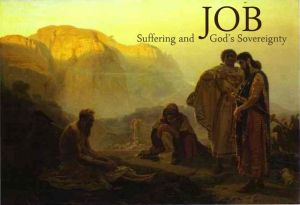
What About Suffering?

What should be our attitude toward suffering trials and tribulations? Let us look into the Word.

Twice in the book of Job, YHWH taunts Satan, asking if he has considered His servant. Here’s the first one:

Job 1:6-8 (HCSB) One day the sons of God came to present themselves before the LORD, and Satan also came with them. The LORD asked Satan, “Where have you come from?” “From roaming through the earth,” Satan answered Him, “and walking around on it.” Then the LORD said to Satan, “Have you considered My servant Job? No one else on earth is like him, a man of perfect integrity, who fears God and turns away from evil.”

In all his suffering Job did not sin – God held him in His hand, sustaining Job through the trial; not removing him from it.

Much later in redemptive history, YHWH tells one of His servants that Satan wants another shot.

Luke 22:31-32 (HCSB) “Simon, Simon, look out! Satan has asked to sift you like wheat.  But I have prayed for you that your faith may not fail. And you, when you have turned back, strengthen your brothers.”

The faithful Son follows the path of His Father and holds His servant and sustains him through the trial, not removing him from it.

When we read of tribulation in the Bible, we are promised we’ll have them if we are walking as children of the light. Rather than looking to be removed from trials, we should have much confidence that God will sustain us through them. For our good and His glory. He has saved us from the wrath to come – what is it to suffer a little while in the flesh?

Judgment is Coming

We are familiar with the parable of the ten minas and 10 servants. This parable is told by Jesus following His encounter with Zacchaeus and begins, Luke 19:11-12 (HCSB) “As they were listening to this, He went on to tell a parable because He was near Jerusalem, and they thought the kingdom of God was going to appear right away. Therefore He said: “A nobleman traveled to a far country to receive for himself authority to be king and then return.”

Note this – those closest to Him still thought the kingdom of God was a response to the Roman occupation of their homeland. He tells them this parable to show them the truth about the kingdom and begins by telling them He is going away to receive authority to be King of kings and then return. That’s the point of this parable – Jesus was going to His Father to receive all authority and then return. He told His servants to engage in business until He came back. Luke 19:14 (HCSB) “But his subjects hated him and sent a delegation after him, saying, ‘We don’t want this man to rule over us!’”

Luke 19:15 (ESV) “When he returned, having received the kingdom, he ordered these servants to whom he had given the money to be called to him, that he might know what they had gained by doing business.”

When Christ returns, it will be as King of kings. He will judge the nations, gather His people, and make all things new. In this parable, He rewards those who were diligent and punishes those who were lazy. Luke 19:27 (ESV) “But as for these enemies of mine, who did not want me to reign over them, bring them here and slaughter them before me.’”

Here, then, is the bad news. Those who, in this age, do not want this man to rule over them will suffer His judgment upon His return. They are His enemies and they will pay, eternally, for their rebellion.

If you hear the call of God, turn and look upon Christ in all His glory. Do not fear man, who can only kill the body. Fear Him who can throw body and soul into hell. Look unto Christ, believe on Him; for you do not know what tomorrow will bring.

Better than the Passover

Better than Passover

You can listen to this sermon here.

This evening, we will compare and contrast the Lord’s Supper with the Passover given to national Israel. So many things given to the Old Covenant people point to partial or final fulfillment in what has been given to New Covenant people – they are there to teach about and point us to Christ. They are intended to give us a richer understanding of how the Bible fits all things together and has a deeper meaning than a superficial read can provide.

The Lord’s Supper is given to God’s people in the New Covenant as the sign of that covenant (Luke 22:19-20), just as the weekly Sabbath was given to God’s people in the Mosaic Covenant as the sign of that covenant (Exod. 31:12-18; Ezek. 20:11-20). In Ex 31, national Israel was commanded to keep the weekly Sabbath for it was a sign between Him and them. In 1 Cor 11 we are told that the Lord’s Supper is a declaration of His victorious death, whereby He conquered sin on our behalf. While the sign of the Old Covenant could be seen and practiced by anyone, the sign of the New Covenant cannot be understood or practiced by anyone unless they have been born again by God.

The Lord’s Supper is connected to the last Passover (Matt 26:17-30), observed in conjunction with weekly fellowship meal (Acts 2:42; 20:7) Just as the Passover meal signified the passing-over of the angel of death, so the Lord’s Supper signifies the passing through death of our Savior.

The first Passover anticipated the redemption of ethnic Israel from the bondage of Egypt (Deut 16:1). The first Lord’s Supper anticipated the redemption of spiritual Israel from the bondage of sin (1 Cor 11:23-26). The annual Passover reminded ethnic Israel of the freedom from Egypt their God had given them. The regular observance of the Lord’s Supper reminds spiritual Israel of the freedom from sin their Savior has given them.

The Passover was the covenant meal of the Old Covenant (Ex 12:17). The Lord’s Supper is the covenant meal of the New Covenant. The Passover was a mostly bitter meal, reminding the Jews of their time of want and the faithful provision of their God. The Lord’s Supper was usually observed after a fellowship meal, reminding the children of God of His provision of food for the body and the soul and the faithfulness of the One Who said He would return.

The Passover was observed with family or close friends within the covenant community (Exod 12:43-49). The Lord’s Supper is observed with all who are in Christ, within the local fellowship of saints.

The Old Covenant required observance of certain religious rites for membership: make circumcision, weekly rest from work, the Passover, occasional monthly and annual feast days. Faith in God, belief in the promised seed was not required for membership – only observance of a few religious rites. Those who fail to observe these rites were cut off from the covenant community. This is termed “formalism” and it is a sign of dead religion and must be guarded against within the local fellowship of saints.

The New Covenant requires the application of one truth: you must be born again by the Spirit of God; you must be circumcised of the heart, done without human hands (Col 2:11). Faith in the promised seed is required for membership – no one can enter the wedding feast of the Lamb without the required clothes (Matt 22:12) – the righteousness of Christ! Failure to participate in the fellowship of the saints and the observation of the Lord’s Supper neglect the care of their own souls and could be cut off from the New Covenant community until such time repentance might be granted.

Jewish parents used the Passover to teach their children about YHWH and their physical redemption. Christian parents should use the Lord’s Supper to teach their children about the redemptive death of Jesus and the need to believe on Him to be delivered from sin. Belief in God and the promised seed was not a requirement to eat the Passover. Belief on the promised Seed is a requirement to partake of the Lord’s Supper. Great teaching opportunity.

If people did not prepare for the initial Passover as directed, they would die (Ex 12:12-13). If Christians take the Lord’s Supper in an unworthy manner, they may die (1 Cor 11:27-30). This is the most graphic reminder that only believers are permitted to take this ordinance seriously. As the people in the Old Covenant taught their children about the need for YHWH’s redemption from Egypt and His faithful provision thereof, so parents in the New Covenant should teach their children about their need for redemption from sin and Jesus’ faithful provision to save. Both ordinances given the New Covenant community are great teaching opportunities for those who have not been brought near by the blood of Christ; and they are great teaching opportunities for all who have been redeemed, as we each need to be reminded of what He has done on our behalf, lest we drift into thinking little of sin and of His payment for it.

See Luke 24:35 – He opened their eyes when He broke the bread. He vanished from their presence after opening their eyes of faith. This served the same purpose for these two as His ascension does for all the saints – He departed from this world to send the Spirit as we learn to walk by faith and not by sight. Pagan religions require a god they can see and handle, because they walk by sight and not faith.

Paul tells us that Jesus was our Passover (1 Corinthians 5:7), showing us the Passover is not a continuing observance, but a ceremonial shadow or type that pointed God’s people to the promised seed who would save His people from their sin. The Lord’s Supper has connections to the Passover but is itself the sign of a better covenant (Luke 22:20 & Hebrews 8:6).

Jesus is our (believers’) Passover (1 Cor 5:7): Your boasting is not good. Don’t you know that a little yeast permeates the whole batch of dough? Clean out the old yeast so that you may be a new batch. You are indeed unleavened, for Christ our Passover has been sacrificed. Therefore, let us observe the feast, not with old yeast or with the yeast of malice and evil but with the unleavened bread of sincerity and truth. The call is to remember our need of salvation, the spiritual application of the temporal redemption given national Israel on their first Passover. No room for boasting within the New Covenant except for the cross of Christ. We are called to not tolerate the mixing of Old Covenant bondage or unbelievers (those infected with malice and evil) within the body of Christ; but welcome only those who are possessed by sincerity and truth.

This ordinance belongs exclusively to the gospel age, being typified in several Old Testament passages, such as when Melchizedek brought wine and bread to refresh Abram and his warriors who had just defeated several pagan kings (Genesis 14:17-20). Even so, we who are born again by the will of God are immediately at war with our flesh, the system of the world and its present ruler. Christ gives us spiritual nourishment with this simple symbol, the bread and wine of the Lord’s Supper, of His victory over sin and death and hell and Satan. ‘Tis a far, far better respite than what Melchizedek gave Abram. We see another reference to this church ordinance in Proverbs 9:1-6, as lady wisdom bids God’s people come to the table she has set, bread and wine, for refreshment and refuge from lure of the culture which wars against our souls.

And read the prophet Isaiah on this topic: On this mountain the LORD of hosts will make for all peoples a feast of rich food, a feast of well-aged wine, of rich food full of marrow, of aged wine well refined. And he will swallow up on this mountain the covering that is cast over all peoples, the veil that is spread over all nations. He will swallow up death forever; and the Lord GOD will wipe away tears from all faces, and the reproach of his people he will take away from all the earth, for the LORD has spoken. It will be said on that day, “Behold, this is our God; we have waited for him, that he might save us. This is the LORD; we have waited for him; let us be glad and rejoice in his salvation.” (Isaiah 25:6-9)

This is the message of the Lord’s Table: “Behold, this is our God; we have waited for him, that he might save us. This is the LORD; we have waited for him; let us be glad and rejoice in his salvation.”

This is just one aspect of how the OT points to spiritual things. Think about how rich the entire OT is in its revelation of Christ; that was the Scripture from which Jesus and the apostles preached the gospel to the first century world.

While the Bible does not explicitly command us on the frequency, we do see a narrative showing it was an important part of their weekly gatherings, some 30 to 40 years after Pentacost. Now on the first day of the week, when the disciples came together to break bread, Paul, ready to depart the next day, spoke to them and continued his message until midnight (Acts 20:7). One author (Terrance O’Hare) observed: “Most commentators agree that this was a Sunday evening meeting, at a recurring gathering of Christians on the first day of the week following their normal activities and work. [Note: this was before Christianity was legal and before Sunday was a regular day off for workers.] They came together in order to break bread. This does not mean that preaching was secondary, but when they came together, they purposed to commune in the symbolism of the covenant meal as the Lord had commended and as the apostles has established by tradition.” We should no more neglect the Lord’s Supper than the Israelites did their Passover.

While Scripture does not tell us how frequently to observe this ordinance, it does command us to take it, revealing that it is nourishing to our souls, enhances our fellowship. This puts a new light on this question about frequency; perhaps the question for some should be, why don’t we take this ordinance more frequently? The commonly discussed down-side to observing this ordinance regularly is that it can (they often mean will) become routine, dull, meaningless. That was my first thought when I served in a church that took the Lord’s Table weekly. My time at that church showed me that, properly handled, the weekly observance of this ordinance is not routine, dull, or meaningless. If Christ be rightly presented, if we are put in our place of coming to Him with gratitude, in humility, aware of our not-yet status of being conformed to Him, then this simple ordinance is what God intended it to be, bringing glory to the Father through the Son and building up His people spiritually.

The beloved Baptist preacher, Charles Spurgeon, declared, “Shame on the Christian Church that she should put it off to once a month, and mar the first day of the week by depriving it of its glory in the meeting together for fellowship and breaking of bread, and showing forth the death of Christ til He comes.” Throughout the history of the church, weekly observance of the Lord’s Supper has been the traditional practice, ably supported by the Word of God.

The cup of blessing that we bless, is it not a participation in the blood of Christ? The bread that we break, is it not a participation in the body of Christ? (1 Corinthians 10:16)

When we take the cup of the Lord’s Supper, we should remember the cup of wrath He took on our behalf. The cup we hold is a symbol of the glorious benefit of being redeemed by His sacrifice, so we thank our God for His grace while we also soberly remember the price that was paid. No small price; He drank the cup of wrath and shed His blood to secure our redemption. As we drink the cup of His peace, the New Covenant, we do drink vicariously the cup of wrath. When we eat the bread or cracker, which is broken in remembrance of His atoning death, we participate vicariously in the death He died. This is why Paul said Galatians 2:19-20: For through the law I died to the law, so that I might live to God. I have been crucified with Christ. It is no longer I who live, but Christ who lives in me. And the life I now live in the flesh I live by faith in the Son of God, who loved me and gave himself for me. This is what is real – our spiritual life. It is what is eternal.

Whenever we take this ordinance, let us seek out those within this fellowship whom we have sinned against or who has sinned against us and seek true reconciliation as the Lord’s Supper represents unity that can only exist by those indwelt by the Holy Spirit.

No Compromise!

As Jesus went through the countryside, preaching and healing people, His fame spread and crowds often followed Him – including religious leaders who saw Him as a threat, rather than the possible Messiah.

When the men lowered their crippled friend on a matt through the roof, so he might get close to Jesus and perhaps healed, the Scribes and Pharisees were watching very closely, to see if they could catch Jesus violating their law.

When Jesus healed the cripple, these religious leaders began to formulate a plan.

But they didn’t see Jesus rightly; He knew their thoughts and, rather than seek to sooth their suspicions, He looked them in the eyes and said, “Why do you question in your hearts? Which is easier, to say, ‘Your sins are forgiven you,’ or to say, ‘Rise and walk’? But that you may know that the Son of Man has authority on earth to forgive sins”—he said to the man who was paralyzed—“I say to you, rise, pick up your bed and go home.” And immediately he rose up before them and picked up what he had been lying on and went home, glorifying God.

So it is with us. When people of the world suspect you are in Christ, they will want to influence you to “not make waves.” This is why we are told not to talk about politics or religion in family gatherings or at work.

Know this: No one will be saved by Christians “playing nice” and avoiding the plain speech of the gospel. Men are by nature children of wrath and wrath they will face unless Christ save them. He – alone – is the Savior of sinners. Preach and declare Him, don’t get intimidated to play nice.

Better Than Moses

Better than Moses, Matt 5:17ff

You can listen to this sermon here. 

The Sermon on the Mount covers chapters 5 – 7 in Matthew’s gospel. The context is shortly after His temptation and the very beginning of His public ministry. Large crowds had begun to follow Him. Matthew 5:1-2 When He saw the crowds, He went up on the mountain, and after He sat down, His disciples came to Him. Then He began to teach them. “Disciples” in this setting refers to the large crowds that followed Jesus from time to time; these people were not His 12 that we read of later.

After telling them about the characteristics of the people in His kingdom (the beatitudes, salt and light, city on a hill), Jesus abruptly shifts gears. He begins to transition into His main point: He is not just a prophet, He is greater than the greatest prophet YHWH had ever raised up. Here’s how He is compared in Hebrews 3:5-6 Moses was faithful as a servant in all God’s household, as a testimony to what would be said in the future. But Christ was faithful as a Son over His household. And we are that household if we hold on to the courage and the confidence of our hope. To be that household mean we are sons. Paul tells us we are no longer servants but sons of God; and since we are sons, we are heirs (Gal 4:7). What a contrast! Moses is described as faithful servant; Jesus is termed the faithful Son over the household of God. And we are sons of God through faith in Christ. This is the hinge-point of the Sermon on the Mount: Jesus unveiling Himself to pious Jews who desired to see the Messiah.

Matthew 5:17-20 (HCSB) “Don’t assume that I came to destroy the Law or the Prophets. I did not come to destroy but to fulfill. For I assure you: Until heaven and earth pass away, not the smallest letter or one stroke of a letter will pass from the law until all things are accomplished. Therefore, whoever breaks one of the least of these commands and teaches people to do so will be called least in the kingdom of heaven. But whoever practices and teaches these commands will be called great in the kingdom of heaven. For I tell you, unless your righteousness surpasses that of the scribes and Pharisees, you will never enter the kingdom of heaven.”

Is the gospel an offer?

Is the gospel an offer?


First, what is an offer? From Webster’s 1828 Dictionary:

OF’FER, verb transitive [Latin offero; ob and fero, to bring.]

  1. Literally, to bring to or before; hence, to present for acceptance or rejection; to exhibit something that may be taken or received or not. He offered me a sum of money. He offered me his umbrella to defend me from the rain.


Does that sound like what the Bible describes as the gospel, something He offers up to be accepted or rejected?


After condemning the Pharisees with the parable of the tenants, Jesus tells them, (Matthew 21:43) Therefore I tell you, the kingdom of God will be taken away from you and given to a nation producing its fruit. The kingdom of God will be TAKEN from national Israel and GIVEN to spiritual Israel; God takes from one and gives to another.

Many people who claim the gospel is an offer turn to any of several places where God calls people to come to Him. In the first place, the English word, come, is an imperative – a command. When a mother tells her toddler “come here,” she is not inviting him, she’s not offering him the option; she’s commanding him. When the queen of England bids an entertainer to sing for her, everybody calls it a “command performance” because the queen issued the “invitation.” So many who call God sovereign posit Him as someone who offers and invites His creatures to come into His kingdom – as if He were less than the queen of England, less than a mother of small children.

How much more greater and grander and beyond our ability to comprehend is the Creator and Judge of all flesh? When the Lord of glory tells His chosen ones, “Come!” it is, as everyone who embraces the doctrines of grace knows, an irresistible call.  When you and I preach the gospel, we try to persuade men – the general call we give (not knowing who the elect are) can be resisted or accepted. Yet our words, our persuasive speech is not what saves anyone. The Spirit of God moves as does the wind – no man controls nor is able to know for sure where He goes. And He gives life to that which was dead, and those called by God to come are no more able to say no than Lazarus was, being 4 days dead in the tomb. Jesus did not invite Lazarus to come forth, didn’t offer him another few years in the flesh. He commanded Lazarus to come forth; and Lazarus did so.

Preach the gospel to every creature, we are told. Nothing about offering the kingdom to anyone. Nothing about inviting them – compel them to come, the master of the wedding feast said. How do we compel people to come to Christ? By being faithful with our proclamation of His gospel. It is the power of God unto salvation for those who are being saved. He compels His chosen ones to come to the wedding feast.

Throughout Acts, we read of the kingdom being preached and proclaimed, not one instance of the kingdom being offered. We read in Revelation that God has made us a kingdom of priest unto Him.  Of 158 occurrences of “kingdom” in the HCSB new testament, not one of them can be portrayed as being offered to anyone.

A similar survey of “gospel” shows us the same results. Of 78 occurrences, we see much about proclaiming and preaching and announcing the gospel. People hear the gospel; the gospel is confessed and presented and it is preserved. The gospel is veiled to those who are perishing (2 Cor 4:3). The gospel is established and advanced. People are called by God through the gospel. No occurrence of the gospel being offered.

Why does this matter?

If the gospel and the kingdom are offered to sinners, God is put in the position of “the anxious seller,” hoping people will accept Him. The Bible does not give any hint of God in this light. He commands the clouds where to go and drop rain, He gives life to that which was dead, He calls into existence things that do not exist.

While none of us is able to describe God comprehensively, each of us who name Christ as Lord should seek to never reduce Him in any of His attributes. God speaks and His sheep hear His voice. He needs not offer His kingdom to anyone – He gives it to whom He pleases.

Uniquely Holy

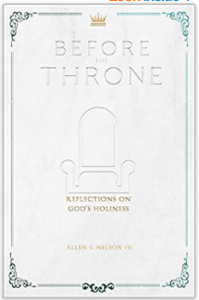
Before the Throne

A review by Stuart Brogden

The subtitle of this book is Reflections on God’s Holiness. Allen Nelson takes us a quick-paced tour of different aspects of God’s holiness, grounded in two passages from God’s Word: Isaiah 6:1-7 and Revelation 4:5-11. One recurring theme is the remedy for what ails the saints and their local fellowships is found in the proper view of the Lord Jesus, not in “new methods” that fleshly ears and eyes always demand. The bottom line is that satisfaction for the soul of man can only be had on the person of Christ Jesus, not in entertainment with a wrapping of pious words from a speaker who presents Creator and Judge of all flesh as familiar spirit that only wants to make people feel good.

God is holy – He does not merely behave holy. His holiness – being set apart from creation, being complete and perfect in His being – defines Him. Twelve chapters explore God’s undoubtable, unspeakable, untamable, unchanging, unapproachable  – and more! – holiness. Our author labors to help us see God as He is: glorious, pure, complete, just, joyful, compassionate, and AWESOME.

Reader – if you are a believer bored or disaffected with your Savior, you are a self-contradiction! Nobody who even partially comprehends Who saves sinners and what sin is cannot be bored or disaffected with the One Who took the cup of wrath due us. Nelson’s book is a ready remedy for dull eyes, weary ears, sullen souls; our author bids us to see Christ more clearly, to behold His glory and be joyfully satisfied in Him.

In the opening chapter, Allen impresses upon us the importance of knowing God rightly, telling us, “When we fail to take seriously the holiness of God it affects everything in our lives. God is holy. Theology matters.” (page 21) Building on the words of Peter, who tells us in 2 Peter 3:18 to be growing in the grace and knowledge of the Lord Jesus, Nelson reminds us “We are still growing in our knowledge of who He is and we will do so for eternity.” He goes on to say, “I want you to hunger to know God better than you do now.” And, “We can’t understand God in an absolute way (He is infinite and we are finite). However, we can (and must) learn what He tells us about Himself in His Holy Bible.” (page 26). This idea is critical for everyone who names the name of Christ – satisfied with being in Him, never satisfied with our maturity as saints.

How should the holiness of God affect us? Our author has this: “The overwhelming concept of God’s holiness ought to lay a heavy weight on our souls. If you can meditate upon the unfathomable holiness of God without any occasions of fear and trembling in your core being, perhaps you’ve not understood it sufficiently.” (page 42). Recall the message from 2 Peter 3:18, and what he said in 2 Peter 1:12, that he intended to always remind us of what it means to be in Christ. Allen is a good friend, reminding us of something critical to our maturing in the Lord, pressing God’s truth upon us so that the reader will not easily be able to be self-satisfied. Contemplating on the response of Isaiah to seeing a vision of God’s holiness in chapter 6 of that gospel, Nelson observes, “The gospel changes “woe is me” to “worthy are You” because the penalty for transgressing God’s Holy Law has been atoned for in Christ. … Reflecting on God’s untamable holiness should ultimately drive us to Christ.” (pages 60 & 61) In a footnote on page 61 he says, “We can either distance ourselves from God through Moses, or draw near to God through Christ.” Works of the law take many forms, most of which are not directly connected to Moses or the law given through him to national Israel. The only way for a sinner to be reconciled to holy God is, as Allen quoted, to “draw near [to God through Christ] with a true heart in full assurance of faith, with our hearts sprinkled clean from an evil conscience and our bodies washed with pure water.” (Hebrews 10:22)

In chapter 5, Nelson explores how this characteristic of God ought to inform and shape our corporate worship. This is one of my favorite parts of this excellent work. While we should be thankful for skilled musicians and singers (being careful, in my opinion, that they do not overwhelm the congregation), Nelson implores us “to listen to an important truth from the passages we’ve seen above [in this section] about facilitating worship: get out of the way.” He bids us to be intentional “in singing hymns that glorify Him instead of focusing on our own experience. We must gear all facets of our singing – words, style, arrangement and content – toward magnifying the unmatchable holiness of God. Holy, holy, holy.” (page 89) Elders should oversee the musical portion of worship as well as the preaching – the people will benefit when the songs are theologically aligned with the sermon.

As for the preaching, Nelson says, “Show me the Holy, and He will suffice. Show me His worthiness in His Word. Show me how His holiness permeates the universe and is glorious enough to exact unceasing praise from all creation. You are not a match for the holiness of God. It’s wicked and foolish to attempt to be. Step out of the way by pointing us to a Holy God and the work of Christ.”(page 92) Application of a passage has its place – and it’s important. But application without the glorious weight of the holiness of God in Christ being held up is a way to legalism. “The greatness and the glory of God are relevant. It does not matter if the surveys turn up a list of perceived needs that does not include the supreme greatness of the sovereign God of grace. That is the deepest need. Our people are starving for God.” (page 94, quoting John Piper)

Beholding the Lord in spirit and truth (only spiritual being can see Him as He is) transforms us. “We become like what we behold. Let us then behold the Lord and not you.” (page 95, speaking to the preacher). “And we all, with unveiled face, beholding the glory of the Lord, are being transformed into the same image from one degree of glory to another. For this comes from the Lord who is the Spirit.” (2 Corinthians 3:18)

This is the drumbeat of this book: study to know Him; be bold in proclaiming Him; trust Him; exalt Him; hide behind Him. For YHWH alone is holy, all powerful, self-existent, and worthy of all praise, honor, and dominion. Whether in your personal walk, evangelism, or ministry in the local fellowship – Jesus is sufficient and nothing else will do.

Pick up this book and read. It will do your soul much good.

One Lord, One Faith, One Baptism

One Lord, One Faith, One Baptism

There are some brothers in Christ who are so focused on the local assembly of saints that they deny there is any congregation of a universal manner; that is, comprised of all the redeemed from every generation. This focus includes an emphasis on water baptism, to the exclusion of what John foretold – that One was coming who would baptism with fire and the Holy Spirit (Matt 3:11).

One passage that is said to be only about water baptism and the local fellowship is Ephesians 4, where we find this: Ephesians 4:4-5 (ESV) There is one body and one Spirit—just as you were called to the one hope that belongs to your call— one Lord, one faith, one baptism,

The context of this short passage should shed light on whether it is all and only about the local assembly and water baptism or if it’s about something greater.

We know that Paul’s letter to the saints at Ephesus was meant to be read to many local assemblies; it’s a universal letter to the body of Christ. In the first three verses of chapter 3, Paul stresses identity in Christ and the unity of believers – dealing with one another in humility, gentleness, patience, and so on.

And then we find this: Ephesians 4:4-7 (ESV) There is one body and one Spirit—just as you were called to the one hope that belongs to your call— one Lord, one faith, one baptism, one God and Father of all, who is over all and through all and in all. But grace was given to each one of us according to the measure of Christ’s gift.

This letter reveals Paul’s passion for all the saints to understand the unity we have because of our union with Christ Jesus, proclaiming there is one body, one Spirit, one hope, one Lord, one faith, one baptism, one God and Father of all. By this union with Christ we each have been given grace according to His gift.

Is there ANYTHING in this passage that hints Paul was addressing only the local assembly or numerous assemblies of saints? Is he not making much of the fact that ALL the saints share in these things, without regard to any temporal circumstances? One body, not numerous local bodies. One Spirit, not a separate Spirit for each locale. One hope, one Lord, one faith, one God and Father of ALL. This speaks to all saints in all locations and all generations. And one baptism.

Water baptism makes no one a child of God. The lack of water baptism keeps no one out of the kingdom of God.

But that baptism John mentioned, the baptism of the Holy Spirit and of fire, corresponds to the circumcision made without hands (Col 2:10-11).  This baptism is what brings enemies of God into His kingdom as His friends and children; without this baptism, no one can enter into His domain.

As much as these brothers resist and insist, there is no argument that can be made from Ephesians 4 that restricts Paul’s message of union and unity to the local assembly only. They can only make assertions in support of their view. Paul’s concern as an apostle was for the whole body of Christ, redeemed saints from every nation, tribe, and tongue. To deny this universal intent is to constrain the love of God for His people to clumps here and there, denying the communion we have through the Holy Spirit to all the saints.

It’s too small a view of God’s work and of His body.

The Nature of the Church

The Nature of the Church

 Stuart L. Brogden

 Greek Word: ἐκκλησία

Strong’s 1577

Transliteration: ekklēsia

from a compound of <G1537> (ek) and a derivative of <G2564> (kaleo); a calling out, i.e. (concretely) a popular meeting, especially a religious congregation (Jewish synagogue, or Christian community of members on earth or saints in heaven or both), assembly, church.

What is “the church”?

The Greek word ekklesia is most often presented in English Bibles as “church.” The word “church” is not a translation of the Greek word, ekklesia; it’s not even a transliterated version of that word. Strong’s concordance shows ekklesia being used in the KJV as either “assembly” or “church.” But the Greek word means “the called ones” and actually shows up in Scripture being applied to an assembly of town-folk (3 times in Acts 19:32-41). As with most words in the Word, the bare definition of the word does not reveal the meaning in every usage.

As for the use of “church” in the Bible, there does not appear to be a clear record of why it was chosen, nor of the meaning of this word. At least twice in the New Testament of the KJV, “church” applies to God’s covenant people in the Old Testament:

Acts 7:37-38 This is that Moses, which said unto the children of Israel, A prophet shall the Lord your God raise up unto you of your brethren, like unto me; him shall ye hear. This is he, that was in the church in the wilderness with the angel which spake to him in the mount Sina, and [with] our fathers: who received the lively oracles to give unto us.

Heb 2:11-12 For both he that sanctifieth and they who are sanctified [are] all of one: for which cause he is not ashamed to call them brethren, Saying, I will declare thy name unto my brethren, in the midst of the church will I sing praise unto thee.

It is not possible for anyone to make a categorical statement that every occurrence of “church” means the local assembly of the saints, as some do.

The first known use of this word in English Bibles is found in Wycliffe’s Bible, spelled “chirche.” His work was translated from the Latin Vulgate and we have no clear reason for his use of this word.

In Smith’s Bible Dictionary from 1884, page 452, we read:

the derivation of the word ‘church’ is uncertain. It is found in the Teutonic and Slavonic languages and answers to the derivatives of ekklesia, which are naturally found in the romance languages and by foreign importation elsewhere. The word is generally said to be derived from the Greek kyriakos, meaning the lord’s house. But the derivation has been too hastily assumed. It is probably associated with the Scottish kirk, the Latin circus/circulous, the Greek klukos, because the congregations were gathered in circles.

Ebenezer Cobham Brewer’s Dictionary of Phrase and Fable of 1898 agrees:

The etymology of this word is generally assumed to be from the Greek, Kuriou oikos (house of God); but this is most improbable, as the word existed in all the Celtic dialects long before the introduction of Greek. No doubt the word means “a circle.” The places of worship among the German and Celtic nations were always circular. (Welsh, cyrch, French, cirque; Scotch, kirk; Greek, kirk-os, etc.) Compare Anglo-Saxon circe, a church, with circol, a circle.

The first definition in Daniel Webster’s 1828 dictionary defines “church” as “A house consecrated to the worship of God, among Christians; the Lords house. This seems to be the original meaning of the word.”

There two things to bear in mind regarding the apparent definition of the word “church.” The ekklesia of God in the New Testament refers to the redeemed saints, not a location or a building. Secondly, one of the messages Jesus taught the woman at the well (John 4) is that, in the Christian faith, there are no sacred or consecrated places where we must meet God.

Since the etymology of “church” is based on location rather than on people, it is a poor choice for ekklesia. In practice, so many Christians think of the building as the church, which many refer to as “the house of God,” it is a constant battle to keep the true meaning of ekklesia in front of people. In contrast, the Scriptures use myriad examples of buildings to refer to God’s redeemed people (1 Cor 3:15-17; 6:19; Eph 2:19-22; 1 Pet 2:5; Gal 4:26; Rev 21:2), and never refers to a temporal location within the New Covenant context. Why do we carry on with this word that people consistently understand to mean a temporal location rather than the people of God?

After Wycliffe’s Bible (1382), the early English Bibles took a different view. Tyndale’s Bible (1526), the Coverdale Bible (1535), Matthew Bible (1537), The Great Bible (1539), and the Bishop’s Bible (1568) all translated ekklesia as “congregation,” a term that conveys the idea of people called to be together. The Geneva Bible (1560) followed Wycliffe and used “church” in place of ekklesia, as did the KJV.

When work on the King James Bible began, the king provided 15 rules that the translators had to follow. Rules 1 & 3 are of particular interest to the topic of this paper:

  1. The ordinary Bible, read in the church, commonly called the Bishop’s Bible, to be followed, and as little altered as the original will permit.
  2. (not used here)
  3. The old ecclesiastical words to be kept; as the word church, not to be translated congregation, &c.

Rule 1 shows that the king wanted his Bible to be in the common tongue, accessible to the people, who were used to having the Great Bible and the Bishop’s Bible used in the state-churches. It is not true, as some KJV defenders claim, that the KJV was a unique Bible; it was based on the Bishop’s Bible. Rule 3 came into play in two prominent words that were not translated, but merely used in place of (as with “church”) or transliterated (as with “baptism”). Translating these two words would have provided us a clearer picture of what God was communicating. Ekklesia rendered as “congregation” or “assembly” shows we are talking about people, not places. Baptizo rendered as “dipping” or “dunking” shows we are talking about being identified with Christ in His death and resurrection by going down into the waters as if unto death and rising up from them as if unto new life. Advocates of the state-church have a history of building geo-political empires with ostentatious buildings for their gatherings and sprinkling infants rather than baptizing disciples.

There are at least eight passages where ekklesia refers to what is called “the universal church,” all the redeemed in Christ, called according to His name.

Matthew 16:18 (KJV) And I say also unto thee, That thou art Peter, and upon this rock I will build my church; and the gates of hell shall not prevail against it.

1 Corinthians 15:9 (KJV) For I am the least of the apostles, that am not meet to be called an apostle, because I persecuted the church of God.

Ephesians 1:22-23 (KJV) And hath put all things under his feet, and gave him to be the head over all things to the church, Which is his body, the fulness of him that filleth all in all.

Ephesians 3:9-11 (KJV) And to make all men see what is the fellowship of the mystery, which from the beginning of the world hath been hid in God, who created all things by Jesus Christ: To the intent that now unto the principalities and powers in heavenly places might be known by the church the manifold wisdom of God, According to the eternal purpose which he purposed in Christ Jesus our Lord.

Ephesians 3:21 (KJV) Unto him be glory in the church by Christ Jesus throughout all ages, world without end. Amen.

Ephesians 5:23-32 (KJV) For the husband is the head of the wife, even as Christ is the head of the church: and he is the saviour of the body. Therefore as the church is subject unto Christ, so let the wives be to their own husbands in every thing. Husbands, love your wives, even as Christ also loved the church, and gave himself for it; That he might sanctify and cleanse it with the washing of water by the word, That he might present it to himself a glorious church, not having spot, or wrinkle, or any such thing; but that it should be holy and without blemish. So ought men to love their wives as their own bodies. He that loveth his wife loveth himself. For no man ever yet hated his own flesh; but nourisheth and cherisheth it, even as the Lord the church: For we are members of his body, of his flesh, and of his bones. For this cause shall a man leave his father and mother, and shall be joined unto his wife, and they two shall be one flesh. This is a great mystery: but I speak concerning Christ and the church.

Philippians 3:6 (KJV) Concerning zeal, persecuting the church; touching the righteousness which is in the law, blameless.

Colossians 1:18 (KJV) And he is the head of the body, the church: who is the beginning, the firstborn from the dead; that in all things he might have the preeminence.

Colossians 1:24 (KJV) Who now rejoice in my sufferings for you, and fill up that which is behind of the afflictions of Christ in my flesh for his body’s sake, which is the church.

Hebrews 12:23 (KJV) To the general assembly and church of the firstborn, which are written in heaven, and to God the Judge of all, and to the spirits of just men made perfect,

In each of these passages, the bolded phrases make consistent sense when seen as references to the total number of God’s redeemed; not as references to any given local ekklesia. In his 1858 book, Manual of Church Order, John Leadly Dagg spent chapter 3 discussing the universal church, beginning with this: “The Church Universal is the whole company of those who are saved by Christ.”

In his book, Concise Theology, chapter “The Church,” J. I. Packer, describes the universal church:

The New Testament defines the church in terms of the fulfillment of Old Testament hopes and patterns through a relationship to all three Persons of the Godhead, brought about by the mediatorial ministry of Jesus Christ. The church is seen as the family and flock of God (Eph. 2:18; 3:15; 4:6; John 10:16; 1 Pet. 5:2-4), his Israel (Gal. 6:16); the body and bride of Christ (Eph. 1:22-23; 5:25-28; Rev. 19:7; 21:2, 9-27); and the temple of the Holy Spirit (1 Cor. 3:16; cf. Eph. 2:19-22). Those in the church are called the “elect” (chosen), the “saints” (consecrated ones, set apart for God), and the “brothers” (adopted children of God).

The truest, purest expression of ekklesia is the vision of heavenly Jerusalem, coming down from heaven with the Lord Jesus upon His second advent (Rev 21:2). Therefore, those New Testament passages which appear to speak of the universal assembly of God’s redeemed should be embraced rather than cast in the shadow, so the references to the local gathering of saints would be established as THE “church.” The primary focus on the “local church” by some brothers is so prominent in their doctrine that one can easily lose sight of the fact that the ekklesia of Christ is a heavenly body. Our citizenship is in heaven, we are pilgrims and sojourners in this age.

It is true that the overwhelming occurrences of ekklesia in the New Testament refers to local assemblies; there is no reason to pretend otherwise. The point is that the local assembly is not the only ekklesia of God’s people mentioned in Scripture. It’s easier to see this when we use a term that clearly portrays the people of God and not merely a place on the ground. The local ekklesia is important for the saints – this is where critical spiritual growth takes place, this is where the Spirit of God gathers and gifts us as it pleased Him. But in each local assembly of saints, there is likely to be false brothers in the pale. In this way, the local ekklesia is a type of the true ekklesia, the universal church, because in that gathering, there are only true sons and daughters of our Holy God; no pretenders.

The congregation is the people of God. Christ gave Himself for His sheep – all and each of them, whether they belong to a local congregation or are awaiting the resurrection of their bodies. After all, the Bible is all about the Lord Jesus and we ought to be, also. Let us not get so earthly focused that we take our eyes off Him.

Justified

You’ve heard it said that “justified” means “just as if I’d never sinned.”

If that were true, we would be in trouble by the hour.

If all Christ did for us was to make us like Adam before the Fall, we are not clothed in His righteousness, we are not aware of the offense against Him we’ve committed, and we have no amazement at the grace He lavished upon that we would be the sons and daughters of Holy God.

Justified means MUCH MORE than “just as if I’d never sinned.” It means forgiven, reconciled, and destined for glory in spite of my sin.

Praise the Lord! He does not merely make our sin go away; He paid for it on the cross and covers us in His righteousness, reconciling us to the Father by the blood of His cross.

A Baptist Look at the Reformation and the Covenants

A Baptist Look at the Reformation and the Covenants

Baptists have historically been called people of the Book, based on a devotion to knowing Christ through His written revelation, seeking wisdom from God as His Spirit guides us.

Our charge is to be faithful to the One who called us, not to those dear brothers who went before us, some 400 years past.

May my imperfect message provoke you to dig into the Word and not be content with being a disciple of men.

The Christian’s True Sabbath

Had the blessing of preaching at Grace Pointe Baptist in Edmond this morning.

Preached on the Christian’s True Sabbath – the Christ who promises true rest to all the Father has given Him. Those who hold to a weekly Sabbath instead strike me as people who sit in the sun and admire a flashlight,

Grace Pointe is a wonderful fellowship where some of the saints make comments or ask questions during the sermon. I like this model!

You can listen to this message here: https://app.box.com/file/327497674962

History of the Sabbath

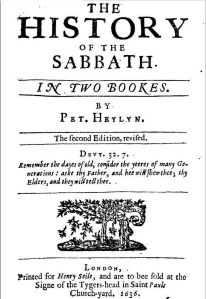
Published in 1636, Peter Heylyn’s The history of the Sabbath: in two bookes details how man’s religion re-skinned the Jewish Sabbath and called it a Christian ordinance. I have edited it to modernize the English and eliminate most of the Latin in an attempt to make this work available and accessible to 21st century readers.

From the dawning of the New Covenant, Christians have struggled over how the Old Covenant Scriptures are to be applied to the lives of the saints. Acts 15 is one of several records showing how some Christians thought the Mosaic Covenant applied to Christians, claiming saints must be circumcised and follow the law of Moses (Acts 15:1 & 5). Peter rebuked these brothers, observing that the Mosaic Law (which was the centerpiece of the Old Covenant) was a yoke too heavy for man to bear and requiring this was putting God to the test (verse 10).  Jesus said His yoke was easy, that He would carry the burden of His sheep (Matt 11:30) and John tells us, This is how we know that we love God’s children when we love God and obey His commands. For this is what love for God is: to keep His commands. Now His commands are not a burden (1 John 5:2-3).

Despite this clear teaching, over time, many Christians began to teach that Christians must be “baptized” as infants and obey the law of Moses – specifically the 4th Word of the Decalogue.

Heylyn’s book shows the historical development of this Christian Sabbatarian practice and how those who taught this practiced it. We see the common tale of those who say, “Do what I say, not what I do.” Paul taught against this (Romans 2:21); it ought not be so within the body of Christ!

I pray this old booke helps open the eyes of those who are trying to carry a heavy yoke or burden other saints with such teaching. In paper and Kindle formats.

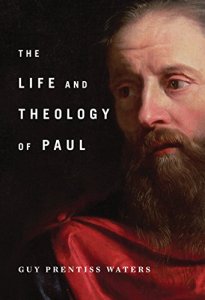
The Life and Theology of Paul

The Life and Theology of Paul

A review by Stuart Brogden

I was intrigued when I saw this book come available for review. I’ve reviewed this author’s commentary on Acts and was eager to see how he addressed Paul. This book will not disappoint the reader who truly wants to know the theology of Paul, which is to say, the theology of the Bible.  

Guy Water’s has organized this book into 12 chapters, covering Paul’s conversion and calling by God, his view of sin, justification, sanctification, the church, and the end of the age. In the introduction, Waters points out that Paul’s life stands as “a testimony to the gospel that he preached” – even while acknowledging what we can know about Paul’s life is found only in the Bible. But considering how much of the Bible Paul wrote, and what Luke wrote about him, we have more than enough material (inspired by God!) to know Paul very well. In summing up a nice, concise review of Paul’s life, our author tells us of two ways his life is still fundamental in the life of the church today. First, God prepared Paul “from the womb to be the “Apostle to the Gentiles.”” (page 10). We should consider our own lives as having been worked out by God for use to His people, trusting Him when we are not sure of our path. Secondly, although he was dramatically converted, the man was not transformed into someone else. Since God had prepared Saul for his role, it would overthrow all that preparation if the result was a different man. God’s preparation leads to His plans being fulfilled. When we look at ourselves, we should look unto the Lord, knowing He is faithful and trustworthy to equip us and keep us.

In his review of Saul’s conversion, Waters observes (page 15), “Saul, then, would serve as a pattern or model of what Jesus Christ would do in the lives of men and women who hear Saul’s witness to Christ.” He notes that not all who hear the gospel are saved, but that those who are saved are saved in the way Saul was. I’ve made note of this myself in much the same way and think people who claim man plays a role in his own conversion would benefit from chapter 2 and the biblical evidence our author marshals.

It has been said that the basis of the Reformation was the doctrine of justification. Waters quotes Martin Luther: “If the article of justification is lost, all Christian doctrine is lost at the same time.” (page 49) Without a clear understanding of Who saves whom – and from Whom – the Christian will tend to drift into thinking too highly of self too lowly of Christ. Waters’ two chapters on justification follow his two chapters on sin. And following justification, we have three chapters on sanctification. I have been severely grieved of late by the number of Christians I’ve encountered who consider sanctification a one-time thing that is finished upon redemption. While I disagree with Waters on his interpretation of the man in Romans 7, his teaching in these chapters is very good and concludes on the high note that the “Christian life is one of unceasing dependence upon Christ” (page 89) and “Our ultimate good is our glorification in and with Christ.” (page 99). If we keep these biblical truths in front of us, we will do well.

Since justification is the hinge point of our faith, I think it best if we make sure we understand it. Waters quotes Romans 3:21, reminding us that “Paul has labored to argue that sinners lack the righteousness that God requires of human beings. Now, for the first time in this letter, Paul begins to describe the righteousness that God has accomplished in Christ and that He freely gives in the gospel to sinners (see Rom. 1:16-17)” (page 50). He then tell us of three important words used by Paul to define and describe this gift of righteousness: redemption, propitiation, and justification.

Redemption, we are told, has a rich history in the biblical story. In Exodus 6:6 and 2 Sam 7:23 God describes “His deliverance of Israel from bondage in Egypt” with this word. “In Isaiah’s prophecy, God often speaks of Himself as the Redeemer of His people,” (page 50) laying the foundation that God is the initiator and author of man’s redemption. To redeem mean to buy back something, such as a slave, by paying a ransom. In redeeming sinners, Christ Jesus has purchased us from the slave market of sin; the purchase price was His life. Waters points out that Paul connects our redemption to the shedding of Jesus’ blood in Eph 1:7.

Secondly, propitiation “is the turning aside or averting of wrath.” (page 51) Our author declares, “those for whom Jesus died have not only had their sins atoned for, but they have also had the Father’s wrath averted from them. Jesus has turned aside the wrath of God from His people because He exhaustively bore the wrath of God on their behalf at the cross.” (page 51) It has been well said that we are saved from God by God. Those who are perishing will not be separated from God in the complete sense – only as regards His benevolence. They will be personally experiencing His unending wrath for eternity as their sinful human frame is unable to atone for their sin against an infinitely holy God. This is why Paul wrote that “there is, therefore no condemnation for those who are in Christ Jesus” (Rom 8:1) – God’s wrath was satisfied in the sacrifice of Jesus. There is no wrath left, no sin debt unpaid, for those who are in Christ!

Regarding justification, Waters warns us about some who claim “justification carries the idea of inward transformation” (page 52), as the Roman Catholic Church does. To Paul we go to find out his view, as we see it as something brought to us once as a gift, and the alternative to condemnation (Rom 5:16; 8:33-34). “The opposite of justification is condemnation. This … confirms justification as a strictly forensic (that is, courtroom) reality.” (page 52) Justification, he says, “has in view two inseparable realities.” (page 52) Firstly, Rom 4:7-8 teaches that forgiveness is complete, none of the sins of the saints are unforgiven, as if the blood of Christ was not sufficient. Secondly, we are declared righteous. “In Justification, God does not clear our account of debt to Him and tell us to start over and do better this time. We are, rather, counted as righteous for Christ’s sake.” (page 53) This is a status that cannot be over turned – not by man, devil or God.

One point of strong disagreement I have with Waters comes to us on page 55 where read that the righteousness of Christ is “offered in the gospel and may be refused (see Rom. 9:30-10:4)” Nowhere in the Bible is the gospel an offer, something that can be refused. When a sovereign says, Come!, that is a command of a superior to an inferior, not a request. The grace that saves is a gift from God, but not a gift that CAN be refused. A proper understanding of redemption reveals that man is regenerated by the Holy Spirit and THEN given the faith needed to receive the grace to believe. John 6:44 sums up the actions and sequence: John 6:44 (HCSB) No one can come to Me unless the Father who sent Me draws him, and I will raise him up on the last day. Note the first act – God draws, or drags, the person who is dead in sins (Eph 2:1-2) to Himself. Everything else, though it cannot be disconnected from this, follows it. Being regenerated, the sinner now wants God where he was unable to before. No one being so changed would be able to refuse God, just as one not changed is not able to want God nor discern spiritual things (John 8:43; 1 Cor 2:15). Further, nothing in the Scripture noted by Waters (Rom 9:30 – 10:4) supports his assertion that sinners are offered salvation and can refuse that offer.

Wanting to finish this review on a positive note, overall Waters does very good, indeed. His third chapter on justification rests on our “union with Christ.” The bond we saints have with Christ Jesus is essential to our salvation and our standing with God. He rightly asserts, “if we are in Christ, this relationship and all that it carries are due entirely to the gracious initiative of God. … Our unity rests on nothing in ourselves, but entirely on our Savior and what He has done to rescue us from sin and death and bring us to eternal life.” (page 68) Christ’s righteousness has been imputed to us just as our sin has been imputed to Christ. We have no righteousness or merit of our own; if not joined to Christ we have no hope. But we who are in Christ have security, we “have a certain glorious future and, therefore, hope for the present.” (page 68)

Reader – pick up this book and read. Your soul be edified.

Raising Passionate Jesus Followers?

A review by Stuart Brogden

There are times when I wonder if anything good can come from Zondervan. Raising Passionate Jesus Followers, by Phil and Diane Comer, did not allay that concern. After reviewing the table of contents (lots of short chapters) I made a bee-line for Appendix B – Leading Your Child to Christ, to find out, first off, if the gospel was properly presented. Sigh. For one thing, this entire book is filled with new-age talk about “sharing Jesus” and “model” Jesus. Amidst some good counsel, Read the Scriptures to them (your children) regularly!” there is a common yet sad misunderstanding of Scripture in the next sentence: “Read John 3: to them and talk about how much God loves them.” (page 284) On the next page, we are told, “After modeling for your kids what it looks like to follow Jesus; and praying and talking to them about making a decision to follow the way of Jesus; when you feel the time is right, be bold and ask them if they would like to receive Jesus as their Savior and Lord!” Praying and talking to your kids about the gospel is the right thing to do. Asking them if they would like to receive Jesus is part and parcel of the false gospel of man’s free will, couched in terms of following Jesus without the gospel being presented.

Throughout this book we find behavior, followers of Jesus, but I don’t recall once having seen the death to sin and resurrection to new life in Christ by grace through faith being discussed. This aligns perfectly, however, with the perspective that behavior modification can result in a “follower.” Still in this revealing appendix, we find this (page 286):

One Sunday afternoon after church, we were driving to a friend’s house for lunch. Our oldest son, John Mark, who was just four-and-a-half years old at the time, was in the car with us. He’s just heard a clear presentation of the good news in his children’s call at church and, as we were driving, he blurted out: “I want to give my life to Jesus right now!”

We pulled the car over nest to a strip mall on a busy boulevard and led him in a prayer to receive Jesus as his Savior and Lord. Right there, in that moment, he was saved!

Later on (same page) we’re told, “You want your child to remember the life-changing decision they (sic) made, so talk about the place, the time, the night and who was there when they (sic) gave their (sic) life to the Lord. Anything to help them remember their decision as they grow older.” I don’t find any of this in Scripture! I see the saints being encouraged to keep their focus on Christ, trusting in Him – not a decision we made – to keep us until He returns. If you have to remember what you did, your confidence that you are right with God will rest on yourself rather than on the One Who saves sinners.

There is some good parenting counsel scattered throughout this book, but the work is built on the faulty foundation of decisional regeneration, a hat-tip to God’s sovereignty, and a lack of biblical clarity.

A quick review, starting with the introductory A Note to Parents, wherein we see this worldly view of the love for God we are to have (page 16): “The Jesus we wanted out kids to fall in love with is the One who …” Falling love is a Greco-Roman view of love, you are helpless, it happened to you. The biblical view of love is that it is a deliberate act of the person in response to having first been loved by God. We don’t fall in love with Jesus; we love Him because He first loved us (1 John 4:19).

Chapter 4 introduces us The Great Shema, and we learn that “Jesus loves your children. He longs to bring them close, to redeem them and make them his own. … God is inviting you to join Him” (page 35), He longs for a loving relationship with each of us” (page 39). Again we see a Jesus who wants to redeem sinners but is apparently unable to do so without our help. In chapter 8 we are told our goal is “to raise sons and daughters who are passionate Jesus followers. By “passionate Jesus followers” we mean kids who grow up to truly love and walk with the Lord” (page 53). By making a goal focused on results rather than on personal faithfulness, the authors are setting their readers up for a crushing sense of failure. We cannot produce Christians – God alone does that. We are to be faithful witnesses of Him by the proper teaching of His Word. If that is our goal, we can rest a bit easier, for God will enable and equip us to do this, as His instructions are to make disciples by teaching them all He has commanded. We teach; God calls people out of spiritual death into the glorious light of His kingdom.

Throughout much of this book, the authors talk about managing the box – the area (physically and psychologically) that our kids occupy. As they grow and mature, the box gets bigger. This is something I personally agree with vigorously, as we are to train our children to take responsibility for their decisions and the scope of those choices which with they can live increases as they mature.

Near the end of the book, advice for parents of adult children is given. Much of it reflects humanistic psychology, wrapped up in personal piety. “Bless your grown children by believing in them … they need our approval and affirmation” (page 263). I would hope parents would bless their adult Christian children by reminding of God’s faithfulness, not puffing them up as if they were something they are. This may be what the authors intended by the last sentence in this section: “Remember, He who began a good work in your children right in your very own home, will carry it on to completion.” Nothing in this chapter up to this point indicates whether the adult children being spoken of are “passionate Jesus followers” or not. And the authors do not once – as far as I noticed – call Christians by that name. Consistently they talk about people who follow Jesus, as if the Bible did not use that term (specifically in 1 Pet 3:16 and 4:16).

When we try to provide Christian parenting counsel, we must be true to the Word of God. Trying to be relevant to our culture and compromising the bare truth found in Scripture will end up leading people astray, not closer to God’s truth.

Sanctification

There are some Christians who teach that saints are totally depraved, with no difference in our being than before we were redeemed. Some of these seem genuinely concerned that we do not hold to infusion of grace into our flesh; and that is a legitimate concern.

It’s not our flesh that has been made new by our new life in Christ. It’s our soul that has been made alive. The soul of the unregenerate is dead – unable to move his flesh in a way pleasing to God. The saint has a soul that is alive to God, with the Spirit of God willing and making him able to do things that ARE pleasing to God (Phil 2:13). This is what I think we are taught in various places, including Romans 12:1-2 (HCSB) Therefore, brothers, by the mercies of God, I urge you to present your bodies as a living sacrifice, holy and pleasing to God; this is your spiritual worship. Do not be conformed to this age, but be transformed by the renewing of your mind, so that you may discern what is the good, pleasing, and perfect will of God.

Note this: the way we avoid being conformed to this age is by being transformed by the renewing of our minds. The soul of the saint has been translated from the kingdom of darkness to the kingdom of His glorious light (Col 1:13) and we are seated with Christ in the heavenlies (Eph 2:6). Obviously this is not speaking about our physical being, but our spiritual being.

It should also be obvious that our mind, which is part and parcel of our soul, controls our thoughts, emotions, and behaviors. We are not told that our flesh gets better with time, but we are told to control our thoughts, words, and deeds; we are not to walk as reprobates do, but as children of God:

Ephesians 5:6-11 (HCSB) Let no one deceive you with empty arguments, for God’s wrath is coming on the disobedient because of these things. Therefore, do not become their partners. For you were once darkness, but now ⌊you are⌋ light in the Lord. Walk as children of light— for the fruit of the light ⌊results⌋ in all goodness, righteousness, and truth— discerning what is pleasing to the Lord. Don’t participate in the fruitless works of darkness, but instead expose them.

Did you notice: a command to walk as children of light, which will bear fruit of that light which will reveal itself in goodness, righteousness, and truth – which means we can discern what’s pleasing to the Lord. Why would He give us such discernment if we have NO ability to influence our thoughts, words, and deeds? Why tell us NOT to take part in works of darkness if we are depraved and unable to say no to sin?

None of us will be without sin while we inhabit these bodies of death; but none who have been born from above by the Spirit of God are without a Helper who wills and equips us to do that which is pleasing to Him. We have an Intercessor who will make a way of escape (1 Cor 10:13) so that sin will not have dominion over us, but allow us to run away from it, as Joseph did so long ago. This is the consistent teaching of Scripture.

Romans 6:16-23 (HCSB) Don’t you know that if you offer yourselves to someone as obedient slaves, you are slaves of that one you obey—either of sin leading to death or of obedience leading to righteousness?  But thank God that, although you used to be slaves of sin, you obeyed from the heart that pattern of teaching you were transferred to, and having been liberated from sin, you became enslaved to righteousness.  I am using a human analogy because of the weakness of your flesh. For just as you offered the parts of yourselves as slaves to moral impurity, and to greater and greater lawlessness, so now offer them as slaves to righteousness, which results in sanctification.  For when you were slaves of sin, you were free from allegiance to righteousness. So what fruit was produced then from the things you are now ashamed of? For the end of those things is death. But now, since you have been liberated from sin and have become enslaved to God, you have your fruit, which results in sanctification—and the end is eternal life!  For the wages of sin is death, but the gift of God is eternal life in Christ Jesus our Lord.

That transforming renewal of our minds works its way out in our patterns of what we think, what we speak, and what we do. We have been liberated from sin and enslaved to God, which results in sanctification – the end of which is eternal life. Sort of sounds like sanctification is one of those essential things God works in us that we cannot do without.

2 Corinthians 7:1 (HCSB) Therefore, dear friends, since we have such promises, let us cleanse ourselves from every impurity of the flesh and spirit, completing our sanctification in the fear of God (see also 1 Peter 2:11).

We work at completing this sanctification by cleansing ourselves from impurities of the flesh and our fleshly desires. We should not think we can cleanse ourselves by our effort and we should not think God will sanctify us no matter what we do; both are ditches we need to avoid. It’s analogous to being so afraid of works righteousness that we do not tell people to repent and believe or being convinced we can save sinners by our clever words. Both are wrong thinking.

1 Thessalonians 4:3-8 (HCSB) For this is God’s will, your sanctification: that you abstain from sexual immorality, so that each of you knows how to control his own body in sanctification and honor, not with lustful desires, like the Gentiles who don’t know God. This means one must not transgress against and defraud his brother in this matter, because the Lord is an avenger of all these offenses, as we also previously told and warned you. For God has not called us to impurity but to sanctification. Therefore, the person who rejects this does not reject man, but God, who also gives you His Holy Spirit.

Here is a very specific area of sanctification – sexual purity. Ouch! But look what we’re told: God wills our sanctification so we will know and be able to control our bodies in an honorable way. How anyone can say we are no different from unregenerate people confounds me. There is no teaching of perfectionism, but there is clear teaching that we are to grow in grace and knowledge of the Lord Jesus so we won’t be led astray by lawless people (2 Pet 3:17 & 18).

Read the qualifications of elders and deacons in 1 Tim 3 and see sanctified life described in action terms: sensible, self-controlled, respectable, hospitable, not a drunkard, not quarrelsome or greedy. No different from depraved reprobates?

2 Thessalonians 2:13-15 (HCSB) But we must always thank God for you, brothers loved by the Lord, because from the beginning God has chosen you for salvation through sanctification by the Spirit and through belief in the truth. He called you to this through our gospel, so that you might obtain the glory of our Lord Jesus Christ. Therefore, brothers, stand firm and hold to the traditions you were taught, either by our message or by our letter.

We are chosen by God for salvation through sanctification. Not that we are sanctified and then saved, but that just as repentance and faith are separate but inseparable, so is salvation and sanctification. And this sanctification is the work of Spirit through the Word of Truth. And we finish this passage with the exhortation to behave rightly and think rightly, as taught by the apostolic records in Scripture. The Christian’s life IS DIFFERENT than the unregenerate’s life.

I have come to the conclusion that while justification (salvation, redemption) is monergistic, sanctification (perseverance, preservation) is not. But it’s not synergistic, either. That term conveys the notion that both elements or parties are required for the process to function. Even a casual read through the Bible will reveal the fact that God bids us to obey (Galatians 6:9) and enables to do so (Hebrews 13:20 & 21), He commands us to press on for the prize that will not tarnish and sustains us in the doing (Hebrews 12:1 & 2), and reminds us that apart from Him we do nothing (John 15:5). This is the essence of Augustine’s famous prayer that ignited the controversy with Pelagius: “God, command what you will, grant what you command.” The Christian will want to obey God and trust Him to bring it to completion. Yet He also works to conform us to His Son when we rebel and are not careful to walk as children of the light (1 Corinthians 5:9-13; Hebrews 12:3-11; James 1:2-4 & 12). Brothers, this should not be the case, we should not kick the goads; but it is comforting (and convicting) to embrace a God Who is not dependent on us!

So I conclude that God can work to sanctify us without our active participation, yet we cannot work towards growing in likeness to Christ without His active participation (John 15:5). We take 100% responsibility for the sin in our lives, we give God 100% of the credit for the good thoughts, words, and deeds we do. His Spirit in us works so that we pray effectively (Romans 8:26), without Him we can do nothing.

Sanctification. If it’s not part of your life, you need to examine yourself to see if you be in the faith (2 Cor 13:5).

Faithful Finance?

A review by Stuart Brogden

One thing sadly lacking for many people in today’s culture – knowledge and discipline for sound financial planning and practice. This book by Emily G. Stroud promises itself as a Bible-based guide to “10 secrets to move from fearful insecurity to confident control.” These “secrets” are examined in the 10 chapters. 

While the book does provide competent but basic counsel on myriad issues across the financial spectrum, it is woefully lacking in being sound in the way the author uses Scripture and recommends certain people. Not many should be teachers; this book would be much better if Mrs. Stroud had focused on financial issues and left theology out of it.

The introduction gives the reader high hopes, as our author tells us money doesn’t give us peace but is merely a tool, there is hope in Christ, God blesses people differently, and we can learn to use money wisely and have a more peaceful and fruitful life. In chapter 1, we read, “Most important, we all need a biblical foundation to understand the importance of putting our knowledge into action. (page 20)” This chapter is devoted to the idea that one needs a professional to worry about out money as we won’t. Several of the concepts described herein are basic and do not require a professional: budgeting, charitable giving, short-term savings. Others are well served by having another provide counsel: insurance, investments, mortgages, retirement planning. It’s a sad reality that so many in this rich country retire with not much more than the coerced plan known as Social Security.

Chapter 2 is titled Cash is King (or Queen) and provides solid counsel on monthly budgeting and short-term savings. If one has no idea how to begin financial disciplines and wants to begin, this chapter is a valuable resource. The next chapter is on giving and here our author shows why she should have avoided bringing her religious views into the book. When she mentions tithing, there’s no question in her mind whether or not it’s a New Covenant practice – only whether one should tithe on gross or net income and whether splitting your tithe between your church and another ministry is robbing God (page 55). She quotes “Mother Teresa” on page 54 with nothing to indicate this wretch was serving demons. Half of page 57 is filled up by a quote from Rick Warren, blabbing about how good it feels to be generous. This pastor (so-called) bases his theology on human phycology, leading many down the path to his theological therapeutic deism he calls Christianity. And on the following page she says people ought to “consider automating their charitable giving and tithing by setting up automatic transfers from your checking account or debit card each month. Then expect God to show up. Wait and see if the rest of your bills still get paid.”

Saints – giving is to be an act of worship, not some trite activity reduced to a bill that is to be paid, as mindlessly as possible.

The end of this chapter brings a challenge to “be the change this world needs” with an exhortation to “remember the wise words of Malachi,” as she then quotes Malachi 3:10 (page 60). Sigh. I’ve heard it said that one’s theology affects the balance of one’s life. This was in observation of how Woodrow Wilson was attracted to world government by Darby’s system of theology. Chapter 10, God Will Provide, ends with Jeremiah 29:11 with no context or application. It hangs there as if anyone can directly appropriate that as a personal promise from God.

Emily Stroud needs to leave her confused theology out of her work if she wants to of good service to all people. There is good, basic financial planning advice in this book. If the reader needs to begin taking responsibility for his money, this book can be very useful. Do not look to it for counsel from God’s Word, as she has shown she needs to learn much before she can be trusted in this arena.

Introduction to Paul’s Letter to the church at Colossae

You can listen to this sermon here.

He (Christ Jesus) is the image of the invisible God, the firstborn of all creation. This is the thesis statement, the core truth of Paul’s letter to the Colossians. A study of this epistle will reveal Jesus as the answer to life. 

Nearly every New Testament letter from Paul was written to combat heresy in one or more local churches; Ephesians is the exception. While Colossians doesn’t specify what heresy had infected that church, one can almost hear the whispers, “Jesus is not enough.” Many think an early form of Gnosticism was emerging. What makes this epistle so vital for life in the church in this age, until Christ returns, is the glorious picture of our Lord Jesus is painted in words by the apostle. It is instructive for us to see the evil distractions from the gospel the enemy put into the church in Paul’s day, but it is essential for life and godliness that we grasp the gospel and the person of Christ as held forth in Scripture. In this short letter, the lord Jesus is presented as our life – quite a contrast to our drab routine; something that ought to bring renewed life to weary saints.

This introduction follows the commentary by John Kitchens and covers 5 questions we should answer:

  1. Who wrote this letter?
  2. To whom was it written?
  3. What were the circumstances?
  4. Why did Paul write it?
  5. What does this letter teach us?
  6. This first topic is important but not vital. We who believe in the inspiration of Scripture know the dual-authorship of the Bible and know God is the Author of what His people wrote. Yet knowing the human author helps us when we can learn about him through other passages. This is particularly helpful in rightly understanding Proverbs, for example.

Nobody questioned Paul’s authorship of this epistle until a few 19th century scholars offered up an alternative. The first two verses seem pretty clear to us: Colossians 1:1-2 Paul, an apostle of Jesus Christ by the will of God, and Timotheus our brother, To the saints and faithful brethren in Christ which are at Colosse: Grace be unto you, and peace, from God our Father and the Lord Jesus Christ. But some smart people, as men see them, said the vocabulary, theology, and style of writing is too different from Paul’s other letters; that Paul works against Gnosticism which was not fully developed until the 2nd century. None of these objections stand up in light of a basic understanding of the Bible. Liberals seem to have it as their goal to cause us to doubt the Word of God.

  1. Written to the saints in Colossae, a town that had been prominent but was now bypassed by the major highway that had driven its commerce; not unlike Gowen or Hartshorne – both of which were prosperous in the mid-20th century as goal mining and defense electronics provided a large bounty of gainful employment. The region Colossae is in was also severely affected by an earthquake, and commerce went with the new highway to Laodicea and Hierapolis. We see in 2:1 that, at the time of this epistle, Paul had not been to Colossae or Laodicea: For I want you to know how great a struggle I have for you and for those at Laodicea and for all who have not seen me face to face. What kindness of God, to have this apostle write to these people in a small neglected town he had never met, yet loved in Christ having been told of the work the Lord had been doing in their midst.

Most likely, Epaphrus had established this church, as we read in 4:12-13 Epaphras, who is one of you, a servant of Christ, saluteth you, always labouring fervently for you in prayers, that ye may stand perfect and complete in all the will of God. For I bear him record, that he hath a great zeal for you, and them that are in Laodicea, and them in Hierapolis. Paul’s confidence was not in his personal work, but in the work done through him and others by the Spirit of God.

One thought occurred to me –apostles were foundational to the New Covenant church (see Eph 2:20) yet most of them wrote no Scripture and are not mentioned much by those who did. Men who labor in obscurity, in man’s perspective, always are in view of our heavenly Father. Our service to one another is pleasing in His sight, even if we are not famous among men; as it is His Spirit that wills and equips us to do so. Let us never drift away from seeking God’s approval in favor of man’s.

  1. The circumstances surrounding this letter are two-fold: temporal and spiritual. Paul was in prison, we see this in chapter 4 where Paul describes himself as in bonds (twice) and a fellow prisoner with Aristarchus. We know Paul was in prison in Caesarea for two years (see Acts 24:24-27) but we do not see him having an open, on-going evangelical ministry. There is no record of Paul being in prison in Ephesus. Yet while in confinement in Rome, we read of a vibrant ministry, wherein he likely wrote this epistle and the letters to Philippi, Ephesus, and Philemon. Acts 28:30-31 And Paul dwelt two whole years in his own hired house, and received all that came in unto him, Preaching the kingdom of God, and teaching those things which concern the Lord Jesus Christ, with all confidence, no man forbidding him. As I mentioned Wed evening, I think this circumstance is illustrative of the current status of Satan – where the angel cast him into the bottomless pit, and shut him up, and set a seal upon him, that he should deceive the nations no more, till the thousand years should be fulfilled: and after that he must be loosed a little season (Revelation 20:3). Locked up, but having an active influence through many of his minions.

The spiritual circumstances are more interesting and relevant to us. Like many of the first century churches, Colossae was a mixture of Gentile and Jewish saints. This is why he emphasized the new man in Christ, which is renewed in knowledge after the image of him that created him: Where there is neither Greek nor Jew, circumcision nor uncircumcision, Barbarian, Scythian, bond nor free: but Christ is all, and in all. (Colossians 3:10-11) Neither group had a problem accepting people like themselves, but each group needed reminders by a brother that each of them had been individually bought and re-created (spiritually) by Christ Jesus; that cultural and ethnic identities that divide people of the world have no place in the church, the body of Christ.

Each of the groups that comprised the church in Colossae brought some of their spiritual baggage from their previous lives into this new creation. We see this in the concern shown in 2:8 Beware lest any man spoil you through philosophy and vain deceit, after the tradition of men, after the rudiments of the world, and not after Christ. And verse 18 Let no man beguile you of your reward in a voluntary humility and worshipping of angels, intruding into those things which he hath not seen, vainly puffed up by his fleshly mind. This lack of learning does not refer to base ignorance – Peter and John caused the council to marvel. The unlearned description was affixed to these fishermen because they spoke in the manner of the common man, rather than in the highly polished rhetoric that was common in public speakers in that day – such as Paul met at Mars Hill in Acts 17. I think this philosophy and vain deceit mentioned here refers to this same manner of puffed-up speaking, which Paul spoke against in his first letter to Corinth. The traditions of men no doubt refers to what we see in Matthew 15:1-2 Then came to Jesus scribes and Pharisees, which were of Jerusalem, saying, Why do thy disciples transgress the tradition of the elders? for they wash not their hands when they eat bread. These practices appeal to our human desire to follow rules and be well thought of but they are dangerous if imposed as necessary for being reconciled to God.

  1. This brings us to the reason Paul wrote this letter: doctrine impacts life, for as a man thinks in his heart, so is he (Prov 23:7). When saints believe wrongly on essential doctrines, our lives profane the savior and we lead others astray, serving as stumbling blocks instead of faithful servants.

There are three categories of error addressed in this epistle:

  1. Legalism, seen in 2:16-17
  2. False spirituality, seen in 2:18-19
  3. Asceticism, seen in 2:20-23

The corrective plan from Paul is not complex – have a right view of the Savior and of self. If our view of God is too low, our view of man will be too high. These three seriously wrong doctrines will fall of their own weight with a proper understanding of how sinful man is reconciled to holy God. And while we see warnings of error in this letter, the consistent theme woven throughout is to rightly comprehend the Lord Jesus and to daily fix our mind’s eye on Him.

  1. That, then, is what this letter teaches us – the same thing Paul was teaching the saints in the small backwater town of Colossae: Christ is enough; His grace is sufficient; we are safe in the strong tower of our God and King.

Listen to how Christ Jesus is described in this letter: He is called “Christ” (which means anointed one) 18 times; He is Christ Jesus the Lord; God’s beloved Son; the mystery of God; in Him are hidden all the treasures of wisdom and knowledge; He is the image of the invisible God; the creator and sustainer of all things; the head of the church; in Him the fullness of God dwells; Jesus is the soil in which we rooted and built up in; He is the substance and fulfillment of all of God’s promises and purposes which were portrayed in the ancient Jewish religion. Christ sits at the right hand of God, indicating the completion of His work; He is our refuge and our life; He is our goal and pattern for life; our teacher and our wisdom; He is our inheritance. He is our master, having freed us from the domain of master sin.

Kitchens says, “He is the origin of all creation (He is before all things); the sphere of all creation (by Him all things were created, both in heaven and on earth, visible and invisible, whether thrones or dominions or rulers or authorities); the agent of creation (all things have been created … by Him); the goal of all creation (all things have been created … for Him); and the sustainer of all creation (in Him all things hold together). Indeed, He is the King of all creation (the firstborn of all creation).” Do you get the idea that Paul considered an accurate picture of Christ as vital to the health of the church? When we see the comprehensive nature of our Lord’s supremacy, it is hard to take in, and – perhaps – a little more understandable when people have too low a view of Him. But a right view of God is essential to a proper view of self – as Isaiah shows us when he saw Him on the throne. In summing up the glorious unity the saints have, Paul said Christ is all and in all – all that we have as children of God is found in Jesus; and by His Spirit, He dwells in every one of us.

This union we have with Christ Jesus is the core of our standing before God. We who are in Christ have died with Him (Colossians 3:3 For ye are dead, and your life is hid with Christ in God.); we were buried with Him (Colossians 2:12 Buried with him in baptism); and made alive with Him (Colossians 2:12 wherein also ye are risen with him through the faith of the operation of God, who hath raised him from the dead.). And He is our life (Colossians 3:4 When Christ, who is our life, shall appear, then shall ye also appear with him in glory.) This is guaranteed and made possible by His Spirit Who lives within us.

We have a new identity, in Christ Jesus. We have a new presence, Christ in us. We will walk and live, more and more, to grow in grace and knowledge of Him Who gave Himself for us. We don’t need programs and fancy facilities. We have God’s great and precious promises, all of which are summed up in the Lord Jesus Christ Who gave Himself as a ransom for helpless sinners. Find rest in Christ Jesus; find peace with God, now and forever, in Christ Jesus. Galatians 2:20 I am crucified with Christ: nevertheless I live; yet not I, but Christ liveth in me: and the life which I now live in the flesh I live by the faith of the Son of God, who loved me, and gave himself for me. That’s the gospel truth. It’s all we have; and that’s all poor sinners need. And it’s always good for the souls of the saints!

Job – A Story About the Sovereignty of God

You can listen to this sermon here.

What follows it the first part.

(Background – from ESV Study Bible) The story of Job has its setting outside Israel to the east and south (Uz is related to Edom, which may be the setting of the book), the author of Job is a Hebrew, thoroughly immersed in the Hebrew Scriptures. The time in which the account of Job is set is not known with precision – many consider the context of Job’s culture and put him in the time of Abraham.

The earliest reference to Job outside the book itself is in Ezekiel. The prophet names three paragons of virtue (chap 14:12 – 14): And the word of the LORD came to me: “Son of man, when a land sins against me by acting faithlessly, and I stretch out my hand against it and break its supply of bread and send famine upon it, and cut off from it man and beast, even if these three men, Noah, Daniel, and Job, were in it, they would deliver but their own lives by their righteousness, declares the Lord GOD.” It is not certain whether Ezekiel knew of these men from the biblical narrative or if his knowledge was from God. If Ezekiel knew of Job through the biblical book, then Job would have lived prior to the Babylonian exile.

The author of Job makes direct allusion to the Hebrew Scriptures (e.g., Ps. 8:4; cf. Job 7:17–18), and at times quotes lines directly (Ps. 107:40; Isa. 41:20; cf. Job 12:21, 24). Such precise repetition of phrases and reapplication of biblical thought indicates that Job had access to these writings, though again it cannot be certain in what form they existed. The author uses a lot of vocabulary with meanings known in later Hebrew. This does not confirm a more precise dating but may favor a date that is during or after the Babylonian exile (538 BC). It would appear that this book may have been written as many as 600 years after Job lived – not without precedent in Scripture, as Moses wrote Genesis some 2,700 years after Creation. None of this is cause for worry, as it is God Who is the primary author of all Scripture.

The book of Job asks the question – “Can God be trusted?” It is fair to say that most of our attention is on Job and his loss and the rough treatment received at the hands of his friends and wife. But the lesson we are to gain from this book is found in the reply from God; that He alone can be trusted, that He alone is creator and sovereign – He is God and He is not obligated to answer His creatures! This maddens those who deny His existence or sovereignty, but ought to comfort us who are redeemed by Christ. If God is not sovereign over all things, He cannot be trusted in anything.

The book sets out from the beginning to show that the reasons for human suffering often remain a secret to human beings, yet under the rule of God. Indeed, Job’s sufferings come upon him because God taunted Satan in the heavenly courts, leaving us to wonder who Satan would have tormented if God had not suggested Job.  We are not given insight to this “behind the scenes” discussion that led up to a similar testing in the New Testament. Luke 22:31 – 32 “Simon, Simon, behold, Satan demanded to have you, that he might sift you like wheat, but I have prayed for you that your faith may not fail. And when you have turned again, strengthen your brothers.” Unlike Job, Peter knows before and why he was tested, we never learn whether the events of Job chapter 1 & 2 were explained to Job. In both accounts, God’s focus is on His character and position as the sovereign Lord Who cares for His people.