The Confession Alone: The 6th Sola

The Confession Alone: The 6th Sola

Confessions and formalized creeds have been an edifying edition to the Christian faith. Since the beginning of the New Covenant (and even further back since the dawn of teaching), mankind has formalized and rehearsed many sayings, creeds, idioms, and other phrases that have refreshed our minds about a how we ought to think or understand life. Within Christendom, there are certain flavors of creeds and confessions that we Reformed folks hold to very dearly. Assuming that you understand which confessions exist, I seek to make my point quickly. If you have never read a creed, confession, or catechism, I highly suggest you do some research and learn from them.

Having said all that, there is an authoritative flaw in our Reformed circles. I call it he Sixth Sola: Confession Alone. It is this idea that if it is not a part of your confession, it cannot (or in some cases should not) be taught or even considered as biblical. Or, practically speaking, although we do not verbally admit this, when we are discussing Scripture with someone, and the first thing that comes out of their mouth is “X confession says…” when making their case, it is making the confession the ultimate authority in the conversation (unless they are just using the confession as a springboard to talk about Scripture). I am aware that this last statement may have ruffled more feathers than the first, but understand what I am actually saying and do not misinterpret my words. If your first or final authoritative response in any discussion about theology or what the Bible teaches concerning what you believe and why is “the confession says” you have turned a guidepost into a destination.

Most, if not all, creeds, confession, and catechisms are reactive. That is, they are written and formed based off of some other creed or confession that is in opposition, and those forming it wish to distinguish themselves for the opposing party. It can be in response to false teaching (or perceived false teaching), or it can be simply trying to make a stand about a certain belief within a specific community that affirms X belief(s). As I already said, this is not inherently wrong. These are great ways to find out where your stand in your faith. i would argue that it is impossible to say anything without it being “creedle” in some way. But if you do not study the Scriptures and seek to understand why you believe what you believe, and whether or not you think you can agree with these confessions, you are placing the cart before horse. The confessions can point you in a specific direction (guidepost), but they are not the final authority (destination). Our first response in any discussion should be Sola Scriptura, not Sola Confessio (Latin check). Yet, time after time, when I dive into the Scriptures with particular pastors, preachers, and believers who ascribe heavily to confessions and creeds, whenever there are any disagreements or whenever I make my points from Scripture, I am faced with “but the Confession says…” How can this be within a Reformed world whose foundational mindset is supposed to be Scripture Alone?

There can be many reasons why one authoritatively appeals to the a confession more than Scripture. But I think I have narrowed them down to two main roots: Traditionalism and laziness. There is nothing wrong with tradition. Every denomination and person has them. It is when that tradition begins to have authority over Scripture that we have a huge problem. Some people find great joy in holding to the long standing tradition that some of our creeds and confessions teach. Nothing wrong with that if you understand what you believe and why. But it seems that this is not the case with many. By proxy, if you are a traditionalist in this area, you will quote the confession better than you can quote Scripture because you are relying on the confession to approve yourself before God (or men). Unless for whatever reason you don’t have any access to Scripture, or in some way you are only able to memorize Scripture by categorizing them via the confession, there should be no reason why you cannot study for yourself what the Bible teaches within the pages that the confessions are pointing to. Which brings me to my next point.

I find that it is easier to quote a saying, phrase, creed, etc., in place of actually making a verbal argument concerning what you actually believe and why. Nothing wrong with summarizing what you believe, or repeating a summarization of something you would affirm. But If I believe that the reason why man exists is to glorify God and enjoy Him forever, why? Because the confession says so? Or because the Scripture quoted in the confessions says so? Have I looked at the listed Scriptures? Have I taken the time to study and reform my thinking in light of the Scriptures that a confession teaches? Will I be courageous to practice Semper Reformanda if I discover some nuance in the Scriptures? Or will I be taking the confession at face value because my community of believers/churches do? Or because the men before me were theological giants who were totally incapable of error even in the minutia? Laziness is what causes us to use the confessions as they were not meant to be used. These are guideposts, not destinations.

Notice, I am not challenging the confessions. Nor am I exhorting anyone to cast away the didactic luxury that they bring to our lives. I am challenging how we think concerning them. We all have a tendency to elevate anything good over God. That is evident in Scripture and in our daily lives. If we find ourselves running to the confessions and creeds as our primary authoritative source for understanding and assurance of our faith in Christ, and we can quote and explain a confession easier than we can explain Scripture and the gospel, we must immediately eject ourselves from the seat of traditionalism and laziness, and we must diligently seek God through the Scriptures for our assurance and understanding. This doesn’t mean we cannot use the confessions to help us in this direction. But once again, where does your affection, affirmation, and assurance of your faith lie? In Scripture Alone, or in the Confession Alone? Is it because the confession says so that you believe X, Y, Z, or is it because you have studied and affirmed that the Scriptures teach it?

One last time, I am not bashing any confession, or the use of them in discussion. But I am standing against any form of authoritative proclamation or behavior that insists that the confession is the first and final say so in any biblical discussion and practice. If your “go-to” argument and assurance of your belief is “the confession says,” you’ve lost all credibility. And if the confession is your main source for approving yourself before God, your credibility may not be the only thing that is lost.

-Until we go home

Rethinking Conditionalism (Part 2a) – Eternal Fire

Rethinking Conditionalism (Part 2a) – Eternal Fire

(Notice: the blog series has moved to Rethinking Conditionalism on Our Common Salvation)

It can be difficult for some people to digest large chucks of complex information. It is even harder for people to pick up on subtle nuances that certain teachers use in order to make their case. What’s even more difficult is the fact that not many Christians read the New Testament with a systematic and linguistic lens that is trained to detect and digest all these subtle nuances that certain teachers use to deceive them. But I have good news! You do not need to know all of how Greek works to understand what I am about to show you. As hopefully some of my readers already know, I like getting to the point. So in this particular article, I will challenge the idea from certain conditionalists that believe hell’s fires are only temporary. Or, to be accurate, the fire is only eternal in the fact that the effect of the punishment they provide the wicked endures forever. If you haven’t picked up on that subtle nuance already, some who believe in conditional immortality believe that the fires of hell are meant to eventually “consume” the person. They contend that this is what Jesus meant by “unquenchable.” That is, the fire cannot be “put out” rather than “die out,” and that it will not stop until the adversaries are totally consumed (or in their case annihilated).

Before I show from Scripture why this isn’t the case, here is the only difficulty I have, or anyone has, who wishes to make a case in writing. This isn’t conversation. In conversation you can investigate and probe in ways that writing cannot. In live debate and cross-examination, you can publically show why a person’s position in a particular area is in error. In blog posts, all people do is write in response to opposing blog posts, and will carefully pick and choose what they will or will not respond to, or write something in such a way that seems like a legitimate response, but it is not. Of course, anyone can use my previous sentence against me, and I should expect that. But the reason I went through all the trouble to write this paragraph is so that the reader is aware that what I am about to deal with in this article is so specific and easy to understand, it would take a linguistic twisting so incredible, that it would have to deny how certain grammars of Greek work. And while some opponents of eternal conscious torment believe this is “insignificant” in comparison to the stacks of evidence that seems to support conditional immortality (CI) or annihilationism, this is just one of the many semantic proofs that will be the proverbial snow ball that rolls down the mountain.

One of the text used by CI folks is Matthew 25:46 when Jesus says:

“And these will go away into eternal punishment, but the righteous into eternal life.”

I will deal with how the words “eternal punishment” does not mean that the results of the punishment lasts forever as CI presents it. But for now, let’s look at this Scripture in context. The first thing we have to see is that this whole chapter deals with Jesus and His judgment on the wicked at His return. Starting in verse 31 of chapter 25, He begins a discourse about those who will inherit the kingdom prepared for them from the foundation of the world, and those that are wicked will be cast into eternal fire prepared for the devil and his angels. Other than the fact that some CI and annihilationists think that Satan and his angels will also be “consumed” by this fire, some others insist that this “eternal fire” is eternal in the sense that it is from God (because He is eternal), or that its punishment upon the wicked has eternal consequence, but not the fire itself. Don’t run, here comes the easy-to-understand-Greek-grammar that I mentioned earlier.

In Greek, you will sometimes have an article-noun-article-adjective construction. Don’t run. If I lost you, you will get it in a second. It would like literally writing, in Matt 25:41,  “the fire, the eternal one.” Adjectives describe or limit nouns. If I say I have a house. That’s the noun. If I have a yellow house. That adjective describes the noun. If I further mention that my house is eternal, then I have added another element to the noun, but it still describes or limits the noun in some way. If I say, “Hey, look at that house.” And you ask “which one?” It is probably because there is more than one house around and you seek to know which one I am looking at. If I reply, “The yellow one” I am implying that not only is the yellow house significantly different than all the other houses around it, but I am also saying that this one is a certain kind of house in context of all the other houses. In this Scripture, starting in verse 41, Jesus turns to the wicked and says:

“Then he will say to those on his left, ‘Depart from me, you cursed, into the eternal fire prepared for the devil and his angels.”

This is what it looks like in Greek. I will highlight the words you need to pay attention to in order to understand my illustration above.

ότε ἐρεῖ καὶ τοῖς ἐξ εὐωνύμων πορεύεσθε ἀπ’ ἐμοῦ οἱ κατηραμένοι εἰς τὸ πῦρ τὸ αἰώνιον τὸ ἡτοιμασμένον τῷ διαβόλῳ καὶ τοῖς ἀγγέλοις αὐτοῦ

Notice that εἰς  means “into” and τὸ (article) πῦρ (noun), which means “the fire.” But not just any fire, but τὸ (article) αἰώνιον (adjective) – “the eternal one.” In essence, what this Scripture is making clear is that unlike all the fires that die out and/or are eventually put out, this fire that the wicked will be cast into, with the Devil and his angels, is itself eternal. This is not dealing with the consequences or results. The fire itself is of an eternal nature meant to burn for eternity. Despite what some opponents may say about this, this carries huge implications. Because what Jesus is saying that we will be cast into the fire, the eternal one, when we are judged. And here is the kicker. The eternal punishment mentioned in verse 46 sits within the context of this eternal fire that awaits us. This means that the fire that burns forever dictates how eternal punishment in this context is to be understood. No linguistic tricks attached. Even though the word “punishment” by itself can ambiguously represent the result of it dished out, in this particular text, it clearly illustrates that the punishment will be itself eternal. And that the fire, which burns eternally, will be the instrument used to carry out the sentence.

But wait there’s more!

In Matthew 18:8, Jesus uses this same Greek construction (article-noun-article-adjective) to illustrate our reaction toward sin. He says:

“And if your hand or your foot causes you to sin, cut it off and throw it away. It is better for you to enter life crippled or lame than with two hands or two feet to be thrown into the eternal fire.”

This is what it looks like in the Greek.

εἰ δὲ χείρ σου πούς σου σκανδαλίζει σε ἔκκοψον αὐτὸν καὶ βάλε ἀπὸ σοῦ καλόν σοί ἐστιν εἰσελθεῖν εἰς τὴν ζωὴν κυλλὸν χωλόν δύο χεῖρας δύο πόδας ἔχοντα βληθῆναι εἰς τὸ πῦρ τὸ αἰώνιον

Look familiar? It should. It is as Matthew 25 says, “the fire, the eternal one.” And Jesus not only says that the fire is itself eternal, but he parallels this with the next verse by saying:

“And if your eye causes you to sin, tear it out and throw it away. It is better for you to enter life with one eye than with two eyes to be thrown into the hell of fire.”

Another way to put this verse is fiery hell. The word hell used here is “Gehenna” which is the book of Revelation equivalent to the lake of fire. And Jesus spoke about Gehenna differently throughout the gospels then He did about Hades, which just generally meant the place of the dead. But CI and annihilationists want you to believe that this fire is not going to burn those in it forever, but that they will eventually be consumed. However, in this Scripture, Jesus semantically links the two – Gehenna and “the fire, the eternal one” – equally to make His point about what will happen to those who don’t take sin seriously and are not born again.

Hang in there, although I can go on, there is only one more thing I want to show you.

Just like in Matthew 18 where Jesus parabolically encourages you to slice your hand off in comparison to being thrown in hell, Mark 9:43 provides a parallel passage that describes the same teaching. But notice how the eternal fire is mentioned here.

“And if your hand causes you to sin, cut it off. It is better for you to enter life crippled than with two hands to go to hell, to the unquenchable fire.”

Here is how it looks in the Greek:

kαὶ ἐὰν σκανδαλίζῃ σε χείρ σου ἀπόκοψον αὐτήν καλόν ἐστίν σε κυλλὸν εἰσελθεῖν εἰς τὴν ζωὴν τὰς δύο χεῖρας ἔχοντα ἀπελθεῖν εἰς τὴν γέενναν εἰς τὸ πῦρ τὸ ἄσβεστον

Do you notice something familiar about this verse? I bolded it for you so you can recognize it. Do you recognize the grammar/construction? You should. It is the art-noun-art-adj construction we’ve been talking about. Except we have a new word introduced. It is ἄσβεστον (asbeston) which means to be “unquenchable” in English. And it is only used three times in the New Testament (Matt. 3:12; Mark 9:43; Luke 3:17). It literally means that it cannot be extinguished, put out, or die out. In essence, what this verse is saying is people will go “into Gehenna, into the fire, the unquenchable (inextinguishable) one.” It’s a bit awkward sounding in English, but Gehenna, fire, and eternal burning are all interconnected ideas.

The proponents of CI like to say that unquenchable means that the fire can’t be “put out,” not that it won’t “die out.” This is a subtle nuance, and I find it manipulative and trite. But it is a nuance nevertheless. The difference is illustrated by knowing when I light a fire, it will either die out on its own, or I can snuff it out, extinguish it, or quench it with my fingers, water, blowing it out, etc. This isn’t an entirely bad case to make, because God’s eternal wrath cannot be quenched against those who are His enemies (except by atonement). The difference is that conditionalists believe that this only means that the fire will not be quenched until it has entirely consumed the wicked. In other words, it can’t be put out until it has finished consuming. But as we already learned from these other passages above, the fire itself is indeed eternal. So whether it cannot be extinguished or put out or die out, really makes no difference seeing that the fire will burn perpetually. Even if it meant that it can’t be “put out,” the point is the fire will not stop burning, ever! But perhaps the Scripture means what it has always meant for the majority who read it, and the Greek scholars who interpret it. That is, the fire burns forever because those in that place of punishment, as Matthew 25 implies, are there forever. Unquenchable means it can’t be put out, extinguished, or die out because God is the only one who can do it! And even if it is taken from Isaiah 66, and various other passages in the Old Testament that have similar semantic value, it does not negate Jesus’ exegesis that the fire will remain and so will those who are in it.

Although more could be said, for the sake of brevity, I will close with this. In a future article, I will deal with “unquenchable” fire and arguments that proponents of CI and annihilationists make to justify their reasoning as to why the fire is a “consuming” fire and not an eternal one. But for now, ponder the grammatical construction and think about how the fire could burn for eternity, and yet there will be nothing left to burn? A predictable rebuttal will be that God Himself is a (or The) consuming fire. I agree. But that is not what the Greek is implying. This fire resides within the “place” where the Devil, his angels, and all those who are wicked will go. It is its own fire. It is categorically different than other fires that burn. That is what the grammar reveals. Of course, it is a fire that comes from God, is kindled by God, and can only be put out by God. And, It is God administering the punishment, and it is God who is present within the fire. But if the persons are eventually consumed, why would the wrathful anger of God burn forever against an enemy that no longer remains? Therefore, the fire cannot be simply from God, because the implications are not as simple to deal with, and the grammar doesn’t point in that direction.

-Until we go home

*For more information on Greek grammar, I recommend getting a copy of Dan Wallace’s book “Greek Grammar: Beyond the Basics” which verifies this grammar and many other constructions.

Rethinking Conditionalism (Part 1) – Intro

Rethinking Conditionalism (Part 1) – Intro

(Notice: the blog series has moved to Rethinking Conditionalism on Our Common Salvation)

The subject of hell for many is very uncomfortable. Even trying to deal with this subject as a topic of apologetics seems very shallow. After all, if there is any kind of punishment after death, since it is from God, it will be terrible regardless of how we try to magnify or mitigate the sentence. Whether we are annihilated immediately after we are resurrected, suffer conscious torment in the intermediate state only to be resurrected and continue in that state of suffering, or we suffer for a time and then are annihilated, why should it matter? Does it matter? Well, yes and no. Yes, in the sense that if we are going to look at what happens to people who are not saved and their punishment, we inevitably will view the atonement and God through a particular lens. No, in the sense that if a person believes only that hell is not eternal conscious torment, and this is their only variation, they aren’t fundamentally saying something that could be considered damnably heretical. However, they certainly do raise eyebrows of concern, especially in the area of the atoning sacrifice of Christ. Because one thing you must always be aware of is that every major doctrine is interconnected. Hell and Heaven are major because they inevitably affect one’s view of what the atonement accomplishes. Alter the state of either destination, you must inevitably shift your view, however subtle, concerning the cross of Christ. Some shifts are damnably heretical (or at least can lead there). Meanwhile other shifts are inconsistent and concerning, but may not be.

For the ministry of Rethinkinghell.com, there are a number of contributors that propose the idea that immortality is not for the wicked, but only reserved for the saved. That is, immortality is conditional upon salvation in Jesus Christ (the doctrine of conditional immortality – CI). As for the wicked, they do not receive immortality as the righteous do. They are doomed for punishment that is eternal, but it is not the process of being punished that is eternal, but the results of the punishment that is eternal. The Scriptures that mention eternal punishment, eternal fire, eternal destruction, according to this position, are semantically pointing to the eternal result of annihilation (or “death” as they put it) that comes from God, not the fact that the punishment or the fire itself will last forever.

In the future posts, I will deal will various arguments that some of the contributors of Rethinking Hell make. I will seek to also clarify and strengthen why I believe the experience of the wicked in hell will be eternal conscious torment. I don’t want to be petty and trite when I discuss this seeing that I view this doctrine as major. However, what needs to be stated is that while I strongly disagree with those that believe this doctrine, I cannot confidently affirm at this time that such a doctrine is damnably heretical. At first I did. I have throttled back some. Seeking to err on the side of caution. I still have a wide suspicion, though, about this doctrine not only because of some of the contributors’ position on penal substitution, but also the theological implication this has on the atonement of Christ (even though the contributors of CI say there are none). Nevertheless, there is proof that this doctrine is indeed a gateway doctrine to heresy and heretical company. And that will be made apparent as well.

These points will be discussed in later posts in detail. But for now, just know that the doctrine of conditional immortality is gaining much notoriety among certain evangelical circles, and everyone within Christendom will have to deal with the subject sooner than later. I have been following Rethinking Hell for about 3-4 years now, and have seen notable attention. This is not to start a theological mob, but to create awareness that discussion is now necessary, and there will be many who will divide, yet again, over something like this. As you read the following parts to this series, remember that while some people say this is not a major doctrine, I believe that it is. To what degree that this will affect/change fundamental truths of Christianity is too soon to be seen. But there are major concerns that I hope people will notice and address as it grows. If you are not familiar with the ministry, you can go to Rethinkinghell.com and read for yourself some of the articles and podcasts put forth by this ministry.

-Until we go home

Jesus’ Punishment Not Like Ours

Jesus’ Punishment Not Like Ours

There are certain denominations that don’t believe in the eternal conscious torment of the sinner, even among professing evangelical circles. I will deal with this in future articles, but they often bring up the inequality of punishment that Christ receives as a substitution for sinners. Someone like me who believes that hell is eternal conscious torment is often accused of not seeing the cross in just terms because Christ didn’t suffer eternally. There are some opponents who are inevitably annihilationist that will admit, however, that Jesus also was not annihilated. So in either case, Jesus’ punishment does not equally demonstrate the punishment of the wicked. Yet some within this camp further affirm that Jesus dying was the punishment. In other words, because Jesus died, that is how He was able to equally take our punishment because we die. And He rose again, defeating death on our behalf so that the righteous can have immortality. In essence, the moment that Jesus died is when Jesus took the punishment and only in dying, therefore, can we justly say He took our place, since death is the punishment.

While I do not holistically disagree with the conclusion, I also do not fully agree with the premise. Jesus’ experienced God’s wrath for us on the cross. The punishment was not solely death, but suffering God’s wrath because sin was laid upon Him. Death is the result of sin, and Jesus should have died long before He hung on that cross because of the way He was beaten. But because He was sinless, and had not yet had sin placed upon Him (which was a picture of the day of atonement), the body He had was not yet ready to die. It was only after sin was laid upon Him, and God’s wrath poured upon Him that He could cry, “It is finished!” This is penal substitution which some who reject eternal conscious torment love to also subtly (and boldly) deny. They also do this by not explicitly affirming it with plain speech. They rather affirm some type of substitution, but not penal substitution. But I digress. The point is how do we reconcile the fact that Jesus was able to endure sufficiently and efficaciously God’s wrath that He will forever pour out on sinners? If the annihilationist position is true, why would Jesus have to experience the Father’s wrath if the punishment is truly realized in His death as some teach?

These are questions that seem weighty, but can be answered easily. Let’s make this plain. Jesus did not suffer punishment the same way that we will suffer punishment. Whether you believe annihilationism (in any form) or eternal conscious torment, one truth about Christ’s atonement will remain the same. Jesus suffered more for sinners than any sinner will ever suffer for their own sin. Why? Because of who He was! Listen, we are not just talking about a regular Joe Schmoe. We are talking about the precious Lamb of God! God of very God. The Holiest of Holies. The High and Mighty Son. The Prince of Peace. He humbled Himself, was born of a virgin, lived a sinless life, was ridiculed, mocked, and beaten by His own creation who He could have crushed like grasshoppers. Yet, He endured suffering in obedience to the Father to fulfill all that was written concerning Him. In one sense, He did not need to hang for hours. He didn’t need to continue bearing with the mocking and jeering that He did on behalf of sinners. But He chose to. And whether God chose to do it with a paper cut, or He chose to do with all of His eternal might, because of who Jesus was, just one tiny drop of blood spilled from an open wound inflicted upon Him would have been sufficient to save infinite legions of depraved sinners. But because dying is a part of the punishment, He could have just had His throat slit like the lambs of the Old Testament. He could have had a swifter execution. But instead He chose one of the most excruciating and humiliating ways to die. And endured God’s wrath as He bore it all!

I pray you don’t miss this. The punishment of Jesus will never match the punishment we receive because Jesus should not have been punished. If it were not for the grace of God, the punishment of Jesus would never have happened. If it were not for the justice of God, the punishment of Jesus would not be necessary. So in one sense, I agree with those who are opponents of eternal conscious torment that the punishment on Jesus doesn’t seem fair and equal. Because it wasn’t! What’s fair is that >>>> I <<<< should have been slaughtered! I should have experienced God’s wrath for all eternity without mercy and grace. Jesus enduring even a millisecond of God’s wrath on my behalf and in my place is infinitely more grace than I will EVER deserve. So when I hear from certain circles concerning their rejection of penal substitution and eternal conscious torment on how it seems cruel, I agree. Jesus should have wiped us all out! It’s seems cruel that it took the matchless, priceless, and spotless God-Man in order for wicked and depraved sinners like us to be free. That Jesus, in His willingness and obedience, stepped into time, clothed Himself in sinless flesh, and subjected Himself to something worse than an everyday criminal’s death. It was one of the most tortuously notorious executions invented by man. A punishment reserved for the worse of the worst. Yet He suffered more than just a criminal’s death so that criminals like me can be saved. Why would He do such a thing?! It is more than cruel, it should not have happened! God would have been perfectly justified in giving us what we deserve, and never thinking twice about it. And in light of what the Father did to Jesus, eternal conscious punishment in Hell seems like an act of mercy in comparison to what Jesus endured for us. But the Triune God, by His mercy and grace, had an eternally bigger plan to save sinners from their sin, and to separate a people unto Himself, so that they can enjoy the greatest blessing ever to receive –Himself.

Jesus was more than a substitute. He was THE Surpassing Substitute. He was more than what you could expect a substitute to ever be. Sacrifices in the Old Testament typified substitution, but Jesus outshines them all! But Jesus wasn’t just a substitute, He was THE Perfect Penal Substitute. He didn’t just suffer a little of God’s wrath, but endured as much as was necessary to appease and satisfy His justice as a propitiation for our sins. And this was still infinitely more than He deserved. He endure more suffering, more pain, more sorrow, more agony not because of how long He was on the cross, but because He was on the cross! I cannot stress this enough.

Jesus is more valuable and more beautiful than any being in the universe because He was God. He gave Himself for our sins. The punishment was not exactly what we should have received in its duration. But it was way more than we’ll ever experience, because He was innocent. This finite duration of punishment was of infinite value. If we can grasp this, when we look at Jesus on the cross, we should no longer wonder how He could sufficiently endure God’s eternal wrath in such a finite amount of time, but wonder why He was on the cross in the first place. We should no longer ponder how does the punishment match the crime, but the fact that He had to be punished in the first place. We should be more offended at Christ having to take such a punishment than the eternal conscious torment of the wicked. Because if we value Jesus as He should be valued, it should be no surprise that God would eternally pour out His wrath on those that choose their sin over Him.

Jesus’ punishment is by far a greater offense than sinners suffering in Hell forever (although paradoxically, it is a glorious grace because of Him who regenerated me because of it). I am more humbled and broken about my sin when I see the Lamb of God crushed by the Father, than by millions of souls weeping and gnashing in Hell. Jesus shouldn’t have suffered and died on that cross. But praise God He did. For it was the only way I would see Jesus as preciously and magnificently as I do today (and it grows daily). And even still, this article falls miserably short in comparison to the glory and majesty of who He is and what He has accomplished for those of us who have repented and believed His glorious gospel.

One final word. While I get what people say when they sing or read that “it should have been us upon that cross,” I can no longer say that this is fully the case for me. I don’t seek to undo thousands of pages that say something to this effect, because, for the most part, I don’t disagree. I should have experienced my punishment for my own sin. And it is from this sentiment that this understanding springs forth. So when people say this, I don’t fret. But I have recently come to appreciate the crucifixion of Christ in a way that has become exceptionally humbling for me, and I sought to share it with all. I pray that this article brings you to the same place it has brought me. To a place of deeper reverence, worship, obedience, and understanding concerning what Jesus accomplished on our behalf.

-Until we go home

One Thing Atheists and Christians Can Agree On

One Thing Atheists and Christians Can Agree On


No doubt many have run into an atheist who is adamant about the non-existence of God (usually, in a more specific sense, the Judaeo-Christian God of the Bible). Whether it is all religions or just Christianity in general, they tend to reject what they believe is blind faith and fairy tales. Of course, they are entitled to their opinion. And there is no small shortage of satirical and philosophical rhetoric that some of them use to “refute” the existence of God. But, if you pay attention to the arguments they use to defame, blaspheme, and misalign God, there is one thing that Christians can agree with them on – the god they believe doesn’t exist really doesn’t.

A Strawman Argument is a logical fallacy that someone sets up as a misrepresentation, exaggeration, or complete fabrication of someone else’s position in order to make their own argument seem more reasonable. In this case, many atheists misrepresent their understanding of God/gods and portray them in such a way as to make their own argument seem reasonable, logical, and justified. But, in doing so, they not only set up a strawman, but they commit the most common and widely violated of all sins – idolatry. How? Well, it’s simple.

Anytime you hear an atheist speak, you will usually hear them mock God’s love in contrast to His justice (hell). Or misrepresent His “inability” to answer prayer. Or maybe you might hear how they don’t agree with Him creating intelligent human beings, yet require them to use “faith” to trust in Him (as if faith is absolutely blind). These are just a few of the many. But even if there is an answer to every misrepresentation they have about God, the most important thing is to reveal that although they don’t believe in God, they have inevitably made one up in their own mind! They have set up a divine strawman by which they can reason against over and over so that they can justify their suppression of the truth (Rom 1:8). So even though atheists may suppress the knowledge of God, and know that the true God of the Bible exists, in order for them to ease their conscience and justify their sin, they must create an image of god that suits themselves. A god that that they can deny, vilify, and reject by the approval of their own thoughts and imaginations. Most of their arguments do not work if they don’t do this. Whether you set up a idol to worship to go to war with, it is still idolatry.

Hopefully this strikes you as a much different approach then just providing scientific evidence for God’s existence. This is a mixed approach between revealing their sin and pressupostionally showing them another reason how and why they reject God. Next time you hear a false representation of God, you should disarm the atheist by telling them something like this, “Boy, I’m glad that the god that you are talking about doesn’t exist, because if he did, I would be an atheist too.” Because when you really get down to the nitty-gritty, what atheists do is exchange the truth of God for a lie (Rom 1:25) just like everyone else who does not know Him. And since eternal life is defined by knowing Christ intimately (John 17:3), other than the fact that the typical atheist is just suppressing the truth in unrighteousness, we must engage them by showing them that they are just like every other religion in the world (yes, atheism is a religion) that believes in false gods. Except theirs is just a deified punching bag that they can throw philosophical blows at in order to make themselves feel superior, more intelligent, and morally justified in their sin.

While other world religions offer sacrifice to their gods in order to appease them, atheists repeatedly sacrifice their false representation of God on the altar of reason, logic, and scientific method (systems of thinking our Lord Jesus Christ gave them) in order to appease themselves.  But hey, at least now when we speak to atheists, Christians can agree that the god they are talking about truly doesn’t exist. Because once they are introduced to the God of the Bible, Jesus Christ, and are regenerated by His Spirit, they will no longer speak defiantly, but devotedly; no longer with a heart of war, but of worship.

Let’s pray for the atheists that we witness to and bring the light of the gospel to them.

Below is an quick example on dealing with these kinds of atheists in conversation.

-Until we go home


Screen shot 2016-07-17 at 9.02.52 AM

Disclaimer: DefCon does not support Peter Kreeft. Only the quote used in the link window.

Not Everyone Can Be The Mouth

Not Everyone Can Be The Mouth

This article contains an excerpt that was taking from my book, Apocity: The Greatest Omission which can now be downloaded for free.
This portion of the book is emphasizing the true meaning behind 1 Corinthians 12, and how this passage cannot be used as means to say that  evangelism is the “mouth” of the body, and therefore, seeing that we have differing roles/gifts, not everyone can be the mouth. Sadly, there are variations to this excuse.


The idea that not everyone can be a consistent witness because they are not “the mouth” is also wrongly pulled out of 1 Corinthians 12. I have actually heard men (more often pastors and teachers within the congregation) say “not everyone can be the mouth.” In other words, we are
not all gifted with the gift of evangelism, and the mouth is the metaphor they use to describe those that do have it. Once again, this is urban legend, and I will clear up this confusion.

When you look at 1 Corinthians 12, right from the get go, in verse 1 Paul clearly says, “now concerning spiritual gifts.” This is a good clue that Paul is about to clarify some things for the Corinthian church. This issue with spiritual gifts and the divisions within the church was one of the reasons Paul wrote 1 Corinthians in the first place. In verse 4 he mentions how there are “diversities of the gifts” that come from the same Spirit. Verse 11 reveals how the Spirit passes out gifts as He wills (This challenges those who think that you have to speak in tongues as proof that you have received the baptism of the Holy Spirit. See Chapter 5). Then, in verse 12, Paul begins to emphasize the unity of the body not only because we are all partakers of His Spirit through salvation (v13), but also because of how the diversity of the members affect the unity of that body. In other words, Paul is trying to give us an illustration that even though there are different gifts within the body of Christ, these divisions of gifts do not mean we are divided as a body. We are unified together by the Spirit, who distributes these gifts, and one gift is not more important than the other in the grand plan of the Church. Are you following? If not, this next part may be harder for you to grasp.

When you look at the metaphor that Paul uses for the body, he repeatedly gives us clues as to what he is trying to get across to the Corinthian church. In verse 15 he says, “If the foot should say, ‘Because I am not a hand, I am not of the body,’ is it therefore not of the body” (Emphasis added). He asks the same questions concerning another body part in verse 16. Verse 21 he says, “And the eye cannot say to the hand, ‘I have no need of you;’ nor again the head to the feet, ‘I have no need of you.’” Once again, Paul seems to be hinting at something here, and in verse 22 he gets to his point: “… those members of the body which seem to be weaker are necessary.” So basically Paul is trying to say that every member of the body is “necessary” no matter what gift, no matter what background (v13), and no matter how weak one seems to be (v23-24). Paul has said all this so that we realize that everyone within the body should need one another and that we should benefit from each other’s gifts, strengths, weakness, and backgrounds (v25). I might have been very general with my exegesis of this text but my purpose is not to get to the small details (that would be a whole other chapter), but to make some observations that I believe will squash this idea that evangelism is a gift, specifically here, “the mouth.”

If you are one to believe that not everyone can be the mouth (insinuating the mouth being a spiritual gift), or you have heard this from someone and think it is a valid statement, then here are some points to consider. 1) Where in this chapter does it specifically mention evangelism? The urban legend that evangelism is a gift still applies here too, not just Ephesians 4. Also, if you are saying that not everyone
can be the mouth, then you have to show me from 1 Corinthians 12 how believing this is in any way a “get out of witnessing free” card, because that is not Paul’s intent in this particular chapter of Corinthians. 2) Paul did not mean for this chapter to be used as a cop out to not preach the gospel. If you remember what I said in the previous paragraph, Paul’s main concern was unity. There seemed to be divisions in the church for various reasons, and the insinuation that Paul gives in numerous verses is that some believed that there were others that were not needed, or that they were not a part of the body because they seemed weaker or less honorable. There might be more background to this, but the main point is that Paul was more specifically targeting the need for everyone within the body and for every spiritual gift, rather than just emphasizing certain ones over the other. 3) Where does “not being the mouth” come into this metaphor? If you read this chapter carefully, when Paul used the metaphor of the body it wasn’t for us to figure out which body part we are (or think we are), it was to help us understand the importance of unity within a human body and relate that to the body of Christ. This was his main point! It is so absurd when I hear people call this person a foot, or that person the hand, or evangelism the mouth. This is not what Paul is saying! 4) When was the last time you did something without all body parts involved? If evangelism is the mouth, does that mean I don’t use my hands or my feet to preach? The Bible talks about feet being beautiful for preaching the gospel (Romans 10:15), so does this mean not everyone can be the feet either? Do I need someone who is the arms carry me to my corner to pass out tracts because I am not gifted in doing it myself? I am being very caustic for a reason. I have become so sorrowfully burdened about these vain attempts to explain away our responsibility to preach that it has caused me great spiritual distress to see professing believers continually making urban legends, like not being a mouth, a popular excuse. The nature of these excuses call into question the salvation of many who call themselves believers (a topic we will explore in the next chapter).

I can understand that there are persons within the body who are skilled in certain areas in which others are not. For instance, there are men and women who fly missionaries to their destination for the glory of God. These saints risk their lives to fly over dangerous areas to do  amazing things for God. Here is my question though: Just because they metaphorically can be the arms that carry missionaries where they need to go, does that remove their responsibility to preach to the lost themselves? Just because my primary job is “an arm” (I don’t actually believe that, just proving a point) does that mean I don’t have a mouth? If anything, anyone who is supporting evangelism efforts would see the importance of evangelism and would feel the obligation to preach themselves. This example goes for those who mow lawns for the church, who do the finances, those who usher, teenagers in youth group, deacons, pastors, and the list goes on! Your primary duty within the local church includes evangelism. Evangelism is not a secondary duty; it is the indivisible infrastructure of your calling as a Christian!

At this point, I feel it is necessary to say this. As I previously said in Chapter 2, I understand that the roles that God has given within the local church are for us to be perfected and conform to the image of Christ. I am not blind to the reality of our weakness, nor do I think that each
person’s gifting is unimportant. I know that pastors have a part, deacons, leaders, congregations, members, etc.; all play an important part in the whole of the universal church of Christ. What the revelation of Scripture seems to imply, however, is that none of that infringes upon our call to be faithful in our witness. None of it! There is no such gift of evangelism and there are no Scriptures that we can use to justify this position. If we refuse to accept this reality, then gross apocity among many local churches will continue. And I do not know about how you, reader, may feel about it, but I think God is weary of it.


-Until we go home

Is Your Wife Your First Ministry?

Is Your Wife Your First Ministry?

At DefCon, we holistically support men who support their families. Men who make discipleship and love a priority for the home. The home is one of the central building blocks for a society, and the marriage is the sun by which everything in the home orbits. Having said this, there are many priorities that pastors, open air preachers, and everyday christian men have that may sometimes burden us. We can become anxious, stressed, and overwhelmed with the multiple obligations that we are to tend to. And yes, wives are included in this list of feelings. And the one thing that is not helpful are Christian cliches like, “Your wife is your first ministry.” It has a nice ring to it, and for the most part it is well meaning, but it does not properly convey the responsibilities and obligations a Christian may face on a day to day basis. It has also been abused by certain preachers that wish to exclude certain men from ministry.

I have attached a blogtalk episode that I and a pastor friend of mine recorded about this topic. My hope is that we would all take into consideration the biblical model of men not just in ministry, but just being men in general. All the material discussed in this episode may or may not reflect all the views of contributing bloggers here at DefCon. Here is the narrative and link of the episode below.

“On this exciting episode of G220 radio, George will be joined by Pastor Tom Shuck from Pilgrim Bible Church. Pastor Shuck is a graduate of Master’s Seminary and Columbia Evangelical Seminary and was a missionary to India for 12 years. He holds both a Masters of Divinity (MDiv.) and a Doctorate of Ministry (DMin.). He has been a pastor of Pilgrim Bible Church for 4 years and helped start a seminary in India as well as planted a church there. He enjoys sports, music, family trips, and George’s personal favorite, linguistics. He has evangelized in cities like Oakland, Orlando, Mumbai, Pune training believers how to evangelize, preach the gospel, and make disciples. His wife is Lisa Shuck and two children.”

“This episode we’ll explore the cliche “Your wife is your first ministry.” Is it Scriptural? Are there other primary biblical responsibilities? Can you make ministry your idol or mistress? What should a man who is called to preach do with this kind of cliche? What about missionaries and evangelists of old that we look up to that sacrificed much, even their marriages, for the gospel? What about Matthew 22:35-40, 1 Corinthians 7:32-34, Ephesians 5:22-33, and 1 Timothy 3:5?”

http://www.blogtalkradio.com/g220radionetwork/2016/05/10/ep-157-is-your-wife-your-first-ministry

-Until we go home


If No Commission Was Given

If No Commission Was Given

Imagine if Jesus never commanded us to make disciples of all nations. Imagine if no explicit declaration was given. If no “go” was uttered and no commission was discharged. Would it change the necessity of the message to be preached? Would it alter, in any way, the reality that it must be preached?

There is something called implication and presupposition which is part of the internal structure of language. They influence the way we view and interpret one another’s speech. If the gospel is a message that says that all men are sinful, and that through faith in Christ are we justified. And that if we do not trust in Him we remain guilty because we have sinned against God and His wrath abides upon us. My question is, “How could anyone keep that to themselves?” A more positive side to this is, if the message contains the truth that eternal life is free, and that Jesus Christ bore God’s wrath on our behalf as a subsitutionary payment to appease God’s wrath and to satisfy the demands of justice concerning the crimes we committed against Him, and by His grace we receive acquittal for our crimes, and that He rose from the dead – defeating death, sin, and hell. Once again, “Why would anyone want keep that to themselves?”

It’s preposterous to think that a person who was pushed out of the way of a bus that was about to hit them would just walk away indifferently, chaining up the story concerning what happened, meanwhile not warning others of the same danger. It would be absolutely insulting to think that a man who was resuscitated from the dead would not be thankful toward the person who accomplished the work, and not publicly praise and declare to others of this person. Then why would some, professingly believing the gospel, not share it with others, seeing that we too were dead in our trespasses and sins and in danger of God’s wrath, and since Jesus revived us and took the punishment in our place? Here’s one idea. Those people never really experienced God’s grace in the first place.

Within the gospel is the commission to go preach. The message in and of itself implies and presupposes our responsibility to be a faithful witness. Even if Jesus never uttered a single command to be a witness to the nations, part of the inner workings of the message is that we automatically make disciples of others. Of course, the Great Commission in Matthew and Luke goes into particular details concerning how disciples are made. But nevertheless, if those details were never presented, the lack of effort and motivation that most have to even tell someone the good news is completely contrary to the message they profess to believe. 

But I already hear one rebuttal. If the gospel implies the commission, then why would Jesus command us nevertheless in Matthew? Answer: Because it was His sovereign will to do so! Also, consider how even when Christ told people to keep their mouths shut concerning His miracles (Mark 7:36), that they still proclaimed it even more! I wonder why they felt compelled to do such a thing? Was it a sin to have disobeyed our Lord at that time? Some say yes. But, once again, how could you keep the good news to yourself? Isn’t regeneration one of the greatest miracles that God does to man’s heart?

Let’s compound this a little more by adding one of the reasons the Holy Spirit was given in the first place. The Scripture teaches that it was in order for us to be witnesses (Acts 1:8). In essence, so that we would have the spiritual power to preach the gospel. If no command to preach the gospel was ever given by Jesus, and the message implies the commission, and indeed, the Holy Spirit dwells within us to empower us to be witnesses, then one on hand, if no command was ever given, we would still have all the motivation we need. On the other hand, since the command has been given, if you are sluggish to behave accordingly, you are either sinning, or you’re not born again.

Whether you are behaving apocitically or not, this one thing is sure. We have the gospel entrusted to us as believers, and we have been made ambassadors in this world. How much more do you need than what you’ve already been given to be a faithful preacher of the good news of Jesus Christ? Why does it require so much energy for you to make disciples in the world? If not you, then your fellow believer in your local assembly? Or your pastor? If you’re a pastor, then why your congregant? I’m not being nasty. I am heart broken. Why? If this is such good news, then why? If Jesus really rose from the dead, then why? If you’ve truly been taken from darkness into light, why? If the Holy Spirit has saved you and dwells within you, then why? Why cast aside the most comprehensible of God’s commands?

It is my prayer that we all grasp the urgency of what we profess and diligently seek to make disciples through gospel proclamation in our local areas.

-Until we go home

He Does Too

He Does Too

When you’re feeling lonely, remember, he does too.

When you’re feeling depressed, remember, he does too.

When you’re feeling your inadequacies, remember, he does too.

When you get unjustly angry, remember, he has too.

When you get convicted for mistreating your wife, remember, he has too.

When you feel like you’ve failed your children, though doing your best, remember, he has too.

When you make a serious mistake, remember, he will too.

When you forget something important, remember, he will too.

When you fail to be graceful, remember, he will too.

And on Sunday, when you see him stepping up to the pulpit, thunderously teaching and preaching about sin, the gospel, and how he desperately needs God and His grace, just remember, you do too.

Pray for your pastor.

-Until we go home

Faith and Justification

faith alone

There was a man who had made his way in the world. He lived by himself, for himself; spent much of his time in his nice condominium on the 5th floor of a nice building, away from the fray and cares of the world. One day a fire broke out in his building, on his floor. By the time he noticed the danger, the way out was impassible. Fire was breaking into his condo, causing the roaches and other vermin that had lived out of sight to seek escape in the open rooms. Desperation was setting in on the man, as he was seeing the stuff of his life consumed and his hidden companions revealed.

Through the open window he heard people yelling. On the ground below he saw men from the fire department, holding a net and yelling for him to jump. But jumping would not save him unless the firemen caught him. If he missed the net, if the net failed, if the men couldn’t hold it or cruelly moved out of the way; he would die. His jump would not save him. The fire had revealed the passing nature of his life trophies and the hidden pests he had been sharing his home with. But the fire could not save him – it only revealed the condition he was in and threatened his safety.

Do you see the spiritual lesson? The fire represents law, which reveals sin. While we Gentiles were never under the Mosaic Law, we were a law unto ourselves before Christ saved us and we were convicted by our own consciences that we were guilty. Unless we are made aware of this danger, we won’t notice it – man is naturally blind to spiritual truth. Jumping represents faith, a necessary component of our salvation, but not the entire scope. Faith in the firemen and their net wouldn’t save our man but it would get him to the safety they could provide. The firemen called the man, he jumped, the net held. Creator God calls men to Himself, (just as He did Lazarus) and they come to Him and are saved. Far more trustworthy than mere men and their net, our Savior is certain to save His elect. Our anchor holds!

Let’s take a closer look at faith and its part in our salvation. Ephesians 2:8 tells us, by grace you have been saved through faith. And this is not your own doing; it is the gift of God. As a footnote, I want to remind us that this faith is itself a gift from God, not something we contribute. Salvation is monergistic – all God and none of man. We also know that without faith no man can please God (Hebrews 11:6) and that not all men have such faith (2 Thessalonians 3:2). And lastly, we know that demons have some sort of faith which does not save them (James 2:19). This faith that God gives so that we can answer His call to “repent and believe” is special, necessary, and always present in the Christian’s life. This faith is not present in the lost person and the lack thereof keeps him from knowing and loving Christ Jesus.

1 Corinthians 2:14 The natural person does not accept the things of the Spirit of God, for they are folly to him, and he is not able to understand them because they are spiritually discerned.

This verse describes people who do not have the Spirit and do not believe in Christ: “the natural man.” This question must be asked: What work of the Holy Spirit is lacking? Does the unbeliever simply need a non-saving form of illumination (which would support faith preceding regeneration) or does he need regeneration itself (which would demand regeneration preceding faith) to overcome his deficiency? Stated plainly, can one who is classified as dead in sins and trespasses be illumined, given faith, without being regenerated?

Natural or unregenerate man is darkened in his understanding (Eph 4:17), hostile to God (Rom 8:7), incapable of pleasing or trusting God (Rom 8:7–8), and dead (Eph 2:1–5; Col 2:13). This is his nature, and he always discerns, evaluates, and chooses in keeping with this nature. The only satisfactory solution to this condition is for him to be given a new nature and become a spiritual man, a man with the indwelling Spirit—he must be regenerated before he can be illuminated with spiritual understanding that comes with faith. (Mark A. Snoeberger)

As important as faith is, to rightly comprehend its meaning and use, we must understand its role in our salvation. For how a man gets saved is the most important thing we can comprehend.

While faith is important, it is not most important. Faith is not what turns away the wrath of God, the blood of Christ does that. Although by faith we have peace with God, faith does not save us; the finished work of Christ dos that. We cannot be saved without faith, but faith cannot save us. And while the righteousness of God comes to us by faith (Romans 3:22), it is Christ’s righteousness that grants us God’s favor: For our sake he made him to be sin who knew no sin, so that in him we might become the righteousness of God. (2 Cor 5:21) Reconciliation with holy God is possible because we become His righteousness by having been bought by the blood of His Son.

Therefore, in everything we do; Bible study, evangelism, personal devotions, discipleship; Christ Jesus and His glory is to be our focus. The gospel is the proclamation of His sinless life and atoning death. The redemptive plan of God is revealed as the core theme of Scripture from Genesis to Revelation. Once we are born again by the Holy Spirit, we are no longer the carnal human we used to be – drawn and driven by the sinful desires of our flesh; we are new creatures in Christ, no longer regarding one another “in the flesh” but seeing all things through spiritual eyes of faith.

If we have been saved, we walk by faith and not by sight. We are no longer hostile towards God but anxious to know and please Him. While some would tell us sin is no big deal – we’ve been forgiven! – Scripture tells us that if one’s mind is set on the flesh, he is a dead man:

For those who live according to the flesh set their minds on the things of the flesh, but those who live according to the Spirit set their minds on the things of the Spirit. 6 For to set the mind on the flesh is death, but to set the mind on the Spirit is life and peace. 7 For the mind that is set on the flesh is hostile to God, for it does not submit to God’s law; indeed, it cannot. 8 Those who are in the flesh cannot please God.  9 You, however, are not in the flesh but in the Spirit, if in fact the Spirit of God dwells in you. (Romans 8:5-9)

If you and I have been redeemed by the blood of the Lamb, His Spirit does dwell in us and we are pleasing to God for the righteousness of Christ is imputed to us; we are justified by his grace as a gift, through the redemption that is in Christ Jesus, whom God put forward as a propitiation by his blood, to be received by faith. (Romans 3:24 & 25) We are justified and redeemed, by grace alone received by faith alone in Christ alone.

Some teach that justified means “just as if I’d never sinned.” If you say it just right, it sounds really cool. But that catchy phrase does not begin to describe the depth of our need nor the scope of Christ’s provision. The truth of our situation is that we were dead in sins and trespasses and Christ died for us while we were His enemies. A Man of sorrows, He stood in our place, having no sin of His own. His blood paid the price we could not pay. We were great sinners who were even more greatly forgiven by our great and holy God. We are forgiven, redeemed, ransomed, and reconciled – by the blood of Christ; to be shielded from the wrath of God and the Lamb on that great Day of Judgment. Are we to consider ourselves as if we’d never sinned? God forbid! Such a view does violence to the cross and the ongoing intercession our Lord provides. Our sin debt was not merely dismissed as a bad grade on an elementary school report card. Jesus hung on the cross and suffered the wrath of God on our account and there is now no condemnation for those who are in Christ Jesus!

The haunting lyrics of Matthew Smith’s rendition of “All I Owe” portrays how the sinner praises Christ for His sacrifice:

And all I owe you paid for me
From all I owe I’ve been set free
And all I owe proves your great mercy to me

We were bought at a price, we do not belong to ourselves any longer. The Spirit of the living God dwells within us, so we are to glorify God in our bodies (1 Cor 6:20). Paul went on to tell us (Gal 5:16-25) to walk by the Spirit, and you will not gratify the desires of the flesh. He contrasts the fruit of the natural man with the fruit of the spiritual man and finishes with an exhortation: And those who belong to Christ Jesus have crucified the flesh with its passions and desires. If we live by the Spirit, let us also keep in step with the Spirit. This is a life of faith; we struggle against sin, take measures to avoid sin, keep our focus on the unseen realm where we are seated with Christ. We are to be heavenly minded so we can be of earthly good. We won’t walk perfectly, for the flesh will always be tempted and sin too often; which is why no flesh can inherit the kingdom of God. But we have not been left to walk this path alone. We have the Holy Spirit within us, working in us to will and to do that which pleases Him (Phil 2:13). And we have an advocate, the Lord Jesus, Who is ever interceding on our behalf!

Walking in Spirit means we are sensitive to the sinful desires of our flesh and repent from those things that grieve Him (Ephesians 4:30). It also means our focus is to cooperate with Him and do, speak, and think things that please Him.  We have been translated from the kingdom of death to the kingdom of life!

Justification and Regeneration, Charles Leiter

Page 34 – 35: There is nothing in man that causes God to justify him, including his repentance and faith. Repentance does not pay for sin. A criminal’s remorse for his crimes does not satisfy the just demands of the law. Neither does faith pay for sin! Only the blood of Jesus can pay for sin! Justification is based on the blood of Christ.

This explains why a person can have a very weak faith and still be justified. Imagine two bridges crossing a chasm: One is very weak and untrustworthy; the other is very strong. A man may have a very strong faith in the weak bridge and confidently step out onto it. His strong faith will not keep him from plunging to his death. On the other hand, a man may have a very weak faith strong bridge and only barely manage with fear and trembling to venture forth upon it. The bridge will hold him securely, regardless of his weak faith. All that is necessary is for him to have enough faith to get him onto the bridge! When someone told Hudson Taylor that he must be a man of great faith, he replied, “No, I am a man of very little faith in a very great God.”

This little snippet reveal something else about faith that we must understand. The object of our faith is what is important. As the strong bridge in the story was essential, so the right Jesus for us. This is why the Roman Catholic Church is a synagogue of Satan: they have an unbiblical Jesus who cannot save. One can have all the faith in the world in a false savior and be certain of doom. As 1 Corinthians 15 declares, Christ Jesus dies for our sins according to the Scriptures; was crucified according to the Scriptures; He was resurrected according to the Scriptures. The Jesus Who saves is the Jesus of the Scriptures, not of man’s imagination!

Colossians 3:1-3 (ESV) If then you have been raised with Christ, seek the things that are above, where Christ is, seated at the right hand of God.  Set your minds on things that are above, not on things that are on earth.  For you have died, and your life is hidden with Christ in God.

Beloved, we who have been bought by the blood of Christ have died to self and this world, our life is hidden from the world because we are in Christ and they cannot see Him unless they are born again (John 3:3). Our citizenship is in heaven (Phil 3:20), we are seated with Christ in the heavenly places (Eph 2:6), crucified to the world (Gal 6:14). It is only our mortal body, our flesh, which has not been redeemed; that and our mission of reconciliation is all that ties us here. We are to put to death our members that are upon the earth (Col 3:5) and present our bodies as a living sacrifice unto our God (Rom 12:1). We are to resist being conformed into the pattern of the world and instead be transformed by the renewing of our minds on the word of God so we will know discern that which pleases Him (Rom 12:2).

This is the life of faith! Having been raised to new life in Christ, we are able and will want to be people who bring honor and glory to Him. He alone is worthy of all praise and we are those living stones He raise up to be His temple and to sing His praises now and throughout eternity!

John’s apocalyptic view of the end of this age (Revelation 5:1-9):

Then I saw in the right hand of him who was seated on the throne a scroll written within and on the back, sealed with seven seals. And I saw a mighty angel proclaiming with a loud voice, “Who is worthy to open the scroll and break its seals?” And no one in heaven or on earth or under the earth was able to open the scroll or to look into it, and I began to weep loudly because no one was found worthy to open the scroll or to look into it.  And one of the elders said to me, “Weep no more; behold, the Lion of the tribe of Judah, the Root of David, has conquered, so that he can open the scroll and its seven seals.” 

And between the throne and the four living creatures and among the elders I saw a Lamb standing, as though it had been slain, with seven horns and with seven eyes, which are the seven spirits of God sent out into all the earth. And he went and took the scroll from the right hand of him who was seated on the throne. And when he had taken the scroll, the four living creatures and the twenty-four elders fell down before the Lamb, each holding a harp, and golden bowls full of incense, which are the prayers of the saints. And they sang a new song, saying,

“Worthy are you to take the scroll

and to open its seals,

for you were slain, and by your blood you ransomed people for God

from every tribe and language and people and nation,
 and you have made them a kingdom and priests to our God,

and they shall reign on the earth.”

What a glorious Lord and Savior is Christ Jesus! He conquered hell and death and sin; He is the author of life and holds the keys of David. By His obedient life He earned the privilege to open the scrolls that spell out God’s consummation of history. The Lamb Who suffered and died, rules all of creation and will judge the quick and the dead. He is worthy of our praise, our devotion, our lives. And He is faithful even when we are faithless and tempted by the devil.

When Satan tempts me to despair

And tell me of the guilt within,

Upward I look and see Him there

Who made an end of all my sin.

Because the sinless Savior died

My sinful soul is counted free,

For God, the Just, is satisfied

To look on Him and pardon me.

(Charitie L. Bancroft)

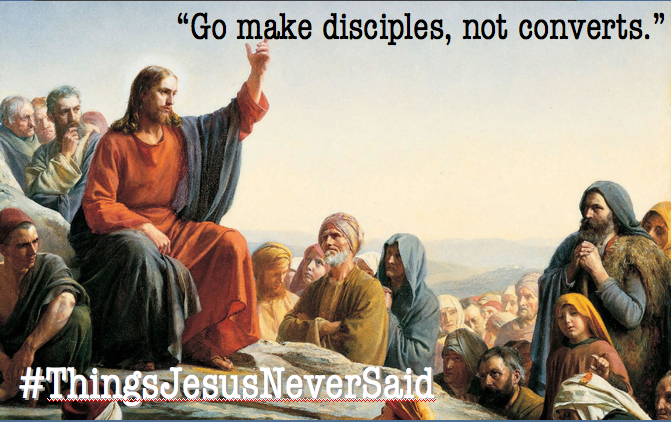
Make Disciples, Not Converts? Really?

Screen shot 2016-04-27 at 12.21.33 PM

Cliches are normal in any language. Sometimes they are able to capture a snippet of thought accurately, other times they muddy the waters of theological judgment. Of course, the impact of any cliche is purely subjective, but it seems that western Christianity is full of cliches that are just not biblically supported. Obviously from the title, you know which one I have in mind so I won’t waste time getting to the point.

Where in the bible do we even find a hint that a convert of Jesus Christ IS NOT a disciple? For the most part, I get it. I get that the idea here is that we focus on making true disciples rather than just a mere decision to follow Christ. However, the reality of the matter is, when a person repents of their sin and trusts in Jesus’ finished work to save them from their sin, if their regeneration is from the Holy Spirit and they exhibit a life that bears fruit and perseverance in Christian character and godliness, that person is not only a convert, but a disciple of Jesus Christ. The moment anyone is saved from their sin, they become a disciple. A follower of Jesus. A convert of Christ. The idea that we can gain a convert but not a disciple is not only unbiblical, but absurd.

One of the ways this cliche gains ground is from the Carnal Christian doctrine and Decisionism. Although they are distinct in some ways, both feed off each other. They propose that a person can become a Christian, yet still live carnally. Also, they teach that a person can have Jesus as Savior, but not as Lord. Furthermore, you can make a decision to follow Christ, but still be a babe or carnal for most, if not all, of your christian life. If such a thing is believed and taught in your church, run.

For the most part, a person may have good intentions when stating this cliche, or they are ignorant of its presupposition. That happens. We want to try and provide someone with the benefit of the doubt as much as possible. Also, not everyone that states this cliche may come from a Carnal Christian perspective (at least not knowingly). But the main thrust here is to challenge even the possibility that someone can become a true convert to Christ, but not be a disciple. They may be a young disciple, a new disciple, or even a false disciple if they fall away. But, in the mean time, they are disciple nevertheless until proven otherwise. The same goes for the word convert. They are semanitcally interchangeable.

In Acts 3:19 Peter preached repentance and conversion. In Acts 15, Paul and Barnabas described to the Phoenicians and Syrians the conversion of the Gentiles. In Psalm 51, David mentioned teaching transgressor God’s ways and converting them (sounds like the Great Commission in a nutshell). In Acts 6:1 it mentions how disciples were multiplying. Acts 14 also mentions making many disciples, and they just started in the faith. And even verses that don’t use the words translated as “convert” or “disciple” in both old and new testaments still semantically explain what conversion and being a follower of Jesus/God is, and are an inclusive list which helps us to systematically understand that to turn from sin and turn to God is conversion and discipleship. Sure, it involves lifetime dedication, devotion, repeated repentance, and obedience to the one you profess to know and love. But it is still conversion and discipleship nevertheless. And to throw a wrench in this whole matter, even Judas was called a disciple when, in reality, he was not.

It would necessitate a bible study of multiple passages and words that would help illustrate my point further. Nevertheless, it is my hope that we grasp that this cliche doesn’t really demonstrate a biblical understanding of a follower of Christ. No matter how you slice it, a disciple is a convert and a convert is a disciple. They can be used interchangeably. And that is the beauty of language and words within language. There may be times when using the word “convert” describes an entry level understanding of just coming to faith in Christ, and other times when someone calls you a convert of Christ and you have been in the faith for years. The same goes for disciple. Some can call you a disciple of Christ and you just got saved yesterday, and you can be called a disciple after years of obedience to Him. It depends on the context and how the word is used. And Scripture illustrates this fact.

Therefore, if the Holy Spirit has indeed saved you, regenerated you, called you out of darkness into light, and you drop your nets, repent, and follow Christ, from that point forward you are a disciple and a convert to Christianity. However, remember that you can be a professing disciple/convert, but not truly be one. I pray the Lord opens our eyes to this truth.

-Until we go home

A Devastating Question for Lifestyle Evangelists

A Devastating Question for Lifestyle Evangelists

If you have followed DefCon or any other site that affirms gospel-centered theology, you have already run across mounds upon mounds of reasons why lifestyle evangelism is unbiblical. We’ve expounded, extrapolated, and exegeted this to death in order to reveal why trying to win souls by simply just living your life before the unsaved is plainly unbiblical. But the one thing we have failed to do is teach how to engage a person that believes we should simply let our good works shine before men, and then be ready to give an answer for the reason of the hope that lies within you when they ask you.

I like to keep the target of an article directly in my gaze. Therefore I will not exhaustively offer my insights as to why I think this strategy of evangelism is good or bad depending on the context.  But here is a mock conversation that will reveal the most devastating question you can ask someone that believes in lifestyle evangelism, which will allow the drill of the gospel to penetrate the problem at its core and root out this man-centered method.

(Background: You are walking down the street and you see someone with a sign by a booth that says “FREE HUGS.” You notice it also has Jesus’ name on some of the other signs, so you walk over to investigate)

Lifestyle Evangelist (LE): Would you like a free hug today?

You: Sure. What’s it for?

LE: We just want to demonstrate the love of Christ and show that we love you?

You: Ah. I see. Do you preach the gospel when you get people who are interested?

LE: We are showing the gospel by sharing the love of Christ through hugs.

You: So what is the greatest demonstration of God’s love to mankind?

LE: Jesus Christ dying for our sins.

You: So how do your hugs measure up?

Did you catch the point? The last two questions really expose the root problem of merely “demonstrating” the love of Christ without opening your mouth about the gospel. And the previous to last question really sets up the penetrating question at hand.

If someone feels that they are being more effective (which is pragmatism by the way) by sharing the gospel through their lifestyle and neglect to share the good news of Christ, by asking them, “What is the greatest demonstration of God’s love?” you will bypass any defense and shoot right to the source of why Christians should even bother to spread the gospel in the first place. The sacrifice of Christ for sin! Even more so, when you ask them “How does their (insert good work here) measure up?” it pinches the nerve of this pragmatic error and hopefully causes the hearer to question their means of “spreading” the gospel. Or, in their minds, letting their good works shine. Because it causes the person to take notice that they are basically saying their good work, whatever that may be, is a proper or better demonstration than Christ’s sacrifice for sin.

If it is true that Christ died for our sin, and that while we were still sinning, Christ died for us, if this gruesome act is what God had to undergo in order to save men from sin, death, and hell, how in the world could any of our good works ever measure up!? Sure we do good works because we are saved, and yes, as a byproduct of our preaching our good works compliment our message, but there is nothing (and I mean nothing) that we can do (ever) that will be a better demonstration of God’s love other than what He has already done! Let’s read that one more time. This is extremely important. There is nothing we can do to demonstrate the love of God in such a way that would project the glory of the gospel than what God has already done. That should be one of the greatest assurances for fearlessly speaking the gospel. But oftentimes, it’s not. Forgive us Lord for our unbelief.

I’m not saying taking up your cross is not a powerful testimony. But it’s not the gospel. I’m not saying you can’t give to the poor. But it’s not the gospel. I’m not saying you can’t show kindness, goodness, meekness, humility, love, self control, gentleness, and the like. But it’s not the gospel. I am not saying that your works amount to absolutely nothing when trying to be a witness in the world. But it’s not the gospel! All these things are types and shadows that should point to the gospel message. And even if they do demonstrate the power and love of Christ in some measure, none of our good works should be held to such a high regard that we think it measures up to the love of Christ efficaciously demonstrated to us on the cross. Tell the old, old story of He who paid an eternal price for our sin and gave Himself for us to make us free from sin’s power!

Remember that the above conversation is only an example. Each conversation is unique and can flow in different directions. However, don’t lose sight of the main point. It might take a little persuasion to reveal what you are trying to say, but as long as you keep the last question in sight (really the last two questions), you should be able to drive home the single, most important point of how the gospel should be shared – that we should tell someone what is the gospel, not just show them! To do otherwise is to essentially say that what we are doing is a better demonstration than what God has done.

-Until we go home

Love the Sinner, Hate the Sin Redeemed

Love the Sinner, Hate the Sin Redeemed

lovehate1-750x400

If you’re like me, you cringe when you hear the trite phrase, “love the sinner, hate the sin.” Depending on who who says and hears this, this can be interpreted a multitude of ways. A liberal leaning might mean it as, “love the sinner, accept the sin.” Another way that someone might take this is “love the sinner, accommodate/tolerate the sin.” Of course, whenever this subject comes up with professing Christians, it tends to lean more toward, “love the sinner, don’t talk about the sin.”  In other words, love them as they are, and simply share the love of Christ (whatever that looks like these days). But then you have the more dreaded extreme by which certain people love the sinner, by showing the maximum amount of hatred toward the sin. That is, they show that they “love” the sinner through harshly expressing their extreme hatred for the sin.

Other than this phrase becoming a mantra for pragmatic church goers who don’t really understand the gospel, and the relationship between God’s wrath and His grace, one of the greatest reasons why this phrase should be offensive to any Christian is that it is attributed to God. Before this idiom was clipped into a nifty little catch phrase for practical application in talking to homosexuals, prostitutes, drug addicts, etc., it was originally stated that “God loves the sinner, but hates the sin.” Meaning that when God looks at a person, His love for them seems to be disconnected from their crime. In essence, God loves the criminal, but only hates the crime.

I would love to go into why the Bible doesn’t truly say this about God. But this subject has been greatly dealt with by mainstream writers. My intent here is to ask another question. “Can this phrase be redeemed?” Regardless of how people may feel about this phrase (myself included), is there a way in which we can twist this quaint phraseology to our advantage to start a biblical conversation and get down to the nuts and bolts of what the gospel is really about? I think we can.

I attended a men’s Bible study about two weeks ago with my church. We were discussing a chapter in Jerry Bridges’ book, The Joy of Fearing God, and this subject of love the sinner hate the sin was brought up. I thought this would go in the direction it usually goes. People getting offended and drawing strong pragmatic lines, and eventually parting ways. However, that was not the case. Every man at that table delivered some pretty informative concepts concerning the kind of theology this tiny phrase insinuates, and the cautious approach we need to have in accepting/stating this phrase. The most interesting part was how we were able to dissect the phrase in our favor to discuss the biblical model of how God, and how we, should deal with sin. Although this was not their intention in the discussion, it opened up my eyes to the possibility that I can now use this phrase in my favor to preach the gospel.

As I mentioned above, when people use “love the sinner, hate the sin” it can mean several things to different people in various contexts. But from this point on, if someone tells me “love the sinner, hate the sin” I will respond in one of three ways:

1. Yes but, do you really love the sinner? If you do, then why won’t you talk to them about their sin so that they might know about salvation. Jesus, Peter, Paul, James, and all Christians in church history mentioned, exposed, and unashamedly condemned sin when they preached the love, mercy, and grace of Jesus Christ and His redemptive work on the cross. And they didn’t just lightly gloss over it. So if you really love the sinner, but hate the sin, then you should at least talk about their sin(s) so that they might come to know Jesus, and why they must be born again!

2. But do you really hate the sin? Think about this, if you really hated the sin, you would talk about it. People are prone to talk about what they are emotionally pleased and disgusted with. This doesn’t mean we turn Westboro Baptist on someone when we preach the gospel, but it is a valid question to ask someone if they lob this phrase at you. If you truly hate the sin, and know that sin is the reason for which Christ died, don’t you think God hated it too? So much so that Christ endured the wrath of God so that guilty sinners can be set free?

3. Love the sinner, hate the sin? Only if it’s biblical. This was one of my favorite points in our men’s meeting (my most favorite is below). If a professing Christian tries to persuade me that I should be more loving toward the sinner, and simply express hatred toward the sin, I would then simply respond, “only if it’s biblical.” This will hopefully spark a conversation about how God both loves and hates the sinner, and that He expresses both anger/wrath just as much as He does mercy/grace. Only God is able to love and hate sin and sinners, and do so equitably, with balance, and without contradiction. I would love to show how the work of election is a crucial puzzle piece that helps us to understand this concept of God’s love/hatred better, but that is beyond the scope of this article. For now, “only if it’s biblical” is a great way to retort in order to get a discussion going.

I might not have been able to “redeem” this phrase, but responding in one of these three ways is best when someone decides to press this practical dogma against you. Regardless of how we respond, the idea that we must grasp is that asking the right question(s) about what someone means when they say “love the sinner, hate the sin” will hopefully lead to a conversation about the gospel and God’s greatness to redeem criminals to Himself. God’s hatred and love were both fully expressed on the cross when Christ was being punished on our behalf for sin. God unleashed His holy fury on Christ, who became sin for us. His love was equally poured out by demonstrating in that while we were still sinning, Christ died for us. If we trust in that sacrifice, and repent of our sin, God’s holy hatred and wrath that abides upon us, is propitiated. And although God loves us in the general sense that we are His creation, only His beloved, those that are born again, experience the fullness of His grace, love, and mercy.

As I hinted at above, there is a statement that better expresses what should be our reaction toward the lost, and has become my new, favorite rebuttal. If you are a Christian, and you know the true, unadulterated gospel, let this be your mantra: Love the sinner, preach the gospel. (Thank you Sam Young for this quote).


– Until we go home

The Phantom Gift of Hospitality…


givinggift

This may seem silly to bring up, but there is a point concerning a specific “spiritual gift” (which is really not a spiritual gift) that many not only claim they have, but they also misapply! It is not only a phantom gift, but it’s supposed application is misdirected. I have searched far and wide for this gift for many years. At this point, it is safe to assume that it is at the end of a theological rainbow. And the only ones that find it are those that are taught that it exists. What is it? Nothing but the “gift” of hospitality.

Let’s begin on where they get this idea comes from. 1 Peter 4:9 says we are to show one another hospitality without grumbling. Sounds pretty straight forward. The grammatical construction implies, though, that it is following from the commands in verse 7. That means amongst other things like being watchful and sober in our prayers, and having fervent love for one another, we are to be hospitable to one another without complaining. Once again, pretty straight forward. But where someone infers from this verse that God endows us with a spiritual gift in order to be gifted in hospitality is confusing. I can see how maybe some make the mistake of reading verse 10 into verse 9 since it mentions “gifts,” but nevertheless cannot see how they can be confident about their conclusion. The list of gifts in Peter starts in verse 10, not 9. But there’s more. Romans 12 has a similar situation.

This is another popular passage cited to didactically reveal spiritual gifts. In Romans 12:6, the apostle Paul explicitly mentions “gifts differing according to the grace that has been given to us.” However, that list terminates at verse 8. Once again, the construction is in such a way that verse 9 begins a new didactic exhortation, and verse 13 is where we see hospitality cited. In context, along with Peter, we must understand that this is not referencing some special ability that the Holy Spirit gives us. In some indirect sense, once we are born again, God gives us a new heart for fellowship with believers and a love for evangelism that causes us to love the unsaved. But that is not what the “gift of hospitality” teachers assume. The believer of the hospitality gift must understand that the exhortations to use gifts differing according to grace terminates at verse 8. Then, verse 9 begins a separate set of exhortations.

So why harp on this? Why pluck this string? Two reasons: excuses and exegesis.

One the one hand, there is always someone that will misapply a verse, gift, theology, etc., to their advantage in order excuse their responsibilities (or sin) in other areas of their Christian life.  For example, they won’t evangelize because their gift is to open up their home (hospitality) to bible study. While that is good and necessary at times, this is not a substitute for any discpline the Christian is called to. And, hospitality in the Bible has more application toward persecuted and traveling believers whom have been banished from their homes, or are on evangelistic journeys. Sure opening your home is hospitable, and can be a fulfillment of Scriptural hospitality depending on the situation. But we must remember that is still not a spiritual gift.

On the other hand, basic exegesis concerning how words and theological concepts are used in their context cannot be stressed enough. The main point I’m trying to make here is that while this phantom gift is microscopic in the grand scale of heretical dogma being preached in the world, a misapplication or misunderstanding like this has avoidable consequences on a your thinking and behavior. If this simple thing cannot be grasped, exegeted, and applied correctly, what can be said of our attitude toward the basics of the gospel, or even biblical discernment? I’m not trying to make a mountain out of a mole hill, but there is something to be said about such a loose approach to Scripture. Of course, this is not a new problem, but I’m attempting to use this phantom gift to shed light on an age-old issue. The issue being the lack discernment for practical thelogy. And it is my hope that we continue to discern from where our othropraxy flows.


– Until we go home

I Do Not Allow a Woman

John MacArthur is spot-on with his gracious approach to the godly role and high-calling of women within the church. Far too many women are violating the Scriptures because of either a misunderstanding of the Word of God, or because of a deliberate rebellion against God’s sovereign purposes for the Bride of Jesus Christ. When you start violating God’s clear commands, it is so easy to then start diverting down other paths to the point where you will hold to and even teach heresy like Joyce Meyers and Beth Moore have done.

Indicatives and Imperatives

The Bible is full of commands, Old Testament and New. Perhaps no issue confuses people as much as rightly determining which commands are for New Covenant people and how they are to obeyed.  Early in the history of our religion, an argument arose that continues still today: does almighty God command man to do that which he is unable to do? When Augustine wrote a prayer asking the Lord to command what He would and grant what He commanded, Pelagius went bonkers over the thought that God must grant the creature the ability to obey what God commanded. His view was that man must inherently be able to do what God commands him to do, as it violated his sense of “fairness” for God to command man to do what man could not.

In our day, many people think Matt 5:48 (be ye perfect as your Father in heaven is perfect) is a command we can perform. This perspective is fraught with an unreasonably high opinion of man, missing the point that Christ alone is perfect and we can only be acceptable in the Father’s sight by being found in Him – not by working real hard trying to be perfect.

To properly interpret and apply commands from God, one must understand the context (historical and theological) and getting things in their proper order – commands follow and are applied according to identity; imperatives follow indicatives. The command to repent and believe on Christ can only apply to and be obeyed by one who has been regenerated and raised from spiritual death by the Spirit of God.

While not anywhere close to a comprehensive lesson on this topic, it’s important to grasp it in order to see why what the preacher in the following sermon did was so wrong. This is not an uncommon error, but it’s one we must be on guard against – no matter who is preaching.

The title of this problematic sermon is good (available here): 4 Marks of a Hell-Bound Man. It sounds like a message about indicatives that reveal one bound for hell. But the way John MacArthur preaches this sermon is to present each of the 4 marks as something you can choose to do if you want to go to hell – “How is it that people die in their sins unforgiven? How does that happen? Unjustified, unconverted, unregenerated, unredeemed and bound for everlasting hell. Well, there are four attitudes that guarantee you will die in your sin, four attitudes. If you want to die in your sin then these four things will make that a reality.”  These four attitudes, self-righteousness, worldliness, ignorance, and unbelief are each presented with this assessment: “You want to die in your sin? Be selfrighteous, worldly, unbelieving and willfully ignorant.” Continue reading

Persuasive Preaching

Persuasive Preaching Overstreet revised3 (7-19-14)

A review by Stuart Brogden

R. Larry Overstreet has subtitled this book, A Biblical and Practical Guide to the Effective Use of Persuasion, and in his prologue (page 4) makes the case that in order for preaching to be persuasive it must include a public invitation. We will see, in chapter 12, that Overstreet is not a disciple of Charles Finney – he warns about the abuse that has followed after Finney’s “new methods”, comparing persuasion with manipulation. What, then, does our author mean by the term “persuasive preaching?” He defines it at the end of chapter 1, page 14:

“(a) the process of preparing biblical, expository message using a persuasive pattern, and

(b) presenting them through verbal and nonverbal communication means

(c) to autonomous individuals who can be convicted and/or taught by God’s Holy Spirit,

(d) in order to alter or strengthen

(e) their attitudes and beliefs towards God, His Word, and other individuals,

(f) resulting in their lives being transformed into the image of Christ.”

While I would combine (c) with (b) and (e) with (d), the overall point he is making is one I think any pastor could embrace. What pastor would not want his people to be transformed by the renewing of their minds as a result of the Spirit working through his preaching?

The bulk of this book, chapters 3 – 11, is an extensive, technical argument in favor of persuasive speech, from the Bible and pagan perspectives – heavily footnoted. I found this part of the book ponderous and laborious; perhaps because I am already convinced that the Lord has shown us we are to be persuasive in our presentation of His Word, while not trusting in our ability to persuade men as an effective means of building His people up.

I think chapter 13, “The Holy Spirit in Preaching”, is the most important part of the book. Overstreet rightly points out that He is the originator of God’s Word (page 172), the revealer of God’s Word (page 172), the communicator (page 175), and the propagator of God’s Word (page 177). We are reminded that the Holy Spirit equips the preacher (180) and the listeners (181). These are excellent reminders and much needed in these days, as so many people have apparently latched on to the notion that preachers are the ones who do these things! Our author instructs us to not grieve or quench the Spirit, but walk in the Spirit, be filled with the Spirit, and in prayer to the Spirit (pages 184 – 191). If the book had ended here, it would have been fine. But Overstreet told us in the prologue that persuasive preaching must include an invitation – so the last chapter, 14, is on that topic.

Much of this last chapter presents the reader with the notion that chapter 13 was not for real – as men are presented as the change agents for “receiving Christ” and “committing themselves to full-time Christian service” (page 194). Overstreet acknowledges (195) that decisions are sometimes known only to God but tries to make the case for public invitations in order make them known to men. He quotes Faris D. Whitesell, who comes across as a Finney disciple: “Anything that helps us to carry out the principles and teaching of the Scriptures in a more effective and practical way is scriptural.” I cannot help but think of Eli’s children and wonder of Whitesell and Overstreet recall their doom.

As he pulls together his arguments in favor of public invitations within the local church, he draws on myriad passages of Scripture that show public invitations and exhortations being made without the local church. The invitations in the Bible are consistently “repent and believe!”, called out all men everywhere. Within the church, we see an intense struggle to stay faithful to the Word to equip the saints. Only once that I am aware of do we see unbelievers in the church – and they are not invited to the front. The focus from Paul is to be clear in the presentation of the Word of God, that the unbeliever might be convicted of truth (1 Cor 14:22 – 25).

While I am not in agreement with Overstreet’s premise – persuasive preaching does not have to end with a public invitation – I am encouraged by his counsel on the use and construction of the invitation:

Be Sensitive to Length

Be Clear in Appeal

Be Exact in Action

Be Loving in Presentation

Be Consistent with Message

Be Positive in Expectation

Be Earnest in Delivery

And he is wise in his warnings the problems one might face with the use of public invitations:

The Liability of Confusion

The Liability of Narrowness

The Liability of Weariness

The Liability of a “Canned” Invitation

The Liability of Unethical Behavior


The focus of this book is good – preachers ought to be persuasive in their preaching! Preachers ought to call men to repent and believe, to cast aside sin and press on with our eyes fixed on the Lord. But we find no biblical warrant for having a public invitation at the end of our sermons. I am thankful for men who understand the dangers of abusing the invitation system – though that abuse tends to be the model followed by most who use it. My prayer is that those who think it important would find in this book a sound argument for being sober and restrained in its practice, lest men think it’s the preacher upon whom all things depend.

Apocity: The Greatest Omission

In my book Apocity: The Greatest Omission I coin a word (apocity – pronounced uh-pa-city) to describe the sin of not evangelizing. This book not only coins a word, but it reveals the pandemic apparent within western Christianity. Moreover, this book not only diagnosis this sin (thoroughly), but it also provides a gospel centered remedy.

Interview on Janet Mefferd Show can be found here (skip to minute 20): http://www.tractplanet.com//assets/images/Share/02-jm_rs_20140317-Mon_-Janet-Mefferd-Show-3_17_2014.mp3.mp3

But selling books is not why I am writing. Since I don’t get a dime off of sales, money is not in the forefront of my concern.

As I have always said, it seems that the western, local churches have failed at the one command that Jesus imparted to us right before He ascended into heaven at the right hand of the Father. When Jesus gave us what is now known as the “great commission,” Jesus explicitly stated that we are to make disciples, and one of the components of doing so is “teaching them to observe all things I have commanded you…” (Matt. 28:20). The other component is “going” or “in your going” (as if that makes a difference). For some reason, however, we have not been consistent in teaching the last thing that Christ taught. What irony that the very commission Christ gave embodies the necessity for making disciples in the world, and yet we will teach others to obey everything else Christ taught, meanwhile dancing around this particular mandate to be regular, consistent, and purposeful witnesses for Christ!

What do we see in the news in America right now? Ebola, ISIS threat, homosexual agenda, feminism, Hollywood attacks on Christianity, false teachers getting the spotlight, pastors getting subpoenaed, violence, sexual immorality, and the list goes on! And what are the majority of local churches doing? Playing their apocitic fiddles while Rome burns! The current state of affairs in America right now is ripe for gospel preaching and we are sleeping (Prov. 10:5). Nevertheless, the LORD has His true laborers. Those that are not faithful workers in His field are going to be found out as frauds in the end (Matt. 25:29).

In giving the sin of not evangelizing a name, it is my hope that many will consider the linguistic power of being able to put a name to this detrimental and once nameless sin. Not only that, to provide a talking point concerning the evangelistic efforts (or lack thereof) in our own lives. In this post, and in future posts to come, I pray that we all can demolish all the sorry excuses we make that keep us from being regular, consistent, and purposeful in fulfilling the command of Christ to make disciples. If you are, or if you know anyone, that is negligent in going out into the world to make disciples (an apocite) toward family, friends, co-workers, AND strangers, I pray this post (and the book) will revive and reveal the greatest omission in our evangelical churches today.

If you wish to get a free copy of “Apocity”, go here: http://www.g220ministries.com/media.html

Call Sinners to Respond to the Gospel!

CALL SINNERS TO RESPOND TO THE GOSPEL!
Geoffrey R. Kirkland, Elder-Shepherd
Christ Fellowship Bible Church

Someone once said that Christians should learn to plead with sinners to embrace Christ and escape hell. A child of God could faithfully give the gospel, speak of God and His character, man and His desperate need, Christ and His sufficient atonement, repentance and faith in clear terms, but one element that evangelists seem to omit is the urgent call for sinners to respond to the gospel! Paul said that he was not ashamed to beg! He pleaded with sinners to come to Christ. Whitefield loudly and lovingly wept as he urged sinners to turn to Christ and live! Spurgeon spoke of this kind of urgent pleading with frequency. The Puritan preachers spent a good deal of time in their sermons exhorting sinners to embrace Christ and follow Him. We should learn from these examples and do the same. We must call sinners to respond to the gospel.

How should Christians ‘call for a response’ when speaking the gospel?

1. Call for a response in OBEDIENCE TO SCRIPTURE.
Elijah called the pagans to ‘choose whom they would serve’: if Baal was god, follow him; if Yahweh was god, follow Him. Joshua told the children of Israel to ‘choose whom they would serve’ and he modeled it by saying that he and his household would serve the LORD. Jesus pleaded with His disciples to ‘compel sinners’ to come to the wedding feast. Paul pleaded with Herod to repent and come to Christ. As ambassadors of God Almighty, believers must take Paul’s words and beg for men and women to be reconciled to God. We must call for a response! We must plead with folks to embrace Christ! We must follow the example set before us by the Apostles: “Repent and believe the gospel!”

2. Call for a response in FOLLOWING CHRIST’S EXAMPLE.
The life and ministry of Christ unveils His heart as He pleaded with sinners repeatedly and patiently to come to Himself for salvation. Often, in the Temple against the backdrop of the hypocritical, works-righteousness system of Judaism, Christ would teach how He came down from heaven as the living Bread, as the water of life, as the door to heaven, as the Shepherd for the sheep, as the Way, the Truth, and the Life, and he invited all to come to Him. If anyone is thirsty, let him come to me. He exemplified not only the clear and bold proclamation of gospel-truth, but he also modeled urgent and compassionate exhortations to respond to the gospel. We must do the same.

3. Call for a response in WARNING AGAINST UNBELIEF.
The gospel of Jesus Christ is a gospel that saves. The gospel of Jesus Christ delivers from hell. No other message on the planet can save from eternal perdition. No other Name given to sinners can deliver from damnation. No other substitutionary work can atone for sins and remove God’s just fury. The good news of Jesus Christ and His cross-work and His imputed righteousness is what saves. It is for this reason that every evangelist should incorporate into his gospel conversations a warning against unbelief. Repeatedly, Jesus said that whoever does not have the Son does not have the Father. Whoever rejected the Apostles in their itinerant preaching rejected the Son and whoever rejected the Son rejected the Father. No one can have the Father without the Son. None can say yes to the Son and say no to the Father. There is no way to come to the Father but through the one door: Jesus Christ. He alone is the Way, the Truth, and the Life. No other path exists whereby one may come to God the Father. Tellers of the gospel must warn sinners of this! To not believe is to commit the sin of unbelief. To live in unbelief is to persist in willful sin. To refuse to bow the knee to Christ now is to live in unbelief and sin now. Christians should faithfully proclaim the gospel, diligently call sinners to respond to the gospel, and boldly warn sinners against rejecting the gospel and dying in the state of willful rejection of the truth (even after having heard the faithful gospel presented to them). Warn the sinner, O Christian!

4. Call for a response in COUNTING THE COST.

Jesus did not preach a gospel akin to many of the popular evangelists in the 21st century today. He never told His followers that they would enjoy wealth, happiness, better health, and certain peace in and of themselves. Rather, he told them to die to themselves. He commanded them to lose their lives. He told them to hate everything on earth in comparison with the supreme love they must have for Him alone. He required exclusive allegiance. He demanded that they forsake any and all other options of attaining righteousness. He warned them that they would die for the faith. He informed them that suffering would certainly come upon them. He spoke that they would be rejected, despised, mocked, and endure much hardship for the gospel. Yet he still called for sinners to respond to the gospel. Perhaps this is why many of the ‘followers’ (=disciples) of Jesus heard his teachings and then ‘left him and followed Him no more.’ A faithful gospel proclamation that models the heralding of Christ should include a plea to count the cost. Unless one gives up all his possessions (that is, a willingness to renounce everything and anything for the cause of Christ), he cannot be Christ’s disciple. O Christian, include this in your gospel call!

5. Call for a response in RELIANCE ON THE SPIRIT.

Jesus Himself preached that the Spirit gives life. No one can come to Me, Jesus said, unless the Spirit of God draws Him. One must be born from above and be born of the Spirit. Jesus believed that new life eternal does not come at a sinner’s own whim. No one enters heaven because of his own freewill. No one chooses Christ because he desires the fire insurance so as to escape hell merely. O Christian, evangelize with such a reliance on the Spirit that you understand that no dead sinner can come to life unless the Spirit of God regenerates him first. Life must first enter the sinner before he can call out to Christ in saving faith and be justified. Rely on the Spirit in all your gospel conversations! Pray passionately! Pray persistently! Pray constantly! Pray believingly! Call sinners to respond to the gospel with all the persuasive mechanisms you have — and yet realize that you can’t do anything in the slightest to save someone, or even make them desire it more. It fully rests on the sovereignty of the Spirit. So call for a response as you confidently trust in the Sovereign grace of the Spirit of God to take your words and bring life.

6. Call for a response in COMPASSION FOR THE SINNER.
A sick patient sitting in the doctor’s office may hear the news of a life-threatening illness that has come into his body and as the doctor gives him the news and the grave consequences, the doctor who really loves his patient will offer the one medicine that can deliver the person from death. He not only describes the only solution available; he urges the patient to receive it — immediately. The physician does this because he cares for his patients. And how much more must the child of God proclaim the gospel to the lost and hellbound out of great love for their immortal souls! The Christian has the only solution to escape hell. The child of God knows the only path to escaping the tidal wave of God’s rage. The believer possesses the only shield and refuge to protect from the flaming and soul-piercing darts of God’s eternal fury. In telling the good news of salvation, the Christian should call for a response out of deep compassion for the sinner. O may the sinner escape hell. O call for the rebel to run for refuge to Jesus Christ! O plead with the transgressor to come to Christ, the wrath-bearing sacrifice who died for His people and offers them His righteousness through repentance and faith in Him. O may the evangelist’s compassion boil! O may the proclaimer run after sinners and plead with them, hold to them, persuade them, and urge them to flee from the wrath to come with a Christ-like and a Christ-pursuing passion!

Reposted by Permission from Pastor Geoffrey Kirkland
HT: Vassal of the King