The Sabbath Complete

THE SABBATH COMPLETESabbath

a review by Stuart Brogden

The latter half of the 20th century has brought a growing interest in Reformed Theology, in striking contrast to the growing apostasy that has gripped many evangelical denominations. Many of my fellow Baptists aggressively and happily embraced the doctrines of grace and the great theological truths about God’s sovereignty and man’s true nature. I am a grateful Baptist who was introduced to this theological construct in the ‘90s and have come to see as foundational to the Christian faith the doctrines of the Reformation, especially the reliance on Scripture Alone for all things having to do with life and godliness and For the Glory of God Alone to keep us focused rightly in all we think, say, and do. And the mostly forgotten doctrine of our forefathers – Semper Reformanda – Always Reforming, because none of has it all together nor will we get it all together while we inhabit these tents of flesh. This brings me to this remarkable book – The Sabbath Complete, by Terrence D. O’Hare. This book is the result of our author “attending an Orthodox Presbyterian Church where various Sabbath-keeping applications were stressed.” (page xi) Prompted by his pastor, who urged his congregation to examine personal motives in religious practice, he decided to study the concept of the “Christian Sabbath”, which is widely popular in churches which hold to 17th century confessions such as the Westminster Confession of Faith and the 1689 London Baptist Confession. O’Hare’s study lasted as decade, producing this comprehensive analysis of this contentious issue. His desire, and mine, is that people on both sides of this issue acknowledge the human tendency to cling to traditions (some of which, he shows, are fine and biblical), which can lead to traditions displacing true worship of God and Christ. The thesis of this book is “that Sabbatarianism is a form of traditional pietism and that the acceptance of the fully ceremonial nature of the Sabbath, though shocking to some, is actually Christ-honoring.” (page xiii)

The Sabbath Complete is organized into 12 chapters which examine various aspects of the Sabbath – prototypes, initial practice, law, feasts; how it prefigures Christ in the rest He earned, the Gospel He preached, His resurrection; and a historical review of the practice which has come to be known in the confessions as the “Christian Sabbath.” Coming in at more than 350 heavily footnoted pages, this book is thorough, enlightening, and thought provoking. It is my prayer to whet your appetite enough so that you will buy this book and study it. May the Lord be our wisdom and His glory our goal.

In his examination of the Sabbatic prototypes given to us in Genesis, O’Hare observes (page 1) that “God’s provision for our physical rest is but a token of a more transcendent remedy for our spiritual privation” and follows up (page 6) thusly: “Though God’s rest after creation is a type of everlasting rest yet to come, it is more certainly a type of Jesus Christ, who has come, in whom the faithful rest in salvation.” This snippet shows O’Hare’s focus on Christ – His provision and sufficiency, which is a constant, welcome, perspective throughout this book. As an expression of God’s sovereignty and redemptive revelation, our author reminds us (page 7), “Jonah did not just happen to be engulfed by a great fish and later ejected as a random biological event, but this occurred as designed by the Lord to shadow forth the death, burial, and resurrection of our Lord. Likewise, the seventh day rest was not a random terminus of creation but a purposed end point to shadow forth the inevitable results of God’s work in redemption.” This sets the stage for a book that is best read slowly, with an open Bible and notepad.

In addition to each Christian studying the Bible for himself, learning from credible sources of church history is very helpful as this sheds light on when and by whom our beloved traditions were started. O’Hare has helpful advice in chapter 9, wherein he reviews the shift to calling Sunday the “Christian Sabbath.” One of the earliest post-apostolic apologists, Justin Martyr, sheds light on the common-place view of Christians in the second century:

And on the first day called Sunday, all who live in cities or in the country gather together in one place, and the memoirs of the apostles or the writings of the prophets are read…But Sunday is the day on which we all hold our common assembly, because it is the first day on which God, having wrought a change in the darkness and matter, made the world; and Jesus Christ our Savior on the same day rose from the dead.”

For this most ancient brother, the Lord’s Day was on the first day not as a new instance of the Jewish Sabbath, but in concert with a remembrance of God’s creation and Christ’s resurrection – wherein we have the promise of having our decaying bodies made new like His. Our author laments how Christian traditions were often started not on the Lord’s revelation to us as New Covenant saints, but by imagining connections to Jewish traditions – “such as circumcision giving way to baptism and the Lord’s Supper approximating the Passover, came the forced and fanciful system of religious holidays common in the Roman Catholic Church.” (page 222) He then provides a lengthy quote from famous Roman Catholic Thomas Aquinas, explaining his support for these practices and then comments (page 223), “This teaching blurred the differences between the old and new covenants and paved the way for works orientation. … It was fitting for a better covenant to have fewer ordinances: one, performed only once that identifies the child of God as an heir to the kingdom, and the second, a recurring and sustaining ordinance of remembrance of the life and work of Jesus Christ. Again, similarity does not connote identity. Baptism is not a Christian circumcision, and communion is not a Christian Passover, neither is the Lord’s Day a Christian Sabbath. This is as absurd as calling the new covenant the “Christian old covenant.”” Did I mention that a Presbyterian wrote this book? He goes on to say, “It is plain that the circumcision of the Christian is spiritual and not ritual, and that it is actually the death of Christ, which was His circumcision, into which we were spiritually baptized.” In response to several sabbatarian authors (such as Walter Chantry) who press the “Christian Sabbath”, in part, as a means to restrain evil and provoke (coerce?) Christian worship, O’Hare rightly observes (page 225), “If Christ can raise up rocks to sing His praises (Matt 3:9), why would it be so difficult for Him to raise up His beloved, who are indwelt by the Holy Spirit, to worship at the appointed time (Ps 116:18-19, 122:1-2)?” Amen! Saints of the living God don’t need a command to gather together for worship and fellowship – we, by definition, love Him, are drawn to Him, and we love the brotherhood!

Each chapter of this book delves into history and Scripture to determine the meaning and origin of the various aspects mentioned in the first paragraph. Each is compelling and enlightening. Chapter 4 – Sabbath Law, examines the Jewish laws and traditions tied to their Sabbath and points out inconsistencies in the practice of modern Christian sabbatarians. In nearly every chapter, the diligent reader will be awed by the realization of how detailed the Jewish religion is as given to them by God and how it is much, much more than merely a quaint religion for those people long ago. The Jewish religion, as the book of Hebrews tells us, is mainly a means of communicating God’s eternal plan of redemption to the people He called out of the pagan nations, to protect the promised seed and make His name known around the world. These two priorities – to glorify the Lord and declare the gospel – are consistently the highest order for us humans. This becomes more and more clear as each chapter is consumed.

To keep this review from running 20 pages or more, I will restrict myself to chapter 10 – The Sabbath in Church History. This will put the “Christian Sabbath” practice so aggressively promoted and protected into its proper context. My desire aligns with the author’s – to have readers of this book see the first day of the week in its biblical context, stripped of the accumulated baggage of 20 centuries of religion.

Chapter 10 begins with the apostolic teaching, with O’Hare stating (page 244), “There are three crucial distinctions between Christianity and its roots in Judaism: holy things, the law, and the customs.” He sees some continuity and some discontinuity in the connection between the old religion and the new, acknowledging the law is good, and “Yet these ceremonial laws isolated the Jews from their pagan neighbors, became the point of contention and ridicule, and represented a wall of separation between the two peoples. This was meant by God to display the isolation between sinners and Himself – the Jew included – so when Christ abolished the ceremonies of Judaism, the gospel of peace and the law of moral commandments would become the unifying theology and practice for Jew and Gentile alike (Eph 2:14-16). … At the beginning of the Christian Church, it was a stumbling block to require Gentiles to observe Jewish rituals: “to whom we gave no commandment.” (Acts 15:24)”

The review of the Didache (50 – 120 AD) reveals no evidence of Sabbath-keeping by Christians; the review of Ignatius’ writings (page 247) shows “he clearly distinguishes between Jewish conduct on the Sabbath and Christian conduct on the Lord’s Day, to indicate the superiority of being a disciple of Christ.” He walks us through the records of Mathetes (130 AD), Justin Martyr (114 – 165 AD), Irenaeus (120 – 202 AD), Tertullian (160 – 225), Origen (185 – 254), Eusebius (265 – 340), Sylvester, Bishop of Rome (314 – 335), the council of Laodicea (364); all of which provide no support for the “Christian Sabbath” and often denounce the idea as being a Jewish encroachment in the church.

By the time Gregory I was installed as pope of the then-emerging Roman Catholic Church, traditions now associated with that religion “were already taking root, such as the liturgical mass, a monastic life, symbolic outfits, ecclesiastical hierarchy, and declaration of days to honor saints.” (page 261) O’Hare provides a lengthy excerpt from a letter to Roman citizens in which Gregory I calls those who forbid work on Sunday (which he called the Sabbath day) “preachers of Antichrist” and sums up: “Gregory’s core understanding is that the Sabbath is a fulfilled ceremonial law that should no longer be literally applied.” (page 262) O’Hare quotes R.J. Bauckham’s claim that Peter Comester (a contemporary of Aquinas and Chancellor of Notre Dame in Paris) was the “first exegete to apply the Sabbath commandment literally to Christian observance of the first day”. (page 263) Our author reminds us (same page) that “While it is helpful to acknowledge the scattered, yet progressive, acceptance of a physical rest on Sunday, it is more important to understand the bases for these practices in empiricism and religious authoritarianism.” History tells us what happened and provides evidence as to motives. The Roman Catholic Church explored ways and means to better influence her subjects, working with the legal authorities to provide a day off work and advocating Christian observance of Sabbath principles. “Their expectation that all citizens attend Mass in this church-state led to the need to force compliance through the appeal to Sabbath law.” Thomas Aquinas further developed this line of thought, “asserting that the old law contains moral (emanating from natural law), judicial (laws regarding justice among men), and ceremonial (laws touching on worship, holiness, and sanctification) precepts; and that these three can be distinguished in the Decalogue as well.” (page 264) This appears to be the first teaching of what is now cherished reformed doctrine – that the Law of Moses can be separated into these three categories and dealt with appropriately for new covenant saints. There should be no denying these three elements are found in the Law of Moses, but, as O’Hare shows us with Aquinas, determining what is ceremonial and what is moral is the rub. Aquinas recognized a moral teaching in the Sabbath commandment – people should worship God; he also recognized the ceremonial component, specifically the date upon which such worship is to be given. “At this juncture, Aquinas took the first step toward Sabbatarianism by moralizing a ceremonial command” by asserting the moral necessity of giving time to God. (page 265) Aquinas agreed with Augustine that moral laws are revealed by nature, so all men are without excuse. But in order to get man to be at mass and give to the church due obeisance, Aquinas saw value in elevating that which had been rightly considered ceremonial to moral status.

We will step quickly through the early reformers to show how this idea progressed. Philip Melancthon is quoted as saying, in 1530, “Those who consider the appointment of Sunday in place of the Sabbath as a necessary institution are very much mistaken, for the Holy Scriptures have abrogated the Sabbath and teach that after the revelation of the Gospel all ceremonies of the old law may be omitted.” (page 274) “Luther vacillates between his definitions of the Sabbath as a ceremonial law bearing no external application for Christians and a binding law incurring God’s judgment if disobeyed.” (page 279) John Calvin also had trouble being consistent in his view on this matter. In asserting “that the Sabbath was ceremonial and is moral leaves us open to problems concerning the nature of its existence – it is both abrogated and legally binding. This was further complicated by the church-state relationship that sought to mimic a theocratic Israel and by Calvin’s misconception that the biblical Sabbath required all Israelites to assemble at the synagogue.” (page 281) In his commentary on the Heidelberg Confession, written in 1563, O’Hare lists eight failures on the part of reformers that led them to embrace the “Christian Sabbath” (page 288):

  • Failure to familiarize themselves with the teachings of the early church fathers regarding the Sabbath.

  • Failure to expand the understanding of how the Lord’s advent fulfilled each specific Sabbath command beyond “resting from one’s sins.”

  • Failure to be consistent in the treatment of ceremonial laws and types.

  • Failure to satisfactorily explain why the ceremonial Sabbath was placed with the body of the Ten Commandments.

  • Failure to recognize the limitations of the Ten Commandments as a means to inculcate Christian ethics.

  • Failure to differentiate the biblical Sabbath from the tradition of the synagogue.

  • Failure to emphasize the authority of the apostles under the inspiration of the Holy Spirit to institute a new order of congregational worship.

  • Failure to distinguish the Sabbath from the Lord’s Day.”

In what may be the keystone paragraph in the entire book, O’Hare explains the meaning of the Sabbath commandment (page 289).

The Mediator is on the first table (of the Decalogue) because, unlike Moses, Christ truly comes from God and is fully God. Yet Christ, by becoming fully man, joins with man to make him complete. Man cannot become complete simply by keeping the law, but he must experience through faith a life-altering union with Christ. The ceremonial Sabbath is the evangelion within the Ten Commandments that addresses the redemption of man. It is Christ Himself who takes the place of the Sabbath in the Decalogue. The Lord’s Day is not a continuum of the Sabbath or its replacement; it is a fresh ordinance for the church of God based upon the completion of redemption that was twice sealed by the Lord, first by His resurrection and second by the descent of the Holy Spirit.”

This puts the Decalogue in the absolute best light for new covenant saints to understand it and relate to it. (Scripture never calls the Decalogue “The Ten Commandments”, but only and always “the ten words” – hence the term Decalogue. But “Ten Commandments” are much weightier in the mouths of religious overlords than are “ten words”. I would have liked O’Hare to address this aspect of the creeping incrementalism of religious lordship in the church.)

It was during this time that the early reformers also broke with the clear teachings of Scripture and the church fathers by beginning to teach the Sabbath as the product of a creation ordinance. This was taught by Ursinus who “may have adopted the theory of the Reformed Englishman John Hooper, who, in his widely published book, Declaration of the Ten Holy Commandments (1548), claimed that God instituted the Sabbath from creation. … So, only 300 years after Aquinas and fifty years after Luther, the admixture of the Sabbath and Lord’s Day developed into a general concept that the Lord’s Day is the Sabbath, fostering the idea that the Sabbath remains a viable force in Christian living.” (page 290) This creation-ordinance based “Christian Sabbath” was a major element used by state-churches on both sides of the Atlantic to coerce Sunday worship – just as Rome had learned to do, using the same unfortunate logic.

In 1973, the Orthodox Presbyterian Church published a report from a committee that had been formed to study the relationship of the Westminster Confession of Faith to the fourth commandment. In part, the committee reported:

The weekly Sabbath is an eschatological sign. This truth, central to the teaching of Hebrews 3:7 – 4:13 as well as fundamental to the entire biblical revelation concerning the Sabbath, does not find expression in the Westminster Confession of Faith and Catechisms. The reason for this would appear to be that the Standards mention the Sabbath commandment primarily in terms of its bearing on the more specific matter of public and private worship.”

The Westminster Confession of Faith was not changed to reflect the eschatological import of the fourth commandment. O’Hare, having taught in this book the nature of moral law (unchanging and universal), observes “If the Sabbath is not ceremonial or typological, it is not eschatological.” “Where”, he asks, “”can it be shown that the Ten Commandments summarize the moral law given to Adam? Where can it be demonstrated that the Sabbath commandment is purely moral?” (page 291) “Was the fourth commandment, as God gave it to Israel, about the Christian Sabbath or the Jewish Sabbath? Was there anything else in the fourth commandment that was abrogated than merely the day of the week on which it fell? Where can it be shown that God abrogated the Jewish Sabbath and installed a Christian Sabbath in its place? … So, besides omitting fundamental truths about the Sabbath, the Westminster codified interpretive errors that budded with Aquinas and blossomed with early Reformers.” (page 292)

In closing this very provoking chapter, O’Hare shows us that the fourth commandment not only commanded rest, it commanded work for six days. The Hebrew word in this commandment is in the Qal imperfect tense, which implies an on-going action – “you work”. “But, if the fourth commandment moralizes the example of God for man to obey, then it is as much a sin to work on the day of rest as it is to rest on the days of work. … if someone completes their (sic) work in three days and does nothing more for three more days, what exactly are they ceasing from on the seventh day?” He instructs us on two types of rest: “1) God’s rest signifies the promise of eternal life, and 2) Israel’s rest signified her faith in God alone. God’s work is redemptive, so man’s work is meaningless apart from that redemption.” (page 309)

The early church correctly believed that the Sabbath was a ceremonial command and welcomed the ordination of the Lord’s Day as a commemoration of the Lord’s resurrection. However, the ascension of church power through the state and the influence of rationalism allowed the medieval church to begin to associate the fourth commandment with the Lord’s Day. The Reformed church, by perpetuating the error of Aquinas, eventually expanded the scope of applications of Sabbath law and increased its moral muscle, forcing the church to practice Sunday Sabbatarianism.” (page 311)

He gives us eight conclusions which are supported by Scripture and history (page 311):

  • The creation account is not about the Sabbath. It is about the primal peace with God that was lost through sin because of a lack of faith. The pattern of creation – six days of God’s work and the ensuing rest – reverberates through Scripture to demonstrate God’s sovereignty in effecting the work of redemption by grace through the faith of man.

  • When Israel left Egypt they were given the Feast of Passover; a few weeks later in the wilderness they were given the Sabbath. At Mount Sinai, Israel received her full calendar of feasts. The Lord devised this new system of shadow laws to prefigure the person and work of the Messiah.

  • The Ten Commandments are a summary of the Mosaic laws and therefore contain both moral and ceremonial laws.

  • Christ in His earthly ministry was born under the law and obeyed the ceremonial laws as well as the moral laws.

  • Christ is the end of the law for righteousness. His work of redemption – His incarnation, death, burial, and resurrection – is the fulfillment of all shadow laws, even though some of them are yet to be manifested in their entirety.

  • The redemption of Jesus Christ initiated the new covenant. It is the fulfillment of what the former covenants forecasted.

  • The apostles had divine warrant to establish first-day worship. Scripture unfolds the transition from things Jewish to things Christian. First-day weekly worship was the normative practice of the early church, it did not move the Sabbath to Sunday.

  • While there is no explicit scriptural mandate for this transition, we have scriptural foreshadowing and history of first-day significance, and rationale. Christ’s resurrection and the inaugural descent of the Holy Spirit – the most important events of the church age – occurred on the first day of the weeks in fulfillment of Israel’s shadowy calendar laws.”

There is much, much more in this book than I can even hint at in these few pages – which are too many for most, I fear. Buy the book. Study the topics, challenge the author (I found a few places where I consider him to be in error), challenge yourself – for none of us has arrived any more than did any of the Reformers.

At the end of it all, why doesn’t this book, or anyone else, show from Scripture why the Jewish Sabbath command is not meant for the new covenant church? This is the wrong starting point. We look to Scripture to see what is, what God has revealed to us; not to prove a point. What we see in Scripture about the Decalogue is that is was an integral part of the Mosaic Covenant and the testimony or witness of that covenant (Ex 31:18, 32:15, 34:27 – 29). This key aspect of the Decalogue being a testimony of God’s covenant with Israel is further developed in Ex 25 and 26, with the ark being the “ark of the testimony” (see Ex 25:22 for emphasis). This is reminiscent of Ex 16:33 – 34 when Moses was commanded to put manna in a jar as a testimony God’s promise of provisions, seen in Ex 16:4 – 5. These are the most (only?) explicit statements in the Bible regarding the reason and purpose for the tablets and the ark – as a testimony of God’s covenant with Israel made on Mt. Sinai. Ezekiel 20:12 tells us the Sabbath is a sign between God and the Hebrews – marking their exodus from Egypt. It is not listed as a sign for the church, any more than water baptism is a sign and seal of that New Covenant. The burden is on the backs of those who say the Jewish Sabbath was, as the confessions say, abolished and re-established on the first day of the week, given to the church as the “Christian Sabbath.” That assertion, is found in paragraph 22.7 of the Second London Baptist Confession, yet established by no Scripture. Yet we do see in God’s Word the admonition for Christians to be understanding and accepting of brothers who lean on the practice of old religion (Romans 14 and 1 Cor 8) as well as stern rebukes for those who want Christians to practice old religion as a requirement (Acts 15).

The Sabbath Complete provides a comprehensive review and analysis of myriad aspects of the Decalogue and the Sabbath; examining the Word of God, the languages, and the historical context. Let the reader humbly go before Holy God and plead for understanding rather than rely on his own “wisdom” or unexamined presuppositions that we all hold too closely. Remember those who went before us – they knew they were fallible, yet many of them acted as if they were complete in their understanding of God’s Word. Yet they stood under the banner of Sufficiency of Scripture and all for the glory of God – as we must. But let these slogans of an bygone era be not merely nifty phrases we use to show our credentials, let each of us also acknowledge that we must be reformed and reforming for the glory of God, for He alone sees and understands perfectly.

This book is available on Amazon and directly from the publisher, at a competitive price.

The Papacy

A few years back, a dear friend who has since ceased his war with the flesh commented to me that he did not papacyunderstand why anyone would call himself a protestant. The Reformation was over – what were we protesting? I implored him to consider the Council of Trent – nothing therein has been retracted. And therein, all who believe in salvation by grace alone through faith alone in Christ alone are considered heretics and beyond “salvation” – according to Rome.

In this book, written in the mid-19th century, J.A. Wylie examines the history of the papacy, the dogma of the papacy, the genius and influence of the papacy, and the policy and present prospects of the papacy – all in little more than 300 pages.

As did most reformers, Wylie considered the papacy to be a work of Satan and man. He portrays Satan as the master deceiver and gives us this look at how he worked in the Roman Catholic Church over the years. Here are three short excerpt from this valuable work, which can be read in its entirety here. Let each man who claims Christ stand on the Word of God alone and may God keep us from error.

This antagonist Satan could confront with but his old policy. That policy took a new form, to adapt itself to new circumstances: its edge was finer, its complications greatly more intricate, and its scale of operation vastly larger; still it was the old policy, radically, essentially unchanged, beneath its new modifications and altered forms. Satan presented over again to the world the COUNTERFEIT; and he succeeded once more in persuading the world to accept the counterfeit and to banish the real. The great primal truth of God’s unity and supreme and exclusive government was supplanted in the old world by the device of making men adore inferior deities, not as God, but as representatives and vicegerents of God. So in the modern world the leading Christian truth respecting Christ, and the oneness of his mediation, has been supplanted by the device of other mediators, and of another Christ,–Antichrist. Popery is the counterfeit of Christianity,–a most elaborate and skilfully contriven counterfeit,– a counterfeit in which the form is faithfully preserved, the spirit utterly extinguished, and the end completely inverted. This counterfeit Church has its high priest,–the Pope,–who blasphemes the royal priesthood of Christ, by assuming his office, when he pretends to be Lord of the conscience, Lord of the Church, and Lord of the world; and by assuming his names, when he calls himself “the Light of the World,” “the King of Glory,” “the Lion of the tribe of Judah,”[1] Christ’s Vicar and God’s Vicegerent. This counterfeit Church has, too, its sacrifice,–the mass, which blasphemes the sacrifice of Christ, by virtually teaching its inefficiency, and needing to be repeated, as is done when Christ’s very body and blood are again offered in sacrifice by the hands of the priests of Rome, for the sins of the living and the dead. This Church has, moreover, its Bible, which is tradition, which blasphemes the Word of God, by virtually teaching its insufficiency. It has its mediators,–saints and angels, and especially the Virgin; and thus it blasphemes the one Mediator between God and man. In fine, it blasphemes the person and the office of the Spirit as the sanctifier, because it teaches that its sacraments can make holy; and it blasphemes God, by teaching that its priests can pardon sin, and can release from the obligations of divine law. Thus has Popery counterfeited, and, by counterfeiting, set aside, all that is vital and valuable in Christianity. It robs Christ of his kingly office, by exalting the Pope to his throne; it robs him of his priesthood in the sacrifice of the mass; it robs him of his power as Mediator, by substituting Mary; it robs him of his prophetical office, by substituting the teachings of an infallible Church; it robs God the Spirit of his peculiar work as the sanctifier, by attributing the power of conferring grace to its own ordinances; and it robs God the Father of his prerogatives, by assuming the power of justifying and pardoning men.

In the second place, the pontiffs claimed to be the successors of the apostles. This was a more masterly stroke of policy still. To the temporal dominion of the Caesars they added the spiritual authority of the apostles. It is here that the great strength of the Papacy lies. As the successor of Peter, the Pope was greater than as the successor of Caesar. The one gave him earth, but the other gave him heaven. The one made him a king; the other made him a king of kings. The one gave him the power of the sword, the other invested him with the still more sacred authority of the keys. The one surrounded him with all the adjuncts of temporal sovereignty,–guards, ambassadors, and ministers of State,–and set him over fleets and armies, imposts and revenues; the other made him the master of inexhaustible spiritual treasures, and enabled him to support his power by the sanctions and terrors of the invisible world. While he has celestial dignities as well as temporal honours wherewith to enrich his friends, he can wield the spiritual thunder as well as the artillery of earth, in contending with and discomfiting his foes. Such are the twin sources of pontifical authority. The Papacy stands with one foot on earth and the other in heaven. It has compelled the Caesars to give it temporal power, and the apostles to yield it spiritual authority. It is the ghost of Peter, with the shadowy diadem of the old Caesars.

We take first the doctrine of infallibility. Can anything be conceived more fitted to crush all intellectual vigour than such a doctrine? As an infallible Church, Rome presents her votaries with a system of dogmas, not a few of which are opposed to reason, and some of them even to the senses. These dogmas are not to be investigated; the person must not attempt to reconcile them to reason, or to the evidence of his senses; he must not attempt even to understand them; they are simply to be believed. If he demands grounds for this belief, he is told that he is committing mortal sin, and perilling his salvation. Here is all action of the mind interdicted, under the highest sanctions. The person is taught that he cannot commit a greater crime than to think; that he cannot more grievously offend against his Creator than by using the powers his Creator has endowed him with. Thus, while the first effect of Christianity is to quicken the intellect, the first effect of Romanism is to strike it with torpor. She inexorably demands of all her votaries that they denude themselves of their understandings and their senses, and prostrate them beneath the wheels of this Juggernaut of hers. While the Protestant is occupied in investigating the grounds of his creed, in tracing the relations of its various truths, and in following out their consequences, the mind of the Roman Catholic is all the while lying dormant. As the bandaged limb loses in time the power of motion, so faculties not used become at length incapable of use. A timid disposition, an inert habit, is produced, which is not confined to religion, but extends to every subject with which the person has to do. His reason is shut up in a cave, and infallibility rolls a great stone to the cave’s mouth.

The Holy Spirit and Reformed Theology

Some books are a chore to read – because of content and/or style and/or the author’s competence as an author. Some books are a joy to read – the content is excellent, the style is engaging and the book is well written and Holy Spiritorganized. This book is such a book – joy unspeakable! Yet about this book, I will speak.

I received this book from a friend who manages a library at a Christian Seminary and wanted someone to read and review it. He got first peek at the review, ya’ll get it as a close “second”.

The Holy Spirit and Reformed Theology

edited by Joel Beeke and Derek Thomas

One area many reformed theologians tend to ignore is the person and work of the Holy Spirit. There is a legitimate concern by most preachers about exalting the Lord Jesus and being faithful to His gospel, but no preaching or evangelism or Bible study would be worthwhile if the Spirit of the living God did not faithfully attend each of these. This book – a compilation of articles on various works of the Holy Spirit, written by 9 Baptists and 9 Paedobaptists – is a wonderful examination of the biblical doctrine of the Holy Spirit. It was written in tribute to the work He has done in the life Geoff Thomas, a faithful gospel minister who has served half a century in the local church our Lord called him to. I have personally benefited greatly from Geoff Thomas’ commentary on Daniel and was most eager to read this book.

The Holy Spirit and Reformed Theology is divided into four sections – Geoff Thomas: Faithful Instrument of the Spirit in part I; Salvation and the Spirit of Christ in part II; Growth and the Spirit of Holiness in part III; and Ministry and the Spirit of Counsel and Might in part IV. As you can see from the section titles, the authors recognize and highlight myriad functions and characteristics of the Holy Spirit. The reader will come away from this book with a heightened sense of the power and majesty of the third person of the Holy Trinity.

I will highlight one chapter to give you a taste of the quality and penetrating theology the authors provide. Fred Malone’s chapter, #6, is titled The Holy Spirit and Human Responsibility – a topic I think many Christians fail to properly comprehend. Malone opens with an observation from Geoff Thomas’ book, The Holy Spirit: Man is fully responsible for his behavior and God is fully sovereign in His work to conform man to the image of His dear Son. In stark contrast to the “higher life” movements which advocate a theology of “let go and let God” and the self-improvement psychology, a biblical view of sanctification acknowledges the tension Thomas proclaimed.

Infamously promoted by the Roman Catholic Church is the conflation of justification and sanctification, leading to confusion about both doctrines. Justification is completely monergistic – by grace alone through faith alone in Christ alone. Sanctification involves man’s effort, so it is not the monergistic work of God alone – yet neither is it rightly called synergistic. This term conveys a process which depends on both elements – in the case of sanctification those are God and man. The truth of biblical sanctification is this: man cannot sanctify himself apart from the indwelling work and power of the Spirit of God; but the Holy Spirit can and does sanctify man without the man’s cooperation, though this should not be our aim. Our responsibility before God is to work with the Holy Spirit, not grieve Him.

In outlining this concept, Malone tells us, “Man does not regenerate himself; God does not repent and believe for man.” Sinners are made able and willing to repent and believe by the Spirit’s work of regeneration. Our nature is changed and we then “choose Christ” – because He first chose us. Our author points to Philippians 2:12-13, saying it “presents the earthly pursuit of Christlikeness as one hundred percent a sovereign work of God the Holy Spirit who works with us and also one hundred percent the work of man with his new God-given ability. If this two hundred percent sum sounds illogical, then we must bow to God’s Word, not man’s logic.” Let all the saints say, Amen!

Malone gives the reader a couple of wonderful paragraphs on the individual’s role in sanctification, with many Scripture passages (pages 76 and 77) and follows up with a short warning: “We cannot blame God for our lack of conformity to Christ.” He explains, “Every step we take forward in Christlikeness brings one hundred percent glory to God alone. However, if we are lacking in that conformity, we must take one hundred percent of the responsibility for that failure and press on by faith.” If this exhortation does not convict as it encourages us to trust all the more in the Lord, then “let a man examine himself to see if he be in the faith.”

This chapter ends by proclaiming the critical nature God’s Word plays in the justification and sanctification of God’s saints. As is pointed out elsewhere in this book, the Holy Spirit inspired the Scripture, equipped the men who put the Word into print, accompanies the reading and preaching of the Word to do His unique work in each predestined child who awaits (unknowingly) his redemption. “So Christians must give full attention to learning the Word of God to grow thereby (1 Peter 2:1-2).” Christian, do you value the Word of God? By this, I ask, do you read it with a humble heart seeking to meet with your maker and judge and Savior? I leave you with one more quote from Malone – “to the degree we live believing the indicatives of grace revealed in the Word – the love of God for us in Christ’s salvation, the unfailing faithfulness of God to His promises to work in us – so we grow in obeying the imperatives of the Word unto further sanctification and Christlikeness.”

Dear reader, the Holy Spirit is God and He works in and through His Word, to raise spiritually dead men to new life, to give them a new nature that loves rather than hates God, to cause us to want what is good and hate what is evil. This book provides a most valuable look at the depth and breadth of His work, highlighting what He does mostly in secret because His role is to bring honor and glory to the Father and the Son. Praise Him!

Strange Fire

Strange Fire by John MacArthur  strange-fire-the-danger-of-offending-the-holy-spirit-with-counterfeit-worship

a review

One area many – dare I say most – current day evangelicals have gone astray from orthodox Christianity is the topic of MacArthur’s latest book. From Southern Baptists to contemporary “Christian” radio, slogans and anecdotes fill space and airways with the message that it’s normal to hear from God. This is not the biblical message of “hearing” from God as you read and study His Word – it’s the dangerous practice of believing inferences and confirmations from myriad sources are God’s way of “speaking to your heart”. It is this claim of extra-biblical revelation that MacArthur addresses in Strange Fire. If your blood isn’t stirred up by the thought of reading and entire book detailing the train wreck of uninhibited charismania, it’s important, maybe more so – that this book also provides the child of God very good counsel on the identity, mission, and work of the Holy Spirit.

MacArthur’s book is comprised of 12 chapters on topics covering new apostles and prophets, gifts of healing and tongues, the work of the Spirit in salvation, sanctification, and the Scripture; the last chapter is an open letter to his continuationist friends. And he provides a handy appendix with several pages of quotes from the past on the topic of the continuation of spiritual gifts, in support of his claim that the current craze is not part of historic, orthodox Christianity. I’ve heard from some who think MacArthur has lumped all continuationists into one bucket of heresy – drawing equivalence between some respected theologians and the likes of Benny Hinn. But MacArthur’s letter to his friends is very clear that he sees much good in the work of these friends, as well as much thin theological ice that their “open canon” represents. He considers them dear brothers who need to be awakened to the danger they pose by sharing some views with flaming heretics – sometimes endorsing and appearing with them.

I will leave it to you to read the chapters detailing the train wreck of the strange fire doctrines, and focus some attention on the last third of the book. Citing an observation from A.W. Tozer, MacArthur says our “view of God is the foundational reality in our thinking, and it encompasses all that we believe about the Holy Spirit.” He points out the truth that while many miracle seekers flock after Benny Hinn and Todd Bentley, a true miracle takes place every time a spiritually dead sinner is raised to new life in Christ. This is too mundane for experience-based Christians, but is glorious to behold by those who inhabit the heavens – and ought to be recognized as such by us. The Holy Spirit works in the birth of new saints by a.) convicting the unredeemed of their sins, b.) convicting unbelievers of righteousness, and c.) convicts sinners that divine judgments are real and necessary. The Spirit of the living God then regenerates the elect – removes the heart of stone and gives a heart of flesh by granting faith to believe the gospel. This is work man cannot do, any more than man can bring about his own natural birth. Salvation is of the Lord, as Jonah declared from the belly of the fish, and the triune God does not share His glory with anyone.

Still in this vein, the Holy Spirit also brings repentance to those He regenerates, liberating us from the power of sin and death and producing love for His righteousness. He enables fellowship with God and makes sweet the fellowship of the saints. We are heirs of the kingdom, free from the dread of God and drawn to Him as our Father, enabled to joyfully sing praises to Him. And here, then, is one biblical truth that cannot be reconciled with the “second baptism” doctrine: the Holy Spirit indwells every man, woman, and child He raises to new life in Christ. He is our Comforter and Helper; protecting, empowering, and encouraging us.

MacArthur delineates the difference between being filled with the Spirit of God and the heretical notion of being drunk on the Spirit. Drunkenness is irrational, out-of-control behavior, while filled with the Spirit is joyful, self-controlled submission to God. Being filled with the Spirit of God is an ongoing experience in the life of every Christian – not an occasional orgy with John Crowder. “Rather than being hopelessly distracted by charismatic counterfeits, believers need to rediscover the real ministry of the Holy Spirit, which is to activate His power in us through His Word, so that we can truly conquer sin for the glory of Christ, the blessing of His church, and the benefit of the lost.”

His last chapter on the true work of the Holy Spirit focuses on the Spirit’s role and identity in the Scriptures. MacArthur gives us a very quick run through history, highlighting a few of the faithful men used by God and several of those who fell or jumped into heresy and have misled countless simple folk. “By departing from the sole authority of Scripture, bot Roman Catholicism and theological liberalism became enemies of true Christianity, fraudulent versions of the very thing they claimed to represent. … Because He is the God of truth, His Word is infallible. Because He cannot lie, His Word is inerrant. Because He is the King of kings, His Word is absolute and supreme.” The Spirit inspired the writing of Scripture, provides illumination for the minds of Christians, and the Spirit gives power to the reading and preaching of Scripture. To reject the Scriptures is to reject the Spirit of God – and the entire trinity.

In his “open letter”, the last chapter, MacArthur observes that, “rather than confronting charismatic errors head-on, continuationists leaders find themselves flirting with aspects of a movement that is full of serious error and corrupt leadership.” These otherwise solid theologians allow the charismatics to set the vocabulary, changing the meaning of words and phrases from what the Bible and history show them to be, in order to justify the nonsensical babbling that passes for tongues in modern churches. “The continuationist position invites any personal impression or subjective feeling as a potential revelation from God. Moreover, it removes any authoritative, objective standard for questioning the legitimacy of someone’s supposed revelation from God.”

All in all, this should be a welcomed book in any Christian’s home. We do need to be provoked to think biblically – about gifts and the One Who gives them.

Instructions for the Ignorant

Instruction for the Ignorant:

BEING A SALVE TO CURE THAT GREAT WANT OF KNOWLEDGE, WHICH SO MUCH REIGNS BOTH IN YOUNG AND OLD.

PREPARED AND PRESENTED TO THEM IN A PLAIN AND EASY DIALOGUE, FITTED TO THE CAPACITY OF THE WEAKEST.

‘My people are destroyed for lack of knowledge.’–Hosea 4:6

Bunyan’s Catechisminstructions-for-the-ignorant

ADVERTISEMENT BY THE EDITOR.

This little catechism is upon a plan perfectly new and unique. It was first published as a pocket volume in 1675, and has been republished in every collection of the author’s works; and recently in a separate tract. The earliest edition that has been discovered bears the date of 1691; from which our copy has been prepared for the press. This is the first book of this class that was composed upon the broad basis of Christianity, perfectly free from sectarian bias or peculiarity. It is an exhibition of scriptural truths, before which error falls without the trouble of pulling it down. It is in the world, like the ark of God in the temple of Dagon. It is alike admirably calculated to convey the most important truths to the inmates of a palace or of a workhouse,–to the young or to the aged,–to the ignorant Roman Catholic, or to the equally ignorant Protestant. Its broad catholicity is its distinguishing excellence. In the separate communions included within the general church of Christ are various, and in many respects, inestimable compendiums of Christian truth, arranged for the catechetical instruction of the young and ignorant; but it cannot be denied that these, one and all, exhibit some marks of sectarian feeling and dogmatic teaching in the details that relate to the special views which each communion takes of certain scriptural doctrines. The reason why this should be the case is very obvious: there would be no differences of opinion amongst Christians except from conviction that these differences are essential, and such conviction naturally leads to these points of disagreement being (may we not say?) rather too obtrusively enforced as part and portion of a saving belief. All Bunyan’s efforts were to awaken sinners to a sense of their degradation, misery, and danger, and to direct them to the only refuge from the wrath to come–the hope set before them in the gospel; and then leaving the pious convert to the guidance of his Bible in forming his connections in the pilgrimage of life. Bunyan is solemnly in earnest; his desire is, that poor sinners should be relieved from ignorance, darkness, and destruction, and be introduced into the glorious liberty of the sons of God. May his impressive injunction be indelibly fixed upon our souls, ‘To read, ponder over, and receive the wholesome medicine as we shall answer in the day of the terrible judgment.’–GEO. OFFOR.

Read this 24 page catechism here.

God’s Wisdom in Proverbs

Any preacher worth his office will tell you that proper handling of wisdom literature (particularly GWIP_thumb[2]Ecclesiastes, Song of Solomon, and Proverbs) is most difficult. Even “simple” Hebrew narratives do not always flow in chronological form as does western literature. Wisdom literature adds another twist in that it not only is designed to impart wisdom, it requires wisdom from God to rightly draw out the meaning. In his book, God’s Wisdom in Proverbs, Dan Phillips leads us by the Word of God to rightly understand this part of the His Word. And he does it with a good sense of humor that should have you smiling broadly, if not laughing out loud. This is not a commentary – it is a guide-book to this overly familiar book in God’s Word.

This book has eight chapters:

  1. Essentials for Understanding Proverbs

  2. The Stated Design of Proverbs

  3. The Foundation of Wisdom

  4. WISDOM: Seeking and Finding

  5. Relating to God by Trust and Worship

  6. Skill in Godly Relationships

  7. Skill in Godly Marriage

  8. Skill in Godly Child-training

There are four appendices, covering the question of human authorship, word studies in Proverbs, an examination of Proverbs 22:6, and preaching and teaching from Proverbs.

Throughout this exceptional book (I only regret not reading it when I first bought it a couple years ago), Phillips keeps front and center the need we all have for a healthy fear of Creator God as the beginning of wisdom and as the posture that keeps us from being full of self and/or comfortable with sin. Says the author – “A God-fearer today is the man who has repented of his good works as well as his bad, trusted Christ alone as his Savior, relied on Christ’s righteousness alone, by the grace of God alone, and taken God’s Word alone as his marching orders, with God’s glory alone as his uniting motivation. That is the man who fears God.” AMEN!

Brothers and sisters – this entire book is founded on this very perspective. It will serve the body of Christ very well.

In telling us how to gain wisdom, he compares it to getting bread. Though the Lord’s prayer includes “give us this day our daily bread”, one doesn’t merely wish or pray for bread. He works for it, goes to where it is, buys it. The same principle, he tells us, applies whether we are after wisdom or whole wheat – pray and work. Creator God rules by means as well as ends.

In helping us understand the large volume of verses expounding foolish behavior, having just discussed the child who honors his parents, Phillips writes, “By contrast, in Proverbs the foolish child is neglectful during his years of instruction and learning (10:5), disregards what he has been taught (19:27), is abusive and insulting to his parents (19:26), is stupid (17:25, 19:13), ignores correction (31:1), and hangs around with sorts of people his father warned him about (1:10. 24:21, 28:7).” Which of us see our younger selves in this summary? Perhaps we are grieved by a close friend or a child of our own who embodies this whole-hearted foolishness. Our hearts should break – yet we should trust in God and cry out to Him for mercy on the fool. For no man can rescue a fool from his God-hating position, none of us can debate or argue the spiritually dead man to come to life. Let us continually thank the Lord for having delivered us from darkness and pray without ceasing for those who are perishing, while we proclaim the gospel to them.

I am tempted to tell you all the good things in this book – but then I would violate the reason for this review. Let me be content to assure you that each chapter and appendix will prompt you to think biblically, will cause you to repent of foolishness or a casual attitude towards the Word of God, will encourage you to trust God all the more and show you the joy that is ours as we walk as children of the light.

The chapter on child-training is worth the retail price of the book. Among the many good things he teaches us, Phillips says, “We must not rear our children in a certain way because it will work (pragmatism); we must rear them in such as way because it pleases and honors Yahweh (fear of Yahweh). God’s pleasure and glory must be our focus. Then we can trust the results to Him with a clean conscience (Prov 16:1, 3, 9).”

One of the comments that made me smile with irony – his style is priceless while the observation is sobering – is in the chapter on marriage. “Modern Christian thought often drinks long and deep at the trough of sociology and psychology, adds a sprinkling of Christainoid pixie-dust, and then merely closes in prayer.”

Lastly, I will tell you about the 3rd appendix, covering Proverbs 22:6. You know the text – Train up a child in the way he should go; even when he is old he will not depart from it. How many of us have given serious thought to this verse? Do we know what Solomon meant, or our we content to merely see the words and allow our culturally trained brain and self-righteousness nature to guide to a conclusion? I’ve read of the interpretation Phillips argues for here and found it to make much more sense than the way I’ve been this verse all my life. He will make you think deeply, even if you do not agree with him.

I’ve been in contact with Dan Phillips and found him to be very cordial and brotherly, even though I told him I abhor dispensationalism (which he holds to). I dare say we would be friends if our paths crossed. He passed this along to me –during November the Proverbs book is actually on sale for 65% off. You have to order it from Kress here in Texas (http://bit.ly/18iX5b5), and use the coupon code BR60833557256.

The Rickety Bridge and the Broken Mirror

The Rickety Bridge and the Broken Mirror by Hal Brunson  9780595438167

Hal Brunson’s book, The Rickety Bridge and the Broken Mirror, is a small collection of parables – two parables about Paedobaptism (one of which brings in Dispensationalism for comparison) and one parable about the death of Christ. Although a short book, Brunson’s work is a compelling examination of some unbiblical teachings about ecclesiology and soteriology. Baptism is the foil in both cases.

The first parable is the tale of a meeting between two now famous men – the young but already distinguished Princeton teacher, Benjamin Breckenridge Warfield and the aged and famous John Nelson Darby. Attending the meeting, as Warfield’s escort from London to Oxford, was a young man of the name Harmon Diapson – grand nephew of the infamous Charles Darwin. On the train to Oxford, Warfield and Darby engage in a vigorous discussion about theology, all the vast differences that exist between the Presbyterian Covenant Theology and the then still-new system of Dispensationalism.

Overhearing this discussion on the train is a portly, cigar smoking man that is, at length unable to restrain himself and asks to participate, making the bold assertion that he can prove that Warfield and Darby have much in common – as though they are approaching each other from opposite ends of a rickety bridge and will meet in the middle, over a deep gorge of false teaching. Warfield and Darby are incredulous and protest wildly; young Diapson is eager to hear this man who describes himself as a country parson. Through many questions of these well known theologians, the parson quips that he sees the basic structure of the bridge connecting them. Darwin’s grand nephew sees it first – “It’s a biological bridge, sir: both coventalism and dispensationalism unite in this one idea – the Abrahamic Covenant finds its earthly fulfillment in biological offspring.” The parson congratulates Diapson, adding “Mr. Darby sees the fulfillment in the Jewish child, and Dr. Warfield sees the fulfillment in the Christian child.”

Brunson comments, “Because of that mutual mistake, the dispensationalist commits an eschatalogical error – the covenant finds it ultimate fulfillment in the biological descendant of the ethnic Jews, and the paedobaptist commits an ecclesiastical error – the covenant finds its ultimate fulfillment in the biological descendant of the Christian parent.” This Presbyterian view amounts to gross presumption that so-called covenant children are in the New Covenant, to be confirmed later in life.

The second parable, The Broken Mirror, drives deeper into the paedobaptist problem, highlighting their common twisting of Peter’s sermon in Acts 2. This is an oft overlooked but grievous error that every Christian should be on guard against. Buy the book to find out more about this parable.

The third parable in this too-short book is of the Death of Christ. In this section, Brunson does not rely on fanciful tales to illustrate absurdities in theology, he examines picturesque Scripture that serves as types that point to and illustrate the depth and glory and horror of the death of our Savior. And in this section of the book, Brunson displays a glorious view of Christ that will do the soul of any Christian much good. He examines:

      1. the oceanic chaos of pristine creation

      2. the flood of Noah

      3. the sorrows of David described as “great waters

      4. the casting of Jonah into the sea, and, finally,

      5. Jesus’ understanding of His death as an apocalyptic baptism.

I will leave you with a couple short examples of the author’s style in this section, the first one talking about the flood: “The captain of our salvation may have gone to the depths for the salvation of His people, but the old ship of Zion rides the waves with linen sails unfurled, impervious to raging winds and roaring waves, speeding safely upon the scarlet billows of judgment to the soul’s desired haven.” Later in this section, “These graphic symbols of baptism require an understanding of our Savior’s death as an immersion, not just into waters of physical suffering and death, but into the oceanic fury of God’s wrath.” Oh, the Savior’s love for His Father – and all those He chose to redeem in Christ!

At the end of the book is a short record of a debate between the author and a friend of his who is a Presbyterian. Brunson, the Baptist, set the rules – no Baptist sources could be used, only “secular” or paedobaptist. The results are devastating, as Brunson reveals one after the other of heralded paedobaptist theologians defending believer’s baptism and admitting there is no biblical support for infant sprinkling. B.B. Warfield being one of the star witnesses against his own position.

This is a delightful book, well written and easy to read. Brunson keeps Christ in focus and the Word of God as the foundation of all his arguments. I am so glad I found it and read it.

The Kingdom of God

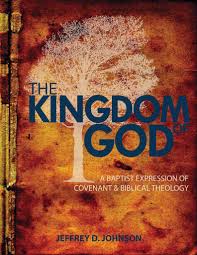
The Kingdom of God by Jeffrey Johnson

Although I had been raised in a family that attended various churches, from non-imagesdenominational military chapels with no discernible doctrine to Nazarene churches with Arminian theology (later in life I was to wonder why those preachers ever preached anything other then Hebrews chapter 6), I was never with an interest in the Word of God. When I was redeemed, I began my search for meaning in the Scriptures and found the popular dispensational teaching of my Baptist church to be very suspect and off track. Once I began learning the doctrines of grace (known as Calvinism), the Scriptures came into a more clear view and then reformed theology was opened to me and I saw the larger redemptive story in the Bible; the main point of the Scripture is to show man how sinful he is and point him to the promised Redeemer.

But something still wasn’t right. The predominate teaching in the reformed world is from the Presbyterians. And while I can accept their church practices (though I cannot agree with them), I could not see how they made the church equal to the nation of Israel. This perspective, and a couple others closely related to it, cause our Presbyterian brothers to view virtually all Scripture as applicable to the church. It was the complete opposite of what I was taught in my dispensational churches, where there is near complete separation between the church and the nation of Israel. Neither system made sense to me.

By the providential hand of God, the early part of the 21st century has brought us a renewed interest in historical Baptist views. While several very good books have been written in this rather large field, the one that made the biggest impact on me was The Fatal Flaw of the Theology Behind Infant Baptism, by a man who has become a dear friend to me, Jeffrey D. Johnson. That book made a very clear, biblical argument against the underlying theology of paedobaptism and introduced me to an historic and biblical Baptist view of covenant theology. This title, plus a couple of books on biblical theology (a process that keeps systematic theology from losing its place in Scripture – biblical theology is the contextual study of what the Bible says. The historic, redemptive context of a passage provides more clues to its meaning than anything other than related Scripture.), were foundational in helping me the Word of God even more clearly.

And now, much to my joy, our brother and servant of God, Jeff Johnson, has written another book: The Kingdom of God, A Baptist Expression of Covenant and Biblical Theology, due out early next year. Rather than a polemic pointing out the errors of paedobaptist theology (in an effort to convince Baptist to stay in the camp and comprehend a better view of the covenants), Jeff’s new book is a focused apologetic in favor of the historic Baptist view of covenant theology and biblical theology.

Is this stuff important? While it’s not as important as a biblical comprehension of who you are and who is the Christ, it is pretty important stuff. Because it will help the reader see the importance of approaching the Scriptures with humility rather than with unexamined presuppositions that subtly influence your understanding of what you read. When we open the Bible, we are taking into our minds the Word of God. The right fear of God and humility because we rightly see ourselves are essential attitudes for certain understanding of His Word and the covenants revealed therein. Charles Spurgeon went as far as to say, “The doctrine of the covenant lies at the root of all true theology. It has been said that he who well understands the distinction between the covenant of works and the covenant of grace, is a master of divinity. I am persuaded that most of the mistakes which men make concerning the doctrines of Scripture are based on fundamental errors with regard to the covenants of law and grace”

Johnson’s writing style is straight forward and easy to read. The main focus on his study of covenant theology is the Abrahamic Covenant and the duality therein. Failure to see the continuity as well as the discontinuity would leave one embracing paedobaptist theology on the first hand or dispenationalism on the other. From an early chapter in his new book, “In one sense, the debate between the continuity and discontinuity of the Old and New Covenants centers on the true identity of the people of God and the relationship between Abraham’s physical seed and Abraham’s spiritual seed, which returns us to the original question. Who are the true people of God? Are God’s people “the nation of Israel”? Are the people of God “believers and their seed?” Are the people of God “believers only?” Are God’s people some sort of combination of the two groups? The differing answers given to this question are what separate these theological positions from one another.”

He ends this section of the book with an examination of the covenant theology revealed in the book of Romans, showing how the Apostle who wrote Galatians was consistent in his theology, even when it went against his deepest human concerns.

The second part of the book is relatively short introduction to biblical theology which makes this topic approachable by any child of God. The historical record from Scripture shows the rise and fall of kingdoms and peoples, all of which were brought to pass to deliver, preserve, and protect the promised Seed. Creator God is the God of means as well as ends. Biblical theology helps us see His hand of providence in history and keeps us from falling into the error of thinking man is in charge of his own destiny.

There is a BONUS appendix in this book, where brother Johnson takes a quick look at The New Perspectives on Paul. Some who are impressed with the wisdom of man have been swept away by this new view; Jeff shows us why the wisdom of God is to be trusted – even in the face of all the king’s men with all their advanced degrees. The biblical Apostle Paul, not the one found in The New Perspectives, told us he did not come to us with brilliance of speech or wisdom, for he didn’t think it was a good idea to know anything among us except Jesus Christ and Him crucified. He came to us in weakness, in fear, in much trembling. His speech and proclamation were not with impressive words of wisdom but with a powerful demonstration by the Spirit, so that our faith would not rest on the wisdom of men but on God’s power.

40% off: Pre-publication sale for The Kingdom of God: A Baptist Expression of Covenant & Biblical Theology.  280 page, hardcover with dust jacket.  Retail price $28.00.  No payment necessary until after it is released. To reserve a copy, email freegracepress@gmail.com. Reserve two copies for 50%, plus free shipping. This is a pre-publication sale only. This offer ends on 27 November.

The Primacy of the Abrahamic Covenant

Why does it matter how one views the covenant with Abraham? Are there actually different views Covenant Viewon it? My experience leads me to believe that most folks don’t really think too much about such things. Yet this singular item is, in fact, the biggest wedge between Reformed Baptists and our Presbyterian brothers.

As pointed out in this book review, the matter of covenants in the Bible and how one looks at and considers them makes a huge difference in myriad other doctrines that sprout forth. To help understand this issue further, I commend this sermon by Jeffrey Johnson, on the topic of the Abrahamic Covenant.

In addition to Johnson’s wonderful book, I recommend this new addition to anyone’s library.

Book Recommendation – Convert: From Adam to Christ

I was recently given the opportunity to read a copy of the book “Convert: From Adam to Christ” by Pastor Emilio Ramos with the request that I post a review online at Amazon.com. After spending a weekend pouring through this text, I must highly recommend this book to anyone who is striving to understand just what it means to become a born again follower of Jesus Christ. Pastor Ramos does a wonderful job of explaining what it means to be a child of Adam, born into a life of sin and why we can never escape the grip of it on our own accord. Additionally, he takes the reader through the theology of what it means to be born again by the sovereign hand of God into Christ. Through all of this, Pastor Ramos continually reinforces everything he writes with sound and contextual citations from scripture.

What truly surprised me with this book, was how much time and effort Pastor Ramos put into explaining throughout the chapters of just what it means to be “in Christ.” This was not just a theological treatise on how a person gets saved, but what being saved means in the life of a Christian. Not only does he address how we enter the new life through a new birth by the hand of God, but he expounds upon the changed heart and mind of one who has been made into a new creation. He takes the Christian through the theology of our separation from the world, our mission while we still live in this world, our responsibility to the local church and our command from Christ to make disciples throughout the nations.

It is my sincere desire that every Christian take the time to pour through this book and really learn what it means to go from being a wretched, foul sinner in Adam, to being a redeemed and new creation in Christ.

Book recommendation: “Escape from the World Trade Center” by Leslie Haskin.

I fully understand that this will be a very controversial post (perhaps the most controversial post in DefCon’s history) and I’ve even been reluctant to post it (opting to leave it sitting in pending drafts for quite awhile). But even if it causes some to cease their readership of this blog, the truth needs to be told.

For almost a year now I’ve been revisiting the events of 9/11/01, without prejudice or preconceived notions, and I have come away shocked with what I have discovered. The more I look into the events of that day the more I am convinced that we have not been told everything about what occurred on that September morning almost eleven years ago.

So when this short book written by  professing Christian Leslie Haskin (detailing her escape from one of the three WTC towers that fell on September 11, 2001) became available for free on Kindle (from the longer book Between Heaven and Ground Zero), I download it. I was curious to read a survivor’s account of that day to see if it corroborated more with the government’s official version of the events of that day, or instead, with that of the mounting evidence pointing to a conspiracy of the magnitude never before seen in this country.

In this book, Haskin tells of her upbringing in a Christian home, her eventual turning from the faith, and how the events of September 11, 2001 brought her back to her faith in God. Haskin has written a few other books and she’s been a guest speaker around the country (and has even appeared on The 700 Club). But it was the details of her escape from WTC Tower One that I was most interested in and she did not fail to deliver. What I read in her account contradicts the official version of what happened on that day, and corroborates the evidence pointed to by conspiracy theorist’s (term not used pejoratively) to prove that not everything we’ve been told to believe about 9/11 is true.

As for the book itself, I found that the placement of Scripture throughout it seemed to be sporadic and random and it became somewhat distracting. Oftentimes the verses cited were completely out of context with the storyline. I also did not find the writing to be as polished as it could have been, as the jumping back and forth between 9/11 and other events in her past didn’t flow well to me and seemed somewhat disjointed. And the overuse of ellipses was very taxing, offering an unprofessional appearance and tone to her writing.

I also wouldn’t recommend this book on the grounds of theological meatiness as it is weak on doctrinal distinctions. I understand that this book is not meant to be a theological tome, but with the profuse employment of Scripture throughout it I would have hoped for a little more solidness in the biblical message she was trying to convey, instead of the man-centered, Hallmark card flavor it carried.

You can read more reviews of the book here where others had similar criticisms about the book.

But in spite of my above cited dissatisfaction, I still highly recommend this book because of the valuable information contained within it as the author details the things she saw, smelled, heard, and felt during her escape from the terror in her tower; things that should cause every American to ask questions without fear of being marginalized with ad hominen attacks pejorative labels like “crazy conspiracy theorists.”

So what is it in Haskin’s book that contradicts the official governmental 9/11 conspiracy theory and instead supports an alternative 9/11 conspiracy theory?

Continue reading

Book recommendation: “Under the Banner of Heaven” by Jon Krakauer.

I recently finished Jon Krakauer’s book, Under the Banner of Heaven: A Story of Violent Faith. I found the book to be very revealing of early Mormon history (much of the stuff modern day Mormons prefer you didn’t know about). Namely this book tackled Mormonism’s twin doctrines of polygamy and Blood Atonement (and detailing the hellish results those unbiblical doctrines wrought on Mormons and non-Mormons alike).

Although this work was a scathing revelation of Mormonism’s twisted and violent history, I could not help but detect the author’s occasional sympathetic bent toward Joseph Smith and the Mormon organization as a whole.

Sympathy or poor research in some instances (I am not certain which), but one example of less-than accurate reporting is when Krakauer said that when Joseph Smith fired his gun at the angry mob (the gun that was smuggled into the Carthage jail), he wounded “at least one.”

However, Mormonism’s own History of the Church cites that Jospeh Smith actually “snapped the pistol six successive times; only three of the barrels, however, were discharged. I afterwards understood that two or three were wounded by these discharges, two of whom, I am informed, died.”

I must say that there’s a chasm of difference between “wounding at least one” and “two or three were wounded . . . two of whom . . . died.”

Another instance in the book where the author would have done well to have done better research is when he writes that Calvinists teach that God is “bent on making humans atone for Adam’s original sin.”

If Krakauer did his homework he would have known that that is not the historic Calvinist position (and never has been). Calvinism teaches that God’s Son (and Him alone) is the only One able to atone for mankind’s sin that was inherited through Adam and for the sins man commits daily. It is actually the belief of Mormonism (and Roman Catholics, and Jehovah’s Witnesses, and Seventh Day Adventists, and Muslims, etc.) that man can atone for or add to Christ’s atoning work on the cross; and this in direct opposition to Galatians 5:4.

In all, although the author was incorrect on a few points, I found the book to be a fascinating look into both the mainstream LDS organization (the one’s who broke away from the original teachings of Joseph Smith and Brigham Young) and the varios fundamental LDS organizations (the one’s who still follow the original teachings of Joseph Smith and Brigham Young) with the Lafferty brothers’ murder of Erica Lafferty and her baby, Erica, on July 24, 1984, as the back drop of the book.

The book, although containing a critical overtone toward all religion, horrifyingly exposes the results of following Joseph Smith and Brigham Young’s teachings faithfully, showing that Mormonism (much like Islam) is a violent religion full of lies, deception, adultery, sexual immorality, and forever marked by the bloodshed of innocent men, women, and children.

Book Review: “Life in the Grey Nunnery at Montreal” by Sarah J. Richardson

 lifegreynunneryWhen one gets a glimpse into the evils of Romanism perpetuated in the name of Jesus throughout history, words are hard to find to express the tempest of emotions roiling within.  Here, the account of Sarah J. Richardson and her years spent in the Grey Nunnery at Montreal are no exception.  Incredulity, shock, grief, loathing and more will flood your heart as you read the incredible account of her years spent imprisoned in this whitewashed sepulcher, which indeed appeared outwardly beautiful, but inwardly was full of all manner of dead men’s bones and uncleanness.

The book starts by providing a little background on Sarah’s earliest years and how her partially intoxicated father, in an act he thought for her best interests, gave his daughter away to the nunnery.  Sarah recalls this painful time of parting from her father by writing:

I am sure my father did not realize what he was doing. Had he waited for a little reflection, he would never have consented to such an arrangement, and my fate would have been quite different. But as it was, he immediately sent for the priest, and gave me to him, to be provided for, as his own child, until I was of age. I was then to be allowed to go out into the world if I chose. To this, Priest Dow consented. … Though I was at that time but six years old, I remember perfectly, all that passed upon that memorable occasion. I did not then comprehend the full meaning of what was said, but I understood enough to fill my heart with sorrow and apprehension.

But reflect on what he was doing was not to be for Sarah’s father, for his mind was made up and for his rashness he would never again see his daughter.  And so Sarah was torn away from her family and the world at large and carried away unto the world of the convent from which the eyes of most are prevented from venturing too deep into its hidden recesses.

From here Sarah begins the recollection of her life and the strict discipline and monastic life she was subjected to.  Something for which Roman Catholics are well known for where self-denial and beating of the body are held in high esteem.  As far as discipline is concerned, the nunnery was marked by it where the slightest infringement of the law of the land could yield the harshest of penalties.  One such law was that the children were not to speak, nay not even to groan or turn on their sides at night lest they cause the least bit of disturbance to the “holy” silence so cherished in convents.

This “holy” silence was to be observed throughout the convent where the nuns had to walk on their tip toes, and upon opening and closing a door had to do so with the utmost of care so as to not disturb the “peace.”  A rule which Sarah found herself mistakenly breaking when one morning in haste, she closed the door much to quickly where “it came together with a loud crash.”  We pick up her story where she writes about what happened next.

On entering the room, I found the Superior waiting for me; in her hand she held a stick about a foot long, to the end of which was attached nine leather strings, some twelve or fifteen inches long, and about the size of a man’s little finger. She bade me come to her, in a voice so cold and stern it sent a thrill of terror through my frame, and I trembled with the apprehension of some impending evil. I had no idea that she was about to punish me, for I was not aware that I had done anything to deserve it; but her looks frightened me, and I feared,–I know not what. She took hold of my arm, and without saying a word, gave me ten or twelve strokes over the head and shoulders with this miniature cat-o’-nine-tails. … But when I began to cry, and beg to go to my father, she sternly bade me stop crying at once, for I could not go to my father. I must stay there, she said, and learn to remember all her commands and obey then. She then taught me the following verse:

   I am a little nun,
The sisters I will mind;
When I am pretty and learn,
Then they will use me kind.
I must not be so noisy
When I go about the house,
I’ll close the doors so softly
They’ll think I am a mouse.

And so began the life of Sarah in the convent.  A life which would be filled with torments and griefs that far surpassed her beating for closing the door too loudly.  Beatings not for her alone though but for all within its walls who dared to violate the orders of the Superior and priests, not matter how inane or petty they were.

More can be said but the reader of this post is encouraged to take the time and read this book for themselves.  In posting this I know many will outright dismiss Sarah’s account as the ravings of a lunatic or the ramblings of yet another anti-Catholic conspirator. To this charge the reader would be well advised to study the history of Rome before making such a hasty verdict.  For we only need to look back a few years to recall the horrors and abject wickedness of Romanism brought into the light as the “sex scandal” became headline news.  Horrors that if protested against before this story broke, would have met with the same denial, incredulity and ridicule.

Or, one should peer back a little into history at the time of the inquisitions to find that men were of such hardened hearts that they could inflict the most horrible of terrors upon those who would not submit to the Papacy.  All of which that Rome would assiduously deny until there was so much proof she could do nothing but slink back into her corner.

The Church – Why Bother?

I was privileged to be able to read this book before it went to print. My short review is below, but first – here is a short promotional video from the author, for the book which can be purchased here: http://www.freegracepress.org/?p=1050

Review of Jeffery D. Johnson’s THE CHURCH: WHY BOTHER?

By Stuart L. Brogden, Jan 2012

The table of contents highlights key areas of ecclesiology that gives the reader high hopes from the beginning. In his Introduction, Johnson rightly begins with a contrast between “easy-believism” and “Lordship salvation”, describing the link between one’s view of soteriology and ecclesiology. A low view of God brings about easy-believism and a hatred for the sovereignty of God. In his discussion of Lordship salvation, the author explains the biblical view of this transaction – such that no one reading would be able to keep their straw-man view of Lordship salvation (professing it is works-based) in hand. Grace alone accompanied by repentance – a stark contrast to the normal process of decisional regeneration. The Introduction comes to a satisfying close by telling us the reason for the book: to “show how a high view of God and a low view of man should shape our understanding of the nature, purpose and functions of the local church.” To that end, Johnson has review questions at the end of each chapter, for group discussions. Furthermore, each chapter has a sub-title, providing insight to what lies ahead.

Chapter 1 (“Wow, What Nice Facilities You Have”) focuses on the nature of the church; Johnson provides a solid, biblical portrayal of the New Testament church, as a Truth bearer comprised of justified, sanctified believers who are united for the life of the brotherhood and proclamation of God’s Word. Frank Viola should read this book 🙂 Chapter 2 (“Church, Why Are We Here?”) is all about the purpose of the church – to glorify God by upholding the Truth, bringing the saints to maturity, and to evangelize the lost. This is accomplished by standing firm on the whole counsel of God’s Word, fostering holiness in its members. Chapter 3 (“Culturally Acceptable, I Mean ‘Relevant’”) then tells us the nature of the church. Johnson draws a clear line between God’s prescription and description of the church and natural man’s view with this piercing analysis: “When the line between a holy church and secular world is blurred, undoubtedly the church will become anthropocentric (man-centered) rather than Christocentric (Christ-centered).” The chapter is a fine description of both sides of this issue, leaving no doubt where Truth lies – the church must reflect Christ if it to bring glory to God or be any good to man.

Next, in chapter 4 (“Programs, Programs, Programs”), the author reviews the activities of the church. Rather than embracing myriad programs of all stripes to reach the culture, the church has 5 basic activities for use in fulfilling the first and most important part of its two-fold mission(to glorify God): to worship God 1) by preaching the Word; 2) through prayer; 3) through fellowship; 4) through the ordinances; and 5) through song. There may be other activities in a church, but they must not be permitted to overshadow these 5 or push them aside. This leads to the next chapter (#5 – “Hey God, Look at Me Worship”), which covers worship. Johnson provides 6 aspects of right worship – all of which are from, through, and to God and Christ. He then defends “Biblical Regulated Worship” with 6 principles, including a detailed examination of the need for holiness and demand that it not be sensual. His 5th principle is one that would benefit many in the home-church movement – worship must be orderly. Lastly, he re-emphasizes the reality that any worship of God that does not come from His Holy Word is the product of man’s imagination and not fit for use in His body; the church does not have the authority to be creative in worship.

Chapter 6 (“Drive-thru Membership”) is about membership, emphasizing the importance of belonging – in contrast to the cultural concept of association by convenience. Johnson describes the terrible impact of post-modern, self-absorbed thinking which reduces membership to a social experiment. He moves on to describe the spiritual union enjoyed by those in the local church, which is the result of the Holy Spirit working therein. This chapter has a rather long and beneficial description of the necessity, seriousness, responsibilities and privileges, and terms of church membership. The section on responsibilities and privileges details responsibilities toward God, one another, church leadership and those outside the church. This leads naturally to the discussion in chapter 7 (“Church Discipline, What’s That?”) on church discipline, starting with this: “The church must deal with the leaven before it contaminates the spiritual integrity of the whole church (1 Cor 5:7-8).” The author provides 5 steps of church discipline; describes the attitude of church discipline; the purpose, authority, and efficacy of church discipline. All of this is founded on Scripture and reasoned faithfully.

Authority within the church is the subject of chapter 8 (“The Survey, ‘Says’”), in which Johnson begins by summarizing the nature of the church (covered in chapter 1) and quickly moves to a short examination of cultural influences that undermine the authority God has given each church; summing it thusly: “The church abrogates its authority by putting the potential visitor in charge.” He then provides a concise review of the biblical authority in each church followed by a good review of the basic government thereof. The chart comparing qualifications for elders and deacons is very helpful to anyone studying the two offices of the church. A large bit of this chapter is devoted to describing the pastor – he is called by God, called to be shepherds, called to serve, called to preach, called to counsel, and called to live an exemplary life. Our author then provides a short summary the responsibilities of elders and of church members (using the unfortunate term “laity”). This chapter is packed with much good information not found nor discussed in many churches, as so many are allergic to spiritual authority.

Chapter 9 (“We Need Concession, Not Confessions”) – the last chapter of the book – discusses doctrinal standards within the church. Johnson begins by examining how many churches have abandoned confessions in favor of vague, ambiguous statements motivated by (1.) indifference, (2.) ignorance, (3.) pragmatism, and (4.) mysticism. This chapter is focused on mysticism, as the author believes it to be the root of the others. He gives short reviews of the first 3 rationales and moves to a somewhat longer review of mysticism, describing its nature, its influence, and the corrective action. Johnson admits some parallels between Christianity and mysticism, acknowledging the saving knowledge one has of Christ cannot be communicated to others; knowing Christ is a gift from God to each one called. Yet God is – within limits He established – knowable by man in general and in a saving way by the elect. This is the conflict with mysticism, which is founded on the presumption of the ultimate unknown being that which is sought. The fact that man cannot know God completely does not make mysticism correct, as God is known by many and can be known. Johnson uses this confusion in the ranks as a platform to encourage the use of confessions – to equip the saints with biblical truth upon which their experiences and emotions are rooted. That of God which is knowable is summed up in a good confession and this provides a useful tool to defend against mindless chatter about “just being biblical” or “all I need is Jesus”. We do need to be biblical and Christians do need Jesus – but we must be equipped by the biblical revelation, not led astray by human ignorance.

Not to be overlooked is the appendix, which provides excellent tools helpful in generating a church membership agreement, outlining responsibilities of church and members.

Those churches which have neglected the serious aspect of membership would benefit greatly from a close study of this entire book, including the appendix. For a short book, this book is a great resource for any pastor or church member who wants to better understand what the Word of God says about His church. It is easy to grasp the author’s message and short enough for even the post-modern ADHD adult to get through. It will benefit the soul of anyone who reads it. May God use this book for His glory and the good of His people.

Book recommendation: “Primetime Propaganda” by Ben Shapiro.

I grew up on a steady diet of TV and have fond memories of such shows as CHiPs, the A-Team, Miami Vice, Facts of Life, Dukes of Hazzard, Diff’rent Strokes, Family Ties, Silver Spoons, Punky Brewster, Alf, the Cosby Show, BJ and the Bear, and Sheriff Lobo.

As I grew older my TV watching waned considerably, but it wasn’t until 2007 that my family and I completely cut TV out of our life and I haven’t regretted it one iota.

So since my TV watching days were long over, I would never have expected to be interested in or actually read a book about television, let alone one that was over 300 pages in length. But when Ben Shapiro’s book Primetime Propaganda was on sale at last year’s Border’s going out of business sale for a ridiculously low price, I couldn’t pass it up.

I must say that I was pleasantly surprised at what an engaging and thoroughly researched book it turned out to be. Shaprio has written a definitive work on the history, politics, and propaganda of television. He meticulously examples how so much of what has been broadcast on television leans left–far left–and how that came to be.

Here is Amazon.com’s description of the book:

The inside story of how the most powerful medium of mass communication in human history has become a propaganda tool for the Left

Primetime Propaganda is the story—told in their own words—of how television has been used over the past sixty years by Hollywood writers, producers, actors, and executives to promote their liberal ideals, to push the envelope on social and political issues, and to shape America in their own leftist image.

In this thoroughly researched and detailed history of the television industry, conservative columnist and author Ben Shapiro argues that left-leaning entertainment kingpins in Los Angeles and New York have leveraged—and continue to use—their positions and power to push liberal messages and promote the Democratic Party while actively discriminating against their opponents on the right. According to Shapiro, television isn’t just about entertainment—it’s an attempt to convince Americans that the social, economic, and foreign policy shaped by leftism is morally righteous.

But don’t take his word for it. Shapiro interviewed more than one hundred of the industry’s biggest players, including Larry Gelbart (M*A*S*H), Fred Silverman (former president of ABC Entertainment, NBC, and vice president of programming at CBS), Marta Kauffman (Friends), David Shore (House), and Mark Burnett (Survivor). Many of these insiders boast that not only is Hollywood biased against conservatives, but that many of the shows being broadcast have secret political messages. With this groundbreaking exposÉ, readers will never watch television the same way again.

Reading this book solidified for me what I already knew: That programs on television are intentionally liberal with the purpose of changing the hearts and minds of its viewers.

This book also furthered my bewilderment regarding Christians who use this medium as a form of entertainment. It simply boggles my mind at just how many Christians will not only willingly digest the steady stream of messages from television that are deliberately antithetical and hostile to their faith (and allow their children to do so as well), but also how so many Christians will defend and justify their consumption of this trash.

It’s amazing to me that they wouldn’t dare step foot in (and take their kids to) many places in this world because of the sin present there, yet they’re perfectly fine with allowing just about anything and everything the world has to offer to be piped into their home via a television set. What they shun in real life is happily digested as “entertainment” in the comfort of their living room.

I cannot recommend this book enough to those Christians who see little to no problem with regularly setting the images, messages, and “wisdom” of the world before their eyes, ears, heart, and soul through the medium of television. And the author of this book simply can’t be dismissed as a Legalist because he has no affiliation with the Christian faith and did not write the book from a theological point of view.

Shapiro reveals the covert and overt liberal, socialist messages in everything from All in the Family to Sesame Street and will cause you to never watch television the same way again.

See also:

The Stranger

The Stranger (Sermon)

The Marketing of Evil

Family Worship and the Use of TV (Sermon)

Once More – with Feeling! “Government Education is Evil!”

I know – our (unregenerate) children are to be sent into the world’s system of “education” to be salt and light; ignoring the context which tells us it is Christians – not unsaved children of Christians – who are to be godly influences in the culture.

EDIT – for clarification: I think that if children are converted and have a credible witness of saving faith, AND a desire to contend for the faith in a government school, that’s a fine decision for parents and the child to make. At some point, every Christian will enter into the world and must know how to live for the glory of God while participating in a worldly system that is hateful toward God. The MAIN point of this article and book and video is to warn parents that the government school system IS evil and not to be deceived nor ignorant about that. Our children are more valuable than saving money and their spiritual welfare is our highest priority in their lives.

I know – we all pay taxes for the government school and it would be dumb to not get any return on that money; ignoring the fact that government schools are moral agents that indoctrinate all children into a worldly, humanistic worldview that is hateful towards God.

All the while, we sit in silent defiance of God’s commands that we who are His train up our children in godliness, in the fear and admonition of our Lord – praying that they might be saved and that, regardless of anything else, He would be glorified by and in our service.

To help Christians understand what it as stake, here’s an 8 minute video and free 600 page ebook. May God have mercy on us!

Book recommendation: “How Do You Kill 11 Million People?” by Andy Andrews.

So exactly how did the Nazis get so many people to cooperate with them in marching toward their deaths without resistance?

This book tells you.

This was an eye-opening read and my only criticism is that its extremely short in length. I felt the author could have gone on and provided more examples and more insight, but even for its short length (you can read it in less than an hour), I was still hit by the truths presented in it. 

Watching current events unfold, this book may not only be about history, but it may very well be a warning for what’s about to come to America; and the author does not hold back from suggesting that grave possibility.

Book recommendation: “When a Nation Forgets God: 7 Lessons We Must Learn from Nazi Germany” by Erwin W. Lutzer

This is a fantastic book on the parallels between today’s society in America and that of Nazi Germany.

The author takes a chilling look into the similarities between the life, culture, politics, and mindset of the populace in Nazi Germany and how we are seeing history begin to repeat itself (as it often does) today. 

Here’s the book’s description:

“According to Dr. Lutzer, the German people’s progression from civility to barbarity was not extraordinary yet the Nazi regime will forever serve as an example of brutality and extreme racism run amok. More than a few benchmarks from their transition can be observed in present day American society. This book does not suggest the United States is definitely marching toward authoritarian oblivion, but that we — especially we believers — must take note of these lessons from history and be vigilant in our stand for truth, justice, and righteousness.”

This book serves as not only a history lesson, but as a warning for where we’re headed. Here is a quote from the book:

. . . [L]aws making education in public schools compulsory have historically been found in the most totalitarian of governments where state-sponsored indoctrination was a major goal of the educational system. Although it is still legal to homeschool children in America, we can’t assume that freedom will continue. . . . The children in [Nazi] Germany were subjected to films that presented the Nazis’ view that the Jews were subhuman and that they were an unnecessary burden on society. Darwin’s evolutionary notions were also presented in the classroom to extol the virtues of the Aryan race (the Germans) and that the evolutionary idea of survival of the fittest could be hurried along by the extermination of the weak. Since only the fittest survive it makes good sense that “might makes right.” Hitler asked, “Why can’t we be as cruel as nature?”

And here is another quote from the book:

When Hitler starved children, he called it putting them on a “low-calorie diet.” And the extermination of Jews was called “cleansing the land.” Euthanasia was referred to as “the best of modern therapy.” Children were put to death in “Children’s Specialty Centers.”

Hitler’s cronies seldom said they were going to kill people; even when plans were made to exterminate millions, the leaders spoke only in abstract slogans such as “the final solution.” Sanitized terms were used to camouflage unspeakable crimes. Planned massacres were spoken of in clinical terms to mislead the naïve and to assuage the conscience of the perpetrators.

We do the same, of course. No one speaks of killing preborn infants. Rather, pregnant women are only removing “a product of conception” or a woman is simply “terminating a pregnancy.” Politicians speak of being in favor of “a woman’s right to choose . . .” but they seldom complete the sentence. Somehow to say they are in favor of a woman’s right to choose to kill her preborn infant, is too honest, too clear—we might add, and too chilling.

Homosexual behavior turns out to be nothing more than “an alternate lifestyle.” And adultery is reduced to the more innocuous word: affair. Schools that demean religion and promote immorality are said to be “value free” and laws which deny religious speech are promoted as “the fairness doctrine” or simply promoting “localism.” Historically, horrendous crimes have been committed in the name of liberty.

After reading this book (and previously posting a quote from it), I was informed that the author holds to the idea of easy believeism. I did not see this presented in the book as the author dealt mostly with how history is repeating itself in politics and culture, so the book is safe for consumption in that regard.

Finding Faithful Edlers and Deacons

This is an astounding little book! Everyone in the church would benefit from reading it. Those men who desire to serve or are currently serving in either of the offices of the church will benefit as they gain insight on how to examine themselves and pursue godliness – keeping Christ and His completed work forefront in their lives, for the good of the people they serve. Christians are given insight and questions to ask of men who desire to serve or are currently serving – to help them better understand each man’s qualifications and suitability for service. Easy to read, with 28 short chapters – each full of encouragement to never stop growing in the grace and knowledge of our Lord Jesus.

About the Author

THABITI ANYABWILE is senior pastor of First Baptist Church of Grand Cayman in the Cayman Islands. He served previously as an elder and assistant pastor at Capitol Hill Baptist Church in Washington, DC, and as an elder at Church on the Rock in Raleigh, North Carolina. His other works include What is a Healthy Church Member, The Faithful Pastor, and The Decline of African-American Theology.

Book recommendation: “The Giant Killer” by A.L.O.E.

I recently finished reading an intriguing story by ALOE (A Lady Of England) to my children entitled, The Giant Killer (1856).

This allegorical tale (told in a fashion similar to Bunyan’s Pilgrim’s Progress) is about a noble knight named Fides who battles giant sins such as Giant Untruth, Giant Hate, and Giant Pride. Reading this to my children gave us much to talk about and helped them understand the battles with sin that we all face.

Lamplighter Publishing describes the book as follows:

The battle continues to rage, day by day and moment by moment. But must we meet the enemy blindfolded? In order to subdue, we must see the real foe; in order to conquer, we must face the true enemy. Through this allegorical tale, we will be better equipped to recognize, then to effectively slay, the many Giants who confront us. We will break through the web of Sloth, struggle out of the pit of Selfishness, choke up the fount of Anger, flee the secret lurking-place of Untruth, and triumph over our most malicious enemy—Pride. The Giant Killer is the tool to reach for if you or your loved ones need encouragement or confidence to enter into the battlefield once again. If you feel that you have nothing firm upon which to lay hold, this book will help you to grasp the strong cord of Love as your means of safety and deliverance.

And here is a reader’s review:

Another wonderful book from Lamplighter Publishing, The Giant Killer is an allegorical story of Christian warfare. Constantine and Adolphus, twin brothers, are sent to live with the Roby family to have Mr. Roby educate them. The spoiled 10-year-olds have much to learn about kindness, thankfulness, and manners. Mrs. Roby teaches these children and her own about godly character traits through stories about “The Giant Killer.” The Giant Killer must fight and conquer the Giants of Sloth, Selfishness, Untruth, Hate and Pride with the sword and armor given to him by his King. Your children will learn as these fictional children did to fight the enemies of the King that are in their own hearts.

Although this is not the best Lamplighter book I’ve ever read (The Basket of Flowers still holds the position of number one for me), it is still a good book that I recommend, and espeically for Christian parents to read to their children.