
Sola Scriptura

The Confession Alone: The 6th Sola
Confessions and formalized creeds have been an edifying edition to the Christian faith. Since the beginning of the New Covenant (and even further back since the dawn of teaching), mankind has formalized and rehearsed many sayings, creeds, idioms, and other phrases that have refreshed our minds about a how we ought to think or understand life. Within Christendom, there are certain flavors of creeds and confessions that we Reformed folks hold to very dearly. Assuming that you understand which confessions exist, I seek to make my point quickly. If you have never read a creed, confession, or catechism, I highly suggest you do some research and learn from them.
Having said all that, there is an authoritative flaw in our Reformed circles. I call it he Sixth Sola: Confession Alone. It is this idea that if it is not a part of your confession, it cannot (or in some cases should not) be taught or even considered as biblical. Or, practically speaking, although we do not verbally admit this, when we are discussing Scripture with someone, and the first thing that comes out of their mouth is “X confession says…” when making their case, it is making the confession the ultimate authority in the conversation (unless they are just using the confession as a springboard to talk about Scripture). I am aware that this last statement may have ruffled more feathers than the first, but understand what I am actually saying and do not misinterpret my words. If your first or final authoritative response in any discussion about theology or what the Bible teaches concerning what you believe and why is “the confession says” you have turned a guidepost into a destination.
Most, if not all, creeds, confession, and catechisms are reactive. That is, they are written and formed based off of some other creed or confession that is in opposition, and those forming it wish to distinguish themselves for the opposing party. It can be in response to false teaching (or perceived false teaching), or it can be simply trying to make a stand about a certain belief within a specific community that affirms X belief(s). As I already said, this is not inherently wrong. These are great ways to find out where your stand in your faith. i would argue that it is impossible to say anything without it being “creedle” in some way. But if you do not study the Scriptures and seek to understand why you believe what you believe, and whether or not you think you can agree with these confessions, you are placing the cart before horse. The confessions can point you in a specific direction (guidepost), but they are not the final authority (destination). Our first response in any discussion should be Sola Scriptura, not Sola Confessio (Latin check). Yet, time after time, when I dive into the Scriptures with particular pastors, preachers, and believers who ascribe heavily to confessions and creeds, whenever there are any disagreements or whenever I make my points from Scripture, I am faced with “but the Confession says…” How can this be within a Reformed world whose foundational mindset is supposed to be Scripture Alone?
There can be many reasons why one authoritatively appeals to the a confession more than Scripture. But I think I have narrowed them down to two main roots: Traditionalism and laziness. There is nothing wrong with tradition. Every denomination and person has them. It is when that tradition begins to have authority over Scripture that we have a huge problem. Some people find great joy in holding to the long standing tradition that some of our creeds and confessions teach. Nothing wrong with that if you understand what you believe and why. But it seems that this is not the case with many. By proxy, if you are a traditionalist in this area, you will quote the confession better than you can quote Scripture because you are relying on the confession to approve yourself before God (or men). Unless for whatever reason you don’t have any access to Scripture, or in some way you are only able to memorize Scripture by categorizing them via the confession, there should be no reason why you cannot study for yourself what the Bible teaches within the pages that the confessions are pointing to. Which brings me to my next point.
I find that it is easier to quote a saying, phrase, creed, etc., in place of actually making a verbal argument concerning what you actually believe and why. Nothing wrong with summarizing what you believe, or repeating a summarization of something you would affirm. But If I believe that the reason why man exists is to glorify God and enjoy Him forever, why? Because the confession says so? Or because the Scripture quoted in the confessions says so? Have I looked at the listed Scriptures? Have I taken the time to study and reform my thinking in light of the Scriptures that a confession teaches? Will I be courageous to practice Semper Reformanda if I discover some nuance in the Scriptures? Or will I be taking the confession at face value because my community of believers/churches do? Or because the men before me were theological giants who were totally incapable of error even in the minutia? Laziness is what causes us to use the confessions as they were not meant to be used. These are guideposts, not destinations.
Notice, I am not challenging the confessions. Nor am I exhorting anyone to cast away the didactic luxury that they bring to our lives. I am challenging how we think concerning them. We all have a tendency to elevate anything good over God. That is evident in Scripture and in our daily lives. If we find ourselves running to the confessions and creeds as our primary authoritative source for understanding and assurance of our faith in Christ, and we can quote and explain a confession easier than we can explain Scripture and the gospel, we must immediately eject ourselves from the seat of traditionalism and laziness, and we must diligently seek God through the Scriptures for our assurance and understanding. This doesn’t mean we cannot use the confessions to help us in this direction. But once again, where does your affection, affirmation, and assurance of your faith lie? In Scripture Alone, or in the Confession Alone? Is it because the confession says so that you believe X, Y, Z, or is it because you have studied and affirmed that the Scriptures teach it?
One last time, I am not bashing any confession, or the use of them in discussion. But I am standing against any form of authoritative proclamation or behavior that insists that the confession is the first and final say so in any biblical discussion and practice. If your “go-to” argument and assurance of your belief is “the confession says,” you’ve lost all credibility. And if the confession is your main source for approving yourself before God, your credibility may not be the only thing that is lost.
-Until we go home
What Must I Do To Be Saved?
Soteriology is the doctrine of salvation – how does one get reconciled to God? It is my desire to show you how essential it is to grasp this doctrine rightly and how humbling and wonderful it is to comprehend what the Lord God has done in redeeming people. 
While there are many religions in this world, with myriad differences, they all have a few things in common and many differences. But no matter the religion, no matter the salvation, no matter the god, all systems of religion, including biblical Christianity, are based on salvation by works. All systems of religion are based on salvation by works. The differences lie beneath that truth. All but one system bases salvation on the works of those who need to be saved. The sole exception is based on men being saved by the finished work of another, a particular man who had no sin of His own to pay for. A man who is God and paid the price for others. The Lawgiver became the Law keeper for Law breakers. This exception, as I’m sure you already know, is our faith – biblical Christianity, based on the work of the God-man, Jesus.
Among professing Christian groups, many variants and shades exist, with most falling into self-saving works of the creature. These views are known as Pelagianism, Semi-Pelagianism, Arminianism, Universalism, etc. All of these are variations of synergistic modes of salvation – systems in which creator God is at best a co-pilot in redeeming people. The Scriptures, which are our only rule for truth and faith and godliness, depict God as the One Who created and sustains all things, directing the paths of kings and storm clouds, saints and Satan. Properly understood, the Word of God reveals a monergistic mode of salvation – children of God are born not of blood nor of the will of the flesh nor of the will of man, but of God alone (John 1:13). Since Scripture cannot be broken, monergistic salvation and synergistic salvation cannot both be true. The passages that appear to contradict each other do not. Our understanding and comprehension are limited and twisted by sin – the Word of God is perfect and by it the Lord searches out our intentions and thoughts. To rightly understand this doctrine of how sinners are made right with holy God, we must humbly submit to the Word of God and cry out for wisdom from the Spirit of God.
This dispute over how a sinner is reconciled to Holy God has been raging among men since Cain’s offering was refused. In the early 17th century a protest was filed with the ruling church court in the Netherlands by activist disciples of Jacob Arminius. Here are the five articles contained in the protest presented to the Council of Dort:
- God elects or reproves on the basis of foreseen faith or unbelief.
- Christ died for all men and for every man, although only believers are saved.
- Man is so depraved that divine grace is necessary unto faith or any good deed.
- This grace may be resisted.
- Whether all who are truly regenerate will certainly persevere in the faith is a point which needs further investigation.
Only the third point reflects biblical truth and was later denied by many of this view. The bedrock of the Arminian objection to monergistic salvation is the notion that divine sovereignty is not compatible with human freedom and that ability limits obligation. This is complementary to the Pelagian view that God would never command man to do that which man was incapable of doing. However, the Scriptures are replete with commands from God to the creature to do that which nobody but God can do, such as be ye perfect, and love God with all your heart, soul, mind and strength. These commands are meant to drive self-righteousness from us and draw us to Christ. The Arminians claim God gives every human the ability to believe on Jesus, and that God will never refuse anyone who exercises that ability and comes to Him in the faith that God gives to everyone; but only some exercise it and are saved. If this is the case, who gets the credit for the sinner’s salvation? And what do we do with 2 Thess 3:2 which tells us not all men have this faith?
Most professing Christians hold to Arminianism, having never heard anything else because most churches do not teach the whole counsel of God’s Word. I personally believe that all Christians are born spiritually as Arminians because we are only accustomed to what our natural senses can discern. And when one is born again, the first thing he is aware of is that he chose Christ; without yet knowing that Christ first chose and first loved him. The Arminian system makes sense to the natural mind, confirmed by natural senses. It shows up in our language: when we say someone “accepted Christ” we imply the person needing salvation decided to get saved. But Scripture denies this. This is why it is of utmost importance that evangelism be firmly connected to and rooted in discipleship. A new-born child of God must be shown and taught the Bible – what he was before he was raised from the dead and what soil preparation the gardener performed to make the seed take root.
In understanding what it means for anyone to be redeemed, to have been reconciled to Holy God, to be made into a new creature, we must grab hold of the biblical reality of our union with Christ. Ephesians 1:3 tells us we were blessed with every spiritual blessing by God the Father – that these spiritual blessings are in the heavenly places and they are in Christ. We mortal sinners get no heavenly, spiritual blessings apart from being in union with Christ, in communion with Christ.
There are several terms that describe what happens when a person is raised from spiritual death, referred to as the order of salvation:
- Predestination: Rom. 8:29 & 30; Eph. 1:3-6 & 11-14
- Effectual Calling (Regeneration): John 1:12 & 13; 6:44, 63-65; Eph. 2:1-5
- Faith/Repentance:
(Faith) – Eph. 2:8,9; Acts 13:48, 16:14
(Repentance) – 2 Cor. 7:9 & 10 - Justification (Legal Declaration): Rom. 5:1 & 2; 2 Cor. 5:21; Gal. 2:16
- Adoption: Rom. 8:15-17, 23-25; Gal. 4:4-7
- Definitive Sanctification: Rom. 6:1 & 2; I Cor. 1:2; 6:9-11
- Progressive Sanctification: Eph. 4:11-16; Phil 2:1-4, 13-15
(Preservation of the Saints) – John 6:37-40; 10:27-30; Phil. 1:6 - Glorification: Matt 25:31-34; 2 Cor. 5:1-8; Phil. 1:21-23; 3:20 & 21
The first of these, predestination, took place before the foundation of the world. Ephesians 1:3-4 Blessed be the God and Father of our Lord Jesus Christ, who has blessed us in Christ with every spiritual blessing in the heavenly places, even as he chose us in him before the foundation of the world, that we should be holy and blameless before him. Predestination is not a reaction to The Fall. God has no “Plan B”. Predestination is “Plan A”. The balance of the steps in this process take place in time, although regeneration, faith, repentance, and justification cannot be separated; we know that they happen in this order but are unable to plot them out, they are so tightly connected. But notice – regeneration comes before faith and repentance. That which is dead cannot develop root nor produce fruit. The soil must be prepared before the seed can sprout. If we do not properly understand this, we are vulnerable of being drawn aside into the Arminian camp, who claim that the spiritually dead sinner exercising faith in Christ causes regeneration. It is this level of attention that is required to discern between good and evil, as we are told in Hebrews 5:14 – But solid food is for the mature, for those who have their powers of discernment trained by constant practice to distinguish good from evil. We have the same fine degree of difference with the Roman Catholic doctrine of “salvation”, wherein the sinner is infused with grace and thereby enabled to be holy and pleasing to God, but never arriving at any assurance of having been saved. The Scriptures teach that sinners are imputed the righteousness of Christ and are thereby justified by grace that is apprehended by the faith that was itself a gift to us – lest anyone boast in anything other than the cross of Christ! Nothing in my hand I bring, only to the cross I cling – this is how we all come to saving faith, no matter what our senses or churches tell us.
Kevin DeYoung, in Chap 7 of his book, The Hole in Our Holiness exhorts us: “… it’s appropriate … to talk about an “order of salvation”, whereby we are called by the Spirit of God, born again, moved to faith and repentance. Justified, adopted, sanctified, preserved, and glorified, we must never separate these benefits from the Benefactor. Every blessing in the order of salvation flows from our union with Christ.” John Murray is quoted as saying, “Union with Christ is really the central truth of the whole doctrine of salvation, not only in its application but also in its once-for-all accomplishment in the finished work of Christ.” We often talk about gifts we get from God – provision in things of this world, for the most part – and need to remind ourselves to not confuse the gift with the Giver. So it is with this greatest gift of all; while we will not truly understand the depth and richness of God’s saving grace towards elect sinners, we must not get so fixed on that spiritual blessing that we lose sight of the One in Whom we have that blessing. If we be not in Christ, we are not His and we vainly imagine that the blessings of redemption and reconciliation are ours. Contrary to what the pope said, sincere belief in whatever god you have chosen is not going to reconcile any sinner to holy God. Responding to a list of questions published in a newspaper, Pope Francis wrote: “You ask me if the God of the Christians forgives those who don’t believe and who don’t seek the faith. I start by saying – and this is the fundamental thing – that God’s mercy has no limits if you go to him with a sincere and contrite heart. The issue for those who do not believe in God is to obey their conscience. Sin, even for those who have no faith, exists when people disobey their conscience.”
Sin is not the failure of a creature to obey his conscience! Sin is not a bad habit, a hurtful hangup, or “something less than God’s best” – as a couple of well-known preachers have called it (referring specifically to homosexuality). An inadequate understanding of sin necessarily results in an inadequate understanding of grace, redemption, reconciliation, and a number of other orthodox doctrines of the Christian faith. Sin is a moral act, word, or thought that contradicts the expressed will of God for human beings. In other words, it is a covenantal breach with the Divine covenant maker. It is not limited to the will, the intellect, or the emotion. Sin involves the whole person.
What is the practical aspect of getting this doctrine – how is one saved? – correct? There are many examples from church history, but this one is my favorite. If you have read any history of the church, you should be aware that the Church of England went through an extended period (after their separation from Rome) wherein they had difficulty finding regenerate pastors. Wesley and Whitefield and Spurgeon all rubbed up against this. In fact, both Wesley and Whitefield came to saving faith in college, after they each had spent themselves in trying to make themselves pleasing to God; following the doctrine of salvation of the Church of England. One pastor in the Church of England discovered this in a rather unique way.
William Haslam was an English country parson who was a hireling of the state, a warm body to fill the pulpit in small country church. One Sunday in 1851 following a period of deep conviction of sin, Haslam ascended into the pulpit with the intention of telling his congregation that he would not preach again to them until he was saved and to ask them to pray for his conversion.
He began to preach on the text ‘What think ye of Christ’ (Matt 22:42), taken from gospel passage handed down from the mother church. As he read about the Jewish leaders who did not see Christ as the Messiah, he saw himself as one of them – a Pharisee who did not recognize that Jesus was the Christ, the Son of God. Haslam said, “I do not remember all I said, but I felt a wonderful light and joy coming into my soul, and I was beginning to see what the Pharisees did not.” At that moment, the Holy Spirit breathed new life into him and the effect was so obvious and marked that a local preacher who was present stood up and shouted ‘the Parson is converted, the parson is converted! Hallelujah!’ and the people rejoiced loudly and with much commotion.
If one fails to see the dire consequences of sin, the hideous nature thereof; if he fails to see Holy God as the judge who weighs the universe in His hands; if he doesn’t see rightly the King of glory Who paid the price for sin that man could never pay – he will die in his sin and be lost forever.
The doctrine of soteriology is not a dry theological construct that has no relation to how we live. It is the very core of the identity we as Christians have – that of being found in Christ. The jailer asked, “What must I do to be saved?” So they (Paul and Silas) said, “Believe on the Lord Jesus and you will be saved.” It is simple in one aspect – believe on the Lord Jesus. But oh how deep and rich is the salvation we have in Christ Jesus! We are found by Him, secured in Him, preserved in Him, saved and sanctified in Him. We walk in Christ, labor in Christ, obey in Christ. We live and die in Christ; and we conquer and overcome death and hell in Christ!
The Apostle Paul fought against false doctrines that taught justification by any other means. It is an essential doctrine upon which our faith rests. All other systems of salvation rest on self-worth and deny the depth of man’s sin and the sufficiency of Christ’s finished work.
Praise the God and Father of our Lord Jesus Christ. According to His great mercy, He has given us a new birth into a living hope through the resurrection of Jesus Christ from the dead and into an inheritance that is imperishable, uncorrupted, and unfading, kept in heaven for you. You are being protected by God’s power through faith for a salvation that is ready to be revealed in the last time. (1 Pete 1:3-5)
If Pelagius was right, Christ died for no purpose. If Scripture is right, and we were dead in our sins and trespasses, our life and worth depends on the death of Christ – in our place, to placate the wrath of God the Father.
Soteriology? It’s a matter of life and death.
Truth or Tradition?
Tevye, Jewish patriarch in Fiddler on the Roof… 
It’s a very busy, tedious, hard-scratch life in Anatevka. And how do we keep our balance? That I can tell you in one word! Tradition!
Because of our traditions, we’ve kept our balance for many, many years. Here in Anatevka, we have traditions for everything. How to sleep. How to eat. How to work. How to wear clothes. For instance, we always keep our heads covered, and always wear a little prayer shawl. This shows our constant devotion to God.
You may ask, how did this tradition get started? I’ll tell you. I don’t know.
But it’s a tradition. And because of our traditions, every one of us knows who he is and what God expects him to do. Without our traditions, our lives would be as shaky as, As… As a fiddler on the roof!
As his family responds to the various circumstances of life, they each tear apart Tevye’s sacred traditions bit by bit. His traditions were not transcendent; their foundation was uncertain.
What can we learn from this movie?
Most Baptists recognize that a major part of the errors embraced by Roman Catholicism are enshrined in extra-biblical traditions that are held up as church dogma. While it’s easy to see this in the Roman religion, do we carefully examine our own walk – as individuals and churches – to see if we are guilty as well? I am quite sure we all know the teaching of Scripture on this topic, as Christ quoted Isaiah in saying to the Jews, in vain do they worship me, teaching as doctrines the commandments of men.’ You leave the commandment of God and hold to the tradition of men.” And he said to them, “You have a fine way of rejecting the commandment of God in order to establish your tradition!” Are we Baptist excluded from this rebuke? My personal experience indicates otherwise. I pray these things are not true of you!
When I was first called as a deacon, it took 6 months of discussion to agree that tithing was not a requirement of that office. I was thankful the other deacons were willing to study this topic rather than merely throw me out. When I was in a seeker sensitive church I was ridiculed because I questioned this teaching, not seeing evangelism as inviting lost people to church, as I studied the Bible.
Baptists have traditions and, like Tevye, we often do not know or care where they came from.
While in a 1689 LBC church, I saw how traditions were to be supported without question, and I was looked down upon for not taking these positions on blind faith. The Decalogue is God’s moral law – why would anyone ask where that is taught in Scripture? The “Christian Sabbath” is binding on all people – why would anyone ask where in the Bible this is found?
In the two years since moving to SE Oklahoma, I’ve been exposed to several local Baptist churches and been intrigued by the extra-biblical traditions they embrace. Just as the other groups of Baptists, they are tenacious in the blind faith they have in their sacred traditions. It’s as if, as one church-man said about his “altar call” – “It’s the most important part of the worship service!” And it’s nowhere found in God’s Holy Word. What’s more, there is no altar in the New Covenant church other than the Lord Jesus Himself. Similar attachments are tied to children’s church (unsaved people have their own worship service!) and children parading through the gathered saints, begging for money to put in an offering plate, being applauded by the adults. I couldn’t help but think of Matthew 6:1-4:
Beware of practicing your righteousness before other people in order to be seen by them, for then you will have no reward from your Father who is in heaven. “Thus, when you give to the needy, sound no trumpet before you, as the hypocrites do in the synagogues and in the streets, that they may be praised by others. Truly, I say to you, they have received their reward. But when you give to the needy, do not let your left hand know what your right hand is doing, so that your giving may be in secret. And your Father who sees in secret will reward you.
In this passage we see that the praise of men is the only reward hypocrites have for their giving; it is not accepted by God as are the gifts from the saints on behalf of the saints (Philippians 4:14-18). The parading children played the part of the hypocrites in the passage cited above, with the adults playing the part of the “others” who praised the hypocrites. As with other acts of worship, giving as worship cannot be performed by those who are not clothed in the righteousness of Christ (Proverbs 21:27) and the money earned by sin should not be offered to God (Deuteronomy 23:18).
Celebration of birthdays and wedding anniversaries of all present in a worship service are the norm. Mothers and fathers are honored on those days so identified by the greeting card industry. Veterans and firemen, et al. are honored on Memorial Day as if these men are why we gather. I’ve seen the inside of a Baptist church building virtually clothed in American flags on July 4th weekend.
All of these practices displace the worship of God with lesser things, making man and his domain the focus of at least part of the time God’s people gather to supposedly worship Him.
The standard Baptist membership covenant from the 19th century requires members “abstain from the sale and use of intoxicating drinks as a beverage.” The Bible forbids getting drunk and warns about “strong wine” but does not prohibit the sale or use of alcohol for any but a few, such as Nazarites (Numbers 6:1-7). At the end of the time of his vow, the Nazarite was permitted to drink wine (Numbers 6:13-20).
Baptists call the church building “the house of God,” forgetting one lesson from John 4 – that in the New Covenant there are no sacred spaces and that the Bible clearly declares we are the house of God! The church building is not a sanctuary, it is, as an Anglican from New Zealand put it, a rain shelter. Our sanctuary is in heaven where our altar is – Christ Jesus is our all in all!
Baptist churches have sole “pastors,” “senior pastors,” “administrative pastors,” “executive pastors,” “worship pastors,” and the list goes on. All the while the Bible shows a plurality and equality of elders (“Pastor” not being a title found anywhere in Scripture). Having two or more men who preach and teach provides several benefits, in addition to aligning with the examples and teachings from Scripture (Acts 11:27-30; 14:21-23; 20:7; Titus 1:5; James 5:14; et al.). Two or more men can sharpen one another and hold each other accountable, while the church sees the true Shepherd more clearly when they see Him work through more than one man. The church will see strengths and weaknesses in each man and those men will have the opportunity to be examples of how to serve in unity without letting egos derail the ministry. As they seek to identify others and train them for this service, more men will have opportunity to serve the saints in myriad ways. This is part of life in the body of Christ that is vital and often ignored or undervalued.
Each of these groups, and I pray, none of us, are what I call “white space theologians,” people who build their doctrine and practice on the white spaces in the Bible rather than the words God put there.
Many of these local churches have no statement of faith declaring to their members and interested saints what they believe; they accumulate their traditions along the way and new members find out by experience what’s important. This can be like walking through an unmarked minefield, and just as deadly.
We who are not of Rome tend to cling to our traditions as tightly as do the Roman Catholics. How can we defend this while rightly decrying their practice? Oh how I wish that Baptists would see the danger of our own traditions that are not based on Scripture and cry out for repentance! We were, once upon a time, called “people of the Book” for our tenacious grip on the Word of God. That name cannot, in good conscience, be applied to Baptists at large.
We protest, “Our traditions are not as bad as following Baal!” Yet search the Scriptures and see if you find any commendation for drifting away from God’s instruction in favor of any teaching of man.
My prayer is that each of us here would recognize the need we have to examine ourselves and our traditions – to see if there be any wicked ways therein. If we worship God according to our personal preferences rather than asking how does Scripture advise us to do so, we are in danger of drifting towards the black hole of Charles Finney.
D’Aubigne, in his History of the Reformation, observed, “Nothing terrifies the defenders of human traditions so much as the word of God.” He further recorded a scene in which a Cambridge professor named Bilney in the 16th century was tormented about his salvation and took the advice of Roman Catholic priests – abasing himself in myriad ways to make himself pleasing to God. He grew weak and wondered if the priests were more interested in themselves than in his salvation. He found a copy of the newly available Greek New Testament; he took it up and read 1 Tim 1:15 – The saying is trustworthy and deserving of full acceptance, that Christ Jesus came into the world to save sinners, of whom I am the foremost. He realized that Christ saves sinners and he was a great sinner who needed salvation. With joy in his soul he rose up from the Book and declared that Christ had cleansed and redeemed him, eliminating all doubt and despair. “I see it all,” said Bilney; “my vigils, my fasts, my pilgrimages, my purchase of masses and indulgences were destroying instead of saving me. All these efforts were, as St. Augustine says, a hasty running out of the right way.”
This is what traditions do, if they are not of God and are pressed down on people as if they are required in order to please Him or build up His people. It’s as Paul said, the letter kills but the Spirit gives life! Unhealthy traditions are a burden that many know not they carry; but they weigh down on them more and more until they lose sight of Christ all together, so consumed in seeing to it their sacred traditions are upheld.
God help us so this may NOT be said of us! Let us remember our Lord’s words: Let not the wise man boast in his wisdom, let not the mighty man boast in his might, let not the rich man boast in his riches, but let him who boasts boast in this, that he understands and knows me, that I am the LORD who practices steadfast love, justice, and righteousness in the earth. For in these things I delight, declares the LORD.” (Jer 9:24 & 25)
Romans 2 teaches NCT
Romans 2:12-16 For all who have sinned without the law will also perish without the law,  and all who have sinned under the law will be judged by the law. For it is not the hearers of the law who are righteous before God, but the doers of the law who will be justified. For when Gentiles, who do not have the law, by nature do what the law requires, they are a law to themselves, even though they do not have the law. They show that the work of the law is written on their hearts, while their conscience also bears witness, and their conflicting thoughts accuse or even excuse them on that day when, according to my gospel, God judges the secrets of men by Christ Jesus.
(Note: what follows is not a complete exegesis of this passage; it is a focused review of the stated topic.)
A casual read of this paragraph has caused many to get confused about Paul’s use of the term “the law;” it requires careful thought and analysis of what he is saying here and what is revealed elsewhere. Much of Paul’s use of “the law” is clearly meant to refer to the Mosaic Covenant and the Law of Moses. Those without the law are Gentiles: everyone who was not a Jew in Paul’s day, and includes all people in all ages who were not part of national Israel. It was clearly Paul’s kinsmen of the flesh who had “the law” in this paragraph.
Lost Gentiles are not without a law; God’s universal law convicts them of certain truths. We in the New Covenant are not without law; but we are not within the Law of Moses.
James gives the same counsel as Paul: But be doers of the word, and not hearers only, deceiving yourselves. For if anyone is a hearer of the word and not a doer, he is like a man who looks intently at his natural face in a mirror. For he looks at himself and goes away and at once forgets what he was like. But the one who looks into the perfect law, the law of liberty, and perseveres, being no hearer who forgets but a doer who acts, he will be blessed in his doing. (James 1:22-25) We see reference to a different law than that of Moses; one that is given to the church, not national Israel. He picks this up again in chapter two, My brothers, do not show favoritism as you hold on to the faith in our glorious Lord Jesus Christ. (James 2:1) Indeed, if you keep the royal law prescribed in the Scripture, Love your neighbor as yourself, you are doing well. But if you show favoritism, you commit sin and are convicted by the law as transgressors. (James 2:8-9) This phrase, love your neighbor as yourself, is the second great command, taken from Lev 19:18. It is the other side of the coin which also conveys the greatest command: You shall love the LORD your God with all your heart and with all your soul and with all your might, cited from Deuteronomy 6:5. On these two commands, neither taken from the Decalogue, hang the Law and the prophets – all the scripture then in hands of man. This shows us that while the Law of Moses is not our master, certain truths that apply to all of God’s people are found in his books. Jesus draws out two and declares them to be supreme to the Old Covenant, the essence of the New Covenant – love for God and one another; love as defined and portrayed in the Bible, not as our culture as deceitfully defined it these past few centuries.
Paul clarifies this in his letter to the Galatians, wherein he gives another term for the perfect law, the law of liberty, the royal law. These are not different laws we must figure out, they are different terms for the same divine concept, in simplicity for those in Christ, contrasted to the endlessly complex scheme developed by the nation of Israel. The New Covenant is contrasted with the Old Covenant in several places, the most familiar one being in Hebrews 8 where the old covenant is described as obsolete and ready to vanish. In Galatians 4 the old covenant is described as earthly Jerusalem and represents slavery while the new covenant is heavenly new Jerusalem wherein lies liberty. We, brothers, like Isaac, are children of promise, children of the free woman. And our apostle gives us clear counsel on how to keep this law. Brothers, if anyone is caught in any transgression, you who are spiritual should restore him in a spirit of gentleness. Keep watch on yourself, lest you too be tempted. Bear one another’s burdens, and so fulfill the law of Christ. (Galatians 6:1-2) This is the love of God expressed in the body of Christ – we love Him by loving one another, and this is an example of biblical love – confronting a brother caught in sin. Not exactly what the world presents as love, is it?
While only the redeemed truly love God, even we are unable to love Him with all that is within us, as the first commandment requires. In the age to come, unstained and not tempted by sin, we will be able to fulfill this law. We can, however, love one another because Christ first loved us. This must be a deliberate focus as our fleshly desires will work against us. There can be no fatalistic “let go and let God” into our lives for He tells us to work out our own salvation (here meaning the present tense “being saved” that characterizes our daily walk) with fear and trembling. As one preacher put it years ago, “The path of least resistance makes both man and rivers crooked.” Seek after the Lord – He will make your pathway straight!
You will hear simple rules such as “if it’s not repeated in the NT it doesn’t apply” and its corollary, “if it’s not repealed by the NT it applies.” These are easy to remember but not at all accurate. Tithing is seen before the Mosaic Covenant and required during it, including those Jews who lived in last century of that covenant, during Paul’s time. Such activity is taken note of the NT but not once is tithing taught by word or example as a New Covenant rule. Without understanding the rule of covenants, one cannot comprehend what rules apply. As Martin Luther summed it up, we follow Christ Jesus, not Moses – and Moses stands with us, accusing those who think their feeble attempts at keeping the Law of Moses will merit favor with YHWH (John 5:45).
The ancient preacher agrees with his New Testament brothers. He gave this advice as the sum of all he had written: The end of the matter; all has been heard. Fear God and keep his commandments, for this is the whole duty of man. For God will bring every deed into judgment, with every secret thing, whether good or evil. (Ecclesiastes 12:13-14)
Jesus said the same thing: “When the Son of Man comes in his glory, and all the angels with him, then he will sit on his glorious throne. Before him will be gathered all the nations, and he will separate people one from another as a shepherd separates the sheep from the goats. And he will place the sheep on his right, but the goats on the left. Then the King will say to those on his right, ‘Come, you who are blessed by my Father, inherit the kingdom prepared for you from the foundation of the world. For I was hungry and you gave me food, I was thirsty and you gave me drink, I was a stranger and you welcomed me, I was naked and you clothed me, I was sick and you visited me, I was in prison and you came to me.’ Then the righteous will answer him, saying, ‘Lord, when did we see you hungry and feed you, or thirsty and give you drink? And when did we see you a stranger and welcome you, or naked and clothe you? And when did we see you sick or in prison and visit you?’ And the King will answer them, ‘Truly, I say to you, as you did it to one of the least of these my brothers, you did it to me.’ “Then he will say to those on his left, ‘Depart from me, you cursed, into the eternal fire prepared for the devil and his angels. For I was hungry and you gave me no food, I was thirsty and you gave me no drink, I was a stranger and you did not welcome me, naked and you did not clothe me, sick and in prison and you did not visit me.’ Then they also will answer, saying, ‘Lord, when did we see you hungry or thirsty or a stranger or naked or sick or in prison, and did not minister to you?’ Then he will answer them, saying, ‘Truly, I say to you, as you did not do it to one of the least of these, you did not do it to me.’ And these will go away into eternal punishment, but the righteous into eternal life.” (Matthew 25:31-46)
Note these tangible actions of loving one another in Christ. This is fulfilling the law of Christ, the law of liberty, the royal law – the focus being on truly loving one another within the body of Christ in response to being loved by Him. This is the same thing Paul, James, and Peter have taught.
After feeding the five thousand, many followed after Him because He fed them. Seek after the food that leads to eternal life, He told them. They then asked Him What must we do to be doing the works of God? (John 6:29) Jesus answered them, “This is the work of God, that you believe in him whom he has sent.” This is the law of Christ – believe in Him, love Him, love one another.
Many Christians are struggling to keep the Law of Moses, having a faulty guide for interpreting Scripture. The right view of man and his need of Christ, with the biblical record of the faithfulness and sufficiency of Christ Jesus will provide the guardrails we need to keep from thinking the heavy yoke of the Old Covenant is ours. Acts 15:10 has Peter rebuking Jewish Christians who taught this: Now, therefore, why are you putting God to the test by placing a yoke on the neck of the disciples that neither our fathers nor we have been able to bear? Jesus, on the other hand, said Come to me, all who labor and are heavy laden, and I will give you rest. Take my yoke upon you, and learn from me, for I am gentle and lowly in heart, and you will find rest for your souls. For my yoke is easy, and my burden is light.” (Matthew 11:28-30)
There is an old covenant, and old law, and a heavy yoke that was given on stone tablets to a people with stone hearts who worshipped in a stone temple. There is a new covenant with an easy yoke, a spiritual law written on tablets of flesh, given to people with hearts of flesh who worship as a spiritual temple; our Savior bids us find our rest in Him.
All will be made plain on the day of judgment, when God brings this age to its end.
Baptist – What Does it Matter?
Anyone passing through Pittsburg County will see many different labels on churches: Methodists, SDA, Presbyterian, Cowboy, Baptist, and more.
 What is the significance of being a Baptist church and why does Arpelar Baptist matter, in this grand sea of varied churches? There are four significant reasons it matters that Arpelar Baptist is a Baptist church. These are not mere denominational distinctives – every group has those. These four characteristics emerged as spiritual truths that should mark any Christian church. First, a little history.
Where did the name Baptist come from? In the 1500s and 1600s, Anabaptist (the word means “re-baptizer”) was a label widely used for all sorts of religious groups that did not submit to the state church, in England and on the European continent. People who practiced believer’s baptism and held to a few other key doctrines took measures to describe themselves to the state, in an effort to distance themselves from the factions that posed a threat to the state and its church. They protested that they weren’t Anabaptists, and it appears that after a time of protesting this, in answer to the inevitable question (if you’re not Anabaptists, what are you?), the name “Baptist” emerged. The manner and meaning of baptism was, from the earliest times, a distinctive doctrine and practice that has divided people for centuries. We are called Baptists because we see the importance of practicing believer’s baptism – that’s the only baptism we find in Scripture. This alludes to a long-time description of Baptists as “people of the Book.” To depart from His special revelation we call the Bible means we rely on our wisdom. And of that we find no approval of in God’s Holy Scriptures.
There are some who hold to various views of successionism which claims that Baptists have existed since the time of Jesus, often pointing to John the Baptist. History does not bear this out. John the Baptist had that label because of his main mission – baptizing people for repentance. What is true is that we find in Scripture and in history, credible accounts of people who held to certain distinctive doctrines that, when Baptists emerged from the chaos of The Reformation, were true of Baptists. We have kin-ship with them. But until 1609, history knows nothing about a people calling themselves Baptists.
Baptist Distinctives. It’s my experience that we are not well informed on what it means to be Baptist. So let’s first take a look at…
Baptism. This is the best-known Baptist distinctive, although why it’s significant is often not well understood. We will quickly look at three aspects of baptism, which will demonstrate why people have misunderstood and fought about it. Books have written about each of these points, this will be a brief summary.
- Mode.How is baptism administered? It ought not to be contested; the only mode found in Scripture is immersion. Many teachers of baby sprinkling admit this, but most of the professing Christian world sprinkles babies and calls that baptism. All we see, beginning with the baptism of our Lord Jesus, is clearly the manner of immersion – being dunked under the water. There’s not an exception to this mode and there are many example of it. Consider the eunuch with Philip, they went down into the water and came back up. If sprinkling was the mode, there was undoubtedly water in the chariot that would be plenty. They stopped at a river and went down into the water. The very word baptism comes from a Greek word that primarily refers to a ship that has sunk. We are people of the Book – we dunk people under the water.
- Candidates. Who is eligible to be baptized? Most recognize faith of some sort is required. Since babies cannot be examined to see if they believe, at least 8 reasons are presented by those who sprinkle infants. Advocates of baby sprinkling read between the lines of lines in Scripture and imagine babies being baptized in a few passages. There is no mention of small children being baptized in God’s Word. ‘Tis far more straightforward and biblical to require the individual presented for baptism to declare his faith in Christ; to be examined by parents and pastor to see if there be evidence of a new creature. Another man’s faith will not serve well on Judgment Day when we each stand before the Lord.
- Significance. What does baptism mean? This gets to the reason we cannot compromise on these first two points. The main reason baptism is given in Scripture is to point to the death and resurrection of Jesus. He said of His baptism, (Luke 12:50), I have a baptism to be baptized with, and how great is my distress until it is accomplished! By this, Jesus was not referring to John’s baptism of Him in the Jordan, though that is a type and shadow of the spiritual truth of what Jesus speaks of in Luke 12. The Lord’s true baptism was when He was punished for our sins on the tree. No mortal man can stand where Jesus did – cursed by God for the sins of others, He laid His life down for us, knowing He would pick it back up again. When we baptize believers, we read, We were buried therefore with him by baptism into death, in order that, just as Christ was raised from the dead by the glory of the Father, we too might walk in newness of life. This gives us a picture of what has been done to us, that as the Lord Jesus was put to death and raised up, so are we – spiritually. This is why baptism is significant and why we cannot compromise on this topic. The Lord’s death and resurrection are the keystones of our faith.
Nature of the local church. There are three forms of government given to man by our Creator: The family, which teaches children the things of God and is the smallest government of all. The civil government, which is to reward those who do good and punish evil-doers; handling disputes involving citizens of the world. The church, which is the pillar and buttress of the truth (1 Tim 3:15), represents the kingdom of God in this age and handles disputes amongst the saints. It is here that people gather, for worship, instruction, prayer, and fellowship. It is here, primarily, that God meets with His people, having given the church shepherds and teachers to equip the saints for the work of ministry, for building up the body of Christ, until we all attain to the unity of the faith and of the knowledge of the Son of God, to mature manhood, to the measure of the stature of the fullness of Christ, so that we may no longer be children, tossed to and fro by the waves and carried about by every wind of doctrine, by human cunning, by craftiness in deceitful schemes. (Eph 4:12-14). The church, both its local form and the universal form, represent the bride of our Lord.
With that background, we will take a look at 4 aspects of the local church.
- Local autonomy. This is another area in which the vast majority of Christian churches differ with us. We see in Scripture local churches in various towns that had relationships with other local churches, but not subject to men outside the church. The Council of Jerusalem, found in Acts 15, shows how the Apostles handled a contentious issue that affected many of the new churches. It was a one-time event, handled gently, with the desire that Christians stand before God with a clean conscience. The office of Apostle does not continue, and we see nothing in God’s Word about popes, presbyteries, or other denominational hierarchies that populate the professing Christian world and hold local churches under the thumb of elevated religious offices. The local church was founded by Jesus – these other religious institutions were dreamed up by man. Each church stands before the Lord, and her pastors will give an account to God for how they have served Him and them. This is why no man-made group can insert itself as lord over a local church – each pastor answers to Christ for his service and needs the love and support from the people the Lord has gathered there. The Scriptures are clear in describing two distinct offices or positions with defined responsibilities within the local church: elder/overseer/pastor and deacon are identified and qualified in 1 Tim 3. The men who serve in these offices are co-laborers, with distinctly different roles within the church. The qualifications from God’s Word for service in these offices are identical, with the exception that the elder/pastor must be able and willing to teach. Acts 6 gives us the best insight as to the function of these offices. The Apostles, forerunner of church pastors, were to devote themselves to prayer and the preaching of the Word. Deacons were to tend to the physical needs of the dynamic and diverse body of Christ. As there are spiritual issues behind every temporal matter a deacon might be called upon to help with, these men must be qualified and there must be a good rapport between the deacons and pastors – so the body of Christ gets the best care possible.
- Deacon: Who can serve as a deacon in the church is a hotly contested issue. This issue exists because of the use of the Greek and English words refer both to one who serves the local church in this capacity as well as those who are simply known for being servants to the body of Christ. Deacons are not required to be spiritual guides, feeders of the flock, or teachers; they are required as to be trustworthy and of moral character as they deal with matters of temporal importance, each of which has a spiritual foundation. The Greek word, diaconos, means servant and oft times in Scripture refers not to those in this office, but to others who serve the local body of Christ in many ways. The health of the church depends on deacons functioning well, which requires the cooperation of the pastors and the people. As with all things, our stand as Baptists must be in line with Scriptures.
- Elder: This function can only be fulfilled by a qualified man. There is no possible interpretation that allows women to serve in this capacity; and yet many churches do. This is always a step to total apostasy for a church. In our English Bibles we see the words Elder/Presbyter, Overseer/Bishop, Shepherd/Pastor. Each pair of these words comes from one Greek word. They are used interchangeably and they all refer to a single office in the church. Man has developed unbiblical structures, imagining that Bishop is more honorific and must carry more responsibility (by which they mean fame). These words are not titles by which the men who serve are to be called, but descriptions of service they provide within the local church. The terms elder and presbyter refer to a man’s experience – in the Word and in the church. Overseer and bishop convey the act of being a spiritual guardian or protector, while pastor and shepherd refer to the spiritual care and feeding of God’s flock. And though these words are not meant to be used as titles, we find it convenient to put labels on functions and people. So one church will call these men elders, another, pastors. As long as the men serving in those offices are not being exalted, there’s really no harm.
- Membership. Local church membership important for two over-arching reasons: it reminds the members that we are not of the world, but aliens and sojourners; and it tells the world that we do not belong to them, but serve a different King. Membership is, for most churches closely related to baptism. For the vast majority of churches which sprinkle babies and call that baptism, this means the infants are declared “covenant children” unless they rebel later in life. The Bible does not talk directly about church membership, we learn about it by seeing it in practice: the unrepentant sinner is thrown out of the local church, the sinning elder is rebuked in front of the local church, disputes between members are settled within the local church, and the Lord’s Supper is taken together as church. None of these make sense if small children and unregenerate people are considered members, as they cannot judge accusations in light of Scripture nor examine themselves to see if they be in the faith. Everything we do see in the Word of God around local church membership tells us it does have a relationship with baptism: both require a credible profession of faith in Christ and a willingness to walk in obedience to Him. So we do what we can to insure that every member of our church is, as best we can tell, a born-again believer in Jesus Christ. Submission to the command to be baptized is an evidence of that faith.
- Relationship to civil government. In the apostolic record of the Bible, each local church existed as on outpost for Christians in a hostile world. Christianity was illegal in the Roman Empire because the church did not embrace the fable of the Caesar being a god. Until Constantine legalized Christianity, governments either persecuted Christian churches or tolerated them. When infant baptism was settled upon, initially for superstitious reasons, it was quickly seen as a wonderful tool for the newly crafted state church to determine how many little tax payers lived within her boundaries. Even to this day, the state church in Scotland allocates geographical regions to each local church. If you live there, that’s where you go to church – very much the way our government schools operate in this country. This is an issue that shows one reason the state churches hated the Anabaptists. All the so-called radical reformers had one thing in common – they believed the local church answered to Christ Jesus directly and that polluting the church with politics works against God’s people. Baptists developed this topic and embraced a healthy separation of church and state, a doctrine that recognizes the different spheres of responsibility God has given to each and recognizes that governments need counsel from churches so they can fulfill their roles – how else will a pagan government know “good” and “evil”? And contrary to many of the Anabaptists, who thought it sinful for Christians to serve in government offices, Baptists think such service is one way God’s church can influence civil governments to be better ministers according to Romans 13.
Liberty of Conscience. In practice, liberty of conscience is a product of one’s view of the nature of the local church. If the local church answers to none but Christ, then He alone rules the hearts of those in the church. If, however, the local church answers to a regional bishop, a pope, or a governor; that political/religious hierarchy inevitably asserts itself and demands obedience. Here’s how this doctrine worked out in the 1500s. Just as the Roman network of roads and the wide scale influence of Greek language and culture were orchestrated by God to bring about the fullness of time for the Lord’s first advent, so He brought about the printing press and common language Bibles to a people who were awakening from the dark ages and beginning to see a great light. Men such John Wycliffe and William Tyndale were used of God to bring His Word to the common people in their own tongues. As time progressed, Puritans refused to submit to the Roman Catholic Church regarding salvation – they believed in salvation by grace alone. They were persecuted by the Roman Church, which had the power of the state in hand, and fled to the colonies. Baptists who had fled from England, where the Anglican Church used the power of the state to persecute them for not sprinkling babies, landed in the American colonies and were persecuted by the Puritans for not submitting to their requirement that babies be sprinkled and churches submit to the colonial government. This shows what is meant by each Christian being part of the priesthood of believers – we each stand before God as individuals and our conscience can be bound by Him alone. Christians have minds that can comprehend spiritual truths but are still affected by inherited sin and active sin, keeping us from understanding Scripture perfectly. Hence, these tensions between Christians and the various views of secondary issues. This leads to my last point.
Authority of the Scriptures. Each of these points presented depends on the Bible being regarded as the express revelation from God. If we give passing assent to this but our lives are no different from the unsaved, we are either backslidden and in need of repentance or we are unsaved. How we see and submit to Scripture is a key indicator of whose we are. Two short observations:
- Necessity of individual knowledge of Scripture. If we do not read and prayerfully study God’s Word we cannot properly exercise this precious gift of liberty of conscience nor will we understand the spiritual significance of baptism, the nature of the local church, or God’s love for us and wrath for the ungodly. As people of the Book, we must cherish and study His Word so we can be faithful servants to His people and faithful witnesses to the lost and dying world.
- Living in light of eternity, not for things that will perish. Our natural tendency is to live for what our flesh craves; this is, as James teaches us, the cause of conflict among us. We are to be focused on the heavenlies, mindful of who we are in Christ and live for His glory, not our own. If the Scriptures are all we need for life and godliness, let our lives be marked the One who authored them and live not for ourselves but for the glory of the One who gave Himself for us.
Four points on why it matters that we are Baptists. Having that name is not the important thing. Being true to the Scriptures is. Each of these 4 points reminds us of Whom we serve and where our hope lies, not that our label is “Baptist”. We live as citizens of God’s kingdom; traveling through a world at war with Him, proclaiming His life-giving gospel and walking as children of the Light. Let us love one another in word and deed, spurring each other onto good works prepared for us before the foundation of the world – as people of the Book, to bring glory to the name of our Lord and Savior and do good to all in the household of God.
Defective Views Of The Church
This article was written decades ago; much more is this counsel needed in our day.
Charles D. Alexander
All By Grace
Sola Christus
 Sola Scriptura Sola Gratia Sola Fida Soli Deo Gloria
Defective views of the Church lie at the root of most prophetical errors, and have played havoc with the holy art of Bible exposition. “Dispensations” have been invented to account for the insertion of the Age of the Christian Church where the kingdom of earthly Israel should have been established according to the literal interpretation of prophecy. So convinced are the dispensationalists that all prophecy is for the nation of Israel that they have introduced the extraordinary theory that the Church as such is nowhere envisaged in OT prophecy, but is hidden from the view of the prophets. This despite the fact that the Day of Pentecost was the subject of the main prophecy of Joel, as Peter asserts in his great Pentecostal sermon and James’s subsequent verdict at the council of the Church at Jerusalem that the calling of the gentiles into the Church was the subject of the prophecy of Amos in his ninth chapter (see Acts 15:13 18). Paul teaches the Ephesians that the Church, so far from being an unexpected event in history was all along that to which God was working from before the foundation of the world, as the means by which He should make known to all creation His manifold wisdom (Ephesians 3:9 10).
In Galatians Paul makes it plain that the Church in her NT form is the continuity of the Israel of the OT and the inheritor, as of rights, of the promises made to Abraham (Galatians 3:26 4.7).
There has been but one Church from the foundation of the world, and one faith (which Paul describes in its continuity from Abel down to his own day, and from then on to the end of time see Hebrews 11). Faith does not change either as to its nature or its object. The object of faith is the promise of life in Christ Jesus, first made in the Garden in the presence of our first parents, around from the beginning. The priesthood of Abel anticipated the sacrifice of Christ. Enoch’s translation was an assurance to the antediluvian world that immortality was pledged in the promise death would be overcome. Abraham’s faith was sealed by the same anticipatory sacrifice as was Abel’s. Paul assures us that so far from the promise to Abraham ‘and his seed’ being the exclusive preserve of the natural seed of Abraham, it was in fact the promise of life to all who believe, be they Jew or gentile. Abraham’s altered name was a pledge of this – “The Father of Many Nations”. “They who are of faith are blest with faithful Abraham”, declares Paul. (Galatians 3:9)
The promise of life, made to Abraham, was not to be the prerogative of an earthly people who throughout their history thrust it from them, but was something which only faith could grasp. Hence “It is of faith, that it might be by grace, to the end the promise might be sure to all the seed; not to that only which is of the law, but to that also which is of the faith of Abraham, who is the father of us all”. (Romans 4:16)
Abraham’s seed was Christ: “Now to Abraham and his seed were the promises made. He saith not, And to seeds, as of many, but as of one: And to thy seed, which is Christ” (Galatians 3:16). So the natural seed of Abraham was never the subject of the promise only that spiritual seed which by faith and the new birth partake of the new life in Christ. This is the only Israel which inherits the promises, and it is an Israel of Jew and gentile, on terms of absolute equality and right, indifferent as to ancestry, a people of faith and repentance.
This Church will continue unchanged as to its calling and nature, till the end of time. No assembly of the Jewish people in Palestine can be regarded as the fulfillment of any promise to Abraham. The land of Canaan was not in itself the fulfillment of the promise, but only a temporal pledge until the seed should come to whom the promise was made, even Christ. Any restoration of the nation of Israel to its ancient privileges would be a reversal of the divine order by which the temporal only foreshadows the spiritual. All the prophecies under the figure of the land of Palestine have been fulfilled in the Church, and are intended to be spiritually understood. The literal interpretation requires that the temple be rebuilt and a ‘most favoured nation’ be established; Christ must vacate His eternal throne to come down to earth as a temporal monarch at Jerusalem. The New Testament knows nothing of this and the New Testament is the sole interpreter of the Old Testament not the reverse.
Our readers should not be startled by the present Jewish occupation of Palestine. It may or may not be permanent, but it is certainly not the fulfillment of any prophecy as understood according to the New Testament. The only ‘nation’ to which the kingdom of God is given is one which brings forth the fruits thereof (Matthew 21:43). To avoid the force of this verse Dr. Scofield introduces a distinction between the kingdom of God and the kingdom of heaven a distinction which does not exist in Holy Scripture.
Literalism has sealed up large tracts of the Divine Word from any relevance to the people of God, and lies at the root of much ineffective preaching today. It also lies at the root of much commercialism in the writing and sale on an enormous scale, of books which purport to foretell the future and read current events in terms of Bible prophecies. It is for this reason that we press on without hope of earthly reward, in our task of presenting our thesis REVELATION SPIRITUALLY UNDERSTOOD.
Note: While this article was written over thirty years ago it is as timely as the current [2006] conflict between “Israel” and Lebanon.
The Origins of the KJV
I’ve been told by some KJV-only advocates that one reason they believe the KJV to be THE  English Bible is that they claim it has been purified 7 times and the Bible prophesied it would be so! Here’s one web site that explains their position. And their summary is:
The seven English versions that make the English Bibles up to and including the Authorized Version fit the description in Psalm 12:6 of the words of the Lord being “purified seven times” are Tyndale’s, Matthew’s, Coverdale’s, the Great Bible (printed by Whitechurch), the Geneva Bible, the Bishops’ Bible, and the King James Bible.
The Wycliffe, Taverner, and Douay-Rheims Bibles, whatever merits any of them may have, are not part of the purified line God “authorized,” of which the King James Authorized Version is God’s last one — purified seven times.
They allude to but do not explain how they made these determinations, but conclude that the 1611 KJV is YHWH’s purified Word. I do find it curious that only English Bibles are included in their lineage of purified Bibles. What does the non-English speaking world do? As for the lineage of the KJV, there is no basis for argument. Here’s how HCSB: Navigating the Horizons in Bible Translations records it:
When in 1604 King James authorized a committee of scholars to publish a new Bible, he directed them to start with the Bishop’s Bible and retain what was already accurate and elegant and excellent, while consulting the original language sources to see if any modifications were necessary. In the introduction, Miles Smith states,
Truly (good Christian Reader) we never thought from the beginning, that we should need to make a new Translation, nor yet to make of a bad one a good one . . . , but to make a good one better, or out of many good ones, one principal good one, not justly to be excepted against; that hath been our endeavor, that our mark.
So the KJV, strictly speaking, is not a translation but a revision. In fact, it is a revision of a revision (Bishop’s Bible) of a revision (Great Bible) of a revision (Matthew’s Bible) of a revision (Coverdale’s Bible) of Tyndale’s translation. “A great deal of praise, therefore, that is given to it belongs to its predecessors. For the idiom and vocabulary, Tyndale deserves the greatest credit; for the melody and harmony, Coverdale; for scholarship and accuracy, the Geneva version.”
Yet the authorized version continued to undergo change. From the same book:
By the time the 1762 Cambridge and 1769 Oxford editions were printed, English spelling was standardized. There were nearly 24,000 changes from the 1611 editions.
Advocates of the KJV argue that the only changes were punctuation, spelling, and correction of printers’ errors. Even that would qualify as an “update.” However, also included in the 24,000 changes were around 1,500 significant changes.
Something I was unaware of is that many English Bibles relied on Latin rather than source language sources for most of the Old Testament:
in the chain of revisions from Tyndale’s Bible to the KJV, the last 34 books of the Old Testament were never translated from the Hebrew and Aramaic! Tyndale only translated the Pentateuch before he was martyred, and Coverdale translated the rest of the Old Testament from the Latin. Therefore, technically, even the RV, ASV, RSV, and ESV contain 34 books of the Old Testament that were originally translated from the Latin and then “carefully compared” to the Hebrew and Aramaic. (ibid)
With the recent availability of ancient manuscripts such as the Dead Sea Scrolls we have access to more and older manuscripts for nearly all of the Old and much of the New Testament. Part of the main goal of accuracy in translation deals with the target language; how can the idea given by God in Greek, Aramaic, or Hebrew be best translated into today’s English? Advances in translation techniques and software in the late 20th century had given translators the best tools yet to ensure English Bibles deliver the meaning of the inspired texts given to His prophets and apostles.
Those who think English forms of speech from 500 years ago and the faulty sources used by the KJV, it is difficult for me to comprehend why some Christians think the KJV is the best and/or only English Bible we should use. It is a good English Bible, but it is not inspired. Once more from Hcsb: navigating the horizons in bible translations:
The first words of Pr 26:23 were always taken as “silver dross,” and it was hard to understand the sense of the verse. Then starting in the late 1920’s thousands of clay tablets were unearthed at Ras Shamra. The language turned out to be Ugaritic, and the tablets greatly increased our knowledge of Near Eastern poetry, Canaanite mythology, and Semitic vocabulary. The Ugaritic word spsg was discovered, which means “glaze.” By dividing the Hebrew differently, the first line can be translated, “Like glaze on an earthen vessel,” which is an apt comparison to “flattering lips with an evil heart.”
As archaeology and linguistics improve our understanding of the language and culture of the ancient Near East, at some point it becomes incumbent upon the English-speaking church to produce a new translation of God’s Word.
May God grant us wisdom to truly seek the meaning of His message to His people, and avoid treating any translation as a religious relic to be revered.
As a postscript, because some people commenting are mistaken in believing the KJV to be supreme, here is a short article examining errors in the KJV. It’s a good translation, but it is the product of man.
False Teachers
Three Common Errors of False Teachers
by Mike Gendron
November 9, 2015
- Since we are now living in the age of religious tolerance and ecumenical unity, there are some people who will immediately call this article unloving and divisive. Others will ask, “What right do you have to judge another religion?” The answer is given in Scripture. All God-fearing people are called to make right judgments, judgments that have already been established by the objective principles of God’s Word (John 7:24). There may be nothing more important than warning people who are being deceived about their eternal destiny. If we do not lovingly confront them with God’s Gospel, they may never know how to escape the eternal fire of God’s punishment. Clearly, the most unloving thing we can do is to ignore them and let them continue down the road to destruction. For this reason, I am always willing to offend people with the offense and exclusivity of the Gospel in the hopes that God may grant some of them repentance leading to a knowledge of the truth (2 Tim. 2: 25). Let us look at three fatal errors of false prophets and how to handle them.
False Teachers Usurp the Authority of God
- The supreme authority of the Bible is established both by its divine origin and inspiration (2 Pet. 1:21). It is the infallible Word of God, and it will accomplish God’s purpose (Isaiah 55:11). It is the very foundation upon which all Christian truths rest. For followers of the Lord Jesus Christ, the Bible is the final court of appeal in all matters pertaining to faith and godliness. “All Scripture is God-breathed and is useful for teaching, rebuking, correcting and training in righteousness” (2 Tim. 3:16). The divine authority of Scripture corrects and rebukes all false teaching because there is no higher authority or infallible source in which to appeal. It is the Word of God, and God cannot lie, cannot break His promise and cannot deceive.
- People fall into serious error and sin when they exalt their own authority over God’s authority or when they suppress the truth of God’s Word to promote their own self-serving agendas. The Roman Catholic religion has done this by establishing its traditions and teachings to be equal in authority with Scripture (Catechism of the Catholic Church [CCC] par. 82). In doing so, it has usurped the supreme authority of our sovereign God who alone has the right to rule and determine the eternal destinies of men. This fatal error has opened the flood gates to numerous other deadly heresies including: the preaching of another gospel, the worship of a counterfeit Jesus, the buying and selling of God’s grace through indulgences, the creation of a fictitious place called purgatory, the establishment of other mediators and praying to and for the dead. These errors are fatal because anyone who is embracing them when they take their last breath will experience eternal death.
- Catholics who are being deceived by these fatal errors must be told that the world has known only one infallible teacher. He is the Lord Jesus Christ, who was the personification of truth and every word He spoke was truth (John 14:6, 17:17). Those who are seeking the truth need to look only to Christ and His Word. The Catholic religion has become corrupt the same way Judaism became corrupt – by following the traditions of men instead of the Word of God (Mark 7:13). The Pharisees taught much truth, but by mixing it with error, they “made the word of God of no effect.” We must never forget that the Bible is what God says and religion is what man says God says.
False Teachers Distort the Person of Christ
- Jesus Christ is God’s perfect man and man’s perfect God. He is the perfect High Priest who offered Himself – the perfect sacrifice – once for the sins of His people. This one sin offering has perfected for all time those who are sanctified (Heb. 10:14). For this reason there are no more offerings for sin (Heb. 10:18). The believer’s eternal sin debt was paid in full and their redemption was secured when God raised Jesus Christ from the dead (Rom. 4:25). Would there be false teachers who would deny this and steal away the honor and glory of our Savior?
- Yes, Paul even warned us that some would come preaching another Jesus. They will offer a counterfeit Jesus “whom we [the apostles] have not preached” (2 Cor. 11:4). Many of these false teachers are Roman Catholics who preach a “Jesus” who does not save sinners completely and forever. They say Catholics must do their part by expiating and making satisfaction for their own sins through penance (CCC, 1459). In this way they attain their own salvation through good works (CCC, 1477). The Catholic Jesus offers conditional life, not eternal life (CCC, 1035). This counterfeit Christ is said to return physically to Catholic altars over 200,000 times each day to be a sin offering for the living and the dead (CCC, 1367).
- Catholics must be warned of the consequences for not knowing and believing the true Jesus. This was made clear by Jesus when He said: “unless you believe that I am He, you shall die in your sins” (John 8:24). Whenever religion rejects God’s authority, it creates “another Jesus” which always leads to “another gospel.” Why? Because whenever the sufficiency of Christ is denied, another gospel must be concocted to instruct people what they must do to be saved.
False Teachers Pervert the Gospel of Christ
- The Gospel is the joyous proclamation of God’s redeeming work through Jesus Christ which saves His people from the punishment, power and ultimately, the presence of sin. It is the one and only message of redemption and the same message for every generation (Eph. 4:4-6, Rev. 14:6). Since the Gospel is about one Savior, it is exclusive and thus declares that all other faiths and religions are false (John 14:6; Mat. 7:13-14). This glorious Gospel declares that salvation is entirely of grace and those who add anything to it stand condemned (Gal. 1:6-9). It comes as no surprise that the most popular perversion of the Gospel is the fatal lie that good works or inherent righteousness are necessary to appease a holy God. Every religion in the world perpetrates this lie of the devil. However, Satan’s oldest and most deadly lie is “You surely shall not die” (Gen. 3:4). This lie is still spread in Catholicism (CCC, 1863).
- Why would any religious leader want to distort the glorious Gospel of grace? The primary reason is to control people by holding them captive in legalistic bondage. It is for this reason the Lord Jesus gave the mark of a true disciple. He said, “If you abide in My word…and you shall know the truth, and the truth shall make you free” (John 8:31-32). People in religious bondage can only be set free when they come to a knowledge of the truth found in Scripture.
- Roman Catholicism is not alone in perverting the Gospel of God. There are many cults and Protestant sects which do the same. Catholicism, however, not only deceives its people with a false gospel, but foolishly condemns those who believe the true Gospel. Over 100 condemnations from the Council of Trent are pronounced on Christians who believe the Lord Jesus is sufficient to save sinners completely and forever. The Catholic “gospel” emphasizes what man must DO to be saved instead of what Christ has DONE. This would include the necessity of doing good works (CCC, 2016), receiving sacraments (1129), attending meritorious masses (1405), keeping the law (2068), buying indulgences (1498) and purgatory (1030).
False Teachers Must Be Confronted
- We must never let doctrinal error go unabated because it dishonors God and deceives the unsuspecting. It defiles the conscience, corrupts the heart and destroys the soul. According to Scripture, that which flows from the lips of false teachers includes: “strange doctrines,” “commandments of men,” “doctrines of devils,” “damnable heresies,” “traditions of men,” “lies,” “falsehood,” “vain deceit” and “deceptive philosophy.” Lying lips are an abomination to the Lord at all times and in all cases (Prov. 12:22). Knowing the fruit of false teachers, we must earnestly contend against them. Peter and Paul said false teachers cause believers to fall from their steadfastness and pure devotion to Christ (2 Pet. 3:17; 2 Cor. 11:3). They disagree with the words of Jesus and bring constant friction within the church (1 Tim. 6:4-5). They give rise to speculation and fruitless discussion which hinder the purposes of God (1 Tim. 1:4-6).
- Many who profess Christ are no longer embracing sound doctrine because they want their ears tickled and are seeking teachers who will do just that (2 Tim. 4:2). Using the Word of God, we must be ready to reprove, rebuke and exhort with great patience and instruction. Those who have been entrusted with the truth must take a stand against those who try to lead men astray. Even when Peter was not straightforward about the truth of the Gospel, Paul withstood him to his face, and rebuked him sharply (Gal. 2:11-14). Jude exhorted us to “earnestly contend for the faith once delivered to the saints” (Jude 3). Those who refuse to defend God’s truth are demonstrating their lack of passion for the truth. We must love the truth and hate every false way (Ps. 119:104). Let us never be intimidated by false teachers because “the fear of man brings a snare” (Prov. 29:25).
The Battle for Truth
- Let us be mindful of the words of A.W. Tozer, who wrote: “So skilled is error at imitating truth that the two are constantly being mistaken for each other. It is therefore critically important that the Christian take full advantage of every provision God has made to save him from delusion – prayer, faith, constant meditation of the Scriptures, obedience, humility and the illumination of the Holy Spirit” (That Incredible Christian).
- We need to ask God for courage and boldness as we rely on the power of His Word. May we all become more like the apostles who were strong, bold, fearless, dogmatic, unaccommodating of error, courageous, intolerant of sin, inflexible concerning the Gospel, controversial, willing to die for the truth and fully devoted to Christ. We are no longer to be children, tossed here and there by waves and carried about by the trickery of men, by craftiness in deceitful scheming (Eph. 4:14). During these times of great deception, the Body of Christ must respond with a theological, biblical worldview that defends the glory and honor of our Lord Jesus Christ. We must protect the purity of His Gospel for the sake of His elect.
Fifty Years in the Chuch of Rome
Most magisterial reformers took only a half-step from Rome. Much of what protestant churches hold to was learnt from Rome. Certain doctrines and practices clung to men like the sin that so easily entangles us. The following is from Charles Chiniquy’s book, Fifty Years in the Church of Rome, chapter 30; published in 1886.
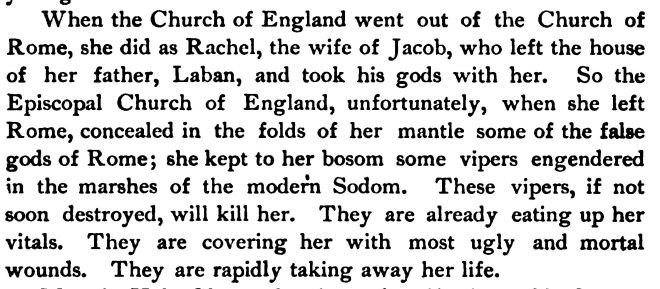
Later in the book, after describing the horrors women experienced in having their most secret sins pried from them by expertly crafted questions, the author reveals one of the vipers mentioned above.

A Testimony of Faith
A poem written during the nascent days of The Reformation.
By Margaret of Valois, duchess of Alencon, France,
sister of King Francis I, a persecutor of The Reformers.
Is there a gulf of ill, so deep and wide
That can suffice but e’en a tenth to hide
Of my vile sins?
Well do I fell within me is the root,
Without are branch and foliage, flower and fruit.
My God, thou hast come down on earth to me, –
To me, although a naked worm I be.
Word Divine, Jesus the Salvator,
Only Son of the eternal Paer,
The first, the last; of all things renovator,
Bishop and king, and mighty triumphator,
From death by death our liberator.
By faith we’re made the sons of the Creator.
Though poor, and weak, and ignorant I be,
How rich, how strong, how wise I am in Thee!
In spirit noble, – but in nature slave;
Immortal I am, -tending to the grave;
Essence of heaven, – and yet of earthly birth;
God’s dwelling place, – and yet how little worth.
The Pastor – Chapter 6, The Use of Titles
How men love titles! Does your “pastor” like to be called “doctor” or even “pastor”? Are such titles biblical for the gathered people of God? The  author gives this peek into today’s message:
Now to grasp another nettle. Titles. The New Testament never uses any title for any man in the church. What is more, it categorically forbids it. Nowadays, however, most Christians do use titles – or one in particular – and do so without turning a hair, even though it contradicts Christ’s plain command. Complaining of the scribes and Pharisees who loved ‘to be greeted in the marketplaces and to have men call them “Rabbi”’, Christ said: But you are not to be called ‘Rabbi’, for you have only one Master and you are all brothers. And do not call any one on earth ‘father’, for you have one Father, and he is in heaven. Nor are you to be called ‘teacher’, for you have one Teacher, the Christ. The greatest among you will be your servant. For whoever exalts himself will be humbled, and whoever humbles himself will be exalted (Matt. 23:1-12). But you, do not be called ‘Rabbi’; for one is your Teacher, the Christ, and you are all brethren. Do not call any one on earth your father… And do not be called teachers… But he who is greatest among you shall be your servant. And whoever exalts himself will be humbled, and he who humbles himself will be exalted (NKJV).
The Pastor – Chapter 4, Attempted Recovery
From the author:
We take up the story at the start of the 16th century with Martin Luther. But before we do, let us remember that protest against the mutilation of Christ’s church was not unknown during the dark ages. Men and, no doubt, women – men like Claude of Turin (died 827), Tanchelm (died 1115), Peter of Bruy s (flourished c1117- c1131), Henry of Lausanne (flourished c1116-1148), Arnold of Brescia (1110-1155), John Tauler (c1300-1361), John Wycliffe (c1328-1384), John Hus(c1369-1415), the Lollards and their like, should never be forgotten.
They all made their protest against Rome, and in one way or another called for a return to the New Testament. I am not pretending that they had full gospel light. But, in their various way s, they all prepared the ground for the approaching Reformation.
This chapter is here: http://www.sermonaudio.com/sermoninfo.asp?SID=116141234374
Chapter 3 is here: http://defendingcontending.com/2015/11/27/the-pastor-chapter-3-the-system-corrupted/
The Dangers of Drifting
A review by Stuart Brogden 
We must, therefore, pay even more attention to what we have heard, so that we will not drift away. – Hebrews 2:1 (HCSB)
Matthew E. Ferris’ book, Evangelicals Adrift – Supplanting Scripture with Sacramentalism, is a fairly comprehensive examination of the differences between biblical Christianity and that which is based on sacramental rituals. He also provides examples of people who have crossed the Tiber River from both sides. For the evangelical who drifts into sacramentalism, the dangers are pointed out with the concern of one manning a lighthouse in treacherous waters, where sailing vessels are bound to be broken on the rocks if they drift away from the narrow channel.
In ten concise chapters, our author covers the theological crises in evangelicalism, the nature and authority of the church and Scripture, and the various departures from biblical truth posed by sacramentalism. In the first chapter, Ferris tells us, “My task is to the show that the definition of the bride of Christ put forth by sacramentalism is an erroneous one, and that Scripture is the only sure guide for the way forward in the Christian life. … I am not writing as “anti-Catholic” or “anti-Orthodox”, but rather as pro-Scripture.” (page 25) This is an important point that evangelicals need to keep in mind, as it is far too easy to drift into being against error instead of in favor of truth; and our mission is to be ambassadors of reconciliation (2 Cor 5:20).
In his discussion about the nature of the church, Ferris contrasts the Apostles’ teaching found in God’s Word with the progressively developed extra-biblical traditions of the sacramental church, concluding, “The final arbiter for sacramentalism returns once more, not to the Scriptures, but to the church.” (page 35), giving us quotes from Roman Catholics that explicitly confirm this. He then asks, “in what sense can the Church be apostolic if it runs counter to the model the apostles themselves left us?” (page 37) Ferris supports the plurality and equality of elders and the priesthood of all believers in the local church, pointing out the word “clergy” is applied in Scripture to the entire church, not only the elders (page 42). Anticipating the claim that there is unanimity amongst the Church Fathers, our author provides a few quotes to show they had as much variation on issues as do any group of Christians, observing that anyone who wants a clean and supporting historical record to support their view must pick and choose which bits of history to rest on, ignoring those which do not line up with their case. “The Church is the pillar and ground of the truth only in that she upholds and defends it; she does not originate truth.” (page 74)
One way that Christians fail to stay on the narrow road is to neglect church history and conclude that their traditions are biblical. Ferris bemoans the fact that many research or know church history only as far back as the Reformation (page 84), leaving them adrift in the historical influences left unexamined. In commenting on how tradition overshadows Scripture in sacramental churches, he sums up a good quote from Oscar Cullman by saying, “there is no need for a canon at all if the ultimate arbiter of truth is the Church and its magisterium.” (page 86) “Roman Catholic doctrine claims to affirm the inspiration of Scripture and that the Bible is authored by God, yet in practice it severely undermines both of these positions.” (page 102) The Roman Catholic Church demands its dogma be accepted as authoritative, while denying the self-attestation of Scripture. Rather than holding to a proper understanding of Sola Scriptura, the Roman Catholic Church is shown to truly hold to sola ecclesia (page 103). This is compounded by the long-standing position of Rome that only its select clergy can interpret the Scripture, which undermines the authority of the Bible. If the Bible is God’s Word to His people, all of whom are indwelt by His Spirit, does it make sense that only a small number of people selected by a small number of religious leaders would be able to rightly comprehend the essentials of the Christian faith? History records that these select leaders, charged with interpreting the Scriptures for the common folk often disagreed with one another and many changed their minds on topics over time. Heretics and false sons have been in the temporal church since the apostolic era and it flies in the face of history, human nature, and the Bible for Rome to claim immunity from the frailties that each son of Adam faces.
Ferris also discusses how the various sacraments within many churches claim to impart grace, robbing the gift YHWH gives of its meaning. Baptism is one of these, with infant “baptism” having its basis in the false belief that it is needed for salvation. “Sacramentalism practices infant baptism as both an entrance into the new covenant with God and as that which cleanses from sin.” (page 160). If this were true, why was the Apostle Paul’s priority on gospel proclamation (1 Cor 1:14 – 17 & 9:22)? Further, he asks, “If baptism is indeed effective in imparting new life, in washing away sin, in putting one into the church, how is it that so many people who have undergone infant baptism manifest no signs of divine life whatsoever?” (page 166)
Chapters 7 and 8 are excellent reviews of the unbiblical view that sacraments convey grace and that mystical doctrine of Mary worship and veneration. Chapter 9 explores the spurious notion that there is theological and doctrinal unity within the Roman Catholic Church – pointing out there is as much variety within that religion as they claim there is amongst evangelicals.
The final chapter asks, “To Whom Shall We Go?” – and points out that “By insisting on the mediation of the Church in every aspect of the believer’s interaction with God, sacramentalism replaces the role of the Holy Spirit in the life of a Christian.” (page 223) Ferris gives the reader an excellent, concise review of the difference between the Roman view of infused grace and the biblical view of imputed grace as the means of saving sinners. The catechism of the Roman Catholic Church declares that the sacraments are necessary for salvation. Our author observes, “There is no experience of God, no conversion, and indeed no final salvation apart from engaging in the ritual acts defined by the Church. This is diametrically opposed to justification by faith in Christ alone. It is the system, rather than the Savior that assumes the importance in sacramentalism.” (page 225) In light of these dangers that we can drift into, to whom shall we go? As Peter rightly understood, we must flee to Christ Jesus – He has the words of eternal life (John 6:68). And so our faithful author points us to the Word Himself. “Every problem, every shortcoming, every doctrinal aberration with evangelicalism, and indeed with any branch of the church, is solved only by an intentional and sustained engagement with scripture. … Embracing sacramentalism will only lead believers further away from the truth that a relationship, not a ritual, is the scripturally ordained way of growth in Christ. Those who drift away can only regain their moorings by once again submitting to the Bible for everything in their Christian live.” (pages 228 & 229)
This book is a most excellent encouragement to the saints of God and, I pray, a wakeup call to those who are drifting into dangerous waters in the Tiber River. To God alone be the glory and honor and dominion and power – now and forever!
The Pastor – Chapter 2
The New Testament Pattern of Church Life and Rule
From the author:
Christ is the King of his church. He is her Master, Lawgiver, Ruler, Sovereign, Lord. He is her only Master, Lawgiver, Ruler, Sovereign, Lord. I deliberately use capitals to stress the point.
Christ is the Head of his church. He is the only Head of his church. No man is, no man ever was, no man ever can be, Head of the church – other than the God-Man Christ Jesus, the Lord Jesus Christ. I do not think I could express my self more clearly. Christ is the Head of his church.
Chapter 2 is here: http://www.sermonaudio.com/sermoninfo.asp?SID=115141029110
Chapter 1 can be found here: http://defendingcontending.com/2015/11/14/the-pastor-an-audio-book/
The Trouble with Trivial Faith
A review by Stuart Brogden 
The title of Melvin Tinker’s book is designed to catch your attention: A Lost GOD in a LOST WORLD, subtitled From deception to deliverance; a plea for authentic Christianity. That lengthy title conveys the idea that something is terribly wrong and change is desperately needed. If we survey the current offering from professing Christians, we cannot but agree that something is not right. While not addressing everything one might want changed, Tinker’s book is a welcome work that should cause every child of God to examine his own church and life, seeking to be biblical and honorable in the sight of YHWH. Tinker says, “The modest aim of this book is to present those key truths about the lostless of man, the greatness of God and the glory of the future which will correct much wrong thinking and behavior within the church and so enable the church to effectively confront the world by holding out the Gospel.” (page 22) He explores these issues in good measure over nine very readable chapters.
In this short book our author examines the weightlessness of God in our culture and what happens when people turn to idols. In these first two chapters Tinker observes “the West is made up of believers alright, but not Christian believers. It is composed of what the Bible calls idolaters” (page 26), further noting idolatry as “the besetting sin of the human race” (page 27). He describes what he means by God being lost: “Not that God has been lost as when we misplace a set of keys, but rather that the truth about the real God is disappearing fast.” (page29) When professing Christians take God for granted, being thoughtless in how He is worshiped (is celebrating birthdays and wedding anniversaries worshipful?), with shallow prayers (are physical healing and income our most pressing needs?), and absent from our daily conversations He has lost weight in our lives. And something has filled that space, weighing heavily on our minds and our prayers. That something, no matter what it is or where it came from, is an idol. Two short paragraphs sum up the cause and danger of this condition (pages 51 & 52):
The predominate view abroad is that with the right knowledge, the right resources, and the right will, crime on our streets will be reduced, terrorists will be hunted down and brought to account, poverty will be abolished and our environment made safe.
Undoubtedly as human beings we have achieved so much. But herein lies the danger, namely, that of being seduced into thinking that it is by our achievements that we measure our self-worth and thus bolster our self-confidence.
It is the myth of self-achievement, self-sufficiency, and self-aggrandizement. The trap is that such thinking invariably excludes God because our focus is on self.
Do you find these thoughts dominating your mind? Christian – examine yourself to see if you be in the faith! “We cannot really understand why the world is in such a mess, together with the mess of our individual lives, unless we see it as part of the bigger and much more tragic picture of humankind’s devastating fall away from its Maker.” (page 61)
From examining the train-wreck of our natural condition, our author takes the rest of this short book explaining the necessity of various aspects of biblical Christianity (‘tis a pity one needs to use that adjective, but there are so many professing Christian who are not biblical) and how they impact our lives. Chapter 3 addresses The need for the grandeur of God, based on Isaiah 40:1 – 31. Christians know God, but often we hang around the milk cooler rather than spend time and effort at the grill for juicy meats (Hebrews 5:11 – 14). “The highest science, the mightiest philosophy, which can ever engage the attention of a child of God, is the name, nature, the person, the work, the doings, and the existence of the great God whom he calls his Father.” (page 65) “And it is the smallness of man set against the grandeur of God which makes God’s tender kindness towards us all the more remarkable and moving.” (page 81) Chapter 4 brings us to The necessity of the Cross, based on Philippians 2:5 – 11. In becoming a man, creator God revealed part of His character; “this God, the true God, chooses not to exploit his divinity, but to display it differently … he exercise a different divine right – the right to be humble, the right to change his form whilst not ceasing to be God.” (page 86) Augustine wrote of this wonder:
He emptied himself, taking the form of a servant, not losing the form of God. The form of a servant was added; the form of God did not pass away. He lies in a manger, but contains the world. He feeds at the breast, but also feeds the angels. He is wrapped in swaddling clothes, but vests us with immortality. He found no place in the inn, but made for Himself a temple in the hearts of believers. In order that weakness might become strong, strength become weak. (page 90)
The mystery of God in Christ – who gave Himself to save sinners. How can a mere mortal truly comprehend this? The cross, an inhumane tool for the torture of humans, stands as the narrow gate to the path that leads to eternal life. Contrary to men pleasers who care not for the Gospel, we who have been bought with the blood of Christ must line up with Paul, whose “primary concern is not with the niceties of literature (or fancy words, my addition) but with the wonder of the Gospel.” (page 91) One of the wonders that Philippians presses on us is the truth that the eternal and divine Son of God put on flesh and became a human. He kept this form of a human (one of His created beings) after His resurrection, forever identifying with those ransomed sinners. Tinker tells us, “it would be a mistake to so emphasize the divinity of Jesus at this point that we neglect his humanity. In ascending back to the Father he did not shed his human flash as a butterfly might shed its chrysalis. The person of the Son of God is forever united to our human nature.” (page 98) Our high priest intercedes for us in this age, the God-man who reconciled sinful men to holy God. Jesus will walk among us in the age to come, His body then perfected as the eternal temple in which He is pleased to dwell. Brothers and sister – do you wonder at Christ? Is He not marvelous beyond words?
Buy the book and read about the work of the Holy Spirit, the necessity of the Gospel, the need for effective grace, the necessity of the second coming, and the need to be heavenly minded. It’s less than 200 pages and, aside from unqualified quotes from some questionable men, a solid work that will cause the child of God to humble himself before his Savior and King. And that’s about all we can expect from a book – a reminder of who YHWH is and who we are.
“The Pastor” – an audio book
From the author:
In this book, I draw attention to an aspect of church life which, I admit, at first glance seems small. Many would say I am try ing to ‘strain out a gnat’ (Matt. 23:24). I disagree. Appearances can be deceiving. ‘A great work’, as Andrew Fuller rightly said, ‘may be hindered and stopped by little things. Little follies will spoil the whole (Eccles. 10:1)’
If we are honest, all of us would have to admit we believe and practice things in our churches that cannot be found commanded or recommended to us in the Word of God. This book aims to provoke us Christians to consider myriad issues and see if they be of man or God.
There are 8 chapters in this book – I will post one per week. I highly encourage those who name Christ to listen with an eager mind to be drawn closer to YHWH. Have your Bible at the ready.
The first chapter can be found here: http://www.sermonaudio.com/sermoninfo.asp?SID=11514104433
Titus – a Fresh Look at an Old Letter
A review by Stuart Brogden
Aldred Genade has written a very thought provoking guide to Titus (The Letter To Titus:  Becoming a Persuasive Leader and Preacher), with the aim of showing how the Apostle intended Christian leaders to be persuasive. Which preacher does not want to be persuasive? The first chapter provides us a review of the various ways pastoral epistles and Titus in particular have been addressed by theologians and gives us this author’s thesis: “This book is an attempt to advance the dialogue concerning the macrostructural coherence of Titus in a meaningful way. The instrument that will be employed toward this end is a modified rhetorical critical method.” 1 He explains that rhetorical reading entails seeking to truly understand the meaning intended by the author by exploring the bits of the letter and the letter as a whole. This intentional endeavor to grab hold of the author’s intended meaning is a wonderful alternative to the inherent post-modernist view so pervasive and unexamined in our world.
In discussing the salutation found in Titus, Genade observes it is meant “to emphasize the divine basis of legitimate ministry.” 2 (emphasis in original) We see in several places in his letters how Paul emphasized his appointment as Christ’s Apostle as a means of impressing on Christians the truth of his message (Romans 1:1; 1 Corinthians 1:1; 2 Corinthians 1:1; Galatians 1:1; Ephesians 1:1; Colossians 1:1; 1 Timothy 1:1; and 2 Timothy 1:1). I think this is an example of being unashamed of the calling; something we could all learn from. Staking our identity in Christ (not as an Apostle, but as an ambassador of the gospel – 2 Corinthians 5:20) is the proper way for every one of us to establish authority; not our own, which every man can claim, but that which comes from the Creator and Judge of all people. This is the basis of Paul’s authority and that’s what makes his – and ours – legitimate ministry. False teachers and false converts have no such solid foundation (Matthew 7:24 – 27). Our author points out the focus of Paul’s ministry (and, by extension, that of the local church) is with the elect of God: Titus, his true son in the faith in Christ they have in common. As we will see later in this book, much of Paul’s message to Titus is meant for the entire church located in Crete.
So as not write a book about this book, I will highlight a few points that I think will serve the reader best. Genade’s book is heavily end-noted; this is good news as a careful writer will always let his readers know his sources. He also uses Greek words “in the open” as part of his dialogue with the reader. If you are like me, ignorant of Greek, the letters and words will make no sense; but the paragraphs in which these appear give us excellent context and explanation so as not to left in the dark. Our author also provides a brief summary and some excellent questions at the end of each chapter. If you have ever tried to formulate questions that require some thought and more than a one-word answer, you will recognize hard work here; and it pays off for those who pay attention.
Each of the twelve chapters covers a different aspect of persuasion, as Genade works through the epistle. Chapter 4 is Persuade by Exposing the Opposition, 5 is by Affirming the ministry of Others. Chapter 7 is Knowing Why You Obey, and is where we will dig in a bit before I sum up. In the previous chapter the lesson was on right behavior, based on Titus 2:5 & 10. This brings us to chapter 7 (Titus 2:11 – 15) and the importance of knowing why we obey. To do good one must have the right goal, the right method, and the right motive. Saints want to do good and we know obedience is better than sacrifice, so know our motives is critical! Genade claims, “Paul is now arguing that God is the one teaching the doctrine, making the doctrine and the behavior inseparable. The teaching as well as the Teacher are transcendent and must therefore be obeyed because they are not of human origin. This line of reasoning stresses the obligatory nature of sound doctrine upon the minds of the Cretans. In other words, sound doctrine must be obeyed because it is the exact opposite of “the commandments of men” (1: 14). Not to obey the doctrine and therefore not to manifest these particular behavioral characteristics is tantamount to disobedience to God.”3 The Christian who cares not about obeying God is testing God: a double bad place to be.
We are further instructed, “Obedience to the instruction becomes obedience to “someone,” rather than something. This is a very persuasive angle. Grace offers the complete opposite of what the false teachers have to offer. By formulating the proposition in this way, the appeal of sound doctrine is highlighted, making the argument for compliance to it even more persuasive. Furthermore, the personification of grace reinforces the notion of accountability.”4 This builds on the same foundation as noted in the opening chapter – Christ Jesus is our righteousness and if one has been made a new creature (2 Corinthians 5:17), he will be humbled to be so clothed, knowing how filthy his own righteousness is apart from Christ (Isaiah 64:6) and this makes each of us who have been born again willing and able to obey our Lord. Again, the false teachers have no foundation and the false convert has no clothes (Matthew 22:11 – 14). As our author tells us a bit later,
They have become in Jesus Christ the objects of divine interest, when he gave himself for them (ὃς ἔδωκεν ἐαυτὸν ὑπὲρ ἡμῶν). The inclusive language in this part is also emphatic. They are no longer mere Cretans, but the people of God— God’s own peculiar people (ἑαυτῷ λαός περιούσιος). Their identity and consequently their natures have been changed. They have been made God’s own “unique people.” This expression reinforces the communal sense prevalent in this section. Thus, when Cretan believers perform good deeds, in other words, when they obey the instructions of divine grace, they are acting consistently with their new character.5
So it ought to be in each local church, this sense of unity in Christ and the desire to honor Him and encourage one another to do so. A church that does not embrace this “communal sense” nor recognize their identity as God’s “peculiar people” is adrift in humanism and the Lord Jesus bids them to return to their first love.
While this book is mostly academic in style and content, it is engaging and provocative, a book I intend to return to time and again when the Lord brings this epistle to mind. We need such books if we are to renew our minds and test what we believe to see if these things be so. For the child of God will seek to be aligned with Holy Writ, not content with the mere words of men. Our brother has written a book that will help us examine our thoughts and God’s Word, and submit the former to the latter.
Footnotes:
1 Genade, Aldred (2015-09-21). The Letter To Titus: Becoming a Persuasive Leader and Preacher (Rhetorical Bible Commentary Book 1) (Kindle Locations 126-128). Africa Scholars Press. Kindle Edition.
2 ibid; Kindle Locations 267-268
3 ibid; Kindle Locations 1057-1061
4 ibid; Kindle Locations 1106-1109
5 ibid; Kindle Locations 1205-1210
Christ and the Gospel
A review by Stuart Brogden. Book available on Amazon.
The subtitles of Jon Cardwell’s book must not be overlooked or you will be confused. The focus  of this book is the proper understanding of the biblical gospel – that is the title: The Simple Gospel. What our brother rightly understands is that one cannot have a true understanding of the gospel if one does not have a true understanding of the person and work of the Lord Jesus. Without a biblical Jesus, faithfully fulfilling the requirements of the Law and the Prophets and taking our place in facing God the Father’s wrath for our sins (Him being without sin), we do not have the biblical gospel. The subtitle, Including Other Essays Exalting Christ’s Person and Work, gives us advance notice that we will spend some time reading about essentials that provide the foundation of the true gospel.
In this title chapter our author gives us his summary of what the Bible presents as the gospel:
The gospel of Jesus Christ is the revelation of God, according to the scriptures of the Old and New Testaments, which focuses on the Person and work of Jesus Christ in His incarnation, crucifixion, resurrection, ascension, and restitution of all things in His bodily return. 1
Note this: the gospel is about the redemptive work of Christ and our need of Him; the gospel is not the entire Bible, although all Scripture has this meta-plan as its ultimate purpose. A little later in this chapter, while reviewing the meaning and significance of the crucifixion, Jon pleads the sufficiency of Christ’s blood, saying, “The power of the purity of Christ’s blood is sufficient to cleanse the redeemed soul from every confessed sin he has committed after he has been saved by God’s grace (1 John 1: 7-10).” 2 While I agree with the intent, I think this idea would be better stated as “The power of the purity of Christ’s blood is sufficient to cleanse the redeemed soul from every sin he has committed or will commit, and is applied when he is saved by God’s grace (1 John 1: 7-10).” For we are commanded to confess our sins, all the sins of the redeemed are forgiven when he raised from spiritual death to new life, not just those committed after salvation and not only those confessed.
Still in this section, Jon brings to our mind the picture of Christ suffering God the Father’s wrath for our sins – a much more horrifying punishment than physical death on the cross, as painful and horrible as that is. If we don’t see Jesus being punished spiritually for the sins you and I committed, we are taking His sacrifice too lightly. This is closely tied to this statement: “The shame that comes to our souls in the light of the revelation of the offense our very lives bring to God, far exceeds the shame of Adam and Eve when their nakedness was revealed to them.”3 Far more powerful than our shortcomings in our foolhardy attempts to keep the law or earn God’s favor by our own strength, seeing the glory of God in Christ will undo us as it did Isaiah and the Apostle John and others who were privileged to see Him clearly. This is the power of the cross!
When he quickly reviews the resurrection’s part in the biblical gospel, our brother tells us two dear truths: “The resurrection of Christ is God’s open display to the entire creation of His seal and acceptance of Christ’s sacrifice.” 4 and “When we speak of the resurrection of Christ we also speak of God’s assurance of a resurrection to come. God promises to all whom He has saved in Christ will one day be resurrected from the dead. The importance of the resurrection is such that a denial of the bodily resurrection of Christ means a denial of the faith altogether (1 Corinthians 15:12-19).” 5 Let no one who claims Christ forget the import of the resurrection – if Christ be not raised from the dead, we are to be most pitied.
His last section on The Simply Gospel is about the restitution or restoration of all things. We cannot, Jon tells us, fully comprehend the recreation of heaven and earth and the Lord’s glorious return without understanding the biblical doctrine of hell. And, he goes on, we cannot rightly comprehend either the new earth or hell if we do not rightly comprehend God! “The same presence of God that is a consuming fire for the wicked dead, Christ’s presence is peace and comfort (2 Corinthians 1: 3), and fullness of joy with pleasures forever more at His right hand (Psalm 16: 11).” 6 This oft-repeated exhortation to see the Lord as He is in His glory and power is a welcome one that does the souls of the saints much good.
Chapter 2 – Propitiation through Faith is an enlightening walk through Romans 3:23 – 27. Our faithful author tells us, “Romans 1: 17 is the key to this epistle, Romans 3: 23-27 is most certainly the door the key unlocks.”7 and “It is through this door one must pass in order to enter life eternal. In one way, it may be here that the Lord’s cryptic words become especially insightful: “I am the door: by me if any man enter in, he shall be saved, and shall go in and out, and find pasture” (John 10: 9; cf. 10: 7). The door of this passage is that wicket gate Mr. Bunyan’s allegory refers. Jesus Christ is that door, that wicket gate, and His cross, His propitiation, is eternal treasure.”8 Such exegesis is welcomed in this day of shallow, superficial reading, as is this: “To sum it up, God’s righteousness was openly displayed and manifested in the… Person of Christ Presentation at the Cross Power of Christ’s resurrection Perfection in Christ’s ascension.”9 As the Apostle Peter told us (2 Peter 1:12), we need to be reminded of the essential things even though we already know them. Cardwell does well in this regard, as he desires to stir up the saints of God to dig into the Word and walk as those who have been raised from the dead. I do wish Jon had spent some time on exploring what Paul meant by the phrase, “the law of faith” in verse 27. I think it is tied to what he elsewhere calls “the law of Christ,” which (I believe) is defined by the Lord’s answer to the Pharisee in Matthew 22:37 – 40 (I highly recommend Charles Leiter’s excellent book, The Law of Christ).
Cardwell emphasizes the fact that the life of a person who has been raised from spiritual death will be evident: “the result of the saved life will be evidenced by, but not limited to these things: a growing resemblance to the life of Christ in sanctification (1 John 1: 7); repentance of sins as the illumination of His light reveals them (1 John 1: 8-10); a love for God’s Word (1 John 2: 3-5); abiding in the Holy Spirit-led life (1 John 2: 6); exhibiting a sacrificial love for fellow-believers (1 John 2: 9-11); a hatred for the things of this world and hatred for the lusts of the flesh because those things are at enmity with the Father (1 John 2: 13-17); and a love for and discernment of the truth (1 John 2: 20-21).” 10 Let no one go easily on with the lie that one can be saved yet unchanged.
I will only touch on the topics of the balance of the book, each chapter will challenge the reader to examine his belief in the Word and the meaning of specific passages and traditions as Cardwell examines the meaning of the sign of Jonah, the Shroud of Turin, traditions of men, and a few other topics.
The fifth chapter examines the Chief End of Man, and Jon does well to debunk the seeker sensitive madness Rick Warren is famous for, but he also takes the Westminster Shorter Catechism without question to answer the question. The problem with the catechism and its answer is the lack of defining the audience. About which man is it asking about the chief end – fallen man or redeemed man? In the context of the catechism, the very beginning, the catechism must be talking about man in general, not the redeemed. And because of this, their answer fails – because those who are bound for eternal torment do not have, as their chief aim “enjoying God.” Further, I find no support in Scripture that our benefit (the redeemed enjoying God forever) is our chief end. All of creation has as its chief end the glory of God. They should have put a period after the first phrase and worked out the latter portion in a later part of the catechism, making it clear enjoying God is a blessed benefit the redeemed will reap. Jon does point out that, to “enjoy God forever did not mean that man’s ultimate happiness comes as the result of what we receive from God. Following this thought toward its logical conclusion would ultimately suggest that God exists for man’s good pleasure and not the other way around.”11 Amen!
Christian – are you satisfied with your understanding of God’s Word and how it applies to you? I trust that is not the case. This short book is a good one to provoke any believer to dig deeper into the Scriptures, to pray for God’s wisdom, and examine some of those things we have been taught but never have thought about. Take and read!
Footnotes:
1 Cardwell, Jon J. (2014-11-15). The Simple Gospel – Including Other Essays Exalting Jesus Christ’s Person and Work: The Gospel Truth of Jesus Christ According to Scripture (The Biblical Gospel of Jesus Christ Book 2) (Kindle Locations 172-174). Vayahiy Press. Kindle Edition.
2 ibid; Kindle Locations 210-211
3 ibid; Kindle Locations 241-242
4 ibid; Kindle Locations 252-253
5 ibid; Kindle Locations 259-262
6 ibid; Kindle Locations 299-301
7 ibid Kindle Location 332
8 ibid Kindle Locations 339-342
9 ibid Kindle Locations 361-365
10 ibid Kindle Locations 504-509
11 ibid Kindle Locations 915-917
The Insanity Of Transubstantiation
Testimony of a former Roman Catholic priest, Herman Hegger: 
“This doctrine of transubstantiation never fascinated me. I felt a certain reluctance to kneel before those external elements. Something in me refused to offer prayers to the Host. A God localized by the forms of bread and wine was against the grain of my deepest religious sentiments. I felt it difficult to lift up my soul to a God Who appeared to me in those dead things. I could not really discover the splendor of the glorified Savior in the Host that I was eating.
“Roman Catholic authors are also aware of this difficulty. They never mention “Jesus who is in my stomach,” but speak of “Jesus who rests on my heart.” Involuntarily they change over in some way to a spiritualization of the formula: “This IS my body!” And indeed, what is the point in transubstantiation? What use is it to me if Jesus ultimately lands in my stomach in the shape of bread and wine?
“The truly great thing is my living communion with the Savior. What good is a bodily presence in those forms? They only divert my attention from the glorious shape of my Redeemer. Jesus appears to me through His Word and Spirit. I rest on Him as He reveals Himself in His Gospel.”
 Christ Alone Wyoming