The Revelation of Christ Jesus

John’s Apocalypse contains many graphic word pictures that are interpreted in many ways, often leadingpeople to see this books as a puzzle which must be put together by finite analysis. I believe John’s Apocalypse is a picture book that reveals the glory and majesty and power and authority of the Christ that our study of this book ought to be aimed at seeing Him more clearly.
 
To that end, I draw your attention to the seven letters in chapters 2 & 3, focusing on how Jesus describes Himself and the rewards He will give to His people. Read these passages carefully, and be at awe of the revelation of Jesus Christ presented in this small portion of John’s Apocalypse.
 
Revelation 2:1 (HCSB) “The One who holds the seven stars in His right hand and who walks among the seven gold lampstands”
Revelation 2:7 (HCSB) “I will give the victor the right to eat from the tree of life, which is in God’s paradise.”
 
Revelation 2:8 (HCSB) “The First and the Last, the One who was dead and came to life”
Revelation 2:11 (HCSB) “The victor will never be harmed by the second death.”
 
Revelation 2:12 (HCSB) “The One who has the sharp, double-edged sword”
Revelation 2:17 (HCSB) “I will give the victor some of the hidden manna. I will also give him a white stone, and on the stone a new name is inscribed that no one knows except the one who receives it.”
 
Revelation 2:18 (HCSB) “The Son of God, the One whose eyes are like a fiery flame and whose feet are like fine bronze”
Revelation 2:26 (HCSB) “The one who is victorious and keeps My works to the end: I will give him authority over the nations”
 
Revelation 3:1 (HCSB) “The One who has the seven spirits of God and the seven stars says”
Revelation 3:5 (HCSB) “the victor will be dressed in white clothes, and I will never erase his name from the book of life but will acknowledge his name before My Father and before His angels.”
 
Revelation 3:7 (HCSB) “The Holy One, the True One, the One who has the key of David, who opens and no one will close, and closes and no one opens”
Revelation 3:12 (HCSB) “The victor: I will make him a pillar in the sanctuary of My God, and he will never go out again. I will write on him the name of My God and the name of the city of My God—the new Jerusalem, which comes down out of heaven from My God—and My new name. “
 
Revelation 3:14 (HCSB) “The Amen, the faithful and true Witness, the Originator of God’s creation”
Revelation 3:21 (HCSB) “The victor: I will give him the right to sit with Me on My throne, just as I also won the victory and sat down with My Father on His throne.”
 
Saints – who is the victor mentioned here these seven times? Is it the man who pulls himself by his own bootstraps? Is it the man who sees Jesus and himself rightly and throws himself at the mercy of the Lamb? What do we read?
 
In describing the end of the age, when final victory over death is ours, Paul wrote, “But thanks be to God, who gives us the victory through our Lord Jesus Christ!” (1 Corinthians 15:57). God gives us victory through Christ. Same as our salvation – by grace through faith in Christ, which is a gift from God (Eph 2:7).
 
John agrees with Paul and I will end with this. “whatever has been born of God conquers the world. This is the victory that has conquered the world: our faith. And who is the one who conquers the world but the one who believes that Jesus is the Son of God?” (1 John 5:4-5). We have victory by faith in Christ.
 
When Jesus says, “to the victor …” He refers to those believers who continue to believe in the face of tribulation, sorrow, riches, and poverty; kept by the Spirit until the day of judgment. Jesus is the almighty creator, sustainer, savior, and judge.
 
If you are in Christ – you have victory! If you are not, while is it yet today, repent and believe on Him.

What About the Judgment?

You can listen to this sermon here.

Hebrews 9:27-28  And just as it is appointed for man to die once, and after that comes judgment,  so Christ, having been offered once to bear the sins of many, will appear a second time, not to deal with sin but to save those who are eagerly waiting for him.

Ask 10 Christians about the day of judgment and you’ll likely get more than a dozen answers. From Ancient times, God’s people have known there will be an accounting before Him, but there seems to be an ongoing lack of understanding about it – the nature, purpose, and participants of and in this great and terrible Day of the Lord.

What is the nature of this judgment? Throughout national Israel’s history, she and the pagan nations around her were subjected to God’s judgment for their actions. One example from Psalm 9:16 The LORD has made himself known; he has executed judgment; the wicked are snared in the work of their own hands. Sometimes we see Israel being punished and at others it was pagan nations. When God’s name is profaned, those responsible will be disciplined.

We see in Psalm 75 that God’s judgment is not always punishment: verse 7 but it is God who executes judgment, putting down one and lifting up another. This was commonly associated with rulers being raised up or put down. As in the days when Israel wanted to be like the pagan nations, with a mortal man as her king, so many Christians in our day put too much hope in political leaders, forgetting the end of the ages has come upon us (1 Corinthians 10:11) and our citizenship is in heaven (Philippians 3:20).

With man’s predilection of being focused on things temporal, Scripture speaks most about the doom of judgment at the end of the age, as there is no recovery from it. Speaking of the God of Abraham, Isaac, and Jacob, Psalm 76:7-9 But you, you are to be feared! Who can stand before you when once your anger is roused? From the heavens you uttered judgment; the earth feared and was still, when God arose to establish judgment, to save all the humble of the earth. We see similar accounts in Isaiah 66, Jeremiah 25, and Ezekiel 39. Matt 16:27 For the Son of Man is going to come with his angels in the glory of his Father, and then he will repay each person according to what he has done. The ancient preacher adds some detail to this: Ecclesiastes 12:13-14 The end of the matter; all has been heard. Fear God and keep his commandments, for this is the whole duty of man. [this first part we are familiar with; this next part is our topic] For God will bring every deed into judgment, with every secret thing, whether good or evil. This should sound familiar, as Paul said virtually the same thing in 2 Corinthians.

The Lord Jesus spoke of the day of judgment without providing detail of its operation, as if the Jews knew all about. Matthew 10:15 Truly, I say to you, it will be more bearable on the day of judgment for the land of Sodom and Gomorrah than for that town. The doom of Sodom and Gomorrah was legendary; this doom Christ spoke of was worse! This type of reference recurs several more times in Matthew 11 and 12. In Luke 3, John tells the Pharisees that the wrath of God is upon them and those “trees” that do not bear good fruit will be cut down and thrown into the fire. In Revelation 6:19ff, the other man named John reveals the terror of being found naked on judgment day: Then the kings of the earth and the great ones and the generals and the rich and the powerful, and everyone, slave and free, hid themselves in the caves and among the rocks of the mountains, calling to the mountains and rocks, “Fall on us and hide us from the face of him who is seated on the throne, and from the wrath of the Lamb, for the great day of their wrath has come, and who can stand?” God’s judgment is real. We must be ready. If the day of judgment was not certain doom, Christ would not have had to bear that dreadful curse and we would not benefit from His wondrous love!

One of the more frequent discussions touching on both the purpose and participants is focused on the “Bema Seat Judgment” of Christians. This phrase generally refers to the idea that believers must stand before God to be rewarded – separately from those who are doomed to hell. The proponents of this doctrine call this the Bema seat judgment to distinguish it from The White Throne Judgment. The latter they believe to be the Judgment that God reserves for judicial verdict against transgressions by the wicked. They may get some support from John 5:24, which uses the same word (in several translations) as verse 22. Truly, truly, I say to you, whoever hears my word and believes him who sent me has eternal life. He does not come into judgment, but has passed from death to life. But the word, judgment, is kree’sis in the Greek; which can also mean damnation or condemnation; context reveals what is correct. The KJV gets this verse right: Verily, verily, I say unto you, He that heareth my word, and believeth on him that sent me, hath everlasting life, and shall not come into condemnation; but is passed from death unto life. We see the same two statements in verse 27 & 29. John 5:28-29 (KJV) Marvel not at this: for the hour is coming, in the which all that are in the graves shall hear his voice, And shall come forth; they that have done good, unto the resurrection of life; and they that have done evil, unto the resurrection of damnation. Again, KJV gets it right, ESV and others use the word “judgment.” We’ve seen that God will bring every deed into judgment – no man escapes this. But we also see that those who have passed from death unto life shall not come into condemnation! This is Paul’s point in Romans 8:1, as he tells those who were tempted to trust in works that there is NO CONDEMNATION for those who are in Christ Jesus, He is the only refuge!

The truth about the judgment seat is a lot less complicated and much less ambiguous. The Greek word bema, which is translated seat, is from a root that means ‘base’ or the foot (and by extension, step). It is used to designate a stepped seating area for Judgment. Thus bema simply refers to the raised seating of a judge or a king. For example, the throne of a King is usually stepped seating. In other words, seating that is raised above the level of the surrounding area. Much the same as our courts today have established for judgments. In our country one must approach the raised judgment area called the bench. Likewise, the bema seat is simply the raised seating of someone sitting to judge. For example, Pilate sat on the judgment seat [bema] when Jesus was being accused of wrong doing (Matt 27:19 & John 19:13). John 19:13 So when Pilate heard these words, he brought Jesus out and sat down on the judgment seat at a place called The Stone Pavement, and in Aramaic Gabbatha. This is the same Greek word as found in 2 Corinthians, where the alleged “Bema seat” judgment takes place.

In both Biblical accounts of this episode (Matt 27 & John 19), the Greek word translated seat, bema, means the exalted seat of judgment. We should note very clearly that far from being a seat to hand out rewards, it is a seat of Judgment in tribunal for crimes (perceived or otherwise). Pilate sits upon this Judgment seat and he makes a Judgment to have the Lord Jesus Christ scourged, and handed over to be crucified. Quite clearly, this was a Judgment seat for judicial law. This is not only illustrated by the context, but also by the content. In both passages, Pilate sits on this bema and delivers a judicial verdict against Christ (beating and handing Him over to be crucified) which has absolutely nothing to do with rewards. Likewise, in the book of Acts we find the same scenario present with this Judgment seat (Acts 18:12 & 17). Acts 18:12 While Gallio was proconsul of Achaia, the Jews made a united attack against Paul and brought him to the judge’s bench. The ESV calls this a tribunal, the KJV calls it a judgment seat. The Greek word is bema.

What is the purpose and who are the participants? The parable of the talents shows believers have rewards, based on our deeds – just as we read in Psalm 75:7. The purpose of judgment day is two-fold; with punishment for evil-doers, rewards for good deeds (which the Holy Spirit equips and wills us to do), and our inheritance as joint-heirs with Christ. This inheritance is our union with Christ: being regenerated or born of God to live and reign with Him. This is taught in Ephesians 1:11, 13-14 In him we have obtained an inheritance, having been predestined according to the purpose of him who works all things according to the counsel of his will. … In him you also, when you heard the word of truth, the gospel of your salvation, and believed in him, were sealed with the promised Holy Spirit, who is the guarantee of our inheritance until we acquire possession of it, to the praise of his glory. This is confirmed in Galatians 3, Colossians 1 & 3, Hebrews 9 & 11, and 1 Peter 1. The inheritance Abraham looked for was that city whose designer and builder was God, the heavenly Jerusalem which is described in Revelation 21:9-10 Then came one of the seven angels who had the seven bowls full of the seven last plagues and spoke to me, saying, “Come, I will show you the Bride, the wife of the Lamb.” And he carried me away in the Spirit to a great, high mountain, and showed me the holy city Jerusalem coming down out of heaven from God.” This is what Peter made mention of in 1 Peter 2, when he referred to the saints in Christ as living stones being built up as a spiritual house. What greater reward could one hope for than being at peace with God, abiding with Him in perfect harmony?

Matthew 25:31-33 When the Son of Man comes in his glory, and all the angels with him, then he will sit on his glorious throne. Before him will be gathered all the nations, and he will separate people one from another as a shepherd separates the sheep from the goats. And he will place the sheep on his right, but the goats on the left. Two groups of people present at this judgment, when Christ returns and sits in judgment on the nations, He is on a bema; sheep at His right hand, goats at His left. No separate judgment for the saints in this passage.

Another glimpse at this judgment: Revelation 22:12-15 “Look! I am coming quickly, and My reward is with Me to repay each person according to what he has done.  I am the Alpha and the Omega, the First and the Last, the Beginning and the End. “Blessed are those who wash their robes, so that they may have the right to the tree of life and may enter the city by the gates. Outside are the dogs, the sorcerers, the sexually immoral, the murderers, the idolaters, and everyone who loves and practices lying”. Same two groups of people, each getting judged. Those who wash their robes (KJV: keeps His commandments) are blessed; these are the people of God who have been raised up and given His Spirit Who wills and equips us to do what pleases Him. Outside are those who do not know Him.

The Bible is clear that there is one Judgment of Christ, and it takes place at the last day. It is then that man will stand before the Judgment seat of Christ to give account of what he has done on earth, whether good or evil. All those who were washed clean in the blood of Christ stand before God spotless with ‘good’ works that are faultless. The rest of the dead stand with ‘bad’ works, and are found guilty in their works of sin. 2 Timothy 4:1 [2342] I charge thee therefore before God, and the Lord Jesus Christ, who shall judge the quick and the dead at his appearing and his kingdom; Romans 14:10 But you, why do you criticize your brother? Or you, why do you look down on your brother? For we will all stand before the tribunal of God. One judgment of all flesh, the quick (alive in Christ) and the dead; at the end of the age.

2 Corinthians 5:10-11 is where many stand to defend a separate “bema seat” judgment for Christians. But does that passage teach this? For we must all appear before the judgment seat (bema) of Christ; that every one may receive the things done in his body, according to that he hath done, whether it be good or bad.  Knowing therefore the terror of the Lord, we persuade men; but we are made manifest unto God; and I trust also are made manifest in your consciences. The same two groups of people, before the judgement seat of God.

This raised seat judgment Paul speaks of in this passage also describes the throne on which Herod sat when he was killed by God (Acts 12), the judgment seat Paul was dragged before Gallio (Acts 18), the place Festus sat in Acts 25, Caesar’s judgment seat in Rome, and the raised platform where Paul met his accusers (Acts 25:16-17). The Greek word does not lend itself to the narrow, single purpose definition imposed upon it by the Bema Seat proponents. Bema used to describe various judgment seats and thrones, from which men in authority render judgment.

The Great White Throne Judgment, in Revelation 20:11-15, has many of the same characteristics of these other passages we’ve read. And I saw a great white throne, and him that sat on it, from whose face the earth and the heaven fled away; and there was found no place for them. And I saw the dead, small and great, stand before God; and the books were opened: and another book was opened, which is the book of life: and the dead were judged out of those things which were written in the books, according to their works. And the sea gave up the dead which were in it; and death and hell delivered up the dead which were in them: and they were judged every man according to their works. And death and hell were cast into the lake of fire. This is the second death. And whosoever was not found written in the book of life was cast into the lake of fire. What in this passage gives the impression it’s a different scene? More detail, same two groups of people, same two eternal states. The Greek word for throne (thronos) is not bema; but one definition of bema is “throne” and one definition of thronos is “seat.” While different words, they are nearly identical in meaning.

Revelation 20 is the same basic scene as in Matthew 25, wherein Christ sits on His throne of glory, judging between sheep and goats. Here in Revelation 20, the Lord sits on a throne which is great and white – terms that ascribe glory and honor. In Matthew 25, the deeds done by each group are reviewed, have everything in common. The one thing that distinguishes between the sheep and the goats is the sheep did their works out of love for Christ and His brothers. Verse 40 “And the King will answer them, ‘I assure you: Whatever you did for one of the least of these brothers of Mine, you did for Me.’ verse 34 Then the King will say to those on His right, ‘Come, you who are blessed by My Father, inherit the kingdom prepared for you from the foundation of the world. The inheritance of the saint in view once more.

In Revelation 20, the sea gave up her dead and death and hell gave up their dead. Is there any doubt that “death and hell” give up the damned, to face their Judge? These are terms commonly associated with those who are not reconciled to God. What about the sea; are its dead the same category of people or does it give up those who have died in Christ? Isaiah 60:5 sheds light on this, describing the fulfillment of what national Israel foreshadowed when all nations come to God, where the abundance of the sea shall be turned to you (God), the wealth of the nations shall come to you! This supports the idea that in Revelation 20, the sea could refer to those being called by God from every nation, tribe, and tongue. This would fit right in with the other judgment passages, which show the same two groups of people – sheep and goats.

And in this scene, it is as clear as it can be: the only thing that determines destiny has nothing to do with deeds we do here. If your name is not written in the Lamb’s Book of Life, you have no life in Christ. If your name IS written in the Lamb’s Book of Life, you have eternal life in Christ. Come, you who are blessed by my Father, inherit the kingdom prepared for you from the foundation of the world. Whatever rewards we may gain by faithful, Spirit led service in this age, inheriting the kingdom is totally based on God’s free gift of grace poured on His sheep.

This is what YHWH meant in this snippet from Job 34:23 – For God has no need to consider a man further, that he should go before God in judgment. The judgment eternal destiny of souls is not based on deeds done in the flesh; it is wholly dependent on and based on the standing one has; is he in Christ? And when one comes to Christ Jesus in faith, which is a gift from God, he will be protected from the wrath of God on that great and terrible day when Jesus judges all nations and peoples.

In speaking about the trials we will face in this age, Peter pointed us to Christ as our example; revealing a truth about the final judgment that ought to comfort the saints. 1 Pet 2:23 When he was reviled, he did not revile in return; when he suffered, he did not threaten, but continued entrusting himself to him who judges justly. This is why we who are in Christ have no need to fear the day of judgment: He is just. The white throne is a sign of Christ’s rule and His glory: He is mighty.


Summary & Conclusion

The nature of this judgment is comprehensive, no mortal is excluded. The purpose of judgment day is twofold: to reward those who by patience in well-doing seek for honor and glory and to punish those who are self-seeking and unrighteous. Varying rewards and punishments. The participants in the day of judgment are two:  those who have been clothed in the righteousness of Christ and seek to bring Him honor and those who are dressed in their own rags of self-righteousness who serve themselves and mind earthly things. In these things, God is glorified in saving sinners, punishing evil doers, and bringing the age of redemption to a close for all will know Him and declare Christ to be King, whether they rejoice in their salvation or weep in their doom.

Luke 12:42-48 And the Lord said, “Who then is the faithful and wise manager, whom his master will set over his household, to give them their portion of food at the proper time? Blessed is that servant whom his master will find so doing when he comes. Truly, I say to you, he will set him over all his possessions. … And that servant who knew his master’s will but did not get ready or act according to his will, will receive a severe beating. But the one who did not know, and did what deserved a beating, will receive a light beating. Everyone to whom much was given, of him much will be required, and from him to whom they entrusted much, they will demand the more.

The great day of the Lord is a frightful time for those who are not clothed in Christ. It’s a validation of all He has promised for those who wear His white robes. 2 Pet 3:13 But according to his promise we are waiting for new heavens and a new earth in which righteousness dwells. If you are in Christ, you can, with a clear conscience, join the saints of old and cry out, Maranatha! Come quickly, Lord Jesus! If you do not have peace in your soul as you consider the end of things and the accounting that must be made to the Creator and Judge of all things, consider His words (John 6:35 & 37): “I am the bread of life; whoever comes to me shall not hunger, and whoever believes in me shall never thirst. … All that the Father gives me will come to me, and whoever comes to me I will never cast out.” There is salvation in no other name or person. Come to Jesus. He is the faithful one.

On the day of judgment, that great and terrible day when everything done in secret will be exposed (Ephesians 5:13), there is no place to hide, no safe refuge, no shield from the wrath of God – except for the very Lamb that will judge all flesh. This is why the gospel is central to mission of every church. This is why Christ Jesus is heralded as the only savior of poor sinners; He alone makes atonement for sin, He alone reconciles His enemies to His Father. He is the bread and water of eternal life; no one who comes to Him will hunger or thirst; no on who flees to Him will ever be cast out. Repent of your sin and believe on Christ – there is no other way to be at peace with God. Peace with God came at a dreadful price as the Son of God drank the cup of wrath due us. This wonderous love, that caused the Lord of bliss to bear the dreadful curse for your soul and mine. Let us exhort one another while we have breath to always look unto Christ, for He is our great salvation and He is our life!

All I Have is Christ

I personally believe that Christ actually died on Thursday and not Friday. I do not see how to get three days and three nights between Friday and Sunday morning. However, the day that He died is not as important as the fact that He did die.

(Edited – If anybody is interested in a previous article I wrote back in 2013 on the crucifixion, then go to THIS LINK.)

The words in this hymn resonate in my heart and I pray they will encourage you today. Whatever day the crucifixion took place, the reality is that Sunday is coming! This coming Lord’s Day we will remember Resurrection Sunday for truly “up from the grave He arose with a mighty triumph o’er His foes!”

And I beheld God’s love displayed
You suffered in my place
You bore the wrath reserved for me
Now all I know is grace!

The Temple of God

Was reading in 1 Corinthians 3 this week and this passage was before me:
1 Corinthians 3:16-17: Do you not know that you are God’s temple and that God’s Spirit dwells in you? If anyone destroys God’s temple, God will destroy him. For God’s temple is holy, and you are that temple.

This should resonate for the Christian, though we are far removed from the heavily Jewish flavor of the 1st century in Palestine. Jewish Christians hearing this from Paul would likely have connected what he said here with cherished promises they had heard all their lives. But the apostle reveals that the true fulfillment of all of God’s promises are found in Christ, not in a parcel of dirt in the middle east.
Here’s what the 1st century Jews were holding onto:
Abram. Genesis 12:2 & 3: I will make of you a great nation, and I will bless you and make your name great, so that you will be a blessing. I will bless those who bless you, and him who dishonors you I will curse, and in you all the families of the earth shall be blessed.
Jacob. Genesis 27:29: Let peoples serve you, and nations bow down to you. Be lord over your brothers, and may your mother’s sons bow down to you. Cursed be everyone who curses you, and blessed be everyone who blesses you!
Israel. Numbers 24:8 & 9: God brings him out of Egypt and is for him like the horns of the wild ox; he shall eat up the nations, his adversaries, and shall break their bones in pieces and pierce them through with his arrows. He crouched, he lay down like a lion and like a lioness; who will rouse him up? Blessed are those who bless you, and cursed are those who curse you.
Blessing and curses. God loves His people! Yes, He does. And note: not only does Paul apply this same blessing curse to the body of Christ, he also told us that all who believe on Jesus are true children of Abraham according to the promise. And Matthew told us that when Israel was called out of Egypt (as we see in Num 24, above and in Hosea 11), that this was a shadow of Jesus coming out of Egypt (Matt 2:15).
1 Corinthians 3:11 (HCSB) For no one can lay any other foundation than what has been laid down. That foundation is Jesus Christ.
1 Corinthians 3:16-17 (HCSB) 16 Don’t you yourselves know that you are God’s sanctuary and that the Spirit of God lives in you? 17 If anyone destroys God’s sanctuary, God will destroy him; for God’s sanctuary is holy, and that is what you are.
Yes, God loves His people. He sent His Son to redeem us from sin and hell and death. He did this so that we would shine like lights in a dark place, heralding the gospel to a world that consuming itself. Fear not, God is giving His kingdom to His children. Go forth, now and tell people that Jesus saves sinners from a certain doom that is far worse than any “hell” they imagine.

Why then the law?

I’m sure you have run across those who claim Paul was speaking to us in the present tense in  Galatians 3:24 when he wrote that the law was our nanny until we came to faith in Christ. There is a two-fold problem with this understanding: First, the context from the middle of chapter 2 through chapter 5 aligns with the passage in chapter 3 which provides explicit language to clarify Paul’s rhetorical question in verse 19 of chapter 3: why, then, the law? Second, a misunderstanding of the answer to this question can lead to believing just what Paul argued against in this letter.

First, does verse 24 in chapter 3 tell us the law was our nanny until we came to faith in Christ? Here’s how the KJV reads: “Wherefore the law was our schoolmaster to bring us unto Christ, that we might be justified by faith.” In case the formatting doesn’t show up, the phrase “to bring us” is in italics, meaning it was added in by the translation team. Read the verse without that phrase: “Wherefore the law was our schoolmaster unto Christ, that we might be justified by faith.” The law did not, does not, bring anyone to Christ – the Spirit does that through the proclamation of the gospel! But that phrase was added to make it appear the law carried people to the Lord.

It is clear from the context that Paul is speaking of the Mosaic Law here. As is the case in all the New Covenant passages, the Mosaic Law is spoken of as a unit. We don’t read about this part or that division of the law. Simply the law. We read in Exodus that before Moses went up Mt Sinai to get the second set of tablets, he “came and told the people all the commands of the Lord and all the ordinances. … He then took the covenant scroll and read it aloud to the people.” (Ex 24:3 & 7) And in verse 12 we see YHWH telling Moses “Come up to Me on the mountain and stay there so that I may give you the stone tablets with the law and commandments I have written for their instruction.” All the law and commandments, not just the Decalogue nor everything other than the Decalogue; all the law and commandments. This is what Paul was referring to.

The word interpreted “schoolmaster” is the Greek word from which we get our word “pedagogue.” While modern definitions, such as used by the KJV, claim that word means tutor, the ancient definition referred to one who was a slave guardian of his master’s child, to make sure the child was where he needed to be, when he was supposed to be there. He was NOT a tutor or schoolmaster, but one charged with the safety of his charge.

Here’s how several other translations render that verse: “The law, then, was our guardian until Christ, so that we could be justified by faith.” (HCSB) The law of Moses was “our guardian” – whose guardian? Go back to chapter 2 and verse 15: “We who are Jews by birth and not “Gentile sinners”” The law of Moses was a guardian for the Jews by birth – national, ethnic Israel, and not to “Gentile sinners.” Some of the folk in the assembly of saints at Galatia wanted to retreat from the milk of the gospel and embrace the heavy yoke that the council in Acts 15 would overthrow. These were called “foolish Galatians” (3:1), followed up by “Are you so foolish? After beginning with the Spirit, are you now going to be made complete by the flesh?” (vs 3) If the law brings people to Christ, why would Paul call people foolish who wanted to live under it?

This brings us to verse 19 and the question – Why, then the law? And the answer: “It was added because of transgressions until the Seed to whom the promise was made would come.” Even the KJV agrees with this. The law of Moses was given because of transgressions and only until the promised Seed came. Jesus came and did His work of redemption and is with the Father on high. The law as it was given to national Israel, as a binding legal code with sanctions for violations, was only until Christ came. Paul sums up the condition of his kinsmen of the flesh in verse 23: “Before this faith came, we were confined under the law, imprisoned until the coming faith was revealed.” Some translations do not have “this” before “faith.” No matter – the apostle is restating his message from verse 19, explaining why and when the law was given.

The law was added – had not been given before this, not to Adam, not to Abraham – to remain in place until the promised Seed came. And until faith came, for the law granted faith to nobody, Jews were in chains under the law. But when faith came, when the Messiah was glorified, verse 25 tells the good news to those who were in bondage – “we are no longer under a guardian, for in Christ Jesus you are all sons of God, through faith.” (verse 26)

Now back to verse 22: “But the Scripture has imprisoned everything under sin’s power, so that the promise by faith in Jesus Christ might be given to those who believe.” This verse does not say “the law has imprisoned everything under/in sin’s power” – it says Scripture has. Scripture tells us the entire creation was cursed when Adam fell. Scripture tells us there is no salvation except in Christ. Scripture tells us creation groans in anticipation of its new birth, when Christ returns to gather His saints on the new earth. We know that everything IS under sin’s power because of sin. Sickness and death stalk each of us. But the promise given to Abraham, that he would be the father of many nations, is incrementally consummated every time one of God’s elect is raised up to new life in Christ Jesus.

This message is given different views in chapters 4 & 5 but the message is the same: present day (in Paul’s day) Jerusalem represented the slavery of the Mosaic Law; freedom from sin comes only in Christ, the heavenly Jerusalem. The law was added until the promised Seed came. Hebrews tells us the religious rites given through Moses served as a copy and shadow of the heavenly things (Heb 8:5). When the fullness of time came, the promised Seed came and conquered sin and death and the shadows, those types found in the law, came to their end.

Why, then, the law? To show the nation of stiff-necked, loop-hole finding, law-loving Jews how wicked they were; to keep them as a nation to display God’s holiness to them and the pagan nations; to make sure they were around when the fullness of time came and the promised Seed arrived. The law was Israel’s guardian until faith came, because Israel could not keep itself. Their history shows that, if left themselves, they were every bit as wicked as the Syrians, or you and me before we were redeemed.

Once the promised Seed came, the guardian is no longer needed. Faith and the promise do not depend on fleshly procreation. By faith we become children of Abraham. Now that Christ has come, the Spirit keeps His people. The law fulfilled its role, its time is past. The covenant based on shadows and types, with fire and threats of punishment for violations of its law has ended. Faith has come in the person of the promised Seed. The law and all the other shadows of the Old Covenant no longer bind anyone with chains but, as the Spirit gives the light of understanding, serve to instruct us about our innate weakness and need for humility before God and fellow man. Just as we read with New Covenant clarity from Jesus, Paul, Peter, and John.

No need to “un-hitch” the Old Testament from our faith – all of it is from God for us. We belong to heavenly country which has different laws; given by the same God but intended for a people with hearts of flesh, not stone; people who, having been loved by God can and will love Him and one another. No need to tell one another, “know the Lord” for we all know Him. The Mosaic Law was chains for a people who needed to be told “know the Lord.” We in the New Covenant are not that people. We can see the law did not restrain national Israel from doing evil. So God gave His Spirit to will and equip us to do what is pleasing to Him.

Not under the yoke of law, which could not save nor can it lead us to Christ; it can only condemn. Therein is the danger of wrongly interpreting this passage.

New heart, new mediator, new priesthood, new covenant, new law from the new Lawgiver.  That’s the difference being in the New Covenant makes.

Sanctification by the law – where is that found?

I’ve looked and looked and don’t find any New Covenant context teaching telling us to go back to Moses. Everything I have found shows me otherwise.
Take Romans 12, for example. First chapter after a bunch of theology, including a bunch of “law” talk. Much encouragement for the saints to walk a certain way and not a hint of law-keeping, other than the exhortation to not take vengeance but leave that to God.
What we see is a continual teaching to live by the grace of God, be transformed by renewing your mind, be humble. In the section on body-life Paul tells us how to love one another with specific teachings – but no law-keeping.
Here’s the bottom line: The Mosaic Law and other laws like it (found in many Fundamental fellowships) are intended for those who are unregenerate. What we are taught in Romans 12 is fit only for those indwelt by the Holy Spirit, who wills and equips us to do what pleases the Father.
While all Scripture is for our edification and benefit, the law of the Old Covenant was for those in that covenant. The Law of Moses does not and never has bound people outside that covenant community.
If you are in Christ, there is a better law, fit for a spiritual people. We have a covenant built on better promises, mediated by a better priest, with a new law meant only for the saints.
Rejoice! God’s grace was sufficient to save you and by it He is sufficient to renew your mind and sanctify your soul until Christ returns or He takes you home.

Does Acts 2:39 teach inclusion of children?

When Peter was preaching during Pentecost, he told the Jewish audience that Jesus was the promised son of David, yet David’s Lord. He summed up with this “altar call”:

Acts 2:36-37 (HCSB) “Therefore let all the house of Israel know with certainty that God has made this Jesus, whom you crucified, both Lord and Messiah!” When they heard this, they came under deep conviction and said to Peter and the rest of the apostles: “Brothers, what must we do?”

His answer to their anguish was not “ask Jesus into your heart.” Acts 2:38 (HCSB) “Repent,” Peter said to them, “and be baptized, each of you, in the name of Jesus Christ for the forgiveness of your sins, and you will receive the gift of the Holy Spirit.” Natural man cannot do this. MUST have the Holy Spirit indwelling a regenerated soul.

And note: repent and be baptized. Not, be sprinkled as a babe and later, if it be you are a true covenant child, repent. Repent then be baptized; this is the biblical practice.

Acts 2:39 (HCSB) “For the promise is for you and for your children, and for all who are far off, as many as the Lord our God will call.”

No matter how you interpret “the promise,” there are several views, there is no way to think the promise is to the children of Christian parents. Peter was speaking to unconverted Jews, not redeemed saints. The promise was to them – they were the ones who asked “what must we do?”

The term “brothers” in verse 37 clearly is not used in the New Covenant context, as they were at that time unconverted. Brothers in the same sense as Paul expressed agony over his “kinsmen of the flesh” – his fellow Jews. In this culture, the Jews saw themselves as the brotherhood of God against the world.

The promise to all – Jews, their children, and ALL WHO ARE FAR OFF (the Gentiles – those who, “at that time you were without the Messiah, excluded from the citizenship of Israel, and foreigners to the covenants of the promise, without hope and without God in the world.” – Eph 2:12). The promise is to the whole world, not somebody’s children – AS MANY AS THE LORD OUR GOD WILL CALL.

The promise is people in every group of people – as many as the Lord calls.

This passage no more gives support to family status in the New Covenant than it gives support to an Arminian view of salvation.

The New Covenant is really NEW!

The New Covenant is not like the Old Covenant (HEB 8).

Entry into the Old Covenant did not require faith in God; most of the people in that community were unbelievers. All they (the males) needed for entry was circumcision of their flesh. Entry into the New Covenant comes only to those who believe on the Son of God (John 10), who have been circumcised of the heart, not made with human hands (Col 2).

The mediator of the New Covenant is not another in the type of Moses – a servant in God’s house (Heb 3). He is the Son and Lord of the house!

God does not change our old stone into a new heart of flesh, He removes the heart of stone and implants a heart of flesh (Jer 31).

God does not improve the stone temple in which Israel worshiped Him, His redeemed are the temple of God! (1 Cor 3, 1 Pet 2)

The New Covenant does not have a priest after the order of Aaron but after the order of Melchizedek, who had no genealogy (Heb 7). This was not merely a change in/within the priesthood, it was a change OF priesthood; the nature of the priesthood is different (Heb 8).

The sacrifices of the Old Covenant could never take away sin, but only cover them for a season. The sacrifice of the New Covenant takes away all the sins of all the people in that covenant community, showing the weakness of the law and the superiority of the oath and promise (Heb 7). The nature of the sacrifices in the two covenant are not the same.

When the passage (Heb 7) says that a change of the priesthood mandates a change OF the law, the same nature of change is at hand. The law given to the Old Covenant community is not suited for the New Covenant community. A new type of law is required – one reflecting the priesthood as well as the community, which is 100% redeemed and dwelt by the Holy Spirit.

The law written on the flesh hearts of the saints is not the legal code with warnings and penalties, issued from the fiery mount (HEB 12). The law written on the hearts of the redeemed is the perfect law, the law of liberty (James 1), the royal law (James 2), the law of Christ (Gal 6). The law of Moses COMMANDED its people to rest from the work of providing for themselves (Ex 20). The law of Christ PROVIDES rest for the redeemed, no longer working to prove themselves to God, but serving one another, bearing burdens, loving others as Christ has loved us.

No legal code with threats and penalties for a stiff-necked and rebellious people but a new creature (Gal 6, 2 Cor 5) that loves God and others, in which the Spirit of God dwells, to equip and will His people to that which pleases Him (Phil 2).

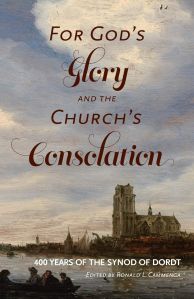
For God’s Glory and the Church’s Consolation

For God’s Glory and the Church’s Consolation

A book review by Stuart Brogden

The subtitle of this book, 400 years of the Synod of Dordt, reveals the content thereof – the book is a collection of messages given in 2019 at a conference celebrating the Canons of Dordt, sponsored by the Protestant Reformed Theological Seminary. The seminary and the conference and the book reflect the Dutch Reformed view, which is in clear view throughout. While the truth of what is called Calvinism (God’s sovereignty in the salvation of sinners) is defined and defended, the traditional tenants of Reformed theology are presented as givens, without the pretense of providing biblical support. In the Editor’s Preface we read that “the Synod of Dordt was much more than the Canons of Dordt and the Arminian heresy. It dealt with the matter of a proper view and observance of the New Testament Sabbath, establishing principles that serve the church today.” (page viii) In the first chapter, Douglas J. Kuiper tells us “the delegates (to the synod) declared that they had reviewed the Belgic Confession and found nothing in it that conflicted with Scripture. They declared the same of the Heidelberg Catechism” shortly thereafter (page 7). These two documents have much within them to be commended, but they teach something not found in the words of Scripture: infant baptism, so-called, and they prop up the misguided notion that the Mosaic Law determines order in the New Covenant.

Kuiper goes on to say, “Reformed churches today must recognize the boundaries that the Reformed churches have previously set, and that Dordt declared to be fixed and unbending. They must love these doctrines and the confessions that contain them and be faithful to them.” (page 8) This view enshrines imperfect documents written by sinful men more than 400 years ago the magisterium for Kuiper and his fellows.

This is not to deny that the Canons of Dordt and the other referenced documents contain much rich truth that all who name Christ can embrace, such as “To go wrong in regard to these five doctrines (the substance of Dordt) will inevitably lead to error regarding many other doctrines as well.” (page 9) The current leadership of the Southern Baptist Convention, many of whom have long waged war against the Doctrines of Grace, serve as a current and graphic example of what Kuiper warned about.

In chapter 2, Angus Stewart reminds us that “main achievement of the synod … is the Canons of Dordt, which set forth the truth of the absolute sovereignty of God in salvation over against the heresies of Arminianism.” (page 23) And then we read, “Thus the five points of Calvinism, based on the Canons of Dordt, summarize the truth of God’s word, which is in accordance with the genius of John Calvin’s biblical theology.” (pages 26-27) At best this is a poorly phrased sentence; at worse it posits the Bible as subordinate to John Calvin’s theology (look up “in accordance with”). I would not have brought this up if this book were not full of deference to the Canons and other documents. No document written by man is ever worthy of such submission, but must be tested in light of Scripture at all points.

As a study on the Canons of Dordt, one would expect some examination of the theology of those who protested against the doctrines of grace. Brian Huizinga tells us, “The Arminians hated nothing more than sovereign predestination. … However, they said they believed in election, they used the term election, and they preached sermons on the doctrine of election, even as they used the terms grace and faith but gave to them different meanings.” (chapter 3, page 58) “The Arminians were so careful to sound Reformed and insisted that they believed the truth but only had different ways of expressing the truth.” (page 59) Note this last statement, see how it (claim to believe the truth but have different ways of expressing it) applies to so many who depart from the biblical truth in so many ways – including papists and Mormons.

Chapter 4 may be my favorite; Mark Shand presents a well-ordered presentation what the gospel is, combined with an equally well-ordered refutation of another error of the Arminians, one that has and still does afflict many within the wider circle of reformed/Calvinistic saints; that of the well-meant offer, so called. Shand points out the Arminians protested that, “if the atonement was not universal, there could be no general proclamation of the gospel. To call all men to repentance and faith when not all were encompassed by the atoning work of Jesus Christ was, said the Remonstrants, to render the call of the gospel insincere and hypocritical.” He answers this by rightly declaring, “The gospel at its heart is not an offer in the sense of an invitation or entreaty. It is the proclamation of a command, coupled with a promise.” (page 86) “The promise is not for all; it is only for those who believe on Jesus Christ.” (page 87) Many paedobaptists contend that the “promise” is for believers and their children, based on a faulty reading of Acts 2:39. In this passage, Peter spoke to unbelieving Jews – “men of Judah, men of Israel, all who dwell in Jerusalem.” These Jews asked Peter and the others, “Brothers (fellow Jews) what shall we do?” And Peter said to them, “Repent and be baptized every one of you in the name of Jesus Christ for the forgiveness of your sins, and you will receive the gift of the Holy Spirit. For the promise is for you and for your children and for all who are far off, everyone whom the Lord our God calls to himself.” And with many other words he bore witness and continued to exhort them, saying, “Save yourselves from this crooked generation.” So those who received his word were baptized, and there were added that day about three thousand souls. (Acts 2:38-41) The command – repent and be baptized for the forgiveness of your sins; and the promise is for you unbelieving Jews and your children and those Gentiles who are far off – everyone whom the Lord our God calls to Himself. This passage has nothing to support “covenant children;” as Shand rightly observed – the promise is only for those believe on Jesus!

Douglas J. Kuiper returns in chapter 5 to discuss the view of covenant theology found in the Canons of Dordt. He asserts that these topics which are other than the answer to the 5 points of the Arminians are not secondary, but serve to support the doctrines of grace (page 99). Kuiper presents the mono-covenant so common in Reformed theology (“Inherent in the Canons’ use of the familiar Old Testament and New Testament is the unity of the covenant: it is one covenant” page 105). He asserts that the death of Jesus fulfilled “the Old Testament ceremonial laws” (page 102); while Scripture never says this (He fulfilled “the law”) nor splits up the Mosaic Law into Aquinas’ tripartite view. He wrote, “the covenant to which the Canons refer is the covenant of grace that God has established with elect sinners, with Adam after the fall, and with everyone who is included in the see of the woman (Gen 3:15)” This makes it appear that Kuiper thinks everyone in history is in the “covenant of grace” – making one wonder why such a covenant is needed, if everyone gets in. Later, Kuiper rightly sees the promise of salvation not given to “all the children that are born under the historical dispensation of the covenant, that is, not upon all that are baptized, but only upon the spiritual seed” (page 125). It appears our speaker was a bit sloppy in describing this extra-biblical covenant; one would think sticking with those covenants mentioned in Scripture would reduce this ambiguity.

Here is the danger of ignoring the biblical data on the Old and New Covenants, resting in and trusting in this ephemeral “covenant of grace” – “Because God continues his covenant with godly believers in the line of generations, “godly parents have no reason to doubt of the election and salvation of their children whom it pleaseth God to call out of this life in their infancy.”” (ending with a quote from Confessions and Church Order, page 106) The Old Covenant was established along line of human generations but those people were not required to believe on the promised seed. The New Covenant is, as Kuiper admits on page 125, made only with spiritual children, those who believe. The Bible explicitly teaches not to trust in human generations: And do not presume to say to yourselves, ‘We have Abraham as our father,’ for I tell you, God is able from these stones to raise up children for Abraham. (Matthew 3:9) Jesus came to bring division to earthly families as those who not His sheep would rise up against those who are (Matthew 10:34-37). This mythical mono-covenant conflates the old and new covenants and gives false cover to this specious notion of “covenant children.”

Note the confusion about the New Covenant in this system. Dordt declares, “being in the covenant, we do not doubt the election of infants of believing parents. This is not because the covenant determines who are elect, but because election determines who are in the covenant.” (page 109) He is emphatic that only elect (I would say only the redeemed) are in the New Covenant, yet he is just as emphatic that offspring of believers are in the covenant – while admitting not all of them are elect! Rather than be presumptuous that our children are elect, we ought to be diligent to teach our children the ways of God, preach the gospel to them, and pray for and with them in hopes that God would save them. In this chapter, Kuiper brings out some of the errors the Arminians presented regarding the New Covenant; our Dutch Reformed brothers have some things to work out themselves.

In chapter 6, William A. Langerak spoke on the polity contained in the Canons of Dordt, further revealing that the Dutch Reformed rest on their traditions and documents as much or more than they rest on Scripture for some doctrines. He declares, “the polity of Dordt is not just good; it is magnificent.” (page 128) He spends several pages summarizing the historical development of Dordt’s polity, saying “the Church Order of Dordt (1619) is basically that of The Hague (1586), which in turn is derived from church orders revised and adopted by two national synods …” (page 134-135) This run-on sentence fills up a paragraph of citations of the foundation of their polity but contains no references to Scripture, only to men and conventions of men. Langerak established their view of tight control over the local assembly of saints by ecclesiastical levels the Bible knows nothing about (pages 138-156), including dictating what songs may be sung, what holy-days are to be observed, what offices (they see three: ministers, elders, deacons; the Bible reveals two: elders and deacons) are to be the council of the church, how frequently the Lord’s Supper should be observed; all the while claiming “Article 30 of the Belgic Confession also establishes the principle of the autonomy of the local congregation as a self-governing church in its own right, apart from any federation with other Reformed churches in a denomination.” (page 146) These controls over the local congregation by the ecclesiastical hierarchy is needed, Langerak says, because they want to avoid “the lawlessness of the Anabaptists” (page 150). Those radicals had the notion that no mortal had authority aver the local assembly of saints; that each congregation answered to Christ. These men were obviously “lawless” – they did not submit to the law of man. One excellent practice embraced by our Dutch Reformed brothers is equality among the men holding each office (page 148); far too many of my fellow Baptists have drifted into serious error by having only one elder or singling out one elder as higher ranking than the others. This should not be! In all the discussion about church polity, not one word about the condition of membership – regeneration. Herein is a danger far beyond any “lawlessness” of refusing ecclesiastical hierarchy.

The last two chapters are very good, the 7th full of Scripture defending election and the flip-side thereof, reprobation, written by Ronald L. Cammenga. Many Calvinists deny this doctrine, but if you hold to God’s sovereign election of a limited number of people He chose, then He has also chosen those who will not be saved. Those He has rejected are the subjects of reprobation. This doctrine is seen in YHWH’s choosing of Israel (a nation He built up) and rejecting all other nations. Proverbs 16:4 and Romans 9:11-13; 21-22 all speak to His power and authority to do with His creatures as He wills. He accepted Jacob and rejected Esau; election and reprobation. God sends a strong delusion to some of those He has not chosen unto salvation to insure they will not come to a knowledge of the truth (2 Thess 2:11-12). The Bible is full of the good news that countless numbers from every nation, tongue, and tribe are His sheep. The only way to accept His choosing some is to recognize His rejection of others. The Bible tells us none seek God, so it’s not as though He rejects those who search for Him; He choose who He would save and the rest of mankind was “chosen” by being rejected. The gospel message is the good news of salvation by grace; there is no need to tell people they might be reprobates (a biblical word describing the subjects of reprobation!) and there is no biblical warrant to do so. But we also have no reason to claim God does not reject anyone, but merely allows them to go their own way. Man is, by nature, an enemy of God and will go to hell unless He intervenes; but the Bible also tells us God gives the reprobates a shove along their way – He gives them over to their sin (Romans 1:24). Reprobation is the bad news from Romans 8:1 implicit for all who are not in Christ Jesus – they are condemned.

In chapter 8, Barret Gritters shows us from Scripture how and why saints can enjoy assurance of the salvation. “Election is not merely God’s choice of certain persons to be saved but his choice to place them in the security of, and into organic connection with, the body of his Son Jesus Christ.” (page 206) Barret also rightly sees our nature – “I am “by nature neither better not more deserving than others.”” (page 207, quoting from Dordt) “The same God who elects, redeems, justifies, and preserves also assures his people of this. By his Spirit and word, God convinces me that of his love for me.” (page 212) Anyone struggling with assurance of salvation would be encouraged to read this chapter – it rests on bedrock: the nature and character of our Redeemer.

If you are like me, you’ve been familiar with the 5 points (commonly called Calvinism) which were drawn up to answer the 5 points put forth by the Arminians but maybe not as familiar with the other doctrines established or restated in the Canons. As a Baptist, I am informed by historic documents of the faith but I am not bound by them if I cannot find their doctrines in Scripture. So it is with much of the other things taught by Dordt. This is an interesting book, providing an in-depth look at what our Dutch Reformed brothers and sisters hold to.


Note: I was asked by the publisher, Reformed Free Publishing, if I would be interested in reviewing this book, which was generously provided by them to me.

Sighing and Groaning?

In my reading through the Scriptures in a year, today I read Ezekiel 5-9. I realize that Ezekiel was written by the prophet Ezekiel to the people of Judah and Israel. Yet, my mind struggled with what was prophesied would happen to Jerusalem.

V. 3 tells us the glory of God had departed! This is itself is tragic, but read on.

Vv. 4-6 give a solemn declaration of judgment pronounced against those who were God’s chosen people. These verses read like this in the ESV,

4 And the LORD said to him, “Pass through the city, through Jerusalem, and put a mark on the foreheads of the men who sigh and groan over all the abominations that are committed in it.” 5 And to the others he said in my hearing, “Pass through the city after him, and strike. Your eye shall not spare, and you shall show no pity. 6 Kill old men outright, young men and maidens, little children and women, but touch no one on whom is the mark. And begin at my sanctuary.” So they began with the elders who were before the house. — (Emphasis added)

ben-white-W8Qqn1PmQH0-unsplash

Dear brothers and sisters, how often do we read through the pages of Scripture and fail to understand what is happening?

We can often overlook the principles found in the Scriptures and do not comprehend how it can apply to our own lives over 2 1/2 millennium after Ezekiel wrote these words under the inspiration of the Holy Spirit.

Under the judgment of God, the ONLY people who would be protected from the wrath of the Almighty were those who sighed and groaned over all the abominations.

There would be no pity shown, and nobody was exempt. Sadly, the nation had become so corrupt that the messengers who would be placing the mark upon the foreheads were told to start with the elders.  These were the men charged with the religious and governmental affairs of the nation.

In other words, there were people from the top of the religious and social stratum who were NOT sighing and groaning over the abominations. These abominations were so vulgar and grotesque that Ezekiel only alludes to some of what these might have been.

The scenario we find in the 21st century is much different. The world faces even greater abominations. Abortion is now acceptable. The family is being destroyed. LGBTQ issues cloud every aspect of culture and society. What transpires behind closed doors is now openly flaunted and accepted.

In fact, our own governments willingly and deliberately strip financial aid from countries that refuse to allow for abortion at will and who refuse to legitimize ALL aspects of the LGBTQ movement.

What is NOT different is that many “elders” who are to stand in the gap and proclaim thus saith the Lord refuse to stand anymore. Even evangelical churches are becoming more open and accepting of contemporary issues of the day.

Instead of being like Martin Luther and stating, “Here I stand, I can do no other”, elders and churches are allowing for more and more abominations to come into the places where God’s people are to worship. Entertainment drives the masses and the goats feel happy while the sheep starve for lack of the bread of life from pulpits.

In this life, we are not worried about the enemy brazenly storming across our land. We do not go to sleep worrying whether our women will be violated, our children openly sold as slaves, and whether we will even have enough to eat for tomorrow.

Sadly — nay, tragically, the abominations that surround us are compounded by the reality that very few sigh and groan. Instead, we laugh when it flickers across our screens. At times, we can become so hardened in our hearts that there is only a twinge of guilt that we have mocked the God we claim as our Father.

naassom-azevedo--2k57MGq4AI-unsplash

My challenge to you — go and read Ezekiel 9. See the state of Israel and Judah. Ask yourself whether you are laughing and enjoying the fruit of the world and its abomination.

If we truly desire revival, we need to begin learning once again how to sigh and groan over the abominations. We need to seek forgiveness for our own areas where we fail to meet the perfect, holy standard that is Jesus Christ. We must hold ourselves accountable and strive to become more like the Master.

May you and I who truly know Jesus Christ as our Savior remember that like Israel of old, we are called to be a spiritual house and a holy priesthood (1 Peter 2:5). Unlike the abominable offerings that God refused to accept from Israel, we MUST offer spiritual sacrifices that are acceptable to God through Jesus Christ.

Take the world, BUT GIVE ME JESUS!

Elders and Deacons

You Can Listen to This Sermon Here.

1 Timothy 3:1-13 This saying is trustworthy: “If anyone aspires to be an overseer, he desires a noble work.” An overseer, therefore, must be above reproach, the husband of one wife, self-controlled, sensible, respectable, hospitable, an able teacher, not addicted to wine, not a bully but gentle, not quarrelsome, not greedy – one who manages his own household competently, having his children under control with all dignity. (If anyone does not know how to manage his own household, how will he take care of God’s church?) He must not be a new convert, or he might become conceited and fall into the condemnation of the Devil. Furthermore, he must have a good reputation among outsiders, so that he does not fall into disgrace and the Devil’s trap.

Deacons, likewise, should be worthy of respect, not hypocritical, not drinking a lot of wine, not greedy for money, holding the mystery of the faith with a clear conscience. And they must also be tested first; if they prove blameless, then they can serve as deacons. Wives, too, must be worthy of respect, not slanderers, self-controlled, faithful in everything. Deacons must be husbands of one wife, managing their children and their own households competently. For those who have served well as deacons acquire a good standing for themselves, and great boldness in the faith that is in Christ Jesus.

Paul begins and ends this passage with commendations for those who aspire to serve as elders or has served well as deacons; it is a privilege to serve in either role. He describes these two roles within the local fellowship of saints, both having very similar qualifications, but very different roles (which are explained elsewhere in Scripture). Both are described as servants with responsibility, not rulers with authority. The Bible has authority in the church; the men do not.

The Apostles, forerunner of church elders, were to devote themselves to prayer and the preaching of the Word; deacons are to tend to the physical needs of the dynamic and diverse body of Christ. In Acts 6 the people did not vote for who would serve as deacons; they nominated seven godly men to the Apostles, who appointed the men to serve. This passage does not show a democracy in action as many Baptists falsely believe. It shows the active participation of the members, recognizing the role of those God had appointed to lead them. As the church matured, the Scripture shows us that elders had oversight on all the church did and deacons provided much more service than “waiting tables.” As there are spiritual issues behind every temporal matter a deacon might be called upon to help with, these men must be qualified and there must be a good rapport between the deacons and elders, so the body of Christ gets the best care possible.

Deacon. The Greek (diaconos) and English words refer both to one who serves the local church in this capacity as well as those who are simply known for being servants to the body of Christ. Deacons are not required to be spiritual guides, feeders of the flock, or teachers; they are required to be trustworthy and of moral character as they deal with matters of temporal importance and the related spiritual foundations. The health of the church depends on deacons functioning well, which requires the cooperation of the elders and the people. It is painfully apparent that many of us have lost sight of the completeness of the wisdom our Lord has provided us and the reason for it. How we serve Him and one another is be to the glory of His name and the good of His people.

Robert Boyt C. Howell laments “much confusion and division of sentiment regarding the nature of the office”; and he points out how so many miss the Scriptural teachings that describe the role of those who hold the office of deacon.

Nearly all the churches have made them ministers of the gospel. In the Roman Catholic church he is an inferior ecclesiastic, the second in the sacred order, who, with the permission of the bishop, has authority to preach and baptize. In the English church the Deacons are clergymen, but of the lowest grade; who can perform all the offices of priests, except the consecration of the sacred elements and the pronouncing of the absolution. In the German Protestant churches, when more ministers than one in the same congregation are necessary, the second, or assistant minister, is called the Deacon; and if there are two assistants the first is called the Arch-Deacon. In the Presbyterian church, the office is commonly merged with that of ruling elder, and, therefore, mostly disused. Where it is still retained, it embraces, as among Congregationalists and others, merely the distribution of alms. The Methodist and Episcopal churches in this country adopt, substantially, the practice of the English church, of which they are descendants. In the Baptist churches, the Deacons are not ministers who preach, on the one hand, nor mere distributors of alms on the other, but serve in a different capacity. They are a board of directors, and have charge of all the secular affairs in the kingdom of Christ

It is not unusual for Baptist deacons to have hire & fire authority over elders (a corollary error in this circumstance is the absence of a plurality of elders). In the end, nobody escapes unscathed! This all-too-common Baptist practice is blatantly taken from the modern business world, and puts the lower office of deacon as overseers of those called of God to be overseers, turning Scripture on its head.

We need to ask, is the Bible so unclear on the nature and duties of the office of deacon? Brothers, this is not the case! It is sin that keeps God’s people from seeing clearly, not a lack of clarity in God’s Holy Word. We must abide by what the Book reveals, and guard against traditions not found therein. If Scripture is not our guide, we are adrift on the sea of man’s wisdom; and that is dangerous.

The qualifications of deacons differ from those of elders on the single requirement of elders, but not deacons, being able to teach the Word of God. Deacons are to be men of good reputation, full of the Holy Spirit, holding the mystery of the faith with a clear conscience. These bedrock character traits often neglected when selecting deacons, as people focus on the man’s record of financial giving, business acumen, and abstinence from alcohol. While those traits can be easily measured, they cannot be found in the Bible as qualification for this office. The traits found in Scripture are not so easily quantified. It takes serious thought and hard work to determine if a man has a good reputation among his neighbors and work colleagues. It takes time and discernment to see if there be evidence of the Holy Spirit in a man. Who wants to put a man on the spot and see if he holds the mystery of the faith with a clear conscience? Can you even explain this requirement, much less investigate it? Installing men to serve the local church as deacons is sober work, not to be taken lightly or without serious prayer and reflection.

A deacon must be the husband of one wife. The literal meaning of the text is “a one woman man” – which means that if there was a biblical divorce and subsequent marriage, the man is not disqualified. If one holds that no divorce is biblical, the on-going sin in a second marriage becomes an on-going problem within the body. I see 2 reasons in Scripture wherein YHWH permits divorce, for unrepentant adultery or for abandonment by an unbelieving spouse. The goal of marriage is for each to last until death parts the couple. But even redeemed saints can fall into sin and be stiff-necked for a season; and the One Who knows our frailty has provided a narrow window – much narrower than in the Mosaic Covenant.

The requirement that deacons be tested first gives us a hint that we should invest the time and energy in examining would-be deacons; and not merely assuming these traits be theirs. This testing also provides the opportunity to see if his wife is sober minded and faithful, if his children are “managed well”. We must exercise the full measure of the biblical text to prove the men who would serve as deacons; they are care-takers of God’s sheep and co-laborers with His under-shepherds. This is a high calling (those who serve well gain a good standing) and we cannot allow our lazy human minds to rest on our own wisdom, or the taking of shortcuts or reliance on the traditions handed to us by other men. Finding men who tithe and do not frequent bars is wrong-headed and too low a bar for the office our Lord established for the temporal care of His redeemed.

As we desire our men to provide for their families, spiritually as well as physically, our deacons are to help families in each arena, with boundaries in both. Neither the church nor either office therein can unreasonably meddle with a family. God has established three spheres in this age, with specific roles and limits. It’s been said that to the state God gave the sword, to the church He gave the keys to the kingdom, and to the family He gave the rod of correction. We should not cross these boundaries without a clear biblical basis. Wisdom and care is needed if we are to tend to God’s people without ruling over them as “Gentiles” tend to do.

Healthy church members let their deacons know ahead of time when they will miss, and explain why. They will be more inclined to assemble with another local body while away if they properly understand church membership. This exercise of membership responsibilities is representative of any number of other earthly matters that deacons are likely to get involved with, each of which most often reflects the spiritual condition of the person. Lack of attendance and interest in church life, neglecting to worship in giving money, and many other concerns can be prompted by earthly things: illness, loss of work, death in the family, etc. In order to be wise stewards of the office, deacons must not presume to know the cause without investigating it, learning from Job who investigated the cause of what he did not know (Job 29:16). This keeps us from the sin of presumption and all that tends to follow closely behind.

As we examine men who would and do serve in our churches as deacons; as we consider how we determine the role of the office and how we select these men, let us humbly petition our God for wisdom and grace to do what is right in His sight – aligned with His scriptures and not resting on our own wisdom.

Elder. This role can only be fulfilled by a qualified man who is called and equipped by God for this service. There is no possible interpretation that allows self-identified or unconverted men, or women to serve in this capacity; and yet many churches do just this. This latter error is always the first big step to total apostasy for a church, preferring fallen man’s view of order over creator God’s declared view.

As mentioned earlier, the only different qualification for this role is that an elder must be able to teach. In our English Bibles we see the words Elder/Presbyter, Overseer/Bishop, Shepherd/Pastor. Each pair of these words comes from one Greek word; Elder/Presbyter is from presbyteros; Overseer/Bishop from episkope; and Shepherd/Pastor from poimen. They are used interchangeably and they all refer to a single office in the church which has several important functions, each of which is designed by the Lord to insure the health of each local church. The terms elder and presbyter refer to a man’s experience; in the Word and in the church. Overseer and bishop convey the act of being a spiritual guardian or protector, while pastor and shepherd refer to the spiritual care and feeding of God’s flock. We see overlap among these three functions in 1 Peter 5:1-5, where elders are exhorted by the Apostle Peter to shepherd God’s people with the right motive and attitude, serving as examples for the less mature Christians. In Acts 20:28, elders are instructed by the Apostle Paul to pay careful attention to themselves and the flock of God, in which the Holy Spirit made you overseers, to care for the church. One aspect of being a faithful elder that is implicit in these passages is that of being among the saints, knowing them as a shepherd knows his flock and being known as the shepherd is by the sheep. A man who does not live among his church members, who lives at a higher station of life, who spends all his time with other preachers is not faithful to his call. The elder must be an able teacher of the Word (1 Timothy 3:2, Titus 3:1-8) and a diligent servant of God’s people (1 Timothy 5:17 & 18).  He must also be able and willing to rebuke those who contradict the Word of God within the local church (Titus 1:7-9), and he must be about training others to work alongside him as under-shepherds of Christ (2 Timothy 2:1-3). One who would hold this office must lead the church, serving as a proper example (2 Thessalonians 2:11 & 12; 2 Timothy 2:15), and the saints are commanded to submit to them, not being burdensome for them (Hebrews 13:17). Elders were given to the church, by God, to equip the saints for the work of the church, bringing them to maturity and the fullness of Christ so they would not be vulnerable to the deceptive schemes of the enemy (Ephesians 4:11-14). This means the biblical elder must feed God’s sheep the whole counsel of His Word, not trusting his opinion or theirs as to what is true nor picking some Scriptures from which to teach and ignoring others. His teaching is to be tested in light of Scripture; not accepted nor rejected by personal whimsy or blind friendship. All of these responsibilities of elders are beyond any man’s abilities, so the Bible reminds us that elders, like the Apostles who preceded them, must be men of prayer (Acts 6:4).

There is another requirement of the man who would serve as an elder. While some read 1 Timothy 3:2 to mean a single man cannot serve as an elder, the view most compatible with Scripture is that an elder who is married must be in a biblical marriage and work at keeping it. Elders must be one-woman men, and they must lead their churches to defend marriage in the face of reprobates. 1 Timothy 3 goes on to say the elder must be sober minded and not quarrelsome; all the more so in defending God’s people from unrighteous men, who by their unrighteousness suppress the truth (Romans 1:18).

Being God’s spokesman is no job for a new convert, one who is unsure of God’s Word, unwilling to proclaim God’s Word, unable to rebuke those who contradict God’s Word, or unworthy of being followed as God’s servant. The times in which we live are treacherous, with many professing Christians embracing abominable sin in order to be well thought of by those outside the camp of Christ. Christians are never to compromise God’s truth for the applause of men (Galatians 1:10) and elders must be held to a high standard so that the Lord’s name not be disgraced among the pagans and the local church not be led astray.

Ezekiel 33 & 34 describes watchman appointed by God with responsibilities to warn, guard, and care for the people of God. In these two chapters we see a contrast of the watchman with the shepherd: the watchman warns, the shepherd tends. In each passage, unfaithful watchmen and shepherds are contrasted with those who are faithful. Ezekiel 34:1-10 describes the failures of the leaders of Israel, showing what shepherds are supposed to fulfill. Shepherds are supposed to care for the flock. These men were feeding on the sheep; fleecing the sheep. These men had all the appearance of shepherds, but they were wolves. Pastoral ministry is hard work, not glamorous. Those who pose as celebrities, living the high life, are not pastors. Pastors should smell like sheep, walking in the mud and mess, scarred by the teeth of biting sheep. This is difficult but rewarding work. Every man should aspire to be a commendable man who leads his family as a shepherd leads the flock. He must diagnose and treat appropriately – you don’t strengthen the stray, you strengthen the weak; you don’t bind up the lost – you search for the lost. Each spiritual condition requires the correct spiritual remedy. The pastor must know illnesses and the people, else he cannot properly treat the sheep. Verse 10 in Ezekiel 34 shows the omnipotent hand of God rescuing His sheep from the teeth of the wolves. A true pastor will watch the flock like a man who must give an account to the God who has purchased the sheep with the blood of His own son. Because that is what God’s Word tells us the truth about those who would call themselves “pastor”.

Even with the best of intentions, we can go astray from the narrow path of biblical truth. Over time, man has developed unbiblical structures, imagining that Bishop is more honorific and must carry more responsibility (by which they mean fame). Most men who preach call themselves “pastor” regardless of whether they shepherd the flock God has gathered there or not. One who preaches but does not work to know and care for the saints the Lord has put under his watch cannot rightly call himself pastor; he is merely a preacher. These words are not titles by which the men who serve are to be called, but descriptions of service they provide within the local church. Because God has given these terms to describe the roles of men He calls to the office, we must be careful to use them correctly.

Plurality of elders. Most churches in every denomination and across the spectrum of Baptists miss the point of Scripture on this point. The Bible repeatedly shows us that even the early churches that met in houses had two or more men serving as elders, a plurality of elders.

Acts 14:22&23 – Paul and Barnabas had traveled to Antioch, Derbe, Iconium, & Lystra, where they strengthened the souls of the disciples, encouraging them to continue in the faith, and saying that through many tribulations we must enter the kingdom of God. And when they had appointed elders for them in every church, with prayer and fasting they committed them to the Lord in whom they had believed.

Acts 20:17 – Paul passed by Ephesus to Miletus. Now from Miletus he sent to Ephesus and called the elders of the church to come to him.

James – Was written to the churches resulting from Saul’s scattering of the saints (1:1), this letter shows elders in the local church (5:14).

Philippians is addressed (1:1) to overseers (elders) and deacons in that church, in addition to the entire congregation.

Hebrews recognizes leaders (elders) in that congregation (13:7, 17, 24).

1 Tim – Timothy was recognized by the elders of his church for his calling as an elder (1 Tim 4:14) and a plurality of elders is seen again in 5:17.

In large and small fellowships, having only one elder can lead to a kind of “cult of personality” as a solitary man is seen as the public face and voice of that church. One man alone, coping with a job, his family, and the ministry is vulnerable to being drawn aside by pragmatism in what may start as an innocent desire to do all things well and unto the Lord but which soon go astray. If the saints YHWH has gathered and gifted in the local church (1 Corinthians 12:4-11) are encouraged to serve the body, those serving as elders and deacons will have a much lighter load and the local church will marvel to see the Lord working in their midst!

Having two or more men who preach and teach provides several benefits, in addition to aligning with the examples and teachings from Scripture (Acts 11:27-30; 14:21-23; 20:7; Titus 1:5; James 5:14; et. al.). Two or more men can sharpen one another and hold each other accountable, while the church sees the true Shepherd more clearly when they see Him work through more than one man. The church will see strengths and weaknesses in each man and those men will have the opportunity to be examples of how to serve in unity without letting egos derail the ministry. As they seek to identify others and train them for this service, more men will have opportunity to serve the saints in myriad ways. This is part of life in the body of Christ that is vital and often undervalued. It is not, as one man said to me, a matter of money. It’s a matter of caring for the people of God as He has shown us.

Baptists used to be known as “people of the Book.” This topic of deacons and elders is one where many Baptists discard the Book and cling to traditions handed down by men. Brothers, this should not be so! We are servants with responsibility. The Bible is our only authority for life and godliness. We are to seek His will, revealed in Scripture, and not rely on our own wisdom or traditions.

The Man in Romans 7

The Man in Romans 7

In order to rightly understand what Paul taught in the latter part of Romans 7, we need to understand how he described two groups of people earlier in this epistle.

In Rom 3 & 4, Paul is teaching his kinsmen of the flesh why being Jewish is not enough, how children of promise are true Jews. In Rom 5:1-5 he is teaching – again – how those Jewish Christians were reconciled to God: righteous in faith, rejoicing in Christ and our afflictions, grounded in love, and possessed by the Holy Spirit.

In what follows in chapter 5 is an ongoing contrast between unconverted Jews and converted Jews, with an abbreviated history of sin – contrasting the first and last Adams. Throughout this chapter, the redeemed are described as righteous, justified, full of grace, saved from wrath, reconciled to God, having eternal life. The unconverted are described as helpless, ungodly, enemies of God, dead in sin, under judgment, condemned. Quite a difference – worth noting.

Chapter 6 is a continuation of Paul’s argument from the previous chapters, where he encourages the redeemed Jews (this is still his primary audience) are exhorted to walk in grace, not sin. These people are called dead to sin, joined with Christ, crucified with Christ, free from sin, alive to God, under grace, slaves of obedience and righteousness. He tells them – and us – not to let sin reign in our mortal bodies, for, he says, “sin will not rule over you because you are not under law but under grace.” (vs 14) We have new fruit resulting in sanctification and eternal life; we have a new master, grace – no longer slaves to master sin.

The unconverted man in Romans 6 has everything in common with his counterpart in chapter 5; he is in bondage and domination of sin, a slave to sin, ruled by death, obedient to sin, unrighteous, and ruled by sin; under law. This man is obedient to sin, under law not grace, a slave to sin – leading to death, weak in the flesh, morally impure, lawless, producing the fruit of death. Sin is his master, not grace.

The contrast between the unconverted sinner and the redeemed sinner is striking and it’s consistent: the one man is fleshly and full of sin, under the law and breaking the law; the other man is full of the Holy Spirit, rejoicing in all things, dead to sin and the law, producing good fruit unto eternal life.

A couple of observations: contextually, Paul has been describing his kinsmen of the flesh. The man in Romans 7 is a Jew, even though all people can identify with the spiritual struggle portrayed. The pious Jew  would see God’s law, instructions, Scriptures as good and holy even while he would be unable to comply with them.

When we then read about the man in Romans 7:13-24, who does he sound like? Let’s look at a list:

vs 13: dead, sinful

vs 14: of flesh, sold into sin’s power

vs 15 & 16: double minded

vs 17: full of sin

vs 18: no ability to do good

vs 19 -21: captive to evil

vs 22: he agrees, he knows the law of God is good

vs 23: he is a prisoner of sin

vs 24: he is a wretched man

While you and I see some of our Christian life in what Paul wrote about in this passage, it’s clear that this man has nothing in common with the redeemed man Paul described in chapter 5 & 6; but he has everything in common with the unconverted man in those chapters.  The context of the epistle indicates Paul is describing a Jew, not a Gentile, and a Jew that is struggling under a law he knows is good but without the ability to obey from the heart and produce good fruit unto eternal life. The man in Romans 7 does not have the Holy Spirit, but he is of the flesh, captive to evil, a slave to sin, producing fruit unto death.

The change to present tense does not mandate the view that Paul has changed course and began talking about himself as a Christian. It may very well be nothing more than a literary device to make the plight of the man all the more gripping. He is in a very dangerous condition! Present tense does not mandate the view that this man is Paul as a Christian. The description of the man and the larger context of the epistle provide a more sure guide to interpret this passage.

Romans 8:5-9 For those who live according to the flesh set their minds on the things of the flesh, but those who live according to the Spirit set their minds on the things of the Spirit. For to set the mind on the flesh is death, but to set the mind on the Spirit is life and peace. For the mind that is set on the flesh is hostile to God, for it does not submit to God’s law; indeed, it cannot. Those who are in the flesh cannot please God. You, however, are not in the flesh but in the Spirit, if in fact the Spirit of God dwells in you. Anyone who does not have the Spirit of Christ does not belong to him.

Paul, in Romans 8, tells us the man characterized by the traits listed in chapter 7 is not one in whom the Spirit of God dwells.

As with all Scripture, we learn from this passage. But we have no more reason to insert ourselves into this passage than we do with Jeremiah 29:11.

Judgment is Coming

We are familiar with the parable of the ten minas and 10 servants. This parable is told by Jesus following His encounter with Zacchaeus and begins, Luke 19:11-12 (HCSB) “As they were listening to this, He went on to tell a parable because He was near Jerusalem, and they thought the kingdom of God was going to appear right away. Therefore He said: “A nobleman traveled to a far country to receive for himself authority to be king and then return.”

Note this – those closest to Him still thought the kingdom of God was a response to the Roman occupation of their homeland. He tells them this parable to show them the truth about the kingdom and begins by telling them He is going away to receive authority to be King of kings and then return. That’s the point of this parable – Jesus was going to His Father to receive all authority and then return. He told His servants to engage in business until He came back. Luke 19:14 (HCSB) “But his subjects hated him and sent a delegation after him, saying, ‘We don’t want this man to rule over us!’”

Luke 19:15 (ESV) “When he returned, having received the kingdom, he ordered these servants to whom he had given the money to be called to him, that he might know what they had gained by doing business.”

When Christ returns, it will be as King of kings. He will judge the nations, gather His people, and make all things new. In this parable, He rewards those who were diligent and punishes those who were lazy. Luke 19:27 (ESV) “But as for these enemies of mine, who did not want me to reign over them, bring them here and slaughter them before me.’”

Here, then, is the bad news. Those who, in this age, do not want this man to rule over them will suffer His judgment upon His return. They are His enemies and they will pay, eternally, for their rebellion.

If you hear the call of God, turn and look upon Christ in all His glory. Do not fear man, who can only kill the body. Fear Him who can throw body and soul into hell. Look unto Christ, believe on Him; for you do not know what tomorrow will bring.

Better than the Passover

Better than Passover

You can listen to this sermon here.

This evening, we will compare and contrast the Lord’s Supper with the Passover given to national Israel. So many things given to the Old Covenant people point to partial or final fulfillment in what has been given to New Covenant people – they are there to teach about and point us to Christ. They are intended to give us a richer understanding of how the Bible fits all things together and has a deeper meaning than a superficial read can provide.
The Lord’s Supper is given to God’s people in the New Covenant as the sign of that covenant (Luke 22:19-20), just as the weekly Sabbath was given to God’s people in the Mosaic Covenant as the sign of that covenant (Exod. 31:12-18; Ezek. 20:11-20). In Ex 31, national Israel was commanded to keep the weekly Sabbath for it was a sign between Him and them. In 1 Cor 11 we are told that the Lord’s Supper is a declaration of His victorious death, whereby He conquered sin on our behalf. While the sign of the Old Covenant could be seen and practiced by anyone, the sign of the New Covenant cannot be understood or practiced by anyone unless they have been born again by God.

The Lord’s Supper is connected to the last Passover (Matt 26:17-30), observed in conjunction with weekly fellowship meal (Acts 2:42; 20:7) Just as the Passover meal signified the passing-over of the angel of death, so the Lord’s Supper signifies the passing through death of our Savior.

The first Passover anticipated the redemption of ethnic Israel from the bondage of Egypt (Deut 16:1). The first Lord’s Supper anticipated the redemption of spiritual Israel from the bondage of sin (1 Cor 11:23-26). The annual Passover reminded ethnic Israel of the freedom from Egypt their God had given them. The regular observance of the Lord’s Supper reminds spiritual Israel of the freedom from sin their Savior has given them.

The Passover was the covenant meal of the Old Covenant (Ex 12:17). The Lord’s Supper is the covenant meal of the New Covenant. The Passover was a mostly bitter meal, reminding the Jews of their time of want and the faithful provision of their God. The Lord’s Supper was usually observed after a fellowship meal, reminding the children of God of His provision of food for the body and the soul and the faithfulness of the One Who said He would return.

The Passover was observed with family or close friends within the covenant community (Exod 12:43-49). The Lord’s Supper is observed with all who are in Christ, within the local fellowship of saints.

The Old Covenant required observance of certain religious rites for membership: make circumcision, weekly rest from work, the Passover, occasional monthly and annual feast days. Faith in God, belief in the promised seed was not required for membership – only observance of a few religious rites. Those who fail to observe these rites were cut off from the covenant community. This is termed “formalism” and it is a sign of dead religion and must be guarded against within the local fellowship of saints.

The New Covenant requires the application of one truth: you must be born again by the Spirit of God; you must be circumcised of the heart, done without human hands (Col 2:11). Faith in the promised seed is required for membership – no one can enter the wedding feast of the Lamb without the required clothes (Matt 22:12) – the righteousness of Christ! Failure to participate in the fellowship of the saints and the observation of the Lord’s Supper neglect the care of their own souls and could be cut off from the New Covenant community until such time repentance might be granted.

Jewish parents used the Passover to teach their children about YHWH and their physical redemption. Christian parents should use the Lord’s Supper to teach their children about the redemptive death of Jesus and the need to believe on Him to be delivered from sin. Belief in God and the promised seed was not a requirement to eat the Passover. Belief on the promised Seed is a requirement to partake of the Lord’s Supper. Great teaching opportunity.

If people did not prepare for the initial Passover as directed, they would die (Ex 12:12-13). If Christians take the Lord’s Supper in an unworthy manner, they may die (1 Cor 11:27-30). This is the most graphic reminder that only believers are permitted to take this ordinance seriously. As the people in the Old Covenant taught their children about the need for YHWH’s redemption from Egypt and His faithful provision thereof, so parents in the New Covenant should teach their children about their need for redemption from sin and Jesus’ faithful provision to save. Both ordinances given the New Covenant community are great teaching opportunities for those who have not been brought near by the blood of Christ; and they are great teaching opportunities for all who have been redeemed, as we each need to be reminded of what He has done on our behalf, lest we drift into thinking little of sin and of His payment for it.

See Luke 24:35 – He opened their eyes when He broke the bread. He vanished from their presence after opening their eyes of faith. This served the same purpose for these two as His ascension does for all the saints – He departed from this world to send the Spirit as we learn to walk by faith and not by sight. Pagan religions require a god they can see and handle, because they walk by sight and not faith.

Paul tells us that Jesus was our Passover (1 Corinthians 5:7), showing us the Passover is not a continuing observance, but a ceremonial shadow or type that pointed God’s people to the promised seed who would save His people from their sin. The Lord’s Supper has connections to the Passover but is itself the sign of a better covenant (Luke 22:20 & Hebrews 8:6).

Jesus is our (believers’) Passover (1 Cor 5:7): Your boasting is not good. Don’t you know that a little yeast permeates the whole batch of dough? Clean out the old yeast so that you may be a new batch. You are indeed unleavened, for Christ our Passover has been sacrificed. Therefore, let us observe the feast, not with old yeast or with the yeast of malice and evil but with the unleavened bread of sincerity and truth. The call is to remember our need of salvation, the spiritual application of the temporal redemption given national Israel on their first Passover. No room for boasting within the New Covenant except for the cross of Christ. We are called to not tolerate the mixing of Old Covenant bondage or unbelievers (those infected with malice and evil) within the body of Christ; but welcome only those who are possessed by sincerity and truth.

This ordinance belongs exclusively to the gospel age, being typified in several Old Testament passages, such as when Melchizedek brought wine and bread to refresh Abram and his warriors who had just defeated several pagan kings (Genesis 14:17-20). Even so, we who are born again by the will of God are immediately at war with our flesh, the system of the world and its present ruler. Christ gives us spiritual nourishment with this simple symbol, the bread and wine of the Lord’s Supper, of His victory over sin and death and hell and Satan. ‘Tis a far, far better respite than what Melchizedek gave Abram. We see another reference to this church ordinance in Proverbs 9:1-6, as lady wisdom bids God’s people come to the table she has set, bread and wine, for refreshment and refuge from lure of the culture which wars against our souls.

And read the prophet Isaiah on this topic: On this mountain the LORD of hosts will make for all peoples a feast of rich food, a feast of well-aged wine, of rich food full of marrow, of aged wine well refined. And he will swallow up on this mountain the covering that is cast over all peoples, the veil that is spread over all nations. He will swallow up death forever; and the Lord GOD will wipe away tears from all faces, and the reproach of his people he will take away from all the earth, for the LORD has spoken. It will be said on that day, “Behold, this is our God; we have waited for him, that he might save us. This is the LORD; we have waited for him; let us be glad and rejoice in his salvation.” (Isaiah 25:6-9)

This is the message of the Lord’s Table: “Behold, this is our God; we have waited for him, that he might save us. This is the LORD; we have waited for him; let us be glad and rejoice in his salvation.”

This is just one aspect of how the OT points to spiritual things. Think about how rich the entire OT is in its revelation of Christ; that was the Scripture from which Jesus and the apostles preached the gospel to the first century world.

While the Bible does not explicitly command us on the frequency, we do see a narrative showing it was an important part of their weekly gatherings, some 30 to 40 years after Pentacost. Now on the first day of the week, when the disciples came together to break bread, Paul, ready to depart the next day, spoke to them and continued his message until midnight (Acts 20:7). One author (Terrance O’Hare) observed: “Most commentators agree that this was a Sunday evening meeting, at a recurring gathering of Christians on the first day of the week following their normal activities and work. [Note: this was before Christianity was legal and before Sunday was a regular day off for workers.] They came together in order to break bread. This does not mean that preaching was secondary, but when they came together, they purposed to commune in the symbolism of the covenant meal as the Lord had commended and as the apostles has established by tradition.” We should no more neglect the Lord’s Supper than the Israelites did their Passover.

While Scripture does not tell us how frequently to observe this ordinance, it does command us to take it, revealing that it is nourishing to our souls, enhances our fellowship. This puts a new light on this question about frequency; perhaps the question for some should be, why don’t we take this ordinance more frequently? The commonly discussed down-side to observing this ordinance regularly is that it can (they often mean will) become routine, dull, meaningless. That was my first thought when I served in a church that took the Lord’s Table weekly. My time at that church showed me that, properly handled, the weekly observance of this ordinance is not routine, dull, or meaningless. If Christ be rightly presented, if we are put in our place of coming to Him with gratitude, in humility, aware of our not-yet status of being conformed to Him, then this simple ordinance is what God intended it to be, bringing glory to the Father through the Son and building up His people spiritually.

The beloved Baptist preacher, Charles Spurgeon, declared, “Shame on the Christian Church that she should put it off to once a month, and mar the first day of the week by depriving it of its glory in the meeting together for fellowship and breaking of bread, and showing forth the death of Christ til He comes.” Throughout the history of the church, weekly observance of the Lord’s Supper has been the traditional practice, ably supported by the Word of God.

The cup of blessing that we bless, is it not a participation in the blood of Christ? The bread that we break, is it not a participation in the body of Christ? (1 Corinthians 10:16)

When we take the cup of the Lord’s Supper, we should remember the cup of wrath He took on our behalf. The cup we hold is a symbol of the glorious benefit of being redeemed by His sacrifice, so we thank our God for His grace while we also soberly remember the price that was paid. No small price; He drank the cup of wrath and shed His blood to secure our redemption. As we drink the cup of His peace, the New Covenant, we do drink vicariously the cup of wrath. When we eat the bread or cracker, which is broken in remembrance of His atoning death, we participate vicariously in the death He died. This is why Paul said Galatians 2:19-20: For through the law I died to the law, so that I might live to God. I have been crucified with Christ. It is no longer I who live, but Christ who lives in me. And the life I now live in the flesh I live by faith in the Son of God, who loved me and gave himself for me. This is what is real – our spiritual life. It is what is eternal.

Whenever we take this ordinance, let us seek out those within this fellowship whom we have sinned against or who has sinned against us and seek true reconciliation as the Lord’s Supper represents unity that can only exist by those indwelt by the Holy Spirit.

No Compromise!

As Jesus went through the countryside, preaching and healing people, His fame spread and crowds often followed Him – including religious leaders who saw Him as a threat, rather than the possible Messiah.

When the men lowered their crippled friend on a matt through the roof, so he might get close to Jesus and perhaps healed, the Scribes and Pharisees were watching very closely, to see if they could catch Jesus violating their law.

When Jesus healed the cripple, these religious leaders began to formulate a plan.

But they didn’t see Jesus rightly; He knew their thoughts and, rather than seek to sooth their suspicions, He looked them in the eyes and said, “Why do you question in your hearts? Which is easier, to say, ‘Your sins are forgiven you,’ or to say, ‘Rise and walk’? But that you may know that the Son of Man has authority on earth to forgive sins”—he said to the man who was paralyzed—“I say to you, rise, pick up your bed and go home.” And immediately he rose up before them and picked up what he had been lying on and went home, glorifying God.

So it is with us. When people of the world suspect you are in Christ, they will want to influence you to “not make waves.” This is why we are told not to talk about politics or religion in family gatherings or at work.

Know this: No one will be saved by Christians “playing nice” and avoiding the plain speech of the gospel. Men are by nature children of wrath and wrath they will face unless Christ save them. He – alone – is the Savior of sinners. Preach and declare Him, don’t get intimidated to play nice.

Is the gospel an offer?

Is the gospel an offer?


First, what is an offer? From Webster’s 1828 Dictionary:

OF’FER, verb transitive [Latin offero; ob and fero, to bring.]

  1. Literally, to bring to or before; hence, to present for acceptance or rejection; to exhibit something that may be taken or received or not. He offered me a sum of money. He offered me his umbrella to defend me from the rain.


Does that sound like what the Bible describes as the gospel, something He offers up to be accepted or rejected?


After condemning the Pharisees with the parable of the tenants, Jesus tells them, (Matthew 21:43) Therefore I tell you, the kingdom of God will be taken away from you and given to a nation producing its fruit. The kingdom of God will be TAKEN from national Israel and GIVEN to spiritual Israel; God takes from one and gives to another.

Many people who claim the gospel is an offer turn to any of several places where God calls people to come to Him. In the first place, the English word, come, is an imperative – a command. When a mother tells her toddler “come here,” she is not inviting him, she’s not offering him the option; she’s commanding him. When the queen of England bids an entertainer to sing for her, everybody calls it a “command performance” because the queen issued the “invitation.” So many who call God sovereign posit Him as someone who offers and invites His creatures to come into His kingdom – as if He were less than the queen of England, less than a mother of small children.

How much more greater and grander and beyond our ability to comprehend is the Creator and Judge of all flesh? When the Lord of glory tells His chosen ones, “Come!” it is, as everyone who embraces the doctrines of grace knows, an irresistible call.  When you and I preach the gospel, we try to persuade men – the general call we give (not knowing who the elect are) can be resisted or accepted. Yet our words, our persuasive speech is not what saves anyone. The Spirit of God moves as does the wind – no man controls nor is able to know for sure where He goes. And He gives life to that which was dead, and those called by God to come are no more able to say no than Lazarus was, being 4 days dead in the tomb. Jesus did not invite Lazarus to come forth, didn’t offer him another few years in the flesh. He commanded Lazarus to come forth; and Lazarus did so.

Preach the gospel to every creature, we are told. Nothing about offering the kingdom to anyone. Nothing about inviting them – compel them to come, the master of the wedding feast said. How do we compel people to come to Christ? By being faithful with our proclamation of His gospel. It is the power of God unto salvation for those who are being saved. He compels His chosen ones to come to the wedding feast.

Throughout Acts, we read of the kingdom being preached and proclaimed, not one instance of the kingdom being offered. We read in Revelation that God has made us a kingdom of priest unto Him.  Of 158 occurrences of “kingdom” in the HCSB new testament, not one of them can be portrayed as being offered to anyone.

A similar survey of “gospel” shows us the same results. Of 78 occurrences, we see much about proclaiming and preaching and announcing the gospel. People hear the gospel; the gospel is confessed and presented and it is preserved. The gospel is veiled to those who are perishing (2 Cor 4:3). The gospel is established and advanced. People are called by God through the gospel. No occurrence of the gospel being offered.

Why does this matter?

If the gospel and the kingdom are offered to sinners, God is put in the position of “the anxious seller,” hoping people will accept Him. The Bible does not give any hint of God in this light. He commands the clouds where to go and drop rain, He gives life to that which was dead, He calls into existence things that do not exist.

While none of us is able to describe God comprehensively, each of us who name Christ as Lord should seek to never reduce Him in any of His attributes. God speaks and His sheep hear His voice. He needs not offer His kingdom to anyone – He gives it to whom He pleases.

Uniquely Holy

Before the Throne

A review by Stuart Brogden

The subtitle of this book is Reflections on God’s Holiness. Allen Nelson takes us a quick-paced tour of different aspects of God’s holiness, grounded in two passages from God’s Word: Isaiah 6:1-7 and Revelation 4:5-11. One recurring theme is the remedy for what ails the saints and their local fellowships is found in the proper view of the Lord Jesus, not in “new methods” that fleshly ears and eyes always demand. The bottom line is that satisfaction for the soul of man can only be had on the person of Christ Jesus, not in entertainment with a wrapping of pious words from a speaker who presents Creator and Judge of all flesh as familiar spirit that only wants to make people feel good.

God is holy – He does not merely behave holy. His holiness – being set apart from creation, being complete and perfect in His being – defines Him. Twelve chapters explore God’s undoubtable, unspeakable, untamable, unchanging, unapproachable  – and more! – holiness. Our author labors to help us see God as He is: glorious, pure, complete, just, joyful, compassionate, and AWESOME.

Reader – if you are a believer bored or disaffected with your Savior, you are a self-contradiction! Nobody who even partially comprehends Who saves sinners and what sin is cannot be bored or disaffected with the One Who took the cup of wrath due us. Nelson’s book is a ready remedy for dull eyes, weary ears, sullen souls; our author bids us to see Christ more clearly, to behold His glory and be joyfully satisfied in Him.

In the opening chapter, Allen impresses upon us the importance of knowing God rightly, telling us, “When we fail to take seriously the holiness of God it affects everything in our lives. God is holy. Theology matters.” (page 21) Building on the words of Peter, who tells us in 2 Peter 3:18 to be growing in the grace and knowledge of the Lord Jesus, Nelson reminds us “We are still growing in our knowledge of who He is and we will do so for eternity.” He goes on to say, “I want you to hunger to know God better than you do now.” And, “We can’t understand God in an absolute way (He is infinite and we are finite). However, we can (and must) learn what He tells us about Himself in His Holy Bible.” (page 26). This idea is critical for everyone who names the name of Christ – satisfied with being in Him, never satisfied with our maturity as saints.

How should the holiness of God affect us? Our author has this: “The overwhelming concept of God’s holiness ought to lay a heavy weight on our souls. If you can meditate upon the unfathomable holiness of God without any occasions of fear and trembling in your core being, perhaps you’ve not understood it sufficiently.” (page 42). Recall the message from 2 Peter 3:18, and what he said in 2 Peter 1:12, that he intended to always remind us of what it means to be in Christ. Allen is a good friend, reminding us of something critical to our maturing in the Lord, pressing God’s truth upon us so that the reader will not easily be able to be self-satisfied. Contemplating on the response of Isaiah to seeing a vision of God’s holiness in chapter 6 of that gospel, Nelson observes, “The gospel changes “woe is me” to “worthy are You” because the penalty for transgressing God’s Holy Law has been atoned for in Christ. … Reflecting on God’s untamable holiness should ultimately drive us to Christ.” (pages 60 & 61) In a footnote on page 61 he says, “We can either distance ourselves from God through Moses, or draw near to God through Christ.” Works of the law take many forms, most of which are not directly connected to Moses or the law given through him to national Israel. The only way for a sinner to be reconciled to holy God is, as Allen quoted, to “draw near [to God through Christ] with a true heart in full assurance of faith, with our hearts sprinkled clean from an evil conscience and our bodies washed with pure water.” (Hebrews 10:22)

In chapter 5, Nelson explores how this characteristic of God ought to inform and shape our corporate worship. This is one of my favorite parts of this excellent work. While we should be thankful for skilled musicians and singers (being careful, in my opinion, that they do not overwhelm the congregation), Nelson implores us “to listen to an important truth from the passages we’ve seen above [in this section] about facilitating worship: get out of the way.” He bids us to be intentional “in singing hymns that glorify Him instead of focusing on our own experience. We must gear all facets of our singing – words, style, arrangement and content – toward magnifying the unmatchable holiness of God. Holy, holy, holy.” (page 89) Elders should oversee the musical portion of worship as well as the preaching – the people will benefit when the songs are theologically aligned with the sermon.

As for the preaching, Nelson says, “Show me the Holy, and He will suffice. Show me His worthiness in His Word. Show me how His holiness permeates the universe and is glorious enough to exact unceasing praise from all creation. You are not a match for the holiness of God. It’s wicked and foolish to attempt to be. Step out of the way by pointing us to a Holy God and the work of Christ.”(page 92) Application of a passage has its place – and it’s important. But application without the glorious weight of the holiness of God in Christ being held up is a way to legalism. “The greatness and the glory of God are relevant. It does not matter if the surveys turn up a list of perceived needs that does not include the supreme greatness of the sovereign God of grace. That is the deepest need. Our people are starving for God.” (page 94, quoting John Piper)

Beholding the Lord in spirit and truth (only spiritual being can see Him as He is) transforms us. “We become like what we behold. Let us then behold the Lord and not you.” (page 95, speaking to the preacher). “And we all, with unveiled face, beholding the glory of the Lord, are being transformed into the same image from one degree of glory to another. For this comes from the Lord who is the Spirit.” (2 Corinthians 3:18)

This is the drumbeat of this book: study to know Him; be bold in proclaiming Him; trust Him; exalt Him; hide behind Him. For YHWH alone is holy, all powerful, self-existent, and worthy of all praise, honor, and dominion. Whether in your personal walk, evangelism, or ministry in the local fellowship – Jesus is sufficient and nothing else will do.

Pick up this book and read. It will do your soul much good.

One Lord, One Faith, One Baptism

One Lord, One Faith, One Baptism

There are some brothers in Christ who are so focused on the local assembly of saints that they deny there is any congregation of a universal manner; that is, comprised of all the redeemed from every generation. This focus includes an emphasis on water baptism, to the exclusion of what John foretold – that One was coming who would baptism with fire and the Holy Spirit (Matt 3:11).

One passage that is said to be only about water baptism and the local fellowship is Ephesians 4, where we find this: Ephesians 4:4-5 (ESV) There is one body and one Spirit—just as you were called to the one hope that belongs to your call— one Lord, one faith, one baptism,

The context of this short passage should shed light on whether it is all and only about the local assembly and water baptism or if it’s about something greater.

We know that Paul’s letter to the saints at Ephesus was meant to be read to many local assemblies; it’s a universal letter to the body of Christ. In the first three verses of chapter 3, Paul stresses identity in Christ and the unity of believers – dealing with one another in humility, gentleness, patience, and so on.

And then we find this: Ephesians 4:4-7 (ESV) There is one body and one Spirit—just as you were called to the one hope that belongs to your call— one Lord, one faith, one baptism, one God and Father of all, who is over all and through all and in all. But grace was given to each one of us according to the measure of Christ’s gift.

This letter reveals Paul’s passion for all the saints to understand the unity we have because of our union with Christ Jesus, proclaiming there is one body, one Spirit, one hope, one Lord, one faith, one baptism, one God and Father of all. By this union with Christ we each have been given grace according to His gift.

Is there ANYTHING in this passage that hints Paul was addressing only the local assembly or numerous assemblies of saints? Is he not making much of the fact that ALL the saints share in these things, without regard to any temporal circumstances? One body, not numerous local bodies. One Spirit, not a separate Spirit for each locale. One hope, one Lord, one faith, one God and Father of ALL. This speaks to all saints in all locations and all generations. And one baptism.

Water baptism makes no one a child of God. The lack of water baptism keeps no one out of the kingdom of God.

But that baptism John mentioned, the baptism of the Holy Spirit and of fire, corresponds to the circumcision made without hands (Col 2:10-11).  This baptism is what brings enemies of God into His kingdom as His friends and children; without this baptism, no one can enter into His domain.

As much as these brothers resist and insist, there is no argument that can be made from Ephesians 4 that restricts Paul’s message of union and unity to the local assembly only. They can only make assertions in support of their view. Paul’s concern as an apostle was for the whole body of Christ, redeemed saints from every nation, tribe, and tongue. To deny this universal intent is to constrain the love of God for His people to clumps here and there, denying the communion we have through the Holy Spirit to all the saints.

It’s too small a view of God’s work and of His body.

The Nature of the Church

The Nature of the Church

 Stuart L. Brogden

 Greek Word: ἐκκλησία

Strong’s 1577

Transliteration: ekklēsia

from a compound of <G1537> (ek) and a derivative of <G2564> (kaleo); a calling out, i.e. (concretely) a popular meeting, especially a religious congregation (Jewish synagogue, or Christian community of members on earth or saints in heaven or both), assembly, church.

What is “the church”?

The Greek word ekklesia is most often presented in English Bibles as “church.” The word “church” is not a translation of the Greek word, ekklesia; it’s not even a transliterated version of that word. Strong’s concordance shows ekklesia being used in the KJV as either “assembly” or “church.” But the Greek word means “the called ones” and actually shows up in Scripture being applied to an assembly of town-folk (3 times in Acts 19:32-41). As with most words in the Word, the bare definition of the word does not reveal the meaning in every usage.

As for the use of “church” in the Bible, there does not appear to be a clear record of why it was chosen, nor of the meaning of this word. At least twice in the New Testament of the KJV, “church” applies to God’s covenant people in the Old Testament:

Acts 7:37-38 This is that Moses, which said unto the children of Israel, A prophet shall the Lord your God raise up unto you of your brethren, like unto me; him shall ye hear. This is he, that was in the church in the wilderness with the angel which spake to him in the mount Sina, and [with] our fathers: who received the lively oracles to give unto us.

Heb 2:11-12 For both he that sanctifieth and they who are sanctified [are] all of one: for which cause he is not ashamed to call them brethren, Saying, I will declare thy name unto my brethren, in the midst of the church will I sing praise unto thee.

It is not possible for anyone to make a categorical statement that every occurrence of “church” means the local assembly of the saints, as some do.

The first known use of this word in English Bibles is found in Wycliffe’s Bible, spelled “chirche.” His work was translated from the Latin Vulgate and we have no clear reason for his use of this word.

In Smith’s Bible Dictionary from 1884, page 452, we read:

the derivation of the word ‘church’ is uncertain. It is found in the Teutonic and Slavonic languages and answers to the derivatives of ekklesia, which are naturally found in the romance languages and by foreign importation elsewhere. The word is generally said to be derived from the Greek kyriakos, meaning the lord’s house. But the derivation has been too hastily assumed. It is probably associated with the Scottish kirk, the Latin circus/circulous, the Greek klukos, because the congregations were gathered in circles.

Ebenezer Cobham Brewer’s Dictionary of Phrase and Fable of 1898 agrees:

The etymology of this word is generally assumed to be from the Greek, Kuriou oikos (house of God); but this is most improbable, as the word existed in all the Celtic dialects long before the introduction of Greek. No doubt the word means “a circle.” The places of worship among the German and Celtic nations were always circular. (Welsh, cyrch, French, cirque; Scotch, kirk; Greek, kirk-os, etc.) Compare Anglo-Saxon circe, a church, with circol, a circle.

The first definition in Daniel Webster’s 1828 dictionary defines “church” as “A house consecrated to the worship of God, among Christians; the Lords house. This seems to be the original meaning of the word.”

There two things to bear in mind regarding the apparent definition of the word “church.” The ekklesia of God in the New Testament refers to the redeemed saints, not a location or a building. Secondly, one of the messages Jesus taught the woman at the well (John 4) is that, in the Christian faith, there are no sacred or consecrated places where we must meet God.

Since the etymology of “church” is based on location rather than on people, it is a poor choice for ekklesia. In practice, so many Christians think of the building as the church, which many refer to as “the house of God,” it is a constant battle to keep the true meaning of ekklesia in front of people. In contrast, the Scriptures use myriad examples of buildings to refer to God’s redeemed people (1 Cor 3:15-17; 6:19; Eph 2:19-22; 1 Pet 2:5; Gal 4:26; Rev 21:2), and never refers to a temporal location within the New Covenant context. Why do we carry on with this word that people consistently understand to mean a temporal location rather than the people of God?

After Wycliffe’s Bible (1382), the early English Bibles took a different view. Tyndale’s Bible (1526), the Coverdale Bible (1535), Matthew Bible (1537), The Great Bible (1539), and the Bishop’s Bible (1568) all translated ekklesia as “congregation,” a term that conveys the idea of people called to be together. The Geneva Bible (1560) followed Wycliffe and used “church” in place of ekklesia, as did the KJV.

When work on the King James Bible began, the king provided 15 rules that the translators had to follow. Rules 1 & 3 are of particular interest to the topic of this paper:

  1. The ordinary Bible, read in the church, commonly called the Bishop’s Bible, to be followed, and as little altered as the original will permit.
  2. (not used here)
  3. The old ecclesiastical words to be kept; as the word church, not to be translated congregation, &c.

Rule 1 shows that the king wanted his Bible to be in the common tongue, accessible to the people, who were used to having the Great Bible and the Bishop’s Bible used in the state-churches. It is not true, as some KJV defenders claim, that the KJV was a unique Bible; it was based on the Bishop’s Bible. Rule 3 came into play in two prominent words that were not translated, but merely used in place of (as with “church”) or transliterated (as with “baptism”). Translating these two words would have provided us a clearer picture of what God was communicating. Ekklesia rendered as “congregation” or “assembly” shows we are talking about people, not places. Baptizo rendered as “dipping” or “dunking” shows we are talking about being identified with Christ in His death and resurrection by going down into the waters as if unto death and rising up from them as if unto new life. Advocates of the state-church have a history of building geo-political empires with ostentatious buildings for their gatherings and sprinkling infants rather than baptizing disciples.

There are at least eight passages where ekklesia refers to what is called “the universal church,” all the redeemed in Christ, called according to His name.

Matthew 16:18 (KJV) And I say also unto thee, That thou art Peter, and upon this rock I will build my church; and the gates of hell shall not prevail against it.

1 Corinthians 15:9 (KJV) For I am the least of the apostles, that am not meet to be called an apostle, because I persecuted the church of God.

Ephesians 1:22-23 (KJV) And hath put all things under his feet, and gave him to be the head over all things to the church, Which is his body, the fulness of him that filleth all in all.

Ephesians 3:9-11 (KJV) And to make all men see what is the fellowship of the mystery, which from the beginning of the world hath been hid in God, who created all things by Jesus Christ: To the intent that now unto the principalities and powers in heavenly places might be known by the church the manifold wisdom of God, According to the eternal purpose which he purposed in Christ Jesus our Lord.

Ephesians 3:21 (KJV) Unto him be glory in the church by Christ Jesus throughout all ages, world without end. Amen.

Ephesians 5:23-32 (KJV) For the husband is the head of the wife, even as Christ is the head of the church: and he is the saviour of the body. Therefore as the church is subject unto Christ, so let the wives be to their own husbands in every thing. Husbands, love your wives, even as Christ also loved the church, and gave himself for it; That he might sanctify and cleanse it with the washing of water by the word, That he might present it to himself a glorious church, not having spot, or wrinkle, or any such thing; but that it should be holy and without blemish. So ought men to love their wives as their own bodies. He that loveth his wife loveth himself. For no man ever yet hated his own flesh; but nourisheth and cherisheth it, even as the Lord the church: For we are members of his body, of his flesh, and of his bones. For this cause shall a man leave his father and mother, and shall be joined unto his wife, and they two shall be one flesh. This is a great mystery: but I speak concerning Christ and the church.

Philippians 3:6 (KJV) Concerning zeal, persecuting the church; touching the righteousness which is in the law, blameless.

Colossians 1:18 (KJV) And he is the head of the body, the church: who is the beginning, the firstborn from the dead; that in all things he might have the preeminence.

Colossians 1:24 (KJV) Who now rejoice in my sufferings for you, and fill up that which is behind of the afflictions of Christ in my flesh for his body’s sake, which is the church.

Hebrews 12:23 (KJV) To the general assembly and church of the firstborn, which are written in heaven, and to God the Judge of all, and to the spirits of just men made perfect,

In each of these passages, the bolded phrases make consistent sense when seen as references to the total number of God’s redeemed; not as references to any given local ekklesia. In his 1858 book, Manual of Church Order, John Leadly Dagg spent chapter 3 discussing the universal church, beginning with this: “The Church Universal is the whole company of those who are saved by Christ.”

In his book, Concise Theology, chapter “The Church,” J. I. Packer, describes the universal church:

The New Testament defines the church in terms of the fulfillment of Old Testament hopes and patterns through a relationship to all three Persons of the Godhead, brought about by the mediatorial ministry of Jesus Christ. The church is seen as the family and flock of God (Eph. 2:18; 3:15; 4:6; John 10:16; 1 Pet. 5:2-4), his Israel (Gal. 6:16); the body and bride of Christ (Eph. 1:22-23; 5:25-28; Rev. 19:7; 21:2, 9-27); and the temple of the Holy Spirit (1 Cor. 3:16; cf. Eph. 2:19-22). Those in the church are called the “elect” (chosen), the “saints” (consecrated ones, set apart for God), and the “brothers” (adopted children of God).

The truest, purest expression of ekklesia is the vision of heavenly Jerusalem, coming down from heaven with the Lord Jesus upon His second advent (Rev 21:2). Therefore, those New Testament passages which appear to speak of the universal assembly of God’s redeemed should be embraced rather than cast in the shadow, so the references to the local gathering of saints would be established as THE “church.” The primary focus on the “local church” by some brothers is so prominent in their doctrine that one can easily lose sight of the fact that the ekklesia of Christ is a heavenly body. Our citizenship is in heaven, we are pilgrims and sojourners in this age.

It is true that the overwhelming occurrences of ekklesia in the New Testament refers to local assemblies; there is no reason to pretend otherwise. The point is that the local assembly is not the only ekklesia of God’s people mentioned in Scripture. It’s easier to see this when we use a term that clearly portrays the people of God and not merely a place on the ground. The local ekklesia is important for the saints – this is where critical spiritual growth takes place, this is where the Spirit of God gathers and gifts us as it pleased Him. But in each local assembly of saints, there is likely to be false brothers in the pale. In this way, the local ekklesia is a type of the true ekklesia, the universal church, because in that gathering, there are only true sons and daughters of our Holy God; no pretenders.

The congregation is the people of God. Christ gave Himself for His sheep – all and each of them, whether they belong to a local congregation or are awaiting the resurrection of their bodies. After all, the Bible is all about the Lord Jesus and we ought to be, also. Let us not get so earthly focused that we take our eyes off Him.