Many people err in their understanding of this doctrine. Not every action or “common grace” by God is irresistible, but His saving grace IS. 
Once again Brian Borgman does an excellent job making this doctrine clear.

Many people err in their understanding of this doctrine. Not every action or “common grace” by God is irresistible, but His saving grace IS.
Once again Brian Borgman does an excellent job making this doctrine clear.
Commonly referred to as Limited Atonement, the idea is that Christ died only for those God  chose to redeem. People opposed to this doctrine also limit the atonement – in their system it makes salvation possible for all but saves none.
Brother Borgman does yeoman’s work once again explaining this from the Bible in ways common folk can readily understand.
B.B. Warfield came up with the TULIP acronym so many are fond of, but, as Brian Borgman will tell us, it may not be the best and most  accurate way to communicate these biblical truths.
This week’s lesson is on the doctrine of election, God’s sovereign choice in determining who will be saved.
As with each of these lessons, our brother searches out the Scriptures to see what is so. He challenges us to seek a deeper, more accurate understanding of the Word of God – and which saint could not want that?
Again, Brian Borgman does a yeoman’s job explaining the biblical truth about man’s  natural condition; yet he continued to confuse the issue a bit by claiming Christians are depraved. None the less, it is most beneficial to the souls of the saints to comprehend this doctrine and Brian’s exposition is well worth the time to listen closely.
With this penetrating look at two gospels, we begin an in-depth examination of the doctrines of grace, commonly called Calvinism. Brian  Borgman does a WONDERFUL job unfolding these rich doctrines, always with an eye towards exalting Christ Jesus.
As he works through these topics, do not be alarmed if you disagree with a minor point or two. Brother Brian does assert a couple of times that redeemed saints are depraved. I find this disconcerting as we have been made new creatures with a new nature – not without sin, but not unable or unwilling to do good in the sight of God. Depraved people are unable and unwilling.
Focus on the main things. Borgman’s entire series (I’ll post one audio file per week) is truly an excellent encouragement to those who are in Christ and a fearful provocation to those who merely think they are.
Be amazed at the love of God for His children. Let us weep at our sin and praise Him for taking it upon Himself.

a book review by Stuart Brogden
Fellow Christian, do you doubt the fact that Christ Jesus was raised from the dead? Truth be told, nobody who has been born of the Spirit of God should doubt this fact. Reality is, many who deny God do. How do you and I respond when a well-educated reprobate throw up man’s wisdom that appears to crumble the foundation of our faith? If we well versed and studied up in what the Bible says about the centerpiece of its theme – the propitiating death of the Son of Man and His resurrection from the dead – we will be on firm footing. Understanding the arguments that will be thrown up against us is of benefit, and that’s the reason for this book.
The Resurrection Fact – Responding to Modern Critics, is a compendium detailing the elements and weaknesses of the enemy’s assaults and the reasoning that gives thinking Christians more confidence in this core aspect of our theology. The 8 chapters first examine the importance of the resurrection of Christ and facts recorded about it, followed by a helpful rehearsal of the impotence of the scientific method regarding historical events. The last 6 chapters review various attacks by people – some claim to be inside the camp of Christ, some deny there is reason for a camp.
Chapter 3 takes a look at an apostate Roman Catholic – but I repeat myself. One former apologist for Rome, John Dominic Crossan, has gone further off the reservation by embracing what the editors of this book call “progressive Christianity.” Typical of this movement is the idea that Christ Jesus’ resurrection was spiritual only, not physical. The editor for this chapter (John Bombaro) call this “unbelief masquerading as “faith.”” (page 61) In a platonic scheme of dismissing the physical for the spiritual, these progressives write off the physical as unimportant, obscuring the meaning, often embracing the gnostic gospels for support. “Progressive Christianity believes it can skirt the pitfall of establishing the historicity of the resurrection because “the truth of a parable – of a parabolic narrative – is not dependent on its factuality.”” (page 66 & 67)
When facts are not important to one’s religion, any collection of stories will suffice. And that’s why spurious documents no one takes seriously are held up as authoritarian by these new style heretics. Contrary to what Crossan and his fellow-travelers claim, “God redeems the totality of a human being according to a Hebraic (not Platonic) anthropology.” (page 69) The result of the progressives’ view is the lack of eschatological hope – if Christ be not raised from the dead, bodily, neither will we be! “Crossan makes the parable primary and the person and work of Jesus secondary. This distinction is akin to the difference in importance between Jesus showing the way and Jesus being the way.” (page 69) This is related to the error many evangelicals make in reducing the life of Christ to an example for us to follow. It is that – and much more! If Jesus had not lived without sin, compliant to the law of the Old Covenant, if He had not submitted Himself to take our place under the wrath of God, propitiating that so we would be judged righteous, then all the good examples in the universe would be nothing more than a cruel hoax.
Bombaro closes out this chapter observing that, “while Crossan may claim that it is the meaning that matters, that meaning has ceased to be exegetically derived and has become altogether eisegetical. There is no Christ risen from the dead, not really, not historically. … Crossan, it turns out, is really that cynic he makes Jesus out to be.”
You can have all the riches in the world, just give me Jesus – the biblical Jesus. None other will do ruined sinners good.
Of all the charges we have been given by God, is there any more serious and important than the gospel? If we rightly believe that  reconciliation of sinners with holy God is the most vital part of life, then the role given us by God in His grand redemptive plan must be worthy of our close attention. It is call to properly understanding and proclaiming that gospel our author strives to impress upon the reader in this fine book.
Seiver’s book is presented in 3 parts, focusing on the necessity of evangelism, the biblical pattern for evangelism, and the theological foundation for evangelism – which takes up the largest space in this book. This reflects what should be common knowledge among the children of God – our practice in all things related to our faith is informed and formed by what we think of ourselves and of God; our theology. This is why, for example, the first 11 chapters of Romans is a seminary in theology and the last 5 are how it works out in the lives of individuals and the local church.
One statement from the introduction that sticks out – the gospel “is not even primarily about sinners going to heaven when they die. It is about the manifestation of God’s glory in the contrivance and execution of the plan of redemption.” Being reconciled to God, being with Him in a state of being unable to sin, showing forth the glorious saving grace found only in Christ Jesus – that is the great prize. Since the Bible tells us (Mark 4 – parable of the seeds) that good soil will produce much fruit, and that the seed is the Word of God, we conclude two things that Randy puts before us: The Gospel is God’s message, not ours; and the fruit produced by our message will reflect its source. A false gospel will produce false converts – God promises to attend the proclamation of His Word, not the “wisdom of man”.
Part 1 defines Calvinism, Arminianism, and these views affect evangelism; about which he says, “We can define evangelism as the proclamation of the good news that God has universally published his terms of peace … this proffered pardon is not based in any sense on the sinner’s willingness to return to God or on his believing acceptance of the terms of peace. Pardon is based solely on Jesus’ redemptive accomplishments on the sinner’s behalf.” Our author bids us cast aside our traditions and concepts and jargon that is not found in the Bible; this should be solid ground but I have been amazed at how few people agree with the idea or with working it out to align with Scripture. This will be the rub for many who read this book. I would encourage anyone interested in the idea of biblical evangelism to take and read.
Bottom line from part 1: “People become effective evangelists when they are so filled with the knowledge of God’s glory and of his truth that they simply cannot be quiet.” That is what the Bible records and that is very good counsel.
Part 2 opens with this jewel: “Whenever we search for a biblical pattern for any aspect of the church’s life and ministry we need to understand that such a pattern is established in the didactic passages of the New Testament Scriptures, not in the historical and hortatory passages.” I dare say that many of the errors so prevalent in church life today are the result of normalizing narratives. Combine that with the long ending of Mark and you have people handling snakes and drinking poison as if commanded to do so by God to demonstrate faith in Him. As you read the chapters in this part, your thoughts of evangelism will likely be shaken, as many of the practices in our churches are not found in the Bible, but are established only as traditions of men. Randy sums much of this section up with this: “the message preached to the unconverted included no call for them to believe that Jesus died for them. It simply demands that sinners leave their sin and their wicked and misguided thoughts about God and return to his way. It assures them that when they account God to be faithful to keep his promise, he will pardon them in Jesus’ name (by his authority and through his merit).”
Part 3 is the longest, focused on the proper theology behind evangelism. He spends time presenting a biblical view of God and tells us, “It is never right to conclude that God is unfair [unrighteous] because he did not act in a way that meets our standard of right and wrong.” It is OK for the Christian to admit he doesn’t understand something; it is flat out wrong to say something clearly taught as God’s will is not right. We are reminded of our main goal in life – the glorify our God, and our author highlights how ur gospel proclamation fits into this: “We preach the gospel because it is in line with God’s great purpose—that is, to make his glory known in the earth.” What can be more glorious than the displayed mercy of holy God as He redeems sinners and makes them fit for His house? If some do not hear our message, we do not lose heart – our goal is to be pleasing to our Savior. He bids us to sow the seed He has given to us, not to presume to know or determine the nature of the soil into which we sow.
This section of the book covers other topics, such as the authority of Scripture, the nature and purpose of salvation, God’s eternal purpose, repentance and faith, and conferring assurance.
You are likely to disagree with some of Mr. Seiver’s conclusions or the details of this or that. But unless you want to sit in judgment on God, you will find yourself in vigorous agreement with his over-arching thrust – salvation is of the Lord!
Now available on Amazon, Barnes & Noble and other fine bookstores. In four parts, Captive to the Word of God examines the history of Baptists and the distinctives that mark them; how Baptists  fit into and should view reformed theology; a Baptist view of the covenants in Scripture; and what these theological and doctrinal concepts look like when practiced in a local church.
Here’s what people are saying about this book:
As a fellow Baptist I am extremely grateful to Stuart for writing and publishing this well written and well researched book. When God drew me out of the mediocrity of American Evangelicalism in 2004 I had the Word of God and works of Luther, Calvin, Sproul, Pink, Packer, Boice, Clark, Edwards, Owen, Horton, Spurgeon, and Bunyan to wade through in an attempt to get a grasp on what Stuart has clearly organized and presented in this fine work. In the above list of names only two of them are Baptists (Spurgeon and Bunyan). I did learn much of my Reformation Theology from all those listed, but I learned how to get things right Biblically through the teachings of those two men. If I had had this book back then it would have been most useful! Why? Stuart gives us the history of the Baptist very succinctly and then history of the Reformation itself and why it was necessary. In part 3 Stuart gives us the proper interpretation of Covenant Theology by Baptists which keeps us from the errors made by so many in todays mess of Evangelicalism. Lastly, Stuart gives us proper soteriology in Part 4 which is sadly missing in our day, which is a large part of why Evangelicalism has lost its way.
I highly recommend Stuart L Brogden’s new book to you. If you are being drawn by God to know Him and your role in His Church then this book is a wonderful place to start. You won’t be disappointed.
Jon J. Cardwell, pastor of Sovereign Grace Baptist Church, Anniston, Alabama and author of Christ and Him Crucified
As we live in times of enormous dysfunction, disagreement, and even disunion in local gatherings professing to have faith in Jesus Christ, Stuart Brogden’s voice rises in the wilderness as a servant and workman of Christ who, by God’s grace and in His providence, has been made manifest among us. Although his message is couched in a Particular Baptist perspective, the underlying theme of his treatise is found in the main title of his book: Captive to the Word of God. A thorough and thoughtful passion for God’s Word has always been needed by the Christian believer, and today, more than ever. Too many, these days, are departing from their First Love, Jesus Christ, because they have divorced who He is and what He has done from what has been written of Him from Genesis to Revelation. Whether you identify with Baptists or not, Stuart Brogden provokes us to love God’s Word unto loving Christ… and loving Christ and His holy Word as much as a sinner saved by grace is able, by God’s grace.
Rev. Jeff Canfield, D. Min., Pastor at Word of Life Church, Sullivan, Indiana and author of A Call to Honor and When Church and Government Collide
Stuart Brogden’s excellent work, subtitled, A Particular Baptist Perspective on Reformed and Covenant Theology, is not only rich in church history, but also in theological substance. Mr. Brogden details the Baptist view of Reformed and Covenant Theology in a scholarly and authoritative manner. Without a doubt, this work should be considered a necessary addition to any serious theological student’s study library, as well as a wonderful resource for any pastor, teacher, or professor.
Jeffrey D. Johnson, pastor at Grace Baptist Church, Conway, Arkansas and author of The Fatal Flaw of the Theology Behind Infant Baptism
Eliza Spurgeon told her son: “I have often prayed for your conversion, but I never thought you would become a Baptist.” With his quick wit, the young Charles responded: “Mother, that shows you that God has not only answered your prayers, but has done exceeding abundantly above all you asked or thought.” Like Charles Spurgeon, I am joyful to be a Baptist but concerned we have lost sight of what it means to be a Baptist. With confessions of faith being stored in the attic as archaic relics of the past, it is no wonder that the labels defining denominational distinctives are being dropped from churches’ names. To recover the Baptist name, it is vital that we recover the historic Baptist distinctives. For this reason I cannot recommend Captive to the Word of God enough. Stuart Brogden covers all the major components of the Baptist faith and traces every doctrinal tenant back to the Scriptures. Above everything else, Brogden explains why Baptists are called “people of the book.” In my opinion, this helpful work needs to be required reading for all Baptist seminary students. In fact, everyone who wants to know what it means to be a Baptist should read this book. Since I love the historic Baptist faith, I love this book.
Click the pic or the link to be taken to the Amazon page. Also, now available on Kindle!
My goal in writing this is to examine my own beliefs, strengthen my fellow Baptists, provoke fellow Christians to think biblically, and be a faithful steward of all the Lord has given me. My goal in life is to serve our God for the glory of His name and the good of His people, and to be remembered by my family and our God. May all who have benefited from anything I have said or done forget my name; may it be the name of the Lord Jesus that is remembered. A more excellent way to sum this up was written by an 18th century pastor, William Mason in his booklet, The Believer’s Pocket Companion:
The design of my writings is to stir up and quicken the Lord’s children in the way of . . .
greater trust in Christ,
more intense looking to Christ,
greater dependence upon Him,
and more consistent abiding in Him
enjoy more sweet fellowship with Him,
find more of the His inestimable preciousness,
and experience more of His wonderful love, which surpasses knowledge.
Amen and amen!
A dear friend and brother in Christ wrote this recently. It is a wonderful reminder of how awesome is our God and how much we have to be thankful for, regardless of our station or circumstances in this age.
|
|
Many people have benefited from Billy Graham and many of those never examined what Graham has been teaching these many decades. We read in the Word of God this brutal judgment:
I am astonished that you are so quickly deserting him who called you in the grace of Christ and are turning to a different gospel— not that there is another one, but there are some who trouble you and want to distort the gospel of Christ. But even if we or an angel from heaven should preach to you a gospel contrary to the one we preached to you, let him be accursed. As we have said before, so now I say again: If anyone is preaching to you a gospel contrary to the one you received, let him be accursed.
Here is a 40 minute review of Billy Graham’s gospel and how it compares to the biblical gospel. Contrary to those who consider Billy Graham to be their pope, may this sermon open your eyes. (Note – the preacher errs in thinking law is part of the biblical gospel – that is as wrong as Graham’s gospel.) http://www.sermonaudio.com/playpopup.asp?SID=86111517593
A wonderful table discussion between Tom Ascol and Tom Nettles (I care not to use honorific titles for brothers in Christ) about how the SBC was formed, where it ran off the rails, what the obstacles are, and how we negotiate the way forward. I do not see conventions and denominations in the Scripture, but these men give me some hope for life within the SBC.
(Notice: the blog series has moved to Rethinking Conditionalism on Our Common Salvation)
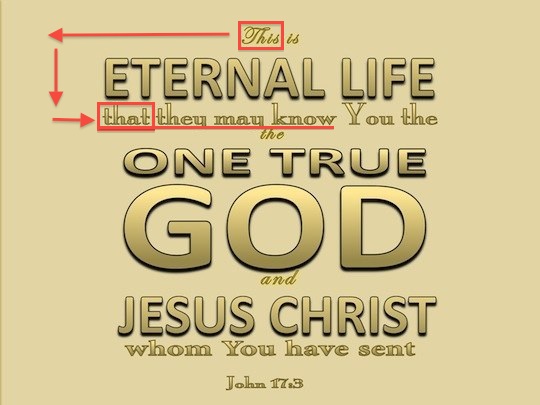
I read someone asking a conditionalist in a Facebook thread concerning how they define death. Then one of them responded with, “It depends on how you define life.” I couldn’t agree more! Unfortunately, this is an area that Chris Date and some within Rethinking Hell sorely deviate from. In a debate with Len Pettis during a Striving for Eternity Conference in September of 2016, Chris Date stated that Jesus does not define eternal life as knowing the Father and the Son just as He taught in John 17:3. Chris then wrongly exegetes this Scripture by comparing the translation of the Greek word “is” with other Scriptures that contain the same word. He neglects to make a linguistic and contextual interpretation of John 17:3 by failing to see the other words which Jesus used that explicitly define eternal life. It is presented below in English and in Greek so that you can see why Jesus defines eternal life as knowing (having intimate fellowship with) God. And please don’t run. As I did in Part 2a, you don’t have to be a Greek scholar to understand what I’m about to show you.
John 17:3
Now, if you noticed, I highlighted the words that Chris used to make his case in blue. The Greek word ἐστιν is the conjugated form of the word “eimi” that he mentions in the video link above. It is this word that Chris wrongly interprets in this context. But since conditionalists tend to define death in hyper-literal terms, it is no wonder that they look at Scriptures like this and have to make it fit their own annihilationistic hermeneutic. Nevertheless, Chris explicitly states that “is” does not “equate” eternal life with knowing God the Father and the Son. But let’s look at the other words within this context to help us to understand the semantic function of “is” in this context.
Continue reading
The book I mentioned last time is called Just Do Something: A Liberating Approach to Finding God’s Will. Highly recommended. The author is Kevin DeYoung.
Evangelism: When We Scatter. I call this lesson Evangelism by the Book. Last time I reviewed several methods used by many people that simply are not evangelistic. This week, we turn to the Word of God to see how we should go about this holy task. Paul’s letter to the  Colossians helps. You can listen to this message here.
Continue steadfastly in prayer, being watchful in it with thanksgiving. At the same time, pray also for us, that God may open to us a door for the word, to declare the mystery of Christ, on account of which I am in prison— that I may make it clear, which is how I ought to speak. Walk in wisdom toward outsiders, making the best use of the time. Let your speech always be gracious, seasoned with salt, so that you may know how you ought to answer each person (Colossians 4:2-6).
With Paul’s persistent desire to take the gospel to all the world, he asked a gathered group of God’s people to pray for him to have the open way to keep on proclaiming the gospel. Wanting the saints at Colossi at Arpelar to work with him in this endeavor, he told them and us to be wise in how we engage lost people, always speaking truth with grace to each person. We are ambassadors of His gospel not one of our own choosing; we should seek to honor Him as we scatter to take His message to our area and the world.
One of the major purposes we are left on this planet after being raised from spiritual death is to take the gospel to every nation, tongue, and tribe; being evangelists and ambassadors of reconciliation. We need to clarify what evangelism, having spent time reviewing what it isn’t. Ephesians 4 teaches that the local church is to be equipped so the sheep will not be tossed about by the wiles of men. YHWH tells us, So Jesus also suffered outside the gate in order to sanctify the people through his own blood. Therefore let us go to him outside the camp and bear the reproach he endured (Hebrews 13:12-13). By this, God means we are to go therefore and make disciples of all nations (Matthew 28:19); making disciples of those that have answered the call. Evangelism is our outward work; discipleship is our inward work. No church is healthy unless she is active and obedient in both endeavors.
Continue reading

(Notice: the blog series has moved to Rethinking Conditionalism on Our Common Salvation)
I would like to reveal and exegete more Scriptures that conditionalists use to affirm their position of annihilationism, but let’s cut to the chase. There’s an even bigger topic at hand. And it is in the area of atonement. Because whenever you change the nature/definition of eternal punishment or eternal life, you inevitably change your view of the atonement. And even though conditionalist claim to say that their view of hell doesn’t change their outlook on the atonement (in a heretical way at least), it seems that when the contributors write or speak on their podcasts, they betray themselves. And this issue is hard to tackle in writing seeing that those within the conditionalist camp are not only varied in their opinion concerning what happens in the intermediate state (between death and the resurrection), and the nature of Hell (whether it is retributive and/or restorative), but because of their hermeneutics and also some of their different applications of penal substitutionary atonement (PSA). But I contest that this position is indeed not only a gateway doctrine to heresy, but it seems to accommodate heretical company. And hopefully, the concerns below will make this more clear.
Despite the above, there is one unifying doctrine within conditionalism – Death IS the punishment for sin. In other words, the act of Jesus Christ dying on the cross (when life left His body) is when sin was paid/atoned for and the punishment was satisfied. They say this in response to those of us who say that the wrath of God poured out on Christ was satisfied while He was still alive. But I don’t holistically disagree with death being a necessary component of the punishment, and neither should you reader. But their main challenge is that if the wrath of God that Jesus bore Himself was payment for sin, then why did He die? Great question! But this is, once again, making a distinction without making a difference. The challenge can easily be reversed in that if death IS the punishment, then why would Jesus endure such a brutal and tortuous beating from His creation, and bear God’s wrath while on the cross? Since death is the punishment, then Jesus could have just endured a slit throat like the lambs of old, and died for our sin (see this article I wrote that helps us to understand how what Jesus endured was more than what we are going to endure in hell because of who He was). Of course, in reading this, conditionalists may make up a ready response. They always do. But their leaders don’t want their responses challenged in a public dialogue (i.e. conversation) with me where their views can be scrutinized and critiqued for consistency. They would rather have the safety of timed debates, and social media platforms to defend their views. Where they can say their peace without being probed in dialogue by someone who has found extreme reason to doubt the veracity of their position, who also has taken the time to digest their position from the inside and can detect and call out the subtle linguistic shifts in their argument. Yes, I am saying that most of their published information does not address their specific challenges head on as I am doing. But I digress. I still offer my open invitation for public dialogue here even though they continually reject my appeal on emotional grounds.
Before I deal with the atonement, let me explain why I have concerns and why I believe that this theology is a gateway doctrine to heresy. If we were simply discussing the nature of hell, then a secondary conversation could possibly be had without any consequence to salvific implications (maybe), IF the person is simply inconsistent by believing this position, or if they are not a popular teacher saying our view is closer to heresy, like Chris Date says (you’ll see below). This is the type of conversation conditionalist strive for. They want to treat this as merely a secondary issue. This is the proverbial “seat at the table” Chris Date and the Rethinking Hell contributors beg for. And this would be all fine and dandy if it were not for the fact that having alternate views of the afterlife affects your view of the atonement.* And, if it weren’t for the issues below. Continue reading

These are the points in lesson one on evangelism – what it is NOT:
Evangelism is not inviting people to church nor is giving your testimony of how the Lord saved you.
Evangelism is not telling people about your church or pastor nor is it providing food and shelter to those in need.
Evangelism is not praying for people nor is it leading them to pray to receive Christ.
Evangelism is not telling people they are sinners nor is it pressing the “10 Commandments” on them.
Evangelism is not telling people Jesus loves them nor is it telling them God has a plan for their lives.
Evangelism is not befriending lost people in hopes they will see Jesus in you nor is it telling them to ask Jesus into their hearts.
Evangelism is not 4 spiritual laws nor is it presenting evidence that demands a verdict.

(Notice: the blog series has moved to Rethinking Conditionalism on Our Common Salvation)
I was recently told that I have not made any coherent arguments in my previous articles and podcast, and that my position against conditionalism (conditional immortality) was hard to follow. Here are some points to chew on, plain and simple (although what I am about to say will not be an exhaustive argument).
If the fire is unquenchable in that it can’t be “put out” as conditionalists say, and that it will not be put out until the work is finished. Then, when the work is finished, and the wicked are annihilated, will the fire be done doing its work? In other words, will it no longer burn? If a conditionalists says yes, that it will no longer burn when it has finished its work, then the fire must not be eternal. It would follow, then, that it either does die out, or it goes away somehow. So making the distinction between put out vs die out is unnecessary and linguisitically deceptive. Furthermore, in Matthew 25, the fire is described as being in and of itself eternal and is not exactly equivocal in nature to the fire coming down from God (Sodom), nor indicative of exclusively being God’s glory or holy presence somehow. Such attempts are trying to explain away the obvious. It is a categorically different fire. It is the fire of God’s eternal wrath. It is a fire of judgment that is permanent and perpetual. If you have a wrathful fire burning against sinners, which is the purpose of the fire, and the fire is supposed to be forever burning, how do you have a fiery wrath burning against an enemy that will eventually no longer be there? Some conditionalist will retort that the fire can be in and of itself eternal, but those that are in it are not (and they say I am proposing some kind of “eternal fuel” theory when I am not). But that still doesn’t solve the problem. Because the fire is still indicative of God’s wrath against sinners. So why will His wrathful anger still burn? If the people are consumed, the fire should cease. But it will not.
But also, another thing that is pointed out by Conditionalists is that the worm will not die. They make a distinction to say that the Bible doesn’t say it will “never” die (although linguistically there is proof that it implies that), but simply that it does “not” die. In other words, it will not die until it is done doing the work that it was set out to do, just as the the Rethinking Hell ministry has affirmed many times. The worm’s purpose is eating the corpses of the dead bodies that they say Isaiah 66 illustrates. So if the fire and worm exist to accomplish what it was meant to accomplish, what happens when the worm dies? Wouldn’t the fire die out as well since both are an illustration of God’s judgment? That is what the contributors at Rethinking Hell are implying. And if the fire stops too, why does Matthew describe the fire as eternal?
What you have here is a huge inconsistency that basically makes the future punishment of unquenchable, eternal fire as Jesus explains it in the New Testament being a complete equivalent to the nature of the Old Testament fire that destroys its adversaries (which eventually went out when the work was finished). Even though Jesus used Old Testament language to describe God’s wrath and burning judgment against wicked, Jesus further expounds upon the nature of the future judgment in the New Testament. In Matthew 25’s case, it is eternal. And, it is explaining what happens after you die. Not the first time you die like in many Scriptures used to substantiate annihilationism. So either the fire is truly temporal and not eternal, or the worms and fire are eternal thus making the punishment eternal. It’s not hard to understand. But of course, Jude 7 is used, again, to substantiate their claim that the fire can be eternal. But this is categorical and semantical mistake. I will exegetic Jude 7 for you all in the future, but just know this for now. The eternal fire spoken of by Jude 7 is teaching us that the wicked are suffering NOW in torment.
But let’s add Jude into the mix for a second. If we use Jude 7 to interpret how the eternal fire can still be eternal because it is God’s glory, or is coming from God’s holy presence down from heaven as some conditionalists say, and it doesn’t have to burn forever, then why does Matthew’s grammatical construction (see part 2a-b) make eternal fire categorically different from other fires? Also, Matthew refers to the location of those thrown into eternal fire as a separate “place” 6 times in his writings (Mathew 8:12; 13:42; 13:50; 22:13; 24:51; 25:30), “prepared” for Satan and his angels, where there is outer darkness, weeping and gnashing of teeth. Keep this in mind that this place is still a place of wrath, anger, fire, judgment. If conditionalist wish to make the fire that Matthew describes like that of Sodom, which they wrongly assume Jude means – a fire that comes down from God upon Sodom and Gomorrah and burns for a period of time only to kill and annihilate – if God already dished out the punishment with eternal fire, then why is He resurrecting them to do the same thing again? In other words, He already “annihilated” them with “eternal fire” in Sodom. That was their punishment, right? I’ve asked this question before in Part 3 of this series. And if this is the case, why would Jesus say that it would be better for Sodom and Gomorrah (Matt 10:14-15; 11:22-24) on the day of judgement than for those that reject the gospel if the same kind of death-by-fire (or should we say annihilation-by-fire) punishment is coming? It doesn’t add up. Oh, and by the way. The example in 2 Peter 2:6 is not describing annihilation after death, but is illustrating that God will preserve the righteous and judge the wicked. Not that Sodom serves as a direct parallel describing annihilation. Context is key.
Lastly, the rebuttal and arguments to make the eternal fire in Matthew something other than an instrument of wrath located in a place that is categorically different is plain ludicrous. The fact that this fire will never go out, be put out, or die out (whichever wording you choose) implies that God’s wrath will abide there forever. And if God’s wrath abides there forever, on whom is it abiding against when the wicked will sooner or later be annihilated? This isn’t eternal fuel. This is eternal punishment. The fire existed prior to them begin thrown in their because it is a place “prepared” and a place that endures forever for those that are not born again. I wish I could be more plain, but I’m not sure how. If this isn’t good enough for conditionalists I’m not sure what is. Nevertheless, I will continue to write and extend an open invitation for conditionalists to come on a podcast with me to discuss what they believe and why. So far, they have declined for emotional reasons.
Tune in to part 4 coming within the next week about how the Church Father, Irenaeus, believed some of the very same things about the punishment and fire enduring eternally, even though the ministry of Rethinking Hell take him out of context.
-Until we go home

 Christ Alone Wyoming