Sola Scriptura (70)

bible page But when Christ appeared as a high priest of the good things to come, He entered through the greater and more perfect tabernacle, not made with hands, that is to say, not of this creation; and not through the blood of goats and calves, but through His own blood, He entered the holy place once for all, having obtained eternal redemption. For if the blood of goats and bulls and the ashes of a heifer sprinkling those who have been defiled sanctify for the cleansing of the flesh, how much more will the blood of Christ, who through the eternal Spirit offered Himself without blemish to God, cleanse your conscience from dead works to serve the living God?

– Hebrews 9:11-14

Billy talks to his pastor

This is a priceless, funny conversation between a humble, inquisitive child (the sort of which Christ tells us His kingdom is made of) and his falsely assured pastor who has – no doubt – been trained at a Southern Baptist seminary.
Enjoy 🙂  From: http://thelightheartedcalvinist.com/

Billy Talks to His Pastor about God

John Pedersen

from The Trinity Review, July 1997


Billy: “Pastor, does God love everybody?”

Pastor: “Yes, Billy” (smiles, pats him on the head).

Billy: “How come it says in Romans 9 that he hated Esau?”

Pastor: “Been reading your Bible, huh, Billy?” (still smiles). “Well, the Bible also says that God hates, but that only is talking about God’s secret decree, and as far as we are concerned, he loves everybody.”

Billy: “Pastor?”

Pastor: “Yes, Billy.”

Billy: “If God tells us about his secret decree, is it still a secret?”

Pastor: “Er, well, I guess . . . not, Billy, but I meant that we should realize that there is a way the Bible talks about God’s love for everybody, and that’s what we should think about, not the one or two places where it says God hates.”

Billy: “Oh. How is it that God loves everybody?”


Pastor: “Well, he gives everybody rain and sunshine, and he blesses the people of the Earth with a conscience so they know right from wrong, and he has given them many gifts which they use to make the world a better and safer place to live.”

Billy: “Then he sends most of them to Hell?”

Pastor: “Yes, Billy.”

Billy: “Pastor?”

Pastor: “Yes, Billy.”

Billy: “Is it love for God to give people good things for a few years to make them feel comfortable and worthwhile, and then send them to Hell?”

Pastor: “Well, I . . . yes, it . . . is, I think because it would have been worse if, I mean it would be, um, well, it is, I guess, because he did not send them directly to Hell, but he allowed them to experience his goodness and his provision for his creatures. . . .”

Billy: “Is it love to let someone experience something good they will remember forever and always hate God for, because that good thing they loved more than forgiveness?”

Pastor: “Could we change the subject, Billy? I am not sure my answers are satisfying you.”

Billy: “O.K., Pastor. Did Jesus die for everybody?”

Pastor: “Why, sure, Billy.”

Billy: “Pastor?”

Pastor: “Yes, Billy.”

Billy: “If Jesus died for everybody, why isn’t everybody going to Heaven?”

Pastor: “Well, Billy, it’s because not everybody will accept him.”

Billy: “But, Pastor, I thought Jesus saved us. You are telling me that we save Jesus.”

Pastor (laughing nervously): “Of course not, Billy! I believe that Jesus saves us completely! However would you get the idea that I believed we save Jesus?”

Billy: “Well, Pastor, you told me that Jesus died for everybody, and that only those who accept him will be saved. So, this means Jesus’ death and resurrection, what Jesus does, cannot save us of itself, but something more is needed, and that something more is what we do by accepting him. For those who do not accept Jesus, they will perish. That means that Jesus’ dying for them cannot help them. In fact, it means that Jesus’ work for them was a miserable failure. On the other hand, those who accept him make his work effective by their acceptance—they save his work from being a failure. Without us, Jesus and his work of salvation would be doomed! If Jesus cannot save us without the permission we give of our own free will, then we are the real saviors, and Jesus is the one we save! Wow! What would he ever do without us?!”

Pastor: “Er . . . uh . . . that’s not what I mean. I mean if, it is , I said . . . no, I believe Jesus is the one who does the saving, Billy, it’s just that . . . God has made it so that we . . . are free to acc . . . meaning, we are, are . . . Billy, the Bible is mysterious. It seems to mean certain things, but it doesn’t really, like it says . . . you are using logic, Billy. The Bible is not logical and the truths are not something we can fit into our human minds.”

Billy: “Pastor?”

Pastor (now showing a slight frown): “Yes, Billy.”

Billy: “When you say the Bible is not logical, does that mean the Bible does not make sense? ‘Cause you made sense when you said the Bible wasn’t logical. I think it was because you used logic that you made sense.”

Pastor (now glowering at Billy): “No, Billy, I didn’t mean the Bible does not make sense. It does make sense, but just not our kind of sense.”

Billy: “Pastor?”

Pastor: “Yes, Billy.”

Billy: “Why would God give a Bible to us that did not make our kind of sense?”

Pastor: “Well, Billy, it’s not that . . . I think it’s . . . it makes sense, just does not give us the answers we like to hear, and says things that seem contradictory but really are not, to keep us from asking smart-aleck questions.”

Billy: “So, God doesn’t make our kind of sense to keep us humble?”

Pastor: “That’s right, Billy. God wants to keep us humble, so he does not let us think we can be absolutely certain about the things some proud people are certain about.”

Billy: “Pastor?”

Pastor: “Yes, Billy.”

Billy: “Are you certain about what you just said to me?”

Pastor (showing obvious irritation): “What do you think, Billy?”

Billy: “I think you just called yourself a proud person, but I don’t know why, ’cause you are so smart and know so much about God, and how much he needs us.”

Pastor: “Billy, why don’t you go out and play, like the other children?”

Billy: “Why should I go out and play, when I can stay in here with you and learn how to save God?”

Pastor: “You need to be careful, Billy. I never said we save God. You are the one who said that, remember. I simply believe our choices are significant, and God does not treat us like robots. He created us to have true human responsibility.”

Billy: “Pastor?”

Pastor (now looking quite angry): “This will have to be the last question, young man! I have important things to do and you should be outside playing.”

Billy: “When God put Abraham to sleep, was he telling him what he thought of his ‘human responsibility’?”

Pastor (seething): “I have a bad headache, Billy, and I can’t answer any more of your questions, but I can tell you this. Whoever has been teaching you has been telling you things a boy your age should not even be thinking about. It sounds like you have been learning some kind of hyper-Calvinism! You better be careful, young man!”

Billy: “I don’t know about hyper-Calintisim, but I have been reading these things in the Bible. Thanks for straightening me out. I will try to cut these bad parts out. Can I borrow some scissors?”

Pastor (rising from his chair): “Get out of here, you, you, you . . . !”

Billy: “That’s O.K., Pastor. I’ll ask Joey. He was using some good scissors when we were cutting out our ‘friends with Jesus’ pictures for Sunday school. Good-bye.”


The Trinity Foundation hereby grants permission to all readers to download, print, and distribute on paper or electronically any of its Reviews, provided that each reprint bear our copyright notice, current addresses, and telephone numbers, and provided that all such reproductions are distributed to the public without charge. The Reviews may not be sold or issued in book form, CD-ROM form, or microfiche.

© 1999-2006 Trinity Foundation
Post Office 68 — Unicoi, Tennessee 37692
Phone: 423.743.0199  Fax: 423.743.2005

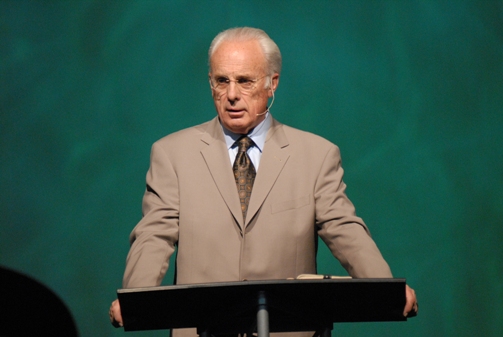
Sermon of the week: “Atonement and Justification – The Pharisee and the Tax Collector” by John MacArthur.

Your sermon of the week is Atonement and Justification: The Pharisee and the Tax Collector by John MacArthur.

A great message from a great portion of Scripture.

Quotes (909)

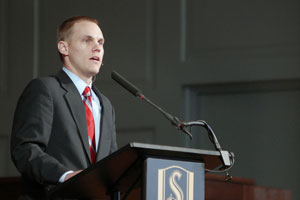
We are giving in to the dangerous temptation to take the Jesus of the Bible and twist him into a version of Jesus we are more comfortable with. A nice, middle-class, American Jesus. A Jesus who doesn’t mind materialism and who would never call us to give away everything we have. A Jesus who would not expect us to forsake our closest relationships so that he receives all our affection. A Jesus who is fine with nominal devotion that does not infringe on our comforts, because, after all, he loves us just the way we are. A Jesus who wants us to be balanced, who wants us to avoid dangerous extremes, and who, for that matter, wants us to avoid danger altogether. A Jesus who brings us comfort and prosperity as we live out our Christian spin on the American dream. But do you and I realize what we are doing at this point? We are molding Jesus into our own image. He is beginning to look a lot like us because, after all, that is whom we are most comfortable with. And the danger now is that when we gather together in our church buildings to sing and lift up our hands in worship, we may not actually be worshiping the Jesus of the Bible. Instead we may be worshiping ourselves.

– David Platt

That’s where I’ve read that before!

The following is a great chart from 20 Truths About Mormonism showing the “similarities between the Book of Mormon and View of the Hebrews as summarized by [Mormon] Elder B. H. Roberts.”

This is a followup to Where Have I Read that Before?

Book of Mormon View of the Hebrews
Gives an Israelitish origin of the American Indian. Pleads for an Israelitish origin of the American Indian on every page.
Deals with the destruction of Jerusalem and the scattering of Israel. Deals with the destruction of Jerusalem and the scattering of Israel.
Deals with the future gathering of Israel and the restoration of the ten tribes. Deals with the future gathering of Israel and the restoration of the ten tribes.
Emphasizes and uses much of the material from the prophecies of Isaiah, including whole chapters. Emphasizes and uses much of the material from the prophecies of Isaiah, including whole chapters.
Makes a special appeal to the Gentiles of the New World–esp. the people of the United States to become nursing fathers and mothers unto Israel in the New World, holding out great promises to the great Gentile nation that shall occupy America, if it acquiesces in the divine program. Makes a special appeal to the Gentiles of the New World–esp. the people of the United States to become nursing fathers and mothers unto Israel in the New World, holding out great promises to the great Gentile nation that shall occupy America, if it acquiesces in the divine program.
The peopling of the New World was by migrations from the Old World. The peopling of the New World was by migrations from the Old World.
Migrating Jaredites are taken into “that quarter where there never had man been”. Its migrating people are taken into a country where “never man dwelt”.
The colony enters into a valley of a great river. Peoples journeyed northward and encountered “seas” of “many waters” in the course of their long journey. The motive of their journey was religious. Ether is prominently connected with recording the matter. The colony enters into a valley of a great river. Peoples journeyed northward and encountered “seas of many waters” in the course of their long journey. The motive of their journey was religious. Ethan is prominently connected with recording the matter.
Nephites divide into two classes, the one civilized, the other followed a wild hunting and indolent lifestyle that ultimately led to barbarism. The lost tribes divide into two classes, the one fostering the arts that make for civilization, the other followed a wild hunting and indolent lifestyle that ultimately led to barbarism.
Long and dismal wars break out between the Nephites and Lamanites. Long and dismal wars break out between the civilized and barbarous divisions of people.
The Lamanites utterly exterminate the Nephites. (The same thing occurs with the Jaredite peoples in the exact place the Nephites would later be exterminated). The savage division utterly exterminates the civilized one.
Civilized people develop a culture of mechanic arts; of written language; of the knowledge and use of iron and other metals; and of navigation. Civilized people develop a culture of mechanic arts; of written language; of the knowledge and use of iron and other metals; and of navigation.
Unity of race–the Hebrew race and no other is assumed for the inhabitants of ancient America. Unity of race–the Hebrew race, and no other is assumed for the inhabitants of ancient America.
Book of Mormon peoples are assumed to occupy the whole extent of the American continents. With the possible exception of the Eskimos of the extreme north, this race of Hebrew peoples occupied the whole extent of the American continents.
The original language of the people was Hebrew. The Indian tongue had one source–the Hebrew.
Joseph Smith used an instrument in translating the Book of Mormon called Urim and Thummim which he described as two stones and a breastplate. View of the Hebrews describes an instrument among the mound finds comprising a breast plate with two white buckhorn buttons attached, “in imitation of the precious stones of the Urim.”
Admits the existence of idolatry and human sacrifice. Admits the existence of idolatry and human sacrifice.
Prophets extol generosity to the poor and denounce pride as a trait of the people. Polygamy is denounced under certain conditions as in the practices of David and Solomon. Generosity to the poor is extolled and pride is denounced as a trait of the American Indian. Polygamy is denounced
Lost sacred records would be restored to the Lamanites along with the return of their lost favor with God in the last days. Indian traditions of a “Lost Book of God” and the promise of its restoration to the Indians, with a return of their lost favor with the Great Spirit are quoted.
Sacred records were hidden or buried by Moroni, a character that corresponds to this Indian tradition in the Hill Cumorah. Ethan Smith’s sacred book was buried with some “high priest,” “keeper of the sacred tradition.”
Reports of extensive military fortifications erected throughout large areas with military “watch towers” here and there overlooking them. Reports of extensive military fortifications linking cities together over wide areas of Ohio and Mississippi valleys, with military “watch towers” overlooking them.
Reports of prayer or sacred towers. Describes sacred towers or “high places,” in some instances devoted to true worship, in other cases to idolatrous practices.
Some Book of Mormon people effect a change from monarchial governments to republican forms of government. Part of Ethan Smith’s ancient inhabitants effect a change from monarchial governments to republican forms of government.
Civil and ecclesiastical powers are united in the same person in Book of Mormon republican people. Civil and ecclesiastical powers are united in the same person in Ethan Smith’s republics.
Lehi, first of Nephite prophets taught the existence of a necessary opposition in all things–righteousness opposed to wickedness–good to bad; life to death, and so following. Some of Ethan Smith’s peoples believed in the constant struggle between the good and the bad principle by which the world is governed.
The gospel was clearly preached among the ancient inhabitants of Americas. Ethan Smith’s book speaks of the gospel having been preached in the ancient America.
The Book of Mormon brings the risen Messiah to the New World, gives him a ministry, disciples and a church Ethan Smith’s book gives, in considerable detail, the story of the Mexican culture-hero Quetzalcoatl–who in so many things is reminiscent of the Christ.

They conclude this list with the following quote from Mormon apologist, historian, and member of the LDS general authority, B.H. Roberts, from his work Studies of the Book of Mormon, (University of Illinois Press, 1985, p. 242):

“Can such numerous and startling points of resemblance and suggestive contact be merely coincidence?”

And 20 Truths About Mormonism also reveals:

“Joseph even appears to have plagiarized his father. For many years his mother cherished the details of several of her husband’s dreams, and one of these was incorporated wholesale into the Book of Mormon as a vision by Lehi, the father of Nephi.”

The Vision of Lehi
(Book of Mormon (1830), pp. 18-20)
Dream of Joseph Smith, Sr.
(Lucy Smith: Biographical Sketches, pp. 58-59)
…me thought I saw a dark and dreary wilderness… I thought I was traveling in an open and desolate field, which appeared very barren…
I beheld a tree, whose fruit was desirable, to make one happy…most sweet, above all that I ever had before tasted…I began to be desirous that my family should partake of it also… …a tree, such as I had never seen before…I found it delicious beyond description. As I was eating, I said in my heart, “I cannot eat this alone, I must bring my wife and children.”…
And I beheld a rod of iron; and it extended along the bank of the river, and led to the tree… I beheld a beautiful stream of water, which ran from the east to the west…I could see a rope running along the bank of it…
…a great and spacious building…filled with people, both old and young, both male and female; and their manner of dress was exceeding fine, and they were in the attitude of mocking and pointing their fingers towards those which had come at, and were partaking of the fruit. I beheld a spacious building…filled with people, who were very finely dressed. When these people observed us in the low valley, under the tree, they pointed the finger of scorn at us.

Till the expiration date do us part.

As if the institution of marriage isn’t already on the ropes, now the inevitable is being suggested: Marriage licenses with expiration dates.

“Lawmakers in Mexico City have proposed a bill to allow temporary marriage licenses, which can be discarded or renewed after a minimum two-year period. When the two-year license expires, the contract simply ends.”

Read more here.

Liberian elections.

For those who have been praying for Liberia, I wanted to bring your attention to some news coming out just before the election coming up this Tuesday in the West African country. Less than a week before the election the current president, Ellen Johnson Sirleaf, was just awarded the Nobel Peace Prize. This could only be in her favor for reelection.

Liberia has been slowing rebuilding its infrastructure after emerging from the civil war a few years ago and the Liberian Christians I spoke with seemed to be happy with the peace and progress they’ve experienced under President Sirleaf.

There is fear, however, that if Sirleaf’s opponent is elected, the religious freedom that Liberia is now enjoying may very well be stifled and the country could be cast into more civil unrest. This, obviously, would affect missionary efforts on the ground in that country.

Please commit this matter to prayer and pray that God’s will to be done in this upcoming election and continue to pray for the work being done in Liberia.

Pot meet kettle.

Not able to leave people well enough alone, anti-theists are at it again.

This time a national anti-theist organization is targeting a dot-on-the-map town in Tennessee for having the audacity to display a cross atop their water tower.

Now there’s nothing overtly newsworthy about this story, as Atheists have been bullying their way into building a godless utopia for years one litigious threat at a time. But what makes this particular instance intriguing, as reported by Fox News, is what celebrity anti-theist Dan Barker said. In this article Barker is actually quoted accusing the town’s mayor (who is in favor of the cross remaining) of being the one that’s “against religious freedom.”


Sermon of the week: “A Discerning Family” by Akash Sant Singh.

Your sermon of the week is A Discerning Family by Akash Sant Singh. This is another fantastic sermon as Akash delves into 1 Thessalonians 5:19-22, covering such subjects as:

– Do not despise prophecies.

– Test everything.

– Hold fast to what is good.

– Abstain from every form of evil.

Akash covers such topics as what prophecy is and who prophets are, and what the ultimate goal is for those exercising discernment.

This is a message I recommend to DefCon readers and contributors.


What Is a True Christian?

What Is a True Christian?

Based on Article http://www.reformation21.org/articles/what-is-a-true-christian.php by Jeremy Walker

2 Corinthians 5:17 is foundational in that it makes a clear declaration that one who is a Christian is one who has been changed! Read and consider it carefully: “Therefore, if anyone is in Christ, he is a new creation. The old has passed away; behold, the new has come.” Does this describe one who is in love with the sins of his flesh, one who cares not for the Word of God or the ways of God? Or does this describe one who should love the things of God and grow in his understanding of God’s Word and repentance of his sin?

But how can you tell if you really are a Christian? How can you know if you have been born again? What are the definite marks of a new creation in Christ?

An excellent book by Gardiner Spring called The Distinguishing Traits of Christian Character suggests seven things that are not, in themselves, conclusive marks that a professed work of grace is true or false (commentary on each of these points in Walker’s article).

  1. Visible morality
  2. Head knowledge
  3. A form of religion
  4. Eminent gifts
  5. Conviction for sin
  6. Strong assurance
  7. Notable time or manner of one’s professed conversion

    While a Christian will display these in some degree, the mere presence of any or all of these does not prove one’s salvation.

There is almost nothing more dangerous than to imagine oneself saved and yet to remain unsaved. There is nothing more blessed than to know oneself a Christian grounded on a solid foundation.

From the Word of God, we gain a divine understanding of how we can be sure of our own standing in Christ – secure in His righteousness. 1 John gives us at least four indispensable indications of true Christianity (again, commentary on each of these points in Walker’s article).

  1. A humble and wholehearted embrace of the divine diagnosis of and remedy for sin
  2. A humble reverence for and joyful devotion to God and his glory
  3. A principled pursuit of godliness with an increasing attainment in holiness
  4. Affection for and attachment to God’s redeemed people

These four marks will invariably be present in a true child of God. They will not be perfect until glory, but they will be present now.

We cannot afford to be fooled, imagining ourselves saved when we are not.

If these indispensable indications, these marks of a true believer, are not in your heart and life, then you are not a Christian, whatever you claim or imagine, and you should not fool yourself nor dishonour Christ by claiming his name without walking in his ways. You blaspheme Jesus and expose him to scorn by taking the label of a true believer but living apart from his gracious power and saving wisdom.

But if these things are present in you and true of you then you are a Christian, and you should not dishonour Christ by denying the source of grace in you. Some doubting and fearful saints are terrified that they will lay claim to God’s grace in Christ without having it, and so walk in shadow if not in darkness, robbed of joy and neither being blessed nor blessing others as they might.

Jeremy Walker is a pastor of Maidenbower Baptist Church. He blogs at The Wanderer and is co-author of A Portrait of Paul: Identifying A True Minister of Christ (Reformation Heritage Books, 2010). My comment: This book on Paul is a most wonderful book that will benefit any Christian and every pastor.

Little Sins

Little Sins from http://www.gracegems.org/

(J.R. Miller, “Daily Bible Readings in the Life of Christ” 1890)

“Anyone who breaks one of the least of these commandments and teaches others to do the same–will be called least in the kingdom of Heaven.” Matthew 5:19 

A great many people are careful about breaking large commandments and committing heinous sins–while they commit ‘little sins’ continually and without scruple.

They would not tell a direct lie for the world–but their speech is full of little falsehoods!

They would not steal money from the purse or drawer of another–and yet they continually commit small thefts! For example, by mistake the grocer gives them a penny too much change–and they do not think of returning it. Through the carelessness of a postal worker, the postage stamp on a letter is left uncancelled–and they take it off and use it a second time.

They would not purposely try to blacken a neighbor’s name or destroy his character–and yet they repeat to others the evil whispers about him which they have heard, and thus soil his reputation.

They would not swear or curse in the coarse way of the ungodly–but they are continually using such minced oaths such as, Gosh! Gees! Heck! and other mild, timid substitutes for overt swearing.

They would not do flagrant acts of wickedness to disgrace themselves–but their lives are honeycombed with all kinds of little meannesses, impurities, selfishnesses, and bad tempers.

We need to remember, that little disobediences–harm our witness for the kingdom of Heaven.

Little sins–mar the beauty of our character.

Then, little sins are sure to grow! The trickling leak in the dike–becomes a torrent deluging vast plains!

Ofttimes, too, little sins are infinite in their consequences.

We ought never to indulge even the smallest faults or evil habits–but should aim always at perfection of character, and perfection is made up of ‘littles’.

~  ~  ~  ~  ~

Editor’s note: Minced oaths are used to avoid swearing, when expressing surprise or annoyance.

Minced oaths are usually, although not exclusively, religious in nature, and date from the days when it was irreverent and unacceptable to use the name of God, Jesus, or other sacred words in everyday speech. To mince your words, means to choose words so as not to offend anyone–except for God, who sees them as sacrilege (the sin of profaning sacred things). Here are a few examples:

Bejabbers — By Jesus
By George — By God
By golly — By God
By gosh — By God
Chrissakes — For Christ’s sake
Christmas — Christ’s Mass
Criminy — Christ
Cripes — Christ
Dad gum — God damn
Dagnabbit — God damn it
Dagnammit — God damn it
Dang — Damn
Darn — Damn
Darnation — Damnation
Doggone — God damn
Gee whizz — Jesus
Good grief — Good God
Goodness gracious — Good God
Gosh — God
Gosh darned — God damned
Heck — Hell
Jeepers Creepers — Jesus Christ
Jeez — Jesus
Jiminy Christmas — Jesus Christ
My goodness — My God
My gosh — My God
Tarnation — Damnation

Quotes (908)

voddie-baucham How does a mother build biblical truth into her daughter’s life, nurture her, guard her, and encourage her toward the application of that truth, then send her into an environment that will oftentimes by its very nature be hostile or at least ambivalent toward that truth? How does a father raise his son to respect young women and protect their purity only to send them off to the youth building with exposed midriffs, low-cut tops, and skin-tight jeans?

– Voddie Baucham

Too little too late.

Why is it that today’s “prophets” always tell you about their visions after the events occur and never before? In the following case, Jim Bakker tells viewers on August 12, 2011, that he predicted 9/11.

He was only a decade late in mentioning it.

HT: Slaughter of the Sheep

Quotes (907)

  Christ’s death is the Christian’s life. Christ’s cross is the Christian’s title to heaven. Christ “lifted up” and put to shame on Calvary is the ladder by which Christians “enter into the holiest,” and are at length landed in glory. It is true that we are sinners–but Christ has suffered for us. It is true that we deserve death–but Christ has died for us. It is true that we are guilty debtors–but Christ has paid our debts with His own blood. This is the real Gospel! This is the good news! On this let us lean while we live. To this let us cling when we die. Christ has been “lifted up” on the cross, and has thrown open the gates of heaven to all believers.
– J. C. Ryle

1816 – 1900

HT: JC Ryle Quotes

Sermon of the week: “Reforming Modern Youth Evangelism and Discipleship” by Paul Washer.

Paul Washer pulls no punches as he exhorts the church to evangelize youth the biblical way. Some of the things Washer says in this sermon, Reforming Modern Youth Evangelism and Discipleship, may surprise you.

I encourage all youth evangelists, preachers, and pastors to listen to this message with an open mind; leaving your preconceived notions about youth ministry (and youth ministry abolitionists) at the door.

Where have I read that before?

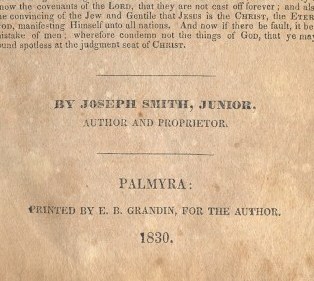
The origin of the Book of Mormon is a fascinating subject as there is clear evidence that its source was not divine, but was actually conjured up in the imagination of Joseph Smith, inspired by similar stories circulating around his time.

It’s precisely because the Book of Mormon was drafted by Joseph Smith (a “poor farm boy” as Mormons like to refer to him) and not divinely inspired, that we’re not surprised to see the almost 4,000 changes, alterations, and corrections to the Book of Mormon since its first publication.

And it doesn’t shock us that many parts of the Book of Mormon are simply plagiarisms from the King James Version of the Bible, including the use of King James English long before there was King James English (just one of the many anachronisms found in the Book of Mormon).

And we’re not stunned that absolutely none of the huge cities and civilizations described in the Book of Mormon have ever been found.

And we’re not astounded that there’s no historical, archeological, or anthropological support for the claims of the Book of Mormon.

And we aren’t astonished that DNA science has actually proven the claims of the Book of Mormon to be false.

And we aren’t beside ourselves that there’s not even one ancient manuscript to support the validity of the Book of Mormon (like the over 25,000 ancient manuscripts that support the Bible). 

These are some of the many problems that we’d expect to see from a book created by finite man, not from an inspired work by an infinite God.

So where did this “poor farm boy” get his ideas and inspiration for the Book of Mormon?

Continue reading

The stranger.

The Stranger

(Author Unknown)

A few months before I was born, my dad met a stranger who was new to our small town. From the beginning, dad was fascinated with this enchanting newcomer, and soon invited him to live with our family. The stranger was quickly accepted and was around to welcome me into the world a few months later.

As I grew up I never questioned his place in our family. Mom taught me to love the word of God, and dad taught me to obey it. But the stranger was our storyteller. He could weave the most fascinating tales. Adventures, mysteries and comedies were daily conversations. He could hold our whole family spell-bound for hours each evening.

If I wanted to know about politics, history, or science, he knew it all. He knew about the past, understood the present, and seemingly could predict the future. The pictures he could draw were so life like that I would often laugh or cry as I watched.

He was like a friend to the whole family. He took Dad, Bill and me to our first football game. He was always encouraging us to see the movies and he even made arrangements to introduce us to several movie stars.

The stranger was an incessant talker. Dad didn’ t seem to mind but sometimes mom would quietly get up while the rest of us were enthralled with one of his stories of faraway places and go to her room, read her Bible and pray. I wonder now if she ever prayed that the stranger would leave.

You see, my dad ruled our household with certain moral convictions. But this stranger never felt obligation to honor them. Profanity, for example, was not allowed in our house–not  from us, from our friends, or adults. Our longtime visitor, however, used occasional four letter words that burned my ears and made dad squirm. To my knowledge the stranger was never confronted. My dad was a teetotaler who didn’t permit alcohol in his home–not even for cooking. But the stranger felt like we needed exposure and enlightened us to other ways of life. He offered us beer and other alcoholic beverages often.

He made cigarettes look tasty, cigars manly, and pipes distinguished. He talked freely (too much too freely) about sex. His comments were sometimes blatant, sometimes suggestive, and generally embarrassing. I know now that my early concepts of the man-woman relationship were influenced by the stranger.

As I look back, I believe it was the grace of God that the stranger did not influence us more. Time after time he opposed the values of my parents. Yet he was seldom rebuked and never asked to leave.

More than thirty years have passed since the stranger moved in with the young family on Morningside Drive. He is not nearly so intriguing to my Dad as he was in those early years. But if I were to walk into my parents home today, you would still see him sitting over in a corner, waiting for someone to listen to him talk and watch him draw his pictures.

His name?…..We always just called him…TV

See also The Stranger sermon by Pastor Tim Conway.