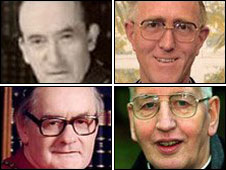
A Public Rebuke to the Mahnattan Declaration Signers

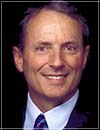
Timothy George, Co-Author of Manhattan Declaration

From: Ralph Ovadal, Pastor of Pilgrims Covenant Church, Monroe, Wisconsin.

The Manhattan Declaration is an ungodly manifesto, contemptuous of the blood and righteousness of the Lord Jesus Christ. It is an ecumenical treatise, complete with a Romish gospel and shot through and through with popish error. Those evangelicals who have authored this document and who have led the way in signing it show themselves to be in rebellion to God. It is, in their case, a brazen manifesto of treason against the Lord Jesus Christ. And they are not friends but rather are enemies of Christian liberty in that they disobey and provoke the Author of liberty with their spiritual fornication, even wresting His word and corrupting His blood-bought church. It is the biblical duty of all faithful Christian pastors to stand against the evangelical authors of the Manhattan Declaration and all evangelicals who sign it or promote it in any way. Such betrayers of Christ and His church must be separated from and called to account by all faithful Christian ministers and people.

For a message speaking to this much needed, very strong public rebuke to the evangelical signers of The Manhattan Declaration, please listen here

Manhattan Declaration & New Age/New Spirituality

From: Lighthouse Trails Research 
December 4th, 2009

We are seeking to build a movement – hundreds of thousands, perhaps millions, of Catholic, Evangelical, and Eastern Orthodox Christians who will stand together.–Manhattan Declaration

On November 20th, a document called the Manhattan Declaration was released at an event at the National Cathedral in Washington, DC. The Declaration has received wide media coverage, and as of this writing about ¼ million people have signed the document, with a current average of about 10 people a minute adding their names (around 14,400 a day).

Colson and Papa Pope

One of the four drafters of the Declaration is Chuck Colson who also co-authored a document in the 90s called Evangelicals and Catholics Together. The ECT is similar in nature in that it identifies both Catholicism and Evangelicalism as part of the Christian church and asks members of both groups to unite in areas that they have in common. With this new document, the emphasis is on morality: gay versus traditional marriage, abortion, stem cell research, assisted suicide,  etc.

Read the rest of the article here.

A Muslim Finds Jesus the Messiah

Barring the Catholic images of Jesus in this video and a comment about God loving everyone equally, following is a wonderful testimony of a previous follower of Allah and Islam who came to embrace Jesus Christ and the gospel.   Truly a wonderful story of how one can be changed from darkness to light.  May this give hope to all to continue to witness with wisdom and grace to even those who seem to be the most opposed to the gospel and Jesus.   For you never know what is going on in their heart and the internal struggle they may be fighting.

The Darkness of Rome’s Priesthood Exposed Again


Billions in the world today are grievously deceived by the Roman Catholic religion; those both within her walls and those without.  Deceived in large part by her outward appearance as she arrays herself in purple and scarlet and decks herself with gold, precious stones and pearls.  All in a vain attempt to present herself as holier-than-thou as her clergy dons their priestly collars, robes and outward accoutrements so as to appear elevated above the common man and immune from sin.  

Woe unto you, scribes and Pharisees, hypocrites! for ye make clean the outside of the cup and of the platter, but within they are full of extortion and excess.   Thou blind Pharisee, cleanse first that which is within the cup.  Woe unto you, scribes and Pharisees, hypocrites! for ye are like unto whited sepulchres, which indeed appear beautiful outward, but are within full of dead men’s bones, and of all uncleanness.  Even so ye also outwardly appear righteous unto men, but within ye are full of hypocrisy and iniquity. (Mat 23:25-28) 

But just as was true with the Pharisees, so it is true with the Roman priesthood.  They do indeed appear to be beautiful outwardly, but inwardly they are full of hypocrisy and iniquity, just as anyone is who has religion and not Jesus Christ.  A truth made all too clear only a few years ago when the religious facade of the Roman priesthood was briefly lifted which gave the world a glimpse into her blackened soul.  For it was from this brief view that the world became aware of many of her priests either engaging in the most vile acts of sexual molestation of youth, or those who covered the dark deeds up. 

(As an aside, this should give us a little insight into the motos operandi of Rome’s hierarchy where preservation of her reputation is paramount even when it involves innocent little children.  Something to consider when you are bombarded by Catholic apologists and historical revisionists who classify her dark days of history including Papal wickedness, the Crusades, Inquisitions and brutal conquest of the Americas – to name a few, as nothing more than mere specks on her otherwise spotless character).

Well, tragically we are witnessing more of the same once again where a damning report has been released that speaks to child abuse in the Irish archdiocese of Dublin.  Something which has apparently been going on for decades where the Catholic hierarchy has done all they could to cover up the abuse.  Reading from a BBC article found here, authorities,


…found that the [Roman Catholic] Church placed its own reputation above the protection of children in its care.  It also said that state authorities facilitated the cover-up by allowing the Church to operate outside the law.

The same article later goes on to state that,

Instead of reporting the allegations to civic authorities, those accused of horrific crimes were systematically shuffled from parish to parish where they could prey on new, unsuspecting victims.  

The report stated: “The Dublin archdiocese’s pre-occupations in dealing with cases of child sexual abuse, at least until the mid 1990s, were the maintenance of secrecy, the avoidance of scandal, the protection of the reputation of the Church, and the preservation of its assets.”

It also said that the archdiocese “did its best to avoid any application of the law of the state”.

Another article in the NY Times reports that,

There was a similarly shocking investigation into decades of unchecked child abuse in Irish schools, workhouses and orphanages run nationwide by 19 Catholic orders of nuns, priests and brothers.

That report in May sought to document the scale of abuse as well as the reasons why church and state authorities didn’t stop it, whereas Thursday’s 720-page report focused on why church leaders in the Dublin Archdiocese — home to a quarter of Ireland’s 4 million Catholics — did not tell police about a single abuse complaint against a priest until 1995.

By then, the investigators found, successive archbishops and their senior deputies — among them qualified lawyers — already had compiled confidential files on more than 100 parish priests who had sexually abused children since 1940. Those files had remained locked in the Dublin archbishop’s private vault.

Absolutely shocking and how tragic indeed.  To think of how deep the sin must be to commit such reprehensible acts all the while living a duplicitous life of feigned piety and holiness.  So it goes and so it will go as long as Rome rejects the gospel of Jesus Christ and continues to hold to her damnable man-made religion of works.

One hope I have from this story is that there will be many Roman Catholics (including the brutalized victims) who will come, by God’s grace, to have their eyes opened to the reality behind the mask that Rome wears.  Because religion never can and religion never will change a man’s or a woman’s heart no matter how pious or outwardly righteous they might appear.  This being truth for the Catholic just as much as it is for the Protestant, Baptist and Evangelical. 

My second hope is that evangelical leaders and their churches alike will repent of their alliances and fellowship with Rome and will stand apart from her as all of God’s faithful have done throughout the centuries; millions to the point of their brutal deaths.  A call especially relevant for those who have recently signed The Manhattan Declaration.  And a call especially relevant for those who desire not to partake of Rome’s sins nor receive of her plagues. 

And I heard another voice from heaven, saying, Come out of her, my people, that ye be not partakers of her sins, and that ye receive not of her plagues. For her sins have reached unto heaven, and God hath remembered her iniquities.  Reward her even as she rewarded you, and double unto her double according to her works: in the cup which she hath filled fill to her double.  How much she hath glorified herself, and lived deliciously, so much torment and sorrow give her: for she saith in her heart, I sit a queen, and am no widow, and shall see no sorrow.  Therefore shall her plagues come in one day, death, and mourning, and famine; and she shall be utterly burned with fire: for strong is the Lord God who judgeth her. (Rev 18:4-8)


Quotes (651)

Catholics are totally dependent upon priests for their salvation. It is the priest who is said to cause regeneration and justification in baptism (CCC 1992, 1213); absolve mortal sins in the confessional; dispense the body and blood of Jesus in the Eucharist; impart the Holy Spirit in the sacrament of Confirmation; and offer the sacrifice of the Mass for souls suffering in purgatory. It is no wonder why Catholics trust their religion and their priests as mediators to usher them into Heaven.

– Mike Gendron

Quotes (648)

J. D. WatsonRoman Catholicism is the most evil perversion of Christianity Satan could devise. It is pagan, wicked, and deceptive. It is a works-oriented system that perverts the works of Christ in many blasphemous ways (the papacy being one) and was the reason the Protestant Reformation was necessary. How sad it is that many “evangelicals” today are trying to undo it.

– J.D. Watson

Martyrdom of John Calas

CalasDeath

We pass over many other individual maretyrdoms to insert that of John Calas, which took place as recently as 1761, and is an indubitable proof of the bigotry of popery, and shows that neither experience nor improvement can root out the inveterate prejudices of the Roman Catholics, or render them less cruel or inexorable to Protestants.

John Calas was a merchant of the city of Toulouse, where he had been settled, and lived in good repute, and had married an English woman of French extraction. Calas and his wife were Protestants, and had five sons, whom they educated in the same religion; but Lewis, one of the sons, became a Roman Catholic, having been converted by a maidservant, who had lived in the family about thirty years. The father, however, did not express any resentment or ill-will upon the occasion, but kept the maid in the family and settled an annuity upon the son. In October, 1761, the family consisted of John Calas and his wife, one woman servant, Mark Antony Calas, the eldest son, and Peter Calas, the second son. Mark Antony was bred to the law, but could not be admitted to practice, on account of his being a Protestant; hence he grew melancholy, read all the books he could procure relative to suicide, and seemed determined to destroy himself. To this may be added that he led a dissipated life, was greatly addicted to gaming, and did all which could constitute the character of a libertine; on which account his father frequently reprehended him and sometimes in terms of severity, which considerably added to the gloom that seemed to oppress him.

On the thirteenth of October, 1761, Mr. Gober la Vaisse, a young gentleman about 19 years of age, the son of La Vaisse, a celebrated advocate of Toulouse, about five o’clock in the evening, was met by John Calas, the father, and the eldest son Mark Antony, who was his friend. Calas, the father, invited him to supper, and the family and their guest sat down in a room up one pair of stairs; the whole company, consisting of Calas the father, and his wife, Antony and Peter Calas, the sons, and La Vaisse the guest, no other person being in the house, except the maidservant who has been already mentioned.

It was now about seven o’clock. The supper was not long; but before it was over, Antony left the table, and went into the kitchen, which was on the same floor, as he was accustomed to do. The maid asked him if he was cold? He answered, “Quite the contrary, I burn”; and then left her. In the meantime his friend and family left the room they had supped in, and went into a bed-chamber; the father and La Vaisse sat down together on a sofa; the younger son Peter in an elbow chair; and the mother in another chair; and, without making any inquiry after Antony, continued in conversation together until between nine and ten o’clock, when La Vaisse took his leave, and Peter, who had fallen asleep, was awakened to attend him with a light.

On the ground floor of Calas’s house was a shop and a warehouse, the latter of which was divided from the shop by a pair of folding doors. When Peter Calas and La Vaisse came downstairs into the shop, they were extremely shocked to see Antony hanging in his shirt, from a bar which he had laid across the top of the two folding doors, having half opened them for that purpose. On discovery of this horrid spectacle, they shrieked out, which brought down Calas the father, the mother being seized with such terror as kept her trembling in the passage above. When the maid discovered what had happened, she continued below, either because she feared to carry an account of it to her mistress, or because she busied herself in doing some good office to her master, who was embracing the body of his son, and bathing it in his tears. The mother, therefore, being thus left alone, went down and mixed in the scene that has been already described, with such emotions as it must naturally produce. In the meantime Peter had been sent for La Moire, a surgeon in the neighborhood. La Moire was not at home, but his apprentice, Mr. Grosle, came instantly. Upon examination, he found the body quite dead; and by this time a papistical crowd of people were gathered about the house, and, having by some means heard that Antony Calas was suddenly dead, and that the surgeon who had examined the body, declared that he had been strangled, they took it into their heads he had been murdered; and as the family was Protestant, they presently supposed that the young man was about to change his religion, and had been put to death for that reason.

The poor father, overwhelmed with grief for the loss of his child, was advised by his friends to send for the officers of justice to prevent his being torn to pieces by the Catholic multitude, who supposed he had murdered his son. This was accordingly done and David, the chief magistrate, or capitol, took the father, Peter the son, the mother, La Vaisse, and the maid, all into custody, and set a guard over them. He sent for M. de la Tour, a physician, and MM. la Marque and Perronet, surgeons, who examined the body for marks of violence, but found none except the mark of the ligature on the neck; they found also the hair of the deceased done up in the usual manner, perfectly smooth, and without the least disorder: his clothes were also regularly folded up, and laid upon the counter, nor was his shirt either torn or unbuttoned.

Notwithstanding these innocent appearances, the capitol thought proper to agree with the opinion of the mob, and took it into his head that old Calas had sent for La Vaisse, telling him that he had a son to be hanged; that La Vaisse had come to perform the office of executioner; and that he had received assistance from the father and brother.

As no proof of the supposed fact could be procured, the capitol had recourse to a monitory, or general information, in which the crime was taken for granted, and persons were required to give such testimony against it as they were able. This recites that La Vaisse was commissioned by the Protestants to be their executioner in ordinary, when any of their children were to be hanged for changing their religion: it recites also, that, when the Protestants thus hang their children, they compel them to kneel, and one of the interrogatories was, whether any person had seen Antony Calas kneel before his father when he strangled him: it recites likewise, that Antony died a Roman Catholic, and requires evidence of his catholicism.

But before this monitory was published, the mob had got a notion that Antony Calas was the next day to have entered into the fraternity of the White Penitents. The capitol therefore caused his body to be buried in the middle of St. Stephen’s Church. A few days after the interment of the deceased, the White Penitents performed a solemn service for him in their chapel; the church was hung with white, and a tomb was raised in the middle of it, on the top of which was placed a human skeleton, holding in one hand a paper, on which was written “Abjuration of heresy,” and in the other a palm, the emblem of martyrdom. The next day the Franciscans performed a service of the same kind for him.

The capitol continued the persecution with unrelenting severity, and, without the least proof coming in, thought fit to condemn the unhappy father, mother, brother, friend, and servant, to the torture, and put them all into irons on the eighteenth of November.

From these dreadful proceedings the sufferers appealed to the parliament, which immediately took cognizance of the affair, and annulled the sentence of the capitol as irregular, but they continued the prosecution, and, upon the hangman deposing it was impossible Antony should hang himself as was pretended, the majority of the parliament were of the opinion, that the prisoners were guilty, and therefore ordered them to be tried by the criminal court of Toulouse. One voted him innocent, but after long debates the majority was for the torture and wheel, and probably condemned the father by way of experiment, whether he was guilty or not, hoping he would, in the agony, confess the crime, and accuse the other prisoners, whose fate, therefore, they suspended.

Poor Calas, however, an old man of sixty-eight, was condemned to this dreadful punishment alone. He suffered the torture with great constancy, and was led to execution in a frame of mind which excited the admiration of all that saw him, and particularly of the two Dominicans (Father Bourges and Father Coldagues) who attended him in his last moments, and declared that they thought him not only innocent of the crime laid to his charge, but also an exemplary instance of true Christian patience, fortitude, and charity. When he saw the executioner prepared to give him the last stroke, he made a fresh declaration to Father Bourges, but while the words were still in his mouth, the capitol, the author of this catastrophe, who came upon the scaffold merely to gratify his desire of being a witness of his punishment and death, ran up to him, and bawled out, “Wretch, there are fagots which are to reduce your body to ashes! speak the truth.” M. Calas made no reply, but turned his head a little aside; and that moment the executioner did his office.

The popular outcry against this family was so violent in Languedoc, that every body expected to see the children of Calas broke upon the wheel, and the mother burnt alive.

Young Donat Calas was advised to fly into Switzerland: he went, and found a gentleman who, at first, could only pity and relieve him, without daring to judge of the rigor exercised against the father, mother, and brothers. Soon after, one of the brothers, who was only banished, likewise threw himself into the arms of the same person, who, for more than a month, took every possible precaution to be assured of the innocence of the family. Once convinced, he thought himself, obliged, in conscience, to employ his friends, his purse, his pen, and his credit, to repair the fatal mistake of the seven judges of Toulouse, and to have the proceedings revised by the king’s council. This revision lasted three years, and it is well known what honor Messrs. de Grosne and Bacquancourt acquired by investigating this memorable cause. Fifty masters of the Court of Requests unanimously declared the whole family of Calas innocent, and recommended them to the benevolent justice of his majesty. The Duke de Choiseul, who never let slip an opportunity of signalizing the greatness of his character, not only assisted this unfortunate family with money, but obtained for them a gratuity of 36,000 livres from the king.

On the ninth of March, 1765, the arret was signed which justified the family of Calas, and changed their fate. The ninth of March, 1762, was the very day on which the innocent and virtuous father of that family had been executed. All Paris ran in crowds to see them come out of prison, and clapped their hands for joy, while the tears streamed from their eyes.
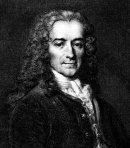
voltaireThis dreadful example of bigotry employed the pen of Voltaire in deprecation of the horrors of superstition; and though an infidel himself, his essay on toleration does honor to his pen, and has been a blessed means of abating the rigor of persecution in most European states. Gospel purity will equally shun superstition and cruelty, as the mildness of Christ’s tenets teaches only to comfort in this world, and to procure salvation in the next. To persecute for being of a different opinion is as absurd as to persecute for having a different countenance: if we honor God, keep sacred the pure doctrines of Christ, put a full confidence in the promises contained in the Holy Scriptures, and obey the political laws of the state in which we reside, we have an undoubted right to protection instead of persecution, and to serve heaven as our consciences, regulated by the Gospel rules, may direct.


End Notes

Full text from: John Foxe. Fox’s Book of Martyrs. Edited by William Byron Forbush. ttp://www.ccel.org/ccel/foxe/martyrs/files/martyrs.html [Accessed: 11.08.2009]

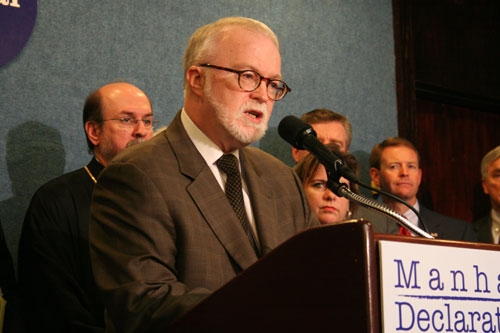
Examining Francis Beckwith’s Return to Rome.

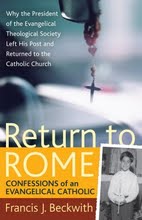
returntoromeA while ago I wrote a post about an ecumenical meeting at Wheaton College between Francis Beckwith and Timothy George. For those who do not know, Francis Beckwith was baptized and raised as a Roman Catholic, where according to his web site, “…his faith journey led him to Protestant evangelicalism. He [then] became a philosophy professor at Baylor University and president of the Evangelical Theological Society (ETS). And then, in 2007, after much prayer, counsel, and consideration, Beckwith decided to return to the Catholic church and step down as ETS president.” 1

Now, firmly entrench in Rome, Beckwith is doing his utmost to preach the merits of Catholicism with individuals like Timothy George and others in the “evangelical” camp helping the cause through their ecumenical discussions. For those who want to better understand some of the key doctrinal issues that separate Roman Catholicism from Biblical Christianity, I’ve included a link below to a series of messages by TBFaceTony Bartolucci, pastor/teacher of Clarkson Community Church in NY. These messages address in very detailed fashion Mr. Beckwith’s return to Rome, which he has documented in his book “Return to Rome – Confessions of an Evangelical Catholic.”

The messages are much more in-depth than the coverage given by James White on his Dividing Line program, which is I included in my prior post (they still are good to listen to). For those who take the time to listen to thee messages, I fully believe you will be greatly blessed and benefited. Not only so your faith is bolstered, but also so you can better minister to Roman Catholics. And so that you can rebuke those in our midst who join hand-in-hand with Catholics calling then brethren.

The messages can be found here, where I have included Tony’s introduction to the messages explaining why he took the time to give them.

As I have stated in the first part of this series, my motivation in pursuing this topic has nothing to do with personal animosity toward Dr. Francis Beckwith or Roman Catholics in general. I was a Roman Catholic. I know what it is like to have my religion challenged and attacked. I left the Roman Catholic Church kicking and screaming all the way. I wanted to remain a Catholic. However, God would not have it. In 1981 he drew me in, fighting all the way, to a repentance that is unto eternal life (2 Timothy 2:25).

Having come through the other side I now cherish the simple Gospel of grace and loath any system that would pervert this precious truth. I abhor what I know will appear to many as an attack on a man. The desire of my heart is to be humble and gracious, while not compromising a God-honoring tenacity for the faith once for all delivered to the saints (Jude 3).

In fact, I don’t particularly enjoy having to do this series. I would be among the first to raise a hand in reply to the question, “are you ready for this series to be done with?” But I am literally compelled to address not only the book, but in doing so, a much larger issue: the Gospel of grace verses [sic] the gospel of Rome.

Like most anyone, I like flying under the radar. I don’t want to be a lightning rod for controversy, to have my name flamed on the internet. But I also know that the closer one gets to the front lines of the battle, the higher the likelihood that one will find himself in the proverbial cross-hairs. So be it.

I’m sure that, like so many Roman Catholics, Francis Beckwith is a very nice guy. I’ve listened to his interview with Greg Koukl on the latter’s program, Stand to Reason. I mourn for him; for his very apparent inability to see that which only those with the eyes of faith (eyes sovereignly granted by God) can see. I would welcome a phone call from Dr. Beckwith in order to discuss these things with him.

My prayer is that God will use this series, and perhaps a forthcoming book, to strengthen genuine believers in the most holy faith, bring faith to those who are doubting, and to save others, snatching them from the fire while hating the garment polluted by the flesh (Jude 20-22). Soli Deo Gloria! 2

End Notes:

1 – Return to Rome. Confessions of an Evangelical Catholic. http://web.me.com/francis.beckwith/Return_to_Rome/home.html [Accessed 11/3/2009]
2 – Why am I doing this? Tony A. Bartolucci. Clarkson Community Church, Clarkson, New York. 585-637-6070. http://www.tonybartolucci.com/Sermons/whytiber.htm [Accessed 11/3/2009]

Quotes (644)

Rev John DownlingThe blessed founder of Christianity chose to make his advent among the lowly and the despised. This was agreeable to the spirit of that Holy Religion which he came to establish. There was a time when a multitude of his followers, astonished and convinced by the omnipotence displayed in his wondrous miracles, were disposed to” take him by force to make him a king,” but so far from encouraging their design, the inspired historian tells us” that he departed again, into a mountain himself alone.” (John vi., 15.) In reply to the inquiries of the Roman governor, he uttered those memorable words, “MY KINGDOM IS NOT OF THIS WORLD,” and his whole conduct from the manger to the cross, and from the cross to the mount of ascension, was in strict accordance with this characteristic maxim of genuine Christianity.
In selecting those whom he would send forth as the apostles of his faith, be went, not to the mansions of the great or to the palaces of kings, but to the humble walks of life, and chose from the poor of this world, those who, in prosecuting their mission, were destined like their divine master, to be despised and rejected of men. In performing the work which their Lord had given them to do, the lowly but zealous fisherman of Galilee, and the courageous tent-maker of Tarsus, with their faithful fellow-laborers, despising all earthly honors and worldly aggrandizement, were content to lay every laurel at the foot of Christs cross, and to” count all things but loss for the excellency of the knowledge of Christ Jesus, their Lord,” for whom they had “suffered the loss of all things” (Philippians, iii., 8.)

A few centuries afterward, we find the professed successor of Peter the fisherman [i.e. the Pope], dwelling in a magnificent palace, attended by troops of soldiers ready to avenge the slightest insult offered to his dignity, surrounded by all the ensigns of worldly greatness, with more than regal splendor proudly claiming to be the sovereign ruler of the universal church the Vicegerent of God upon earth, whose decision is infallible and whose will is law. The contrast between these two pictures of Primitive Christianity in the first century, and Papal Christianity in the seventh or eighth, is so amazing, that we are irresistibly led to the inquiry, can they be the same? If one is a faithful picture of Christianity, can it be possible that the other is worthy of the name?

John Dowling (Source: Dowling, John (1845). The History of Romanism: from the Earliest Corruptions of Christianity to the Present Time)

Birthdate & date of death unknown


Quotes (639)

revsunderland


“…it is asked, ‘Why all this tirade against Roman Catholics?’ We repel the implication. It is not against the unhappy millions that are ground down under the iron heel of that enormous despotism. They are of the common humanity, our brethren and kinsmen, according to the flesh. They need the same light instruction and salvation that we need. Like ourselves they need the one God, the one mediator between God and man, the man Christ Jesus; and from the heart we love and pity them. We would grant them all the privileges which we claim to ourselves. We can have no animosity towards them as men and candidates with ourselves for the coming judgment. But it is the system under which they are born, and live, and die, I repeat, which we denounce, and when we shall cease to oppose it, then let our right hand forget her cunning, and our tongue cleave to the roof of our mouth. What is it but a dark and terrible power on earth before which so many horrible memories start up? Why, sir, look at it! We drag the bones of the grim behemoth out to view, for we would not have the world forget his ugliness nor the terror he has inspired. ‘A tirade against Romanism,’ is it? O sir, we remember the persecutions of Justinian; we remember the days of the Spanish Inquisition; we remember the reign of ‘the Bloody Mary;’ we remember the revocation of the Edict of Nantes; we remember St. Bartholomew; we remember the murdered Covenanters, Huguenots, and Piedmontese; we remember the noble martyrs dying for the testimony of the faith along the ancient Rhine; we remember the later wrath which pursued the islanders of Madeira, till some of them sought refuge upon these shores; we remember the Madiai, and we know how the beast ever seeks to propagate his power, by force where he can, by deception where he must. And when we remember these things, we must protest against the further vigor and prosperity of this grand Babylon of all. … We come a growing phalanx [a rectangular mass military formation], not with carnal weapons, but with the armor of the gospel, and wielding the sword of truth on the right hand and on the left, we say that ANTICHRIST MUST FALL. Hear it, ye witnesses, and mark the word; by the majesty of the coming kingdom of Jesus, and by the eternal purpose of Jehovah, THIS ANTICHRIST MUST FALL.”

– Rev. Dr. Sunderland

1819 – 1901

Persecution of John Huss

200px-Jan_Hus“John Huss (Jan Hus) was born at Hussenitz, a village in Bohemia, about the year 1380. His parents gave him the best education their circumstances would admit; and having acquired a tolerable knowledge of the classics at a private school, he was removed to the university of Prague, where he soon gave strong proofs of his mental powers, and was remarkable for his diligence and application to study.
In 1398, Huss commenced bachelor of divinity, and was after successively chosen pastor of the Church of Bethlehem, in Prague, and dean and rector of the university. In these stations he discharged his duties with great fidelity; and became, at length, so conspicuous for his preaching, which was in conformity with the doctrines of Wickliffe, that it was not likely he could long escape the notice of the pope and his adherents, against whom he inveighed with no small degree of asperity.

The English reformist, Wickliffe, had so kindled the light of reformation, that it began to illumine the darkest corners of popery and ignorance. His doctrines spread into Bohemia, and were well received by great numbers of people, but by none so particularly as John Huss, and his zealous friend and fellow martyr, Jerome of Prague.

The archbishop of Prague, finding the reformists daily increasing, issued a decree to suppress the further spreading of Wickliffe’s writings: but this had an effect quite different to what he expected, for it stimulated the friends of those doctrines to greater zeal, and almost the whole university united to propagate them.

Being strongly attached to the doctrines of Wickliffe, Huss opposed the decree of the archbishop, who, however, at length, obtained a bull from the pope, giving him commission to prevent the publishing of Wickliffe’s doctrines in his province. By virtue of this bull, the archbishop condemned the writings of Wickliffe: he also proceeded against four doctors, who had not delivered up the copies of that divine, and prohibited them, notwithstanding their privileges, to preach to any congregation. Dr. Huss, with some other members of the university, protested against these proceedings, and entered an appeal from the sentence of the archbishop.

The affair being made known to the pope, he granted a commission to Cardinal Colonna, to cite John Huss to appear personally at the court of Rome, to answer the accusations laid against him, of preaching both errors and heresies. Dr. Huss desired to be excused from a personal appearance, and was so greatly favored in Bohemia, that King Winceslaus, the queen, the nobility, and the university, desired the pope to dispense with such an appearance; as also that he would not suffer the kingdom of Bohemia to lie under the accusation of heresy, but permit them to preach the Gospel with freedom in their places of worship.

Three proctors appeared for Dr. Huss before Cardinal Colonna. They endeavored to excuse his absence, and said they were ready to answer in his behalf. But the cardinal declared Huss contumacious, and excommunicated him accordingly. The proctors appealed to the pope, and appointed four cardinals to examine the process: these commissioners confirmed the former sentence, and extended the excommunication not only to Huss but to all his friends and followers.

From this unjust sentence Huss appealed to a future Council, but without success; and, notwithstanding so severe a decree, and an expulsion in consequence from his church in Prague, he retired to Hussenitz, his native place, where he continued to promulgate his new doctrine, both from the pulpit and with the pen.

The letters which he wrote at this time were very numerous; and he compiled a treatise in which he maintained, that reading the books of Protestants could not be absolutely forbidden. He wrote in defence of Wickliffe’s book on the Trinity; and boldly declared against the vices of the pope, the cardinals, and clergy, of those corrupt times. He wrote also many other books, all of which were penned with a strength of argument that greatly facilitated the spreading of his doctrines.

In the month of November, 1414, a general Council was assembled at Constance, in Germany, in order, as was pretended, for the sole purpose of determining a dispute then pending between three persons who contended for the papacy; but the real motive was to crush the progress of the Reformation.

John Huss was summoned to appear at this Council; and, to encourage him, the emperor sent him a safe-conduct: the civilities, and even reverence, which Huss met with on his journey were beyond imagination. The streets, and sometimes the very roads, were lined with people, whom respect, rather than curiosity, had brought together.

He was ushered into the town with great acclamations, and it may be said that he passed through Germany in a kind of triumph. He could not help expressing his surprise at the treatment he received: “I thought (said he) I had been an outcast. I now see my worst friends are in Bohemia.”

As soon as Huss arrived at Constance, he immediately took logdings in a remote part of the city. A short time after his arrival, came one Stephen Paletz, who was employed by the clergy at Prague to manage the intended prosecution against him. Paletz was afterwards joined by Michael de Cassis, on the part of the court of Rome. These two declared themselves his accusers, and drew up a set of articles against him, which they presented to the pope and the prelates of the Council.

When it was known that he was in the city he was immediately arrested, and committed prisoner to a chamber in the palace. This violation of common law and justice was particularly noticed by one of Huss’s friends, who urged the imperial safe-conduct; but the pope replied he never granted any safe-conduct, nor was he bound by that of the emperor.

While Huss was in confinement, the Council acted the part of inquisitors.

They condemned the doctrines of Wickliffe, and even ordered his remains to be dug up and burned to ashes; which orders were strictly complied with. In the meantime, the nobility of Bohemia and Poland strongly interceded for Huss; and so far prevailed as to prevent his being condemned unheard, which had been resolved on by the commissioners appointed to try him.

When he was brought before the Council, the articles exhibited against him were read: they were upwards of forty in number, and chiefly extracted from his writings.

John Huss’s answer was this: “I did appeal unto the pope; who being dead, and the cause of my matter remaining undetermined, I appealed likewise unto his successor John XXIII: before whom when, by the space of two years, I could not be admitted by my advocates to defend my cause, I appealed unto the high judge Christ.”

When John Huss had spoken these words, it was demanded of him whether he had received absolution of the pope or no? He answered, “No.” Then again, whether it was lawful for him to appeal unto Christ or no? Whereunto John Huss answered: “Verily I do affirm here before you all, that there is no more just or effectual appeal, than that appeal which is made unto Christ, forasmuch as the law doth determine, that to appeal is no other thing than in a cause of grief or wrong done by an inferior judge, to implore and require aid at a higher Judge’s hand. Who is then a higher Judge than Christ? Who, I say, can know or judge the matter more justly, or with more equity? when in Him there is found no deceit, neither can He be deceived; or, who can better help the miserable and oppressed than He?” While John Huss, with a devout and sober countenance, was speaking and pronouncing those words, he was derided and mocked by all the whole Council.

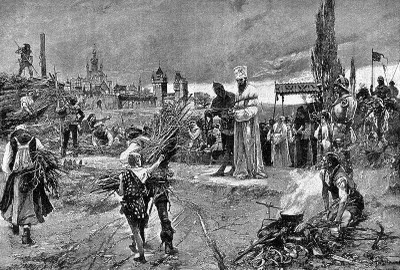
husBurningThese excellent sentences were esteemed as so many expressions of treason, and tended to inflame his adversaries. Accordingly, the bishops appointed by the Council stripped him of his priestly garments, degraded him, put a paper miter on his head, on which was painted devils, with this inscription, “A ringleader of heretics.” Which when he saw, he said: “My Lord Jesus Christ, for my sake, did wear a crown of thorns; why should not I then, for His sake, again wear this light crown, be it ever so ignominious? Truly I will do it, and that willingly.” When it was set upon his head, the bishop said: “Now we commit thy soul unto the devil.” “But I,” said John Huss, lifting his eyes towards the heaven, “do commend into Thy hands, O Lord Jesus Christ! my spirit which Thou has redeemed.”
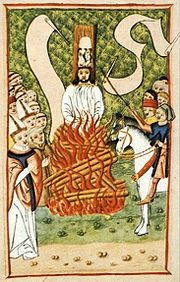
 When the chain was put about him at the stake, he said, with a smiling countenance, “My Lord Jesus Christ was bound with a harder chain than this for my sake, and why then should I be ashamed of this rusty one?”

When the fagots were piled up to his very neck, the duke of Bavaria was so officious as to desire him to abjure. “No, (said Huss;) I never preached any doctrine of an evil tendency; and what I taught with my lips I now seal with my blood.” He then said to the executioner, “You are now going to burn a goose, (Huss signifying goose in the Bohemian language:) but in a century you will have a swan which you can neither roast nor boil.” If he were prophetic, he must have meant Martin Luther, who shone about a hundred years after, and who had a swan for his arms.

180px-Jan_Hus_at_the_StakeThe flames were now applied to the fagots, when our martyr sung a hymn with so loud and cheerful a voice that he was heard through all the cracklings of the combustibles, and the noise of the multitude. At length his voice was interrupted by the severity of the flames, which soon closed his existence.

Then, with great diligence, gathering the ashes together, they cast them into the river Rhine, that the least remnant of that man should not be left upon the earth, whose memory, notwithstanding, cannot be abolished out of the minds of the godly, neither by fire, neither by water, neither by any kind oof torment.”

Full text from: John Foxe. Fox’s Book of Martyrs. Edited by William Byron Forbush. ttp://www.ccel.org/ccel/foxe/martyrs/files/martyrs.html [Accessed: 11.01.2009]

The more Rome changes, the more it stays the same.

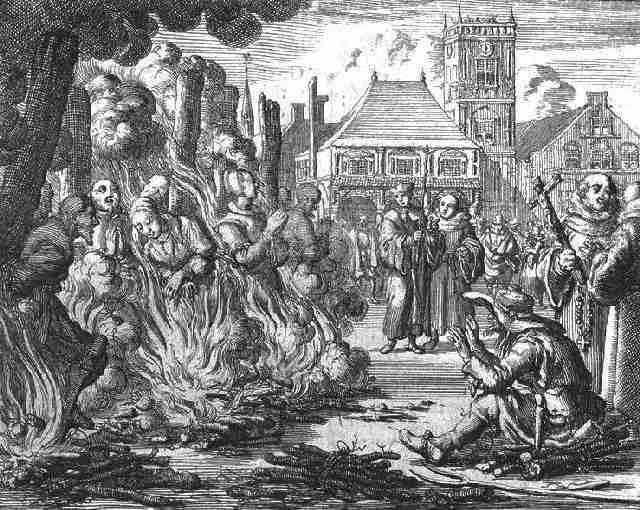
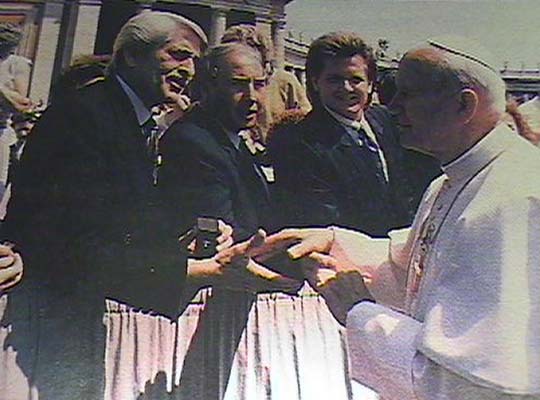
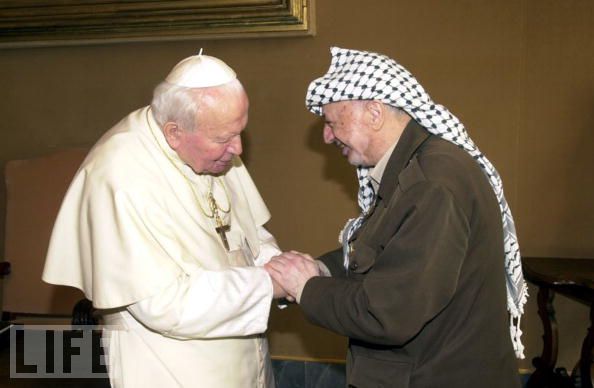
You can tell a man by the friends he keeps and likewise you can tell a church by the associations it keeps. So this Reformation Day, let us take a stroll through the halls of Roman Catholicism’s past and present as a simple reminder why true Biblical Christianity will never be at peace with the false religious system and counterfeit Christian organization of Rome.

torture_inquisition

inquisition

catholic_iquisition_torture

burned_at_the_stake

Pope and false religion

priests-salute

NaziPriestsSaluteHitler

Hitler-with-Muller

hitler_cardinal4

Pope and Castro

Obama Vatican

Pope and TBN

Pope and Dali Lama

Pope and Islam

Pope and Yassir Arafat

Catholicism and Islam

Pope and Arafat Greet

Arafat and Pope

Paul John Paul II Kissing the Koran

Pope and Chavez

VATICAN SAUDI KING

INterfaith

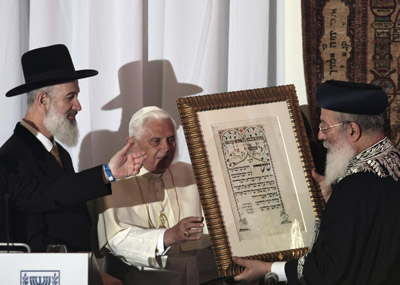
Pope Jewish

Pope Mosque

Interfaith Pope

Ecumenical Pope

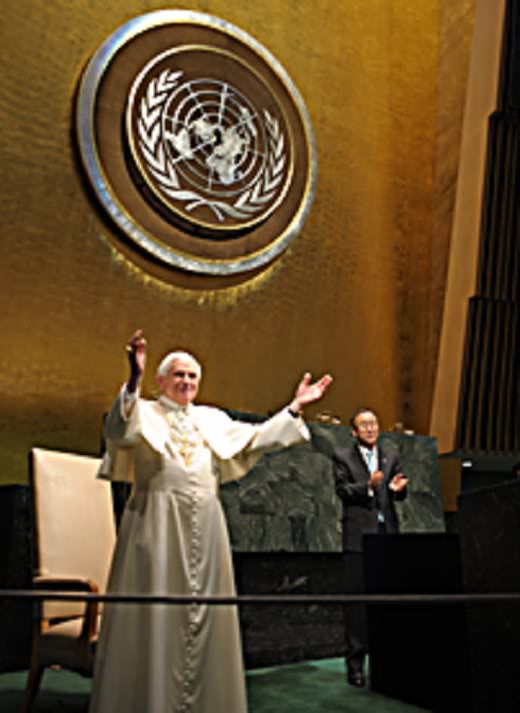
Pope UN

The Gospel: The Power of God Unto Salvation

gospelIt is written in the Scriptures that the gospel of Jesus Christ “…is the power of God unto salvation to every one that believeth; to the Jew first, and also to the Greek.” (Rom 1:16)  Likewise, it is written that if anyone one “…be in Christ, he is a new creature: old things are passed away; behold, all things are become new.” (II Cor 5:17)

Today, countless people have religion that purports itself as Christianity.  Yet this religion has no power to save and no power to transform their lives.  Rather, it is dead religion not unlike what one would have found with the Pharisees and their disciples during the days when Jesus walked the earth.  Rote, ritualistic and repetitious; this religion is found across our land.  Here, countless people are raised in such faiths from babes upward and have been taught the traditions of men from their religion’s hierarchy as to what they must do and must not do in order to be “right” with God and rewarded with eternal life. 

Or, we have so-called pastors instructing millions that salvation is simply raising their hand to “ask Jesus into their heart” or the repeating of the “sinner’s prayer.”  Scant mention is ever given to the gospel, repentance and what salvation truly is; rather the bulk of their appeal is made to the flesh.  This done through various mediums with the most popular being music where skilled musicians take the congregants on an emotional roller coaster ride so as to get as many as possible to raise their hand or come forward to the “altar.”

Yet I ask how many of these persons are ever changed by the power of God through the gospel?  How many can truly testify that they are new creatures in Christ where they have put to death the old man and are now walking in newness of life?  How many can say that the darkness they use to love and run to, they now hate and flee from?  How many can profess that the light they use to hide from and scorn, they now seek out and proclaim from the rooftops?  Truly some can and to God we give all the glory for this, but many cannot because sadly for these once the music dies down, the lights dim and the crocodile tears dry, they are the same person they were before every praying that prayer or making their purported profession of faith.

The conversion of Pasha, a Russian immigrant in the 1800’s, is no such empty profession or example of impotent religion.  Rather, it is an amazing testimony of the power of God through the gospel to totally transform a wretched sinner.  A story that will surely bring tears to your eyes not only as you see how great the gospel is and the God who has given it unto this world, but also for his tender mercies to shower rich blessings on his children.  Please take the time to read it as you will be greatly blessed therein. 

My hope for the true Christian is that reading it may give you great joy as your love is increased for the God who hath graciously saved you even if your testimony or mine is not as stunning as Pasha’s.  For the Christian in name only, I pray your reading it may give you a longing in your heart to be set free from your sin and changed by the power of the God through the gospel even as Pasha was.

The full text can be found here

The immaculate deception.

Immaculate Deception

The following is an article by James Swan refuting an attempted defense of Roman Catholicism’s great heresy: The Immaculate Conception. I found the timing of this to be highly apropos in light of a continued discussion that is taking place on this very subject on the comment thread from this post.

How To Prove The Immaculate Conception Without Biblical Proof

10/04/2009 – James Swan

The constant dilemma of the Roman Catholic apologist is to insert doctrines into the Bible that aren’t there to begin with. Their argumentation of meandering logic seeks to demonstrate: a) The Bible doesn’t contradict the doctrine being inserted; b)There are indirect Bible passages that if interpreted by first granting the validity of the extra-biblical doctrine, actually support the extra biblical doctrine. Catholic apologist John Martignoni’s most recent newsletter is a perfect example. He presents “Challenge/Response/Strategy” in defending Mary’s immaculate conception. This argumentation is for his upcoming book on basic Roman Catholic apologetics.

In Martignoni’s argumentation, the immaculate conception must first be brought to the biblical text. That is, by a plain reading of the Bible, one would not read from Genesis to Revelation and conclude Mary was born sinless and remained free of sin her entire life. Martignoni’s apologetic then is to prove the immaculate conception is not disproved by anything the Bible states, and that certain texts can be utilized as indirect proofs. I outlined Martignoni’s hypothetical challenges and his responses in the order he presented them. My counter responses are in red.

Argument 1: The Bible doesn’t use the words immaculate conception. Therefore it is an unbiblical concept.

Martignoni’s Response: The words Trinity and Incarnation are not found in the Bible either.

Swan’s Counter: I know of no serious Protestant apologist that actually uses such an argument. The question is not whether the phrase is found in the Bible, but are there specific direct passages that substantiate such a concept? To substantiate such a concept as a clear teaching of scripture one needs direct passages, not a few vague inference passages.

Argument 2: Trinity and Incarnation are concepts supported by the Bible, the immaculate conception has no such support.

Martignoni’s response: There is no passage in Scripture which directly states that Mary was not conceived without original sin, or that she was not immaculately conceived.

Swan’s counter: Aside from the fact this response doesn’t follow from the argument, this type of argument can [be] applied to many individuals within the Bible. The Bible doesn’t say Priscilla was conceived without original sin, or that she was not immaculately conceived, yet we don’t assume she was. A lack of evidence does not bolster or further an argument.

Argument 3: Romans 3:9-12 and 3:22-23 says all are under the power of sin and that all have sinned, therefore Mary sinned.

Martignoni’s response (four points):
A. Such an argument does not address Mary being immaculately conceived, it addresses whether or not she was sinless her entire life, which is a different question.

Swan’s Counter: Under the heading of “The Immaculate Conception,” the Catechism of the Catholic Church states, “By the grace of God Mary remained free of every personal sin her whole life long” (CCC 493), so it is not a different question.

B. There is no passage in Scripture which directly states that Mary was not conceived without original sin, or that she was not immaculately conceived.

Swan’s Counter: Luke 1:35 positively says Jesus was conceived by the Holy Spirit. There is no such verse about Mary’s conception. There is no verse that states Mary must be sinless in order to bear the Son of God. Martignoni offers no similar positive evidence that would separate her from the rest of humanity described in Romans 3.

C. Some Protestants believe things not found in the Bible. Catholics likewise should be allowed to believe things not directly stated in the Bible. Example: The Bible nowhere says contraception is okay, yet most protestants believe it is.

Swan’s Counter: Martignoni’s argument would not work against Protestants who deny both the immaculate conception and contraception. To prove some Protestants may believe something not found in the Bible does nothing more than prove an inconsistency. To prove such offers no positive support for an extra-biblical belief in the immaculate conception.

D. Some Scripture passages indirectly support the Immaculate Conception, like Genesis 3:14-15. Mary is the woman described. Enmity exists between Satan and the woman. Martignoni says, “If you have sin in you, can you say that there is enmity between you and Satan?” Only a sinless being can be at enmity with Satan. Therefore Mary was not conceived in sin, and did not commit personal sin.

Swan’s counter: This is Martignoni’s only attempt to present positive argumentation. He candidly admits his Biblical proof is indirect. The argument has an unproven assumption: only a sinless person can be an enemy of Satan, at war with Satan. But, there has always been enmity between believers and Satan. One does not have to be sinless to be at war with Satan. Why would Paul exhort the Ephesians to put on the full armor of God “so that you can take your stand against the devil’s schemes“? Wouldn’t he first clarify that in order to put on the armor, one must be entirely sinless? Similarly, why would Peter exhort Christians to resist the Devil (1 Peter 5:8), or James to resist the devil (James 4:7)? Here we have direct proof that all Christians are enemies of Satan, at war with Satan. John warns us that “if we claim to be without sin, we deceive ourselves.” Christians are sinners, and they are at war with Satan. Nothing could be clearer.

Martignoni states that he was limited with the amount of time he had to put into this argumentation. Then again, he states this argumentation is for a book (as if the world needs yet another book repeating arguments already put forth by other writers). If he’s going to continue with a similar line of reasoning, perhaps he should back up a bit and explain his proofs are not proofs, but inferences. He claims to be presenting “biblical, historical, and logical perspectives” as to the immaculate conception. His reasoning though amounts to inferences and leaps of logic read into the text.

HT: Isaiah

Quotes (626)

Rome never changes. Rome will never admit that she has made mistakes. She burned our English Reformers 300 years ago. She tried hard to stamp out by violence the Protestantism which she could not prevent spreading by arguments. If Rome had only the power, I am not sure that she would not attempt to play the whole game over again.
– J.C. Ryle

1816 – 1900

The Papal Curse

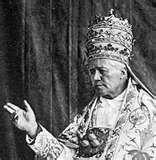
pius ix tierraThe anathema of the Pope, words that would strike moral terror in the hearts of men and women throughout time who lived under the tyranical rule of the self-professed Vicar of Christ.  One who not only took upon himself the power to kill men in body, but one who also brazenly claimed the power to destroy men’s souls.  Thereby in effect making himself equal with God (see Mt 10:28). 

Below we will read the curse pronounced by  Pope Pius IX upon Victor Emmanuel, where in Grover’s “Romanism The Danger Ahead”, it is written:

Victor Emmanuel and his patriotic countrymen wrested the temporal power from Pius IX., and liberated the Italian people from the power of the Church of Rome forever, so far as civil government is concerned. Being otherwise powerless, the pope strikes back, with a curse, which is here given, as printed in the Philadelphia Morning Post. It is the perfection of pious swearing by the Vicegerent of God, who said “swear not at all.” (1)

It is also said that this curse was pronounced on the Rev. Wm. Hogan, (a converted Roman Catholic priest), in Philadelphia. (2)  One might also image that less explicit curses and anathemas as found in pronouncements from councils like Trent, carry with them the same underlying intent.  So when you read of the papal curses still on the books, which have never been revoked by Rome, keep these words in mind that flow forth from lips of the man who dresses like an angel but speaks like a dragon. 

Let us now read the words of the Pope:

“Pronounced on all who leave the Church of Rome. By the authority of God Almighty, the Father, Son and Holy Ghost, and the undefiled Virgin Mary, mother and patroness of our Saviour, and of all celestial virtues, Angels, Archangels, Thrones, Dominions, Powers, Cherubim and Seraphim, and of all the holy Patriarchs, Prophets, and of all the Apostles and Evangelists, of the holy innocents, who in the sight of the holy Lamb are found worthy to sing the new song of the Holy Martyrs and Holy Confessors, and of all the Holy Virgins, and of all the Saints, together with the Holy Elect of God,–MAY HE BE DAMNED. We excommunicate and anathematize him, from the threshold of the holy church of God Almighty. We sequester him, that he may be tormented, disposed, and be delivered over with Datham and Abiram, and with those who say unto the Lord, ‘Depart from us, we desire none of thy ways;’ as a fire is quenched with water, so let the light of him be put out forevermore, unless it shall repent him, and make satisfaction. Amen.

“May the Father who creates man, curse him. May the Son, who suffered for us, curse him! May the Holy Ghost who is poured out in baptism, curse him! May the Holy Cross, which Christ for our salvation, triumphing over his enemies, ascended, curse him!

“May the Holy Mary, ever Virgin and Mother of God, curse him! May all the Angels, Principalities, and Powers, and all heavenly Armies curse him! May the glorious band of the Patriarchs and Prophets curse him! “May St. John the Precursor, and St John the Baptist, and St. Peter and St Paul, and St. Andrew and all other of Christ’s Apostles together curse him and may the rest of the Disciples and Evangelists who by their preaching converted the universe, and the Holy and wonderful company of Martyrs and Confessors, who by their works are found pleasing to God Almighty; may the holy choir of the Holy Virgins, who for the honor of God have despised the things of the world, damn him. May all the Saints from the beginning of the world to everlasting ages, who are found to be beloved of God, damn him!

“May he be damned wherever he be, whether in the house or in the alley, in the woods or in the water, or in the church! May he be cursed in living or dying!

“May he be cursed in eating and drinking, in being hungry, in being thirsty, in fasting and sleeping, in slumbering, and in sitting, in living, in working, in resting, and in blood letting! May he be cursed in all the faculties of his body!

“May he be cursed inwardly and outwardly. May he be cursed in his hair; cursed be he in his brains, and his vertex, in his temples, in his eyebrows, in his cheeks, in his jaw-bones, in his nostrils, in his teeth, and grinders, in his lips, in his shoulders, in his arms, and in his fingers.

“May he be damned in his mouth, in his breast, in his heart, and purtenances, down to the very stomach!

“May he be cursed in his reins and groins, in his thighs and his hips, and in his knees, his legs and his feet, and his toe-nails!

“May he be cursed in all his joints, and articulation of the members; from the crown of the head to the soles of his feet, may there be no soundness!

“May the Son of the living God, with all the glory of his majesty, CURSE HIM! And may Heaven, with all the powers that move therein, rise up against him, and curse and damn him; unless he repent and make satisfaction! Amen! So be it. Be it so. Amen.” (3)


Endnotes
1 Ray, D. B.  The Papal Controversy Involving The Claim Of The Roman Catholic Church To Be The Church Of God Between “American Baptist” and “Church Progress”. St. Louis, MO.: National Baptist Publishing Company, 1892. Online at: Source.
2 Richardson, Sarah J. Life In The Grey Nunnery.  Boston: Edward P. Hood, 1857. Online at: Source.
3 Ray, D. B.  1892.

Quotes (618)

http://easterpeople.wordpress.com/2009/07/23/im-a-charismatic-baptist-reformed-calvinist/

But the man Christ can be but in one place, and he is now at the right hand of the Majesty on high. It is absurd, it is horrible, both to faith and to reason, to say that Christ’s body is eaten, and that his blood is drunk in tens of thousands of places wherever priests choose to offer what they call “the mass.” A “Mass” of profanity, indeed, it is!

– Charles Spurgeon

1834 – 1892

Modern Ecumenists and the Return to Rome

POPE/

I recently watched an ecumenical dialog at Wheaton College between Timothy George, Dean of the Southern Baptist Beeson Divinity School, and Francis Beckwith, a “Protestant” who recently returned to Rome. Words fail me at how disgusted I was as the cotton candy eating, Kumbaya singing and kid-glove handling of the damnable errors of the religion of Rome. This coming not from a pulpit sitting believer who has never studied doctrine related to Catholicism, but from a Dean of one of the leading Southern Baptist Seminaries who is obviously very well read in these areas. I’m still waiting for the outcry from the Southern Baptist Convention.

More could be said, but I will leave that to James White, a man I greatly respect and one whom I have learned a great deal from. A man who, like, Richard Bennett of Berean Beacon, is willing to speak out against the foundational errors of the Roman religion that separate it from true, Christ-centric, Biblical Christianity. One who also will challenge the ecumenists of our day who are causing a great many to stumble and are fueling the confusion between Rome and true Christianity, and further abetting the plans of the Pope to gather the “lost” sheep back into his open arms.

From the Alpha and Omega Ministries Apologetics Blog, James White writes:

I will be slamming more church doors in my face tomorrow on the DL [Dividing Line broadcast] as I begin working through the entirety of the Timothy George/Frank Beckwith dialogue from Wheaton. What I mean by that, of course, is that it is grossly unpopular to address, in a fair, biblical, historical fashion, the subject of Roman Catholicism, and even more so, to criticize non-Catholics who refuse to see the real issues of the gospel that are at stake when we speak of Roman Catholicism. But, it must needs be done. Someone has to speak up when men are intent upon reducing the gospel to a mere matter of opinion. So I will begin working through the dialogue–all of it–on the program tomorrow, beginning with Timothy George’s opening assertion that the gospel of Rome saves—not that he said those words, but, within the first minute he referred to Beckwith as his “brother in Christ,” making it very clear from the start that whatever “differences” that exist, they do not separate us from salvation. Beckwith likewise provided a number of quotes I will be adding to the chapter I had already finished (but will now expand) on whether he ever actually crossed the Tiber in the first place. (Source: Link)

The programs are not sound bites as the subject is too deep and important to cover with a 15 minute pod-cast. I encourage all those who really want to better understand the nuances of what we are dealing with in the evangelical world of ecumenical compromise, please listen to the following Dividing Line Programs.

  • 9/15 program – Program where James White begins working through the Timothy George/Frank Beckwith dialogue.
  • 9/17 program – Second program dealing with George/Beckwith dialogue.
  • 9/22 program – Third program as James works through the Beckwith/George dialogue from Wheaton.

Quotes (606)

JA Wylie

All idolatries, in whatever age or country they have existed, are to be viewed but as successive developments of the one grand apostacy. That apostacy was commenced in Eden, and consummated at Rome. It had its rise in the plucking of the forbidden fruit; and it attained its acme in the supremacy of the Bishop of Rome,–Christ’s Vicar on earth. The hope that he would “be as God,” led man to commit the first sin; and that sin was perfected when the Pope “exalted himself above all that is called God, or that is worshipped; so that he, as God, sitteth in the temple of God, showing himself that he is God.” Popery is but the natural development of this great original transgression. It is just the early idolatries ripened and perfected … on earth, in the Mystery of Iniquity which came to be seated on the Seven Hills; for therein man deified himself, became God, nay, arrogated powers which lifted him high above God.  Popery is the last, the most matured, the most subtle, the most skilfully contriven, and the most essentially diabolical form of idolatry which the world ever saw, or which, there is reason to believe, it ever will see. It is the ne plus ultra of man’s wickedness, and the chef d’oeuvre of Satan’s cunning and malignity.

– J. A. Wylie
1808-1890
THE PAPACY, Its History, Dogmas, Genius and Prospects