Elders and Deacons

You Can Listen to This Sermon Here.
1 Timothy 3:1-13 This saying is trustworthy: “If anyone aspires to be an overseer, he desires a noble work.” An overseer, therefore, must be above reproach, the husband of one wife, self-controlled, sensible, respectable, hospitable, an able teacher, not addicted to wine, not a bully but gentle, not quarrelsome, not greedy – one who manages his own household competently, having his children under control with all dignity. (If anyone does not know how to manage his own household, how will he take care of God’s church?) He must not be a new convert, or he might become conceited and fall into the condemnation of the Devil. Furthermore, he must have a good reputation among outsiders, so that he does not fall into disgrace and the Devil’s trap.

Deacons, likewise, should be worthy of respect, not hypocritical, not drinking a lot of wine, not greedy for money, holding the mystery of the faith with a clear conscience. And they must also be tested first; if they prove blameless, then they can serve as deacons. Wives, too, must be worthy of respect, not slanderers, self-controlled, faithful in everything. Deacons must be husbands of one wife, managing their children and their own households competently. For those who have served well as deacons acquire a good standing for themselves, and great boldness in the faith that is in Christ Jesus.

Paul begins and ends this passage with commendations for those who aspire to serve as elders or has served well as deacons; it is a privilege to serve in either role. He describes these two roles within the local fellowship of saints, both having very similar qualifications, but very different roles (which are explained elsewhere in Scripture). Both are described as servants with responsibility, not rulers with authority. The Bible has authority in the church; the men do not.

The Apostles, forerunner of church elders, were to devote themselves to prayer and the preaching of the Word; deacons are to tend to the physical needs of the dynamic and diverse body of Christ. In Acts 6 the people did not vote for who would serve as deacons; they nominated seven godly men to the Apostles, who appointed the men to serve. This passage does not show a democracy in action as many Baptists falsely believe. It shows the active participation of the members, recognizing the role of those God had appointed to lead them. As the church matured, the Scripture shows us that elders had oversight on all the church did and deacons provided much more service than “waiting tables.” As there are spiritual issues behind every temporal matter a deacon might be called upon to help with, these men must be qualified and there must be a good rapport between the deacons and elders, so the body of Christ gets the best care possible.

Deacon. The Greek (diaconos) and English words refer both to one who serves the local church in this capacity as well as those who are simply known for being servants to the body of Christ. Deacons are not required to be spiritual guides, feeders of the flock, or teachers; they are required to be trustworthy and of moral character as they deal with matters of temporal importance and the related spiritual foundations. The health of the church depends on deacons functioning well, which requires the cooperation of the elders and the people. It is painfully apparent that many of us have lost sight of the completeness of the wisdom our Lord has provided us and the reason for it. How we serve Him and one another is be to the glory of His name and the good of His people.

Robert Boyt C. Howell laments “much confusion and division of sentiment regarding the nature of the office”; and he points out how so many miss the Scriptural teachings that describe the role of those who hold the office of deacon.

Nearly all the churches have made them ministers of the gospel. In the Roman Catholic church he is an inferior ecclesiastic, the second in the sacred order, who, with the permission of the bishop, has authority to preach and baptize. In the English church the Deacons are clergymen, but of the lowest grade; who can perform all the offices of priests, except the consecration of the sacred elements and the pronouncing of the absolution. In the German Protestant churches, when more ministers than one in the same congregation are necessary, the second, or assistant minister, is called the Deacon; and if there are two assistants the first is called the Arch-Deacon. In the Presbyterian church, the office is commonly merged with that of ruling elder, and, therefore, mostly disused. Where it is still retained, it embraces, as among Congregationalists and others, merely the distribution of alms. The Methodist and Episcopal churches in this country adopt, substantially, the practice of the English church, of which they are descendants. In the Baptist churches, the Deacons are not ministers who preach, on the one hand, nor mere distributors of alms on the other, but serve in a different capacity. They are a board of directors, and have charge of all the secular affairs in the kingdom of Christ

It is not unusual for Baptist deacons to have hire & fire authority over elders (a corollary error in this circumstance is the absence of a plurality of elders). In the end, nobody escapes unscathed! This all-too-common Baptist practice is blatantly taken from the modern business world, and puts the lower office of deacon as overseers of those called of God to be overseers, turning Scripture on its head.

We need to ask, is the Bible so unclear on the nature and duties of the office of deacon? Brothers, this is not the case! It is sin that keeps God’s people from seeing clearly, not a lack of clarity in God’s Holy Word. We must abide by what the Book reveals, and guard against traditions not found therein. If Scripture is not our guide, we are adrift on the sea of man’s wisdom; and that is dangerous.

The qualifications of deacons differ from those of elders on the single requirement of elders, but not deacons, being able to teach the Word of God. Deacons are to be men of good reputation, full of the Holy Spirit, holding the mystery of the faith with a clear conscience. These bedrock character traits often neglected when selecting deacons, as people focus on the man’s record of financial giving, business acumen, and abstinence from alcohol. While those traits can be easily measured, they cannot be found in the Bible as qualification for this office. The traits found in Scripture are not so easily quantified. It takes serious thought and hard work to determine if a man has a good reputation among his neighbors and work colleagues. It takes time and discernment to see if there be evidence of the Holy Spirit in a man. Who wants to put a man on the spot and see if he holds the mystery of the faith with a clear conscience? Can you even explain this requirement, much less investigate it? Installing men to serve the local church as deacons is sober work, not to be taken lightly or without serious prayer and reflection.

A deacon must be the husband of one wife. The literal meaning of the text is “a one woman man” – which means that if there was a biblical divorce and subsequent marriage, the man is not disqualified. If one holds that no divorce is biblical, the on-going sin in a second marriage becomes an on-going problem within the body. I see 2 reasons in Scripture wherein YHWH permits divorce, for unrepentant adultery or for abandonment by an unbelieving spouse. The goal of marriage is for each to last until death parts the couple. But even redeemed saints can fall into sin and be stiff-necked for a season; and the One Who knows our frailty has provided a narrow window – much narrower than in the Mosaic Covenant.

The requirement that deacons be tested first gives us a hint that we should invest the time and energy in examining would-be deacons; and not merely assuming these traits be theirs. This testing also provides the opportunity to see if his wife is sober minded and faithful, if his children are “managed well”. We must exercise the full measure of the biblical text to prove the men who would serve as deacons; they are care-takers of God’s sheep and co-laborers with His under-shepherds. This is a high calling (those who serve well gain a good standing) and we cannot allow our lazy human minds to rest on our own wisdom, or the taking of shortcuts or reliance on the traditions handed to us by other men. Finding men who tithe and do not frequent bars is wrong-headed and too low a bar for the office our Lord established for the temporal care of His redeemed.

As we desire our men to provide for their families, spiritually as well as physically, our deacons are to help families in each arena, with boundaries in both. Neither the church nor either office therein can unreasonably meddle with a family. God has established three spheres in this age, with specific roles and limits. It’s been said that to the state God gave the sword, to the church He gave the keys to the kingdom, and to the family He gave the rod of correction. We should not cross these boundaries without a clear biblical basis. Wisdom and care is needed if we are to tend to God’s people without ruling over them as “Gentiles” tend to do.

Healthy church members let their deacons know ahead of time when they will miss, and explain why. They will be more inclined to assemble with another local body while away if they properly understand church membership. This exercise of membership responsibilities is representative of any number of other earthly matters that deacons are likely to get involved with, each of which most often reflects the spiritual condition of the person. Lack of attendance and interest in church life, neglecting to worship in giving money, and many other concerns can be prompted by earthly things: illness, loss of work, death in the family, etc. In order to be wise stewards of the office, deacons must not presume to know the cause without investigating it, learning from Job who investigated the cause of what he did not know (Job 29:16). This keeps us from the sin of presumption and all that tends to follow closely behind.

As we examine men who would and do serve in our churches as deacons; as we consider how we determine the role of the office and how we select these men, let us humbly petition our God for wisdom and grace to do what is right in His sight – aligned with His scriptures and not resting on our own wisdom.

Elder. This role can only be fulfilled by a qualified man who is called and equipped by God for this service. There is no possible interpretation that allows self-identified or unconverted men, or women to serve in this capacity; and yet many churches do just this. This latter error is always the first big step to total apostasy for a church, preferring fallen man’s view of order over creator God’s declared view.

As mentioned earlier, the only different qualification for this role is that an elder must be able to teach. In our English Bibles we see the words Elder/Presbyter, Overseer/Bishop, Shepherd/Pastor. Each pair of these words comes from one Greek word; Elder/Presbyter is from presbyteros; Overseer/Bishop from episkope; and Shepherd/Pastor from poimen. They are used interchangeably and they all refer to a single office in the church which has several important functions, each of which is designed by the Lord to insure the health of each local church. The terms elder and presbyter refer to a man’s experience; in the Word and in the church. Overseer and bishop convey the act of being a spiritual guardian or protector, while pastor and shepherd refer to the spiritual care and feeding of God’s flock. We see overlap among these three functions in 1 Peter 5:1-5, where elders are exhorted by the Apostle Peter to shepherd God’s people with the right motive and attitude, serving as examples for the less mature Christians. In Acts 20:28, elders are instructed by the Apostle Paul to pay careful attention to themselves and the flock of God, in which the Holy Spirit made you overseers, to care for the church. One aspect of being a faithful elder that is implicit in these passages is that of being among the saints, knowing them as a shepherd knows his flock and being known as the shepherd is by the sheep. A man who does not live among his church members, who lives at a higher station of life, who spends all his time with other preachers is not faithful to his call. The elder must be an able teacher of the Word (1 Timothy 3:2, Titus 3:1-8) and a diligent servant of God’s people (1 Timothy 5:17 & 18).  He must also be able and willing to rebuke those who contradict the Word of God within the local church (Titus 1:7-9), and he must be about training others to work alongside him as under-shepherds of Christ (2 Timothy 2:1-3). One who would hold this office must lead the church, serving as a proper example (2 Thessalonians 2:11 & 12; 2 Timothy 2:15), and the saints are commanded to submit to them, not being burdensome for them (Hebrews 13:17). Elders were given to the church, by God, to equip the saints for the work of the church, bringing them to maturity and the fullness of Christ so they would not be vulnerable to the deceptive schemes of the enemy (Ephesians 4:11-14). This means the biblical elder must feed God’s sheep the whole counsel of His Word, not trusting his opinion or theirs as to what is true nor picking some Scriptures from which to teach and ignoring others. His teaching is to be tested in light of Scripture; not accepted nor rejected by personal whimsy or blind friendship. All of these responsibilities of elders are beyond any man’s abilities, so the Bible reminds us that elders, like the Apostles who preceded them, must be men of prayer (Acts 6:4).

There is another requirement of the man who would serve as an elder. While some read 1 Timothy 3:2 to mean a single man cannot serve as an elder, the view most compatible with Scripture is that an elder who is married must be in a biblical marriage and work at keeping it. Elders must be one-woman men, and they must lead their churches to defend marriage in the face of reprobates. 1 Timothy 3 goes on to say the elder must be sober minded and not quarrelsome; all the more so in defending God’s people from unrighteous men, who by their unrighteousness suppress the truth (Romans 1:18).

Being God’s spokesman is no job for a new convert, one who is unsure of God’s Word, unwilling to proclaim God’s Word, unable to rebuke those who contradict God’s Word, or unworthy of being followed as God’s servant. The times in which we live are treacherous, with many professing Christians embracing abominable sin in order to be well thought of by those outside the camp of Christ. Christians are never to compromise God’s truth for the applause of men (Galatians 1:10) and elders must be held to a high standard so that the Lord’s name not be disgraced among the pagans and the local church not be led astray.

Ezekiel 33 & 34 describes watchman appointed by God with responsibilities to warn, guard, and care for the people of God. In these two chapters we see a contrast of the watchman with the shepherd: the watchman warns, the shepherd tends. In each passage, unfaithful watchmen and shepherds are contrasted with those who are faithful. Ezekiel 34:1-10 describes the failures of the leaders of Israel, showing what shepherds are supposed to fulfill. Shepherds are supposed to care for the flock. These men were feeding on the sheep; fleecing the sheep. These men had all the appearance of shepherds, but they were wolves. Pastoral ministry is hard work, not glamorous. Those who pose as celebrities, living the high life, are not pastors. Pastors should smell like sheep, walking in the mud and mess, scarred by the teeth of biting sheep. This is difficult but rewarding work. Every man should aspire to be a commendable man who leads his family as a shepherd leads the flock. He must diagnose and treat appropriately – you don’t strengthen the stray, you strengthen the weak; you don’t bind up the lost – you search for the lost. Each spiritual condition requires the correct spiritual remedy. The pastor must know illnesses and the people, else he cannot properly treat the sheep. Verse 10 in Ezekiel 34 shows the omnipotent hand of God rescuing His sheep from the teeth of the wolves. A true pastor will watch the flock like a man who must give an account to the God who has purchased the sheep with the blood of His own son. Because that is what God’s Word tells us the truth about those who would call themselves “pastor”.

Even with the best of intentions, we can go astray from the narrow path of biblical truth. Over time, man has developed unbiblical structures, imagining that Bishop is more honorific and must carry more responsibility (by which they mean fame). Most men who preach call themselves “pastor” regardless of whether they shepherd the flock God has gathered there or not. One who preaches but does not work to know and care for the saints the Lord has put under his watch cannot rightly call himself pastor; he is merely a preacher. These words are not titles by which the men who serve are to be called, but descriptions of service they provide within the local church. Because God has given these terms to describe the roles of men He calls to the office, we must be careful to use them correctly.

Plurality of elders. Most churches in every denomination and across the spectrum of Baptists miss the point of Scripture on this point. The Bible repeatedly shows us that even the early churches that met in houses had two or more men serving as elders, a plurality of elders.

Acts 14:22&23 – Paul and Barnabas had traveled to Antioch, Derbe, Iconium, & Lystra, where they strengthened the souls of the disciples, encouraging them to continue in the faith, and saying that through many tribulations we must enter the kingdom of God. And when they had appointed elders for them in every church, with prayer and fasting they committed them to the Lord in whom they had believed.

Acts 20:17 – Paul passed by Ephesus to Miletus. Now from Miletus he sent to Ephesus and called the elders of the church to come to him.

James – Was written to the churches resulting from Saul’s scattering of the saints (1:1), this letter shows elders in the local church (5:14).

Philippians is addressed (1:1) to overseers (elders) and deacons in that church, in addition to the entire congregation.

Hebrews recognizes leaders (elders) in that congregation (13:7, 17, 24).

1 Tim – Timothy was recognized by the elders of his church for his calling as an elder (1 Tim 4:14) and a plurality of elders is seen again in 5:17.

In large and small fellowships, having only one elder can lead to a kind of “cult of personality” as a solitary man is seen as the public face and voice of that church. One man alone, coping with a job, his family, and the ministry is vulnerable to being drawn aside by pragmatism in what may start as an innocent desire to do all things well and unto the Lord but which soon go astray. If the saints YHWH has gathered and gifted in the local church (1 Corinthians 12:4-11) are encouraged to serve the body, those serving as elders and deacons will have a much lighter load and the local church will marvel to see the Lord working in their midst!

Having two or more men who preach and teach provides several benefits, in addition to aligning with the examples and teachings from Scripture (Acts 11:27-30; 14:21-23; 20:7; Titus 1:5; James 5:14; et. al.). Two or more men can sharpen one another and hold each other accountable, while the church sees the true Shepherd more clearly when they see Him work through more than one man. The church will see strengths and weaknesses in each man and those men will have the opportunity to be examples of how to serve in unity without letting egos derail the ministry. As they seek to identify others and train them for this service, more men will have opportunity to serve the saints in myriad ways. This is part of life in the body of Christ that is vital and often undervalued. It is not, as one man said to me, a matter of money. It’s a matter of caring for the people of God as He has shown us.

Baptists used to be known as “people of the Book.” This topic of deacons and elders is one where many Baptists discard the Book and cling to traditions handed down by men. Brothers, this should not be so! We are servants with responsibility. The Bible is our only authority for life and godliness. We are to seek His will, revealed in Scripture, and not rely on our own wisdom or traditions.
One Lord, One Faith, One Baptism

One Lord, One Faith, One Baptism

There are some brothers in Christ who are so focused on the local assembly of saints that they deny there is any congregation of a universal manner; that is, comprised of all the redeemed from every generation. This focus includes an emphasis on water baptism, to the exclusion of what John foretold – that One was coming who would baptism with fire and the Holy Spirit (Matt 3:11).

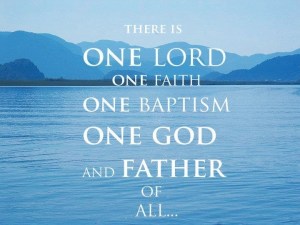
One passage that is said to be only about water baptism and the local fellowship is Ephesians 4, where we find this: Ephesians 4:4-5 (ESV) There is one body and one Spirit—just as you were called to the one hope that belongs to your call— one Lord, one faith, one baptism,

The context of this short passage should shed light on whether it is all and only about the local assembly and water baptism or if it’s about something greater.

We know that Paul’s letter to the saints at Ephesus was meant to be read to many local assemblies; it’s a universal letter to the body of Christ. In the first three verses of chapter 3, Paul stresses identity in Christ and the unity of believers – dealing with one another in humility, gentleness, patience, and so on.

And then we find this: Ephesians 4:4-7 (ESV) There is one body and one Spirit—just as you were called to the one hope that belongs to your call— one Lord, one faith, one baptism, one God and Father of all, who is over all and through all and in all. But grace was given to each one of us according to the measure of Christ’s gift.

This letter reveals Paul’s passion for all the saints to understand the unity we have because of our union with Christ Jesus, proclaiming there is one body, one Spirit, one hope, one Lord, one faith, one baptism, one God and Father of all. By this union with Christ we each have been given grace according to His gift.

Is there ANYTHING in this passage that hints Paul was addressing only the local assembly or numerous assemblies of saints? Is he not making much of the fact that ALL the saints share in these things, without regard to any temporal circumstances? One body, not numerous local bodies. One Spirit, not a separate Spirit for each locale. One hope, one Lord, one faith, one God and Father of ALL. This speaks to all saints in all locations and all generations. And one baptism.

Water baptism makes no one a child of God. The lack of water baptism keeps no one out of the kingdom of God.

But that baptism John mentioned, the baptism of the Holy Spirit and of fire, corresponds to the circumcision made without hands (Col 2:10-11).  This baptism is what brings enemies of God into His kingdom as His friends and children; without this baptism, no one can enter into His domain.

As much as these brothers resist and insist, there is no argument that can be made from Ephesians 4 that restricts Paul’s message of union and unity to the local assembly only. They can only make assertions in support of their view. Paul’s concern as an apostle was for the whole body of Christ, redeemed saints from every nation, tribe, and tongue. To deny this universal intent is to constrain the love of God for His people to clumps here and there, denying the communion we have through the Holy Spirit to all the saints.

It’s too small a view of God’s work and of His body.

The Nature of the Church

The Nature of the Church

 Stuart L. Brogden

 Greek Word: ἐκκλησία

Strong’s 1577

Transliteration: ekklēsia

from a compound of <G1537> (ek) and a derivative of <G2564> (kaleo); a calling out, i.e. (concretely) a popular meeting, especially a religious congregation (Jewish synagogue, or Christian community of members on earth or saints in heaven or both), assembly, church.

What is “the church”?

The Greek word ekklesia is most often presented in English Bibles as “church.” The word “church” is not a translation of the Greek word, ekklesia; it’s not even a transliterated version of that word. Strong’s concordance shows ekklesia being used in the KJV as either “assembly” or “church.” But the Greek word means “the called ones” and actually shows up in Scripture being applied to an assembly of town-folk (3 times in Acts 19:32-41). As with most words in the Word, the bare definition of the word does not reveal the meaning in every usage.

As for the use of “church” in the Bible, there does not appear to be a clear record of why it was chosen, nor of the meaning of this word. At least twice in the New Testament of the KJV, “church” applies to God’s covenant people in the Old Testament:

Acts 7:37-38 This is that Moses, which said unto the children of Israel, A prophet shall the Lord your God raise up unto you of your brethren, like unto me; him shall ye hear. This is he, that was in the church in the wilderness with the angel which spake to him in the mount Sina, and [with] our fathers: who received the lively oracles to give unto us.

Heb 2:11-12 For both he that sanctifieth and they who are sanctified [are] all of one: for which cause he is not ashamed to call them brethren, Saying, I will declare thy name unto my brethren, in the midst of the church will I sing praise unto thee.

It is not possible for anyone to make a categorical statement that every occurrence of “church” means the local assembly of the saints, as some do.

The first known use of this word in English Bibles is found in Wycliffe’s Bible, spelled “chirche.” His work was translated from the Latin Vulgate and we have no clear reason for his use of this word.

In Smith’s Bible Dictionary from 1884, page 452, we read:

the derivation of the word ‘church’ is uncertain. It is found in the Teutonic and Slavonic languages and answers to the derivatives of ekklesia, which are naturally found in the romance languages and by foreign importation elsewhere. The word is generally said to be derived from the Greek kyriakos, meaning the lord’s house. But the derivation has been too hastily assumed. It is probably associated with the Scottish kirk, the Latin circus/circulous, the Greek klukos, because the congregations were gathered in circles.

Ebenezer Cobham Brewer’s Dictionary of Phrase and Fable of 1898 agrees:

The etymology of this word is generally assumed to be from the Greek, Kuriou oikos (house of God); but this is most improbable, as the word existed in all the Celtic dialects long before the introduction of Greek. No doubt the word means “a circle.” The places of worship among the German and Celtic nations were always circular. (Welsh, cyrch, French, cirque; Scotch, kirk; Greek, kirk-os, etc.) Compare Anglo-Saxon circe, a church, with circol, a circle.

The first definition in Daniel Webster’s 1828 dictionary defines “church” as “A house consecrated to the worship of God, among Christians; the Lords house. This seems to be the original meaning of the word.”

There two things to bear in mind regarding the apparent definition of the word “church.” The ekklesia of God in the New Testament refers to the redeemed saints, not a location or a building. Secondly, one of the messages Jesus taught the woman at the well (John 4) is that, in the Christian faith, there are no sacred or consecrated places where we must meet God.

Since the etymology of “church” is based on location rather than on people, it is a poor choice for ekklesia. In practice, so many Christians think of the building as the church, which many refer to as “the house of God,” it is a constant battle to keep the true meaning of ekklesia in front of people. In contrast, the Scriptures use myriad examples of buildings to refer to God’s redeemed people (1 Cor 3:15-17; 6:19; Eph 2:19-22; 1 Pet 2:5; Gal 4:26; Rev 21:2), and never refers to a temporal location within the New Covenant context. Why do we carry on with this word that people consistently understand to mean a temporal location rather than the people of God?

After Wycliffe’s Bible (1382), the early English Bibles took a different view. Tyndale’s Bible (1526), the Coverdale Bible (1535), Matthew Bible (1537), The Great Bible (1539), and the Bishop’s Bible (1568) all translated ekklesia as “congregation,” a term that conveys the idea of people called to be together. The Geneva Bible (1560) followed Wycliffe and used “church” in place of ekklesia, as did the KJV.

When work on the King James Bible began, the king provided 15 rules that the translators had to follow. Rules 1 & 3 are of particular interest to the topic of this paper:

  1. The ordinary Bible, read in the church, commonly called the Bishop’s Bible, to be followed, and as little altered as the original will permit.
  2. (not used here)
  3. The old ecclesiastical words to be kept; as the word church, not to be translated congregation, &c.

Rule 1 shows that the king wanted his Bible to be in the common tongue, accessible to the people, who were used to having the Great Bible and the Bishop’s Bible used in the state-churches. It is not true, as some KJV defenders claim, that the KJV was a unique Bible; it was based on the Bishop’s Bible. Rule 3 came into play in two prominent words that were not translated, but merely used in place of (as with “church”) or transliterated (as with “baptism”). Translating these two words would have provided us a clearer picture of what God was communicating. Ekklesia rendered as “congregation” or “assembly” shows we are talking about people, not places. Baptizo rendered as “dipping” or “dunking” shows we are talking about being identified with Christ in His death and resurrection by going down into the waters as if unto death and rising up from them as if unto new life. Advocates of the state-church have a history of building geo-political empires with ostentatious buildings for their gatherings and sprinkling infants rather than baptizing disciples.

There are at least eight passages where ekklesia refers to what is called “the universal church,” all the redeemed in Christ, called according to His name.

Matthew 16:18 (KJV) And I say also unto thee, That thou art Peter, and upon this rock I will build my church; and the gates of hell shall not prevail against it.

1 Corinthians 15:9 (KJV) For I am the least of the apostles, that am not meet to be called an apostle, because I persecuted the church of God.

Ephesians 1:22-23 (KJV) And hath put all things under his feet, and gave him to be the head over all things to the church, Which is his body, the fulness of him that filleth all in all.

Ephesians 3:9-11 (KJV) And to make all men see what is the fellowship of the mystery, which from the beginning of the world hath been hid in God, who created all things by Jesus Christ: To the intent that now unto the principalities and powers in heavenly places might be known by the church the manifold wisdom of God, According to the eternal purpose which he purposed in Christ Jesus our Lord.

Ephesians 3:21 (KJV) Unto him be glory in the church by Christ Jesus throughout all ages, world without end. Amen.

Ephesians 5:23-32 (KJV) For the husband is the head of the wife, even as Christ is the head of the church: and he is the saviour of the body. Therefore as the church is subject unto Christ, so let the wives be to their own husbands in every thing. Husbands, love your wives, even as Christ also loved the church, and gave himself for it; That he might sanctify and cleanse it with the washing of water by the word, That he might present it to himself a glorious church, not having spot, or wrinkle, or any such thing; but that it should be holy and without blemish. So ought men to love their wives as their own bodies. He that loveth his wife loveth himself. For no man ever yet hated his own flesh; but nourisheth and cherisheth it, even as the Lord the church: For we are members of his body, of his flesh, and of his bones. For this cause shall a man leave his father and mother, and shall be joined unto his wife, and they two shall be one flesh. This is a great mystery: but I speak concerning Christ and the church.

Philippians 3:6 (KJV) Concerning zeal, persecuting the church; touching the righteousness which is in the law, blameless.

Colossians 1:18 (KJV) And he is the head of the body, the church: who is the beginning, the firstborn from the dead; that in all things he might have the preeminence.

Colossians 1:24 (KJV) Who now rejoice in my sufferings for you, and fill up that which is behind of the afflictions of Christ in my flesh for his body’s sake, which is the church.

Hebrews 12:23 (KJV) To the general assembly and church of the firstborn, which are written in heaven, and to God the Judge of all, and to the spirits of just men made perfect,

In each of these passages, the bolded phrases make consistent sense when seen as references to the total number of God’s redeemed; not as references to any given local ekklesia. In his 1858 book, Manual of Church Order, John Leadly Dagg spent chapter 3 discussing the universal church, beginning with this: “The Church Universal is the whole company of those who are saved by Christ.”

In his book, Concise Theology, chapter “The Church,” J. I. Packer, describes the universal church:

The New Testament defines the church in terms of the fulfillment of Old Testament hopes and patterns through a relationship to all three Persons of the Godhead, brought about by the mediatorial ministry of Jesus Christ. The church is seen as the family and flock of God (Eph. 2:18; 3:15; 4:6; John 10:16; 1 Pet. 5:2-4), his Israel (Gal. 6:16); the body and bride of Christ (Eph. 1:22-23; 5:25-28; Rev. 19:7; 21:2, 9-27); and the temple of the Holy Spirit (1 Cor. 3:16; cf. Eph. 2:19-22). Those in the church are called the “elect” (chosen), the “saints” (consecrated ones, set apart for God), and the “brothers” (adopted children of God).

The truest, purest expression of ekklesia is the vision of heavenly Jerusalem, coming down from heaven with the Lord Jesus upon His second advent (Rev 21:2). Therefore, those New Testament passages which appear to speak of the universal assembly of God’s redeemed should be embraced rather than cast in the shadow, so the references to the local gathering of saints would be established as THE “church.” The primary focus on the “local church” by some brothers is so prominent in their doctrine that one can easily lose sight of the fact that the ekklesia of Christ is a heavenly body. Our citizenship is in heaven, we are pilgrims and sojourners in this age.

It is true that the overwhelming occurrences of ekklesia in the New Testament refers to local assemblies; there is no reason to pretend otherwise. The point is that the local assembly is not the only ekklesia of God’s people mentioned in Scripture. It’s easier to see this when we use a term that clearly portrays the people of God and not merely a place on the ground. The local ekklesia is important for the saints – this is where critical spiritual growth takes place, this is where the Spirit of God gathers and gifts us as it pleased Him. But in each local assembly of saints, there is likely to be false brothers in the pale. In this way, the local ekklesia is a type of the true ekklesia, the universal church, because in that gathering, there are only true sons and daughters of our Holy God; no pretenders.

The congregation is the people of God. Christ gave Himself for His sheep – all and each of them, whether they belong to a local congregation or are awaiting the resurrection of their bodies. After all, the Bible is all about the Lord Jesus and we ought to be, also. Let us not get so earthly focused that we take our eyes off Him.

Captive to the Word of God

Now available on Amazon, Barnes & Noble and other fine bookstores. In four parts, Captive to the Word of God examines the history of Baptists and the distinctives that mark them; how Baptists fit into and should view reformed theology; a Baptist view of the covenants in Scripture; and what these theological and doctrinal concepts look like when practiced in a local church.

Here’s what people are saying about this book:

Mike Ratliff

As a fellow Baptist I am extremely grateful to Stuart for writing and publishing this well written and well researched book. When God drew me out of the mediocrity of American Evangelicalism in 2004 I had the Word of God and works of Luther, Calvin, Sproul, Pink, Packer, Boice, Clark, Edwards, Owen, Horton, Spurgeon, and Bunyan to wade through in an attempt to get a grasp on what Stuart has clearly organized and presented in this fine work. In the above list of names only two of them are Baptists (Spurgeon and Bunyan). I did learn much of my Reformation Theology from all those listed, but I learned how to get things right Biblically through the teachings of those two men. If I had had this book back then it would have been most useful! Why? Stuart gives us the history of the Baptist very succinctly and then history of the Reformation itself and why it was necessary. In part 3 Stuart gives us the proper interpretation of Covenant Theology by Baptists which keeps us from the errors made by so many in todays mess of Evangelicalism. Lastly, Stuart gives us proper soteriology in Part 4 which is sadly missing in our day, which is a large part of why Evangelicalism has lost its way.

I highly recommend Stuart L Brogden’s new book to you. If you are being drawn by God to know Him and your role in His Church then this book is a wonderful place to start. You won’t be disappointed.

Jon J. Cardwell, pastor of Sovereign Grace Baptist Church, Anniston, Alabama and author of Christ and Him Crucified

As we live in times of enormous dysfunction, disagreement, and even disunion in local gatherings professing to have faith in Jesus Christ, Stuart Brogden’s voice rises in the wilderness as a servant and workman of Christ who, by God’s grace and in His providence, has been made manifest among us. Although his message is couched in a Particular Baptist perspective, the underlying theme of his treatise is found in the main title of his book: Captive to the Word of God. A thorough and thoughtful passion for God’s Word has always been needed by the Christian believer, and today, more than ever. Too many, these days, are departing from their First Love, Jesus Christ, because they have divorced who He is and what He has done from what has been written of Him from Genesis to Revelation. Whether you identify with Baptists or not, Stuart Brogden provokes us to love God’s Word unto loving Christ… and loving Christ and His holy Word as much as a sinner saved by grace is able, by God’s grace.

Rev. Jeff Canfield, D. Min., Pastor at Word of Life Church, Sullivan, Indiana and author of A Call to Honor and When Church and Government Collide

Stuart Brogden’s excellent work, subtitled, A Particular Baptist Perspective on Reformed and Covenant Theology, is not only rich in church history, but also in theological substance. Mr. Brogden details the Baptist view of Reformed and Covenant Theology in a scholarly and authoritative manner. Without a doubt, this work should be considered a necessary addition to any serious theological student’s study library, as well as a wonderful resource for any pastor, teacher, or professor.

Jeffrey D. Johnson, pastor at Grace Baptist Church, Conway, Arkansas and author of The Fatal Flaw of the Theology Behind Infant Baptism

Eliza Spurgeon told her son: “I have often prayed for your conversion, but I never thought you would become a Baptist.” With his quick wit, the young Charles responded: “Mother, that shows you that God has not only answered your prayers, but has done exceeding abundantly above all you asked or thought.” Like Charles Spurgeon, I am joyful to be a Baptist but concerned we have lost sight of what it means to be a Baptist. With confessions of faith being stored in the attic as archaic relics of the past, it is no wonder that the labels defining denominational distinctives are being dropped from churches’ names. To recover the Baptist name, it is vital that we recover the historic Baptist distinctives. For this reason I cannot recommend Captive to the Word of God enough. Stuart Brogden covers all the major components of the Baptist faith and traces every doctrinal tenant back to the Scriptures. Above everything else, Brogden explains why Baptists are called “people of the book.” In my opinion, this helpful work needs to be required reading for all Baptist seminary students. In fact, everyone who wants to know what it means to be a Baptist should read this book. Since I love the historic Baptist faith, I love this book.

Click the pic or the link to be taken to the Amazon page. Also, now available on Kindle!

My goal in writing this is to examine my own beliefs, strengthen my fellow Baptists, provoke fellow Christians to think biblically, and be a faithful steward of all the Lord has given me. My goal in life is to serve our God for the glory of His name and the good of His people, and to be remembered by my family and our God. May all who have benefited from anything I have said or done forget my name; may it be the name of the Lord Jesus that is remembered. A more excellent way to sum this up was written by an 18th century pastor, William Mason in his booklet, The Believer’s Pocket Companion:

The design of my writings is to stir up and quicken the Lord’s children in the way of . . .

greater trust in Christ,

 more intense looking to Christ,

greater dependence upon Him,

and more consistent abiding in Him

  • so that they may . . .

enjoy more sweet fellowship with Him,

find more of the His inestimable preciousness,

and experience more of His wonderful love, which surpasses knowledge.

Amen and amen!

Evangelism by the Book

The book I mentioned last time is called Just Do Something: A Liberating Approach to Finding God’s Will. Highly recommended. The author is Kevin DeYoung.

Evangelism: When We Scatter. I call this lesson Evangelism by the Book. Last time I reviewed several methods used by many people that simply are not evangelistic. This week, we turn to the Word of God to see how we should go about this holy task. Paul’s letter to the evangelismColossians helps. You can listen to this message here.

Continue steadfastly in prayer, being watchful in it with thanksgiving. At the same time, pray also for us, that God may open to us a door for the word, to declare the mystery of Christ, on account of which I am in prison— that I may make it clear, which is how I ought to speak. Walk in wisdom toward outsiders, making the best use of the time. Let your speech always be gracious, seasoned with salt, so that you may know how you ought to answer each person (Colossians 4:2-6).

With Paul’s persistent desire to take the gospel to all the world, he asked a gathered group of God’s people to pray for him to have the open way to keep on proclaiming the gospel. Wanting the saints at Colossi at Arpelar to work with him in this endeavor, he told them and us to be wise in how we engage lost people, always speaking truth with grace to each person. We are ambassadors of His gospel not one of our own choosing; we should seek to honor Him as we scatter to take His message to our area and the world.

One of the major purposes we are left on this planet after being raised from spiritual death is to take the gospel to every nation, tongue, and tribe; being evangelists and ambassadors of reconciliation. We need to clarify what evangelism, having spent time reviewing what it isn’t. Ephesians 4 teaches that the local church is to be equipped so the sheep will not be tossed about by the wiles of men. YHWH tells us, So Jesus also suffered outside the gate in order to sanctify the people through his own blood. Therefore let us go to him outside the camp and bear the reproach he endured (Hebrews 13:12-13). By this, God means we are to go therefore and make disciples of all nations (Matthew 28:19); making disciples of those that have answered the call. Evangelism is our outward work; discipleship is our inward work. No church is healthy unless she is active and obedient in both endeavors.
Continue reading

The Pastor – Chapter 8, Conclusion

If you have listened to this book, you know the author desires only to please YHWH and help Solaequip His people so we will not be tossed about by the whimsy of man. Here’s his wrap for the last chapter:

Having published this book, I know I shall be accused of denigrating both the biblical work of the gospel minister, and the man himself. Indeed, I knew it before I began. But I didn’t agree with it then, and I don’t agree with it now. Yet, if such a critique of an unscriptural title really has undermined what many regard as ‘the ministry ’, then something is seriously wrong with what we think of as ‘the ministry ’. And the sooner we find it out the better. In the 16th century, men like Thomas Cartwright and Robert Browne came to realise that the warrant to preach does not depend on a magistrate’s licence, and they had the courage to destroy the noxious bits of paper which pretended to make a man into a minister. We must show the same courage and the same spirit in our day. If an elder’s authority depends on the invention of an office, on Humpty Dumpty’s misuse of biblical words, or on the use of a title, we ought to recognise where we are – and the consequences of it. To accommodate the words of the Independent, Henry Jacob: A teacher in Christ’s church has a far ‘better original’ than calling him ‘Pastor’; or ought to have! Of course, we must honour all men to whom honour is due (Rom. 13:7). In particular, as I have repeatedly stressed, we should ‘respect’ our elders ‘who work hard among [us], who are over [us] in the Lord and who admonish [us]’, and we should ‘hold them in the highest regard in love
because of their work’ (1 Thess. 5:12-13), but this does not mean we should give them a title.
While we must not undervalue the gifts of Christ to his church, pastor-teachers among them, neither must we make little popes of them! Or big!

Chapter 8 is here.

Chapter 7 can be found here.

The Pastor – Chapter 7, The All-Body Ministry

What is meant by “the priesthood of believers?” Does the Bible show “the pastor” as being the ruler of all that goes on within the local church? SolaHere’s a note from the author on this chapter:

As we have seen, church rule and care has been ruined, twisted into a monstrosity. In tandem – the one feeding off the other – the priesthood of all believers has been allowed to dwindle into practical neglect, so that it has become the poor relation of the Christian religion, rarely discussed, let alone thought about, least of all acted upon. And for those who do have some concept of it, too frequently they think of it as an individual thing, a personal thing – I can go directly to God for my self. A wonderful truth, of course, but one that fails to exhaust the breadth and depth of meaning of this priesthood.

Chapter 7 is here.

Chapter 6 was posted here.

The Pastor – Chapter 6, The Use of Titles

How men love titles! Does your “pastor” like to be called “doctor” or even “pastor”? Are such titles biblical for the gathered people of God? The Solaauthor gives this peek into today’s message:

Now to grasp another nettle. Titles. The New Testament never uses any title for any man in the church. What is more, it categorically forbids it. Nowadays, however, most Christians do use titles – or one in particular – and do so without turning a hair, even though it contradicts Christ’s plain command. Complaining of the scribes and Pharisees who loved ‘to be greeted in the marketplaces and to have men call them “Rabbi”’, Christ said: But you are not to be called ‘Rabbi’, for you have only one Master and you are all brothers. And do not call any one on earth ‘father’, for you have one Father, and he is in heaven. Nor are you to be called ‘teacher’, for you have one Teacher, the Christ. The greatest among you will be your servant. For whoever exalts himself will be humbled, and whoever humbles himself will be exalted (Matt. 23:1-12). But you, do not be called ‘Rabbi’; for one is your Teacher, the Christ, and you are all brethren. Do not call any one on earth your father… And do not be called teachers… But he who is greatest among you shall be your servant. And whoever exalts himself will be humbled, and he who humbles himself will be exalted (NKJV).

Chapter 6 can be found here.

Chapter 5 is here.

The Pastor – Chapter 5, Four NT Words Misused

Note from the author:  Sola

I closed the previous chapter by saying that the widespread corruption of the New Testament system of church care and government has come about, in part at least, because believers have taken four New Testament words and changed – warped – their meaning. The words in question are pastor, minister, clergy and ordain. I realise several other words have been contaminated beyond recognition – ‘bishop’ among them – but I am trying to get to the root of the problem as it exists among Reformed and evangelical churches – dissenters in the main; in other words, nonepiscopalians. ‘Bishop’ does not seem to be a problem in such churches. But ‘pastor’, ‘minister’, ‘clergy ’ and ‘ordain’ are.

Chapter 5 is found here: http://www.sermonaudio.com/sermoninfo.asp?SID=11614140241

Chapter 4 is here: http://defendingcontending.com/2015/12/06/the-pastor-chapter-4-attempted-recovery/

The Pastor – Chapter 4, Attempted Recovery

From the author:

We take up the story at the start of the 16th century with Martin Luther. But before we do, let us remember that protest against the mutilation of Christ’s church was not unknown during the dark ages. Men and, no doubt, women – men like Claude of Turin (died 827), Tanchelm (died 1115), Peter of Bruy s (flourished c1117- c1131), Henry of Lausanne (flourished c1116-1148), Arnold of Brescia (1110-1155), John Tauler (c1300-1361), John Wycliffe (c1328-1384), John Hus(c1369-1415), the Lollards and their like, should never be forgotten.

They all made their protest against Rome, and in one way or another called for a return to the New Testament. I am not pretending that they had full gospel light. But, in their various way s, they all prepared the ground for the approaching Reformation.

This chapter is here: http://www.sermonaudio.com/sermoninfo.asp?SID=116141234374

Chapter 3 is here: http://defendingcontending.com/2015/11/27/the-pastor-chapter-3-the-system-corrupted/

The Pastor – Chapter 3; The System Corrupted

A note from the author:

Sadly, after the death of the apostles, the church began to leave Christ’s revealed will Solaby inventing for itself a system of church care. Take that word ‘hierarchy ’, which we have already met, and which will come up again and again. There is, of course, a New Testament hierarchy in the churches of Christ. Within clearly defined limits, as long as the apostles were alive, they were over the entire people of God, over all the churches of Christ, with elders, overseers, bishops, leaders (as I have explained, the names are virtually synonymous), rulers over local churches.

Paul, writing to believers, spoke clearly about those ‘who are over you in the Lord’ (1 Thess. 5:12; see also Heb. 13:17). So there is, in this sense, a New Testament hierarchy. But in this chapter I am going to look at the Fathers’ corruption of the New Testament pattern, and one of the cardinal marks of their defection was the introduction of an unbiblical hierarchy, a worldly hierarchy. This was, and remains, abhorrent in the churches of Christ. So, when the word ‘hierarchy ’ appears in the rest of this book, the context must decide whether or not we are talking about its proper New Testament use, or the deformed – abominable – idea which has done so much harm to the church of Christ these past two millennia.

Chapter 3 is here: http://www.sermonaudio.com/sermoninfo.asp?SID=116141043204

Chapter 2 is found here: http://defendingcontending.com/2015/11/19/the-pastor-chapter-2/

The Pastor – Chapter 2


The New Testament Pattern of Church Life and Rule Sola

From the author:

Christ is the King of his church. He is her Master, Lawgiver, Ruler, Sovereign, Lord. He is her only Master, Lawgiver, Ruler, Sovereign, Lord. I deliberately use capitals to stress the point.
Christ is the Head of his church. He is the only Head of his church. No man is, no man ever was, no man ever can be, Head of the church – other than the God-Man Christ Jesus, the Lord Jesus Christ. I do not think I could express my self more clearly. Christ is the Head of his church.

Chapter 2 is here: http://www.sermonaudio.com/sermoninfo.asp?SID=115141029110

Chapter 1 can be found here: http://defendingcontending.com/2015/11/14/the-pastor-an-audio-book/

“The Pastor” – an audio book

From the author:      Sola

In this book, I draw attention to an aspect of church life which, I admit, at first glance seems small. Many would say I am try ing to ‘strain out a gnat’ (Matt. 23:24). I disagree. Appearances can be deceiving. ‘A great work’, as Andrew Fuller rightly said, ‘may be hindered and stopped by little things. Little follies will spoil the whole (Eccles. 10:1)’

If we are honest, all of us would have to admit we believe and practice things in our churches that cannot be found commanded or recommended to us in the Word of God. This book aims to provoke us Christians to consider myriad issues and see if they be of man or God.

There are 8 chapters in this book – I will post one per week. I highly encourage those who name Christ to listen with an eager mind to be drawn closer to YHWH. Have your Bible at the ready.

The first chapter can be found here: http://www.sermonaudio.com/sermoninfo.asp?SID=11514104433

The Glory of a True Church

Now available! A book by Benjamin Keach that has been out of print for more than 100 1425078955676-1024x1024years. Brought to you by Free Grace Press. Check it out, see who recommends it – for pastors and all saints.

Benjamin Keach was one of the best and most well-known baptist, puritan theologians of the 1600s. He was instrumental in introducing hymns into the church’s worship, and also was one of the framers of the 1689 London Baptist Confession. He also had a profound love for the church. He began preaching at 18, and pastoring at 28 and his ministry was tremendously blessed by God with growth in truth and defense against error. He was despised by the authorities of the Church of England and often persecuted for his faith. – See more at: http://www.freegracepress.org/products/the-glory-of-a-true-church-by-benjamin-keach/#sthash.7vwpKTyb.dpuf

Baptist – What does it mean and why is it important?

It was my privilege to preach at a small country Baptist church this past Sunday. My sermon for that eveningBaptists-logo  was to help them better understand why being a Baptist church matters. The outline for the sermon is this:

Baptists – where did the name come from?
Four Distinctives:
1) Baptism: Mode, Candidates, Significance
2) Nature of the local church: Local autonomy, Offices, Membership, Relation to civil governments
3) Liberty of Conscience
4) Authority of Scripture: Individual responsibility to know the Word of God and live in light of eternity.

Declaration of the Faith and Practice of the Church of Christ

A Baptist perspective on how to do church, from the mid-1600s.Clipboard01

Declaration of the Faith and Practice of the Church of Christ,

in Carter-Lane, Southwark, under the Pastoral Care of Dr. John Gill, Read and assented to, at the Admission of Members.

HAVING been enabled, through divine grace, to give up ourselves to the Lord, and likewise to one another by the will of God, we account it a duty incumbent upon us, to make a declaration of our faith and practice, to the honour of Christ, and the glory of his name; knowing, that as with the heart man believeth unto righteousness, so with the mouth confession is made unto salvation; (Rom. 10:10) a which declaration is as follows, viz.,

I. We believe, That the Scriptures of the Old and New Testament, are (2 Tim. 3:15-17; 2 Peter 1:21) the word of God, and the only (John 5:39; Acts 17:11; 2 Peter 1:19, 20) rule of faith and practice.

II. We believe, That there is but one (Deut. 6:4; 1 Cor. 8:6; 1 Tim. 2:5; Jer. 10:10) only living and true God: that there are (1 John 5:7; Matthew 28:19) three persons in the Godhead, the Father, the Son, and the Holy Ghost, who are equal in nature, power, and glory; and that the Son ((John 10:30; Phil. 2:6; Rom. 9:5; 1 John 5:20) and the Holy Ghost (Acts 5:3, 4; 1 Cor. 3:16, 17; 2 Cor. 3:17, 18) are as truly and properly God as the Father. These three divine persons are distinguished from each other, by peculiar relative properties: The distinguishing character and relative property of the first person is begetting; he has begotten a Son of the same nature with him, and who is the express image of his person; (Ps. 2:7; Heb. 1:3) and therefore is with great propriety called the Father: The distinguishing character and relative property of the second person is that he is begotten; and he is called the only begotten of the Father, and his own proper Son; (John 1:14; Rom. 8:3, 32) not a Son by creation, as angels and men are, nor by adoption, as saints are, nor by office, as civil magistrates; but by nature, by the Father’s eternal generation (Ps. 2:7) of him in the divine nature; and therefore he is truly called the Son: The distinguishing character and relative property of the third person is to be breathed by the Father and the Son, and to proceed from both, (Job 33:4; Ps. 33:6; John 15:26 and 20:26 and 20:22; Gal. 4:6) and is very Properly called the Spirit, or breath of both. These three distinct divine persons, we profess to reverence, serve, and worship as the one true God. (1 John 5:7; Matthew 4:10)

III. We believe, That before the world began God did elect (Eph. 1:4; 1 Thess. 1:4 and 5:9; 2 Thess. 2:13; Rom. 8:30; Eph. 1:5; 1 John 3:1; Gal. 4:4, 5; John 1:12) a certain number of men unto everlasting salvation whom he did predestinate to the adoption of children by Jesus Christ of his own free grace, and according to the good pleasure of his will; and that in pursuance of this gracious design, he did contrive and make a covenant (2 Sam. 23:5; Ps. 89:2, 28, 34; Isa. 42:6) of grace and peace with his son Jesus Christ, on the behalf of those persons; wherein a Saviour (Ps. 89:19; Isa. 49:6) was appointed, and all spiritual (2 Sam. 23:5; Isa. 55:3; Eph. 1:3) blessings provided for them; as also that their (Deut. 33:3; John 6:37, 39 and 10:28, 29; Jude 1) persons, with all their grace (2 Tim. 1:9; Eph. 1:3; Col. 3:3, 4) and glory, were put into the hands of Christ, and made his care and charge.

IV. We believe, That God created the first man, Adam, after his image, and in his likeness, an upright, holy, and innocent creature, capable of serving and glorifying him: (Gen. 1:26, 27; Eccl. 7:29; Ps. 8:5) but he sinning, all his posterity sinned in him, and came short of the glory of God; (Rom. 5:12 and 3:23) the guilt of whose sin is imputed; (Rom. 5:12, 14, 18, 19; 1 Cor. 15:22; Eph. 2:3) and a corrupt nature derived to all his offspring descending from him by ordinary and natural generation: (Job 14:4; Ps. 51:5; John 3:6; Ezek. 16:4-6) that they are by their first birth carnal and unclean; averse to all that is good, incapable of doing any, and prone to every (Rom. 8:7, 8 and 3:10-12; Gem 6:5) sin: and are also by nature children of wrath, and under a sentence of condemnation; (Eph. 2:3; Rom. 5:12, 18) and so are subject, not only to a corporal death, (Gen. 2:7; Rom. 5:12, 14; Heb. 9:27) and involved in a moral one, commonly called spiritual; (Matthew 8:21; Luke 15:24, 32; John 5:25; Eph. 3:1) but are also liable to an eternal death, (Rom. 5:18 and 6:23; Eph. 2:3) as considered in the first Adam, fallen and sinners; from all which there is no deliverance, but by Christ, the second Adam. (Rom. 6:23 and 7:24, 25 and 8:2; 2 Tim. 1:10; 1 Cor. 15:45, 47)

V. We believe, That the Lord Jesus Christ, being set up from (Prov. 8:22, 23; Heb. 12:24) everlasting as the Mediator of the covenant, and he having engaged to be the (Ps. 49:6-8; Heb. 7:22) Surety of his people, did In al. 4:4; Heb. 2:14, 16, 17) human nature, and not before, neither in whole, nor in part; his human soul being a creature, existed not from eternity, but was created and formed in his body by him that forms the spirit of man within him, when that was conceived in the womb of the virgin; and so his human nature consists of a true body and a reasonable soul: both which, together and at once the Son of God assumed into union with his divine person, when made of a woman, and not before; in which nature he really suffered, and died (Rom. 4:25; 1 Cor. 15:3; Eph. 5:2; 1 Peter 3:18) as the substitute of his people, in their room and stead; whereby he made all that satisfaction (Rom. 8:3, 4 and 10:4; Isa. 42:21; Rom. 8:1, 33, 34) for heir sins, which the law and justice of God could require; as well as made way for all those blessings (1 Cor. 1:30; Eph. 1:7) which are needful for them both for time and eternity.

VI. We believe, That eternal Redemption which Christ has obtained by the shedding of his blood (Matthew 20:28; John 10:11, 15; Rev. 5:9; Rom. 8:30) is special and particular: that is to say, that it was only intentionally designed for the elect of God, and sheep of Christ, who only share the special and peculiar blessings of it.

VII. We believe, That the justification of God’s elect, is only by the righteousness (Rom. 3:28 and 4:6 and 5:16-19) of Christ imputed to them, without the consideration of any works of righteousness done by them; and that the full and free pardon of all their sins and transgressions, past, present, and to come, is only through the blood of Christ, (Rom. 3:25; Eph. 1:7; Col. 2:13; 1 John 1:7, 9) according to the riches of his grace.

VIII. We believe, That the work of regeneration, conversion, sanctification, and faith, is not an act of (John 1:13; Rom. 9:16 and 8:7) man’s free will and power, but of the mighty, efficacious, and irresistible grace (Phil. 2:13; 2 Tim. 1:9; James 1:18; 1 Peter 1:3; Eph. 1:19; Isa. 43:13) of God.

IX. We believe, that all those, who are chosen by the Father, redeemed by the Son, and sanctified by the Spirit, shall certainly and finally (Matthew 24:24; John 6:39, 40 and 10:28, 29; Matthew 16:18; Ps. 125:1, 2; 1 Peter 1:5; Jude 24; Heb. 2:13; Rom. 8:30) persevere; so that not one of them shall ever perish, but shall have everlasting life.

X. We believe, That there will be a resurrection of the dead; (Acts 24:15; John 528, 29; Dan. 12:2) both of the just and unjust; and that Christ will come a second time to judge (Heb. 9:28; Acts 17:31; 2 Tim. 4:1; 2 Thess. 1:7-10; 1 Thess. 4:15-17) both quick and dead; when he will take vengeance on the wicked, and introduce his own people into his kingdom and glory, where they shall be for ever with him.

XI. We believe, That Baptism (Matthew 28:19, 20; 1 Cor. 11:23-26) and the Lord’s Supper are ordinances of Christ, to be continued until his second coming; and that the former is absolutely requisite to the latter; that is to say, that those (Acts 2:41 and 9:18, 26) only are to be admitted into the communion of the church, and to participate of all ordinances in it, (Mark 16:16; Acts 8:12, 36, 37 and 16:31-34 and 8:8) who upon profession of their faith, have been baptized, (Matthew 3:6, 16; John 3:23; Acts 8:38, 39; Rom. 6:4; Col. 2:12) by immersion, in the name of the Father, (Matthew 28:19) and of the Son, and of the Holy Ghost.

XII. We also believe, That singing of psalms, hymns, and spiritual songs vocally, (Matthew 26:30; Acts 16:25; 1 Cor. 14:15, 26; Eph. 5:19; Col. 3:16) is an ordinance of the Gospel, to be performed by believers; but that as to time, place, and manner, every one ought to be left to their (James 5:13) liberty in using it.

Now all and each of these doctrines and ordinances, we look upon ourselves under the greatest obligation to embrace, maintain,, and defend; believing it to be our duty (Phil. 1:27; Jude 3) to stand fast in one spirit, with one mind, striving together for the faith of the Gospel.

And whereas we are very sensible, that our conversation, both in the world and in the church, ought to be as becometh the Gospel of Christ; (Phil. 1:27) we judge it our incumbent duty, to (Col. 4:5) walk in wisdom towards them that are without, to exercise a conscience (Acts 24:16) void of offence towards God and men, by living (Titus 2:12) soberly, righteously, and godly in this present world.

And as to our regards to each other, in our church-communion; we esteem it our duty to (Eph. 4:1-3; Rom. 12:9, 10, 16; Phil. 2:2, 3) walk with, each other in all humility and brotherly love; to watch (Lev. 19:17; Phil. 2:4) over each other’s conversation; to stir up one (Heb. 10:24, 25) another to love and good works; not forsaking the assembling of ourselves together, as we have opportunity, to worship God according to his revealed will; and, when the case requires, to warn, (1 Thess. 5:14; Rom. 15:14; Lev. 19:17; Matthew 18:15-17) rebuke, and admonish one another, according to the rules of the Gospel.

Moreover, we think ourselves obliged (Rom. 12:15; 1 Cor. 12:26) to sympathize with each other, in all conditions, both inward and outward, which God, in his providence, may bring its into; as also to (Rom. 15:1; Eph. 4:12; Col. 3:13) bear with one another’s weaknesses, failings and infirmities; and particularly to pray for one another, (Eph. 6:18, 19; 2 Thess. 3:1) and that the Gospel, and the ordinances thereof, might be blessed to the edification and comfort of each others souls, and for the gathering in of others to Christ, besides those who are already gathered.

All which duties we desire to be found in the performance of, through the gracious assistance of the Holy Spirit whilst we both admire and adore the grace, which has given us a place, and a name in God’s house, better than that of sons and daughters. (Isa. 56:5)

What’s Wrong with being “Seeker Sensitve”?

Seeker Sensitive

The Greek word (ekklesia) we interpret as “church” means “the called out ones”. Those who are not redeemed are not part of the church.  

Isaiah 43:1 But now thus saith the LORD that created thee, O Jacob, and he that formed thee, O Israel, Fear not: for I have redeemed thee, I have called thee by thy name; thou art mine.

2 Cor 4:1 – 5 Therefore seeing we have this ministry, as we have received mercy, we faint not; But have renounced the hidden things of dishonesty, not walking in craftiness, nor handling the word of God deceitfully; but by manifestation of the truth commending ourselves to every man’s conscience in the sight of God. But if our gospel be hid, it is hid to them that are lost: In whom the god of this world hath blinded the minds of them which believe not, lest the light of the glorious gospel of Christ, who is the image of God, should shine unto them. For we preach not ourselves, but Christ Jesus the Lord; and ourselves your servants for Jesus’ sake.

1 Cor 1:1 – 2 Paul, called to be an apostle of Jesus Christ through the will of God, and Sosthenes our brother, Unto the church of God which is at Corinth, to them that are sanctified in Christ Jesus, called to be saints, with all that in every place call upon the name of Jesus Christ our Lord, both theirs and ours

The mission of the church is more accurately found in Ephesians 4:12 & 13 – “the church exists For the perfecting of the saints, for the work of the ministry, for the edifying of the body of Christ: Till we all come in the unity of the faith, and of the knowledge of the Son of God, unto a perfect man, unto the measure of the stature of the fullness of Christ.” Titus chapter 2 seems to sum up the mission of the church very nicely.

There is no place in scripture where saints are told to bring lost souls to the gathering nor is this portrayed in any scriptural narratives. The only place I know where scripture comments on lost people being in church is 1 Corinthians chapter 14. Paul is wrapping up his comments on the lust for gifts exhibited by the church in Corinth. “In the law it is written, With men of other tongues and other lips will I speak unto this people; and yet for all that will they not hear me, saith the Lord. Wherefore tongues are for a sign, not to them that believe, but to them that believe not: but prophesying serveth not for them that believe not, but for them which believe. If therefore the whole church be come together into one place, and all speak with tongues, and there come in those that are unlearned, or unbelievers, will they not say that ye are mad? But if all prophesy, and there come in one that believeth not, or one unlearned, he is convinced of all, he is judged of all: And thus are the secrets of his heart made manifest; and so falling down on his face he will worship God, and report that God is in you of a truth.” It’s clear in this passage that the priority is on the clear proclamation of God’s Word – not on being mindful of making lost folks feel comfortable.

When church leaders focus on lost people, they disobey scripture (Colossians 3:1 – 3, 2 Corinthians 4:18, etc.) and they will be distracted from the right focus on God. Seeking to be appealing to men, elders must turn from seeking to please the Lord – this is disobedience as well. And no man can do both (Galatians 1:10). Furthermore, such a focus on man inevitably leads to the practice of teaching men they can choose Christ – as the natural man wants to be in control of his life. The lost man is dead in his sin (Ephesians 2:1 – 5) and cannot seek God lest he be drawn to Him by Him (Romans 3:10 – 11, John 6:43 – 44, John 1:12 – 13) nor can he comprehend the things of God (1 Corinthians 2:12 – 14, Ephesians 4:17 – 19). It is demeaning to God to pretend man can have a hand in saving himself, giving himself spiritual birth (1 Peter 1:2 – 5, John 15:16). Those who teach and preach are held to a higher standard by God (James 3:1) because they represent God to people. They, therefore, ought to be very careful to only speak for God what He has declared in His Word.

These men pleasers tend to teach people that evangelism consists of inviting lost neighbors to church, so they can hear the preacher. The Bible knows of no such evangelism, telling us to go and preach Christ to the world (Matthew 28:19, Mark 16:14 – 15, Col 1:23). It’s the work of the church to disciple babes in Christ, to bring them to a full understanding of our glorious Lord (1 Corinthians 4:17, 1 Timothy 1:1 – 4, 1 Timothy 4:6 – 11, Titus chapter 2, 2 Peter 3:17 – 18, Ephesians 4:11 – 16).

Our audience – as regards any Christian ministry – is God, not man. His Word – alone – tells us how He wants to be represented to His creature. Our job is not be creative in finding ways to make heathens like the church – the cross is an offense to them (1 Corinthians 1:26 – 29, 1 Peter 2:7 – 8, Galatians 5:11). Our job is to proclaim Christ crucified, trusting God to call to new life those He predestined to be His children (Ephesians 1:3 – 6, Romans 8:32 – 34, John 1:13, Romans 9:6 – 11, Romans 11:5 – 6, 2 Peter 1:2 – 11), making disciples of those are redeemed by Christ. Anything that glorifies man – his status, position, abilities – is sin (Isaiah 48:9 – 11). The aim of each child of God is glorify Him – this is the foundation of everything we do. We cannot love one another properly without God’s glory being the basis. We cannot love lost folks properly if our reason for doing so is anything other than bringing God glory. Any other reason will lead us astray, into doing things for pragmatic reasons, mindful of results and numbers instead of God and His glory.

Soli Deo Gloria”Glory To God Alone

Solus Christus”Christ Alone

Sola Scriptura”Scripture Alone

Sola Fide”Faith Alone

Sola Gratia”Grace Alone

May we serve the lord with joy and seek to be forgotten, that those we speak to will remember the Christ of Whom we spoke.

Stuart L. Brogden

Nov 2008.

Deacon Ministry in a Reformed Baptist Church

One of the hallmarks of reformed theology is captured in the cry of Sola Scriptura! We recall from 2 Peter 1:3 that the Lord has given us all we need for life and godliness – and this applies no less to life in the local church than to the individual Christian. As we consider the various way local churches deploy the office of deacon, it is painfully apparent that many of us have lost sight of the completeness of the wisdom our Lord has provided us and the reason for it – that how we serve Him and one another would be to the glory of His name and the good of His people.

The Scriptures are clear in describing two distinct offices (by this I mean positions with defined responsibilities) within the local church: elder/overseer/pastor and deacon are identified and qualified in 1 Tim 3. The men who serve in these offices are co-laborers, with distinctly different roles within the church. The account in Acts 6 gives a clear delineation between the two offices (with the Apostles as the spiritual shepherds at this time, prior to New Covenant elders), showing the service aspect of deacon ministry contrasted with the ministry of the word and prayer.
Read the rest of the article here.

Self-elevated little popes!

A gem from A. W. Pink:

Self-elevated little popes!

(Arthur Pink, “Private Judgment” 1950)

“But you are not to be called ‘Rabbi,’ for you have only one Master and you are all brothers.” Matthew 23:8

In every generation, there are those of an officious spirit who aspire to leadership, demanding deference from their fellows. Such men insist upon unqualified subjection from their followers. Their interpretation of the Scriptures must not be challenged, their dictates are final. Everyone must believe precisely what they teach, and order all the details of his life by the rules of conduct which they prescribe–or else be branded as a heretic.

There have been, and still are, many such self-elevated little popes in Christendom, who deem themselves to be entitled to implicit credence and obedience, whose decisions must be accepted without question. They are nothing but arrogant usurpers, for Christ alone is the Master of Christians; and since all of His disciples are “brethren,” they possess equal rights and privileges.

“Do not call anyone on earth your father; for One is your Father–He who is in Heaven.” Matthew 23:9. This dehortation has ever been needed by God’s people, for they are the most part simple and unsophisticated, trustful and easily imposed upon. In those verses, the Lord Jesus was enforcing the duty of private judgment, bidding believers to allow none to be the dictators of their faith, or lords of their lives.

No man is to be heeded in spiritual matters, any further than he can produce a plain and decisive, “Thus says the LORD” as the foundation of his appeal. To be in subjection to any ecclesiastical authority which is not warranted by Holy Writ, or to comply with the whims of men–is to renounce your Christian freedom. Allow none to have dominion over your mind and conscience. Be regulated only by the teaching of God’s Word, and firmly refuse to be brought into bondage to “the commandments and doctrines of men.” Instead, “Stand fast in the liberty with which Christ has made us free,” yielding unreservedly to His authority alone.

God does not require the minds and consciences of His children to be enslaved by any ecclesiastical dominion. Each one has the right to exercise his own judgment.

“Be shepherds of God’s flock that is under your care . . . not greedy for money, but eager to serve; not lording it over those entrusted to you, but being examples to the flock.” 1 Peter 5:2-3. Instead of lording it over God’s heritage, preachers are to be “examples to the flock”–personal patterns of good works, holiness, and self-sacrifice; models of piety, humility, and charity.

Love of power has been as common a sin in the pulpit, as love of money, and many of the worst evils which have befallen Christendom, have issued from a lusting after dominion and ecclesiastical honors. Such is poor human nature, that good men find it hard to keep from being puffed up and misusing any measure of authority when it is committed unto them, and from not doing more harm than good with the same. Pastors are to make self-abnegation, and not self-exaltation, their constant aim.

The right of private judgment does not mean that each Christian may be a law unto himself, and still less lord over himself. We must beware of allowing liberty to degenerate into license! No, it means the right to form our own views from Scriptures, to be in bondage to no ecclesiastical authority, and to be subject unto God alone. Two extremes are to be guarded against:
1. slavery to human authority and tradition, and
2. the spirit of self-will and pride.

Private judgment does not mean private imagination, but a deliberate conviction based on Holy Writ! Though I must not resign my mind and conscience to others, or deliver my reason and faith over blindfold to any church–yet I ought to be very slow in rejecting the approved judgment of God’s true servants. Self-conceit is to be rigidly restrained. Private judgment is to be exercised humbly, soberly, and impartially, with a willingness to receive light from any quarter.

Ponder the Word for yourself; but mortify the spirit of haughty self-sufficiency, and be ready to avail yourself of anything likely to afford you a better understanding of God’s truth. Above all, daily beg the Holy Spirit to be your teacher! And always accord your brethren the same right and privilege, which you claim for yourself.

HT: http://gracegems.org/Pink/private_judgment1.htm

The Church – Why Bother?

I was privileged to be able to read this book before it went to print. My short review is below, but first – here is a short promotional video from the author, for the book which can be purchased here: http://www.freegracepress.org/?p=1050

Review of Jeffery D. Johnson’s THE CHURCH: WHY BOTHER?

By Stuart L. Brogden, Jan 2012

The table of contents highlights key areas of ecclesiology that gives the reader high hopes from the beginning. In his Introduction, Johnson rightly begins with a contrast between “easy-believism” and “Lordship salvation”, describing the link between one’s view of soteriology and ecclesiology. A low view of God brings about easy-believism and a hatred for the sovereignty of God. In his discussion of Lordship salvation, the author explains the biblical view of this transaction – such that no one reading would be able to keep their straw-man view of Lordship salvation (professing it is works-based) in hand. Grace alone accompanied by repentance – a stark contrast to the normal process of decisional regeneration. The Introduction comes to a satisfying close by telling us the reason for the book: to “show how a high view of God and a low view of man should shape our understanding of the nature, purpose and functions of the local church.” To that end, Johnson has review questions at the end of each chapter, for group discussions. Furthermore, each chapter has a sub-title, providing insight to what lies ahead.

Chapter 1 (“Wow, What Nice Facilities You Have”) focuses on the nature of the church; Johnson provides a solid, biblical portrayal of the New Testament church, as a Truth bearer comprised of justified, sanctified believers who are united for the life of the brotherhood and proclamation of God’s Word. Frank Viola should read this book 🙂 Chapter 2 (“Church, Why Are We Here?”) is all about the purpose of the church – to glorify God by upholding the Truth, bringing the saints to maturity, and to evangelize the lost. This is accomplished by standing firm on the whole counsel of God’s Word, fostering holiness in its members. Chapter 3 (“Culturally Acceptable, I Mean ‘Relevant’”) then tells us the nature of the church. Johnson draws a clear line between God’s prescription and description of the church and natural man’s view with this piercing analysis: “When the line between a holy church and secular world is blurred, undoubtedly the church will become anthropocentric (man-centered) rather than Christocentric (Christ-centered).” The chapter is a fine description of both sides of this issue, leaving no doubt where Truth lies – the church must reflect Christ if it to bring glory to God or be any good to man.

Next, in chapter 4 (“Programs, Programs, Programs”), the author reviews the activities of the church. Rather than embracing myriad programs of all stripes to reach the culture, the church has 5 basic activities for use in fulfilling the first and most important part of its two-fold mission(to glorify God): to worship God 1) by preaching the Word; 2) through prayer; 3) through fellowship; 4) through the ordinances; and 5) through song. There may be other activities in a church, but they must not be permitted to overshadow these 5 or push them aside. This leads to the next chapter (#5 – “Hey God, Look at Me Worship”), which covers worship. Johnson provides 6 aspects of right worship – all of which are from, through, and to God and Christ. He then defends “Biblical Regulated Worship” with 6 principles, including a detailed examination of the need for holiness and demand that it not be sensual. His 5th principle is one that would benefit many in the home-church movement – worship must be orderly. Lastly, he re-emphasizes the reality that any worship of God that does not come from His Holy Word is the product of man’s imagination and not fit for use in His body; the church does not have the authority to be creative in worship.

Chapter 6 (“Drive-thru Membership”) is about membership, emphasizing the importance of belonging – in contrast to the cultural concept of association by convenience. Johnson describes the terrible impact of post-modern, self-absorbed thinking which reduces membership to a social experiment. He moves on to describe the spiritual union enjoyed by those in the local church, which is the result of the Holy Spirit working therein. This chapter has a rather long and beneficial description of the necessity, seriousness, responsibilities and privileges, and terms of church membership. The section on responsibilities and privileges details responsibilities toward God, one another, church leadership and those outside the church. This leads naturally to the discussion in chapter 7 (“Church Discipline, What’s That?”) on church discipline, starting with this: “The church must deal with the leaven before it contaminates the spiritual integrity of the whole church (1 Cor 5:7-8).” The author provides 5 steps of church discipline; describes the attitude of church discipline; the purpose, authority, and efficacy of church discipline. All of this is founded on Scripture and reasoned faithfully.

Authority within the church is the subject of chapter 8 (“The Survey, ‘Says’”), in which Johnson begins by summarizing the nature of the church (covered in chapter 1) and quickly moves to a short examination of cultural influences that undermine the authority God has given each church; summing it thusly: “The church abrogates its authority by putting the potential visitor in charge.” He then provides a concise review of the biblical authority in each church followed by a good review of the basic government thereof. The chart comparing qualifications for elders and deacons is very helpful to anyone studying the two offices of the church. A large bit of this chapter is devoted to describing the pastor – he is called by God, called to be shepherds, called to serve, called to preach, called to counsel, and called to live an exemplary life. Our author then provides a short summary the responsibilities of elders and of church members (using the unfortunate term “laity”). This chapter is packed with much good information not found nor discussed in many churches, as so many are allergic to spiritual authority.

Chapter 9 (“We Need Concession, Not Confessions”) – the last chapter of the book – discusses doctrinal standards within the church. Johnson begins by examining how many churches have abandoned confessions in favor of vague, ambiguous statements motivated by (1.) indifference, (2.) ignorance, (3.) pragmatism, and (4.) mysticism. This chapter is focused on mysticism, as the author believes it to be the root of the others. He gives short reviews of the first 3 rationales and moves to a somewhat longer review of mysticism, describing its nature, its influence, and the corrective action. Johnson admits some parallels between Christianity and mysticism, acknowledging the saving knowledge one has of Christ cannot be communicated to others; knowing Christ is a gift from God to each one called. Yet God is – within limits He established – knowable by man in general and in a saving way by the elect. This is the conflict with mysticism, which is founded on the presumption of the ultimate unknown being that which is sought. The fact that man cannot know God completely does not make mysticism correct, as God is known by many and can be known. Johnson uses this confusion in the ranks as a platform to encourage the use of confessions – to equip the saints with biblical truth upon which their experiences and emotions are rooted. That of God which is knowable is summed up in a good confession and this provides a useful tool to defend against mindless chatter about “just being biblical” or “all I need is Jesus”. We do need to be biblical and Christians do need Jesus – but we must be equipped by the biblical revelation, not led astray by human ignorance.

Not to be overlooked is the appendix, which provides excellent tools helpful in generating a church membership agreement, outlining responsibilities of church and members.

Those churches which have neglected the serious aspect of membership would benefit greatly from a close study of this entire book, including the appendix. For a short book, this book is a great resource for any pastor or church member who wants to better understand what the Word of God says about His church. It is easy to grasp the author’s message and short enough for even the post-modern ADHD adult to get through. It will benefit the soul of anyone who reads it. May God use this book for His glory and the good of His people.