Quotes (918)

. . . [W]e must restore to the family the responsibility of ministering to youth. In many churches–but by no means all–the purpose of the youth group is founded on premises that are an impediment to the training of godly children. Some of these false premises are: 1) That young people need a place where their problems are understood–where others of the same age share the same struggles; 2) that as it is often difficult for parents to communicate with and understand their teenagers, a youth leader who can identify with the young people is needed; 3) that it is important for young people to have fun and to see that “church people” have fun too; 4) that a youth group is needed to reach unsaved youth, and by getting them involved in fun activities, they will be more receptive to the presentation of the gospel.

Following the trends of secular culture, age-segregated groups have been established in church educational programs. Christopher Schlect, in his book Critique of Modern Youth Ministry, explains that the “divisions breed immaturity because they hinder younger people from associating with and learning from their elders.” The group can become the source of authority, thus diminishing the authority of the father and mother.

– William & Colleen Dedrick

From: The Little Book of Christian Character & Manners

Book recommendation: “The Giant Killer” by A.L.O.E.

I recently finished reading an intriguing story by ALOE (A Lady Of England) to my children entitled, The Giant Killer (1856).

This allegorical tale (told in a fashion similar to Bunyan’s Pilgrim’s Progress) is about a noble knight named Fides who battles giant sins such as Giant Untruth, Giant Hate, and Giant Pride. Reading this to my children gave us much to talk about and helped them understand the battles with sin that we all face.

Lamplighter Publishing describes the book as follows:

The battle continues to rage, day by day and moment by moment. But must we meet the enemy blindfolded? In order to subdue, we must see the real foe; in order to conquer, we must face the true enemy. Through this allegorical tale, we will be better equipped to recognize, then to effectively slay, the many Giants who confront us. We will break through the web of Sloth, struggle out of the pit of Selfishness, choke up the fount of Anger, flee the secret lurking-place of Untruth, and triumph over our most malicious enemy—Pride. The Giant Killer is the tool to reach for if you or your loved ones need encouragement or confidence to enter into the battlefield once again. If you feel that you have nothing firm upon which to lay hold, this book will help you to grasp the strong cord of Love as your means of safety and deliverance.

And here is a reader’s review:

Another wonderful book from Lamplighter Publishing, The Giant Killer is an allegorical story of Christian warfare. Constantine and Adolphus, twin brothers, are sent to live with the Roby family to have Mr. Roby educate them. The spoiled 10-year-olds have much to learn about kindness, thankfulness, and manners. Mrs. Roby teaches these children and her own about godly character traits through stories about “The Giant Killer.” The Giant Killer must fight and conquer the Giants of Sloth, Selfishness, Untruth, Hate and Pride with the sword and armor given to him by his King. Your children will learn as these fictional children did to fight the enemies of the King that are in their own hearts.

Although this is not the best Lamplighter book I’ve ever read (The Basket of Flowers still holds the position of number one for me), it is still a good book that I recommend, and espeically for Christian parents to read to their children.

Quotes (917)

. . . [M]any go away from the “altar [call],” told that they are now Christians, knowing that they are not changed one bit. As a result, their unbelief may harden into skepticism toward anything Christian.

R. L. Dabney notes:

“They feel that a cruel trick has been played upon their inexperience by the ministers and friends of Christianity in thus thrusting them, in the hour of their confusion, into false positions…. How natural to conclude that those [experiences of conversion] of all others are delusions also? They say: ‘The only difference between myself and these earnest Christians is that they have not yet detected the cheat as I have.'”

The extension of an appeal for public decision may result in a purely psychological response that provides a catharsis for the emotional pressure of the sermon. Such persons falsely assume that their action has made them right with God. In others, it may drive them further into skepticism and doubt about the reality of the conversion of anyone. Such dangers ought to alarm every person sincerely concerned about the salvation of lost souls.

Jim Ehrhard

The Way of Salvation

The Way of Salvation


At the heart of the controversy between Rome and historic Protestants is a dispute over the way of salvation. In speaking of salvation, we note that the term “salvation” encompasses a wide range of important topics, and it is important to distinguish between various aspects of redemption. 

Since the fall of mankind, the human race stands in need of salvation (or deliverance): deliverance from the guilt of sin, and also deliverance from the power of sin. From the biblical doctrine of justification, we learn the divine provision whereby sinners are delivered from the punishment due to the guilt of their sins. From the doctrine of sanctification, we learn the means whereby God delivers sinners from the reigning power of sin.

Of course, there are other facets of redemption, such as election, effectual calling, glorification, etc. Obviously the subjects of redemption are interrelated to one another; but they are not identical, and should not be confounded. Even though the various aspects of salvation bear a close relationship to one another, the scriptures clearly distinguish between them. In several places within Paul’s epistles, the apostle maintains a clear distinction between justification and sanctification. For example: “But ye are washed, but ye are sanctified, but ye are justified in the name of the Lord Jesus, and by the Spirit of our God” (1 Cor. 6:11; cf. Rom. 8:30; 1 Cor. 1:30). [1]

Another closely related topic is the nature of regeneration, or the new birth. Those whom God regenerates are given repentance, faith, and inward renewal so that they strive for godliness.

With the foregoing considerations in view, we wish to assert several important truths which bear on the state of Roman Catholicism and modern evangelicalism.

Read the rest here: http://www.swrb.com/newslett/actualNLs/2_shipwr.htm

Sermon of the week: “Christmas Traditions” by Jim McClarty

Your sermon of the week delves into the origins of the Christ-Mass.

In this casual lecture entitled Christmas Traditions, Jim McClarty peels back the veil of our annual Christmas traditions to reveal the genesis of many of the practices of this holiday, which makes for a very interesting history lesson that you won’t want to miss.

If you’re looking for more information on this subject, you may be interested in the History Channel’s video on the origins of Christmas entitled Christmas Unwrapped.

You may also be interested in A radical approach to December 25th: Why we won’t be celebrating Christmas this year, (and its follow-up post found here), as well as A.W. Pink’s views on Christmas in the post Dreaming of a Pink Christmas.

HT: AiroCross

Just what the world needs.

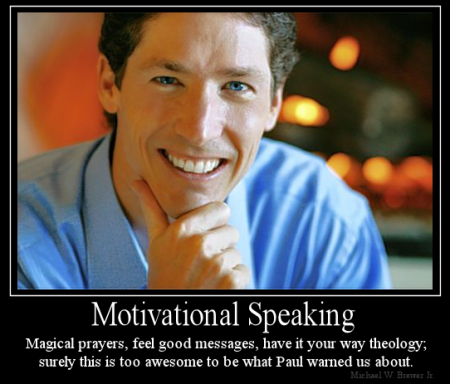
(CBS/AP) Houston televangelist Joel Osteen is a preacher, lecturer and author. Soon, he’ll add reality TV star to his accomplishments.

The leader of a Texas megachurch, whose Sunday services are broadcast to audiences around the world, has signed an agreement to work with producer Mark Burnett to develop a reality show about his mission trips with members of his Lakewood Church.

Osteen, 48, announced the agreement Tuesday. He said the program would also feature Victoria, his wife of more than two decades.

Osteen also travels a cross the country presenting programs in large arenas. He is the author of several best-selling books, the latest of which is “Every Day a Friday.”

The British-born Burnett is executive producer of the CBS hit show “Survivor” and creator of such reality series as “Celebrity Apprentice,” “The Voice” and “Are You Smarter Than a Fifth Grader?”

Lakewood Church’s website says its broadcasts reach more than 200 million households. Its headquarters is the former Compaq Center, which the NBA’s Houston Rockets once called home. It took more than 15 months and $75 million to convert the arena into a church.

Source: CBS

The Tragedy of American Compassion

The Tragedy of American Compassion – Marvin Olasky

Reviewed by Stuart Brogden, 30 Oct 2011

Tragedy and Compassion – two words that we don’t normally associate together. How could compassion be tragic? While we likely have different levels of bad news in mind when think of tragedy, we are all in agreement that tragedy is bad and something ought to be done. Although I think the TV news industry is working hard to widen the definition to include hangnails.

Compassion is a bit more complicated. We tend to think of compassion from the ame perspective that we think of love – the unbiblical, Greco-Roman emotional view. Americans view compassion today differently than we did 250 years ago. We want to “relieve suffering” but don’t stop to think about the proper way of doing this, or even if there is such a thing. There are some issues – life threatening, for example – for which rapid elimination of the threat is proper. But there are many life issues that are the accumulation of bad decisions for which there is no proper quick relief. We can look at G.W. Bush’s policy in the Middle East, thinking the solution there was to quickly implant democratic governments. People will not value the liberty a representative government of laws brings until they realize their need of it. Small children will not realize the value of math if mom tells them the answers rather than teaches and asks diagnostic questions.

Biblical compassion is based on biblical love – wanting the best (as God defines it) for the person and to honor God. As we’ve been taught, good deeds must incorporate right motive, right method, right attitude, and right objective. So biblical compassion must be based on a biblical view of God and of man. Our goal is not to bail a man out – it is to set him on his feet, exposed to the gospel, equipped to provide for his family.

It is this framework that Olasky has done a masterful work outlining in this book. The Puritans had a reformed view of man: he is depraved and will avoid that which is unpleasant (work) if at all possible. This perspective, encoded in the laws of the late 17th century, was evidenced by giving time rather than treasure, requiring “decent living” of those being helped, punishment for wrongdoing – which included slothfulness. A key attribute of this perspective was the personal knowledge and connection between the better-off and the poor. Works-testing was required, so that a man or woman who was able to work would be put to work in order to secure food and shelter. “This social policy was based upon the theological view that stressed man’s sinfulness, which only God’s grace could change.” (pg 10) Further, “nothing that could contribute to the breakup of families, or to the loss of the family’s central role as support of its members was encouraged.” (pg 11) So a three-legged stool of family, church, and neighborhood was in place. The goal was not equal treatment of all who were in need, but personal attention to each with the aim of building responsibility and morality.

Poverty – caused by circumstances such a illness or death – was seen differently than pauperism, a lifestyle of living off others with no regard for personal responsibility. Ten causes of pauperism were identified: ignorance, idleness, intemperance (personal character), “want of economy”, imprudent and hasty marriages (circumstances), lotteries, pawnbrokers, brothels, and gambling houses (institutions). Last on the list were charities that gave away money too freely.

A key aspect of being responsible toward the poor was trying to discern between those stricken by poverty and those trying to “game the system”. “Their goal was not to weed out people – for they saw all as created after God’s image, and thus very different from weeds – but to require self-confrontation” and admission of their need. “The poverty which proceeds from improvidence and vice ought to feel the consequences and penalties which God annexed.” No one, however, was left to starve. “Tough love”, as it was called not too long ago. “When anyone asked for relief, the appropriate deacon investigated in order to discriminate and beneficially assist the really necessitous and deserving poor.” Your deacons have studied this aspect of benevolence, and have been encouraged by Job’s view of this activity: Job 29:15 – 16: I was eyes to the blind and feet to the lame. I was a father to the needy, and I searched out the cause of him whom I did not know.

These methods, motives, means, and aims resulted in changed lives. Those predestined by God to new life were saved, others found meaning in the moral goodness of working for their food. As cities grew and problems more evident, agencies emerged to take advantage of economies of scale. Yet “charity leaders believed that few would volunteer many hours each week of they did not see themselves as soul-savers and not just bread-providers.” (pg 30) In the mid 19th century, Charles Brace, who had hoped for political change to help poor folk, quickly realized that “high taxes that supported a corrupt city administration were part of the problem, not a road to solution.” (pg 31) Brace tried direct material distribution to needy children (bypassing families and churches) but learned “if you put a comfortable coat on the first idle and ragged lad who applies, you will have fifty half-clad lads, many of who possess hidden away a comfortable outfit leaving their business next day, to get jackets for nothing”. He learned that spiritual reform must go hand-in-hand with material reform. This Christian view of man and compassion took care of what modern folk have called “human debris” – those folk without normal capacities of thought or emotional relationships, which governments tend to put away.

And while this country was in pursuit of this God-honoring perspective, Benjamin Franklin saw in London, in 1766, the destruction wrought by the British welfare act: “There is no country in the world in which poor are more idle, dissolute, drunken and insolent. The day you passed that act you took away before their very eyes the greatest of all inducements to industry, frugality and sobriety, by giving them a dependence on somewhat else than a careful accumulation during youth and health for support in age and sickness … Repeal that law and you will soon see a change in their manners. St. Monday and St. Tuesday will cease to be holidays. In this country, such welfare was widely hated and seen for the danger it was. Charities continued to see two categories of deserving poor people – the impotent poor, who could not help themselves (due to age, illness, etc.) and the able poor, who could work and would be required to do so. Being poor carried some measure of shame, seen as a deterrent to the attraction of pauperism.

Continue reading

Sermon of the week: “God’s view on Marriage and Divorce” by Akash Sant Singh.

If last week’s sermon on marriage by Albert Martin (found here) was a left hook, today’s message is an uppercut.

God’s view on marriage and divorce is a message that I strongly encourage DefCon readers to listen to whether you are married, divorced, widowed, or single (yes, that’s intended to be all-inclusive).

What a wonderfully convicting and encouraging message Akash brings from the book of Malachi. You won’t want to miss this one.

Book recommendation: “Dangers of the Invitation System” by Jim Ehrhard

I recently finished this short  booklet, Dangers of the Invitation System, that I simply can’t recommend enough.

In about 30 pages, Jim Ehrhard reveals the utter folly of the modern evangelical practice of the altar call.

If you know someone (friends, family, evangelist, pastor, etc.) who employs the altar call in their presentation of the gospel, you need to get this booklet into their hands.

This booklet regularly retails at $2.95 but is currently part of the one cent sale at CCWOnline where you can get up to twenty copies for only a penny each.

Saturday sermon series: “The Gospel Demands Radical Giving” by David Platt.

We are in week five of our eight-week series on Radical. What makes today’s message, The Gospel Demands Radical Giving, so important is that in it David Platt answers many of the criticisms levied against him.

If you dislike the message Platt is delivering in this series and you refuse to listen to it because you think Platt  believes that Christians who give away more are better than those who don’t; you think Platt “guilts “people into giving to the poor (and keeping less for ourselves); you think Platt believes the rich man was in Hell because he had money and Lazarus was in Heaven because he was poor; you think Platt is advancing a works-righteousness gospel; or any of the other baseless judgments that have been levied against him for daring to touch American Christianity’s golden calf of affluence, then please listen to this message so you can better understand his heart and his message.

I don’t wish for the “controversy” surrounding Radical to overshadow the message Platt is giving, but the criticisms must be answered and in this particular message Platt does just that (most of which is done in the first 14 1/2 minutes of this message).

Sermon of the week: “Marriage and Redemption” by Albert Martin.

Your sermon of the week is Marriage and Redemption by Albert N. Martin.

I greatly appreciate Pastor Martin’s willingness to go where so many pastors in America won’t. Whether it’s dealing with such taboo subjects in the church as the expectation of families to have family worship time and warning against the misuse of television (see here) or the subject of the rampant immodesty within the church (see here), Pastor Martin is not one to shy away from stepping on toes as he deals with subjects that most other pastors won’t touch for fear of alienating segments of the church or being labeled a “legalist.” 

In today’s message Pastor Martin takes the gloves off as he deals with the subject of marriage. This is no “ten steps to a better marriage” type sermon; expect to be challenged and convicted.  

Pharisees, leprous Samaritans, and other bloggers.

This post may not win me friends, and it may only make the sport of loathing me (and this blog) all the more attractive, but I am compelled to address a problem within the Christian internet community; a problem that doesn’t appear to show signs of ending anytime soon.

The problem I am speaking of is the increasing (and unnecessary) condescension and personal attacks from upper class Christians of the blogging world directed toward their lower class brothers and sisters.

This unsightly pock mark on the face of the Christian blogging world has risen to an alarming level and ignoring it –or hoping that it will soon run its course—simply won’t alleviate the problem. In this post I will be brutally honest (risking possible verbal retaliation and smears) but I hope and pray my words will be received in the spirit in which they are intended and will not actually contribute to the already inflamed derision among the caste system of Christian bloggers.

If anyone is offended by what may appear as an overly harsh rebuke or admonition (or some tongue-in-cheek), I apologize in advance, as my intent is not to offend, but the situation has boiled to such a level that pulling punches will serve no good in my appeal to see an end to this disadvantageous behavior.

I am also not deluded into believing my words will persuade all parties involved, but I do pray that it will cause at least a few of the combatants to pause and reflect on just how poorly attitudes and behaviors have gotten lately. I also pray that those involved will repent for the damage already done and then join me in calling a truce in this war among brethren.

To be fair.

I must begin by conceding that there are in fact some very angry, argumentative, and combative Christian bloggers out there who really need to reconsider the reason they blog. These bloggers (which comprise a very small minority) would do the cause of Christ and the gospel a service if they would consider taking a sabbatical to reevaluate their current spiritual state. (I have already addressed this issue in my previous post Caustic Calvinists.)

The fact is, these acidic bloggers are not representative of every Christian blogger out there who happens to find themselves outside the gates of the upper echelons of the blogging food chain, and I reject the efforts by some to lump all lower class apologist bloggers together as part of the seething minority.

But this post is not about them. This post is about the elitists who paint all inferior bloggers in cyberspace with the same broad brush as the few caustic bloggers.

My observations.

In my estimation most Christian bloggers fall into two main categories:

1). The hierarchical internet popes who see themselves as the only class of bloggers that are worthy, able, and enlightened enough to defend the faith and address the problems within the church.

To be analogous, I liken this growing elitist mentality to the Pharisees–not in the malicious way that critics apply the term as a way to stifle their opponents in a debate–but in the sense that, like the Pharisees, these bloggers strongly present themselves as the only ones worthy to deal with religious matters. All other bloggers are just not at the spiritual, educational, and intellectual level necessary to blog as the elites are, and thus, all other Christian bloggers would do best to leave the temple grounds and take their laptops with them.

2). The rest of the Christian aplogetics blogging world falls into the other category. These low-level mavens of the blogging world are what I analogously (and affectionately) refer to as the dreaded leprous Samaritans, those unclean pariahs not even worthy to blog alongside their premier blogging counterparts.

These oftentimes sincere and faithful bloggers are commonly referred to by their elitist superiors by the pejorative terms “watchbloggers” and “ODMs” (online discernment ministries), names strategically employed to marginalize them and their worthless contributions. The professionals view these gentile bloggers with utter contempt and–given the opportunity–would likely have those unkempt, vile dogs of cyberspace censured (if not tarred, feathered, flogged, and burned at the stake).

Friendly fire.

It’s true that not every menial blogger has been to seminary; it’s true that not every blogging serf has a master’s degree; it’s true that not every lower class blogger has had a book published; it’s true that not every peasant blogger has the greatest of depth in theological understanding; it’s true that not every amateur blogger has the following year booked up with speaking engagements around the nation, but does this mean that these grunts in the trenches of the battlefield have no right to exercise their freedom of speech as they write about the gospel, the faith, and their convictions, simply because they don’t say it exactly in the manner that the upper crust in the blogging world would?

Do these amateur bloggers really deserve all the loathing, condescension, and rancid vitriol that they’ve been increasingly receiving from these elites?

If we’re all truly in Christ then we’re all in this truth war together, but when the generals begin turning their cannons on the ground troops, the cause of Christ is sullied.

When the world gazes upon the bloody and battered mass of wounded warriors (many of which eventually succumb to the injuries inflicted on them by their comrades), the unbelieving snicker at us as they slip deeper into their self-assurance that all this friendly fire is simply more “proof” of the utter failure and futility of Christianity. Because, after all, Jesus said that the world would know that we are His disciples by the love we have for one another. Unfortunately the world sees anything but this type of evidence when they visit some Christian blogs.

Ironically, oftentimes the subpar bloggers that the elite loathe the most are the ones who are linking to their sites, recommending their books, and posting their sermons.

The common goals of those in the truth war.

Aren’t we all unified under the same Lord with the same shared purpose of  glorifying God, spreading the gospel, and defending the faith from those who have crept in unnoticed?

All Christians are undeniably in this truth war (even if most professing Christians prefer to avoid controversies). And in spite of the seemingly vast chasm affixed between the upper-crust bloggers and their inferiorly-viewed lower-crust bloggers, they share much in common. Here, for your consideration, are just some of the commonalities that these two tiers of bloggers share:

– Both camps believe in the essentials of the Christian faith.

– Both camps believe in defending these essentials from the wolves who seek to subvert them.

– Both camps have a righteous indignation for false teachers that lead the sheep astray.

– Both camps have a passion to share the gospel of Jesus Christ (the only means of salvation) to a lost and dying world.

– Both camps adhere to the God-glorifying Doctrines of Grace.

– Both camps rejoice, take comfort in, and proclaim the sovereignty of God over His creation.

– Both camps believe in the perspicuity and divine origin of the Scriptures.

– Both camps believe the Bible doesn’t contain the Word of God but is the Word of God.

– Both camps proclaim the Solas of the Reformation.

– Both camps have placed their trust in the Lord Jesus Christ as the propitiation for their sins.

In other words, both camps are comprised of actual, literal brothers and sisters in the Lord, members of Christ’s body, fellow Christians. And each of these bottom dwelling Christian bloggers that are loathed, smeared, dragged through the mud, and demeaned by other Christian bloggers are dear souls that have been redeemed by the precious shed blood of the Lord Jesus Christ. Forget not that those you deride are the Lord’s beloved bride, and will be sharing a seat at the table of the Lord’s marriage feast with you.

Enough is enough.

To the ostentatious bloggers of grandiose superiority, I am calling for a stop to this madness of public ridicule of fellow Christians who are in the same war fighting the same battles. Quit viewing them as too unsophisticated and unworthy to blog because their polemic is not to the same degree of eloquence or level of loftiness that you possess. I urge the generals to bear this in mind before their next public evisceration of a foot soldier on their theological bayonets of contempt.

Jehovah’s Witnesses are quietly opening new Kingdom Halls, Rome is quietly baptizing new converts, Mormons are quietly gaining more approval and legitimacy in the arena of public opinion, Emergents and liberals are quietly subverting the gospel, the anti-theists are quietly publishing more books questioning the existence of God, and Muslims are quietly planning their next mass-casualty attack in the name of Allah. And all of this is happening while the ones who hold the saving knowledge of Jesus Christ—the very gospel these souls trapped in their growing false religions so desperately need to hear—are  preoccupied in a pretentious battle of who’s allowed to blog or not.

Oh, how this is all to our shame!

The beginning of strife is like letting out water,
so abandon the quarrel before it breaks out.

Proverbs 17:14

Quotes (915)

I know well the tendency there is, at a certain stage of anxious inquiry, to ask, “What is faith that I may do it?” It is a legalist’s work to satisfy that craving; but this is what is in the “inquiry-room.”

“Who is He that I may believe in Him?” was the question asked by one who approached the dawning of a day of salvation. Explanations of what faith is are but trifling with souls. How different is the Scripture way! The great aim there is to “set forth” the object, not to explain the act, of faith.

– John Kennedy

1819 – 1884

No need for commentary.

From the NY Post:

It’s Our Lady of Spin the Bottle.

Pastor Maurice Johnson of the Winners Church in Queens delivers the sexiest Sunday sermon in town, preaching on how to keep romance alive in marriage — and then asking congregants to make out in a passionate, public kissing contest during the service.

The parishioners with the most passion — and tongue-wagging — win $50 to spend on date night.

“Your bedroom and your love life are fires that must be nurtured and fought for,” Johnson preaches in a booming voice that reverberates through the makeshift church in the PS 38 gym in Rosedale, Queens.

“Use the power of touch to ignite passion in your marriage,” Johnson tells his giggling, nondenominational congregation of 75.

He adds, “You should be visually stimulated for your husband or your wife. It is your biblical responsibility to look good for your spouse.”

Johnson then calls upon four married couples to rise and approach the pulpit.

As a keyboardist and a drummer ooze R&B tunes such as “I Like It” by DeBarge, the couples demonstrate their passion — by locking lips, hips and tongues for a seemingly endless five minutes.

When they come up for air, the rest of the churchgoers choose a winner by clapping for the most amorous couple.

Johnson, 39, told The Post he chose to deliver a series of sermons, titled “The Power and Pleasure of Romance,” to underscore the importance of marriage in the African-American community.

“Some people were like, ‘It seems strange to do at church,’ ” he said, “but they thought it was very creative.”

Keeping a romantic partnership ticking, he said, depends on showering your spouse with physical affection.

“God created a desire for love and romance,” Johnson said.

The face-sucking had some churchgoers blushing.

“You see kissing in all kinds of contexts, but you don’t necessarily see it in a marriage context,” said Frantz Cochy, 39, who won the contest when he seemed to forget that he was in front of a crowded room and hungrily embraced his wife of 13 years, Makeetah, 36.

“I wasn’t embarrassed, but I guess I felt a little awkward,” he said.

Olaiya Ayani, 33, had to cajole his wife, Ayanna, to stand up and play tonsil hockey in front of the packed room. But once on stage, the couple wrapped their arms around each other and didn’t hold back.

“My father and my mother never showed affection in public,” said Ayani, who met his wife two years ago on Craigslist. “I told myself, ‘I’m going to be more affectionate to my wife.’ ”

The pastor said he encourages married couples to drop their guard and experiment with each other in public.

“Any society that celebrates marriage, romance and love is going to be a free society,” Johnson said. “Public displays of affection aren’t wrong. Adam and Eve were naked, and they were not ashamed.”

The bachelor pastor says he’ll practice what he preaches next year, when he expects to marry.

HT: ExMinistries via Witnessing Encouragement

Sermon of the week: “Biblical Nonconformity” by Robert Briggs.

Your sermon of the week is the three-part message, Biblical Nonconformity, by Robert Briggs. 

Biblical Nonconformity Part 1 (Introduction)

Biblical Nonconformity Part 2

Biblical Nonconformity Part 3 (Source of our Strength)