A sword in a madman’s hand, and the Word of God in some wicked man’s mouth, are used much alike.
– William Gurnall
1617 – 1679

A sword in a madman’s hand, and the Word of God in some wicked man’s mouth, are used much alike.
– William Gurnall
1617 – 1679

In the news: The Duggar’s welcome child number 19 and a feminist who wants the planet to adopt China’s limited child policy (video).

Timothy George, Co-Author of Manhattan Declaration
From: Ralph Ovadal, Pastor of Pilgrims Covenant Church, Monroe, Wisconsin.
The Manhattan Declaration is an ungodly manifesto, contemptuous of the blood and righteousness of the Lord Jesus Christ. It is an ecumenical treatise, complete with a Romish gospel and shot through and through with popish error. Those evangelicals who have authored this document and who have led the way in signing it show themselves to be in rebellion to God. It is, in their case, a brazen manifesto of treason against the Lord Jesus Christ. And they are not friends but rather are enemies of Christian liberty in that they disobey and provoke the Author of liberty with their spiritual fornication, even wresting His word and corrupting His blood-bought church. It is the biblical duty of all faithful Christian pastors to stand against the evangelical authors of the Manhattan Declaration and all evangelicals who sign it or promote it in any way. Such betrayers of Christ and His church must be separated from and called to account by all faithful Christian ministers and people.
For a message speaking to this much needed, very strong public rebuke to the evangelical signers of The Manhattan Declaration, please listen here.
 Who made the following statement?
My message is not about doctrine. I don’t have to get 50 references from Scripture in a sermon for it to be a good sermon. Churches that are helping people live out a Christian life are growing and flourishing. . . . I want to be careful not to criticize anybody or be negative . . . but we need to change with the times.
Answer . . .
 Your sermon of the week is The Labor of Prayer by Kenneth Stewart of Dowanvale church in Scotland. Stewart deals not with the issue of prayer in and of itself as much as he deals with the labor of prayer. Definitely a convicting message that I wished to share with the readers of DefCon.

The following is from John MacArthur’s book The Jesus You Can’t Ignore: What You Must Learn from the Bold Confrontations of Christ. And as always, he’s spot on.
~~~~~~~~~~~~~~~~~~~~~~~~~~~~~~~~~~~~~~~~~~~
The problem is that the needed reformation within evangelicalism won’t occur at all if false ideas that undermine our core theological convictions cannot be openly attacked and excluded. When peaceful coexistence “with our deepest differences” becomes priority one and conflict per se is demonized as inherently sub-Christian, any and every false religious belief can and will demand an equal voice in the “conversation.”
That has actually been happening for some time already. Listen, for example, to what some of the leading voices in and around the Emergent movement have said. Tony Campolo is a popular speaker and author who has a major influence in evangelical circles. He believes evangelicals should be in dialogue with Islam, seeking common ground. In an interview conducted by Shane Claiborne,Campolo said:
I think that the last election aggravated a significant minority of the evangelical community, believing that they did not want to come across as anti-gay, anti-women, anti-environment, pro war, pro capital punishment, and anti-Islam. There is going to be one segment of evangelicalism, just like there is one segment in Islam that is not going to be interested in dialogue. But there are other evangelicals who will want to talk and establish a common commitment to a goodness with Islamic people and Jewish people particularly.
Brian McLaren is perhaps the best-known figure in the Emergent conversation. He thinks the future of the planet—not to mention the salvation of religion itself (including Christianity)—depends on a cooperative search for the real meaning of Jesus’ message. In McLaren’s assessment, this means an ongoing dialogue between Christians and followers of all other religions. This, he is convinced, is of the utmost urgency:
In an age of global terrorism and rising religious conflict, it’s significant to note that all Muslims regard Jesus as a great prophet, that many Hindus are willing to consider Jesus as a legitimate manifestation of the divine, that many Buddhists see Jesus as one of humanity’s most enlightened people, and that Jesus himself was a Jew, and without understanding his Jewishness, one doesn’t understand Jesus. A shared reappraisal of Jesus’ message could provide a unique space or common ground for urgently needed religious dialogue—and it doesn’t seem an exaggeration to say that the future of our planet may depend on such dialogue. This reappraisal of Jesus’ message may be the only project capable of saving a number of religions, including Christianity.
Indiscriminate congeniality, the quest for spiritual common ground, and peace at any price all naturally have great appeal, especially in an intellectual climate where practically the worst gaffe any thoughtful person could make is claiming to know what’s true when so many other people think something else is true. Besides, dialogue does sound nicer than debate. Who but a fool wouldn’t prefer a calm conversation instead of conflict and confrontation?
In fact, let’s state this plainly once more: Generally speaking, avoiding conflicts is a good idea. Warmth and congeniality are normally preferable to cold harshness. Civility, compassion, and good manners are in short supply these days, and we ought to have more of them. Gentleness, a soft answer, and a kind word usually go farther than an argument or a rebuke. That which edifies is more helpful and more fruitful in the long run than criticism. Cultivating friends is more pleasant and more profitable than crusading against enemies. And it’s ordinarily better to be tender and mild rather than curt or combative—especially to the victims of false teaching.
But those qualifying words are vital: usually, ordinarily, generally. Avoiding conflict is not always the right thing. Sometimes it is downright sinful. Particularly in times like these, when almost no error is deemed too serious to be excluded from the evangelical conversation, and while the Lord’s flock is being infiltrated by wolves dressed like prophets, declaring visions of peace when there is no peace (cf. Ezekiel 13:16). Even the kindest, gentlest shepherd sometimes needs to throw rocks at the wolves who come in sheep’s clothing.
 Any system of training that does not make knowledge of Scripture the first thing is unsafe and unsound.
– J.C. Ryle
1816 – 1900
 A few days ago I entered the book section of a local Wal-Mart and was shocked to see a large section of books on Mormonism. And no, this Wal-Mart was not in Utah.
I then checked the internet and discovered they even sell Mormonism’s plagiarized piece of fiction known as the Book of Mormon online. (To understand more about the Book of Mormon check out this excellent documentary.)
I never thought I’d see the day when a major retailer would carry cult literature. I suppose this isn’t much of stretch for Wal-Mart, though. They’ve been selling Rick Warren, Joel Osteen, and Joyce Meyer for years.
I wonder if the Jehovah’s Witnesses will demand their place on Wal-Mart’s bookshelves next.
 Barring the Catholic images of Jesus in this video and a comment about God loving everyone equally, following is a wonderful testimony of a previous follower of Allah and Islam who came to embrace Jesus Christ and the gospel. Truly a wonderful story of how one can be changed from darkness to light. May this give hope to all to continue to witness with wisdom and grace to even those who seem to be the most opposed to the gospel and Jesus. For you never know what is going on in their heart and the internal struggle they may be fighting.
 Here is the great evangelical disaster—the failure of the evangelical world to stand for truth as truth. There is only one word for this—namely accommodation: the evangelical church has accommodated to the world spirit of the age. And let us understand that to accommodate to the world spirit about us in our age is nothing less than the most gross form of worldliness in the proper definition of that word. And with this proper definition of worldliness, we must say with tears, with exceptions, the evangelical church is worldly and not faithful to the living Christ.
– Francis Schaeffer
1912 – 1984
 Far too much of today’s evangelical world has been swept up in the powerful magnetic field of the secular popular culture. Thinking they’re doing God’s work behind enemy lines of the atheistic popular culture, they’ve gradually and inadvertently taken on many more characteristics and attitudes of the enemy than they realize. That’s why, when I drive my car and turn on the radio, it sometimes takes several minutes before I can figure out whether I’m listening to a regular, secular rock song or a Christian rock song. They often sound uncannily the same–the Christian song being a virtual clone of the secular. In turn, the powerful popular culture ridicules evangelicals for their lame imitation of the real thing.
– David Kupelian
 Your sermon of the week is Sola Scriptura: The Supremacy of Scripture by Brian Borgman. This is part four of a thirteen-part series entitled Introduction to the Reformed Faith that Pastor Borgman gave in 1998. Look for the each additional installment (in order) every couple weeks. See the last installment here.
 It’s that wonderful time of the year again–the Christmas season. But unfortunately, along with the fresh snow, smell of baked goods, time spent with family and friends, and joyous holiday memories in the making, this time of the year also comes with an unavoidable annoyance. No, not fruitcake. I’m referring to all the keep Christ in Christmas campaigns with their bumper stickers and yard signs, and it’s Ok to wish me a Merry Christmas car magnets and buttons.
Do I have a problem with Christ being remembered as the reason Christians celebrate Christmas? Absolutely not. Am I happy with the removal of Christ from the very holiday that’s supposed to be celebrating His birth? No way. Do I think the secularization of Christmas is a positive trend? Certainly not. Am I pleased with the mass consumerism that Christmas has become? Never. Is this post about whether or not Christians should even celebrate Christmas? Nope.

This post is about my issue with the yearly keep Christ in Christmas campaigns accompanied with all their recommended boycotts of stores that choose “Happy Holidays” over “Merry Christmas.” My issue with these campaigns, however, is not in the substance of their arguments (stopping the expunging of Jesus Christ from Christmas), but my issue is in their misapplied efforts to correct what they deem as a sin almost equivalent to Judas’ betrayal of Christ. These folks with the best of intentions have grossly misdiagnosed the problem: It’s not them (the world), it’s us (the church).
Before I continue I want to acknowledge that it’s true, Christmas’ origins aren’t even Christian and most of the Christmas traditions we cherish today (Christmas trees, candy canes, tinsel, bulbs, stockings, mistletoe, yule logs, eggnog, etc.) cannot be supported by Scripture. Although I understand that there are many who want to argue against Christmas on those points, this is not what this post is about. The basis of this post can be summed up by these two points:
1. – Many of the most vocal opponents of the secularization of Christmas make nary a peep all year long to the secularization taking place within the church itself.
2. – These same folks fail to recognize that the true source of the removal of Christ from Christmas is only a result of the removal of Christ from our culture due to the removal of Christ from our churches; something that began a long time ago (long before secular retailers opted for “Happy Holidays” over “Merry Christmas”).
The secularization of Christmas is just a visible sore caused by the underlying affects of a cancer that’s ravaging the church. Trying to “save Christmas” while the bigger issue looms over us is like baling out a sinking boat with a thimble or putting a band-aid on a bullet wound. Your efforts may make you look busy and cause you to feel that you’re doing some good, but in reality they’re both just a waste of time against the tidal wave of the inevitable. Additionally, your efforts also adversely serve as a diversion from the real problem.
I am convinced that the efforts of these social-conscious Christians is not only futile, but distracting. You only hear from these Christians around the Christmas season bemoaning the secularization of the holiday while they remain passive to the secularization that’s crept into their churches all year long with its deadly poisons of lukewarmness and rank heresy.
So what’s my solution? Am I complaining just to complain and be a Scrooge? Not this time.
 My recommendation is that first, these seasonal activists recognize that the world is acting like the world. We wouldn’t expect a goldfish to act like a tiger, so why do we expect unregenerate sinners to act like Christians during Christmas time, or at any other time for that matter?
Those of the flesh are hostile toward God. Forcing them to keep Christ in Christmas accomplishes nothing but provides them with a false sense of religious security: “But God, I went to church every Christmas.”
Secondly, stop holding Target, Starbucks, Wal-Mart, and GAP responsible for the spiritual stagnation of your community, church, and family, and start holding your pastors responsible! When your pastor preaches cutesy little candy-coated, Osteenesque-type, esteem-building, Christ-less lectures about your best life now, protest that!
Finally, teach your children the true meaning of why we celebrate Christmas. Emphasize the real reason Christ stepped from Heaven to be born among men. Be faithful to your calling as parents to teach your children the faith, and don’t abdicate that responsibility to some biblically illiterate youth pastor.
Never let your kids for one moment think that the real story of Christ’s incarnation is about anything other than Christ and Him crucified. The whole point of Christ’s birth was not for gift exchanges and office parties, it was about God making Him who knew no sin to become sin on our behalf so that we might become the righteousness of God in Him (2 Corinthians 5:21).

So here’s my question: If these proponents of keeping Christ in Christmas prevailed today, and everybody put Christ back in Christmas tomorrow, in the realm of eternity, what will they have actually accomplished? Would they have not successfully created a throng of hypocrites who honor God with their lips but whose hearts are far from Him?
Continuing to bemoan the absence of Christ from Christmas while remaining quiet on the absence of Christ in our pulpits is like complaining about the smoke burning your eyes while your house is burning down with your family trapped inside.
Have a Merry Christmas.
 Too many Christians, just like their unsaved counterparts, are impressed by appearances rather than structure; are seeking thrills and excitement rather than substance; are more apt to respond to emotional manipulation than a rational discourse. How does a church compete in this rather crowded marketplace? If entertainment has become the standard way of life (as some are suggesting) then how can the churches vie unless they become a bastion of entertainment? But if it gives way to this powerful temptation has not the church been transformed into something other than the church?
– Garry Gilley
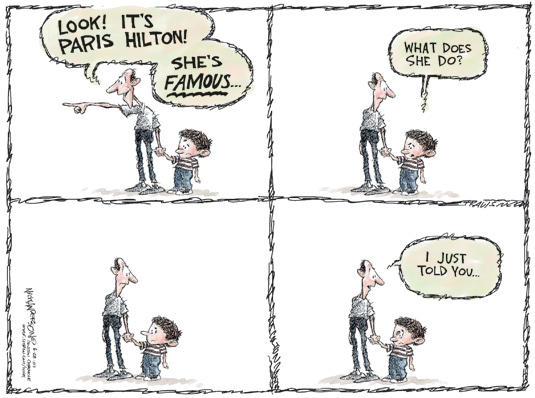
Paul Proctor has written a much needed piece on the idolatry of celebrity worship, something that has taken our culture by storm. Here’s a quote from the article:
Under their exploited influence, our envy and infatuation often bypasses logic, reason and sound judgment, persuading us to listen and follow their lead even though they don’t know us and we don’t know them beyond the manufactured and well-guarded image we see and hear in the media.
This is the mysterious power of celebrity – a seductive and intoxicating force that too many covet and too few fear – a form of inebriation and delusion, and at times, insanity that incites brazen and bizarre behavior from those who fawn at the feet of fame, making them say and do things they would not otherwise.
The next time you happen to be anywhere near a celebrity, don’t watch them – watch the people around them and you’ll better understand what I’m talking about. Hopefully, what you see and hear will be offensive enough to keep you from being brought under the celebrity’s spell.
Proctor also addresses this same phenomenon within the church as he cites one pastor’s starry-eyed infatuation with the universalist Billy Graham. To read Proctor’s entire article, click here.

Within fifty years of the death of the last of the apostles, so far as we can now learn, the Gospel of God’s grace almost ceased to be preached. Instead of evangelizing, the preachers of the second and third centuries gave themselves to philosophizing. Metaphysics took the place of the simplicity of the Gospel. Then, in the fourth century, God mercifully raised up a man, Augustine, who faithfully and fearlessly proclaimed the Gospel. So mightily did God empower both his voice and pen that more than half of Christendom was shaken by him. Through his instrumentality came a Heaven-sent revival. His influence for good staved off the great Romish heresy for another century. Had the churches heeded his teaching, popery would never have been born. But they turned back to vain philosophy and science, falsely so-called. Then came the Dark Ages, when for centuries the Gospel ceased to be generally preached. Here and there feeble voices were raised, but most of them were soon silenced by the Italian priests. It was not until the fifteenth century that the great Reformation came. God raised up Martin Luther, who taught in no uncertain terms that sinners are justified by faith and not by works.
– A.W. Pink
1886 – 1952
Our purest works are no better than filthy rags, when tried by the light of God’s holy law. . . . Our best things are stained and tainted with imperfection. They are all more or less incomplete, wrong in the motive or defective in the performance.
– J.C. Ryle
1816 – 1900
 Your sermon of the week is another good one from Randall Easter entitled Our Identity in Christ. Again, pastor Easter steps on toes as he preaches the Word without compromise.
HT: The Bororean
 The following Q & A with Voddie Baucham is from Unashamed Workman.
1. Where do you place the importance of preaching in the grand scheme of church life?I believe preaching is central to the grand scheme of church life (see Acts 2:42ff). Preaching/teaching sets the tone and the parameters for all other functions of the church. Our understanding of fellowship, evangelism, discipline, worship, etc., all arise out of our understanding of God’s word. Without sound preaching and teaching, all else will falter. Hence, preaching is of seminal importance in the grand scheme of church life.
2. In a paragraph, how did you discover your gifts in preaching?As a young college student, I went on a preaching mission with several teammates of mine. I was a relatively new believer and had no experience sharing God’s word. Two of my mentors guided me through the week and helped me discover my gifts in preaching for the first time. I felt as though something in me was awakened for the first time. I’ve been preaching ever since.
3. How long (on average) does it take you to prepare a sermon?
When we start a series (preaching through a book or section), it can 15-20 hours or more. However, once we are in the midst of the text much of the background work builds upon previous studies and cuts the time dramatically. Nevertheless, crafting the message, adding illustrative material and mining the text for that last nuance, is a process that never really ends until the preaching moment. That’s the only time I can truly say I am finished preparing the sermon.4. Is it important to you that a sermon contain one major theme or idea? If so, how do you crystallise it?
Absolutely! I am always looking for the central theme in a passage. There may be more than one, but I have come to realize that I am most effective when I limit myself to the main idea. I find that idea by analyzing the paragraph, then the broader context of the section, then the book as a whole, then its place in the broader revelation. Then I go through the process in reverse back down to the passage in question.
5. What is the most important aspect of a preacher’s style and what should he avoid?
The most important aspect of a preacher’s style is authenticity. When I started preaching, I thought my ‘style’ had to fit a certain category. As a result I mimicked some of my favorite preachers. I was constantly reinventing myself. Ultimately, I had to find my own ‘style’ and stick with it. That meant there was one less thing I had to manufacture. I had to realize that God gave me a unique personality and he intended to use it in unique ways. God gave us four gospels written by four unique men, from four different perspectives. I had to remind myself that it is as much of a travesty for me to try to be Tony Evans as it would have been for John to try to be Matthew.
 I believe one of the greatest crutches in the church is the nursery. Parents who have neglected to train their children have very little encouragement to do so when there is a place to hide them. The father who should be up in arms by the time he gets home from church because of the embarrassment to which his child subjected him ends up going home with a clear conscience while the nursery worker takes a handful of aspirin.
– Voddie Baucham
 Christ Alone Wyoming