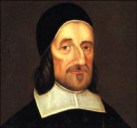
 Will you put God to this, that either He must work constant miracles in every age, and before every man, or else He must not be believed?
– Richard Baxter
1615 – 1691

Will you put God to this, that either He must work constant miracles in every age, and before every man, or else He must not be believed?
– Richard Baxter
1615 – 1691

The following is from John MacArthur’s book The Jesus You Can’t Ignore: What You Must Learn from the Bold Confrontations of Christ. And as always, he’s spot on.
~~~~~~~~~~~~~~~~~~~~~~~~~~~~~~~~~~~~~~~~~~~
The problem is that the needed reformation within evangelicalism won’t occur at all if false ideas that undermine our core theological convictions cannot be openly attacked and excluded. When peaceful coexistence “with our deepest differences” becomes priority one and conflict per se is demonized as inherently sub-Christian, any and every false religious belief can and will demand an equal voice in the “conversation.”
That has actually been happening for some time already. Listen, for example, to what some of the leading voices in and around the Emergent movement have said. Tony Campolo is a popular speaker and author who has a major influence in evangelical circles. He believes evangelicals should be in dialogue with Islam, seeking common ground. In an interview conducted by Shane Claiborne,Campolo said:
I think that the last election aggravated a significant minority of the evangelical community, believing that they did not want to come across as anti-gay, anti-women, anti-environment, pro war, pro capital punishment, and anti-Islam. There is going to be one segment of evangelicalism, just like there is one segment in Islam that is not going to be interested in dialogue. But there are other evangelicals who will want to talk and establish a common commitment to a goodness with Islamic people and Jewish people particularly.
Brian McLaren is perhaps the best-known figure in the Emergent conversation. He thinks the future of the planet—not to mention the salvation of religion itself (including Christianity)—depends on a cooperative search for the real meaning of Jesus’ message. In McLaren’s assessment, this means an ongoing dialogue between Christians and followers of all other religions. This, he is convinced, is of the utmost urgency:
In an age of global terrorism and rising religious conflict, it’s significant to note that all Muslims regard Jesus as a great prophet, that many Hindus are willing to consider Jesus as a legitimate manifestation of the divine, that many Buddhists see Jesus as one of humanity’s most enlightened people, and that Jesus himself was a Jew, and without understanding his Jewishness, one doesn’t understand Jesus. A shared reappraisal of Jesus’ message could provide a unique space or common ground for urgently needed religious dialogue—and it doesn’t seem an exaggeration to say that the future of our planet may depend on such dialogue. This reappraisal of Jesus’ message may be the only project capable of saving a number of religions, including Christianity.
Indiscriminate congeniality, the quest for spiritual common ground, and peace at any price all naturally have great appeal, especially in an intellectual climate where practically the worst gaffe any thoughtful person could make is claiming to know what’s true when so many other people think something else is true. Besides, dialogue does sound nicer than debate. Who but a fool wouldn’t prefer a calm conversation instead of conflict and confrontation?
In fact, let’s state this plainly once more: Generally speaking, avoiding conflicts is a good idea. Warmth and congeniality are normally preferable to cold harshness. Civility, compassion, and good manners are in short supply these days, and we ought to have more of them. Gentleness, a soft answer, and a kind word usually go farther than an argument or a rebuke. That which edifies is more helpful and more fruitful in the long run than criticism. Cultivating friends is more pleasant and more profitable than crusading against enemies. And it’s ordinarily better to be tender and mild rather than curt or combative—especially to the victims of false teaching.
But those qualifying words are vital: usually, ordinarily, generally. Avoiding conflict is not always the right thing. Sometimes it is downright sinful. Particularly in times like these, when almost no error is deemed too serious to be excluded from the evangelical conversation, and while the Lord’s flock is being infiltrated by wolves dressed like prophets, declaring visions of peace when there is no peace (cf. Ezekiel 13:16). Even the kindest, gentlest shepherd sometimes needs to throw rocks at the wolves who come in sheep’s clothing.
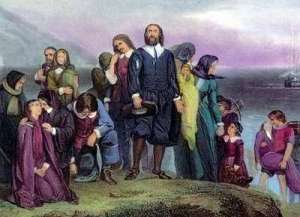 We cannot prescribe how God should be glorified. . . . How have men fooled themselves and dishonored God in the matter of worship! They invent and prescribe forms and modes, when they have no ground to believe that He will accept them. . . . We must not determine these things ourselves, as to how, when, where, whom we please, for this would dishonor rather than credit the cause of God, because this matter wholly depends upon His pleasure. Now anything of our will would . . . subtract from that divine symmetry and concord which encompasses the wisdom, holiness, power, and sovereign grace of God. And we might as well teach Him how He should govern the world, as how He should dispose of us. . . . God is not glorified but in His own way.
– Dr. John Singleton
Died – 1706
 In the comment thread of another post, reader “David T” linked to a revealing article on Mark Driscoll from the blog The Christian Worldview which I wished to highlight in this post. You can read it here:
Mark Driscoll: Is He Qualified To Lead?
I caution you, however, that discretion is needed because the article quotes Mark Driscoll heavily. It’s unfortunate I have to provide a caution regarding what comes out of the mouth of a “minister,” but these are the times in which we live.
I hope that the article linked above will help those who are on the fence in regards to Driscoll. But beware, you may feel the need to take a shower after reading some of Driscoll’s quotes.
And for those who feel the need to defend their man Driscoll, before you leave your comments you must first reconcile Driscoll’s speech with the following Scriptures, or don’t expect your comments to be approved.
A worthless person, a wicked man, is the one who walks with a perverse mouth . . . Proverbs 6:12
The fear of the LORD is to hate evil; pride and arrogance and the evil way and the perverted mouth, I hate. Proverbs 8:13
The lips of the righteous bring forth what is acceptable, but the mouth of the wicked what is perverted. Proverbs 10:32
Better is a poor man who walks in his integrity than he who is perverse in speech and is a fool. Proverbs 19:1
Likewise urge the young men to be sensible; in all things show yourself to be an example of good deeds, with purity in doctrine, dignified, sound in speech which is beyond reproach, so that the opponent will be put to shame, having nothing bad to say about us. Titus 2:6-8
_______________________________________________________________________
See also:
I’ve had it with Mark Driscoll and his mouth
Sermon of the week: “Sound Doctrine; Sound Words” by Phil Johnson
Recognizing those who are taking a stand against the current downgrade
I suppose I’ll be the first to start this season’s music off with my all-time favorite Christmas song. This is a beautiful rendition by Christina Sonnemann.
O come, O come, Emmanuel
And ransom captive Israel
That mourns in lonely exile here
Until the Son of God appear
Rejoice! Rejoice! Emmanuel
Shall come to thee, O Israel
O come, O come, Emmanuel
And ransom captive Israel
That mourns in lonely exile here
Until the Son of God appear
Rejoice! Rejoice! Emmanuel
Shall come to thee, O Israel
O come, Thou Key of David, come
And open wide our heavenly home
Make safe the way that leads on high
And close the path to misery
Rejoice! Rejoice! Emmanuel
Shall come to thee, O Israel
For those who have never suffered under the bondage of the Word of Faith extension of the Charasmatic movement (that I and many others have been delivered from) you need to know that it’s not all about naming it and claiming it, begging for money, speaking in tongues, being slain in the spirit, (fake) healings, (false) prophecies, and dancing in the aisles; sometimes they actually teach from the Bible . . . and that’s when it really gets scary.
In the following clip Jesse Duplantis shamelessly ‘twists‘ Scripture to make God look less knowledgeable and powerful than He is, and conversely makes man look more knowledgeable and powerful than he is. (Those who have come out of this heretical movement know all too well that these wolves are infamous for bringing God down and raising man up.)
In a nutshell this is four minutes of absolute foolishness and is a perfect example of awful hermeneutics and complete biblical illiteracy. But hey, he sure does tickle ears, doesn’t he?
Thanks to DefCon reader Shane for alerting me to this video clip.
He that seems righteous toward men, and is irreligious toward God, is but an honest heathen; and he that seems religious toward God, and is unrighteous toward men, is but a fake Christian.
– George Swinnock
1627 – 1673
First came the Rubber Ducky Nativity, now here’s this gem depicting the birth of Christ. Nothing says Christmas like psychedelic frogs, eh?

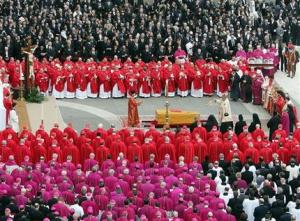
Billions in the world today are grievously deceived by the Roman Catholic religion; those both within her walls and those without. Deceived in large part by her outward appearance as she arrays herself in purple and scarlet and decks herself with gold, precious stones and pearls. All in a vain attempt to present herself as holier-than-thou as her clergy dons their priestly collars, robes and outward accoutrements so as to appear elevated above the common man and immune from sin.
Woe unto you, scribes and Pharisees, hypocrites! for ye make clean the outside of the cup and of the platter, but within they are full of extortion and excess. Thou blind Pharisee, cleanse first that which is within the cup. Woe unto you, scribes and Pharisees, hypocrites! for ye are like unto whited sepulchres, which indeed appear beautiful outward, but are within full of dead men’s bones, and of all uncleanness. Even so ye also outwardly appear righteous unto men, but within ye are full of hypocrisy and iniquity. (Mat 23:25-28)
But just as was true with the Pharisees, so it is true with the Roman priesthood. They do indeed appear to be beautiful outwardly, but inwardly they are full of hypocrisy and iniquity, just as anyone is who has religion and not Jesus Christ. A truth made all too clear only a few years ago when the religious facade of the Roman priesthood was briefly lifted which gave the world a glimpse into her blackened soul. For it was from this brief view that the world became aware of many of her priests either engaging in the most vile acts of sexual molestation of youth, or those who covered the dark deeds up.
(As an aside, this should give us a little insight into the motos operandi of Rome’s hierarchy where preservation of her reputation is paramount even when it involves innocent little children. Something to consider when you are bombarded by Catholic apologists and historical revisionists who classify her dark days of history including Papal wickedness, the Crusades, Inquisitions and brutal conquest of the Americas – to name a few, as nothing more than mere specks on her otherwise spotless character).
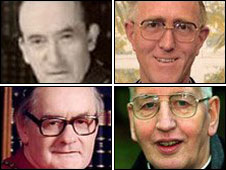 Well, tragically we are witnessing more of the same once again where a damning report has been released that speaks to child abuse in the Irish archdiocese of Dublin. Something which has apparently been going on for decades where the Catholic hierarchy has done all they could to cover up the abuse. Reading from a BBC article found here, authorities,
…found that the [Roman Catholic] Church placed its own reputation above the protection of children in its care. It also said that state authorities facilitated the cover-up by allowing the Church to operate outside the law.
The same article later goes on to state that,
Instead of reporting the allegations to civic authorities, those accused of horrific crimes were systematically shuffled from parish to parish where they could prey on new, unsuspecting victims.
The report stated: “The Dublin archdiocese’s pre-occupations in dealing with cases of child sexual abuse, at least until the mid 1990s, were the maintenance of secrecy, the avoidance of scandal, the protection of the reputation of the Church, and the preservation of its assets.”
It also said that the archdiocese “did its best to avoid any application of the law of the state”.
Another article in the NY Times reports that,
There was a similarly shocking investigation into decades of unchecked child abuse in Irish schools, workhouses and orphanages run nationwide by 19 Catholic orders of nuns, priests and brothers.
That report in May sought to document the scale of abuse as well as the reasons why church and state authorities didn’t stop it, whereas Thursday’s 720-page report focused on why church leaders in the Dublin Archdiocese — home to a quarter of Ireland’s 4 million Catholics — did not tell police about a single abuse complaint against a priest until 1995.
By then, the investigators found, successive archbishops and their senior deputies — among them qualified lawyers — already had compiled confidential files on more than 100 parish priests who had sexually abused children since 1940. Those files had remained locked in the Dublin archbishop’s private vault.
Absolutely shocking and how tragic indeed. To think of how deep the sin must be to commit such reprehensible acts all the while living a duplicitous life of feigned piety and holiness. So it goes and so it will go as long as Rome rejects the gospel of Jesus Christ and continues to hold to her damnable man-made religion of works.
One hope I have from this story is that there will be many Roman Catholics (including the brutalized victims) who will come, by God’s grace, to have their eyes opened to the reality behind the mask that Rome wears. Because religion never can and religion never will change a man’s or a woman’s heart no matter how pious or outwardly righteous they might appear. This being truth for the Catholic just as much as it is for the Protestant, Baptist and Evangelical.
My second hope is that evangelical leaders and their churches alike will repent of their alliances and fellowship with Rome and will stand apart from her as all of God’s faithful have done throughout the centuries; millions to the point of their brutal deaths. A call especially relevant for those who have recently signed The Manhattan Declaration. And a call especially relevant for those who desire not to partake of Rome’s sins nor receive of her plagues.
And I heard another voice from heaven, saying, Come out of her, my people, that ye be not partakers of her sins, and that ye receive not of her plagues. For her sins have reached unto heaven, and God hath remembered her iniquities. Reward her even as she rewarded you, and double unto her double according to her works: in the cup which she hath filled fill to her double. How much she hath glorified herself, and lived deliciously, so much torment and sorrow give her: for she saith in her heart, I sit a queen, and am no widow, and shall see no sorrow. Therefore shall her plagues come in one day, death, and mourning, and famine; and she shall be utterly burned with fire: for strong is the Lord God who judgeth her. (Rev 18:4-8)
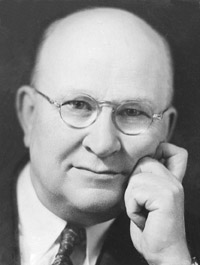 Error is like leaven of which we read, a little leaven leaveneth the whole lump. Truth mixed with error is equivalent to all error, except that it is more innocent looking and, therefore, more dangerous. God hates such a mixture! Any error, or any truth-and-error mixture, calls for definite exposure and repudiation. To condone such is to be unfaithful to God and His Word and treacherous to imperiled souls for whom Christ died.
– Harry Ironside
1876 – 1951
 You know there are two great plagues that have distressed the church of Christ and it will never be quite free from them; a multitude of hypocrites on a fair day, and a multitude of apostates on a foul day.
– Robert Traill
1642 – 1716
A Christian, if he has not a care, may be proud of his very humility. It is hard starving this sin, because it can live on almost nothing. . . . Be much in meditation on death and judgment. A serious and frequent meditation on death will be a means to kill pride. Ask yourself: “What is man, but a little living lump of clay? And what is his life, but “a vapor, that appeareth for a little time, and then vanisheth away?”
– Richard Mayo
1631 – 1695
 Now I should like to know whether your soul, tired of it’s own righteousness, is learning to be revived by and to trust in the righteousness of Christ. For in our age the temptation to presumption besets many, especially those who try with all their might to be just and good without knowing the righteousness of God which is most bountifully and freely given us in Christ. They try to do good of themselves in order that they might stand before God clothed in their own virtues and merits. But this is impossible…Therefore, my dear brother, learn Christ and Him crucified. Learn to pray to him and, despairing of yourself, say, “Thou, Lord Jesus, art my righteousness, but I am thy sin. Thou hast taken upon thyself what is mine and hast given to me what is thine. Thou have taken upon thyself what thou wast not and hast given to me what I was not.” … For why was it necessary for him to die if we can obtain a good conscience by our own works and afflictions? Accordingly you will find peace only in him and only when you despair of yourself and your own works. Besides, you will learn from him that just as he has recieved you, so he has made your sins his own and made his righteouness yours.
– Martin Luther (From a letter to George Spenlein)
1483 – 1546

Apparently First Baptist Dallas has chosen to spend that amount of money on a church building. Of course, had this news come out sooner I would have certainly included it in my post How To Know If Your Church Isn’t Spending Enough On Missions.
Here’s a quote from The Church Report article on this $130 million dollar church project:
DALLAS,TX– The congregation of First Baptist Church Dallas today overwhelmingly affirmed recommended plans to proceed with a $130 million capital campaign to build an expansive new 1.5 million square foot, state-of-the-art campus, making it the largest church building program in modern history, according to church fundraising experts.
The CrossTalk Blog quotes house-church pastor, Ken Eastburn who hits the proverbial nail on the head:
“If the church is to be God’s plan for the world, the vessel by which the Good News of his redemption spreads, we are going to need to learn how to reach out to culture without becoming it. Expensive buildings don’t scream ‘we have been redeemed,’ they scream, ‘we are just like you.’ And that certainly isn’t the message that Jesus was nailed to a cross for.”
Pastor Ken Eastburn also lists on his blog some of the amenities that this new church building is expecting to have:
- 1.5 million square feet
- LEED certified (its green and energy efficient)
- Glass structure
- Stone water tower topped with a luminescent cross
- Common area for downtown residents and guests
- 3,000 seat worship center (on the second story)
- 7 high-definition screens
- Choir and Orchestra pit
- Senior adult education center (under the sanctuary)
- 300-space underground parking garage
- 6-story education building for children/youth ministries
- 2 side-by-side gymnasiums
- Children’s play areas
- Outdoor concert space
- Adjacent parking garage with 500-plus parking spaces
After pondering yet another example of the staggering excess of American Christianity, this story would not be complete without directing your attention to the short video on this previous DefCon post (a video that I have not been able to bring myself to watching twice). It serves to do the above story justice by way of a necessary comparison and a much needed, sobering, priority-correcting, reality check.
The testimony of ex-Roman Catholic Sister Charlotte Keckler and her experience as a cloistered nun and her subsequent deliverance from this system.
Part I
Part II
Jacqueline Kassar spent twenty-two years as a nun in an enclosed convent dedicated to adoration, reparation and suffering, trying to appease the wrath of God. She believed it was a nun’s calling to be a miniature savior of the world like unto Jesus Christ. Now, on camera, in her apartment into Brooklyn NY, she tells her story with compassion and care for sincere Catholics who truly live Catholic teaching. [Text from YouTube video posting]
To learn about Jacqueline’s experience, please watch the video below.
 The blessed founder of Christianity chose to make his advent among the lowly and the despised. This was agreeable to the spirit of that Holy Religion which he came to establish. There was a time when a multitude of his followers, astonished and convinced by the omnipotence displayed in his wondrous miracles, were disposed to” take him by force to make him a king,” but so far from encouraging their design, the inspired historian tells us” that he departed again, into a mountain himself alone.” (John vi., 15.) In reply to the inquiries of the Roman governor, he uttered those memorable words, “MY KINGDOM IS NOT OF THIS WORLD,” and his whole conduct from the manger to the cross, and from the cross to the mount of ascension, was in strict accordance with this characteristic maxim of genuine Christianity.
In selecting those whom he would send forth as the apostles of his faith, be went, not to the mansions of the great or to the palaces of kings, but to the humble walks of life, and chose from the poor of this world, those who, in prosecuting their mission, were destined like their divine master, to be despised and rejected of men. In performing the work which their Lord had given them to do, the lowly but zealous fisherman of Galilee, and the courageous tent-maker of Tarsus, with their faithful fellow-laborers, despising all earthly honors and worldly aggrandizement, were content to lay every laurel at the foot of Christs cross, and to” count all things but loss for the excellency of the knowledge of Christ Jesus, their Lord,” for whom they had “suffered the loss of all things” (Philippians, iii., 8.)
A few centuries afterward, we find the professed successor of Peter the fisherman [i.e. the Pope], dwelling in a magnificent palace, attended by troops of soldiers ready to avenge the slightest insult offered to his dignity, surrounded by all the ensigns of worldly greatness, with more than regal splendor proudly claiming to be the sovereign ruler of the universal church the Vicegerent of God upon earth, whose decision is infallible and whose will is law. The contrast between these two pictures of Primitive Christianity in the first century, and Papal Christianity in the seventh or eighth, is so amazing, that we are irresistibly led to the inquiry, can they be the same? If one is a faithful picture of Christianity, can it be possible that the other is worthy of the name?
– John Dowling (Source: Dowling, John (1845). The History of Romanism: from the Earliest Corruptions of Christianity to the Present Time)
Birthdate & date of death unknown
 It takes an incredible amount of effort and energy on the part of the news media to maintain such an obviously outrageous suspension of reality. But what would happen if the press reported accurately, objectively, and courageously on the Middle East conflict? Media reports would reflect, truthfully, that Israel is a Western democracy surrounded by dozens of backward, repressive, terror-supporting Arab police states dedicated to Israel’s annihilation. They’d show that the Nobel Peace Prize-winning Arafat was the father of modern terrorism. They’d show that the so-called Palestinian problem was cynically created for the precise purpose of eliminating the Jewish state by deception. The media would reveal that the Palestinian leadership is not now, nor has it ever been, interested in a separate Palestinian state next to Israel, but rather, in taking over all of Israel.
– David Kupelian
 “John Huss (Jan Hus) was born at Hussenitz, a village in Bohemia, about the year 1380. His parents gave him the best education their circumstances would admit; and having acquired a tolerable knowledge of the classics at a private school, he was removed to the university of Prague, where he soon gave strong proofs of his mental powers, and was remarkable for his diligence and application to study.
In 1398, Huss commenced bachelor of divinity, and was after successively chosen pastor of the Church of Bethlehem, in Prague, and dean and rector of the university. In these stations he discharged his duties with great fidelity; and became, at length, so conspicuous for his preaching, which was in conformity with the doctrines of Wickliffe, that it was not likely he could long escape the notice of the pope and his adherents, against whom he inveighed with no small degree of asperity.
The English reformist, Wickliffe, had so kindled the light of reformation, that it began to illumine the darkest corners of popery and ignorance. His doctrines spread into Bohemia, and were well received by great numbers of people, but by none so particularly as John Huss, and his zealous friend and fellow martyr, Jerome of Prague.
The archbishop of Prague, finding the reformists daily increasing, issued a decree to suppress the further spreading of Wickliffe’s writings: but this had an effect quite different to what he expected, for it stimulated the friends of those doctrines to greater zeal, and almost the whole university united to propagate them.
Being strongly attached to the doctrines of Wickliffe, Huss opposed the decree of the archbishop, who, however, at length, obtained a bull from the pope, giving him commission to prevent the publishing of Wickliffe’s doctrines in his province. By virtue of this bull, the archbishop condemned the writings of Wickliffe: he also proceeded against four doctors, who had not delivered up the copies of that divine, and prohibited them, notwithstanding their privileges, to preach to any congregation. Dr. Huss, with some other members of the university, protested against these proceedings, and entered an appeal from the sentence of the archbishop.
The affair being made known to the pope, he granted a commission to Cardinal Colonna, to cite John Huss to appear personally at the court of Rome, to answer the accusations laid against him, of preaching both errors and heresies. Dr. Huss desired to be excused from a personal appearance, and was so greatly favored in Bohemia, that King Winceslaus, the queen, the nobility, and the university, desired the pope to dispense with such an appearance; as also that he would not suffer the kingdom of Bohemia to lie under the accusation of heresy, but permit them to preach the Gospel with freedom in their places of worship.
Three proctors appeared for Dr. Huss before Cardinal Colonna. They endeavored to excuse his absence, and said they were ready to answer in his behalf. But the cardinal declared Huss contumacious, and excommunicated him accordingly. The proctors appealed to the pope, and appointed four cardinals to examine the process: these commissioners confirmed the former sentence, and extended the excommunication not only to Huss but to all his friends and followers.
From this unjust sentence Huss appealed to a future Council, but without success; and, notwithstanding so severe a decree, and an expulsion in consequence from his church in Prague, he retired to Hussenitz, his native place, where he continued to promulgate his new doctrine, both from the pulpit and with the pen.
The letters which he wrote at this time were very numerous; and he compiled a treatise in which he maintained, that reading the books of Protestants could not be absolutely forbidden. He wrote in defence of Wickliffe’s book on the Trinity; and boldly declared against the vices of the pope, the cardinals, and clergy, of those corrupt times. He wrote also many other books, all of which were penned with a strength of argument that greatly facilitated the spreading of his doctrines.
In the month of November, 1414, a general Council was assembled at Constance, in Germany, in order, as was pretended, for the sole purpose of determining a dispute then pending between three persons who contended for the papacy; but the real motive was to crush the progress of the Reformation.
John Huss was summoned to appear at this Council; and, to encourage him, the emperor sent him a safe-conduct: the civilities, and even reverence, which Huss met with on his journey were beyond imagination. The streets, and sometimes the very roads, were lined with people, whom respect, rather than curiosity, had brought together.
He was ushered into the town with great acclamations, and it may be said that he passed through Germany in a kind of triumph. He could not help expressing his surprise at the treatment he received: “I thought (said he) I had been an outcast. I now see my worst friends are in Bohemia.”
As soon as Huss arrived at Constance, he immediately took logdings in a remote part of the city. A short time after his arrival, came one Stephen Paletz, who was employed by the clergy at Prague to manage the intended prosecution against him. Paletz was afterwards joined by Michael de Cassis, on the part of the court of Rome. These two declared themselves his accusers, and drew up a set of articles against him, which they presented to the pope and the prelates of the Council.
When it was known that he was in the city he was immediately arrested, and committed prisoner to a chamber in the palace. This violation of common law and justice was particularly noticed by one of Huss’s friends, who urged the imperial safe-conduct; but the pope replied he never granted any safe-conduct, nor was he bound by that of the emperor.
While Huss was in confinement, the Council acted the part of inquisitors.
They condemned the doctrines of Wickliffe, and even ordered his remains to be dug up and burned to ashes; which orders were strictly complied with. In the meantime, the nobility of Bohemia and Poland strongly interceded for Huss; and so far prevailed as to prevent his being condemned unheard, which had been resolved on by the commissioners appointed to try him.
When he was brought before the Council, the articles exhibited against him were read: they were upwards of forty in number, and chiefly extracted from his writings.
John Huss’s answer was this: “I did appeal unto the pope; who being dead, and the cause of my matter remaining undetermined, I appealed likewise unto his successor John XXIII: before whom when, by the space of two years, I could not be admitted by my advocates to defend my cause, I appealed unto the high judge Christ.”
When John Huss had spoken these words, it was demanded of him whether he had received absolution of the pope or no? He answered, “No.” Then again, whether it was lawful for him to appeal unto Christ or no? Whereunto John Huss answered: “Verily I do affirm here before you all, that there is no more just or effectual appeal, than that appeal which is made unto Christ, forasmuch as the law doth determine, that to appeal is no other thing than in a cause of grief or wrong done by an inferior judge, to implore and require aid at a higher Judge’s hand. Who is then a higher Judge than Christ? Who, I say, can know or judge the matter more justly, or with more equity? when in Him there is found no deceit, neither can He be deceived; or, who can better help the miserable and oppressed than He?” While John Huss, with a devout and sober countenance, was speaking and pronouncing those words, he was derided and mocked by all the whole Council.
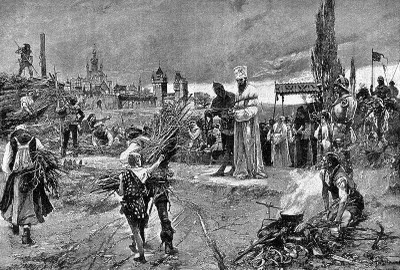 These excellent sentences were esteemed as so many expressions of treason, and tended to inflame his adversaries. Accordingly, the bishops appointed by the Council stripped him of his priestly garments, degraded him, put a paper miter on his head, on which was painted devils, with this inscription, “A ringleader of heretics.” Which when he saw, he said: “My Lord Jesus Christ, for my sake, did wear a crown of thorns; why should not I then, for His sake, again wear this light crown, be it ever so ignominious? Truly I will do it, and that willingly.” When it was set upon his head, the bishop said: “Now we commit thy soul unto the devil.” “But I,” said John Huss, lifting his eyes towards the heaven, “do commend into Thy hands, O Lord Jesus Christ! my spirit which Thou has redeemed.”
When the chain was put about him at the stake, he said, with a smiling countenance, “My Lord Jesus Christ was bound with a harder chain than this for my sake, and why then should I be ashamed of this rusty one?”
When the fagots were piled up to his very neck, the duke of Bavaria was so officious as to desire him to abjure. “No, (said Huss;) I never preached any doctrine of an evil tendency; and what I taught with my lips I now seal with my blood.” He then said to the executioner, “You are now going to burn a goose, (Huss signifying goose in the Bohemian language:) but in a century you will have a swan which you can neither roast nor boil.” If he were prophetic, he must have meant Martin Luther, who shone about a hundred years after, and who had a swan for his arms.
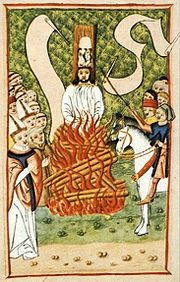 The flames were now applied to the fagots, when our martyr sung a hymn with so loud and cheerful a voice that he was heard through all the cracklings of the combustibles, and the noise of the multitude. At length his voice was interrupted by the severity of the flames, which soon closed his existence.
Then, with great diligence, gathering the ashes together, they cast them into the river Rhine, that the least remnant of that man should not be left upon the earth, whose memory, notwithstanding, cannot be abolished out of the minds of the godly, neither by fire, neither by water, neither by any kind oof torment.”
Full text from: John Foxe. Fox’s Book of Martyrs. Edited by William Byron Forbush. ttp://www.ccel.org/ccel/foxe/martyrs/files/martyrs.html [Accessed: 11.01.2009]
 Christ Alone Wyoming