95 THESES AGAINST DISPENSATIONALISM – Part 3

This is part 3 of analysis of the 19th century theological invention known as dispensationalism. Part 2 can be imagesfound here: http://defendingcontending.com/2014/01/11/95-theses-agai…onalism-part-2/  Following are the next ten theses from the NiceneCouncil.com’s concise but thorough examination of the critical errors with the theological system known as dispensationalism. Dispensationalism is, like most other systems, not comprised of a monolithic group who all believe alike. So please bear in mind this series in not an attack on any person, but an examination of a system.

11. Contrary to the dispensationalists’ structuring of redemptive history into several dispensations, the Bible establishes the basic divisions of redemptive history into the old covenant, and the new covenant (Luke 22:20; 1 Cor 11:25; 2 Cor 3:6; Heb 8:8; 9:15), even declaring that the “new covenant … has made the first obsolete. But whatever is becoming obsolete is ready to disappear” (Heb 8:13).

12. Contrary to the dispensationalists’ frequent citation of the King James Version translation of 2 Tim 2:15, “rightly dividing” the truth, as evidence for the need to divide the biblical record into discrete dispensations, all modern versions of Scripture and non-dispensational commentators translate this verse without any allusion to “dividing” Scripture into discrete historical divisions at all, but rather show that it means to “handle accurately” (NASB) or “correctly handle” (NIV) the word of God.

13. Because the dispensational structuring of history was unknown to the Church prior to 1830, the dispensationalists’ claim to be “rightly dividing the Word of Truth” by structuring history that way implies that no one until then had “rightly divided” God’s word.

14. Dispensationalism’s argument that “the understanding of God’s differing economies is essential to a proper interpretation of His revelation within those various economies” (Charles Ryrie) is an example of the circular fallacy in logic: for it requires understanding the distinctive character of a dispensation before one can understand the revelation in that dispensation, though one cannot know what that dispensation is without first understanding the unique nature of the revelation that gives that dispensation its distinctive character.

15. Despite the dispensationalists’ popular presentation of seven distinct dispensations as necessary for properly understanding Scripture, scholars within dispensationalism admit that “one could have four, five, seven, or eight dispensations and be a consistent dispensationalist” (Charles Ryrie) so that the proper structuring of the dispensations is inconsequential.

16. Despite the dispensationalists’ commitment to compartmentalizing history into distinct dispensations, wherein each “dispensation is a distinguishable economy in the outworking of God’s purpose” and includes a “distinctive revelation, testing, failure, and judgment” (Charles Ryrie), recent dispensational scholars, such as Darrell Bock and Craig Blaising, admit that the features of the dispensations merge from one dispensation into the next, so that the earlier dispensation carries the seeds of the following dispensation.

17. Despite the dispensationalists’ affirmation of God’s grace in the Church Age, early forms of dispensationalism (and many populist forms even today) deny that grace characterized the Mosaic dispensation of law, as when C. I. Scofield stated that with the coming of Christ “the point of testing is no longer legal obedience as the condition of salvation” (cf. John 1:17), even though the Ten Commandments themselves open with a statement of God’s grace to Israel: “I am the Lord your God, who brought you out of the land of Egypt, out of the house of slavery” (Exo 20:1).

18. Contrary to the dispensationalists’ structuring of law and grace as “antithetical concepts” (Charles Ryrie) with the result that “the doctrines of grace are to be sought in the Epistles, not in the Gospels” (Scofield Reference Bible – SRB, p. 989), the Gospels do declare the doctrines of grace, as we read in John 1:17, “For the law was given by Moses; but grace and truth came by Jesus Christ,” and in the Bible’s most famous verse: “For God so loved the world, that He gave His only begotten Son, that whoever believes in Him should not perish, but have eternal life” (John 3:16).

19. Contrary to the dispensationalists’ historic position that the Sermon on the Mount was designed for Israel alone, to define kingdom living, and “is law, not grace” (SRB, p. 989), historic evangelical orthodoxy sees this great Sermon as applicable to the Church in the present era, applying the Beatitudes (Matt 5:2-12), calling us to be the salt of the earth (Matt 5:13), urging us to build our house on a rock (Matt 7:21-27), directing us to pray the Lord’s Prayer (Matt 6:9-13), and more.

20. Despite the dispensationalists’ vigorous assertion that their system never has taught two ways of salvation (Couch), one by law-keeping and one by grace alone, the original Scofield Reference Bible, for instance, declared that the Abrahamic and new covenants differed from the Mosaic covenant regarding “salvation” in that “they impose but one condition, faith” (SRB, see note at Ex. 19:6).

The Danger of Reformed Traditionalism

TRADITION! It’s a great song from Fiddler on the Roof. It has some value in the life of any church. But as tradition-banthe train wreck of Roman Catholicism (and others) demonstrate, it brings some dangers as well. When a tradition – such as holding to an overall good confession of faith – displaces Scripture, then, Houston, we have a problem!
There is a church, which shall remain unnamed, that is solid in many ways. The gospel is front and center, Christ is presented as the Redeemer and Judge in nearly every sermon. The entire worship service is carefully structured to humble the creature, exalt the Creator, and remind the redeemed that we have reason to rejoice and be thankful, but always aware of the sin that so easily entangles us.

This church had a vigorous and fruitful leader training program that equipped and tested men who desire to serve as pastor/elder. And yet, this church hides behind its beloved confession of faith, written in the 17th century, and does not so much as consider what the Scriptures say about the qualification of any given man unless the man claims to “fully subscribe” to the confession. This document covers a wider range of doctrine and deeper level of detail than do the biblical texts that reveal God’s requirements for the men who serve in this office. The confession demands agreement on a few issues that are beyond the denominational distinctives, which are a reasonable standard for serving in that church. It is said that “full subscription” to the confession is required to insure unity among the elders of that church – and that is a reasonable standard. But – these fine men consider the confession to be the sum of “sound doctrine” that the Apostle Paul requires of all Christians and, therefore, they will not consider ordaining and sending men who are qualified and agree with denominational distinctives unless they also claim full subscription to the confession. So it’s not about unity within the church, it’s about a narrow view unsupported by Scripture as to what “sound doctrine” is.

And that makes this article so relevant!

The Danger of Reformed Traditionalism

The New Testament speaks of inspired apostolic tradition, which is good, and non-inspired religious tra­dition, which is often bad. This data should make us wary of any non-inspired ecclesiastical tradition that competes with or invalidates the supreme authority of Scripture. In this post, I’ll note the tendency of becoming over-infatuated with a good tradition and the tendency of reacting to modern errors by relying more on one’s favorite tradition rather than Scripture. Both of these tendencies can make good people resistant to changes in their tradition that are biblically warranted. Moreover, they can subtly influence one’s hermeneutic so that the Bible is read through the lens of the tradition rather than the tradition through the lens of the Bible.

Religious Tradition: the Good and the Bad

The NT employs the Greek παραδοσις (paradosis) to refer to religious teaching that has been handed down orally or in writing, commonly known as “tradition.” One finds examples of both good and bad tradition. Inspired apostolic tradition is viewed in a positive light (1 Cor. 11:2; 2 Thess. 2:13). Non-inspired ecclesiastical tradition is usually viewed in a negative light  (Matt. 15:1-9; Gal. 1:13-14; Col. 2:8). The danger of non-inspired tradition is its potential for distorting, invalidating, and even supplanting biblical truth. This would hold true not only of non-inspired Jewish tradition but also of non-inspired Christian tradition.

Putting Tradition under Scripture

The framers of the Westminster Confession of Faith were well aware of this danger and addressed it unambiguously:

The supreme judge by which all controversies of religion are to be determined, and all decrees of councils, opinions of ancient writers, doctrines of men, and private spirits, are to be examined, and in whose sentence we are to rest can be no other but the Holy Spirit speaking in the Scripture (1.10).

All synods or councils, since the apostles’ times, whether general or particular, may err; and many have erred. Therefore, they are not to be made the rule of faith or practice; but to be used as a help in both (31.3).

Although the second paragraph cited above is not included in the 1689, the first paragraph is. So our Particular Baptist forefathers concurred with their Paedobaptist brothers on the supremacy of Scripture and the subordinate nature of religious tradition. The former was to be our “rule of faith and life”; the latter, “a help in both.”

Reformation Today

Throughout the last several decades many evangelical churches in America have been engaged in a process of reformation that is in some ways analogous to the great Protestant Reformation of the 16th century. Like the early Protestant churches, a number of churches today are reforming in doctrine, in worship, and in church government. In these and other respects, today’s reformation is similar to the Reformation of Luther, Zwingli, and Calvin, except on a smaller scale.

In other respects, however, these two reformations differ. For example, the Reformers lived in a context in which there was an overemphasis on the authority of the church and an under-emphasis on the priesthood of the believer (which is related to liberty of conscience). In our day it seems to be the reverse. Today there appears to be an overemphasis on the priesthood of the believer (i.e., individualism) and an under-emphasis on the importance and authority of the church. In the 16th century, the Reformers had to correct a distorted gospel, which attempted to make good works the instrument of justification, by restoring simple faith to its proper place. Today, we have to correct the perversion of grace and faith (i.e., Easy-believism) by an emphasis upon the necessity of good works as the fruit of saving faith.

There are other differences we could highlight. But there is one in particular upon which I’d like to focus our attention. This distinction between the Protestant Reformation and our modern reformation is subtle. But I believe it is an important distinction and worthy of our consideration.

To the Prophets and the Apostles!

One of the hallmarks of the Protestant Reformation was a movement away from traditionalism and a return to the Scriptures as the ultimate authority of the Christian church. This wasn’t a complete rejection of church tradition or legitimate human authority. Rather, it was a conscious effort to reestablish the primacy of Scripture in matters of faith and practice and to subordinate all church tradition to the teaching of Scripture.1 It was this restored focus upon Bible’s authority and teaching that gave birth to the Latin phrase, sola Scriptura (by Scripture alone). It also promoted the principle ecclesia reformata semper reformanda est secundum verbum dei (i.e., “the Reformed church is always being reformed by God’s word”).

To the Reformers and the Puritans!?

How does this differ from our modern reformation? Most Reformed churches today continue to affirm the principles of sola Scriptura and semper reformanda. However, alongside that affirmation, there is, I believe, a renewed emphasis upon historical tradition, particularly the Protestant Reformed and Puritan traditions. This renewed interest in the Reformed tradition is seen in the resurgence and republication of Reformed literature. Think, for example, of all the good Reformed and Puritan books that have been reprinted and republished by publishers like Banner of Truth Trust and Soli Deo Gloria. And many theologians today are publishing articles and books that analyze and expound this Reformed tradition—Luther’s doctrine of justification; Calvin’s doctrine of sacraments; the Puritan regulative principle of worship, etc.

Furthermore, there has been the republication of the great Reformed confessions and catechisms. This renewed interest in the Reformed creeds has coincided with the emergence of evangelical churches like ours that are studying and adopting these old creeds as doctrinal standards. In fact, many of these churches have chosen to express their commitment to and identification with this Reformed tradition by inserting the term “Reformed” in the name of the church. Thus, one can find a “Reformed Baptist Church Directory” on the Internet in which appear such names as, “Grace Reformed Baptist Church,” “Covenant Reformed Baptist Church,” or the “Reformed Baptist Church of Kansas City.” So alongside an affirmation of sola Scriptura, there is also this growing interest in and identification with the Reformed and Puritan tradition.

A Subtle Shift of Focus

As I said earlier, the Protestant Reformers were not opposed to all tradition. If you read their writings, you’ll find that they often cite the church fathers and earlier church tradition, sometimes in a positive light. For instance, both Luther and Calvin had a deep appreciation for the writings of Augustine. They quoted Augustine to demonstrate that what they were teaching was not entirely novel. But we do not seem to find among the Reformers a pronounced concern or preoccupation to be identified with the Augustinian tradition. We do not find Protestant churches springing up with the name, “The Augustinian Church of Wittenburg,” or “Grace Augustinian Church.” We do not find Luther and Calvin calling the church to return to the writings of Augustine. Rather, the Reformers were primarily concerned to take the church back not to Augustine, not to Athanasius, not to Irenaeus, but all the way back to Jesus, and to Paul, and to John, and to the other biblical writers.

By noting this contrast, I’m not implying that Reformed churches today are unconcerned with the Bible. On the contrary, one of the reasons churches like ours appreciate the Reformed tradition is because of its emphasis upon the Scripture. Along with the Reformers, we continue to affirm the principle of sola Scriptura. But here is where the danger lies: whereas the Reformers evaluated the faith and practice of the church in the light of Scripture; some Reformed leaders today seem to evaluate the faith and practice of the church in the light of the Reformed tradition, especially in light of their Reformed Confession of Faith. 

Confessionally Colored Lenses

Actually, the danger is really subtler. Few Reformed pastors today would begin their sermon by asking the congregation to turn to page 250 of Calvin’s Institutes of the Christian Religion or to chapter 14 of the Westminster Confession of Faith. Like the 16th century Reformers, modern Reformed pastors endeavor to take God’s people back to the Scripture. With a growing interest in and appreciation for the Reformed tradition, however, there can be a tendency to look at the Bible only through the lens of Reformed tradition. In other words, there is a real danger of imposing the Reformed tradition as a grid over the Bible and then insisting that every interpretation and application must agree with that tradition.

In principle no Reformed pastor or theologian would elevate his tradition to the same level as Scripture. But in practice I believe there can be a very subtle tendency in that direction. Let me give you two examples: first, consider Herman Hoeksema’s Reformed Dogmatics. This is a systematic theology written by a professor of the Protestant Reformed church. Let me quote the volume’s description from the dust jacket:

Here is a thoroughly Scriptural and Reformed exposition of the faith once delivered to the saints…. In the view of the author, there are three factors essential to a sound dogmatics.  The first is that dogmatics must be faithful to the Scriptures, and therefore thoroughly exegetical. The second is that fundamentally all of dogmatics must be theologically construed, and must therefore be theocentric. The third is that a sound dogmatics must be faithful to the Reformed creeds and to the dogma of the church (emphasis added).2

A perusal through the book demonstrates the author’s coordinate concern to base his doctrinal formulations both in the teaching of Scripture and also in the Reformed continental symbols.

A second example of this determination to remain within the confines of Reformed tradition can be found in D. G. Hart and John R. Muether, With Reverence and Awe: Returning to the Basics of Reformed Worship. In the introductory chapter, the authors identify the purpose and method of their book. In light of what they see as wrong assumptions and practices in modern worship, they write,

We need to return to basics on worship. That is the purpose of this little book. On the basis of Scripture and Reformed confessions, we have designed a primer on what is arguably the Christian’s most important calling. A primer is defined as a short, introductory book on a single subject. This is exactly what follows—a brief overview of how Reformed theology informs the way we think about, put together, and participate in a worship service (emphasis added).3

Can you see how in both of these examples the authors want us to look at the Scriptures through the lens of Reformed tradition? Of course, they affirm the authority of Scripture. But there seems to be an underlying assumption that the only right way to interpret and apply the Bible is through the medium of Reformed creeds.4 The unfortunate result is that one can begin interpreting the Bible in light of John Calvin instead of interpreting Calvin in light of the Bible. Instead of looking at the Confession through the lens of Scripture, we begin to view Scripture through the lens of the Confession. The result is that historical theology sometimes manipulates or misuses exegetical and biblical theology. Kevin Vanhoozer’s portrayal is not too far from the mark when he remarks, “One typically begins with a doctrinal confession and then sets off trawling through the Scriptures. One’s exegetical ‘catch’ is then dumped indiscriminately into parenthesis irrespective of where the parts were found.”5

The Genetic Fallacy

It’s a genetic fallacy to assume that because the Reformed tradition is a good tradition, everything that comes out of the Reformed tradition must be good. Conversely, it’s fallacious to argue that because other traditions have weaknesses, nothing can be learned from them. What Donald Carson says about some Christian theologians and leaders is especially true of a growing number in the Reformed community: “Christian thinkers have often mistaken their own tradition for the sum of all truth.”6 I fear that this faulty assumption can slowly erode our commitment to the principle and practice of sola Scriptura, and it can dangerously elevate the authority of our Reformed tradition. Moreover, it tends to discourage or minimize any post- 16th or 17th century doctrinal development and reformation. John Frame perceptively describes this infatuation with Reformed tradition:

[Scholars] may sometimes attach themselves to some movement in the past or present that they come to regard virtually as a standard of truth. In Reformed circles, this tendency leads to a fervent traditionalism, in which, not only the Confessions, but also the extra-confessional practices of the Reformed tradition, in areas such as worship, evangelism, pastoral care, are placed beyond question. In an atmosphere of such traditionalism, it is not possible to consider further reform, beyond that accomplished in the Reformation period itself. There is no continuing reformation of the church’s standards and practices by comparing them with Scripture. Thus there is no way in which new practices, addressing needs of the present time, can be considered or evaluated theologically. This is ironic, because one of the most basic convictions of the Reformed tradition itself is sola Scriptura, which mandates continuing reformation, semper reformanda. At this point, Reformed traditionalism is profoundly anti-traditional.7

Respect, Not Reverence

I am not opposed to creeds or confessions. On the contrary, I’ve recently written a series of posts defending the use of creeds and underscoring their value to the church.8 Of all the historical creeds, I believe those of the Reformed tradition most accurately represent the teaching of Scripture. Of all the Reformed creeds, I believe the 1689 Baptist Confession is, overall, the best! To use the language commonly found in many Reformed Baptist local church constitutions, I regard “the London Baptist Confession of Faith … as an excellent, though not inspired, expression of the teaching of the Word of God.” Moreover, I not only believe in the validity and value of the Confession, but I also believe we should know and acquaint our congregation with the teaching of its doctrinal standard(s).

I am, nevertheless, sensitive to the danger of an unhealthy veneration of the Confession. As James Williamson notes, “Documents gain an unsightly prestige over time when they are foundational documents for a given body of believers. They are invested with a sense of authority and regarded as virtually untouchable by succeeding generations. We have seen this happen with the King James Version of the Bible”9 Such thinking can create the impression that the Confession is incapable of improvement or that the Confession has said everything that needs to be said or that teachings of the Bible must conform in proportion and emphasis to the teaching of our Confession. We should respect good tradition, but we should resist the temptation to venerate that tradition.10 As church historian Philip Schaff cautioned, “Symbolatry [i.e., the veneration of creeds and confessions] is a species of idolatry, and substitutes the tyranny of a printed book for that of a living pope.”11 Most of my readers rightly reject the crass traditionalism of much “KJV Only-ism.” My hope is that we’ll also be wary of a kind of “1689 Only-ism” that invalidates the primacy of the Scripture and circumvents the need for ongoing reformation.

Back to the Future – Just Not Far Enough

One way to make progress in the future is to look back to the past. This is where theological tradition and historical theology can serve an important role. “The history of the biblical period enables us far better to understand the Scriptures,” writes John Frame, “and the post-biblical history helps us far better to apply the Word to our own times. The latter helps us both to avoid the mistakes of the past and to build on the foundations laid by those who have gone before.”12 But we do wrong if we turn primarily to historical theology in our defense of the faith. I fear this happens too frequently in Reformed circles. As Nicolas Alford insightfully observes,

As modern church life has become increasingly egalitarian, democratic, and individualistic, the proverbial pendulum has swung back wildly too far. Confessional hubris has been the result. Good men have rightly fled the errors of the day, but they have found refuge in the false citadel of illegitimate confessionalism.13

Instead of “confessionalism,” we need to promote and cultivate “something close to biblicism.”14 Instead of expending the bulk of our energies exegeting the Confession and the writings of Luther, Calvin, and the Puritans, we need to go back farther in history and find the answers and solutions to modern questions and problems as they’re provided in the writings of Moses, the Prophets, and the Apostles.

Ad (Bible) Fontes!

In order to prevent our esteem for the London Baptist Confession in particular or our Reformed heritage in general from subtly weakening our commitment to sola Scriptura, I suggest that (1) we beware of the danger of traditionalism and (2) we be aware of the limitations of our own Baptist Confession. Of course, we may, to use the language of the WCF, continue using the 1689 Confession as “a help for faith and practice.” Sound theological tradition can help us avoid the errors of the past and provide a foundation of theological reflection upon which we can continue to build our understanding of Scripture and its application for today. But we do wrong if we rely primarily on historical theology for our interpretation and defense of “the faith once delivered to the saints.” Such an inordinate reliance on historical tradition (as good as it may be) will in the end result in a departure from rather than a return to apostolic truth and practice. John Murray’s warning is particularly relevant for Reformed Christians today:

When any generation is content to rely upon its theological heritage and refuses to explore for itself the riches of divine revelation, then declension is already underway and heterodoxy will be the lot of the succeeding generation…. A theology that does not build on the past ignores our debt to history and naively overlooks the fact that the present is conditioned on the past. A theology that relies on the past evades the demands of the present.”15

The theology of the past provides us with a solid foundation. But we mustn’t stop building and refining our theological reflections on and applications of Scripture. We must go farther back to the fountains (ad fontes) of all saving knowledge and truth, the Scriptures of the Old and New Testaments. As we do, we’ll continue to respect our Reformed Confession and affirm the timeless truths contained therein. But we’ll also read the Confession through the lens of Scripture with a critical eye. Only in an atmosphere where the Bible reigns supreme and where the Reformed tradition serves the church rather than lords it over God’s people will the church mature in the grace and knowledge of Christ and effectively fulfill her mission to the world.

B.G.

Print Friendly
  1. For a brief overview of a Protestant view of ecclesiastical tradition in contrast with the Roman Catholic veneration of tradition and the anabaptist rejection of tradition, see Josh Dermer’s two part series, “We Have Tradition Too! Part 1″ and “We Have Tradition Too! Part 2.” []
  2. Reformed Dogmatics (Grand Rapids: Reformed Free Publishing Association, 1966). []
  3. With Reverence and Awe: Returning to the Basics of Reformed Worship (Phillipsburg: Presbyterian and Reformed, 2003), 13. []
  4. The reader is invited to read these works and judge for himself. The authors engage in precious little criticism of their own tradition. This is especially true of the second book, which seems to assume that Reformed worship as defined by the Puritan symbols is the only biblical way to worship God. []
  5. “From Canon to Concept: ‘Same’ and ‘Other’ in the Relation Between Biblical and Systematic Theology,” Scottish Bulletin of Evangelical Theology 12 (1994): 104, cited in Carson, The Gagging of God, 543. []
  6. The Gagging of God: Christianity Confronts Pluralism (Grand Rapids: Zondervan, ), 101. []
  7. “Traditionalism and Sola Scriptura (accessed Nov 17, 2011). []
  8. See my series “On the Validity & Value of Confessions of Faith,” Part I, Part II, Part III, Part IV. []
  9. “Is It Time for a New Confession?” 7. []
  10. I think John Frame reflects the proper balance when he writes, “So when the claims of a tradition are suitably modest, and that tradition facilitates the communication of the biblical Word of God, that tradition should be respected, even while being viewed with a critical eye. What we should avoid is traditionalism, such as (1) the view that once a tradition is established, it can never be changed, (2) the notion that some tradition is just as authoritative as Scripture, and (3) the notion that we should not test traditions by the Scriptures.” Doctrine of the Word of God (Phillipsburg: Presbyterian and Reformed, 2010), 282. []
  11. The Creeds of Christendom, 6th edition, ed. David S. Schaff, 3 vols. (1931; Grand Rapids: Baker Books, 1990), 1:7. []
  12. John Frame, “In Defense of Something Close to Biblicism: Reflections On Sola Scriptura and History in Theological Method,” WTJ 59:2 (Fall 1997): 271). []
  13. Emphasis his; “Confessional Imbroglio” (Unpublished paper, 2010), 18-20. James Williamson makes a similar observation: “Hand and hand with this overreacting adoration can go a traditionalism that looks back to a particular era rather than deeper into the Word of God itself for the answers to doctrinal questions and controversies of our day.” “Is It Time for a New Confession?” (Unpublished paper, 2009), 8. []
  14. See my article on sola Scriptura entitled “Something Close to Biblicism,” the title of which I borrowed from John Frame. []
  15. John Murray, “Systematic Theology,” in vol 4 of the Collected Writings of John Murray (Banner of Truth, 1982), 8-9. []

95 THESES AGAINST DISPENSATIONALISM – Part 2

This is part 2, the first week of actual critique of the 19th century theological invention known as imagesdispensationalism. The introduction can be found here: http://defendingcontending.com/2014/01/03/95-theses-against-dispensationalism/ Following are the first ten theses from the NiceneCouncil.com’s concise but thorough examination of the critical errors with the theological system known as dispensationalism. Dispensationalism is, like most other systems, not comprised of a monolithic group who all believe alike. So please bear in mind this series in not an attack on any person, but an examination of a system.
1. Contrary to the dispensationalists’ claim that their system is the result of a “plain interpretation” (Charles Ryrie) of Scripture, it is a relatively new innovation in Church history, having emerged only around 1830, and was wholly unknown to Christian scholars for the first eighteen hundred years of the Christian era.

2. Contrary to the dispensationalist theologians’ frequent claim that “premillennialism is the historic faith of the Church” (Charles Ryrie), the early premillennialist Justin Martyr states that “many who belong to the pure and pious faith, and are true Christians, think otherwise.” Premillennialist Irenaeus agreed. A primitive form of each of today’s three main eschatological views existed from the Second Century onward. (See premillennialist admissions by D. H. Kromminga, Millennium in the Church and Millard J. Erickson, Christian Theology).

3. Contrary to the dispensationalists’ attempt to link its history to that of early premillennial Church Fathers, those ancient premillennialists held positions that are fundamentally out of accord with the very foundational principles of dispensationalism, foundations which Ryrie calls “the linchpin of dispensationalism”, such as (1) a distinction between the Church and Israel (i.e., the Church is true Israel, “the true Israelitic race” (Justin Martyr) and (2) that “Judaism … has now come to an end” (Justin Martyr).

4. Despite dispensationalism’s claim of antiquity through its association with historic premillennialism, it radically breaks with historic premillennialism by promoting a millennium that is fundamentally Judaic rather than Christian.

5. Contrary to many dispensationalists’ assertion that modern-day Jews are faithful to the Old Testament and worship the God of Abraham, Isaac and Jacob (Hagee), the New Testament teaches that there is no such thing as “orthodox Judaism.” Any modern-day Jew who claims to believe the Old Testament and yet rejects Christ Jesus as Lord and God rejects the Old Testament also.

6. Contrary to the dispensationalists’ assertion that the early Church was premillennial in its eschatology, “none of the major creeds of the church include premillennialism in their statements” (R.P. Lightner), even though the millennium is supposedly God’s plan for Israel and the very goal of history, which we should expect would make its way into our creeds.

7. Despite the dispensationalists’ general orthodoxy, the historic ecumenical creeds of the Christian Church affirm eschatological events that are contrary to fundamental tenets of premillennialism, such as: (1) only one return of Christ, rather than dispensationalism’s two returns, separating the “rapture” and “second coming” by seven years; (2) a single, general resurrection of all the dead, both saved and lost; and (3) a general judgment of all men rather than two distinct judgments separated by one thousand years.

8. Despite the dispensationalists’ general unconcern regarding the ecumenical Church creeds, we must understand that God gave the Bible to the Church, not to individuals, because “the church of the living God” is “the pillar and support of the truth” (1 Tim 3:15).

9. Despite the dispensationalists’ proclamation that they have a high view of God’s Word in their “coherent and consistent interpretation” (John Walvoord), in fact they have fragmented the Bible into numerous dispensational parts with two redemptive programs—one for Israel and one for the Church—and have doubled new covenants, returns of Christ, physical resurrections, and final judgments, thereby destroying the unity and coherence of Scripture.

10. Contrary to the dispensationalists’ commitment to compartmentalizing each of the self-contained, distinct dispensations, the Bible presents an organic unfolding of history as the Bible traces out the flow of redemptive history, so that the New Testament speaks of “the covenants [plural] of the [singular] promise” (Eph 2:12) and uses metaphors that require the unity of redemptive history; accordingly, the New Testament people of God are one olive tree rooted in the Old Testament (Rom 11:17-24).

95 THESES AGAINST DISPENSATIONALISM

Each week, I will list a portion of the short paragraphs from the NiceneCouncil.com’s concise but thorough imagesexamination of the critical errors with the theological system known as dispensationalism. Of course, dispensationalism is, like most other systems, not comprised of a monolithic group who all believe alike. So please bear in mind this series in not an attack on any person, but an examination of a system. With that, here is the introduction.

Preface
What follows should not be interpreted to mean that NiceneCouncil.com nor the historic Bible believing church would place every dispensationalist outside of the Christian faith. We acknowledge that most are dedicated to the foundational orthodox doctrines of Christianity. Unlike the sixteenth century dispute over the doctrine of justification, this is an in-house discussion, a debate among evangelical Christians. We recognize and treasure all born again believers who operate within a dispensational framework as brothers and sisters in Christ.

However, we must remember that Paul loved his fellow apostle Peter and esteemed him the senior and more honored of the two of them. Nevertheless, when it came to a point of theology that had profound implications for the purity and health of the Church, Paul was constrained by his love for Christ and the Truth publicly to withstand Peter to his face. (Galatians 2:11)

Therefore, because we believe that dispensationalism has at least crippled the Church in her duty of proclaiming the gospel and discipling the nations, and out of love for the truth and the desire to bring it to light, the following propositions will be discussed in a series of videos written and produced by NiceneCouncil.com under the title The Late Great Planet Church. And as iron sharpens iron we request that every Christian, congregation, and denomination discuss and debate these issues. By the grace of our great Sovereign let us engage in this debate with an open mind and an open Bible. Like the Bereans nearly two thousand years ago, let us “search the Scriptures daily, to see whether these things are so.”

A CALL TO SELF-EXAMINATION

A CALL TO SELF-EXAMINATION  kom

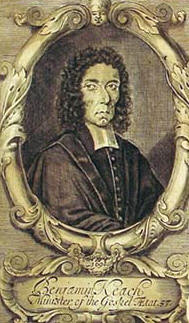
by Benjamin Keach

What can render the state of a person worse than to be an enemy of God, Jesus Christ, and the power of godliness; and yet to think he is holy and a good Christian? Nay, because his conscience is blind in the matter, it acquits him since it lacks saving light, while he keeps up in a zealous performance of the external acts of duty and religion; by which means he is deprived of that help which some openly profane gain from the rebukes and lashes of their own consciences, which often proves a means of their conversion. But the hypocritical professor, not knowing he lacks a changed heart, nor understanding that he is without those Sacred Principles from whence should flow all he acts and does, but contrariwise he is stirred up by false Principles, and acts only by the power of natural conscience and affections, having no clear judgment to discern his own danger, nor what a state he is still in. His condition is deplorable, and this unclean spirit is worse and more dangerous than that which he was in before.

Their blindness and ignorance consists in that they cannot discern nor distinguish between a changed heart and a changed life, or between legal reformation and true regeneration. They think, because their behavior seems so much better than it was before, in their own apprehension, and in the apprehension of others also, their condition is good enough. They comparing themselves with themselves, beholding what a vast difference there is, or seems to be in respect of what they once were, when swearers, drunkards, whoremongers, etc., cannot but commend themselves to themselves. Once they saw themselves sinners, and called themselves so, and were ashamed of their own sinful and wicked lives; but now they are righteous in their own eyes, and so have no need of any further work, being arrived to that state of holiness (so they think) to that degree of piety, to that change, to that conversion, that they conclude they need not seek for further change and yet they are deceived…

The state of the self-righteous and Pharisaical persons is far worse than the state of gross and profane sinners. These are sick and know it not; wounded, but see no need of a physician… They may conclude they are converted, and therefore seek not after conversion.

It is a hard and difficult thing to bring a Pharisaical person, one that looks upon himself to be a religious man, to see his woeful state and condition.

Men may be civilized, and make a great profession of religion, and pass for saints on the earth, that are not such in the sight of God in heaven.

It is a most dangerous thing to make a profession of religion without true regeneration being first wrought in the soul; better to be no professors at all, than not so as to be sincere…

This may inform us of the cause and reason there is so great reproach brought upon religion, and on the ways of God, and on the people of God, by some who profess the gospel. Alas, many of them who are called saints, we may fear are but counterfeit Christians, such as who never experienced a true work of grace; they may have knowing heads, but unsanctified hearts…

Moreover, it sharply reproves those preachers whose great business is to bring men into visible profession, and make them members of churches, whose preaching tends more to bring persons to baptism, and to subject to external ordinances, than to show them the necessity of regeneration, faith, or a changed heart. For the Lord’s sake take heed what you do, if you would be pure from the blood of all men. We too often see when people are got into churches, they conclude all is well; and when conversion is preached, they do not think it concerns them, but other people who are openly profane: and thus they come to be blinded, maybe to their own destruction…

It may also put us all upon a strict examination of our own hearts, lest we should be found to be some of these false and counterfeit Christians. And that we may clear ourselves in this matter; consider:

1. Were you ever thoroughly convinced of your sinful and lost condition by nature, and of that horrid evil there is in sin? Did you ever see sin as the greatest evil, most hateful to God, not only of the evil effects of sin, but also of the evil nature of sin, not only as it has made a breach between God and man, but has also defaced the Image of God in man, and made us like the devil, filling our minds with enmity against God, godliness, and good men?

2. Is there no secret sin lived in and favored, the evil habit never being broke? Is not the world more in your affections, desires, and thoughts, than Jesus Christ?

3. Are you willing to suffer and part with all that you have, rather than sin against God? Do you see more evil in the least sin, than in the greatest suffering?

4. Do you as much desire to have your sins mortified as pardoned, to be made holy as well as to be made happy? Do you love the work of holiness as well as the reward of holiness? Do you love the Word of God for that purity which is in it, as well as the advantage that comes by it?

5. Have you seen your own righteousness as filthy rags, and have you been made poor in spirit?

6. Have you received a whole Christ with a whole heart? A whole Christ comprehends all His offices (prophet, priest, and king), and a whole heart includes all our faculties. Is not your heart divided?

7. Is Christ precious to you, even the chiefest among ten thousand? Are you the same in private as in public? Do you love Christ above son or daughter? Do you love the Person of Christ?

8. Can you bear reproof kindly to your faults, and look upon him your best friend, that deals most plainly with you?

9. Do you more pry into your own faults, than the miscarriages of others? Are you universal in your obedience? Do you obey Christ’s Word, His commands, because you love Him?

10. Have you been the same in a day of adversity, as now you are in a day of prosperity?

11. Can you say you hate sin as sin? Is your mind spiritual, and set upon heavenly things? Do you love the saints, all the saints, though some of them are not of your sentiments in some points of religion?

12. Can you go comfortably on in the ways of Christ, though you meet with little esteem among the saints? Can you stay your souls upon God, though in darkness, having no light? Is all the stress of your justification and salvation built upon Jesus Christ?

Consider these few questions, and do not doubt but that your hearts are sincere, when you can give a comfortable answer to them, though it be with some fear and doubts that still may arise in you. A true Christian is ready to mistake what belongs to him, and take that to be his, that belongs to an hypocrite; while, on the other hand, an hypocrite mistakes that which belongs to him, and applies that to himself, which is the portion of sincere Christians. – Benjamin Keach

Taken from The Counterfeit Christian or the Danger of Hypocrisy by Benjamin Keach, (London: John Pike, 1691). Some archaic words have been modernized.

Do not quickly read these questions and forget about them. Many professing Christians today are simply outwardly religious, but their hearts have not been changed by the regenerating power of God. Christ demands the supreme place in your heart and affections. If you love anything more than Christ; if you love anything equal to Christ (though you may have a wealth of biblical knowledge); you are not a child of God. “Do not be deceived” (Galatians 6:7).

Test ALL Things, Cling to that which is Good!

Each of us has doctrines we hold to without properly examining them in light of Scripture – that’s how we are wired as humans. This comes into play on this notion of Christian Sabbath keeping which was first invented by early Roman Catholics in the 6th century and codified in paedobaptists’ system of theology a thousand years later. Now it is a tightly held tradition by many; and many who love this teaching celebrate any work that supports their perspective – which does their argument no good. Walter Chantry’s book, Call the Sabbath a Delight, is such a work. In my two years of researching this subject, this book did more to convince me this “Christian Sabbath” is not defensible from Scripture than anything written against this doctrine. The best thing about this book is that it’s small and short.

Call the Sabbath a Delight call-the-sabbath-walt-chantry

by Walter Chantry – a critical review

Walter Chantry was born and raised in a Presbyterian home and graduated from a Presbyterian school (Westminster Theological Seminary). This is something worth mentioning, as it’s obvious he was heavily influenced by our paedobaptist brothers. Let each one of us realize we are likewise influenced by what we’ve taught and think is “so” and need test all things in light of God’s holy Word. In the introduction to this book, Chantry starts off presuming the Decalogue (not called the Ten Commandments until the New Geneva Bible) equals God’s moral law. Since this is foundational to his entire argument, it needs some explanation and defense, not mere assertion – but our author provides none. Perhaps he assumes everybody knows this or accepts it. Why this is problematic will be shown later. This short introduction to his book sets his premise, in which he comes across very much like the folks in the movie, Divided: just as the movie implied teenagers were going to hell because the right church program was not available, so Chantry paints a picture of a culture hell-bound because people have turned their back on the so-called Christian Sabbath: “We should consider it nothing less than shockingly unacceptable for Bible teachers and ministers to undermine the practice of the worship and service of God by teaching against the Sabbath law.” This pragmatic streak is another thing that shows up throughout this book. But we know, God saves His elect through the gospel people; salvation does not come through the Law or through behavior modification.

In chapter 1, Chantry quotes Ex 20:8-11 and calls it the 4th commandment. Does anyone think the tablets God wrote on contained all those words for the “4th Word”? By assuming all the words in these verses are the commandment, he fails to see the ceremonial, judicial, civil, etc. content in this and several of the commandments. He considers all of Ex 20:3 – 17 to be “the Ten Commandments”, summing up God’s moral law. If the 10 Words on the first set of tablets is God’s moral law, why do we not have those 10 Words clearly preserved in Scripture rather than bound up in words that conveyed the re-issue of the covenant of works to the Hebrew people? And why does the record of the Decalogue differ, particularly in the 4th commandment, between Ex 20 and Deut 5? Our author merely waves this aside, asserting, “as originally given on Mount Sinai (Exodus 20), the fourth law was enforced with an argument from God’s behavior during creation week.” Yes, the Lord gave illumination of His Sabbath command to the Hebrews by pointing back to the 7th day of creation, providing an example of the rest He was commanding the Hebrews to keep. God doesn’t call the 7th day of creation a Sabbath in Ex 20 – but He does use that word to describe the sign He has given the Hebrews. In his effort to defend his position, Chantry claims, “the Ten Commandments per se are free of all ceremonial and judicial peculiarities of the Mosaic covenant.” If this is true, should not the Lord have struck Moses dead for changing His eternal, moral law with he “rehearsed the Ten Commandments to Israel” in Deuteronomy? If by this our author means that embedded in the text of Ex 20:3 – 17 are the “the Ten Commandments per se”, that some of what’s recorded in this passage is not God’s moral law, he should have developed this argument. He leaves us wondering what he means, because he consistently calls “the Ten Commandments” God’s moral law and he does not tell us what he thinks “the Ten Commandments per se” might be. Just as we don’t have an inspired record of “the 10 words”, neither do we have for “the Ten Commandments per se”.

Chantry tells us (page 24) that Rom 2:15 is proof that Adam was given the Decalogue when he was created. This verse tells us that Gentiles without the law of Moses have the works of the law written on their hearts – it does NOT prove Adam was created with the Decalogue written on his conscience as claimed. Further, how could Adam know the Decalogue or any version of the moral law of God prior to having knowledge of good and evil? The law – any law – brings awareness of sin (evil); Adam knew none of this before he ate and his eyes were opened. Before the Fall, Adam and Eve knew the goodness of God; they did not know evil. After he and Eve ate the forbidden fruit, God said “the man has become like one of us in knowing good and evil.” It appears that Adam was given the moral law of God in conjunction with The Fall – not when he was created nor when he walked in innocence.

There is, however, much to agree with in this book – we do get guidance from God as to what is honorable from His moral law, Christians are to be joyful about gathering on the Lord’s Day, he decries the overly rigid rules-based Puritan view of enforcing their Sabbath – which the authors of the WCF had as their baseline for their view. But Chantry, who was raised and educated as a Presbyterian, doesn’t seem to see the difference between the Jews living under the Old Covenant and the children of Abraham according to the promise living in the New Covenant. And he lumps all who don’t see this equivalence into the dust bin of dispensationalism (this line of argument takes up most of chapter 4, providing a platform for Chantry to condemn all who disagree by saying, “Never in Israel or the church did the gospel of salvation by grace through faith promote lawlessness.” This is the bucket all who do not hold his view are thrown into. There is no other position in Chantry’s model: if you are not a Sabbatarian, you are an antinomian. This is, sadly, an all-too-common assertion by Sabbatarians.

Another problem in claiming the Decalogue equals God’s moral law comes into play when Chantry argues for its universal application to all men at all times – implicitly endorsing blue laws and contradicting the historical record of Scripture and all of mankind. Only by Special Revelation can man know he is to worship God on a given day. How can the entire 4th Commandment, as presented herein, be universal when it’s apparent everywhere that many don’t know it, when nowhere in Scripture are any people outside the Mosaic Covenant punished for violating it? Nowhere in general revelation is man given the 7 day week; yet there is every evidence that all men everywhere know murder and robbery, etc. are wrong and all men worship something. God’s moral law is known to man and no man is without excuse. But there is no evidence that weekly rest from labor is part of that moral law; it appears only in context with God’s covenant people. Nowhere in any version of the 10 Commandments are people told to worship God on the Sabbath and nowhere in the Scriptures is the first day of the week called “Sabbath”. Yet we know from Scripture that the saints gathered to worship on the day after the Sabbath. They went to the synagogues to dispute with the Jews on the Sabbath.

He gives conflicting messages, telling us rightly that, as Peter said, we are not to live under the Mosaic law (beginning of chapter 2). But our author makes no effort to separate God’s moral law from the Mosaic Covenant in applying his sabbatarian argument. He cites Isaiah 58:13 & 14 as “a discussion of the Sabbath in all its spiritual beauty. Here is a text in which the Sabbath Law is presented without the drab and unappealing attire of judicial additives.” But Chantry told us in chapter 1 that “the Ten Commandments per se are free of all ceremonial and judicial peculiarities of the Mosaic covenant.” Is he now citing Isaiah 58 as proof against his assertion from chapter 1? He gives superficial attention to Scriptures but spends lots of pages talking about the woeful state of the culture and giving what can only be called pragmatic advice. “Mothers and fathers must work at making the Sabbath a delight to their children. Boys and girls must not come to view the day of worship as grim and repressive.” One cannot muster up nor manufacture “the joy of the Lord”. If mom and dad are new creatures in Christ, they will have joy in the worship, instruction, and fellowship that takes place in a local church. Yes, they will have sin to deal with and must strive for holiness. This should be modeled for their unregenerate small children – those impressionable young people can be easily trained to look like covenant children; but that is a very dangerous role for any person to play. As with the taking of the Lord’s Supper, young people ought to see Christian character and worship but parents ought to know they cannot participate unless they be born again.

Chantry (page 52) says there are some who “the claim that the New Testament is silent on the fourth commandment.” He then shoots himself squarely in the foot by claiming Matt 12:1-14, Mark 2:23- 3:6, Luke 6:1-11, Luke 13:10-17, Luke 4:1-6, John 5:1-18, and John 7:20-24 are New Testament teachings about Christians keeping the Sabbath – “They contain our Lord Jesus’ frequent and extensive teaching on the subject.” All of these passages are records of activity by Christ and/or His disciples doing kingdom work on the Jewish Sabbath with those under the Mosaic Law. He fails to cite the clear and thrice-told declaration (Ex 31:13 – 17, Ez 20:12. Ez 20:20) that the Sabbath is a sign between YHWH and the Jews. Chantry goes on to claim (page 54), that in Mark 2:27-28, Christ points back to creation in defending the continuation of the weekly Sabbath – And he said to them, “The Sabbath was made for man, not man for the Sabbath. So the Son of Man is lord even of the Sabbath.” Chantry claims the phrase, “the Sabbath was made”, refers to the 7th day of creation. He compares this passage from Mark to Paul’s very clear tie of creation to marriage – “Paul uses almost an identical formula in 1 Corinthians 11:8-9. ‘Man is not come from woman, but woman from man; neither was man created for woman but woman for man.’” Contrary to Chantry’s claim, there is no comparison: Paul clearly cites Genesis 2:18 – 23, but one has to claim Moses used the wrong word in writing Genesis 2:2-3, because he didn’t use the word for Sabbath found in Exodus 20. The Hebrew word for the “rest” God observed on the “seventh” day found in Genesis 2:2-3 is shābat; a primitive root; to repose, i.e. desist from exertion; the word for Sabbath in Exodus 20:8-11 is shabbāt; intensive from <H7673> (shabath); intermission, i.e. (specific) the Sabbath. These two are related but are not the same.

He constantly insists the Sabbath was created in the beginning, because God set aside the 7th day as His day of rest, made it holy, blessed it because on it He rested from creation. No mention of Sabbath, no command to man to do anything nor punishment of man for failing to obey this command. Nehemiah (chapter 9 verses 13 & 14) records that God gave the Sabbath to the Jews on Mt. Sinai. The sabbath that Christ says was made for men – not just for the Jews – is that sabbath rest all elect enter into when we are raised to new life in Jesus and cease from our working to be right with God as the Old Covenant demands. Hebrews 4 is not talking about a continuation of the pale, weekly day of the Jewish religion, which was a type and weak imitation of the eternal rest and reconciliation He bought with His blood.

In chapter 5, Chantry inadvertently makes my point – that the moral law of God is not equal to the Decalogue, though it shone through the Decalogue – when he observes that Jesus and the disciples defined moral purity by quoting the Decalogue. When the commandments are quoted in the New Testament, they rarely (once?) include the judicial/ceremonial language contained in Ex 20 and Deut 5. These first century men knew the actual “10 Words” as did their Jewish audiences. And not once does Jesus or His apostles teach or enforce any type of sabbath keeping as described in the Westminster Confession of Faith and the 1689 London Baptist Confession in context of the Christian faith. But Chantry doesn’t see this – he says, “Keeping the Sabbath Day holy is a commandment embedded in the code of moral law written by God’s own finger. It is a part of the definition of righteousness.” (page 63) Many theologians like to make much of the fact that God wrote the 10 Words on the first set of tablets, tablets made of stone – which Moses destroyed. The second set of tablets, which probably carved by Moses as commanded by God, were stored in the Ark of the Covenant, along with the jar of manna and Aaron’s rod. This Ark of the Covenant was lost in antiquity, and according the Word of God, is to be forgotten – (Jr 3:15-16): “And I will give you shepherds after my own heart, who will feed you with knowledge and understanding. And when you have multiplied and increased in the land, in those days, declares the LORD, they shall no more say, “The ark of the covenant of the LORD.” It shall not come to mind or be remembered or missed; it shall not be made again.” Might these “tablets of testimony” (Ex 31:18) of the Mosaic Covenant be types and shadows that point us to something greater, as so much of what God gave Israel in that covenant is properly recognized as? God’s law written on tablets of stone, given to people with hearts of stone, who gathered for worship in a temple of stone. Compare this the new Covenant Jeremiah writes about: God’s people given hearts of flesh to replace their hearts of stone, God’s law written on the tablets of our hearts rather than tablets of stone, and we are God’s temple which is comprised of spiritual stones He is assembling for Himself. Chantry goes on to state (still on page 63),“The ways in which the moral law was applied and the way it was enforced differ greatly when we compare the management of Moses and the management of Christ.” This sounds a whole lot like our paedobaptist argument – that the covenant of Moses is part of the covenant of grace, just under a different administrator.

Chantry is right and correct in pointing out the ancient basis of the covenant of grace, delineating the difference between it and the Mosaic Covenant. His guidance regarding motives, in chapter 6, is solid, although he continues to use dramatic and inaccurate comparisons – calling those who do not align with his view of the first day of the week, lawless, antinomian. This is poor practice. It will take a biblical argument pressed on me by the Spirit of God that convinces me of anything – not a comparison between Christians and the culture.

In his argument about why Christians worship on Sunday, there is no argument – until he describes how the Sabbath was moved to the day after the Sabbath. If one takes the stone tablets as God’s moral law, rather than seeing them as a lens through which His moral law shone in the context of the Mosaic Covenant, then one must find a way to explain how that “which God wrote with His finger” was changed without a command from God. If the entire record in Ex 20 known as the 10 Commandments is considered to be God’s moral law, then one cannot accept changing the day (explicitly called out as the seventh day, not “every seventh day, and not the first); that is as much a part of God’s moral law as is the command to work six days (not five). And the 4th commandment does not command worship – but to keep it holy, set apart, and to abstain from work. But, if one sees God’s moral law as described above – shining through the Decalogue rather than the Decalogue being the source – then we can easily accept this change in the day, seeing the moral principle as the key thing. The Jews were commanded to honor the seventh day; Christ was raised from the dead on the first day and we gather for worship on that day. I know that many theologians agree with Chantry that Heb 4 is a proof text for weekly Sabbath keeping. But the Old Testament type given was a one time entry into temporal rest, just as was Creator God’s one time entering into His rest from Creation work – so why would the rest between these two be other than the one time rest the elect enter into when they are redeemed by Christ and take His light load upon them and find rest in Him? It is a stretch that belies belief to claim this is a weekly Sabbath, something that was a pale shadow of what was promised in Gen 3:15.

In the last chapter, Chantry tries to write off biblical passages that appear to teach that a festival or a new moon or a Sabbath were a shadow of what was to come, Col 2 being “the most striking and troublesome” for the author. “It is apparent that these three texts are describing ceremonial and judicial laws of Moses. … Weekly Sabbath-keeping as required in the fourth commandment does not fit the description of days described in Romans 14, Galatians 4 and Colossians 2.” His argument for this position is tied to his insistence on a creation ordinance – “The weekly Sabbath day is a creation ordinance just as is marriage. Moses said so (Genesis 2:1-3), Jesus said so (Mark 2:27, 28)! So did the author of Hebrews 4:3-4!” That Genesis 2 says nothing about a weekly pattern of rest for men does not come into Chantry’s evaluation of this topic. This pattern of days refers to all of the holy days of the Jews from yearly feasts to the weekly Sabbath, and comes from repeated descriptions of the Mosaic ritual, found in 1 Chron 23:30-31; 2 Chron 2:4, 8:12-13, 31:3; Neh 10:33; Isaiah 1:13-14; Ezek 45:17; and Hosea 2:11. This is another indication that the Mosaic code, of which the Decalogue is part, does not apply to Christian as a law – but as a type or shadow of the Christ to come. Our exodus is not from Egypt; that country is a type for sin and wickedness. The moral law, though it is revealed within the Mosaic code, is eternal and no more uniquely part of that Sinai covenant than the New Covenant is – though the covenant of grace was progressively revealed over time, even within the era of the Mosaic Covenant. His last point addresses “proper Sabbath behavior.” He gives some good counsel on the limits of elders and common sense examples of variation depending on circumstance, but defaults to Jewish rules to guide us. He does finish with a recognition that Sabbath keeping isn’t the “answer to all man’s ills”, but still holds up a Christian imitation of the Jewish rite as a joy for us to keep.

In explaining how the Sabbath day can be changed from the 7th to the 1st day, Chantry accepts the narrative accounts in Scripture which document the fact that Christians met for worship on the 1st day, claiming this does not “cause the entire law to crumble or disappear.” But if the Decalogue and this commandment in particular have no judicial or ceremonial content, then changing from “the seventh day” should take something more substantial. It is a common hermeneutic rule – narrative is not normative; one doesn’t build doctrine from narrative. Why should one be able to change God’s moral law by narrative example?

Regarding the assertion that the Decalogue is or sums up God’s moral law, this is a very complex topic that would benefit from a well researched book being written. One would need to develop the concept of “God’s moral law”, get a handle on what may have been carved on the stone tablets compared to what Moses recited to the Hebrew nation, and examine the biblical history and biblical theology of the relevant texts. If someone knows of such a work, please chime in!

The authors of Chantry’s “List of Outstanding Materials on the Sabbath” is comprised of 18 paedobaptists and 1 Baptist – Erroll Hulse, plus the Westminster Confession of Faith and Shorter and Larger Westminster Catechisms. This, in itself, tells us where the bulk of support is for Chantry’s position – those who flatten out the covenants and, in an opposite ditch from the dispensationalists, see equality of identity between the church and the nation of Israel.

Give me the joyful gathering of the saints who eagerly come together to worship the Lord and build one another up; I care not to enter into the shadow of what Christ brought to His church.

Bitter Bile in the Throat!

When a woman cries, men often feel awkward or embarrassed. They struggle with knowing what to say or do. A man will seek to sympathize with her and may say something designed to help when all she may need is just a listening ear and a tissue to wipe her eyes. Another woman will both sympathize and empathize knowing that no matter what the problem is, there are times when a good cry may help to soothe the aching heart.

However, when one sees a man who has been brought to the point where he is sobbing in utter despair and anguish, there is a sense of hopelessness and helplessness. How does one watch a man completely broken without the realization that his entire life has crashed to the point where it seems life has been destroyed? There is something that crushes the spirit when a man sees another brought to such depths of despair. Nothing can be said that will probably offer help. A man in grief is often alone, or feels alone, because what makes him a man has been compromised and defeated – but in his despair, he does not care for what others think.

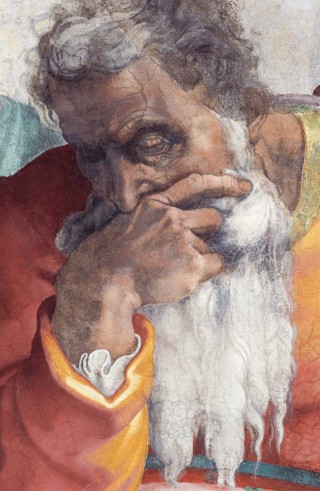
Jeremiahweeps

The year is 586 B.C. and the prophet Jeremiah has come to that point. Reading his words with a true understanding paints a picture that is awkward to read and reveals much of the man in our account. Lamentations 2:11 continues with more of what transpired in the first chapter, but the description of his grief and despair is emotionally draining. “My eyes are spent with weeping; my stomach churns; my bile is poured out to the ground.”

I remember the day like it was yesterday. My 22 year old brother’s boss called me at home to tell me that my brother was having difficulty breathing, that the EMT’s were already helping him, that they were taking him to the hospital for further observation, and that we were not to worry as he would be fine very soon.

Arriving at the hospital, I ran inside and was confronted by two nurses talking about a “John Doe.” Identifying myself, they checked their files and asked me to take a seat in a little room. One nurse told me the doctor would be with me very shortly and then closed the door behind me. I was getting rather worked up at this point, but I did not think the worst – yet!

After what seemed like an eternity but was probably no more than 4-5 minutes, I walked back out and repeated my request to see my brother. The nurses hastened to assure me that the doctor was with my brother and would come see me in just a minute. I walked back to the little room, and as I closed the door, I noticed a little sign that said, “Family Consultation Room.”

Now, my mind is starting to race back through the times I had tried to help others and fear began to grip my mind and heart. Still having no desire to put all the pieces together in my mind, I tried to rationalize away everything that was pointing to a meeting I knew I was not going to like. I staggered to a seat and sat down. Absent-mindedly, I watched a couple of minutes later as the doctor walked in with a person in some type of uniform. The only thing I remember seeing was the cross on the lapel of each side of a stiffly starched collar – and I knew!

The doctor’s words, “I’m so sorry. We did all we could, but there was nothing we could do.” The words were not necessary and his apology already rang as trite in my mind. After all, it was NOT his brother who had just had a massive heart attack. What did he mean that there was nothing that they could do? Surely, they could just either just restart his heart, or at the very least reverse the clock so that time could undo what had transpired over the previous 45 minutes.

It seemed like my world ended. My eyes filled with tears for weeks and months at the mere mention of something that made my brother special to our family. I struggled to eat and more times than not, my stomach churned at the very thought of food. That day in the “Family Consultation Room”, I do remember the contents of my stomach demanding to make an appearance. Throwing up is an action and feeling that I hate with a passion and it was all I could do to keep from vomiting that day.

There have been very few times in my life where I have been so violently ill that I have thrown up everything in my stomach. In a handful of those times, I can remember my stomach still tried to find something to get rid of, and so, it found the bile. Bile has a very bitter taste and is dark green or yellow in color.

What had caused such a reaction in my body? It was, of course, the helpless situation that sought to engulf my life. An unexpected death brought an overwhelming sense of despair and it seemed like there was nobody to turn to for comfort. Through no fault of his own, the doctor appeared as an enemy, and the last thing I wanted was the woman chaplain to try and offer me comfort. I did not want the box of tissues she offered and she could not bring my brother back. She was of no use to me.

Cemetery

For the first time in my life, death had personally visited our home. That is what it took to bring me to my knees. The reality of death produced in me a body racked with pain because of the sobs and wailing that broke over and over from my throat like a small boat caught in the waves of a storm.

What in the world did it take to do the same to Jeremiah, a man accustomed to difficult situations? Did somebody that he loved die, maybe a wife, a parent, or a child?

The entire second chapter of Lamentations reveals that it was not the death of a close loved one that was destroying the physical well-being of Jeremiah’s body. Jeremiah’s emotions have been brought to what he thinks is the lowest possible point. He clutches his chest with the pain that courses through his soul. His head must hurt from the throbbing, and just as he thinks he has control of his emotions, another wave crashes over him and takes him down to another level.

Are you ready for the revelation of his words? It was –

THE WRATH OF GOD BEING POURED OUT UPON ISRAEL!

Listen to these words and phrases – “The Lord in His anger,” “The Lord has swallowed up without mercy,” “In His wrath He has broken down,” “He has cut down in fierce anger,” and “He has poured out His fury like fire.”

While we must ask the question of why is this happening, Jeremiah records some of the most solemn events that he has actually seen take place.

1) The Lord has made Zion forget the feasts and the Sabbath.
2) The Lord has spurned both priest and king because of His fierce indignation.
3) The Lord has scorned the altar of sacrifice in the Temple.
4) The Lord has disowned His sanctuary.

When my brother passed away, I remember repeating over and over, “Why, why, why, why?” I sat heartbroken, and although I knew the answer was found in the sovereign purposes of a holy, righteous, and loving God, I still wanted to blame others. There were even a few moments that I wanted to lay the blame on God.

But with Israel, it was different. Tragedy had struck. The tragedy that befell Israel was much worse than my losing a brother. In the despair our family faced, God was so very gracious and gave measure after measure of grace and strength in time of trouble.

wrath_of_god

Israel did not have this luxury. It was too late for that. Jeremiah has confessed his faults and rebellion before God, but the nation has failed to turn from her wicked ways. Now, judgment day had arrived and nothing would stay the hand of Almighty God. The children of Israel thought they could play games with God and get away with it, but they were wrong!

Jeremiah then paints a picture that reveals the same tragedies being played on the stages of many churches across our land. It was a time of not tragedy, but it was a time of utter ruin. In 2:14, we find that many false prophets had risen up to bring nothing more than false hope. The problem was that 1) they prophesied false and deceptive visions saying that it was from God, 2) they had failed to expose the iniquity of the people, and 3) they have sought to encourage only those who are false and misleading.

The church in the West needs to listen to the laments of Jeremiah and take heed. Stop listening to the false prophets spouting Jeremiah 29:11, “For I know the plans I have for you, declares the LORD, plans for good and not for evil, to give you a future and a hope.” Stop listening to ministers who whenever things are going wrong parrot the first part of Romans 8:28, “We know ALL things work together for God.” They use this verse out of context thinking this is like a pill that will make everything better for whoever wants to swallow it.

But these prophets who seek to forecast great days ahead have forgotten the rest of the verse, “All things work together for good to them that love God and to them who are called according to His purpose.” This means that not everybody will have all things worked out for the good. The ALL things are conditional based on our obedience.

In fact, the bitter bile that rises in the throat when we realize that we may be the recipients of what Jeremiah notes in Lamentations 2:17, “The LORD has done what He purposed; He has carried out His word, which He commanded long ago; He has thrown down without pity; He has made the enemy rejoice over you and exalted the might of your foes.”

Let me point out one more verse that has rocked me to the core as I read this over and over again this week. Lamentations 2:15, “All who pass along the way clap their hands at you; they hiss and wag their heads at the daughter of Jerusalem: ‘Is this the city that was called the perfection of beauty, the joy of all the earth?’”

Those who are true believers should take heed to the lament before it becomes too late as it did with Jeremiah weeping over Jerusalem. If we do not repent and plead to God for mercy for our nation and for our churches, we will see the heathen pass by us clapping their hands, hissing and wagging their heads in derision.

Just as there were few who wept over their sin along with Jeremiah, so, too, there are few today who weep over their sin, the sin in their homes, the sin in their churches, and the sin in their nation. Our churches have failed miserably over and over again. Few are crying out the warnings necessary because it is not popular. It does not make people feel good about themselves. They have itching ears, but as Leonard Ravenhill often stated, “We have no commission to scratch them!”

The representation of Jesus Christ on this earth is the true church for which He died and shed His precious blood. Each local body of believers is called upon to be a light to the part of the world in which they live.

How tragic it will be when those to whom we are called to witness turn on the church. Hissing and wagging their heads in derision, we will hear them say, “Is this the (church) that was called the perfection of beauty, the joy of all the earth?”

True believers, we are called to heed the Scriptures as they call us to remember that one day the glorious Bridegroom Jesus Christ will return for a beautiful Bride. She will be the one who has made herself ready and arrayed herself in white garments. Do our churches reflect Jesus Christ who is the joy of all the earth? Do the heathen see in us the perfection of beauty because of what Jesus Christ has done in and through us? Or, do they only see and laugh at our destruction because instead of being like Christ, we thought it more important to be like the world?

When the heathen were courting Jerusalem with wine, jewels, and precious things, those called by the name of God were happily enchanted as they prostituted themselves over the gods of wood and stone. But when destruction came, the heathen had spoiled and taken all they wanted. They had assaulted Jerusalem and there was no more allure to the beautiful city of God.

Church of Jesus Christ, when we have finished courting the world and finished prostituting ourselves to gain the attention of unbelievers through entertainment and trivialities and messages that save nobody but only bring damnation to the souls of those who come to our meetings – then we will have to pay the price that comes from a reckless abandon of God and the rewards for our unforsaken and unconfessed sin will come home.

We will weep and wail. Our eyes will be red. Our hearts will pound with pain in our chests. The bile will rise in our throat as we vomit our anguish realizing that God cannot and will not be mocked, and that whatsoever we have sown, we will also reap.

However, right now, it would appear that there is still time for repentance. It would appear that the Lord remains a longsuffering and patient God. Let us flee to Him before our laments darken the skies of our existence in a day when it will be too late!

Strange Fire

Strange Fire by John MacArthur  strange-fire-the-danger-of-offending-the-holy-spirit-with-counterfeit-worship

a review

One area many – dare I say most – current day evangelicals have gone astray from orthodox Christianity is the topic of MacArthur’s latest book. From Southern Baptists to contemporary “Christian” radio, slogans and anecdotes fill space and airways with the message that it’s normal to hear from God. This is not the biblical message of “hearing” from God as you read and study His Word – it’s the dangerous practice of believing inferences and confirmations from myriad sources are God’s way of “speaking to your heart”. It is this claim of extra-biblical revelation that MacArthur addresses in Strange Fire. If your blood isn’t stirred up by the thought of reading and entire book detailing the train wreck of uninhibited charismania, it’s important, maybe more so – that this book also provides the child of God very good counsel on the identity, mission, and work of the Holy Spirit.

MacArthur’s book is comprised of 12 chapters on topics covering new apostles and prophets, gifts of healing and tongues, the work of the Spirit in salvation, sanctification, and the Scripture; the last chapter is an open letter to his continuationist friends. And he provides a handy appendix with several pages of quotes from the past on the topic of the continuation of spiritual gifts, in support of his claim that the current craze is not part of historic, orthodox Christianity. I’ve heard from some who think MacArthur has lumped all continuationists into one bucket of heresy – drawing equivalence between some respected theologians and the likes of Benny Hinn. But MacArthur’s letter to his friends is very clear that he sees much good in the work of these friends, as well as much thin theological ice that their “open canon” represents. He considers them dear brothers who need to be awakened to the danger they pose by sharing some views with flaming heretics – sometimes endorsing and appearing with them.

I will leave it to you to read the chapters detailing the train wreck of the strange fire doctrines, and focus some attention on the last third of the book. Citing an observation from A.W. Tozer, MacArthur says our “view of God is the foundational reality in our thinking, and it encompasses all that we believe about the Holy Spirit.” He points out the truth that while many miracle seekers flock after Benny Hinn and Todd Bentley, a true miracle takes place every time a spiritually dead sinner is raised to new life in Christ. This is too mundane for experience-based Christians, but is glorious to behold by those who inhabit the heavens – and ought to be recognized as such by us. The Holy Spirit works in the birth of new saints by a.) convicting the unredeemed of their sins, b.) convicting unbelievers of righteousness, and c.) convicts sinners that divine judgments are real and necessary. The Spirit of the living God then regenerates the elect – removes the heart of stone and gives a heart of flesh by granting faith to believe the gospel. This is work man cannot do, any more than man can bring about his own natural birth. Salvation is of the Lord, as Jonah declared from the belly of the fish, and the triune God does not share His glory with anyone.

Still in this vein, the Holy Spirit also brings repentance to those He regenerates, liberating us from the power of sin and death and producing love for His righteousness. He enables fellowship with God and makes sweet the fellowship of the saints. We are heirs of the kingdom, free from the dread of God and drawn to Him as our Father, enabled to joyfully sing praises to Him. And here, then, is one biblical truth that cannot be reconciled with the “second baptism” doctrine: the Holy Spirit indwells every man, woman, and child He raises to new life in Christ. He is our Comforter and Helper; protecting, empowering, and encouraging us.

MacArthur delineates the difference between being filled with the Spirit of God and the heretical notion of being drunk on the Spirit. Drunkenness is irrational, out-of-control behavior, while filled with the Spirit is joyful, self-controlled submission to God. Being filled with the Spirit of God is an ongoing experience in the life of every Christian – not an occasional orgy with John Crowder. “Rather than being hopelessly distracted by charismatic counterfeits, believers need to rediscover the real ministry of the Holy Spirit, which is to activate His power in us through His Word, so that we can truly conquer sin for the glory of Christ, the blessing of His church, and the benefit of the lost.”

His last chapter on the true work of the Holy Spirit focuses on the Spirit’s role and identity in the Scriptures. MacArthur gives us a very quick run through history, highlighting a few of the faithful men used by God and several of those who fell or jumped into heresy and have misled countless simple folk. “By departing from the sole authority of Scripture, bot Roman Catholicism and theological liberalism became enemies of true Christianity, fraudulent versions of the very thing they claimed to represent. … Because He is the God of truth, His Word is infallible. Because He cannot lie, His Word is inerrant. Because He is the King of kings, His Word is absolute and supreme.” The Spirit inspired the writing of Scripture, provides illumination for the minds of Christians, and the Spirit gives power to the reading and preaching of Scripture. To reject the Scriptures is to reject the Spirit of God – and the entire trinity.

In his “open letter”, the last chapter, MacArthur observes that, “rather than confronting charismatic errors head-on, continuationists leaders find themselves flirting with aspects of a movement that is full of serious error and corrupt leadership.” These otherwise solid theologians allow the charismatics to set the vocabulary, changing the meaning of words and phrases from what the Bible and history show them to be, in order to justify the nonsensical babbling that passes for tongues in modern churches. “The continuationist position invites any personal impression or subjective feeling as a potential revelation from God. Moreover, it removes any authoritative, objective standard for questioning the legitimacy of someone’s supposed revelation from God.”

All in all, this should be a welcomed book in any Christian’s home. We do need to be provoked to think biblically – about gifts and the One Who gives them.

Instructions for the Ignorant

Instruction for the Ignorant:

BEING A SALVE TO CURE THAT GREAT WANT OF KNOWLEDGE, WHICH SO MUCH REIGNS BOTH IN YOUNG AND OLD.

PREPARED AND PRESENTED TO THEM IN A PLAIN AND EASY DIALOGUE, FITTED TO THE CAPACITY OF THE WEAKEST.

‘My people are destroyed for lack of knowledge.’–Hosea 4:6

Bunyan’s Catechisminstructions-for-the-ignorant

ADVERTISEMENT BY THE EDITOR.

This little catechism is upon a plan perfectly new and unique. It was first published as a pocket volume in 1675, and has been republished in every collection of the author’s works; and recently in a separate tract. The earliest edition that has been discovered bears the date of 1691; from which our copy has been prepared for the press. This is the first book of this class that was composed upon the broad basis of Christianity, perfectly free from sectarian bias or peculiarity. It is an exhibition of scriptural truths, before which error falls without the trouble of pulling it down. It is in the world, like the ark of God in the temple of Dagon. It is alike admirably calculated to convey the most important truths to the inmates of a palace or of a workhouse,–to the young or to the aged,–to the ignorant Roman Catholic, or to the equally ignorant Protestant. Its broad catholicity is its distinguishing excellence. In the separate communions included within the general church of Christ are various, and in many respects, inestimable compendiums of Christian truth, arranged for the catechetical instruction of the young and ignorant; but it cannot be denied that these, one and all, exhibit some marks of sectarian feeling and dogmatic teaching in the details that relate to the special views which each communion takes of certain scriptural doctrines. The reason why this should be the case is very obvious: there would be no differences of opinion amongst Christians except from conviction that these differences are essential, and such conviction naturally leads to these points of disagreement being (may we not say?) rather too obtrusively enforced as part and portion of a saving belief. All Bunyan’s efforts were to awaken sinners to a sense of their degradation, misery, and danger, and to direct them to the only refuge from the wrath to come–the hope set before them in the gospel; and then leaving the pious convert to the guidance of his Bible in forming his connections in the pilgrimage of life. Bunyan is solemnly in earnest; his desire is, that poor sinners should be relieved from ignorance, darkness, and destruction, and be introduced into the glorious liberty of the sons of God. May his impressive injunction be indelibly fixed upon our souls, ‘To read, ponder over, and receive the wholesome medicine as we shall answer in the day of the terrible judgment.’–GEO. OFFOR.

Read this 24 page catechism here.

No Interview Like It!

This blog and video was posted at The Gospel Coalition by Thabiti Anyabwile. It is an amazing interview that would definitely not even be permitted in England and probably not even in America in many places.

************

Thabiti Anyabwile is Senior Pastor of First Baptist Church of Grand Cayman in the Grand Cayman Islands and a Council member with The Gospel Coalition.

Will We Ever See Another Interview Like It?

Perhaps you’ve already seen the 1970 interview of Dr. D. Martyn Lloyd-Jones by Dame Joan Bakewell on the nature of man. If not, you owe it to yourself to check out this 19-minute conversation recently released by the Martyn Lloyd-Jones Trust.

The interview is striking for a number of reasons.

First, it’s conducted in the U.K., where most observers would guess such a fair and engaging interview would be all but impossible today.

Second, the interviewer’s familiarity with basic doctrinal Christianity and the contentions of the broader culture set her apart from the talking heads today.

Third, it seems there may be very few evangelicals today of the stature of Lloyd-Jones who could command any interest from secular television.

Fourth, most sadly, are there any evangelical pastors who would be so thoroughly convinced and unashamed of the Bible’s teaching about man, sin and salvation in Jesus Christ alone?

So, I guess you should view the interview because we’re not likely to see its like in our lifetimes.

HT: The Gospel Coalition

What’s the Significance of the Lord’s Supper?

As with baptism, there is much more meaning in this ordinance than what meets the eye. Every time weLords-Supper are given the blessed opportunity to be nourished spiritually with this ordinance, how it represents the broken body and shed blood of Christ, which cut the New Covenant and in which we have our adoption as sons of the Living God. This description is right and it is a main point we supposed to gain from observing this ordinance. We will examine these truths – but there is another aspect that I think will add a deeper appreciation and greater holy awe of our Lord and Savior. We read from 1 Cor 11 each week, but the establishment of this ordinance is also found in Matthew 26, Mark 14, and Luke 22. This is an important means God has given us, we must diligently inquire of His Word what it means and how we are to practice it. 

Click here to listen to the message.

Making Your Calling and Election Sure

This is a wonderful post by Mike Ratcliff. It is most important for every professing Christian to strive for holiness and not take the grace of Christ for granted. Here’s the introduction, make sure you head over to Mike’s blog to read the whole article. It will convict you if you are a child of the living God, for none of us walk entirely as we ought.

How can we know if we are truly in Christ? Or you may ask, “What is the fruit which genuine believers bear?” If true salvation is as impacting on a believers life as we contend then there should be verifiable evidence or fruit manifested in that life. The problem is in knowing what evidences really prove the presence of God in a person’s life and those that do not. I have noticed most professing Christians look at the wrong things in their self-evaluations to determine if they are in Christ. Real evidence of the presence of God in a person’s life will be the fruits of salvation. These fruits will in turn lead to outward manifestations of “goodness” or “religiosity” which, unfortunately, can be counterfeited. These outward manifestations are often what we look at to determine if we are a “good Christian” or not. My brethren, this is a fallacy. Any activity or attitude that can be counterfeited by a false believer cannot be used to verify ones salvation.

Let’s take a close look at these evidences that should never be used to verify our salvation. 

Read the rest here.

Baptism – What’s the BIG DEAL?

One area Baptists and paedobaptists commonly agree is that there are only two ordinances given to the Baptismchurch, contrasted with the seven claimed by the Roman Catholics. While we agree on what these two ordinances are – baptism and the Lord’s Supper – we do not agree on some of the details, particularly as regards baptism. We baptize believers – by submersion. We’re in the minority. Denominations that practice infant baptism include Roman Catholics, Eastern and Oriental Orthodox, Anglicans, Lutherans, Presbyterians, Methodists, some Nazarenes, the United Church of Christ (UCC), Moravian Church, Metropolitan Community Church, Wesleyans, and Episcopalians. There are those who believe baptism is salvific – Church of Christ, Disciples of Christ, and those who hold to Federal Vision. I will not go into that discussion, just know they are out there.

Baptists have long loved to call themselves – ourselves – “people of the book”, denoting our claim to being among those who stand on the sure foundation of Scripture and under the authority of Scripture. May this be true of us, as many wise and solid sounding arguments have been marshaled in support of the opposing view of baptism – the sprinkling of little ones. I do not want to spend much time explaining why the paedobaptist view on baptism is wrong, I will appeal to a few of their finest theologians to tell us they are wrong.

Listen to the message here

The Most Terrifying Truth of Scripture!

The gospel cannot be made any clearer than this. This is the message that is simple and free to all who will come and plead for mercy at the feet of a holy, righteous God.

The Rickety Bridge and the Broken Mirror

The Rickety Bridge and the Broken Mirror by Hal Brunson  9780595438167

Hal Brunson’s book, The Rickety Bridge and the Broken Mirror, is a small collection of parables – two parables about Paedobaptism (one of which brings in Dispensationalism for comparison) and one parable about the death of Christ. Although a short book, Brunson’s work is a compelling examination of some unbiblical teachings about ecclesiology and soteriology. Baptism is the foil in both cases.

The first parable is the tale of a meeting between two now famous men – the young but already distinguished Princeton teacher, Benjamin Breckenridge Warfield and the aged and famous John Nelson Darby. Attending the meeting, as Warfield’s escort from London to Oxford, was a young man of the name Harmon Diapson – grand nephew of the infamous Charles Darwin. On the train to Oxford, Warfield and Darby engage in a vigorous discussion about theology, all the vast differences that exist between the Presbyterian Covenant Theology and the then still-new system of Dispensationalism.

Overhearing this discussion on the train is a portly, cigar smoking man that is, at length unable to restrain himself and asks to participate, making the bold assertion that he can prove that Warfield and Darby have much in common – as though they are approaching each other from opposite ends of a rickety bridge and will meet in the middle, over a deep gorge of false teaching. Warfield and Darby are incredulous and protest wildly; young Diapson is eager to hear this man who describes himself as a country parson. Through many questions of these well known theologians, the parson quips that he sees the basic structure of the bridge connecting them. Darwin’s grand nephew sees it first – “It’s a biological bridge, sir: both coventalism and dispensationalism unite in this one idea – the Abrahamic Covenant finds its earthly fulfillment in biological offspring.” The parson congratulates Diapson, adding “Mr. Darby sees the fulfillment in the Jewish child, and Dr. Warfield sees the fulfillment in the Christian child.”

Brunson comments, “Because of that mutual mistake, the dispensationalist commits an eschatalogical error – the covenant finds it ultimate fulfillment in the biological descendant of the ethnic Jews, and the paedobaptist commits an ecclesiastical error – the covenant finds its ultimate fulfillment in the biological descendant of the Christian parent.” This Presbyterian view amounts to gross presumption that so-called covenant children are in the New Covenant, to be confirmed later in life.

The second parable, The Broken Mirror, drives deeper into the paedobaptist problem, highlighting their common twisting of Peter’s sermon in Acts 2. This is an oft overlooked but grievous error that every Christian should be on guard against. Buy the book to find out more about this parable.

The third parable in this too-short book is of the Death of Christ. In this section, Brunson does not rely on fanciful tales to illustrate absurdities in theology, he examines picturesque Scripture that serves as types that point to and illustrate the depth and glory and horror of the death of our Savior. And in this section of the book, Brunson displays a glorious view of Christ that will do the soul of any Christian much good. He examines:

      1. the oceanic chaos of pristine creation

      2. the flood of Noah

      3. the sorrows of David described as “great waters

      4. the casting of Jonah into the sea, and, finally,

      5. Jesus’ understanding of His death as an apocalyptic baptism.

I will leave you with a couple short examples of the author’s style in this section, the first one talking about the flood: “The captain of our salvation may have gone to the depths for the salvation of His people, but the old ship of Zion rides the waves with linen sails unfurled, impervious to raging winds and roaring waves, speeding safely upon the scarlet billows of judgment to the soul’s desired haven.” Later in this section, “These graphic symbols of baptism require an understanding of our Savior’s death as an immersion, not just into waters of physical suffering and death, but into the oceanic fury of God’s wrath.” Oh, the Savior’s love for His Father – and all those He chose to redeem in Christ!

At the end of the book is a short record of a debate between the author and a friend of his who is a Presbyterian. Brunson, the Baptist, set the rules – no Baptist sources could be used, only “secular” or paedobaptist. The results are devastating, as Brunson reveals one after the other of heralded paedobaptist theologians defending believer’s baptism and admitting there is no biblical support for infant sprinkling. B.B. Warfield being one of the star witnesses against his own position.

This is a delightful book, well written and easy to read. Brunson keeps Christ in focus and the Word of God as the foundation of all his arguments. I am so glad I found it and read it.

The Kingdom of God

The Kingdom of God by Jeffrey Johnson

Although I had been raised in a family that attended various churches, from non-imagesdenominational military chapels with no discernible doctrine to Nazarene churches with Arminian theology (later in life I was to wonder why those preachers ever preached anything other then Hebrews chapter 6), I was never with an interest in the Word of God. When I was redeemed, I began my search for meaning in the Scriptures and found the popular dispensational teaching of my Baptist church to be very suspect and off track. Once I began learning the doctrines of grace (known as Calvinism), the Scriptures came into a more clear view and then reformed theology was opened to me and I saw the larger redemptive story in the Bible; the main point of the Scripture is to show man how sinful he is and point him to the promised Redeemer.

But something still wasn’t right. The predominate teaching in the reformed world is from the Presbyterians. And while I can accept their church practices (though I cannot agree with them), I could not see how they made the church equal to the nation of Israel. This perspective, and a couple others closely related to it, cause our Presbyterian brothers to view virtually all Scripture as applicable to the church. It was the complete opposite of what I was taught in my dispensational churches, where there is near complete separation between the church and the nation of Israel. Neither system made sense to me.

By the providential hand of God, the early part of the 21st century has brought us a renewed interest in historical Baptist views. While several very good books have been written in this rather large field, the one that made the biggest impact on me was The Fatal Flaw of the Theology Behind Infant Baptism, by a man who has become a dear friend to me, Jeffrey D. Johnson. That book made a very clear, biblical argument against the underlying theology of paedobaptism and introduced me to an historic and biblical Baptist view of covenant theology. This title, plus a couple of books on biblical theology (a process that keeps systematic theology from losing its place in Scripture – biblical theology is the contextual study of what the Bible says. The historic, redemptive context of a passage provides more clues to its meaning than anything other than related Scripture.), were foundational in helping me the Word of God even more clearly.

And now, much to my joy, our brother and servant of God, Jeff Johnson, has written another book: The Kingdom of God, A Baptist Expression of Covenant and Biblical Theology, due out early next year. Rather than a polemic pointing out the errors of paedobaptist theology (in an effort to convince Baptist to stay in the camp and comprehend a better view of the covenants), Jeff’s new book is a focused apologetic in favor of the historic Baptist view of covenant theology and biblical theology.

Is this stuff important? While it’s not as important as a biblical comprehension of who you are and who is the Christ, it is pretty important stuff. Because it will help the reader see the importance of approaching the Scriptures with humility rather than with unexamined presuppositions that subtly influence your understanding of what you read. When we open the Bible, we are taking into our minds the Word of God. The right fear of God and humility because we rightly see ourselves are essential attitudes for certain understanding of His Word and the covenants revealed therein. Charles Spurgeon went as far as to say, “The doctrine of the covenant lies at the root of all true theology. It has been said that he who well understands the distinction between the covenant of works and the covenant of grace, is a master of divinity. I am persuaded that most of the mistakes which men make concerning the doctrines of Scripture are based on fundamental errors with regard to the covenants of law and grace”

Johnson’s writing style is straight forward and easy to read. The main focus on his study of covenant theology is the Abrahamic Covenant and the duality therein. Failure to see the continuity as well as the discontinuity would leave one embracing paedobaptist theology on the first hand or dispenationalism on the other. From an early chapter in his new book, “In one sense, the debate between the continuity and discontinuity of the Old and New Covenants centers on the true identity of the people of God and the relationship between Abraham’s physical seed and Abraham’s spiritual seed, which returns us to the original question. Who are the true people of God? Are God’s people “the nation of Israel”? Are the people of God “believers and their seed?” Are the people of God “believers only?” Are God’s people some sort of combination of the two groups? The differing answers given to this question are what separate these theological positions from one another.”

He ends this section of the book with an examination of the covenant theology revealed in the book of Romans, showing how the Apostle who wrote Galatians was consistent in his theology, even when it went against his deepest human concerns.

The second part of the book is relatively short introduction to biblical theology which makes this topic approachable by any child of God. The historical record from Scripture shows the rise and fall of kingdoms and peoples, all of which were brought to pass to deliver, preserve, and protect the promised Seed. Creator God is the God of means as well as ends. Biblical theology helps us see His hand of providence in history and keeps us from falling into the error of thinking man is in charge of his own destiny.

There is a BONUS appendix in this book, where brother Johnson takes a quick look at The New Perspectives on Paul. Some who are impressed with the wisdom of man have been swept away by this new view; Jeff shows us why the wisdom of God is to be trusted – even in the face of all the king’s men with all their advanced degrees. The biblical Apostle Paul, not the one found in The New Perspectives, told us he did not come to us with brilliance of speech or wisdom, for he didn’t think it was a good idea to know anything among us except Jesus Christ and Him crucified. He came to us in weakness, in fear, in much trembling. His speech and proclamation were not with impressive words of wisdom but with a powerful demonstration by the Spirit, so that our faith would not rest on the wisdom of men but on God’s power.

40% off: Pre-publication sale for The Kingdom of God: A Baptist Expression of Covenant & Biblical Theology.  280 page, hardcover with dust jacket.  Retail price $28.00.  No payment necessary until after it is released. To reserve a copy, email freegracepress@gmail.com. Reserve two copies for 50%, plus free shipping. This is a pre-publication sale only. This offer ends on 27 November.

Why God Won’t Go Away

Why God Won’t Go Away by Alister McGrath

a reviewwhy-god-wont-go-away-sm

 In his book, Why God Won’t Go Away, Alister McGrath acquaints his reader with “new atheism”, a term apparently coined in 2006. He identifies four well-known atheists (Richard Dawkins, Daniel Dennett, Sam Harris, and Christopher Hitchens) with this philosophy, telling us how it got started, what’s new about it, what characterizes it, and how we as Christians should respond to it. As we read through this book, we find that there’s about as much “new” in new atheism as there is in new age – it’s an age-old false view of creation that unrighteous men use to suppress the knowledge of Truth that our Creator has put into His creation (Romans 1:18). The common element in this view, advocated by these high profile professing atheists, is a condescending attitude toward Christianity. Much ink has been spilled by these men trying to dissuade people from believing in the One Who created all things and people. Books such as The God Delusion and The End of Faith, as if there could be a human that could live on this earth without having faith in something – even if only that the chair would hold up when sat upon. These men tend to lump all professed religions together in an effort to “prove” God cannot exist because He is full of contradictions. No matter that the Word of God reveals that man creates and worships and serves all sorts of false gods and calls some of by the name of the one true God.

Hitchens admits he is not merely unconvinced of God’s existence, but that he is more an anti-theist than an atheist. McGrath quotes a humanist chaplain from Harvard, who defines anti-theism this way: “While atheism is the lack of belief in any god, anti-theism means actively seeking out the worst aspects of faith in god and portraying them as representative of all religion. Anti-theism seeks to shame and embarrass people away from religion, browbeating them about the stupidity of belief in a bellicose god.” People whose focus is on tearing down their enemies tend to lose all sense of perspective and end up redefining who they are by their irrational inability to allow Christians to believe what they want to.

Chapter 3 is a provoking look at a history full of violence committed by professing Christians, which gives a high road of condescension to the anti-atheists. Ah, but we also get a look at the history of bloodshed at the hands of atheists – this proving what Christians know to be biblical truth: all men are capable of hideous acts. The Lord God of Heaven restrains sinful men so that very few are as bad as they might be and His Spirit leads the redeemed to desire holiness rather than the sinful desires of the flesh.

Next up, the enlightenment is still going strong, as our anti-atheists worship at the altar of human wisdom. We learn here why it is hopeless to try and argue an anti-atheist into the kingdom of God – it’s hopeless to try and argue anyone into the Kingdom of God. Men are born again, not of blood nor of the will of the flesh nor of the will of man, but of God. We should not be tempted to argue with lost people over facts related to the gospel – they are at war with God and He alone can give a man with a heart of stone understanding and love for Him. The intellect of the anti-atheists blinds them to the Truth, and only the Author of Truth can give him sight.

Where McGrath departs from his call as a gospel minister is in the last chapter. He heralds Mother Teresa and declares his desire to emulate her. This woman is held up by many as a model Christian, but she made it clear many times that she did not even try to convert anyone to Christ; she thought God would be pleased and save as many as tried to be good Hindus, Buddhists, or whatever false religion one was following. This is not the model for any Christian. McGrath talks around the gospel and then states that he “cannot pursue this matter further here.” He does, however, make note that “Christian beliefs, like those of the New Atheism or any other worldview, ultimately lie beyond final rational proof.” Amen! And this is why worldly wisdom is foolishness and why we must trust God and be unashamed of His gospel and willing to be thought of as fools for Christ because we will not retreat from His Word. This book would have ended much better if McGrath would have spent three pages explaining the biblical answer to the anti-atheists – those enemies of God have no other place to go if they want truthful answers to their questions.

Cross Encounters Radio Addresses the False Teachings of Bethel “Church”

Kris VallotonOn Cross Encounters Radio, we have been setting up special broadcasts to address the false teachings of the Bethel “church” in Redding, California. Today, Tony Miano took to task the false gospel statements of senior associate pastor Chris Valloton. I highly recommend you check out the article Tony wrote in association with this broadcast, both of which can be found below:

“This article is the second in an ongoing series of articles looking at the false teaching and false practices of Bethel Church, in Redding, CA. In this article I will address the false gospel of false prophet and teacher, Kris Vallotton, Senior Associate Pastor at Bethel Church.

Here is Vallotton’s biography, posted on the Bethel Church website:
“Kris Vallotton is a noted prophetic voice in Northern California, and has trained prophetic teams in this region. He is a sought after speaker with a vision for equipping an “Elijah generation” for the end-time harvest. Kathy’s practical wisdom and prophetic insight combine to give her a unique and profound ministry as both an instructor and the school’s administrator. Kathy is also an anointed worship leader,assisting with the training of the worship teams at the school. Both Kris and his wife Kathy have a vision to raise up a company of warriors to impact this generation for Christ. Their goal is to see the fulfillment of Isaiah 61 with their own eyes. This prophecy begins with individual people getting delivered and healed–it ends with the ruined cities being restored. Kris says it is time for the fire of God to burn up His enemies and warm the hearts of the lost. This mandate has become their mission. God has instructed them to gather together warriors with like hearts, then train and equip them, and send them into the Harvest. Holy Spirit fortifications must be established in the midst of the darkest places of the planet earth. Kris is currently Senior Associate Pastor at Bethel Church in Redding, California and Kris and his wife Kathy are Overseers at Bethel’s School of Supernatural Ministry. They have four children and five grandchildren.”

Read the article here: Bethel Church: The False Gospel of Kris Vallotton

Is the Sabbath a Creation Ordinance?

Clipboard01If you say the Sabbath is a Creation Ordinance, a few guidelines for the discussion and a couple of observations. First, define “Creation Ordinance”; secondly, explain from Scripture how it is determined that Sabbath keeping is a Creation Ordinance. Thirdly, is Sabbath keeping binding on Christians (exegesis of Scripture); fourthly, where is the command to move the observance from the 7th day to the 1st day?

Observations: Most reformed folk consider marriage a Creation Ordinance, and we do see a command in Gen 2 regarding it. However, I know of no theologian who thinks every person or every Christian is commanded to marry. It is normal, blessed by God, etc. but not commanded.

1. Why would one Creation Ordinance NOT be a command and another one BE a command?
2. When is Sabbath keeping first observed in Scripture?
3. What is your interpretation of the manna collecting commands in Ex 16?
4. Where in the New Testament do you see Christians keeping the Sabbath?