What is a disciple?

What is a disciple?Disciple Making Church-background

Little Tommy was doing very badly in math. His parents had tried everything; tutors, flash cards, special learning centers, everything they could think of. Finally, in a last ditch effort, they enrolled him in the local Catholic School.

After the first day, little Tommy came home with a very serious look on his face. He didn’t kiss his mother hello, but instead went straight to his room and started studying. When his mother went up to check, she found books and papers spread out all over the room and Tommy hard at work.

To her further amazement, the minute he finished dinner he marched back to his room without a word and hit the books as hard as before.

This went on day after day, for the entire first term until Tommy finally brought home his report card. He quietly laid it on the table, went on up to his room, and hit the books. With some trepidation, his mom looked at it, but to her surprise and relief, little Tommy had an “A” in math.

Unable to contain her curiosity any longer, she went up to his room and asked “Son, what was it? Was it the nuns?” Tommy shook his head. “Well then,” she continued, “was it the books, the discipline, the structure, the uniforms, WHAT was it?”

Tommy just looked at her and said, “On the first day of school, when I saw that guy nailed to the plus sign, I knew they weren’t fooling around.”

You see, Tommy developed a COMMITMENT that changed his life! The funny part is that we all know Tommy’s commitment was based on a misunderstanding. Tommy was a learner, but not a disciple. His work was good – by man’s standards – but his motive was all wrong.

Commitment is like faith in several ways. Like faith, the object or reason for your commitment is what determines how significant it is. Like faith, commitment can be based on the wrong motivation. And like faith, commitment is important, and must be focused on Christ if it to have any value.

From the Homan Bible Dictionary: “In the Greek world the word “disciple” normally referred to an adherent of a particular teacher or religious/philosophical school. It was the task of the disciple to learn, study, and pass along the sayings and teachings of the master. Disciples of the rabbis could select their teachers.

One can assume that Jesus used traditional rabbinic teaching techniques (question and answer, discussion, memorization) to instruct His disciples. In many respects Jesus differed from the rabbis. He called His disciples, saying, “Follow me”. He taught more as a bearer of divine revelation than a link in the chain of Jewish tradition.”

Disciples of Christ are called by Him – they haven’t chosen Him.

It’s the Heart of the matter

Here’s the unpleasant reality – behavior doesn’t necessarily reveal the heart. Tommy’s mother wanted him to do better in math. But no parent would want his child to have Tommy’s motivation as the reason for the proper behavior. That funny story points out a major problem in many people’s lives: they make major commitments based on misconceptions, we do the right thing for the wrong reason. When circumstances get difficult, the false premise of our commitment causes it to crumble. Like a house built on sand. Our boy Tommy probably lost his zeal for math after a few semesters. He may have found out the truth about the “guy nailed to the plus sign”.

What does the Bible say about those who would be Christ’s disciples? In Luke 14: 25 – 27 “And there went great multitudes with him: and he turned, and said unto them, If any man come to me, and hate not his father, and mother, and wife, and children, and brethren, and sisters, yea, and his own life also, he cannot be my disciple. And whosoever doth not bear his cross, and come after me, cannot be my disciple.” This is a standard traditional rabbis and other teachers did not require. But we Christians are to love Christ more than we love our Earthly family.

Matthew 28:16 – 20 The Great Commission: “Then the eleven disciples went away into Galilee, into a mountain where Jesus had appointed them. And when they saw him, they worshipped him: but some doubted. And Jesus came and spake unto them, saying, All power is given unto me in heaven and in earth. Go ye therefore, and teach all nations, baptizing them in the name of the Father, and of the Son, and of the Holy Ghost: Teaching them to observe all things whatsoever I have commanded you: and, lo, I am with you alway, even unto the end of the world. Amen.

This word, “teach” is the Greek word “math-ayt-yoo’-o“ (verse 19) or “didasko” (verse 20), both of which mean to disciple or instruct. One thing of interest here: Christ is telling His disciples to “teach all nations” – yet He is not telling each disciple to teach all nations. The church must evangelize and disciple the whole world, but only God Himself can tell you and I where and how we are to “go and teach”. It’s obvious that not every disciple can go to all nations. But the church can!

Luke 6:46 “why call ye me, Lord, Lord, and do not the things which I say?” The Lord wants us to realize that our words must be backed up by our actions. We aren’t the first generation to live at odds with our professed beliefs. And the world is watching us, to see if we live on Monday in accordance to our “Amens” on Sunday.

Matthew 22:37 – 40 The Greatest Commandment: “Jesus said unto him, Thou shalt love the Lord thy God with all thy heart, and with all thy soul, and with all thy mind. This is the first and great commandment. And the second is like unto it, Thou shalt love thy neighbor as thyself. On these two commandments hang all the law and the prophets.

If we are Christ’s disciples, we will love Him with the right motive and that love with be evident to others. If we don’t obey Him in the things that we know are His will, how can we claim to be His disciples?

Consider marriage, the most serious, sacred commitment one person can make to another person – created to give mankind a glimpse of Christ’s commitment to the church. Yet many marriages end in divorce and so often the reason – more properly, the excuse – is irreconcilable differences. Many people get married with prenuptial agreements in place. Plans already made and documented, detailing who gets what WHEN they divorce. These folk are planning to fail. Many people get married not realizing God is the author of the institution – whether they believe in Him or not. They get married thinking they are going to be able to change their mate into their own image. They get married thinking their own faults will be overlooked but they won’t overlook their mate’s. All of these misconceptions lead to unrealized expectations and frustrations. And failure. The sacred commitment is abandoned. One’s view of marriage reveals one’s view of God. This happens in the church as often as outside the church. By people focused on self, not Christ

The American Heritage Dictionary defines commitment as “A pledge to do. The state of being bound emotionally or intellectually to a course of action or to another person.” Why is it that our “pledge” to cherish until death often fails? Do we let the state of our emotions rule our intellect, creating irreconcilable differences where the Lord intended complimentary strengths and weaknesses? Many do, and the “life-long” commitment is abandoned.

Commitment Isn’t Enough

You recall the case of three teenagers, named Hananiah, to Mishael, and Azariah. The king ordered all his people to worship an idol and these boys were committed to their God – not his – so they refused. The king had the boys brought before him and told them to bow down to the idol or be burned to death in the furnace. These teenagers, you know them as Shadrach, Meshach, and Abednego, replied to the king, “O Nebuchadnezzar, we do not need to defend ourselves before you in this matter. If we are thrown into the blazing furnace, the God we serve is able to save us from it, and he will rescue us from your hand, O king. But even if he does not, we want you to know, O king, that we will not serve your gods or worship the image of gold you have set up.” Nebuchadnezzar was committed. He threw the boys into the furnace. But God had a plan working that the king could not see and did not anticipate, one that ultimately changed his plans to line up with God’s.

Mere commitment might have let them comply with Nebuchadnezzar because of irreconcilable differences between their religion and life itself. They could have rationalized this one compromise, because commitments are made to be broken. But their commitment had been left behind; they had surrendered their rights – abandoned their lives – to God and could not go back. Regardless of the outcome. The young men went beyond commitment – they were disciples. That’s the line that we must cross – leaving the future to God, obeying Him despite the consequences. Because we know Him and trust Him.

Abandoned to God

The American Heritage Dictionary defines abandon as “To surrender one’s right; give up entirely. To yield oneself completely.”

Commitment is good, but in our language today, it implies too much ongoing effort on our part. It is too often bound up in circumstances that shift as sand on the beach during a hurricane. As such, commitment falls short, leaving us free to re-evaluate our decision and change it as circumstances warrant. The call of Christ is for you and me to yield completely – no turning back. And commitment cannot take us as far as Christ would have us go in our walk. Like going to Europe – you can drive yourself to the airport, but you will have to trust completely in the airplane and its crew to get you across the ocean.

When a pastor calls upon you to make a commitment for Christ, he better be telling you to abandon your life to Christ. A former pastor of mine said, “God didn’t invade planet Earth to change your life, He came to kill you!” Jesus said to his disciples, “If anyone would come after me, he must deny himself and take up his cross and follow me. For whoever wants to save his life will lose it, but whoever loses his life for me will find it.” (Matthew 16:24-25) You cannot accept His gift of salvation on your terms – with an escape clause or an opportunity to bail out if times get tough. Life in Christ is complete – on His terms. With His unconditional love, Christ calls us to an unconditional surrender. Paul wrote in Galatians 2:20” I have been crucified with Christ and I no longer live, but Christ lives in me. The life I live in the body, I live by faith in the Son of God, who loved me and gave himself for me.” Nobody who was ever crucified lived. And there’s no turning back. Is your commitment strong enough to ensure you will never turn back? Mine isn’t and neither is yours. We’re men, our will is insufficient. As Dirty Harry puts it, “A man’s gotta know his limitations.”

This is standard Jesus set with His own life. Philippians 2:6-8 “Your attitude should be the same as that of Christ Jesus: Who, being in very nature God, did not consider equality with God something to be grasped, but made himself nothing, taking the very nature of a servant, being made in human likeness. And being found in appearance as a man, he humbled himself and became obedient to death – even death on a cross!” Yes, Christ was committed – perfectly. And there’s the rub – our commitments, and the efforts to keep them, are imperfect.

What was so special about the death of Christ that goes beyond commitment? He was arrested and dragged all over town during the dead of night, repeatedly beaten and mocked through six separate trails. Whipped 39 times with a whip of leather with knots holding bits of bone or balls of lead. Romans had scourging down to science, bringing the victim as close to death as possible. The balls bruised, the leather thongs cut open the bruises. Continued beating tore into muscles, tearing them such that bleeding flesh hung in quivering ribbons. Arteries, veins and muscles were torn open, at times even entrails were laid bare. Normally, a victim would faint after two and half minutes.

How many of us would find a way out of a commitment before we got to the whip? And He had yet to face the cross. And we deserve that death; He didn’t.

Mel Gibson’s movie did not exaggerate the cruelty of the suffering Christ submitted Himself to.

Prior to His arrest, Christ prayed “Father, if you are willing, take this cup from me; yet not my will, but yours be done.” Then He was led away, beaten, and nailed to the cross.

Abandon: “To surrender one’s right; give up entirely. To yield oneself completely.” Not my will, but His. This is the standard, the call of Christ to men.

Who Holds the Future?

Professional athletes are committed. They work hard, give of themselves and perform amazing physical feats. But how often do contract disputes, injuries, personal issues get in the way of their commitment? As remarkable as your favorite football player is on the field, his efforts fall short of perfection. Since Troy Aikman could not predict the future nor control the aging of his own body, his relationship with the Dallas Cowboys ended a year or two earlier than he planned. In spite of his passionate commitment to play baseball, Daryl Strawberry’s unplanned drug addiction was more powerful. These athletes are wonderfully talented, but they cannot control what is yet to come.

Your marriage will never be what you expected. No matter how hard you work, it’s a commitment that you may not be able to keep. Your life will never turn out how your planned it. Because we are not in control and cannot see the future, sacred relationships must be marked – controlled – by something that will not change. Something outside yourself, that is true whether you agree with it or not, is true whether you know about it or not. God’s Word is true, will never fail, will never change. Everything crafted by man will fail, will change.

He calls you and me to walk in obedience as sons of the most high King of kings. He says if we love Him we will obey His teachings. We should be able to say, “I’m abandoned to the One who love me and gave Himself that I might have life eternal.” So great a gift – all the world’s riches could not buy it. Such a small price for me to pay – not to earn it, but to demonstrate that He’s given it to me – obey the perfect will of my Father in heaven, rather than my myopic, self destructive will. And He promises peace and joy – something the whole lost world is dying for and cannot deliver. How could we refuse?

No Turning Back

When Hernando Cortez landed his Spanish fleet on the shores of Mexico in the spring of 1519, he considered his mission too critical to quit. So when the difficulties in the New World proved to be more than his crews envisioned, he ordered them to burn the ships that brought them the new world – and could take them back to Spain. It may be that he had heard the legend of a Greek general who torched his ships so his army would not be tempted to retreat in the heat of the battle. Whatever his reason, Cortez took the commitment he and his men had made and turned it into being completely yielded. No turning back – abandoned to the mission.

Why does this matter?

Everyone wants to live a life that matters. Every godly man wants to leave a godly legacy. What does it take to do so?

Consider Goodyear, Rockefeller, Pulitzer, Vanderbilt, Morgan, Macy, Gould, Crane, Astor. Names you know. In 1886 some of the East Coast’s most prominent millionaires purchased a coastal island near Georgia for a hunting preserve and winter family retreat. Members of the exclusive, clannish Jekyll Island Club, they controlled one-sixth of the world’s wealth, forging together an alliance that virtually controlled America’s corporations and government. As an example, in one of the elegant private rooms of the secluded Jekyll Island Clubhouse, top government officials hammered out the first draft of the Federal Reserve Act.

The first transcontinental telephone call was initiated from the Jekyll Island Clubhouse to President Woodrow Wilson in Washington and Alexander Graham Bell in New York. J. P. Morgan twice financed the teetering United States government, staving off federal bankruptcy. The Jekyll Island Club was the absolute highest form of a temporal kingdom. These men were committed – devoted – to worldly success and had achieved it!

Though they once commanded one-sixth of the world’s wealth, these power brokers have two things in common with every other man of their era: All their plans have come and gone, and they are all dead.

Today, the Jekyll Island Club is history. Curious visitors wander among a half-dozen restored buildings scattered around the grounds. The overgrown weeds, the peeling paint, the shattered glass – all vividly illustrate the futility of man-made kingdoms. Except those restored for tourists, the posh winter “cottages” lay in ruin, representing the final destiny of all the kingdoms of man.

What good will it be for a man if he gains the whole world, yet forfeits his soul?” (Matthew 16:26). All the benefits of prosperity are temporal. All the risks of prosperity are eternal. Tread lightly in temporal kingdoms, for all our plans will come to an end, and then we die. The only profit that matters is an eternal one. Are you spending your wealth for Earthly pleasures or are you sending it ahead to heaven by building the kingdom of God?

What are you committed to? If your commitment is to reform your flesh – compelling yourself to bigger and better things – your focus is on the wrong target and you will fail. Your commitment, if you are to succeed, must be in Christ – plus nothing. “Seek ye first the kingdom of God…” “Be anxious for nothing …” Not “Me first!” Where’s your focus? Your commitment? Want success in the battle over your sinful flesh? “Walk in the spirit and ye shall not fulfill the lust of the flesh.”

Commitment? Go farther. Mere commitment won’t take you where Christ calls you to go. You want success in your walk with the Savior and your marriage? Deny – abandon – yourself to a higher calling. Are you willing to answer His call? Want to leave a godly legacy? The legacy you leave will be the legacy you live. You don’t build a legacy in the last six months of your life. As the wall of Jerusalem was rebuilt one stone at a time, your godly legacy will be built one day, one decision, at a time. You can’t microwave it, buy it from L.L. Bean, or fake it. Live for Christ! Walk in the spirit and you will fulfill His plan for your life. Only at the end of such a life will you or I have the legacy we yearn to leave for our children and grand children.

In 1994, a team of Christians arrived in Stravopol, Russia to distribute Bibles. A local resident recalled seeing Bibles in an old warehouse – they had been confiscated in the 1930s when Stalin was persecuting the church. Amazingly, the Bibles were still there!

Among those who showed up to load them into trucks was a young agnostic student who was simply looking to earn some easy money. But he soon slipped away from the job with a Bible he had stolen. Some time later, a fellow worker found him in a corner, weeping. Out of the hundreds of Bibles, he had stolen one that bore the handwritten signature of his own grandmother. Persecuted for her faith, she had no doubt prayed for her family often. God used that woman’s Bible – preserved for 60 years – to convict her young grandson of his sins.

Romans 10:17 – “So then faith cometh by hearing, and hearing by the word of God.” It is the Word of God that convicts people of their sin and brings them to Godly repentance. We must know this or else we will fear failure about our ability to witness and evangelize adequately.

Want success that matters? I do. Abandon yourself to Christ and let Him direct your work, use your wealth, and secure your future. There is hope in none other and in Him alone is there eternal security.

Truth and Error

Truth and error

Near Truth:  Departing from what God has said is serious. quote-a-rusty-nail-placed-near-a-faithful-compass-will-sway-it-from-the-truth-and-wreck-the-argosy-walter-scott-166220

God’s Truth: Genesis 2:16 – 17 “And the LORD God commanded the man, saying, Of every tree of the garden thou mayest freely eat: But of the tree of the knowledge of good and evil, thou shalt not eat of it: for in the day that thou eatest thereof thou shalt surely die.”

The temptation: Genesis 3:1 “Now the serpent was more subtle than any beast of the field which the LORD God had made. And he said unto the woman, Yea, hath God said, Ye shall not eat of every tree of the garden?

Near Truth: Genesis 3:2 – 3 “And the woman said unto the serpent, We may eat of the fruit of the trees of the garden: But of the fruit of the tree which is in the midst of the garden, God hath said, Ye shall not eat of it, neither shall ye touch it, lest ye die.”

Consequence: Genesis 3:16 – 19 & 22 – 24 “Unto the woman he said, I will greatly multiply thy sorrow and thy conception; in sorrow thou shalt bring forth children; and thy desire shall be to thy husband, and he shall rule over thee. And unto Adam he said, Because thou hast hearkened unto the voice of thy wife, and hast eaten of the tree, of which I commanded thee, saying, Thou shalt not eat of it: cursed is the ground for thy sake; in sorrow shalt thou eat of it all the days of thy life; Thorns also and thistles shall it bring forth to thee; and thou shalt eat the herb of the field; In the sweat of thy face shalt thou eat bread, till thou return unto the ground; for out of it wast thou taken: for dust thou art, and unto dust shalt thou return…. And the LORD God said, Behold, the man is become as one of us, to know good and evil: and now, lest he put forth his hand, and take also of the tree of life, and eat, and live for ever: Therefore the LORD God sent him forth from the garden of Eden, to till the ground from whence he was taken. So he drove out the man; and he placed at the east of the garden of Eden Cherubims, and a flaming sword which turned every way, to keep the way of the tree of life.”

Lesson: That which sounds like Truth may not be. If one simple Truth (Do not eat from the tree of knowledge of good and evil) cannot be held in a more perfect mind than we have, how much more need do we have than Adam and Eve to study the Word of God in order to not depart from it? We have been given much more Truth and have a great need for the Holy Spirit to teach us.


Pragmatism: Doing God’s work our way can be dangerous, methods do matter.

God’s way: Numbers 4:14 – 15 “And they (Aaron and his sons) shall put upon it all the vessels thereof, wherewith they minister about it, even the censers, the fleshhooks, and the shovels, and the basins, all the vessels of the altar; and they shall spread upon it a covering of badgers’ skins, and put to the staves of it. And when Aaron and his sons have made an end of covering the sanctuary, and all the vessels of the sanctuary, as the camp is to set forward; after that, the sons of Kohath shall come to bear it: but they shall not touch any holy thing, lest they die. These things are the burden of the sons of Kohath in the tabernacle of the congregation.”

Man’s way: 2 Samuel 6:2 – 4, 6 -7 “And David arose, and went with all the people that were with him from Baale of Judah, to bring up from thence the ark of God, whose name is called by the name of the LORD of hosts that dwelleth between the cherubims. And they set the ark of God upon a new cart, and brought it out of the house of Abinadab that was in Gibeah: and Uzzah and Ahio, the sons of Abinadab, drave the new cart. And they brought it out of the house of Abinadab which was at Gibeah, accompanying the ark of God: and Ahio went before the ark. … And when they came to Nachon’s threshingfloor, Uzzah put forth his hand to the ark of God, and took hold of it; for the oxen shook it. And the anger of the LORD was kindled against Uzzah; and God smote him there for his error; and there he died by the ark of God.

Consequence: Departure from God’s clear instruction can kill a man.

Lesson: Focusing on “what works” is not normally the right thing to do. We know not what the future holds, therefore we know not “what works”. Man vainly imagines what is good and strives to acheive it. God tells us to obey Him and trust Him for the results.


Carelessness.

God’s way: Exodus 28:40 – 43 “And for Aaron’s sons thou shalt make coats, and thou shalt make for them girdles, and bonnets shalt thou make for them, for glory and for beauty. And thou shalt put them upon Aaron thy brother, and his sons with him; and shalt anoint them, and consecrate them, and sanctify them, that they may minister unto me in the priest’s office. And thou shalt make them linen breeches to cover their nakedness; from the loins even unto the thighs they shall reach: And they shall be upon Aaron, and upon his sons, when they come in unto the tabernacle of the congregation, or when they come near unto the altar to minister in the holy place; that they bear not iniquity, and die: it shall be a statute for ever unto him and his seed after him.”

Man’s way: Numbers 3:2 – 4 “And these are the names of the sons of Aaron; Nadab the firstborn, and Abihu, Eleazar, and Ithamar. These are the names of the sons of Aaron, the priests which were anointed, whom he consecrated to minister in the priest’s office. And Nadab and Abihu died before the LORD, when they offered strange fire before the LORD, in the wilderness of Sinai, and they had no children: and Eleazar and Ithamar ministered in the priest’s office in the sight of Aaron their father.”

Consequence: Negligence of God’s clear instruction can kill a man.

Lesson: God does not depend on any man or group of men. If we are careless with our charge, He will use others.

(Note: I am not, in these two examples, advocating that Christians should adhere to Levitical requirements; merely pointing out that God is serious about telling us what He requires.)


Doctrine: Compromising on God’s established teachings is evil.

God’s way: Ephesians 2:13 – 22 “But now in Christ Jesus ye who sometimes were far off are made nigh by the blood of Christ. For he is our peace, who hath made both one, and hath broken down the middle wall of partition between us; Having abolished in his flesh the enmity, even the law of commandments contained in ordinances; for to make in himself of twain one new man, so making peace; And that he might reconcile both unto God in one body by the cross, having slain the enmity thereby: And came and preached peace to you which were afar off, and to them that were nigh. For through him we both have access by one Spirit unto the Father. Now therefore ye are no more strangers and foreigners, but fellowcitizens with the saints, and of the household of God; And are built upon the foundation of the apostles and prophets, Jesus Christ himself being the chief corner stone; In whom all the building fitly framed together groweth unto an holy temple in the Lord: In whom ye also are builded together for an habitation of God through the Spirit.”

Man’s way: Galatians 2:11 – 14 “But when Peter was come to Antioch, I withstood him to the face, because he was to be blamed. For before that certain came from James, he did eat with the Gentiles: but when they were come, he withdrew and separated himself, fearing them which were of the circumcision. And the other Jews dissembled likewise with him; insomuch that Barnabas also was carried away with their dissimulation. But when I saw that they walked not uprightly according to the truth of the gospel, I said unto Peter before them all, If thou, being a Jew, livest after the manner of Gentiles, and not as do the Jews, why compellest thou the Gentiles to live as do the Jews?

Consequence: Polluting God’s doctrine with traditions of men will be noticed.

Lesson: Our public reputation and ego are of no consideration to God. His teachings – His doctrine – will be taught correctly or the false teacher will (sooner or later) be disciplined.


Summary: The Scriptures are full of instruction from God to us – as individuals and as a church. Being cavalier with our personal walk or public service is sin. Each man should humbly submit himself to the Holy Spirit of God for instruction and discipline, and be on guard to not let his heart become hard. It is the nature of deception for the one being deceived to be ignorant of his condition. Do not trust yourself. Submit to God. Study His Word. Fellowship with others who are serious about their walk with the Redeemer of your soul.

Baptist Covenant Theology

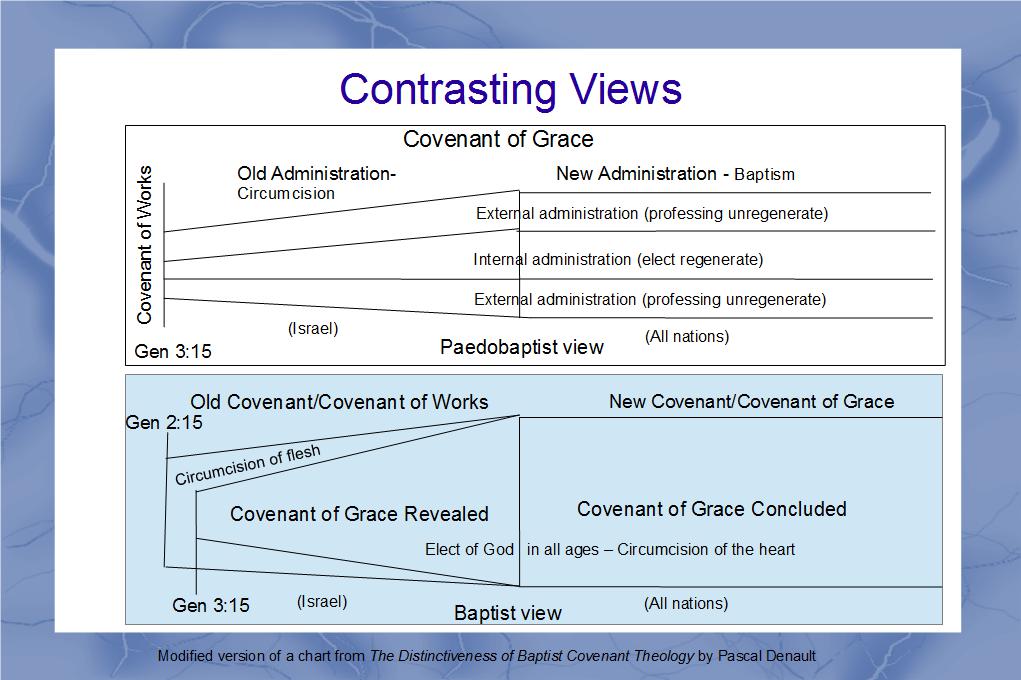
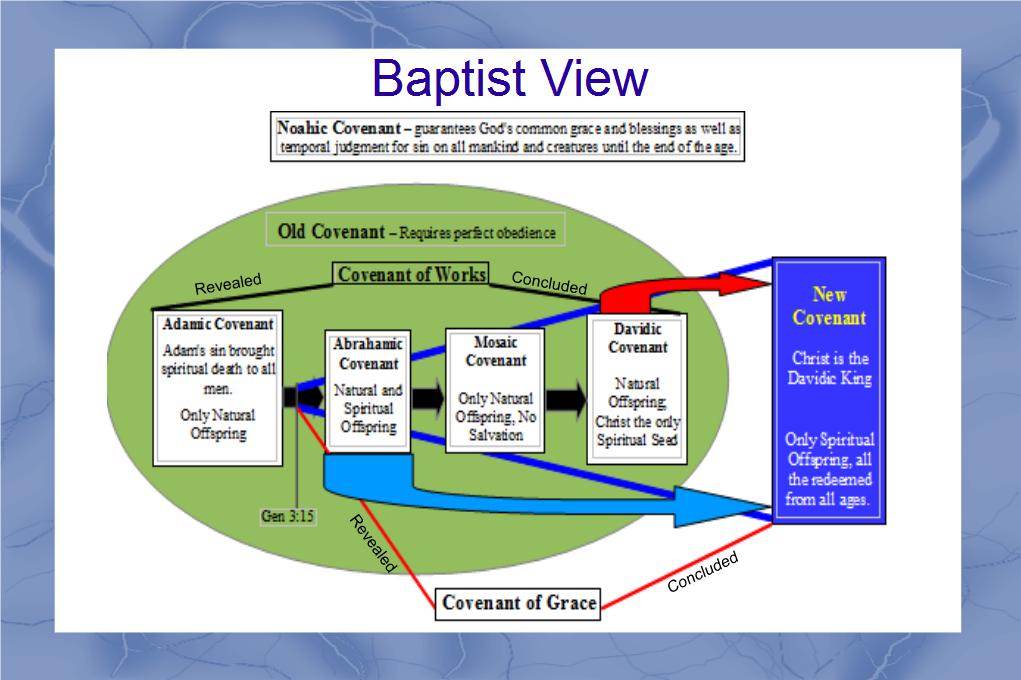
Reformed theology is often referred to as covenant theology – based on the covenants between God and Baptist Covenant Viewman revealed in Scripture and the view that God deals with us primarily through covenants. One of our old Baptist brothers, C. H. Spurgeon, had this to say about the importance of understanding the covenants of Scripture: “The doctrine of the covenant lies at the root of all true theology. … I am persuaded that most of the mistakes which men make concerning the doctrines of Scripture are based upon fundamental errors with regard to the covenants of law and grace.” He went on to say: “The covenant of works was, “Do this and live, O man!” but the covenant of grace is, “Do this, O Christ, and thou shalt live, O man!”” As we will see, the differences we have with our Presbyterian brothers has to do with these two covenants. Pascal Denault, in The Distinctiveness of Baptist Covenant Theology describes them thusly: The Covenant of Works is revealed by the light of nature; nature’s light teaches self-righteousness (Rom 2:15). The Covenant of Grace is revealed by the Spirit of God; He reveals Christ’s righteousness.

The entire message with all the slides mentioned can be downloaded or listened to here.

A Defense of Credo-Baptism

I testify that baptism or dipping in water is one of the commandment of this Lord

Jesus Christ.

By John Clark, Physician of Rhode Island in America, 1652

That this commandment of Jesus is by way of dipping, and, as it were by drowning, overwhelming or burying in water and not by sprinkling with water, appears many ways.

1. In that although there be frequent mention made of that appointment of Christ in His last will and testament, yet is it never expresses by the word that may be rendered rantism, or sprinkling, but by the word that is rendered baptism, or dipping.

2. In that the word by which it is so frequently expressed doth in proper English signify to dip, to plunge under water, and as it were, to drown, but yet so as with safety so that the party (as to the manner) may be drowned again and again, see the instance of Naaman. He dipped himself seven times in Jordan (2 King5:14) and to this sense of the word (at least in that place) both the Greek, Latin and English Churches agree.

3. In that the phrase (in which there is mention made of such an appointment of Christ) doth necessarily import such a thing, and, therefore, when mention is made of baptizing, there generally followeth that word the preposition (iv) which is commonly translated in or into which suits the dipping, and not the preposition (sun) which signifies with and so suit with sprinkling. It may as well be rendered I baptize you in water and he shall baptize in the Holy Spirit (Mar 1:8) as it is rendered John did baptize in the wilderness and in the river of Jordan (vs 4, 5) or that John was in the Spirit on the Lord’s day (Rev 1:10) and they were baptized in the cloud and in the Sea (1 Cor 10:2). Yea, it might as well be rendered I baptize, or dip you, into water as it is rendered they were casting a net into the Sea (Mar 1:16) for the words are the same and it would be an improper speech to say John did baptize with the wilderness and they were casting a net with the Sea.

4. That this appointment of Christ is by way of dipping, and not sprinkling, appears in that for the resemblance and likeness hereunto. The Israelites passing under the cloud and through the Sea where the Egyptians that were their lords and commanders, their pursuers and enemies, that sought their destruction were drowned, left behind and seen no more, is by the Holy Spirit called a baptism (1 Cor 10:1,2) They were baptized in the cloud etc. Observe, it is not here rendered with the cloud and with the Sea, as in the other place (Mar 1:8) with water, because it suits with sprinkling although the word be the same, but in the cloud and in the Sea which suits with dipping or overwhelming. So, with the appointment of Christ, they passing through the midst of the red or bloody Sea on dry land which stood on both sides as a wall, and being under the Cloud, were as men, in a carnal eye, overwhelmed and drowned and yet truly saved and safe from their enemies.

5. That this appointment of Christ was not by sprinkling, but by dipping, or putting the person into or under the water appears by Phillip’s baptizing the Eunuch. It is said They went down into the water, both Philip the baptizer and the Eunuch that was the person to be baptized, and being there in the water, Philip baptized, or dipped him in that water as John did Jesus in the river of Jordan. Then it is said as they descended, or went down into the water, so they ascended or went straight way up out of the water. See Acts 8:38, 39; Matt 3:16. Mark the expression: “And Jesus, when He was baptized, went up straightway out of the water..”, therefore had he been down in the water.

6. That this appointment of Christ was not by sprinkling, but by dipping, or , as it were a drowning, appears in that John the Baptizer, his work being to baptize, remains in the wilderness by the river of Jordan and afterward in Aenon. The reason that this is rendered by the Spirit of God why there he abode, was, because there was much water there, which need not have been if that appointment could have been performed by sprinkling and not by dipping. See Luke 3:2,3 John 3:23.

7. That this appointment of Christ was not to be performed by sprinkling, but by dipping etc. Appears from the nature of the Ordinance itself. It is such an Ordinance as whereby the person that submitteth thereto doth visibly put on Christ Jesus the Lord and is hereby visibly planted into His death, holding forth therein a lively similitude and likeness unto His death. Whereby only through faith he now professeth he hath escaped death and is in hope to obtain life and peace everlasting and so to have fellowship with Him in His death as to be dead with Him and thereupon to reckon himself to be dead indeed unto sin, Satan, the law and the curse. See Gal 3:27; Rom 8:2,3; 5:7,8,11; 1 Cor 15:29. But the planting of a person into the likeness of death is no ways resembled by sprinkling. But by dipping it is lively set forth and demonstrated.

8. This appointment of Christ, Baptism, is an ordinance whereby the person that submitteth thereto, doth visibly and clearly resemble the burial of Christ, and his being buried with Him. So, as in respect of the old man, the former lusts and conversation, like the Egyptians, to be taken out of the way and seen no more. See Romans 6:4,6; Col 2:12. But sprinkling doth no way lively resemble the burial of Christ, or the persons being buried with Him as dipping doth.

 9. This appointment of Christ, Baptism, is an ordinance whereby the person that submitteth thereto doth visibly and lively hold forth herein the resurrection of Christ, declares Him Whose life was taken from the Earth to be alive again, Who although he died and was buried, yet was He not left in the grave to see corruption, but was raised again and behold He liveth for evermore. As hereby he holds forth the resurrection of Christ, so doth he also his own being planted in the likeness thereof so as to reckon himself to be in his soul and spirit quickened and risen with Christ from henceforth to live unto God the fountain of life and to Christ Jesus the Lord Who died for him, and rose again and so to walk in newness of life in this present evil world, being also begotten unto a lively hope that in the world to come, he shall be raised and quickened both in should and body to a life everlasting. See (Rom 6:4,5,8,11; Acts 8:33,35,36; Col 2:12; Rom 8:11; 1 Cor 15:29; 1 Pet 1:3. Sprinkling doth no way lively resemble the resurrection of Christ, or the souls or bodies rising, or being raised by Him, as the way of dipping doth. Therefore, this appointment of Christ was, and still is, to be performed by way of dipping or putting the person into or under the water and not by sprinkling.

 That this dipping in or into water in the name of Jesus is one of the commandments of this Lord Jesus Christ doth evidently appear Matt 28:19; Mark 16:15, 16 compared with Acts 2:38, 41; 8:36, 38 and 10:47, 48. And that it is also to be observed by all that trust in Christ, as other of is commands, as He is Lord, until He come again, is likewise expressly manifested to be His will: Matt 28:20; Gal 1:7, 8; Jude 3; 2 Tim 2:2; Col 2:5, 6; Rev 2:25; 3:11 Hold fast till I come. Rev 22:14, 19; Heb 12:25

A visible believer or disciple of Christ Jesus (that is, one that manifesteth repentance towards God and faith in Jesus Christ) is the only person that is to be baptized with that visible baptism or dipping of Jesus Christ in water

 That a visible disciple or scholar of Christ, one that manifesteth himself to have heard Him, to have been taught by Him and to have yielded himself to Him as his teacher, is the only person, etc. Will be made manifest:

 1. By the commission itself and the argument stands thus-they and they only have right t this ordinance and appointment of Jesus Christ, whom the Ordainer Himself, Christ Jesus the Lord, hath appointed it to disciples and to believers and to such only. The first proposition cannot be denied and the second will easily be roved. See the commission by which the apostles were warranted to administer this ordinance. So must all baptize or they will appear but usurpers (Mat 28:18, 19). All power is given to me in heaven and in earth, saith the Lord, Go ye therefore and disciplize or make disciples not among the Jews only, but among the Gentiles and Nations and baptize them. If the question should have been made, Lord whom shall we baptize of the Nations among the Jews and Gentiles? His answer was given in the words before. He would have given no other. You shall baptize amongst the Nations Jews and Gentiles, such as first been taught, and by teaching have been made my disciples. Mar 16:16 go ye into all the World, saith the Lord, and preach the gospel to every creature-to the Gentiles as well as the Jews. He that believeth and is baptized shall be saved etc. If the question should be here propounded again who among the religious and strict Jews and the loose and profane Gentiles should be baptized, the answer is plain-those to whom the Gospel first hath been preached and they through that Gospel have also believed.

 2. By the practice of the commissioners of Christ who were faithful unto their Lord and to the charge which He gave them. The argument stands thus: Such as faithful Apostles, and first commissioners of Christ Jesus the Lord administered this ordinance of baptism unto such and only such ought to be made partakers thereof. But the Apostles and first commissioners of Christ administered not this ordinance unto carnal babes, infants of days(these are by the scriptures declared to be conceived in sin to be brought forth in iniquity, and in being born of the flesh to be but flesh, and so by nature the Children of wrath, one as well as another, being also untaught), but to such as first were taught and were ordained by the immortal seed of the world to be born again and as new born babes in Christ, having tasted of the sincere milk of the word, desire still more of the same that they might grow up thereby and such as appeared to be converted and to become as little ones, such little ones as believed in Jesus.

 The first proposition I suppose none that own Christ and his Apostles will dare to deny. And the second which is more questionable will also be proved. See Acts 2:38, etc. Although Peter with the 11 calls upon the convicted Jews to repent and to be baptized every one in the name of the Lord Jesus for the remission of sins, and tells them that then they shall be made partakers of the Holy Spirit, and that they should not need to distrust it, he shows them the largeness of the promise that was made concerning the pouring forth of the Holy Spirit, it being promised to be poured forth upon all flesh as they had expressed in the beginning of their discourse out of Joel 5:16, 17 and therefore saith ‘tis to you and to your children and to all that are a far off even as many(of you, your children and such as are a far off) as the Lord our God shall call. Yet, he baptized none, but such as were called by the holding forth the word of salvation by Jesus Christ as appears in the words. For they that gladly received his word were baptized and they only, for they that were baptized were added and continued together in the disciples’ doctrine and in fellowship and in breaking of bread and in prayer and continued daily with one accord in the Temple, and breaking bread from house to house, did eat their meat with gladness and singleness of heart. This place, therefore, if rightly considered, will be so far from affording a ground for the baptizing of the children of believing parents, because here it is said the promise is to you and your children, that it will sufficiently evince the contrary. Such an apprehension is accompanied with 2 or 3 evident mistakes. There is a mistake in the promise, in the parties to whom the promise belongs and the manner how it is to them and their children.

 1. There is a mistake if the promise in that it is looked at as the covenant of Grace which doth ingratiate the soul into and gives it an interest in all the privileges of the Gospel of Christ. So in order doth go before baptism or any other visible ordinance and appointment of His whereas is very truth by promise there, is meant that Holy Spirit of promise which they which believed in Christ, and obeyed Him, should, according to promise, receive after He was ascended unto the right hand of the Father as appears John 7:39; 14:16; 16:7. That which He had here shed abroad in a powerful manner upon the Apostles, and that which these Jews also believing and obeying the Gospel of Christ should also receive and therefore saith Peter, Repent and be baptized and ye shall receive etc. And was no other than that which was of old prophesied of by Joel as is declared in v.16 and so is a promise that follows faith and obedience and not such as goes before to give right to this appointment of Christ.

 2. There is a mistake in the parties to whom the promise belongs. For whereas it is said to you and to your children, and thereupon it is conceived to be meant believers, and their infants of days which upon that account are to be baptized, it is plain and evident when the apostle spoke these words to them, they could not be looked upon as believers, forasmuch as they being pricked at the heart and only convinced of their evil in murdering the Lord of life, propounded what they should do to be saved which is far from believing. To which the apostle replies, Repent and be baptized in the name of the Jesus for the remission of sins. To conceive that by their children were meant infants of days, it may be as well as understood by your sons and daughters which should so receive of the promise of the Spirit as to prophecy mentioned in the seventeenth verse of this chapter to which these words are related: and to make it appear that the promise was not so either to them or their children (as yet manifested) to give them right unto baptism. After many more words used by the apostle to persuade them to save themselves from this adulterous generation, it is said, but as many as gladly received his word, were baptized and but only such and not their infants of days. They that were baptized continued together in such appointments of Christ as infants are in no measure capable of.

3. There is a mistake in the manner how this promise is to them and their children, not spoken to them now as believers and their children as having right and interest peculiar by them, but, indeed, to them and their children no otherwise than to all that are a far off. If taken in the general, cannot be understood but with respect to the general promise which is to pour forth His Spirit upon all flesh. But, if with the restriction, which is, even as many as the Lord our God shall call, then parents and children, Jews and Gentiles, such as are near, and such as are a far off, must be called by the word of His grace before they can have a peculiar right and interest in this Spirit of promise. So a child that is called to believe and obey the Gospel may have this promise made good unto him before his father, and a Gentile that is a far off before a Jew that is near.

This will appear also by other instances as of Philip baptizing in Samaria. They were men and women that he baptized there, such as believed and received the word with great joy (Acts 8:8, 12). When the Eunuch seeing the water, asked what should let him to be baptized. Philip intimates that although he had been taught, yet want of a manifestation of faith would be a let (v. 36, 37) and whereas there is mention made of whole houses that were baptized, that the commissioner might appear faithful unto their Lord, and keep close to the very words of their commission, you shall find they were first taught, and by teaching, were made His disciples, and gladly received His word. See it in Cornilius’ household (Acts 10:44, 47) compared with the jailers’ household (Acts 16: 32, 34). They spake unto him the word of God and unto all that were in his house, and he set meat before them, and rejoicing, believing in God with all his house. See it also in Crispus’ household (Acts 18: 8-11), Stephanus’ household (1 Cor 1:16, 17 compared with 16:15). And as for Lydia’s household (Acts 16), the Spirit of God being more silent therein, they that cannot interpret it by the other four, nor yet by the commission itself, nor by the commissioners’ faithful observance thereof in all other instances, let them prove, if they can, these three particulars: a. That Lydia ever had a husband. B. In case she had, that ever she had any children by him, and if so, then in the c. That they were not dead or so grown up that they might hear and receive the word gladly as well as their mother.

 A third argument to prove that a visible believer is the person that according to the mind of Christ is to be baptized in water may be taken from the order which the Spirit of Christ lays down: faith and baptism, in the scriptures of truth, putting faith still in the first place witness Mark 16: 15, 16, Matt 28: 19; Heb 6; Eph 4.

 A fourth argument may be taken from the nature of the ordinance and a fifth from John’s baptism. Yea, much more might be said to this point, but this may suffice.

 The only person that is to walk in the visible order of his house and so to wait for his coming the second time in the form of a Lord and King with his glorious Kingdom according to promise.

 That he is the only person that is to enter into and walk in the visible order of His house will evidently appear, if the order in which our Lord left His house when he went to His father to receive His Kingdom, be duly considered. In His last will and testament, we shall find it thus recorded. When our Lord was about to be gone, he gave order unto His apostles whom He made stewards in His house of the mysteries of God to make Him disciples of all Nations and that such as were to be made should then be baptized and so visibly be planted into Christ and put on Christ, and having so received Him, should walk in Him, observing all things whatsoever He had commanded. The first thing whereof as touching order was to be added or joined one to another in the fellowship of the Gospel by a mutual professed subjection to the Scepter of Christ and being a company thus called out of the world, from worldly vanities, and worldly worships after Christ Jesus the Lord (which is the proper English of these words-the Church of Christ, and is in other terms called the Household of faith) should steadfastly continue together in the Apostles’ doctrine, the consolation, reproof, and instruction thereof, in fellowship, the mutual support both inward and outward, in breaking of bread, thereby remembering the death of our Lord whose soul was made an offering for sin. As His flesh is meat indeed, and His blood drink indeed by the help of the Spirit to nourish our souls and spirits up unto eternal life and in prayer, one with and for another. This is the absolute order which the Lord hath appointed in His last will and testament. This appeareth both by His own precept and command, and by the practice of such as first trusted in Him. And, if so, then neither infants of days, nor yet such as profess themselves to be believers in Jesus, but refuse as a manifestation thereof, according to the practice of such as first trusted in Christ, to yield themselves to be planted into the death, burial and resurrection of Christ, and so visibly to put Christ on, as did the Christians of old, I say, such have no right to enter into, or walk in the order of the Gospel of Christ. To conclude the point the argument stands thus: they, and they only , have visible right to enter and walk in the visible order of Christ’s house, and so to wait for His coming, whom Christ Jesus Himself being the Lord of the house, hath appointed, and His Apostles being His stewards, have approved of, but such as first have been taught and made disciples or scholars of Jesus and believers in Christ, and afterwards have been baptized or dipped and thereby visible and lively planted in to the death, burial and resurrection of Christ, are they, and they only, whom Christ hath appointed and the apostles approved of. See His commission. Peruse their practice, ergo, they and they only have visible right to enter into and walk in the order of Christ’s house and so to wait for His coming the second time in the for of a King with His glorious Kingdom according to promise. See for a further confirmation of the last clause in the first epistle to the Corinthians !: 7; 1 The 1: 10; 2 The 3: 5.

The Hypocrisy of the LGBT Community

A few thoughts to consider for the thoughtful reader of DefCon –

1. Ok, for those who think to the contrary of the Bible, I would like to call your bluff in no uncertain terms. Please provide indisputable PROOF from the scientific and medical communities that people are born transgender or as homosexuals or lesbians, etc. THEORIES or PRESUPPOSITIONS based on psychology does not count. It must be based on DNA, genetics, things that can be proven in a lab or research facility.

hypocrisy2

2. For those who think that God “MADE” a mistake when He made you, I would encourage you to read the truth of Scriptures. The same holds true to any who think that ALL or ANY sexual activity outside the bounds of marriage between one man and one woman is acceptable. John 3:36 makes it clear as to God’s perspective on those who willfully abide in their sin and abomination. “He that believes on the Son has everlasting life: and he that believes not the Son will not see life; but the wrath of God abides on him.” Those who are children of God will obey the commands of Scripture, but those who choose their own paths are clearly bent on destruction AND the wrath of God does abide on them until salvation takes place. The bottom line is that God does NOT make mistakes and He does not create that which would contradict the principles and truths found in His Word (the Holy Scriptures).

3. I share with those who read that there is no hatred for any who live in a lifestyle that is contrary to God. It is NOT up to me to bring condemnation of eternal punishment. If I am to follow the truth of Scripture, I must learn to 1) love God with all my heart, soul, and mind, and the 2) is to love my neighbor as myself. However, it is NOT loving if I fail to warn you that there is a high price to pay one day for choosing a path or lifestyle that is in contradiction to the character of the Holy God. Some who read might PRESUME upon my character and belief that I hate you and others who do not live like I do. That is unfounded and is based purely on the speculation of how you THINK others should believe and how you THINK others should allow you to practice with no lack of tolerance apart from intolerance towards “bigots” and “hate-mongers” like me. I look forward to seeing your “PROOF.”

4. So, just to clarify, a person can HATE the actions of those who choose to pray aloud to God in school or a public place but that person probably would say nothing if it was a Muslim student doing it. Further, you can hate prayer and find it an affront or grievance to you, but you would have NO problem fully endorsing that same person’s right to speak if they choose to spew filthy, vulgar language or even speak aloud of his or her ability to practice deviant lifestyles. Absolutely amazing! So, you can HATE as long as you get your way, but if I HATE that which is contrary to the Scriptures, I am condemned as a bigot and I am judging others. So, exactly, how does this logic work again???

5. The problem is that the world is trying to dictate new standards of morality based on what suits the depravity of the human heart. You cannot have morals without the God who gave and created the morals to begin with. It is the same God who created one man and one woman and instituted marriage between those two. The reality is that the LGBT agenda is an abomination before God and will always be so. Sadly, a small very vocal minority are trying to bully the world into accepting perverted lifestyles. By the way, Disney has long sought to subtly and now openly promote the homosexual agenda. The homosexual agenda will never be content with “marriage” between two of the same sex. They are after our children. We are headed the way of Rome and will be brought to our knees just as Rome was for her wickedness.

hypocrisy2

6. By the way, if homosexuality or lesbianism is “normal” and supposedly created by God, why in each relationship do you have one that acts the part of a male and one a female? God created one man and one woman and commanded them to multiply and fill the earth. Interesting that God did not give the ability to procreate between two men or two women, and biology and science cannot change that. Notice I did not mention “gay” sex. I spoke of the irony of how in any relationship between two men, one will seek to be effeminate (or the wife), while with two lesbians, one will seek to dominate and play a masculine role.

7. God states that ALL AND ANY sex outside of marriage between one man and one woman is an abomination before Him. God also tells us that the hearts of ALL men and women are evil. Romans 3 states that there is nobody who is good, not even one. They have all gone out of the way in their depravity. There does not need to be any additional verses regarding a person who thinks they were born in the wrong type of body. To hold to this is ultimately stating that God makes mistakes. Further, the Bible is clear that it is not a particular sin that will send people to hell, but the one of unbelief. Belief in God resulting in salvation only comes when a person repents and confesses their sin to God and then places their faith in Christ alone for their salvation. That belief then is followed by a willing obedience to the commands of Christ.

8. Despite the fact that many will studiously avoid my thoughts and questions, I will share that God commands all men to repent. The need for repentance is not dependent on one’s choice of sex or lifestyle. It is based solely on the fact that man is separated by his very nature from a holy God. What would God say to a transgender person? He tells them to repent and that today is the day of salvation for all who come in faith in Jesus Christ. The transgender equality issue is one that seeks to erode what God has created. To force those choices upon the general public, particularly within the education system, is foolishness and stupidity at best, and at worst, only further undermines the differences between male and female as created by God.

The Consistency of God’s Justification

20130712-141054.jpgI found a gem on justification, written by J.I. Packer, that can be found here:

Let me quote from it:

God’s justifying judgment seems strange, for pronouncing sinners righteous may appear to be precisely the unjust action on the judge’s part that God’s own law forbade (Deut. 25:1; Prov. 17:15). Yet it is in fact a just judgment, for its basis is the righteousness of Jesus Christ who as “the last Adam” (1 Cor. 15:45), our representative head acting on our behalf, obeyed the law that bound us and endured the retribution for lawlessness that was our due and so (to use a medieval technical term) “merited” our justification. So we are justified justly, on the basis of justice done (Rom. 3:25-26) and Christ’s righteousness reckoned to our account (Rom. 5:18-19).

The argument, in summary, is this: If God is just, how can He declare someone that is sinful to be righteous? Answer: Because the righteousness that God sees when he looks at the elect sinner is the righteousness of Christ. In other words, God does not nilly willy and “in a vacuum” declare something sinful to be holy. That would indeed be an unjust declaration. However, if in Christ we are righteous, because He is our “Adam,” that is, our spiritual representative and head, then it would be unjust for God to NOT declare us justified. See the logic there? According to God’s own consistency, since Jesus is our righteousness, God justifies the elect.

The justifying action of God is not an exception to his otherwise perfect justice. On the contrary, the action is an application of God’s perfect justice. This is the magnificence of the cross. The cross verified and guaranteed the justifying salvation to all who were of the elect sons and daughters of Christ, the new and perfect Adam.

CARM Takes on Matthew Vines

CARMIf you are not familiar with Matthew Vines, he is a pro homosexual activist who spoke at College Hill United Methodist Church in Kansas. During that speech, Mr. Vines advocated that the Bible does not condemn same sex monogamous relationships. Mr. Vines went to great lengths to redefine the very meaning of scripture as he attempted to explain what God actually meant, by his own assessment, when He inspired the writers of the Bible to pen the words we read today. Unlike many who have taken Christians to task on this issue, Mr. Vines presents himself as a kind and polite person, one with whom you would like to sit down and have a conversation with. He does not attempt to make the vitriolic speech that many who have advocated “gay rights” have used. His demeanor makes his redefining of scripture more acceptable in the eyes of those who have not made the effort to understand what God has truly said on the matter of homosexuality. As a result, Mr. Vines, and the views he espouses, are more easily received, even by those to claim to be followers of Jesus Christ.

Last year I posted an article titled “Christians Are We Ready” where I referenced a series of audio messages prepared by Dr. James White addressing this very speech by Matthew Vines. I continue to heartily recommend those messages to every Christian as they directly dismantle the very arguments made by Mr. Vines. Now I would like to refer our readers to yet another resource that will further equip us. CARM has prepared a section on their apologetics site that continues to expound on this issue. Homosexuality is one of the defining arguments of our day. Christians must be prepared to answer the challenges presented by those who would promote their belief that sexual immorality is acceptable in the eyes of God. Therefore, I ask you to visit the following link at CARM and become equipped to answer when people ask you why you believe homosexuality is a sin. Let us be fully prepared, not so we can prove ourselves morally better, but so that we can graciously and compassionately warn those of the judgment to come for their sin, and that there is yet salvation in Jesus Christ.

http://carm.org/matthew-vines

DefCon Writer is on YouTube

20130702-073500.jpgIn addition to blogging and co-hosting a radio program, I also maintain a YouTube account. I have recently begun posting new video blogs there that I wish to share with our readers. In the past, my video efforts were more in the area of highlighting the need for biblical evangelism so as to encourage other brethren to preach the gospel to the lost. However, more recently I have felt burdened to produce videos that encourage and edify the body of Christ to be serious about our faith. It is my conviction that we as Christians need to delve deeper into the Word of God because it is the only source of truth, the only thing that can truly answer the problems we face today. To that end, I have posted two videos (which are linked below) that I hope and pray glorify God and equip the brethren. It is my intent to produce similar videos in the weeks to come. I ask you to consider watching and sharing these videos with other Christians. I also welcome questions and suggestions for future videos. If you have any thoughts on what else you would like to see covered, please email me at defendingcontending@gmail.com.

“Blessed is the man”–Psalm 1:1

Psalm 1_1

There are at least 50 places in the Bible that use the word, “Blessed.” Or “Blessed be…” Psalm 128:1Blessed is the man who fears the LORD. Matthew 11:6“Blessed is he who is not offended because of Me.” And of course, all the Beatitudes begin with the phrase, “Blessed are…” Matthew 5:3-8“Blessed are the poor in spirit…they that mourn…the meek…those who hunger and thirst for righteousness.” 2nd Corinthians 11:31Blessed be the God and Father of our Lord Jesus Christ. Revelation 20:6Blessed and holy is he who has a part in the first resurrection.

When referring to God, the word “blessed” means “glorified, revered.” When referring to a person, that word “blessed” can also be defined as one who is “happy,” or “to be congratulated.” Today, we’re going to look at what type of person is truly “blessed,” and is deserving of “congratulations.” We’re going to read the first two verses of the first Psalm, and look a little deeper at what the psalmist is saying here.

If we want to be blessed in this life—and especially in the life to come—there are some things we need to avoid. Some people just don’t get that. They think that true joy and happiness come from the things we do and the things we get right now, here in this life. But we’ll talk more about Joel Osteen some other time. And when things don’t quite work out the way they expected them to, and their lives start crumbling around them, and they wonder how it happened, and how they can fix it. And how many times, when we tell them that if they would just stop doing things the way they’re doing them, and trust God, and follow His ways that they will be better able to deal with their situation. It doesn’t mean that their lives will suddenly turn to sunshine and unicorns, but they’ll have a more lasting and true peace about those things.

But, they usually want to hear about how they can keep doing the same thing they’ve been doing, the same way they’ve been doing it—even if it’s the wrong thing to do, and the wrong way to do it—they want to keep doing the same thing, but get a different result. And that is the definition of what? Insanity. Instead of turning to the LORD. When we turn to God for answers—He may not FIX our problems, but He will give us the strength and the patience we need to endure until those storms pass. So, how does one find true blessedness?

Psalm 1:1Blessed is the man who walks not in the counsel of the ungodly, nor stands in the path of sinners, nor sits in the seat of the scornful. We are blessed when we avoid the ways of the world. What we see here in verse 1 is a progression. When we get caught up in sin, is it because we charge right into it? Do we wake up one day and say, “It looks so nice outside. I think I’ll get hooked on meth today!” I can’t imagine that sentence has ever passed through anybody’s lips. But how many times—especially for believers—is it very gradual, and very subtle? How many times have we wound up somewhere doing something that we were so absolutely sure “that would NEEEVVVER happen.” And then you look up one day and you think, “What the heck am I doing here!!”

It’s a slow fade when you give yourself away
It’s a slow fade when black and white have turned to gray
Thoughts invade, choices are made, a price will be paid
When you give yourself away
People never crumble in a day
It’s a slow fade
–Casting Crowns, “Slow Fade”

Blessed is the man who walks not in the counsel of the ungodly. We need to be really careful about who we look to for advice. There are many psychologists and psychiatrists, and therapists, that—they have all these years of school, and college, and you walk in and they have these fancy diplomas on their wall—and they don’t know a thing about how to help you get through your problems. Other than, “Here, take this pill! It will make you happy!” Many times, our problems—whether they are physical, or emotional, or psychological—most of the time, the root of that problem is spiritual. We may be looking at our problem through our own eyes, and the problem looks impossible—to us. But is anything impossible with God?

Another example: when somebody does something to us, what does the world say we’re supposed to do? Get even with them. What did Jesus say to do? Yeah, you know, that whole “Turn the other cheek” thing.

“You don’t know what Naomi said about me!” They blasphemed Christ.
“But Joseph’s been cheating with my girlfriend!” His people committed harlotry with other gods.
“That drunk driver killed my baby daughter!” And your sins nailed Jesus to the cross.

And I guarantee you one thing: what you’re fixin’ to do to that person is a whole lot worse than what they did to you. It’s never about “getting even”, now, is it? Isn’t it always “get even—and then some”? Somebody does something to you, you have to do worse to them, right? No. Walk away. Don’t walk in the counsel of someone who says you need to “get even” with the one who offended you and hurt your delicate little feelings.

Blessed is the man who walks not in the counsel of the ungodly, nor stands in the path of sinners. How many of y’all remember what high school was like? Not every school is the same, but in most, you’ve got your jocks over here, your cheerleaders over here, your science geeks over here, then you’ve got a group made up of kids who aren’t in ANY group. They’ve made their own group. “We are the ‘not-in-any-group’ group!” You could tell what type of person somebody was by the group they hung out with. The same when it comes to us, and which group we belong to—do we stand with saints or do we stand with sinners. There’s no neutral territory. Hebrews 3:12Beware, brethren, lest there be in any of you an evil heart of unbelief in departing from the living God. Unbelief is evil. I’m sure we’ve all heard someone say they know a friend who is “walking with one foot in the world, and one foot in the kingdom.” That is an absolute impossibility. One cannot walk with one foot in the world and one foot in the kingdom. They will either have both feet in the world or both feet in the kingdom. Matthew 6:24“No man can serve two masters…” James 4:4The friendship of the world is hostility with God. So which path do we stand in? Do we take sides with the world, or with God?

Now, does that mean we can’t have friends who aren’t Christians? No, it does not. We are, in fact, encouraged to have non-Christian friends rather than friends who claim to be Christians, but are living an immoral lifestyle. 1st Corinthians 5:9-11I wrote to you in my epistle not to keep company with sexually immoral people. Yet I certainly did not mean with the sexually immoral people of this world, or with the covetous, or extortioners, or idolaters, since then you would need to go out of the world. But now I have written to you not to keep company with anyone named a brother, who is sexually immoral, or covetous, or an idolater, or a reviler, or a drunkard, or an extortioner—not even to eat with such a person. Let me give you one example of this. I found a video while back from a ministry in Los Angeles. A woman from this ministry was talking to a couple of young men outside the BET awards. They wanted to see all the big-name rappers. These men said, “Yeah, we’re Christians.” And during the course of this interview, these men said (I kid you not) that these rappers were—quote—“God-fearing men.” Apparently, in some people’s eyes God-fearing men rap about going to clubs, having multiple sexual partners, drugs. And these men who claimed to be Christians were standing in the same path with them! Psalm 101:3I will set nothing wicked before my eyes; I hate the work of those who fall away; it shall not cling to me. Philippians 4:8Whatsoever things are true, whatsoever things are honest…just… pure…lovely…of good report…any virtue…any praise, think on these things. We can have non-Christian friends—we should, so we can let our light shine before them, they can glorify our Father in Heaven—that doesn’t mean we should be imitating them.

Blessed is the man who walks not in the counsel of the ungodly, nor stands in the path of sinners, nor sits in the seat of the scornful. This is the most dangerous of all. Because if you are walking or standing, you can look around and eventually you’ll say, “What am I doing? I’m outta here!!!” But when you sit at someone’s table, you are making yourself comfortable with what they are offering you. When you see a friend—especially one who claims to be a brother—you see them doing something you know is sinful, and not only do you say nothing to him, but you take part in it, you are “sitting in the seat of the scornful.” Proverbs 23:6-8Do not eat the bread of [the greedy], nor desire his delicacies; for as he thinks in his heart, so is he. “Eat and drink!” he says to you, but his heart is not with you. The morsel you have eaten, you will vomit up, and waste your pleasant words. In other words, don’t partake of another’s evil, because they may act like they’re your friend, but when it’s all said and done they don’t care about you, and you’re going to be in worse shape than you were before.

Another thing to consider: think about how Jehovah’s Witnesses and Mormons go about their work. Do they just stand outside the Wal-Mart and hand out tracts? No. They knock on your door. They want to come into your house. And what do they want to do? They want to sit down with you. And they want you to be comfortable. And if you know what Jehovah’s Witnesses and Mormons believe, then you know Satan is coming through that door too, right? 2nd John 9-11He who abides in the doctrine of Christ has both the Father and the Son. If anyone comes to you and does not bring this doctrine, do not receive him into your house nor greet him; for he who greets him shares in his evil deeds. When we lived in our last house, we lived about 3 blocks away from a Mormon church. And on 3 separate occasions we had some Mormon missionaries come to our door. And it was cold outside. And we stood at the door. And they tried to tell me all about their polygamous prophet. And I want you to know, they did not step one foot in our house. And they probably about froze. But I was not about to let them in the house. Why? Because I was not a good neighbor? No. Because God tells us not to! You want to preach your false god, you can do it from outside my door. But you ain’t stepping foot inside.

Now, Psalm 1:2 kinda gives us the other side of the coin. It shows us what we can do to find true blessedness. Psalm 1:2But his delight is in the law of the LORD, and in His law he meditates day and night. What is the Law? It’s all those 613 commandments in Exodus, Leviticus, Numbers and Deuteronomy. Which is the great commandment? Matthew 22:37-38“‘You shall love the LORD your God with all your heart, with all your soul, and with all your mind.’ This is the first and great commandment.” This is what we meditate on day and night. Love the LORD our God with everything in us, and our neighbor as ourselves. Where does it teach us to do that? The Law. You can watch talk shows, read all kinds of books written by people who don’t know the LORD—and don’t want to know Him. You can get all kinds of advice from the newest, trendiest pop psychologist. But you will never know how to please the LORD if you don’t read His word.

Charles Spurgeon said,

“‘His delight is in the law of the Lord.’ He is not under the law as a curse and condemnation, but he is in it, and he delights to be in it as his rule of life; he delights, moreover, to meditate in it, to read it by day, and think upon it by night. He takes a text and carries it with him all day long; and in the night-watches, when sleep forsakes his eyelids; he [reflects] upon the Word of God. In the day of his prosperity he sings psalms out of the Word of God, and in the night of his affliction he comforts himself with promises out of the same book.”

He’s saying that “day and night” doesn’t just mean the sun coming up and going down. But the day can also refer to when things are going good, and the night when things aren’t so good. And in it all, we know that God is sovereign over it all, that nothing happens in our lives that He does not allow, and if He does allow it to happen it is so we can glorify Him in the midst of our trouble. Psalm 30:5Weeping may endure for a night, but joy cometh in the morning.

Blessed be Your name
In the land that is plentiful
Where your streams of abundance flow
Blessed be Your name

Blessed be Your name
When I’m found in the desert place
Though I walk through the wilderness
Blessed be Your name

Blessed be Your name
When the sun’s shining down on me
When the world’s ‘all as it should be’
Blessed be Your name

Blessed be Your name
On the road marked with suffering
Though there’s pain in the offering
Blessed be Your name
–Matt Redman, “Blessed Be Your Name”

When things look bleak, we have promises from God that He will see us through it. When we have joy, we can find countless ways to praise Him for His goodness! No other religion on earth gives any assurance that you are pleasing that particular deity. Not the Buddhist god, nor the Hindu god, nor the god of the Jehovah’s Witnesses or the god of the Mormons. And especially not the god if the Muslims. But if we know Christ then we can know, without a doubt, that we are indeed children of the One, True, Living God. Let me finish up this quote from Spurgeon.

“‘The law of the Lord’ is the daily bread of the true believer. And yet, in David’s day, how small was the volume of inspiration, for they had scarcely anything save the first five books of Moses! How much more, then, should we prize the whole written Word which it is our privilege to have in all our houses!”

Think about that for a second. When these Psalms were written, all they had was the Torah. They didn’t have the book of Romans. Or Matthew, Mark, Luke, or John. They did not know about the cross. They did not know that the sinless Son of God would be made sin for us, so that we could be the righteousness of God in Christ. All they knew was “LAW”. Consider this also: there are some parts of the world where if you get caught with a Bible, you’re dead! There are still other places that have never seen one! Yet how casually do we treat it, we who can go into any Wal-Mart or Target, without fear of prosecution—or persecution—and pick one up, and it’ll cost you 5 bucks. Some countries, it’ll cost you your life! But blessed are we when we take this book, and read it, and study it, and believe in the promises contained inside and understand that this is the perfect word of God, not just a bunch of stories. “Bunch of stories from old Jewish guys.” No, they are not. This beloved book is no less than a collection of 66 love letters from God to His people.

I’ll close with an example of a man who did not walk in the counsel of the ungodly. In Luke chapter 23, after Jesus has given up the ghost it says in Luke 23:50-53

  • Now behold, there was a man named Joseph, a council member, and a good and just man—a good and just man, in the middle of that Sanhedrin that wanted Jesus dead.
  • He had not consented to their decision and action—a good and just man in the middle of a bunch of blasphemers—but he voiced his opposition, and did not walk in the counsel of the ungodly.
  • And he was looking for the kingdom of God—His delight was in the Law of the LORD and on that Law he meditated day and night.
  • This man went to Pilate and asked for the body of Jesus. Then he took it down and wrapped it in a linen shroud and laid him in a tomb cut in stone, where no one had ever been laid—When it was all said and done, he took the Word of God, went to great lengths to care for it, and laid it in his own tomb—knowing that Christ’s body wasn’t going to be there forever. And three days later, it wasn’t.

We don’t need advice from the ungodly. We don’t need to imitate sinners and we certainly do not need to partake of and feel comfortable conforming to the ways of those who mock and scorn God. Let us meditate on the Law of the LORD, let it be our guide to living lives that please Him, knowing that our God and Savior Jesus Christ fulfilled all 613 commands contained therein, freeing us from its yoke and giving us life and life more abundantly! Praise Him for His indescribable Gift! (2nd Corinthians 9:15).

The Necessity and Sufficiency of Scripture

Scripture: Necessity and Sufficiency 

Last week, we studied the authority and clarity of Scripture. Anyone recall anything about those subjects and why they’re important?  images

Today, we examine the necessity and sufficiency of Scripture. Again, two tightly connected attributes of God’s Word that are closely tied to the two we looked at last week. If any of these 4 attributes were to be determined false, it would call into question the entire cannon of Scripture. We study these attributes because they are important reminders of the character of our God and because it will equip us to stand against the wily schemes of Satan and countless minions.

Listen to this message here.

Cross Encounters Radio: How Can a Person Know They are Saved?

20121217-090608.jpg I was blessed to be able to sit in as host to Cross Encounters Radio this week. In preparation for the show, we had asked listeners to let us know what topics they would like to hear discussed. One topic came up repeatedly, how can a person know they are truly saved, and conversely, what are the marks of a false convert. I pray that this discussion during the first hour of the show brings glory to God and is edifying to the saints. If you do find it is blessing, would you consider sharing this with others, for I believe this is a vitally important topic for Christians to understand. Thank you.

http://www.blogtalkradio.com/cross-encounters/2013/05/06/cross-encounters–how-can-a-person-know-they-are-saved

Hippety-hop, There Goes Peter Rabbit!

Have you ever seen this scenario take place?

A good friend calls you to tell you that they are struggling with their current church and wants your advice on how to work things out. Your heart sinks as you realize that what he or she is wanting is not what they are asking for. The first or second time the phone call took place, you may have encouraged them to speak with the pastors or elders to try to work out any differences or resolve any issues. Now, the real reason they are calling you is not to seek your help and guidance in seeing relationships restored. What they really want is for you to say that it is acceptable for them to don their Peter Rabbit suit and hop to the next church that might or might not make them happy.

desertisland01I am reminded of the old joke about the ship that stops at what they thought was a deserted island only to discover that an old man lives there as a castaway. Taking a tour, the man proudly shows off his little hut where he lives and takes the captain into another little building that has a steeple made of coconut palm leaves. He informs the captain that this is his church where he worships God. Thanking them for coming, the island castaway walks with them back down to their ship. However, the captain is intrigued about a third building that the man had said nothing about, so he asked him what it was. The old man replied, “That’s the church I used to go to!”

Sadly, hopping from church to church often becomes the normal pattern for many Christians. Instead of considering what may be wrong in their own life, the fault is always placed at the feet of the church that they used to attend. The sad reality is that even if they were to attend by themselves, like the old man on the deserted island, they would eventually find a reason to leave.

I have long contended that the reason people go to a church is more times than not the very reason why they will leave. As an example, if you go to a church because they have a great music program, when that ministry fails or begins to struggle, you will look for another church. The same is true if you go because of the programs or all the ministries designed to keep your children happy and entertained. If the really hip, cool, relevant youth leader leaves and the youth group dries up, you will soon be on the search for a new place to worship.

For the record, I am not discounting leaving a church because the church refuses to address sin, or because of a change in teaching to a doctrinal position that is clearly not in line with Scripture. I am speaking about the plague that has infiltrated churches to the point where members are switching from one church to another faster than they switch fitness clubs or switch from the latest diet to the next.

Now as honesty is the best policy, I am afraid that in the beginning of our marriage, I was there. We hopped so many times that I had a custom-made Peter Rabbit suit that I would wear before I even attended the first service. While I was ensuring that my family was with me, I was certainly not being a spiritual leader.

The normal routine was to schedule an appointment with the pastor. In that meeting, I would grill him on the usual “important” issues like the KJV Bible, or if they used CCM in their services, whether they had adequate programs to babysit my children when my wife and I wanted a break, etc., etc., etc. Yes, I remember playing the spiritual card of “We just want a place where we can serve and where our family can be fed!” That would normally score points with the pastor and his wife.

However, it may have been a week later, month later, or even a year later, we would become discontented with something that was being done and we would “miss” a Sunday to see if somebody came to visit or to call us. Eventually, my standard phrase became, “Well, I think we should be looking for a new church because we are not getting fed at this church! What do YOU think, Sweetheart?” That was always a good indicator for me as to whether she was unhappy with the church as much as I was or whether I was just looking for an excuse to leave so we would not have to become too committed.

I can remember a conversation with my father one day while we were in the midst of yet another church hop. His comment was, “Son, I’m sure that every church around your area can’t be bad! What is it you are looking for?”

That was a good question and the standard answer was usually, “mumble-mumble-mumble-just don’t feel like I am getting fed-mumble-mumble-mumble.”

Looking back, I realize that not all churches and pastors we visited or were part of it for awhile were preaching false doctrine or involved in covering over issues of immorality. Some of the churches were struggling works or small and it was just easy to come up with excuses about how we “need more teaching for ummmm…yeah, more teaching for the kids.” That was the answer! Some of the churches were large though and the excuses then would be, “well, we feel like we are just a number and our needs are being overlooked!”

peterrabbitsuitBut the truth is that until I was willing to find a place that was first and foremost doctrinally sound, the rest of what we were looking for was actually irrelevant. Further, when we found a place where doctrine was the focus along with expositional ministry of the Word, I should have been thankful that somebody cared enough to feed my soul and my family as we worshiped together. However, this was rarely the case because doctrine was not as important to me as I thought it was or as I pretended it to be. You see, if doctrine was really important, THAT would have been the reason why I remained instead of looking for another excuse to run to the next place.

So instead of focusing on learning and how I could be a blessing to others, I simply became Peter Rabbit again and laid the blame for the next hop on the previous pastor or church we were attending.

However, this plague that is devastating to churches is a problem that occurs for two main reasons. It is often these two reasons or a closely related one as to why I and others like me would have hopped from church to church, or even why you or somebody you know is still getting plenty of usage out of their Peter Rabbit outfit.

First, pastors and elders have made it too easy to be part of their social club. Having been there as a pastor, I can recall how great it felt to finally get some visitors to come in to service. Of course, in our desire to see them back again, we would invite them to lunch to get to know them. While there is nothing wrong with taking guests home for Sunday lunch, there were times when during the conversation I would be listening to all the things they would tell me they had done in their previous church and how eager they were to find a church where…yep, you guessed it…where as they would put it, “We just want a place where we can serve and where our family can be fed!” Hmmmmm, where had I heard that before?

My problem was that I was focusing on numbers instead of disciple-making. What I should have been asking was WHY were they leaving their previous church? Was it a doctrinal difference or was this another church hop? Then, I could have clarified WHAT kind of doctrinal difference would cause them to initiate an upheaval in their family and leave their local fellowship behind. When it got to the point where they were expressing an interest right at the beginning, I should have taken the time to contact my fellow brother and colleague to verify there were no hidden issues.

The problem would become compounded if there were issues or if the family was not leaving their previous church due to moral or doctrinal problems, and by accepting them into our assembly, we were choosing to overlook the issues hoping that our church would be the catalyst that might throw them into a better relationship with God. Sometimes that does happen, but I am afraid that accepting problems from one church is only going to add to the problems that already exist in your own ministry. By accepting the problems when a person is leaving for an unbiblical reason, we have not helped that previous church or pastor, nor have we helped the family looking to join, nor have we helped our own church.

Another sordid example from my own life came home to roost when I first pastored in England. Like the times when we would leave a church for the wrong reasons, we had some folks do the same with us where I was pastoring. It caused quite a bit of turmoil, and while they left because in their words, “We prefer to go somewhere that we can hear nice, fluffy messages,” they simply ran right down the road and were accepted into membership there. I never received one phone call, but neither did I attempt to contact the other pastor. As far as I was concerned, “He could have the problem if they want members that bad!”

Now I recognize that not all leavings fit into this category, but I have found that many do. It is hurtful and does not portray a unity within the body of Christ to those who watch us from the world.

Today, my ministry is different and I hope there are a few areas in which I have grown considerably. Numbers are not so important any more and I try to be content with those whom God has placed in front of me each week at each meeting that I have the privilege of opening His Word. When I speak with a person now, I want to know the answers to those hard questions that I should have been asked and that I should have asked in prior ministries.

And if our assembly accepts somebody into the fellowship, my prayer is that it will be for the right reasons and that they will be coming for the right reasons. I do not offer programs with the hopes that more will come and I have no desire to present people for acceptance if they look like they are hopping to avoid problems that they refuse to address either in their own lives or that might just be a minor difference or even based on a personality conflict. I do ask them if they have sat down with the leadership at their previous church and spoken about their concerns. If they have not, I do tell them that I will contact the leadership to see if we have their blessing to work with the family and if there are any concerns of which we need to be aware.

As a little side note, there is something to be said for the “letters of commendation” given from one church to another as mentioned in 1 Corinthians 16. I am NOT talking about the little postcard sent when people transfer their membership by letter either. But that should probably be a post for another day.

church hopping 1Now on to the second problem for the plague of church-hopping and it is fairly simple. Members today have little to no commitment for the hard things of God or His Word. As long as they do not have to be committed, nor are expected to be committed, they will continue donning the Peter Rabbit suit as often as it suits their whims or desire for the latest and greatest programs racing the church circuits.

Commitment seems to be a dirty word in many circles. It requires that we give up our pet foibles and whims in an honest desire to share fellowship with brethren around what is important. What is important is what is clearly stated in Scripture, and not the latest battles raging today over minor issues like Bible versions, style of music, or a whole host of other concerns that are separating brethren that are not worth the fight and only make us look foolish to the watching world.

To conclude, my encouragement to fellow pastors and elders is to be careful who we consider allowing into our midst. Sometimes wolves start off looking like nice fluffy little pups. We are to guard our flocks in our calling as overseers and this will require taking a more proactive stance on dealing with issues like the perennial Peter Rabbits. Brothers, we are not islands to ourselves and should be working to fellowship with others who are like or simmilarly minded in doctrine and teaching. Our churches profit little if all we are doing is growing by sheep-stealing.

And, to my fellow brothers and sisters, from past personal experience, the Peter Rabbit suit is not all that it is cracked up to be. It is uncomfortable to wear for you and your family and to those you keep leaving behind. Wearing the suit will normally only serve to get you all hot and bothered. Then you will end up looking for fellowship in all the wrong places and for all the wrong reasons. It is time that we take the suits off and don’t bother hanging them back up in the closet to wear another day. It is time they were destroyed and that we started seeing commitment to God and His Word, and to have a heart to deal with the problems as they arise.

In all this, our one desire should be 1 Corinthians 10:31, “Whether you eat or drink or whatsoever you do, DO ALL TO THE GLORY OF GOD!”

ABSOLUTE Predestination

ABSOLUTE Predestination

I just finished reading Jerome Zanchius’ book that a dear brother was so kind to give me. Wow! I Clipboard01wept and rejoiced and thanked the Lord for faithful men who have gone before. Thanks be unto God for the dear brother who worked to bring this book back to life. Absolute Predestination is an awesome work explaining systematically and biblically why this doctrine is true, what it means, and why it must be preached. I will treasure this book until the Lord deems my days are done. What follows is a short review and exhortation for my brothers and sisters to take this book and read. You can buy it here: http://www.heritagebooks.org/absolute-predestination-introduction-by-joel-beeke/

This current publication is from Free Grace Press and includes a very informative introduction by Joel Beeke. Zanchius was an Italian who lived in the early to mid 16th century, grew up as a Roman Catholic and served as a monk. It was during this time he read some Martin Luther, Martin Bucer, and John Calvin and was soon converted into a Christian. He lived the balance of his life studying, teaching, and writing and was widely considered a highly valued author of Reformed theological studies – all of which were in Latin. Nearly 200 years later, an Englishman ran across his Latin writings on predestination. Augustus Toplady was converted in his teen years and held to the free will teachings of his contemporary, John Wesley; until “an old man challenged him to stop arguing long enough to ask himself: Did he have any part in obtaining God’s grace? Wouldn’t he have resisted God’s grace if the Spirit left him to his own will? These questions from a Wesleyan brother stabbed him to the quick.” And so Toplady began a study on the sovereign grace of God, learned Hebrew and Greek, and embraced the sweet doctrines of grace commonly called Calvinism.

Toplady served in many churches as pastor, but initially held back from preaching on sovereign grace – focusing his sermons on justification by faith and holiness of life, as was taught by Wesley. “People liked his preaching, but few were converted. When he began preaching predestination as the eternal source of our salvation in Christ, many were angry with him, but many other were truly converted to Christ.” Amen! This is how the true gospel works – it was how the Apostle Paul experienced it. The true gospel (for there is no other gospel) is preached. Some will hate you for it, others will rejoice and beg to hear more. Those who have been given ears to hear will hear! Praise God!

As time went by, Toplady conversed with Wesley and denounced his old teacher. As A.W. Pink turned a bit sharp in his criticism of dispensationalism once he left that theological train wreck, so did Augustus Toplady in his critique of the spiritual ship wreck of Arminianism.

Toplady translated Zanchius’ book into English and, by his own admission, heavily edited it in places to as to provide a more complete treatise on the topic. It is hard to tell where one writer hands off to the other, as the reader works his way through this book. With that, here’s a brief review of this most excellent little book. Zanchius lays out each chapter as a progressive argument, moving through myriad positions as he documents six key areas that help us comprehend the sovereignty of God and our need of Him.

The Preface is written by Toplady and titled Observations on the Divine Attributes. We are quickly introduced to this author and this work by two stark statements. “I cannot help standing astonished at the pride of impotent, degenerate man. … The Scripture doctrine of predetermination lays the axe to the very root of this potent delusion.” Having personally left Wesley’s doctrine behind, Toplady declares that this book is needed because “Arminianism is the grand religious evil of this age and country.” We can only imagine what he might have said in response to Charles Finney! In bringing his preface to a close, Toplady reminds us that words have meaning, or else they are worthless, and then defines predestination as “God’s determinate plan of action.” And then he reservedly reveals his opinion on the theological construct he had left behind – “He that made all things either directs all things he has made, or has consigned them over to chance. But what is chance, but a name for nothing. Arminianism, therefore, is Atheism.”

Zanchius’ first chapter has the same name as Toplady’s Preface – they are not the same! In this opening chapter, our servant of God desires us to know more about the Lord, acknowledging He is beyond our comprehension, but not entirely; and that He wants us to know Him as He has revealed Himself in Scripture. Zanchius’ pen will help us better understand: (1) God’s eternal wisdom and foreknowledge; (2) The absolute freedom and liberty of His will; (3) The perpetuity and unchangeableness both of Himself and His decrees; (4) His omnipotence; (5) His justice; and (6) His mercy. Without these attributes explained, Zanchius claims the doctrine of predestination cannot be properly grasped. While every argument in this chapter is worth careful reading, the series of statements and expositions under (2) cannot go without special mention. Here is the summary paragraph from the end of that section:

“From the whole of what has been delivered under this section head, I would observe that the genuine tendency of these truths are not to make men more indolent and careless, or lull them to sleep on the lap of presumption and carnal security, but (1) to fortify the people of Christ against the attacks of unbelief and the insults of their spiritual enemies. And what it so fit, to guard them against these, as the comfortable persuasion of God’s unalterable will to save them, and of their unalienable interest in the sure mercies of David? (2) To withdraw them entirely from all dependence whether on themselves or to any creature whatever; to make them renounce their own righteousness, no less than their sins, in point of reliance,and to acquiesce sweetly and safely in the certain perpetuity of His rich favor. (3) To excite them, from a trust of His goodwill toward them, to love God who has given such great and numberless proofs of His love to men, and, in all their thoughts, words, and works, to aim, as much as possible, at His honour and glory.”

Is this not the goal of Christian exhortation and life? What Christian would be opposed to this?

In chapter 2, titled Defining Terms, we are given biblically based expositions on The Love of God, The Hatred of God, Election, Reprobation, The Purpose of God, Foreknowledge, and Predestination. This last is presented with a four-fold definition. (1) God did from before time determine and ordain to create and dispose of all creation with the over-arching reason to bring glory to Himself. (2) As relates to mankind, God created Adam in His image and allowed him to fall and take all humanity (and creation) with him as the federal head. (3) As relates to the elect, God chose before time to redeem some in time by faith in Christ. Such are justified, adopted, sanctified, and preserved safely to the end of this age. (4) As regards the reprobate, it is God’s eternal sovereign and immutable will whereby He has determined to leave some men in their sin to be justly punished.

Chapters 3, 4, and 5 discuss predestination as it relates to All Men, to the Saints, and the Ungodly. It is most useful to see this doctrine discussed in detail in these three distinct applications, as much confusion reigns among men when important terms are not defined and applied properly. In the 3rd chapter, Zanchius shows from Scripture that God has predestined the ends of men, that He decreed The Fall, that the elect will be saved, the reprobate damned. Each of these is explored in detail after a brief introduction. The chapter closes with a wonderful quote from Augustine: “Brethren, let us not imagine that God puts down any man in His book and then erases him, for if Pilate could say, ‘What I have written, I have written,’ how can it be thought that the great God would write a person’s name in the book of life and then blot it out again?”

Predestination of the Saints, chapter 4, ought to give everyone born of the Spirit joy and supreme assurance of being safe in the refuge of Christ – it is full of Scriptural support for the monergistic saving act of God in the life of every saint. Zanchius includes two excellent bits of counsel as he wraps us this most important chapter – Christians ought to believe the redeemed standing of other Christians (based on sober reflection of evidences that bear witness to same). For how, he asks, can we love one another rightly if we do not believe they, also, are loved with same everlasting love as we? Then he remands us to never judge any man to be a reprobate. He says that we may infer the election of some by the marks and appearances of grace in their lives, but we cannot know sure enough to claim that any person is damned while he yet breathes – because a man who is a reprobate today may have been chosen before time and decreed to repent and believe upon Christ tomorrow! Presumption is sinful and we ought not walk in it; we are, rather, to walk in humility and love – proclaiming the saving gospel to dead men everywhere.

Chapter 5 presents Predestination as it relates to the Ungodly – something I dare say most of us have not thought of. But just as there will be those on the Lord’s right hand on that great day of judgment, there will also be those on His left hand (Matt 7). In explaining predestination to the Romans, Paul reminds us what God had said – “Jacob I loved, but Esau I hated”. So in Matt 7, when Jesus is telling those on His left hand that He never knew them, He is saying, “I have always hated you.” How differently we tend to discuss the enemies of God in our day! Our mantra is, “God loves everybody” or “God is love”, as if He had but one dimension. There can be no true, biblical love from God if He is compelled to love everyone. He cannot be holy if He accepts those who are not justified. God does not “hate the sin but loves the sinner.” He is angry with sinners all day long! While some will hate this talk, it is the revelation from God Himself – and redeemed saints ought not to shy away from uncomfortable truths.

The last chapter is Predestination as it Relates to the Preacher. In this surprising (to me) chapter, the author makes the case that preaching this doctrine is necessary for the spiritual health of God’s people that He has gathered in each local church. He warns, “Let it, however, be preached with judgment and discretion, i.e., delivered by the preacher as it is delivered in Scripture, and no otherwise.” This doctrine is such that men twist it and deny it – meaning that the wisdom of man is totally insufficient to explain or defend it. So Scripture alone is the rule. Further, since “Election is the golden thread that runs through the whole Christian system,” any gospel preached without it is not the gospel!

Zancius invites us ponder Matt 11:25 & 26, in which he declares that “Christ thanks the Father for doing that very thing which Arminians exclaim against us is unjust, and censure us as partial.” And in Matt 24:22 – 24 the Lord “teaches (1) that there is a certain number of persons who are elected to grace and glory, and (2) that it is absolutely impossible for these to be deceived into total or final apostasy.” Preachers must preach predestination and the sovereignty of God because “Whilst a man is persuaded that he has it in his power to contribute anything, be it ever so little, to his own salvation, he remains in carnal confidence.” This may be the biggest concern in churches in our day – so many men convinced they are “OK with God” because they chose Him! They think God did His share and they must do theirs – not realizing that this system leaves them on the wrong side of the Tiber river. Predestination gives sinners a more accurate picture of both God and man, showing the grace of God – which stands against human worthiness. A footnote shows from Scripture why this doctrine must be preached, for the good of the saints – “do not my words do good to him that walks uprightly?” (Mic 2:7)

There truly is too much good and godly counsel in this book for me to comment on it all. But let this review close out with this glorious exhortation from this dear brother from another century.

“How sweet must the following considerations be to a distressed believer! (1) There most certainly exists an almighty, all-wise and infinitely gracious God. (2) He has given me in times past, and is giving me at present (if I had but eyes to see it), many and signal intimations of His love to me, both in a way of providence and grace. (3) This love of His is immutable; He never repents of it nor withdraws it. (4) Whatever comes to pass in time is the result of His will from everlasting, consequently (5) my afflictions were a part of His original plan, and are all ordered in number, weight and measure, (6) The very hairs of my head are (every one) counted by Him, nor can a single hair fall to the ground but in consequence of His determination. Hence (7) my distresses are not the result of chance, accident or a fortuitous combination of circumstances, nor of Satan getting ahead of God, but (8) the providential accomplishment of God’s purpose, and (9) designed to answer some wise and gracious ends, nor (10) shall my affliction continue a moment longer than God sees meet. (11) He who brought me to it has promised to support me under it and to carry me through it. (12) All shall, most assuredly, work together for His glory and my good, therefore (13) “The cup which my heavenly Father hath given me to drink, shall I not drink it?” Yes, I will, in the strength He imparts, even rejoice in tribulation; and using the means of possible redress, which He has or may hereafter put into my hands, I will commit myself and the event to Him, whose purpose cannot be overthrown, whose plan cannot be disconcerted, and who, whether I am resigned or not, will still go on to work all things after the counsel of His own will.”

At the end of this book, I was left undone by the glorious mercies of God, in choosing to save His enemies – and me being counted among the redeemed. If that last paragraph does not cause your soul to rejoice in wonder and praise and adoration – you need to examine yourself to see if you be in the faith. Christ is all glorious, all powerful, and victorious. By His blood he has purchased a people to be trophies of grace that He will present to our Father on that great and terrible day when all the deeds of men will be judged. The earth and sky will try to flee from the face of God and the wrath of the Lamb, but there will be no place to hide. But ALL whose names were written in the Lamb’s book of Life before the foundation of the world shall be welcomed to the wedding feast when the Lord consummates His eternal plan of redemption! Christ is our refuge and strong tower – He is sufficient! We need no other plea. Run to Christ, cry out for mercy. Seek Him while it is yet today.

Blood Work

Blood work – this is a common phrase used in the medical industry. Every critical medical procedure must be based on BLO01BH_200x1000accurate blood work – the chemistry demanded by the body relies on the right delicate balance and the blood work reveals what that chemistry mix is, so the doctors can proceed safely. The body depends on blood work.

In a recently released book, Anthony Carter documents in thirteen short but deep chapters how blood work is crucial to the health of the body of Christ. The book, Blood Work – How the Blood of Christ Accomplishes our Salvation, takes a refreshing and humbling look at the death of Christ and how His blood avails for us. The body of Christ depends on the blood work of the cross.

The Bible has more to say about the blood of Christ than the cross and the death of Christ. Though all three of these are intrinsically linked, it is the blood of Christ that is most often mentioned as being critical to our spiritual health, such as in Rev 12:11 – And they have conquered him by the blood of the Lamb and by the word of their testimony, for they loved not their lives even unto death.

The blood work of Jesus Christ reconciles sinners to Holy God. Our eternal safety and security depend on His blood work.

Carter tells us that our religion is a bloody one – not because of the renegades who wrongly shed the blood of men in the Crusades, the Great Inquisition, and other sinful actions by professing Christians. Christianity is a bloody religion because the perfect Lamb of God was predestined to be slain to take away the sins of people throughout the world – as many were called and believed on Christ.

In his book, Carter reminds us that we are purchased by the blood of Christ; cleansed by the blood of Christ; ransomed, justified, redeemed, sanctified – and more! – all by the blood of the Lord Jesus, who is the Christ. Rather than shrinking back from talking about the bloody cross of the Lord, we are encouraged to embrace and proclaim it! His blood avails for each of His chosen ones and without it none of us can be reconciled or brought near to God. It is foolishness to the world and all who are perishing – but the cross of Christ is the power of salvation to those who are being saved.

This book reminds us of what is essential for the body of Christ – we need good blood work. And there is none better than that of Jesus Christ. It is a bloody cross to which we cling, it is that blood spilt on Calvary that cleanses us from sin – all other blood stains us. Proclaim the blood of Christ – without His blood work none will be justified or reconciled to Holy God.

O precious is the flow

That makes us white as snow.

No other fount I know,

Nothing but the blood of Jesus.

This book available here in several formats.

Dangers of Counseling – Part 2

In our most recent post, we covered a few areas of danger that befall those who offer counsel in any type of setting, but particularly those in a church setting. In this post, I wish to address two main issues.

First, I want to clarify that I do not believe that all counselors are operating contrary to the Scriptures. Neither do I believe that those who seek the counsel of a professional counselor are or should be automatically considered to be in sin against God. Further, I understand that not all pastors or elders are willing to address subjects that they feel is beyond their knowledge in a particular area.

The issue that we are seeking to make clear is that for a believer, the very first recourse should be to the Word of God, not what the latest so-called Christian psychobabble has to say about the problem being addressed. In addition, the first recourse for the pastors or elders should not be the Yellow Pages under the heading of Counseling, but should be the Word of God.

Professional counselors have taken off in popularity and sadly, the role of pastors and elders means that too often they are failing in their God-ordained responsibility to care for the sheep. Pastors and elders, we are commanded to feed the sheep. This does not mean just for 45 minutes on a Sunday morning and maybe an extra 30 minutes on a mid-week Bible study.

It is imperative that we bring ourselves back to the ministries that were found under the leadership of men like Richard Baxter who would spend hours a week discipling his flock either in his own home or in their home. Yes, this is work, but being willing to disciple others is the only way we will know the hurt, the pain, and the straying of our flocks. It is rank foolishness to think that our people are perfectly fine without any attention during the remaining 166 1/2 hours per week that they are in the world. I am saddened when I have heard pastors say, “I didn’t know they were even struggling in that area!”

Granted, while much of the responsibility for this lack is on the shoulders of pastors and elders, there are times that church members do not want us to get that close. However, I am convinced that this is due to a lack of teaching on the importance of continued discipleship. By our actions and by our teaching, we sometimes are guilty of allowing those who are in fellowship to think that worship is what we do on a Sunday morning between 10:30 – 12:00 noon.

So, the heart of the problem facing the church today is not necessarily professional counselors. Although that can and continues to be a problem in many instances, the biggest problem is that believers in our churches are seeking help outside the confines of the local assembly. The church collectively is to be there to assist in bearing the burdens of one another.

Another difficulty comes when the professional counselor is operating outside the confines or strictures of a local church setting. This means that the person who is being counseled is now no longer accountable for their sin and their testimony before their brothers and sisters. They can hide behind an individual with a professional degree who is bound by confidentiality not to divulge any information to others. Thus, when a marriage is breaking down, a daughter gets pregnant out of wedlock, or a child finds themselves dealing with an addiction, the church and leadership can no longer help because they are often completely unaware of the problems.

Let’s now proceed to the second concern.

One person commented about the pitfalls of online or social media and asked for further thoughts. Just as it is wrong to think that worship is only what we do on Sunday, it is also wrong to think that there is only a danger in counseling if we are face to face with an individual.

A standard definition of counseling is – The provision of assistance and guidance in resolving personal, social, or psychological problems and difficulties.

Counseling is not black and white and neither are the settings in which counseling can be accomplished. This can take place in person, at a coffee shop in an informal type setting, over the phone, through text messaging, emails, or even Instant Messaging via a social media like Facebook.

Pastors, it is true that many in our congregations are probably using a wide variety of social medias in order to communicate with one another. While this post is not meant to belabor the futility of solving problems on Twitter, MySpace, or text messages, there is something to be said for the deplorable conditions that dictate to us that we can somehow accomplish much counsel or disciple through the means of 140 characters or less at a time.

Further, I am not decrying the use of social media formats for connecting with friends and family, there is a pitfall that has taken far too many down the path of ruin. It is a path and a pitfall that could have been avoided had the individuals who found themselves trapped been more careful to begin with.

Before I elaborate, let me reiterate what we say we already believe about marriage. Marriage is designed by God to be a complete covenant that focuses on God and is solely between one man and one woman. Men/pastors/elders/teachers/leaders, this means that every area of our life should be like an open book to our spouse. Too many are walking a very thin line that delineates between what is hers, what is his, and what is theirs together. This is a wrong and dangerous answer.

Let me make this very plain and simple. My wife and I have identical passwords to all of our computers and have the same passwords for each of the online social media formats with which we engage during the week. We have made a deliberate decision that each one of us cannot seek to hide contacts or messages from one another. If I have to fear what my wife would think about my online conversations, then I am breaking my marriage vows to have her in my heart and no other til death us do part.

If there is a reason that I find myself having to communicate with a female via email (as an example), my wife is fully involved. This not only protects the person to whom I am writing, but also protects us. There are times when I have been asked for pastoral counsel or advice, but just as I refuse to counsel a woman alone in my office, I have the same standards even when not face to face. This means that I also have made a point not to spend time alone using Instant Messenger with a woman who is not my wife.

Brothers, I cannot stress this enough, YOU MUST GUARD YOUR HEART! You must protect the wife of your youth. How can we possibly express concern over our children failing to guard their thought life if they see us spending time with somebody to whom we are not married. Men, we cannot fall into the trap of being willing to share confidences with another woman for it will eventually steal part of your heart away.

Sisters, I implore you as well to be careful with social media. It can prove easy to spend time sharing thoughts and concerns with a friend, but far harder to to keep from eventually sharing your heart. There is no part of your marriage problems that I need to be personally aware of if I am required to keep that information from my wife.

While I am covering this area, I believe it is not just Twitter, Facebook, or MySpace that is the problem. Areas that involve RPG’s (role playing games) or MPG’s (multi-player games) are detrimental to both your time as well as the well-being of your heart. You will be forced to interact in a fantasy world that will require you to share things that come from your own personal situation.

Sadly, more and more marriages are ending in divorce because men and women have foolishly failed to see the dangers of spending time alone with someone of the opposite sex. This is true whether face-to-face or in a chat room or any other social media format. If you do not guard your heart from all attacks, then do not be surprised if you end up losing the battle.

Pastors and elders, while social media can be used to further the message of the gospel, we must seek to warn our brothers and sisters of the dangers lurking in the electronic world in which we live. The dangers are very real and cannot be avoided. May the Lord help us to stand firm and resolute in a world that cares not one little bit whether our marriages or ministries survive.

Dangers of Counseling!

Standing in the court, the man heard the judge pronounce a sentence of twelve years hard time in a penitentiary. The world collapsed around the man and his family as the harsh realities of the unknown future were only just beginning to manifest themselves in ways that would seem like a horror movie.

Sadly, the man hearing the sentence was none other than Jack Schaap, pastor of First Baptist Church of Hammond, Indiana and the president of Hyles-Anderson College. Schaap was guilty of many sins against God, but the crime that brought him, his family, and his ministry into disgrace was transporting a young girl across state lines with the purpose of having sexual relations with her. Some would claim that his problems started by counseling the girl by himself, but the reality is that the problems started long before that.

What is even sadder than Schaap’s downfall is that the breaking of marriage vows and illicit sexual relationships have been a thorn in the side of the ministries founded by Jack Hyles. Hyles, Jack Schaap’s father-in-law, will long be remembered as a man of similar passions in that he was accused of failing to keep his own vows, yet was permitted to remain as both pastor and president of one of the largest Baptist churches and Bible schools in the world.

My heart is sad for what this man and his family will have to go through over the years to come. I am also sad for the young girl who was duped into believing that her pastor was looking out for her best interests in providing many counseling sessions. While I am not going to dissect his ministry, there are a few lessons that must be present or we will find this kind of crime an on-going issue within our churches.

Could this have been prevented? Yes, most definitely! Will this be the last event of this type to bring disgrace into the churches? Sadly, no, it will not be. The way in which this can be prevented and the reasons for why this disgrace will continue is what I wish to address.

Charles Spurgeon, pastor of Metropolitan Tabernacle in London during the late 1800’s, commented to the men that he trained that there were two areas which would quickly bring a preacher to ruin – money and women.

This great advice has probably been reiterated by many men down through the years and is still being taught in several Bible colleges in Counseling 101 and/or Pastoral Theology classes. The problem though is that pastors often forget what they have been taught or they choose to ignore what they were taught because they think they are above the problems facing other pastors who have fallen into sin. They believe they are strong enough to withstand temptations.

Let me attempt to provide a little advice about the dangers of counseling that I have been taught and I pray will keep each of us from falling. I know that such a fall can only be prevented by the aid and strength of the Holy Spirit, but it would behoove each of us to be watchful in humility before God. Pride often can get in the way, and we do not take heed, we will fall.

Pastors, elders, and leaders, I humbly implore each of us to remember the dangers of ministry, especially in the realm of counseling. There is nothing better the evil one would like than to see each leader in local churches collapse in sin and bring dishonor to themselves, their families and the church. I am so sad to see the decline of the church today and I am convinced that much of our current state could be averted if church leaders were being more careful in how they interact with the brothers and sisters in their congregations when it comes to counseling.

First, while we are not going to dwell on this aspect of counseling at this point, we must ensure that all counseling must begin, continue, and end with the Word of God.

Counseling that is based on the latest worldly perspectives, the teachings of Freud, Skinner, James Dobson, etc., or based on any other style that is not centered completely on the Scriptures is wrong and should be considered as unacceptable to any true believer, and its usage should be shunned by all leaders within each local church.

Second, we must remember that there are pitfalls to be avoided. This one cannot be stressed enough. DO NOT COUNSEL ALONE! I remember my Dad teaching his first class to men desiring to be in the ministry. In that class, he reiterated this and it was a principle that I have watched him live by for over 30 years of ministry.

Leaders, we have NO business counseling a young person or a woman without another elder or our wife present with us. There is nothing that can be said, or that needs to be said, in a counseling session that should remain hidden from either our spouse or from another fellow elder. If a person insists that they want to counsel with us alone, my recommendation would be to remind them of your rules and your number one priority – to glorify God in all things. For us to glorify God, we must keep from any possible means of reproach. If they still insist, then I would have good reason to think that they are not coming to you for the right reasons.

Further, one of the reasons this pastor in Indiana fell is because he failed to be accountable to other elders and because his church failed to ensure that he was not a law unto himself. Had he placed himself under the care of godly men just as he demanded from others, I cannot help but wonder whether he would be home tonight with his wife and family instead of counting hours in fear in a windowless cell with a door made of steel bars.

Men, we have NO business allowing our spouses to be counseled by another man without being present with her. If my wife and I need to be counseled, then we should be sitting down together to address our sin and failures. When this is done, we move forward. However, the dangers facing a married couple are HUGE and can often prove to be disastrous if we seek to relegate our God-given responsibilities to somebody whom God has not ordained to be the spiritual leader to our wife or our children. Husbands, we are failing in our vows when we give the care of our wife’s heart into the care of another man. If you have no problem with such an event, then you should not be surprised if immorality is the end result. Even if immorality does not take place, we are still responsible before God to protect her from harm.

Ladies, with due respect, I love my wife too much not to have firewalls in place when I am seeking to give counsel or when somebody is coming to me for counsel. I struggle with enough problems not to face the reality that failure is only a few missteps away at any time. There is nothing that you can say that requires me to have a vow of silence between my wife and I. There is nothing you need to say and nothing that I need to hear that would require me to spend time alone with a woman that is not my wife.

Parents, we are acting in a foolish manner if we are permitting our young children to be counseled by anybody in a private situation where they are alone with the counselor. It is our responsibility to care for them as a gift from God for only a short time.

Had the parents of the young lady in the sordid tale from Hammond, Indiana, been more observant and taken their responsibility more seriously to protect their daughter, she would never have been alone with her pastor! While the pastor was wrong, so were they for allowing the situation to get out of hand. Their daughter lost her purity and is scarred for life because their pastor failed to be a man of integrity and because they blindly put their trust in a man who was human. He was lifted up to a status to which no minister should ever be raised.

I realize that some may think this is harsh, but this is a harsh world in which we live. We are responsible first and foremost to our Lord to hold fast our testimony. We will fail to keep that testimony if we do not protect our hearts and our minds from the dangers that are constantly pressing in upon us. Husbands, it is our duty to disciple our families. If more were doing this according to Biblical patterns, there would be far less need to go to “counselors.”

This warning is not meant to paint all counselors with the same brush. It is my desire that it be an encouragement to us as we pursue the way of the Master in an area of our lives that we have fallen prey to the idea that counseling is a paid profession and that it is to be done in a secretive manner that can be detrimental (and often has been) to the bonds that unite husbands and wives, and also to the bonds that help bring parents and children together.

Lord willing, I intend on sharing more thoughts on counseling in the near future. My prayer is that this will prove helpful to our readers.

Personal Insights into Counseling

Sadly, we live in an age where counseling features little in pastoral ministry. The reasons for this are many, but I want to point out just a few.

First, we live in a litigious society. Counseling is a two-edged sword that can produce good results or it can result in a person suing the counselor because of what they have heard. This problem is compounded when pastors and churches absolutely refuse to counsel because they fear what might happen.

Second, the introduction of counseling degrees has placed the responsibility for the spiritual care of church members into the hands of paid professionals that normally operate outside the structure of a local church context. This means that those who are entrusted with the “care for your soul” are often relinquishing part of a vital ministry that can make a huge difference in the person being counseled.

Third, when there is counseling, there must inevitably be some form of discipline that must be enacted. Whether this is self-discipline, one-to-one, or in extreme cases where the problems must be addressed by the elders and the local church, discipline is just as necessary as counseling. Biblical counseling is the means whereby we are able to assist those in our midst to grow in the grace of God.

Fourth, quite possibly the biggest issue that is being faced in the church today is that pastors have failed to teach their people in the complete sufficiency of the Word of God. Oh, the Sunday School lesson or a sermon every now and then might state that we believe this, but the outworking of our lives show something completely different. We will often search the internet, browse the newspapers, or visit the local Christian bookstore for the latest and greatest self-help manual. Yet, the answers to all that pertains to life and godliness is to be found in the Word of God.

When we relegate how we are to live our lives and how we are to address the issues of life apart from the Word of God, then we will only prove to the world that our use of the term Sola Scriptura is but mere lip service. Therefore, instead of addressing the heart issues that underlie what is wrong in our lives, we pay a professional to help us feel better about ourselves or to build up our self-esteem.

The bottom line is that we should not be surprised when the brothers and sisters in the congregation continue to struggle if they are being sent to a counselor. It will be a rare counselor that reverts automatically to the Word of God to show the real issue is the depravity of the heart and rebellion against a thrice-holy God that drives the problems we find in local churches. There are further problems that arise through the lack of local church connection. If the counseling is not working and sin is not being addressed, then the elders and local church will often have no recourse to enact discipline for the purpose of restoration.

We recognize that the realm of counseling covers a wide array of sub-topics – drugs, marriage, family, child, sexual dependency, alcohol, etc. Sadly, I fear that many think that only a professional and often highly-paid individual can possibly have the answers to whatever is wrong with you or your family member. The normal scenario means that an individual who needs help with make an appointment to see a counselor. The moment arrives when the individual walks into the counselor’s office and the counselor normally wants to know how you are feeling or what kind of emotions are you struggling with. A counselor will not tell the person being counseled that they are a sinner and they are in need of a Savior. They will probably not tell them that it is out of the mouth that the heart speaks and that whatever is hidden in the recesses of your heart will often come out with whatever addiction or problem the person is facing.

People become dependent upon drugs, alcohol, sex, pornography, self-harm, etc. because their hearts are not right with God. The automatic answer is not Ritalin, Valium, or a host of other prescription medication. The answer is not finding others who will build your self-esteem and make you feel valuable again.

As more and more address their concerns outside the confines of the local church, pastors often grow discouraged as they watch people come and go. They will watch as various individuals face growing problems within their marriages or with their children. As the problems mount, the pastor wrings his hands hoping that somebody can offer assistance. They then go to a counselor and countermand much of what the pastor should be declaring as the truth of God’s Word. When the individual or family thinks that their problems are solved, they find they have no need of the church and attendance drops off drastically.

When a counselor is the go-to-person instead of the elders, the leadership will struggle with how to provide spiritual guidance or even know how to pray. When marriages end in divorce, a child ends up pregnant or they commit suicide, the leaders will have to be faced with the reality that the answer was always available. And either God’s Word is sufficient for all things and is our guide to life, or it is but another self-help manual that is good for some and not for others.

Lord willing, there will be more to come as I address some thoughts on the dangers of counseling found within the local church.

Comparison Between Particular and General Baptists

I recently read this book which documents how Baptists throughout the past few centuries have been known as men of the 41HUukthTrL._SY300_book. Whether a man was a general or particular Baptist, a common thread through them was a high and proper regard for the Word of God. This is, one hand, a most encouraging book, as it shows how Baptists have been faithful to the Word of God in face of opposition from within and without the camp of Christ. On the other hand, it is a reminder that sin yet inhabits the saints of God and some will be led astray – and worse: there are false brothers within the camp and some will be shown by their works and doctrine to be no child of God. Heart-breaking as it is, such false ones must be treated as such and not as brothers. Perhaps God will yet bring them to repentance and faith. Our call is to be faithful to the message He has given us and not curry favor with men.

It is a very good book – I was surprised by it. One excellent tool in this book is the chart below, documenting the differences between these two main groups of Baptists: those who hold to the particular redemption that Christ applies only to the elect and those who hold to a general redemption in which Christ died for all men.

Comparison Between Particular and Genera – L. Russ Bush

What Does it Mean to be Reformed?

What Does it Mean to be Reformed?

The hallmark cry of The Reformation centered on 5 solas – 5 statements on core Christian doctrines that define the Christian faith from the Scriptures:

Sola Scriptura -The Scripture Alone is the Standard5 Solas

Soli Deo Gloria! – For the Glory of God Alone

Solo Christo! – By Christ’s Work Alone are We Saved

Sola Gratia – Salvation by Grace Alone

Sola Fide -Justification by Faith Alone

Apart from these truths, many will be led astray from the narrow path of God’s Truth. Many reformed Christians add a reminder that we, as sinful creatures, will never stop learning about the Lord – and ourselves – in this age. This reminder was summed up in the phrase, Sempre Reformanda – Always Reforming; lest anyone think he has “arrived”.

To remind us of these biblical truths and provide a clear understanding of what those within a local church have in common faith, Reformed Churches are confessional – they hold to a written confession about how key Scriptures are interpreted and applied to life. Presbyterians have the Westminster Confession; paedobaptist congregationalists have the Savoy; Baptists have two London Baptist Confessions, the 1644/46 LBC and the 1689 LBC. There are others, but one gets the idea that confessions are useful and common, at least among certain churches.

This brings me to a sticky wicket, so to speak, of holding to a confession and to the higher principles of The Reformation. Confessions are good and useful tools to codify core doctrines around which a local church can grow and have close fellowship. They are subordinate to the Scriptures, not a tool by which to interpret the Scriptures. They are documents written in a particular historical context by men who were limited in their comprehension of Scripture and somewhat blind to their own presuppositions – as are all men. Standing on and under the Word of God, resisting the siren call to rely on the traditions of men (men we love and thank God for), and ever growing in our love and knowledge of God and His Word means we may discover errors in our confessions, wording that is no longer clear, or conclusions that don’t appear as evident as they must have to those brothers 400 years ago. Our confessions as well as our personal presuppositions need to be tested in light of Scripture, always reforming for the glory of our God. Not seeking change for cultural convenience, but in response to the command that we grow as Christians and churches and hold only to that which is good – Truth as God has revealed.

How does a Reformed church or Christian keep from allowing the confession to dictate beliefs on secondary issues, as if it were the ruling document? Is this not evident in many Reformed churches – people defend their confession first, or only? Brothers, this should not be so! To cling to one’s confession of faith, no matter how sound it may be, as one’s first priority is not Reformed. Such a priority reflects the carnal priorities of all false religions, and turns a good confession into another golden calf.

As Baptists learn more about the covenants of Scripture, apart from the Presbyterian hermeneutic so prevalent in Reformed publications, will we be willing to examine what our confession says about the secondary doctrines that flow out from one’s view of the covenants? If we are to be true to our calls of Sola Scriptura and Sempre Reformanda we will. And we will also not be willing to defend our confession by mere argument, but with a clear conscience led by the teaching from the Word of God.

This does not mean that aggressive “inquiries” that appear to be meant only for tearing down confessional doctrines should be entertained. It does mean that honest inquiries from saints who want to sincerely understand how a given doctrine is defended from Scripture should be welcomed. A clear indication of trouble is when secondary documents are not allowed to be questioned, this is a sign of cultish behavior.

Change for its own sake is rarely a good thing. But change when we see more clearly from the Word of God is always a good thing. And we mustn’t allow our own wisdom or that of men who went before us to stand in the way. How can we claim to be Reformed if our confession is unchangeable? While our confessions are good and useful, they must always submit to the Word of God and we must be willing to entertain honest questions from saints wishing to understand them better or examine them in light of Scripture, with the aim of being more accurate and, therefore, honorable to our God and useful to His children.

With much love for the brotherhood and malice toward none,