
 The handwritten letter by Mormon forger and bomber, Mark Hofmann, to his parole board in 1988 has finally been released.
For those not familiar with Hofmann and the great Salamander Letter controversy, here’s a synopsis:
Mark Hofmann fooled the prophets and leaders of his church in the 1980s when he began making a lucrative living by selling them forged (fake) documents that were damaging to Mormonism. These documents were purchased by the Mormon church and archived away (or destroyed) so that no one would ever see them.
(The fact that LDS prophets were so easily fooled by forgeries is telling, as well as the fact that the LDS leadership–thinking the documents were genuine–were willing to pay a lot of money to procure them from Hofmann to keep the world from seeing them. These two facts alone speak volumes about Mormonism . . . but I digress.)
Once Hofmann’s scam began to unravel he resorted to bombs. In the end, two people were killed and Hofmann was seriously injured when one of the bombs detonated prematurely.
For a more detailed examination of the incident, I highly recommend the book The Mormon Murders. It is a riveting page-turner investigated and written by two secular (non-Mormon, non-Christian) authors.
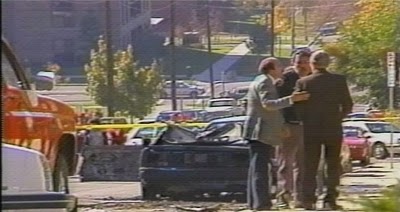 Hofmann opened his letter to the Utah parole board with this amazing statement:
“These are some of my thoughts concerning my crimes and how I became what I am. As far back as I can remember I have liked to impress people through my deceptions. In fact, some of my earliest memories are of doing magic and card tricks. Fooling people gave me a sense of power and superiority. I believe this is what led to my forging activities.”
You can read the whole letter (in PDF format) here.
For those of you who have studied early Mormon history (pre-revisionism), I am certain that you find the same irony in this quote as I did: This quote could easily be ascribed to Mormonism’s founder, Joseph Smith, and it would be just as accurate and apropos.
It’s true that the fruit never falls far from the tree.
(FILE | The Salt Lake Tribune) Mark W. Hofmann, left, and LDS Church leaders N. Eldon Tanner, Spencer W. Kimball, Marion G. Romney, Boyd K. Packer and Gordon B. Hinckley examine the Anthon transcript April 22, 1980.
 Catholics are taught to believe a miracle has occurred when the inner essence of the host (wafer) is changed into the body and blood of Christ even though it still looks and tastes like a wafer. Can you think of any miracle in the Bible that never appeared to happen?
 Your sermon of the week is
  He that desires to read his Bible with profit, must first ask the Lord Jesus to open the eyes of his understanding by the Holy Spirit. Human commentaries are useful in their way. The help of good and learned men is not to be despised. But there is no commentary to be compared with the teaching of Christ. A humble and prayerful spirit will find a thousand things in the Bible, which the proud, self-conceited student will utterly fail to discern.
 DefCon begins our 2011 weekly sermons with a new series by Phil Johnson on the subject of the Ten Commandments.
 Consider the call of the Throne above, “Go ye,” and from round about, “Come over and help us,” and even the call from the damned souls below, “Send Lazarus to my brothers, that they come not to this place.”
 The Bible is God-centered. Psychology is man-centered. The Bible teaches that our purpose in life is to glorify God. Therefore, everything else is subject to that purpose. Psychology, being man-centered, has as its highest goal the happiness of the individual. This is the foundation for the current emphasis on felt need. If mankind’s greatest goal is his own happiness, then all other things in life, including God, become means to secure that happiness. . . . This worldview is completely at odds with the biblical worldview. Since this is true, to offer God or salvation as the means whereby our felt needs are satisfied is a perversion of biblical teaching at best, and more likely a false gospel.


 Christ Alone Wyoming