
 Your sermon of the week is Honoring Authority. This is part six of a fantastic series on The Ten Commandments by Phil Johnson. Look for the next installment in two weeks.
Jesus Christ
Morality without God?
 The following article is from World Magazine:
Confirmation of biblical wisdom came earlier this fall from an unlikely source: an Ivy League savant who says it’s wrong to depend on the Bible.
The prestigious Oxford University Press sent me the new book Morality Without God by Walter Sinnott-Armstrong, a Dartmouth professor. (I’m going to quote him a lot, so I’ll use his initials.) WSA begins by complaining that his students quote to him Dostoevsky’s favorite line, “If God is dead, everything is permitted.” WSA then argues that we don’t need God: We all should simply agree not to harm others—cause death, pain, or disability—unless there is “adequate reason.”
Wondering if WSA is one of those exceedingly rare secular professors with the courage to be pro-life, I emailed him to ask. He responded that there is no “simple solution to this complex problem . . . the moral problem of abortion cannot be solved by citing religious texts or religious leaders.”
Hmm . . . How can it be solved? WSA wrote, “What matters is the present and future harm to the fetus and others. This does not solve the problem, but it tells us where to focus our discussions. I hope this helps.”
Hmm . . . It helps only if WSA can tell us how to compare “harm to the fetus” (death) to other harms, so I emailed him again. He responded, “The bottom line is that I think some moral problems are insoluble. . . . They are just too difficult for us to figure out. . . . The answer, ‘I do not know,’ should become common.”
Read the entire article here.
Sermon of the week: “Remember the Sabbath” by Phil Johnson.
Your sermon of the week is Remember the Sabbath. This is part five of a fantastic series on The Ten Commandments by Phil Johnson. Look for the next installment in two weeks.
Roman Catholicism’s competition in Mexico.
 I recently read an article about cults in Mexico that I found absolutely fascinating. It seems that the Roman Catholic organization is experiencing some competition in one of their stronghold nations.
Here’s a quote from the article about the growing worship of fictional drug-trafficking saint, Jesús Malverde:
“The emotional pressures, the tensions of living in a time of crisis lead people to look for symbolic figures that can help them face danger,” says José Luis González, a professor at Mexico’s National School of Anthropology and History who specializes in popular religions. Among the helper figures are Afro-Cuban deities that have recently found their way to new shores and outlaws that have been transformed into miracle workers, like a mythical bandit from northern Mexico called Jesús Malverde. There are even saints from the New Testament repurposed for achieving not salvation but success. In this expanding spiritual universe, the worship of a skeleton dressed in long robes and carrying a scythe—La Santa Muerte—is possibly the fastest growing and, at first glance at least, the most extravagant of the new cults.
There’s a reason for God’s prohibition against graven images and the bowing down to them. Our hearts are truly idol factories and here’s an example of how one such idol was created:
Eligio had been working as a driver in 1976 when he was knifed and shot in a holdup and left for dead. He prayed to Malverde, whose only monument at the time was a pile of rocks where his grave was said to be, promising to erect a proper shrine in Malverde’s honor if the saintly bandit saved his life. When he survived, he kept his word. González appears to have understood that people would grasp Malverde’s real importance only if there were an image of him they could worship, but unfortunately no photograph of Malverde existed—and, in fact, no evidence at all that he’d ever lived. In the 1980s González asked an artisan in the neighborhood to create a plaster bust: “Make him sort of like Pedro Infante and sort of like Carlos Mariscal,” Infante being a famous movie star from Sinaloa and Mariscal a local politician.

 And then there’s the skeletal idol of death known as La Santa Muerte reminiscent of the Grim Reaper:
Antonio explains what gives La Santa Muerte her powerful attraction: “La Muerte is always beside you—even if it’s just a little postage stamp that you put up above your cot, you know that she’s not going to move, that she’ll never leave.” . . . El Niño and Antonio say just that La Santa Muerte will grant your prayers—but only in exchange for payment, and that payment must be proportional to the size of the miracle requested, and the punishment for not meeting one’s debt to her is terrible.
I find it ironic that the official position of the Roman Catholic organization is in opposition to the worship of Jesús Malverde and La Santa Muerte when they are one of the worst offenders of idol worship around and seem to have no problem when the idol being worshiped is one that they’ve created.
Mexicans who retain a strong connection to the Roman Catholic faith might turn instead to St. Jude Thaddeus. At a time when no-win situations abound, he is experiencing a rise in popularity comparable only to that of La Santa Muerte, perhaps because he is known in the Catholic Church as the patron saint of desperate causes. . . . St. Jude’s official feast day is October 28, and thousands of his followers feel inspired to come and pray to him on that day every month. Sixteen Masses are celebrated in the parish from dawn to evening, and worshippers crawl to the statue of the saint on their knees, praying for help, protection, and survival.

But let me caution you, before we look down on these souls in Mexico who are steeped in idol worship, let us not forget that we in America are equally as guilty of this sin; our idols just come in different forms (cars, sports, money, status, possessions, self, etc.).
To read the entire National Geographic article (and to view more pictures) visit National Geographic online.

Sermon of the week: “What’s In A Name?” by Phil Johnson.
Your sermon of the week is a wonderfully convicting message by Phil Johnson entitled What’s In A Name?
I say “wonderfully convicting” because it really opened my eyes to what it means to “take the Lord’s name in vain” and challenged me to be even more vigilant to keep His name holy and unprofaned.
Warning: Fans (and defenders) of Mark Driscoll will probably not like this message because Johnson doesn’t beat around the bush regarding Driscoll’s mouth.
This current installment is from Johnson’s series on the Ten Commandments that we are currently featuring on DefCon every other week as your Sermon of the Week (on Thursdays).
Sermon of the week: “A Jealous God” by Phil Johnson.
Your sermon of the week is A Jealous God by Phil Johnson. This is the next installment of Johnson’s series on the Ten Commandments that are being featured on DefCon every other week as your Sermon of the Week (on Thursdays).
Paul Washer: “We haven’t even got the foundation straight.”
A proper response to How to make a false convert.
Quotes (854)
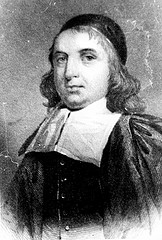 We must mourn more for the sin of a child than for the sickness of a child . . . more for fear they died in sin, than because they died.
– William Jenkyn
1613 – 1685
A video for Nikki.
In response to Chuck Smith’s worldly and utterly unbiblical counsel to Nikki, I offer this video of baby Elliot who (according to doctors) wasn’t supposed to make it to birth. I pray that this video finds its way to Nikki before it’s too late.
First posted on DefCon on July 7, 2008
Sermon of the week: “No Graven Images” by Phil Johnson.
Your sermon of the week is No Graven Images by Phil Johnson. This is the next installment of Johnson’s series on the Ten Commandments that will be featured on DefCon every other week as your Sermon of the Week (on Thursdays).
The Daniel Plan.
 Rick Warren’s Daniel Plan has begun and Jennifer Pekich was there for its inception. Her report from inside the lion’s den (pun intended) can be found here.
Here’s a quote from her article:
Following Dr. Hyman’s talk my best friend arrived to observe the day with me, only to hear Dr. Amen mention in his presentation that he did a brain scan on one of his clients who had a habit of cheating on his wife. The brain scan showed that there were “holes in the pre-frontal cortex of his brain” which controls the impulses. In other words, this man wasn’t sinful, he was “mentally ill.” All he needed was to get on the “Change Your Brain, Change Your Body” program and his personal struggles with sin were remedied. Once again Jesus was removed from the equation. My friend and I were dumbfounded when we listened to the Saddleback crowd cheer. My best friend couldn’t contain it any longer and let out a, “You’ve got to be kidding me!”
The best quote from Jennifer’s article, however, was when she made this observation of the event:
I have to admit that visions of the masses being manipulated by Adolf Hitler’s oratory skills came to my mind, only this particular crowd had just been manipulated by a really bad infomercial.
You can listen to Jennifer’s interview about her visit to Saddleback here on the Crosstalk radio show. You can also read an article on this event by Lighthouse Trails here and another article by Marsha West here.
Unbelievable abortion counsel from Calvary Chapel’s Chuck Smith.
Chuck Smith’s advice: God will be with you while you kill your child and He won’t condemn you for it.
Voddie Baucham’s reaction to this ungodly counsel (from Facebook):
I must admit that this one made me ANGRY! I’m on the road preaching at a pro-life banquet and someone sent me this YouTube video of Chuck Smith (founder of Calvary Chapel) giving abortion advice that made me want to throw something (or someone). This woman is agonizing right now over this decision, and a pastor just told her Jesus would be alright with her killing her children. Please pray for her.
Here is a video for Nikki to help encourage her to do the right thing in her decision; and this same video is for Chuck Smith to encourage him to repent and retract his worldly, unbiblical position:
Sermon of the week: “A Final Word” by Angelo Sanchez.
 What message would you deliver to your congregation if it was your final sermon after twenty years as their pastor?
Find out what candid words of exhortation and warning Pastor Sanchez has for not only his congregation but also for the pastor taking his place in the message A Final Word.
This message delivered to his congregation after two decades of service is very revealing and should be heard by all pastors and their congregations, especially new pastors entering into ministry.


Sermon of the week: “No Other Gods” by Phil Johnson.
Your sermon of the week is No Other Gods by Phil Johnson. This is part one (minus two preludes found here and here) of Johnson’s series on the Ten Commandments that will be featured on DefCon every other week as your Sermon of the Week (on Thursdays).
This is a great series that you won’t want to miss.
Sermon of the week: “The Breadth of God’s Moral Law” by Phil Johnson.
Your sermon of the week is The Breadth of God’s Moral Law by Phil Johnson. This is the second installment on Johnson’s series on the Ten Commandments that will be featured every other week as your Sermon of the Week (on Thursdays).
This sermon (like the first one in this series) is a prelude to getting into the study on the Ten Commandments themselves. In two weeks Johnson will get into the first commandment.
If James contradicts Paul, then James also contradicted himself.
 For a long time I struggled with the second chapter of the letter of James. I had great difficulty reconciling what James was saying with the rest of Scripture. I would listen intently to any preacher who was expositing this chapter of James for an explanation but their answers never seemed to satisfy me regarding the seemingly irreconcilable views James taught.
I know that I was not alone in this quandary as I’ve often heard the declaration that when it comes to the issue of justification, “James contradicts Paul.”
The most vocal proponents of James’ alleged doctrine that faith and works are required for justification are known as the works-righteousness crowd. (Think: Jehovah’s Witnesses, Mormons, and Roman Catholics.)
Whenever the subject of justification by grace alone through faith alone in Christ alone comes up, these groups immediately run to James chapter two as their proof-text that you must do your part in conjunction with God’s part in order to bring about your redemption.
And granted, they do make a convincing argument, for it appears that’s precisely what James is saying. However, the opposing argument (faith alone through grace alone) can be made with equal tenacity based on a plethora of Paul’s teaching.
In relation to the totality of all of Scripture, this polemic goes beyond just Paul and James, but the gist of the debate can be summed up most succinctly by the following two verses:
James:
“You see that a man is justified by works and not by faith alone.” – James 2:24
Paul:
“For we maintain that a man is justified by faith apart from works of the Law.” – Romans 3:28
These two axioms really only leave us with three possible options:
A). James is teaching that salvation is by faith and works (and conversely, so is Paul).
B). Paul is teaching salvation is by faith apart from works (and conversely, so is James).
C). The two men contradict one another and thus, the Bible contradicts itself.
 If “C” is the answer to this dilemma, then the Bible is worthy of the trash heap and we should all get together to eat, drink, and be merry, for tomorrow we die.
For those of us who understand that “C” is not a viable option, we’re only left with options “A” and “B.” So, to determine which is the correct interpretation we must resort to the old practice of letting Scripture interpret Scripture.
In this post I will attempt to prove—in eight points—that not only do James and Paul agree that salvation is by faith apart from works (i.e. alone), but that if James is actually teaching that your obedience to the law and/or your practicing of good works contributes to your salvation, then he would not only be contradicting Paul, but he would also be contradicting himself!
Let’s begin.
Sermon of the week: “The Preeminence of God’s Moral Law” by Phil Johnson.
DefCon begins our 2011 weekly sermons with a new series by Phil Johnson on the subject of the Ten Commandments.
We begin with one of two preludes to the Ten Commandments entitled The Preeminence of God’s Moral Law. We will continue with this series every other week.
Jesus Our High Priest – Part 20 (Conclusion)
 We are pleased to continue the Saturday Sermon Series again. This is the final (part 20) in a series of twenty messages from John 17. It was sovereignly delivered by Akash Sant Singh, who is one of the elders at Community Bible Church in Reno, Nevada. May it bring conviction to each of us as we realize our deep lack of prayer, which should be elemental to our Christian faith. Sadly, our prayer lives tend to reveal more about our self-sufficiency than of our utter dependency on the Saviour of our souls.
In conclusion: My final post on Christmas.
 In this, my last post on the subject of Christmas, I wanted to share some final thoughts.
When I first posted my reasons for not celebrating Christmas (found here) I never imagined the furor it would cause. Although I was grateful to see much healthy dialogue on the subject, and equally grateful for those readers who are beginning to examine this matter for themselves, that gratefulness was eclipsed by how the discussion disintegrated into vitriolic arguments, including threats of violence (as seen in the comments section of this post on the origins of Christmas).
Watching the exchanges deteriorate as they did grieved me. I simply wanted to present my thoughts to the readers in the hopes that they too would begin to wrestle with the subject: Not to debate about whether or not we have liberty to celebrate the holiday, but “why as Christians do we celebrate it?”
It was certainly never my intent to cause discord or division among the saints. And because of that I want to apologize to those who witnessed the graceless exchange.
In my original post on Christmas I provided two primary reasons for choosing to no longer celebrate the holiday. I spent only 305 words mentioning the Romish and pagan origins of the holiday and 1,143 words (not counting the conclusion) discussing the other reason–namely the greed, covetousness, and the massive amount of money spent on ourselves while much of the world is starving for food, water, and the gospel. Unfortunately the overwhelming majority of the comments on DefCon over the past month has focused on the 305 words and not much was mentioned regarding the other 1,143 words. The latter reason, I feel, is just as important to consider as the former.
Where words fail in communicating a point sometimes images can help. For this reason I have chosen to share the following video as an illustration of why I have such a hard time with me–as a Christian–partaking in the festival of Christmas. How can I justify to myself, my children, my family, and ultimately God, that spending more money on vain material items under the guise of celebrating the birth of the One who gave up so much for us, is actually a good thing?
When I consider how the family in this video (one of countless families throughout the world) spends their Christmas–and every other day of the year–it makes a pile of needless presents sitting under a pretty tree seem rather pointless, selfish, and almost . . . sinful.
On this Christmas I want to introduce you to Sam, Esther, and Jane of Uganda:
It has been (and continues to be) my hope and prayer that we each examine our reasons for celebrating Christmas. It is also my hope and prayer that this issue will not divide us and that I will never develop a judgmental or better-than attitude toward those who choose to continue marking the holiday.
In conclusion I ask that you ponder with me this final thought: What would you and I prefer to be caught doing if the Lord came back during next year’s Christmas season?
1). Standing in a long line at Wal-Mart purchasing a large pile of soon-to-be-forgotten presents placing us further in debt in order to celebrate a holiday birthed from an unholy union between Rome and pagans celebrated by much of the unbelieving world in which–no matter how hard we try to avoid it–Jesus gets relegated to a sentimental byline–crowded out by the hectic activities, gluttonous parties, and greed of the season, all (supposedly) in honor of Jesus Christ’s incarnation?
2). Or would you and I prefer to be found using our time, money, and resources to help those like Sam, Esther, and Jane (not just at Christmas but all year long) by putting food and water in their bellies, a Bible in their hand, and a faithful missionary preacher in their midst?
You all know where I stand on the issue . . . I just ask, will you join me?
May the Lord receive the reward for His suffering.
– Pilgrim
Jesus Our High Priest – Part 19
We are pleased to continue the Saturday Sermon Series again. This is the nineteenth in a series of twenty messages from John 17. It was sovereignly delivered by Akash Sant Singh, who is one of the elders at Community Bible Church in Reno, Nevada. May it bring conviction to each of us as we realize our deep lack of prayer, which should be elemental to our Christian faith. Sadly, our prayer lives tend to reveal more about our self-sufficiency than of our utter dependency on the Saviour of our souls.
 Christ Alone Wyoming