 Obedience to the great commission has more consistently been poisoned by affluence than by anything else.
– Ralph Winter
1924 – 2009
 Obedience to the great commission has more consistently been poisoned by affluence than by anything else.
– Ralph Winter
1924 – 2009
 God, I pray Thee, light these idle sticks of my life and may I burn for Thee. Consume my life, my God, for it is Thine. I seek not a long life, but a full one, like You, Lord Jesus.
– Jim Elliot
1927 – 1956
 It is not your hold on Christ that saves you; it is Christ. It is not your joy in Christ that saves you; it is Christ. It is not even your faith in Christ, though that be the instrument; it is Christ’s blood and merit.
– Charles Spurgeon
1834 – 1892
 Not, how much of my money will I give to God, but how much of God’s money will I keep for myself.
– John Wesley
1703 – 1791
 The Roman Catholic Church teaches that infants are forgiven of original sin when a priest pours water over the baby in the sacrament of baptism. There are two serious problems with this practice. First, there is no occurrence of infant baptism in the New Testament, and second, one must believe in Jesus in order to be forgiven. Clearly a baby cannot respond in faith to the Gospel and thus be forgiven.
– Mike Gendron
 Does any Christian reader imagine for a moment that when he or she shall stand before their holy Lord, that they will regret having lived “too strictly” on earth? Is there the slightest danger of His reproving any of His own because they were “too extreme” in “abstaining from fleshly lusts, which war against the soul” (1 Peter 2:11)? We may gain the good will and good works of worldly religionists today, by our compromising on “little points,” but shall we receive His smile and approval on that day? Oh to be more concerned about what He thinks, and less concerned about what perishing mortals think.
– A.W. Pink
1886 – 1952
 We speak with disdain of politicians not limiting their spending to available revenues. But our national debt is an extension of the same irresponsible mentality many of us demonstrate in our own lives. Home mortgages, auto loans, and credit cards all seem normal to us . . . . We drive our bank-financed cars, running on credit card gas, to open a department store charge account so we can fill our savings and loan-funded homes with installment-purchased furniture. We’re living a lie and hocking the future to finance it.
– Randy Alcorn
 We conclude our eight-week series on the radical demands of the gospel by David Platt with the final message, The Gospel Demands Radical Abandonment (C).
To obtain the entire series (or watch the videos of these sermons) visit Disciple Making International.
 The Puritan/Presbyterian wing of the Reformation accomplished a purity in worship not seen since the apostolic church. This purity was attained by making the Scriptures of the Old and New Testaments the only infallible standard and authority in determining worship ordinances. Any ordinances solely based on church tradition or man’s authority were discarded. However, this purity attained by our spiritual forefathers has, with the passage of time, been cast aside. Pragmatism, tradition and human opinion are exalted in determining how God’s people are to worship Him. The attitude among many in church leadership positions is to give the people what they want, rather than to submit to God’s divine revelation. . . . . God has set down in Scripture how He is to be worshiped. Man is not to add to or detract from what God says. . . . .
 . . . [W]e must restore to the family the responsibility of ministering to youth. In many churches–but by no means all–the purpose of the youth group is founded on premises that are an impediment to the training of godly children. Some of these false premises are: 1) That young people need a place where their problems are understood–where others of the same age share the same struggles; 2) that as it is often difficult for parents to communicate with and understand their teenagers, a youth leader who can identify with the young people is needed; 3) that it is important for young people to have fun and to see that “church people” have fun too; 4) that a youth group is needed to reach unsaved youth, and by getting them involved in fun activities, they will be more receptive to the presentation of the gospel.
Following the trends of secular culture, age-segregated groups have been established in church educational programs. Christopher Schlect, in his book Critique of Modern Youth Ministry, explains that the “divisions breed immaturity because they hinder younger people from associating with and learning from their elders.” The group can become the source of authority, thus diminishing the authority of the father and mother.
– William & Colleen Dedrick
From: The Little Book of Christian Character & Manners
 . . . [M]any go away from the “altar [call],” told that they are now Christians, knowing that they are not changed one bit. As a result, their unbelief may harden into skepticism toward anything Christian.
R. L. Dabney notes:
“They feel that a cruel trick has been played upon their inexperience by the ministers and friends of Christianity in thus thrusting them, in the hour of their confusion, into false positions…. How natural to conclude that those [experiences of conversion] of all others are delusions also? They say: ‘The only difference between myself and these earnest Christians is that they have not yet detected the cheat as I have.'”
The extension of an appeal for public decision may result in a purely psychological response that provides a catharsis for the emotional pressure of the sermon. Such persons falsely assume that their action has made them right with God. In others, it may drive them further into skepticism and doubt about the reality of the conversion of anyone. Such dangers ought to alarm every person sincerely concerned about the salvation of lost souls.
 We continue our Radical Saturday sermon series with part seven of eight: The Gospel Demands Radical Abandonment (B) by David Platt.
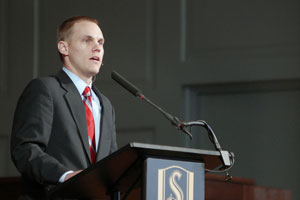 We continue our Radical Saturday sermon series from David Platt with part six, The Gospel Demands Radical Abandonment (A).
We are in week five of our eight-week series on Radical. What makes today’s message, The Gospel Demands Radical Giving, so important is that in it David Platt answers many of the criticisms levied against him.
If you dislike the message Platt is delivering in this series and you refuse to listen to it because you think Platt believes that Christians who give away more are better than those who don’t; you think Platt “guilts “people into giving to the poor (and keeping less for ourselves); you think Platt believes the rich man was in Hell because he had money and Lazarus was in Heaven because he was poor; you think Platt is advancing a works-righteousness gospel; or any of the other baseless judgments that have been levied against him for daring to touch American Christianity’s golden calf of affluence, then please listen to this message so you can better understand his heart and his message.
I don’t wish for the “controversy” surrounding Radical to overshadow the message Platt is giving, but the criticisms must be answered and in this particular message Platt does just that (most of which is done in the first 14 1/2 minutes of this message).
 Today we bring you part four in the series Radical. Today’s message is The Gospel Demands Radical Urgency by Chris Nichols.
We continue our Saturday sermon series from David Platt. The Gospel Demands Radical Compassion is part three in this eight-part series.
This series was the inspiration for Platt’s book, Radical.
Here is the description of the series:
“In the same way, any of you who does not give up everything he has cannot be my disciple.” With these words, Jesus turned away large crowds who were following Him. With grace and authority, He beckoned potential followers to consider the demands of discipleship. For most, the price was too high and the cost was too great. In the 2000 years since Jesus spoke these words, it begs the question: Do we in contemporary Christianity realize the high price of following Jesus? Do we understand the great cost for all who call themselves followers of Christ? Take a closer look at the words of Jesus that require us to consider the implications of the Gospel for every facet of our lives.
We continue our Saturday sermon series with the second installment from David Platt’s series Radical which inspired the book by the same name.
This week’s message is The Gospel Demands Radical Sacrifice (you can find last week’s message here).
This sermon series is one of the most sobering and deeply challenging that I’ve ever listened to. I have found it to be incredibly convicting and trust that you will too.
Yes, I’m going to do it. Starting today I am going to post a series of sermons so weighty and so sobering that I dare say they rival any other sermon ever presented on DefCon in the area of depth of conviction. If you don’t believe me, I dare you to listen to today’s message (part one in the series) entitled What the Gospel Demands.
For the next eight Saturdays I challenge all the readers of DefCon to listen to this series. Some of you will be glad you did, but some of you may be angry with what you hear and refuse to listen to any more after today.
I expect some to be repentant due to deep conviction after listening to this message. And I even expect some to be very angry due to that same conviction after listening to this message. But I can’t fathom anyone being indifferent to this message.
I warn you, though, this series will end on Saturday, December 24th, and more than likely it will damper your current view of the upcoming self-indulgent Christmas festivities.
The gospel reveals eternal realities about God that we would sometimes rather not face. We prefer to sit back, enjoy our clichés, and picture God as a Father who might help us, all the while ignoring God as a Judge who might damn us. Maybe this is why we fill our lives with the constant drivel of entertainment in our culture—and in the church. We are afraid that if we stop and really look at God in His Word, we might discover that He evokes greater awe and demands deeper worship than we are ready to give Him.
– David Platt

A lesson for all of us to consider from the puritan Joseph Meade:
I once walked into a garden with a lady to gather some flowers. There was one large bush whose branches were bending under the weight of the most beautiful roses. We both gazed upon it with admiration. There was one flower on it which seemed to outshine all the rest in beauty. This lady pressed forward into the thick bush, and reached far over to pluck it. As she did this, a black snake, which was hid in the bush, wrapped itself round her arm. She was alarmed beyond all description; she ran from the garden, screaming, and almost in convulsions. During all that day she suffered very much with fear. Her whole body trembled, and it was a long time before she could be calmed. That lady is still alive. Such is her hatred now of the whole serpent race, that she has never since been able to look at a snake, even a dead one. No one could ever persuade her to venture again into a cluster of bushes, even to pluck a beautiful rose.
Now this is the way the sinner acts who truly repents of his sins. He thinks of sin as the serpent that once coiled itself around him. He hates it. He dreads it. He flees from it. He fears the places where it inhabits. He does not willingly go into the haunts. He will no more play with sin than this lady would afterwards have fondled snakes.
 Christ Alone Wyoming