We Are Family

Last night, I was thinking about my family. I have five younger siblings. As I’ve watched them grow into adulthood, it’s been interesting how different we all are. We have different music interests, movie likes, convictions, etc. And yet we also share memories, stories, private jokes. I think deep down we also have a commitment to not allow things to become so mountainous that it negatively affects our relationship. Sure, we might strongly disagree with each other but most of our disagreements are not worth losing the friendship we have.

bodyofchrist

This is how the Body of Christ should be as well. If we really understood that “we, though many, are one body in Christ, and individually members of one another” (Romans 12:5), maybe we would cherish each other more. If you were in an accident and lost your hand, you would no doubt try to find it and take it to the doctor to see if he could sew it back on. Yet, when a Brother or Sister cuts himself or herself off from the Body, we hardly notice. We may even think “good riddance.” I wonder if we would see more people come to know the Lord if they saw genuine love and care from God’s people.

This coming year, let’s ask God to give us greater hearts of love. Ask Him to give you His heart for those around you. I believe you would begin to look at people differently than you ever have before. God doesn’t look on a person’s outward appearance. He looks at the heart. We must learn to do that as well. As we draw near to Him, I believe He will help us to do so.

Desiring to Change

My “must watch” Christmas movie the last few years has been A Christmas Carol with George C. Scott. I realize that it can be spooky and a bit scary for some, but it is thought provoking and has a great message if you can get past the eeriness.

I’m sure almost everyone is familiar with this classic about Ebenezer Scrooge, the mean, selfish, wealthy miser who cares nothing for anyone but himself and despises Christmas as a day when people want to deprive him of his hard-earned money. The thing that makes this story great, however, is that it does not end on that note. By the end of the story, Mr. Scrooge realizes that, “If those courses be departed from, the end must change,” and he becomes willing to make those changes. The next morning (Christmas day), no one recognizes him as the man they had seen the day before. Sure, he looks like himself, but he does not act like Mr. Scrooge at all. He is a new person, and it is noticeable to everyone he comes in contact with.

newcreation

Wouldn’t it be nice if everyone changed that easily? We all have roots of pride and selfishness but, many times, we choose to ignore them and fail to see what effect those things are having on others.

“We know that our old self was crucified with him in order that the body of sin might be brought to nothing, so that we might be enslaved to sin” (Romans 6:6).

“And he died for all, that those who live might no longer live for themselves but for him who for their sake died and was raised” (2 Corinthians 5:15).

When we come to know the Lord, Christ begins to live in and through us. We become a new creation as old things pass away (2 Corinthians 5:17).

My prayer this coming year is that people see more of Christ and less of me. I don’t want to hang on to any “sin that so easily ensnares” (Hebrews 12:1). This week, as the year winds to a close, I encourage you to take the time to look at your life. Are you doing what God wants you to do? Are you impacting people for His Kingdom? Are you walking in faith and victory, full of anticipation for what God is doing in your life, or are you depressed and downhearted? These are questions I am asking myself. It’s not easy but I am making myself be quiet and trusting that God will continue to speak to me this week. I hope you will take time to do that as well. The world desperately needs to see God’s people walking differently than the rest of the world. God, help us to desire to change!

My Strength and My Portion

Psalm 73:25-26 Whom have I in heaven but thee? and there is none upon earth that I desire beside thee. My flesh and my heart faileth: but God is the strength of my heart, and my portion for ever.

As I look back over my life I am struck by the many times I’ve failed the Lord and others. I’m also struck by the many times family and friends have failed me. Each thing that I do is tainted with sin even when I think I’m doing things for the right reasons.

Whom have I? I think I have friends and family that will love me and never let me down but they let me down. I think I will be able to move forward and never let the Lord down or my friends and family yet I continue to do so. The reality is that I have no one except the Lord Who never lets me down. He is the only One!

Whom have I in heaven? Everything in this life points to the Lord Jesus Christ no matter what it is. The look of love from your sweetheart, the great fellowship within the church, the time of rest given where you recuperate from the cares of life, a wonderful day in which everything goes right, etc. are all pointers to the Person Who made all these things possible. Each gift we receive is from the Lord and should point us to the Lord. Our response should be total and complete adoration of God, the Giver of all good and perfect gifts. James 1:17

Whom have I in heaven but Thee? People will fail you so you cannot keep your focus on them, it must be on the Lord. Leaders can fail and preach something that is contrary to the Word of God but we are to study God’s Word so we know God Himself. This will keep us from falling into the trap of false teachers. How do I know which teacher is false and which is true? The Word of God gives me discernment as I study it. I don’t study the Word of God just to gain discernment. I study it so I will know God and, in knowing Him, I discern who is teaching truth and who is teaching lies.

jesussatisfies

So the question is, Whom have I in heaven but Thee? This leads into the answer, there is no one but the Lord. Not only in heaven but on earth. There is none upon earth that I should desire beside Thee. If anyone or anything comes before the Lord then we are in sin against God. Our love, worship, and adoration of Him should be such that everyone and everything we care about is like hate compared to our love for Him.

There is none anywhere whether in heaven or on earth that should be so adored as our Lord and Savior Jesus Christ. No one should be so desired as He. As we struggle through each day what can we find that is so desirable? Can the world satisfy us? Can our flesh satisfy us? Can others satisfy us? Can addictions satisfy us?

No! A thousand times no! My flesh fails me all the time. When I think I found something that makes my flesh happy and satisfied, it crumbles like the dust and soon I have nothing but bitterness and sin. My heart fails me, as well. The Bible is clear that my heart is wicked and sinful. Jer. 17:9. It is totally corrupt and nothing good about it. My flesh and my heart fails me continually but….surely something satisfies?

Yes, God is the strength of my heart and my portion forever! So, in finishing up contentment we find that only the Lord can satisfy. When I was a child, a song came out that we sang a lot at church and home.

Only Jesus can satisfy your soul.
Only He can change your heart and make you fully whole.
He’ll give you peace you never knew
Sweet love and joy, and heaven, too
For only Jesus can satisfy your soul.

The Lord is the only way to true satisfaction and contentment. He’s the only way to be able to change and grow, whether physically or spiritually. He is the Way, the Truth, and the Life! Nothing and no one can live apart from Him because, in Him we live, and move, and have our being. Acts 17:28. Praise God that He is the strength of our hearts, those who are true believers, and our portion forever to make into the image of the Lord Jesus Christ! Amen!

Speaking Graciously

Truth in grace. I love the new blog title. I’ve said for years that some people have no problem “speaking the truth” (or what they perceive that truth to be) but they forget the “in love” part.  If we love each other, our words will be “gracious, seasoned with salt, so that you may know how you ought to answer each person” (Col. 4:6).

col46

People complain about the internet being a place where some say things that they would never say to a person’s face. I personally love this mode of communication because it gives me time to think through how to respond to a person or situation. Not that I always do it perfectly, but I have the opportunity to slow down and allow God to speak through me as opposed to speaking off the top of my head words that might be full of pride and ignorance.

Whatever we do, whether in word or deed, we are to do it to the glory of God (Col. 3:17). I pray that I will never lose sight of that truth.


Contentment

Contentment…this can be a difficult subject both in learning and in life. This is something the Lord wants each of His children to learn, it is also something we should be willing to take great pains to learn. What is even harder but should be concerning to each of us who are the children of God is contentment in the midst of trials. You see, contentment in the Lord seems to be simple enough.

The Lord uses each situation for us to learn dependence on Him and a desire to fulfill His will. Yet, in the midst of that, as the backdrop of life, the trials we face are there for us to learn to be contented in the midst of that specific trial knowing Who is in control and the plans He has or us is not only for His honor and glory but also for the good of those who love Him and are called according to His purpose.

The Lord clearly told His disciples that the servant is not above the Master and if the world hated the Master and treated Him horribly then it would treat His servants just as bad, if not worse. As we grow in the grace of the Lord we find that life does not get easier but harder. Each trial or tribulation we face is that much harder than the last but, for each one, we are given the grace and strength to get through.

contentment-newlife

When we fight the Lord, instead of gracefully letting Him have His way, we find that the way is so much more difficult than it should be. Fighting only brings anger and frustration our way instead of the peace that passes all understanding. It becomes easy to fume and fret about what we have to face in life. Instead of having a quiet spirit that comes from the Lord, we then have a complaining and fretful spirit. This brings us to a point of having to be disciplined by the Lord.

As the trial or tribulation comes into our lives we begin fretting and fuming that we don’t want it to happen. We were content for things to be as they were and yet it takes those trials to make us more like the Lord Jesus Christ, to grow in faith.

Many times we are like the child that grows impatient and demands their own way when things are not done exactly the way they want them. They sulk and throw temper tantrums because they think that all should be exactly as they would have it, not as the parents know is best for them. They want the candy, the fruit, the dessert, the sweets, the play time, the whatever the case may be instead of spending their time studying, or wanting to eat the proper and healthy foods the parents know they should have so they will grow up strong and wise.

The Lord knows exactly what we need in our lives to make us wise and strong believers. To fret against His wise bestowments (wise even in the midst of our trials) tells Him that we love this world more than Him. How can we desire the world above Him? Is wealth, comfort, life, health, friends, entertainment, sports, family, or anything else more important than Him? To put anything before Him is to worship the created thing more than the Creator, who gave His only begotten Son for our worthless souls.

As each trial comes into our lives let us be willing to thank the Lord for what He taught us already in the past trials and be willing to trust that “God is good all the time and all the time God is good.”

Moving Forward

Hello Brothers and Sisters,

Of recent times, I have been doing much soul-searching in particular as it applies to Defending Contending. I have seriously considering everything from closing it down to transferring ownership to another person. However, the more I have considered this, the more tense I became. This was not because it has been mine for so long, but because this has been an opportunity that the Lord has used to help me to grow and to be able to share with others. I have been writing at Defending Contending for 9 years come the end of January 2017.

During that time, there have been things I have both read and written that I have cringed. There are posts written that have caused my heart to break before the Lord and I have had to seek repentance for my own stubbornness and lack of Christ-likeness. We have gained many viewers and lost more than we have gained. I believe that we are in a state of flux within evangelical Christianity and my heart has long been to reach out to our readers in a way that still point out the truth without being hateful, spiteful, or vitriolic in any manner even when we disagree with others.

With that in mind, I believe for the time being that a change in direction will be a profitable move. I want to lay these out just briefly.

climateoftruth

1. A new name – Truth In Grace — Reason is simply because we are truly called to preach and teach truth, but I believe we are called to do so with grace. The new picture on the website says, “Truth without grace is a prison; Grace without truth is chaos.”
2. A new tagline – “Sharing truth and faith in a spirit of love and grace.”
3. A new direction with posts
4. Additional contributors — I have just this evening reached out to two people that I believe could be a blessing to our readers.

I believe that this new direction, name change, and tagline are still very much in line with where The Pilgrim was going with the blog when he started it. Yes, we have all had to learn and I pray this will continue to reach others with a gracious spirit years in to the future.

However, I know that with the additions and changes, there will be other differences to deal with which is another reason for writing. Not all of us, even now, are in full agreement on every aspect of doctrine. I have no doubt that our differences are not salvific in nature, but I also understand that can be debated by some if they choose a hard line on some points.

For example, through the ages, men like Spurgeon, Sproul, MacArthur, Wilkerson, Conway, Baucham, Lloyd-Jones, etc. would have all agreed on many points of foundational truths that are unassailable, but they would have disagreed on some doctrines that, in my humble opinion, do not make a difference in whether a person is a true believer or not. Another example would be where Lloyd-Jones stood on the work and role of the Holy Spirit as compared to say Sproul or MacArthur. Yet, I have no doubt that they would have been gracious to each other and would have learned from each other.

Many of you know that I hold to the doctrines of grace, but it is not a drum that I have ever made a point of beating others up on. I can respectfully agree to disagree with another and still call them my brother or sister in Christ. I can disagree on things like family integrated or Sunday school, or in the style and meaning of missions, or in the version or music styles I choose to use and still call the other side of the coin a brother or sister in Christ.

Not everybody who has or who will write at DefCon are staunch Calvinists. Each of us are at different points in our Christian walk, and even one who is mature in the faith in many areas can still have much to learn as though they were a new believer. Brothers and sisters, as I get older, my heart’s desire is that my mind would be brought into closer communion with the Lord of glory. We will not be found in glory based on or divided into groups according to what we believed on certain issues. We will be in glory because of what Christ alone has done for us.

I know that each of you will have to make decisions as to what direction you will go into the future. As for me, this is where I believe the Lord would have me to walk. My issue will be that every post provides encouragement, edification, or exhortation according to the principles of God’s Word. Simply put, my intention is not to linger on one issue, one doctrine, or even appear as though we are nothing but a discernment blog. The new blog will be so much more, as the Lord blesses and is glorified.

If you have any questions, thoughts, or concerns, please feel free to reach back out to me.

I am so thankful for all we have been through down through each season that you have been part of our readership. My prayer is that this will continue for a long time, but it needs to move in a new direction effective immediately. You are my brothers and sisters in Christ even if we do not ultimately agree in the end. Thank you for your understanding.

In Christian love and grace,

Mark Anthony

Rethinking Conditionalism – (Part 6a) Eternal Life and Immortality

Rethinking Conditionalism – (Part 6a) Eternal Life and Immortality

(Notice: the blog series has moved to Rethinking Conditionalism on Our Common Salvation)

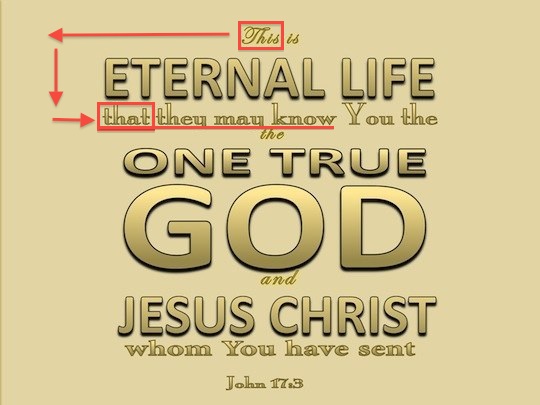
I read someone asking a conditionalist in a Facebook thread concerning how they define death. Then one of them responded with, “It depends on how you define life.” I couldn’t agree more! Unfortunately, this is an area that Chris Date and some within Rethinking Hell sorely deviate from. In a debate with Len Pettis during a Striving for Eternity Conference in September of 2016, Chris Date stated that Jesus does not define eternal life as knowing the Father and the Son just as He taught in John 17:3. Chris then wrongly exegetes this Scripture by comparing the translation of the Greek word “is” with other Scriptures that contain the same word. He neglects to make a linguistic and contextual interpretation of John 17:3 by failing to see the other words which Jesus used that explicitly define eternal life.  It is presented below in English and in Greek so that you can see why Jesus defines eternal life as knowing (having intimate fellowship with) God. And please don’t run. As I did in Part 2a, you don’t have to be a Greek scholar to understand what I’m about to show you.

John 17:3

  • (English – ESV) And this is eternal life, that they know you the only true God, and Jesus Christ whom you have sent.
  • (Greek – MGNT) αὕτη δέ ἐστιν αἰώνιος ζωή ἵνα γινώσκωσιν σὲ τὸν μόνον ἀληθινὸν θεὸν καὶ ὃν ἀπέστειλας Ἰησοῦν Χριστόν

Now, if you noticed, I highlighted the words that Chris used to make his case in blue. The Greek word ἐστιν is the conjugated form of the word “eimi” that he mentions in the video link above.  It is this word that Chris wrongly interprets in this context. But since conditionalists tend to define death in hyper-literal terms, it is no wonder that they look at Scriptures like this and have to make it fit their own annihilationistic hermeneutic. Nevertheless, Chris explicitly states that “is” does not “equate” eternal life with knowing God the Father and the Son. But let’s look at the other words within this context to help us to understand the semantic function of “is” in this context.
Continue reading

Rethinking Conditionalism (Part 5a) – The Atonement

Rethinking Conditionalism (Part 5a) – The Atonement

(Notice: the blog series has moved to Rethinking Conditionalism on Our Common Salvation)

I would like to reveal and exegete more Scriptures that conditionalists use to affirm their position of annihilationism, but let’s cut to the chase. There’s an even bigger topic at hand. And it is in the area of atonement. Because whenever you change the nature/definition of eternal punishment or eternal life, you inevitably change your view of the atonement. And even though conditionalist claim to say that their view of hell doesn’t change their outlook on the atonement (in a heretical way at least), it seems that when the contributors write or speak on their podcasts, they betray themselves. And this issue is hard to tackle in writing seeing that those within the conditionalist camp are not only varied in their opinion concerning what happens in the intermediate state (between death and the resurrection), and the nature of Hell (whether it is retributive and/or restorative), but because of their hermeneutics and also some of their different applications of penal substitutionary atonement (PSA). But I contest that this position is indeed not only a gateway doctrine to heresy, but it seems to accommodate heretical company. And hopefully, the concerns below will make this more clear.

Despite the above, there is one unifying doctrine within conditionalism – Death IS the punishment for sin. In other words, the act of Jesus Christ dying on the cross (when life left His body) is when sin was paid/atoned for and the punishment was satisfied. They say this in response to those of us who say that the wrath of God poured out on Christ was satisfied while He was still alive. But I don’t holistically disagree with death being a necessary component of the punishment, and neither should you reader. But their main challenge is that if the wrath of God that Jesus bore Himself was payment for sin, then why did He die? Great question! But this is, once again, making a distinction without making a difference. The challenge can easily be reversed in that if death IS the punishment, then why would Jesus endure such a brutal and tortuous beating from His creation, and bear God’s wrath while on the cross? Since death is the punishment, then Jesus could have just endured a slit throat like the lambs of old, and died for our sin (see this article I wrote that helps us to understand how what Jesus endured was more than what we are going to endure in hell because of who He was). Of course, in reading this, conditionalists may make up a ready response. They always do. But their leaders don’t want their responses challenged in a public dialogue (i.e. conversation) with me where their views can be scrutinized and critiqued for consistency. They would rather have the safety of timed debates, and social media platforms to defend their views. Where they can say their peace without being probed in dialogue by someone who has found extreme reason to doubt the veracity of their position, who also has taken the time to digest their position from the inside and can detect and call out the subtle linguistic shifts in their argument. Yes, I am saying that most of their published information does not address their specific challenges head on as I am doing.  But I digress. I still offer my open invitation for public dialogue here even though they continually reject my appeal on emotional grounds.

Gateway Heresy

Before I deal with the atonement, let me explain why I have concerns and why I believe that this theology is a gateway doctrine to heresy. If we were simply discussing the nature of hell, then a secondary conversation could possibly be had without any consequence to salvific implications (maybe), IF the person is simply inconsistent by believing this position, or if they are not a popular teacher saying our view is closer to heresy, like Chris Date says (you’ll see below).  This is the type of conversation conditionalist strive for. They want to treat this as merely a secondary issue. This is the proverbial “seat at the table” Chris Date and the Rethinking Hell contributors beg for. And this would be all fine and dandy if it were not for the fact that having alternate views of the afterlife affects your view of the atonement.* And, if it weren’t for the issues below. Continue reading

An Encouraging Thanksgiving

Dear Reader,

With all the hubbub about the recent US Presidential election still not over, I felt it would be appropriate to go a different direction with this post. May it be an encouragement to you as we enter a very special season.

In the UK, a special day reminds us to be thankful and is often called Harvest Sunday or Harvest Thanksgiving Sunday. Many churches gather together and have a large display of crops from the surrounding farming lands. They give thanks to God that stomachs are not empty, pantries are stocked, and another year of working in the fields has come to a productive end.

loveendures

In the USA, schoolchildren are taught that Thanksgiving came about as a way to thank the Lord for bringing the Pilgrims through a bleak winter where many of them died. Proclamations were made for a Thanksgiving remembrance by various officials until,

“As President of the United States, George Washington proclaimed the first nationwide thanksgiving celebration in America marking November 26, 1789, ‘as a day of public thanksgiving and prayer to be observed by acknowledging with grateful hearts the many and signal favours of Almighty God.’”

Oh, how is it that we have fallen so far from such a proclamation about what we should be doing. This year though there will be no prayer to Almighty God. Our nation has become a nation where the vast majority prefers to live in a way that emulates the Book of Judges. “Every man (and woman) does that which is right in their own eyes.”

The apostle Paul could have easily been seeing the future when he wrote Romans 3:18, “There is no fear of God before their eyes.” This once great nation, established as one nation under God, has crumbled. It has gone from being a moral and upright democracy to a nation that has no morals. We are not an immoral society but have gone far beyond that point.

Even a vast majority of those who claim the name of Christ have determined that, in the words of Doris Day, “Que sera, sera.” Whatever will be, will be. The world and the church glibly sings, “The future is not ours to see. Live for the moment. Eat, drink, and be merry.”

Yet, the future is there to behold to the eye of the saint who is watching, waiting, and working for the return of her Beloved Bridegroom. The future holds so much hope and promise knowing that one day we will no longer have to remain living in a human shell that still craves at times what was paid for on the Cross of Calvary.

One day, we will no longer have to deal with even a single vestige of the old man. We will no longer have to cry bitterly with Paul as we both proclaim, “O wretched man, who will deliver us from the body of this death?”

This last week, I read more than one person who thinks a large percentage of Americans are true Christians. Several have expressed hope in the new US President-Elect, yet within days of having won the election is already waffling on his promises.

Many think that we should just wear safety pins to show everybody they are loved and accepted just as they are with no change required. What a travesty that all of this has so permeated the church to the point that believers look almost identical to the world.

The church-at-large has failed. Let me reiterate that – THE CHURCH-AT-LARGE HAS FAILED. Miserably. Conclusively. Totally.

However….

Elijah was reminded that there were 7,000 who had still not bowed the knee to Baal. In like manner, I want to remind those who are true believers that there are others who have not bowed their knees to the Baals of this world. My hope is not found in politics. It is not found in a bank account. It is not built on failed promises that will never be kept by mortal men.

This Thanksgiving season is one that I choose to remember the glory of the Risen Christ. It is a season that I choose to remember the price that was paid so that I can reign with Him on high. This year, I will again bow the knee and heart and give thanks with a grateful heart. A true heart of Thanksgiving will not be destroyed by the depravity of the world around us. We will and MUST remain grateful and keep our eyes looking up to the prize that is set before us.

Our Lord went to the cross and despised the shame. It is from that Cross that He calls us to TAKE UP our cross and follow Him. As strangers and pilgrims, we are not called to bind ourselves to this world that C.S. Lewis rightly called, “The Shadowlands.”

Lord willing, a few of us will be writing and sharing words of Biblical encouragement during this season. Yes, there will still be a depraved world to live in, but we can encourage one other with these words as Paul was eager to remind the Thessalonian believers.

My desire is not to point out the fallacy of all that is transpiring in the world. I do not want to get to the point where I say, “See, I told you so.” My heart is to share with you and encourage you to such a point of thankfulness that when we close our eyes on this earth and wake up in the arms of our Blessed Redeemer that we will be able to say, “The half has never been told!”

Happy Thanksgiving!

Rethinking Conditionalism (Part 4b) – Irenaeus

Rethinking Conditionalism (Part 4b) – Irenaeus

(Notice: the blog series has moved to Rethinking Conditionalism on Our Common Salvation)

***Please read part 4a first***

In this continuation of Part 4a, we will look at different chapters of Irenaeus’ work that reveal that he really believed in the wicked who continue in eternal punishment, not annihilation. I worded it that way on purpose because those within the Rethinking Hell network believe that this Church Father (and others) simply used “biblical language” to talk about hell, not meaning that the wicked would reside there forever. In the future, I will show why that is simply not true depending on who you mention. You should read the article I’m referring to here if you have not read it already.

Although, I will not elevate the writing of the Church Fathers above Sola Scriptura, I am only taking the time to write about this simply because a claim is made, and being familiar enough with the Church Fathers’ writing, wanted to re-investigate these claims. And predictably, they are out of context. The principles of textual analysis that I will incorporate here in understanding Irenaeus can easily be applied to other writings if need be. One of them being, systematic study of the whole of their writings. Or at the very least, a good chunk of it.

Below is a list of chapters I will reference so that you can click on each of them and read them at your leisure. They will be numbered, and I will quote from them so that you know which link I am referring to.

1. Against Heresies (Book V, Chapter 27)

2. Against Heresies (Book IV, Chapter 28)

3. Against Heresies (Book II, Chapter 33)

4. Against Heresies (Book IV, Chapter 39)

5. Against Heresies (Book IV, Chapter 40)

1. Regarding Book V, Chapter 27, Irenaeus recognizes that not only will there be a greater punishment awaiting the wicked than those of Sodom and Gomorrah (a city Chris affirms is an example of annihilation), Irenaeus goes on to say:

Continue reading

Rethinking Conditionalism (Part 4a) – Irenaeus

Rethinking Conditionalism (Part 4a) – Irenaeus

(Notice: the blog series has moved to Rethinking Conditionalism on Our Common Salvation)

On an article posted for RethinkingHell.com, there is a misquoted and misguided reference to Irenaeus, a 2nd Century Church Father, that wrongfully places him as supporting a conditionalist/annihilationist position. You can find the article here. I do not put much stock into the Church Fathers as I do the authority of Sola Scriptura, but I do hope to show how it doesn’t seem like those at the Rethinking Hell ministry take the time to read the other chapters of Irenaeus’ work. They conveniently only quote (out of context) parts of Book 2 Chapter 34. Chris Date, the author, states:

  • Contrary to the claims of traditionalists (those that believe in eternal conscious torment), however, [Irenaeus’] work is one of the earliest explicit affirmations outside of scriptures of the final annihilation of the wicked.” 

Open the link to Chris Date’s article above in another tab or window, and compare what I am going to say in light of what he says. Excuse the swiftness of what I write as I am trying to be brief and clear.

After you’ve read the whole article, if you focus your attention on the sub-heading that says “Existence and Continuance” you will notice that Chris only quotes pieces of the Irenaeus’ work in this whole chapter. If you don’t have time to read the whole article, here is the main portion of Irenaeus work that Chris quotes from :

  • For as the heaven which is above us, the firmament, the sun, the moon, the rest of the stars, and all their grandeur, although they had no previous existence, were called into being, and continue throughout a long course of time according to the will of God, so also any one who thinks thus respecting souls and spirits, and, in fact, respecting all created things, will not by any means go far astray, inasmuch as all things that have been made had a beginning when they were formed, but endure as long as God wills that they should have an existence and continuance. (underline mine)

Now, before we show the parts he doesn’t quote, if you read the previous chapter of Irenaeus’ work, Chapter 33, you’ll find that he is opposing those who believe that the souls of people can transmigrate from body to body, and that those souls have no previous knowledge of their prior existence.  He even goes on to point out how just as those that rise to eternal life will go into that life with soul and body, so will those that go to punishment, having body and soul. But Chris would predictably respond that this chapter does not say that people in hell will suffer eternally. A point that will soon be refuted.

Now that you know the background, Here is the whole of chapter 34 here, with the bolded areas revealing what was left out from his article, as well as numbered markers in between to reference my explanations afterward.

Continue reading

Rethinking Conditionalism (Part 2c) – Eternal Fire

Rethinking Conditionalism (Part 2c) – Eternal Fire

(Notice: the blog series has moved to Rethinking Conditionalism on Our Common Salvation)

I was recently told that I have not made any coherent arguments in my previous articles and podcast, and that my position against conditionalism (conditional immortality) was hard to follow. Here are some points to chew on, plain and simple (although what I am about to say will not be an exhaustive argument).

If the fire is unquenchable in that it can’t be “put out” as conditionalists say, and that it will not be put out until the work is finished. Then, when the work is finished, and the wicked are annihilated, will the fire be done doing its work? In other words, will it no longer burn? If a conditionalists says yes, that it will no longer burn when it has finished its work, then the fire must not be eternal. It would follow, then, that it either does die out, or it goes away somehow. So making the distinction between put out vs die out is unnecessary and linguisitically deceptive. Furthermore, in Matthew 25, the fire is described as being in and of itself eternal and is not exactly equivocal in nature to the fire coming down from God (Sodom), nor indicative of exclusively being God’s glory or holy presence somehow. Such attempts are trying to explain away the obvious. It is a categorically different fire. It is the fire of God’s eternal wrath. It is a fire of judgment that is permanent and perpetual. If you have a wrathful fire burning against sinners, which is the purpose of the fire, and the fire is supposed to be forever burning, how do you have a fiery wrath burning against an enemy that will eventually no longer be there? Some conditionalist will retort that the fire can be in and of itself eternal, but those that are in it are not (and they say I am proposing some kind of “eternal fuel” theory when I am not). But that still doesn’t solve the problem. Because the fire is still indicative of God’s wrath against sinners. So why will His wrathful anger still burn? If the people are consumed, the fire should cease. But it will not.

But also, another thing that is pointed out by Conditionalists is that the worm will not die. They make a distinction to say that the Bible doesn’t say it will “never” die (although linguistically there is proof that it implies that), but simply that it does “not” die. In other words, it will not die until it is done doing the work that it was set out to do, just as the the Rethinking Hell ministry has affirmed many times. The worm’s purpose is eating the corpses of the dead bodies that they say Isaiah 66 illustrates. So if the fire and worm exist to accomplish what it was meant to accomplish, what happens when the worm dies? Wouldn’t the fire die out as well since both are an illustration of God’s judgment? That is what the contributors at Rethinking Hell are implying. And if the fire stops too, why does Matthew describe the fire as eternal?

What you have here is a huge inconsistency that basically makes the future punishment of unquenchable, eternal fire as Jesus explains it in the New Testament being a complete equivalent to the nature of the Old Testament fire that destroys its adversaries (which eventually went out when the work was finished). Even though Jesus used Old Testament language to describe God’s wrath and burning judgment against wicked, Jesus further expounds upon the nature of the future judgment in the New Testament. In Matthew 25’s case, it is eternal. And, it is explaining what happens after you die. Not the first time you die like in many Scriptures used to substantiate annihilationism.  So either the fire is truly temporal and not eternal, or the worms and fire are eternal thus making the punishment eternal. It’s not hard to understand. But of course, Jude 7 is used, again, to substantiate their claim that the fire can be eternal. But this is categorical and semantical mistake. I will exegetic Jude 7 for you all in the future, but just know this for now. The eternal fire spoken of by Jude 7 is teaching us that the wicked are suffering NOW in torment.

But let’s add Jude into the mix for a second. If we use Jude 7 to interpret how the eternal fire can still be eternal because it is God’s glory, or is coming from God’s holy presence down from heaven as some conditionalists say, and it doesn’t have to burn forever, then why does Matthew’s grammatical construction (see part 2a-b) make eternal fire categorically different from other fires? Also, Matthew refers to the location of those thrown into eternal fire as a separate “place” 6 times in his writings (Mathew 8:12; 13:42; 13:50; 22:13; 24:51; 25:30), “prepared” for Satan and his angels, where there is outer darkness, weeping and gnashing of teeth. Keep this in mind that this place is still a place of wrath, anger, fire, judgment. If conditionalist wish to make the fire that Matthew describes like that of Sodom, which they wrongly assume Jude means – a fire that comes down from God upon Sodom and Gomorrah and burns for a period of time only to kill and annihilate – if God already dished out the punishment with eternal fire, then why is He resurrecting them to do the same thing again? In other words, He already “annihilated” them with “eternal fire” in Sodom. That was their punishment, right?  I’ve asked this question before in Part 3 of this series. And if this is the case, why would Jesus say that it would be better for Sodom and Gomorrah (Matt 10:14-15; 11:22-24) on the day of judgement than for those that reject the gospel if the same kind of death-by-fire (or should we say annihilation-by-fire) punishment is coming? It doesn’t add up. Oh, and by the way. The example in 2 Peter 2:6 is not describing annihilation after death, but is illustrating that God will preserve the righteous and judge the wicked. Not that Sodom serves as a direct parallel describing annihilation. Context is key.

Lastly, the rebuttal and arguments to make the eternal fire in Matthew something other than an instrument of wrath located in a place that is categorically different is plain ludicrous. The fact that this fire will never go out, be put out, or die out (whichever wording you choose) implies that God’s wrath will abide there forever. And if God’s wrath abides there forever, on whom is it abiding against when the wicked will sooner or later be annihilated? This isn’t eternal fuel. This is eternal punishment. The fire existed prior to them begin thrown in their because it is a place “prepared” and a place that endures forever for those that are not born again. I wish I could be more plain, but I’m not sure how. If this isn’t good enough for conditionalists I’m not sure what is. Nevertheless, I will continue to write and extend an open invitation for conditionalists to come on a podcast with me to discuss what they believe and why. So far, they have declined for emotional reasons.

Tune in to part 4 coming within the next week about how the Church Father, Irenaeus, believed some of the very same things about the punishment and fire enduring eternally, even though the ministry of Rethinking Hell take him out of context.

-Until we go home

Love Mercy

He has shown you, O man, what is good; and what does the LORD require of you, but to do justly, and to love mercy, and to walk humbly with your God? (Micah 6:8).

But if you had known what this means, I will have mercy, and not sacrifice, you would not have condemned the guiltless (Matthew 12:7).

A while back, I came to the conclusion that I would rather err on the side of mercy when relating to others. I’m not talking about being soft on sin. But I am talking about walking graciously toward others who may not be at the same place in their walk with the Lord as you or I may be. And, if a brother or sister is caught in sin, learning how to “restore such a one in the spirit of meekness” (Gal. 6:1).

When I look at others who are covered with the scars of bad decisions they have made, I do not lose sight of the fact that there but for the grace of God go I. God has spared me from a lot in life but that is a testimony to His goodness, not mine.

mercifulgod

Luke 6:36 tells us:

Be you therefore merciful, as your Father also is merciful.

Matthew 5:7 says:

Blessed are the merciful, for they shall obtain mercy.

I have received so much mercy in my life. How could I be so heartless as to not show mercy in return?

Dictionary.com defines “mercy” as:

1. compassionate or kindly forbearance shown toward an offender, an enemy, or other person in one’s power; compassion, pity, or benevolence:
2. the disposition to be compassionate or forbearing:
3. the discretionary power of a judge to pardon someone or to mitigate punishment, especially to send to prison rather than invoke the death penalty:
4. an act of kindness, compassion, or favor:
5. something that gives evidence of divine favor; blessing.
I want to be that person that doesn’t hesitate to put an arm around a struggling sinner who is broken instead of the one who says (even in the heart), “If you just hadn’t done that stupid thing, you wouldn’t be in this predicament.”
 
There are times when pious, religious people may need a firm rebuke but only if it can be done in humility with the purpose of the sinner coming to repentance and being restored. But there are other times that we must help to lift up the broken so they can find that hope that will lift them out of the pit they find themselves in.
Several times in the Gospels, we read that “Jesus had compassion.” We need to follow His example. Won’t you show mercy to someone today?

Two Kingdoms

It saddens me to see so many Christians get wrapped up in politics. We have virtually no sense of history (the early days of what used to 26822be a representative republic were far wilder than the current election cycle) and seem to have lost sight of the two kingdoms in play. Augustine likened them to Two Cities.

The Bible is clear – God created three units of government for this age: the family, the state, and the church. We do not read of any of the apostles nor the Lord trying to overthrow the Roman government, although that is the charge brought against Jesus by the Jewish leaders.

We are not selecting a theologian-in-chief this year. We have not had a solid Christian man in the White House in the past 100 years; all of them have put politics above Truth for the most part. We play into the hands of the world when we try make this country into the mold we imagine for it. But no matter how much we desire a secure temporal future under a God-fearing government, that is not where our security lies.

The best thing for this country would be political leaders who cling to the Constitution, just as the best thing for our local churches are men who cling to the Scripture.

The political machinery in D.C. all works together to consolidate power at the national level (the Whig Party lives in the policies of both current parties). No matter if your favorite President was Woodrow Wilson, Ronald Reagan, GW Bush, or Bill Clinton (all professing Christians) – none of those men were able to put this country on the foundation of Scripture. That is not the job of the President.

If your view is that you must vote for a truly godly person as President, how is your position different from the Jews who clamored for a king like the pagan nations had, discontent with having YHWH as their King?

A President who will work against the status-quo and try to push the national government back to it charter document will do this country good, no matter what you or I think of his theology.

The Shepherd and His Sheepdogs

The Shepherd and His Sheepdogs

One of the things I am passionate about is closing the gap between Evangelists, Pastors, and Teachers within the body of Christ. We have become so segregated in our roles that it is almost as if they never overlap. The Pastor is in charge of the sheep, and the Evangelist is in charge of bringing the lost sheep into the fold. My dear readers, this is wrong! Just as equally wrong is the idea that the Evangelist is incapable of preaching on any other topic other than evangelism, that the burden of biblical counseling should only be left upon the head Pastor, or that Eldership belongs only to the pastors or teachers of the congregation. In accordance with Ephesians 4:11-15, I would encourage all of us to view the roles/gifts these kind of men bring to our local congregations and the universal body of Christ.

I remember an illustration a famous preacher gave one time about how the sheepdog is like the Evangelist that barks at the sheep and the sheep run into the sheepfold. Meanwhile, the sheep are taken care of by the pastor(s) of the flock. I submit to you that I have a better illustration. The Evangelist and the Pastors and Teachers are all sheepdogs. And whether they hold to the office of Elder within a particular church or not, they are going to be called by God to gather the lost sheep, rally the sheep, guide the sheep, discipline the sheep, and keep the sheep bonded in the unity and fellowship of the Holy Spirit. But you know what, they do it all underneath the command of The Shepherd! Don’t miss this point. The Shepherd guides and gives commands to the sheepdogs as to what He wants, in accordance with His will. Let me further explain what I mean.

When I visited a farm in Washington, they were having a Scottish Border Collie demonstration. They showed how these dogs rally the sheep and guide them into the sheepfold underneath the command of the shepherd. The shepherd would whistle and call out commands that would inform the dog to run, lie down, or walk at a specific pace or in a certain direction. It is really a sight to see. I wanted to upload the video I captured, but my phone crashed before I could. So I could only find this video to give some visual illustration of what I am talking about. If you watched the video, you will notice that even though the dog may have some natural instinct on what to do, the sheepdog, nevertheless, must still be underneath the guidance and direction of the shepherd. And this is where Ephesians 4:11-16 comes in.

In the work of the ministry, all those who are gifts to the body as Ephesians says overlap in some way concerning their work among the sheep. I hope to write a book about how the Evangelist needs to be reclaimed and reintegrated back into our local churches, but for now, understand that true Evangelists are not lone wolves. They are sheepdogs, just like the pastors and teachers, among the body that listen to the voice of The Good Shepherd, my Lord Jesus. Although there can be street preachers who may not necessarily be Evangelists in accordance with Ephesians 4 (which isn’t a bad thing), and there may be some who claim to be Evangelists but preach a false gospel and disdain the body of Christ (which is a bad thing), an Evangelist called by God will fulfill their ministry not just by calling the lost to repentance and bringing people into the fold, but by building up the body, perfecting the saints, teaching sound doctrine, and many other things that seem to be only “the pastors job.”

If you think about this, this is one of the reasons why the plurality of Elders is not just biblical, but essential wisdom. I strongly assert that Evangelists are an essential piece on God’s chess board. Even if it was just one man in a small congregation, he should nevertheless do the work of an evangelist (2 Tim 4:5). Also, even though an Evangelist may be typified by church planting, missionary work (local or overseas), and/or proclaiming the gospel among the heathen in the local area, the pastors and teachers among us should be doing some of the very same things! And if you’re thinking consistently about the Great Commission, every Christian is called to do their part in the work of making disciples. But regarding our ministerial duty to the body, as sheepdogs, we are called as a team that heeds the voice of our Shepherd to do the joyous labor of serving the body while we endeavor in the very same mission. And whether it is building up the body by adding to the church, or by edifying and perfecting those already added, Evangelists, Pastors, and Teachers must rally together more than ever underneath the sound of Jesus’ voice to protect, guide, unify, and edify His sheep.

I am pleading with those of you who are leaders to stop putting Evangelists in the evangelistic sand box to play outside the church as if that is their sole domain.  We can do better than this! There are many Evangelists who are fit to lead and exegete the Scriptures and can provide relief to their fellow sheepdogs. Their heart may lie in a passion for lost souls, but that doesn’t mean they don’t have a passion for God’s people either. We may differ in personalities, strengths, and abilities, but so do the many of pastors and teachers in our congregations. Evangelists are no different. We desire to train and build up and lead the sheep just as much as any of the others who are called to the work.

One thing I remember about my time at that farm was all the sheepdogs on the sidelines, chained to the fence, aching to get in the field and work among the sheep. They were zealous, eager, knowledgeable, and would jump up and down while they watched their fellow sheepdogs do the work they were also bred for. But when they were let loose, they all attentively obeyed the voice of the Shepherd. And if either them stepped out of line, or did not obey, they would be disciplined just as much as the sheep. And this applies to all sheepdogs! Some of us have been standing on the sidelines waiting for our local congregations to let us join in on the work for too long. Although anyone called by God will fulfill their calling whether blind leaders recognize it or not, they nevertheless desire to work hand in hand with other sheepdogs. The problem is, we have too many wolves in the pulpits who desire to devour the sheep and not obey the voice of the Shepherd. And unfortunately, there are too many goats that don’t mind serving themselves up on their plate every Sunday.

But that aside, if you are reading this, and you are a leader/elder/pastor among your congregation, I plead with you to join arms with your fellow sheepdog, the Evangelist. I’d love to help you on how you can best approach this. You can contact me here, and we can correspond through email. Or if you are reading this and you feel like you are called as an Evangelist, I would love to help you to study thoroughly what that means and equip you to know how you can support and approach your local church. You can also contact me here. Keep in mind, though, that in some churches, their ecclesiastical government may require that you submit underneath the Eldership. In other congregations, the Evangelist may be appointed as one of the Elders. But whatever government your church may have, one thing remains true – there are sheepdogs that are eager and called to do the work of the ministry within the body of Christ. Some are already obeying the voice of their Heavenly Shepherd. As a church, as leader, as a Christian, will you do the same?

-Until we go home

Rethinking Conditionalism (Part 3) – Eternal Punishment

Rethinking Conditionalism (Part 3) – Eternal Punishment

(Notice: the blog series has moved to Rethinking Conditionalism on Our Common Salvation)

The distance that certain conditionalists will go to deny the obvious linguistic nature of eternal conscious torment is very disturbing. While I have already revealed in Part 2a why the fire is categorically different and in and of itself eternal, AND how it is semantically linked as the instrument and reason why those that are in it will continually endure eternal punishment (since it is indicative of God’s wrath, read Part 2b), the twisting of Scripture continues. The basic premise is that eternal punishment is not an eternal “punishING” but one of eternal “punishMENT.” In essence, what is proposed is that the eternal punishment that Jesus speaks of in Matthew does not refer to the process of being punished for an eternity, but that Jesus’ administration of the punishment (in their case the punishment is death/annihilation brought about by fire) is what is meant by eternal punishment. Therefore, that punishment which He administers lasts forever.

There are several personal observations that I must bring to the forefront before I address the linguistic/scriptural issue of this argument. 1) Language is messy business. It is one thing that I learned from studying linguistics is that many of what we take for granted everyday can often be arbitrary and ambiguous. Many of the points conditionalists make, from a linguistic standpoint, are notable nuances, but too often are exploited for their benefit. In other words, they capitalize on the ambiguities of language. This is to not say that I or anyone else is not guilty of doing such a thing, but they do it so often with clearly understandable texts like Matthew 25 that I have no choice but to assume deception (which is once again, what we are accused of). 2). A dictionary is not meant to regulate language. I know it is a habit for some to use dictionary definitions of words because it is an easy reference, but this wonderful tool simply records how the language can be used in any given context, not regulate how is should be used. In other words, it describes not prescribes. It tells you how words have been used and are conventionally used (that means by agreement) depending on the kind of dictionary you have. But they do not always capture every nuance. However, internet is changing that. So whenever we go to our dictionaries, remember that it is good to have an general understanding of what a word entails, but syntax, grammatical structuring, discourse structuring, and even idioms can break the “rules.” Therefore we are to be cautious how we bring dictionaries to make our points. Look up lexicography if you care to know more. It really is a fascinating field of linguistics. Now, unto my arguments.

Here is the first problem I see. In my last post, I mentioned how conditionalists believe that the result of the punishment is eternal. I wrote it this way because whether it is Chris Date in his podcasts/debates, or recently William Tinksley (a contributing author to Rethinking Hell), I am told something along the lines that this is not what they believe. Their correction to my statement is that they too believe in “eternal punishment,” and I am apparently wrong for saying that they believe in the results of the punishment. But then they go on to say (perhaps not all of them) that the punishment is the result of Jesus’ punishing action, or it is the duration of the punishment inflicted once which is eternal (the example given is capital punishment). So what we have here is an example of saying the same thing, just differently. By asserting that eternal punishment refers to “the result of Jesus’ punishing action” is to say, in essence, that you believe that eternal punishment in Matt 25 is implying the result, not the process. So to be corrected by saying that conditionalists do not believe that the results of the punishment is eternal is being semantically illusive. They are very good at making distinctions without making any difference, as well as proving their point without proving their position (which I’m sure I will be accused of doing).

Here’s the second problem. In order to prove their point, conditionalist compare the words redemption (using Hebrews 9:12 as an example) and punishment. Since redemption can refer to a one time act, or can refer to the results (there’s that word again) of an act, they say that this is a comparable example to the punishment administered by Christ in Matt 25. From a linguistic perspective, this is a notable nuance in any given context. Even though conditionalists are correct that punishment and redemption both can refer to a single act or a result of an act, they overlooked the very same Scripture tells us what exactly that punishment is (eternal fire), and they assume we will be burned up. But they also don’t realize that the suffixes of both punishment and redemption can imply a state or condition. Before I go to Matt 25, here is a quick breakdown of suffix usage.

The suffix -ment can refer to a state or condition. It is a way to “noun” a verb (notice I just verbed the word noun because how I placed it in the sentence. This kind of syntax is key when having these sorts of discussions. Not just how words are defined, but how they are used in any given utterance or text). For the word redemption, the suffix -tion does the same.  In both words, the suffix can imply a state or condition. In Jesus’ case, He went into the Holy place to obtain eternal redemption for us. In this case, eternal punishment refers to the state or condition of being punished. In other words, while Jesus’s obtaining the state of condition of eternal redemption for us is accomplished by the one time act of enduring the wrath of God and death, we experience the state or condition of punishment by being in eternal torment by the one time act of being thrown there (we I will explain below). But also in this case, if you are given a punishment, depending on the punishment, it can be temporary or eternal based off of how or by what means it is being administered. The effects can last even after the infliction has has passed (just like the death penalty), or you can remain in a state of condition of being punished (like a lifetime in prison). The downfall in our case is that any punishment that is meant to endure can only endure in our lifetime. And, if it does endure throughout our lifetime, it can be a punishment that is consistently being administered or undergone by an instrument or agent, or it can simply leave a lasting result (sort of like a physical scar, although emotional “scaring” is not outside the realm of semantics).  In Matthew 25, eternal punishment into eternal fire is a state or condition that the wicked find themselves in forever, eternal punishment being another way of appositionally (see Part 2b again to remember what I’m talking about here) describing that state.

Now, lest you think this can also sway in the conditionalist favor, one must understand that verbal nouns like punishment keep some semantic value of the verbal form, although they do not function as a verb. I can get pretty technical at this point, but I will save that for other posts or conversations that I may have with conditionalists. For now, punishment always has the sufferer in mind. That is, whatever the means, whatever the outcome, punishment always has the person receiving it as its focus. Seeing that the fire mentioned earlier in Matthew is eternal, and is the instrument that will forever administer the punishment, and since that fire is indicative of God’s wrath and judgment, if the fire is eternal, then the one who is experiencing that fire is in that state or condition for an eternity.

It is clear that any punishment administered in this life that is administered by man or by God, even physical death, is not eternal. The first death we experience is not forever. We will one day be resurrected. Jesus came to save us from the power of the first death (Rev 20:6; 1 cor 15:54), which by natural consequence saves us from second death. But the first death is not like the second in nature. And Scripture clearly demonstrates, at the very least in Matthew 25, as making the day of judgement and final judgment different by saying that out of all the punishments, this one will last forever. If death is the punishment as conditionalists make it out to be, then why would God have to resurrect them to only do the same thing again? This question cannot be redirected at us who believe in eternal conscious torment because while we may die, we have yet to face the wrath of God that Jesus took upon Himself on the cross before He died. And we can’t, because we would die in our current state. And if conditionalists continue to assert that the eternal fire in Jude 7 is equivalent to the eternal fire in Matthew 25 (in the sense of how they use it) then if Sodom and Gomorrah suffered punishment by eternal fire, why resurrect them and do it all over again? Eternal conscious torment is consistent in that the only thing that the wicked have not yet faced is God’s full wrath in the body. This is something Jesus did. And He doesn’t need to suffer eternally like we do to do it. Which is the reason why we need a resurrected body designed for such an occasion.  Because if we use the Old Testament as an example, which  Sodom and Gomorrah is just a taste of, then there is a reason why that body would have to be a body fit for eternal punishment. Because the current one we have will whittle away.

But guess what, in one sense, the conditionalists are right! When you read verses 41 and 46 of Matthew 25 which reveal that the wicked “go away into” eternal punishment while the righteous to eternal life, it is a one time act of sending them to their respective locations. And when they arrive, they will experience the bliss or the pain of what God has in store for them there, and they will experience that state or condition for an eternity. So to say that the punishment can be a one time act, or the result of the act really makes no difference seeing that the punished will experience their state of punishment eternally, just as the natural understanding of the text is to be interpreted. So even if this is what it means to be punished, this one time act of being thrown into the fire indeed has an eternity behind it, and those that are there will be in a state of eternal punishment. In other words, how conditionalists argue their points still doesn’t prove their position, nor does it prove that those that are thrown into the fire will be eventually annihilated.

But what of the words “eternal destruction” in 2 Thessalonians 1:9 and the parts in Scripture where Jesus uses parables to describe what happens to the wicked when they are judged? Like in Luke 13:40 where the Greek word katakiaw is used to illustrate the wicked being “burned up”? What about those? Those will be dealt with later on in upcoming articles. For now, remember to take all these article as a collective whole. What I mean is, each article is designed to build off of one another. It may be difficult to process all this, but I know many of you reading the New Testament understand the implications of eternal fire and punishment and that it lasts forever. It is something our Church Fathers understood (something I will prove as well), and it is something that has been easily understood by many generations, except for those that have an agenda (whether they realize it or not) to prove otherwise.

-Until we go home

Rethinking Conditionalism (Part 2b) – Eternal Fire

Rethinking Conditionalism (Part 2b) – Eternal Fire

(Notice: the blog series has moved to Rethinking Conditionalism on Our Common Salvation)

Since I have written part 2a, there has been an attempt to dilute the argument concerning the article-noun-article-adjective construction (called the second attributive) in Matthew 25. But the attempt is, once again, a linguistic game that seems to be the trend amongst conditionalists. In essence, what is being stated is that there is no special emphasis placed upon this kind of construction in Greek, and that the other kinds of constructions, that are like this one, are used just as much, if not more, in the New Testament, and they too have the same attributive meaning. In other words, there are other grammatical constructions that are used in the New Testament with adjectives that can express the same kind of attribution, but doesn’t give the special emphasis that I claim it makes.

For instance, if you remember from my previous article, “the fire, the eternal one” would be the somewhat literal but awkward translation of this fire. Now, whether the Greek uses another type of adjectival construction (first or third attributive as they are called) to describe eternal fire or not, is something that can be debated. But it doesn’t do away with the fact that the Greek language makes the fire categorically different from all other fires. This is something I mentioned in 2a of this series. Since the Scripture references this fire as a separate location also makes a significant difference. But, what is being rebutted is the fact that the construction I pointed out is no more significant than any other construction. And then, an appeal to multiple resources that point out that there isn’t any difference is how the diffusion is attempted (don’t be fooled). To this I will say a few things before we move forward.

1. There are at least three resources that show the construction I pointed out in 2a are significant. Dan Wallace’s Greek Grammar Beyond the Basics, A.T. Robertson’s, GRAMMAR OF THE GREEK NEW TESTAMENT (which Wallace draws from), and Deeper Greek. These resources come from scholars who have practically spent their whole lives studying the Greek Language. However, the other respected scholars affirm that there are no differences in meaning. But it is no surprise to me that linguists would emphasis or not emphasis certain nuances within a language. Language is often complex, fluid, and nuanced. So even if there is a disagreement (which we can’t be sure if the authors are even aware that there is even a contention) concerning the kind of emphasis the word “eternal” places on the fire in Matt 25, there is one thing that is for sure – the adjective describes the fire in and of itself as eternal. An inescapable truth that is still being twisted.

2. Making a case that there are no differences in meaning between the types of constructions ignores the most fundamental thing that adjectives do to nouns. In language, adjectives describe, limit, modify or expound upon the noun and can attribute special characteristics depending on the context. It is clear, even in the English, that the noun (fire) is modified by the adjective (eternal), making the fire in and of itself eternal. This is especially significant since, as I said in 2a, that the fire is indicative of God’s wrath. So if you have a fiery wrath that burns forever, but no one is there to burn against it since they are consumed, you have a huge (perhaps heretical) problem. And yes, the fire exists because the wicked exist. One attempt was made to say that because no one is in the fire even while it is burning means that the fire does not need people to burn against. Once again, this is an attempt to deflect the obvious.

3. There is one other thing about these Greek constructions with adjectives that most people who do not study linguistics may not  know about that other languages demonstrate. It is called apposition. What apposition is is a phrase, word, or description that further expounds upon  another word, phrase, or description. A simple way of explaining this would be like saying, “Ricky, the tall dude over there, likes to eat…” The emphasized portion is the apposition. In our case of eternal fire, the way the Greek is constructed, even if one disagrees with the significance of grammar, the fact that the fire is appositionally described as “eternal” further makes the case that this fire is indeed categorically different than other fires. Therefore, if even some linguists of Greek see no difference in meaning between constructions, at base level, they are appositional. In laymans terms, eternal fire means that it will burn forever.

The next thing to point out is the attempt to say that the fire is eternal in the sense that it is from God. Since God is a consuming fire, then the eternal fire is just another way to point out that it is God doing the punishment of annihilation or consumption of the wicked. There may be nuances as to how this is argued, but the general attempt is to sweep away the obvious. The fire in which Satan, his angels, and the wicked are thrown into is going to be a fire that burns forever. And in Matt 25:46, the fire is semantically linked to eternal punishment (as well as unquenchable fire). This punishment is going to be eternal because, quite simply, the fire is eternal. If an attempt is made to say that the fire is only simply God, of God, or from God (something I wouldn’t holistically disagree with), that is ignoring the fact that the language portrays that this fire is still categorically different. It is created and located somewhere for a specific purpose. And, if it is God who is partaking of this burning, yet the wicked are eventually consumed, then who is He burning against if they are supposed to be eventually annihilated?

There is more to this, and this series will go on for quite some time I assume. But the main gist to grasp from this is that the language is clear in that it makes a distinction  that eternal fire is just that, eternal. I only made this article less technical in the attempts to reach mass amounts of readers. There are more linguistic evidences and arguments that could be made. The only word of advice to the reader I have at this time is this. If you think that the wicked are not going to face eternal conscious torment, whether you realize it or not, it will affect your view of the atonement. This is something I plan to address in detail in the future, but for now, please know that some in the conditionalist camps have defended abhorrent theology like Evangelical Universalism, and there are others that seemingly reject the penal substitutionary atonement of Jesus Christ. As you read further articles, I pray more connections would be made plain.

-Until we go home

A Christian’s Duty Through The Heralds of Ancient Greece

A Christian’s Duty Through The Heralds of Ancient Greece

Whether a elder in the pulpit, a preacher on the street, or a believer seeking to be a faithful witness, we can all glean from this.

In Ancient Greece, heralds had a specific role in the culture with a specific reputation. It is that reputation that I am going to use as illustrative examples  concerning a believer’s/preacher’s duty to spread the gospel. Although we know that the Bible is sufficient for life and godliness, still, illustrations are a powerful tool to help nail the truths deeper into our mind and make plain what is simply less memorable to some. With that said, here are some points that will help us reaffirm our calling as ambassadors and heralds of the gospel. Once again, these points are purely illustrative, not expository. But they nevertheless communicate biblical truth.

  1. A herald was often called kerukes, which meant “herald.” In Ancient Greece, the name was often ascribed to a traditional family of priests thought to have descended from Hermes. However, it was used for anyone that was designated to carry a message.
    • The Bible declares that all Christians are now a royal priesthood and we are chosen to proclaim the praises of Him who called us out of darkness into light (2 Peter 2:9) 
    • Because Christ has saved us, we are now direct descendants of Him who has commissioned usto preach His gospel.
  2. A herald (kerukes) can also be associated with any kind of messenger (angeloi) or envoy 
(presbeis), although not operating in the same manner as a herald.
    • The Bible declares that we are ambassadors (presbeuo) for Christ, and that we are to implore mankind as though God was pleading with man through us (2 Cor. 5:20).
    •  Our ministry is angelic in practice. And though we are not, by nature, angels from heavenbringing the good news (evanggelizo) (Luke 2:10), nevertheless we are fellow servantswith the angels and considered family in the work of being a messenger (Rev. 22:8).
  3. Kerukes were designated in a city to be watchers for prearranged signals in the sky that
 communicated messages from considerable distances. The signals were communicated by
 flag during the day, or fire by night. Whatever the message, heralds were to
 interpret those signals and immediately declare them to the town.
    • As Christians, our eyes should always be in the Heavens, looking unto Jesus and His word (God’s prearranged communicated message) and immediatelydeclare them unto those who are in our town (Col. 1:27-29; Heb 1:2). 
  4. Heralds carried a staff with them called kerukeion which not only established their identity  and office, but it was also a visual reminder that they were under the care of the Greek messenger god Hermes. And just like Hermes, whenever they were seen with the rod in  hand, it signified that they were about to announce an official message.
    • We should always have with us our kerukeion – the Bible. This willserve as a visual reminder for others that we are underneath the authority and care of Jesus Christ our King. And this will assist in establishing our identity withHim as well as His authority. Whenever we carry this rod with us, it should signify toour hearers that we are about to announce an official message. 
  5. Hermes was commissioned by Zeus to be his messenger and in turn, Hermes commissioned others to be heralds.
    • Jesus Christ was God in the flesh, sent by the Father to declare this gospel in the world, and thosewho are true followers of Christ are commissioned by Him to declare it to others(Matt. 28:19). 
  6. Some families appointed kerukes because it was an inherited right. Other heralds were elected  and/or dispatched by a legislative assembly of leaders called boule.
    • As Christians, we are adopted into the family of Christ, and therefore possess theinherited right to herald the gospel into the world.
    • As the chosen of God, we are elected and dispatched as kerukes to preach the gospelto every creature. Although this should be something that a local church should support, equip, and encourage one another to do, this is not always the case. In this instance, we must remember that our authority to share the gospel comes from Christ first and foremost.
  7. Heralds were often chosen for their ability to carry their voice over noise and distance.
    • If we plan on preaching in the open air, a general principle is that we should speak to be heard. This requires skill and clarity on the part of the speaker so that every detail of the message is not muffled because of inability or negligence.
    • Stentor, a herald mentioned in Homer’s Iliad, was described as having a voice aspowerful as 50 men. He was the herald for the Greek forces during the Trojan War. Although it is not mandatory to have this kind of voice, we must still speak to be heard.
  8. In military contexts, kerukes would be in close proximity to the commander to carry forth orders. Furthermore, they were called upon to rally the troops together, and also were sent out to recover the dead bodies of those slain (specifically in war) and bring them back.
    •   If you are going to be an Evangelist of the gospel, we should always remain close to the Commander (Jesus) in order to carry forth orders that He has declared. It is a preacher’s duty not only to carry forth the orders of the Commander appointed over him, but also in rallying the troops to obey His orders. A good preacher will not only declare what Christcommands to His enemies, but also declare to the allied forces that they are to be in obedience to His commission!
    • 
Whether those dead in trespasses and sins or our brethren temporarily slain by sin, the herald is to bring back those slain and dead through the resurrection power of the gospel proclaimed. We are specifically sent out to recoverthese poor souls and bring them all back to God through the power of the Holy Spirit.
  9. Heralds were not only used to convey information, but collect it.
    • We are not to be givers of information from our own will, but phonological reflectors of God’swill. We are to collect information and study God’s word so that we can clearly andzealously publish to the world that which we have already digested ourselves. Manuallabor on an empty stomach is not wise; neither is preaching the gospel without fillingup on His Word and Spirit. 
  10. Greek heralds were sent out to declare policy, demands, and decrees abroad. Also, they 
would announce warnings, or offers, to hostile cities or armies, as well as declare war itself.
 More often than not, kerukes were denied entry into warring cities as a sign of protest or 
insult.
    • We are to be faithful in declaring the policies, demands, and decrees of God to all.We are to preach the warnings of God as well as His offer of peace to the hostilecities of the world. It is necessary, as a part of our duties, to reveal that man isalready at war with God, and we must boldly stand before Satan’s Army to declare
 conditions of peace and judgment from the King.
    • More often than not, we will be denied entry into many places in order to declare ourmessage, but this should not deter us. Although done as sign of protest and insult against God, we are to be steadfast in delivering the message whenever possible (Luk 6:22).

As a final illustration, we will use a famous herald, Phidippides, as an example of a faithful messenger. According to myth, Phidippides ran 26 miles from the battle of Marathon to Athens to announce Greek victory in war. Depending on the source, the message was somewhere along the lines of “Joy to you, we have won” or “Rejoice, we have the victory.” It was after proclaiming this that he breathed his last breath and died.

As believers we have received the victory over sin, death, and hell. Christ has gone 
into the Most Holy place and atoned for our sins and has defeated the armies of 
darkness, making a public shame of them because of His sacrifice. Because this war 
is won, shouldn’t we also be running a spiritual marathon declaring “we have the 
victory?” Shouldn’t we be giving our very lives in order to publish this good news,
 even if it is the very last thing we say with our mouths? Phidippides, although myth, is a
 great example of dedication, swiftness, and perseverance in order to deliver a
message that literally cost him his life. Are willing to run in the steps of Phidippides 
for Christ? To go the extra mile or two or twenty-six? No matter how it must be
 done, let us be found faithfully preaching the glorious gospel until our LORD comes 
for His bride.

-Until we go home