
Things I have learned: Disease vs. Cure, Overcoming the Will

Some say there’s a heaven for those who wait
Some say it’s better but I say it ain’t
I’d rather laugh with the sinners than cry with the saints
The sinners are much more fun
–Billy Joel, “Only the God Die Young”

Continuing the series of theological truths I have seen illustrated through our fostering experience, we come to two truths: the natural man would rather die and go to Hell than have to accept and submit to the Lordship of Christ; man’s will must be overcome in order to believe the gospel.

Shortly after these children came to us, the little one was sitting on her bed one evening, holding her ears and crying. We asked her what was wrong, her answer was, “Nuthin”. Of course, we knew something was wrong, so we took her to the local children’s hospital. Long story short, turns out she had an ear infection–in both ears. This the result of being allowed to sleep with a bottle of milk at night, even until she came to us at the age of six (yes, you read that right. She was on a bottle at six years old). The doctor prescribed some liquid antibiotics, the local pharmacy filled it and added flavoring to it, and we began the next day to try and give her the antidote to her infection. No problem, right?

Wellll……the next morning we tried to give her the medicine. She sat there crying for an hour, refusing to take the 1 1/2 ounces of medicine. We tried convincing her that if she didn’t take her medicine, her ears would not heal. We tried telling her that if she did take it, her ears wouldn’t hurt anymore. We tried every way possible to convince her to take her medicine. Finally, after an hour, she took it with a sip of Sprite. This very same scenario was played out twice a day, every day, for two weeks.

And isn’t that just like us? How many times, before God’s grace opened our eyes, did we hear the name of Christ, hear the gospel, and refuse to obey the gospel? Why? Because we were a natural man, and the natural man does not receive the things of the Spirit of God, for they are foolishness to him; nor can he know them, because they are spiritually discerned (1st Corinthians 2:14). We cannot understand the importance of the gospel, or even the gospel itself, in our natural state, for we (like the Corinthians) think it’s ridiculous that our eternal fate rests on believing in a man dying on a cross and coming up out of the grave. Besides, even if the natural man did believe the gospel, he certainly would not want to forsake the life he has, and all its pleasures and comforts, to humble ourselves to God and repent of our sinful lifestyle and put others ahead of our own wants.

What, you don’t think that’s exactly what happens when someone rejects the gospel? What did Jesus say? John 3:19-20“And this is the condemnation, that the light has come into the world, and men loved darkness rather than light, because their deeds were evil. For everyone practicing evil hates the light and does not come to the light.” We’re having too much fun, living the good life, to be bothered with all this “Jesus stuff.” They would rather have their fun now, rather enjoy this time that have–you might say they would rather have their “Best Life” now. Or, as Benny Hinn once famously said, “Who cares about streets of gold in Heaven? I want my gold now, baby!” And just like that little girl who would rather suffer the pain of a double ear infection than take her medicine, the natural man, unregenerated by the Holy Spirit, would rather die and go to Hell than to receive the things of the gospel and submit himself to Christ.

But that is the natural man. That is the nature of man, to want what he wants when he wants it, without having to submit himself to anyone’s yolk. And that is where the natural man finds his folly. He thinks he is free. He does not realize that he is actually a slave of sin, and is only free in regard to righteousness (Romans 6:20). We are all slaves. None of us has a will that is truly free. When we are born, we are born slaves of sin, even though we all belong to God. “The earth is the LORD’s…the world and all that dwell therein” (Psalm 24:1). We belong to God,  And we must overcome our master in order to obey the gospel. For “no man can serve two masters, else he will love the one and hate the other, or despise the one and love the other” (Matthew 6:24). We cannot set ourselves free from Satan in order to obey Christ, for we are all our lifetime subject to bondage (Hebrews 2:14).

In fact, we don’t want to free ourselves from Satan, because we are having too much fun. Satan may be our master, we may be his slave–but he is not a very demanding master. He gives his slaves everything they want in order to keep them happy.

  • “So, you like drugs? What do you prefer? Alcohol? Marijuana? Cocaine? Ooh, here’s one of my favorites–methamphetamine!”
  • “So, you like sex? What kind do you like? Heterosexual? Homosexual? Bisexual? Transvestites? S&M? Ooh, here’s one of my favorites–living together without marriage!”
  • “So, you like money? And you don’t want to work for it? Well, we’ve got all kinds of ways for you to get other people’s money. Robbery. Fraud. Ponzi schemes. Ooh, here’s one of my favorites–the lottery!”

And he gives us enough stuff to keep us happy in these bodies of flesh. And rather than take the antidote for fleshly happiness, we would rather continue on with the disease. But. God, in His grace and mercy, overcomes our stubborn will so that we may understand that we need that antidote–and that we will want that antidote. This was the task to which the apostle Paul was commissioned, as we see in Acts 26:17-18“I will deliver you from the Jewish people, as well as from the Gentiles, to whom I now send you, to open their eyes, in order to turn them from darkness to light, and from the power of Satan to God, that they may receive forgiveness of sins and an inheritance among those who are sanctified by faith in Me.'” A man can no more understand the gospel apart from being granted that power by the Holy Spirit than a blind man can read Dostoyevsky. (Or anybody else for that matter) There is nothing in the heart of man that says “I want to know the things of God.”

And just like we had to overcome that little girl’s stubborn will to convince her she needed to take her medicine to be made well, so God has to overcome our stubborn will to convince us that we need Christ in order to be made well. That is where the Holy Spirit comes in. John 14:16-17“And I will pray the Father and He will give you another Helper…the Spirit of Truth whom the world cannot receive.” And what will that Helper do? “He will teach you all things” and “He will convict the world of sin and righteousness and judgment” (John 14:30, 16:8). It was this Helper, the Holy Spirit, that opened the eyes of a certain seller of purple to accept Christ. Now a certain woman named Lydia heard us…the Lord opened her heart to heed the things spoken by Paul (Acts 16:14). But not all people receive the Holy Spirit. Agrippa did not receive this Helper. Acts 26:27-28 (Revised Version)–“King Agrippa, believest thou the prophets? I know that thou believest. And Agrippa said unto Paul, “With but little persuasion thou wouldest fain make me a Christian.” (I use the RV because it is actually one of the closest in translating this passage). What prevented Agrippa from accepting Christ as Savior and Lord? He had all the facts before him. He even believed all that the prophets said about Mishiach. But why wouldn’t he take the medication that would cure him of his disassemble of sin? He did not receive the Helper. And this because he was of the world, and the Helper is the One “Whom the world cannot receive” (John 14:17).

Agrippa would not believe because he could not believe. Just like the Pharisees would not believe because they could not believe. John 12:37-4037 But although He had done so many signs before them, they did not believe in Him, 38 that the word of Isaiah the prophet might be fulfilled…39 Therefore they could not believe, because Isaiah said again: 40 He has blinded their eyes and hardened their hearts, lest they should see with their eyes, lest they should understand with their hearts and turn, so that I should heal them.” John Gill wrote of Agrippa’s near-conversion–

“An almost Christian is one that has much light and knowledge, but no grace; he may know something of himself and of sin, of its being a violation of the law of God, and of the bad consequences of it, but has not true repentance for it; he may know much of Christ in a speculative way, concerning his person and offices, as the devils themselves do, and of the good things which come by him, as peace, pardon, righteousness, and salvation; but has no application of these things to himself; he may have a large notional knowledge of the doctrines of the Gospel, but has no experience of the power, sweetness, and comfort of them in his own soul; all his knowledge is unsanctified, and without practice…he has a great deal of faith in the historical way, and sometimes a bold confidence and assurance of everlasting happiness; but has not faith of the right kind, which is spiritual and special, which is the faith of God’s elect, the gift of God, and the operation of his Spirit; by which the soul beholds the glory, fulness, and suitableness of Christ, under a sense of need, and goes forth to him, renouncing everything of self, and lays hold upon him, and trusts in him for salvation; and which works by love to Christ and his people, and has with it the fruits of righteousness…Agrippa was only persuaded, and but almost persuaded by the apostle to be a Christian, but not by the Lord, nor altogether.”

The one who is sick, whose will is not overcome by the Lord, cannot be persuaded by any amount of words to take of the medicine–the only medicine–that will cure his eternal sickness and impart eternal life to his deal spirit.

Gay Is Not the New Black

Voddie Baucham has written a though provoking article (just read some of the more than 300 comments that follow it!) about the current cultural battle over the covenant of marriage. Here is a small excerpt, here is a link to the entire article.

It’s hard to deny that homosexual marriage appears to be a foregone conclusion in America. This is a frightening prospect not only for those of us who understand marriage to be a testimony of the relationship between Christ and his bride, the church, but also for all who value the family and its contribution to the well-being of society and human thriving. And while it’s difficult to watch a coordinated, well-funded, well-connected propaganda strategy undermine thousands of years of human history, it’s especially disconcerting to witness the use of the civil rights struggle as the vehicle for the strategy.

The idea that same-sex “marriage” is the next leg in the civil rights race is ubiquitous. One of the clearest examples of the conflation of homosexual “marriage” and civil rights is Michael Gross’s article in The Advocate, in which he coins the now-popular phrase “Gay is the new black.”1 Gross is not alone in his conflation of the two issues, however. At a 2005 banquet, Julian Bond, former head of the NAACP, said, “Sexual disposition parallels race. I was born this way. I have no choice. I wouldn’t change it if I could. Sexuality is unchangeable.”2

James Boice on Election.

So many people think that election is useless and perhaps even pernicious. It is nothing of the sort. It is part of the Bible’s inspired teaching and is therefore “useful,” as Paul insisted all Scripture is (2 Tim. 3:16-17). Here’s a look at ways election impacts things like evangelism and worship:

1. Election is humbling. Those who do not understand election often suppose the opposite, and it is true that those who believe in election sometimes appear prideful or smug. But this is an aberration. God tells us that he has chosen some by grace entirely apart from merit or even an ability to receive grace, precisely so that pride will be eliminated: “For it is by grace you have been saved, through faith–and this not from yourselves, it is the gift of God–not by works, so that no one can boast”(Eph. 2:8-9).

2. Election encourages our love for God. If we have a part in salvation, however small, then our love for God is diminished by just that amount. If it is all of God, then our love for him must be boundless. Sadly, today’s church frequently takes the love of God for granted. “Of course, God loves me,” we say. “I love myself; why shouldn’t God love me too?” Consider the little girl who loved the Barney theme song from television (“I love you, you love me; we’re a happy family”). But she sang it this way: “I love me, you love me; we’re a happy family.” That is how we tend to think of God’s love. We think we deserve it. Understanding that we are elected by grace alone undermines our self-centered, self-satisfied way of thinking.

3. Election will enrich our worship. Who can admire a God who is frustrated by the rebellious will of human beings? Martin Luther wrote, “It is not irreligious, idle, or superfluous, but in the highest degree wholesome and necessary, for a Christian to know whether or not his will has anything to do in matters pertaining to salvation…. For if I am ignorant of the nature, extent and limits of what I can and must do with reference to God, I shall be equally ignorant and uncertain of the nature, extent and limits of what God can and will do in me–though God, in fact, works all in all. Now, if I am ignorant of God’s works and power, I am ignorant of God himself; and if I do not know God, I cannot worship, praise, give thanks, or serve Him, for I do not know how much I should attribute to myself and how much to Him. We need, therefore, to have in mind a clear-cut distinction between God’s power and ours, and God’s work and ours, if we would live a godly life.”

4. Election encourages us in our evangelism. People suppose that if God is going to save certain individuals, then he will save them, and there is no point in our having anything to do with it. But it does not work that way. Election does not exclude the use of the means by which God works, and the proclamation of the gospel is one of those means (1 Cor. 1:21).

Moreover, it is only the truth of election that gives us any hope of success as we proclaim the gospel to unsaved men and women. If the heart of a sinner is as opposed to God as the Bible declares it to be, and if God does not elect people to salvation, then what hope of success could we possibly have in witnessing? If God does not call sinners to Christ effectively, it is certain that we cannot do so either. Even more, if the effective agent in salvation is not God’s choice and call–if the choice is up to the individual or to us, because of our powers to persuade others to accept Christ–how could we even dare to witness? For what if we make a mistake? What if we give a wrong answer? What if we are insensitive to the person’s real questions? In that case, people will fail to believe. They may eventually go to hell, and their eternal destiny will be partly our fault, and how could any thinking, feeling Christian live with that?

But on the other hand, if God has elected some to salvation and if he is calling those elected individuals to Christ, then we can go forth boldly, knowing that our witness does not have to be perfect, that God uses even weak and stuttering testimonies to his grace and, best of all, that all whom God has chosen for salvation will be saved. We can be fearless, knowing that all who are called by God will come to him.

HT: Old Truth

Why I Love Jesus But Reject Islam

I ran across this while reading on James White’s web site. I pray it is encouraging to you, my brother or sister in Christ; and that it might provoke a lost sheep to consider the God-Man, Jesus – Who is the Christ.

In response to Kamal Saleh’s video found here:

http://www.youtube.com/watch?v=YNGqrzkFp_4

James White of Alpha and Omega Ministries (www.aomin.org) teamed up with Ivey Conerly ( http://www.ivhisson.com/ ) to produce a Christian response. Our hope and prayer is that the message of the Gospel will be clearly presented to all who watch this video, but especially to Muslims who are led to listen and consider our words.

A written response to Kamal’s video can be found here: http://www.aomin.org/aoblog/index.php?itemid=4948

A 52 minute video response, point by point, can be found here:
http://t.co/hrx8AKqe

My sincere thanks to Ivey and Marcus for their great work. Soli Deo Gloria!

Please note: comments are not active for the simple reason that atheists (and others) cannot control their tongues, or their keyboards, and we have no interest in providing a forum for such things. If you wish to discuss the claims made in this video, listen to The Dividing Line and call in when we have open phones, toll free. See:

http://www.aomin.org/articles/webcast.html

Homosexuality, Polyester, and Shellfish.

The following article, Homosexuality, Polyester, and Shellfish (found here), is a condensed version of a larger article of the same name (found here).

I hope this helps to answer the false charges of “inconsistency” leveled against Christians based on ignorance of the scriptures (and poor hermeneutics) from those making the accusations.

Jun 19, 2012 • By David Murray

Churches and ministries are coming under increasingly aggressive pressure from militant homosexuality. Some homosexuals are combing websites looking for sermons and statements that they can use in the media to ridicule Christianity and build sympathy for their cause.

When challenged, many Christians and even many pastors, struggle to defend and explain their position in a way that is Scriptural, consistent, and loving. Homosexuals and the media often point to other Old Testament verses that forbid things that Christians now eat or use. How do we explain that? 

Well, here’s a short briefing paper that I hope will answer some of these questions, and also help Christians and pastors to explain the Bible’s teaching in a loving way. Below you will find a bullet point summary of the paper (each point is explained in fuller detail in the paper). For further reading, please see the books referenced in the footnotes. And a huge thank you to my Research Assistant for the huge amount of work he put into this paper. 

Homosexuality, polyester, and shellfish.

What do these three things have in common? Well, they are all mentioned in the Bible as forbidden by God. And the latter two come up in conversations about the first.  The charge is often that Christians are being inconsistent – we allow polyester and enjoy shellfish, but we still condemn homosexuality.

The real question is not why Christians are inconsistent. The real question is why and how Christians do make a distinction between homosexuality, polyester, and shellfish. Because they do, and it matters.

The short answer is because Scripture demands that we must. The long answer is that when we take into account some basic hermeneutical principles and some Scriptural principles, we realize that we must relate differently to homosexuality than to shellfish.

Basic Hermeneutical Principles.  Our interpretation of Scripture is based on the following convictions:

  • Scripture is an authoritative revelation of God.
  • The central unifying theme of Scripture is Jesus Christ.
  • Old Testament law is divided into three main types: civil, ceremonial, and moral:
    • The civil laws were given to a unique nation (Israel) for a unique purpose and time.
    • The ceremonial laws pointed to Christ’s sacrifice and were abolished by His sacrifice.
    • The moral laws define sin and continue in force.
  • Homosexuality falls under the moral law.
  • The punishments for the moral law have changed.
  • The Old Testament needs to be understood in light of the New Testament.
  • The Old Testament law is still relevant today.

So, since the Bible is the authoritative Word of God, and we can distinguish between various Old Testament commands, what does the Bible say about homosexuality?

Relevant Scriptural Principles. Our position on homosexuality is based on Scriptural principles:

  • God created all things, including sexuality.
  • All humans are God’s creation.
  • Sex has a limited role and purpose in life.
  • Sin impacts all of life, including sex.
  • Homosexuality is a consequence of sin.
  • Scripture states that homosexuality is sinful behavior.
  • Homosexuality is not the only sin in society.
  • Sinners, including homosexual sinners, can receive salvation.
  • Believers cannot be characterized as having a homosexual life.
  • Victory over sin, including homosexuality, is possible.

Basic Relational Principles. Our interactions and relationships will be based on Scriptural principles:

  • Remember that salvation is more important than being heterosexual, or outlawing same-sex marriage.
  • Homosexuality is being used as a cultural battleground.
  • Fear and hatred of homosexuals are not proper responses.
  • Christians need to show grace to those who misunderstand.
  • Addressing the issue of homosexuality gives the church a unique opportunity to witness. 
  • All ministry on earth (apart from Christ’s) is from sinners to sinners.
  • Love sometimes demands non-approval.

Therefore the difference between homosexuality, polyester, or shellfish is not a reactionary choice between homophobia or vestiphobia or ichthyophobia. It is not an inconsistent personal preference.

It is a principled decision based on divine revelation.

HOMOPPRESSION IS AS BAD AS HOMOPHOBIA

A most excellent post by Ken Silva at Apprising Ministries.

Or do you not know that the unrighteous will not inherit the kingdom of God? Do not be deceived: neither the sexually immoral, nor idolaters, nor adulterers, nor men who practice homosexuality, nor thieves, nor the greedy, nor drunkards, nor revilers, nor swindlers will inherit the kingdom of God. (1 Corinthians 6:9-10)

It’s Not Loving And Tolerant To Withhold Truth From Someone; It’s Hateful And Harmful

The homoppression I refer to here is not telling the truth to someone, claiming to be Christian, who self-identifies as lesbian, gay, bisexual, transgendered, queer (LGBTQ) and thereby leaving them under oppression in their sin of practicing the sexual immorality of sexual relations with another of the same sex aka homosexuality.

As with any other sin e.g. heterosexual adultery or fornication, we are specifically commanded to tell people the truth according to God’s Word:

Brothers, if anyone is caught in any transgression, you who are spiritual should restore him in a spirit of gentleness. Keep watch on yourself, lest you too be tempted. Bear one another’s burdens, and so fulfill the law of Christ. (Galatians 6:1-2)

Here the Emerging Church-friendly comment of L. Ann Jervis concerning the above Scripture will prove helpful:

Addressing his readers as brothers, Paul turns to a fuller description of how a community living by the Spirit should behave. He first says that if someone is caught in a sin those who are spiritual should restore him gently. In contrast to 5:21, where Paul warned that those who do sinful acts would not inherit the kingdom of God, here Paul addresses the practical situation of a believer doing wrong.

This circumstance does not  call for the believer to be excommunicated or handed over to Satan (cf. 1 Cor. 5:5). Instead, the transgressor is to be restored, “put in order,” corrected for his or her own good.1

Well, we can’t very well restore someone until they are first “corrected for his or her own good,” now can we? Don’t go running down the rabbit trails. Sin, is sin; period. As our opening text tells us with crystalline clarity, unless one is willing to forsake it in the first place, i.e. repent, they will not enter the Kingdom of God.

However it’s also wrong, not to mention downright cruel and unloving, to simply leave people who are professing to be believers under the oppression of their sin should they transgress. And after-all, as Dr. Walter Martin (1928-1989) used to say, “Christians can do a lot a stupid things.”

So the issue isn’t about whether or not Christians can commit sexual sin; only those with their heads deeply buried beneath the sand will deny that. Rather, the heart of the matter, is the appalling homoppression and unloving refusal to follow what the Bible says concerning those openly practicing the sin of homosexuality.

Unfortunately, many today are flat-out lying to these LGBTQ people, precious souls for whom Jesus also died, and telling them that they are fine in the practice of their sin. However, the absolute truth is neither they, nor anyone else, can ever be in right standing with God while remaining in willful sin.

Take for example this tweet from Huffington Post a while ago today:


(source)

The link takes up to the HuffPost piece I’m Not Saying You’re Homophobic; I’m Just Saying You’re Homophobic by Mark Sandlin, a PC(USA) Minister & co-founder of The Christian Left, who immediately reveals his own absolutely untenable position:

Until today, I’ve restrained from calling people “homophobic.” I’ve called their laws homophobic, their ideas homophobic, their words homophobic, but never them. So, today I’m coming out as a person who calls other people homophobic.

Why? Well, because they are. Homophobia is the fear of homosexuality. At this point, it is impossible for me to believe that most people who hide behind the Bible or denominational polity haven’t had more than ample time to recognize that those two things simply don’t support their belief that homosexuality is a sin. (source)

Well, no matter how many times apostates like Sandlin repeat their man-pleasing mantra that the Bible doesn’t teach homosexual relations is sin, they cannot change e.g. our opening text. It’s simply laughable to suggest that Christians faithful to the Word of our Lord are fearful of homosexuality.

All Sandlin has done in his screedal post is to find a Matthew Vines to tell him what he already wanted to hear (cf. 2 Timothy 4:3-4):

“It’s still commonplace for straight Christians to say, ‘Yes, I believe that homosexuality is a sin, but don’t blame me — I’m just reading the Bible. That’s just what it says.’ Well, first of all, no, you are not just reading the Bible. You are taking a few verses out of context and extracting from them an absolute condemnation that was never intended.” (source)

Those of us know the Bible also know that Vines is only repeating the mythology of the evil pro-homosexual lobby that’s currently tearing apart the mortally wounded mainline denominations. They’ll receive even more footing soon within mainstream evangelicalism as it more openly embraces women claiming to be pastors.

So, why has Apprising Ministries “singled out” those practicing homosexuality? I’m glad you asked; 1) first of all we have not merely singled out homosexuality, and 2) I’ve yet to notice websites such as Christ-Followers In Fornication, or Thieves 4 Jesus, or Adultermergent.

I have, however, been led by apostate Emergence Christianity theologian Dr. Tony Jones to Queermergent. Jones is also “theologian in residence” at the Emergent Church gathering of his equally apostate “pastor” Doug Pagitt; and I’ve told you about Doug Pagitt. The Emerging Church, And Affirming Homosexuality.

As I close this out, for now, I’ll give you a glaring example—over at The Gay Christian Network (GCN)—of the homoppression of which I speak. We turn to their help section under “frequently asked questions.” There we find a number of questions, which if one is not careful can send us off chasing rabbits.

One critical question is: ”Does the Bible condemn gay sex?” And we’re told:

The Bible doesn’t discuss gay feelings, but it does discuss gay sex. There are only a handful of passages which mention same-gender sexual relationships, and all of them are negative.

There are basically two ways to interpret these passages, and gay Christians are divided on which is the appropriate one.

One view holds that the Bible does condemn gay sex, and that gay Christians should commit themselves to lifelong celibacy. This is the predominant view in the Roman Catholic Church, for example.

The other view holds that the Bible condemns certain sexual practices – including the homosexual sex rites of ancient pagan idol worship – but that God blesses a loving, monogamous, Christ-centered, same-sex marriage. A lot of information on this view can be found in the “Bible & theology” section of our resource page. (source, emphasis mine)

Let’s be careful not wrestle with the snake here and just stick to the most important concerns, which I have highlighted above. Kernels of truth within these eternally deadly lies would be: 1) The Bible condemns “gay sex”; and 2) it’s true, sadly, professing Christians are divided concerning these passages.

However, the fatal poison that’s been injected is that there are two legitimate ways to interpret those admittedly negative passages. Frankly, the Christians who would try to reinterpret the Bible in this area are thinking with their feelings; they are most certainly not going by what the text of Scripture actually says.

Well-meaning or not, they are still falling for the oldest lie the enemy has: “Did God actually say” (cf. Genesis 3:1)? Tragically, because I happen to love LGBTQ people enough to tell them the truth, someone like me absolutely does run the risk of being branded homophobic; that no matter how gently I express my views.

But rather, it’s really people like Mark Sandlin and Gay Christian Network who are, in very fact, actually perpetrating a type of homoppression—albeit sincerely—by lying to them in Jesus’ Name. And shouldn’t the Body of Christ also love these people enough to admonish them to stop this madness; before it’s too late…

Further reading

Endnotes

L. Ann Jervis, New International Biblical Commentary [Peabody: Hendrickson, 1999], 153, bold hers.

Prevenient Grace and Semi-Pelagianism

Considering the recent dust up in my church group (we southern Baptists ain’t – yet – a denomination), documented here and rightly rebutted here, it may be beneficial to review the theological presuppositions at work in both camps. The snippet below is from page 5 of a 15 page document entitled “Prevenient Grace and Semi-Pelagian” (click the title for the whole article). The author makes a compelling argument that there ain’t much tangible difference between the two, although I personally disagree with him as to whether or not Arminianism is heresy (how can you read any of the 5 points of the remonstrance and not consider it heresy?).

Summarizing, most Arminians hold to these distinctive features of prevenient grace. 1) It is bestowed upon all men at birth. 2) It mitigates the effects of the fall mainly by restoring to man libertarian free will that is able to respond positively to the gospel by exercising faith. 3) It allows men to be enlightened concerning the truth of the gospel. 4) It is not saving grace but it leads to faith which does save. 5) It is resistible by virtue of the fact that it enables the ability of the will to act contrary to it if one so chooses. Thus, in order to activate its power one must cooperate with it by not resisting it. 6) It precedes regeneration and thus the spiritual transformation of the believer.

Let us examine ourselves and repent of any and all man-centered, flesh gratifying false theology.

Soli Deo Gloria!

False Teachers

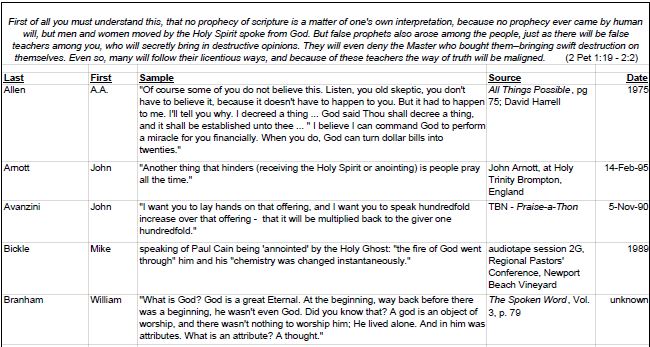
Several years ago, my wife took up the job of organizing the library of the church we were members of. She found some material that looked questionable and asked me to help her figure out which authors should be put in the closet on the “heresy shelf”.

I spent several weeks reading books and researching popular authors and developed a “cheat sheet” of false teachers and a sample of the heresy they taught. Below is a screen shot, the file (6 pages) can be downloaded here.

While I hope this is useful, please note that it is not up to date – some of the newer false teachers this site has brought to light are not included. But the people on this list are behind most of the folks now popular that we should be aware of.

Be on your guard, for the deceiver prowls around like a lion looking for his next meal. A little leaven leavens the whole lump – so do not buy the lie that you should “chew up the meat and spit out the bones.” Test everything – hold to that which is good. When you determine a man (or a woman) to be a false teacher, from such, turn away.

Thabiti Anyabwile on the altar call.

The following article, What About Altar Calls?, is from Thabiti Anyabwile:

I’m sometimes asked by people why we don’t do “altar calls” at our services. Like the people who ask the question, the churches in my personal background pretty much all practiced “altar calls” at the conclusion of a sermon or service. I’ve seen them done in very poor fashion, and I’ve seen some pastors be really clear about the gospel, repentance, faith, and the fact that “coming forward” does not save. I date my own conversion to the preaching of Exodus 32, which concluded with an altar call.

So, why don’t we practice “altar calls”? I don’t think the pastor who practices an “invitation” at the end of a sermon is in sin, but he may not be acting wisely either. This list of reasons, compiled by Pastor Ryan Kelly of Desert Springs Church, is a pretty good summation of some of my thinking (HT: Z).

1. The altar call is simply and completely absent from the pages of the N.T.

2. The altar call is historically absent until the 19th century, and its use at that time (via Charles Finney) was directly based upon bad theology and a man-centered, manipulative methodology.

3. The altar call very easily confuses the physical act of “coming forward” with the spiritual act of “coming to Christ.” These two can happen simultaneously, but too often people believe that coming to Christ is going forward (and vice-versa).

4. The altar call can easily deceive people about the reality of their spiritual state and the biblical basis for assurance. The Bible never offers us assurance on the ground that we “went forward.”

5. The altar call partially replaces baptism as the means of public profession of faith.

6. The altar call can mislead us to think that salvation (or any official response to God’s Word) happens primarily on Sundays, only at the end of the service, and only “up front.”

7. The altar call can confuse people regarding “sacred” things and “sacred” places, as the name “altar call” suggests.

8. The altar call is not sensitive to our cautious and relational age where most people come to faith over a period of time and often with the interaction of a good friend.

9. The altar call is often seen as “the most important part of the service”, and this de-emphasizes the truly more important parts of corporate worship which God has prescribed (preaching, prayer, fellowship, singing).

10. God is glorified to powerfully bless the things He has prescribed (preaching, prayer, fellowship, singing), not the things we have invented. We should always be leery of adding to God’s prescriptions for His corporate worship.

Numbers 1, 2, 3, 4, 5, and 10 of Ryan’s list are the most compelling reasons in my opinion. These would seem very serious objections for anyone who takes seriously the idea that our Christian lives and gatherings should conform to what the NT commands, models, and prohibits. Perhaps I would add an 11th: The “altar call” teaches the congregation to evaluate the “success” or “effectiveness” of the ministry on outward, visible actions and results.

Further, the need to be pastorally careful and sensitive with the souls of men needing to repent and believe couldn’t be more urgent. So, anything that obscures the reality of God the Holy Spirit’s work in conversion and the necessity of repentance and faith must be regarded–at best–a practice with potential to undermine the very work we’re giving our lives to.

Do people “respond” to the word of God at our services? They do. And we give them a number of ways they may follow up on what they’ve heard, from talking to an elder or Christian friend after the service, to scheduling an appointment during the week, to letting us know they would like us to visit with them, and so on. One thing I appreciate about our approach is that it allows us to meet, listen, question, encourage, teach and pray in a much more thorough way. By God’s grace we’re seeing people converted and profess their faith in baptism as the Spirit opens their hearts. We’re not perfect by any means. But I do hope we’re being faithful to the scripture’s commands, examples, and restrictions.

What do you think about Kelly’s list? Are you “for” or “against” and why? Would you add anything to or challenge anything on the list?

Sermon of the Week: “The Calling of a Preacher” by Albert Mohler.

Albert Mohler was one the key-note speakers at the 2012 Shepherd’s Conference. While there were several excellent speakers throughout the event, this message from Mohler was timely and relevant to me personally – and seemed to resonate with the two or three thousand others gathered there as well. Here is an excerpt from his introduction, full message in video below, mp3 download here (right click and save or click to listen).

Let’s admit it. There’s a lot of mysteries in the christian life, but one of the greatest mysteries is why God would in His sovereign, omnipotent and omniscient, and wisdom and righteousness, and mercy choose the likes of folks as we… to do this. You might think that if we were orchestrating this, we might have angels doing the preaching. Everybody would listen to an angel, wouldn’t they? Of course,  not American angels. We domesticate little angels, we paint little pictures of cherubs and hang them in the bathroom. It’s a completely different reality. Just remember in the Gospel of Luke, the angelic hosts showed up to the shepherds and the first think they had to say is, “First of all, don’t die” – “Fear not, we bring you tidings of great joy”. Meanwhile, most Americans, in our weirdo, fake, postmodern spirituality think they’re channeling with little cherubs in the bathroom.

But God doesn’t assign angels to do the preaching. He assigned human preachers, men whom He has called because when an angel shows up to preach you don’t ask, “How did God do that?”. But, when we show up to preach you’re looking at me going (saying), “He’s just flesh and blood. He’s nearsighted. He only speaks one language. He’s gonna be hungry soon. He fell asleep during a Greek lecture, thirty something years ago and you’re letting him preach?” Well, it’s as the apostle Paul says, “It’s so that the glory would be all of God’s and not ours. So that the excellence would be His excellence that’s demonstrated and not ours.”

Admit it: you’d love to be doing this, and then admit it: That’s a good thing. And then let’s just admit it together, it’s just a priceless thing that we get to be together for these days and these hours, to preach and to hear preaching and to be encouraged, not only by each other, but by the Holy Spirit of God in this calling that has come to us.

Quotes (938)

“If signs and wonders did still exist, do you think they would be given to people with bad theology? You think God would give Benny Hinn the power to do miracles to authenticate really bad theology? If those gifts existed, they would belong to the purest, most faithful, sound teachers of the word of God to authenticate their teaching–not to hair-brained people who spew out whatever comes into their head.”

John MacArthur

When Presuppositions Lead Men Astray

This post is not to throw stones but to point out to all of us how dangerous our unexamined thoughts are. We see this in casual ways when we infer what wasn’t written or implied – such as when we read Bible passages that are very familiar. Another way is when we defend a position – in politics or religion, related to style of worship or doctrinal distinctives. What follows is an example of a blogger for whom I have much respect has written a post to make the point that we each should “draw the line” on what music is good and proper – ostensibly in worship.

This post is NOT a forum to debate whether “Christian rap” or “Christian hip-hop” is good; the reason for this post is to examine the subtle tendency we have to use faulty logic (making sweeping arguments without discriminating actual facts) and misapplication of Scripture (based on unexamined presuppositions).

In this post http://5ptsalt.com/2012/05/16/christian-rap-is-a-lost-cause/ the author condemns a form of music by saying it “uses the ways, lusts, pride, dress and manner of the world.” And he gives no example of “Christian rap” that fulfills this charge. Nor does he acknowledge that nearly every generation of Christians makes a similar charge at what’s new in music – as Spurgeon did with organs in churches. Handel used grand orchestras to portray his message of God’s glory and people today still love some of his music without loving his Lord. Was Handel as guilty as the un-named “Christian rappers”?

In his follow-up post, http://5ptsalt.com/2012/05/17/qa-where-do-you-draw-the-line-in-music/ he conflates rap and hip-hop, condemning both as wanting to redeem the culture. He has a quote attesting to this under LeCrea’s picture – but does not tell us who spoke those words. It appears to be the author of the post, as those exact words appear later in the post. In making this claim of what the goal of “Christian hip-hop” is, he fails to provide one shred of evidence in support. LeCrea does not make any statement, in the video linked to, that the culture should or can be redeemed. The quote from Tripp says that “many today believe the hip hop culture is unredeemable” and how he hopes to REACH that culture with the gospel. He does not claim to want to redeem the culture – he wants to invade the hip-hop culture with truth.

The author slams several people as supporters of “Christian hip-hop” and, therefore, advocates of the unbiblical mission of redeeming the culture; naming Mark Dever and Thabiti Anyabwile in this regard. But in the video of Thabiti Anyabwile that is linked to, he DOES NOT say that culture can or should be redeemed, by hip-hop of anything else. He said that music (in this case, hip-hop) that carries reformed biblical truth can pierce the culture and form worldviews. There is no evidence that Thabiti or Dever support cultural redemption in either post.

Making these allegations without providing evidence and while misapplying what documentation is provided is wrong headed. Truth is important. Those who push for cultural redemption or cultural reformation should be properly exposed – with clear and convincing evidence rather than unsupported allegations. But we who claim Christ must be truthful and honest in our examination of the facts and allegations. I fail to find anything of substance in these posts, only mere allegations and a refusal to answer questions about sources and basis for judgment.

It is my prayer that the author of those posts repent and honestly report departures from biblical truths without resorting to half-baked arguments based on misquotes or neglect of the facts. It is my prayer that you and I likewise investigate the cause we do not know, as did wise Job (Job 29:16). We should think the best of brothers and sisters in Christ and be slow to throw allegations at people. Discuss the issues, use facts and sound logic. May God have mercy on all of us – for we each fall short in myriad ways each day.

Jesus IS Lord in 1st & 2nd Timothy, Titus, Philemon, and Hebrews

1st Timothy 1:1-2—Paul, an apostle of Jesus Christ, by the commandment of God our Savior and the Lord Jesus Christ, our hope, to Timothy, a true son in the faith: Grace, mercy, and peace from God our Father and Jesus Christ our Lord.

1st Timothy 1:12-14—And I thank Christ Jesus our Lord who has enabled me, because He counted me faithful, putting me into the ministry, although I was formerly a blasphemer…And the grace of our Lord was exceedingly abundant, with faith and love which are in Christ Jesus.

1st Timothy 5:21—I charge you before God and the Lord Jesus Christ and the elect angels that you observe these things without prejudice, doing nothing with partiality.

1st Timothy 6:3-4—If anyone teaches otherwise and does not consent to wholesome words, even the words of our Lord Jesus Christ, and to the doctrine which accords with godliness, he is proud, knowing nothing…

1st Timothy 6:13-15—I urge you in the sight of God who gives life to all things, and before Christ Jesus who witnessed the good confession before Pontius Pilate, that you keep this commandment without spot, blameless until our Lord Jesus Christ’s appearing , which He will manifest in His own time, He who is the blessed and only Potentate, the King of kings and Lord of lords.

Continue reading

May Day! May Day! Don’t let the swindlers lead you astray!

The Tithe

It is arguably the most pervasive doctrine of the Church, so well-received that even those who ardently decry any other form of abusive ministry will just as fervently defend this doctrine.

“Will a man rob God? Yet you are robbing Me! But you say, ‘How have we robbed Thee?’ In tithes and offerings. You are cursed with a curse, for you are robbing Me, the whole nation of you! Bring the whole tithe into the storehouse, so that there may be food in My house, and test Me now in this, says the LORD of hosts, if I will not open for you the windows of heaven, and pour out for you a blessing until it overflows. Then I will rebuke the devourer for you, so that it may not destroy the fruits of the ground, nor will your vine in the field cast its grapes, says the LORD of hosts” (Malachi 3:8-11).

This one passage, very familiar to anyone who has attended church faithfully for a period of time, has done much to burden the Christian with something that doesn’t even apply to him.

Without going into a great amount of detail, the comparisons between the Old Testament law of tithes and offerings and the New Testament principles of giving contrast so sharply that it is virtually impossible to ignore the differences.

For one thing, the O.T. tithes were directed toward the nation of Israel. The above verse indicates that quite clearly. It was a physical demonstration of the Jewish people in covenant relationship with the LORD. It was both the individual Jew’s and the entire nation of Israel’s duty to tithe on order to fulfill the Law. If he/they didn’t tithe, they were cursed.

There is no such thing as a nation of Christians. Our covenant is one of the heart. Christ has already fulfilled the Law in us (Romans 8:3-4). The mandated, outward observance of religious statutes (such as circumcision and tithes) have been done away. When Paul heard that Judaizers were attempting to bring circumcision into the Christian community, he placed anathema on them for subverting the law of grace (Galatians 1:6-9). The whole point of the book of Galatians was to show that we are no longer under the Law, nor could the Law make us righteous (Galatians 3:10-11). Since it says in verse 10 that everyone who practices the Law must abide by every point, or he is cursed, it is clear that circumcision is also implied, as were the temple practices, the priesthood, etc. Since these things are no longer in practice for the Christian, tithing falls right into the same area. Also, since Malachi curses those who do not tithe, and we are told in Galatians 3:13 that Christ has redeemed us from the curse of the Law, it is evident that both cannot apply.

Also, it is obvious that the Old Testament tithe was a requirement–no exceptions. But we are told in 2 Corinthians 9:7 that we are not to give under compulsion (or requirement), but to give as we ourselves purpose to give from our heart.

The tithes were used to support the Levitical priesthood for service at the Temple (Numbers 18:21-30). In the New Testament, all believers make up the priesthood (Revelation 1:6), and believers themselves are the temple of the Holy Spirit (1 Corinthians 6:19), the only temple where God dwells.

One more critical point should bring the argument in favor of a tithe to a screeching halt. The tithes were assessed only the increase of the crops and cattle of the Jews, and was paid in crops and cattle (Deuteronomy 14:22-23). Only if a person lived too far from the temple to make the yearly trip with a caravan of goods could he convert the tithe into money, and add one-fifth to the price (Leviticus 27:30-33, Deuteronomy 14: 24-25).

Now, it is a great leap to say that the local church building now represents the Temple where the tithes were stored, and since it is too far to bring our cattle, produce, new wine, etc., then we are permitted to bring our money instead. But then, remember that we must add one-fifth to the price, thereby giving more than the traditional 10% tithe. And all this to support the Levitical priesthood, which, symbolically is now the local pastor…

You can see where this is all going. The argument falls apart when taken in context. Now, certainly we should give, and that generously, for we own nothing. We are only stewards of what belongs to God anyway. But twisting the financial arm of the average church-goer or laying a heavy burden of guilt on him for failure to fulfill an unwarranted expectation is Pharisaical.

“And He sat down opposite the treasury, and began observing how the multitude were putting money into the treasury; and many rich people were putting in large sums. And a poor widow came and put in two small copper coins, which amount to a cent. And calling His disciples to Him, He said to them, ‘Truly I say to you, this poor widow put in more than all the contributors to the treasury; for they all put in out of their surplus, but she, out of her poverty put in all she owned, all she had to live on'” (Mark 12:41-44). (The above is by author unknown, found by me years ago.)

We see here, at the last, a revelation from the Lord that giving is a matter of the soul. Read the sermon on the mount and see the comparison between sheep and goats – each group did the same things, but the sheep did so unto the brothers of Christ, knowing only that they loves the redeemed brotherhood; and the goats gave without knowledge of love, thinking they were honoring the Lord. This reminds us that the righteousness of deeds done in our flesh is rubbish, while the small things we do in the Spirit of God are pure gold.

Not everyone who teaches tithing is a swindler. A.W. Pink is an example of such a man. Yet the teaching of tithing is, in my opinion, the result of not seeing the theology of the Kingdom of God rightly, being too concerned with earthly things and the continuation of Israel as seen with eyes of flesh.

For more reading, including a couple of free ebooks, check out http://www.tithingdebate.com/

The battle cry of The Reformation was – and still must be – Soli Deo Gloria! Let nothing we do be less.

The God of gods

That men may know that Thou, whose name alone is JEHOVAH art the Most High over all the earth! ⎯ Psalm 83:18

In the beginning was the WORD, and the WORD was with God, and the WORD was God. The same was in the beginning with God. All things were made by Him; and without Him was not any thing made that was made… And the WORD was made flesh, and dwelt among us, and we beheld His glory, the glory as of the only begotten of the Father, full of grace and truth. ⎯ John 1:1-3,14

For by Him were all things created, that are in heaven, and that are in earth, visible and invisible, whether they be thrones, or dominions, or principalities, or powers: All things were created by Him, and for Him: And He is before all things, and by Him all things consist. ⎯ Colossians 1:16-17

As it is written: No eye has seen, no ear has heard, no mind has conceived what God has prepared for those who love Him. ⎯ 1 Corinthians 2:9

For in Him we live, and move, and have our being; as certain also of your own poets have said: For we are also His offspring. ⎯ Acts 17:28

Shall a man make gods unto himself, and they are no gods? ⎯ Jeremiah 16:20 → (Allah = Satan)

Woe unto him that striveth with his Maker! ⎯ Isaiah 45:9

Woe unto that man by whom the Son of man is betrayed. It would have been good for that man if he had not been born! ⎯ Mark 14:21

And Pilate asked JESUS: Are You the KING of the Jews? JESUS replied: You have said it! ⎯ Mark 15:2

I said therefore unto you, that you shall die in your sins: for if you believe not that I AM He, you shall die in your sins. ⎯ John 8:24

For unto us a Child is born, unto us a Son is given: and the government shall be upon His shoulder: and His name shall be called: Wonderful, Counsellor, The Mighty God, The Everlasting Father, The Prince of Peace. ⎯ Isaiah 9:6

I and My Father are One. ⎯ John 10:30

Now I, Nebuchadnezzar, praise and extol and honor the KING of heaven; All whose works are truth, and His ways judgment: and those that walk in pride He is able to abase. ⎯ Daniel 4:37

But let him that glories, glory in this: that he understands and knows Me, that I AM the LORD which exercise lovingkindness, judgment, and righteousness, in the earth: for in these things I delight, says the LORD. ⎯ Jeremiah 9:24

I form the light, and create darkness: I make peace, and create evil: I the LORD do all these things. ⎯ Isaiah 45:7

Put not your trust in princes, nor in the son of man, in whom there is no help. When his breath goes forth, he returns to his earth; in that very day his thoughts perish. Happy is he that has the God of Jacob (Israel) for his help, whose hope is in the LORD his God: Which made heaven, and earth, the sea, and all that therein is: Which keeps truth forever. ⎯ Psalm 146:3-6

For all those things has Mine hand made, and all those things have been, saith the LORD: but to this man will I look, even to him that is poor (humble) and of a contrite (repentant) spirit, and who trembles at My Word. ⎯ Isaiah 66:2

Remember the former things of old: for I AM God, and there is none else; I AM God, and there is none like Me; declaring the end from the beginning, and from ancient times the things that are not yet done, saying: My counsel shall stand, and I will do all My pleasure… Yea, I have spoken it, I will also bring it to pass; I have purposed it, I will also do it. ⎯ Isaiah 46:9-11

Seek ye the LORD while He may be found, call ye upon Him while He is near: Let the wicked forsake his way, and the unrighteous man his thoughts: and let him return unto the LORD, and He will have mercy upon him; and to our God, for He will abundantly pardon. For My thoughts are not your thoughts, neither are your ways My ways, saith the LORD. For as the heavens are higher than the earth, so are My ways higher than your ways, and My thoughts than your thoughts… So shall My Word be that goeth forth out of My mouth: It shall not return unto Me void, but it shall accomplish that which I please, and it shall prosper in the thing whereto I sent it. ⎯ Isaiah 55:6-9,11

For the LORD your God is the GOD of gods, and the LORD of lords ⎯ Deuteronomy 10:17

Wherefore, God also has highly exalted Him, and given Him a name which is above every name: That at the name of JESUS every knee should bow, of things in heaven, and things in earth, and things under the earth; and that every tongue should confess that: JESUS CHRIST is LORD to the glory of God the Father. ⎯ Philippians 2:9-11

And He has on His vesture and on His thigh a name written: KING OF KINGS, AND LORD OF LORDS. ⎯ Revelation 19:16

And when all the people saw it, they fell on their faces: and they said: The LORD, He is the God; The LORD, He is the God! ⎯ 1 Kings 18:39

A quiz for Arminians.

I found the following quiz for Arminians at Chosen by Grace Alone via Bob Hanks’ blog.

~~~~~~~~~~~~~~~~~~~~~~~~~~~~~~~~~~~~~~~~~~~~~~~~~~~~~~~

Eph. 1:11 …[W]ho [God] worketh all things after the counsel of His will.

Q. If God works all things after the counsel of His will, how much does He work to the will of you, me, Satan, etc.?

A. None.
B. 20%
C. 50%
D. 85%

Is. 14:24 Jehovah of hosts hath sworn, saying , Surely, as I have thought, so shall it come to pass; and as I have purposed, so shall it stand.

Q. How much of what He wants to come to pass, doesn’t?

A. All of His thoughts will come to pass
B. Some of His thoughts will not come to pass
C. A few of His thoughts will not come to pass
D. A lot of His thoughts will not come to pass

Rom. 8:29 For whom He foreknew, He also foreordained to be conformed to to the image of His Son, that He might be the firstborn among many bretheren: and whom He foreordained, them He also called: and whom he called, them he also justified: and whom He justified, them He also glorified.

Q. How many do you think have been called, justified, or glorified that He did not first foreknow or foreordain?

A. Write in your answer: ___________________

John 10:14 I am the good shepherd; and I know my own, and mine own know me, even as the Father knoweth me, and I know the Father; and I lay down my life for the sheep.

Q. Where does this scripture say that Jesus laid down his life for the sheep and the goats

A. It doesn’t
B. It doesn’t, but I just know He meant the goats, too

John 6:65 No man can come unto me, except it be given unto him of the Father.

Q. How many come to Jesus that were not first given to him by the Father?

A. 0
B. 5,000
C. 5,000,000
D. 10,000,000

John 6:37 All that the Father giveth me shall come unto me

Q. How many that the Father gave Him will not come to Him?

A. Two
B. A couple of thousand
C. A couple of million
D. Trick question, it says they will all come unto him

John 10:28 I [Jesus] give unto them the (true followers, or ‘sheep’) eternal life; and they shall never perish, and no one shall snatch them out of my hand. My Father, who hath given them unto me, is greater than all; and no one is able to snatch them out of the Father’s hand.

Q. How many sheep do you think have been snatched from either God’s or Jesus’ hands?

A. None
B. 50,000
C. 500,000
D. 1,000,000

Rev. 13:8 And all that dwell upon the earth shall worship him, whose names are not written in the book of life of the Lamb slain from the foundation of the world. Rev. 20:15 And whosoever was not found written in the book of life was cast into the lake of fire.

Q. Considering this, and other related scripture, God having to blot out a name from the book of life would mean:

A. God makes mistakes.
B. Some have been snatched from Jesus’ hands?
C. God didn’t know that some of His sheep were really goats.
D. None of the above.

Q. Could a person whose name was written in the book of life from the foundation of the world not have become a Christian (or have saving faith in God if born before Jesus)?

A. No
B. Yes
C. This confuses me, but I’m going to believe the Bible.
D. This confuses me, and I’m going to pretend this isn’t in the Bible (be honest).

Matt. 13 10 And the disciples came, and said unto him, Why speakest thou unto them in parables? 11 He answered and said unto them, Because it is given unto you to know the mysteries of the kingdom of heaven, but to them it is not given.

Q. Jesus himself declared that one of the reasons why He spoke in parables was that the truth might be concealed from whom it was not intended. Is this fair?

A. No.
B. Yes.
C. Who are we to question God?
D. I’m going to pretend I didn’t see that verse.

Rom. 8:28 To them that love God all things work together for good, even to them that are called according to His purpose.

Q. How many things do not work for the good of those who love God?

A. 10% of all things
B. 40% of all things
C. 85% of all things
D. Trick question, the Bible says all things work for the good of those who love Him

Mark 14:30 And Jesus said unto him (Peter), Verily I say unto thee, that thou, today, even this night before the cock crow twice shall deny me thrice.

Questions:

A. Could Peter not have denied Jesus three times before the cock crowed twice?
Answer here: ____________________________
B. Did Jesus make Peter deny him, or did Peter do it of his own free will?
Answer here: ____________________________

Exodus 4:11 [God Himself asks the rhetorical question] Who gave man his mouth? Who makes him deaf or dumb? Who gives him his sight or makes him blind? Is it not I the Lord?

Q. Is this fair?

A. Yes.
B. No.
C. Who are we to question God?
D. I’m going to pretend this isn’t in the Bible.

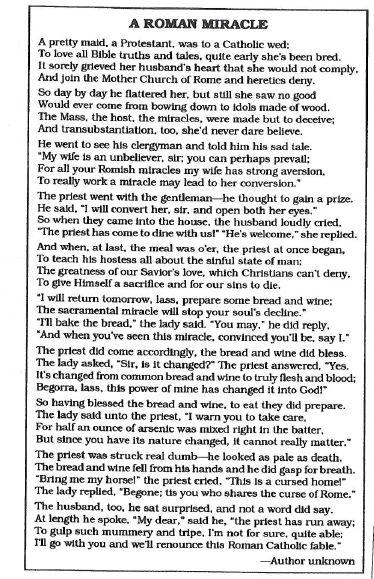
A True Roman Catholic Miracle!

I ran across this poem while reading about the difference between the biblical gospel and the false gospel of the cult of Rome, revealing a bonafide miracle! Don’t discount miracles within the Roman cult until you read this, taken from a pamphlet written by Richard Bennett. You can read more from this kind gentleman here: http://www.bereanbeacon.org/

Jesus IS Lord in Colossians, and 1st & 2nd Thessalonians

Colossians 1:1-3—Paul, an apostle of Jesus Christ by the will of God, and Timothy our brother, to the saints and faithful brethren in Christ who are in Colosse: Grace to you and peace from God our Father and the Lord Jesus Christ. We give thanks to the God and Father of our Lord Jesus Christ, praying always for you.

Colossians 2:6—As you therefore have received Christ Jesus the Lord, so walk in Him.

Colossians 3:16-24—Let the word of Christ dwell in you richly in all wisdom, teaching and admonishing one another in psalms and hymns and spiritual songs, singing with grace in your hearts to the Lord. And whatever you do in word or deed, do all in the name of the Lord Jesus, giving thanks to God the Father through Him. Wives, submit to your own husbands, as is fitting in the Lord. Husbands, love your wives and do not be bitter toward them. Children, obey your parents in all things, for this is well pleasing to the Lord…And whatever you do, do it heartily, as to the Lord and not to men, knowing that from the Lord you will receive the reward of the inheritance; for you serve the Lord Christ.

Colossians 4:7—Tychicus, a beloved brother, faithful minister, and fellow servant in the Lord, will tell you all the news about me.

Colossians 4:17—And say to Archippus, “Take heed to the ministry which you have received in the Lord, that you may fulfill it.”

________________________________________

1st Thessalonians 1-8—Paul, Silvanus, and Timothy, to the church of the Thessalonians in God the Father and the Lord Jesus Christ: Grace to you and peace from God our Father and the Lord Jesus Christ. We give thanks to God always for you all, making mention of you in our prayers, remembering without ceasing your work of faith, labor of love, and patience of hope in our Lord Jesus Christ in the sight of our God and Father…And you became followers of us and of the Lord, having received the word in much affliction…from you the word of the Lord has sounded forth, not only in Macedonia and Achaia, but also in every place.

1st Thessalonians 2:14-15—You also suffered the same things from your own countrymen, just as they did from the Judeans, who killed both the Lord Jesus and their own prophets, and have persecuted us; and they do not please God and are contrary to all men.

1st Thessalonians 2:19—For what is our hope, or joy, or crown of rejoicing? Is it not even you in the presence of our Lord Jesus Christ at His coming?

1st Thessalonians 3:8-13—For now we live, if you stand fast in the Lord. For what thanks can we render to God for you, for all the joy with which we rejoice for your sake before our God…Now may our God and Father Himself, and our Lord Jesus Christ, direct our way to you. And may the Lord make you increase and abound in love to one another and to all, just as we do to you, so that He may establish your hearts blameless in holiness before our God and Father at the coming of our Lord Jesus Christ with all His saints.

1st Thessalonians 4:1-6—Finally then, brethren, we urge and exhort in the Lord Jesus that you should abound more and more, just as you received from us how you ought to walk and to please God; for you know what commandments we gave you through the Lord Jesus. For this is the will of God, your sanctification…that no one should take advantage of and defraud his brother in this matter, because the Lord is the avenger of all such, as we also forewarned you and testified.

1st Thessalonians 4:15-17—For this we say to you by the word of the Lord, that we who are alive and remain until the coming of the Lord will by no means precede those who are asleep. For the Lord Himself will descend from heaven with a shout, with the voice of an archangel, and with the trumpet of God. And the dead in Christ will rise first. Then we who are alive and remain shall be caught up together with them in the clouds to meet the Lord in the air. And thus we shall always be with the Lord.

1st Thessalonians 5:2—You yourselves know perfectly that the day of the Lord so comes as a thief in the night.

1st Thessalonians 5:9-12—For God did not appoint us to wrath, but to obtain salvation through our Lord Jesus Christ…And we urge you, brethren, to recognize those who labor among you, and are over you in the Lord and admonish you

1st Thessalonians 5:23-28—Now may the God of peace Himself sanctify you completely; and may your whole spirit, soul, and body be preserved blameless at the coming of our Lord Jesus Christ…I charge you by the Lord that this epistle be read to all the holy brethren. The grace of our Lord Jesus Christ be with you. Amen.

________________________________________

2nd Thessalonians 1:1-2—Paul, Silvanus, and Timothy, to the church of the Thessalonians in God our Father and the Lord Jesus Christ: Grace to you and peace from God our Father and the Lord Jesus Christ.

2nd Thessalonians 1:7-12—…and to give you who are troubled rest with us when the Lord Jesus is revealed from heaven with His mighty angels, in flaming fire taking vengeance on those who do not know God, and on those who do not obey the gospel of our Lord Jesus Christ. These shall be punished with everlasting destruction from the presence of the Lord and from the glory of His power…Therefore we also pray always for you that our God would count you worthy of this calling…that the name of our Lord Jesus Christ may be glorified in you, and you in Him, according to the grace of our God and the Lord Jesus Christ.

2nd Thessalonians 2:1-2—Now, brethren, concerning the coming of our Lord Jesus Christ and our gathering together to Him, we ask you not to be soon shaken in mind or troubled, either by spirit or by word or by letter, as if from us, as though the day of Christ had come.

2nd Thessalonians 2:8—And then the lawless one will be revealed, whom the Lord will consume with the breath of His mouth and destroy with the brightness of His coming.

2nd Thessalonians 2:13-17—But we are bound to give thanks to God always for you, brethren beloved by the Lord, because God from the beginning chose you for salvation through sanctification by the Spirit and belief in the truth, to which He called you by our gospel, for the obtaining of the glory of our Lord Jesus Christ…Now may our Lord Jesus Christ Himself, and our God and Father, who has loved us and given us everlasting consolation and good hope by grace, comfort your hearts and establish you in every good word and work.

2nd Thessalonians 3:1-6—Finally, brethren, pray for us, that the word of the Lord may run swiftly and be glorified, just as it is with you, and that we may be delivered from unreasonable and wicked men; for not all have faith. But the Lord is faithful, who will establish you and guard you from the evil one. And we have confidence in the Lord concerning you, both that you do and will do the things we command you. Now may the Lord direct your hearts into the love of God and into the patience of Christ. But we command you, brethren, in the name of our Lord Jesus Christ, that you withdraw from every brother who walks disorderly and not according to the tradition which he received from us.

2nd Thessalonians 3:12—Now those who are such we command and exhort through our Lord Jesus Christ that they work in quietness and eat their own bread.

2nd Thessalonians 3:16-18—Now may the Lord of peace Himself give you peace always in every way. The Lord be with you all. The salutation of Paul with my own hand, which is a sign in every epistle; so I write. The grace of our Lord Jesus Christ be with you all. Amen.