Justified

You’ve heard it said that “justified” means “just as if I’d never sinned.”

If that were true, we would be in trouble by the hour.

If all Christ did for us was to make us like Adam before the Fall, we are not clothed in His righteousness, we are not aware of the offense against Him we’ve committed, and we have no amazement at the grace He lavished upon that we would be the sons and daughters of Holy God.

Justified means MUCH MORE than “just as if I’d never sinned.” It means forgiven, reconciled, and destined for glory in spite of my sin.

Praise the Lord! He does not merely make our sin go away; He paid for it on the cross and covers us in His righteousness, reconciling us to the Father by the blood of His cross.

A Baptist Look at the Reformation and the Covenants

A Baptist Look at the Reformation and the Covenants

Baptists have historically been called people of the Book, based on a devotion to knowing Christ through His written revelation, seeking wisdom from God as His Spirit guides us.

Our charge is to be faithful to the One who called us, not to those dear brothers who went before us, some 400 years past.

May my imperfect message provoke you to dig into the Word and not be content with being a disciple of men.

History of the Sabbath

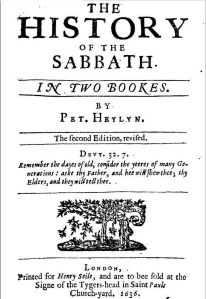
Published in 1636, Peter Heylyn’s The history of the Sabbath: in two bookes details how man’s religion re-skinned the Jewish Sabbath and called it a Christian ordinance. I have edited it to modernize the English and eliminate most of the Latin in an attempt to make this work available and accessible to 21st century readers.

From the dawning of the New Covenant, Christians have struggled over how the Old Covenant Scriptures are to be applied to the lives of the saints. Acts 15 is one of several records showing how some Christians thought the Mosaic Covenant applied to Christians, claiming saints must be circumcised and follow the law of Moses (Acts 15:1 & 5). Peter rebuked these brothers, observing that the Mosaic Law (which was the centerpiece of the Old Covenant) was a yoke too heavy for man to bear and requiring this was putting God to the test (verse 10).  Jesus said His yoke was easy, that He would carry the burden of His sheep (Matt 11:30) and John tells us, This is how we know that we love God’s children when we love God and obey His commands. For this is what love for God is: to keep His commands. Now His commands are not a burden (1 John 5:2-3).

Despite this clear teaching, over time, many Christians began to teach that Christians must be “baptized” as infants and obey the law of Moses – specifically the 4th Word of the Decalogue.

Heylyn’s book shows the historical development of this Christian Sabbatarian practice and how those who taught this practiced it. We see the common tale of those who say, “Do what I say, not what I do.” Paul taught against this (Romans 2:21); it ought not be so within the body of Christ!

I pray this old booke helps open the eyes of those who are trying to carry a heavy yoke or burden other saints with such teaching. In paper and Kindle formats.

The Life and Theology of Paul

The Life and Theology of Paul

A review by Stuart Brogden

I was intrigued when I saw this book come available for review. I’ve reviewed this author’s commentary on Acts and was eager to see how he addressed Paul. This book will not disappoint the reader who truly wants to know the theology of Paul, which is to say, the theology of the Bible.  

Guy Water’s has organized this book into 12 chapters, covering Paul’s conversion and calling by God, his view of sin, justification, sanctification, the church, and the end of the age. In the introduction, Waters points out that Paul’s life stands as “a testimony to the gospel that he preached” – even while acknowledging what we can know about Paul’s life is found only in the Bible. But considering how much of the Bible Paul wrote, and what Luke wrote about him, we have more than enough material (inspired by God!) to know Paul very well. In summing up a nice, concise review of Paul’s life, our author tells us of two ways his life is still fundamental in the life of the church today. First, God prepared Paul “from the womb to be the “Apostle to the Gentiles.”” (page 10). We should consider our own lives as having been worked out by God for use to His people, trusting Him when we are not sure of our path. Secondly, although he was dramatically converted, the man was not transformed into someone else. Since God had prepared Saul for his role, it would overthrow all that preparation if the result was a different man. God’s preparation leads to His plans being fulfilled. When we look at ourselves, we should look unto the Lord, knowing He is faithful and trustworthy to equip us and keep us.

In his review of Saul’s conversion, Waters observes (page 15), “Saul, then, would serve as a pattern or model of what Jesus Christ would do in the lives of men and women who hear Saul’s witness to Christ.” He notes that not all who hear the gospel are saved, but that those who are saved are saved in the way Saul was. I’ve made note of this myself in much the same way and think people who claim man plays a role in his own conversion would benefit from chapter 2 and the biblical evidence our author marshals.

It has been said that the basis of the Reformation was the doctrine of justification. Waters quotes Martin Luther: “If the article of justification is lost, all Christian doctrine is lost at the same time.” (page 49) Without a clear understanding of Who saves whom – and from Whom – the Christian will tend to drift into thinking too highly of self too lowly of Christ. Waters’ two chapters on justification follow his two chapters on sin. And following justification, we have three chapters on sanctification. I have been severely grieved of late by the number of Christians I’ve encountered who consider sanctification a one-time thing that is finished upon redemption. While I disagree with Waters on his interpretation of the man in Romans 7, his teaching in these chapters is very good and concludes on the high note that the “Christian life is one of unceasing dependence upon Christ” (page 89) and “Our ultimate good is our glorification in and with Christ.” (page 99). If we keep these biblical truths in front of us, we will do well.

Since justification is the hinge point of our faith, I think it best if we make sure we understand it. Waters quotes Romans 3:21, reminding us that “Paul has labored to argue that sinners lack the righteousness that God requires of human beings. Now, for the first time in this letter, Paul begins to describe the righteousness that God has accomplished in Christ and that He freely gives in the gospel to sinners (see Rom. 1:16-17)” (page 50). He then tell us of three important words used by Paul to define and describe this gift of righteousness: redemption, propitiation, and justification.

Redemption, we are told, has a rich history in the biblical story. In Exodus 6:6 and 2 Sam 7:23 God describes “His deliverance of Israel from bondage in Egypt” with this word. “In Isaiah’s prophecy, God often speaks of Himself as the Redeemer of His people,” (page 50) laying the foundation that God is the initiator and author of man’s redemption. To redeem mean to buy back something, such as a slave, by paying a ransom. In redeeming sinners, Christ Jesus has purchased us from the slave market of sin; the purchase price was His life. Waters points out that Paul connects our redemption to the shedding of Jesus’ blood in Eph 1:7.

Secondly, propitiation “is the turning aside or averting of wrath.” (page 51) Our author declares, “those for whom Jesus died have not only had their sins atoned for, but they have also had the Father’s wrath averted from them. Jesus has turned aside the wrath of God from His people because He exhaustively bore the wrath of God on their behalf at the cross.” (page 51) It has been well said that we are saved from God by God. Those who are perishing will not be separated from God in the complete sense – only as regards His benevolence. They will be personally experiencing His unending wrath for eternity as their sinful human frame is unable to atone for their sin against an infinitely holy God. This is why Paul wrote that “there is, therefore no condemnation for those who are in Christ Jesus” (Rom 8:1) – God’s wrath was satisfied in the sacrifice of Jesus. There is no wrath left, no sin debt unpaid, for those who are in Christ!

Regarding justification, Waters warns us about some who claim “justification carries the idea of inward transformation” (page 52), as the Roman Catholic Church does. To Paul we go to find out his view, as we see it as something brought to us once as a gift, and the alternative to condemnation (Rom 5:16; 8:33-34). “The opposite of justification is condemnation. This … confirms justification as a strictly forensic (that is, courtroom) reality.” (page 52) Justification, he says, “has in view two inseparable realities.” (page 52) Firstly, Rom 4:7-8 teaches that forgiveness is complete, none of the sins of the saints are unforgiven, as if the blood of Christ was not sufficient. Secondly, we are declared righteous. “In Justification, God does not clear our account of debt to Him and tell us to start over and do better this time. We are, rather, counted as righteous for Christ’s sake.” (page 53) This is a status that cannot be over turned – not by man, devil or God.

One point of strong disagreement I have with Waters comes to us on page 55 where read that the righteousness of Christ is “offered in the gospel and may be refused (see Rom. 9:30-10:4)” Nowhere in the Bible is the gospel an offer, something that can be refused. When a sovereign says, Come!, that is a command of a superior to an inferior, not a request. The grace that saves is a gift from God, but not a gift that CAN be refused. A proper understanding of redemption reveals that man is regenerated by the Holy Spirit and THEN given the faith needed to receive the grace to believe. John 6:44 sums up the actions and sequence: John 6:44 (HCSB) No one can come to Me unless the Father who sent Me draws him, and I will raise him up on the last day. Note the first act – God draws, or drags, the person who is dead in sins (Eph 2:1-2) to Himself. Everything else, though it cannot be disconnected from this, follows it. Being regenerated, the sinner now wants God where he was unable to before. No one being so changed would be able to refuse God, just as one not changed is not able to want God nor discern spiritual things (John 8:43; 1 Cor 2:15). Further, nothing in the Scripture noted by Waters (Rom 9:30 – 10:4) supports his assertion that sinners are offered salvation and can refuse that offer.

Wanting to finish this review on a positive note, overall Waters does very good, indeed. His third chapter on justification rests on our “union with Christ.” The bond we saints have with Christ Jesus is essential to our salvation and our standing with God. He rightly asserts, “if we are in Christ, this relationship and all that it carries are due entirely to the gracious initiative of God. … Our unity rests on nothing in ourselves, but entirely on our Savior and what He has done to rescue us from sin and death and bring us to eternal life.” (page 68) Christ’s righteousness has been imputed to us just as our sin has been imputed to Christ. We have no righteousness or merit of our own; if not joined to Christ we have no hope. But we who are in Christ have security, we “have a certain glorious future and, therefore, hope for the present.” (page 68)

Reader – pick up this book and read. Your soul be edified.

Infant Baptism Biblical or Unbiblical? (Part 3)

Some professing believers simply don’t see any harm with infant baptism regardless if it’s biblical or unbiblical.  However, there is indeed a great danger to the practice of infant baptism vs. believer’s baptism.  Danger?  Yes, danger!  Mankind is born into sin and to declare an infant to be spiritually cleansed is heresy!

Paedobaptists believe that the infant offspring of believers enjoy hereditary right to the covenant of grace, and due to their “baptism” they have full membership privileges in that local church.  These churches that ascribe to this practice of “infant baptism” would never consider baptizing an infant whose parents are unbelievers.  Whether the newborn infant is the offspring of believers or unbelievers doesn’t change the spiritual status of the newborn infant as a sinner in need of Christ as their Savior!

Note:  “not everyone who says Lord, Lord”…there are parents who profess themselves as believers who in fact are not.  This begs the question as to the supposed spiritual benefit inherited by the infant who is “baptized” with the assumption that their parents are believers when they in fact are not.  Now what happens regarding the infant based upon the presupposition that they are (true) believers?

The belief that infants of believing parents will guarantee the covenant benefits that God in Christ will be their God too, and thus, making them as God’s chosen elect is contrary to God already choosing His elect before the foundation of the world.  Some hold to the view that the mere physical birth of an infant to believing parents makes them members of the church and were never ungodly sinners to begin with, and their (physical) birth alone makes them members in the household of faith.

Let’s consider the subject of universal depravity regarding the harmony of these two principles.  “Thou shalt love the Lord thy God with all thy soul, with all thy mind, and with all thy strength, and thy neighbor as thyself” (Matt. 12:30-32).  By nature, men prefer the world and its sinful gratifications, versus preferring the love of God and of their neighbor.  Mankind’s affections take the place of God’s affections and therefore mankind is totally depraved.

How does this depravity apply to infant’s born to believing parents?  Simply put, the children of believing parents are just as depraved as infants born to unbelieving parents (as previously stated).  “All have sinned and come short of the glory of God” (Rom. 3:23).  “By one man sin entered into the world, and death by sin, and so death passed upon all men, for that all have sinned” (Rom. 5:12).

Ok, let’s do some comparison between infant baptism and universal depravity.  They teach that the children of believing parents are sanctified by being born of believing parents, and that they are federally holy, and therefore, they should be “baptized.”  Though these churches teach universal depravity they negate universal depravity based upon their belief of infants being born to believing parents.  You cannot be totally depraved and somehow holy at the same time of your physical birth.  The truth of the matter is the fact that all are born into sin, and are by nature, depraved.  Those who ascribe to the hereditary claims of infant baptism falsify the doctrine of universal depravity.

Here’s what Paul said, “But it is not as though the word of God has failed. For not all who are descended from Israel belong to Israel, and not all are children of Abraham because they are his offspring, but “Through Isaac shall your offspring be named.” This means that it is not the children of the flesh who are the children of God, but the children of the promise are counted as offspring” (Rom. 9:6-8).  Which shall we believe and stand firm upon?  Dear (Christian) reader we shall always stand firm upon the Word of God above any creed or confession of faith.

Another consideration to ponder is, if the infant children of believing parents are “holy,” in the “covenant of grace,” and “born into the church,” this would mean that they have pure nature’s, and the work of the Spirit of God is quite unnecessary indeed.  Being taught this from their early and formative years produces men and women who have never felt a deep sense of the miserable condition as (lost) sinners on their way to a devil’s hell nor can they have any deep sense of gratitude and appreciation for the (saving) grace of God Almighty!

Some of them may very well come to a saving knowledge of Christ by the hearing of His Word and the convicting power of the Holy Spirit, yet apart from this they will never know the King of kings and Lord of lords.  Infant baptism nullifies universal depravity and teaches an unbiblical message that the children of believing parents have no need of the renewing power of the Holy Spirit of God.  Therefore, infant baptism is not only unbiblical at its core, it is a doctrine of devils because it is completely contrary to God’s Holy Word.

More to come…………………………………………………..


Raising Passionate Jesus Followers?

A review by Stuart Brogden

There are times when I wonder if anything good can come from Zondervan. Raising Passionate Jesus Followers, by Phil and Diane Comer, did not allay that concern. After reviewing the table of contents (lots of short chapters) I made a bee-line for Appendix B – Leading Your Child to Christ, to find out, first off, if the gospel was properly presented. Sigh. For one thing, this entire book is filled with new-age talk about “sharing Jesus” and “model” Jesus. Amidst some good counsel, Read the Scriptures to them (your children) regularly!” there is a common yet sad misunderstanding of Scripture in the next sentence: “Read John 3: to them and talk about how much God loves them.” (page 284) On the next page, we are told, “After modeling for your kids what it looks like to follow Jesus; and praying and talking to them about making a decision to follow the way of Jesus; when you feel the time is right, be bold and ask them if they would like to receive Jesus as their Savior and Lord!” Praying and talking to your kids about the gospel is the right thing to do. Asking them if they would like to receive Jesus is part and parcel of the false gospel of man’s free will, couched in terms of following Jesus without the gospel being presented.

Throughout this book we find behavior, followers of Jesus, but I don’t recall once having seen the death to sin and resurrection to new life in Christ by grace through faith being discussed. This aligns perfectly, however, with the perspective that behavior modification can result in a “follower.” Still in this revealing appendix, we find this (page 286):

One Sunday afternoon after church, we were driving to a friend’s house for lunch. Our oldest son, John Mark, who was just four-and-a-half years old at the time, was in the car with us. He’s just heard a clear presentation of the good news in his children’s call at church and, as we were driving, he blurted out: “I want to give my life to Jesus right now!”

We pulled the car over nest to a strip mall on a busy boulevard and led him in a prayer to receive Jesus as his Savior and Lord. Right there, in that moment, he was saved!

Later on (same page) we’re told, “You want your child to remember the life-changing decision they (sic) made, so talk about the place, the time, the night and who was there when they (sic) gave their (sic) life to the Lord. Anything to help them remember their decision as they grow older.” I don’t find any of this in Scripture! I see the saints being encouraged to keep their focus on Christ, trusting in Him – not a decision we made – to keep us until He returns. If you have to remember what you did, your confidence that you are right with God will rest on yourself rather than on the One Who saves sinners.

There is some good parenting counsel scattered throughout this book, but the work is built on the faulty foundation of decisional regeneration, a hat-tip to God’s sovereignty, and a lack of biblical clarity.

A quick review, starting with the introductory A Note to Parents, wherein we see this worldly view of the love for God we are to have (page 16): “The Jesus we wanted out kids to fall in love with is the One who …” Falling love is a Greco-Roman view of love, you are helpless, it happened to you. The biblical view of love is that it is a deliberate act of the person in response to having first been loved by God. We don’t fall in love with Jesus; we love Him because He first loved us (1 John 4:19).

Chapter 4 introduces us The Great Shema, and we learn that “Jesus loves your children. He longs to bring them close, to redeem them and make them his own. … God is inviting you to join Him” (page 35), He longs for a loving relationship with each of us” (page 39). Again we see a Jesus who wants to redeem sinners but is apparently unable to do so without our help. In chapter 8 we are told our goal is “to raise sons and daughters who are passionate Jesus followers. By “passionate Jesus followers” we mean kids who grow up to truly love and walk with the Lord” (page 53). By making a goal focused on results rather than on personal faithfulness, the authors are setting their readers up for a crushing sense of failure. We cannot produce Christians – God alone does that. We are to be faithful witnesses of Him by the proper teaching of His Word. If that is our goal, we can rest a bit easier, for God will enable and equip us to do this, as His instructions are to make disciples by teaching them all He has commanded. We teach; God calls people out of spiritual death into the glorious light of His kingdom.

Throughout much of this book, the authors talk about managing the box – the area (physically and psychologically) that our kids occupy. As they grow and mature, the box gets bigger. This is something I personally agree with vigorously, as we are to train our children to take responsibility for their decisions and the scope of those choices which with they can live increases as they mature.

Near the end of the book, advice for parents of adult children is given. Much of it reflects humanistic psychology, wrapped up in personal piety. “Bless your grown children by believing in them … they need our approval and affirmation” (page 263). I would hope parents would bless their adult Christian children by reminding of God’s faithfulness, not puffing them up as if they were something they are. This may be what the authors intended by the last sentence in this section: “Remember, He who began a good work in your children right in your very own home, will carry it on to completion.” Nothing in this chapter up to this point indicates whether the adult children being spoken of are “passionate Jesus followers” or not. And the authors do not once – as far as I noticed – call Christians by that name. Consistently they talk about people who follow Jesus, as if the Bible did not use that term (specifically in 1 Pet 3:16 and 4:16).

When we try to provide Christian parenting counsel, we must be true to the Word of God. Trying to be relevant to our culture and compromising the bare truth found in Scripture will end up leading people astray, not closer to God’s truth.

Infant Baptism Biblical or Unbiblical? (Part 2)

With part 1 we looked at the fact that infant baptism is not supported by the Word of God.  Today, we will learn about the perversions of God’s Word that those who espouse infant baptism use to defend and/or justify their unbiblical practice.  Some folks have a very simplistic way of viewing baptism regardless of the mode, practice, and message behind it.  However, infant baptism is not a mere ceremony, which after it is performed, is an event that is no longer significant, nor is it an isolated ordinance.

Consider the following Scripture:  “And he said unto them, Go ye into all the world, and preach the gospel to every creature.  He that believeth, and is baptized shall be saved; but he that believeth not shall be damned” (Mark 16:15-16).  Dear reader, do you see it?  The order of the Great Commission is imperative and is to be observed, followed, and practiced.  First of all, one MUST believe and secondly, baptism comes after, and this is known as “believer’s baptism.”

Biblical baptism is a result of an inward change upon the lost sinner becoming born again.  Because the Lord now dwells within a new convert there is a new character as well.  To baptize an infant is to do so regardless of the inward change and therefore though still an infant remains in the spiritual status of a lost sinner.  The infant cannot make a public profession of faith in Christ Jesus nor does the infant have any ability whatsoever to repent and trust Christ as Savior.

One of the explanations given by those who practice infant baptism is:  “For the promise is unto you, and to your children, and to all that are afar off, even as many as the Lord our God shall call” (Acts 2:39).  A supportive verse given by those who practice infant baptism is:  “For the unbelieving husband is sanctified by the wife, and the unbelieving wife is sanctified by the husband: else were your children unclean; but now are they holy” (1st Cor. 7:14).  They believe that there is a sense in which the children of even one believing parent are made holy; and that they are set apart from the world by God.

Let’s take an expository look at these two verses.  “For the promise is unto you, and to your children…”  The Greek translation of “children” in this verse is:  τέκνον, ου, τό (teknon) and is defined as:  a child, descendent, inhabitant.  The use of this term by Peter, is in the sense of posterity.  Another perversion of this passage is that the promise related to the blessings pledged in the “covenant with Abraham.”  The “promise” as stated by Peter, was the gift of the Holy Ghost to believers.  With this perversion they maintain that the “gospel” covenant is a continuance of the covenant of circumcision.

They will quote Genesis 17:7 which says, “And I will establish my covenant between me and thee and thy seed after thee in their generations for an everlasting covenant, to be a God unto thee, and to thy seed after thee.”  One other perversion of this passage, is the claim that Peter means by “the promise,” that infants are to be baptized, receive the Holy Ghost, and be taken into the church.  Some parents who become members of the church will ask, “what about my children?  Shouldn’t they be allowed to become members as well?”  These ministers will quickly say, “why yes, indeed they should be included and by all means that great promise of God’s being to you a God, is as much to you and your children now, as it ever was.”

The Presbyterians are widely known for their practice of infant baptism and in accordance with the Westminster Confession of Faith (1647) Chapter 28 titled: ‘Of Baptism,’ para. #4 states: “Not only those that do actually profess faith in and obedience unto Christ, (but also the infants of one or both believing parents are to be baptized”). The Presbyterians also believe that the New Testament texts commanding baptism are always more, and not less, inclusive than circumcision.

 
Regarding baptism Presbyterians believe that there is 1) continuity of the covenant of grace, 2) that there is a parallelism between baptism and circumcision, 3) the setting apart of believers and their children, 4) the expansion, rather than the contraction of that covenant, and 5) Jesus’ willingness to richly bless children brought to him by parents who trusted in him. Furthermore, they believe that those who are children of Abraham by faith, just like those who were once children of Abraham by birth, should give their children the sign and seal of the gospel, and pray that they will come to understand and believe the gospel their parents hold to.

Presbyterians also believe that to withhold or neglect the baptism of an infant to be a “great sin,” although they don’t consider it to be so critical in its importance that grace and salvation are inseparably annexed or joined to it.  Remember, the term “children” does not biblically refer to infants.  Presbyterians strongly hold to the circumcision being a sacramental sign that sealed a righteousness which the patriarch already had, by faith, as an uncircumcised man.

More to come…


Infant Baptism Biblical or Unbiblical?

This author very adamantly refutes infant baptism and will exposit why infant baptism is indeed unbiblical.  An interesting point that I would like to address is the use of the term “baptism” relating to infants.  Biblical baptism is total or complete immersion and those who practice infant “baptism” do not totally or completely immerse an infant and therefore “baptism” does not biblically nor correctly apply though the term is widely used.  Therefore, attaching the term “baptism” to the practice of sprinkling whether an infant or an older individual is a misnomer and it is unbiblical.

Since I am stating that what is known as “infant baptism” is unbiblical I should give clear, concise, and confessing evidence from the written Word of God as proof to my statement.  For what truly matters is what saith the Lord regardless of what any man has to say.  Our authoritative and perfect rule for life and practice is God’s inerrant, infallible, and inspired Word to mankind.  The practice of “infant baptism” lacks any divine authority and causes serious errors within the body of Christ.  For example:  many who practice infant baptism declare the infant to be a born again child of God because of their (supposed) baptism, and many parents believe their children to be “saved” as a result.

Some will arguably make the claim that infant baptism is biblical and to this statement I must say, show me in the divine record the practice of infant baptism!  Within the 66 canonical books of the Bible we are not commanded nor are we authorized to practice infant baptism.  For anyone who begs to differ let us examine the Holy Scriptures and adduce these supporting portions of Holy Writ regarding the practice of infant baptism to which there are none.  Those who are given to the practice of infant baptism believe that this “baptism” gives to the infant the regeneration of the Holy Spirit, and it becomes vitally important to administer this “baptism” for the sake of the infants spiritual well-being both here on earth and in eternity as well.

baptism2

Because the Word of God is indeed our supreme rule of faith and practice and infant baptism is clearly nowhere to be found within God’s Word we must reject this practice and we should not give it any credence whatsoever.  That which is unbiblical is also anti-biblical and the belief in and practice of something that is unbiblical/anti-biblical is a doctrine of devils (1st Tim. 4:1) which is blatantly hostile to God, His Word, and Christianity itself.  “Infant baptism” is a lie straight from none other than Satan himself the father of (all) lies (Jn. 8:44).  This demonic deception has permeated Christianity and has been a long-standing tradition as a rule of faith and practice in direct opposition to God’s authoritative Word which is our rule of faith and practice.

Since infant baptism is nowhere in the Scriptures some will say that infant baptism is not forbidden and they see no evil in its practice.  However, if we truly hold to the Scriptures as our (sole) rule of faith and practice based upon this foundation alone is sufficient to declare infant baptism as unbiblical.  What God has revealed to us in His written Word we are obligated to cherish, obey (reverently), and faithfully live out and practice what God commands without any addition, dimunitin, or change.  Whenever a minister performs the (so-called) infant baptism and claims to do so by the authority of Jesus Christ is lying because Christ has never authorized infant baptism.

If one who professes Christ Jesus and (strict) adherence to His Word as a rule of faith and practice this believer is a (true) biblicist.  If one who professes Christ Jesus and makes tradition a rule of faith and practice this believer is a (true) traditionalist.  Dear reader, are you a biblicist or a traditionalist?  As for me I am a biblicist.  My next segment of this treatise will be dealing with the perversions of God’s Word regarding infant baptism.

Jim Kelley


Sanctification

There are some Christians who teach that saints are totally depraved, with no difference in our being than before we were redeemed. Some of these seem genuinely concerned that we do not hold to infusion of grace into our flesh; and that is a legitimate concern.

It’s not our flesh that has been made new by our new life in Christ. It’s our soul that has been made alive. The soul of the unregenerate is dead – unable to move his flesh in a way pleasing to God. The saint has a soul that is alive to God, with the Spirit of God willing and making him able to do things that ARE pleasing to God (Phil 2:13). This is what I think we are taught in various places, including Romans 12:1-2 (HCSB) Therefore, brothers, by the mercies of God, I urge you to present your bodies as a living sacrifice, holy and pleasing to God; this is your spiritual worship. Do not be conformed to this age, but be transformed by the renewing of your mind, so that you may discern what is the good, pleasing, and perfect will of God.

Note this: the way we avoid being conformed to this age is by being transformed by the renewing of our minds. The soul of the saint has been translated from the kingdom of darkness to the kingdom of His glorious light (Col 1:13) and we are seated with Christ in the heavenlies (Eph 2:6). Obviously this is not speaking about our physical being, but our spiritual being.

It should also be obvious that our mind, which is part and parcel of our soul, controls our thoughts, emotions, and behaviors. We are not told that our flesh gets better with time, but we are told to control our thoughts, words, and deeds; we are not to walk as reprobates do, but as children of God:

Ephesians 5:6-11 (HCSB) Let no one deceive you with empty arguments, for God’s wrath is coming on the disobedient because of these things. Therefore, do not become their partners. For you were once darkness, but now ⌊you are⌋ light in the Lord. Walk as children of light— for the fruit of the light ⌊results⌋ in all goodness, righteousness, and truth— discerning what is pleasing to the Lord. Don’t participate in the fruitless works of darkness, but instead expose them.

Did you notice: a command to walk as children of light, which will bear fruit of that light which will reveal itself in goodness, righteousness, and truth – which means we can discern what’s pleasing to the Lord. Why would He give us such discernment if we have NO ability to influence our thoughts, words, and deeds? Why tell us NOT to take part in works of darkness if we are depraved and unable to say no to sin?

None of us will be without sin while we inhabit these bodies of death; but none who have been born from above by the Spirit of God are without a Helper who wills and equips us to do that which is pleasing to Him. We have an Intercessor who will make a way of escape (1 Cor 10:13) so that sin will not have dominion over us, but allow us to run away from it, as Joseph did so long ago. This is the consistent teaching of Scripture.

Romans 6:16-23 (HCSB) Don’t you know that if you offer yourselves to someone as obedient slaves, you are slaves of that one you obey—either of sin leading to death or of obedience leading to righteousness?  But thank God that, although you used to be slaves of sin, you obeyed from the heart that pattern of teaching you were transferred to, and having been liberated from sin, you became enslaved to righteousness.  I am using a human analogy because of the weakness of your flesh. For just as you offered the parts of yourselves as slaves to moral impurity, and to greater and greater lawlessness, so now offer them as slaves to righteousness, which results in sanctification.  For when you were slaves of sin, you were free from allegiance to righteousness. So what fruit was produced then from the things you are now ashamed of? For the end of those things is death. But now, since you have been liberated from sin and have become enslaved to God, you have your fruit, which results in sanctification—and the end is eternal life!  For the wages of sin is death, but the gift of God is eternal life in Christ Jesus our Lord.

That transforming renewal of our minds works its way out in our patterns of what we think, what we speak, and what we do. We have been liberated from sin and enslaved to God, which results in sanctification – the end of which is eternal life. Sort of sounds like sanctification is one of those essential things God works in us that we cannot do without.

2 Corinthians 7:1 (HCSB) Therefore, dear friends, since we have such promises, let us cleanse ourselves from every impurity of the flesh and spirit, completing our sanctification in the fear of God (see also 1 Peter 2:11).

We work at completing this sanctification by cleansing ourselves from impurities of the flesh and our fleshly desires. We should not think we can cleanse ourselves by our effort and we should not think God will sanctify us no matter what we do; both are ditches we need to avoid. It’s analogous to being so afraid of works righteousness that we do not tell people to repent and believe or being convinced we can save sinners by our clever words. Both are wrong thinking.

1 Thessalonians 4:3-8 (HCSB) For this is God’s will, your sanctification: that you abstain from sexual immorality, so that each of you knows how to control his own body in sanctification and honor, not with lustful desires, like the Gentiles who don’t know God. This means one must not transgress against and defraud his brother in this matter, because the Lord is an avenger of all these offenses, as we also previously told and warned you. For God has not called us to impurity but to sanctification. Therefore, the person who rejects this does not reject man, but God, who also gives you His Holy Spirit.

Here is a very specific area of sanctification – sexual purity. Ouch! But look what we’re told: God wills our sanctification so we will know and be able to control our bodies in an honorable way. How anyone can say we are no different from unregenerate people confounds me. There is no teaching of perfectionism, but there is clear teaching that we are to grow in grace and knowledge of the Lord Jesus so we won’t be led astray by lawless people (2 Pet 3:17 & 18).

Read the qualifications of elders and deacons in 1 Tim 3 and see sanctified life described in action terms: sensible, self-controlled, respectable, hospitable, not a drunkard, not quarrelsome or greedy. No different from depraved reprobates?

2 Thessalonians 2:13-15 (HCSB) But we must always thank God for you, brothers loved by the Lord, because from the beginning God has chosen you for salvation through sanctification by the Spirit and through belief in the truth. He called you to this through our gospel, so that you might obtain the glory of our Lord Jesus Christ. Therefore, brothers, stand firm and hold to the traditions you were taught, either by our message or by our letter.

We are chosen by God for salvation through sanctification. Not that we are sanctified and then saved, but that just as repentance and faith are separate but inseparable, so is salvation and sanctification. And this sanctification is the work of Spirit through the Word of Truth. And we finish this passage with the exhortation to behave rightly and think rightly, as taught by the apostolic records in Scripture. The Christian’s life IS DIFFERENT than the unregenerate’s life.

I have come to the conclusion that while justification (salvation, redemption) is monergistic, sanctification (perseverance, preservation) is not. But it’s not synergistic, either. That term conveys the notion that both elements or parties are required for the process to function. Even a casual read through the Bible will reveal the fact that God bids us to obey (Galatians 6:9) and enables to do so (Hebrews 13:20 & 21), He commands us to press on for the prize that will not tarnish and sustains us in the doing (Hebrews 12:1 & 2), and reminds us that apart from Him we do nothing (John 15:5). This is the essence of Augustine’s famous prayer that ignited the controversy with Pelagius: “God, command what you will, grant what you command.” The Christian will want to obey God and trust Him to bring it to completion. Yet He also works to conform us to His Son when we rebel and are not careful to walk as children of the light (1 Corinthians 5:9-13; Hebrews 12:3-11; James 1:2-4 & 12). Brothers, this should not be the case, we should not kick the goads; but it is comforting (and convicting) to embrace a God Who is not dependent on us!

So I conclude that God can work to sanctify us without our active participation, yet we cannot work towards growing in likeness to Christ without His active participation (John 15:5). We take 100% responsibility for the sin in our lives, we give God 100% of the credit for the good thoughts, words, and deeds we do. His Spirit in us works so that we pray effectively (Romans 8:26), without Him we can do nothing.

Sanctification. If it’s not part of your life, you need to examine yourself to see if you be in the faith (2 Cor 13:5).

Consistent Inconsistency – Part 5 – Children & Church

Let us consider another inconsistency, but let me first warn the reader that it may cause some real heart searching, especially if you have children.

The scene is the same just about every week. Families struggle to get up on Sunday morning. Many have not bothered to prepare their hearts throughout the previous week, and especially the Saturday night before. This quickly becomes obvious as the rest of the morning progresses.

Breakfast is rushed and the parents are shouting at the kids to “Hurry or we will be late to church.” With a final flurry of activity, everybody runs out and jumps in the appropriate vehicle. On the way, the driver is pushing past the speed limit and hoping that a policeman is not sitting over the next hill with a radar gun. In the back, the children begin to bicker and then fight. The parents both threaten to stop the car to take care of the problem that does little to straighten out the children. The little ones are mostly immune to the threats because they have already figured out long ago that the parents don’t really mean what they say.

Every now and then, a word of wisdom may grace the conversation. One of the parents will remind their offspring that “we all need to settle down as we are going to worship the Lord.”

Arriving at their chosen place of worship a few minutes late, the parents send their children off to a little classroom. In the room, they only manage to get through 45 minutes due to the seemingly endless supply of snacks and juice. During the class, they may receive a pithy little lesson which may come complete with puppets and pages to color.

Stated otherwise, this means: Continue reading

Consistent Inconsistency – Part 2

There are issues or practices that exist in many evangelical churches. Many are valid, while others are merely the status quo. This means the existing state of affairs. When I pastored in England, there was a saying that summed this up quite nicely. “We have been doing this since the year dot.” Making this statement referenced the reality that nobody knew how or when an issue or practice started, but it has always been that way. Therefore, we have no plans on changing what we are doing.

In the last article, we addressed three items in particular 1) the KJV-only position, 2) the rapture, and 3) The role of supporting missions.

My post is not written with a desire is to belittle a specific person who holds to a KJV-only or rapture position, nor even undermine the role of missions in a local church. My concern is to point out the inconsistencies of holding to a particular position or belief if it is not based solely on Scripture. In fact, I have friends and family who hold to both of these positions and seem to have no issue with the way that churches support missions.

My concern is the lack of fellowship and the vitriol that exists between those who claim the name of Christ. Again, before anybody questions my doctrinal position, I want to add that I have NEVER wavered on the foundational truths of Scripture. What I have changed is where I stand on positions that are not 100% clear. Some of my beliefs have been subjective at best, while others have been refined and clarified through the years.

Through the years, I have learned that some of my convictions are actually nothing more than preferences. I often heard a conviction is something a person would be willing to die for, but a preference does not hold the same value. Sadly though, I have seen many preferences become a “hill to die on” instead of remaining a preference.

But are preferences really as important as some make them out to be? Let me give a follow up example. The use of the KJV is a preference, and not a conviction. If a person were to threaten a person who holds to a KJV-only with harm if they did not read or teach one service from another version, there would be no hesitation at all. They would use the other version. That is another level of inconsistency.

Anytime the status quo changes, one of two things tends to happen. 1) People tend to ask questions and search for the truth, or 2) people get angry and upset. When they get upset, they then tend to abandon all reason. As humans, we do not like to be wrong. To find out we have been wrong in an area requires having humility before God. Yet, some are not willing to be taught.

However, there is another level to the inconsistencies found in many churches. As a pastor, the role of the shepherd is to help guide the sheep. He is tasked with the solemn responsibility of using the time afforded him to minister the Word of God. This teaching is to be such that it helps the hearers strive to become more like the Lord Jesus Christ today than they were last week.

In addition, pastors are to encourage the listener to be followers of Christ, NOT followers of the latest fads or trends in Christian circles. Pastors are NOT called to be little dictators, but to point only to Christ. As the apostle Paul stated so well in 1 Corinthians 11:1, “Be imitators of me, as I am of Christ.”

During my 50 years of life, I have heard “sermons” preached about long hair on men, women wearing trousers, the dangers of Christian Contemporary Music, and a myriad of other preferences. These were a waste of time and only serve to show the lack of preparation time that was spent before the Lord in order to preach the truth. Pastors who do this are failing in their calling.

Pastors and elders, if our goal every week is to stand in the pulpit and harp on preferences, we are demeaning our calling. Time is short and we must be good stewards of our time.

Consider this – Every week consists of 168 hours, and if the average listener comes to a service but once a week, that means that as ministers or teachers of God’s Holy Word that we only have but 30-60 minutes to point them to Christ. To do otherwise is to be inconsistent with the duties of a shepherd.

Do we fully understand this? If people ask those in fellowship what your church believes, the answer they are prepared to give is telling on the sad demise of Biblical truth being preached and taught throughout much of western Christianity.

Many times, the situation would sound like this.

Speaker 1 – “What do you believe?”

Speaker 2 – “Well, I believe what my church believes.”

Speaker 1 – “Tell me what your church believes then.”

Speaker 2 – “My church believes what my pastor believes.”

Speaker 1 – “Please tell me, what does your pastor believe?”

Speaker 2 – “Oh that’s easy, my pastor believes what I believe!”

1 Peter 3:15 says, “But in your hearts honor Christ the Lord as holy, always being prepared to make a defense to anyone who asks you for a reason for the hope that is in you; yet do it with gentleness and respect.” This is the Biblical standard. 

Is there any wonder why people are so willing to hop from one church to another? Maybe it is because too many pastors are interested in building personal kingdoms and keeping them staffed then they are in preparing hearts for eternity!

Pastors, elders, teachers, and churches, please consider these things –

  1. This world is NOT our home. We are only strangers passing through from that which is temporal and will fade away to that land where eternity reigns.
  2. EVERY believer is to be accountable to one another. This means that pastors and teachers are to be held to God’s standard, not self-made standards. If a pastor or teacher is teaching from the book of Second Preferences or the book of Third Do-it-my-way-or-the-highway, then they have failed.
  3. Pastors and teachers – You are NOT called to build your own kingdom. It is the kingdom of Christ. He is the One Who died for sins. He is the One Who keeps His people secure. He is the One Who justifies the sinner, redeems them, and sets their feet on the Solid Rock. He is the Bridegroom Who is coming again for those who are true believers. “Well done!” is not something we will ever hear if Christ is NOT only prominent but preeminent in every aspect of our ministry.
  4. As a family, if you are choosing to listen to teaching that does not rest solely on the pages of Scripture, then you are NOT leading your family in the way of truth. You are doing nothing more than taking them to a buffet full of nothing but junk food and expecting your family to grow healthy in the ways of Christ. It will not happen. One day you will wake up and may find that your children do not care for church or the things of God. Why should they think any differently when all they may have seen was hypocrisy and inconsistencies that do not line up with the same Scripture that we, as parents, claimed to be the ONLY rule of faith and practice?

More thoughts to come –

Introduction to Paul’s Letter to the church at Colossae

You can listen to this sermon here.

He (Christ Jesus) is the image of the invisible God, the firstborn of all creation. This is the thesis statement, the core truth of Paul’s letter to the Colossians. A study of this epistle will reveal Jesus as the answer to life. 

Nearly every New Testament letter from Paul was written to combat heresy in one or more local churches; Ephesians is the exception. While Colossians doesn’t specify what heresy had infected that church, one can almost hear the whispers, “Jesus is not enough.” Many think an early form of Gnosticism was emerging. What makes this epistle so vital for life in the church in this age, until Christ returns, is the glorious picture of our Lord Jesus is painted in words by the apostle. It is instructive for us to see the evil distractions from the gospel the enemy put into the church in Paul’s day, but it is essential for life and godliness that we grasp the gospel and the person of Christ as held forth in Scripture. In this short letter, the lord Jesus is presented as our life – quite a contrast to our drab routine; something that ought to bring renewed life to weary saints.

This introduction follows the commentary by John Kitchens and covers 5 questions we should answer:

  1. Who wrote this letter?
  2. To whom was it written?
  3. What were the circumstances?
  4. Why did Paul write it?
  5. What does this letter teach us?
  6. This first topic is important but not vital. We who believe in the inspiration of Scripture know the dual-authorship of the Bible and know God is the Author of what His people wrote. Yet knowing the human author helps us when we can learn about him through other passages. This is particularly helpful in rightly understanding Proverbs, for example.

Nobody questioned Paul’s authorship of this epistle until a few 19th century scholars offered up an alternative. The first two verses seem pretty clear to us: Colossians 1:1-2 Paul, an apostle of Jesus Christ by the will of God, and Timotheus our brother, To the saints and faithful brethren in Christ which are at Colosse: Grace be unto you, and peace, from God our Father and the Lord Jesus Christ. But some smart people, as men see them, said the vocabulary, theology, and style of writing is too different from Paul’s other letters; that Paul works against Gnosticism which was not fully developed until the 2nd century. None of these objections stand up in light of a basic understanding of the Bible. Liberals seem to have it as their goal to cause us to doubt the Word of God.

  1. Written to the saints in Colossae, a town that had been prominent but was now bypassed by the major highway that had driven its commerce; not unlike Gowen or Hartshorne – both of which were prosperous in the mid-20th century as goal mining and defense electronics provided a large bounty of gainful employment. The region Colossae is in was also severely affected by an earthquake, and commerce went with the new highway to Laodicea and Hierapolis. We see in 2:1 that, at the time of this epistle, Paul had not been to Colossae or Laodicea: For I want you to know how great a struggle I have for you and for those at Laodicea and for all who have not seen me face to face. What kindness of God, to have this apostle write to these people in a small neglected town he had never met, yet loved in Christ having been told of the work the Lord had been doing in their midst.

Most likely, Epaphrus had established this church, as we read in 4:12-13 Epaphras, who is one of you, a servant of Christ, saluteth you, always labouring fervently for you in prayers, that ye may stand perfect and complete in all the will of God. For I bear him record, that he hath a great zeal for you, and them that are in Laodicea, and them in Hierapolis. Paul’s confidence was not in his personal work, but in the work done through him and others by the Spirit of God.

One thought occurred to me –apostles were foundational to the New Covenant church (see Eph 2:20) yet most of them wrote no Scripture and are not mentioned much by those who did. Men who labor in obscurity, in man’s perspective, always are in view of our heavenly Father. Our service to one another is pleasing in His sight, even if we are not famous among men; as it is His Spirit that wills and equips us to do so. Let us never drift away from seeking God’s approval in favor of man’s.

  1. The circumstances surrounding this letter are two-fold: temporal and spiritual. Paul was in prison, we see this in chapter 4 where Paul describes himself as in bonds (twice) and a fellow prisoner with Aristarchus. We know Paul was in prison in Caesarea for two years (see Acts 24:24-27) but we do not see him having an open, on-going evangelical ministry. There is no record of Paul being in prison in Ephesus. Yet while in confinement in Rome, we read of a vibrant ministry, wherein he likely wrote this epistle and the letters to Philippi, Ephesus, and Philemon. Acts 28:30-31 And Paul dwelt two whole years in his own hired house, and received all that came in unto him, Preaching the kingdom of God, and teaching those things which concern the Lord Jesus Christ, with all confidence, no man forbidding him. As I mentioned Wed evening, I think this circumstance is illustrative of the current status of Satan – where the angel cast him into the bottomless pit, and shut him up, and set a seal upon him, that he should deceive the nations no more, till the thousand years should be fulfilled: and after that he must be loosed a little season (Revelation 20:3). Locked up, but having an active influence through many of his minions.

The spiritual circumstances are more interesting and relevant to us. Like many of the first century churches, Colossae was a mixture of Gentile and Jewish saints. This is why he emphasized the new man in Christ, which is renewed in knowledge after the image of him that created him: Where there is neither Greek nor Jew, circumcision nor uncircumcision, Barbarian, Scythian, bond nor free: but Christ is all, and in all. (Colossians 3:10-11) Neither group had a problem accepting people like themselves, but each group needed reminders by a brother that each of them had been individually bought and re-created (spiritually) by Christ Jesus; that cultural and ethnic identities that divide people of the world have no place in the church, the body of Christ.

Each of the groups that comprised the church in Colossae brought some of their spiritual baggage from their previous lives into this new creation. We see this in the concern shown in 2:8 Beware lest any man spoil you through philosophy and vain deceit, after the tradition of men, after the rudiments of the world, and not after Christ. And verse 18 Let no man beguile you of your reward in a voluntary humility and worshipping of angels, intruding into those things which he hath not seen, vainly puffed up by his fleshly mind. This lack of learning does not refer to base ignorance – Peter and John caused the council to marvel. The unlearned description was affixed to these fishermen because they spoke in the manner of the common man, rather than in the highly polished rhetoric that was common in public speakers in that day – such as Paul met at Mars Hill in Acts 17. I think this philosophy and vain deceit mentioned here refers to this same manner of puffed-up speaking, which Paul spoke against in his first letter to Corinth. The traditions of men no doubt refers to what we see in Matthew 15:1-2 Then came to Jesus scribes and Pharisees, which were of Jerusalem, saying, Why do thy disciples transgress the tradition of the elders? for they wash not their hands when they eat bread. These practices appeal to our human desire to follow rules and be well thought of but they are dangerous if imposed as necessary for being reconciled to God.

  1. This brings us to the reason Paul wrote this letter: doctrine impacts life, for as a man thinks in his heart, so is he (Prov 23:7). When saints believe wrongly on essential doctrines, our lives profane the savior and we lead others astray, serving as stumbling blocks instead of faithful servants.

There are three categories of error addressed in this epistle:

  1. Legalism, seen in 2:16-17
  2. False spirituality, seen in 2:18-19
  3. Asceticism, seen in 2:20-23

The corrective plan from Paul is not complex – have a right view of the Savior and of self. If our view of God is too low, our view of man will be too high. These three seriously wrong doctrines will fall of their own weight with a proper understanding of how sinful man is reconciled to holy God. And while we see warnings of error in this letter, the consistent theme woven throughout is to rightly comprehend the Lord Jesus and to daily fix our mind’s eye on Him.

  1. That, then, is what this letter teaches us – the same thing Paul was teaching the saints in the small backwater town of Colossae: Christ is enough; His grace is sufficient; we are safe in the strong tower of our God and King.

Listen to how Christ Jesus is described in this letter: He is called “Christ” (which means anointed one) 18 times; He is Christ Jesus the Lord; God’s beloved Son; the mystery of God; in Him are hidden all the treasures of wisdom and knowledge; He is the image of the invisible God; the creator and sustainer of all things; the head of the church; in Him the fullness of God dwells; Jesus is the soil in which we rooted and built up in; He is the substance and fulfillment of all of God’s promises and purposes which were portrayed in the ancient Jewish religion. Christ sits at the right hand of God, indicating the completion of His work; He is our refuge and our life; He is our goal and pattern for life; our teacher and our wisdom; He is our inheritance. He is our master, having freed us from the domain of master sin.

Kitchens says, “He is the origin of all creation (He is before all things); the sphere of all creation (by Him all things were created, both in heaven and on earth, visible and invisible, whether thrones or dominions or rulers or authorities); the agent of creation (all things have been created … by Him); the goal of all creation (all things have been created … for Him); and the sustainer of all creation (in Him all things hold together). Indeed, He is the King of all creation (the firstborn of all creation).” Do you get the idea that Paul considered an accurate picture of Christ as vital to the health of the church? When we see the comprehensive nature of our Lord’s supremacy, it is hard to take in, and – perhaps – a little more understandable when people have too low a view of Him. But a right view of God is essential to a proper view of self – as Isaiah shows us when he saw Him on the throne. In summing up the glorious unity the saints have, Paul said Christ is all and in all – all that we have as children of God is found in Jesus; and by His Spirit, He dwells in every one of us.

This union we have with Christ Jesus is the core of our standing before God. We who are in Christ have died with Him (Colossians 3:3 For ye are dead, and your life is hid with Christ in God.); we were buried with Him (Colossians 2:12 Buried with him in baptism); and made alive with Him (Colossians 2:12 wherein also ye are risen with him through the faith of the operation of God, who hath raised him from the dead.). And He is our life (Colossians 3:4 When Christ, who is our life, shall appear, then shall ye also appear with him in glory.) This is guaranteed and made possible by His Spirit Who lives within us.

We have a new identity, in Christ Jesus. We have a new presence, Christ in us. We will walk and live, more and more, to grow in grace and knowledge of Him Who gave Himself for us. We don’t need programs and fancy facilities. We have God’s great and precious promises, all of which are summed up in the Lord Jesus Christ Who gave Himself as a ransom for helpless sinners. Find rest in Christ Jesus; find peace with God, now and forever, in Christ Jesus. Galatians 2:20 I am crucified with Christ: nevertheless I live; yet not I, but Christ liveth in me: and the life which I now live in the flesh I live by the faith of the Son of God, who loved me, and gave himself for me. That’s the gospel truth. It’s all we have; and that’s all poor sinners need. And it’s always good for the souls of the saints!

God’s Fulfilled Promise

In anticipation of the Christmas season, we’ve reviewed the biblical account for why Jesus had to come as a man to save us and how it was all in accord with God’s promise. We are by nature in desperate need of a savior, having no hope and without God in the world (Eph 2:12); Christ Jesus is the only One Who can save us, reconcile helpless sinners to God – He is our peace!

“For a child will be born to us, a son will be given to us;

And the government will rest on His shoulders;

And His name will be called Wonderful Counselor, Mighty God, Eternal Father, Prince of Peace.”(Isaiah 9:6)

The incarnation of all God is was born to us as one of us.

Jesus was not born into a vacuum, with no connection to the people or culture into which He came as man. That passage from Isaiah 9 tells us Israel had been looking for their promised Messiah for a long, long time. The faithful prophets reminded the nation of promises made when Adam rebelled (Gen 3:15) and when Abraham was called (Gen 12, 15, & 17); and their sordid track record of disobedience and punishment for breaking the covenant given them on Mt Sinai gave them plenty of cause to be anxiously awaiting the fulfillment of that promised seed. Malachi had told them YHWH would send a messenger to prepare the way for the Messiah. He would come suddenly into His temple, bringing the new covenant prophesied by Jeremiah.

But Malachi also warned unbelieving Israel of the judgement that would come “against sorcerers and adulterers; against those who swear falsely; against those who oppress the widow and the fatherless, and cheat the wage earner; and against those who deny justice to the foreigner. They do not fear Me, says the LORD of Hosts. (Malachi 3:5) But who can endure the day of His coming? And who will be able to stand when He appears? For He will be like a refiner’s fire and like cleansing lye. (Malachi 3:2) This warning was of judgment was balanced with the promise, which for Israel, was contingent on their faithful obedience to their Old Covenant. “Remember the instruction of Moses My servant, the statutes and ordinances I commanded him at Horeb for all Israel. Look, I am going to send you Elijah the prophet before the great and awesome Day of the LORD comes. And he will turn the hearts of fathers to their children and the hearts of children to their fathers. Otherwise, I will come and strike the land with a curse.” (Malachi 4:4-6)

More than 400 years had transpired since the last prophet had spoken to Israel – most of them had grown comfortable in their empty religion and did not recognize their Messiah when He came. They had forgotten the warnings of judgment and curses for disobedience. Their complacency caused them to not recognize the prophet we know as John. They had lapsed into the fatal conclusion that their flawed attempts at law-keeping coupled with their fleshly connection to Abraham would bring them peace with God. But we read in Romans 3, Galatians 2, Acts 13 that no flesh can be justified – made right with God – by the law, even though the law and the prophets bear witness the righteousness of God that is through faith in Christ for all who believe (Romans 3:21-22). The promised Messiah would redeem Israel – just not the same Israel the Jews thought nor by the method they thought.

Gal 4:4 tells us Jesus was born under the Law of Moses to redeem those who were under the Law. The Law-giver became the Law-keeper to redeem Law-breakers. The genealogy given us in Matthew takes great pain to show that, according to the flesh, Jesus came from Abraham and David. Being connected to Abraham connected Jesus to the salvation of Jews and Gentiles – all the nations of the world. Being connected to David connects Jesus to the throne that will never be overthrown, which we see in Luke 1:32-33 as the angel of the Lord told Mary Who her child was: He shall be great, and shall be called the Son of the Highest: and the Lord God shall give unto him the throne of his father David:  And he shall reign over the house of Jacob for ever; and of his kingdom there shall be no end.

Yet most of the Jews living in the time Jesus walked the earth knew Him not, other than as Joseph’s son. The comfort they had under the boot of Roman rule reminds me of that experience they had as slaves to Pharaoh. When Moses led them out to freedom, towards the promised land, they left the certainty of slavery for the uncertainty of liberty; and they berated Moses for leading them out. Now, under Roman rule, they would demand Jesus be crucified rather than be led out of slavery for liberty; desiring the fleeting comforts under Rome to the eternal liberty found only in the promised seed.

What does this mean to us who are not Jewish? We are what they called Gentiles. Read the gospels and see how national Israel looked down on Gentiles as less than dogs. Yet when one Jewish priest who had been faithfully waiting and looking for the promised Messiah laid his aged eyes on the baby Joseph and Mary had brought to the temple to be circumcised according to the law of Moses, Simeon broke out in song:

Luke 2:29-32 “Lord, now you are letting your servant depart in peace, according to your word;  for my eyes have seen your salvation  that you have prepared in the presence of all peoples, a light for revelation to the Gentiles, and for glory to your people Israel.”

Born as a Jew under the Law of that nation, to save those in bondage to that heavy burden. But, as promised to father Abraham, He also came as a blessing to many nations (Gen 12:1-3), the father to many nations (Gen 17:1-7), with descendants as numerous as the stars (Gen 15:5). Paul was appointed as the apostle to the Gentiles (Acts 9:15) and Peter was given a divine revelation (Acts 10:11) that Gentiles were not unclean but were to be evangelized. And in Acts 13:47 he tells the Jews and Gentiles, Acts 13:47, quoting from Isaiah 42 &49 that this is what the Lord has commanded us: I have made you a light for the Gentiles to bring salvation to the ends of the earth.

Jesus, the promised seed, the promised Messiah, the Lamb of God that takes away sin – not just from Jewish sinners, but from sinners throughout the world. This is Who was born to a virgin in the town of Bethlehem so long ago. This the child Who learned obedience to His earthly parents so no charge of law-breaking could be laid at His feet. This is the Man Who drank the cup of wrath due us so we could be sons and daughters of God.

He did not come to this earth, humiliating Himself to take our form upon Himself, so that we would have our best life now. His mission was not to be adored as a baby each year, forgotten in the rush of presents and lavish meals and the crush of family and friends. He was not crushed so we could live unto ourselves as if that was our highest purpose.

Jesus came to earth as a human being for one reason – to reconcile helpless sinners to holy God and restore creation to a glory surpassing what it had when God spoke it into existence. All to bring glory to the name that is above all names and submit all things whether thrones or principalities under His feet.

When we gather this day and tomorrow with friends and family, will your excitement be only and all about the gifts, the looks on the children’s faces, your favorite food, the black sheep of the family? While all those were given for our benefit and are good if received with thanksgiving (even the black sheep), none of them nor all of them are why Jesus came.

If you celebrate the birth of Christ, make the day all about Him. Make sure your friends and family hear from you why He came and what His reason was.

Jesus, being in the form of God, thought it not robbery to be equal with God: But made himself of no reputation, and took upon him the form of a servant, and was made in the likeness of men: And being found in fashion as a man, he humbled himself, and became obedient unto death, even the death of the cross. Wherefore God also hath highly exalted him, and given him a name which is above every name: That at the name of Jesus every knee should bow, of things in heaven, and things in earth, and things under the earth; And that every tongue should confess that Jesus Christ is Lord, to the glory of God the Father. (Phil 2:6-11)

Merry Christmas just doesn’t seem to do justice to the incarnation of God the Son. This phrase is on the lips of untold numbers of people who do not know Christ Jesus as Lord and Savior. If this season doesn’t bring joy to your soul because you haven’t been converted from a natural sinner to a supernatural child of God, His Word for you this day is to believe on the Lord Jesus. Jesus came to save sinners and has done all that is required for each lost sheep to be fully restored to fellowship with Creator God.

Christ’s richest blessings are bestowed on all the children of God. Jesus came to bring life – the abundant life that being reconciled to almighty God brings to those who love Him. He has gone to prepare a place for us and He is coming back to take us there. If these great and very precious promises from the faithful witness do not get you excited about telling others how they can be called friends of God, something more than “merry Christmas” is needed. And in Christ, we have all we need. The pearl of great price has been revealed, the Lamb of God has been sacrificed. Herald this news as you gather with family and friends, be a peace-maker the likes of which Santa cannot be.

God’s Faithful Promise

You can listen to this sermon here.

In anticipation of the Christmas season, last week we reviewed the biblical account for why Jesus had to come as a man to save us. We are by nature in desperate need of a savior, having no hope and without God in the world (Eph 2:12); Christ Jesus is the only One Who can save us, reconcile helpless sinners to God – He is our peace!

Today, we review the biblical account of God’s faithful promise to provide this savior.

Several decades back, a Christian para-church organization took the nation by storm. Promise Keepers filled football stadiums with hundreds of thousands of men, listening to preaching and singing hymns. Many of those who went wanted to be better men, men who would keep their promises to lead their families rightly and walk in obedience to God. And for several years, many men were redeemed, revived, and reconciled. But the leaders of this ministry were found to be much less than their public facades portrayed. The founder confessed that he was a miserable failure and his right hand man drifted into gross theological error. And many critics and men who benefited from this ministry turned aside and followed them no more.

We read in the Scriptures that God is not like man, that He should lie (Numbers 23:19); so a promise made by God is something more sure than any promise man can make. God warns man that it’s better for us not to make a promise or vow than to make one and not keep it (Eccl 5:5 & 6). The gap between the two – creature and Creator – in keeping promises is as great as the gap between us in character. Our confidence must therefore be in God and Christ Jesus (He is the faithful witness – Rev 1:5), for they are faithful and rock-solid, while we are weak and fickle. With this reminder, let us see the awesome power of the One Who can make a promise and is certain to keep it.

The birth of Jesus and His work of redemption was not a reaction to the creature’s faithlessness. We see this in 1 Peter 1:20 & 21 – He was chosen before the foundation of the world but was revealed at the end of the times for you who through Him are believers in God, who raised Him from the dead and gave Him glory, so that your faith and hope are in God. The Fall was not unplanned; the redemption found in Christ was not a reaction. Since man’s fall was inevitable, due to our weak frame, God determined before the world was created that the Son would redeem sinners and bring many sons to glory (Heb 2:10). The main reason creation exists is to glorify the Creator. Again we turn to Peter – If any man speak, let him speak as the oracles of God; if any man minister, let him do it as of the ability which God giveth: that God in all things may be glorified through Jesus Christ, to whom be praise and dominion for ever and ever. Amen. (1 Peter 4:11) The first phrase shows us how the man who preaches must not speak as a mere man with an opinion, but as a man who stands in fear of God to proclaim and preach the Word of God. Next we see that all who serve in any capacity are to do so recognizing it is God who gives such gifts. Lastly we see the reason – that in all things, preaching and serving, God will be glorified. And this glory is possible because we are in Christ Jesus. The oracles of God tell us Jesus is the focus of Scripture (Luke 24:27), promised to us before the world began (Titus 1:2).

Man’s Fallen Condition

This is the sermon I preached this morning. Will see if the saints at Cambria embrace the truth.

Christmas is coming. People who know Jesus and those who merely know the name will be making much of Dec 25th, although their reasons differ widely. The person and cross of Christ continues to divide history and implies there’s a problem. 

We hear evidence of it every time a police siren howls. The priceless sacrifice of the Son of God makes no sense if there’s no need. The question we must address is, what is the problem that requires this act? Humanists and politicians will tell you that man is intrinsically good – all he needs is a good education and good examples. The politicians need to say this because it makes people feel good about themselves and it creates demands for their services – education and public service announcements. Humanists are the unrighteous people Paul wrote about in Romans 1 who suppress their knowledge of the truth by their unrighteousness. The Bible tells us what the problem is – man has rebelled against Holy God and is by nature at war with God (Rom 5:10) and spiritually dead (Eph 2:1), hurtling towards physical death (Rom 6:23).

We see this played out in front of us on the TV news all the time. Someone does something outright horrible and none of their family or neighbors could accept the news. It’s the same virtually every time. The murderers amongst us seem so normal. The mother whose adult son is arrested cannot admit he would do such a thing. Yet every day these normal sons and daughters demonstrate the Word of God to be true – man is, by nature, hostile towards God and sinfully wicked in his fleshly desires.

The Apostle summed this up for the fine folks in Corinth: For as by a man came deathin Adam all die (1 Corinthians 15:21-22) and Rome: Therefore, just as sin came into the world through one man, and death through sin, and so death spread to all men because all sinned … death reigned from Adam to Moses … many died through one man’s trespass … the judgment following one trespass brought condemnation …because of one man’s trespass, death reigned through that one manone trespass led to condemnation for all menby the one man’s disobedience the many were made sinners… (Romans 5:12-19).

You can listen to this sermon here.

What’s the New Covenant?

The New Covenant – Fullness in Christ.

Even a casual read of the Bible reveals several covenants. Many books have been written about them. One covenant, the New Covenant, stands as the answer to everything that is wrong, God’s final Word on making all things right. The glory of being in Christ Jesus is revealed in this covenant, which binds Christ and His church together, providing redemption and eternal salvation for sinners. The sign of the New Covenant is circumcision not made with human hands followed by water baptism (Colossians 2:11-12). The Lord’s Supper is another sign within this covenant, reminding us of its Author and His return (1 Corinthians 11:25). One dear brother I count as a friend helps us see this:

Baptism serves as an outward sign of the inward grace of regeneration and union with Christ. It is less than meaningless if there is no inward grace to reflect. Jesus said, “This cup is the new covenant in my blood” (Luke 22:20). What Jesus is saying is that this cup of wine represents the new covenant he is going to ratify by shedding his blood. This cup becomes the sign of that covenant.  Every time we take communion we should rejoice that we are heirs of the new and better covenant that was ratified by his blood. (Randy Seiver)

In Hebrews 7-9 the New Covenant described, contrasted with the Old Covenant, so we can see it more accurately. Chapter 9:1 even the first covenant had regulations for worship and an earthly place of holiness.What follows is a description of the tabernacle of the Hebrew religion, featuring lampstands, a table and bread, the Most Holy Place with the ark of the Mosaic covenant containing the tablets of testimony, the golden vial of manna, and Aaron’s staff. Levitical priests ever making sacrifices that would cover sin for a time but never able to take away sin. All of these forms of worship are summed up in verse 9 as symbolic for that age and “imposed until the time of reformation” (verse 10). There will be no re-institution of those types and symbols as the sacrifice of the Lord Jesus was sufficient, satisfying God the Father and finishing the redemptive work announced in Genesis 3:15, bringing that reformation.

when Christ appeared as a high priest of the good things that have come, then through the greater and more perfect tent (not made with hands, that is, not of this creation [speaking here of His body of flesh]he entered once for all into the holy places, not by means of the blood of goats and calves but by means of his own blood, thus securing an eternal redemption.Therefore he is the mediator of a new covenant, so that those who are called may receive the promised eternal inheritance, since a death has occurred that redeems them from the transgressions committed under the first covenant. (Hebrews 9:11-12 & 15)

Listen to this sermon here

Conditionalism Refuted on the Bible Thumping Wingnut Show

Bible-Thumping-Wingnut-Logo

(Notice: the blog series has moved to Rethinking Conditionalism on Our Common Salvation)

I know I haven’t written anything here in a while, but I had the privilege to appear on the Bible Thumping Wingnut show to discuss conditionalism/annihilationism. We went over the common mistake people make when dialoguing with conditionalists, the heretical associations Rethinking Hell has with theologies like Open Theism, Unitarianism, and Universalism, and finally Jude 7 regarding the Greek language and how it affirms the inhabitants of Sodom and Gomorrah currently suffering eternal conscious torment now, even as we speak, in final punishment. We also talked about Chris Date and Rethinking Hell still refusing to have a real conversation with me about this topic. Tune in and share with friends.

http://biblethumpingwingnut.com/2017/10/31/btwn-episode-277-rethinking-hell/

Are Christians Depraved?

Over the years I’ve noticed some reformed Christians fail to distinguish between the nature of the unbeliever and that of the saint. I thought they were focused too much on the old man. Recently I’ve heard and have been told directly that Christians are still depraved, even though they be in Christ. Is this what the Bible teaches?

A depraved man is corrupt in each and all of his faculties, a man of the flesh, unable to love God or even want to do so. His best thoughts are only evil continually. A Christian is identified as a spiritual man who can discern the truth of God’s Word – something a natural man cannot. A Christian can be transformed by the renewing of his mind on the Word of God, he can grow in grace and knowledge of the Lord Jesus, he can cast off the sin that so easily entangles us, he can love the Lord and his brothers and sisters in Christ, and he can put on the whole armor of God, put on kindness, humility, compassion, gentleness, patience. The Christian can worship God. The natural man, trapped in his sin and depraved throughout, can do NONE OF THESE!

To say Christian are depraved is to deny the truth of Scripture. Being in Christ begins with the legal justification that translates us from the kingdom of darkness to the kingdom of His glorious light. Christians will exhibit the fruit of the Spirit of God, depraved people will not – they CAN NOT.

Christians have faith in God (Col 1:4), we can grow in wisdom and spiritual understanding (Col 1:9), we can walk worthy of the calling of Christ Jesus (Col 1:10), bearing fruit and growing in knowledge of God (Col 1:10). We are strengthened with all power according to His glorious might that we would have patience and joyful thanksgiving to God (Col 1:11-12), we have been rescued from the domain of darkness and transferred to the kingdom of the Lord Jesus (Col 1:13), in Whom we have redemption and the forgiveness of sins. We could go on, but the point is made explicitly clear from Scripture. Christians are not of the same category of persons as are depraved persons.

Because we are in Christ Jesus, in the New Covenant, we have benefits – some now, all in the age to come. Read how Benjamin Keach described these benefits and see if any of them can be claimed by the unbelieving depraved person.

It is a Full Covenant; because in it there is the Mediators Fulness Communicated to all such that are united to him as the effects thereof, ’tis not a Creature-Fullness that is in Christ; no, but the Fullness of God: For it pleased the Father that in him all Fulness should dwell; – in him dwelleth the Fulness of the God-head Bodily: The Fulness of the God-head dwells as truly in the Son, as in the Father; and of his Fulness do all Believers partake, Of his Fulness all we receive, and Grace for Grace.


  1. Therefore in this Covenant, we do not only receive Light, but the Fulness of Light.

  2. Not only Life, but the Fulness of Life, because Christ is our Life whom we receive in this Covenant.

  3. Not only Strength, but the Fulness of Strength; The Lord is the Strength of my heart, and my Portion forever.

  4. Not only Pardon of Sin, but Fulness of Pardon; or, the Fullest pardon, complete Pardon.

  5. Not only Righteousness, but the Fulness of Righteousness; perfect and complete Righteousness, and you are complete in him

  6. Not only Peace, but the Fulness of Peace; Peace that passes all understanding.

  7. Not only Beauty, but the Fulness of Beauty; for it was perfect, thro’ my Comliness which I put upon thee saith the Lord God.

  8. Not only Knowledge, but the Fulness of Knowledge; And ye also are Full of all goodness, filled with all knowledge, etc. The parts may be weak, yet where Christ dwells or hath taken possession of the heart, there the Soul hath a Fulness of Spiritual knowledge: Our Vessels may be full though’ but small.

  9. Not only Joy, but the Fulness of Joy.”

We will struggle against sin until we die or the Lord returns, knowing this is pleasing to our King and being empowered by His Spirit. The depraved man doesn’t struggle against sin, he tries to manage it so his life will be pleasing to himself, he has not the Spirit of God nor the love of or for Him.

The Biblical Gospel

This is third message I taught on evangelism last year, but forgot to post this one! 
You can listen to this message here.

Biblical Gospel. What is more important to those made in God’s image than being cleansed from the sin that stains and separates us from our Creator? Jesus said it’s more important than the whole world! And he said to all, “If anyone would come after me, let him deny himself and take up his cross daily and follow me. For whoever would save his life will lose it, but whoever loses his life for my sake will save it. For what does it profit a man if he gains the whole world and loses or forfeits himself? For whoever is ashamed of me and of my words, of him will the Son of Man be ashamed when he comes in his glory and the glory of the Father and of the holy angels (Luke 9:23-26.) If we take God at His Word, we will want to get this part right. Proclaiming His message of reconciliation is the only role He has given us in His grand plan of redemption. We can’t save anyone’s soul, we can’t know who God will save. All we can do, and it is a glorious privilege, is to be faithful with His Gospel, trusting Him to do what only He can do.

First, the gospel is not an urgent call to obey the Law, based on and extracted from the Mosaic Covenant. The Law of God demands perfect obedience and the Scriptures remind us of what we know to be true, we cannot do it (Romans 3:9-18). The Law demands to be answered, but, as an old Baptist hymn reminds us, the lost man senses something is wrong and often runs to the wrong place:

I felt the arrows of distress

And found I had no shield, no hiding place

Holy justice stood in view

To Sinai’s fiery mount I flew

But justice cried with frowning face

“This mountain is no hiding place!” 25

If we cannot answer Mount Sinai’s demand for justice, how can we face the Holy God who shakes the earth (Hebrews 12:18-29) with His demands? The holiness of God causes man to tremble (Isaiah 6) and that is what we hold up in the gospel. The Law may be useful to break the pride of some men, but the Law is not the gospel. Jesus Christ and Him crucified – the holy One of God sacrificed for sinners; that is the gospel!

God the judge provides the God-Man as the justifier; that is the mystery and the glory of God’s gospel. 1 Corinthians 15:1-8 is considered by many to be the best summary of the gospel given to us in the Scriptures.

Now I would remind you, brothers, of the gospel I preached to you, which you received, in which you stand,  and by which you are being saved, if you hold fast to the word I preached to you—unless you believed in vain. For I delivered to you as of first importance what I also received: that Christ died for our sins in accordance with the Scriptures, that he was buried, that he was raised on the third day in accordance with the Scriptures,  and that he appeared to Cephas, then to the twelve. Then he appeared to more than five hundred brothers at one time, most of whom are still alive, though some have fallen asleep. Then he appeared to James, then to all the apostles. Last of all, as to one untimely born, he appeared also to me.

This message proclaims the mighty work of redemption completed by the biblical Jesus; no pale, culturally relevant imitation will suffice. This biblical gospel is tied to a place in time and space, the hill and the grave-site near Jerusalem; where the Lamb of God was slain as a wrath-satisfying (propitiating) sacrifice to save sinners and make them presentable to God the Father. And, lastly, this God-Man was raised from the dead and seen by many people. The resurrection of Jesus is one of the most substantiated events of the ancient world, and it gives us the firm hope that He will raise us from our graves one day and make us like Himself and make His home among us (Revelation 21:3).

The biblical gospel recognizes that, as Jonah declared from the belly of the fish, Salvation is of YHWH! We are told that we can plant seed (which is the proclamation of the gospel – Mark 4:14), we can water (which is making disciples of those God has saved – Acts 18:27), but it is God Who gives the increase (which is the work of reclaiming ruined sinners, see 1 Timothy 1:15). People become the children of God, not according to blood, to the will of flesh or the will of man; but according to the will of God (John 1:10-13).

Within the pale of those Christians who agree that there is no other name, there are those who mistakenly think man has something to do with securing reconciliation with God. Mostly, this is the result of poor teaching, which takes a verse here and there out of context and settles in one’s mind as “gospel.” Since Scripture cannot be broken, it will not contradict itself. Therefore, we must seek to understand the whole counsel of God’s Word, not just a few “proof texts,” to rightly comprehend this most important doctrine. If anything man does contributes to his justification, to being reconciled to Holy God, then that man’s gospel is polluted, reducing the supreme work of redemption completed by Jesus to something that doesn’t quite save anyone. If the work of Jesus is not enough, nothing we can do can close the rift. We must think carefully and deliberately to weed out any shred of self-confidence or self-will regarding this most important change, of being made a new creature (2 Corinthians 5:17). Salvation is a monergistic work of God; man plays no role in being raised from the dead any more than he did in being born physically (John 3:1-8). Man is by nature spiritually dead, following after the spiritual father of fallen humanity, this according to the Word of God. Paul’s letter to the church, those who had been redeemed, at Ephesus provides an excellent summary of man’s problem and God’s redemptive answer (Ephesians 2:1-10):

And you were dead in the trespasses and sins in which you once walked, following the course of this world, following the prince of the power of the air, the spirit that is now at work in the sons of disobedienceamong whom we all once lived in the passions of our flesh, carrying out the desires of the body and the mind, and were by nature children of wrath, like the rest of mankind.

But God, being rich in mercy, because of the great love with which he loved us, even when we were dead in our trespasses, made us alive together with Christ — by grace you have been saved — and raised us up with him and seated us with him in the heavenly places in Christ Jesus, so that in the coming ages he might show the immeasurable riches of his grace in kindness toward us in Christ Jesus. For by grace you have been saved through faith. And this is not your own doing; it is the gift of God, not a result of works, so that no one may boast. For we are his workmanship, created in Christ Jesus for good works, which God prepared beforehand, that we should walk in them.

This passage shows that there is no “demilitarized zone” in the spiritual realm; one is a child of Satan unless and until God gives new life and faith to the sinner, adopting him as His child. We who have been chosen by God to be reconciled to Him by His gift of grace, were chosen for this redemption before the foundation of the world, just as those who were left to serve and worship the beast, who was allowed to make war on the saints and to conquer them. And authority was given it over every tribe and people and language and nation, and all who dwell on earth will worship it, everyone whose name has not been written before the foundation of the world in the book of life of the Lamb who was slain (Revelation 13:5-8). This is seen again a few chapters later as people who marvel at the beast are described as the dwellers on earth whose names have not been written in the book of life from the foundation of the world (Revelation 17:8).

Christians were chosen and given saving grace in Christ before the foundation of the world (1 Timothy 1:8&9; Ephesians 1:4), predestined for adoption as sons through Jesus Christ according to His will (Ephesians 1:5), and we were formed and predestined for good works (Ephesians 2:10). There is no biblical support for man choosing to save himself or for a saved man to continue in sin with no concern for being obedient to his Savior and Lord. When we recognize that God saves sinners, and we do not, the pressure is off us. Our mission is to proclaim His gospel. He has given us the means, planting and watering, and reserved the ends, spiritual life, to Himself. How wretched the is the Christian who thinks he failed to save some because he said something just less than perfect!

We must embrace the truth of Scripture, even if it goes against what we’ve learned from our favorite author or preacher. For the word of God is living and active, sharper than any two-edged sword, piercing to the division of soul and of spirit, of joints and of marrow, and discerning the thoughts and intentions of the heart (Hebrews 4:12). God’s Word is sharp and, as wielded by the Holy Spirit, cuts like a scalpel, bringing healing to our broken souls. False teaching is seen as less threatening, like a butter knife. And it works the same way, tearing the flesh as it pierces, bringing destruction rather than healing. Good counsel presents the truth of Scripture; this is biblical love, even though our beloved traditions may have to be abandoned.

Many claim the gospel is summed up in John 3:16. Let us briefly examine this verse to see if this is so, as good Bereans. Here’s the verse, from the King James: For God so loved the world, that he gave his only begotten Son, that whosoever believeth in him should not perish, but have everlasting life. That settles it for many, who do not stop to take note of the context or see if the words may have had a different meaning when written 500 years ago than they do today. But contrary to a popular hermeneutic which declares, “when the plain sense of Scripture makes common sense, seek no other sense,” the plain sense of Scripture often contradicts the true meaning of Scripture and our common sense often makes no heavenly sense. The genre of the text we are reading will indicate how we are to read it: poetry and apocalyptic books cannot be taken literally, and even historical narratives are full of word pictures that must be interpreted rightly to get God’s view of His Scriptures. The Jews of the first century had common sense and they took certain prophecies in the plain sense. This caused them to look for a king like David, a man of war, and miss the true meaning of their own Scripture.

In regards to John 3:16, let us examine a couple of key words upon which the meaning of this verse hang. In English, the word “so” can be either an adverb or an adjective. We see it in verse 14: And as Moses lifted up the serpent in the wilderness, even so must the Son of man be lifted up (KJV). Here, the word “so” is an adverb, meaning “in like manner” or “in the same way,” describing the nature of something. Many people think the word “so” is an adjective in verse 16, describing the degree of the thing that follows: God loves the world SO much. The problem with this view is that the Greek word translated as “so” in English (houtos – Strong’s #3779) is rarely used as an adjective. Strong’s Greek and Hebrew dictionary defines it only as an adverb. Houtos shows up more than 200 places in the Greek New Testament. In only four occurrences it is definitely an adjective: Galatians 1:6; 3:3; Hebrews 12:21 (houto); and Revelation 16:18. In more than 97% of the uses the word houtos is an adverb.6 Now looking back to John’s gospel, let us read a little more for context:

John 3:14-16 (KJV) And as Moses lifted up the serpent in the wilderness, even so must the Son of man be lifted up: That whosoever believeth in him should not perish, but have eternal life. For God so loved the world, that he gave his only begotten Son, that whosoever believeth in him should not perish, but have everlasting life.

Is there a compelling argument that John’s use of houtos changes from the common adverb in verse 14 to the extremely rare adjective in verse16? If its use in verse 16 is as an adjective, the Bible tells us God loved the world to such a great degree that He sent Christ to die for the same world He said we are not to love (1 John 2:15). Since Jesus said Scripture cannot be broken (John 10:35) we must interpret Scripture with Scripture and lean not on our own understanding (Proverbs 3:5), even if the plain sense makes common sense to us. Our common sense is our understanding, not God’s. I do not have space here to examine “the world” and how it is used; but since not everybody at all times in every nation, tribe, and tongue has been forgiven, it is reasonable and in keeping with Christ’s high priestly prayer in John 17 that Jesus did not come to save the whole world in the comprehensive sense some assert. As noted in Ephesians 5:25, Jesus gave His life for the church, not everybody in the world. And since “the world” often means a region (Luke 2:1; John 12:19), or the system which lies under Satan’s rule (John 15:19; 17:13; 1 Corinthians 2:12), we have no reason to assume this term means everyone everywhere as regards salvation, as the Lamb of God died for the redeemed, not the damned.

Here’s this passage from John 3 in the Holman Christian Standard Bible:

Just as Moses lifted up the snake in the wilderness, so the Son of Man must be lifted up, so that everyone who believes in Him will have eternal life. “For God loved the world in this way: He gave His One and Only Son, so that everyone who believes in Him will not perish but have eternal life.

This is more in line with the common use of the Greek and keeps consistency within the passage and with the whole teaching of the redemptive work of the Lord Jesus. The ESV has a note in the margin agreeing with the HCSB on verse 16a.

If Christ died for all people, either hell is not a place of wrath poured out on sins (because people there had their sins paid for by the One Whose death satisfied the Father’s wrath and wouldn’t pay again) or the blood of Christ is not truly sufficient to save anyone or does not satisfy the Father’s wrath (as not everyone gets saved). Each of these consequences of that perspective contradict clear teachings in Scripture. Therefore, we can strenuously teach and believe that when Jesus says He gave His life for His sheep (John 10:11) and He gave Himself for the church (Ephesians 5:25) He meant exactly that!

If man is free to resist, God is not free to act, for He is bound by man’s freedom. If God is to be free to act, man must be bound by the will of God. … But in a fallen world, God’s grace must be irresistible or man’s will can remain forever opposed to God, and the will of the creature overrides the will of the Creator. (Arthur C. Custance, The Sovereignty of Grace)

“No one can come to me unless the Father who sent me draws him.” (John 6:44) The Greek word behind “draws” conveys the notion of dragging. The gracious act of the Holy Spirit giving life to that which was dead is overwhelming; it’s irresistible, just as when Jesus commanded Lazarus, by name, to come out of the tomb. The man, who had been dead four days, responded to the call of Christ, and rose up and came out of the grave; alive again. No one can come to the Father of his personal volition; all are useless and dead in sin. No one can refuse the call of the Father; though he may seek refuge in the belly of a big fish. God’s will shall be accomplished in this grand redemptive plan of His; Christ Jesus will have His full reward for the suffering He faced on their account.

When we proclaim the gospel to lost people, we don’t have to tell them God loves them and has a wonderful plan for their lives. We don’t have to believe that God will save the ones we are speaking to. We have to be faithful to His gospel – Jesus came to save sinners, repent and believe on Him! His Word and His Spirit will do the work of saving souls. We are blessed to be able to participate as workers who are nothing, as Paul referred to himself and Apollos as those who planted and watered.

For I delivered to you as of first importance what I also received: that Christ died for our sins in accordance with the Scriptures, that he was buried, that he was raised on the third day in accordance with the Scriptures.

As an aid in help man see the biblical case for the awesome work God does when a sinner is redeemed, theologians have developed a systematic theology (a process of taking the whole counsel of God into account) of salvation.


  • Order of Salvation (Ordo Salutis)

Predestination – As it refers to the elect, God did, in eternity past, chose who He would save. By default, all not so chosen are left to their sinful desires and predestined to eternal torment. (Ephesians 1:3-14)

Effectual Calling (Regeneration) – While God’s choosing of His elect took place before the foundation of the world, each of us was called and born again in time, as the Holy Spirit worked by the sowing of the Word. In Mark 3:13 we see the effective call of the apostles, Jesus called those whom He selected. How much more valuable is the call to salvation, and yet many declare man chooses. Only those with ears to hear, those whose names were written in the Lamb’s book of life before the foundation of the world (Rev 13:8), hear and respond to the call – our nature being changed so we could hear and joyfully answer (Matthew 22:8-14; 2 Timothy 1:9). As Conrad Mbewe put it, making sure we get the sequence right: “We’re born again in order for us to repent & believe; & not that we repent & believe in order to be born again. Regeneration comes first!”8

Faith/Repentance – The soil having been prepared, the seed having been sown, true growth – root and fruit – begin to emerge. As the Spirit of the living God gives ears to hear, so He gives faith & repentance to God’s elect only; and without fail (Mark 4:10-20; Acts 20:17-21).

Justification (Legal Declaration) – Those whom God chose and called and brought to faith & repentance, He declares to be NOT GUILTY! No, that’s not enough. He declares us to be RIGHTEOUS! Our legal system lets people off with the lower standard; God’s justice demands perfection and the earned righteousness of Christ is credited to each of our accounts, irreversible. The calling of God is without repentance; no undoing what He has predetermined to do. His will is what history records (Romans 3:27 & 28; 8:29 & 30).

Adoption – Herein is the kindness of God towards those He has redeemed. Knowing we are weak minded and forgetful, creator God adopts us into His family! No longer strangers, we are sons and daughters, joint heirs with Christ Jesus (Romans 8:14 & 15; Galatians 4:3-7; Ephesians 1:3-6).

Definitive Sanctification – That fertile soil allows the seed to sprout and put down roots and begin “above ground” growth. There will be evidence of being made a new creature in Christ. We do not have a litmus test of tongues or other gifts, but we do expect to see some evidence, as no one born again by the Spirit of God can be unchanged (2 Corinthians 5:17; Mark 4:20).

Progressive Sanctification (Preservation of the Saints) – As we mature in Christ, our appetites change. Things that used to appeal to us and draw us into sin are less attractive; the Truth of Scripture that proclaims the glories of God and sinfulness of man nourish our souls, whereas they used to repel our flesh (Hebrews 12:1 & 2; 1 Thessalonians 5:23 & 24).

Glorification – At the end of all things, we will be made like our Savior, free from temptation and unable to sin (Philippians 3:17-21).

With each aspect of this Ordo Solutis, God is the one who either does it outright or enables us to cooperate with Him in the work. There is nothing we do outright; God is the source of all good and we have nothing that He has not given us (1 Corinthians 4:7).

The Biblical gospel – one of the marks of a biblical church; and that’s what a Baptist church should be.