Captive to the Word of God

Now available on Amazon, Barnes & Noble and other fine bookstores. In four parts, Captive to the Word of God examines the history of Baptists and the distinctives that mark them; how Baptists fit into and should view reformed theology; a Baptist view of the covenants in Scripture; and what these theological and doctrinal concepts look like when practiced in a local church.

Here’s what people are saying about this book:

Mike Ratliff

As a fellow Baptist I am extremely grateful to Stuart for writing and publishing this well written and well researched book. When God drew me out of the mediocrity of American Evangelicalism in 2004 I had the Word of God and works of Luther, Calvin, Sproul, Pink, Packer, Boice, Clark, Edwards, Owen, Horton, Spurgeon, and Bunyan to wade through in an attempt to get a grasp on what Stuart has clearly organized and presented in this fine work. In the above list of names only two of them are Baptists (Spurgeon and Bunyan). I did learn much of my Reformation Theology from all those listed, but I learned how to get things right Biblically through the teachings of those two men. If I had had this book back then it would have been most useful! Why? Stuart gives us the history of the Baptist very succinctly and then history of the Reformation itself and why it was necessary. In part 3 Stuart gives us the proper interpretation of Covenant Theology by Baptists which keeps us from the errors made by so many in todays mess of Evangelicalism. Lastly, Stuart gives us proper soteriology in Part 4 which is sadly missing in our day, which is a large part of why Evangelicalism has lost its way.

I highly recommend Stuart L Brogden’s new book to you. If you are being drawn by God to know Him and your role in His Church then this book is a wonderful place to start. You won’t be disappointed.

Jon J. Cardwell, pastor of Sovereign Grace Baptist Church, Anniston, Alabama and author of Christ and Him Crucified

As we live in times of enormous dysfunction, disagreement, and even disunion in local gatherings professing to have faith in Jesus Christ, Stuart Brogden’s voice rises in the wilderness as a servant and workman of Christ who, by God’s grace and in His providence, has been made manifest among us. Although his message is couched in a Particular Baptist perspective, the underlying theme of his treatise is found in the main title of his book: Captive to the Word of God. A thorough and thoughtful passion for God’s Word has always been needed by the Christian believer, and today, more than ever. Too many, these days, are departing from their First Love, Jesus Christ, because they have divorced who He is and what He has done from what has been written of Him from Genesis to Revelation. Whether you identify with Baptists or not, Stuart Brogden provokes us to love God’s Word unto loving Christ… and loving Christ and His holy Word as much as a sinner saved by grace is able, by God’s grace.

Rev. Jeff Canfield, D. Min., Pastor at Word of Life Church, Sullivan, Indiana and author of A Call to Honor and When Church and Government Collide

Stuart Brogden’s excellent work, subtitled, A Particular Baptist Perspective on Reformed and Covenant Theology, is not only rich in church history, but also in theological substance. Mr. Brogden details the Baptist view of Reformed and Covenant Theology in a scholarly and authoritative manner. Without a doubt, this work should be considered a necessary addition to any serious theological student’s study library, as well as a wonderful resource for any pastor, teacher, or professor.

Jeffrey D. Johnson, pastor at Grace Baptist Church, Conway, Arkansas and author of The Fatal Flaw of the Theology Behind Infant Baptism

Eliza Spurgeon told her son: “I have often prayed for your conversion, but I never thought you would become a Baptist.” With his quick wit, the young Charles responded: “Mother, that shows you that God has not only answered your prayers, but has done exceeding abundantly above all you asked or thought.” Like Charles Spurgeon, I am joyful to be a Baptist but concerned we have lost sight of what it means to be a Baptist. With confessions of faith being stored in the attic as archaic relics of the past, it is no wonder that the labels defining denominational distinctives are being dropped from churches’ names. To recover the Baptist name, it is vital that we recover the historic Baptist distinctives. For this reason I cannot recommend Captive to the Word of God enough. Stuart Brogden covers all the major components of the Baptist faith and traces every doctrinal tenant back to the Scriptures. Above everything else, Brogden explains why Baptists are called “people of the book.” In my opinion, this helpful work needs to be required reading for all Baptist seminary students. In fact, everyone who wants to know what it means to be a Baptist should read this book. Since I love the historic Baptist faith, I love this book.

Click the pic or the link to be taken to the Amazon page. Also, now available on Kindle!

My goal in writing this is to examine my own beliefs, strengthen my fellow Baptists, provoke fellow Christians to think biblically, and be a faithful steward of all the Lord has given me. My goal in life is to serve our God for the glory of His name and the good of His people, and to be remembered by my family and our God. May all who have benefited from anything I have said or done forget my name; may it be the name of the Lord Jesus that is remembered. A more excellent way to sum this up was written by an 18th century pastor, William Mason in his booklet, The Believer’s Pocket Companion:

The design of my writings is to stir up and quicken the Lord’s children in the way of . . .

greater trust in Christ,

 more intense looking to Christ,

greater dependence upon Him,

and more consistent abiding in Him

  • so that they may . . .

enjoy more sweet fellowship with Him,

find more of the His inestimable preciousness,

and experience more of His wonderful love, which surpasses knowledge.

Amen and amen!

My post-election thoughts.

Trigger warning: some brutal honesty ahead.


img_1214TO THE OVERPAID CELEBRITY HACKS
Oh, the horror! The end of the world is coming. Hurry, pack up and leave the country (like you promised you would).


TO THE SOCIAL JUSTICE WARRIORS
See above.


TO THE TRUMP SUPPORTERS
img_1028He better be as good as he claims to be (and you say he is).

If he really wants to break from the establishment, a nice place for him to start would be 1). Restoring the lost concept of liberty in a nation that boasts it as its foundation. 2). Preserving the sanctity of life in the womb AND in unnecessary foreign wars by bringing an end to both of these profit-making vehicles of death.

(I won’t be holding my breath.)


TO THE RANK AND FILE HILLARY SUPPORTERS
img_1218Now that the election is over, please, stop the fear mongering. It got old with all the frightful “What evils Trump might do if elected” rhetoric all the while conveniently ignoring “What evil Hillary did do during her entire criminal career.”

And relax. Trump will not be nearly as bad as you painted him over your past year-long effort to make Hillary look better. My advice for next time, nominate a candidate whose platform has some legitimate accomplishments instead of propping up your entire campaign on, “My opponent said a mean thing.”


img_1200TO THE CHRISTIAN VOTERS
It was nice for some of you to finally wake up and declare that politics is utterly corrupt, and for even considering voting for a third party candidate instead of whatever RINO was paraded out for you to vote for.

Unfortunately, many of you only came to this conclusion after your “saviors” Carson and Cruz fell from contention. Only time will tell if you crawl back to your political idols like a dog returns to its vomit. For those who will never go back, welcome! It’s nice to have you.


CONCLUSION
For the second presidential election in a row I have chosen to vote for a candidate based on his stance on the issues, instead of voting for the lesser of two evils. And although my guy didn’t win (or even come close), I feel good about my vote (not dirty like so many other voters said they felt yesterday).

img_1212So, how do I feel today? I’m glad to finally see an end to the Clinton crime family, it’s unabated corruption, and its shameful scandals.

Jezebel and Ahab have fallen. Good riddance.

A Christian’s Duty Through The Heralds of Ancient Greece

A Christian’s Duty Through The Heralds of Ancient Greece

Whether a elder in the pulpit, a preacher on the street, or a believer seeking to be a faithful witness, we can all glean from this.

In Ancient Greece, heralds had a specific role in the culture with a specific reputation. It is that reputation that I am going to use as illustrative examples  concerning a believer’s/preacher’s duty to spread the gospel. Although we know that the Bible is sufficient for life and godliness, still, illustrations are a powerful tool to help nail the truths deeper into our mind and make plain what is simply less memorable to some. With that said, here are some points that will help us reaffirm our calling as ambassadors and heralds of the gospel. Once again, these points are purely illustrative, not expository. But they nevertheless communicate biblical truth.

  1. A herald was often called kerukes, which meant “herald.” In Ancient Greece, the name was often ascribed to a traditional family of priests thought to have descended from Hermes. However, it was used for anyone that was designated to carry a message.
    • The Bible declares that all Christians are now a royal priesthood and we are chosen to proclaim the praises of Him who called us out of darkness into light (2 Peter 2:9) 
    • Because Christ has saved us, we are now direct descendants of Him who has commissioned usto preach His gospel.
  2. A herald (kerukes) can also be associated with any kind of messenger (angeloi) or envoy 
(presbeis), although not operating in the same manner as a herald.
    • The Bible declares that we are ambassadors (presbeuo) for Christ, and that we are to implore mankind as though God was pleading with man through us (2 Cor. 5:20).
    •  Our ministry is angelic in practice. And though we are not, by nature, angels from heavenbringing the good news (evanggelizo) (Luke 2:10), nevertheless we are fellow servantswith the angels and considered family in the work of being a messenger (Rev. 22:8).
  3. Kerukes were designated in a city to be watchers for prearranged signals in the sky that
 communicated messages from considerable distances. The signals were communicated by
 flag during the day, or fire by night. Whatever the message, heralds were to
 interpret those signals and immediately declare them to the town.
    • As Christians, our eyes should always be in the Heavens, looking unto Jesus and His word (God’s prearranged communicated message) and immediatelydeclare them unto those who are in our town (Col. 1:27-29; Heb 1:2). 
  4. Heralds carried a staff with them called kerukeion which not only established their identity  and office, but it was also a visual reminder that they were under the care of the Greek messenger god Hermes. And just like Hermes, whenever they were seen with the rod in  hand, it signified that they were about to announce an official message.
    • We should always have with us our kerukeion – the Bible. This willserve as a visual reminder for others that we are underneath the authority and care of Jesus Christ our King. And this will assist in establishing our identity withHim as well as His authority. Whenever we carry this rod with us, it should signify toour hearers that we are about to announce an official message. 
  5. Hermes was commissioned by Zeus to be his messenger and in turn, Hermes commissioned others to be heralds.
    • Jesus Christ was God in the flesh, sent by the Father to declare this gospel in the world, and thosewho are true followers of Christ are commissioned by Him to declare it to others(Matt. 28:19). 
  6. Some families appointed kerukes because it was an inherited right. Other heralds were elected  and/or dispatched by a legislative assembly of leaders called boule.
    • As Christians, we are adopted into the family of Christ, and therefore possess theinherited right to herald the gospel into the world.
    • As the chosen of God, we are elected and dispatched as kerukes to preach the gospelto every creature. Although this should be something that a local church should support, equip, and encourage one another to do, this is not always the case. In this instance, we must remember that our authority to share the gospel comes from Christ first and foremost.
  7. Heralds were often chosen for their ability to carry their voice over noise and distance.
    • If we plan on preaching in the open air, a general principle is that we should speak to be heard. This requires skill and clarity on the part of the speaker so that every detail of the message is not muffled because of inability or negligence.
    • Stentor, a herald mentioned in Homer’s Iliad, was described as having a voice aspowerful as 50 men. He was the herald for the Greek forces during the Trojan War. Although it is not mandatory to have this kind of voice, we must still speak to be heard.
  8. In military contexts, kerukes would be in close proximity to the commander to carry forth orders. Furthermore, they were called upon to rally the troops together, and also were sent out to recover the dead bodies of those slain (specifically in war) and bring them back.
    •   If you are going to be an Evangelist of the gospel, we should always remain close to the Commander (Jesus) in order to carry forth orders that He has declared. It is a preacher’s duty not only to carry forth the orders of the Commander appointed over him, but also in rallying the troops to obey His orders. A good preacher will not only declare what Christcommands to His enemies, but also declare to the allied forces that they are to be in obedience to His commission!
    • 
Whether those dead in trespasses and sins or our brethren temporarily slain by sin, the herald is to bring back those slain and dead through the resurrection power of the gospel proclaimed. We are specifically sent out to recoverthese poor souls and bring them all back to God through the power of the Holy Spirit.
  9. Heralds were not only used to convey information, but collect it.
    • We are not to be givers of information from our own will, but phonological reflectors of God’swill. We are to collect information and study God’s word so that we can clearly andzealously publish to the world that which we have already digested ourselves. Manuallabor on an empty stomach is not wise; neither is preaching the gospel without fillingup on His Word and Spirit. 
  10. Greek heralds were sent out to declare policy, demands, and decrees abroad. Also, they 
would announce warnings, or offers, to hostile cities or armies, as well as declare war itself.
 More often than not, kerukes were denied entry into warring cities as a sign of protest or 
insult.
    • We are to be faithful in declaring the policies, demands, and decrees of God to all.We are to preach the warnings of God as well as His offer of peace to the hostilecities of the world. It is necessary, as a part of our duties, to reveal that man isalready at war with God, and we must boldly stand before Satan’s Army to declare
 conditions of peace and judgment from the King.
    • More often than not, we will be denied entry into many places in order to declare ourmessage, but this should not deter us. Although done as sign of protest and insult against God, we are to be steadfast in delivering the message whenever possible (Luk 6:22).

As a final illustration, we will use a famous herald, Phidippides, as an example of a faithful messenger. According to myth, Phidippides ran 26 miles from the battle of Marathon to Athens to announce Greek victory in war. Depending on the source, the message was somewhere along the lines of “Joy to you, we have won” or “Rejoice, we have the victory.” It was after proclaiming this that he breathed his last breath and died.

As believers we have received the victory over sin, death, and hell. Christ has gone 
into the Most Holy place and atoned for our sins and has defeated the armies of 
darkness, making a public shame of them because of His sacrifice. Because this war 
is won, shouldn’t we also be running a spiritual marathon declaring “we have the 
victory?” Shouldn’t we be giving our very lives in order to publish this good news,
 even if it is the very last thing we say with our mouths? Phidippides, although myth, is a
 great example of dedication, swiftness, and perseverance in order to deliver a
message that literally cost him his life. Are willing to run in the steps of Phidippides 
for Christ? To go the extra mile or two or twenty-six? No matter how it must be
 done, let us be found faithfully preaching the glorious gospel until our LORD comes 
for His bride.

-Until we go home

Truth or Tradition?

Tevye, Jewish patriarch in Fiddler on the Roof… truth or tradition

It’s a very busy, tedious, hard-scratch life in Anatevka. And how do we keep our balance? That I can tell you in one word!             Tradition!

Because of our traditions, we’ve kept our balance for many, many years. Here in Anatevka, we have traditions for everything. How to sleep. How to eat. How to work. How to wear clothes. For instance, we always keep our heads covered, and always wear a little prayer shawl. This shows our constant devotion to God.

You may ask, how did this tradition get started? I’ll tell you. I don’t know.

But it’s a tradition. And because of our traditions, every one of us knows who he is and what God expects him to do. Without our traditions, our lives would be as shaky as,   As…  As a fiddler on the roof!

As his family responds to the various circumstances of life, they each tear apart Tevye’s sacred traditions bit by bit. His traditions were not transcendent; their foundation was uncertain.

What can we learn from this movie?

Most Baptists recognize that a major part of the errors embraced by Roman Catholicism are enshrined in extra-biblical traditions that are held up as church dogma. While it’s easy to see this in the Roman religion, do we carefully examine our own walk – as individuals and churches – to see if we are guilty as well? I am quite sure we all know the teaching of Scripture on this topic, as Christ quoted Isaiah in saying to the Jews, in vain do they worship me, teaching as doctrines the commandments of men.’  You leave the commandment of God and hold to the tradition of men.” And he said to them, “You have a fine way of rejecting the commandment of God in order to establish your tradition!” Are we Baptist excluded from this rebuke? My personal experience indicates otherwise. I pray these things are not true of you!

When I was first called as a deacon, it took 6 months of discussion to agree that tithing was not a requirement of that office. I was thankful the other deacons were willing to study this topic rather than merely throw me out. When I was in a seeker sensitive church I was ridiculed because I questioned this teaching, not seeing evangelism as inviting lost people to church, as I studied the Bible.

Baptists have traditions and, like Tevye, we often do not know or care where they came from.

While in a 1689 LBC church, I saw how traditions were to be supported without question, and I was looked down upon for not taking these positions on blind faith. The Decalogue is God’s moral law – why would anyone ask where that is taught in Scripture? The “Christian Sabbath” is binding on all people – why would anyone ask where in the Bible this is found?

In the two years since moving to SE Oklahoma, I’ve been exposed to several local Baptist churches and been intrigued by the extra-biblical traditions they embrace. Just as the other groups of Baptists, they are tenacious in the blind faith they have in their sacred traditions. It’s as if, as one church-man said about his “altar call” – “It’s the most important part of the worship service!” And it’s nowhere found in God’s Holy Word. What’s more, there is no altar in the New Covenant church other than the Lord Jesus Himself. Similar attachments are tied to children’s church (unsaved people have their own worship service!) and children parading through the gathered saints, begging for money to put in an offering plate, being applauded by the adults. I couldn’t help but think of Matthew 6:1-4:

Beware of practicing your righteousness before other people in order to be seen by them, for then you will have no reward from your Father who is in heaven. “Thus, when you give to the needy, sound no trumpet before you, as the hypocrites do in the synagogues and in the streets, that they may be praised by others. Truly, I say to you, they have received their reward. But when you give to the needy, do not let your left hand know what your right hand is doing, so that your giving may be in secret. And your Father who sees in secret will reward you.

In this passage we see that the praise of men is the only reward hypocrites have for their giving; it is not accepted by God as are the gifts from the saints on behalf of the saints (Philippians 4:14-18). The parading children played the part of the hypocrites in the passage cited above, with the adults playing the part of the “others” who praised the hypocrites. As with other acts of worship, giving as worship cannot be performed by those who are not clothed in the righteousness of Christ (Proverbs 21:27) and the money earned by sin should not be offered to God (Deuteronomy 23:18).

Celebration of birthdays and wedding anniversaries of all present in a worship service are the norm. Mothers and fathers are honored on those days so identified by the greeting card industry. Veterans and firemen, et al. are honored on Memorial Day as if these men are why we gather. I’ve seen the inside of a Baptist church building virtually clothed in American flags on July 4th weekend.

All of these practices displace the worship of God with lesser things, making man and his domain the focus of at least part of the time God’s people gather to supposedly worship Him.

The standard Baptist membership covenant from the 19th century requires members “abstain from the sale and use of intoxicating drinks as a beverage.” The Bible forbids getting drunk and warns about “strong wine” but does not prohibit the sale or use of alcohol for any but a few, such as Nazarites (Numbers 6:1-7). At the end of the time of his vow, the Nazarite was permitted to drink wine (Numbers 6:13-20).

Baptists call the church building “the house of God,” forgetting one lesson from John 4 – that in the New Covenant there are no sacred spaces and that the Bible clearly declares we are the house of God! The church building is not a sanctuary, it is, as an Anglican from New Zealand put it, a rain shelter. Our sanctuary is in heaven where our altar is – Christ Jesus is our all in all!

Baptist churches have sole “pastors,” “senior pastors,” “administrative pastors,” “executive pastors,” “worship pastors,” and the list goes on. All the while the Bible shows a plurality and equality of elders (“Pastor” not being a title found anywhere in Scripture).  Having two or more men who preach and teach provides several benefits, in addition to aligning with the examples and teachings from Scripture (Acts 11:27-30; 14:21-23; 20:7; Titus 1:5; James 5:14; et al.). Two or more men can sharpen one another and hold each other accountable, while the church sees the true Shepherd more clearly when they see Him work through more than one man. The church will see strengths and weaknesses in each man and those men will have the opportunity to be examples of how to serve in unity without letting egos derail the ministry. As they seek to identify others and train them for this service, more men will have opportunity to serve the saints in myriad ways. This is part of life in the body of Christ that is vital and often ignored or undervalued.

Each of these groups, and I pray, none of us, are what I call “white space theologians,” people who build their doctrine and practice on the white spaces in the Bible rather than the words God put there.

Many of these local churches have no statement of faith declaring to their members and interested saints what they believe; they accumulate their traditions along the way and new members find out by experience what’s important. This can be like walking through an unmarked minefield, and just as deadly.

We who are not of Rome tend to cling to our traditions as tightly as do the Roman Catholics. How can we defend this while rightly decrying their practice? Oh how I wish that Baptists would see the danger of our own traditions that are not based on Scripture and cry out for repentance! We were, once upon a time, called “people of the Book” for our tenacious grip on the Word of God. That name cannot, in good conscience, be applied to Baptists at large.

We protest, “Our traditions are not as bad as following Baal!” Yet search the Scriptures and see if you find any commendation for drifting away from God’s instruction in favor of any teaching of man.

My prayer is that each of us here would recognize the need we have to examine ourselves and our traditions – to see if there be any wicked ways therein. If we worship God according to our personal preferences rather than asking how does Scripture advise us to do so, we are in danger of drifting towards the black hole of Charles Finney.

D’Aubigne, in his History of the Reformation, observed, “Nothing terrifies the defenders of human traditions so much as the word of God.” He further recorded a scene in which a Cambridge professor named Bilney in the 16th century was tormented about his salvation and took the advice of Roman Catholic priests – abasing himself in myriad ways to make himself pleasing to God. He grew weak and wondered if the priests were more interested in themselves than in his salvation. He found a copy of the newly available Greek New Testament; he took it up and read 1 Tim 1:15 – The saying is trustworthy and deserving of full acceptance, that Christ Jesus came into the world to save sinners, of whom I am the foremost. He realized that Christ saves sinners and he was a great sinner who needed salvation. With joy in his soul he rose up from the Book and declared that Christ had cleansed and redeemed him, eliminating all doubt and despair. “I see it all,” said Bilney; “my vigils, my fasts, my pilgrimages, my purchase of masses and indulgences were destroying instead of saving me. All these efforts were, as St. Augustine says, a hasty running out of the right way.”

This is what traditions do, if they are not of God and are pressed down on people as if they are required in order to please Him or build up His people. It’s as Paul said, the letter kills but the Spirit gives life! Unhealthy traditions are a burden that many know not they carry; but they weigh down on them more and more until they lose sight of Christ all together, so consumed in seeing to it their sacred traditions are upheld.

God help us so this may NOT be said of us! Let us remember our Lord’s words: Let not the wise man boast in his wisdom, let not the mighty man boast in his might, let not the rich man boast in his riches, but let him who boasts boast in this, that he understands and knows me, that I am the LORD who practices steadfast love, justice, and righteousness in the earth. For in these things I delight, declares the LORD.” (Jer 9:24 & 25)

Defective Views Of The Church

This article was written decades ago; much more is this counsel needed in our day.

Charles D. Alexander
All By Grace
Sola Christus          
Sola Scriptura           
Sola Gratia           
Sola Fida           
Soli Deo Gloria
Defective views of the Church lie at the root of most prophetical errors, and have played havoc with the holy art of Bible exposition. “Dispensations” have been invented to account for the insertion of the Age of the Christian Church where the kingdom of earthly Israel should have been established according to the literal interpretation of prophecy. So convinced are the dispensationalists that all prophecy is for the nation of Israel that they have introduced the extraordinary theory that the Church as such is nowhere envisaged in OT prophecy, but is hidden from the view of the prophets. This despite the fact that the Day of Pentecost was the subject of the main prophecy of Joel, as Peter asserts in his great Pentecostal sermon   and James’s subsequent verdict at the council of the Church at Jerusalem that the calling of the gentiles into the Church was the subject of the prophecy of Amos in his ninth chapter (see Acts 15:13 18). Paul teaches the Ephesians that the Church, so far from being an unexpected event in history was all along that to which God was working from before the foundation of the world, as the means by which He should make known to all creation His manifold wisdom (Ephesians 3:9 10).
 
In Galatians Paul makes it plain that the Church in her NT form is the continuity of the Israel of the OT and the inheritor, as of rights, of the promises made to Abraham (Galatians 3:26   4.7).
 
There has been but one Church from the foundation of the world, and one faith (which Paul describes in its continuity from Abel down to his own day, and from then on to the end of time   see Hebrews 11). Faith does not change either as to its nature or its object. The object of faith is the promise of life in Christ Jesus, first made in the Garden in the presence of our first parents, around from the beginning. The priesthood of Abel anticipated the sacrifice of Christ. Enoch’s translation was an assurance to the antediluvian world that immortality was pledged in the promise death would be overcome. Abraham’s faith was sealed by the same anticipatory sacrifice as was Abel’s. Paul assures us that so far from the promise to Abraham ‘and his seed’ being the exclusive preserve of the natural seed of Abraham, it was in fact the promise of life to all who believe, be they Jew or gentile. Abraham’s altered name was a pledge of this – “The Father of Many Nations”. “They who are of faith are blest with faithful Abraham”, declares Paul. (Galatians 3:9)
 
The promise of life, made to Abraham, was not to be the prerogative of an earthly people who throughout their history thrust it from them, but was something which only faith could grasp. Hence “It is of faith, that it might be by grace, to the end the promise might be sure to all the seed; not to that only which is of the law, but to that also which is of the faith of Abraham, who is the father of us all”. (Romans 4:16)
 
Abraham’s seed was Christ: “Now to Abraham and his seed were the promises made. He saith not, And to seeds, as of many, but as of one: And to thy seed, which is Christ” (Galatians 3:16). So the natural seed of Abraham was never the subject of the promise only that spiritual seed which by faith and the new birth partake of the new life in Christ. This is the only Israel which inherits the promises, and it is an Israel of Jew and gentile, on terms of absolute equality and right, indifferent as to ancestry, a people of faith and repentance.
 
This Church will continue unchanged as to its calling and nature, till the end of time. No assembly of the Jewish people in Palestine can be regarded as the fulfillment of any promise to Abraham. The land of Canaan was not in itself the fulfillment of the promise, but only a temporal pledge until the seed should come to whom the promise was made, even Christ. Any restoration of the nation of Israel to its ancient privileges would be a reversal of the divine order by which the temporal only foreshadows the spiritual. All the prophecies under the figure of the land of Palestine have been fulfilled in the Church, and are intended to be spiritually understood. The literal interpretation requires that the temple be rebuilt and a ‘most favoured nation’ be established; Christ must vacate His eternal throne to come down to earth as a temporal monarch at Jerusalem. The New Testament knows nothing of this and the New Testament is the sole interpreter of the Old Testament   not the reverse.
 
Our readers should not be startled by the present Jewish occupation of Palestine. It may or may not be permanent, but it is certainly not the fulfillment of any prophecy as understood according to the New Testament. The only ‘nation’ to which the kingdom of God is given is one which brings forth the fruits thereof (Matthew 21:43). To avoid the force of this verse Dr. Scofield introduces a distinction between the kingdom of God and the kingdom of heaven a distinction which does not exist in Holy Scripture.
Literalism has sealed up large tracts of the Divine Word from any relevance to the people of God, and lies at the root of much ineffective preaching today. It also lies at the root of much commercialism in the writing and sale on an enormous scale, of books which purport to foretell the future and read current events in terms of Bible prophecies. It is for this reason that we press on without hope of earthly reward, in our task of presenting our thesis  REVELATION SPIRITUALLY UNDERSTOOD.
 
Note: While this article was written over thirty years ago it is as timely as the current [2006] conflict between “Israel” and Lebanon.

A lot to consider regarding our “little sins.”

The following article by Frank Powell gives us a lot to think about:

image9 Sins the Church Is Surprisingly OK With as Long as You Love Jesus
What if the big sins, you know the ones you try hardest to avoid, aren’t the greatest threat?

I was in an engineering class the first time I watched the tragic explosion of the Space Shuttle Challenger. Even though I wasn’t alive when it happened, I caught a glimpse of the horror thousands must have felt as the events unfolded.

And, the first question everyone wanted to know was, “What happened?”

After months of investigation, here’s what the Rogers Commission (the group commissioned to investigate the explosion) discovered: An o-ring seal in the right solid rocket booster failed at take-off. I won’t bore you with the details, but an o-ring is a small device relative to the size of a space shuttle. Very small.

It wasn’t something huge, like a puncture in the rocket booster or a hole in the cabin, that caused this disaster. It was a small, seemingly insignificant, o-ring failure.

I think there’s a lesson here for the church. What if the big sins, you know the ones you try hardest to avoid, aren’t the greatest threat to your joy and the church’s mission?

Maybe it’s the sins lying underneath, the ones considered normal or acceptable, the ones going undetected, that are affecting the church the most. I want to address nine of these sins.

Continue reading here.

A Light View of Sin

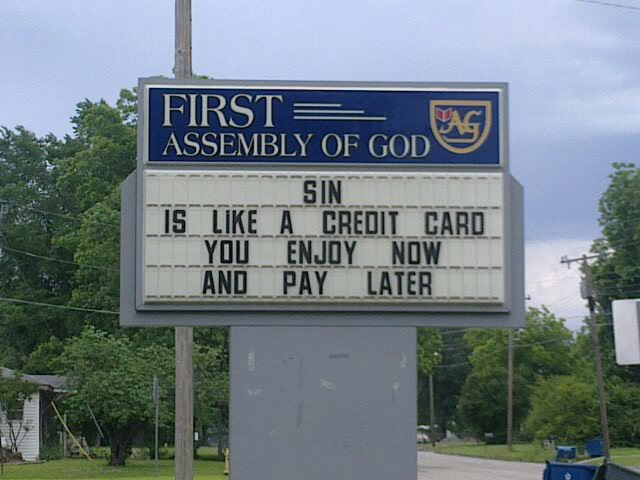
Each week day I drive through a small town on my to and from work. For the past month or more, this sign has been in the yard of a church building. Even with good content, having a message board can be more of a burden than a benefit – it takes work and diligence to keep truth in a short message updated often enough so people notice. But when the message is wretched, one wonders why it is there at all.

Sin like a credit card

While it’s true that sin can seem enjoyable – what value would temptation be to Satan if the end product was rightly portrayed? – it is a biblical fact that we are to hate sin, not enjoy it. Paul addressed this in teaching how abundant God’s grace to towards His children, far greater than our sin, and then asking the rhetorical question:  Romans 6:1-2 (HCSB)  What should we say then? Should we continue in sin so that grace may multiply?  Absolutely not! How can we who died to sin still live in it?

Does the apostle’s instruction seem more biblical than that of the church board in the picture? Again, the apostle –  2 Corinthians 5:21 (HCSB)  He made the One who did not know sin to be sin for us, so that we might become the righteousness of God in Him.

Knowing this, that Christ Jesus took our sin upon Himself, for them on the cross and was the object of God’s wrath that was due us, how can we abide a professing man of God who tells us to be cavalier towards sin?

Enjoy it now, pay for it later? It was PAID IN FULL on the cross! We add to the debt we owe Him every time we sin. It’s too often when we diligently seek to pursue Christ, how much more wretched would our track record be if we thought we were supposed to enjoy sin? Let the lyrics of this old hymn pierce your heart and mine. May we NO LONGER be at peace with our sin – or those who tell us to enjoy it! Let us not grow weary in well doing, but press on toward the prize that will not tarnish and be done with lesser things!

Stricken, smitten, and afflicted,
See Him dying on the tree!
’Tis the Christ by man rejected;
Yes, my soul, ’tis He, ’tis He!
’Tis the long expected prophet,
David’s Son, yet David’s Lord;
Proofs I see sufficient of it:
’Tis a true and faithful Word.

Tell me, ye who hear Him groaning,
Was there ever grief like His?
Friends through fear His cause disowning,
Foes insulting his distress:
Many hands were raised to wound Him,
None would interpose to save;
But the deepest stroke that pierced Him
Was the stroke that Justice gave.

Ye who think of sin but lightly,
Nor suppose the evil great,
Here may view its nature rightly,
Here its guilt may estimate.
Mark the Sacrifice appointed!
See Who bears the awful load!
’Tis the Word, the Lord’s Anointed,
Son of Man, and Son of God.

Here we have a firm foundation,
Here the refuge of the lost.
Christ the Rock of our salvation,
Christ the Name of which we boast.
Lamb of God for sinners wounded!
Sacrifice to cancel guilt!
None shall ever be confounded
Who on Him their hope have built.

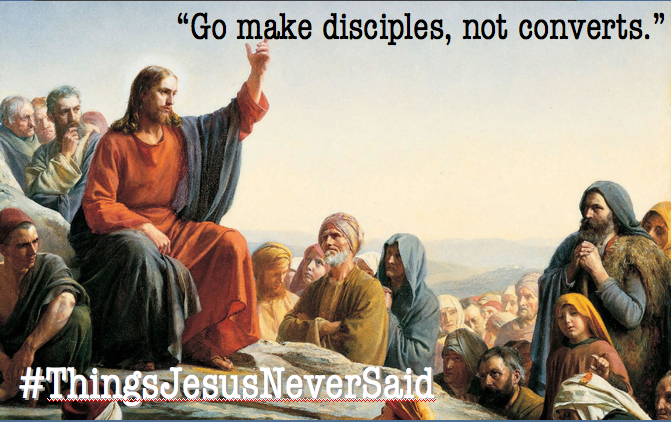
Make Disciples, Not Converts? Really?

Screen shot 2016-04-27 at 12.21.33 PM

Cliches are normal in any language. Sometimes they are able to capture a snippet of thought accurately, other times they muddy the waters of theological judgment. Of course, the impact of any cliche is purely subjective, but it seems that western Christianity is full of cliches that are just not biblically supported. Obviously from the title, you know which one I have in mind so I won’t waste time getting to the point.

Where in the bible do we even find a hint that a convert of Jesus Christ IS NOT a disciple? For the most part, I get it. I get that the idea here is that we focus on making true disciples rather than just a mere decision to follow Christ. However, the reality of the matter is, when a person repents of their sin and trusts in Jesus’ finished work to save them from their sin, if their regeneration is from the Holy Spirit and they exhibit a life that bears fruit and perseverance in Christian character and godliness, that person is not only a convert, but a disciple of Jesus Christ. The moment anyone is saved from their sin, they become a disciple. A follower of Jesus. A convert of Christ. The idea that we can gain a convert but not a disciple is not only unbiblical, but absurd.

One of the ways this cliche gains ground is from the Carnal Christian doctrine and Decisionism. Although they are distinct in some ways, both feed off each other. They propose that a person can become a Christian, yet still live carnally. Also, they teach that a person can have Jesus as Savior, but not as Lord. Furthermore, you can make a decision to follow Christ, but still be a babe or carnal for most, if not all, of your christian life. If such a thing is believed and taught in your church, run.

For the most part, a person may have good intentions when stating this cliche, or they are ignorant of its presupposition. That happens. We want to try and provide someone with the benefit of the doubt as much as possible. Also, not everyone that states this cliche may come from a Carnal Christian perspective (at least not knowingly). But the main thrust here is to challenge even the possibility that someone can become a true convert to Christ, but not be a disciple. They may be a young disciple, a new disciple, or even a false disciple if they fall away. But, in the mean time, they are disciple nevertheless until proven otherwise. The same goes for the word convert. They are semanitcally interchangeable.

In Acts 3:19 Peter preached repentance and conversion. In Acts 15, Paul and Barnabas described to the Phoenicians and Syrians the conversion of the Gentiles. In Psalm 51, David mentioned teaching transgressor God’s ways and converting them (sounds like the Great Commission in a nutshell). In Acts 6:1 it mentions how disciples were multiplying. Acts 14 also mentions making many disciples, and they just started in the faith. And even verses that don’t use the words translated as “convert” or “disciple” in both old and new testaments still semantically explain what conversion and being a follower of Jesus/God is, and are an inclusive list which helps us to systematically understand that to turn from sin and turn to God is conversion and discipleship. Sure, it involves lifetime dedication, devotion, repeated repentance, and obedience to the one you profess to know and love. But it is still conversion and discipleship nevertheless. And to throw a wrench in this whole matter, even Judas was called a disciple when, in reality, he was not.

It would necessitate a bible study of multiple passages and words that would help illustrate my point further. Nevertheless, it is my hope that we grasp that this cliche doesn’t really demonstrate a biblical understanding of a follower of Christ. No matter how you slice it, a disciple is a convert and a convert is a disciple. They can be used interchangeably. And that is the beauty of language and words within language. There may be times when using the word “convert” describes an entry level understanding of just coming to faith in Christ, and other times when someone calls you a convert of Christ and you have been in the faith for years. The same goes for disciple. Some can call you a disciple of Christ and you just got saved yesterday, and you can be called a disciple after years of obedience to Him. It depends on the context and how the word is used. And Scripture illustrates this fact.

Therefore, if the Holy Spirit has indeed saved you, regenerated you, called you out of darkness into light, and you drop your nets, repent, and follow Christ, from that point forward you are a disciple and a convert to Christianity. However, remember that you can be a professing disciple/convert, but not truly be one. I pray the Lord opens our eyes to this truth.

-Until we go home

How to Know If You’re a Fool

How to Know If You’re a Fool

While some Christians like to make April 1st “National Atheist Day,” I think it is a perfect day to reflect on our own foolishness. The Bible has much to say about what makes a fool. Way too many references for me to pack into one blog post! But a few years ago I complied a list of 17 ways you can know if you’re a fool. Some might pertain you, some might not. But if you want to know if you are being foolish, this list might be the snappiest way to find out. Reflect and pass on.

  1. When you trust your heart.
    He who trusts in his own heart is a fool, But whoever walks wisely will be delivered. -Proverbs 28:26
    How can we trust something that is more deceptive than the devil himself? If God is true, and we place our heart’s desires over His revealed word, we are indeed fools.
  2. When you spread gossip.
    Whoever hides hatred has lying lips, And whoever spreads slander is a fool. -Proverbs 10:18
    Slander may be information that is true or not true which is meant to destroy the character, reputation, or perception others may have about a particular person(s). The reason why you are a fool when you slander is because, often times, you might be spreading something that doesn’t accurately depict the person, event, situation, etc. Be careful! Only God has the big picture.
  3. When you think it is fun to do things that are sinful.
    To do evil is like sport to a fool, But a man of understanding has wisdom. -Proverbs 10:23
    This is a tough pill to swallow. There are some things that may seem sinful and are not, and not sinful yet are. But it should never be fun and delightful for us to partake, or devise a plan to partake, in anything that we know to be sinful. To do so is foolish.
  4. When you think your way is right and God’s is wrong.
    The way of a fool is right in his own eyes, But he who heeds counsel is wise. -Proverbs 12:15
    Be not wise in your own eyes: fear the LORD, and depart from evil. -Proverbs 3:7
    This goes along the same lines as point 1, which I think is a foundational point concering why we sin in the first place. Nevertheless, to justify your own reasoning over God’s revelation, is worthy of the title of fool.
  5. When you won’t listen to good correction, even from your parents.
    A fool despises his father’s instruction, But he who receives correction is prudent. -Proverbs 15:5
    Parent’s are there for our good. Sometimes we may not have godly parents, or we have parent’s that were/are never there for us. But regardless of the source of instruction, godly and good instruction is to be received and praised. To reject this will often be to your detriment.
  6. When you only care about what you have to say and not the truth.
    A fool has no delight in understanding, But in expressing his own heart. -Proverbs 18:2
    Just want to vent? There may be a time and place for that. But if your end goal isn’t to discover truth, or find a godly solution, you’ve stepped into the realm of fools.
  7. When you live as though God does not exist.
    The fool has said in his heart, There is no God. -Psalm 14:1
    This verse isn’t for atheists only. The essence of atheism is not just declaring openly that God does not exist. It is a philosophy of the heart that lives as though God does not exist. And there are millions of people who are professing Christians who live like atheists although they profess to know Him. A heart unconvinced by the gospel and unregenerated by God’s Spirit will have a heart that is full of foolishness.
  8. When you are a woman who is loudly argumentative and don’t care if you’re right or wrong.
    A foolish woman is clamorous: she is simple, and knows nothing. – Proverbs 9:13
    Men have many marks that make them foolish. So do women. This verse can pertain to men just as much as women, but this kind of behavior should be checked at the door if you’re this kind of women.
  9. When you laugh at sinful things or don’t take sin seriously.
    Fools make mock at sin: but among the righteous there is favor. -Proverbs 14:9
    The idea here is that we don’t take the nature of sin lightly. We are not supposed to jeer at the severity of sin, and we are to remain aware of the seriousness of it. By slighting sin, and removing the sobering nature of it, we can drop the psychological barriers that alarm us of its danger. This is foolish indeed.
  10. When you refuse to turn away from sin.
    A desire accomplished is sweet to the soul, But it is an abomination to fools to depart from evil. -Proverbs 13:19
    Repentance is a beautiful thing. God grants us repentance so that we might know Him more intimately. But refusing to repent is a dangerous game. Whether it is a sin against your spouse, neighbor, co-worker, child, and yes, God, turn away from the evil you have committed against them! To refuse makes you a fool.
  11. When you don’t like to meditate about life after death, but rather about what is fun and pleasurable now.
    The mind of the wise is in the house of mourning, While the mind of fools is in the house of pleasure. -Ecclesiastes 7:4 (NASB)
    I quoted the NASB here because the important sense of this verse needs to readable (although I think the NLT, I hate to say, is more spot on to the sense of this verse). The house of mourning here is speaking about death.  A funeral home is the best way to translate it in our time. Pondering eternity and death can truly make one wise. But in our day and age, everything is about the here and now, and what is the most pleasurable experience we can have. Fools live in that kind of mindset. Although it is good to enjoy live and the things that God has given us to enjoy freely, a fool has no pleasure in pondering eternity.
  12. When you have a bad temper, or are quick to get angry.
    Do not be quick to be angry, For anger rests in the heart of fools. -Ecclesiastes 7:9
    If you have ever been angry, justified or not, we know what quality product anger can produce (insert sarcasm here). There is nothing wrong with righteous anger. But even then, if we do not know how to bring it captive to Christ, we will allow the fire to burn too long in our hearts which will in turn produce catastrophically foolish results.
  13. When you think you are smarter than you actually are and are stubbornly unpersuaded in a sinful manner.
    Do you see a man wise in his own eyes? There is more hope for a fool than for him. -Proverbs 26:12
    This verse points out that you are in a worse condition than a fool when you are like this. If there is any hope for a fool, it is nill in comparison to thinking you are wise in your own eyes. Refer to point 1 and 4 if you need help in this area.
  14. When you are unthankful for the knowledge of God, and exchange the truth of God for a lie.
    …although they knew God, they did not glorify Him as God, nor were thankful, but became futile in their thoughts, and their foolish hearts were darkened. Professing to be wise, they became fools, and changed the glory of the incorruptible God into an image made like corruptible man… -Romans 1:21-23
    Whatever revelation God has given man, it is so that man can, in turn, glorify God. In nature, the conscience, and even some revelation through His Word, each man is without excuse before God. To be unthankful, to reject His goodness, to exchange what we know about the truth of God for a lie, and suppress it in unrighteousness is the epitome of foolishness! Apart from the grace of God, how else could we escape such a despairing condition? Nothing but the blood Jesus can set us free.
  15. When you live for money, retirement, riches, etc., but have neglectful care for your eternity.
    But God said to him, ‘Fool! This night your soul will be required of you; then whose will those things be which you have provided? So is he who lays up treasure for himself, and is not rich toward God. -Luke 12:20-21
    Wealth in the world is not wealth in the spirit. Don’t be fooled by material gain, meanwhile neglect heavenly treasures. It is foolish to gain much, but lose your soul in the end.
  16. When you recklessly spend money.
    There is desirable treasure, And oil in the dwelling of the wise, But a foolish man squanders it. -Proverbs 21:20
    This doesn’t not mean that if you are wise you will always be rich. There are plenty of people who are very wise, and God has limited them monetarily. But what this does mean is that the foolish don’t know how to reserve themselves and spend money wisely. That pay check, tax return, Christmas bonus, loan, or whatever, will be squandered irresponsibly. Are you a reckless spender? Then you are a fool.
  17. When you don’t trust Christ alone to save your from your sin, and instead would rather trust in anything else but the Bible.
    But everyone who hears these sayings of Mine, and does not do them, will be like a foolish man who built his house on the sand: and the rain descended, the floods came, and the winds blew and beat on that house; and it fell. And great was its fall. -Matthew 7:26-27
    Obeying Christ is an outpouring of our salvation. There is nothing more important in this world than to know you are saved by Christ and are obeying His commandments. To do otherwise is eternally foolish! If you are not reading God’s word in order to know Him more, so that you can obey and love Him as you were created to do, you are indeed foolish. 

Once again, this is not an exhaustive list, but I pray this would be edifying and convicting enough for each of us to evaluate the foolishness dwelling within ourselves quicker than pointing out the foolishness we see in others.

– Until we go home

Fifty Years in the Chuch of Rome

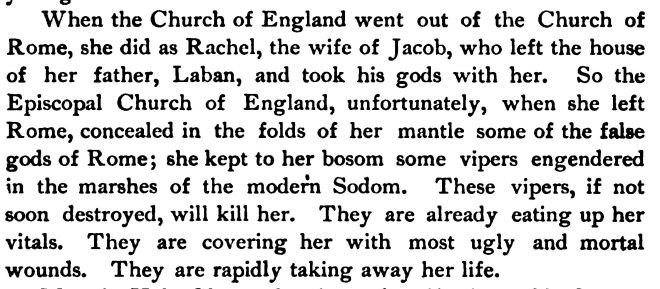
Most magisterial reformers took only a half-step from Rome. Much of what protestant churches hold to was learnt from Rome. Certain doctrines and practices clung to men like the sin that so easily entangles us. The following is from Charles Chiniquy’s book, Fifty Years in the Church of Rome, chapter 30; published in 1886.
Half-step from Rome
Later in the book, after describing the horrors women experienced in having their most secret sins pried from them by expertly crafted questions, the author reveals one of the vipers mentioned above.
586

The Visitor is available to download for free today.

imageWhat happens when someone travels into the past to deliver an urgent message about the future, but ends up in the wrong place at the wrong time?

Would those unintended recipients of the future warning be able to stop any of the atrocities of the 20th Century (including the assassination of President Kennedy)? Or, in spite of man’s ability to travel through time, would God’s sovereignty demand that the horrible events of history’s past can never be changed?

The Visitor, by J.L. Pattison, is a short story best described as part science fiction, part history, part time travel, and part mystery. With a tablespoon of politics, a pinch of dystopia, and a dash of conspiracy, this tale will take you on an entertaining ride with a climactic ending that will leave you in contemplation long after you’ve put it down.

Here’s what others are saying about The Visitor:

– “I appreciated the conflict between the sovereignty of God and time travel. I have often wondered what would happen if time travel were possible. This story reminded [me] of the rich man and Lazarus from the Gospel of Luke, especially Father Abraham’s words ‘If they hear not Moses and the prophets, neither will they be persuaded, though one rose from the dead.’ Or in this case, traveled back through time.”  Javier L. Taylor (5 Stars)

– “A new talent to watch. . . . If the Twilight Zone still existed, this short story would be an episode, it is that good. . . . Rod Serling himself would be proud.” PapaPhilly (5 Stars)

– “Possibly the best short story I have [ever] read!” Anne (5 Stars)

– “I guarantee you will be old before you forget this book.” Mark Escalera (5 Stars)

– “Very thought provoking.” Laura McGowen (4 Stars)

– “The author has crafted an excellent short story that captures your imagination and draws you in with its characters. . . . Well done.” Chris Hohnholz (5 Stars)

– “Reads like a suspenseful Twilight Zone episode . . . . If you are a fan of the Twilight Zone this book is for you.” John Cavallone (5 Stars)

– “There is an allusion to the tension between the sovereignty of God and the outworking of history in relation to time travel. I find that to be an interesting thought experiment. Finally, there’s a big nod given to Neil Postman and his vision of the American future given in Amusing Ourselves to Death . . . . The weaving of an interesting fictional narrative with theology, history, political commentary, media ecology, science fiction . . . in such a short space is impressive.” Heath Cross (5 Stars)

– “I love that it moved quickly and touched on so many interesting points and . . . had such an unpredictable ending.” Bernard Ruiz (5 Stars)

– “It was amazing and scary at the same time. The Vistor left me breathless.” Michelle Bledsoe (5 Stars)

– ” I found this to be a new concept for this genre and actually left me pondering what I would change if I could go back and warn others. Overall, a very thoughtful and entertaining read. The writing and pace was perfect . . . . I found this very enjoyable and thought provoking . . . .” Jenaca (5 Stars)

– “The plot is compelling – I imagine Rod Sterling could adapt it quite nicely for an episode of the Twilight Zone.” Jay Eldred (4 Stars)

– “The Visitor . . . [is] . . . a truism that big things come in small packages.” Chad (5 Stars)

– “Very well written in a manner that kept me riveted to the end.” Paul Bayne (5 Stars)

“This story left me with so many questions, and theories. Not about the plot or the characters, but about humans and their choice of not seeing what’s right in front of their eyes.” Laura (5 Stars)

“I really enjoyed this book! . . . I didn’t want the story to be over. It had great depth and character development for such a short story. There were several thought provoking themes woven into the story line that hung in my head for several days after reading [it]. . . . I look forward to reading more from this author.” Kayci (4 Stars)

___________________

If you’re ready to read a unique tale that is also family friendly, then download The Visitor today at Amazon.com.

Even if you don’t own a Kindle, you can still read The Visitor by downloading the free Kindle reading app to your tablet, phone or PC here

A napkin, a pen, and a Bible verse to prove the deity of Christ.

image“Years ago I read the following simple but effective illustration from Greg Koukl on how to use a napkin, a pen, and a Bible verse to show a Jehovah’s Witness that Scripture teaches (even in their own translation) that Jesus must be God. Greg, who is the president of Stand to Reason and the author of one of my favorite books on reasoning with unbelievers, kindly granted permission to reprint the explanation below. I hope you find it helpful.”
Read the entire article here

The Pastor – Chapter 5, Four NT Words Misused

Note from the author:  Sola

I closed the previous chapter by saying that the widespread corruption of the New Testament system of church care and government has come about, in part at least, because believers have taken four New Testament words and changed – warped – their meaning. The words in question are pastor, minister, clergy and ordain. I realise several other words have been contaminated beyond recognition – ‘bishop’ among them – but I am trying to get to the root of the problem as it exists among Reformed and evangelical churches – dissenters in the main; in other words, nonepiscopalians. ‘Bishop’ does not seem to be a problem in such churches. But ‘pastor’, ‘minister’, ‘clergy ’ and ‘ordain’ are.

Chapter 5 is found here: http://www.sermonaudio.com/sermoninfo.asp?SID=11614140241

Chapter 4 is here: http://defendingcontending.com/2015/12/06/the-pastor-chapter-4-attempted-recovery/

The Pastor – Chapter 4, Attempted Recovery

From the author:

We take up the story at the start of the 16th century with Martin Luther. But before we do, let us remember that protest against the mutilation of Christ’s church was not unknown during the dark ages. Men and, no doubt, women – men like Claude of Turin (died 827), Tanchelm (died 1115), Peter of Bruy s (flourished c1117- c1131), Henry of Lausanne (flourished c1116-1148), Arnold of Brescia (1110-1155), John Tauler (c1300-1361), John Wycliffe (c1328-1384), John Hus(c1369-1415), the Lollards and their like, should never be forgotten.

They all made their protest against Rome, and in one way or another called for a return to the New Testament. I am not pretending that they had full gospel light. But, in their various way s, they all prepared the ground for the approaching Reformation.

This chapter is here: http://www.sermonaudio.com/sermoninfo.asp?SID=116141234374

Chapter 3 is here: http://defendingcontending.com/2015/11/27/the-pastor-chapter-3-the-system-corrupted/

The Dangers of Drifting

A review by Stuart Brogden   Evangelicals-Adrift-94x150

We must, therefore, pay even more attention to what we have heard, so that we will not drift away. – Hebrews 2:1 (HCSB)

Matthew E. Ferris’ book, Evangelicals Adrift – Supplanting Scripture with Sacramentalism, is a fairly comprehensive examination of the differences between biblical Christianity and that which is based on sacramental rituals. He also provides examples of people who have crossed the Tiber River from both sides. For the evangelical who drifts into sacramentalism, the dangers are pointed out with the concern of one manning a lighthouse in treacherous waters, where sailing vessels are bound to be broken on the rocks if they drift away from the narrow channel.

In ten concise chapters, our author covers the theological crises in evangelicalism, the nature and authority of the church and Scripture, and the various departures from biblical truth posed by sacramentalism. In the first chapter, Ferris tells us, “My task is to the show that the definition of the bride of Christ put forth by sacramentalism is an erroneous one, and that Scripture is the only sure guide for the way forward in the Christian life. … I am not writing as “anti-Catholic” or “anti-Orthodox”, but rather as pro-Scripture.” (page 25) This is an important point that evangelicals need to keep in mind, as it is far too easy to drift into being against error instead of in favor of truth; and our mission is to be ambassadors of reconciliation (2 Cor 5:20).

In his discussion about the nature of the church, Ferris contrasts the Apostles’ teaching found in God’s Word with the progressively developed extra-biblical traditions of the sacramental church, concluding, “The final arbiter for sacramentalism returns once more, not to the Scriptures, but to the church.” (page 35), giving us quotes from Roman Catholics that explicitly confirm this. He then asks, “in what sense can the Church be apostolic if it runs counter to the model the apostles themselves left us?” (page 37) Ferris supports the plurality and equality of elders and the priesthood of all believers in the local church, pointing out the word “clergy” is applied in Scripture to the entire church, not only the elders (page 42). Anticipating the claim that there is unanimity amongst the Church Fathers, our author provides a few quotes to show they had as much variation on issues as do any group of Christians, observing that anyone who wants a clean and supporting historical record to support their view must pick and choose which bits of history to rest on, ignoring those which do not line up with their case. “The Church is the pillar and ground of the truth only in that she upholds and defends it; she does not originate truth.” (page 74)

One way that Christians fail to stay on the narrow road is to neglect church history and conclude that their traditions are biblical. Ferris bemoans the fact that many research or know church history only as far back as the Reformation (page 84), leaving them adrift in the historical influences left unexamined. In commenting on how tradition overshadows Scripture in sacramental churches, he sums up a good quote from Oscar Cullman by saying, “there is no need for a canon at all if the ultimate arbiter of truth is the Church and its magisterium.” (page 86) “Roman Catholic doctrine claims to affirm the inspiration of Scripture and that the Bible is authored by God, yet in practice it severely undermines both of these positions.” (page 102) The Roman Catholic Church demands its dogma be accepted as authoritative, while denying the self-attestation of Scripture. Rather than holding to a proper understanding of Sola Scriptura, the Roman Catholic Church is shown to truly hold to sola ecclesia (page 103). This is compounded by the long-standing position of Rome that only its select clergy can interpret the Scripture, which undermines the authority of the Bible. If the Bible is God’s Word to His people, all of whom are indwelt by His Spirit, does it make sense that only a small number of people selected by a small number of religious leaders would be able to rightly comprehend the essentials of the Christian faith? History records that these select leaders, charged with interpreting the Scriptures for the common folk often disagreed with one another and many changed their minds on topics over time. Heretics and false sons have been in the temporal church since the apostolic era and it flies in the face of history, human nature, and the Bible for Rome to claim immunity from the frailties that each son of Adam faces.

Ferris also discusses how the various sacraments within many churches claim to impart grace, robbing the gift YHWH gives of its meaning. Baptism is one of these, with infant “baptism” having its basis in the false belief that it is needed for salvation. “Sacramentalism practices infant baptism as both an entrance into the new covenant with God and as that which cleanses from sin.” (page 160). If this were true, why was the Apostle Paul’s priority on gospel proclamation (1 Cor 1:14 – 17 & 9:22)? Further, he asks, “If baptism is indeed effective in imparting new life, in washing away sin, in putting one into the church, how is it that so many people who have undergone infant baptism manifest no signs of divine life whatsoever?” (page 166)

Chapters 7 and 8 are excellent reviews of the unbiblical view that sacraments convey grace and that mystical doctrine of Mary worship and veneration. Chapter 9 explores the spurious notion that there is theological and doctrinal unity within the Roman Catholic Church – pointing out there is as much variety within that religion as they claim there is amongst evangelicals.

The final chapter asks, “To Whom Shall We Go?” – and points out that “By insisting on the mediation of the Church in every aspect of the believer’s interaction with God, sacramentalism replaces the role of the Holy Spirit in the life of a Christian.” (page 223) Ferris gives the reader an excellent, concise review of the difference between the Roman view of infused grace and the biblical view of imputed grace as the means of saving sinners. The catechism of the Roman Catholic Church declares that the sacraments are necessary for salvation. Our author observes, “There is no experience of God, no conversion, and indeed no final salvation apart from engaging in the ritual acts defined by the Church. This is diametrically opposed to justification by faith in Christ alone. It is the system, rather than the Savior that assumes the importance in sacramentalism.” (page 225) In light of these dangers that we can drift into, to whom shall we go? As Peter rightly understood, we must flee to Christ Jesus – He has the words of eternal life (John 6:68). And so our faithful author points us to the Word Himself. “Every problem, every shortcoming, every doctrinal aberration with evangelicalism, and indeed with any branch of the church, is solved only by an intentional and sustained engagement with scripture. … Embracing sacramentalism will only lead believers further away from the truth that a relationship, not a ritual, is the scripturally ordained way of growth in Christ. Those who drift away can only regain their moorings by once again submitting to the Bible for everything in their Christian live.” (pages 228 & 229)

This book is a most excellent encouragement to the saints of God and, I pray, a wakeup call to those who are drifting into dangerous waters in the Tiber River. To God alone be the glory and honor and dominion and power – now and forever!

The Pastor – Chapter 2


The New Testament Pattern of Church Life and Rule Sola

From the author:

Christ is the King of his church. He is her Master, Lawgiver, Ruler, Sovereign, Lord. He is her only Master, Lawgiver, Ruler, Sovereign, Lord. I deliberately use capitals to stress the point.
Christ is the Head of his church. He is the only Head of his church. No man is, no man ever was, no man ever can be, Head of the church – other than the God-Man Christ Jesus, the Lord Jesus Christ. I do not think I could express my self more clearly. Christ is the Head of his church.

Chapter 2 is here: http://www.sermonaudio.com/sermoninfo.asp?SID=115141029110

Chapter 1 can be found here: http://defendingcontending.com/2015/11/14/the-pastor-an-audio-book/

The Trouble with Trivial Faith

A review by Stuart Brogden     Tinker


The title of Melvin Tinker’s book is designed to catch your attention: A Lost GOD in a LOST WORLD, subtitled From deception to deliverance; a plea for authentic Christianity. That lengthy title conveys the idea that something is terribly wrong and change is desperately needed. If we survey the current offering from professing Christians, we cannot but agree that something is not right. While not addressing everything one might want changed, Tinker’s book is a welcome work that should cause every child of God to examine his own church and life, seeking to be biblical and honorable in the sight of YHWH. Tinker says, “The modest aim of this book is to present those key truths about the lostless of man, the greatness of God and the glory of the future which will correct much wrong thinking and behavior within the church and so enable the church to effectively confront the world by holding out the Gospel.” (page 22) He explores these issues in good measure over nine very readable chapters.

In this short book our author examines the weightlessness of God in our culture and what happens when people turn to idols. In these first two chapters Tinker observes “the West is made up of believers alright, but not Christian believers. It is composed of what the Bible calls idolaters” (page 26), further noting idolatry as “the besetting sin of the human race” (page 27). He describes what he means by God being lost: “Not that God has been lost as when we misplace a set of keys, but rather that the truth about the real God is disappearing fast.” (page29) When professing Christians take God for granted, being thoughtless in how He is worshiped (is celebrating birthdays and wedding anniversaries worshipful?), with shallow prayers (are physical healing and income our most pressing needs?), and absent from our daily conversations He has lost weight in our lives. And something has filled that space, weighing heavily on our minds and our prayers. That something, no matter what it is or where it came from, is an idol. Two short paragraphs sum up the cause and danger of this condition (pages 51 & 52):

The predominate view abroad is that with the right knowledge, the right resources, and the right will, crime on our streets will be reduced, terrorists will be hunted down and brought to account, poverty will be abolished and our environment made safe.

Undoubtedly as human beings we have achieved so much. But herein lies the danger, namely, that of being seduced into thinking that it is by our achievements that we measure our self-worth and thus bolster our self-confidence.

It is the myth of self-achievement, self-sufficiency, and self-aggrandizement. The trap is that such thinking invariably excludes God because our focus is on self.

Do you find these thoughts dominating your mind? Christian – examine yourself to see if you be in the faith! “We cannot really understand why the world is in such a mess, together with the mess of our individual lives, unless we see it as part of the bigger and much more tragic picture of humankind’s devastating fall away from its Maker.” (page 61)

From examining the train-wreck of our natural condition, our author takes the rest of this short book explaining the necessity of various aspects of biblical Christianity (‘tis a pity one needs to use that adjective, but there are so many professing Christian who are not biblical) and how they impact our lives. Chapter 3 addresses The need for the grandeur of God, based on Isaiah 40:1 – 31. Christians know God, but often we hang around the milk cooler rather than spend time and effort at the grill for juicy meats (Hebrews 5:11 – 14). “The highest science, the mightiest philosophy, which can ever engage the attention of a child of God, is the name, nature, the person, the work, the doings, and the existence of the great God whom he calls his Father.” (page 65) “And it is the smallness of man set against the grandeur of God which makes God’s tender kindness towards us all the more remarkable and moving.” (page 81) Chapter 4 brings us to The necessity of the Cross, based on Philippians 2:5 – 11. In becoming a man, creator God revealed part of His character; “this God, the true God, chooses not to exploit his divinity, but to display it differently … he exercise a different divine right – the right to be humble, the right to change his form whilst not ceasing to be God.” (page 86) Augustine wrote of this wonder:

He emptied himself, taking the form of a servant, not losing the form of God. The form of a servant was added; the form of God did not pass away. He lies in a manger, but contains the world. He feeds at the breast, but also feeds the angels. He is wrapped in swaddling clothes, but vests us with immortality. He found no place in the inn, but made for Himself a temple in the hearts of believers. In order that weakness might become strong, strength become weak. (page 90)

The mystery of God in Christ – who gave Himself to save sinners. How can a mere mortal truly comprehend this? The cross, an inhumane tool for the torture of humans, stands as the narrow gate to the path that leads to eternal life. Contrary to men pleasers who care not for the Gospel, we who have been bought with the blood of Christ must line up with Paul, whose “primary concern is not with the niceties of literature (or fancy words, my addition) but with the wonder of the Gospel.” (page 91) One of the wonders that Philippians presses on us is the truth that the eternal and divine Son of God put on flesh and became a human. He kept this form of a human (one of His created beings) after His resurrection, forever identifying with those ransomed sinners. Tinker tells us, “it would be a mistake to so emphasize the divinity of Jesus at this point that we neglect his humanity. In ascending back to the Father he did not shed his human flash as a butterfly might shed its chrysalis. The person of the Son of God is forever united to our human nature.” (page 98) Our high priest intercedes for us in this age, the God-man who reconciled sinful men to holy God. Jesus will walk among us in the age to come, His body then perfected as the eternal temple in which He is pleased to dwell. Brothers and sister – do you wonder at Christ? Is He not marvelous beyond words?

Buy the book and read about the work of the Holy Spirit, the necessity of the Gospel, the need for effective grace, the necessity of the second coming, and the need to be heavenly minded. It’s less than 200 pages and, aside from unqualified quotes from some questionable men, a solid work that will cause the child of God to humble himself before his Savior and King. And that’s about all we can expect from a book – a reminder of who YHWH is and who we are.