One man’s journey away from contemporary Christian music.

imageHere is the opening excerpt from a recent article by Dan Cogan:

I have been what many would call a “worship leader” for close to two decades. When I first became involved in “worship ministry” in an Assemblies of God youth group we sang such songs as The Name of the Lord Is a Strong Tower, As the Deer, Lord I Lift Your Name on High, and others of the era of the 1980s and 90s. Ours was considered a stylistically progressive church since we used almost exclusively contemporary songs.

This meant that if I were to visit a “traditional” church, not only would I be unfamiliar with the hymns, I would also likely cringe when they sang them and in my heart ridicule them (the people rather than the songs) as being old-fashioned.

It was during these formative years in my experience as a worship leader that I began to introduce even more contemporary songs to our youth group. It was then that I discovered artists like Delirious, Darrel Evans, Matt Redman, and Vineyard Music with their songs Did You Feel the Mountains Tremble, Trading My Sorrows, Heart of Worship, and Hungry.

As a young musician who desired to honor Christ, I found these songs to be particularly compelling. I felt different when we sang them. The way Nirvana gave voice to the angst of Generation X, bands like Delirious were giving voice to a generation of young Christians who didn’t feel they could relate to the songs of their parents and grandparents.

Over the years when I would occasionally hear a hymn, the language was always strikingly foreign, with Ebenezers and bulwarks, diadems and fetters. Which only served to confirm my bias that hymns were simply out-of-date. They had served their purpose. They had run their course.

Continue reading the entire article here at DanCogan.com.

Christ and the Gospel

A review by Stuart Brogden. Book available on Amazon.

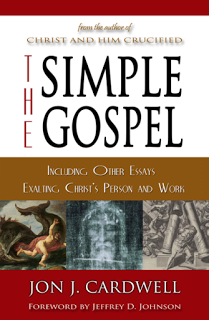
The subtitles of Jon Cardwell’s book must not be overlooked or you will be confused. The focus Screen Shot 2015-10-27 at 9.43.03 AMof this book is the proper understanding of the biblical gospel – that is the title: The Simple Gospel. What our brother rightly understands is that one cannot have a true understanding of the gospel if one does not have a true understanding of the person and work of the Lord Jesus. Without a biblical Jesus, faithfully fulfilling the requirements of the Law and the Prophets and taking our place in facing God the Father’s wrath for our sins (Him being without sin), we do not have the biblical gospel. The subtitle, Including Other Essays Exalting Christ’s Person and Work, gives us advance notice that we will spend some time reading about essentials that provide the foundation of the true gospel.

In this title chapter our author gives us his summary of what the Bible presents as the gospel:

The gospel of Jesus Christ is the revelation of God, according to the scriptures of the Old and New Testaments, which focuses on the Person and work of Jesus Christ in His incarnation, crucifixion, resurrection, ascension, and restitution of all things in His bodily return. 1

Note this: the gospel is about the redemptive work of Christ and our need of Him; the gospel is not the entire Bible, although all Scripture has this meta-plan as its ultimate purpose. A little later in this chapter, while reviewing the meaning and significance of the crucifixion, Jon pleads the sufficiency of Christ’s blood, saying, “The power of the purity of Christ’s blood is sufficient to cleanse the redeemed soul from every confessed sin he has committed after he has been saved by God’s grace (1 John 1: 7-10).” 2 While I agree with the intent, I think this idea would be better stated as “The power of the purity of Christ’s blood is sufficient to cleanse the redeemed soul from every sin he has committed or will commit, and is applied when he is saved by God’s grace (1 John 1: 7-10).” For we are commanded to confess our sins, all the sins of the redeemed are forgiven when he raised from spiritual death to new life, not just those committed after salvation and not only those confessed.

Still in this section, Jon brings to our mind the picture of Christ suffering God the Father’s wrath for our sins – a much more horrifying punishment than physical death on the cross, as painful and horrible as that is. If we don’t see Jesus being punished spiritually for the sins you and I committed, we are taking His sacrifice too lightly. This is closely tied to this statement: “The shame that comes to our souls in the light of the revelation of the offense our very lives bring to God, far exceeds the shame of Adam and Eve when their nakedness was revealed to them.”3 Far more powerful than our shortcomings in our foolhardy attempts to keep the law or earn God’s favor by our own strength, seeing the glory of God in Christ will undo us as it did Isaiah and the Apostle John and others who were privileged to see Him clearly. This is the power of the cross!

When he quickly reviews the resurrection’s part in the biblical gospel, our brother tells us two dear truths: “The resurrection of Christ is God’s open display to the entire creation of His seal and acceptance of Christ’s sacrifice.” 4 and “When we speak of the resurrection of Christ we also speak of God’s assurance of a resurrection to come. God promises to all whom He has saved in Christ will one day be resurrected from the dead. The importance of the resurrection is such that a denial of the bodily resurrection of Christ means a denial of the faith altogether (1 Corinthians 15:12-19).” 5 Let no one who claims Christ forget the import of the resurrection – if Christ be not raised from the dead, we are to be most pitied.

His last section on The Simply Gospel is about the restitution or restoration of all things. We cannot, Jon tells us, fully comprehend the recreation of heaven and earth and the Lord’s glorious return without understanding the biblical doctrine of hell. And, he goes on, we cannot rightly comprehend either the new earth or hell if we do not rightly comprehend God! “The same presence of God that is a consuming fire for the wicked dead, Christ’s presence is peace and comfort (2 Corinthians 1: 3), and fullness of joy with pleasures forever more at His right hand (Psalm 16: 11).” 6 This oft-repeated exhortation to see the Lord as He is in His glory and power is a welcome one that does the souls of the saints much good.

Chapter 2 – Propitiation through Faith is an enlightening walk through Romans 3:23 – 27. Our faithful author tells us, “Romans 1: 17 is the key to this epistle, Romans 3: 23-27 is most certainly the door the key unlocks.”7 and “It is through this door one must pass in order to enter life eternal. In one way, it may be here that the Lord’s cryptic words become especially insightful: “I am the door: by me if any man enter in, he shall be saved, and shall go in and out, and find pasture” (John 10: 9; cf. 10: 7). The door of this passage is that wicket gate Mr. Bunyan’s allegory refers. Jesus Christ is that door, that wicket gate, and His cross, His propitiation, is eternal treasure.”8 Such exegesis is welcomed in this day of shallow, superficial reading, as is this: “To sum it up, God’s righteousness was openly displayed and manifested in the… Person of Christ Presentation at the Cross Power of Christ’s resurrection Perfection in Christ’s ascension.”9 As the Apostle Peter told us (2 Peter 1:12), we need to be reminded of the essential things even though we already know them. Cardwell does well in this regard, as he desires to stir up the saints of God to dig into the Word and walk as those who have been raised from the dead. I do wish Jon had spent some time on exploring what Paul meant by the phrase, “the law of faith” in verse 27. I think it is tied to what he elsewhere calls “the law of Christ,” which (I believe) is defined by the Lord’s answer to the Pharisee in Matthew 22:37 – 40 (I highly recommend Charles Leiter’s excellent book, The Law of Christ).

Cardwell emphasizes the fact that the life of a person who has been raised from spiritual death will be evident: “the result of the saved life will be evidenced by, but not limited to these things: a growing resemblance to the life of Christ in sanctification (1 John 1: 7); repentance of sins as the illumination of His light reveals them (1 John 1: 8-10); a love for God’s Word (1 John 2: 3-5); abiding in the Holy Spirit-led life (1 John 2: 6); exhibiting a sacrificial love for fellow-believers (1 John 2: 9-11); a hatred for the things of this world and hatred for the lusts of the flesh because those things are at enmity with the Father (1 John 2: 13-17); and a love for and discernment of the truth (1 John 2: 20-21).” 10 Let no one go easily on with the lie that one can be saved yet unchanged.

I will only touch on the topics of the balance of the book, each chapter will challenge the reader to examine his belief in the Word and the meaning of specific passages and traditions as Cardwell examines the meaning of the sign of Jonah, the Shroud of Turin, traditions of men, and a few other topics.

The fifth chapter examines the Chief End of Man, and Jon does well to debunk the seeker sensitive madness Rick Warren is famous for, but he also takes the Westminster Shorter Catechism without question to answer the question. The problem with the catechism and its answer is the lack of defining the audience. About which man is it asking about the chief end – fallen man or redeemed man? In the context of the catechism, the very beginning, the catechism must be talking about man in general, not the redeemed. And because of this, their answer fails – because those who are bound for eternal torment do not have, as their chief aim “enjoying God.” Further, I find no support in Scripture that our benefit (the redeemed enjoying God forever) is our chief end. All of creation has as its chief end the glory of God. They should have put a period after the first phrase and worked out the latter portion in a later part of the catechism, making it clear enjoying God is a blessed benefit the redeemed will reap. Jon does point out that, to “enjoy God forever did not mean that man’s ultimate happiness comes as the result of what we receive from God. Following this thought toward its logical conclusion would ultimately suggest that God exists for man’s good pleasure and not the other way around.”11 Amen!

Christian – are you satisfied with your understanding of God’s Word and how it applies to you? I trust that is not the case. This short book is a good one to provoke any believer to dig deeper into the Scriptures, to pray for God’s wisdom, and examine some of those things we have been taught but never have thought about. Take and read!


Footnotes:

1 Cardwell, Jon J. (2014-11-15). The Simple Gospel – Including Other Essays Exalting Jesus Christ’s Person and Work: The Gospel Truth of Jesus Christ According to Scripture (The Biblical Gospel of Jesus Christ Book 2) (Kindle Locations 172-174). Vayahiy Press. Kindle Edition.

2 ibid; Kindle Locations 210-211

3 ibid; Kindle Locations 241-242

4 ibid; Kindle Locations 252-253

5 ibid; Kindle Locations 259-262

6 ibid; Kindle Locations 299-301

7 ibid Kindle Location 332

8 ibid Kindle Locations 339-342

9 ibid Kindle Locations 361-365

10 ibid Kindle Locations 504-509

11 ibid Kindle Locations 915-917

Ortho-what?

Orthodoxy is defined “in the Christian sense” to mean “conforming to the Christian faith as represented in the creeds of the early Church.” This word comes from the Greek orthos meaning correct and the Greek doxy meaning opinion.

Orthopraxy is defined as “correctness or orthodoxy of action or practice.” The word comes from the Greek orthos meaning correct and the Greek praxis meaning deed or action.

It is often stated in many circles that doctrine divides. Doctrine does certainly divide but the belief or conformity to the Christian faith is a lofty ideal that many hold to unswervingly. The average person may not fully understand all the words or theological terms, but they have no issue repeating the creeds or stating that they believe just like their church believes.

The problem is NOT with too much orthodoxy in the church. Orthodoxy is easy to fine in most evangelical churches. Creeds grace the walls of many sanctuaries. Hymnbooks contain creeds or doctrinal statements that encourage the reader to understand what his or her chosen congregation believes. Bulletins include calls to recitation of orthodox doctrine. Books line the walls of the libraries found in the pastor’s study or the church lending room. Many of these books are a basis or a foundation of what can be expected in regards to doctrine. Pastors and teachers speak each week and many messages are based on a particular aspect of Christian doctrine. In essence, they are standing to share the “correct opinion” of what the Word of God has to say to the hearer.

The problem in much of what passes for American Christianity is that the orthodoxy rarely translates into orthopraxy. “Correct opinion” of the Word of God is not being seen as “correct deeds or actions” either within the church or outside of the church.

follow-me

Orthodoxy vs. Orthopraxy means:

  1. We believe God’s Word is sufficient for all that pertains to life and godliness (2 Peter 1:3), AND we practice this in each aspect of our daily walk.
  1. We believe the law of Christ (Luke 10:27), AND we show that we love God and our neighbor through daily interaction.
  1. We believe we are to have godly families (Ephesians 5 & 6), AND we show to those closest to us that our correct opinion translates into correct actions.
  1. We believe we are to be lights to a dark, sin-sick world (Matthew 5:16), AND we strive to share the truth of the Gospel by reaching out to those around us.
  1. We believe church is to be a fellowship of true blood-bought believers (1 Peter 1 & 2), AND we practice fellowship by desiring to spend MORE time than just 1 hour and 20 minutes on a Sunday morning each week.
  1. We believe church should be a representation of the fellowship we will enjoy together for all of eternity, AND we work diligently not to let minor things separate us.
  1. We believe covenanting together in Christian unity (Acts 2), AND we stop shopping for the next big fad on the Christian church horizon.
  1. We believe pastor-teachers are called to edify and exhort and encourage the local body of Christ (Ephesians 4), AND we refuse to compare them with the latest and greatest speakers on TV, radio, or internet.
  1. We believe pastor-teachers are to protect the flock (1 Peter 5), AND we take comfort as they lead us in straight paths instead of looking for reasons to leave.
  1. We believe we are to bear one another’s burden (Galatians 6), AND we take an active interest in the lives of those we have covenanted together with to ensure that needs are being met (including emotional and spiritual needs).
  1. We believe Christ died for His Bride (Ephesians 5), AND we take delight in loving and forgiving those for whom He died.
  1. We believe Christ forgives us of our sins (1 John 1), AND we do not hold unforgiveness or bitterness in our hearts toward those who can NEVER wrong us to the degree that we did to Christ before He saved us.
  1. We believe strife and contention are not part of the fruit of the Spirit (Galatians 5), AND we refuse to take needless offense when others don’t respond JUST like we do or JUST like we expect them to do.
  1. We believe prayer is vital in the life of every true believer (James 5:16), AND we learn to discipline our lives and the life of the church to pray without ceasing.
  1. We believe only Christ is Perfect (1 Peter 1), AND we encourage each other to become more like Christ daily instead of demanding perfection from imperfect sinners saved by grace.
  1. We believe the Scriptures are infallible and inspired by God (2 Peter 1:21), AND we stop running to the local so-called Christian bookstore for the latest drivel that makes vain attempts to make us feel better about ourselves.
  1. We believe we are not to be conformed to the world (Romans 12), AND this means we will stop liking and loving what God hates. Wizardry, witches, demonology, vampires, titillating reality shows, etc. are NOT what God likes. In fact, if you can love these things of the world, 1 John makes it clear that the love of God is not in you and you are NOT a true believer.
  1. We believe we are but sojourners in this world (Hebrews 11), AND we strive to keep our focus on things of heaven and to have a continual perspective of eternity.

These are just a few ways in which we must grow in our spiritual walk if we are to make a difference in the world. All of the orthodoxy (or correct opinion) of God’s Word will never change you or those who know you unless it can be seen that such orthodoxy transforms you into having a biblical orthopraxy (or correct deeds).

The church has no business even claiming they believe correct orthodoxy if they do not also believe and strive to practice correct orthopraxy.

So, the question is this for each of us to consider today and every day – does your orthopraxy proclaim your orthodoxy or does your orthodoxy get in the way of your orthodoxy?

What’s coming.

“Maybe at the present the authorities smile on the church of God; but within a while it may frown, and the storm of persecution arise. There was a time when the churches had ‘rest throughout all Judea’ (Acts 9:31). It was a blessed time. But how long did it last? Alas! not long.”

– William Gurnall
1617 – 1679

Why this will be the last Starbucks I drink.

imageI don’t make a habit of photographing my food or drinks, and I certainly don’t post them for others to be subjected to, but the cup of Starbucks in this picture is significant because it will be my last.

I shrugged my shoulders as Starbucks bullied small coffee companies (e.g. here and here).

I looked the other way when Starbucks sued small coffee companies (e.g. here and here).

I ignored the fact that Starbucks uses GMO products.

And I rolled my eyes when Starbucks tried to ram race issues down my throat.

But now I discovered something about my favorite coffee chain that is too egregious to look past; too evil to ignore

Continue reading here.

Finding God’s Will

The last few nights, I have not slept well. Last night, I was really tired but I expected it was going to be another long night. I was thinking of different things I could do to help me relax and rest my mind. I was thinking of turning on some music when I thought of Times Square Church. I used to listen to their messages when I couldn’t sleep but I’ve not done so in a while. I went to my website and saw the title of Pastor Carter Conlon’s message, “Finding the Will of God.” I knew then that it was definitely God who directed me, and I highly recommend this message to everyone who is willing to take 45 minutes to hear a message from the Lord.

Recently, I have been evaluating my life: laying hold on what I know is God’s will and praying for wisdom in areas I’m not sure about. Sometimes I think I am so obsessed with knowing God’s will and scared of stepping outside of it that I become paralyzed and end up wasting time that I could spend just following Him. That probably sounds stupid if you’ve not experienced that feeling, but a couple years ago, I realized God’s will is not always as complicated as I think it is. Last night, I was reminded that God’s Word is very clear what His will is for His people. It may not tell us where we are to work or who we are to marry but it tells us how we are to live. If I am not doing that, I am kidding myself to think that God will entrust me with greater things. If I am living the life He has commanded me to and drawing near to Him on a daily basis, I must trust Him to direct me. Until He does, I continue to do what I know He has called me to, at least for the time being.

gods-will

I think one of my concerns is that it’s easy for me to get in a rut and do things just because that’s what I’ve been doing. I do not like change and so I tend to fight it. God has brought me a long way in the 23 years I’ve been serving Him but I am still constantly learning and hopefully changing. I desire to take the whole written Word and apply it to my life so that I can hear His voice when He desires to redirect my personal life.

I encourage you to focus on this too. No task is too small. “Little is much if God is in it.” If you’re doing what He has called you to, it is important, and all He requires of you is to do the best job you can. Your calling may be to raise children who are going to impact the Kingdom in a powerful way. It may be to do the behind the scenes work for a ministry that God is using in a mighty way. Maybe you are not the one speaking and writing but you handle the schedule, filing, mail sorting, whatever. This is not small in God’s eyes. It takes the whole Body working together to accomplish God’s work.

The world measures success by how well you’re known, how many degrees you have, etc. God measures success by how faithful you are in the work He gave you to do. That is what He has equipped you for.  Nothing else is important to Him, and He is the only one you have to please.

Take some time this week to study what the will of God is for every Believer. If you have been wondering what God’s will is for your life, this is a great place to start. If you are settled in knowing that you are doing God’s will, it still won’t hurt to make sure you are in His will in every area of life.

“Not One Iote or One Title…”

“Not One Iote or One Title…”: A Plea for Original Spelling by John Bookman [Pseudo.]

[Attention–this is a SATIRE] KING-JAMES-ONLY-115396838242

by Doug Kutilek

www.kjv-only.com/doug/spelling.html

Just days ago, I realized that we have not gone far enough in insisting that the Bible be preserved unchanged “in the form God intended for us to have.” Of course, I speak of the infallible, inerrant, verbally-inspired and unalterably preserved English Bible, the Authorized Version (AV 1611), “the Bible God uses and Satan hates.” Sure, there are lots of zealous defenders who have shielded it from the corruptions of such heinous translations as the NIV, the NASB and that most sinister NKJB, and have kept us from returning to the now-completely-unnecessary Hebrew and Greek. But while they kept their watch on one front, the Enemy has come in unawares by another route and sown seeds of corruption that have, I fear, already yielded a corrupt harvest.

What am I getting at? Simply this: we have insisted on the verbal inspiration of the English, that is, that the very English words were divinely chosen and given to the Learned Men. But simply insisting on the perfection of the English words and preserving the words is not enough. A careful consideration of the true intent and meaning of the words of Matthew 5:18 is necessary: “Till heauen and earth passe, one iote or one title, shall in no wise passe from the law, till all be fulfilled.” (I have made no mistake in my spelling, as I shall shortly explain). Notice how Jesus insisted on the verbal inspiration, not just of the words, but also of the very letters of the words of Scripture. And since this verse is a specific promise of the preservation of Scripture in our infallible English Bible, we must insist on following, not just the original KJV words but also their very spelling. What other meaning can we draw out of the words “one iote or one title”? Every letter–the very spelling–is certainly inspired, and to alter the spelling of a single word, to alter even a single letter in a single word, is to deny and reject the inspiration of the AV 1611. If God had wanted us to spell the words in the AV 1611 different in our Bibles, He would have given them to us in that form originally. Modern spelling is as hideous and hateful a thing as modern translations. Its new age corruption, pure and simple. No one was ever authorized to corrupt, to “modernize” the infallible original spelling. There are eight spelling corruptions in John 3:16 alone!!!

I’m sure some “liberal” soul will say, “What difference does spelling make?” Argue it out with Jesus, brother! Didn’t He say that inspiration of the words included the very spelling, every iote, not just the words? Will you reject the teaching of Matthew 5:18 of letter/spelling inspiration of our preserved AV 1611? To stop at “word inspiration” and not insist on spelling inspiration is to be second cousin to mere “thought inspiration.” It is creeping apostasy, through and through. Next someone will deny the inspiration of the chapter and verse numberings in the AV 1611. Where will it stop?

And I think we must recognize that Jesus’ infallible English word was “title” and not the now-corrupted “tittle.” A tittle is part of the ornamentation of a Hebrew letter (at least that’s what I’ve heard at Fellowship meetings, so I have assurance that it’s right). But a title is something else. I have complete confidence that this promise of Jesus was a specific reference to the preservation of the chapter and page headings, the titles found in the original AV 1611. Sadly, those infallible titles, attached by the Learned Men under divine inspiration at the top of each page and at the beginning of each chapter have been removed from our modern editions. Without them, we cannot claim that we have a perfectly preserved Bible, and by allowing them to be removed, we have called God a liar, and denied that He is able to preserve the inspired English Bible He has given us.

It is no secret that none of the commonly used English Bibles published in our day have the original AV 1611 spelling, or punctuation (that, too, is part of our directly inspired, infallible English Bible) or titles of which Jesus spoke, so in reality, these Bibles, even though they say “King James Version” or “Authorized Version” are really not Bibles at all. Only the Nelson reprint of the original 1611 AV is a real Bible; all the others are sinister corruptions.

And there is growing upon me the deep conviction, as deep as anything I’ve written in this article, that no English-speaking person can be saved if he was not saved by an original, unaltered AV 1611, with original spelling, original punctuation, and original chapter and page titles. This simply means that anyone who thought he was saved by reading a revised “KJV” or by hearing a sermon from such a “Bible” or by reading a Gospel tract that quoted the words in a revised spelling form, even if it was labelled “KJV” is not really saved, has never been saved, and never will be saved until he gets a true, fully-preserved AV 1611. That will mean that virtually all those who thought they were saved–preachers, deacons and all–will have to go back and get truly saved through a real AV 1611, then get rebaptized. Verbal inspiration of the English requires inspiration of the very spelling as well. Anything less is rank modernism.

I will confess to one further worry: original type style. The real AV 1611 was printed in what printers call “black letter,” a very ornate type style much like Gothic script, which is still used many times for the banner at the top of the front page of newspapers. This original type style was replaced with “Roman” type sometime in the 18th century. Note that name: Roman. I fear that once again, the Jesuits have conspired to corrupt the pure word in English. They have taken away the original Gothic (and as everyone knows, the Gothic Bible used the textus receptus for its foundation which proves with certainty that the Gothic was the correct script for a real Bible), and have substituted the corrupt Roman script. In a real sense, even the KJV has become a Roman Bible, since its modern editions use Roman script and not the original black letter. As further proof that Roman type is a corruption, notice that all these apostate Bibles–the ERV, ASV, NASB, NIV, NKJB, and the rest, have always been printed in Roman type. That’s proof enough to me that any Bible in Roman type is no Bible at all, and that only a Bible with the original script, the black letter, given to us in the form we should have it by the Learned Men, is a true Bible. Perhaps even those saved by the true original spelling KJV are not saved at all, and must locate a black letter edition. The Roman script Nelson reprint may not be enough (it’s just like those Bible corrupters at Thomas Nelson to pass off a Roman script KJV as though it were a real Bible!). Fortunately for me, my brother has a facsimile reprint in the original black letter of the AV 1611, and I’m secure since I’ve studied out of it several times.

It is a desperate situation. The shortage of black letter, original spelling AV 1611 Bibles is severe. There is truly a famine of the preserved word of God in the land. And all our efforts at preaching, teaching, Bible study, and soul winning are completely futile until we return to the real, unaltered, perfectly preserved bonafide AV 1611. Perhaps the best thing to do for the present is to send off and buy one of those pages from an original KJV, and if you can get a page that has a salvation verse, or part of the “Romans road,” perhaps there will be enough of the Gospel in the true preserved English to rescue your soul.

[As a service to the reader, so he can be saved through a real AV 1611, I will quote John 3:16; unfortunately, I have no capacity to reproduce the original black letter script, so even believing the unrevised spelling may not be enough, but we can hope for the best:

For God so loued ye world, that he gaue his only begotten Sonne: that whosoeuer beleeueth in him, should not perish, but haue euerlasting life.

And just today, I came to understand that the only proper format for any Bible is in scroll form (or at least loose-leaf), since the Apostle assures us that “the word of God is not bound.” Therefore any book that is bound, regardless of its printed contents, cannot honestly be said to be the word of God. I’m sure the inspired 1611 translators never intended for their translation to come sown and within leather covers. Such would be a travesty, in light of the Apostle’s clear and plain teaching.

I’ve begun the systematic unstitching of all my sewn Bibles so that they can qualify, according to Paul’s definition, as the word of God. I urge you to do the same.

The Danger of Presuppositions

The Danger of Presuppositions

The Sabbath before the command, a sermon by Voddie Baucham

reviewed and analyzed by Stuart Brogden

This review is not intended to malign or condemn my dear brother and friend, Voddie thBaucham; it is to expose the errors one can be led to if presuppositions are left unexamined, if documents other than Scripture are held too tightly. This sermon sums up much of what caused me to withdraw from Grace family Baptist Church; it violates many of the basic rules of hermeneutics that Voddie taught me, apparently having his view distorted by his “confessionally colored glasses” as Bob Gonzales put it.
To the sermon, which can be listened to here: http://www.sermonaudio.com/sermoninfo.asp?SID=410151353280

Early in this sermon, Voddie asserts “Israel mirrors New Covenant people.” This is fundamental to the message of this sermon, but is it true? A mirror is intended to give an accurate image of the object, as when Scripture says Jesus Christ is the visible image of the invisible God (Col 1:15) and He is the radiance of the glory of God and the exact imprint of his nature (Heb 1:3). Israel, however, is NOT a mirror image of the church which was purchased by the blood of Christ Jesus. Israel was a type, a shadow – providing a useful but imperfect image of the antitype, the church (Hebrews 8:1 – 6). They were a mixed seed of mostly unregenerate people. While the local church will have wheat and chaff growing side-by-side until the reaping (Matt 34:31; Rev 14:15), the universal church is pure and undefiled in any way (Eph 5:27). This cannot be said about Israel; it is NOT a mirror of God’s redeemed people. But it’s important for Voddie’s entire message that we agree that we are Israel (as he points out later), because the Scriptures tell us that the covenant was made with Israel and the words written on the stone tablets testify of that covenant (Ex 34:27 & 28). Moses emphasizes (Deut 5:2 & 3) this covenant was made with national Israel, not the patriarchs. And not – by implication – with Adam or the redeemed. As we will see, if Israel is not a mirror of the church, this message fails.

Still early in the sermon we are told, “Understanding the Sabbath is one of the most important junctures in our theology.” I agree with him on this. It will be apparent, however, I do not agree with his understanding of the Sabbath. Then he says, “Is it 8 of 10 or 9 of 10 who deny a Sabbath commandment?” It’s clear he simply made up this number, apparently to demonstrate the pitiable condition of the apathetic saints who disagree with him. Before getting into the substance of his argument, I am compelled to point out a subtle but glaring aspect of his repeated description of non-Sabbatarian Christians as those who deny or do not believe in a Sabbath command. Speaking for myself, I do not deny that the Bible has a Sabbath command. I believe in the Sabbath command. I simply look to the Scripture to inform me as to the subjects of this – and other commands. I deny that the Sabbath Command is binding for people in the New Covenant. I openly agree that it IS binding on those in the Mosaic Covenant, but not all men universally. By phrasing it as if we deny that the Bible commands some people to keep the Sabbath, Voddie implies though we cut objectionable parts from our Bibles. It is more likely, as we will see, that sabbatarians add parts to the Bible – reminding me of an author who describes dispensationalists as people of the invisible Scripture. Voddie taught me to tackle the best argument of those I disagreed with, as any victory over a weak argument would be meaningless. He appears to have forgotten this counsel, as this sermon engages only weak (or made up) positions.

One of the main tenents of his argument is that the Decalogue, as a unit, is equal to God’s moral law. This is not explained or defended from Scripture. As his beloved Second London Baptist Confession states in chapter 19, paragraph 3 (referring to the tablets of stone mentioned in paragraph 2), “Besides this law, commonly called moral …” and not one single verse is referenced. As one author I recently ran across observed, when theologians don’t have a biblical defense for something they assert, they use phrases such as “commonly called”. This is an appeal to a false authority – a logical fallacy. This is another aspect of preaching Voddie taught me – do not fall into the use of logical fallacies to make your point. Doing so lessens the authority of the message.

Therefore, he concludes, as a moral law, the Sabbath is binding on all people. From this position, He mocks 7th day Sabbatarians, whom he describes as 1 of the 10 who don’t get “truth” as he defines it. Another 10 percent hold to the idea of a “Christian Sabbath”; the remaining 8 of 10, a huge majority of Christians, deny the “Christian Sabbath” and are unable to explain why. Voddie is well aware of scholarly works by credible Christians who provide solid biblical defense for why the Sabbath is for Israel and not the Christian. D.A. Carson’s From Sabbath to Lord’s Day and Terrence O’Hare’s The Sabbath Complete are two such books that I know he is aware of. Is it sophistry to assert that, in general, all those Christians who deny the “Christian Sabbath” cannot explain why they hold that position. I betcha 9 of 10, or maybe 10 of 10 people who believe the Decalogue equals God’s moral law cannot explain it from Scripture. This is because Scripture does not define “moral law” nor does it equate that concept to the Decalogue. That correlation is simply not found there. That’s why the Westminster and Second London Baptist Confessions say the Law given Moses is “commonly called” the moral law. This is a concept originally put down on paper by Thomas Aquinas, the same one who developed the triad view of the Mosaic Law.

Baucham makes the interesting observation that since the Sabbath command was introduced in Exodus 16, chronologically before the law was given to Moses, and because it is allegedly rooted and grounded in a creation ordinance, it transcends the Decalogue. This is a double assertion based on his confessional presuppositions, not found in Scripture. When YHWH instructs the infant Hebrew nation about the Sabbath, using manna as the object, it is clear they were not familiar with the Sabbath, it was something new to them. This is the first record of the Sabbath in Scripture. It is another argument from silence to claim the Sabbath was known, kept and enforced from creation. The mention of the 7th day in the Decalogue does not establish a creation ordinance; it is given by God as an example for Israel to help them understand His command to rest from their work. John Calvin, John Gill, and John Bunyan each held a high view of the Lord’s Day, but dismissed and argued against the idea of a Sabbath creation ordinance. Circumcision was part of the Mosaic Covenant given before the Decalogue – does it also transcend the Decalogue and bind all people?

Voddie asserts that the 7th day of creation sets the pattern for work and worship. He later calls this God’s rhythm for life. I completely agree that YHWH was demonstrating for us our need for rest from work in sanctifying the 7th day of creation to Himself, as a minimum. Since all creation and the gift of work were soon to be cursed by the Fall, I also see the 7th day rest pointing to the One Who will do away with the ravages of sin and provide true and eternal rest for weary souls. Scripture tells us that God gave the Sabbath to the Hebrew people through Moses:

You came down on Mount Sinai, and spoke to them from heaven. You gave them impartial ordinances, reliable instructions, and good statutes and commands.  You revealed Your holy Sabbath to them, and gave them commands, statutes, and instruction through Your servant Moses.  You provided bread from heaven for their hunger; You brought them water from the rock for their thirst. You told them to go in and possess the land You had sworn to give them. Nehemiah 9:13-15 (HCSB)

YHWH gave the Sabbath to Israel as part of the ordinances, instructions, statutes, and commands, through His servant Moses. When Nehemiah continues on to describe YHWH’s kind provision in the desert, giving the Sabbath command to them is not listed. But taking the command in Exodus 16 into account, we can be sure YHWH taught and revealed His Sabbath to Israel at that time – but it was not given as the sign of the Mosaic Covenant until Sinai. There was a Sabbath before the commandment. It began as a teaching of the concept to the Hebrew people, not as a continuation of something they knew for generations since Adam taught Seth. In Exodus 16, when Israel is rebuked for trying to gather manna on the Sabbath, God tells them the Sabbath is to be kept by the families staying in their homes. There is no corporate worship, nothing standing as a type for the “Christian Sabbath”.

Voddie tells us, “Whenever you see Israel messin’ up – stop and insert yourself. That is you and me before we came to God. Forget generalities – this is you and me.” Again, the notion that Israel is a mirror of New Covenant saints shows up and seems innocuous. Voddie also taught me to be careful about inserting self into a Scripture passage, often using Jeremiah 29:11 to teach this. It appears he forgot this lesson. While all Scripture, including Exodus 16, is for our edification (1 Cor 10:6; Rom 15:4), not all Scripture can be applied directly to us. Israel is typological of all sinners, but that is NOT the same as saying you and I are Israel in this passage. Being less than careful in this matter can lead to serious errors – as when people drink poison and handle snakes by inserting themselves into Mark 16:17 & 18.

He quotes Ian Campbell from Why Easter makes me a Sabbatarian. This is an interesting article, easily found on the Internet, providing a defense of the Westminster Confession’s view of the “Christian Sabbath”. Despite Campbell’s assertion to the contrary, the pre-command for Sabbath-keeping in Exodus 16 is given only to Israel, not all people; same as the Decalogue. Nothing in the context of either scene comes remotely close to including Gentiles. Voddie admits the Decalogue summarizes the Mosaic Covenant, yet declares “the Sabbath was not just for Israel.” His continued conflating God’s moral law with the Decalogue leads him to impose the Decalogue universally. “If the Decalogue is a communication of God’s righteousness, then everyone is responsible for upholding it.” If by upholding it Voddie means we are bound by it (as the 1689 says), then he will run into myriad problems throughout the Bible as God’s righteousness is revealed and communicated in ways that even Christian Sabbatarians would not claim. The crime and punishment of Achan in Judges 7 comes to mind.

If everyone is required by God to keep His Sabbath, why is the only record of the Decalogue we have contained in the monologues by Moses, communicating this law (the summary of the Mosaic Covenant) to that people? If it was commonly practiced from creation, why is there no Biblical record of anyone other than Israelites being instructed about the Sabbath or punished for violating it? There is plenty of punishment meted out on people for murder, theft, idolatry, etc., before the Decalogue is published, giving warrant to the notion that there is a moral law at work in all humanity. Yet nowhere in Scripture is the Sabbath held up in this light; it is a sign of the covenant between God and Israel. The tripartite view of Mosaic Law is difficult to demonstrate, as when we try to separate moral law from ceremonial in Leviticus we see they are interwoven everywhere one looks. Principals of moral law and ceremonial and civil law are there to learn from; but they are not neatly defined and set aside (sanctified) as separate records.

Voddie claims Sabbatarians are the only people who see all men responsible before God for keeping His law. Others say man must voluntarily enter into covenant with God to be held accountable. This is another logical fallacy – the Excluded Middle: assuming there are only two alternatives when in fact there are more. Are Sabbatarians the only ones who embrace God’s sovereignty and monergistic work of justification, and the Christian’s responsibility to pursue godliness? Reading from Luke 6, wherein Jesus makes the claim He is the Lord of the Sabbath, Voddie asks, “would Jesus claim to be Lord of something that was abolished?” What if the Sabbath is by design a type of the rest we find in Christ as He redeems us? We are told to rest in the Lord (Psalm 37:7) and are invited by the Lord Jesus to find rest in Him (Matthew 11:28 – 29). If He gives us spiritual rest when we come to Him in faith (which He graciously gives His elect), is He not, in this way, continuing as Lord of the Sabbath? No one enters into His rest unbidden by Him – He is Lord of the Sabbath! Jesus does not promise the pale imitation of the rest provided for by temporal respite; He gives the eternal rest that can be found nowhere else. Baucham then runs to Hebrews 4:9 to claim THAT as a Sabbath – the weekly “Christian Sabbath.” For each of the types spoken of in Hebrews 3 & 4, the Spirit recounts how the infant nation of Israel failed to enter His rest in Canaan because of unbelief (Heb 3:7 – 19), how we who do believe enter that rest (not in Canaan, but in Christ; Heb 4:3), and He speaks, again, how Creator God rested from that work on the seventh day (Greek word hebdomos, #G1442; Heb 4:4), and how the (spiritual) rest promised to those who believe is different than the (temporal) rest Joshua promised (Heb 4:8). Therefore, a Sabbath rest remains for God’s people.  For the person who has entered His rest has rested from his own works, just as God did from His. (Hebrews 4:9-10 (HCSB)) This rest, sabbatismos (Greek word G4520) is used nowhere else; it is found only in verse 9. If it were to be a weekly Sabbath, we would expect to see sabbaton (Greek word G4521) which is used 68 times in the New Testament, overwhelmingly to describe the Jewish Sabbath. If the temporal rest Joshua sought was singular occurrence and the rest from creation was a singular occurrence, why would the rest believers gain when we are adopted by God be a weekly event, rather than a singular, ongoing rest in the finished redemptive work of Christ Jesus? The Jewish Sabbath was a pale ceremonial rest from work to demonstrate their trust in YHWH, not an instruction to develop corporate worship. As a command to rest from that work which provided food for themselves and their families, the Jewish Sabbath serves a wonderful type for Christians – to rest from that work which seems to earn God’s favor and find true rest in the finished work of Jesus, the antitype; not a weekly spiritual respite.

Where does the Sabbath command include worship? This question is never asked nor answered in this sermon. One might think it central to the idea that the command to rest from work had been changed not only in the day in which it is to be observed, but as to its practice. We are to assume worship is commanded; Voddie does, and then strains to accommodate the change in day: “The commandment is 1 day in 7, not the 7th day.” This is simply not true. If it were true, each tribe of Israel could have established their own day of the week to honor the Sabbath given by God as a sign of the covenant. We know they did not do so. The commandment is “the 7th day”; the example from creation is “the 7th day.” Exodus 20:9-10 (HCSB) You are to labor six days and do all your work, but the seventh day is a Sabbath to the LORD your God. You must not do any work—you, your son or daughter, your male or female slave, your livestock, or the foreigner who is within your gates. From Strong’s Hebrew dictionary: Number 7637, shebîʿâ, is found 98 times in the KJV and means “seventh” 96 times, “seventh time” once, and “seven” once. Since this word is used myriad times to describe the Jewish Sabbath (there being no other kind in Scripture), how could it mean any day in a given week? Our English translations (NIV, NASB, ESV, HCSB, KJV, and many others) all say “the seventh day.” I didn’t find a commentary written by men in either camp who interpret this word as “one day in seven;” they universally interpret it “the seventh day.” And as with creation, the day after the sixth day is specified as the day of rest, not worship. But Voddie says “8 out 10 Christians do not believe that there is a Sabbath command … this means that going to church is optional.”

In truth, we see clearly a Sabbath command; we don’t see it given to anyone other than national Israel and we don’t see it commanding worship. There’s a HUGE difference! Voddie continues to portray only two extremes – you believe in the “Christian Sabbath” or you believe worshiping God with His people is not important. This is another example of the Excluded Middle fallacy. There are many Christians who understand the Sabbath command to be a sign of the Mosaic Covenant and yet eagerly and willingly participate in regular corporate worship with the saints. People indwelt by the Spirit of God will increasingly desire to please Him and will not degrade into the slouches Voddie posits as the end of all who neglect his idea of Sabbath keeping. Being burdened by a law from the Mosaic Covenant will not transform them. The Jerusalem Council (Acts 15) was emphatic on this point:

some of the believers from the party of the Pharisees stood up and said, “It is necessary to circumcise them and to command them to keep the law of Moses!” (verse 5) … Now then, why are you testing God by putting a yoke on the disciples’ necks that neither our ancestors nor we have been able to bear? (verse 10)

In this comparison between the Christian Sabbatarian position and those who do not agree with it, Voddie lumps all non-sabbatarians in with Ed Young’s horrible Easter Sunday extravaganza. “This command, which has been place since the creation of the world…” Again, there is no record of any Sabbath command or Sabbath keeping until Israel was instructed in Exodus 16. Law against murder is clearly in view, for example – yet NOTHING about Sabbath until the Exodus. There is no command or instruction to move the Sabbath to the 8th day. Christian gatherings on the 8th day (prayer, praise, preaching, and fellowship of the saints) have no connection to the commandment – which was to stay in your house and rest from your work. The false contrasts continues.  He states that only Sabbatarians give the Lord every Sunday, and everyone else only Easter. Voddie heavily expounds, “the timeless command observed by us on this day speaks volumes.” And “As God’s people, this is what God commands of us” – to gather twice as much manna on Friday so we won’t gather on the Sabbath. “But if you believe there is an obligation for God to be worshiped on this day, ‘but you do whatever to rid yourself of the guilt of playing sports on Sunday’ … is the day His or is it not?” “That’s the question – is the day His or is it not? We cannot embrace the blessing of the Sabbath without embracing the fact that it is a command.” He implies the “Christian Sabbath” is the only means by which saints can gather and participate in the ordinary means of grace our Lord has given us.

A long quote from B.B. Warfield’s sermon on the “Christian Sabbath”, pressing the command and obligation of the Sabbath, with no exegesis to show how this command is binding on Christians as is claimed. Voddie touts the notion that we must be commanded to worship each week because the world does not see its need to worship God – sounding just like Walter Chantry’s pragmatic plea to keep the Sabbath as a means of redeeming the culture (Call the Sabbath a Delight). Paraphrase: ‘Only if you get the “Christian Sabbath” as a command do you get the blessing God intends for you in this day.’ How ‘bout this, as an alternative: Jesus kept the law of Moses and the prophets, not just the Decalogue. He earned the right to be our lamb who takes away sin. We find the blessing of our rest in Him and His finished work.

He laments, ‘Failure to attend church regularly will cause your soul to shrivel. Failure to give God this day is to your great harm and detriment.’ Again – Christians want to gather and worship our Lord; the command does not command worship.

‘What does the Sabbath teaching in Exodus 16 tell us about Israel and us? First, it was commanded and very specific. Gather twice the bread on the 6th day … As the people of God, this is what God commands us. Again, 8 of 10 Christians do not believe the Sabbath command means they think going to church is optional.’ I agree with Voddie that we who claim Christ must trust Him to provide for us and not view work as an ends to be pursued to the detriment of our souls. This principle is taught us by the Sabbath command given the Hebrews. This is how types are interpreted, discerning the way they apply to us, rather than assuming equivalence.

“Ancient writers wrote about how extraordinary Israel was where in 1 day out of 7 everything stopped.” He doesn’t tell us the name of one of these ancient writers, but the official record of Israel’s history, the Scriptures, tell us Israel routinely profaned God’s Sabbath command and were punished many times (Ezek 20 & 22 for example). “This 1 day in 7 set them apart inwardly.” FAIL! Only the Spirit of God can do this! He presumes equivalence between “the Lord’s Day” and the “Christian Sabbath” and assigns spiritual blessings to Christians for keeping of the Law of Moses – which the Apostles declared a burden no man could bear.

“This is the day when we let everything else stop!” And yet – Voddie has repeatedly taught that it’s OK for people to enjoy sports and recreation on Sunday as long as it does not conflict with church. The Christian values the community of faith on Sunday, but meets with God every day. It’s not just the 8th day that is God’s – every day is. Our Sabbath rest is found in our Savior, not in a shadowy ceremonial type that was fulfilled in the person and work of our Lord.

FINALLY he tells us our day of rest is the rest we find in Christ (IAW Heb 4:9, perhaps?); but it’s still only a weakly (no misspelling!) rest for Voddie, rather than the ever increasing rest we enjoy as He sanctifies us. “He gives you six days – do you not believe He can multiply your bread on the 6th?” We mostly work 5 days in this country and ought to trust in our provider more than our employer – but that work is as much as ordinary means of grace as any other provided for us.

Voddie condescendingly dismisses rules for Sabbath keeping, pointing to Exodus 16:23 – claiming they were permitted to cook the manna on the 7th day, just not permitted to gather (the text does not say they were permitted to cook manna on the 7th day). Therefore, he declares, there are no lists for what it means to keep the Sabbath! But what says the Scripture? There we find many rules for Sabbath keeping – not only those made up by the religious rulers.  Exodus 31:15 (death for working); 35:1 – 3 (which forbids kindling a fire); Numbers 15:32 – 36 (death for picking up wood); Leviticus 25 (describes the Sabbath Year – why do Christian Sabbatarians not practice this?); Numbers 28:9 – 10 (burnt offerings); 1 Chron 9:32 (bread of the presence); 2 Chron 23:8 (military guard); Neh 10:31 (showing the Sabbath applying to Israel, not others); Neh 13 (God’s wrath promised to come on Israel for their profaning the Sabbath); Jer 17(prohibition of bearing burdens). No rules for Sabbath keeping, no penalties for breaking those rules? No lists for what God means to keep His Sabbath? Contrary to what Voddie says, the biblical Sabbath has rules, penalties, and lists. If the “Christian Sabbath” he holds to does not, it does not bear witness to the Sabbath in Exodus 16 he is pressing upon his flock.

Voddie claims the typological aspect of the Sabbath comes into play after the first resurrection. It’s only a weak weekly observance until you die. He declares that the work of ministry is permitted on the Sabbath and then says his Sunday ministry (preaching) is not work – it’s worship. Preparation for preaching is work. Why, then, defend the work of ministry on the Sabbath if that is not work? A day off to rest his body is fine, but he will not dare call it a Sabbath, “because the Sabbath is the Lord’s Day, not mine.” Every day we live is the Lord’s Day, not ours – just as every good thing we have is a gift of God and not our own (1 Cor 4:7).

My dear brother gives us many good reminders about the value of Christians gathering for corporate worship – yet no exegesis showing how the 8th day is defined by the 4th word. He simply gives a naked assertion that the 4th word “goes all the way back to creation.” The Scriptures are silent on this topic in that era; it violates Sola Scriptura to teach that it does. No argument from me that to work six days and rest one is a God-given rhythm for life. The Sabbath command teaches this – it does not teach nor require worship. “This is what we must learn, saints – that God will give us 7 days of provision in 6 days of work.” IS THIS THE APPLICATION OF THE 4th WORD FOR CHRISTIANS? I rather treasure the surety of my soul! Just as God rested from His work of creation to show us a pattern for life and point us to the promised seed, Christ rested from His work of redemption to provide us an eternity of rest – rest that starts as soon as He redeems us and gets better every day until He returns to bring the ultimate glory to His name by recreating the heavens and earth and putting a final end to sin for His saints. That’s my Sabbath – the God-man who is Lord of the Sabbath, He bids me find my rest in Him.

To borrow from Kim Riddlebarger’s Reply to John MacArthur (located here: http://kimriddlebarger.squarespace.com/a-reply-to-john-macarthur/), This is hard to say, but in his sermon Pastor Baucham set up and repeatedly attacked a straw man.  His was a pyrrhic victory over a phantom foe.

A Tale of Two Sabbaths

A Tale of Two Sabbaths

Stuart BrogdenSabbath

The Bible declares itself to be sufficient for life and godliness for those indwelt by the Holy Spirit. This is the concept behind the doctrine of Sola Scriptura. People who truly hold to this doctrine will not embrace dogma that cannot be clearly taught from God’s Word. While there are myriad issues that divide denominations and churches from one another, one’s view of the Sabbath appears to be one of major contention amongst those who embrace the idea of Sola Scriptura. Within this arena there is a coalition who herald the Puritan view of the Sabbath, which is recorded in the Westminster and Second London Baptist confessions. What follows is a comparison between the biblical description of the weekly Sabbath and the confessional views of Christian Sabbatarians, according to the Second London Baptist Confession in chapter 22. Let the reader decide if the Puritans and those confessions had it right or followed traditions of man.

Biblical Sabbath “Christian Sabbath”
Every 7th day (Ex 16:27-30, Ex 20:8-11, 31:15, 35:2; Lev 23:3; Deut 5:14) Para 7: Claims “law of nature … by Gods appointment” a “moral, and perpetual commandment, binding all men, in all ages” (no Scripture citation). One day in Seven (Ex20:8). Changed from the last day of the week to the first day of the week (citing 1 Cor 16:1-2; Acts 20:7); claiming “Christian Sabbath” as the Biblical Sabbath was abolished (no Scripture citation).
Rest from all work (Ex 16:23, 25; 20:8-10; 35:2; Lev 23:3; Num 15:32; Deut 5:12-15; Jer 17:21) Para 8: Rest from all things (Isaiah 58:13; Neh 13:15-22).
Remain in your dwelling (Ex 16:29; Lev 23:3) Private and public worship are commanded (para 8; no Scripture citation)
It is a sign to the Israelite (Ex 31:13, 16, 17; Lev 24:8; 2 Chr 2:4; Neh 9:14; Ezek 20:12, 20)
Death penalty for violating it, even minor activities such as picking up sticks (Ex 31:14-15; Num 15:32-36)
No fires for cooking, Sabbath day meals were prepared the day before (Ex 35:3)
Ceremonial bread, made in accordance with a strict formula, was presented (Lev 24:8; 1 Chr 9:32)
Offerings – consisting of lambs, grain, and drink (Num 28:9, 10)
Soldiers/priests guard the temple (2 Kings 11:5-12; 2 Chr 23:4-8)
Gentiles not bound (Deut 5:15; Neh 10:31) All men are bound (para 7; Ex 20:8)
Prohibited from business (buying or selling) with Gentiles (Neh 10:31, 13:15-19)
Gentiles invited to join with God’s people and keep the Sabbath (Isaiah 56:1-7)
Israel to keep the Sabbath (Isaiah 58:13)
Duties of necessity and mercy are permitted (para 8; Matt 12:1-13)
No bearing of burdens (Jer 17:21-27)

Notes:

  1. The Second London Baptist Confession (1689 LBC) cites Exodus 20:8 for setting the Sabbath one day in seven and for binding all men. That verse does not mention the frequency of the Sabbath; verses 10 & 11 both specify the 7th day, that day which ended the week for the Hebrew nation. Every 7th day, not one day in seven – that’s the consistent record in Scripture. Neither does that passage mention anyone other than national Israel as the subjects of this covenant and this specific command.
  2. The 1689 LBC then claims 1 Cor 16:1-2 and Acts 20:7 as a record of God having changed the day of observing the Sabbath. Read the texts – narratives showing the practice of the new church on “the day after the Sabbath.” No instruction or record of changing the Sabbath; no record of establishing the “Christian Sabbath” or abolishing the 7th day Sabbath, which continued on during the Lord’s time on earth and the apostolic era.
  3. Because of the death penalty for minor infractions of the Sabbath command to rest (as shown in Ex 31 & Num 15), it was common in Israel for the people to ask the religious leaders for clarification of what was permissible. This developed into the complex, legalistic list of rules that were infamous in the time of Christ.
  4. The “holy convocation” mentioned in Lev 23:3 is widely considered to have been a call to prayer, praise, and instruction from the Word of God. But the biblical record (Ex 12; Lev 23; Num 28 & 29) shows a consistent requirement to cease work, with cooking meals being the only exception. There is the occasional mention of humbling one’s self, making offerings to God, and the blowing of trumpets. Some of these convocations lasted several days or weeks. There is nothing in Scripture to indicate this was a weekly occurrence of prayer, praise, and preaching; although extra-biblical history does show the post-exile nation adopting the weekly synagogue practice that was well established by the time of Christ.
  5. There are many special Sabbaths, such as the Day of Atonement (Lev 23:32) and the Sabbath year (Lev 25). This comparison is restricted to the weekly Sabbath.
  6. Nehemiah 13:20-22 reveals the only passage in Scripture wherein Gentiles are told about the Sabbath, their merchants being warned to leave the Jews alone on the Sabbath so the Jews won’t be led astray. Gentiles are not commanded by Nehemiah to keep the Sabbath.
  7. There is not one Scripture cited by the 1689 showing the weekly Sabbath being addressed to, defined for, imposed on, or required of anyone other than those under the rule of Moses. Nor is there any biblical record of Christians keeping the Sabbath.

Evidence that Cannot Save

Evidence that Cannot Save Law

A review by Stuart Brogden

John Warwick Montgomery has an impressive resume – author of more than 60 books in in 6 languages; he holds eleven earned degrees; is admitted as a lawyer to practice before the U.S. Supreme Court; and is a Distinguished Research Professor at Concordia University Wisconsin. That’s something of note. He has written a short book, History, Law, and Christianity, which is divided into two parts that examine the historical and legal evidence for Christianity. One of his colleagues at the university, Rod Rosenbladt, endorses this book and encourages readers to buy several copies, “because you will end up doing what I do. You will give copies to non-Christians!”

And this perspective reveals the faulty foundation of this work – it is presented as a compelling argument for the biblical account of Jesus that can bring lost people into the kingdom of God. We should not overlook the excellent examination of historical and legal evidence that does support the biblical accounts – but we cannot fall into the trap of thinking evidence or philosophical arguments will save anyone. This faulty foundation shows up early in the book – page 4, as the author declares, “Like Cambridge professor C.S. Lewis, I was brought ‘kicking and struggling’ into the kingdom of God by the historical evidence on behalf of Jesus’ claims.” On page 31, Montgomery serves up a short quote by Pliny the Younger, circa 122, showing how early Christians met for worship, and he then comments, “From that day to this all Christians – Eastern Orthodox, Roman Catholic and Protestant – have worshiped Christ as God on the basis of the historically impeccable testimony of Jesus’ own followers and of those who knew them intimately.”  Let’s leave aside the issue of which Jesus is embraced by Eastern Orthodox and Roman Catholics and just focus on the thrust of Montgomery’s statement. It is another declaration that people come to saving knowledge of Christ on the basis of evidence and confidence of arguments based on that evidence.

This cannot be allowed to go unchallenged. If the author’s perspective is true, we need to witness with an eye towards saving people contrary to the Apostle Paul – And I, when I came to you, brothers, did not come proclaiming to you the testimony of God with lofty speech or wisdom. For I decided to know nothing among you except Jesus Christ and him crucified. And I was with you in weakness and in fear and much trembling, and my speech and my message were not in plausible words of wisdom, but in demonstration of the Spirit and of power, so that your faith might not rest in the wisdom of men but in the power of God. (1 Corinthians 2:1-5, ESV)

As with other books that have been written in this vein, this book can be quite useful for Christians who want to grow in their confidence of the biblical record, but is dangerous as a witnessing tool. People convinced by such evidence and sound arguments may very well end up having a faith that rests in the wisdom of men. We are ambassadors of the cross, not of historical evidence. People are brought into a saving knowledge of Christ Jesus by the work of His Spirit, as we proclaim His gospel. The flip side of the coin offered up by Montgomery is the attractive but just as faulty view that we can save Mormons (or others) by showing them factual errors in their religious books and doctrines. We cannot argue anyone into the kingdom of God.

That being said, this book has much encouragement for the saints. Montgomery rightly refutes post-modernism, false philosophical arguments, and liberal theology. He provides a very credible and readable defense of the person and deity of Christ Jesus from the historical record and the legal perspective, starting off (page 8) reminding us our faith is not blind or without evidentiary support: “Christian theology cannot be divorced from logic and history.” Since the gospel is centered on the work and person of Christ Jesus, we must accept the biblical record as factual – not something merely mystical – just as Jesus did when He talked about Adam, Jonah, Abraham, and other ancients from Moses’ account. Montgomery reminds us that while we can gain much from reading books written by other Christians, our faith and our truth are founded on the “primary documents” – the word of God. This is good stuff!

On page 11 and following, our author examines the historical credibility of the Bible, looking at biographical evidence, internal evidence, and external evidence. In each of these areas, the Scriptures excel in comparison to other historical persons and events accepted by all with far less support in all of these areas. Does this not reinforce the fact that such evidence cannot bring about the change that happens when one is born by again by the will of the Creator? But to see how blind lost people are to truth and willing they are to believe anything else, Montgomery observes: “To express skepticism concerning the resultant text of the New Testament books (as represented, for example, by Nestle’s Novem Testamentum Graece) is to allow all of classical antiquity to slip into obscurity, for no documents of the ancient period are as well attested bibliographically as the New Testament.” We can have confidence in our God because His Word is reliable. But we believe His Word because He opened our mind to His Truth when He made new creatures in Christ.

The second part of this short book focuses on the legal defense of the faith. He begins (page 47) by pointing out that every false religion is self-validating, a standard that very post-modern would embrace. “Christianity, on the other hand, declares that the truth of its absolute claims rests squarely on certain historical facts open to ordinary investigation.” The edge of the knife – our faith is fact-based, historically, archeologically, and philosophically; but can only be embraced if we are raised from spiritual death by the Author of all Truth. By nature, men suppress the Truth (Roman 1:18) and cannot will or desire to see it (Isaiah 64:7). Beginning on page 51, Montgomery addresses “four overarching questions” that “need to be addressed: (1) Are the historical records of Jesus solid enough to rely upon? (2) Is the testimony in these records concerning his life and ministry sufficiently reliable to know what he claimed about himself? (3) Do the accounts of his resurrection from the dead, offered as proof of his divine claims, in fact establish those claims? (4) If Jesus’ deity is established in the foregoing manner, does he place a divine stamp of approval on the Bible so as render it pronouncements apodictically certain?” Then he uses classical legal reasoning to examine each of these.

Our author examines motives for false testimony and the complexities of deception, providing nifty charts to show the various points of tension in each false presentation. Telling lies requires excellent memory and collaboration – and falls apart rather easily under competent cross-examination. The culture of disciples provided a cross-examination of sorts, making it impossible for them to carry on a life based on lies when so many Jews and Romans, who were hostile to their claims, walked among them day by day.

His last paragraph is worth a close read: “To meet man’s desperate need for apodictic (clearly established or beyond dispute) principles of human conduct, an incarnate God must not speak with a forked tongue. And, as we have seen, no divine stuttering has occurred. To the contrary, his message can be relied upon as evidentially established, a sure light shining in a dark world, illuminating the path to eternity.” Note this clearly – “His message can be relied upon.” We have been entrusted with His message, not our own. His message is the simple, foolish message of the cross, the story of the fall of man, the perfect life of the solitary God-man who earned the right to take the punishment for our sins and make a way for sinners to be reconciled to holy God. That is the life-giving message that He has given us – and we have nothing to be ashamed of when we proclaim it. The message is credible because the Author is credible. Once He gives new life, we can appreciate and embrace the trustworthiness of the message.

The Gospel in the Old Testament

The Gospel in the Old Testament. christ-in-the-old-460x259

What follows is a portion of what will be in part 2 of the book I am writing (Reformed and Baptist). I would like any constructive criticism ya’ll may be able and willing to contribute.

Perhaps the most clear, comprehensive illustration of the gospel in the Old Testament is portrayed in the story of the great flood. In the days of Noah, as in most eras of humanity, men were evil and there were few who knew and worshiped the One God. Noah found favor in the eyes of YHWH (Gen 6:3). Noah alone, of all the men on earth at that time, found favor in God’s sight. What does this mean? Abraham declared that he had found favor in God’s sight (Ex 33:12 & 13) and Moses, like Noah, is said by YHWH to have found favor in His eyes (Ex 33:16 & 17). Each man was solitary in his standing as God’s chosen vessel in the midst of a wicked and crooked generation, just as was the Christ to whom each of these men pointed. These mortal men, however, had no righteousness of their own, as the types always fail to fully portray the anti-type. They found favor in God’s sight because, as we see in the tale of Joseph in Egypt (Gen 39 – 50), God was with each of them and His favor was given to each of them. While each of the ancient patriarchs serve our purpose of showing how salvation has always been by grace given to sinners through faith given to sinners to believe God’s message about the promised Savior, Noah is the one example we will focus on.

In verse 9 we read that Noah was righteous, blameless in his generation – because he walked with God. Here, again, we must not read too much into these adjectives describing Noah. No natural man has ever been or will ever be truly blameless or righteous before God unless God justifies him and makes Him so (Ecc 7:20); there is no one who calls upon God, no one who rouses himself to take hold of Him (Isa 64:7). Noah’s blamelessness means he was circumspect in his living and did not give his generation cause to blaspheme God, just as described in 1 Tim 3:7, wherein the qualifications of elders are revealed. As our Lord kept Himself pure (John 17:4), using His walk with and prayer to His Father (Luke 22:39 – 46) to strengthen Him, so Noah was strengthened by walking with God – just as you and I are in our day. The earth was corrupt in God’s sight, filled with violence (verse 11); note the contrast to Noah, who found favor in God’s sight. As He will do at the end of the age, God the Righteous Judge declared His judgment upon the wicked world (verse 13) and told Noah how to save himself and his family (verses 14 – 17). Noah was told to make an ark and make many rooms in it, for the salvation of his family and all the animals God would shut up in the ark (Gen 7:11 – 17). None but the people and animals that God called would be allowed in the ark, none but those effectually called by YHWH into His provision of refuge would be saved. The vast majority of the earth’s population was consumed by God’s wrath; there was no refuge for anyone other than being in the ark (verses 20 – 23).

Do you see how this story points us to Christ? He was the solitary Son who was pleasing to the Father, hated by the world (John 15:18 & 19) and the wicked and corrupt generation that was seeking after signs (Matt 16:4). God pronounced His judgment that will cause the earth and its starry heavens to burn up and be consumed in His wrath (2 Pet 3:10), brought forth in resurrected glory as will His children be (1 Cor 15:35 – 49). Jesus went to prepare many rooms in His Father’s house, promising to take us there (John 14:2 & 3). The house, the temple (Eph 2:21 & 22), the city in which our Lord will dwell with those He saves (Rev 21:1-3); is built up of His elect, spiritual stones (1 Pet 2:4 & 5); firmly planted on the foundation laid by Jesus (1 Cor 3:11) and the prophets and apostles (Eph 2:20) – our Chief Cornerstone (Acts 4:11) and the other foundations stones that will never be shaken (Heb 12:28). None but those effectually called by God (John 17:1 & 2) will be allowed to enter in to the New Jerusalem that Christ is building by His blood and His righteousness (Heb 9:12; 1 Pet 1:18 & 19; 1 Cor 1:30).

I bring in a parable on baptism in chapter 2, so the reader will also know that this ark is specifically called out by Peter as a type, with the flood representing Jesus’ baptism in the wrath of God (1 Pet 3:21), the cup of which He drank – to the fullest, all the dregs (Psalm 75:2 – 8; Christ stood in our place as the one condemned, which is portrayed here) – to save those He predestined for that glorious end.

This is why I think this bit of history from God’s Holy Scriptures is one of the best for showing the comprehensive story of God’s redemptive purposes shown throughout His Word, which is the main theme in all of Scripture. Don’t take my word for it – this is what the Captain of our salvation said to dull minded disciples shortly after His resurrection. And he said to them, “O foolish ones, and slow of heart to believe all that the prophets have spoken! Was it not necessary that the Christ should suffer these things and enter into his glory?” And beginning with Moses and all the Prophets, he interpreted to them in all the Scriptures the things concerning himself. (Luke 24:25-27)