
Christianity
The Visitor is available to download for free today.
 What happens when someone travels into the past to deliver an urgent message about the future, but ends up in the wrong place at the wrong time?
Would those unintended recipients of the future warning be able to stop any of the atrocities of the 20th Century (including the assassination of President Kennedy)? Or, in spite of man’s ability to travel through time, would God’s sovereignty demand that the horrible events of history’s past can never be changed?
The Visitor, by J.L. Pattison, is a short story best described as part science fiction, part history, part time travel, and part mystery. With a tablespoon of politics, a pinch of dystopia, and a dash of conspiracy, this tale will take you on an entertaining ride with a climactic ending that will leave you in contemplation long after you’ve put it down.
Here’s what others are saying about The Visitor:
– “I appreciated the conflict between the sovereignty of God and time travel. I have often wondered what would happen if time travel were possible. This story reminded [me] of the rich man and Lazarus from the Gospel of Luke, especially Father Abraham’s words ‘If they hear not Moses and the prophets, neither will they be persuaded, though one rose from the dead.’ Or in this case, traveled back through time.” Javier L. Taylor (5 Stars)
– “A new talent to watch. . . . If the Twilight Zone still existed, this short story would be an episode, it is that good. . . . Rod Serling himself would be proud.” PapaPhilly (5 Stars)
– “Possibly the best short story I have [ever] read!” Anne (5 Stars)
– “I guarantee you will be old before you forget this book.” Mark Escalera (5 Stars)
– “Very thought provoking.” Laura McGowen (4 Stars)
– “The author has crafted an excellent short story that captures your imagination and draws you in with its characters. . . . Well done.” Chris Hohnholz (5 Stars)
– “Reads like a suspenseful Twilight Zone episode . . . . If you are a fan of the Twilight Zone this book is for you.” John Cavallone (5 Stars)
– “There is an allusion to the tension between the sovereignty of God and the outworking of history in relation to time travel. I find that to be an interesting thought experiment. Finally, there’s a big nod given to Neil Postman and his vision of the American future given in Amusing Ourselves to Death . . . . The weaving of an interesting fictional narrative with theology, history, political commentary, media ecology, science fiction . . . in such a short space is impressive.” Heath Cross (5 Stars)
– “I love that it moved quickly and touched on so many interesting points and . . . had such an unpredictable ending.” Bernard Ruiz (5 Stars)
– “It was amazing and scary at the same time. The Vistor left me breathless.” Michelle Bledsoe (5 Stars)
– ” I found this to be a new concept for this genre and actually left me pondering what I would change if I could go back and warn others. Overall, a very thoughtful and entertaining read. The writing and pace was perfect . . . . I found this very enjoyable and thought provoking . . . .” Jenaca (5 Stars)
– “The plot is compelling – I imagine Rod Sterling could adapt it quite nicely for an episode of the Twilight Zone.” Jay Eldred (4 Stars)
– “The Visitor . . . [is] . . . a truism that big things come in small packages.” Chad (5 Stars)
– “Very well written in a manner that kept me riveted to the end.” Paul Bayne (5 Stars)
– “This story left me with so many questions, and theories. Not about the plot or the characters, but about humans and their choice of not seeing what’s right in front of their eyes.” Laura (5 Stars)
“I really enjoyed this book! . . . I didn’t want the story to be over. It had great depth and character development for such a short story. There were several thought provoking themes woven into the story line that hung in my head for several days after reading [it]. . . . I look forward to reading more from this author.” Kayci (4 Stars)
___________________
If you’re ready to read a unique tale that is also family friendly, then download The Visitor today at Amazon.com.
Even if you don’t own a Kindle, you can still read The Visitor by downloading the free Kindle reading app to your tablet, phone or PC here.
The Pastor – Chapter 5, Four NT Words Misused
Note from the author: 
I closed the previous chapter by saying that the widespread corruption of the New Testament system of church care and government has come about, in part at least, because believers have taken four New Testament words and changed – warped – their meaning. The words in question are pastor, minister, clergy and ordain. I realise several other words have been contaminated beyond recognition – ‘bishop’ among them – but I am trying to get to the root of the problem as it exists among Reformed and evangelical churches – dissenters in the main; in other words, nonepiscopalians. ‘Bishop’ does not seem to be a problem in such churches. But ‘pastor’, ‘minister’, ‘clergy ’ and ‘ordain’ are.
Chapter 5 is found here: http://www.sermonaudio.com/sermoninfo.asp?SID=11614140241
Chapter 4 is here: http://defendingcontending.com/2015/12/06/the-pastor-chapter-4-attempted-recovery/
The Pastor – Chapter 4, Attempted Recovery
From the author:
We take up the story at the start of the 16th century with Martin Luther. But before we do, let us remember that protest against the mutilation of Christ’s church was not unknown during the dark ages. Men and, no doubt, women – men like Claude of Turin (died 827), Tanchelm (died 1115), Peter of Bruy s (flourished c1117- c1131), Henry of Lausanne (flourished c1116-1148), Arnold of Brescia (1110-1155), John Tauler (c1300-1361), John Wycliffe (c1328-1384), John Hus(c1369-1415), the Lollards and their like, should never be forgotten.
They all made their protest against Rome, and in one way or another called for a return to the New Testament. I am not pretending that they had full gospel light. But, in their various way s, they all prepared the ground for the approaching Reformation.
This chapter is here: http://www.sermonaudio.com/sermoninfo.asp?SID=116141234374
Chapter 3 is here: http://defendingcontending.com/2015/11/27/the-pastor-chapter-3-the-system-corrupted/
The Dangers of Drifting
A review by Stuart Brogden 
We must, therefore, pay even more attention to what we have heard, so that we will not drift away. – Hebrews 2:1 (HCSB)
Matthew E. Ferris’ book, Evangelicals Adrift – Supplanting Scripture with Sacramentalism, is a fairly comprehensive examination of the differences between biblical Christianity and that which is based on sacramental rituals. He also provides examples of people who have crossed the Tiber River from both sides. For the evangelical who drifts into sacramentalism, the dangers are pointed out with the concern of one manning a lighthouse in treacherous waters, where sailing vessels are bound to be broken on the rocks if they drift away from the narrow channel.
In ten concise chapters, our author covers the theological crises in evangelicalism, the nature and authority of the church and Scripture, and the various departures from biblical truth posed by sacramentalism. In the first chapter, Ferris tells us, “My task is to the show that the definition of the bride of Christ put forth by sacramentalism is an erroneous one, and that Scripture is the only sure guide for the way forward in the Christian life. … I am not writing as “anti-Catholic” or “anti-Orthodox”, but rather as pro-Scripture.” (page 25) This is an important point that evangelicals need to keep in mind, as it is far too easy to drift into being against error instead of in favor of truth; and our mission is to be ambassadors of reconciliation (2 Cor 5:20).
In his discussion about the nature of the church, Ferris contrasts the Apostles’ teaching found in God’s Word with the progressively developed extra-biblical traditions of the sacramental church, concluding, “The final arbiter for sacramentalism returns once more, not to the Scriptures, but to the church.” (page 35), giving us quotes from Roman Catholics that explicitly confirm this. He then asks, “in what sense can the Church be apostolic if it runs counter to the model the apostles themselves left us?” (page 37) Ferris supports the plurality and equality of elders and the priesthood of all believers in the local church, pointing out the word “clergy” is applied in Scripture to the entire church, not only the elders (page 42). Anticipating the claim that there is unanimity amongst the Church Fathers, our author provides a few quotes to show they had as much variation on issues as do any group of Christians, observing that anyone who wants a clean and supporting historical record to support their view must pick and choose which bits of history to rest on, ignoring those which do not line up with their case. “The Church is the pillar and ground of the truth only in that she upholds and defends it; she does not originate truth.” (page 74)
One way that Christians fail to stay on the narrow road is to neglect church history and conclude that their traditions are biblical. Ferris bemoans the fact that many research or know church history only as far back as the Reformation (page 84), leaving them adrift in the historical influences left unexamined. In commenting on how tradition overshadows Scripture in sacramental churches, he sums up a good quote from Oscar Cullman by saying, “there is no need for a canon at all if the ultimate arbiter of truth is the Church and its magisterium.” (page 86) “Roman Catholic doctrine claims to affirm the inspiration of Scripture and that the Bible is authored by God, yet in practice it severely undermines both of these positions.” (page 102) The Roman Catholic Church demands its dogma be accepted as authoritative, while denying the self-attestation of Scripture. Rather than holding to a proper understanding of Sola Scriptura, the Roman Catholic Church is shown to truly hold to sola ecclesia (page 103). This is compounded by the long-standing position of Rome that only its select clergy can interpret the Scripture, which undermines the authority of the Bible. If the Bible is God’s Word to His people, all of whom are indwelt by His Spirit, does it make sense that only a small number of people selected by a small number of religious leaders would be able to rightly comprehend the essentials of the Christian faith? History records that these select leaders, charged with interpreting the Scriptures for the common folk often disagreed with one another and many changed their minds on topics over time. Heretics and false sons have been in the temporal church since the apostolic era and it flies in the face of history, human nature, and the Bible for Rome to claim immunity from the frailties that each son of Adam faces.
Ferris also discusses how the various sacraments within many churches claim to impart grace, robbing the gift YHWH gives of its meaning. Baptism is one of these, with infant “baptism” having its basis in the false belief that it is needed for salvation. “Sacramentalism practices infant baptism as both an entrance into the new covenant with God and as that which cleanses from sin.” (page 160). If this were true, why was the Apostle Paul’s priority on gospel proclamation (1 Cor 1:14 – 17 & 9:22)? Further, he asks, “If baptism is indeed effective in imparting new life, in washing away sin, in putting one into the church, how is it that so many people who have undergone infant baptism manifest no signs of divine life whatsoever?” (page 166)
Chapters 7 and 8 are excellent reviews of the unbiblical view that sacraments convey grace and that mystical doctrine of Mary worship and veneration. Chapter 9 explores the spurious notion that there is theological and doctrinal unity within the Roman Catholic Church – pointing out there is as much variety within that religion as they claim there is amongst evangelicals.
The final chapter asks, “To Whom Shall We Go?” – and points out that “By insisting on the mediation of the Church in every aspect of the believer’s interaction with God, sacramentalism replaces the role of the Holy Spirit in the life of a Christian.” (page 223) Ferris gives the reader an excellent, concise review of the difference between the Roman view of infused grace and the biblical view of imputed grace as the means of saving sinners. The catechism of the Roman Catholic Church declares that the sacraments are necessary for salvation. Our author observes, “There is no experience of God, no conversion, and indeed no final salvation apart from engaging in the ritual acts defined by the Church. This is diametrically opposed to justification by faith in Christ alone. It is the system, rather than the Savior that assumes the importance in sacramentalism.” (page 225) In light of these dangers that we can drift into, to whom shall we go? As Peter rightly understood, we must flee to Christ Jesus – He has the words of eternal life (John 6:68). And so our faithful author points us to the Word Himself. “Every problem, every shortcoming, every doctrinal aberration with evangelicalism, and indeed with any branch of the church, is solved only by an intentional and sustained engagement with scripture. … Embracing sacramentalism will only lead believers further away from the truth that a relationship, not a ritual, is the scripturally ordained way of growth in Christ. Those who drift away can only regain their moorings by once again submitting to the Bible for everything in their Christian live.” (pages 228 & 229)
This book is a most excellent encouragement to the saints of God and, I pray, a wakeup call to those who are drifting into dangerous waters in the Tiber River. To God alone be the glory and honor and dominion and power – now and forever!
The Trouble with Trivial Faith
A review by Stuart Brogden 
The title of Melvin Tinker’s book is designed to catch your attention: A Lost GOD in a LOST WORLD, subtitled From deception to deliverance; a plea for authentic Christianity. That lengthy title conveys the idea that something is terribly wrong and change is desperately needed. If we survey the current offering from professing Christians, we cannot but agree that something is not right. While not addressing everything one might want changed, Tinker’s book is a welcome work that should cause every child of God to examine his own church and life, seeking to be biblical and honorable in the sight of YHWH. Tinker says, “The modest aim of this book is to present those key truths about the lostless of man, the greatness of God and the glory of the future which will correct much wrong thinking and behavior within the church and so enable the church to effectively confront the world by holding out the Gospel.” (page 22) He explores these issues in good measure over nine very readable chapters.
In this short book our author examines the weightlessness of God in our culture and what happens when people turn to idols. In these first two chapters Tinker observes “the West is made up of believers alright, but not Christian believers. It is composed of what the Bible calls idolaters” (page 26), further noting idolatry as “the besetting sin of the human race” (page 27). He describes what he means by God being lost: “Not that God has been lost as when we misplace a set of keys, but rather that the truth about the real God is disappearing fast.” (page29) When professing Christians take God for granted, being thoughtless in how He is worshiped (is celebrating birthdays and wedding anniversaries worshipful?), with shallow prayers (are physical healing and income our most pressing needs?), and absent from our daily conversations He has lost weight in our lives. And something has filled that space, weighing heavily on our minds and our prayers. That something, no matter what it is or where it came from, is an idol. Two short paragraphs sum up the cause and danger of this condition (pages 51 & 52):
The predominate view abroad is that with the right knowledge, the right resources, and the right will, crime on our streets will be reduced, terrorists will be hunted down and brought to account, poverty will be abolished and our environment made safe.
Undoubtedly as human beings we have achieved so much. But herein lies the danger, namely, that of being seduced into thinking that it is by our achievements that we measure our self-worth and thus bolster our self-confidence.
It is the myth of self-achievement, self-sufficiency, and self-aggrandizement. The trap is that such thinking invariably excludes God because our focus is on self.
Do you find these thoughts dominating your mind? Christian – examine yourself to see if you be in the faith! “We cannot really understand why the world is in such a mess, together with the mess of our individual lives, unless we see it as part of the bigger and much more tragic picture of humankind’s devastating fall away from its Maker.” (page 61)
From examining the train-wreck of our natural condition, our author takes the rest of this short book explaining the necessity of various aspects of biblical Christianity (‘tis a pity one needs to use that adjective, but there are so many professing Christian who are not biblical) and how they impact our lives. Chapter 3 addresses The need for the grandeur of God, based on Isaiah 40:1 – 31. Christians know God, but often we hang around the milk cooler rather than spend time and effort at the grill for juicy meats (Hebrews 5:11 – 14). “The highest science, the mightiest philosophy, which can ever engage the attention of a child of God, is the name, nature, the person, the work, the doings, and the existence of the great God whom he calls his Father.” (page 65) “And it is the smallness of man set against the grandeur of God which makes God’s tender kindness towards us all the more remarkable and moving.” (page 81) Chapter 4 brings us to The necessity of the Cross, based on Philippians 2:5 – 11. In becoming a man, creator God revealed part of His character; “this God, the true God, chooses not to exploit his divinity, but to display it differently … he exercise a different divine right – the right to be humble, the right to change his form whilst not ceasing to be God.” (page 86) Augustine wrote of this wonder:
He emptied himself, taking the form of a servant, not losing the form of God. The form of a servant was added; the form of God did not pass away. He lies in a manger, but contains the world. He feeds at the breast, but also feeds the angels. He is wrapped in swaddling clothes, but vests us with immortality. He found no place in the inn, but made for Himself a temple in the hearts of believers. In order that weakness might become strong, strength become weak. (page 90)
The mystery of God in Christ – who gave Himself to save sinners. How can a mere mortal truly comprehend this? The cross, an inhumane tool for the torture of humans, stands as the narrow gate to the path that leads to eternal life. Contrary to men pleasers who care not for the Gospel, we who have been bought with the blood of Christ must line up with Paul, whose “primary concern is not with the niceties of literature (or fancy words, my addition) but with the wonder of the Gospel.” (page 91) One of the wonders that Philippians presses on us is the truth that the eternal and divine Son of God put on flesh and became a human. He kept this form of a human (one of His created beings) after His resurrection, forever identifying with those ransomed sinners. Tinker tells us, “it would be a mistake to so emphasize the divinity of Jesus at this point that we neglect his humanity. In ascending back to the Father he did not shed his human flash as a butterfly might shed its chrysalis. The person of the Son of God is forever united to our human nature.” (page 98) Our high priest intercedes for us in this age, the God-man who reconciled sinful men to holy God. Jesus will walk among us in the age to come, His body then perfected as the eternal temple in which He is pleased to dwell. Brothers and sister – do you wonder at Christ? Is He not marvelous beyond words?
Buy the book and read about the work of the Holy Spirit, the necessity of the Gospel, the need for effective grace, the necessity of the second coming, and the need to be heavenly minded. It’s less than 200 pages and, aside from unqualified quotes from some questionable men, a solid work that will cause the child of God to humble himself before his Savior and King. And that’s about all we can expect from a book – a reminder of who YHWH is and who we are.
Quotes: What we deserve isn’t what we think we deserve.

One man’s journey away from contemporary Christian music.
 Here is the opening excerpt from a recent article by Dan Cogan:
I have been what many would call a “worship leader” for close to two decades. When I first became involved in “worship ministry” in an Assemblies of God youth group we sang such songs as The Name of the Lord Is a Strong Tower, As the Deer, Lord I Lift Your Name on High, and others of the era of the 1980s and 90s. Ours was considered a stylistically progressive church since we used almost exclusively contemporary songs.
This meant that if I were to visit a “traditional” church, not only would I be unfamiliar with the hymns, I would also likely cringe when they sang them and in my heart ridicule them (the people rather than the songs) as being old-fashioned.
It was during these formative years in my experience as a worship leader that I began to introduce even more contemporary songs to our youth group. It was then that I discovered artists like Delirious, Darrel Evans, Matt Redman, and Vineyard Music with their songs Did You Feel the Mountains Tremble, Trading My Sorrows, Heart of Worship, and Hungry.
As a young musician who desired to honor Christ, I found these songs to be particularly compelling. I felt different when we sang them. The way Nirvana gave voice to the angst of Generation X, bands like Delirious were giving voice to a generation of young Christians who didn’t feel they could relate to the songs of their parents and grandparents.
Over the years when I would occasionally hear a hymn, the language was always strikingly foreign, with Ebenezers and bulwarks, diadems and fetters. Which only served to confirm my bias that hymns were simply out-of-date. They had served their purpose. They had run their course.
Continue reading the entire article here at DanCogan.com.
Christ and the Gospel
A review by Stuart Brogden. Book available on Amazon.
The subtitles of Jon Cardwell’s book must not be overlooked or you will be confused. The focus 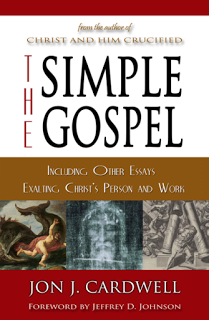 of this book is the proper understanding of the biblical gospel – that is the title: The Simple Gospel. What our brother rightly understands is that one cannot have a true understanding of the gospel if one does not have a true understanding of the person and work of the Lord Jesus. Without a biblical Jesus, faithfully fulfilling the requirements of the Law and the Prophets and taking our place in facing God the Father’s wrath for our sins (Him being without sin), we do not have the biblical gospel. The subtitle, Including Other Essays Exalting Christ’s Person and Work, gives us advance notice that we will spend some time reading about essentials that provide the foundation of the true gospel.
In this title chapter our author gives us his summary of what the Bible presents as the gospel:
The gospel of Jesus Christ is the revelation of God, according to the scriptures of the Old and New Testaments, which focuses on the Person and work of Jesus Christ in His incarnation, crucifixion, resurrection, ascension, and restitution of all things in His bodily return. 1
Note this: the gospel is about the redemptive work of Christ and our need of Him; the gospel is not the entire Bible, although all Scripture has this meta-plan as its ultimate purpose. A little later in this chapter, while reviewing the meaning and significance of the crucifixion, Jon pleads the sufficiency of Christ’s blood, saying, “The power of the purity of Christ’s blood is sufficient to cleanse the redeemed soul from every confessed sin he has committed after he has been saved by God’s grace (1 John 1: 7-10).” 2 While I agree with the intent, I think this idea would be better stated as “The power of the purity of Christ’s blood is sufficient to cleanse the redeemed soul from every sin he has committed or will commit, and is applied when he is saved by God’s grace (1 John 1: 7-10).” For we are commanded to confess our sins, all the sins of the redeemed are forgiven when he raised from spiritual death to new life, not just those committed after salvation and not only those confessed.
Still in this section, Jon brings to our mind the picture of Christ suffering God the Father’s wrath for our sins – a much more horrifying punishment than physical death on the cross, as painful and horrible as that is. If we don’t see Jesus being punished spiritually for the sins you and I committed, we are taking His sacrifice too lightly. This is closely tied to this statement: “The shame that comes to our souls in the light of the revelation of the offense our very lives bring to God, far exceeds the shame of Adam and Eve when their nakedness was revealed to them.”3 Far more powerful than our shortcomings in our foolhardy attempts to keep the law or earn God’s favor by our own strength, seeing the glory of God in Christ will undo us as it did Isaiah and the Apostle John and others who were privileged to see Him clearly. This is the power of the cross!
When he quickly reviews the resurrection’s part in the biblical gospel, our brother tells us two dear truths: “The resurrection of Christ is God’s open display to the entire creation of His seal and acceptance of Christ’s sacrifice.” 4 and “When we speak of the resurrection of Christ we also speak of God’s assurance of a resurrection to come. God promises to all whom He has saved in Christ will one day be resurrected from the dead. The importance of the resurrection is such that a denial of the bodily resurrection of Christ means a denial of the faith altogether (1 Corinthians 15:12-19).” 5 Let no one who claims Christ forget the import of the resurrection – if Christ be not raised from the dead, we are to be most pitied.
His last section on The Simply Gospel is about the restitution or restoration of all things. We cannot, Jon tells us, fully comprehend the recreation of heaven and earth and the Lord’s glorious return without understanding the biblical doctrine of hell. And, he goes on, we cannot rightly comprehend either the new earth or hell if we do not rightly comprehend God! “The same presence of God that is a consuming fire for the wicked dead, Christ’s presence is peace and comfort (2 Corinthians 1: 3), and fullness of joy with pleasures forever more at His right hand (Psalm 16: 11).” 6 This oft-repeated exhortation to see the Lord as He is in His glory and power is a welcome one that does the souls of the saints much good.
Chapter 2 – Propitiation through Faith is an enlightening walk through Romans 3:23 – 27. Our faithful author tells us, “Romans 1: 17 is the key to this epistle, Romans 3: 23-27 is most certainly the door the key unlocks.”7 and “It is through this door one must pass in order to enter life eternal. In one way, it may be here that the Lord’s cryptic words become especially insightful: “I am the door: by me if any man enter in, he shall be saved, and shall go in and out, and find pasture” (John 10: 9; cf. 10: 7). The door of this passage is that wicket gate Mr. Bunyan’s allegory refers. Jesus Christ is that door, that wicket gate, and His cross, His propitiation, is eternal treasure.”8 Such exegesis is welcomed in this day of shallow, superficial reading, as is this: “To sum it up, God’s righteousness was openly displayed and manifested in the… Person of Christ Presentation at the Cross Power of Christ’s resurrection Perfection in Christ’s ascension.”9 As the Apostle Peter told us (2 Peter 1:12), we need to be reminded of the essential things even though we already know them. Cardwell does well in this regard, as he desires to stir up the saints of God to dig into the Word and walk as those who have been raised from the dead. I do wish Jon had spent some time on exploring what Paul meant by the phrase, “the law of faith” in verse 27. I think it is tied to what he elsewhere calls “the law of Christ,” which (I believe) is defined by the Lord’s answer to the Pharisee in Matthew 22:37 – 40 (I highly recommend Charles Leiter’s excellent book, The Law of Christ).
Cardwell emphasizes the fact that the life of a person who has been raised from spiritual death will be evident: “the result of the saved life will be evidenced by, but not limited to these things: a growing resemblance to the life of Christ in sanctification (1 John 1: 7); repentance of sins as the illumination of His light reveals them (1 John 1: 8-10); a love for God’s Word (1 John 2: 3-5); abiding in the Holy Spirit-led life (1 John 2: 6); exhibiting a sacrificial love for fellow-believers (1 John 2: 9-11); a hatred for the things of this world and hatred for the lusts of the flesh because those things are at enmity with the Father (1 John 2: 13-17); and a love for and discernment of the truth (1 John 2: 20-21).” 10 Let no one go easily on with the lie that one can be saved yet unchanged.
I will only touch on the topics of the balance of the book, each chapter will challenge the reader to examine his belief in the Word and the meaning of specific passages and traditions as Cardwell examines the meaning of the sign of Jonah, the Shroud of Turin, traditions of men, and a few other topics.
The fifth chapter examines the Chief End of Man, and Jon does well to debunk the seeker sensitive madness Rick Warren is famous for, but he also takes the Westminster Shorter Catechism without question to answer the question. The problem with the catechism and its answer is the lack of defining the audience. About which man is it asking about the chief end – fallen man or redeemed man? In the context of the catechism, the very beginning, the catechism must be talking about man in general, not the redeemed. And because of this, their answer fails – because those who are bound for eternal torment do not have, as their chief aim “enjoying God.” Further, I find no support in Scripture that our benefit (the redeemed enjoying God forever) is our chief end. All of creation has as its chief end the glory of God. They should have put a period after the first phrase and worked out the latter portion in a later part of the catechism, making it clear enjoying God is a blessed benefit the redeemed will reap. Jon does point out that, to “enjoy God forever did not mean that man’s ultimate happiness comes as the result of what we receive from God. Following this thought toward its logical conclusion would ultimately suggest that God exists for man’s good pleasure and not the other way around.”11 Amen!
Christian – are you satisfied with your understanding of God’s Word and how it applies to you? I trust that is not the case. This short book is a good one to provoke any believer to dig deeper into the Scriptures, to pray for God’s wisdom, and examine some of those things we have been taught but never have thought about. Take and read!
Footnotes:
1 Cardwell, Jon J. (2014-11-15). The Simple Gospel – Including Other Essays Exalting Jesus Christ’s Person and Work: The Gospel Truth of Jesus Christ According to Scripture (The Biblical Gospel of Jesus Christ Book 2) (Kindle Locations 172-174). Vayahiy Press. Kindle Edition.
2 ibid; Kindle Locations 210-211
3 ibid; Kindle Locations 241-242
4 ibid; Kindle Locations 252-253
5 ibid; Kindle Locations 259-262
6 ibid; Kindle Locations 299-301
7 ibid Kindle Location 332
8 ibid Kindle Locations 339-342
9 ibid Kindle Locations 361-365
10 ibid Kindle Locations 504-509
11 ibid Kindle Locations 915-917
Happy Reformation Day!

Quotes: What I need to be frequently reminded of.
“It would be better if [Christians doubting the grace in their lives] spent their time in praying, and asking Christ for more grace, instead of bestowing complaints of their supposed gracelessness!”
– Richard Baxter
1615 – 1691
A Catholic Fable
A Catholic Fable 
A review by Stuart Brogden
I tried to give this book, My God and My All – The Life of Saint Francis of Assisi, an honest opportunity to impress me. Elizabeth Goudge was a 20th century novelist and it is most appropriate that a fiction author wrote about this topic. The cover art gives us a peak into the perspective the reader will face: it’s a well-known (in Roman Catholic circles) painting of Francis in prayer. His hands are crossed over his chest and there is a nail hole visible in his left hand. Several segments within the Roman Catholic Church believe they are obedient to Scripture when they punish their bodies in imitation of the physical punishment our Lord took upon Himself in obedience to His call as being born under the Law, cursed for the sake of those He was sent to save. This may also be a twisted view of Colossians 1:24. Sam Storms has a very good analysis of this verse (posted here: http://www.samstorms.com/all-articles/post/filling-up-the-afflictions-of-christ–1:24-) that, may it please the Lord, will help some Roman Catholics see the truth of Scripture on this topic.
It is fitting that a novelist wrote this book for two reasons. First, the book is a fictionalized account of Francis’ life. Secondly, it presents a thoroughly Roman Catholic view of Francis’ life, which is as much a work of fiction as is every distinctive of that religion. I’ll focus on this second aspect, as fiction presented as truth is a danger that we cannot blithely ignore. And we see this false religion on pages 1 and 2:
In the case of those whom we call the saints, this power is immeasurable. They are the true makers of men. Other great men may alter the material aspect of life for millions, but the saints make us for eternity. By emptying themselves, by getting rid of self altogether, they become the channels of God’s creative power and by him, through them, we are made. … And so his (Francis’) power lives on and we cannot measure it because it is nowhere near its end.
The Bible calls all of His redeemed people, saints. There is no determination by any man-made religion as to whom is worthy of being identified as such. The one who plants and the one who waters are nothing – the growth comes from God and He, alone, is everything (1 Cor 3:7). The “saints” of Rome do not “make us for eternity,” they were in every bit the same need of God’s grace to be saved as any other men. There are no “great men” in the world or in the body of Christ; all men are weak and sinful and the only good we have claim to is the good He (not any religious pretender) works in and through us.
Another short insight into the dual nature of this being a novel: on page 6 the author shows us her method of weaving this story together, speaking of Francis’ birth:
Tradition says it was long and hard and that as the hours passed and her child was not born she asked to be taken to the stable that adjoined the house, that she might feel a little nearer to Mary, the Mother of God, and that in the stable her child was born. Today the little place is a chapel, the Chapel of the Infant Francis.
Many Roman Catholics deify Mary, who was a sinner used by God, not a sinless woman God was fortunate to have on His team. She was the mother of Jesus, the man, not God. Jesus, being eternally existent as the second member of the Trinity, was not born of a women in the sense that would validate this phrase beloved by Rome – Mary, mother of God. That is a blasphemous statement, but not seen as such by those who worship Mary. We also see here the practice of building a shrine at “sacred places,” as if Jesus did not have the conversation with the Samaritan woman in John 4. Places are not sacred in the Christian world, only in the pagan world. God’s people (individually and corporately) are His temple (1 Cor 3:16; 6:19; Eph 2:17 – 22). He does not require nor even want temples made by human hands (Acts 7:48; 17:24) and when men make ornate buildings as places of worship, the tendency is to take pleasure in the grand architecture and the images normally found therein – forgetting the God Who made all things and is Lord of all things.
Francis was, as many Roman Catholics are, a mystic who imagined he heard direct from God apart from His Word (page 22). In one such moment he dreamed YHWH revealed the perfect bride for him, “Lady Poverty” (page 21). And by so determining he must deny self by becoming temporally poor, “Francis entered upon this battle of winning himself for God.” (page 22) This reveals one danger of the mystical life: a person can be misled by various voices which lead away from God’s Word. This shows up again on page 28 as Francis “heard the Lord speaking with the voice of a friend, and saying, ‘Francis, go and repair my church, which as thou seest is wholly in ruin.” In focusing on the crucifix, Francis “realized that though the sufferings of Christ in his human body were ended yet the At-one-ment was always going on. Christ still reigned from the cross, looking out over the suffering world, drawing all men to himself on his cross that might unite them to God in himself.” When Jesus finished His work of redemption, He sat down at the right hand of God (Heb 1:3). He is not still hanging on the cross!
Francis is recorded in this novel as working on the rebuilding of three buildings, which are called churches. This is a vital error, putting places in the place of the body of Christ, as noted earlier. Of His church, the Lord said He would build her (Matt 16:18), this spiritual building that is the work of God alone. He does not need the help of men, although He does command us to be obedient in proclaiming the gospel to men everywhere and to disciple the saints within the local church.
Chapter 5 carries the book’s title and describes the Roman Catholic mass as the center of worship. “Nothing could be greater than the coming of Christ the King in the sacrament of the altar. Soon the little church would be as holy as the courts of heaven” (page 50). So much of the Roman religion is taken from the Jewish religion without any discernment. The New Covenant church has no altar, and Christ the King is not offered up on any altar! His empty cross serves as a spiritual altar (Heb 13:10). Note how this is explained by the Jamieson-Fausset-Brown Bible Commentary:
Christianity and Judaism are so totally distinct, that “they who serve the (Jewish) tabernacle,” have no right to eat our spiritual Gospel meat, namely, the Jewish priests, and those who follow their guidance in serving the ceremonial ordinance. He says, “serve the tabernacle,” not “serve in the tabernacle.” Contrast with this servile worship ours.
an altar—the cross of Christ, whereon His body was offered. The Lord’s table represents this altar, the cross; as the bread and wine represent the sacrifice offered on it. Our meat, which we by faith spiritually eat, is the flesh of Christ, in contrast to the typical ceremonial meats. The two cannot be combined (Gal 5:2). That not a literal eating of the sacrifice of Christ is meant in the Lord’s Supper, but a spiritual is meant, appears from comparing Heb 13:9 with Heb 13:10, “with grace, not with meats.”
The last thing I will briefly cover comes from chapter 6 – The Rule. We have a snippet written by Francis wherein he reveals his authority: the pope. “And when the Lord gave me some brothers, no one showed me what I ought to do, but the Most High himself revealed to me that I should according to the form of the holy gospel. And I cause it to be written in a few words and simply, and the pope confirmed it for me.” Also on page 73 the author says “Francis was a devoted and loyal son of the Church.” When Francis and his brothers formed their group, “Francis promised obedience and reverence to both Innocent and his successors after him. All the brothers were to take the three evangelical vows of poverty, chastity, and obedience, and they were to live without any property whatever” (pages 74 & 75). These “evangelical vows” are not found in Scripture. We find in God’s Word that His children are to be poor in spirit, not proud; sexually pure, in marriage unless gifted with singleness; and obedient to Christ as revealed in Scripture, not to traditions and words of men.
The god of Francis appears, from this book, not to be the God of the Bible. If that god was his all, his end was worse than his beginning. I pray all who claim to be in Christ examine themselves to see if they be in the faith (2 Cor 13:5). The Christian religion is not the product of men. It is the work of God in the people He called to new life in Christ (2 Cor 5:17) from their natural condition of spiritual death (Eph 2:1 – 10). To Him alone be all honor and glory and dominion, and none of that to any man.
What’s coming.
“Maybe at the present the authorities smile on the church of God; but within a while it may frown, and the storm of persecution arise. There was a time when the churches had ‘rest throughout all Judea’ (Acts 9:31). It was a blessed time. But how long did it last? Alas! not long.”
– William Gurnall
1617 – 1679
Quotes: No man knows the end of sin.

Quotes: Frogs and fish.
“Some can better remember an item of news than a line of Scripture; their memories are like these ponds, where the frogs live, but the fish die.”
Thomas Watson
1620 – 1686
Why this will be the last Starbucks I drink.
 I don’t make a habit of photographing my food or drinks, and I certainly don’t post them for others to be subjected to, but the cup of Starbucks in this picture is significant because it will be my last.
I shrugged my shoulders as Starbucks bullied small coffee companies (e.g. here and here).
I looked the other way when Starbucks sued small coffee companies (e.g. here and here).
I ignored the fact that Starbucks uses GMO products.
And I rolled my eyes when Starbucks tried to ram race issues down my throat.
But now I discovered something about my favorite coffee chain that is too egregious to look past; too evil to ignore
Continue reading here.
Quotes: Glory in adversity.
“There is no work which God has made–the sun, moon, stars, and all the world–in which so much of the glory of God appears as in a man who lives quietly in the midst of adversity.”
– Jeremiah Burroughs
1600-1646
The new Nazis.
While America wrestles over whether or not to ban a flag, while our society fawns over a former Olympic athlete wearing a dress, while our media’s talking heads debate whether or not to call the Chattanooga shooting “terrorism,” and while most Christians are wringing their hands over the recent Supreme Court decision, Planned Parenthood continues its epically evil agenda of not only barbarically dismembering children for profit, but now they’re selling the body parts of the kids they murder . . . even discussing the creation of a “menu” for body part sales.
Read more about this story here.
Quotes: The road most densely populated with thieves.
“No road is so full of thieves as the road to heaven.”
– Richard Steele
1672 – 1729
“Not One Iote or One Title…”
“Not One Iote or One Title…”: A Plea for Original Spelling by John Bookman [Pseudo.]
[Attention–this is a SATIRE] 
by Doug Kutilek
www.kjv-only.com/doug/spelling.html
Just days ago, I realized that we have not gone far enough in insisting that the Bible be preserved unchanged “in the form God intended for us to have.” Of course, I speak of the infallible, inerrant, verbally-inspired and unalterably preserved English Bible, the Authorized Version (AV 1611), “the Bible God uses and Satan hates.” Sure, there are lots of zealous defenders who have shielded it from the corruptions of such heinous translations as the NIV, the NASB and that most sinister NKJB, and have kept us from returning to the now-completely-unnecessary Hebrew and Greek. But while they kept their watch on one front, the Enemy has come in unawares by another route and sown seeds of corruption that have, I fear, already yielded a corrupt harvest.
What am I getting at? Simply this: we have insisted on the verbal inspiration of the English, that is, that the very English words were divinely chosen and given to the Learned Men. But simply insisting on the perfection of the English words and preserving the words is not enough. A careful consideration of the true intent and meaning of the words of Matthew 5:18 is necessary: “Till heauen and earth passe, one iote or one title, shall in no wise passe from the law, till all be fulfilled.” (I have made no mistake in my spelling, as I shall shortly explain). Notice how Jesus insisted on the verbal inspiration, not just of the words, but also of the very letters of the words of Scripture. And since this verse is a specific promise of the preservation of Scripture in our infallible English Bible, we must insist on following, not just the original KJV words but also their very spelling. What other meaning can we draw out of the words “one iote or one title”? Every letter–the very spelling–is certainly inspired, and to alter the spelling of a single word, to alter even a single letter in a single word, is to deny and reject the inspiration of the AV 1611. If God had wanted us to spell the words in the AV 1611 different in our Bibles, He would have given them to us in that form originally. Modern spelling is as hideous and hateful a thing as modern translations. Its new age corruption, pure and simple. No one was ever authorized to corrupt, to “modernize” the infallible original spelling. There are eight spelling corruptions in John 3:16 alone!!!
I’m sure some “liberal” soul will say, “What difference does spelling make?” Argue it out with Jesus, brother! Didn’t He say that inspiration of the words included the very spelling, every iote, not just the words? Will you reject the teaching of Matthew 5:18 of letter/spelling inspiration of our preserved AV 1611? To stop at “word inspiration” and not insist on spelling inspiration is to be second cousin to mere “thought inspiration.” It is creeping apostasy, through and through. Next someone will deny the inspiration of the chapter and verse numberings in the AV 1611. Where will it stop?
And I think we must recognize that Jesus’ infallible English word was “title” and not the now-corrupted “tittle.” A tittle is part of the ornamentation of a Hebrew letter (at least that’s what I’ve heard at Fellowship meetings, so I have assurance that it’s right). But a title is something else. I have complete confidence that this promise of Jesus was a specific reference to the preservation of the chapter and page headings, the titles found in the original AV 1611. Sadly, those infallible titles, attached by the Learned Men under divine inspiration at the top of each page and at the beginning of each chapter have been removed from our modern editions. Without them, we cannot claim that we have a perfectly preserved Bible, and by allowing them to be removed, we have called God a liar, and denied that He is able to preserve the inspired English Bible He has given us.
It is no secret that none of the commonly used English Bibles published in our day have the original AV 1611 spelling, or punctuation (that, too, is part of our directly inspired, infallible English Bible) or titles of which Jesus spoke, so in reality, these Bibles, even though they say “King James Version” or “Authorized Version” are really not Bibles at all. Only the Nelson reprint of the original 1611 AV is a real Bible; all the others are sinister corruptions.
And there is growing upon me the deep conviction, as deep as anything I’ve written in this article, that no English-speaking person can be saved if he was not saved by an original, unaltered AV 1611, with original spelling, original punctuation, and original chapter and page titles. This simply means that anyone who thought he was saved by reading a revised “KJV” or by hearing a sermon from such a “Bible” or by reading a Gospel tract that quoted the words in a revised spelling form, even if it was labelled “KJV” is not really saved, has never been saved, and never will be saved until he gets a true, fully-preserved AV 1611. That will mean that virtually all those who thought they were saved–preachers, deacons and all–will have to go back and get truly saved through a real AV 1611, then get rebaptized. Verbal inspiration of the English requires inspiration of the very spelling as well. Anything less is rank modernism.
I will confess to one further worry: original type style. The real AV 1611 was printed in what printers call “black letter,” a very ornate type style much like Gothic script, which is still used many times for the banner at the top of the front page of newspapers. This original type style was replaced with “Roman” type sometime in the 18th century. Note that name: Roman. I fear that once again, the Jesuits have conspired to corrupt the pure word in English. They have taken away the original Gothic (and as everyone knows, the Gothic Bible used the textus receptus for its foundation which proves with certainty that the Gothic was the correct script for a real Bible), and have substituted the corrupt Roman script. In a real sense, even the KJV has become a Roman Bible, since its modern editions use Roman script and not the original black letter. As further proof that Roman type is a corruption, notice that all these apostate Bibles–the ERV, ASV, NASB, NIV, NKJB, and the rest, have always been printed in Roman type. That’s proof enough to me that any Bible in Roman type is no Bible at all, and that only a Bible with the original script, the black letter, given to us in the form we should have it by the Learned Men, is a true Bible. Perhaps even those saved by the true original spelling KJV are not saved at all, and must locate a black letter edition. The Roman script Nelson reprint may not be enough (it’s just like those Bible corrupters at Thomas Nelson to pass off a Roman script KJV as though it were a real Bible!). Fortunately for me, my brother has a facsimile reprint in the original black letter of the AV 1611, and I’m secure since I’ve studied out of it several times.
It is a desperate situation. The shortage of black letter, original spelling AV 1611 Bibles is severe. There is truly a famine of the preserved word of God in the land. And all our efforts at preaching, teaching, Bible study, and soul winning are completely futile until we return to the real, unaltered, perfectly preserved bonafide AV 1611. Perhaps the best thing to do for the present is to send off and buy one of those pages from an original KJV, and if you can get a page that has a salvation verse, or part of the “Romans road,” perhaps there will be enough of the Gospel in the true preserved English to rescue your soul.
[As a service to the reader, so he can be saved through a real AV 1611, I will quote John 3:16; unfortunately, I have no capacity to reproduce the original black letter script, so even believing the unrevised spelling may not be enough, but we can hope for the best:
For God so loued ye world, that he gaue his only begotten Sonne: that whosoeuer beleeueth in him, should not perish, but haue euerlasting life.
And just today, I came to understand that the only proper format for any Bible is in scroll form (or at least loose-leaf), since the Apostle assures us that “the word of God is not bound.” Therefore any book that is bound, regardless of its printed contents, cannot honestly be said to be the word of God. I’m sure the inspired 1611 translators never intended for their translation to come sown and within leather covers. Such would be a travesty, in light of the Apostle’s clear and plain teaching.
I’ve begun the systematic unstitching of all my sewn Bibles so that they can qualify, according to Paul’s definition, as the word of God. I urge you to do the same.
 Christ Alone Wyoming