A Tale of Two Sabbaths

A Tale of Two Sabbaths

Stuart BrogdenSabbath

The Bible declares itself to be sufficient for life and godliness for those indwelt by the Holy Spirit. This is the concept behind the doctrine of Sola Scriptura. People who truly hold to this doctrine will not embrace dogma that cannot be clearly taught from God’s Word. While there are myriad issues that divide denominations and churches from one another, one’s view of the Sabbath appears to be one of major contention amongst those who embrace the idea of Sola Scriptura. Within this arena there is a coalition who herald the Puritan view of the Sabbath, which is recorded in the Westminster and Second London Baptist confessions. What follows is a comparison between the biblical description of the weekly Sabbath and the confessional views of Christian Sabbatarians, according to the Second London Baptist Confession in chapter 22. Let the reader decide if the Puritans and those confessions had it right or followed traditions of man.

Biblical Sabbath “Christian Sabbath”
Every 7th day (Ex 16:27-30, Ex 20:8-11, 31:15, 35:2; Lev 23:3; Deut 5:14) Para 7: Claims “law of nature … by Gods appointment” a “moral, and perpetual commandment, binding all men, in all ages” (no Scripture citation). One day in Seven (Ex20:8). Changed from the last day of the week to the first day of the week (citing 1 Cor 16:1-2; Acts 20:7); claiming “Christian Sabbath” as the Biblical Sabbath was abolished (no Scripture citation).
Rest from all work (Ex 16:23, 25; 20:8-10; 35:2; Lev 23:3; Num 15:32; Deut 5:12-15; Jer 17:21) Para 8: Rest from all things (Isaiah 58:13; Neh 13:15-22).
Remain in your dwelling (Ex 16:29; Lev 23:3) Private and public worship are commanded (para 8; no Scripture citation)
It is a sign to the Israelite (Ex 31:13, 16, 17; Lev 24:8; 2 Chr 2:4; Neh 9:14; Ezek 20:12, 20)
Death penalty for violating it, even minor activities such as picking up sticks (Ex 31:14-15; Num 15:32-36)
No fires for cooking, Sabbath day meals were prepared the day before (Ex 35:3)
Ceremonial bread, made in accordance with a strict formula, was presented (Lev 24:8; 1 Chr 9:32)
Offerings – consisting of lambs, grain, and drink (Num 28:9, 10)
Soldiers/priests guard the temple (2 Kings 11:5-12; 2 Chr 23:4-8)
Gentiles not bound (Deut 5:15; Neh 10:31) All men are bound (para 7; Ex 20:8)
Prohibited from business (buying or selling) with Gentiles (Neh 10:31, 13:15-19)
Gentiles invited to join with God’s people and keep the Sabbath (Isaiah 56:1-7)
Israel to keep the Sabbath (Isaiah 58:13)
Duties of necessity and mercy are permitted (para 8; Matt 12:1-13)
No bearing of burdens (Jer 17:21-27)

Notes:

  1. The Second London Baptist Confession (1689 LBC) cites Exodus 20:8 for setting the Sabbath one day in seven and for binding all men. That verse does not mention the frequency of the Sabbath; verses 10 & 11 both specify the 7th day, that day which ended the week for the Hebrew nation. Every 7th day, not one day in seven – that’s the consistent record in Scripture. Neither does that passage mention anyone other than national Israel as the subjects of this covenant and this specific command.
  2. The 1689 LBC then claims 1 Cor 16:1-2 and Acts 20:7 as a record of God having changed the day of observing the Sabbath. Read the texts – narratives showing the practice of the new church on “the day after the Sabbath.” No instruction or record of changing the Sabbath; no record of establishing the “Christian Sabbath” or abolishing the 7th day Sabbath, which continued on during the Lord’s time on earth and the apostolic era.
  3. Because of the death penalty for minor infractions of the Sabbath command to rest (as shown in Ex 31 & Num 15), it was common in Israel for the people to ask the religious leaders for clarification of what was permissible. This developed into the complex, legalistic list of rules that were infamous in the time of Christ.
  4. The “holy convocation” mentioned in Lev 23:3 is widely considered to have been a call to prayer, praise, and instruction from the Word of God. But the biblical record (Ex 12; Lev 23; Num 28 & 29) shows a consistent requirement to cease work, with cooking meals being the only exception. There is the occasional mention of humbling one’s self, making offerings to God, and the blowing of trumpets. Some of these convocations lasted several days or weeks. There is nothing in Scripture to indicate this was a weekly occurrence of prayer, praise, and preaching; although extra-biblical history does show the post-exile nation adopting the weekly synagogue practice that was well established by the time of Christ.
  5. There are many special Sabbaths, such as the Day of Atonement (Lev 23:32) and the Sabbath year (Lev 25). This comparison is restricted to the weekly Sabbath.
  6. Nehemiah 13:20-22 reveals the only passage in Scripture wherein Gentiles are told about the Sabbath, their merchants being warned to leave the Jews alone on the Sabbath so the Jews won’t be led astray. Gentiles are not commanded by Nehemiah to keep the Sabbath.
  7. There is not one Scripture cited by the 1689 showing the weekly Sabbath being addressed to, defined for, imposed on, or required of anyone other than those under the rule of Moses. Nor is there any biblical record of Christians keeping the Sabbath.

Evidence that Cannot Save

Evidence that Cannot Save Law

A review by Stuart Brogden

John Warwick Montgomery has an impressive resume – author of more than 60 books in in 6 languages; he holds eleven earned degrees; is admitted as a lawyer to practice before the U.S. Supreme Court; and is a Distinguished Research Professor at Concordia University Wisconsin. That’s something of note. He has written a short book, History, Law, and Christianity, which is divided into two parts that examine the historical and legal evidence for Christianity. One of his colleagues at the university, Rod Rosenbladt, endorses this book and encourages readers to buy several copies, “because you will end up doing what I do. You will give copies to non-Christians!”

And this perspective reveals the faulty foundation of this work – it is presented as a compelling argument for the biblical account of Jesus that can bring lost people into the kingdom of God. We should not overlook the excellent examination of historical and legal evidence that does support the biblical accounts – but we cannot fall into the trap of thinking evidence or philosophical arguments will save anyone. This faulty foundation shows up early in the book – page 4, as the author declares, “Like Cambridge professor C.S. Lewis, I was brought ‘kicking and struggling’ into the kingdom of God by the historical evidence on behalf of Jesus’ claims.” On page 31, Montgomery serves up a short quote by Pliny the Younger, circa 122, showing how early Christians met for worship, and he then comments, “From that day to this all Christians – Eastern Orthodox, Roman Catholic and Protestant – have worshiped Christ as God on the basis of the historically impeccable testimony of Jesus’ own followers and of those who knew them intimately.”  Let’s leave aside the issue of which Jesus is embraced by Eastern Orthodox and Roman Catholics and just focus on the thrust of Montgomery’s statement. It is another declaration that people come to saving knowledge of Christ on the basis of evidence and confidence of arguments based on that evidence.

This cannot be allowed to go unchallenged. If the author’s perspective is true, we need to witness with an eye towards saving people contrary to the Apostle Paul – And I, when I came to you, brothers, did not come proclaiming to you the testimony of God with lofty speech or wisdom. For I decided to know nothing among you except Jesus Christ and him crucified. And I was with you in weakness and in fear and much trembling, and my speech and my message were not in plausible words of wisdom, but in demonstration of the Spirit and of power, so that your faith might not rest in the wisdom of men but in the power of God. (1 Corinthians 2:1-5, ESV)

As with other books that have been written in this vein, this book can be quite useful for Christians who want to grow in their confidence of the biblical record, but is dangerous as a witnessing tool. People convinced by such evidence and sound arguments may very well end up having a faith that rests in the wisdom of men. We are ambassadors of the cross, not of historical evidence. People are brought into a saving knowledge of Christ Jesus by the work of His Spirit, as we proclaim His gospel. The flip side of the coin offered up by Montgomery is the attractive but just as faulty view that we can save Mormons (or others) by showing them factual errors in their religious books and doctrines. We cannot argue anyone into the kingdom of God.

That being said, this book has much encouragement for the saints. Montgomery rightly refutes post-modernism, false philosophical arguments, and liberal theology. He provides a very credible and readable defense of the person and deity of Christ Jesus from the historical record and the legal perspective, starting off (page 8) reminding us our faith is not blind or without evidentiary support: “Christian theology cannot be divorced from logic and history.” Since the gospel is centered on the work and person of Christ Jesus, we must accept the biblical record as factual – not something merely mystical – just as Jesus did when He talked about Adam, Jonah, Abraham, and other ancients from Moses’ account. Montgomery reminds us that while we can gain much from reading books written by other Christians, our faith and our truth are founded on the “primary documents” – the word of God. This is good stuff!

On page 11 and following, our author examines the historical credibility of the Bible, looking at biographical evidence, internal evidence, and external evidence. In each of these areas, the Scriptures excel in comparison to other historical persons and events accepted by all with far less support in all of these areas. Does this not reinforce the fact that such evidence cannot bring about the change that happens when one is born by again by the will of the Creator? But to see how blind lost people are to truth and willing they are to believe anything else, Montgomery observes: “To express skepticism concerning the resultant text of the New Testament books (as represented, for example, by Nestle’s Novem Testamentum Graece) is to allow all of classical antiquity to slip into obscurity, for no documents of the ancient period are as well attested bibliographically as the New Testament.” We can have confidence in our God because His Word is reliable. But we believe His Word because He opened our mind to His Truth when He made new creatures in Christ.

The second part of this short book focuses on the legal defense of the faith. He begins (page 47) by pointing out that every false religion is self-validating, a standard that very post-modern would embrace. “Christianity, on the other hand, declares that the truth of its absolute claims rests squarely on certain historical facts open to ordinary investigation.” The edge of the knife – our faith is fact-based, historically, archeologically, and philosophically; but can only be embraced if we are raised from spiritual death by the Author of all Truth. By nature, men suppress the Truth (Roman 1:18) and cannot will or desire to see it (Isaiah 64:7). Beginning on page 51, Montgomery addresses “four overarching questions” that “need to be addressed: (1) Are the historical records of Jesus solid enough to rely upon? (2) Is the testimony in these records concerning his life and ministry sufficiently reliable to know what he claimed about himself? (3) Do the accounts of his resurrection from the dead, offered as proof of his divine claims, in fact establish those claims? (4) If Jesus’ deity is established in the foregoing manner, does he place a divine stamp of approval on the Bible so as render it pronouncements apodictically certain?” Then he uses classical legal reasoning to examine each of these.

Our author examines motives for false testimony and the complexities of deception, providing nifty charts to show the various points of tension in each false presentation. Telling lies requires excellent memory and collaboration – and falls apart rather easily under competent cross-examination. The culture of disciples provided a cross-examination of sorts, making it impossible for them to carry on a life based on lies when so many Jews and Romans, who were hostile to their claims, walked among them day by day.

His last paragraph is worth a close read: “To meet man’s desperate need for apodictic (clearly established or beyond dispute) principles of human conduct, an incarnate God must not speak with a forked tongue. And, as we have seen, no divine stuttering has occurred. To the contrary, his message can be relied upon as evidentially established, a sure light shining in a dark world, illuminating the path to eternity.” Note this clearly – “His message can be relied upon.” We have been entrusted with His message, not our own. His message is the simple, foolish message of the cross, the story of the fall of man, the perfect life of the solitary God-man who earned the right to take the punishment for our sins and make a way for sinners to be reconciled to holy God. That is the life-giving message that He has given us – and we have nothing to be ashamed of when we proclaim it. The message is credible because the Author is credible. Once He gives new life, we can appreciate and embrace the trustworthiness of the message.

Accidental Discipleship

Change. All of us want to – need to – change in some way. We try all sorts of tactics, theories, imagesand drugs. All of which are shortcuts, focused on defeating the desires of our flesh. Too seldom do we seek God’s wisdom, thinking His way takes too long, requires too much effort.

But change is the wrong goal. It’s what the flesh wants and it’s a shortcut that will lead to disappointment or destruction. Knowing Jesus is the correct goal. In Him we are complete (Colossians 2:10). Whatever change is truly needed in our lives will be wrought by the Spirit of God if we abandon our plans for self-justification and pursue Christ. Not improvement, not change for the better, not relief from our pain; just Jesus.

Pursuing the wrong objective – a better life, defeating a habitual sin – is like attacking a heavily defended fortress (a stronghold) with toy weapons. We will be defeated. When we focus on the enemy, the sin, the stronghold that assails you – you are drawn away from the narrow path that Christ calls His brothers to walk. Only by keeping your eyes focused on your Guide can you keep from straying from the narrow way.

Christ is more than our goal. He is our creator, example, savior, teacher, brother, and King. All battles against sin will be – and can only be – won by making a determined, get-up-when-you-fall, faith-based pursuit of Jesus the Christ. When you or I fail to pursue Him, we grow complacent and disenchanted with Him. The allure of the flesh entices (James 1:14 & 15) and we fall – or jump – into sin. Why didn’t God stop us? Why didn’t He prevent it? He gave us His Spirit and His Son – and the choice to walk in Him or walk in the desires of our flesh. He gives us the promise that if we walk in Him, we will not fulfill the desires of the flesh (Gal 5:16). The flip side of that coin is also true: if we walk in the flesh we will not fulfill the desires of His spirit, but of our flesh.

Seek to know Him. Paul told the church at Corinth, “I determined not to know anything among you, except Jesus Christ, and Him crucified.” (1 Corinthians 2:2) Christ alone – good enough for the Apostle Paul. Is He enough for you? If not, it’s not because He is lacking – it’s because you and I choose wrong and fail to be thankful for Him. Choose Christ – above all else – regardless of your emotions.

As Jesus was deliberate in coming to Earth (Philippians 2:5 – 11) to seek and save you and me, we who are redeemed by His blood must be deliberate in seeking His will, His Word – Him.

If a man expects to drift into spiritual obedience or maturity, he is mightily deceived. This is what Satan would have God’s children believe – that we can mature to Christ-likeness by going with the flow.

Remember: The path of least resistance makes both men and rivers crooked. Choose to pursue Christ and he we will make your path straight. (Psalms 27:11)

It Was a LIE!

Any Christian with basic knowledge of the Bible knew it was a false tale – a lie – from the very Heaven

beginning. But how many professing Christians were taken in? We who claim Christ should not be such easy targets for deceptive tales that rail against the Word of God given to us.

Now, the publisher, author, his parents, and who all else who was involved in allowing this take the country by storm admit is was a lie! Of course, the Washington Post has the story – when has that paper not delighted in trying to bring disgrace to the body and name of Christ.

Read it before they take it down – click this sentence to open the story on the Washington Post web site.

Here’s how it opens:

Tyndale House, a major Christian publisher, has announced that it will stop selling “The Boy Who Came Back From Heaven,” by Alex Malarkey and his father, Kevin Malarkey.

The best-selling book, first published in 2010, purports to describe what Alex experienced while he lay in a coma after a car accident when he was 6 years old. The coma lasted two months, and his injuries left him paralyzed, but the subsequent spiritual memoir – with its assuring description of “miracles, angels, and life beyond This World” – became part of a popular genre of “heavenly tourism.”

Earlier this week, Alex recanted his testimony about the afterlife. In an open letter to Christian bookstores posted on the Pulpit and Pen Web site, Alex states flatly: “I did not die. I did not go to Heaven.”

Contrasting Adam and Israel

This comparison came to me a while back while I was studying for a hand of Godsermon. I do not presume to have unearthed deep truths, but pray this simple comparison prompts the reader to consider each Word that has proceeded from the mouth of God.

Contrasting Adam and Israel.

Adam Israel
Formed by God from the dust of the earth. Formed by God from the dust of the people of the world.
Was brought to life by the word and breathe of God. Was brought into being by the word of God.
Had close fellowship with God. Had close fellowship with God.
Was given a covenant within which to live and prosper. Was given a covenant within which to live and prosper.
Broke the covenant and received the penalty of death, which was carried out in due time. Broke the covenant and received the penalty of death, which was carried out in the fullness of time.
Was cast out of the garden, cursed to walk and work in the world which was wrecked by The Fall. Was divorced by God, left desolate, cursed to walk and work in darkness until the light of Christ.
As a type of Christ, Adam points us to the anti-type, Christ Jesus, in whom there is life for Adam’s children who are secure in the Last Adam. As a type of Christ, Israel points us to the anti-type, Christ Jesus, in whom there is life for Abraham’s children of promise.

What Does God say about Bioethics?

Christian Bioethics 517UykgR7dL._BO2,204,203,200_PIsitb-sticker-v3-big,TopRight,0,-55_SX278_SY278_PIkin4,BottomRight,1,22_AA300_SH20_OU01_

A review by Stuart Brogden

This book, subtitled A Guide for Pastors, Health Care Professional, and Families, is part of a series on Christian ethics published by B&H Publishing Group. I dare say anyone within each of those groups would be challenged to think more biblically about the relevant issues as well as being better informed by reading this book. In the preface, the series editor tells us the thesis of this book by asking this question: “How do we move from an ancient text like the Bible to twenty-first-century questions about organ transplants, stem-cell research, and human cloning?” This book, written by an ordained minister of the gospel (C. Ben Mitchell) and a physician (D. Joy Riley), gives solid counsel and these emotionally charged issues in 9 chapters, and is broken up into four parts: Christian Bioethics, Taking Life, Making Life, and Remaking/Faking Life. The format of each chapter is a look into a real life situation immersed in the subject, followed by questions for reflection, and Q & A between the authors. Other than a too frequent quoting of Roman Catholics as though that Church is Christian institution, this team provides solid insight from God’s Word on each of these topics.

Chapter 1 gives the reader an overview of the Hippocratic Oath which opened my eyes to the ancient context and false gods the oath was originally made to and the awareness that most doctors today do not subscribe to this oath, which we mostly know as the pledge to, First, do no harm. This was spelled out in explicit language that forbid euthanasia and abortion. The absence of a doctor’s oath to “do no harm” may cause a patient to wonder how much he can trust his doctor. In summing up this topic our physician author observes (page 22, italics in original) “Doctors should work hard to be trust-worthy and humble.” A few pages later (page 28), as they address stem-cell research, our minister reminds us, after quoting 2 Peter 1:3, “God has not left his people without guidance in every area of life. Although the Bible is not a science textbook, its message speaks to the deep underlying values that can guide decisions about scientific matters. Although the Bible is not manual of medicine, its truths may be applied to medical decision making.” This is a key perspective for every child of God to properly understand how to walk in the light of God’s Word. Much of the rest of chapter 2 is good advice for properly reading and understanding the Scriptures, taking into account literary, historical, and cultural context as well the genre of what is being read.

The chapter addressing abortion is sobering and probably eye-opening for most. The authors make a full-court press to establish the humanity of every life, starting from conception. Mitchell makes the essential connection between our view of Jesus and our view of humanity, developing the humanity of our Lord to show how every mortal is given value by the Creator – above all other life forms – from the time the egg is joined with a sperm. At the end of chapter 3, the authors exhort Christians to be active in opposing abortion and supporting life, but they draw no lines of getting involved with pro-life Roman Catholics. Christians must be deliberate and biblically thoughtful in deciding who to get cozy with in the public arena. The next chapter covers death and dying, providing thought-provoking observations about the details of pain and suffering and how one’s Christian world view informs us. A key element in handling the death of any person, they tell us, is to remember the patient (perhaps a close relative) is a human being, not merely a patient to be treated. “Much of the suffering of dying persons comes from being subtly treated as nonpersons.” (page 85) There is discussion of the efforts to extend life, even at the expense of that life being human. It is a long-held desire of fleshly human beings to grasp eternal life in our present form, without submitting to God’s revealed plan of redemption – which includes our death and resurrection. Being a faithful child of God includes how we approach death – do we trust our heavenly Father in our dying as did our Savior? Again, we get faithful advice (pages 100 & 101): “Through the resurrection of Christ, God has given us grounds to hope that death, however awful, will not have the last word.” Amen!

As they move from taking life to making life, the reader is presented with a biology lesson on how babies come into the world. They take this opportunity to reinforce the Christians view of anthropology (page 113): “Knowing that pregnancy occurs at fertilization rather than at implantation will help us make several important distinctions later.” They then cover several options medicine has provided for artificial this or that, discussing the line we cross regarding family integrity and God’s authority, observing (page 123), “When a third party intrudes on the procreative relationship, the divinely instituted structure of the family is altered. Trouble is bound to follow.” This may be unwelcome by some, who have such a great desire for a child that their love for the Word of God is overshadowed. All of us fall into this pit on one issue or another from time-to-time, so let us not rush to judgment.

The last part of this fine book covers the definition of death and the forces behind the changes we’ve seen in the last 50 years; organ donation and transplants; cloning and human/animal hybrids; and life extension practices. In this last category, we are introduced to trans-humanists, a group that wants to extent life in the human body and beyond. This was the topic of recent movie, Transcendence, which traced the consequences of a computer scientist whose “essence” was transferred into a powerful computer he had built. It gets very ugly before it ends. In summing up how we who profess Christ ought to look at aging, Mitchell provides a contrast between Christians and Trans-humanists (page 181): “Interestingly, the trans-humanists and Christians seem to have some common concerns. We share:

  • The quest for the good life.
  • Longing for immortality
  • Pursuit of the relief of human suffering
  • Appreciation for technology’s benefits.

Where we differ is in the mean to achieve these aims. For Christians the good life and the goods of life are found in God and his presence in our lives. The good life is not defined by the number of years one lives but the reality of God’s presence in however many years one lives. While we, like the apostle Paul, long for immortality, Christians understand that they already possess it. … Another place we differ with the trans-humanist is in loathing every human limitation. Because we are creatures and nor creators, we accept most limitations as gifts from the One who made us.”

And while there is much more in this book that will do the reader much good, I think that is a wonderful point on which to end this review. Christian – are you content with our God’s provision in your life? Do we think we deserve better than YHWH has given us? To quote the Apostle, “Who are you, oh man, to answer back to the One who made you thus?” Let us, as did the Lord Jesus, trust ourselves to the One who judges justly. Trust God, rejoice always, pray without ceasing, give thanks in all circumstances, for this is the will of God for you in Christ Jesus. In living and dying – and all that comes between those two finite points.

Jeremiah’s Lament

Jeremiah’s Lament Jeremiah

What In The World Is Going On? – Reviewed by Stuart L. Brogden`

Once more, a “Christian” book touts its status on the New York Times and USA Today Best Seller’s list. Each time I read such a book, I try to find out why worldings would find the book so interesting. This book is a sensational fable presented as fact, based on a theology birthed by Roman Catholic Jesuit priests in the 16th century and a mystic young woman of the 19th century who belonged to the Plymouth Brethren. The priests developed the future-based Anti-Christ and Mary McDonald was given the pre-trib secret rapture in a dream, which she told to John Darby (details on this background here: http://www.dispensationalism.org.uk/). This is not the faith that was once for all delivered to the saints. While some Christians have accepted premillenialism since the first century A.D., the dispensational twists (pre-trib rapture, fixation on the Anti-Christ, and focus on national Israel) are new fabrications. If dispensationalism is true, why would Sovereign God keep it a secret from His people for 1800 years?

David Jeremiah starts each chapter with a story from culture or history that sets the stage for his “prophetic clues”. None of these 10 prophetic clues make any sense unless one accepts the fable that dispensationalism is biblically sound. But there is not a single verse in the Bible that supports the pre-trib rapture, not one. Please watch this short video to gain a better understanding of this issue: http://www.youtube.com/watch?v=uQgrJ-pYhCM

I will not comment on each chapter – to do justice on such an effort would take a book. One more preface to specific comments: Dispensationalists tend to be guilty of paying heed to current events and finding some prophetic Scriptures that can be wrapped around them, sounding biblical to those who are not disciplined in studying Scripture. To facilitate this, Jeremiah starts each chapter with a tale from recent history or current events. He claims (page xv) to be “viewing current events from the perspective of God’s wonderful Word” but a careful review of his book and of Scripture discloses that he is reading the Word of God through the lens of current events. This leads into his “prophetic clue” of each chapter, as he acts as a pied piper of dispensational error.

The dispensational error of being focused on Israel shows up in a classic way on page 3: “Apparently God finds Abraham and his descendants to be of enormous importance.” This tendency of assigning value to the creation rather than seeing God using sinful, rebellious people for His purposes is a common affliction. Further in this opening chapter, pages 4 & 5, the author brags on the Jews throughout history – as if they, rather than Almighty God were responsible for their success and influence. Yet he admits on page 7 that “The Bible tells us His choice of Israel had nothing to do with merit.” Back a page, Jeremiah proclaims his belief that God’s promise of land was the most important covenant promise made to Abraham and on pages 9 – 11 he tells us it is not yet fulfilled. Yet Hebrews 11:8-10 show that Abraham “was looking forward to the city that has foundations, whose designer and builder is God.” In John 8:56, the Lord declared to the Jews, “Your father Abraham rejoiced that he would see my day. He saw it and was glad.” Abraham knew the terrestrial property which Israel fully claimed all that was promised by God (read Joshua 21:41 – 45), contrary to the dispensational claim that this promise is yet to be fulfilled. The promised land on Earth was a type and shadow of the Promised Land that Christ will bring all that the Father has given Him unto. Not some dusty bit of the mid-east. Still in the opening chapter, on page 18, we are told that the promise given in Jeremiah 32:37 – 38 is yet to be fulfilled. This promise, however, was fulfilled at Calvary, when Christ ended the Jewish religion and delivered on His promise to pay the debt for all God’s chosen people, giving each new-born Christian a safe refuge and identity as His people.

Chapter two shows a man who knows or cares so little about spiritual realities that he bases a sermon or two on crude oil (page 35), calling it “the stuff of life” (page 27) and a “sign” (the inference I drew is that he considers this a biblical sign). On page 30, the author reveals that he disbelieves the biblical account of creation, believing oil took “eons of time” to create. On page 38, Doctor Jeremiah tells us that Deuteronomy 33:24 (And of Asher he said, “Most blessed of sons be Asher; let him be the favorite of his brothers, and let him dip his foot in oil.) and Genesis 49:22 – 26 indicate there is oil beneath the dirt occupied by the modern nation of Israel. The oil mentioned in Deuteronomy is olive oil, used in medicine and religious anointing. The passage from Genesis simply refers to blessings directly from God in Heaven and indirectly from God here below. To derive a promise of crude oil from these passages is perhaps the worst example of eisegesis (reading assumptions into Scripture) that I’ve seen.

Let me say that I agree with parts of this book. The author’s warning (page 42) that we who profess Christ remain vigilant and focused on the Lord and his admonitions #2 –10 (pages 233 – 234) on how to live until the Lord returns are both spot-on. Likewise, chapter 4 – his warning about Islam – is a bold statement that many soft-hearted, fuzzy-thinking people need to read.

But the balance of the book is in the same vein as the first two – based on faulty presuppositions rather than on Scripture. On page 69, Doctor Jeremiah tells us that Romans 13:11 is a warning about the end of the age, but the context clearly is that of instructing Christians how to live in the world, in light of our firm hope of eternal life. On the same page, we see another common aspect of dispensational teaching – a works-based view of salvation, wherein one is told to “accept His offer of salvation”. The Bible tells us we are drawn to Christ and salvation is “not of blood nor of the will of the flesh nor of the will of man, but of God.” (John 1:12 & 13). This Arminian error shows up in a couple places throughout this book and is deceptive and man pleasing – but has more in common with heresy than with biblical truth.

Compounding his error in teaching a pre-trib rapture, Jeremiah devotes a chapter (#5) to digging a deeper hole. He claims 1 Thessalonians 4:13 – 18 describes the pre-trib rapture (page 102) and he calls this a “stealth event” (page 100) which only Christians are aware of (page 206). A stealth event which only Christians witness, characterized by “a cry of command, with the voice of an archangel, and with the sound of the trumpet of God”. Reads like something everybody will know about – like the resurrection of every soul on Judgment Day.

In chapter 6, we are told that the Bible prophecies a role in the end times for the United States of America and foretells Russia invading Israel. This is in your Bible to same degree as his crude oil find in chapter 2. He relies much on his country, calling our way of life “our lifeline” (page 129). Perhaps he ought to look unto Christ as his lifeline! On the next page, he quotes the “high priest” of pre-trib rapture, Tim LaHaye, who asks, “Why would the God of prophecy not refer to the supreme nation in the end times in preparation for the one-world government of the Antichrist?” I suggest LaHaye and Jeremiah reacquaint themselves with the lesson of Judges 7:2 and Psalms chapter 20. God does not need nor does He depend on horses, chariots, or superpowers.

Chapter 7 is devoted to propping up the fable from Rome that there is a future Antichrist who will rule the world. Remember – this doctrine did not exist until the 16th century and appears to be a Roman Catholic response to The Reformation, which taught that the office of pope was the AntiChrist. In this chapter, Jeremiah quotes A.W. Pink as a supporter of this view. This was true, but Pink later repented and had unkind things to say about dispensationalism, in the same way a former smoker hates cigarette smoke. Read Pink’s later statement, in four chapters, here: http://www.pbministries.org/books/pink/Dispensationalism/dispensationalism.htm

My suggestion to the reader who wants to know what will happen is to read the Gospel of John and cry out to God for repentance and faith. Christians do not fear tribulation, for our God is a strong tower and a secure refuge. Out God knows how to save His people from harm, in the midst of trouble. We are promised safety from the wrath of God’s judgment (Romans 8:1) but we are promised trouble and tribulation while we live on planet earth: Matthew 24 describes significant tribulation that His people will face; John 16:33 informs us we will have tribulation in this world; Romans 8:35 tells us tribulation will not separate us from Christ; Romans 12:12 tells us to rejoice in tribulation. Rather than being raptured before tribulation, the Bible tells us we will be preserved in and through tribulation! This is more to the glory of God – shielding and protecting His own – than a pre-trib rapture, where He snatches them up before trough times hit. It takes a mighty God to protect His people through the midst of tribulation. Have faith in God!

Attacking the Church – It is Rarely Doctrinal

Pastor Jon Gleason does an excellent job in this post addressing the issue of church problems being based on doctrine. This is his second article and should be read by all discerning believers. I have chosen to highlight a few parts and added a couple of pictures.

Attacking the Church — It is Rarely Doctrinal

My last post said that church problems are always doctrinal.  It is never accurate to say that a church which is straying in some way is doctrinally sound.  Every church problem is based on an error in applied doctrine.

In this article, it may sound like I’m contradicting that article.  If every church problem is doctrinal, won’t attacks on the church always be doctrinal in nature?  Perhaps — but they rarely start with a doctrinal focus.

Paul and John, in their epistles to the churches, warned of false teachers, sometimes naming them.  Down through the centuries, whether Christianity was persecuted or state-sanctioned, there has always been heresy, there have always been those who tried to come into the church to spread their false doctrine.  Just as there has always been false teachers, there have always been those who would stand against the heresies — and always those who have fallen prey to the wolves.

wolf-in-sheeps-clothing-300x249

Today, false teaching is gaining traction in many churches.  One can walk into any number of “evangelical” churches and hear a false Gospel preached.  In recent high profile cases, some famous mega-church pastors endorsed a man who spreads false teaching on the Triune nature of our God, and a well-known British evangelical rejected the Biblical teaching on the atonement (and now, he rejects Biblical teaching in other areas as well).  Almost every area of Biblical doctrine is under attack in churches where the Bible was once faithfully taught, often where the stated doctrinal position of the church is still sound.

False teaching seems to be on the rise — but the attack on a church rarely begins with false teaching.  Sound pastors or teachers do not usually wake up one morning and say, “I think I’ll change the doctrine I teach going forward,” and begin to promote error.  Faithful church members do not usually say, “I think I’ll stop checking the Scriptures to see if what I’ve been taught is true.”  No one in a true Biblical church suddenly decides, “I think what our church needs is more false teaching.”

The first attack is usually spiritual, not doctrinal.  We have been told not to love the world, but we have accepted the world’s value system, its philosophies, its politics, its entertainment, and its loves.  Too many churches are full of people who love what the world loves and think the way the world thinks.

People don’t say, “Let’s let error come in,” whether it be error that is taught directly or (as I mentioned in yesterday’s article) error that is taught by practice.  But when churches are full of spiritual weaklings who have been drugged and poisoned by the world and the things the world loves, they don’t even see what is happening.

When we spend more time on entertainment and Internet discussion (which is often really just another form of entertainment, even if it is on Christian topics) than we do our Bibles, we become spiritually stunted.  Our minds are not being transformed and renewed, and we don’t even recognise the error when it comes.

The Scriptures warn repeatedly that false teachers will come, and keep coming, and we need to be ready.  The solution is not writing better doctrinal statements or owning more theology books.  That has already been done.  Those who had good doctrinal statements and owned (and even wrote) good theology books have gone into error.

They loved the world, or the praise of man, or their own intellectual or preaching prowess, or pleasure, or another person, or some other thing.  Their hearts grew distant from God as sins of pride or lust or ingratitude or anger took hold — and doctrinal error found fertile soil to produce its bitter harvest.

If our senses are tuned to truth, we’ll recognise when someone tries to give us something besides the truth, even if we don’t know exactly what it is.  If you love a cup of tea, you’ll know when someone gives you one containing a foreign substance.  There will be a taste there, a taste you don’t recognise.  You’ll say, “Hey, something is wrong here!”

Nice_Cup_of_TeaBut if you stop making yourself a cup of tea, you just don’t take the time to do it anymore, you’ll forget the exact taste.  If someone gives you a cup that seems a little off, well, you probably just forgot what it really tastes like, right?  You’ve gotten away from tea drinking these days.  I’m sure it’s fine.

But not only do our hearts grow distant from God, we take from the world and learn to love its loves.  Too easily, we spend Monday through Saturday drinking the spiritual equivalent of anti-freeze.  Our spiritual taste buds become a mess.  A false teacher could put anything in your spiritual cup of tea on Sunday morning, and you’ll never know the difference.  You’ve forgotten what truth tastes like, and learned to like poison.

Church problems may always be doctrinal — but the attacks on churches almost always start on a spiritual level (not a doctrinal one) in turning our love, ever so slightly, away from the Lord to other things.  It starts slowly, deceptively, insidiously growing, until we either don’t care or don’t notice when error shows up.  We’ve been drugged by false loves, the love of the world, and the enemy can do with us what he wishes — as long as he keeps supplying the drug.

When we get to that state, the adversary could easily get us to leave the church, but he’s in no hurry to do that.  He can use us to destroy from within.  We won’t recognise error any longer, or care about it.  There are things we want, now, things we love, and we’ll be in favour of anyone who provides them.  If we can get those things we want and love in the church, all the better — we’ll be able to drift along feeling good about ourselves spiritually as we pursue the loves we got from the world.  If anyone says anything, tries to warn us, we might even get angry — “It tastes good to me, and I like it!”

In fact, if the church only had teachers who said the things we love are ok, are Christian, are actually what the church SHOULD be doing, that would be best of all!  Give me my loves in a Christian flavour, please!

We’ll be ready allies for the false teachers when they show up.  One should be along any day now.

Colossians 3:1-4

1 If ye then be risen with Christ, seek those things which are above, where Christ sitteth on the right hand of God.
2 Set your affection on things above, not on things on the earth.
3 For ye are dead, and your life is hid with Christ in God.
4 When Christ, who is our life, shall appear, then shall ye also appear with him in glory.

The Sabbath Complete

THE SABBATH COMPLETESabbath
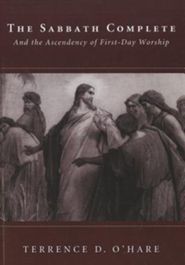
a review by Stuart Brogden

The latter half of the 20th century has brought a growing interest in Reformed Theology, in striking contrast to the growing apostasy that has gripped many evangelical denominations. Many of my fellow Baptists aggressively and happily embraced the doctrines of grace and the great theological truths about God’s sovereignty and man’s true nature. I am a grateful Baptist who was introduced to this theological construct in the ‘90s and have come to see as foundational to the Christian faith the doctrines of the Reformation, especially the reliance on Scripture Alone for all things having to do with life and godliness and For the Glory of God Alone to keep us focused rightly in all we think, say, and do. And the mostly forgotten doctrine of our forefathers – Semper Reformanda – Always Reforming, because none of has it all together nor will we get it all together while we inhabit these tents of flesh. This brings me to this remarkable book – The Sabbath Complete, by Terrence D. O’Hare. This book is the result of our author “attending an Orthodox Presbyterian Church where various Sabbath-keeping applications were stressed.” (page xi) Prompted by his pastor, who urged his congregation to examine personal motives in religious practice, he decided to study the concept of the “Christian Sabbath”, which is widely popular in churches which hold to 17th century confessions such as the Westminster Confession of Faith and the 1689 London Baptist Confession. O’Hare’s study lasted as decade, producing this comprehensive analysis of this contentious issue. His desire, and mine, is that people on both sides of this issue acknowledge the human tendency to cling to traditions (some of which, he shows, are fine and biblical), which can lead to traditions displacing true worship of God and Christ. The thesis of this book is “that Sabbatarianism is a form of traditional pietism and that the acceptance of the fully ceremonial nature of the Sabbath, though shocking to some, is actually Christ-honoring.” (page xiii)

The Sabbath Complete is organized into 12 chapters which examine various aspects of the Sabbath – prototypes, initial practice, law, feasts; how it prefigures Christ in the rest He earned, the Gospel He preached, His resurrection; and a historical review of the practice which has come to be known in the confessions as the “Christian Sabbath.” Coming in at more than 350 heavily footnoted pages, this book is thorough, enlightening, and thought provoking. It is my prayer to whet your appetite enough so that you will buy this book and study it. May the Lord be our wisdom and His glory our goal.

In his examination of the Sabbatic prototypes given to us in Genesis, O’Hare observes (page 1) that “God’s provision for our physical rest is but a token of a more transcendent remedy for our spiritual privation” and follows up (page 6) thusly: “Though God’s rest after creation is a type of everlasting rest yet to come, it is more certainly a type of Jesus Christ, who has come, in whom the faithful rest in salvation.” This snippet shows O’Hare’s focus on Christ – His provision and sufficiency, which is a constant, welcome, perspective throughout this book. As an expression of God’s sovereignty and redemptive revelation, our author reminds us (page 7), “Jonah did not just happen to be engulfed by a great fish and later ejected as a random biological event, but this occurred as designed by the Lord to shadow forth the death, burial, and resurrection of our Lord. Likewise, the seventh day rest was not a random terminus of creation but a purposed end point to shadow forth the inevitable results of God’s work in redemption.” This sets the stage for a book that is best read slowly, with an open Bible and notepad.

In addition to each Christian studying the Bible for himself, learning from credible sources of church history is very helpful as this sheds light on when and by whom our beloved traditions were started. O’Hare has helpful advice in chapter 9, wherein he reviews the shift to calling Sunday the “Christian Sabbath.” One of the earliest post-apostolic apologists, Justin Martyr, sheds light on the common-place view of Christians in the second century:

And on the first day called Sunday, all who live in cities or in the country gather together in one place, and the memoirs of the apostles or the writings of the prophets are read…But Sunday is the day on which we all hold our common assembly, because it is the first day on which God, having wrought a change in the darkness and matter, made the world; and Jesus Christ our Savior on the same day rose from the dead.”

For this most ancient brother, the Lord’s Day was on the first day not as a new instance of the Jewish Sabbath, but in concert with a remembrance of God’s creation and Christ’s resurrection – wherein we have the promise of having our decaying bodies made new like His. Our author laments how Christian traditions were often started not on the Lord’s revelation to us as New Covenant saints, but by imagining connections to Jewish traditions – “such as circumcision giving way to baptism and the Lord’s Supper approximating the Passover, came the forced and fanciful system of religious holidays common in the Roman Catholic Church.” (page 222) He then provides a lengthy quote from famous Roman Catholic Thomas Aquinas, explaining his support for these practices and then comments (page 223), “This teaching blurred the differences between the old and new covenants and paved the way for works orientation. … It was fitting for a better covenant to have fewer ordinances: one, performed only once that identifies the child of God as an heir to the kingdom, and the second, a recurring and sustaining ordinance of remembrance of the life and work of Jesus Christ. Again, similarity does not connote identity. Baptism is not a Christian circumcision, and communion is not a Christian Passover, neither is the Lord’s Day a Christian Sabbath. This is as absurd as calling the new covenant the “Christian old covenant.”” Did I mention that a Presbyterian wrote this book? He goes on to say, “It is plain that the circumcision of the Christian is spiritual and not ritual, and that it is actually the death of Christ, which was His circumcision, into which we were spiritually baptized.” In response to several sabbatarian authors (such as Walter Chantry) who press the “Christian Sabbath”, in part, as a means to restrain evil and provoke (coerce?) Christian worship, O’Hare rightly observes (page 225), “If Christ can raise up rocks to sing His praises (Matt 3:9), why would it be so difficult for Him to raise up His beloved, who are indwelt by the Holy Spirit, to worship at the appointed time (Ps 116:18-19, 122:1-2)?” Amen! Saints of the living God don’t need a command to gather together for worship and fellowship – we, by definition, love Him, are drawn to Him, and we love the brotherhood!

Each chapter of this book delves into history and Scripture to determine the meaning and origin of the various aspects mentioned in the first paragraph. Each is compelling and enlightening. Chapter 4 – Sabbath Law, examines the Jewish laws and traditions tied to their Sabbath and points out inconsistencies in the practice of modern Christian sabbatarians. In nearly every chapter, the diligent reader will be awed by the realization of how detailed the Jewish religion is as given to them by God and how it is much, much more than merely a quaint religion for those people long ago. The Jewish religion, as the book of Hebrews tells us, is mainly a means of communicating God’s eternal plan of redemption to the people He called out of the pagan nations, to protect the promised seed and make His name known around the world. These two priorities – to glorify the Lord and declare the gospel – are consistently the highest order for us humans. This becomes more and more clear as each chapter is consumed.

To keep this review from running 20 pages or more, I will restrict myself to chapter 10 – The Sabbath in Church History. This will put the “Christian Sabbath” practice so aggressively promoted and protected into its proper context. My desire aligns with the author’s – to have readers of this book see the first day of the week in its biblical context, stripped of the accumulated baggage of 20 centuries of religion.

Chapter 10 begins with the apostolic teaching, with O’Hare stating (page 244), “There are three crucial distinctions between Christianity and its roots in Judaism: holy things, the law, and the customs.” He sees some continuity and some discontinuity in the connection between the old religion and the new, acknowledging the law is good, and “Yet these ceremonial laws isolated the Jews from their pagan neighbors, became the point of contention and ridicule, and represented a wall of separation between the two peoples. This was meant by God to display the isolation between sinners and Himself – the Jew included – so when Christ abolished the ceremonies of Judaism, the gospel of peace and the law of moral commandments would become the unifying theology and practice for Jew and Gentile alike (Eph 2:14-16). … At the beginning of the Christian Church, it was a stumbling block to require Gentiles to observe Jewish rituals: “to whom we gave no commandment.” (Acts 15:24)”

The review of the Didache (50 – 120 AD) reveals no evidence of Sabbath-keeping by Christians; the review of Ignatius’ writings (page 247) shows “he clearly distinguishes between Jewish conduct on the Sabbath and Christian conduct on the Lord’s Day, to indicate the superiority of being a disciple of Christ.” He walks us through the records of Mathetes (130 AD), Justin Martyr (114 – 165 AD), Irenaeus (120 – 202 AD), Tertullian (160 – 225), Origen (185 – 254), Eusebius (265 – 340), Sylvester, Bishop of Rome (314 – 335), the council of Laodicea (364); all of which provide no support for the “Christian Sabbath” and often denounce the idea as being a Jewish encroachment in the church.

By the time Gregory I was installed as pope of the then-emerging Roman Catholic Church, traditions now associated with that religion “were already taking root, such as the liturgical mass, a monastic life, symbolic outfits, ecclesiastical hierarchy, and declaration of days to honor saints.” (page 261) O’Hare provides a lengthy excerpt from a letter to Roman citizens in which Gregory I calls those who forbid work on Sunday (which he called the Sabbath day) “preachers of Antichrist” and sums up: “Gregory’s core understanding is that the Sabbath is a fulfilled ceremonial law that should no longer be literally applied.” (page 262) O’Hare quotes R.J. Bauckham’s claim that Peter Comester (a contemporary of Aquinas and Chancellor of Notre Dame in Paris) was the “first exegete to apply the Sabbath commandment literally to Christian observance of the first day”. (page 263) Our author reminds us (same page) that “While it is helpful to acknowledge the scattered, yet progressive, acceptance of a physical rest on Sunday, it is more important to understand the bases for these practices in empiricism and religious authoritarianism.” History tells us what happened and provides evidence as to motives. The Roman Catholic Church explored ways and means to better influence her subjects, working with the legal authorities to provide a day off work and advocating Christian observance of Sabbath principles. “Their expectation that all citizens attend Mass in this church-state led to the need to force compliance through the appeal to Sabbath law.” Thomas Aquinas further developed this line of thought, “asserting that the old law contains moral (emanating from natural law), judicial (laws regarding justice among men), and ceremonial (laws touching on worship, holiness, and sanctification) precepts; and that these three can be distinguished in the Decalogue as well.” (page 264) This appears to be the first teaching of what is now cherished reformed doctrine – that the Law of Moses can be separated into these three categories and dealt with appropriately for new covenant saints. There should be no denying these three elements are found in the Law of Moses, but, as O’Hare shows us with Aquinas, determining what is ceremonial and what is moral is the rub. Aquinas recognized a moral teaching in the Sabbath commandment – people should worship God; he also recognized the ceremonial component, specifically the date upon which such worship is to be given. “At this juncture, Aquinas took the first step toward Sabbatarianism by moralizing a ceremonial command” by asserting the moral necessity of giving time to God. (page 265) Aquinas agreed with Augustine that moral laws are revealed by nature, so all men are without excuse. But in order to get man to be at mass and give to the church due obeisance, Aquinas saw value in elevating that which had been rightly considered ceremonial to moral status.

We will step quickly through the early reformers to show how this idea progressed. Philip Melancthon is quoted as saying, in 1530, “Those who consider the appointment of Sunday in place of the Sabbath as a necessary institution are very much mistaken, for the Holy Scriptures have abrogated the Sabbath and teach that after the revelation of the Gospel all ceremonies of the old law may be omitted.” (page 274) “Luther vacillates between his definitions of the Sabbath as a ceremonial law bearing no external application for Christians and a binding law incurring God’s judgment if disobeyed.” (page 279) John Calvin also had trouble being consistent in his view on this matter. In asserting “that the Sabbath was ceremonial and is moral leaves us open to problems concerning the nature of its existence – it is both abrogated and legally binding. This was further complicated by the church-state relationship that sought to mimic a theocratic Israel and by Calvin’s misconception that the biblical Sabbath required all Israelites to assemble at the synagogue.” (page 281) In his commentary on the Heidelberg Confession, written in 1563, O’Hare lists eight failures on the part of reformers that led them to embrace the “Christian Sabbath” (page 288):

  • Failure to familiarize themselves with the teachings of the early church fathers regarding the Sabbath.

  • Failure to expand the understanding of how the Lord’s advent fulfilled each specific Sabbath command beyond “resting from one’s sins.”

  • Failure to be consistent in the treatment of ceremonial laws and types.

  • Failure to satisfactorily explain why the ceremonial Sabbath was placed with the body of the Ten Commandments.

  • Failure to recognize the limitations of the Ten Commandments as a means to inculcate Christian ethics.

  • Failure to differentiate the biblical Sabbath from the tradition of the synagogue.

  • Failure to emphasize the authority of the apostles under the inspiration of the Holy Spirit to institute a new order of congregational worship.

  • Failure to distinguish the Sabbath from the Lord’s Day.”

In what may be the keystone paragraph in the entire book, O’Hare explains the meaning of the Sabbath commandment (page 289).

The Mediator is on the first table (of the Decalogue) because, unlike Moses, Christ truly comes from God and is fully God. Yet Christ, by becoming fully man, joins with man to make him complete. Man cannot become complete simply by keeping the law, but he must experience through faith a life-altering union with Christ. The ceremonial Sabbath is the evangelion within the Ten Commandments that addresses the redemption of man. It is Christ Himself who takes the place of the Sabbath in the Decalogue. The Lord’s Day is not a continuum of the Sabbath or its replacement; it is a fresh ordinance for the church of God based upon the completion of redemption that was twice sealed by the Lord, first by His resurrection and second by the descent of the Holy Spirit.”

This puts the Decalogue in the absolute best light for new covenant saints to understand it and relate to it. (Scripture never calls the Decalogue “The Ten Commandments”, but only and always “the ten words” – hence the term Decalogue. But “Ten Commandments” are much weightier in the mouths of religious overlords than are “ten words”. I would have liked O’Hare to address this aspect of the creeping incrementalism of religious lordship in the church.)

It was during this time that the early reformers also broke with the clear teachings of Scripture and the church fathers by beginning to teach the Sabbath as the product of a creation ordinance. This was taught by Ursinus who “may have adopted the theory of the Reformed Englishman John Hooper, who, in his widely published book, Declaration of the Ten Holy Commandments (1548), claimed that God instituted the Sabbath from creation. … So, only 300 years after Aquinas and fifty years after Luther, the admixture of the Sabbath and Lord’s Day developed into a general concept that the Lord’s Day is the Sabbath, fostering the idea that the Sabbath remains a viable force in Christian living.” (page 290) This creation-ordinance based “Christian Sabbath” was a major element used by state-churches on both sides of the Atlantic to coerce Sunday worship – just as Rome had learned to do, using the same unfortunate logic.

In 1973, the Orthodox Presbyterian Church published a report from a committee that had been formed to study the relationship of the Westminster Confession of Faith to the fourth commandment. In part, the committee reported:

The weekly Sabbath is an eschatological sign. This truth, central to the teaching of Hebrews 3:7 – 4:13 as well as fundamental to the entire biblical revelation concerning the Sabbath, does not find expression in the Westminster Confession of Faith and Catechisms. The reason for this would appear to be that the Standards mention the Sabbath commandment primarily in terms of its bearing on the more specific matter of public and private worship.”

The Westminster Confession of Faith was not changed to reflect the eschatological import of the fourth commandment. O’Hare, having taught in this book the nature of moral law (unchanging and universal), observes “If the Sabbath is not ceremonial or typological, it is not eschatological.” “Where”, he asks, “”can it be shown that the Ten Commandments summarize the moral law given to Adam? Where can it be demonstrated that the Sabbath commandment is purely moral?” (page 291) “Was the fourth commandment, as God gave it to Israel, about the Christian Sabbath or the Jewish Sabbath? Was there anything else in the fourth commandment that was abrogated than merely the day of the week on which it fell? Where can it be shown that God abrogated the Jewish Sabbath and installed a Christian Sabbath in its place? … So, besides omitting fundamental truths about the Sabbath, the Westminster codified interpretive errors that budded with Aquinas and blossomed with early Reformers.” (page 292)

In closing this very provoking chapter, O’Hare shows us that the fourth commandment not only commanded rest, it commanded work for six days. The Hebrew word in this commandment is in the Qal imperfect tense, which implies an on-going action – “you work”. “But, if the fourth commandment moralizes the example of God for man to obey, then it is as much a sin to work on the day of rest as it is to rest on the days of work. … if someone completes their (sic) work in three days and does nothing more for three more days, what exactly are they ceasing from on the seventh day?” He instructs us on two types of rest: “1) God’s rest signifies the promise of eternal life, and 2) Israel’s rest signified her faith in God alone. God’s work is redemptive, so man’s work is meaningless apart from that redemption.” (page 309)

The early church correctly believed that the Sabbath was a ceremonial command and welcomed the ordination of the Lord’s Day as a commemoration of the Lord’s resurrection. However, the ascension of church power through the state and the influence of rationalism allowed the medieval church to begin to associate the fourth commandment with the Lord’s Day. The Reformed church, by perpetuating the error of Aquinas, eventually expanded the scope of applications of Sabbath law and increased its moral muscle, forcing the church to practice Sunday Sabbatarianism.” (page 311)

He gives us eight conclusions which are supported by Scripture and history (page 311):

  • The creation account is not about the Sabbath. It is about the primal peace with God that was lost through sin because of a lack of faith. The pattern of creation – six days of God’s work and the ensuing rest – reverberates through Scripture to demonstrate God’s sovereignty in effecting the work of redemption by grace through the faith of man.

  • When Israel left Egypt they were given the Feast of Passover; a few weeks later in the wilderness they were given the Sabbath. At Mount Sinai, Israel received her full calendar of feasts. The Lord devised this new system of shadow laws to prefigure the person and work of the Messiah.

  • The Ten Commandments are a summary of the Mosaic laws and therefore contain both moral and ceremonial laws.

  • Christ in His earthly ministry was born under the law and obeyed the ceremonial laws as well as the moral laws.

  • Christ is the end of the law for righteousness. His work of redemption – His incarnation, death, burial, and resurrection – is the fulfillment of all shadow laws, even though some of them are yet to be manifested in their entirety.

  • The redemption of Jesus Christ initiated the new covenant. It is the fulfillment of what the former covenants forecasted.

  • The apostles had divine warrant to establish first-day worship. Scripture unfolds the transition from things Jewish to things Christian. First-day weekly worship was the normative practice of the early church, it did not move the Sabbath to Sunday.

  • While there is no explicit scriptural mandate for this transition, we have scriptural foreshadowing and history of first-day significance, and rationale. Christ’s resurrection and the inaugural descent of the Holy Spirit – the most important events of the church age – occurred on the first day of the weeks in fulfillment of Israel’s shadowy calendar laws.”

There is much, much more in this book than I can even hint at in these few pages – which are too many for most, I fear. Buy the book. Study the topics, challenge the author (I found a few places where I consider him to be in error), challenge yourself – for none of us has arrived any more than did any of the Reformers.

At the end of it all, why doesn’t this book, or anyone else, show from Scripture why the Jewish Sabbath command is not meant for the new covenant church? This is the wrong starting point. We look to Scripture to see what is, what God has revealed to us; not to prove a point. What we see in Scripture about the Decalogue is that is was an integral part of the Mosaic Covenant and the testimony or witness of that covenant (Ex 31:18, 32:15, 34:27 – 29). This key aspect of the Decalogue being a testimony of God’s covenant with Israel is further developed in Ex 25 and 26, with the ark being the “ark of the testimony” (see Ex 25:22 for emphasis). This is reminiscent of Ex 16:33 – 34 when Moses was commanded to put manna in a jar as a testimony God’s promise of provisions, seen in Ex 16:4 – 5. These are the most (only?) explicit statements in the Bible regarding the reason and purpose for the tablets and the ark – as a testimony of God’s covenant with Israel made on Mt. Sinai. Ezekiel 20:12 tells us the Sabbath is a sign between God and the Hebrews – marking their exodus from Egypt. It is not listed as a sign for the church, any more than water baptism is a sign and seal of that New Covenant. The burden is on the backs of those who say the Jewish Sabbath was, as the confessions say, abolished and re-established on the first day of the week, given to the church as the “Christian Sabbath.” That assertion, is found in paragraph 22.7 of the Second London Baptist Confession, yet established by no Scripture. Yet we do see in God’s Word the admonition for Christians to be understanding and accepting of brothers who lean on the practice of old religion (Romans 14 and 1 Cor 8) as well as stern rebukes for those who want Christians to practice old religion as a requirement (Acts 15).

The Sabbath Complete provides a comprehensive review and analysis of myriad aspects of the Decalogue and the Sabbath; examining the Word of God, the languages, and the historical context. Let the reader humbly go before Holy God and plead for understanding rather than rely on his own “wisdom” or unexamined presuppositions that we all hold too closely. Remember those who went before us – they knew they were fallible, yet many of them acted as if they were complete in their understanding of God’s Word. Yet they stood under the banner of Sufficiency of Scripture and all for the glory of God – as we must. But let these slogans of an bygone era be not merely nifty phrases we use to show our credentials, let each of us also acknowledge that we must be reformed and reforming for the glory of God, for He alone sees and understands perfectly.

This book is available on Amazon and directly from the publisher, at a competitive price.

Biblical Christianity vs. Roman Catholicism

There will always be, until the Lord returns with a triumphant shout and the sound of trumpets (1 Thess 4:16), people who confuse one false religion or another for the biblical faith Creator God revealed to us in His Scriptures and His Son. To help us keep in focus some of the essential differences between biblical Christianity and one of the largest, widely accepted false religions in the world, here is a handy chart comparing 9 facts of the faith as taught by the Bible and the Roman Catholic Church. An extract is below, to give you a preview.

I thought I would add to this a bit with a wonderful quote from a book I read last week:

“Now where the Scripture has not a Mouth to speak we must not have an Ear to hear.”
Thomas Patient, The Doctrine of Baptism and the Covenants. 1654 A.D.

Slide 1

A CALL TO SELF-EXAMINATION

A CALL TO SELF-EXAMINATION  kom

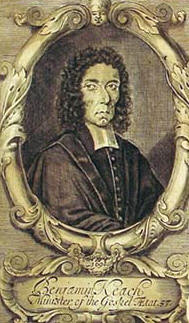
by Benjamin Keach

What can render the state of a person worse than to be an enemy of God, Jesus Christ, and the power of godliness; and yet to think he is holy and a good Christian? Nay, because his conscience is blind in the matter, it acquits him since it lacks saving light, while he keeps up in a zealous performance of the external acts of duty and religion; by which means he is deprived of that help which some openly profane gain from the rebukes and lashes of their own consciences, which often proves a means of their conversion. But the hypocritical professor, not knowing he lacks a changed heart, nor understanding that he is without those Sacred Principles from whence should flow all he acts and does, but contrariwise he is stirred up by false Principles, and acts only by the power of natural conscience and affections, having no clear judgment to discern his own danger, nor what a state he is still in. His condition is deplorable, and this unclean spirit is worse and more dangerous than that which he was in before.

Their blindness and ignorance consists in that they cannot discern nor distinguish between a changed heart and a changed life, or between legal reformation and true regeneration. They think, because their behavior seems so much better than it was before, in their own apprehension, and in the apprehension of others also, their condition is good enough. They comparing themselves with themselves, beholding what a vast difference there is, or seems to be in respect of what they once were, when swearers, drunkards, whoremongers, etc., cannot but commend themselves to themselves. Once they saw themselves sinners, and called themselves so, and were ashamed of their own sinful and wicked lives; but now they are righteous in their own eyes, and so have no need of any further work, being arrived to that state of holiness (so they think) to that degree of piety, to that change, to that conversion, that they conclude they need not seek for further change and yet they are deceived…

The state of the self-righteous and Pharisaical persons is far worse than the state of gross and profane sinners. These are sick and know it not; wounded, but see no need of a physician… They may conclude they are converted, and therefore seek not after conversion.

It is a hard and difficult thing to bring a Pharisaical person, one that looks upon himself to be a religious man, to see his woeful state and condition.

Men may be civilized, and make a great profession of religion, and pass for saints on the earth, that are not such in the sight of God in heaven.

It is a most dangerous thing to make a profession of religion without true regeneration being first wrought in the soul; better to be no professors at all, than not so as to be sincere…

This may inform us of the cause and reason there is so great reproach brought upon religion, and on the ways of God, and on the people of God, by some who profess the gospel. Alas, many of them who are called saints, we may fear are but counterfeit Christians, such as who never experienced a true work of grace; they may have knowing heads, but unsanctified hearts…

Moreover, it sharply reproves those preachers whose great business is to bring men into visible profession, and make them members of churches, whose preaching tends more to bring persons to baptism, and to subject to external ordinances, than to show them the necessity of regeneration, faith, or a changed heart. For the Lord’s sake take heed what you do, if you would be pure from the blood of all men. We too often see when people are got into churches, they conclude all is well; and when conversion is preached, they do not think it concerns them, but other people who are openly profane: and thus they come to be blinded, maybe to their own destruction…

It may also put us all upon a strict examination of our own hearts, lest we should be found to be some of these false and counterfeit Christians. And that we may clear ourselves in this matter; consider:

1. Were you ever thoroughly convinced of your sinful and lost condition by nature, and of that horrid evil there is in sin? Did you ever see sin as the greatest evil, most hateful to God, not only of the evil effects of sin, but also of the evil nature of sin, not only as it has made a breach between God and man, but has also defaced the Image of God in man, and made us like the devil, filling our minds with enmity against God, godliness, and good men?

2. Is there no secret sin lived in and favored, the evil habit never being broke? Is not the world more in your affections, desires, and thoughts, than Jesus Christ?

3. Are you willing to suffer and part with all that you have, rather than sin against God? Do you see more evil in the least sin, than in the greatest suffering?

4. Do you as much desire to have your sins mortified as pardoned, to be made holy as well as to be made happy? Do you love the work of holiness as well as the reward of holiness? Do you love the Word of God for that purity which is in it, as well as the advantage that comes by it?

5. Have you seen your own righteousness as filthy rags, and have you been made poor in spirit?

6. Have you received a whole Christ with a whole heart? A whole Christ comprehends all His offices (prophet, priest, and king), and a whole heart includes all our faculties. Is not your heart divided?

7. Is Christ precious to you, even the chiefest among ten thousand? Are you the same in private as in public? Do you love Christ above son or daughter? Do you love the Person of Christ?

8. Can you bear reproof kindly to your faults, and look upon him your best friend, that deals most plainly with you?

9. Do you more pry into your own faults, than the miscarriages of others? Are you universal in your obedience? Do you obey Christ’s Word, His commands, because you love Him?

10. Have you been the same in a day of adversity, as now you are in a day of prosperity?

11. Can you say you hate sin as sin? Is your mind spiritual, and set upon heavenly things? Do you love the saints, all the saints, though some of them are not of your sentiments in some points of religion?

12. Can you go comfortably on in the ways of Christ, though you meet with little esteem among the saints? Can you stay your souls upon God, though in darkness, having no light? Is all the stress of your justification and salvation built upon Jesus Christ?

Consider these few questions, and do not doubt but that your hearts are sincere, when you can give a comfortable answer to them, though it be with some fear and doubts that still may arise in you. A true Christian is ready to mistake what belongs to him, and take that to be his, that belongs to an hypocrite; while, on the other hand, an hypocrite mistakes that which belongs to him, and applies that to himself, which is the portion of sincere Christians. – Benjamin Keach

Taken from The Counterfeit Christian or the Danger of Hypocrisy by Benjamin Keach, (London: John Pike, 1691). Some archaic words have been modernized.

Do not quickly read these questions and forget about them. Many professing Christians today are simply outwardly religious, but their hearts have not been changed by the regenerating power of God. Christ demands the supreme place in your heart and affections. If you love anything more than Christ; if you love anything equal to Christ (though you may have a wealth of biblical knowledge); you are not a child of God. “Do not be deceived” (Galatians 6:7).

Instructions for the Ignorant

Instruction for the Ignorant:

BEING A SALVE TO CURE THAT GREAT WANT OF KNOWLEDGE, WHICH SO MUCH REIGNS BOTH IN YOUNG AND OLD.

PREPARED AND PRESENTED TO THEM IN A PLAIN AND EASY DIALOGUE, FITTED TO THE CAPACITY OF THE WEAKEST.

‘My people are destroyed for lack of knowledge.’–Hosea 4:6

Bunyan’s Catechisminstructions-for-the-ignorant

ADVERTISEMENT BY THE EDITOR.

This little catechism is upon a plan perfectly new and unique. It was first published as a pocket volume in 1675, and has been republished in every collection of the author’s works; and recently in a separate tract. The earliest edition that has been discovered bears the date of 1691; from which our copy has been prepared for the press. This is the first book of this class that was composed upon the broad basis of Christianity, perfectly free from sectarian bias or peculiarity. It is an exhibition of scriptural truths, before which error falls without the trouble of pulling it down. It is in the world, like the ark of God in the temple of Dagon. It is alike admirably calculated to convey the most important truths to the inmates of a palace or of a workhouse,–to the young or to the aged,–to the ignorant Roman Catholic, or to the equally ignorant Protestant. Its broad catholicity is its distinguishing excellence. In the separate communions included within the general church of Christ are various, and in many respects, inestimable compendiums of Christian truth, arranged for the catechetical instruction of the young and ignorant; but it cannot be denied that these, one and all, exhibit some marks of sectarian feeling and dogmatic teaching in the details that relate to the special views which each communion takes of certain scriptural doctrines. The reason why this should be the case is very obvious: there would be no differences of opinion amongst Christians except from conviction that these differences are essential, and such conviction naturally leads to these points of disagreement being (may we not say?) rather too obtrusively enforced as part and portion of a saving belief. All Bunyan’s efforts were to awaken sinners to a sense of their degradation, misery, and danger, and to direct them to the only refuge from the wrath to come–the hope set before them in the gospel; and then leaving the pious convert to the guidance of his Bible in forming his connections in the pilgrimage of life. Bunyan is solemnly in earnest; his desire is, that poor sinners should be relieved from ignorance, darkness, and destruction, and be introduced into the glorious liberty of the sons of God. May his impressive injunction be indelibly fixed upon our souls, ‘To read, ponder over, and receive the wholesome medicine as we shall answer in the day of the terrible judgment.’–GEO. OFFOR.

Read this 24 page catechism here.

Making Your Calling and Election Sure

This is a wonderful post by Mike Ratcliff. It is most important for every professing Christian to strive for holiness and not take the grace of Christ for granted. Here’s the introduction, make sure you head over to Mike’s blog to read the whole article. It will convict you if you are a child of the living God, for none of us walk entirely as we ought.

How can we know if we are truly in Christ? Or you may ask, “What is the fruit which genuine believers bear?” If true salvation is as impacting on a believers life as we contend then there should be verifiable evidence or fruit manifested in that life. The problem is in knowing what evidences really prove the presence of God in a person’s life and those that do not. I have noticed most professing Christians look at the wrong things in their self-evaluations to determine if they are in Christ. Real evidence of the presence of God in a person’s life will be the fruits of salvation. These fruits will in turn lead to outward manifestations of “goodness” or “religiosity” which, unfortunately, can be counterfeited. These outward manifestations are often what we look at to determine if we are a “good Christian” or not. My brethren, this is a fallacy. Any activity or attitude that can be counterfeited by a false believer cannot be used to verify ones salvation.

Let’s take a close look at these evidences that should never be used to verify our salvation. 

Read the rest here.

Thanksgiving Perspectives

This Thanksgiving Day, we are providing a post written by the Pilgrim from Thanksgiving 2009. So much has happened and changed in the world in the last 4 years, but there are also many things that have not. This is a reminder we should have in front of us every year.

*********

As we in America celebrate Thanksgiving, and all the great freedoms, advancements, and benefits that the exporting of Christianity to this land brought with it, let us not forget about those millions of other people who are trapped in the bondage of their nations who are held captive to false religions and the human wreckage that those false religions bring.

Becoming Last had a post containing some pictures which reminded me exactly how thankful we should be, and exactly how starkly different the continent of North America may have turned out had the light of Christianity not pierced the darkness that covered this land.

The pictures in the post came from a piece in the Sacramento Bee. I’ve included some of these sobering but needful reminders below.


Let us not go to our graves having done nothing to see the advancement of the gospel to the uttermost parts of the world, where the worship of idols and demons keeps millions, if not billions, of souls in bondage.

God’s Wisdom in Proverbs

Any preacher worth his office will tell you that proper handling of wisdom literature (particularly GWIP_thumb[2]Ecclesiastes, Song of Solomon, and Proverbs) is most difficult. Even “simple” Hebrew narratives do not always flow in chronological form as does western literature. Wisdom literature adds another twist in that it not only is designed to impart wisdom, it requires wisdom from God to rightly draw out the meaning. In his book, God’s Wisdom in Proverbs, Dan Phillips leads us by the Word of God to rightly understand this part of the His Word. And he does it with a good sense of humor that should have you smiling broadly, if not laughing out loud. This is not a commentary – it is a guide-book to this overly familiar book in God’s Word.

This book has eight chapters:

  1. Essentials for Understanding Proverbs

  2. The Stated Design of Proverbs

  3. The Foundation of Wisdom

  4. WISDOM: Seeking and Finding

  5. Relating to God by Trust and Worship

  6. Skill in Godly Relationships

  7. Skill in Godly Marriage

  8. Skill in Godly Child-training

There are four appendices, covering the question of human authorship, word studies in Proverbs, an examination of Proverbs 22:6, and preaching and teaching from Proverbs.

Throughout this exceptional book (I only regret not reading it when I first bought it a couple years ago), Phillips keeps front and center the need we all have for a healthy fear of Creator God as the beginning of wisdom and as the posture that keeps us from being full of self and/or comfortable with sin. Says the author – “A God-fearer today is the man who has repented of his good works as well as his bad, trusted Christ alone as his Savior, relied on Christ’s righteousness alone, by the grace of God alone, and taken God’s Word alone as his marching orders, with God’s glory alone as his uniting motivation. That is the man who fears God.” AMEN!

Brothers and sisters – this entire book is founded on this very perspective. It will serve the body of Christ very well.

In telling us how to gain wisdom, he compares it to getting bread. Though the Lord’s prayer includes “give us this day our daily bread”, one doesn’t merely wish or pray for bread. He works for it, goes to where it is, buys it. The same principle, he tells us, applies whether we are after wisdom or whole wheat – pray and work. Creator God rules by means as well as ends.

In helping us understand the large volume of verses expounding foolish behavior, having just discussed the child who honors his parents, Phillips writes, “By contrast, in Proverbs the foolish child is neglectful during his years of instruction and learning (10:5), disregards what he has been taught (19:27), is abusive and insulting to his parents (19:26), is stupid (17:25, 19:13), ignores correction (31:1), and hangs around with sorts of people his father warned him about (1:10. 24:21, 28:7).” Which of us see our younger selves in this summary? Perhaps we are grieved by a close friend or a child of our own who embodies this whole-hearted foolishness. Our hearts should break – yet we should trust in God and cry out to Him for mercy on the fool. For no man can rescue a fool from his God-hating position, none of us can debate or argue the spiritually dead man to come to life. Let us continually thank the Lord for having delivered us from darkness and pray without ceasing for those who are perishing, while we proclaim the gospel to them.

I am tempted to tell you all the good things in this book – but then I would violate the reason for this review. Let me be content to assure you that each chapter and appendix will prompt you to think biblically, will cause you to repent of foolishness or a casual attitude towards the Word of God, will encourage you to trust God all the more and show you the joy that is ours as we walk as children of the light.

The chapter on child-training is worth the retail price of the book. Among the many good things he teaches us, Phillips says, “We must not rear our children in a certain way because it will work (pragmatism); we must rear them in such as way because it pleases and honors Yahweh (fear of Yahweh). God’s pleasure and glory must be our focus. Then we can trust the results to Him with a clean conscience (Prov 16:1, 3, 9).”

One of the comments that made me smile with irony – his style is priceless while the observation is sobering – is in the chapter on marriage. “Modern Christian thought often drinks long and deep at the trough of sociology and psychology, adds a sprinkling of Christainoid pixie-dust, and then merely closes in prayer.”

Lastly, I will tell you about the 3rd appendix, covering Proverbs 22:6. You know the text – Train up a child in the way he should go; even when he is old he will not depart from it. How many of us have given serious thought to this verse? Do we know what Solomon meant, or our we content to merely see the words and allow our culturally trained brain and self-righteousness nature to guide to a conclusion? I’ve read of the interpretation Phillips argues for here and found it to make much more sense than the way I’ve been this verse all my life. He will make you think deeply, even if you do not agree with him.

I’ve been in contact with Dan Phillips and found him to be very cordial and brotherly, even though I told him I abhor dispensationalism (which he holds to). I dare say we would be friends if our paths crossed. He passed this along to me –during November the Proverbs book is actually on sale for 65% off. You have to order it from Kress here in Texas (http://bit.ly/18iX5b5), and use the coupon code BR60833557256.

Why God Won’t Go Away

Why God Won’t Go Away by Alister McGrath

a reviewwhy-god-wont-go-away-sm

 In his book, Why God Won’t Go Away, Alister McGrath acquaints his reader with “new atheism”, a term apparently coined in 2006. He identifies four well-known atheists (Richard Dawkins, Daniel Dennett, Sam Harris, and Christopher Hitchens) with this philosophy, telling us how it got started, what’s new about it, what characterizes it, and how we as Christians should respond to it. As we read through this book, we find that there’s about as much “new” in new atheism as there is in new age – it’s an age-old false view of creation that unrighteous men use to suppress the knowledge of Truth that our Creator has put into His creation (Romans 1:18). The common element in this view, advocated by these high profile professing atheists, is a condescending attitude toward Christianity. Much ink has been spilled by these men trying to dissuade people from believing in the One Who created all things and people. Books such as The God Delusion and The End of Faith, as if there could be a human that could live on this earth without having faith in something – even if only that the chair would hold up when sat upon. These men tend to lump all professed religions together in an effort to “prove” God cannot exist because He is full of contradictions. No matter that the Word of God reveals that man creates and worships and serves all sorts of false gods and calls some of by the name of the one true God.

Hitchens admits he is not merely unconvinced of God’s existence, but that he is more an anti-theist than an atheist. McGrath quotes a humanist chaplain from Harvard, who defines anti-theism this way: “While atheism is the lack of belief in any god, anti-theism means actively seeking out the worst aspects of faith in god and portraying them as representative of all religion. Anti-theism seeks to shame and embarrass people away from religion, browbeating them about the stupidity of belief in a bellicose god.” People whose focus is on tearing down their enemies tend to lose all sense of perspective and end up redefining who they are by their irrational inability to allow Christians to believe what they want to.

Chapter 3 is a provoking look at a history full of violence committed by professing Christians, which gives a high road of condescension to the anti-atheists. Ah, but we also get a look at the history of bloodshed at the hands of atheists – this proving what Christians know to be biblical truth: all men are capable of hideous acts. The Lord God of Heaven restrains sinful men so that very few are as bad as they might be and His Spirit leads the redeemed to desire holiness rather than the sinful desires of the flesh.

Next up, the enlightenment is still going strong, as our anti-atheists worship at the altar of human wisdom. We learn here why it is hopeless to try and argue an anti-atheist into the kingdom of God – it’s hopeless to try and argue anyone into the Kingdom of God. Men are born again, not of blood nor of the will of the flesh nor of the will of man, but of God. We should not be tempted to argue with lost people over facts related to the gospel – they are at war with God and He alone can give a man with a heart of stone understanding and love for Him. The intellect of the anti-atheists blinds them to the Truth, and only the Author of Truth can give him sight.

Where McGrath departs from his call as a gospel minister is in the last chapter. He heralds Mother Teresa and declares his desire to emulate her. This woman is held up by many as a model Christian, but she made it clear many times that she did not even try to convert anyone to Christ; she thought God would be pleased and save as many as tried to be good Hindus, Buddhists, or whatever false religion one was following. This is not the model for any Christian. McGrath talks around the gospel and then states that he “cannot pursue this matter further here.” He does, however, make note that “Christian beliefs, like those of the New Atheism or any other worldview, ultimately lie beyond final rational proof.” Amen! And this is why worldly wisdom is foolishness and why we must trust God and be unashamed of His gospel and willing to be thought of as fools for Christ because we will not retreat from His Word. This book would have ended much better if McGrath would have spent three pages explaining the biblical answer to the anti-atheists – those enemies of God have no other place to go if they want truthful answers to their questions.

Christianity’s Identity Crises

Christianity’s Identity Crises

antique-185371_640-640x400Among the liberal “Christian” sites that I peruse on a daily basis is Jim Wallis’ website/magazine Sojourners.  Yes, this happy conservative Christian reads through many liberal sites daily.  It is good to stay current on those who teach a message opposite yours.  One of today’s featured articles at “Sojo” was titled: “Rob Bell, Oprah Winfrey, and Christianity’s Identity Crises.”  That is a great title.  I could write a very lengthy article entitled the same.  It’s content would be radically different.  But perhaps the very first sentence of that article could be endorsed word for word:

Christianity is facing an identity crisis that boils down to one question: Who is God?

I think this is stunningly accurate.  Jesus asked his disciples this very question: “Who do you say that I am?”  It was Peter who answered: “You are the Christ.”  This answer was a good one.  Jesus replied: “Blessed are you [Peter]!” This was recorded in Matthew 16.  Christianity depends, has always depended, on the answer to that question.

What happens when we are not correct in our identification of God?  What happens when we do not know who He is?  How could we possibly worship Him?  Sojo and C.Jay Engel agree: Christianity must answer this question.  Our identity as Christians depends on it.  Unfortunately, Sojo, Rob Bell, and Oprah, much to the surprise of no one, take a far different path than I do in seeking an answer.

For instance, the article reports that in a conversation between Bell and Oprah, the following exchange took place (italics original):

Rob: For many people … God is against us. God doesn’t want human flourishing. God is the one waiting to punish or torment …

Oprah: Yeah. Because when you say to people, “God is love,” there’s a whole other group of people who say, “Yeah, he may be love, but God is also judgment and wrath and punishing …

Rob: Right … People immediately take that to mean, whatever struggle I’m going through, whatever life is really like for me, God is against me.

This is a common liberal structure of argumentation.  It can be difficult to quickly break down, primarily because, as conservatives, we are mentally preparing for a proposition about God which can be used a representative of their position.  We want Bell or Oprah to say something like: “God is always for us and this means that He will not punish us because of how we act.”  That way, we can whip out verses A, B, and C to counter the proposition.  But anyone who reads liberals (please don’t read this word as a derogatory term) like Rob Bell knows that he likes the mysterious, come-to-your-own-conclusions,” type of conversation.  For the record, I do not in any sense oppose the “whip out the verse” type of argument, unless it lacks a spirit of love.  It is to our society’s detriment that we fear leaping to the Scriptures to prove our case.

So therefore, in order to actually analyze a positive assertion that may be held by the liberal in the quest to answer Who is God?, we must look beyond conversations such as the one excerpted above.  The liberal, as clearly shown above, enjoys making claims about what people tend to think (feel), but they rarely make a truth claim that they will stand behind.  They will talk all day about how “many people” feel that God is this or that, but they are never willing to show why the “many people” are right or wrong.”  The conservative, who believes that truth is propositional, must either refuse to get involved to deeply in these conversations at all, or else push the liberal to offer a proposition so that a more productive discussion can ensue.  When the conservative comes to the table with his theory of truth and tries to debate the liberal who has an entirely different framework, it is obvious that not much will be accomplished.

Thus, we seek something more substantive in the article with which to interact.

Here is a set of assertions written by the Sojo article which does not rely on the “many people feel or think” argument:

The crisis facing Christianity is whether God is for human flourishing or against it; whether God is love or a mixture of love and hate. Of course, this crisis is nothing new. Humans have always assumed the divine was a mixture of good and evil, of being for humans sometimes and against us at other times.

“The crisis facing Christianity is….”  This is good.  It is a statement that does not rely on the subjectivity of the masses.  We can interact with this.  We will start by disagreeing with the first dichotomy.  God is not for either one of those as an end in itself.  God is for His own glory and He glorifies Himself by portraying Himself to the world.  He portrays His love, His justice, His foreknowledge, His mercy, His wrath, His wisdom, His grace, His anger, and on and on.  He will make the human flourish or not flourish based on whether it gives Him glory.  If He was for human flourishing as an ultimate, none would be eternally punished.  This is Bell’s position, but it is not Biblical.  If He was against human flourishing as an ultimate, none would be eternally saved.  This too is wrong.  For some are saved and some are not.  Thus, this is a bad way of representing the crisis.  What we should say is that the crisis is whether God is ultimately for His own glory.  And also whether God demonstrates His glory be saving some and not saving others.  Some humans will flourish, others will not.

On the second dichotomy, this one has always confused me.  That is, I don’t know what the philosophical problem is.  Let’s say that God loves when people get along.  What then does he think about people unnecessarily fighting?  Does He love that?  It would seem that if you love something, you must logically hate that “something’s” opposite.  And isn’t this a good thing?  Can’t we agree that the activity of rape should be hated –and is hated by God?  Certainly God does not love such an atrocious crime!  What else is left?  Is He neutral toward it?  What, then, does the word justice even mean?  Hence, this dichotomy, while perhaps more understandable, is at least misleading.  A better way of framing this is by asking, what, exactly, does God hate and what does He love?

Moving on.  The author writes:

I’m in the midst of reading the revised and expand version of Michael Hardin’s book The Jesus Driven Life. Michael brilliantly speaks to the history of this crisis. From nearly the beginning of religion, the human experience of the sacred has been marked by ambivalence. The gods were fickle and you never knew where you stood with them. They were loving and wrathful, forgiving and judgmental.

Michael refers to this as the Janus-faced gods. Janus was a god of Rome, and the god that January is named after. Janus was literally two-faced, but the metaphorical way we use the term “two-faced” is a good way to understand Janus, and indeed, all the archaic gods. Christianity’s identity crisis stems from our conception of God remaining infected by Janus. In fact, many theologians hold to a god that looks more like Janus than the God revealed by Jesus.

That last sentence.  I’d like to know who he is talking about.  Hint: it is not the liberals (like Bell and Oprah).  More likely, it is the conservative theologians whom he refers to.  This is a common liberal argument that can be seen often in liberal writing.  But our reply is to point out that, in actuality, it is the Conservative who avoids the problem of the so-called Janus-faced god and the liberal who pushes it.  The reason I say this is simple.  The Conservative trusts that the propositions of Scripture are literally true.  This is different than “true literally!” (oh! please dear reader, don’t misunderstand me!).  As Gordon H. Clark once explained:

This thesis that the Bible is literally true does not imply that the Bible is true literally. Figures of speech occur in the Bible, and they are not true literally. They are true figuratively. But they are literally true. The statements may be in figurative language, but when they are called true the term true is to be understood literally.

Thus, the phrase “never knew where you stood with them” cannot by applied to conservative Christian worldview in the least.  The Scriptures are very clear where we stand and what God’s response is to both faith as well as sin.  On the other hand, what about the liberal who understands the nature of Scripture far differently and embraces things like “mystery” and “subjective” and who certainly don’t take the Scriptures as literal truth?  How could they possibly know where they stand with God?  The “God revealed by Jesus” is one of clarity and absolutes.  There should be no question as to where we stand: for those who believe in Christ, they are saved.  This, the basis of the Christian doctrine of assurance.

For the conservative then, the crisis of Christianity, Who is God?, is a matter of life and death.

Here comes the most important quote of the Sojo article.

In Jesus, we discover that God has nothing to do with violence or retribution, but everything to do with a love that is for human flourishing. As Michael puts it:

“By removing retribution from the work and character of God, Jesus … opened up a new way, a path, which he also invites us to travel. Sadly, few have found that this path and church history replete with hundreds, even thousands of examples of a Janus-faced god, a god who is merciful and wrathful, loving and punishing. Some have said that we need to hold to both of these sides together. Jesus didn’t and neither should we. It is time for us to follow Jesus in reconsidering what divinity without retribution looks like.” (70)

John 3:36 reads: “Whoever believes in the Son has eternal life; whoever does not obey the Son shall not see life, but the wrath of God remains on him.”  This is the opposite of what Sojo writes.  This verse shows us two things.  One, it shows us that God is a wrathful God toward those who do not believe in Christ.  Two, it shows us something that we noted above; namely, that God is not for or against human flourishing as an absolute.  For some are saved and others are not.  It depends solely on how God wants to demonstrate His glory through them.

The quote from Michael Hardin’s book too is very misguided.  I’m curious what basis Hardin has to say that Jesus removed an aspect of God’s character!  What does that even mean?  He literally (or figuratively?) took a part of “Who” God is, His very character, and removed it?  That is remarkable, not to mention patently unbiblical.  That seems like a doctrine that comes from the same place as our modern Federal Reserve-monopolized dollars: straight out of thin air.

Hardin apparently does not like the idea that God can be both merciful and wrathful depending on the situation and the person that he is dealing with.  But the Bible is full of examples of believing Christ leads to life (because of God’s grace) and rejecting Christ leads to wrath (because of God’s justice).  To say that Jesus didn’t support this is absurd.  It may seem a bit tedious to share some verses contradicting Hardin, but is a simple rebuttal indeed.  We only have to look at one gospel to find some examples.

1. “And do not fear those who kill the body but cannot kill the soul. Rather fear him who can destroy both soul and body in hell.” (Matthew 10:28)

2. “Then he began to denounce the cities where most of his mighty works had been done, because they did not repent. “Woe to you, Chorazin! Woe to you, Bethsaida! For if the mighty works done in you had been done in Tyre and Sidon, they would have repented long ago in sackcloth and ashes. But I tell you, it will be more bearable on the day of judgment for Tyre and Sidon than for you. And you, Capernaum, will you be exalted to heaven? You will be brought down to Hades. For if the mighty works done in you had been done in Sodom, it would have remained until this day. But I tell you that it will be more tolerable on the day of judgment for the land of Sodom than for you.” (Matthew 11:20-24)

3. “The field is the world, and the good seed stands for the sons of the kingdom. The weeds are the sons of the evil one, and the enemy who sows them is the devil. The harvest is the end of the age, and the harvesters are angels. “As the weeds are pulled up and burned in the fire, so it will be at the end of the age. The Son of Man will send out his angels, and they will weed out of his kingdom everything that causes sin and all who do evil. They will throw them into the fiery furnace, where there will be weeping and gnashing of teeth.” (Matthew 13:38-42)

4. “Then he will say to those on his left, ‘Depart from me, you cursed, into the eternal fire prepared for the devil and his angels.” […] “And these will go away into eternal punishment, but the righteous into eternal life.” (Matthew 25:41 and 46)

And this is not even to mention the fact that the rest of the New Testament, which records the words of God written by other people besides Jesus, supports the idea that faith leads to life and faithlessness leads to death.  Hardin’s final statement as copied above was this: “it is time for us to follow Jesus in reconsidering what divinity without retribution looks like.”  Not only is he not following Jesus in such an endeavor, but he is also taking a path which leads away from the Scriptures completely.

The Sojo article contains the following in its concluding paragraph:

Christianity is suffering from an identity crisis and I thank God for it. I’m also thankful that we have Rob, Oprah, and Michael to help guide us through the crisis….

Lesson: You are not going to make it through the identity crisis successfully if you rely on Rob, Oprah, and Michael to be your guides.

But I think the identity crisis is spot on.  ”Who is God?” There is only one answer and Christianity must depend on the Scriptures to find that answer.  Sadly, much of what is called “Christianity” today does not, in fact, rely on the Bible and therefore has failed in the midst of crisis.  And if you fail in this area, if you fail on the very fundamental of the nature and person of our God, your faith is in the wrong object.  It is “your faith that saves you,” and we therefore better answer our question right.  Thanks be to God for giving us His word.

_______

“For the Lord your God is God of gods and Lord of lords, the great, the mighty, and the awesome God, who is not partial and takes no bribe. He executes justice for the fatherless and the widow, and loves the sojourner, giving him food and clothing. Love the sojourner, therefore, for you were sojourners in the land of Egypt. You shall fear the Lord your God. You shall serve him and hold fast to him, and by his name you shall swear. He is your praise. He is your God, who has done for you these great and terrifying things that your eyes have seen. Your fathers went down to Egypt seventy persons, and now the Lord your God has made you as numerous as the stars of heaven.” (Deuteronomy 10:17-22)