Your podcast is not your pastor.

DefCon has been pleased to provide our readers with our sermon of the week for several years now (over 300 available in our sermons category). But we know that this comes with a caution. 

With the advent of the internet, there’s a propensity for some to withdraw from fellowship with other believers and to rely on internet sermons as their sole source of preaching.

The following article from Trevin Wax serves as a healthy reminder to not let our blessing of the availability of internet sermons become a hindrance or a curse.

“There’s been a lot of talk in the blogosphere this year about the rise of ‘celebrity pastors’ with ‘rock-star status’ and the larger-than-life influence of popular conference speakers whose sermons are downloaded by the thousands. Some have openly decried this development; others are glad that at least pastors are being celebrated. Most of us are somewhere in the middle.”

Continue reading here.

The Great Exchange.

Life is filled with unanswered questions. The most troubling of which are questions surrounding the afterlife. For example: What happens to us after we die? Who will find themselves in Hell? How does someone get to Heaven?

We hear many opinions about these mysteries from family, friends, co-workers, churches, religious leaders, psychics, and even television talk show hosts. But the one issue that needs to be dealt with before we die is the one problem that people rarely—if ever—mention. It’s the dilemma they cannot account for, remedy or fix, yet it is the one thing that will determine where each and every one of us will spend eternity. This problem that I am speaking of is sin.

We all do it.

Every person who has ever lived or is living now has sinned (Romans 3:9, 3:23), and as long as we live we continue to indulge in sin (Genesis 6:5). None of us are free of sin (1 John 1:8), and God will judge us for every one of our sins, including the secret ones we thought were hidden (1 Samuel 16:7, Ecclesiastes 12:14, Romans 2:16, Romans 8:27).

Sin results in two deaths.

The sin that we inherited from Adam and the sin we willingly commit every day will result in our physical death (Romans 5:12-17, 6:23), but of greater peril than our physical death is that our sin will result in what’s called the “second death” (Revelation 21:8). This “second death” is better known as Hell, a very real and horrifying place consisting of eternal punishment, darkness, weeping, gnashing of teeth, and an unquenchable fire (Matthew 8:12, Luke 3:17, Jude 7).

Our common denial.

We are all guilty before God, condemned by a lifetime of accumulated sin, but some people aren’t convinced that they’re sinners until they face these four questions:

– 1) Have you ever told a lie, even a little white lie? (Proverbs 6:16-17, Revelation 21:8)

– 2) Have you ever taken something that did not belong to you? (Leviticus 19:11)

– 3) Have you ever lusted after someone? (Matthew 5:27-28)

– 4) Have you ever used God’s name in vain? (Exodus 20:7)

If you answered “Yes” to these four questions then you’ve admitted to being a lying, thieving, adulterous blasphemer. On the great and dreadful day of God’s final judgment, will you be found guilty or innocent? Based on God’s standards (not ours), the answer is obvious: you, like the rest of mankind, will stand condemned.

We’re already under God’s judgment.

Contrary to popular opinion, we do not have to wait until the day of God’s judgment to find out whether or not we’re in right standing with God. It’s not a question of if upon your death you’ll be condemned to God’s eternal, fierce, and terrifying judgment; it’s already your current condition. Because we’ve all sinned, we are already under His judgment and consigned to His wrath (John 3:18, 3:36).

Our obedience and good works are useless.

If you try to pay your sin-debt to God and earn His favor by being a good person and following the Law, then you must follow all of God’s Laws perfectly your entire life without ever failing in one area or you’ll be charged with breaking all of His Laws (Galatians 3:10, James 2:10). If you’ve already sinned in your life—even once—then perfect obedience to the Law for salvation is not even an option for you.

Not only are you under a curse if you sin in just one area of the Law, but you’re incapable of completely obeying the Law even if you wanted to (Romans 8:6-8). And—as if it couldn’t get any worse—the Bible tells us that those who try to earn their salvation by following the Law have fallen from grace and are cut off from Christ (Galatians 5:4).

God expects absolute moral perfection.

Not only does God require us to be holy (Leviticus 11:44, 1 Peter 1:16), but Jesus said that our righteousness must surpasses that of the Pharisees (Matthew 5:20) and we must be perfect just as God is perfect (Matthew 5:48).

God cannot forgive you and still remain holy.

God cannot simply forgive us of our sin without becoming an abomination unto Himself (Proverbs 17:15, 18:5, 24:24). It would be unjust and corrupt of Him to merely overlook our sin-debt just as it would be for an earthly judge to overlook the transgressions of a criminal in his courtroom. We shouldn’t expect God to forgive our offense to Him any more than we should expect an earthly judge to simply forgive the man who was guilty of murder. If the court judge let the criminal go free because he’s a tolerant, forgiving, and loving judge, then that judge would be as wicked as the murderer who committed the crime. Such a pardon would be the epitome of corruption and injustice, yet this is exactly what most people expect God will do for them when they stand before Him on Judgment Day.

God cannot simply ignore your sin and still remain a righteous and just Judge because justice demands that punishment be carried out. Based on the moral standard required of our holy, perfect, and righteous final Judge, you and I must be eternally punished under God’s relentless, unmitigated wrath because we have sinned against an eternal and infinitely holy God.

What hope is there?

So, what hope is there? How can we be forgiven for our multitude of sins that require punishment? How can God justify the sinner and still remain just (Romans 3:26)?

But God . . .

But God, our Judge, being merciful and because of His great love toward us (even while we were still sinners and dead in our transgressions), provided the means of salvation by brutally sacrificing His own Son so that we may be forgiven and reconciled to Him (Romans 5:8, Ephesians 2:4).

Without the shedding of blood there is no remission of sins (Leviticus 17:11, Hebrews 9:22). The only way for us to be forgiven of our transgressions is for someone to die in our place (a propitiatory substitute) in order to bear the wrath of God that our sins justly deserve. Only a sinless sacrifice could redeem us and bridge the gap between a holy and righteous God and a depraved and sinful people. The sacrifice had to be fully human and fully God in order to qualify to be an adequate mediator to reconcile us to God.

God crushed His own Son (Isaiah 53:10) as He placed our sins upon Him (Isaiah 53:6). Jesus bore our sins on the cross (Psalm 22:16, Isaiah 53:12, 1 Peter 2:24), and He redeemed us from the curse of the Law by becoming a curse for us (Galatians 3:13).The Father placed the wretched, filthy, and vile sins of His people upon His beloved, sinless Son so that Jesus would become sin on our behalf (our substitute) while simultaneously giving (imputing) Christ’s righteousness to us (Romans 4:22-24, 2 Corinthians 5:21, Philippians 3:9). Jesus Christ not only paid our insurmountable debt of sin with His own life (a debt we could never pay), but He also credited His own perfect righteousness to our account—the very righteousness that God requires of us but that we could never obtain on our own. This judicial transfer or great exchange meets the requirements of God’s Law and satisfies the demands of God’s justice.

Jesus Christ is the one and only means God provided to reconcile us to Himself. The Son is the only way to the Father (John 14:6), and salvation is found in no one but Jesus (Acts 4:12). No matter how “good” we think we are or how hard we strive to follow God’s Laws, no one (not even you or me) is justified by the Law (Galatians 2:16, 3:11) but by faith in Christ alone because, if righteousness could be obtained by following the Law, then Jesus Christ died needlessly (Galatians 2:21).

Once upon a cross . . .

Either Jesus paid for your sins and absorbed God’s wrath for you by His substitutionary death on the cross, and conversely His righteousness has been merited to you, or you will pay for your own sins and endure God’s unrelenting wrath for eternity in Hell. God declares that we should repent because He has appointed a day in which He will judge the world (Acts 17:30-31). It will be a terrifying­­­­ day for you (Proverbs 21:15, Hebrews 10:31) if you haven’t repented (Luke 13:3) and believed/trusted (Mark 1:15) in Christ alone as your perfect sacrificial substitute, Savior, and Lord.


Quotes (931)

Mormons do not take criticism of their faith lightly; sadly, many [of them] have followed the path of our culture in assuming that disagreement is akin to bigotry.

– Bill McKeever

Oh anathema, my anathema.

How many anathemas are you under?

Mark, from Here I Blog, decided to count his:

“I decided to count the number of anathemas that I am under from the 33 canons on justification. My count is 23 anathemas as I understand the canons. I tried to consider any nuances. Keep in mind that this is only 1 of 25 sessions of Trent.”

Read his post and see how many anathemas Romanism has you under here.


What does the Bible say about OMG?

The following is from Growing 4 Life:

“I was sitting at a sporting event, when the lovely, Christian lady beside me shouted, “Oh, my God!” as her child made a mistake.  I cringed inside.  And then I wondered, “does she know?”  Does she know that the Bible tells us not to use God’s name in vain? And honestly, this is not unusual.  I hear Christians do this all of the time.  Many are wonderful people who obviously love the Lord.  Is it because we just don’t hear this called sin anymore?  Are we so hardened to the use of His name due to the company we keep and the entertainment that we fill our minds with, that we just didn’t notice when we started doing it, too?”

You can read the whole piece here.

Planned Parenthood’s propaganda machine would make Goebbels jealous.

This very disturbing cartoon churned out by Planned Parenthood of San Francisco is the type of propaganda that’s reminiscent of Nazi Germany (not counting their similar goals of the mass killing of innocent, defenseless human beings).

Hitler would be so proud of what Planned Parenthood has accomplished, after all, they’ve picked up where he left off and they’ve exterminated more human beings (specifically minorities) than he ever could have ever dreamed of doing.


Daddies and daughters.

Ingrid Schlueter has hit the nail on the head with her article Daddies and Daughters.

Her piece should serve as a reminder to all fathers that even success in something as important as ministry should not come at the expense of your children. What endeavor, career, or goal in life could be more important than capturing your daughter’s heart?

Here’s an excerpt from Ingrid’s article:

“Buried under the eye-liner, body-piercings, provocative clothing and exhibitionist behavior of so many girls today are sad hearts and souls, weeping for a daddy who never cared.”

You can read the entire article (which I highly encourage you to do) here.

Are women who pastor churches sinning against God?

Lyn, from the blog  Saved By Grace, asks the question, “Are women who pastor churches sinning against God?” in her article of the same name.

“This is a subject that isn’t very popular within the realm of Christianity, it is hotly debated with more and more women taking what they believe is their rightful place in the pulpit. I believe it goes back to one of the five solas, sola scriptura. Do we really believe God’s word is the sole authority and are we submissive to it? If you believe women have a right to preach, you do not adhere to sola scriptura.”

Continue reading here.

Quotes (927)

It is not your hold on Christ that saves you; it is Christ. It is not your joy in Christ that saves you; it is Christ. It is not even your faith in Christ, though that be the instrument; it is Christ’s blood and merit.

– Charles Spurgeon

1834 – 1892

John Piper now endorses a book by a contemplative female reverend.

John Piper has endorsed the book Real Sex: The Naked Truth About Chastity by Lauren Winner, a deacon at St. Luke’s who (according to her bio on the church’s webpage) “looks forward to celebrating her ordination to the priesthood,” and (according to the Laity Lodge webpage) is scheduled to be a speaker this June at a contemplative retreat.

 HT: Sola Sisters

How to think like a Roman Catholic.

The following is an illustrated lesson to help you understand how the average Roman Catholic thinks on the matter of idolatry. I have provided several images which will allow you to better understand how a Romanist processes information.

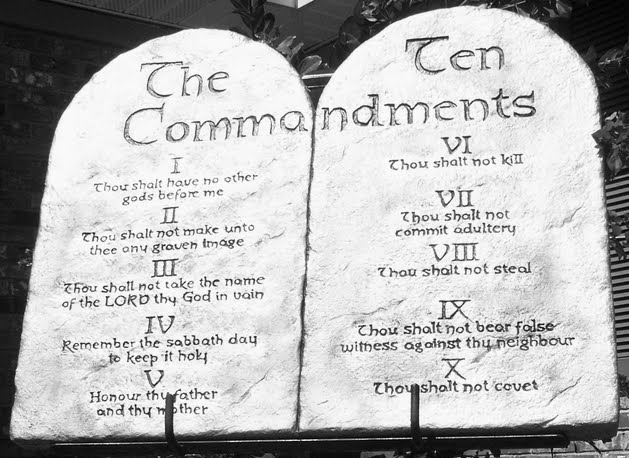
But before we begin, and so you can fully grasp this lesson, you must carefully read the following passages from Leviticus 26:1 and Exodus 20:4-5 (respectively):

“You shall not make for yourselves idols, nor shall you set up for yourselves an image or a sacred pillar, nor shall you place a figured stone in your land to bow down to it; for I am the LORD your God.

“You shall not make for yourself an idol, or any likeness of what is in heaven above or on the earth beneath or in the water under the earth. You shall not worship them or serve them; for I, the LORD your God, am a jealous God, visiting the iniquity of the fathers on the children, on the third and the fourth generations of those who hate Me,”

Now, let’s begin.

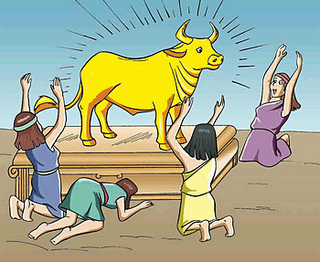
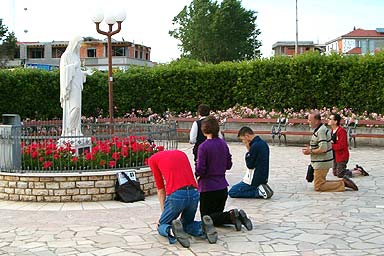
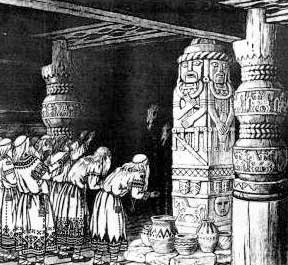
To see if you think like a Roman Catholic, what is your response to each of the the following pictures (the “proper” Romanist responses are indicated below each image).

Pagan idol worship condemned by scripture.

_______________________________

Veneration.
_______________________________

Pagan idol worship condemned by scripture.

_______________________________

Veneration.

_______________________________

Pagan idol worship condemned by scripture.

_______________________________

Veneration.

_______________________________

Pagan idol worship condemned by scripture.

_______________________________

Veneration.

_______________________________

Pagan idol worship condemned by scripture.

_______________________________

Veneration.

_______________________________

Pagan idol worship condemned by scripture.

_______________________________

Veneration.

_______________________________

Pagan idol worship condemned by scripture.

_______________________________

Veneration.

_______________________________

Pagan idol worship condemned by scripture.

_______________________________

Veneration.

_______________________________

Pagan idol worship condemned by scripture.

_______________________________

Veneration.

_______________________________

Pagan idol worship condemned by scripture.

_______________________________

Veneration.

_______________________________

Pagan idol worship condemned by scripture.

_______________________________

Veneration.

_______________________________

To see if you’ve been successfully conditioned to think like a Roman Catholic, we’ll conclude with one last picture.

Examine the following photograph carefully. The worshipers in the picture are from India, a country dominated with the worship of countless idols of Hindu gods made from stone and wood. So, are the people in this picture merely offering veneration, or are they pagan idol worshipers violating God’s prohibition of such activity found in Leviticus 26:1 and Exodus 20:4-5?

The answer: They are Roman Catholics, so therefore, their actions are only that of veneration.

If you answered this correctly, you are thinking like a Romanist, if you answered incorrectly you either need to start again at the beginning of this post, or you’re simply one of those fundamentalists who takes God’s prohibition against idolatry literally and seriously.

But for the cowardly and unbelieving and abominable and murderers and immoral persons and sorcerers and idolaters and all liars, their part will be in the lake that burns with fire and brimstone, which is the second death. Revelation 21:8

Or do you not know that the unrighteous will not inherit the kingdom of God? Do not be deceived; neither fornicators, nor idolaters, nor adulterers, nor effeminate, nor homosexuals, nor thieves, nor the covetous, nor drunkards, nor revilers, nor swindlers, will inherit the kingdom of God. Such were some of you; but you were washed, but you were sanctified, but you were justified in the name of the Lord Jesus Christ and in the Spirit of our God. 1 Corinthians 6:9-11

The source of LDS lunar life discovered?

Those who have studied Mormonism’s history have seen that much of the Book of Mormon was written largely in part thanks to other sources that were available to Joseph Smith at the time he lived.

The two most notable examples are Joseph Smith’s plagiarism of the King James Bible, and Joseph Smith’s not-so-unique tales of native American Indians being ancestors of Israelites. The former was the standard translation of the Bible used in America at that time, and the latter was a popular notion advanced in numerous books during Joseph Smith’s time.

Even Mormons (including LDS general authority member and apologist B.H. Roberts) have had to concede the uncanny similarities between the Book of Mormon and other works of men available to Joseph Smith at the time.

In fact, there’s been much discussion about writings by Solomon Spaulding and Ethan Smith which are eerily similar to that of the Book of Mormon and predate the Book of Mormon. 

 You can read more on Solomon Spaulding’s manuscript here, and view the numerous similarities between Ethan Smith’s work and Joseph Smith’s Book of Mormon here.


But the Indians-are-Hebrews stories aren’t the only tales that were circulating during Joseph Smith’s time

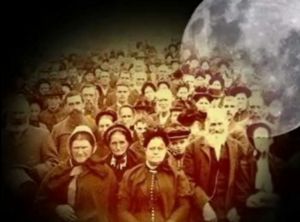
There is another Mormon teaching that was espoused by early Mormon leaders that–like the Indian/Hebrew theory–was also not original to Mormonism. I’m speaking of the Mormon teaching that the moon was inhabited by men.

Oliver B. Huntington, who was a close associate of Joseph Smith and remained a faithful Mormon his whole life, said:

Astronomers and philosophers have, from time almost immemorial until very recently, asserted that the moon was uninhabited, that it had no atmosphere, etc. But recent discoveries, through the means of powerful telescopes, have given scientists a doubt or two upon the old theory. Nearly all the great discoveries of men in the last half century have, in one way or another, either directly or indirectly, contributed to prove Joseph Smith to be a prophet. As far back as 1837, I know that he said the moon was inhabited by men and women the same as this earth, and that they lived to a greater age than we do, that they live generally to near the age of a 1000 years. He described the men as averaging near six feet in height, and dressing quite uniformly in something near the Quaker style. In my Patriarchal blessing, given by the father of Joseph the Prophet, in Kirtland, 1837, I was told that I should preach the gospel before I was 21 years of age; that I should preach the gospel to the inhabitants upon the islands of the sea, and–to the inhabitants of the moon, even the planet you can now behold with your eyes. Young Woman’s Journal, Volume 3, pages 263-264, 1892

Huntington also said the following of Joseph Smith’s teaching regarding  moon people:

The inhabitants of the moon are more of a uniform size than the inhabitants of the earth, being about 6 feet in height. They dress very much like the quaker style and are quite general in style, or fashion of dress. They live to be very old; coming generally, near a thousand years.” This is the description of them as given by Joseph the Seer, and he could “see” whatever he asked the father in the name of Jesus to see. The Journal of Oliver B. Huntington, Volume 3, Page 166

William A. Linn had this to say about Martin Harris, one of the three Witnesses to the Book of Mormon:

Daniel Hendrix relates that as he and [Martin] Harris were riding to the village one evening, and he remarked on the beauty of the moon, Harris replied that if his companion could only see it as he had, he might well call it beautiful, explaining that he had actually visited the moon, and added that it “was only the faithful who were permitted to visit celestial regions.” William A. Linn, The Story of the Mormons, Page 35,  1902

Of, course, not to be outdone by all the grandiose claims, Mormon Prophet Brigham Young went even farther by alleging that there are solar inhabitants as well:

We are called ignorant; so we are: but what of it? Are not all ignorant? I rather think so. Who can tell us of the inhabitants of this little planet that shines of an evening, called the moon? When we view its face we may see what is termed “the man in the moon,” and what some philosophers declare are the shadows of mountains. But these sayings are very vague, and amount to nothing; and when you inquire about the inhabitants of that sphere you find that the most learned are as ignorant in regard to them as the most ignorant of their fellows. So it is with regard to the inhabitants of the sun. Do you think it is inhabited? I rather think it is. Do you think there is any life there? No question of it; it was not made in vain. It was made to give light to those who dwell upon it, and to other planets; and so will this earth when it is celestialized. Journal of Discourses, Volume 13, Page 271, 1870

So where did early Mormon leaders devise such tall tales about moon people and sun dwellers?

Well, all of the above quotes from Mormonism arose after 1835, the year when a tale of lunar habitation by humans was being spun by a paper called the New York Sun. A tale that later became known as The Great Moon Hoax.

In August of 1835 (just two years before Oliver B. Huntington said Joseph Smith began talking about inhabitants of the moon) the New York Sun (a paper from Joseph Smith’s own home state) reported that British astronomer Sir John Herschel discovered people living on the moon (as well as unicorns and hut-dwelling, fire-wielding bi-ped beavers).

Of course, thanks to advancements in astronomy, we now know for certain that men do not live on the moon (or the sun) and modern Mormons have since back-peddled from these teachings (painting over them with a veneer that these were only their leaders’ “opinion”). But even though they recognized the foolishness of these teachings, they still believe in extra-terrestrial habitation on other planets . . . just not on our moon or sun.

Mormon prophet Brigham Young said:

Mankind are here because they are the offspring of parents who were first brought here from another planet, and power was given them to propagate their species. Journal of Discourses, Volume 7, Page 285, 1859

Joseph Fielding Smith, tenth prophet/president of the Mormon organization, said:

We are not the only people that the Lord has created. We have brothers and sisters on other earths. They look like us because they, too, are the children of God and were created in his image, for they are also his offspring. Doctrines of Salvation, Volume 1, Page 62

Recognizing the prophets’ errors of claiming the moon and sun are inhabited is honest and the right thing to do, but why still cling to the idea that other planets are inhabited?

I’m still waiting for LDS apologists to finally concede that the Book of Mormon was just Joseph Smith’s “opinion” as well since advancements in archeology have not revealed one city, town, sword, shield, coin or other artifact or location in Book of Mormon history; advancements in DNA science have proven that American Indians are not descendants of ancient Hebrews as the Book of Mormon claims; that there is not one ancient manuscript to support the authenticity of the Book of Mormon; that the “Reformed Egyptian” language Joseph Smith supposedly translated the Book of Mormon from has never existed; and that the Book of Mormon (called “the most correct of any book on earth”), has undergone 3,913 documented changes, corrections, and alterations since it’s original 1830 publication.

But I suppose, even in the face of all that evidence, the odds of Mormons admitting that the Book of Mormon was a fabrication is as slim as finding Quakers living on the moon.


The blasphemy of Rome’s priesthood.

Reminiscent of The Pharisees

“The priest speaks, and Christ, the eternal and omnipotent God, bows his head in humble obedience to the priest’s command.”

– “Father” John O’Brien

The Faith of Millions

“Jesus died to institute the priesthood. Had he not died, where should we find the victim that the priests now offer? It was not necessary for the Redeemer to die in order to save the world; a drop of his blood, a single tear, or prayer, was sufficient to procure salvation for all . . . but to institute the priesthood, the death of Jesus Christ was necessary.”

– Alphonsus Ligouri

The Dignity and Duties of the Priest

Sermon of the week: “Sovereign Election, Israel & Eschatology (a.k.a. Why Every Self-Respecting Calvinist is a Premillennialist)” by John MacArthur.

John MacArthur Your sermon of the week is Sovereign Election, Israel & Eschatology (a.k.a. Why Every Self-Respecting Calvinist is a Premillennialist) by John MacArthur. This is the message that caused a stir a few years ago when MacArthur delivered it at the Shepherd’s Conference.

Not all the contributors on this blog agree with MacArthur on this subject, but I wanted to make it available here for those who have not listened to it yet.

You may also want to hear the opposition’s position to the Premil view posted last week by ATG.

For a more in-depth examination of this subject, I highly recommend MacArthur’s six -part series found on this previous post. (I actually prefer MacArthur’s six-part series as he has more time to unpack his points, and makes a more convincing argument for the Premil position, than he does in today’s single message.)

You can download this week’s message by MacArthur by going to the page found on this link, or just right-click and save this link.

Quotes (924)

After Hitler was defeated, war crime trials were held in Nuremberg to judge the guilt of Hitler’s henchmen. But a dispute arose as to what laws should be used to try the accused, after all, Hitler’s cronies argued, quite plausibly, that they had not broken any laws; their actions were carried out within the protection of their own legal system. They could not be accused of murder because personhood had been redefined to exclude Jews and other undesirables. These men were simply following the laws handed down by the courts of their day. As Eichmann protested before his execution, “I was simply following the laws of war and my flag!” . . . Moral relativists who believe that laws are nothing more than the result of social conditioning, subject to the whim of leaders and nations, would have to agree with Goering, Hitler’s designated successor, when at Nuremberg he insisted, “This court has no jurisdiction over me, I am a German!” By what laws then, should the Nazis be tried? And what would [be] the basis of such laws? . . . If all laws are relative, and each country has its own idea of what laws they should enact, there is no universal standard by which laws can be judged. . . . Several years ago a group of pro-life protesters who picketed an abortion clinic were sued for slander for calling abortionists murderers. The abortionists argued, just as Hitler’s emissaries had done, that they could not be murderers because they were not breaking any laws! The experience of Nuremberg and the silent holocaust in our abortion clinics bear eloquent witness to the fact that when a state is accountable to no one except itself, it simply assumes whatever is legal is moral. The law is simply whatever the courts or a dictator say it is. Show me your laws and I will show you your God.

– Erwin Lutzer

Seeing the handwriting on the wall.

Two years ago I published a post about a CCM entertainer’s comments that he gave to a Roman Catholic organization in which the entertainer, David Crowder, admitted:

“Much of the Catholic traditions and writings have been influential in my formation of faith and to be quite contradictory of what was stated earlier, I’ve found much inspiration there.”

Of course, my pointing this out went over like a lead balloon with many professing Christians. Daring to bring to light (or even make mention of) the biblically antithetical theology, leanings, and/or admitted influences of any of their beloved entertainers will always incur the wrath of the American evangelical. (That same post also spoke of David Crowder’s ties to contemplatives too, but for some reason that has never been much of a point of contention with Crowder’s defenders.)

I received numerous responses of defense for Crowder from tons of professing Christians telling me how stupid I was for pointing out Crowder’s obvious Roman Catholic leanings. In the estimation of his defenders, I was just jumping to conclusions, making mountains out of mole hills, and seeing things that were simply not there.

But was I?

(I still wonder how Crowder defenders would have reacted if he had said “Much of the Mormon traditions and writings have been influential in my formation of faith . . .“.) 

Apparently I have to venture outside the whitewashed, happy, clappy realm of Americanized Christianity to find someone else who can add 2 plus 2 and come up with 4. 

Marc, a Roman Catholic who blogs at Bad Catholic, is one of those out there who also read Crowder’s interview and saw the same handwriting on the wall. On his latest post praising David Crowder, Marc writes what’s so obvious as the noon-day sun to him (and me) but seems to escape the comprehension of so many professing Christians:

“So, remember that time I invited David Crowder to become Catholic? Yeah, that might have been redundant. . . .  I’m happy as can be, and praying for Mr. Crowder, hoping he comes into full communion soon, though it seems his heart is already there.”

Although Marc and I will disagree on many (many) things regarding theology, we can at least both agree on what we’re seeing coming from the “evangelical” entertainer, David Crowder.

Marc also wrote an open letter (an open invitation) to David Crowder to invite hm to finally “enter into full communion with the Holy Catholic Church.”

Because of Crowder’s most recent album, Marc has said that he finds himself “in one of the most incredible moments of my music-loving, Christ-worshipping, Roman Catholic existence” and that “To the Christian, this is awesome. To the Catholic, well, this is freaking fantastic.”

Here is an excerpt from Marc’s article regarding Crowder’s latest album, an album that has at least one Roman Catholic all abuzz:

“So when your album started with a man walking into a Church, and the voice of a priest saying ‘Grant them eternal rest, Lord, and let perpetual light shine on them…’ (in Latin!) I fairly well freaked out. That prayer is not merely a memory of the dead, it is a prayer for the dead, that they might be granted to enter into Heaven.”

Here is Marc’s invitation to “evangelical” entertainer, David Crowder: 

“Though I’m sure you’ve been invited before — and if not, I take this opportunity to apologize for it — I’d like to invite you to enter into full communion with the Holy Catholic Church. You’ve been in my prayers and the prayers of my friends for some time now. We heard when you said that many ‘of the Catholic traditions and writings have been influential in [your] formation of faith,’ and about your love for St. Francis when you granted LifeTeen an interview, and we got pretty pumped.”

So, I guess I wasn’t alone with what I concluded in that interview David Crowder gave to LifeTeen; even Marc and some of his Roman Catholic friends understood it and have not only been praying for Crowder, but were “pretty pumped” by what Crowder said. It’s the cultural Christians who have their fingers in their ears and their eyes slammed shut refusing to examine whether or not the CCM emperor is wearing clothes.

I also find it ironic that the very first comment Marc received on his open invitation to David Crowder came from a Roman Catholic who claims to have actually worked with David Crowder and his band, and knows them on a personal level. This commenter scolded Marc, informing him that he’s not giving David Crowder enough credit for his Romainst leanings:

“I’m a Catholic who’s worked with the Crowder band up until their recent retirement. I was standing there when they walked off stage for the last time in Atlanta two weeks ago, and I know all the guys on a personal level. . . . [Y]ou have absolutely no idea what Dave does or does not know about the Catholic faith. Without that knowledge, I’m finding it hard to understand why you chose to write a manifesto about our faith as if you were telling him things he doesn’t already know. It sounds to me you’ve made an awful lot of assumptions here. Dave has a very healthy knowledge of the Catholic faith. He knows much more than you and others are giving him credit for. When the idea of this album came up, Dave sought out Catholic musician Matt Maher and asked for his input and in depth perspective regarding the Catholic funeral liturgy.”

I’ll conclude with a short video posted on Marc’s blog of David Crowder talking about his latest album, “Give Us Rest or (A Requiem Mass in C [The Happiest of All Keys]),” a video in which the first commenter on Marc’s post wrote:

“Did David Crowder, the renowned Protestant musician, just use the words ‘Liturgy’ ‘Latin’ ‘Mass’ and ‘Eucharist’ in that video??! I’m failing to see how this could lead anywhere other than into the welcoming arms of Holy Mother Church.”