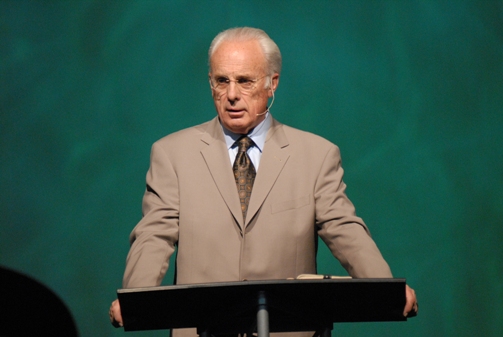
 Your sermon of the week is Atonement and Justification: The Pharisee and the Tax Collector by John MacArthur.
A great message from a great portion of Scripture.

Your sermon of the week is Atonement and Justification: The Pharisee and the Tax Collector by John MacArthur.
A great message from a great portion of Scripture.
 The following is a great chart from 20 Truths About Mormonism showing the “similarities between the Book of Mormon and View of the Hebrews as summarized by [Mormon] Elder B. H. Roberts.”
This is a followup to Where Have I Read that Before?
| Book of Mormon | View of the Hebrews |
| Gives an Israelitish origin of the American Indian. | Pleads for an Israelitish origin of the American Indian on every page. |
| Deals with the destruction of Jerusalem and the scattering of Israel. | Deals with the destruction of Jerusalem and the scattering of Israel. |
| Deals with the future gathering of Israel and the restoration of the ten tribes. | Deals with the future gathering of Israel and the restoration of the ten tribes. |
| Emphasizes and uses much of the material from the prophecies of Isaiah, including whole chapters. | Emphasizes and uses much of the material from the prophecies of Isaiah, including whole chapters. |
| Makes a special appeal to the Gentiles of the New World–esp. the people of the United States to become nursing fathers and mothers unto Israel in the New World, holding out great promises to the great Gentile nation that shall occupy America, if it acquiesces in the divine program. | Makes a special appeal to the Gentiles of the New World–esp. the people of the United States to become nursing fathers and mothers unto Israel in the New World, holding out great promises to the great Gentile nation that shall occupy America, if it acquiesces in the divine program. |
| The peopling of the New World was by migrations from the Old World. | The peopling of the New World was by migrations from the Old World. |
| Migrating Jaredites are taken into “that quarter where there never had man been”. | Its migrating people are taken into a country where “never man dwelt”. |
| The colony enters into a valley of a great river. Peoples journeyed northward and encountered “seas” of “many waters” in the course of their long journey. The motive of their journey was religious. Ether is prominently connected with recording the matter. | The colony enters into a valley of a great river. Peoples journeyed northward and encountered “seas of many waters” in the course of their long journey. The motive of their journey was religious. Ethan is prominently connected with recording the matter. |
| Nephites divide into two classes, the one civilized, the other followed a wild hunting and indolent lifestyle that ultimately led to barbarism. | The lost tribes divide into two classes, the one fostering the arts that make for civilization, the other followed a wild hunting and indolent lifestyle that ultimately led to barbarism. |
| Long and dismal wars break out between the Nephites and Lamanites. | Long and dismal wars break out between the civilized and barbarous divisions of people. |
| The Lamanites utterly exterminate the Nephites. (The same thing occurs with the Jaredite peoples in the exact place the Nephites would later be exterminated). | The savage division utterly exterminates the civilized one. |
| Civilized people develop a culture of mechanic arts; of written language; of the knowledge and use of iron and other metals; and of navigation. | Civilized people develop a culture of mechanic arts; of written language; of the knowledge and use of iron and other metals; and of navigation. |
| Unity of race–the Hebrew race and no other is assumed for the inhabitants of ancient America. | Unity of race–the Hebrew race, and no other is assumed for the inhabitants of ancient America. |
| Book of Mormon peoples are assumed to occupy the whole extent of the American continents. | With the possible exception of the Eskimos of the extreme north, this race of Hebrew peoples occupied the whole extent of the American continents. |
| The original language of the people was Hebrew. | The Indian tongue had one source–the Hebrew. |
| Joseph Smith used an instrument in translating the Book of Mormon called Urim and Thummim which he described as two stones and a breastplate. | View of the Hebrews describes an instrument among the mound finds comprising a breast plate with two white buckhorn buttons attached, “in imitation of the precious stones of the Urim.” |
| Admits the existence of idolatry and human sacrifice. | Admits the existence of idolatry and human sacrifice. |
| Prophets extol generosity to the poor and denounce pride as a trait of the people. Polygamy is denounced under certain conditions as in the practices of David and Solomon. | Generosity to the poor is extolled and pride is denounced as a trait of the American Indian. Polygamy is denounced |
| Lost sacred records would be restored to the Lamanites along with the return of their lost favor with God in the last days. | Indian traditions of a “Lost Book of God” and the promise of its restoration to the Indians, with a return of their lost favor with the Great Spirit are quoted. |
| Sacred records were hidden or buried by Moroni, a character that corresponds to this Indian tradition in the Hill Cumorah. | Ethan Smith’s sacred book was buried with some “high priest,” “keeper of the sacred tradition.” |
| Reports of extensive military fortifications erected throughout large areas with military “watch towers” here and there overlooking them. | Reports of extensive military fortifications linking cities together over wide areas of Ohio and Mississippi valleys, with military “watch towers” overlooking them. |
| Reports of prayer or sacred towers. | Describes sacred towers or “high places,” in some instances devoted to true worship, in other cases to idolatrous practices. |
| Some Book of Mormon people effect a change from monarchial governments to republican forms of government. | Part of Ethan Smith’s ancient inhabitants effect a change from monarchial governments to republican forms of government. |
| Civil and ecclesiastical powers are united in the same person in Book of Mormon republican people. | Civil and ecclesiastical powers are united in the same person in Ethan Smith’s republics. |
| Lehi, first of Nephite prophets taught the existence of a necessary opposition in all things–righteousness opposed to wickedness–good to bad; life to death, and so following. | Some of Ethan Smith’s peoples believed in the constant struggle between the good and the bad principle by which the world is governed. |
| The gospel was clearly preached among the ancient inhabitants of Americas. | Ethan Smith’s book speaks of the gospel having been preached in the ancient America. |
| The Book of Mormon brings the risen Messiah to the New World, gives him a ministry, disciples and a church | Ethan Smith’s book gives, in considerable detail, the story of the Mexican culture-hero Quetzalcoatl–who in so many things is reminiscent of the Christ. |
They conclude this list with the following quote from Mormon apologist, historian, and member of the LDS general authority, B.H. Roberts, from his work Studies of the Book of Mormon, (University of Illinois Press, 1985, p. 242):
“Can such numerous and startling points of resemblance and suggestive contact be merely coincidence?”
And 20 Truths About Mormonism also reveals:
“Joseph even appears to have plagiarized his father. For many years his mother cherished the details of several of her husband’s dreams, and one of these was incorporated wholesale into the Book of Mormon as a vision by Lehi, the father of Nephi.”
| The Vision of Lehi (Book of Mormon (1830), pp. 18-20) |
Dream of Joseph Smith, Sr. (Lucy Smith: Biographical Sketches, pp. 58-59) |
| …me thought I saw a dark and dreary wilderness… | I thought I was traveling in an open and desolate field, which appeared very barren… |
| I beheld a tree, whose fruit was desirable, to make one happy…most sweet, above all that I ever had before tasted…I began to be desirous that my family should partake of it also… | …a tree, such as I had never seen before…I found it delicious beyond description. As I was eating, I said in my heart, “I cannot eat this alone, I must bring my wife and children.”… |
| And I beheld a rod of iron; and it extended along the bank of the river, and led to the tree… | I beheld a beautiful stream of water, which ran from the east to the west…I could see a rope running along the bank of it… |
| …a great and spacious building…filled with people, both old and young, both male and female; and their manner of dress was exceeding fine, and they were in the attitude of mocking and pointing their fingers towards those which had come at, and were partaking of the fruit. | I beheld a spacious building…filled with people, who were very finely dressed. When these people observed us in the low valley, under the tree, they pointed the finger of scorn at us. |

Dr. James White has some pretty honest reasons why, if you are shopping for a local Christian fellowship, you may want to dismiss a Reformed Baptist Church. You tell ‘em Doc.
 How does a mother build biblical truth into her daughter’s life, nurture her, guard her, and encourage her toward the application of that truth, then send her into an environment that will oftentimes by its very nature be hostile or at least ambivalent toward that truth? How does a father raise his son to respect young women and protect their purity only to send them off to the youth building with exposed midriffs, low-cut tops, and skin-tight jeans?
– Voddie Baucham
 Christ’s death is the Christian’s life. Christ’s cross is the Christian’s title to heaven. Christ “lifted up” and put to shame on Calvary is the ladder by which Christians “enter into the holiest,” and are at length landed in glory. It is true that we are sinners–but Christ has suffered for us. It is true that we deserve death–but Christ has died for us. It is true that we are guilty debtors–but Christ has paid our debts with His own blood. This is the real Gospel! This is the good news! On this let us lean while we live. To this let us cling when we die. Christ has been “lifted up” on the cross, and has thrown open the gates of heaven to all believers.
– J. C. Ryle
1816 – 1900
HT: JC Ryle Quotes
What really happens when one is born again? If all one does is consider what is seen and felt, one will conclude that one is born again by choosing Christ or accepting Him. 
But there is an unseen, spiritual reality described in the Bible – that man is born of the flesh dead spiritually, unable to do anything good and unable to desire to do anything good – as defined by God.
The humble creature who desires to know the Truth will – as best a man can do – set aside his presuppositions and preconceived conclusions that are based on what he sees and feels, and he will inquire humbly of the Lord, seeking wisdom from His Spirit, as he reads His word.
This that follows is an outline showing the spiritual reality – God predestined those He would save, in time, through faith (a gift given the elect) in Christ; who saves by grace alone and not through the deeds of the flesh or will of man, but by the will of God (John 1:12 – 13).
Order of Salvation (Ordo Salutis)
Predestination:
Rom. 8:29, 30; 9:1-25;
Eph. 1:3-14; 2 Thess 2:12,13
Effectual Calling (Regeneration)
John 1:12,13; 3:1-10; 6:44,45, 63-65
Eph. 2:1-5; Titus 3:3-6, Rom. 8:30
Faith/Repentance
Acts 20:21
(Faith)
Eph. 2:8,9; Phil. 1:29; Acts 13:48; 16:14;
18:27; James 2:14
(Repentance)
Acts 5:31; 11:18; 2 Cor. 7:10-11
Justification (Legal Declaration)
Deut. 25:1; Acts 10:43; Prov. 17:15
Rom. 3:21; 4:8; 5:1,2, 12-18; 8:32;
Gal. 2:16; 3:1-13; 2 Cor. 5:21; Phil. 3:9
Adoption
Rom. 8:15-17, 23-25; Gal. 4:1-5
John 1:12-13; 8:40 to end
I John 3:1,2
Definitive Sanctification
John 10:26-30; Rom. 6; I Cor. 1:2; 6:9-12
Progressive Sanctification
Lev. 11:44; Matt. 5-7; Rom. 13; Eph. 4-5;
Phil 2:1-13; I Cor. 13; Gal. 5:16-23;
I Peter 1:15,16; 2 Peter 1:1-10; 3:18
(Preservation of the Saints)
Jer. 32:40; John 6:37-40; 10:26-30
Rom. 8:30-end; Phil. 1:6; I John 3:9
Glorification
Matt 25; I Thess 4:13-end; 2 Cor. 5:1-8
Phil. 1:23; 3:20,21; I John 3:1-3
Rev. 6:9-10
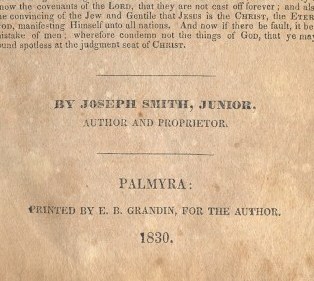
The origin of the Book of Mormon is a fascinating subject as there is clear evidence that its source was not divine, but was actually conjured up in the imagination of Joseph Smith, inspired by similar stories circulating around his time.
It’s precisely because the Book of Mormon was drafted by Joseph Smith (a “poor farm boy” as Mormons like to refer to him) and not divinely inspired, that we’re not surprised to see the almost 4,000 changes, alterations, and corrections to the Book of Mormon since its first publication.
And it doesn’t shock us that many parts of the Book of Mormon are simply plagiarisms from the King James Version of the Bible, including the use of King James English long before there was King James English (just one of the many anachronisms found in the Book of Mormon).
And we’re not stunned that absolutely none of the huge cities and civilizations described in the Book of Mormon have ever been found.
And we’re not astounded that there’s no historical, archeological, or anthropological support for the claims of the Book of Mormon.
And we aren’t astonished that DNA science has actually proven the claims of the Book of Mormon to be false.
And we aren’t beside ourselves that there’s not even one ancient manuscript to support the validity of the Book of Mormon (like the over 25,000 ancient manuscripts that support the Bible).
These are some of the many problems that we’d expect to see from a book created by finite man, not from an inspired work by an infinite God.
So where did this “poor farm boy” get his ideas and inspiration for the Book of Mormon?
Your sermon of the week is on the subject of Hell in the sobering message The Rich Man and Lazarus by John MacArthur.
This sermon is a follow-up to this previous message by MacArthur. I encourage you to listen to them both.
We who home educate, oppose youth ministries, believe Christians should dress modestly, etc. are often accused of believing this way of life makes one a Christian and makes one holy. And of course, we deny those baseless charges of “legalism” but nevertheless, the accusations are still hurled at us.
This is why I’m pleased to present this Thursday’s sermon of the week entitled The Sufficiency of Scripture and the Gospel. Paul Washer (a home education proponent and youth ministry abolitionist himself) proves that not everyone in this camp is a legalist, and to those in this camp who may tend to lean that way, he does for them in this sermon as he did for the lukewarm in his famous Shocking Sermon from 2003 (found here).
Paul Washer addresses the notion that these wonderful family oriented ideals (along with manners, modesty, etc.), albeit beautiful and virtuous and good, they in and of themselves do nothing to save a man’s soul. And he did this at a conference sponsored by the National Center for Family Integrated Churches.
This is classic Paul Washer.
Classic!

You can purchase a similar version of this bumper sticker here, and you can read a blistering article on the foolishness of the Coexist sticker here.
HT: 4 Simpsons
Never are men’s hearts in such a hopeless condition, as when they are not sensible of their own sins. He that would not make shipwreck on this rock, must beware of measuring himself by his neighbors. What does it signify that we are more moral than other men? We are all vile and imperfect in the sight of God. “If we contend with Him, we cannot answer him one in a thousand” (Job 9:3). Let us remember this. In all our self-examination let us not try ourselves by comparison with the standard of men. Let us look at nothing but the requirements of God. He that acts on this principle will never be a Pharisee.
– J. C. Ryle
1816 – 1900
HT: JC Ryle Quotes
Not one to shy away from controversy, I present the following short video that I can only describe as sobering, shocking, and disturbing. This video depicts one of the arguments I’ve made for years in the abortion debate, and now that argument is effectively visual.
I wholeheartedly believe this video needs to be seen (truth should never be hidden), but I strongly urge caution for younger viewers. It’s one of the most powerful videos I’ve seen in quite a while (first viewing left me speechless, second viewing brought me to tears). Its impact will leave you shaken.
Viewer Discretion is Advised
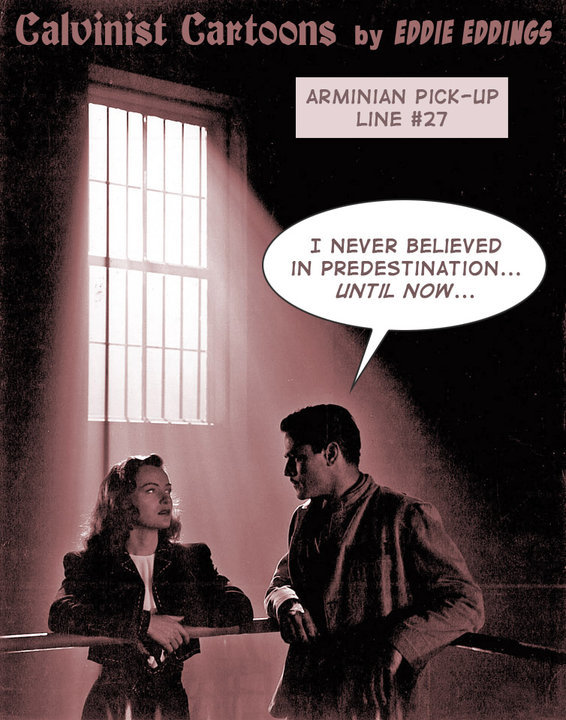 The following is from the Disciple Man blog:
You Might Just Be A Calvinist If….
If you have a Martin Luther Jell-O mold… you just might be a Calvinist.
If your DVR has over 25 episodes of Wretched With Todd Friel recorded on it… you just might be a Calvinist.
If your child’s first word was “Westminster”… you just might be a Calvinist.
If your 4 year old can explain what the word “propitiation” means… you might just be a Calvinist.
If you send your mother tulips on Mother’s Day… you might be a Calvinist.
If your passion for evangelism blows away your Arminian friends… you might just be a (true) Calvinist.
If you hate rap music BUT you listen to Lecrea, The Cross Movement, Flame or D.A. T.R.U.T.H. because of the lyrics and theology… you might be a Calvinist.
If quotes from Pink, Spurgeon, Luther, Piper, and McArthur make up 90% of your Facebook statuses…you might be a Calvinist.
The following is an interesting article from an unlikely source.

What most LDS have been taught in church and believe as truth.
The name of the angel that visited Joseph Smith three times on the night of Sept. 21, 1823 was named Moroni. The name of the angel is mentioned several times in many LDS publications and he has always been referred to as Moroni.
Significant details & problems that most LDS are not aware of.
This angel is the one who told Joseph Smith where the gold plates were buried and can be seen on top of most LDS temples. However, a close examination of early church history tells a different story. Some early LDS sources which say that the angel’s name was actually Nephi are as follows:
Keep reading here.
 I recently published an article on one of Mormonism’s wild claims about big, black, hairy Cain still roaming the earth in the post Mormon Prophet Lends Credibility to a Wild Claim. And, of course, the first response that post received from a Mormon apologist was:
The real shame is that it is simply a waste of time as no self-respecting person would really care enough to take the time to right [sic] about such meaningless prattle. Such a pity.
This was an interesting response considering the fact that it was important enough to Mormon President Spencer W. Kimball to write about it in his book The Miracle of Forgiveness. Evidently it’s only prattle when a non-Mormon discusses the matter.
And apparently one Mormon didn’t get the memo because he’s still talking (and writing) about the Cain/Bigfoot (and racism) matter. Blogger Doug Gibson has risked not being self-respecting because he’s been wasting his time by writing about such prattle when he recently published the post Awareness of Racism Eased Mormon Folk Tales Regarding Cain, Bigfoot. According to Gibson’s article, President Kimball wasn’t the only one in Mormon history to report claims of Cain/Bigfoot sightings.
Although some Mormon apologists would have you ignore such “prattle,” I highly encourage you to read Gibson’s article. And be sure to read all the enlightening comments afterward, like this sample from a commenter named Mikeasell:
Here is the deal: the church likes to teach what they call unchanged, revealed doctrine. When said doctrine becomes unpopular and threatens the church financially, the doctrine gets downgraded quickly to a “teaching” or a “guideline”, then a further downgrade to a “practice”, it is then removed from manuals and books (hence why people of different generations heard or did not hear the stories). Then the practice can simply be “discontinued”. They begin with the Lord has said X because Y is a true principle, live by it or go to hell, then they begin saying well we have been taught in the past that X=Y, then they begin with the “we don’t understand, but we are sure there is a mysterious purpose as to X is somewhat related to Y, but it is not for us to question the Lord”, then the blatant downgrade: we no longer “practice X, X practice has been discontinued, it is not really tied with Y”.
The reality is that the LDS church had inclusion criteria based on race. When it became apparent that the NCAA would allow teams like Stanford to avoid playing BYU and therefore the Church was having their non-profit status reviewed by the IRS, then suddenly (within a month) God changed his mind. Same with polygamy, it went from we will die before we give it up, we will break the law cuz God is a higher law, to sending ppl to Mexico to practice it to eventually pretending it really did not happen for that long or that it was because it was just a trial, there were too many men, etc. . . . .It is amazing to me, shocking really, that people are gullible enough to believe that a never changing restored gospel needs changing all the time, and surprisingly to accommodate cultural pressures. I cannot believe that people that believe in prophets can also believe that those prophets can not agree on basic doctrine, to the point that Joseph Smith, if he were to come back, would be excommunicated from the church he founded because of his beliefs and practices.
 An article from Mormon Coffee offers the following six things you’d expect to see if Mormonism were true. You can read the entire article here.
____________________________________
If Mormonism were true…
1. … Joseph Smith would have been able to consistently, accurately, remember his visit from two separate supernatural beings, God the Father and Jesus the Son. We now know that is not the case (for more info, see here, here, and here).
2. …the LDS “truth” that there are at least two gods, our Heavenly (spirit) Father, whose name is Elohim, and Jesus (Elohim’s son), whose spirit-name is Jehovah, would have been consistent since Mormonism’s beginnings. Instead, the Book of Mormon, Joseph Smith’s first work, preaches that there is only one (modal) God (see Alma 11:26-31, 2 Nephi 31:21, Mosiah 15:1-5 for example). Joseph Smith originally taught that Jesus’ father’s name was Jehovah, and Brigham Young, Mormonism’s second prophet, taught that Heavenly Father was actually Adam, the first man on earth. Joseph also originally taught that of the three members of the “Godhead,” only Jesus had a body. That of course is no longer Mormon belief.
3. …the Book of Mormon, a book that is supposed to contain the “fulness of the gospel,” would teach on the plurality of gods, man’s potential for godhood, eternal marriage in Mormon temples, baptism for the dead, three degrees of heaven, and the other beliefs that separate Mormonism from orthodox Christianity. Not only does the Book of Mormon not teach these things, it and the other LDS scriptures frequently contradict current Mormon truths, and each other.
4. …there would be evidence of a large battle on or around the Hill Cumorah in New York, and other archeological evidence to support the notion of Book of Mormon life on this continent. Instead, LDS apologists are still struggling to locate and identify possible Book of Mormon geography sites (see also here and here).
5. …the Book of Mormon would not contain Greek and French words like “adieu” and “Jesus” and “Alpha” and “Omega.” It would not speak of things that had not yet been invented. It would not contain quotes from the KJV Bible, including KJV mistakes. It would not abuse the phrase “it came to pass” in all of its books but two. It would not contain country-boy vernacular. But it does.
6. …when portions of the papyri used to create the Book of Abraham were recovered and translated, the text would be very similar to what Joseph had written. Instead, just as you would expect if Joseph Smith had bought merely a couple of random mummies that had been found in an ordinary catacomb from a man with many mummies and scraps to sell, the papyri has been discovered to be common Egyptian funerary documents.
 You hear Mormons say it all the time whenever you challenge any of their doctrines: “We never attack other faiths.” Or, “We never disparage other religions.” Or, “We’re too busy sharing the gospel to be negative about other people’s beliefs.”
For those who know better, these words are usually uttered out of either a profound ignorance of their own religion or a desperate attempt to get you off topic and put you on the defensive.
It is a fact that Mormonism has attacked, disparaged, ridiculed, and spoken negatively about the Christian faith (anyone who knows Mormon history knows this; it’s not even debatable).
The very Mormon organization is founded on a preemptive attack of Christianity. Mormonism’s founder, Joseph Smith, claimed that all of Christianity was apostate. Without his assault on the Christian faith, the impetus for Joseph Smith’s religion is removed and there would be no need for Mormonism.
Simply put, Mormonism’s very existence is predicated on the lie that Christianity is apostate, the Bible is mistranslated, Christ’s sacrifice was insufficient, and “The Christian God is the Mormon’s Devil.”
And other early Mormon leaders were not shy with divulging their disdain for our faith. See this article to read some of the mean, nasty and downright hateful things uttered about Christians by Mormon prophets, leaders, and apologists.
And inevitably there will be Mormons who claim, “We don’t teach that anymore” as if truth one day is a non-truth the next (and notice that they rarely ever say, “We don’t BELIEVE that anymore“). If they were honest they’d say, “We’re just more subtle about it now.”
The below video from the June 2011 Manti Pageant reveals that the well-hidden derogatory sentiment against Christians by the Church of Jesus Christ of Latter-day Saints (and some not so hidden) is still alive and well.
Thanks to Mormon Coffee for posting the video and astutely observing:
In this short clip, the Mormon Church pageant makes fun of the Christian doctrines pertaining to the nature of God and eternal punishment, portrays Christian pastors as being unwilling or unable to answer the most basic of life’s questions, and misrepresents the “fervor of religious revival” with “the exhortations of contending preachers, each proclaiming his own church the only avenue of escape from the horrors of a burning hell.” The narrator jeers, “Amen, Hallelujah”; one of three pontificating preachers drones, “It is only here that you will find salvation. Only here,” while churchgoers dismiss the play’s sincere truth-seekers, Mary and Robert, with an annoyed sweep of their arms.

“Will you love your brothers or sisters likewise, when they have committed a sin that cannot be atoned for without the shedding of their blood? Will you love that man or woman well enough to shed their blood?”
– Brigham Young as recorded in Journal of Discourses Volume 4 Page 219
“If you want to know what to do with a thief that you may find stealing, I say kill him on the spot, and never suffer him to commit another iniquity.”
– Brigham Young as recorded in Journal of Discourses Volume 1 Page 108
“Men, who have been warned and forewarned, but who will associate with the wicked and take a course to commit whoredom, and will strive to lead our daughters and our wives into the society of poor, wicked curses, with a view to gratify their cursed passions; we will take them and slay them before this people.”
– Heber C. Kimball as recorded in Journal of Discourses, Volume 4, Page 173
As the debate among Christians continues on whether or not they would (or should) vote for a Mormon for president, and whether or not a Mormon president would be a good thing for our nation, there is a concern that has gone virtually unmentioned that I’d like to bring to your attention.
During the early years of The Church of Jesus Christ of Latter-day Saints (LDS), a doctrine was taught (and practiced) that essentially gave Mormons the divine right to take another man’s life, believing not only that it was sanctioned by God, but that by doing so they were doing the victim a favor.
“There are sins that men commit for which they cannot receive forgiveness in this world, or in that which is to come, and if they had their eyes open to see their true condition, they would be perfectly willing to have their blood spilt upon the ground, that the smoke thereof might ascend to heaven as an offering for their sins; and the smoking incense would atone for their sins, whereas, if such is not the case, they will stick to them and remain upon them in the spirit world. I know, when you hear my brethren telling about cutting people off from the earth, that you consider it is a strong doctrine; but it is to save them, not destroy them.”
– Brigham Young as recorded in Journal of Discourses Volume 4 Page 53
This Mormon doctrine, known as Blood Atonement, calls for the murder of those who commit sins that the blood of the Mormon Jesus can’t cleanse.
“It is true that the blood of the Son of God was shed for sins through the fall and those committed by men, yet men can commit sins which it can never remit.”
– Brigham Young as recorded in Journal of Discourses Volume 4 Page 54
Mormons actually believed that they were doing what Christ could not do; namely, saving a sinner’s soul. In this upside down world of Mormon atonement—which is completely antithetical to God’s plan of redemption as revealed in the Bible—even King David was unable to be fully forgiven by God for his sins and had to pay for his own sins in Hell.
According to Mormonism, even the sin of adultery could not be atoned for by God’s Son, and was cause for men and women needing their own blood shed:
“Suppose you found your brother in bed with your wife, and put a javelin through both of them, you would be justified, and they would atone for their sins and be received into the kingdom of God. I would at once do so in such a case; and under such circumstances, I have no wife whom I love so well that I would not put a javelin through her heart, and I would do it with clean hands. . . . There is not a man or woman who violates the covenants made with their God, that will not be required to pay the debt. The blood of Christ will never wipe that out, your own blood must atone for it.”
– Brigham Young as recorded in Journal of Discourses Volume 3 Page 247
Not surprisingly, like many early Mormon teachings that later Mormon leaders felt were politically expedient to downplay, deny, or reverse (like racism, Adam was God, polygamy, the Mormon god’s sexual encounter with Mary, spiritual vegetables, people living on the moon, people living on the sun, etc.), their doctrine of Blood Atonement eventually just went away.
So, what bearing does this have on whether or not a Mormon is elected president? And how is the doctrine of Blood Atonement that’s no longer practiced (at least by the mainstream denomination of Mormonism) germane to American politics? And why should we be concerned about it now?
The answer lies in the reason they don’t practice it.
Mormon apologists claim they no longer practice Blood Atonement because it can only be practiced when the power of the government and the power of the church are in the same hands:
“This doctrine can only be practiced in its fulness in a day when the civil and ecclesiastical laws are administered in the same hands. It was, for instance, practiced in the days of Moses, but it was not and could not be practiced in this dispensation . . . .”
– Bruce R. McConkie as recorded on page 93 of his book Mormon Doctrine (1966 edition)
If either Mormon presidential candidate Romney or Jon Huntsman is elected president of the United States, then the civil and ecclesiastical laws will be in the same hands of the LDS organization, thus, there would be nothing preventing them from lifting their moratorium on shedding the blood of sinners. And, after all, they would be doing a great service to those caught up in sins that the Mormon Jesus simply can’t redeem them from.
But there is one thing that will stop them from following through with the words of their own prophets concerning Blood Atonement: Their insatiable appetite to protect the façade that they’re actually Christians.
Should a Mormon be elected president, the largest obstacle to their reinstitution of Blood Atonement would be that it would gravely hurt their proselytizing efforts. And as anyone who’s studied Mormon history knows, modern mainstream Mormonism will sacrifice their former principles and doctrines anytime it becomes politically expedient to do so. When times change, so does the mind of Mormonism’s god.
Modern Mormons have worked too hard to distance themselves from the uncomfortable teachings of their past prophets, while simultaneously (and ironically I might add) tirelessly working to reinvent themselves to appear to the unsuspecting and undiscerning as Christians, (the very Christians—and Christian faith—they consider apostate).
If the LDS organization loses converts it loses money. I don’t believe that the current LDS propaganda machine would do anything to jeopardize their new mainstream image, but with the “civil and ecclesiastical laws” being “administered in the same hands” the ban from practicing Blood Atonement would be gone, and that is a more frightening prospect than a promised tax hike.
To learn more about Blood Atonement, see:
The Mormon doctrine of Blood Atonement as taught by Brigham Young
The Doctrine of Blood Atonement as taught by the Mormon organization
“The wickedness and ignorance of the nations forbid this principle’s [sic] being in full force, but the time will come when the law of God will be in full force. This is loving your neighbour [sic] as ourselves; if he needs help, help him; and if he wants salvation and it is necessary to spill his blood on the earth in order that he may be saved, spill it. Any of you who understand the principles of eternity, if you have sinned a sin requiring the shedding of blood, except the sin unto death, would not be satisfied nor rest until your blood should be spilled, that you might gain that salvation you desire. This is the way to love mankind.”
– Brigham Young as recorded in Journal of Discourses Volume 4 Page 220
 What happened to the God-centered method of evangelism that calls sinners to repent and believe the Gospel? For the last 100 years people have been told to repeat a prayer, come forward, sign a card or get baptized to be saved. Many of them have lived with a false hope because none of these methods are found in God’s Word. . . . Well-meaning Christians who use a man-centered approach to evangelism by manipulating people to make a decision are helping the devil plant tares. They promote easy believism with no call to repentance or discipleship because it produces quick results that people can measure. The unanticipated results of their actions are devastating: God is not glorified, the sinner is not saved, the church is not sanctified and the devil is thrilled and delighted. . . . We must quit seeking quick results and instead glorify God by making disciples and faithfully proclaiming His Word until the sinner asks, “What must I do to be saved?”
– Mike Gendron
 Christ Alone Wyoming