
There is little doubt that many Roman Catholic doctrines simply aren’t in the Bible. They’ve been introduced by the Roman Catholic Church over the centuries. Much as Muslims make weak attempts to find prophecies about Muhammad in the Bible, Catholics grasp at straws to find support for their doctrines in the Bible.
I recently had a conversation with a couple of knowledgeable Catholics. I started by discussing the fact that the Bible blatantly contradicts some of their beliefs. Specifically, they claimed that atheists “of good will” could end up in heaven. There are dozens of verses that prove that line of thinking wrong, and I quoted a few to them. Their response was that they don’t care what I say about the Bible, because according to Catholic teaching, no one is able to interpret the Bible outside the authority of Rome.
This was the first time I’d heard that from a Catholic, and it turns out that it really is the standard teaching of Rome, and it’s based on a misinterpretation of 2 Peter 1:20. Later, they mentioned that there really is no infallible interpretation of this verse, so I’m not sure what authority they have to give any interpretation of that verse.
I showed them Acts 17:11, which describes how the Bereans were commended for scrutinizing Paul’s teaching with the Scripture. I asked them why the Bereans were able to verify Paul’s teaching with the Scripture, but today I am unable to verify Rome’s teaching with Scripture. They never directly answered my question. I gave up asking the question when the only “answer” provided was:
Why did Paul have to “check in” with the Apostles and have them lay hands on him to continue his ministry?
That has absolutely nothing to do with my question. Honest, knowledgeable answers generally don’t start with a “why” and end with a question mark.
They do think that I should verify the doctrines of Rome, but not by searching Scripture. I should determine the truth of Rome’s claims by verifying that their doctrines haven’t changed over the last 2,000 years, and I should do this by reading church fathers. (They were kind enough to give me a list of church fathers to check out.)
But this only leads to more questions. If I’m not trustworthy enough to interpret Scripture, why am I trustworthy enough to interpret the writings of church fathers? Why should I read the second generation (or later) of Christian beliefs when the Bible provides the first generation? If two church fathers disagree (there are many early “Christians” who were outright heretics), which one is trustworthy?
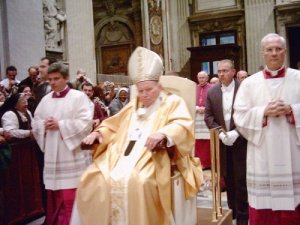
There is no good way to test the Catholic Church. Bottom line: I’m supposed to become a Catholic, because the pope says so.
Trust me.
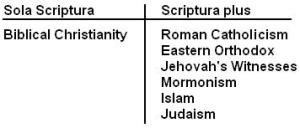
At the root of this disagreement is the epistemology of Catholics and Evangelicals. Evangelicals believe the Bible is the only source for absolute truth, and Catholics have the Bible plus their tradition. The problem is that the Bible is insufficient to arrive at modern Catholic doctrines (if not contradictory to those doctrines), and there is no other infallible, inerrant source to attest to Catholic doctrines. In order to buy into the teaching of Rome, you must take a blind leap of faith.
 When was the last time you heard of a church rebuking members for gossip, admonishing men for the immodest dress of their wives and daughters, or excommunicating a member for adultery? Today’s evangelical church may take a strong stand on fundamental doctrines like the divine nature of Christ and the inspiration of Scripture, but it too often denies this Christ and this inspired Word by not practicing a true Christian lifestyle. The pattern of life of most Christians is so much like the world around them that they blend right in and cannot serve as salt and light.
 The Word declares, “The carnal mind is enmity against God” (Romans 8:7). Multitudes go through the form of paying homage to God, but of a “god” of their own imagination. They hate the living God, and, were it possible, would rid the universe of Him. This is clear from their treatment of Christ, for He was none other than “God . . . manifest in the flesh” (1 Timothy 3:16). They hated and hounded Him to death, and nothing short of death by crucifixion would appease them. At Calvary the real character of man was revealed, and the desperate wickedness of his heart laid bare.
 If our homes are to reflect our position as the people of God in the midst of the opposition of a pagan culture, we, like the Israelites, must learn to love. Our homes must be rife with the aroma of love. Those who visit us should notice immediately that they have left the world of self-serving, egocentric narcissism and have entered a safe harbor where people value and esteem others above themselves. Outsiders should enter our homes and never want to leave. Our neighbors should find excuses to visit us just to get another whiff of the fragrant aroma of love. The brokenhearted should long to be near us. The downtrodden and the abused should seek us out. Families on the brink of disaster should point to us and say, “Why can’t out homes be like that?”
 If you struggle with the doctrine of Limited Atonement, I have just the sermon for you. I am confident that after listening to
 This is the thought that should be uppermost on your mind in all you do for your children. In every step you take about them, in every plan and scheme and arrangement that concerns them, do not leave out that mighty question, “How will this affect their souls?”

 Your sermon of the week is a two part message by John MacArthur entitled Sheep Among Wolves. MacArthur identifies how to spot the wolves, what methods they will use to kill the sheep, and how the sheep should respond to the presence of wolves. I highly recommend this to the readers of DefCon.


 Christ Alone Wyoming
