The Little God Who Can’t

The Little God Who Can’timages

Is God unable to save everyone he loves?  Here’s more thought on a delicate subject.

————————————————————-

In reading about the life of the nation of Israel in the Old Testament, one cannot help being struck by the enormity of what a failure it all was.  There were grand and glorious promises made to the Hebrew people about their life in their promised land, but the writings of Moses also contained prophecies about a crashing destruction that would come upon their nation in the end.  What was God doing?  Why would he create such a grand experiment in the life of humanity knowing that it would only end in failure and tragedy?  Was God unable to make such a great and elaborate plan a success rather than a failure?  The answer, of course, is made plain in the New Testament.  God’s full intention was to show and prove to all people that man has sinned against the God who made him and fully deserves eternal death.  It was and still is a hard lesson to learn.

In our world today man still has not fully understood what it was that the failure of Israel taught us — that man cannot save himself by being “good” and keeping laws — or even by making correct decisions. Even a large part of the Christian community today believes in a religious system that leaves the far greater part of humanity in a burning hell rather than “saved” because they have not “done” something to make themselves acceptable to God.

To many Christians today God is a failure. He means well, but He just can’t get what He wants. He supposedly wants to save the whole world of humanity from hell, but that obviously is not happening; and people that he (supposedly) dearly loves are being separated from him for eternity. Popular Christian belief today requires that a person must first hear the gospel, believe it, then repent and confess their sin.  Then they can become born again and go to heaven. The truth is , however, that for the first 4,000 years of human history there was no New Testament gospel as we have it today.  And even in modern times the greater part of the world’s population still has not heard it.

Has Israel’s failure to save themselves in Old Testament times now become God’s failure in our time?  The choice of heaven or hell is now (supposedly) in the hands of man. God is excluded from the contest (gamble). He wants everybody to be eternally “saved,” but the losses are terrible, and hell is filling up with unbelievers who do not choose God. What can God do? He is powerless. He made the rules and now He must abide by them. Will He grieve forever because people He loves are in a state of eternal torment? Is this the God we believe in?  Is something wrong?

*

Radio Pastor Loren Henry Wilson
Responsibility, Inability and Grace

A great review of important issues that bear on the essential doctrine of soteriology – how is one saved? By John Hendrix. accounted-as-righteousness_t_nv

Responsibility, Inability and Grace

“All that the Father gives Me will come to Me…” – John 6:37

The truth of God’s word is honored not in holding exclusively to one truth to the exclusion of another truth, but in believing the whole counsel of God. The Bible plainly teaches that man is responsible to obey the summons of God to repent and believe the gospel just as it plainly teaches that he is morally unwilling and unable to do so. These two seemingly contradictory assertions can be reconciled when we understand that, after the fall, God’s perfect standard for holiness for man does not change … so even the very desire for faith, by which we believe in Christ who justifies sinners, can only belong to us, not by nature but by a gift of grace, that is, by the inspiration of the Holy Spirit amending our will and turning it from unbelief to faith and from godlessness to godliness. Jesus says, “no one can come to me [i.e. believe in me] unless the Father who sent me grants it.” (John 6:54) Again, the Apostle Paul says, “And I am sure that he who began a good work in you will bring it to completion at the day of Jesus Christ” (Phil. 1:6). And again, “For by grace you have been saved through faith; and this is not of yourselves, it is the gift of God” (Eph. 2:8).

Furthermore some teach that God has mercy upon us when, apart from his regenerative grace, we believe, will and desire to believe, but do not confess that it is by the work of renewal by the Holy Spirit within us that we even have the faith, the will, or the desire to do all these things; If we make the assistance of grace depend on our own wisdom, humility, prudence, obedience, sound judgment or good sense, but don’t agree that it is a gift of grace itself that we are obedient and humble, we then directly contradict the Scripture which says, “What have you that you did not receive?” (1 Cor. 4:7), and, “But by the grace of God I am what I am” (1 Cor. 15:10).

The following chart shows that the Bible clearly teaches both man’s responsibility to believe the gospel and his inability to do so. The third column helps us to understand how those whom God has set his affection on infallibly come to faith, in spite of this inability and, most of all, how this gives all glory to God in the work of salvation: Augustine once said, “God bids us do what we cannot, that we may know what we ought to seek from him.”

(This chart is loosely based on a chart by Lamar McKinney)

The Responsibility of Man

The Inability of Man

Monergistic Grace of God

Come unto me, all ye that labour and are heavy laden, and I will give you rest.

Matt. 11:28

No man can come to me, . . .

John 6:44a

. . . except the Father which hath sent me draw him: and I will raise him up at the last day.

John 6:44b

…whoever believes in Him shall not perish, but have eternal life.

John 3:16

…men loved the darkness rather than the Light…and will not come into the light…

John 3:20, 21

..”But he who practices the truth comes to the Light, so that his deeds may be manifested as having been wrought in God.”

John 3:21

Note: there are, indeed, those who come to the light — namely those whose deeds are the work of God. “Wrought in God” means worked by God. Apart from this gracious work of God all men hate the light of God and will not come to him lest their evil be exposed.

Seek ye the LORD while he may be found, call ye upon him while he is near:

Isa 55:6

There is none that understandeth, there is none that seeketh after God.

Rom 3:11

. . . I was found of them that sought me not; I was made manifest unto them that asked not after me.

Rom 10:20b

This is His commandment, that we believe in the name of His Son Jesus Christ…

1 John 3:23

“…the sinful mind is hostile to God. It does not submit to God’s law, nor can it do so.

Romans 8:7

you do not hear, because you are not of God.

John 8:47

“…and these whom He called, He also justified;

Rom 8:30

…and as many as were ordained to eternal life believed.

Acts 13:48

God…commandeth all men every where to repent.

Acts 17:30

…the Spirit of truth, whom the world cannot receive, because it neither sees Him nor knows Him

John 14:7

“…if perhaps God may grant them repentance leading to the knowledge of the truth.”

2 Tim 2:25

. . . whosoever will, let him take the water of life freely.

Rev 22:17b

So then it is not of him that willeth, . . .

Rom 9:16a

“…but on God, who has mercy.” – Rom 9:16b

…Thy people shall be willing in the day of thy power,. . .

Ps 110:3a

Look unto me, and be ye saved, all the ends of the earth: for I am God, and there is none else.

Isa 45:22

. . . Except a man be born again, he cannot see the kingdom of God.

John 3:3a

. . . The God of our fathers hath chosen thee, that thou shouldest . . . see that Just One, . . ..

Acts 22:14

But as many as received him, to them gave he power to become the sons of God, even to them that believe on his name:

John 1:12

But the natural man receiveth not the things of the Spirit of God: for they are foolishness unto him: neither can he know them, because they are spiritually discerned.

1 Cor 2:14

But as many as received him, . . . were born, not of . . the will of the flesh, nor of the will of man, but of God.

John 1:12-13

. . . if thou shalt confess with thy mouth the Lord Jesus, . . .

ROM 10:9

. . . no man can say that Jesus is Lord . . .

1 Cor 12:3b

. . . but by the Holy Ghost.

1 Cor 12:3b

. . . make you a new heart and a new spirit: for why will ye die, . . ?

Ezek 18:31

The heart is deceitful above all things, and desperately wicked: . . .

Jer 17:9

A new heart also will I give you, . . . and I will take away the stony heart . . .

Ezek 36:26

“If you wish to be complete, go and sell your possessions and give to the poor, and you will have treasure in heaven; and come, follow Me.”

Matt 19:21

“Again I say to you, it is easier for a camel to go through the eye of a needle, than for a rich man to enter the kingdom of God.”


Matt 19:23

“Then who can be saved?” And looking at them Jesus said to them, “With people this is impossible, but with God all things are possible.”

Matt 25b-26

God knoweth we have nothing of ourselves, therefore in the covenant of grace he requireth no more than he giveth, and giveth what he requireth, and accepteth what he giveth.” – Richard Sibbes

John Hendryx
Monergism

Weep With Those Who Weep

It seems so many I know are going through physical issues, relational issues, family issues … you name it.  I am struggling physically myself right now which makes bearing other’s burdens more challenging and yet my heart goes out to those whose trials are greater than my own. For those who know God, however, those things are more bearable. I am surprised suicide is not even more rampant for those who don’t know Him.

weeping

In Scripture, we are told to weep with those who weep, to bear each other’s burdens, to love others as much as we love ourselves. (It is the rare person who does not truly love himself.) Yet it is so easy to become self-focused and forget those around us who are hurting. Please don’t fall into this trap. God puts people in our lives for a reason and sometimes it is so that we can lift up those who are weak, intercede for those who are hurting, and be a shoulder for someone to cry on.

encouragement-weeping

It’s not always an easy task to care for others to that degree but it is a necessary one. Don’t ever be too busy to lend an ear to someone who just needs to bare their heart or to put an arm around a friend who is feeling sad or alone. One day, it may be you needing that kind of friend. People need to be reminded that weeping may endure for a night but joy comes in the morning.

What Does God say about Bioethics?

Christian Bioethics 517UykgR7dL._BO2,204,203,200_PIsitb-sticker-v3-big,TopRight,0,-55_SX278_SY278_PIkin4,BottomRight,1,22_AA300_SH20_OU01_

A review by Stuart Brogden

This book, subtitled A Guide for Pastors, Health Care Professional, and Families, is part of a series on Christian ethics published by B&H Publishing Group. I dare say anyone within each of those groups would be challenged to think more biblically about the relevant issues as well as being better informed by reading this book. In the preface, the series editor tells us the thesis of this book by asking this question: “How do we move from an ancient text like the Bible to twenty-first-century questions about organ transplants, stem-cell research, and human cloning?” This book, written by an ordained minister of the gospel (C. Ben Mitchell) and a physician (D. Joy Riley), gives solid counsel and these emotionally charged issues in 9 chapters, and is broken up into four parts: Christian Bioethics, Taking Life, Making Life, and Remaking/Faking Life. The format of each chapter is a look into a real life situation immersed in the subject, followed by questions for reflection, and Q & A between the authors. Other than a too frequent quoting of Roman Catholics as though that Church is Christian institution, this team provides solid insight from God’s Word on each of these topics.

Chapter 1 gives the reader an overview of the Hippocratic Oath which opened my eyes to the ancient context and false gods the oath was originally made to and the awareness that most doctors today do not subscribe to this oath, which we mostly know as the pledge to, First, do no harm. This was spelled out in explicit language that forbid euthanasia and abortion. The absence of a doctor’s oath to “do no harm” may cause a patient to wonder how much he can trust his doctor. In summing up this topic our physician author observes (page 22, italics in original) “Doctors should work hard to be trust-worthy and humble.” A few pages later (page 28), as they address stem-cell research, our minister reminds us, after quoting 2 Peter 1:3, “God has not left his people without guidance in every area of life. Although the Bible is not a science textbook, its message speaks to the deep underlying values that can guide decisions about scientific matters. Although the Bible is not manual of medicine, its truths may be applied to medical decision making.” This is a key perspective for every child of God to properly understand how to walk in the light of God’s Word. Much of the rest of chapter 2 is good advice for properly reading and understanding the Scriptures, taking into account literary, historical, and cultural context as well the genre of what is being read.

The chapter addressing abortion is sobering and probably eye-opening for most. The authors make a full-court press to establish the humanity of every life, starting from conception. Mitchell makes the essential connection between our view of Jesus and our view of humanity, developing the humanity of our Lord to show how every mortal is given value by the Creator – above all other life forms – from the time the egg is joined with a sperm. At the end of chapter 3, the authors exhort Christians to be active in opposing abortion and supporting life, but they draw no lines of getting involved with pro-life Roman Catholics. Christians must be deliberate and biblically thoughtful in deciding who to get cozy with in the public arena. The next chapter covers death and dying, providing thought-provoking observations about the details of pain and suffering and how one’s Christian world view informs us. A key element in handling the death of any person, they tell us, is to remember the patient (perhaps a close relative) is a human being, not merely a patient to be treated. “Much of the suffering of dying persons comes from being subtly treated as nonpersons.” (page 85) There is discussion of the efforts to extend life, even at the expense of that life being human. It is a long-held desire of fleshly human beings to grasp eternal life in our present form, without submitting to God’s revealed plan of redemption – which includes our death and resurrection. Being a faithful child of God includes how we approach death – do we trust our heavenly Father in our dying as did our Savior? Again, we get faithful advice (pages 100 & 101): “Through the resurrection of Christ, God has given us grounds to hope that death, however awful, will not have the last word.” Amen!

As they move from taking life to making life, the reader is presented with a biology lesson on how babies come into the world. They take this opportunity to reinforce the Christians view of anthropology (page 113): “Knowing that pregnancy occurs at fertilization rather than at implantation will help us make several important distinctions later.” They then cover several options medicine has provided for artificial this or that, discussing the line we cross regarding family integrity and God’s authority, observing (page 123), “When a third party intrudes on the procreative relationship, the divinely instituted structure of the family is altered. Trouble is bound to follow.” This may be unwelcome by some, who have such a great desire for a child that their love for the Word of God is overshadowed. All of us fall into this pit on one issue or another from time-to-time, so let us not rush to judgment.

The last part of this fine book covers the definition of death and the forces behind the changes we’ve seen in the last 50 years; organ donation and transplants; cloning and human/animal hybrids; and life extension practices. In this last category, we are introduced to trans-humanists, a group that wants to extent life in the human body and beyond. This was the topic of recent movie, Transcendence, which traced the consequences of a computer scientist whose “essence” was transferred into a powerful computer he had built. It gets very ugly before it ends. In summing up how we who profess Christ ought to look at aging, Mitchell provides a contrast between Christians and Trans-humanists (page 181): “Interestingly, the trans-humanists and Christians seem to have some common concerns. We share:

  • The quest for the good life.
  • Longing for immortality
  • Pursuit of the relief of human suffering
  • Appreciation for technology’s benefits.

Where we differ is in the mean to achieve these aims. For Christians the good life and the goods of life are found in God and his presence in our lives. The good life is not defined by the number of years one lives but the reality of God’s presence in however many years one lives. While we, like the apostle Paul, long for immortality, Christians understand that they already possess it. … Another place we differ with the trans-humanist is in loathing every human limitation. Because we are creatures and nor creators, we accept most limitations as gifts from the One who made us.”

And while there is much more in this book that will do the reader much good, I think that is a wonderful point on which to end this review. Christian – are you content with our God’s provision in your life? Do we think we deserve better than YHWH has given us? To quote the Apostle, “Who are you, oh man, to answer back to the One who made you thus?” Let us, as did the Lord Jesus, trust ourselves to the One who judges justly. Trust God, rejoice always, pray without ceasing, give thanks in all circumstances, for this is the will of God for you in Christ Jesus. In living and dying – and all that comes between those two finite points.

Are we Christians? Or are we worldlings?

Are we Christians? Or are we worldlings? rick+warren+wide+gate

(Horatius Bonar, “Self-Denial Christianity”)

“Woe to those who are at ease in Zion!” Amos 6:1

What do we say to . . .
our self-indulgence,
our spiritual sloth,
our love of ease,
our avoidance of hardship,
our luxury,
our pampering of the body,
our costly feasts,
our silken couches,
our brilliant furniture,
our gay attire,
our jeweled fingers,
our idle mirth,
our voluptuous music,
our jovial tables, loaded with every variety of rich viands?

Are we Christians? Or are we worldlings?

Where is the self-denial of the New Testament days?

Where is the separation from a self-pleasing luxurious world?

Where is the cross, the true badge of discipleship, to be seen–except in useless religious ornaments for the body, or worse than useless decorations for the sanctuary?

“Woe to those who are at ease in Zion!”
Is not this the description of multitudes who name the name of Christ? They may not be “living in debauchery, lust, drunkenness, orgies, carousing and detestable idolatry.” But even where these are absent, there is ‘high living’–luxury of the table or the wardrobe–in conformity to ‘this present evil world.’

“At ease in Zion!” Yes! there is the shrinking . . .
from hard service;
from ‘spending and being spent;’
from toil and burden-bearing and conflict;
from self-sacrifice and noble service;
for the Master’s sake.

There is conformity to the world, instead of conformity to Christ!
There is a laying down, instead of a taking up of the cross.
Or there is a lining of the cross with velvet, lest it should gall our shoulders as we carry it!
Or there is an adorning of the cross, that it may suite the taste and the manners of our refined and intellectual age.

Anything but the bare, rugged and simple cross!

We think that we can make the strait gate wider, and the narrow way broader, so as to be able to walk more comfortably to the heavenly kingdom. We try to prove that ‘modern enlightenment’ has so refined ‘the world and its pleasures’, that we may safely drink the poisoned cup, and give ourselves up to the inebriation of the Siren song.

“At ease in Zion!” Even when the walls of our city are besieged, and the citadel is being stormed!

Instead of grasping our weapons, we lie down upon our couches!

Instead of the armor, we put on the silken robe!

We are cowards, when we should be brave!

We are faint-hearted, when we should be bold!

We are lukewarm, when we should be fervent!

We are cold, when we should be full of zeal!

We compromise and shuffle and make excuses, when we should lift up our voice like a trumpet! We pare down truth, or palliate error, or extenuate sin–in order to placate the world, or suit the spirit of the age, or ‘unify’ the Church.

Learn self-denying Christianity. Not the form or name, but the living thing. Let us renounce the lazy, luxurious, self-pleasing, fashionable religion of the present day!

A self-indulgent religion has nothing in common with the cross of the Lord Jesus Christ; or with that cross of ours which He has commanded us to take up and carry after Him–renouncing ease and denying self.

Our time,
our abilities,
our money,
our strength–
are all to be laid upon the altar.

“Woe to those who are at ease in Zion!”
Amos 6:1

A Lesson on Gratitude

A wonderful look at Christian gratitude from a dear friend of mine. You can read more of his work here: By Way of Reminder.

By Way of Reminder #83 Reminder
Gratitude (2/5)

On the twenty-first of the seventh month, the word of the LORD came by Haggai the prophet saying … “For thus says the LORD of hosts, ‘Once more in a little while, I am going to shake the heavens and the earth, the sea also and the dry land. I will shake all the nations; and they will come with the wealth of all nations, and I will fill this house with glory,’ says the LORD of hosts. (Haggai 2:1, 6-7)

And His voice shook the earth then, but now He has promised, saying, “Yet once more I will shake not only the earth, but also the heaven.” This expression, “Yet once more,” denotes the removing of those things which can be shaken, as of created things, so that those things which cannot be shaken may remain. (Hebrews 12:26-27)

In the previous issue we contemplated the end of our days on Earth, hoping we will look back and see how His word inspired us to action. Though we do not work to build the Kingdom of God here on Earth, our work in this life ought to be an example of what we consider important for the next. We must trust Scripture to stand as truth while many try to discredit His plan, words, and character.


All of the most popular religious beliefs (except agnostics) teach some form of afterlife. Protestants and pagans alike have been guilty of teaching that everyone will end up…somewhere. Hey, if it’s better than this life, why should we care to know more? Heaven is merely a relief from pain: “They are in a better place.”

I am grateful that Heaven is not just better than this life, but because our Lord is there! After the shaking of these dusty dwellings, the church will be together at last (Hebrews 11:40). The innumerable redeemed from every nation and tongue will finally look upon the King of Kings, face-to-face (Revelation 7:9-12).


The heart of man, raging against God, desires to put trust in a system of ever-evolving truths, rather than be accountable to one constant. This self-refuting way of life does not end in truth, nor does it give aid in times of uncertainty. “Science” is heralded as a system of religion, instead of cataloged hypotheses.

I am so grateful that God does not share His glory with another (Isaiah 42:8), nor does He excuse a sideways glance at His nature, His image, His name, nor His day(Exodus 20:1-11). This is grace, to command our attention (Hebrews 12:1-2) that we might not lose hope as we strive toward home (Philippians 3:12-14).


One of the most potent arguments against God is the exactness that exists in observable movements of space and time. Some reason that “winding the clock back” to the beginning of time would provide ample evidence that everything started with a bang, not a purposeful, inspired event by a sovereign Creator.

Know this first of all, that in the last days mockers will come with their mocking, following after their own lusts, and saying, “Where is the promise of His coming? For ever since the fathers fell asleep, all continues just as it was from the beginning of creation.” For when they maintain this, it escapes their notice that by the word of God the heavens existed long ago and the earth was formed out of water and by water, through which the world at that time was destroyed, being flooded with water. But by His word the present heavens and earth are being reserved for fire, kept for the day of judgment and destruction of ungodly men. (2 Peter 3:3-7, emphasis mine)

I am grateful, because His Kingdom stands just as He commands, just as He sustains all things (Colossians 1:17). Even the skeptics are being preserved by His word, that He might exact His plans. Contrary to what man thinks he knows,Yahweh of the Bible preserves clear instructions, commands, and evidences of His character within the pages of Scripture, and for our good (2 Timothy 3:14-17).

Therefore, since we receive a kingdom which cannot be shaken, let us show gratitude, by which we may offer to God an acceptable service with reverence and awe; for our God is a consuming fire. (Hebrews 12:28-29)

Do justly. Love kindness. Walk humbly. Stay tuned.

In Christ,

CK Hicks

“I will always be ready to remind you of these things, even though you already know them, and have been established in the truth which is present with you.” (2 Pt. 1:12)

Copyright © 2014 CKHicks.com, All rights reserved.

Rick Warren has a pope!

James White continues to stand firm, praise the Lord! I do wish, however, that he would not run to the Reformation as his first line of defense as he often does. While I agree with and thank God for the Reformation, our first line and only line of defense is the Bible – as White came back to later in the video. Also, nowhere in the Bible do we see or get instruction on “living out the gospel”. The gospel is a report of the news of Christ’s redemptive work – it’s not something we live out. Because of the work of the Holy Spirit in conjunction with the gospel, we are raised to new life and live for the glory of God, proclaiming the gospel to dead men everywhere. But we do not and cannot live the gospel

None the less, may the Lord protect and hold up our dear brother as he continues to press on!

Speak Softly, and….

Speak Softly, and….

Teddy Roosevelt, US President:
“Speak softly, and carry a big stick.”

Jesus of Nazareth
spoke softly, and carried a cross.

Isaiah 42:1-3

1 Behold my servant, whom I uphold; mine elect, in whom my soul delighteth; I have put my spirit upon him: he shall bring forth judgment to the Gentiles.
2 He shall not cry, nor lift up, nor cause his voice to be heard in the street.
3 A bruised reed shall he not break, and the smoking flax shall he not quench: he shall bring forth judgment unto truth.

Curing “Oh My Goodness!”

We are appreciative to Pastor Jon Gleason for writing the following article which is a follow-on to a previous post on taking the Lord’s name in vain. May this be a profit to you in your life. Jon has graciously given us permission to use his articles here at Defending Contending and this one is certainly very timely.

***************

Curing “Oh My Goodness!”

Mark Escalera at Defending. Contending. ran (with permission) my post, “OMG” — and Other Ways Christians Take God’s Name in Vain (this continues to be, by far, my most shared post).  In the comments at DefCon someone said she has tried to break the habit of saying, “Oh my goodness!”

This also is something Christians might say from time to time that has no real profit, is often just a “sanctified swearing substitute,” and is highly dubious theologically as well:

Philippians 3:9

And be found in him, not having mine own righteousness, which is of the law, but that which is through the faith of Christ, the righteousness which is of God by faith:

So much for “my goodness” — that pretty much covers it, doesn’t it?  The only “goodness” we have is the goodness of God, so He is our goodness, our righteousness.  What exactly do the words “oh my goodness” mean, for a Christian?  If you say this, your words are not saying what you mean by them….

It seems this is another expression we really could do without.  It isn’t something I ever said a lot, but I became convinced a while ago that I would be best looking to stop.  As with most things we want to do to please our Lord, Scripture provides some help, and I thought I would take the time here to briefly expand on my answer over at DefCon.

Step 1.  Memorise the following verse, or at least the first half of it:

Isaiah 64:6

But we are all as an unclean thing, and all our righteousnesses are as filthy rags; and we all do fade as a leaf; and our iniquities, like the wind, have taken us away.


Step 2.  Whenever you slip into the habit and say, “Oh my goodness,” remind yourself your goodness is as filthy rags.

If that doesn’t do it, engage step 3.

Step 3. Tell people close to you (friends, family) you are trying to break the habit, and ask them, every time you say, “Oh my goodness,” to respond, “…is as filthy rags.” If nothing else, you’ll stop just because you get tired of hearing that response!

If they don’t know the Lord, so much the better.  You are giving them an important part of the Gospel in a way they will not be likely to ever forget, showing them your commitment to please the Lord in small things as well as big, and demonstrating a humble awareness of your own sinfulness and need of a Saviour.

In fact, maybe you should just jump straight to step 3!

As with so many other statements that we make unthinkingly, the Christian who says “Oh my goodness” almost certainly never means any disrespect to God, never means to exalt himself or be self-righteous.  It is almost always just a habit into which he has drifted without even thinking about it.

If our Lord has blessed you with a relationship which permits it, perhaps when you hear another Christian say it you can give a gentle reminder of how that expression matches up with Scripture.  Or, if he has a sense of humour, just be ready with a quick response:  “Oh my goodness”” — “…is as filthy rags!”

What Are You Worshiping?

In Exodus 20:3-6, God gives the first commandment, and I think possibly the most important commandment since, if we master this, we will have no problem obeying the others.

idol2cp

You shall have no other gods before me. You shall not make to you any graven image, or any likeness of any thing that is in heaven above, or that is in the earth beneath, or that is in the water under the earth. You shall not bow down yourself to them, nor serve them: for I the LORD your God am a jealous God, visiting the iniquity of the fathers on the children to the third and fourth generation of them that hate me; And showing mercy to thousands of them that love me, and keep my commandments.

When you think of idols, you probably think of Bible days where people would build statues or poles and bow down to them, praying or worshiping their “god” made of wood or stone. Today, people don’t seem to do that as much but this doesn’t mean that we don’t have idols just the same.

runegods

Here in America, we are inundated with so many things that can replace time we could spend with the Lord. Whether it’s TV, a relationship, sports, activities, etc., it is easy to get to the end of the day and realize God received a small portion of your time while these other things occupied a good bit of it.

God has blessed us with many things but everything serves a purpose. If any person or possession means more to you than your relationship with God, that thing needs to go. If you spend hours watching TV and only a few minutes with the Lord, your priorities are horribly misplaced.

I am currently evaluating my life in these areas as well. I hate the phrase “too heavenly minded to be any earthly good” because we must be heavenly minded to be any good on this earth. Everything we do should be centered around Christ and what pleases Him. If something does not please Him, it needs to go.

How do you spend your days? Are you daily seeking His face, drawing near to Him, worshiping Him as you go about your daily tasks? Or is he a tack-on to your already full day? I would encourage you to truly ponder this and ask God to show you if there are things in your life that are hindering the close fellowship that He desires to have with you. We often adjust to life and don’t realize that God has so much more for us. This is not a matter to be complacent about. Matthew 6:33 tells us, “Seek ye first the Kingdom of God and His righteousness and all these things shall be added unto you.” That needs to be our priority every single day of our lives.

Amid the frantic pace of life, don’t neglect quality time with your Savior, the only One you should be worshiping.

Falling in Love with Jesus All over Again

Let me fall in love with You all over again
Let me know You as never before

As I was praying this morning, this song, sung by the late Kenny Hinson, became my prayer. There is nothing I desire more than to fall in love with Jesus all over again.

In the last few years, I’ve gone through a number of changes, some of which I struggled with a long time before surrendering to the direction God wanted me to take. I don’t like change, and I had to be absolutely sure He was leading. As I look back now, it is so obvious to me that He was indeed calling, and I am overwhelmed by His love for me and His willingness to use this weak, stubborn vessel.

In the last few years, God has also brought some wonderful people into my life–those who are willing to intercede for me, bear with me, and encourage me whenever God lays me on their heart. They say if you can count on one hand your true friends, you are very blessed. If I think about it, I can probably do that and more. At the same time, no one can replace my first Love.

loving-jesus

I am not always faithful. I do not always embrace the tests He brings but have instead cried and begged Him to remove tests when I thought I could not stand it. In the end, though, like the apostle Paul, I found His grace to be sufficient and His strength to be made perfect through my weakness.

I was watching Joni Tada last night on the True Woman Conference’s webcast, and she talked about the importance of surrender to whatever will draw us closer to Jesus. That is a lesson I am still learning but, if I desire a closer walk, I must be willing to accept whatever He knows will rid me of myself so that I can have true communion with Him.

Being over 40 years old and single, God has been my husband and Father. He has been the friend who is there in the middle of the night when all I can do is cry. I have felt Him hold me and assure me He is there, even when I knew I had failed Him. True to His Word, He has never left me or forsaken me but He has blessed me much more than I will ever deserve, and He has surrounded me with people who love me.

I have had an ear infection for several months and, yesterday, I finally got in to get my ears cleaned out. I cried as the doctor worked to remove all the junk in there, but I knew the pain was necessary if I was going to be able to hear again and heal completely.

This experience brought home the reality that it is the same way with life. The heart is deceitful and desperately wicked. The longer we live, the more sin accumulates until we meet Jesus and He begins to chip away the sins that ensnare us. Even after walking with him for over 20 years, there are still things in my life that need to go. Humanly, I don’t want to go through the pain I may need to go through so He can chisel them out of my heart, but I realize it is necessary in order to have more room for Him. He cannot dwell where sin is present and so surrender I must. If I do so, I will feel more of His love and peace, and I will in turn love Him more than ever before.

God, make that truly my desire, that I love You, not only on the mountain when the sun is shining bright, but also in the valleys when it’s dark and I can’t see You. Keep me looking straight ahead and not on what is going on around me for, with You holding my hand, nothing can touch me and, one day, You will lead me to my eternal Home where nothing will ever harm me again. Thank You, Father. Amen!

Don’t Forget

I am reading through the book of Numbers and remembering how important it is to not forget the good things God has done. Unfortunately, humankind hasn’t changed and, when trials come, it’s easy to wonder how God can do these things to US–His servants! Bad things do happen to Godly people, however, and you must remember it is these things that increase our faith and have the capacity to make us more Godly if we would surrender.

This is a reminder I needed today. I have seen God’s hand at work so many times and, even when I can’t see, I need to trust and know that everything He allows in my life is for my good and His glory. It is often in the valley that I take more time to seek His face and listen for His voice. I admit this to my shame but it is something I think about when trials come. If this is the only way that God can get my attention, then I need not complain but, instead, I should be praising Him for His faithfulness in continually drawing me closer to Him.

I pray I never forget His goodness and His love for me. I hope you don’t either. Over and over in Scripture, God told the Israelites to Remember. God is still saying that today. Thank Him for His blessings for they are many.

blog-thank-god-1

A Call to Repentance and Surrender

After Bible Study the other night, we were sitting around talking, and someone mentioned that, before he knew the Lord, he wouldn’t attend church because he knew he wasn’t living right. Thankfully, he finally hit a place where he surrendered to the Lord, changed the things he knew needed to change, and surrendered his life to Christ.

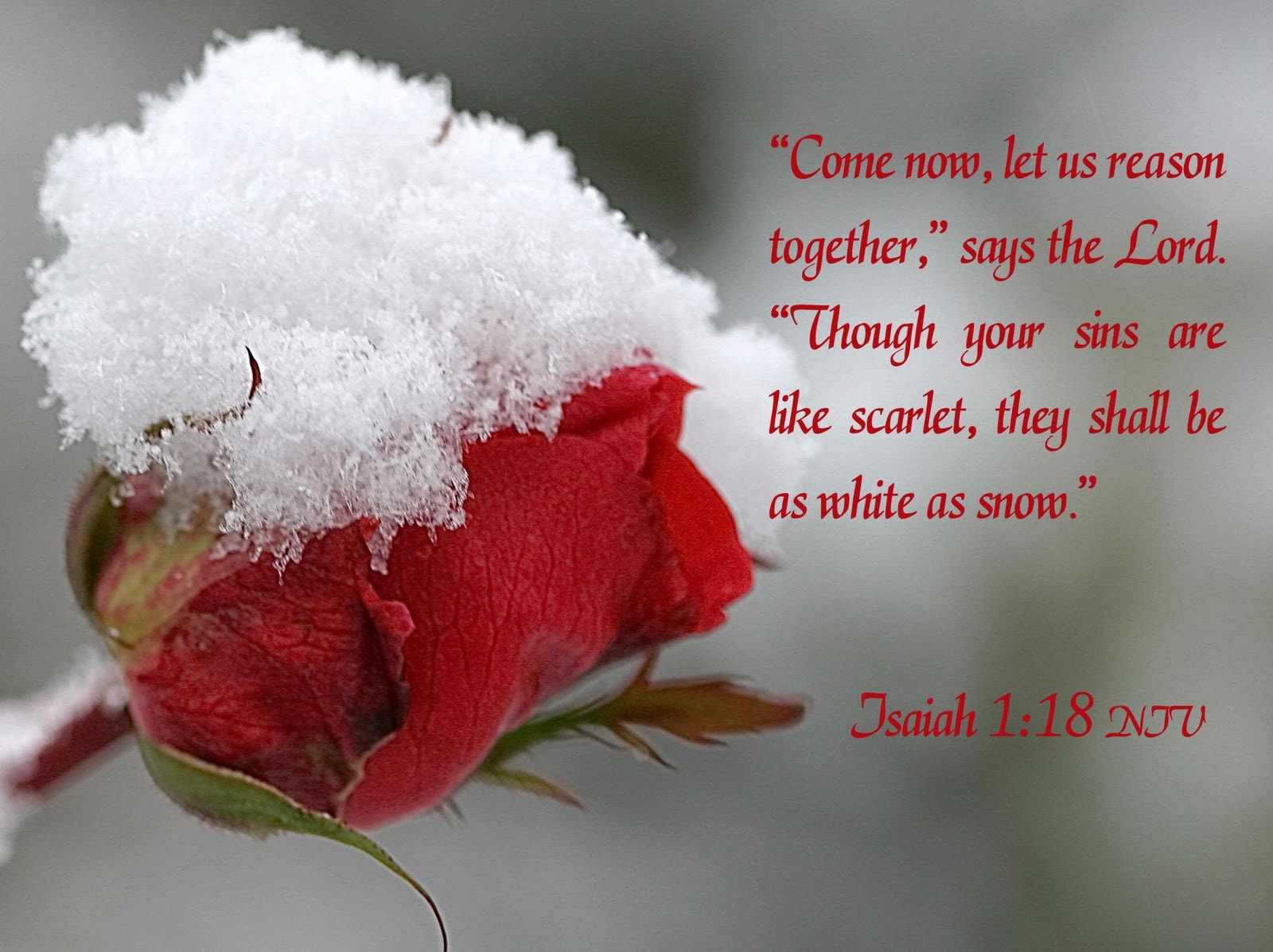
I understand why churches stress the importance of coming to Jesus as you are instead of waiting to be cleaned up but it also seems like way too many stay as they are, even after making a profession of faith. Isaiah 1:18 says, “‘Come now, and let us reason together,’ said the LORD: ‘though your sins be as scarlet, they shall be as white as snow; though they be red like crimson, they shall be as wool.'” This doesn’t mean your sins become white but that your life of sin disappears as you begin to serve God.

sinsasscarlet

In Romans 6:1, Paul asks, “What shall we say then? Shall we continue in sin, that grace may abound?” In verse 2, he answers his own question, “God forbid. How shall we, that are dead to sin, live any longer therein?”

In Galatians 2:20, Paul says, “I am crucified with Christ: nevertheless I live; yet not I, but Christ lives in me: and the life which I now live in the flesh I live by the faith of the Son of God, who loved me, and gave Himself for me.” We know Christ knew no sin so, if He lives in me, I won’t live a life of sin either.

Many times in Scripture, people were told to repent. That call still goes out today. If you are one who looks nice on the outside but inside, you are full of uncleanness, repent. If you are nice to the people at church but mean to your family, repent. If you are living a life that you know is not honoring to God, it is never too late to turn from your sinful ways and surrender those areas to the One who loves you more than you will ever be able to comprehend. The answer isn’t to stop going to church; the answer is to understand your need and turn to Him today.

Pretend that you are about to take communion. Think about the horrendous death that Jesus suffered because of your sins and mine. As you begin to bring the bread and cup to your lips, does your heart well up with gratitude for what Christ has done for you or do you find yourself squirming because you know that you are not able to take communion worthily but you know that others have no idea what your life is really like? Worse yet, do you not feel that sense of guilt about the life you are living?

Hebrews 12:6 says, “For whom the Lord loves He chastens, and whips every son whom He receives.” If you are able to sin and not be disciplined by the Lord, you should really search your heart to know if you are truly His.

Let me also say here that there is a difference between conviction and condemnation. Condemnation feels like there is no hope. Conviction is the mercy of the Holy Spirit tapping you on the shoulder and showing you what you are doing wrong so that you can change. That is what I want you to feel today: the conviction that only God can bring. I don’t know your life. I don’t know what you’re going through. But I do know that God loves you, and He can change you today, whether you have gone to church for a day, a month, a year, 5 years, 65 years, or not at all. His arm is not too short, and He desires you to spend eternity with Him. Won’t you surrender today?

Lead Me to the Cross

“Lead me to the cross where Your love poured out. Bring me to my knees, Lord, I lay me down. Rid me of myself. I belong to You. Lead me.”

It’s been a hectic six months for me which has been followed by some trials that I would prefer not to walk through but God is giving tremendous grace, for which I am grateful.

The other night, I was experiencing immense physical pain due to an ear infection. As I was crying out to God for relief, He reminded me that He is no stranger to pain. As badly as I wanted the pain to go away, I knew then that, if God didn’t remove it, He would give me the strength to endure, and that is exactly what He did, enabling me to sleep in the midst of it. I am still dealing with pain but I know that this too will pass. He is such a good Father.

godisgood

Although my pain this past week was physical, this can apply to any trial or pain you’re going through. It does not compare to what He suffered. If you keep that in mind, you will not be able to rail against God but your heart will be filled with love for Him in spite of your suffering.

If you are going through a trial and don’t know how you’re going to make it, ask God to lead you to the cross, to rid you of yourself, to help you to lean on Him as never before. He will not leave you in the midst of your trial and suffering but He will carry you through it if you will surrender all to Him.

What Do You Know?

A friend has told me a number of times, “When you don’t know what you’re supposed to do, go back to the last time you knew what you were supposed to do and do that.” That’s where I’m at today: evaluating what I know.

There are so many decisions to make in life: Who should I marry? What job should I take? How can I best serve the Lord? This last question is one we should ask on a daily basis. Every morning I rise, I know there is a reason I am still here. God has a job for me to do, and I must fulfill that task.

phil16

What do I know? God has called me. He desires to use me. He has blessed me more than I deserve. If I am faithful to the end, He will give me a crown of life.

What do you know? I would venture to guess that much of what I know would hold true for you as well but question deeper than that. Are you continuing in the calling to which God has called you? Have you lost sight of the direction you received a while back? Are you struggling to hear God’s voice? Think back to the last time you heard Him and consider if that is still His word to you or if He is changing your direction. It’s easy to be so busy that we don’t take the time to hear but, in these days of uncertainty, it is vital that we do hear.

If you are struggling to know God’s will for this season of your life, take the time to press in until you know what He desires of you. Then move forward in faith, knowing that He will complete the work that He’s begun in your life.

May this beautiful song by Steve Green encourage the heart of our readers today.

Ever Learning

Today is an easy day to praise the Lord. The sun is shining, I can see God’s hand at every turn while feeling His love and protection. There are days it is not so easy though, yet praise is not an option. It is a necessity.

Trust, Colorful words hang on rope by wooden peg

I wish I were better at consistently praising Him, even when everything around me looks like it’s falling apart. This is an area God does help me in though. He often reminds me that, even when I can’t see it, He is working. He loves me and, no matter what happens, I am still His beloved child.

I am so grateful to have the best Father in the world. His love for me is not measured by how successful I am. He simply wants me to trust Him and serve Him with all my heart. I am still learning how to do that as well, but I am thankful that He doesn’t give up. He constantly encourages me to try, try again.

I expect I will never stop learning until the day He takes me Home but I pray I will pass my tests with flying colors. He is so good!

A beautiful hymn by Fernando Ortega to give Praise to the Lord the Almighty today.

God’s Story

God’s Story  Gods Story

A review by Stuart Brogden


This book is subtitled, A Student’s Guide to Church History. As one who has greatly benefited from studying church history, I was most eager to read this book as I think all Christians would learn much that is helpful by such a study. In the introduction, Brian Cosby says “knowing church history helps explain our identity … helps explain the present … guards us from repeating mistakes … testifies to God’s powerful working as HIS STORY.” Studying church history done well will have much in common with the historical narratives in Scripture – showing the brute truth about God’s people: redeemed sinners who still struggle with sin and obey with less than perfection.


In chapters 2 – 10, our author provides a quick overview of the history of God’s people from Genesis through the Great Awakening, giving details that should whet the appetite of any young – or older Christian – to discover more about the providential care for His people in all ages.


The last couple of chapters provide a warning to all who might be drawn aside from the study of the Scriptures. Church history shows that those who do not cling to the Bible as the Word of God inevitably drift to using human wisdom to determine eternal outcomes. In the 11th chapter (they are not numbered), Cosby details four categories of abandonment of Scriptures as the rule for life and godliness, with shipwrecks of faith being the inevitable outcome. First, he describes revivalism, headlined by Charles Finney – who gave us altar calls and myriad “new measures”. Dispensationalism arrived at about the same time. Second, Cosby tells us about liberalism – which denies the inerrancy and inspiration of Scripture. This leads professing Christians to deny the virgin birth, the creation account, and pretty much anything essential to the Christian faith. He names people so we will recognize them when we read other documents, so we are properly warned. Friedrich Schleiermacher (1768-1834) is known as the “Father of Modern Liberal Theology” and had many followers, including Henry Ward Beecher, Adolf von Harnack, Albrecht Ritschl, Harry Emerson Fosdick, Rudolf Bultmann, Paul Tillich, John Hick, and John Shelby Spong.


The third abandonment of Scripture is cults, which are typified by the Latter Day Saints and Jehovah’s Witnesses. Both of these cults have a heretical view of Jesus and the trinity, each has their own twisted version of the Bible. These factual departures from the Word of God does not stop millions of people from following these cults and leading many to a certain doom apart from Christ. The fourth and last category is evolution. I was happy to see this listed, as I have come to see this view as particularly incompatible with Christianity, yet accepted by many Christians who are too impressed by what men call science. There is no evidence of any evolutionary change in kinds – from non-dog to dog, etc. All the “proof experiments” document that environmental adaptation (known as micro-evolution) is common. Change in kind (macro-evolution) has never been documented, much less has evolution been shown to be the cause for the origin of any species.


The last chapter is a review of four influences in the 20th century that have encouraged or derailed many Christians: fundamentalism (reaffirming the essentials of the Christian faith), neo-orthodoxy (the Bible becomes the Word of God when used by God to draw a sinner to faith), Pentecostalism (a focus on experience rather than Truth), and evangelicalism (emphasizing the historic Protestant theological convictions). This last also brought a mixture of revivalism and new measures as churches experimented with different forms of entertainment worship.


This excellent book finishes with an exhortation from the author that should encourage every Christian, young or old:


As we look back through the history of the Christian church, we see God’s faithfulness to preserve his people in spite of their sin and rebellion against his truth. We see a great cloud of witnesses, generations of those who have embraced Christ by faith, beckoning us onward as we will one day be translated from the Church Militant to the Church Triumphant. And until that day comes, we pray, “Come quickly, Lord Jesus!”


I say amen!


This is a very good book, easy to grab hold of. Parents should put this in front of their children, read it with them and discuss the attributes of God and the sinfulness of man that are always on display. This latter ought remind that none but Jesus does helpless sinners good. Flee to Him. This book shows us the way.

There is JOY in Serving Jesus!

Some churches still sing the old song, “There is Joy in Serving Jesus” but I wonder if they really believe what they are singing. Way too many go to church, sing the songs, hear the preaching, but still look as if they have the weight of the world on their shoulders.

Life is hard. There’s no doubt about it. But, for a Believer, joy should flow out of our hearts because we are sons and daughters of the King! He didn’t promise us that life would be all sunshine and roses but life is not all thorns either.

quotes-about-joy

Don’t let Satan blind you to the many blessings you have received at God’s hand. Ask God to help you get your mind off of the negative and onto Him. You are called to be a Light, to radiate with His love. If you have lost your joy, you can’t do that. If you think you are joyful, ask yourself if others can see that joy. If they can’t, I doubt that you are as joyful as you think you are.

I hope you can sing with all your heart:

There is joy, joy
Joy in serving Jesus
Joy that throbs within my heart
Every moment, every hour
As I draw upon His power
There is joy, joy
Joy that never shall depart.

Paul Washer – The Great Commission

Paul hits another one out of the park with this little sermon jam. It is well worth just under 7 minutes of your time to watch this video. May we be encouraged to continue moving forward for Christ instead of staying stagnant. As Paul exhorts in this video, let us live for Christ in such a way that we will have no regrets when we die.