When Good Men go Wrong.

Augustine is a man beloved by both Calvinists and Catholics. I dare most who read this blog can think of one Augustineor reasons we like him. How many of us are aware of the gross error he taught? Here’s a sample of why Rome loves this man.

Augustine of Hippo, did not shrink from giving a dogmatic basis to what had come to be the practice of the church, and even professed to find warrant for it in Scripture. “It is, indeed, better that men should be brought to serve God by instruction than by fear of punishment, or by pain. But because the former means are better, the latter must not therefore be neglected. Many must often be brought back to their Lord, like wicked servants, by the rod of temporal suffering, before they attain the highest grade of religious development. . . The Lord himself orders that guests be first invited, then compelled, to his great supper.” And Augustine argues that if the State has not the power to punish religious error, neither should it punish a crime like murder. Rightly did Neander say of Augustine’s teaching, that it “contains the germ of the whole system of spiritual despotism, intolerance, and persecution, even to the court of the Inquisition.” Nor was it long before the final step was taken in the church doctrine of persecution. Leo the Great, the first of the popes, in a strict sense of that term, drew the logical inference from the premises already provided for him by the Fathers of the church, when he declared that death is the appropriate penalty for heresy.

Once more, let us be just: the Roman Church is right in this conclusion if we grant its first premise, that salvation depends not on personal faith in the Lord Jesus Christ, as a result of which or in connection with which the Holy Spirit regenerates the soul immediately, but is to be attained only through the church and its sacraments— baptism accomplishing the soul’s regeneration, and this new life being nourished and preserved through the Eucharist and other sacraments. Granting this doctrine of sacramental grace, not only is Rome justified in persecuting, but all who believe in sacramental grace are wrong not to persecute. For if salvation is impossible except through the church and its sacraments, every heretic is, as Rome charges, a murderer of souls. Is it not right to restrain and punish a murderer? From this point of view it becomes the duty of the church to root out heresy at all cost of human life—to make the world a desert, if need be, but at any rate to ensure peace. And all persecutors have been half-hearted in the work except only Rome; she has had the courage of her accursed convictions. She alone has recognized that if you say A you must say B, and so on, to the end of the alphabet; that if you once begin to persecute you must not tremble at blood and tears, nor shrink from sending men to the rack, the gibbet, and the stake. The Inquisition is the perfectly logical, the inevitable outcome of Roman doctrine, and the entire system of persecution is rooted in this idea of sacramental grace.

From Henry Vedder’s A Short History of the Baptists

Biblical Christianity vs. Roman Catholicism

There will always be, until the Lord returns with a triumphant shout and the sound of trumpets (1 Thess 4:16), people who confuse one false religion or another for the biblical faith Creator God revealed to us in His Scriptures and His Son. To help us keep in focus some of the essential differences between biblical Christianity and one of the largest, widely accepted false religions in the world, here is a handy chart comparing 9 facts of the faith as taught by the Bible and the Roman Catholic Church. An extract is below, to give you a preview.

I thought I would add to this a bit with a wonderful quote from a book I read last week:

“Now where the Scripture has not a Mouth to speak we must not have an Ear to hear.”
Thomas Patient, The Doctrine of Baptism and the Covenants. 1654 A.D.

Slide 1

The Road to Emmaus

The biblical passage in Luke 24 known as the Road to Emmaus is – like many passages – twisted and misused, Emmaussometimes innocently, many times intentionally. There is a mystical three-day retreat called The Walk to Emmaus (also known as Chrysalis) that was modeled after the Roman Catholic retreat known as Cursillo, which started in Spain in 1949. These two retreats are like identical twins – not the same, but very much alike. And both are embraced by a wide range of churches – including Methodist, Episcopalian, Lutherans, Presbyterian, and Baptist.

You can read about The Walk to Emmaus here: http://emmaus.upperroom.org/ Their FAQ are most informative, and all copyrighted. Here’s another web site where a Baptist who attended one of these retreats discusses the event and explains why evangelicals should not participate.

All that background to bring your this – a wonderful sermon from the text of Luke 24:13-35, wherein we are reminded that the Lord opens eyes to see truth, that seeing is not believing, and that those who are given sight and hearing will respond to the Savior. Pull up your chair and give a listen – you will be glad you did.

The Papacy

A few years back, a dear friend who has since ceased his war with the flesh commented to me that he did not papacyunderstand why anyone would call himself a protestant. The Reformation was over – what were we protesting? I implored him to consider the Council of Trent – nothing therein has been retracted. And therein, all who believe in salvation by grace alone through faith alone in Christ alone are considered heretics and beyond “salvation” – according to Rome.

In this book, written in the mid-19th century, J.A. Wylie examines the history of the papacy, the dogma of the papacy, the genius and influence of the papacy, and the policy and present prospects of the papacy – all in little more than 300 pages.

As did most reformers, Wylie considered the papacy to be a work of Satan and man. He portrays Satan as the master deceiver and gives us this look at how he worked in the Roman Catholic Church over the years. Here are three short excerpt from this valuable work, which can be read in its entirety here. Let each man who claims Christ stand on the Word of God alone and may God keep us from error.

This antagonist Satan could confront with but his old policy. That policy took a new form, to adapt itself to new circumstances: its edge was finer, its complications greatly more intricate, and its scale of operation vastly larger; still it was the old policy, radically, essentially unchanged, beneath its new modifications and altered forms. Satan presented over again to the world the COUNTERFEIT; and he succeeded once more in persuading the world to accept the counterfeit and to banish the real. The great primal truth of God’s unity and supreme and exclusive government was supplanted in the old world by the device of making men adore inferior deities, not as God, but as representatives and vicegerents of God. So in the modern world the leading Christian truth respecting Christ, and the oneness of his mediation, has been supplanted by the device of other mediators, and of another Christ,–Antichrist. Popery is the counterfeit of Christianity,–a most elaborate and skilfully contriven counterfeit,– a counterfeit in which the form is faithfully preserved, the spirit utterly extinguished, and the end completely inverted. This counterfeit Church has its high priest,–the Pope,–who blasphemes the royal priesthood of Christ, by assuming his office, when he pretends to be Lord of the conscience, Lord of the Church, and Lord of the world; and by assuming his names, when he calls himself “the Light of the World,” “the King of Glory,” “the Lion of the tribe of Judah,”[1] Christ’s Vicar and God’s Vicegerent. This counterfeit Church has, too, its sacrifice,–the mass, which blasphemes the sacrifice of Christ, by virtually teaching its inefficiency, and needing to be repeated, as is done when Christ’s very body and blood are again offered in sacrifice by the hands of the priests of Rome, for the sins of the living and the dead. This Church has, moreover, its Bible, which is tradition, which blasphemes the Word of God, by virtually teaching its insufficiency. It has its mediators,–saints and angels, and especially the Virgin; and thus it blasphemes the one Mediator between God and man. In fine, it blasphemes the person and the office of the Spirit as the sanctifier, because it teaches that its sacraments can make holy; and it blasphemes God, by teaching that its priests can pardon sin, and can release from the obligations of divine law. Thus has Popery counterfeited, and, by counterfeiting, set aside, all that is vital and valuable in Christianity. It robs Christ of his kingly office, by exalting the Pope to his throne; it robs him of his priesthood in the sacrifice of the mass; it robs him of his power as Mediator, by substituting Mary; it robs him of his prophetical office, by substituting the teachings of an infallible Church; it robs God the Spirit of his peculiar work as the sanctifier, by attributing the power of conferring grace to its own ordinances; and it robs God the Father of his prerogatives, by assuming the power of justifying and pardoning men.

In the second place, the pontiffs claimed to be the successors of the apostles. This was a more masterly stroke of policy still. To the temporal dominion of the Caesars they added the spiritual authority of the apostles. It is here that the great strength of the Papacy lies. As the successor of Peter, the Pope was greater than as the successor of Caesar. The one gave him earth, but the other gave him heaven. The one made him a king; the other made him a king of kings. The one gave him the power of the sword, the other invested him with the still more sacred authority of the keys. The one surrounded him with all the adjuncts of temporal sovereignty,–guards, ambassadors, and ministers of State,–and set him over fleets and armies, imposts and revenues; the other made him the master of inexhaustible spiritual treasures, and enabled him to support his power by the sanctions and terrors of the invisible world. While he has celestial dignities as well as temporal honours wherewith to enrich his friends, he can wield the spiritual thunder as well as the artillery of earth, in contending with and discomfiting his foes. Such are the twin sources of pontifical authority. The Papacy stands with one foot on earth and the other in heaven. It has compelled the Caesars to give it temporal power, and the apostles to yield it spiritual authority. It is the ghost of Peter, with the shadowy diadem of the old Caesars.

We take first the doctrine of infallibility. Can anything be conceived more fitted to crush all intellectual vigour than such a doctrine? As an infallible Church, Rome presents her votaries with a system of dogmas, not a few of which are opposed to reason, and some of them even to the senses. These dogmas are not to be investigated; the person must not attempt to reconcile them to reason, or to the evidence of his senses; he must not attempt even to understand them; they are simply to be believed. If he demands grounds for this belief, he is told that he is committing mortal sin, and perilling his salvation. Here is all action of the mind interdicted, under the highest sanctions. The person is taught that he cannot commit a greater crime than to think; that he cannot more grievously offend against his Creator than by using the powers his Creator has endowed him with. Thus, while the first effect of Christianity is to quicken the intellect, the first effect of Romanism is to strike it with torpor. She inexorably demands of all her votaries that they denude themselves of their understandings and their senses, and prostrate them beneath the wheels of this Juggernaut of hers. While the Protestant is occupied in investigating the grounds of his creed, in tracing the relations of its various truths, and in following out their consequences, the mind of the Roman Catholic is all the while lying dormant. As the bandaged limb loses in time the power of motion, so faculties not used become at length incapable of use. A timid disposition, an inert habit, is produced, which is not confined to religion, but extends to every subject with which the person has to do. His reason is shut up in a cave, and infallibility rolls a great stone to the cave’s mouth.

Big Ol’ Catholic Billboard

billboard2 I took this picture today in Pueblo, Colorado. They also bought the other side of the billboard and it has a different message.

The thing that is just so painfully obvious to me is that Catholics do, in fact, worship Mary. Talking to someone who is dead, and expecting them to be able to help you, seems a lot like worship to me. I realize they don’t think of Mary as God or a god, but they think she can hear millions of prayers at once, and she can at least attempt to persuade her Son to do something.

While it’s obvious to me that they’re attributing abilities to Mary that belong only to God, and that prayer is an act of worship to be reserved for God alone, I’ll just quote a couple of standard Catholic prayers to Mary, and everyone can decide for themselves.

Hail Mary
Hail Mary, full of grace, the Lord is with thee; blessed are thou among women, and blessed is the fruit of thy womb, Jesus. Holy Mary, Mother of God, pray for us sinners, now and at the hour of our death.
Amen.

Morning Consecration to Mary
My Queen, My Mother, I offer
myself entirely to thee.
And to show my devotion to thee,
I offer thee this day, my eyes,
my ears, my mouth, my heart,
my whole being without reserve.
Wherefore, good Mother,
as I am thine own, keep me,
guard me as thy property and possession.
Amen.

The Necessity and Sufficiency of Scripture

Scripture: Necessity and Sufficiency 

Last week, we studied the authority and clarity of Scripture. Anyone recall anything about those subjects and why they’re important?  images

Today, we examine the necessity and sufficiency of Scripture. Again, two tightly connected attributes of God’s Word that are closely tied to the two we looked at last week. If any of these 4 attributes were to be determined false, it would call into question the entire cannon of Scripture. We study these attributes because they are important reminders of the character of our God and because it will equip us to stand against the wily schemes of Satan and countless minions.

Listen to this message here.

The Re-Evangelization of Rome??

The world undergoes change every single day. Some changes are for good, but many prove to be detrimental at best. This last week has produced many noteworthy events.

1. Cyprus has decided that every person who has a bank account should forfeit amounts up to almost 10% of what you own. This has transpired because of greed and poor fiscal management within the government.
2. Obama is making a trip to Israel but has no expectations that they will accomplish anything.
3. North Korea continues to rattle sabres and threaten the world with destruction through the use of possibly a single nuclear weapon.

This and more dominates the headlines in our newspapers, but the one aspect that many might have missed took place in Rome. No, I am not talking about the election of a new pope. That was an expected event. No, I am not talking about the election of a new pope from someplace outside of Europe. That was also expected to a large decree especially considering that 40% or more of the world’s 1.3 billion Catholics come from Central or South America.

What caught my attention was some of the first words from the first ever pope that hails from the ranks of the Jesuit order. Before we speak about those words though, a brief history lesson might be in order.

The Jesuits were founded by Ignatius Loyola of Spain. He was from a noble family and after founding the Society of Jesus (Jesuits), he would ultimately become the order’s Superior General.

Further, the Jesuits were the primary tool used by the Catholic Church during the Spanish Inquisition to persecute and murder tens of thousands of true believers in the Lord Jesus Christ. This order has long been held as the military arm of the Roman Catholic system.

The Jesuits sought to “evangelize” the world by subjecting entire countries through whatever barbaric means possible to the teachings of Rome. The Bible was deliberately kept from the people and even many priests knew little more than the doctrines with which they had been indoctrinated in their training. Anybody caught reading or studying the Scripture for themselves was subject to torture on the rack or other brutalities up to and including outright murder.

Through fear of physical harm to the body, as well as the teachings that enslaved the spiritual soul of men and women, the Jesuits were instrumental in ensuring that the Roman Catholic system would have a steady influx of funds and wealth for her coffers.

When soldiers sent from the courts of Europe “discovered” the New World, they came with a show of arms and required the local populations to accept the heresy of Rome at the point of a sword. Women and children were sexually abused, some were tortured, while many would be put to death – ALL in the name of Jesus Christ. The priests leading the charges were in many cases from the Society of Jesus or Jesuits.

What a way to evangelize! Will you convert or would you rather be abused or murdered? Today, the poor peoples in many lands, but primarily Latin and South America, have been under bondage to the evils of Rome. Her priests continue to be abusers and her teachings are nothing short of heresy. She preys on the innocent and all who get in her way eventually feel her wrath.

Visit the hinterlands of Mexico, Columbia, Peru, or Bolivia, and declare yourself as an evangelical devoted to the sharing of the gospel of Jesus Christ. You will face immediate opposition and evangelical missionaries in these countries are still struggling and have suffered at the hands of the local peoples who have been incited to anger by the priests of the Roman Catholic Church.

Fast forward to this last week with the election of the new pope from Argentina. Argentina, a land that was settled by immigrants from Europe over the last almost two centuries. Argentina, a land that has ruthlessly murdered all the native inhabitants by several hundred thousand at the lowest estimate. Argentina, a land that holds many in poverty while her people watch the Roman Catholic church grow richer and richer at their expense. Yes, this is the same Argentina that the new pope hails from.

The new pope has chosen the name of Francis as a way to honor Francis of Assisi. Francis of Assisi, the priest who preached heresy and was known for baptizing and preaching to birds and animals. Francis, from Argentina, has declared that he desires to represent the poor of the world. However, I do not think that we will ever see the Catholic church giving her vast treasures back to the peoples from whom they were stolen through the last 1500+ years.

The words the new pope stated though should strike a chord in the heart of every true believer. In his words, he desires to evangelize the world and to “re-evangelize” the areas of the world that they are a predominant force. Remember that at the heart of this very fallible, very sinful, very depraved man from Argentina is the fact that he has long been a cardinal of the order of Jesuits.

I am afraid that there will be many, even in evangelical circles, who will laud this man and the work that he says he wants to accomplish for the poor and downtrodden of the world. They will claim that he is a brother and knows Christ just as they declared about John Paul II and Theresa of Calcutta.

In the meantime, the Catholic machinery will move into action once again against the peoples of Latin and South America. Evangelicals will come under fire for their teachings, and some may even face martyrdom all for the sake and testimony of Jesus Christ.

The harsh reality is the truth of Scripture does not line up with the teachings of Rome. Jesus Christ said that He alone is the way, the truth and the life. Further, He made it clear that nobody could get to God unless they go through Jesus Christ.

However, Rome has duped her followers into believing that they can pray to the saints, or to Mary for deliverance. She has told them that they can do penance and somehow atone for their own sins. She tells them at every mass that the death of Christ was not a one-time sacrifice and that in order to be assured of a short time in Purgatory that they must each physically and literally eat and drink of the flesh and blood of Jesus Christ. She teaches her priests to ignore Scripture because the end justifies the means. She leads her people astray and when they die, the priest solemnly atones to the gathered crowd that they have departed to be with God, but must first do time in a non-existent location called Purgatory. More money and more masses are encouraged so that the people foster a false hope that their loved ones will be able to escape the fires of hell.

Sadly, while many will go to serve as “missionaries” to these gospel-deprived lands, those who go will not be taking the truth with them. More and more will be encouraged to be led astray into the Roman Catholic system with the rallying cry to follow the first Latin American pope.

However, all of that is to be expected. Rome is not stupid and she will use whatever means necessary in order to not only attempt to keep her share of the market, but to also gain more converts. For 1500+ years of her existence, she has ruthlessly, barbarically, and coldly gathered millions to follow her teachings. Constantine, who was the first pope of Rome (NOT PETER), started the process by mixing paganism with Christianity. The result dominates many lands today in what is known as syncretism. Rome does not care who you worship during the week as long as you play your part in the theatricals of the mass and give of your wealth to ensure that she grows richer.

Yet, the reality is that there are many in our neighborhoods who are being led down the same primrose path. You may find an increase in social events being led by a local priest. There will even be further attempts to draw more back into the fold from mainline Protestant denominations. You can be sure that they will adopt more of our language, and they will declare that they teach the same truths we do. The truth though is very dark, and for many, the light will be extinguished as they go into a lost eternity. An eternity that was declared to be the way of God, but that was nothing more than the figment of the imagination of a group of men who are no more concerned about their own souls than they are the souls of those who follow them.

My challenge to those of us who have been washed in the blood of the Lamb is this – what are we going to do to reach out to lost within our own circles? Will we stand idly by while the priest continues to lead our friends and co-workers down the path to hell? We each have a calling to tell the truth, no matter what it costs. May our heart’s desire be to pray for those trapped in their sin and religion, to pray for those who serve at great cost to life and limb as they share the truth in the face of great opposition, and to pray that God will burden our hearts to see beyond the trappings of religion and look for a people who need the Lord.

I have family and friends who are caught in the traps of Catholicism. My heart breaks for them for they have been indoctrinated very well. They believe that they are correct and that heaven awaits their arrival regardless of the truth that they have flaunted the Word of God in favor of the teachings and leading of depraved men.

Who is my neighbor? Jesus made it clear that the Good Samaritan was the type of neighbor we are to be. We must care for others from a social aspect, but not at the expense of the preaching of the gospel. We must be willing to reach out to others when nobody else is willing. We must care enough to forget about our own self-importance and remember that each person we meet will face eternity very soon. Many will blindly walk the broad road to destruction while very, very few will find the path to life.

May it not be said when we stand before Christ that we allowed ourselves to become an obstacle to any to find the path to life.

The Dogma of Papal Infallibility

What Roman Catholics refer to as “the Dogma of Papal Infallibility” is one of the most  Papalstunning of all of RCC doctrine. According to this dogma, the Pope-when he speaks on matters concerning the church-is protected from the possibility­ of error. Note that it is not that what he says is always true, but something more radical is claimed: there is not even the possibility of him speaking something untrue.

When this dogma was first codified (the first Vatican Council in 1870) they obviously defined it in more constrained terms than it had been practiced through history. Now, it only applies to matters concerning “faith and morals,” and when the Pope binds “the whole Church” to the declaration. While it was codified by the First Vatican Council, it in effect has been practiced throughout much of Roman Catholic Church history.

In fact much of RCC doctrine rests on nothing other than this authority. For one clear example, in 1950 Pope Pious XII declared that Mary did not die a physical death, but was “assumed” (assunta) up to heaven. This is a teaching with no biblical evidence (although Pope John Paul II did allege that it was the fulfillment of Jesus’ promise in John 14:3), and even less credible historical evidence. Actually, no one in the first 300 years of church history had even claimed such a thing had happened.

Because it is such an important part of what separates the RCC from Protestants, an obvious question to ask is, “are there times when the Popes have contradicted each other?” If so, that would be a glaring piece of evidence that the RCC’s claims to authority and doctrine are indeed fallible.

First, let me explain why this is important to me. Discussing theology with a Catholic can be frustrating, and usually goes in one of two ways. Either they claim to believe everything I believe, but they just also claim to have an unbroken tradition of history behind them. Or they respond to my biblical objections to RCC doctrine by saying Protestants are wrong because their interpretations contradict the interpretations of the RCC, which we know to be infallible.

Read the rest of this article here.

Papal Contradictions and the Roman Child

by Jesse Johnson

In 1497, Pope Alexander had a crisis of his own making that was threatening to undermine his ability to govern the Catholic Church. A romantic rivalry between two of his sons (he had at least six children) had become a source of intrigue around Rome. In fact, this scandal was so lurid, it was appalling even to those accustomed to flagrant immorality from the papacy. 

The two sons in question were Cesare and Juan, and they were both in love with their sister, Lucrezia. The plot thickened, as the Pope refused to let either of his sons marry his daughter, as he was sleeping with her himself. As the famous biographer and historian William Manchester wrote, “Even for those times, this was scandalous.”

When one of the sons, Juan, turned up murdered, suspicion was split between the father and brother. When Lucrezia turned up pregnant, that same divided suspicion remained. Rome had long been accustomed to assassinations, orgies, and public rioting from the Pope’s family. But this scandal involved all three simultaneously, and even the public was beginning to demand change. Alexander decided he needed to marry his daughter off to a powerful Duke, consolidating the Pope’s power, and ending the scandal.

There were numerous problems with this plan. First, Lucrezia was already married (technically speaking…it was a political alliance thing). No problem, that marriage could be annulled by the Pope. But in order for that to happen, the Pope and a Vatican council had to certify that she was a virgin. This would be impossible to do with a straight face, seeing as how she was known to be the Pope’s lover, was six months pregnant, and visibly showing. So the Vatican council acted without the straight face, and when they declared her a virgin, witnesses said that laughter echoed throughout the Vatican. One poet, Jacopo Sannazaro, wrote a poem commemorating the declaration. Translated from the Latin, it reads:

Here lies Lucrezia, who was really a tart,
The daughter, wife, and daughter in-law of Alexander.

In Latin it rhymed. But regardless, the third obstacle was insurmountable, and the marriage was halted when the groom was murdered by Cesare.

This lead to the uncomfortable development that the Pope’s daughter gave birth to a son, Giovanni, and there was no way of knowing if the father was the Pope’s son or the Pope himself. By the time the child was 3 years old, his mother was 21. It became necessary politically for the Pope to marry her off, and the Pope chose the Duke of Ferrara. The new problem was that Canonical Law forbade the Pope from recognizing his own illegitimate children (only if they were fathered while he was Pope, which in this case was obvious; in fact the public labeled Giovanni “the Roman Child”). That difficulty here was notably compounded by they fact that the mother of his son was also his daughter. But…if the Pope recognized Cesare (his other son and her other lover) as Giovanni’s father, then the Duke of Ferrara would likely not marry Lucrezia for fear of losing his title as Duke.

If that is confusing, here it is simply: The Pope was in a Catch-22. Either the Giovanni was his, or his son’s. One option was permissible legally, the other was possible politically. So what would he do?

First, read/remember yesterday’s post on Papal Infallibility.

Here is his solution, in the words of William Manchester:

The Pope, deciding to legitimatize his daughter’s child, issued two extraordinary bulls September 1, 1501. The first, which was made public, identified the three-year-old boy as the offspring of Cesare and an unmarried woman… The second, a secret bull, acknowledged Giovanni to be the son of the pope and the same woman.

In other words, Giovanni had two fathers. And, don’t loose sight of the fact that he was born only three months after the Vatican and Pope had declared his mother a virgin. That is a truly immaculate conception!

The Bad PopesI was alerted to this story by reading E. R. Chamberlin’s book The Bad Popes. Believe me when I say that this affair is not even in the top five as far as radically immoral acts committed by the Popes of that time. In fact, some of the stories were so graphic and stunning that I paused to ask myself why I was even reading them. The answer is two-fold. First, it is a powerful reminder that Luther’s Reformation was not in a vacuum. Theology has consequences, and bad theology destroys lives. In this case, bad theology had the potential to destroy a continent, which it did. The dark ages were so backwards and perverse, in large part because of the rampant immorality of the Popes.

Secondly, it is a reminder that the strongest argument that Catholic Apologists use today-that the Catholic Church has an unbroken chain of tradition stretching back to the Apostles-is pure fabrication. Not only is it fabrication in the historic sense (because the papacy did not being in any recognizable way until the 400’s), but it is fabrication in the ethical sense. Many Popes, Luther said, “have so often contradicted themselves,” and he did not simply mean on the finer points of theology. When Alexander declared his daughter (whom he had been sleeping with) to be a virgin, only to see her give birth 3 months later, Luther was 16 years old. When Alexander issued official Church Bulls declaring that his son had two fathers, Luther was 19 years-old. He entered the monastery four years later.

It would be another twelve years before he posted his thesis on the church door. From that point forward, it is simply no longer feasible to maintain that Catholics and Protestants essentially believe the same things. There are substantive differences, one of which is the concept of papal authority, and another of which is the claim that the Roman Catholic Church has a glorious and unbroken continuity of being Christ’s seat on Earth.

They may have a tradition, but is neither glorious nor unbroken.

Distributed by http://www.worldviewweekend.com

Happy Reformation Day!

In honor of Reformation Day, we share a scene from “Luther”, Martin Luther’s famous speech in the Diet of Worms. Give glory to God for those godly men who have stood up throughout history to preach the true gospel.

http://www.youtube.com/watch?v=r5P7QkHCfaI&feature=youtube_gdata_player

Self-elevated little popes!

A gem from A. W. Pink:

Self-elevated little popes!

(Arthur Pink, “Private Judgment” 1950)

“But you are not to be called ‘Rabbi,’ for you have only one Master and you are all brothers.” Matthew 23:8

In every generation, there are those of an officious spirit who aspire to leadership, demanding deference from their fellows. Such men insist upon unqualified subjection from their followers. Their interpretation of the Scriptures must not be challenged, their dictates are final. Everyone must believe precisely what they teach, and order all the details of his life by the rules of conduct which they prescribe–or else be branded as a heretic.

There have been, and still are, many such self-elevated little popes in Christendom, who deem themselves to be entitled to implicit credence and obedience, whose decisions must be accepted without question. They are nothing but arrogant usurpers, for Christ alone is the Master of Christians; and since all of His disciples are “brethren,” they possess equal rights and privileges.

“Do not call anyone on earth your father; for One is your Father–He who is in Heaven.” Matthew 23:9. This dehortation has ever been needed by God’s people, for they are the most part simple and unsophisticated, trustful and easily imposed upon. In those verses, the Lord Jesus was enforcing the duty of private judgment, bidding believers to allow none to be the dictators of their faith, or lords of their lives.

No man is to be heeded in spiritual matters, any further than he can produce a plain and decisive, “Thus says the LORD” as the foundation of his appeal. To be in subjection to any ecclesiastical authority which is not warranted by Holy Writ, or to comply with the whims of men–is to renounce your Christian freedom. Allow none to have dominion over your mind and conscience. Be regulated only by the teaching of God’s Word, and firmly refuse to be brought into bondage to “the commandments and doctrines of men.” Instead, “Stand fast in the liberty with which Christ has made us free,” yielding unreservedly to His authority alone.

God does not require the minds and consciences of His children to be enslaved by any ecclesiastical dominion. Each one has the right to exercise his own judgment.

“Be shepherds of God’s flock that is under your care . . . not greedy for money, but eager to serve; not lording it over those entrusted to you, but being examples to the flock.” 1 Peter 5:2-3. Instead of lording it over God’s heritage, preachers are to be “examples to the flock”–personal patterns of good works, holiness, and self-sacrifice; models of piety, humility, and charity.

Love of power has been as common a sin in the pulpit, as love of money, and many of the worst evils which have befallen Christendom, have issued from a lusting after dominion and ecclesiastical honors. Such is poor human nature, that good men find it hard to keep from being puffed up and misusing any measure of authority when it is committed unto them, and from not doing more harm than good with the same. Pastors are to make self-abnegation, and not self-exaltation, their constant aim.

The right of private judgment does not mean that each Christian may be a law unto himself, and still less lord over himself. We must beware of allowing liberty to degenerate into license! No, it means the right to form our own views from Scriptures, to be in bondage to no ecclesiastical authority, and to be subject unto God alone. Two extremes are to be guarded against:
1. slavery to human authority and tradition, and
2. the spirit of self-will and pride.

Private judgment does not mean private imagination, but a deliberate conviction based on Holy Writ! Though I must not resign my mind and conscience to others, or deliver my reason and faith over blindfold to any church–yet I ought to be very slow in rejecting the approved judgment of God’s true servants. Self-conceit is to be rigidly restrained. Private judgment is to be exercised humbly, soberly, and impartially, with a willingness to receive light from any quarter.

Ponder the Word for yourself; but mortify the spirit of haughty self-sufficiency, and be ready to avail yourself of anything likely to afford you a better understanding of God’s truth. Above all, daily beg the Holy Spirit to be your teacher! And always accord your brethren the same right and privilege, which you claim for yourself.

HT: http://gracegems.org/Pink/private_judgment1.htm

BE STILL: CONTEMPLATIVE OR LISTENING PRAYER 7 PSALM 46:10

By Larry DeBruyn.

Bible Interpretation 101 teaches that every text without a context is pretext. Extracting Psalm 46:10 to be an endorsement of meditative-listening prayer is just such a pretext. Here’s why.

After reading Ephesians 1:15-23 (lectio divina, i.e. Latin for reading sacred things) at the Passion 2012 conference, and while standing on stage with the other keynote speakers beneath a giant screen reading Jesus, speak to me,
Beth Moore tells the audience:
Without any comment please, let’s pause and be still,
and ask Jesus to speak His word to us.
Held in Atlanta, GA, last January 1-3, at the Georgia Dome, and attended by over 42,000 college age youth, one can observe Lecrae (a converted rap and Hip Hop artist), Francis Chan, Louie Giglio and John Piper, along with thousands of youth, participating in the mystical practice of contemplative or “listening” prayer at Moore’s behest, and this despite the fact that Scripture provides no instruction or any illustration for engaging in such a “spiritual” activity.[1] 
“Be still, and know that I am God . . .” (Psalm 46:10)

Those promoting contemplative or “listening” prayer refer to this Scripture as a biblical endorsement for pursuing this spiritual discipline. As a precondition for experiencing Soul-to-soul communication from God, contemplative Christians advocate cultivating quietude for the purpose of creating a spiritual tabula rasa(i.e., Latin for blank slate) in which personal communication from God can be received. Influential Christian leaders and spiritual directors encourage listening prayer (praying without words) as a means to experience ”God’s guidance in everyday life.” At face value, Psalm 46 verse 10 appears to endorse this increasingly popular but ancient and mystical way to pray.

Read the rest of the article here.

SOLA SCRIPTURA OUR ONLY FOUNDATION

The following was written by Michael Horton. I agree with him – any departure from the sufficiency of Scripture for all we need for life and godliness will cause us to fall into a ditch. The only source of God’s revealed will is found in holy writ – let the saints of the living God be content with what He has provided us and resist those who call us to listen to “the voice within.”

Many critics of the Reformation have attempted to portray it as the invitation to individualism, as people discover for themselves from the Bible what they will and will not believe. “Never mind the church. Away with creeds and the church’s teaching office! We have the Bible and that’s enough.” But this was not the reformers’ doctrine of sola Scriptura–only Scripture. Luther said of individualistic approaches to the Bible, “That would mean that each man would go to hell in his own way.”

On one side, the reformers faced the Roman Church, which believed its teaching authority to be final and absolute. The Roman Catholics said that tradition can be a form of infallible revelation even in the contemporary church; one needs an infallible Bible and an infallible interpreter of that sacred book. On the other side were the Anabaptist radicals, who believed that they not only did not need the teaching office of the church; they really didn’t seem to need the Bible either, since the Holy Spirit spoke to them–or at least to their leaders–directly. Instead of one Pope, Anabaptism produced numerous “infallible” messengers who heard the voice of God. Against both positions, the Reformation insisted that the Bible was the sole final authority in determining doctrine and life. In interpreting it, the whole church must be included, including the laity, and they must be guided by the teachers in the church. Those teachers, though not infallible, should have considerable interpretive authority. The creeds were binding and the newly reformed Protestant communions quickly drafted confessions of faith that received the assent of the whole church, not merely the teachers.

Today, we are faced with similar challenges even within evangelicalism. On one hand, there is the tendency to say, as Luther characterized the problem, “I go to church, hear what my priest says, and him I believe.” Calvin complained to Cardinal Sadoleto that the sermons before the Reformation were part trivial pursuit, part story-telling. Today, this same process of “dumbing down” has meant that we are, in George Gallup’s words, “a nation of biblical illiterates.” Perhaps we have a high view of the Bible’s inspiration: 80% of adult Americans believe that the Bible is the literal or inspired Word of God. But 30% of the teenagers who attend church regularly do not even know why Easter is celebrated. “The decline in Bible reading,” says Gallup, “is due in part to the widely held conviction that the Bible is inaccessible, and to less emphasis on religious training in the churches.” Just as Rome’s infallibility rested on the belief that the Bible itself was difficult, obscure, and confusing, so today people want the “net breakdown” from the professionals: what does it mean for me and how will it help me and make me happy? But those who read the Bible for more than devotional meditations know how clear it is–at least on the main points it addresses–and how it ends up making religion less confusing and obscure. Again today, the Bible–especially in mainline Protestant churches–is a mysterious book that can only be understood by a small cadre of biblical scholars who are “in the know.”

But we have the other side, too. There is a popular trend in many “evangelical” churches to emphasize direct communication with the Holy Spirit apart from the Word. In these circles, tradition and the teaching ministry of the church through the ages are not only treated as fallible (as the reformers believed), but as objects of mockery. The sentiments of Thomas Muntzer, who complained that Luther was “one of our scribes who wants to send the Holy Ghost off to college,” would find a prime-time spot on the nation’s leading evangelical radio and television broadcasts. Calvin said of these folks, “When the fanatics boast extravagantly of the Spirit, the tendency is always to bury the Word of God so they may make room for their own falsehoods.”

Christianity is not a spirituality, but a religion. Wade Clark Roof and other sociologists have pointed out that evangelicals today are indistinguishable from the general cultural trends, especially when it comes to preferring to think of their relationship to God more in terms of an experience than in terms of a relationship that is mediated through words. Ours is a visual or image-based society, much like the Middle Ages, and yet Christianity can only flourish through words, ideas, beliefs, announcements, arguments. There can be no communication with God apart from the written and living Word. Everything in the Christian faith depends on the spoken and written Word delivered by God to us through the prophets and apostles.

Further, sola Scriptura meant that the Word of God was sufficient. Although Rome believed it was infallible, the official theology was shaped more by the insights of Plato and Aristotle than by Scripture. Similarly today, psychology threatens to reshape the understanding of the self, as even in the evangelical pulpit sin becomes “addiction”; the Fall as an event is replaced with one’s “victim” status; salvation is increasingly communicated as mental health, peace of mind, and self-esteem, and my personal happiness and self-fulfillment are center-stage rather than God’s holiness and mercy, justice and love, glory and compassion. Does the Bible define the human problem and its solution? Or when we really want facts, do we turn somewhere else, to a modern secular authority who will really carry weight in my sermon? Of course, the Bible will be cited to bolster the argument. Political ideology, sociology, marketing, and other secular “authorities” must never be allowed priority in answering questions the Bible addresses. That is, in part, what this affirmation means, and evangelicals today seem as confused on this point as was the medieval church.

Debate: Mariology – Who is Mary according to Scripture?

When you build a theology on pagan goddess worship, man’s traditions, a dead religion of works, and arguing from silence, you will always lose the debate when faced with God’s Word.

See also: It’s All About Mary?

HT: Cup of Joe

Roman Catholic cardinal claims Adam and Eve were a mythology.

Below is the article from The Australian:


AUSTRALIA’S Cardinal George Pell has described the biblical story of Adam and Eve as a sophisticated myth used to explain evil and suffering rather than a scientific truth.

Cardinal Pell last night appeared on the ABC’s Q&A program, where he was debating British evolutionary biologist and atheist Richard Dawkins.

Cardinal Pell said humans “probably” evolved from Neanderthals but it was impossible to say exactly when there was a first human. “But we have to say if there are humans, there must have been a first one,” he said.

According to Genesis, God created Adam and Eve as the first man and woman.

Asked by journalist Tony Jones if he believed in the existence of an actual Garden of Eden with an Adam and Eve, Cardinal Pell said it was not a matter of science but rather a beautiful mythological account.

“It’s a very sophisticated mythology to try to explain the evil and the suffering in the world,” he said.

“It’s certainly not a scientific truth. And it’s a religious story told for religious purposes.”

Cardinal Pell argued that the “great atheist movements” of Hitler and Stalin were the personification of social Darwinism.

“It’s the struggle for survival, the strong take what they can, and the weak give what they must and there’s nothing to restrain them.” he said. “And we’ve seen that in the two great atheist movements of the last century.”

Professor Dawkins, author of The God Delusion, rejected the notion as “ridiculous”.

He said Stalin was an atheist and Hitler was not, and they each perpetrated their acts for different reasons.

Towards the end of the debate, the head of the Catholic Church in Australia appeared to lament his struggle to promote Christ.

“My life would be much easier if I didn’t have to go into bat for . . . Christian principles,” he said.

Cardinal Pell then mused that he sometimes wondered if he should regret his life’s work, before asserting: “No, no.”

The Papacy is The Antichrist!

The London Baptist Confession of 1689 and the Westminster Confession both identify the office of Pope, within the Roman Catholic Church, as antichrist. Many modern evangelicals have lost sight of the reason for The Reformation and think Vatican II brought Rome closer to Protestant soteriology. This is a sadly mistaken conclusion, as Rome has never refuted The Council Of Trent, which proclaims damnation on all who hold to salvation by grace alone by faith alone in Christ alone. To this day, Rome proclaims an infused grace from their false Christ that empowers the Catholic to work his spiritual birth by his own efforts.

Below is a snapshot of the Preface to a 50 page booklet by J.A. Wylie wherein he documents the biblical case that proves the perspective in the two confessions noted above. The complete booklet can be found here. May the blood-bought saints of the living God stand firm on His Word, for the glory of the Lord Jesus.

Holy Spirit Held Hostage?

Well, so says a new petition “made at the Our Lady of All Nations Prayerday in Amsteredam [sic]” this past Sunday. It was a “world wide open petition to Pope Benedict for a new coming of the Holy Spirit.”

Apprising Ministries points you to this rather peculiar situation where, in the superstition of apostate Roman Catholicism, apparently Pope Benedict and the Virgin Mary are a bit at odds and holding up the Holy Spirit.

In the video below Dr. Mark Miravalle fills us in further concerning a petition about Mary, “the Mother of all Nations.” He reminds us that she allegedly appeared via apparitions in Amsterdam “from 1945 to 1959.”

He speculates that she chose to so grace Amsterdam because “it is the most universal city in the world” represented by “over 120 different nationalities.” He explains that the apparitions had a “universal message.”

Miravalle then tells us these apparitions, which he does believe to be the Virgin Mary, gave:

a prayer for all people to pray and ultimately seeking the proclamation of a dogma; a solid proclamation that she is, indeed, the spiritual mother of all peoples–under it’s three essential aspects of co-redemptrix, mediatrix of all graces, and advocate.

Below you’ll see that Miraville goes on to tell us about a very special announcement also made a week ago today concerning “the launch of a world wide open petition to Pope Benedict for a new coming of the Holy Spirit.”

Miraville tells us how important he thinks this petition is because, as he sees it, the future of the world may depend upon our receiving “the Holy Spirit anew, and it’s through Mary.” In fact, says Miraville:

Our Lady has told us, it’s only with the proclamation of this dogma, will peace enter the world. So these are her words.

Hmm, I would think that Jesus—the Prince of Peace—might take a different view. It almost sounds like a type of spiritual extortion: “Make me the fourth member of the Godhead or I’ll withhold the Holy Spirit and world peace.”

Miravalle hopes that through”intercession of Mary” Roman Catholics will continue to petition Pope Benedict, their “beloved Holy Father,” to officially proclaim this Marian dogma. He continues:

And let’s remember, it’s our Lady herself who asks for petitions; where she say on May 31, 1954, “Work and ask for this dogma; you should petition the Holy Father for this dogma”…

This is important for the good of the Church. So join in this online, world-wide, petition for a new Pentecost, through the intercession of our Lady, to the proclamation of Mary as the spiritual mother of all peoples.

“Mary” seems a bit perturbed and a tad bossy to me. One wonders why she herself just doesn’t ask God to make that proclamation. O wait; it’s not that Holy Father. She means we have to petition the pope, the other holy father.

Let’s see if we have this straight; we ask the under god to officially proclaim Mary Co-Redemptrix and Co-Mediatrix for God the Holy Father and then she’ll intercede for a second Pentecost to send God the Holy Spirit?

Well, following is the petition itself:

Aside from addressing this to “his holiness,” I don’t fault the first two paragraphs. As a former Roman Catholic, and now Christian pastor, I’m concerned about those things as well. I agree, we definately need God’s help.

However, we don’t need a second coming of the Holy Spirit; He is already here. Acts 2 describes when God the Holy Spirit came to fulfill Jesus’ High Priestly Prayer of John 17 to bring the Body of Christ into union with God.

We read in this petition that, “Mary prayed for the Holy Spirit to come at Pentecost, and the Holy Spirit came.” No, she was among the other believers in Jesus Christ who were praying. Jesus had earlier told them:

“And behold, I am sending the promise of my Father upon you. But stay in the city until you are clothed with power from on high.” (Luke 24:49)

Jesus said He was sending the Holy Spirit, Mary had nothing to do with it (cf. John 15:26; John 16:7). This next part is absolutely not even close to Christian theology:

Mary has said that she will intercede for a New Pentecost if you, Holy Father, would publicly proclaim her role as the Spiritual Mother of humanity. This proclamation will lead to a new descent of the Holy Spirit and an era of world peace (see Fatima, Amsterdam, Akita Apparitions, etc).

Seriously; Mary will only intercede if she gets her demand to be named “Spiritual Mother of humanity?” Does this mean Almighty God is held hostage to his creation Mary’s demands and hamstrung if His “Vicar” doesn’t comply?

In closing this, for now, notice the petition then says:

we believe in the powerful intercession of Mary as Advocate to bring the light of Holy Spirit into the world today.

Really; Mary as advocate. Have you noticed Who’s been missing in all of this nonsense? Jesus. It is written:

But understand this, that in the last days there will come times of difficulty. For people will be lovers of self,…having the appearance of godliness, but denying its power. Avoid such people. (2 Timothy 3:1-2; 2 Timothy 3:5)

Posted here.

Book Review: “Life in the Grey Nunnery at Montreal” by Sarah J. Richardson

 lifegreynunneryWhen one gets a glimpse into the evils of Romanism perpetuated in the name of Jesus throughout history, words are hard to find to express the tempest of emotions roiling within.  Here, the account of Sarah J. Richardson and her years spent in the Grey Nunnery at Montreal are no exception.  Incredulity, shock, grief, loathing and more will flood your heart as you read the incredible account of her years spent imprisoned in this whitewashed sepulcher, which indeed appeared outwardly beautiful, but inwardly was full of all manner of dead men’s bones and uncleanness.
The book starts by providing a little background on Sarah’s earliest years and how her partially intoxicated father, in an act he thought for her best interests, gave his daughter away to the nunnery.  Sarah recalls this painful time of parting from her father by writing:

I am sure my father did not realize what he was doing. Had he waited for a little reflection, he would never have consented to such an arrangement, and my fate would have been quite different. But as it was, he immediately sent for the priest, and gave me to him, to be provided for, as his own child, until I was of age. I was then to be allowed to go out into the world if I chose. To this, Priest Dow consented. … Though I was at that time but six years old, I remember perfectly, all that passed upon that memorable occasion. I did not then comprehend the full meaning of what was said, but I understood enough to fill my heart with sorrow and apprehension.

But reflect on what he was doing was not to be for Sarah’s father, for his mind was made up and for his rashness he would never again see his daughter.  And so Sarah was torn away from her family and the world at large and carried away unto the world of the convent from which the eyes of most are prevented from venturing too deep into its hidden recesses.

From here Sarah begins the recollection of her life and the strict discipline and monastic life she was subjected to.  Something for which Roman Catholics are well known for where self-denial and beating of the body are held in high esteem.  As far as discipline is concerned, the nunnery was marked by it where the slightest infringement of the law of the land could yield the harshest of penalties.  One such law was that the children were not to speak, nay not even to groan or turn on their sides at night lest they cause the least bit of disturbance to the “holy” silence so cherished in convents.

This “holy” silence was to be observed throughout the convent where the nuns had to walk on their tip toes, and upon opening and closing a door had to do so with the utmost of care so as to not disturb the “peace.”  A rule which Sarah found herself mistakenly breaking when one morning in haste, she closed the door much to quickly where “it came together with a loud crash.”  We pick up her story where she writes about what happened next.

On entering the room, I found the Superior waiting for me; in her hand she held a stick about a foot long, to the end of which was attached nine leather strings, some twelve or fifteen inches long, and about the size of a man’s little finger. She bade me come to her, in a voice so cold and stern it sent a thrill of terror through my frame, and I trembled with the apprehension of some impending evil. I had no idea that she was about to punish me, for I was not aware that I had done anything to deserve it; but her looks frightened me, and I feared,–I know not what. She took hold of my arm, and without saying a word, gave me ten or twelve strokes over the head and shoulders with this miniature cat-o’-nine-tails. … But when I began to cry, and beg to go to my father, she sternly bade me stop crying at once, for I could not go to my father. I must stay there, she said, and learn to remember all her commands and obey then. She then taught me the following verse:

   I am a little nun,
The sisters I will mind;
When I am pretty and learn,
Then they will use me kind.
I must not be so noisy
When I go about the house,
I’ll close the doors so softly
They’ll think I am a mouse.

And so began the life of Sarah in the convent.  A life which would be filled with torments and griefs that far surpassed her beating for closing the door too loudly.  Beatings not for her alone though but for all within its walls who dared to violate the orders of the Superior and priests, not matter how inane or petty they were.

More can be said but the reader of this post is encouraged to take the time and read this book for themselves.  In posting this I know many will outright dismiss Sarah’s account as the ravings of a lunatic or the ramblings of yet another anti-Catholic conspirator. To this charge the reader would be well advised to study the history of Rome before making such a hasty verdict.  For we only need to look back a few years to recall the horrors and abject wickedness of Romanism brought into the light as the “sex scandal” became headline news.  Horrors that if protested against before this story broke, would have met with the same denial, incredulity and ridicule.

Or, one should peer back a little into history at the time of the inquisitions to find that men were of such hardened hearts that they could inflict the most horrible of terrors upon those who would not submit to the Papacy.  All of which that Rome would assiduously deny until there was so much proof she could do nothing but slink back into her corner.

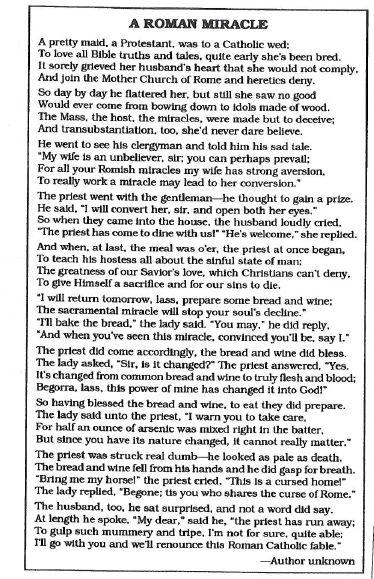
A True Roman Catholic Miracle!

I ran across this poem while reading about the difference between the biblical gospel and the false gospel of the cult of Rome, revealing a bonafide miracle! Don’t discount miracles within the Roman cult until you read this, taken from a pamphlet written by Richard Bennett. You can read more from this kind gentleman here: http://www.bereanbeacon.org/

A letter to the pope.

Thanks to Banner of Truth for reprinting this letter from Charles Hodge to Pope Pius the Ninth. In today’s atmosphere of blur-the-lines doctrinal positions it’s refreshing to see how men of old stood their ground on principles and refused to compromise truth on the alter of ecumenicalism.

~~~~~~~~~~~~~~~~~~~~~~~~~~~~~~~~~~~~~~~~~~~~~~

The text of a letter written by Charles Hodge of Princeton Theological Seminary on behalf of the two General Assemblies of the Presbyterian Church in the USA, explaining why the Pope’s invitation to Protestants to send delegates to the first Vatican Council of 1869-70 was being declined.

To Pius the Ninth, Bishop of Rome,

By your encyclical letter dated 1869 you invite Protestants to send delegates to the Council called to meet at Rome during the month of December of the current year. That letter has been brought to the attention of the two General Assemblies of the Presbyterian Church in the United States of America. Those Assemblies represent about five thousand ministers and a still larger number of Christian congregations.

Believing as we do, that it is the will of Christ that his Church on earth should be united, and recognizing the duty of doing all we consistently can to promote Christian charity and fellowship, we deem it right briefly to present the reasons which forbid our participation in the deliberations of the approaching Council.

Continue reading