A Catholic Fable

A Catholic Fable   Francis

A review by Stuart Brogden

I tried to give this book, My God and My All – The Life of Saint Francis of Assisi, an honest opportunity to impress me. Elizabeth Goudge was a 20th century novelist and it is most appropriate that a fiction author wrote about this topic. The cover art gives us a peak into the perspective the reader will face: it’s a well-known (in Roman Catholic circles) painting of Francis in prayer. His hands are crossed over his chest and there is a nail hole visible in his left hand. Several segments within the Roman Catholic Church believe they are obedient to Scripture when they punish their bodies in imitation of the physical punishment our Lord took upon Himself in obedience to His call as being born under the Law, cursed for the sake of those He was sent to save. This may also be a twisted view of Colossians 1:24. Sam Storms has a very good analysis of this verse (posted here: http://www.samstorms.com/all-articles/post/filling-up-the-afflictions-of-christ–1:24-) that, may it please the Lord, will help some Roman Catholics see the truth of Scripture on this topic.

It is fitting that a novelist wrote this book for two reasons. First, the book is a fictionalized account of Francis’ life. Secondly, it presents a thoroughly Roman Catholic view of Francis’ life, which is as much a work of fiction as is every distinctive of that religion. I’ll focus on this second aspect, as fiction presented as truth is a danger that we cannot blithely ignore. And we see this false religion on pages 1 and 2:

In the case of those whom we call the saints, this power is immeasurable. They are the true makers of men. Other great men may alter the material aspect of life for millions, but the saints make us for eternity. By emptying themselves, by getting rid of self altogether, they become the channels of God’s creative power and by him, through them, we are made. … And so his (Francis’) power lives on and we cannot measure it because it is nowhere near its end.

The Bible calls all of His redeemed people, saints. There is no determination by any man-made religion as to whom is worthy of being identified as such. The one who plants and the one who waters are nothing – the growth comes from God and He, alone, is everything (1 Cor 3:7). The “saints” of Rome do not “make us for eternity,” they were in every bit the same need of God’s grace to be saved as any other men. There are no “great men” in the world or in the body of Christ; all men are weak and sinful and the only good we have claim to is the good He (not any religious pretender) works in and through us.

Another short insight into the dual nature of this being a novel: on page 6 the author shows us her method of weaving this story together, speaking of Francis’ birth:

Tradition says it was long and hard and that as the hours passed and her child was not born she asked to be taken to the stable that adjoined the house, that she might feel a little nearer to Mary, the Mother of God, and that in the stable her child was born. Today the little place is a chapel, the Chapel of the Infant Francis.

Many Roman Catholics deify Mary, who was a sinner used by God, not a sinless woman God was fortunate to have on His team. She was the mother of Jesus, the man, not God. Jesus, being eternally existent as the second member of the Trinity, was not born of a women in the sense that would validate this phrase beloved by Rome – Mary, mother of God. That is a blasphemous statement, but not seen as such by those who worship Mary. We also see here the practice of building a shrine at “sacred places,” as if Jesus did not have the conversation with the Samaritan woman in John 4. Places are not sacred in the Christian world, only in the pagan world. God’s people (individually and corporately) are His temple (1 Cor 3:16; 6:19; Eph 2:17 – 22). He does not require nor even want temples made by human hands (Acts 7:48; 17:24) and when men make ornate buildings as places of worship, the tendency is to take pleasure in the grand architecture and the images normally found therein – forgetting the God Who made all things and is Lord of all things.

Francis was, as many Roman Catholics are, a mystic who imagined he heard direct from God apart from His Word (page 22). In one such moment he dreamed YHWH revealed the perfect bride for him, “Lady Poverty” (page 21). And by so determining he must deny self by becoming temporally poor, “Francis entered upon this battle of winning himself for God.” (page 22) This reveals one danger of the mystical life: a person can be misled by various voices which lead away from God’s Word. This shows up again on page 28 as Francis “heard the Lord speaking with the voice of a friend, and saying, ‘Francis, go and repair my church, which as thou seest is wholly in ruin.” In focusing on the crucifix, Francis “realized that though the sufferings of Christ in his human body were ended yet the At-one-ment was always going on. Christ still reigned from the cross, looking out over the suffering world, drawing all men to himself on his cross that might unite them to God in himself.” When Jesus finished His work of redemption, He sat down at the right hand of God (Heb 1:3). He is not still hanging on the cross!

Francis is recorded in this novel as working on the rebuilding of three buildings, which are called churches. This is a vital error, putting places in the place of the body of Christ, as noted earlier. Of His church, the Lord said He would build her (Matt 16:18), this spiritual building that is the work of God alone. He does not need the help of men, although He does command us to be obedient in proclaiming the gospel to men everywhere and to disciple the saints within the local church.

Chapter 5 carries the book’s title and describes the Roman Catholic mass as the center of worship. “Nothing could be greater than the coming of Christ the King in the sacrament of the altar. Soon the little church would be as holy as the courts of heaven” (page 50). So much of the Roman religion is taken from the Jewish religion without any discernment. The New Covenant church has no altar, and Christ the King is not offered up on any altar! His empty cross serves as a spiritual altar (Heb 13:10). Note how this is explained by the Jamieson-Fausset-Brown Bible Commentary:

Christianity and Judaism are so totally distinct, that “they who serve the (Jewish) tabernacle,” have no right to eat our spiritual Gospel meat, namely, the Jewish priests, and those who follow their guidance in serving the ceremonial ordinance. He says, “serve the tabernacle,” not “serve in the tabernacle.” Contrast with this servile worship ours.

an altar—the cross of Christ, whereon His body was offered. The Lord’s table represents this altar, the cross; as the bread and wine represent the sacrifice offered on it. Our meat, which we by faith spiritually eat, is the flesh of Christ, in contrast to the typical ceremonial meats. The two cannot be combined (Gal 5:2). That not a literal eating of the sacrifice of Christ is meant in the Lord’s Supper, but a spiritual is meant, appears from comparing Heb 13:9 with Heb 13:10, “with grace, not with meats.”

The last thing I will briefly cover comes from chapter 6 – The Rule. We have a snippet written by Francis wherein he reveals his authority: the pope. “And when the Lord gave me some brothers, no one showed me what I ought to do, but the Most High himself revealed to me that I should according to the form of the holy gospel. And I cause it to be written in a few words and simply, and the pope confirmed it for me.” Also on page 73 the author says “Francis was a devoted and loyal son of the Church.” When Francis and his brothers formed their group, “Francis promised obedience and reverence to both Innocent and his successors after him. All the brothers were to take the three evangelical vows of poverty, chastity, and obedience, and they were to live without any property whatever” (pages 74 & 75). These “evangelical vows” are not found in Scripture. We find in God’s Word that His children are to be poor in spirit, not proud; sexually pure, in marriage unless gifted with singleness; and obedient to Christ as revealed in Scripture, not to traditions and words of men.

The god of Francis appears, from this book, not to be the God of the Bible. If that god was his all, his end was worse than his beginning. I pray all who claim to be in Christ examine themselves to see if they be in the faith (2 Cor 13:5). The Christian religion is not the product of men. It is the work of God in the people He called to new life in Christ (2 Cor 5:17) from their natural condition of spiritual death (Eph 2:1 – 10). To Him alone be all honor and glory and dominion, and none of that to any man.

Comparing Adam and Israel

Scripture records Christ as “the last Adam” in 1 Cor 15:45. Were there others who stood in as an “Adam” in the course of redemptive history? I think the Bible shows this to be the case, with Noah, Abraham, David, and the nation of Israel (summed up in Abraham, Isaac, and Jacob) being the “interim Adams” before the last One appeared.

This chart shows my view on how Israel fulfilled this role.

Comparing Adam and Israel

ADAM ISRAEL
Formed by God from the dust of the earth.

(Gen 2:7; 1 Cor 15:47)

Formed by God from the dust of the people of the world. (Gen 11:10 – 11:3; Deut 7:7)
Was brought to life by the word and breath of God. (Gen 1:26 & 27; 2:7) Was brought into being by the word of God. (Gen 12:2 & 3; 15:1; Ex 3)
Had close fellowship with God. (Gen 2:15ff; 3:8a) Had close fellowship with God. (Gen 15; Ex 15; 2 Kings 23:1 – 27)
Was given a covenant within which to live and prosper. (Gen 2:16 & 17; Hosea 6:7) Was given a covenant within which to live and prosper. (Gen 17:14; Ex 19:3 – 6; 24:3 – 8; Neh 9 & 10)
Broke the covenant and received the penalty of death, which was carried out in due time. (Gen 3:6 & 7; 22 – 24; 5:5) Broke the covenant and received the penalty of death, which was carried out in the fullness of time. (Deut 31:16 – 18; Judges 2:11 – 15; Jer 11:10 – 13; 1 Kings 11:9 – 11; Ezek 44:1 – 7; Hosea 6:7)
Was cast out of the garden, cursed to walk and work in the world which was wrecked by The Fall. (Gen 3:23 & 24; 3:17 – 19) Was divorced by God, left desolate, cursed to walk and work in darkness until the light of Christ. (Jer 3:6 – 10; Matt 15:12 – 14; 23:37 & 38; 2 Cor 3:12 – 17)
As a type of Christ, Adam points us to the anti-type, Christ Jesus, in whom there is life for Adam’s children who are secure in the Last Adam. (1 Cor 15:45) As an echo of Adam, Israel points us to the anti-type, Christ Jesus, in whom there is life for Abraham’s children of promise. (Gal 4:21 – 31)

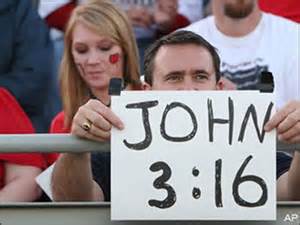
What Does John 3:16 Teach?

The following is part of the book I am writing, from a section on the gospel which is a necessary element of a biblical church. th

There are truths in God’s Word that rub our flesh the wrong way; predestination is one of them. I refer the reader to Appendix 5 for a biblical defense of this doctrine. We must embrace the truth of Scripture, even if it goes against what we’ve learned from me. For the word of God is living and active, sharper than any two-edged sword, piercing to the division of soul and of spirit, of joints and of marrow, and discerning the thoughts and intentions of the heart. (Hebrews 4:12) God’s Word is sharp and, as wielded by the Holy Spirit, cuts like a scalpel, bringing healing to our broken souls. False teaching is seen as less threatening, like a butter knife. And it works the same way – tearing the flesh as it pierces, bringing destruction rather than healing. Good counsel presents the truth of Scripture; this is biblical love – even though our beloved traditions may have to be abandoned.

Many who disbelieve predestination run to John 3:16, as if this verse disproves it. Let us briefly examine this verse to see what its message truly is. Here’s the verse, from the King James: For God so loved the world, that he gave his only begotten Son, that whosoever believeth in him should not perish, but have everlasting life. That settles it for many, who do not stop to see if the words may have had a different meaning when written 500 years ago than they do today; including Baptist preachers who ought to know better. But contrary to a popular hermeneutic which declares, “when the plain sense of Scripture makes common sense, seek no other sense”, the plain sense of Scripture often contradicts the true meaning of Scripture and our common sense often makes no heavenly sense. The genre of the text we are reading will indicate how we are to read it – poetry and apocalyptic books cannot be taken literally, and even historical narratives are full of word pictures that must be interpreted rightly to get God’s view of His Scriptures. The Jews of the first century had common sense and they took certain prophecies in the plain sense. This caused them to look for a king like David – a man of war – and miss the true meaning of their own Scripture.

In regards to John 3:16, let’s examine a couple of key words upon which the meaning of this verse hang. In English, the word “so” can be either an adverb or an adjective. We see it in verse 14: And as Moses lifted up the serpent in the wilderness, even so must the Son of man be lifted up (KJV). Here, the word “so” is an adverb, meaning “in like manner” or “in the same way” – describing the nature of something. Many people think the word “so” is an adjective in verse 16 – describing the degree of the thing that follows: God loves the world SO much. The problem with this view is that the Greek word translated as “so” in English (houtos – Strong’s #3779) is rarely used as an adjective. Strong’s Greek and Hebrew dictionary defines it only as an adverb. Houtos shows up more than 200 places in the Greek New Testament. In only four occurrences it is definitely an adjective: Galatians 1:6; 3:3; Hebrews 12:21 (houto); and Revelation 16:18. In more than 97% of the uses the word houtos is an adverb. (http://www.brenthobbs.com/index_files/john_3_16.php accessed 25 May 2015) Now looking back John’s gospel, let’s read a little more for context:

John 3:14-16 (KJV) And as Moses lifted up the serpent in the wilderness, even so must the Son of man be lifted up: That whosoever believeth in him should not perish, but have eternal life. For God so loved the world, that he gave his only begotten Son, that whosoever believeth in him should not perish, but have everlasting life.

Is there a compelling argument that John’s use of houtos changes from the common adverb in verse 14 to the extremely rare adjective in verse16? If its use in verse 16 is as an adjective, the Bible tells us God loved the world to a great degree that He sent Christ to die for the same world He said we are not to love (1 John 2:15). Since Jesus said Scripture cannot be broken (John 10:35) we must interpret Scripture with Scripture and lean not on our own understanding (Proverbs 3:5), even if the plain sense makes common sense to us. Our common sense is our understanding, not God’s. I don’t have space here to examine “the world” and how it’s used; but since not everybody at all times in every nation, tribe, and tongue has been forgiven, it’s reasonable and in keeping with Christ’s high priestly prayer in John 17 that Jesus did not come to save the whole world in the comprehensive sense some assert. As noted in Ephesians 5:25, Jesus gave His life for the church, not everybody in the world. And since “the world” often means a region (Luke 2:1; John 12:19), or the system which lies under Satan’s rule (John 15:19; 17:13; 1 Corinthians 2:12), we have no reason to assume this term means everyone everywhere as regards salvation, as the Lamb of God died for the redeemed, not the damned.

The argument is not whether or not the death of Christ is sufficient to save everyone – His death is more than sufficient for the entire human race. The question is, did Christ die for all men – is the atonement universal? One English Bible translates this phrase, “in tasting death He should stand for us all” – those for whom Christ stands are the redeemed. The word, man, is not in the Greek text, meaning the original phrase would be “should taste death for the whole” – the whole body, the church for whom Christ gave Himself (Ephesians 5:25); Jesus died for every son God brings to glory. God the Father chooses only some to be saved – election is not universal. God the Spirit regenerates only some to bring them to new life, He only seals those who are born again – the Spirit’s work in saving and sealing is not universal. For Christ’s death to be universal, it would mean that some of His blood, some of His trials and suffering under the wrath of God the Father, was for those who are spending eternity under God’s wrath. Any blood or work done by Christ on their account would be wasted! And if the death of Christ was universal, it would put Him at odds with the Father and the Spirit, because their work in salvation is particular, not universal.

Let’s read the passage from John 3 in the Holman Christian Standard Bible:

Just as Moses lifted up the snake in the wilderness, so the Son of Man must be lifted up, so that everyone who believes in Him will have eternal life. “For God loved the world in this way: He gave His One and Only Son, so that everyone who believes in Him will not perish but have eternal life.

This is more in line with the common use of the Greek and keeps consistency within the passage and with the whole teaching of the redemptive work of the Lord Jesus.

The Pilgrim’s Journey

The Pilgrim’s Journey  9781601783875

A review by Stuart Brogden

I first heard of Jeremy Walker a few years ago when I happened upon a most wonderful book he co-authored with Rob Ventura – A Portrait of Paul: Identifying a True Minister of Christ. That book confirmed in my desire to serve the Lord’s people as a pastor and also put the fear of that responsibility in me. This new book by Walker, Passing Through, is subtitled Pilgrim Life in the Wilderness and has vignettes from John Bunyan’s Pilgrim’s Progress throughout as our author makes compelling case that our Creator sees us as aliens, sojourners – pilgrims. I confess reading this book convicted me on several points and I think any honest Christian will be able to admit the same as we all tend to seek comfort in this world, though it is not our home, living in practical forgetfulness of where our citizenship lies.

This book is divided into 12 chapters, each of which provides Scriptural Framework and Specific Counsels for the topic. I grew a little weary of this format by the end of the book, but thank the Lord for it – it is a wonderful exposition of many truths and useful counsel and encouragements we each have need of. He starts off (page 1) asking “Who are you? What are you?” and tells us on the next page that we “need, therefore, to consider our identity and our activity in the light of Scripture.” If you are in a solid church, you will be reminded of the dangers of worldliness. But if your church is shallow, it may look more like the world than one of God’s outposts in this hostile arena. He concludes chapter 2 –Strangers and Pilgrims, with this: “We like to speak of death as “going home,” and so it is to every child of God, but why do we then live as if we are already home? Such confusion betrays us.” (page 36)

I will highlight chapter 7 – Respect the Authorities, as I see all too often Christians demanding the church do “this” or other Christians do “that” in response to cultural or political events. Also, the proper respect for authorities – each in its own arena of influence – is something we all need to understand better. “The church, by divine design, is a spiritual force, a gospel organism. Her involvement in and impact upon the world socially, politically, and economically may not be insignificant, but it will be substantially incidental. The church does not exist to have a political life or role.” (page 125) The scriptural framework consists of understanding proper subjection to governing authorities (citing Romans 13:1-7), parental authority (Exodus 20:12) as earthly authorities that He established and which answer to Him – not us or the church. And while Walker agrees that role of governments is to do good as God’s ministers, he admits that they often don’t; and their failure to be good does not give us excuse to rebel. When we must disobey earthly authorities (when they command us to sin or forbid from obeying our God), we must be respectful as were Daniel and his colleagues and the disciples written about in Acts 5 were. “There language is polite and eminently respectful. Their recognition of the king’s authority is sincere and humble. Their refusal to obey is absolute. Their faithfulness to God is complete.” (page 131)


We are commanded to pray for our government (1 Tim 2) – who among us lives in such a hateful environment for Christians as did Paul when he penned God’s instructions on this topic? We are to live in such a way so that evil men would see the way we live, rather than speak evil of us they would glorify God (1 Pet 2). We will find ourselves disinterested and unable to have this focus if we don’t have our identity and activity lined up with Scripture. As to the proper focus of the church in the face of God-hating government, Walker brings us to Acts 4:24-31. The Jewish leaders are organized and determined to put an end to this Way that has popped up and is turning the world upside down. Peter and John were commanded to not speak or teach in the name of Jesus; But Peter and John answered them, “Whether it is right in the sight of God to listen to you rather than to God, you must judge, for we cannot but speak of what we have seen and heard.” They were respectful but uncompromising. What happened next is instructive and directly on topic with this chapter.

Acts 4:23-31 (ESV) When they were released, they went to their friends and reported what the chief priests and the elders had said to them. And when they heard it, they lifted their voices together to God and said, “Sovereign Lord, who made the heaven and the earth and the sea and everything in them, who through the mouth of our father David, your servant, said by the Holy Spirit, “‘Why did the Gentiles rage, and the peoples plot in vain? The kings of the earth set themselves, and the rulers were gathered together, against the Lord and against his Anointed’ — for truly in this city there were gathered together against your holy servant Jesus, whom you anointed, both Herod and Pontius Pilate, along with the Gentiles and the peoples of Israel, to do whatever your hand and your plan had predestined to take place. And now, Lord, look upon their threats and grant to your servants to continue to speak your word with all boldness, while you stretch out your hand to heal, and signs and wonders are performed through the name of your holy servant Jesus.”  And when they had prayed, the place in which they were gathered together was shaken, and they were all filled with the Holy Spirit and continued to speak the word of God with boldness.

Notice this: they did not plot a protest or overthrow of the corrupt government of Israel. They praised God, thanked Him for being faithful, recognized He had appointed the evil men to rule over them, and prayed for the name of Jesus to be glorified through the service He had called them to. This is the proper posture for the church in the midst of political turmoil and persecution. “The church’s response to the assaults made on her is not a rallying cry to civic resistance or even civic engagement, but to get on their knees before the living Lord and to seek His face, crying for heavenly power to declare divine truth faithfully and fruitfully even in the face of opposition and persecution.” (page 136)

“The governing power of the saints is a heavenly one. The church takes her identity, her sense of privilege and priority, her direction for behavior, and her enduring hope from her heavenly King and the realities of citizenship in His kingdom. This conditions all our relationships with the authorities here. The men of the world set their minds on earthly things, but the citizens of Zion set their minds on heavenly things.” (page 137) Yet the saints say, Amen!

“Here is the key point: though the citizens of the two kingdoms necessarily mingle as they make their way through this world, God’s people cannot be finally identified with any nation, party, society, or institution in the earth. … It is only when the Christian understands himself to be unequivocally and distinctly a citizen of heaven that he knows how to relate to the kingdoms of the world.” (page 141)

If we want to live in accordance with God’s plan, we must have our identity and activity aligned with His Word. We must ever be growing in grace and knowledge, seeking to be renewed in our minds as we cooperate with His Spirit’s work to sanctify us and conform us to Christ. We must be heavenly minded if we are to be of any earthly good. We must embrace our identity as a pilgrim of God, an alien on planet earth. This is wonderful book to help us figure that out and live accordingly.

The Danger of Presuppositions

The Danger of Presuppositions

The Sabbath before the command, a sermon by Voddie Baucham

reviewed and analyzed by Stuart Brogden

This review is not intended to malign or condemn my dear brother and friend, Voddie thBaucham; it is to expose the errors one can be led to if presuppositions are left unexamined, if documents other than Scripture are held too tightly. This sermon sums up much of what caused me to withdraw from Grace family Baptist Church; it violates many of the basic rules of hermeneutics that Voddie taught me, apparently having his view distorted by his “confessionally colored glasses” as Bob Gonzales put it.
To the sermon, which can be listened to here: http://www.sermonaudio.com/sermoninfo.asp?SID=410151353280

Early in this sermon, Voddie asserts “Israel mirrors New Covenant people.” This is fundamental to the message of this sermon, but is it true? A mirror is intended to give an accurate image of the object, as when Scripture says Jesus Christ is the visible image of the invisible God (Col 1:15) and He is the radiance of the glory of God and the exact imprint of his nature (Heb 1:3). Israel, however, is NOT a mirror image of the church which was purchased by the blood of Christ Jesus. Israel was a type, a shadow – providing a useful but imperfect image of the antitype, the church (Hebrews 8:1 – 6). They were a mixed seed of mostly unregenerate people. While the local church will have wheat and chaff growing side-by-side until the reaping (Matt 34:31; Rev 14:15), the universal church is pure and undefiled in any way (Eph 5:27). This cannot be said about Israel; it is NOT a mirror of God’s redeemed people. But it’s important for Voddie’s entire message that we agree that we are Israel (as he points out later), because the Scriptures tell us that the covenant was made with Israel and the words written on the stone tablets testify of that covenant (Ex 34:27 & 28). Moses emphasizes (Deut 5:2 & 3) this covenant was made with national Israel, not the patriarchs. And not – by implication – with Adam or the redeemed. As we will see, if Israel is not a mirror of the church, this message fails.

Still early in the sermon we are told, “Understanding the Sabbath is one of the most important junctures in our theology.” I agree with him on this. It will be apparent, however, I do not agree with his understanding of the Sabbath. Then he says, “Is it 8 of 10 or 9 of 10 who deny a Sabbath commandment?” It’s clear he simply made up this number, apparently to demonstrate the pitiable condition of the apathetic saints who disagree with him. Before getting into the substance of his argument, I am compelled to point out a subtle but glaring aspect of his repeated description of non-Sabbatarian Christians as those who deny or do not believe in a Sabbath command. Speaking for myself, I do not deny that the Bible has a Sabbath command. I believe in the Sabbath command. I simply look to the Scripture to inform me as to the subjects of this – and other commands. I deny that the Sabbath Command is binding for people in the New Covenant. I openly agree that it IS binding on those in the Mosaic Covenant, but not all men universally. By phrasing it as if we deny that the Bible commands some people to keep the Sabbath, Voddie implies though we cut objectionable parts from our Bibles. It is more likely, as we will see, that sabbatarians add parts to the Bible – reminding me of an author who describes dispensationalists as people of the invisible Scripture. Voddie taught me to tackle the best argument of those I disagreed with, as any victory over a weak argument would be meaningless. He appears to have forgotten this counsel, as this sermon engages only weak (or made up) positions.

One of the main tenents of his argument is that the Decalogue, as a unit, is equal to God’s moral law. This is not explained or defended from Scripture. As his beloved Second London Baptist Confession states in chapter 19, paragraph 3 (referring to the tablets of stone mentioned in paragraph 2), “Besides this law, commonly called moral …” and not one single verse is referenced. As one author I recently ran across observed, when theologians don’t have a biblical defense for something they assert, they use phrases such as “commonly called”. This is an appeal to a false authority – a logical fallacy. This is another aspect of preaching Voddie taught me – do not fall into the use of logical fallacies to make your point. Doing so lessens the authority of the message.

Therefore, he concludes, as a moral law, the Sabbath is binding on all people. From this position, He mocks 7th day Sabbatarians, whom he describes as 1 of the 10 who don’t get “truth” as he defines it. Another 10 percent hold to the idea of a “Christian Sabbath”; the remaining 8 of 10, a huge majority of Christians, deny the “Christian Sabbath” and are unable to explain why. Voddie is well aware of scholarly works by credible Christians who provide solid biblical defense for why the Sabbath is for Israel and not the Christian. D.A. Carson’s From Sabbath to Lord’s Day and Terrence O’Hare’s The Sabbath Complete are two such books that I know he is aware of. Is it sophistry to assert that, in general, all those Christians who deny the “Christian Sabbath” cannot explain why they hold that position. I betcha 9 of 10, or maybe 10 of 10 people who believe the Decalogue equals God’s moral law cannot explain it from Scripture. This is because Scripture does not define “moral law” nor does it equate that concept to the Decalogue. That correlation is simply not found there. That’s why the Westminster and Second London Baptist Confessions say the Law given Moses is “commonly called” the moral law. This is a concept originally put down on paper by Thomas Aquinas, the same one who developed the triad view of the Mosaic Law.

Baucham makes the interesting observation that since the Sabbath command was introduced in Exodus 16, chronologically before the law was given to Moses, and because it is allegedly rooted and grounded in a creation ordinance, it transcends the Decalogue. This is a double assertion based on his confessional presuppositions, not found in Scripture. When YHWH instructs the infant Hebrew nation about the Sabbath, using manna as the object, it is clear they were not familiar with the Sabbath, it was something new to them. This is the first record of the Sabbath in Scripture. It is another argument from silence to claim the Sabbath was known, kept and enforced from creation. The mention of the 7th day in the Decalogue does not establish a creation ordinance; it is given by God as an example for Israel to help them understand His command to rest from their work. John Calvin, John Gill, and John Bunyan each held a high view of the Lord’s Day, but dismissed and argued against the idea of a Sabbath creation ordinance. Circumcision was part of the Mosaic Covenant given before the Decalogue – does it also transcend the Decalogue and bind all people?

Voddie asserts that the 7th day of creation sets the pattern for work and worship. He later calls this God’s rhythm for life. I completely agree that YHWH was demonstrating for us our need for rest from work in sanctifying the 7th day of creation to Himself, as a minimum. Since all creation and the gift of work were soon to be cursed by the Fall, I also see the 7th day rest pointing to the One Who will do away with the ravages of sin and provide true and eternal rest for weary souls. Scripture tells us that God gave the Sabbath to the Hebrew people through Moses:

You came down on Mount Sinai, and spoke to them from heaven. You gave them impartial ordinances, reliable instructions, and good statutes and commands.  You revealed Your holy Sabbath to them, and gave them commands, statutes, and instruction through Your servant Moses.  You provided bread from heaven for their hunger; You brought them water from the rock for their thirst. You told them to go in and possess the land You had sworn to give them. Nehemiah 9:13-15 (HCSB)

YHWH gave the Sabbath to Israel as part of the ordinances, instructions, statutes, and commands, through His servant Moses. When Nehemiah continues on to describe YHWH’s kind provision in the desert, giving the Sabbath command to them is not listed. But taking the command in Exodus 16 into account, we can be sure YHWH taught and revealed His Sabbath to Israel at that time – but it was not given as the sign of the Mosaic Covenant until Sinai. There was a Sabbath before the commandment. It began as a teaching of the concept to the Hebrew people, not as a continuation of something they knew for generations since Adam taught Seth. In Exodus 16, when Israel is rebuked for trying to gather manna on the Sabbath, God tells them the Sabbath is to be kept by the families staying in their homes. There is no corporate worship, nothing standing as a type for the “Christian Sabbath”.

Voddie tells us, “Whenever you see Israel messin’ up – stop and insert yourself. That is you and me before we came to God. Forget generalities – this is you and me.” Again, the notion that Israel is a mirror of New Covenant saints shows up and seems innocuous. Voddie also taught me to be careful about inserting self into a Scripture passage, often using Jeremiah 29:11 to teach this. It appears he forgot this lesson. While all Scripture, including Exodus 16, is for our edification (1 Cor 10:6; Rom 15:4), not all Scripture can be applied directly to us. Israel is typological of all sinners, but that is NOT the same as saying you and I are Israel in this passage. Being less than careful in this matter can lead to serious errors – as when people drink poison and handle snakes by inserting themselves into Mark 16:17 & 18.

He quotes Ian Campbell from Why Easter makes me a Sabbatarian. This is an interesting article, easily found on the Internet, providing a defense of the Westminster Confession’s view of the “Christian Sabbath”. Despite Campbell’s assertion to the contrary, the pre-command for Sabbath-keeping in Exodus 16 is given only to Israel, not all people; same as the Decalogue. Nothing in the context of either scene comes remotely close to including Gentiles. Voddie admits the Decalogue summarizes the Mosaic Covenant, yet declares “the Sabbath was not just for Israel.” His continued conflating God’s moral law with the Decalogue leads him to impose the Decalogue universally. “If the Decalogue is a communication of God’s righteousness, then everyone is responsible for upholding it.” If by upholding it Voddie means we are bound by it (as the 1689 says), then he will run into myriad problems throughout the Bible as God’s righteousness is revealed and communicated in ways that even Christian Sabbatarians would not claim. The crime and punishment of Achan in Judges 7 comes to mind.

If everyone is required by God to keep His Sabbath, why is the only record of the Decalogue we have contained in the monologues by Moses, communicating this law (the summary of the Mosaic Covenant) to that people? If it was commonly practiced from creation, why is there no Biblical record of anyone other than Israelites being instructed about the Sabbath or punished for violating it? There is plenty of punishment meted out on people for murder, theft, idolatry, etc., before the Decalogue is published, giving warrant to the notion that there is a moral law at work in all humanity. Yet nowhere in Scripture is the Sabbath held up in this light; it is a sign of the covenant between God and Israel. The tripartite view of Mosaic Law is difficult to demonstrate, as when we try to separate moral law from ceremonial in Leviticus we see they are interwoven everywhere one looks. Principals of moral law and ceremonial and civil law are there to learn from; but they are not neatly defined and set aside (sanctified) as separate records.

Voddie claims Sabbatarians are the only people who see all men responsible before God for keeping His law. Others say man must voluntarily enter into covenant with God to be held accountable. This is another logical fallacy – the Excluded Middle: assuming there are only two alternatives when in fact there are more. Are Sabbatarians the only ones who embrace God’s sovereignty and monergistic work of justification, and the Christian’s responsibility to pursue godliness? Reading from Luke 6, wherein Jesus makes the claim He is the Lord of the Sabbath, Voddie asks, “would Jesus claim to be Lord of something that was abolished?” What if the Sabbath is by design a type of the rest we find in Christ as He redeems us? We are told to rest in the Lord (Psalm 37:7) and are invited by the Lord Jesus to find rest in Him (Matthew 11:28 – 29). If He gives us spiritual rest when we come to Him in faith (which He graciously gives His elect), is He not, in this way, continuing as Lord of the Sabbath? No one enters into His rest unbidden by Him – He is Lord of the Sabbath! Jesus does not promise the pale imitation of the rest provided for by temporal respite; He gives the eternal rest that can be found nowhere else. Baucham then runs to Hebrews 4:9 to claim THAT as a Sabbath – the weekly “Christian Sabbath.” For each of the types spoken of in Hebrews 3 & 4, the Spirit recounts how the infant nation of Israel failed to enter His rest in Canaan because of unbelief (Heb 3:7 – 19), how we who do believe enter that rest (not in Canaan, but in Christ; Heb 4:3), and He speaks, again, how Creator God rested from that work on the seventh day (Greek word hebdomos, #G1442; Heb 4:4), and how the (spiritual) rest promised to those who believe is different than the (temporal) rest Joshua promised (Heb 4:8). Therefore, a Sabbath rest remains for God’s people.  For the person who has entered His rest has rested from his own works, just as God did from His. (Hebrews 4:9-10 (HCSB)) This rest, sabbatismos (Greek word G4520) is used nowhere else; it is found only in verse 9. If it were to be a weekly Sabbath, we would expect to see sabbaton (Greek word G4521) which is used 68 times in the New Testament, overwhelmingly to describe the Jewish Sabbath. If the temporal rest Joshua sought was singular occurrence and the rest from creation was a singular occurrence, why would the rest believers gain when we are adopted by God be a weekly event, rather than a singular, ongoing rest in the finished redemptive work of Christ Jesus? The Jewish Sabbath was a pale ceremonial rest from work to demonstrate their trust in YHWH, not an instruction to develop corporate worship. As a command to rest from that work which provided food for themselves and their families, the Jewish Sabbath serves a wonderful type for Christians – to rest from that work which seems to earn God’s favor and find true rest in the finished work of Jesus, the antitype; not a weekly spiritual respite.

Where does the Sabbath command include worship? This question is never asked nor answered in this sermon. One might think it central to the idea that the command to rest from work had been changed not only in the day in which it is to be observed, but as to its practice. We are to assume worship is commanded; Voddie does, and then strains to accommodate the change in day: “The commandment is 1 day in 7, not the 7th day.” This is simply not true. If it were true, each tribe of Israel could have established their own day of the week to honor the Sabbath given by God as a sign of the covenant. We know they did not do so. The commandment is “the 7th day”; the example from creation is “the 7th day.” Exodus 20:9-10 (HCSB) You are to labor six days and do all your work, but the seventh day is a Sabbath to the LORD your God. You must not do any work—you, your son or daughter, your male or female slave, your livestock, or the foreigner who is within your gates. From Strong’s Hebrew dictionary: Number 7637, shebîʿâ, is found 98 times in the KJV and means “seventh” 96 times, “seventh time” once, and “seven” once. Since this word is used myriad times to describe the Jewish Sabbath (there being no other kind in Scripture), how could it mean any day in a given week? Our English translations (NIV, NASB, ESV, HCSB, KJV, and many others) all say “the seventh day.” I didn’t find a commentary written by men in either camp who interpret this word as “one day in seven;” they universally interpret it “the seventh day.” And as with creation, the day after the sixth day is specified as the day of rest, not worship. But Voddie says “8 out 10 Christians do not believe that there is a Sabbath command … this means that going to church is optional.”

In truth, we see clearly a Sabbath command; we don’t see it given to anyone other than national Israel and we don’t see it commanding worship. There’s a HUGE difference! Voddie continues to portray only two extremes – you believe in the “Christian Sabbath” or you believe worshiping God with His people is not important. This is another example of the Excluded Middle fallacy. There are many Christians who understand the Sabbath command to be a sign of the Mosaic Covenant and yet eagerly and willingly participate in regular corporate worship with the saints. People indwelt by the Spirit of God will increasingly desire to please Him and will not degrade into the slouches Voddie posits as the end of all who neglect his idea of Sabbath keeping. Being burdened by a law from the Mosaic Covenant will not transform them. The Jerusalem Council (Acts 15) was emphatic on this point:

some of the believers from the party of the Pharisees stood up and said, “It is necessary to circumcise them and to command them to keep the law of Moses!” (verse 5) … Now then, why are you testing God by putting a yoke on the disciples’ necks that neither our ancestors nor we have been able to bear? (verse 10)

In this comparison between the Christian Sabbatarian position and those who do not agree with it, Voddie lumps all non-sabbatarians in with Ed Young’s horrible Easter Sunday extravaganza. “This command, which has been place since the creation of the world…” Again, there is no record of any Sabbath command or Sabbath keeping until Israel was instructed in Exodus 16. Law against murder is clearly in view, for example – yet NOTHING about Sabbath until the Exodus. There is no command or instruction to move the Sabbath to the 8th day. Christian gatherings on the 8th day (prayer, praise, preaching, and fellowship of the saints) have no connection to the commandment – which was to stay in your house and rest from your work. The false contrasts continues.  He states that only Sabbatarians give the Lord every Sunday, and everyone else only Easter. Voddie heavily expounds, “the timeless command observed by us on this day speaks volumes.” And “As God’s people, this is what God commands of us” – to gather twice as much manna on Friday so we won’t gather on the Sabbath. “But if you believe there is an obligation for God to be worshiped on this day, ‘but you do whatever to rid yourself of the guilt of playing sports on Sunday’ … is the day His or is it not?” “That’s the question – is the day His or is it not? We cannot embrace the blessing of the Sabbath without embracing the fact that it is a command.” He implies the “Christian Sabbath” is the only means by which saints can gather and participate in the ordinary means of grace our Lord has given us.

A long quote from B.B. Warfield’s sermon on the “Christian Sabbath”, pressing the command and obligation of the Sabbath, with no exegesis to show how this command is binding on Christians as is claimed. Voddie touts the notion that we must be commanded to worship each week because the world does not see its need to worship God – sounding just like Walter Chantry’s pragmatic plea to keep the Sabbath as a means of redeeming the culture (Call the Sabbath a Delight). Paraphrase: ‘Only if you get the “Christian Sabbath” as a command do you get the blessing God intends for you in this day.’ How ‘bout this, as an alternative: Jesus kept the law of Moses and the prophets, not just the Decalogue. He earned the right to be our lamb who takes away sin. We find the blessing of our rest in Him and His finished work.

He laments, ‘Failure to attend church regularly will cause your soul to shrivel. Failure to give God this day is to your great harm and detriment.’ Again – Christians want to gather and worship our Lord; the command does not command worship.

‘What does the Sabbath teaching in Exodus 16 tell us about Israel and us? First, it was commanded and very specific. Gather twice the bread on the 6th day … As the people of God, this is what God commands us. Again, 8 of 10 Christians do not believe the Sabbath command means they think going to church is optional.’ I agree with Voddie that we who claim Christ must trust Him to provide for us and not view work as an ends to be pursued to the detriment of our souls. This principle is taught us by the Sabbath command given the Hebrews. This is how types are interpreted, discerning the way they apply to us, rather than assuming equivalence.

“Ancient writers wrote about how extraordinary Israel was where in 1 day out of 7 everything stopped.” He doesn’t tell us the name of one of these ancient writers, but the official record of Israel’s history, the Scriptures, tell us Israel routinely profaned God’s Sabbath command and were punished many times (Ezek 20 & 22 for example). “This 1 day in 7 set them apart inwardly.” FAIL! Only the Spirit of God can do this! He presumes equivalence between “the Lord’s Day” and the “Christian Sabbath” and assigns spiritual blessings to Christians for keeping of the Law of Moses – which the Apostles declared a burden no man could bear.

“This is the day when we let everything else stop!” And yet – Voddie has repeatedly taught that it’s OK for people to enjoy sports and recreation on Sunday as long as it does not conflict with church. The Christian values the community of faith on Sunday, but meets with God every day. It’s not just the 8th day that is God’s – every day is. Our Sabbath rest is found in our Savior, not in a shadowy ceremonial type that was fulfilled in the person and work of our Lord.

FINALLY he tells us our day of rest is the rest we find in Christ (IAW Heb 4:9, perhaps?); but it’s still only a weakly (no misspelling!) rest for Voddie, rather than the ever increasing rest we enjoy as He sanctifies us. “He gives you six days – do you not believe He can multiply your bread on the 6th?” We mostly work 5 days in this country and ought to trust in our provider more than our employer – but that work is as much as ordinary means of grace as any other provided for us.

Voddie condescendingly dismisses rules for Sabbath keeping, pointing to Exodus 16:23 – claiming they were permitted to cook the manna on the 7th day, just not permitted to gather (the text does not say they were permitted to cook manna on the 7th day). Therefore, he declares, there are no lists for what it means to keep the Sabbath! But what says the Scripture? There we find many rules for Sabbath keeping – not only those made up by the religious rulers.  Exodus 31:15 (death for working); 35:1 – 3 (which forbids kindling a fire); Numbers 15:32 – 36 (death for picking up wood); Leviticus 25 (describes the Sabbath Year – why do Christian Sabbatarians not practice this?); Numbers 28:9 – 10 (burnt offerings); 1 Chron 9:32 (bread of the presence); 2 Chron 23:8 (military guard); Neh 10:31 (showing the Sabbath applying to Israel, not others); Neh 13 (God’s wrath promised to come on Israel for their profaning the Sabbath); Jer 17(prohibition of bearing burdens). No rules for Sabbath keeping, no penalties for breaking those rules? No lists for what God means to keep His Sabbath? Contrary to what Voddie says, the biblical Sabbath has rules, penalties, and lists. If the “Christian Sabbath” he holds to does not, it does not bear witness to the Sabbath in Exodus 16 he is pressing upon his flock.

Voddie claims the typological aspect of the Sabbath comes into play after the first resurrection. It’s only a weak weekly observance until you die. He declares that the work of ministry is permitted on the Sabbath and then says his Sunday ministry (preaching) is not work – it’s worship. Preparation for preaching is work. Why, then, defend the work of ministry on the Sabbath if that is not work? A day off to rest his body is fine, but he will not dare call it a Sabbath, “because the Sabbath is the Lord’s Day, not mine.” Every day we live is the Lord’s Day, not ours – just as every good thing we have is a gift of God and not our own (1 Cor 4:7).

My dear brother gives us many good reminders about the value of Christians gathering for corporate worship – yet no exegesis showing how the 8th day is defined by the 4th word. He simply gives a naked assertion that the 4th word “goes all the way back to creation.” The Scriptures are silent on this topic in that era; it violates Sola Scriptura to teach that it does. No argument from me that to work six days and rest one is a God-given rhythm for life. The Sabbath command teaches this – it does not teach nor require worship. “This is what we must learn, saints – that God will give us 7 days of provision in 6 days of work.” IS THIS THE APPLICATION OF THE 4th WORD FOR CHRISTIANS? I rather treasure the surety of my soul! Just as God rested from His work of creation to show us a pattern for life and point us to the promised seed, Christ rested from His work of redemption to provide us an eternity of rest – rest that starts as soon as He redeems us and gets better every day until He returns to bring the ultimate glory to His name by recreating the heavens and earth and putting a final end to sin for His saints. That’s my Sabbath – the God-man who is Lord of the Sabbath, He bids me find my rest in Him.

To borrow from Kim Riddlebarger’s Reply to John MacArthur (located here: http://kimriddlebarger.squarespace.com/a-reply-to-john-macarthur/), This is hard to say, but in his sermon Pastor Baucham set up and repeatedly attacked a straw man.  His was a pyrrhic victory over a phantom foe.

A Commentary on Acts

A Commentary on Acts 415ueiiJyrL._SS300_

A review by Stuart Brogden

Writing a commentary on any book of the Bible is a daunting task. Especially, I think, a New Testament book. We tend to be more familiar with the New Testament and the theological divisions within the realm of Christianity are daunting. And we have much less commentary and interpretation by the Apostles of the New Testament than we have of the Old. And, as with any study of God’s Word, we all bring our presuppositions with us and have to conscientiously focus to seek the true meaning of Scripture rather than merely defend what we’ve been taught by others. Guy Prentiss Waters has spent untold hours to provide us a study commentary on the book of Acts.

Right up front, Mr. Waters makes it clear the perspective from which he views Scripture, which will delight his fellow paedobaptists but ought to give Baptists a bit of caution. Here, from the Introduction, page 9: “This commentary is Reformed in its orientation. It proceeds from the conviction that the Westminster Standards are the best summary of the Bible’s teaching in the church’s possession. It believes that Reformed theology and sound exegesis are not mutually exclusive alternatives, but the very best of friends.”

Many Baptists claim to be Reformed, but do not hold to the Westminster Confession. And putting any man-authored document as the lens through which to read Scripture is contrary to the very essence of being Reformed, which relies on the never-ending journey of Semper Reformanda, Always Reforming to Scripture for the glory of God. Some Baptists are just as guilty as some of our Presbyterian brothers.

That said, I think that Mr. Waters has written a very good commentary, focused on the redemptive story that holds all of Scripture together. This being a 600 page book, it’s not possible to give you a comprehensive review; so I’ve chosen to focus on a couple of passages in Acts chapter 2.

In a section titled, Promise Explained (page 84), our author does an excellent job explaining why Peter’s sermon (which Luke summarized for his account) points to Jesus as the promised son of David, pointing out: “First, David had ‘both died and was buried’ in Jerusalem. Second, David was a ‘prophet.’ Third, David had received the promise of God, on oath, ‘to seat one from the fruit of his loins upon his throne’ (Ps 132:11, cf 2 Sam 7:1; 1 Chr 17).” And just a few pages later, Waters leans (in a footnote) on the Westminster Longer Catechism to claim baptism as “a sign and seal of the forgiveness of sins that is granted alone through faith in Christ.” (page 89) There is no Scripture referenced and there is no Scripture that can be brought to defend this idea. It is conjecture conjured up by paedobaptists to support paedobaptism. One can argue from Scripture that circumcision of the heart or the Lord’s Supper or both are signs and/or seals of the New Covenant – which is what provides that forgiveness of sins (Luke 22:20 and Rom 2:29, respectively). Later on page 89 and onto page 90, Waters refers to Acts 2:39 and again allows his confessional tradition to influence his understanding of Scripture:

In Acts 2:39, Peter makes an important statement concerning the reach or scope of the promise of which he has been speaking. The promise pertains to three groups of people. First, it is ‘for you’, that is, the Jews – not simply these particular Jews gathered in Jerusalem, but for all Jews within reach of the gospel. Second, it is ‘for your children’. God had specially extended his promises to the offspring of believers under the Old Covenant, and will continue to do so under the New Covenant (Gen 17:7). Third, it is ‘for all who are afar off.’” Waters’ second point is one of the key areas that paedobaptists must not honestly examine, because the actual meaning of this Scripture undermines the foundation of their system. The promise given to Abraham in Gen 17:7 was not one that brought the offspring of Jewish children into the New Covenant. The other side of this covenant given to Abraham, described in Gen 17:9 -14, is what brought Jewish offspring into the Mosaic Covenant community – not the New Covenant. Most importantly, God’s Word tells us the proper interpretation of the promise in Gen 17:7: Galatians 3:16 (ESV) Now the promises were made to Abraham and to his offspring. It does not say, “And to offsprings,” referring to many, but referring to one, “And to your offspring,” who is Christ. The promises were to Abraham and his seed – not seeds; to include Christ and His body in the New Covenant, not unregenerate Jewish or Presbyterian children.

But, the paedobaptist says, Scripture clearly says “the promise is for you and your children!” Two things must be observed from this passage in God’s Word. First, this verse cited in part by Waters and most paedobaptist defenders – For the promise is for you and for your children and for all who are far off, everyone whom the Lord our God calls to himself. That little phrase at the end qualifies everything that precedes it in this sentence. Only those children that are called by the Lord our God to himself will be saved and, therefore, included in the New Covenant. Secondly, the promise mentioned in verse 29 does not refer to the Abrahamic covenant, as paedobaptists claim in their effort include their biological seed in the New Covenant. Context reveal no mention of Abraham in Peter’s sermon. Starting in verse 22 and continuing to verse 36, Peter describes how Christ Jesus is the heir to God’s covenant with David as fulfillment of God’s promise to David to raise up your offspring after you, who shall come from your body, and I will establish his kingdom. He shall build a house for my name, and I will establish the throne of his kingdom forever. (2 Samuel 7:12-13)

No matter how you slice Acts 2, you will not find Abraham’s covenant nor a promise by God to include all the children of a group of people in the New Covenant.

As with all things written by man, there is error in this book of which the reader must be wary. But there is much good, as well. Many Baptists and Presbyterians agree vigorously on how sinners are saved – it is a monergistic work of God. This view of soteriology shines brightly throughout this commentary and ought to be an encouragement to many.

If you are a fan of the Westminster system of theology, you will enjoy this book more than us Baptists. But we can all learn and benefit from it as it will cause the serious reader to dig into Scripture to see if these things be so.

Yet Still Stinking

Dear readers,

We live in a day and age where false doctrine and heresy becomes more and more rampant within the church of the Lord Jesus Christ. In any and every way possible, the evil one seeks to undermine the Scriptures with the oldest question in all of history spoken to the minds of people of all walks of life, but particularly to those who claim the name of Christ.

“Yea, has God really said?”

sinlessperfection

In this excellent video by Pastor John MacArthur, he deals with the false teaching propagated by many in mainline evangelical denominations and by those who in the Charismatic movements. This message entitled, “Spiritually Living, Yet Still Stinking” he deals with the false teaching of sinless perfectionism and that we can live a fully sanctified life before being redeemed from this corrupt flesh. This form of Arminianism was taught and spread by false teachers such as Charles G. Finney, who is considered the father of modern-day revivalism.

From MacArthur’s message found in the video below:

It was J.C. Ryle in his marvelous epic book written in 1879 by the title of Holiness who said, “Sudden instantaneous leaps from conversion to consecration I fail to see anywhere in the Bible.” And the reason J.C. Ryle didn’t see them is because they’re not there. That was an utterly unbiblical concept. He knew what all accurate theologians know, that justification and sanctification are inseparable. They both come at the instant of salvation. Justification is immediate and sanctification is progressive, but they cannot be separated. And sanctification is not some experience subsequent to salvation.

Paul claimed to be the chiefest of all sinners, and 1 John is clear that if anybody says he or she is not a sinner, then they are calling God a liar.  We will never achieve sinless perfection in this life. However, we can give thanks to our Lord and Savior Jesus Christ that one day He is coming back and He will change our corruptible bodies into that which is incorruptible. What a glorious day that will be.

http://www.youtube.com/watch?v=MmK_bHemygY

The Little God Who Can’t

The Little God Who Can’timages

Is God unable to save everyone he loves?  Here’s more thought on a delicate subject.

————————————————————-

In reading about the life of the nation of Israel in the Old Testament, one cannot help being struck by the enormity of what a failure it all was.  There were grand and glorious promises made to the Hebrew people about their life in their promised land, but the writings of Moses also contained prophecies about a crashing destruction that would come upon their nation in the end.  What was God doing?  Why would he create such a grand experiment in the life of humanity knowing that it would only end in failure and tragedy?  Was God unable to make such a great and elaborate plan a success rather than a failure?  The answer, of course, is made plain in the New Testament.  God’s full intention was to show and prove to all people that man has sinned against the God who made him and fully deserves eternal death.  It was and still is a hard lesson to learn.

In our world today man still has not fully understood what it was that the failure of Israel taught us — that man cannot save himself by being “good” and keeping laws — or even by making correct decisions. Even a large part of the Christian community today believes in a religious system that leaves the far greater part of humanity in a burning hell rather than “saved” because they have not “done” something to make themselves acceptable to God.

To many Christians today God is a failure. He means well, but He just can’t get what He wants. He supposedly wants to save the whole world of humanity from hell, but that obviously is not happening; and people that he (supposedly) dearly loves are being separated from him for eternity. Popular Christian belief today requires that a person must first hear the gospel, believe it, then repent and confess their sin.  Then they can become born again and go to heaven. The truth is , however, that for the first 4,000 years of human history there was no New Testament gospel as we have it today.  And even in modern times the greater part of the world’s population still has not heard it.

Has Israel’s failure to save themselves in Old Testament times now become God’s failure in our time?  The choice of heaven or hell is now (supposedly) in the hands of man. God is excluded from the contest (gamble). He wants everybody to be eternally “saved,” but the losses are terrible, and hell is filling up with unbelievers who do not choose God. What can God do? He is powerless. He made the rules and now He must abide by them. Will He grieve forever because people He loves are in a state of eternal torment? Is this the God we believe in?  Is something wrong?

*

Radio Pastor Loren Henry Wilson

A CHRISTOTELIC VIEW OF DANIEL 9:24-27

What follows is an excellent approach to an optimum understanding of this famous but often Disp
misunderstood passage from God’s Word, written by Zachary Maxcey who blogs at Providence Theological Seminary Blog (http://nct-blog.ptsco.org/)

A Preliminary Plea for Tolerance in Non-Essential Eschatological Matters

Few areas of theological study ignite such heated controversy as eschatology. Sadly, on account of eschatological differences, Christians all too often hurl harsh, bitter invectives against those whom they would claim as their fellow brothers and sisters in Christ. Such behavior, not to mention the doctrinal divisions, both damages the public witness of the Body of Christ and significantly hinders the proclamation of the Gospel. In the words of the Apostle James, My brothers, this should not be  (James 3:10).[1] As believers in Christ, we must be able to lock arms together on all essential matters of the Christian faith, while agreeing to disagree in non-essential or disputable matters. We must remember that famous statement of Rupertus Meldenius, In essentials unity, in non-essentials liberty, in all things charity. [2] When we fail to do so, we stand in violation of Christ’s command to love one another as He loved us, an outworking of the second greatest commandment (John 13:34; Matt 22:39). As long as we accept the absolute essentials[3] of orthodox Christian eschatology, we can agree to disagree with fellow believers on such eschatological questions as the timing of the rapture, the issue of the millennium, or the Seventy Weeks prophecy. If we are unable to respectfully[4] differ in Christian love with fellow believers on these (and other) disputable matters, we, including this author, have absolutely no business communicating our eschatological opinions.

Download the 56 page document here: https://app.box.com/s/fmyp05zgs8t1b112nz52

What Does God say about Bioethics?

Christian Bioethics 517UykgR7dL._BO2,204,203,200_PIsitb-sticker-v3-big,TopRight,0,-55_SX278_SY278_PIkin4,BottomRight,1,22_AA300_SH20_OU01_

A review by Stuart Brogden

This book, subtitled A Guide for Pastors, Health Care Professional, and Families, is part of a series on Christian ethics published by B&H Publishing Group. I dare say anyone within each of those groups would be challenged to think more biblically about the relevant issues as well as being better informed by reading this book. In the preface, the series editor tells us the thesis of this book by asking this question: “How do we move from an ancient text like the Bible to twenty-first-century questions about organ transplants, stem-cell research, and human cloning?” This book, written by an ordained minister of the gospel (C. Ben Mitchell) and a physician (D. Joy Riley), gives solid counsel and these emotionally charged issues in 9 chapters, and is broken up into four parts: Christian Bioethics, Taking Life, Making Life, and Remaking/Faking Life. The format of each chapter is a look into a real life situation immersed in the subject, followed by questions for reflection, and Q & A between the authors. Other than a too frequent quoting of Roman Catholics as though that Church is Christian institution, this team provides solid insight from God’s Word on each of these topics.

Chapter 1 gives the reader an overview of the Hippocratic Oath which opened my eyes to the ancient context and false gods the oath was originally made to and the awareness that most doctors today do not subscribe to this oath, which we mostly know as the pledge to, First, do no harm. This was spelled out in explicit language that forbid euthanasia and abortion. The absence of a doctor’s oath to “do no harm” may cause a patient to wonder how much he can trust his doctor. In summing up this topic our physician author observes (page 22, italics in original) “Doctors should work hard to be trust-worthy and humble.” A few pages later (page 28), as they address stem-cell research, our minister reminds us, after quoting 2 Peter 1:3, “God has not left his people without guidance in every area of life. Although the Bible is not a science textbook, its message speaks to the deep underlying values that can guide decisions about scientific matters. Although the Bible is not manual of medicine, its truths may be applied to medical decision making.” This is a key perspective for every child of God to properly understand how to walk in the light of God’s Word. Much of the rest of chapter 2 is good advice for properly reading and understanding the Scriptures, taking into account literary, historical, and cultural context as well the genre of what is being read.

The chapter addressing abortion is sobering and probably eye-opening for most. The authors make a full-court press to establish the humanity of every life, starting from conception. Mitchell makes the essential connection between our view of Jesus and our view of humanity, developing the humanity of our Lord to show how every mortal is given value by the Creator – above all other life forms – from the time the egg is joined with a sperm. At the end of chapter 3, the authors exhort Christians to be active in opposing abortion and supporting life, but they draw no lines of getting involved with pro-life Roman Catholics. Christians must be deliberate and biblically thoughtful in deciding who to get cozy with in the public arena. The next chapter covers death and dying, providing thought-provoking observations about the details of pain and suffering and how one’s Christian world view informs us. A key element in handling the death of any person, they tell us, is to remember the patient (perhaps a close relative) is a human being, not merely a patient to be treated. “Much of the suffering of dying persons comes from being subtly treated as nonpersons.” (page 85) There is discussion of the efforts to extend life, even at the expense of that life being human. It is a long-held desire of fleshly human beings to grasp eternal life in our present form, without submitting to God’s revealed plan of redemption – which includes our death and resurrection. Being a faithful child of God includes how we approach death – do we trust our heavenly Father in our dying as did our Savior? Again, we get faithful advice (pages 100 & 101): “Through the resurrection of Christ, God has given us grounds to hope that death, however awful, will not have the last word.” Amen!

As they move from taking life to making life, the reader is presented with a biology lesson on how babies come into the world. They take this opportunity to reinforce the Christians view of anthropology (page 113): “Knowing that pregnancy occurs at fertilization rather than at implantation will help us make several important distinctions later.” They then cover several options medicine has provided for artificial this or that, discussing the line we cross regarding family integrity and God’s authority, observing (page 123), “When a third party intrudes on the procreative relationship, the divinely instituted structure of the family is altered. Trouble is bound to follow.” This may be unwelcome by some, who have such a great desire for a child that their love for the Word of God is overshadowed. All of us fall into this pit on one issue or another from time-to-time, so let us not rush to judgment.

The last part of this fine book covers the definition of death and the forces behind the changes we’ve seen in the last 50 years; organ donation and transplants; cloning and human/animal hybrids; and life extension practices. In this last category, we are introduced to trans-humanists, a group that wants to extent life in the human body and beyond. This was the topic of recent movie, Transcendence, which traced the consequences of a computer scientist whose “essence” was transferred into a powerful computer he had built. It gets very ugly before it ends. In summing up how we who profess Christ ought to look at aging, Mitchell provides a contrast between Christians and Trans-humanists (page 181): “Interestingly, the trans-humanists and Christians seem to have some common concerns. We share:

  • The quest for the good life.
  • Longing for immortality
  • Pursuit of the relief of human suffering
  • Appreciation for technology’s benefits.

Where we differ is in the mean to achieve these aims. For Christians the good life and the goods of life are found in God and his presence in our lives. The good life is not defined by the number of years one lives but the reality of God’s presence in however many years one lives. While we, like the apostle Paul, long for immortality, Christians understand that they already possess it. … Another place we differ with the trans-humanist is in loathing every human limitation. Because we are creatures and nor creators, we accept most limitations as gifts from the One who made us.”

And while there is much more in this book that will do the reader much good, I think that is a wonderful point on which to end this review. Christian – are you content with our God’s provision in your life? Do we think we deserve better than YHWH has given us? To quote the Apostle, “Who are you, oh man, to answer back to the One who made you thus?” Let us, as did the Lord Jesus, trust ourselves to the One who judges justly. Trust God, rejoice always, pray without ceasing, give thanks in all circumstances, for this is the will of God for you in Christ Jesus. In living and dying – and all that comes between those two finite points.

A Lesson on Gratitude

A wonderful look at Christian gratitude from a dear friend of mine. You can read more of his work here: By Way of Reminder.

By Way of Reminder #83 Reminder
Gratitude (2/5)

On the twenty-first of the seventh month, the word of the LORD came by Haggai the prophet saying … “For thus says the LORD of hosts, ‘Once more in a little while, I am going to shake the heavens and the earth, the sea also and the dry land. I will shake all the nations; and they will come with the wealth of all nations, and I will fill this house with glory,’ says the LORD of hosts. (Haggai 2:1, 6-7)

And His voice shook the earth then, but now He has promised, saying, “Yet once more I will shake not only the earth, but also the heaven.” This expression, “Yet once more,” denotes the removing of those things which can be shaken, as of created things, so that those things which cannot be shaken may remain. (Hebrews 12:26-27)

In the previous issue we contemplated the end of our days on Earth, hoping we will look back and see how His word inspired us to action. Though we do not work to build the Kingdom of God here on Earth, our work in this life ought to be an example of what we consider important for the next. We must trust Scripture to stand as truth while many try to discredit His plan, words, and character.


All of the most popular religious beliefs (except agnostics) teach some form of afterlife. Protestants and pagans alike have been guilty of teaching that everyone will end up…somewhere. Hey, if it’s better than this life, why should we care to know more? Heaven is merely a relief from pain: “They are in a better place.”

I am grateful that Heaven is not just better than this life, but because our Lord is there! After the shaking of these dusty dwellings, the church will be together at last (Hebrews 11:40). The innumerable redeemed from every nation and tongue will finally look upon the King of Kings, face-to-face (Revelation 7:9-12).


The heart of man, raging against God, desires to put trust in a system of ever-evolving truths, rather than be accountable to one constant. This self-refuting way of life does not end in truth, nor does it give aid in times of uncertainty. “Science” is heralded as a system of religion, instead of cataloged hypotheses.

I am so grateful that God does not share His glory with another (Isaiah 42:8), nor does He excuse a sideways glance at His nature, His image, His name, nor His day(Exodus 20:1-11). This is grace, to command our attention (Hebrews 12:1-2) that we might not lose hope as we strive toward home (Philippians 3:12-14).


One of the most potent arguments against God is the exactness that exists in observable movements of space and time. Some reason that “winding the clock back” to the beginning of time would provide ample evidence that everything started with a bang, not a purposeful, inspired event by a sovereign Creator.

Know this first of all, that in the last days mockers will come with their mocking, following after their own lusts, and saying, “Where is the promise of His coming? For ever since the fathers fell asleep, all continues just as it was from the beginning of creation.” For when they maintain this, it escapes their notice that by the word of God the heavens existed long ago and the earth was formed out of water and by water, through which the world at that time was destroyed, being flooded with water. But by His word the present heavens and earth are being reserved for fire, kept for the day of judgment and destruction of ungodly men. (2 Peter 3:3-7, emphasis mine)

I am grateful, because His Kingdom stands just as He commands, just as He sustains all things (Colossians 1:17). Even the skeptics are being preserved by His word, that He might exact His plans. Contrary to what man thinks he knows,Yahweh of the Bible preserves clear instructions, commands, and evidences of His character within the pages of Scripture, and for our good (2 Timothy 3:14-17).

Therefore, since we receive a kingdom which cannot be shaken, let us show gratitude, by which we may offer to God an acceptable service with reverence and awe; for our God is a consuming fire. (Hebrews 12:28-29)

Do justly. Love kindness. Walk humbly. Stay tuned.

In Christ,

CK Hicks

“I will always be ready to remind you of these things, even though you already know them, and have been established in the truth which is present with you.” (2 Pt. 1:12)

Copyright © 2014 CKHicks.com, All rights reserved.

Divine Sovereignty

There is no attribute of God more comforting to His children than the doctrine of Divine Sovereignty.

Under the most adverse circumstances, in the most severe troubles, they believe that Sovereignty has ordained their afflictions, that Sovereignty overrules them, and that Sovereignty will sanctify them all.

There is nothing for which the children of God should more earnestly contend than the dominion of their Master over all creation—the kingship of God over all the works of His own hands—the throne of God, and His right to sit upon that throne. On the other hand, there is no doctrine more hated by worldlings, no truth of which they kick around the most, as the great, stupendous, but yet most certain doctrine of the Sovereignty of the infinite Jehovah.

Men will allow God to be everywhere except on His throne.

They will allow Him to be in His workshop to fashion worlds and to make stars. They will allow Him to be in His position as Giver to dispense His gifts and bestow His blessings. They will allow Him to sustain the earth and uphold its pillars, or light the lamps of heaven, or rule the waves of the ever-moving ocean.

But when God ascends His throne, His creatures then gnash their teeth. And when we proclaim an enthroned God, and His right to do as He wills with His own, to dispose of His creatures as He thinks well, without consulting them in the matter—that is when men turn a deaf ear to us, for God on His throne is not the God they love. They love him anywhere better than they do when He sits with His sceptre in His hand and His crown upon His head.

But it is God upon the throne that we love to preach. It is God upon His throne whom we trust.

Read more sermons by Spurgeon at Blue Letter Bible.

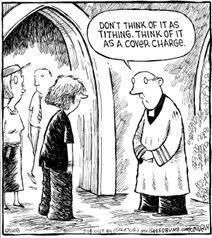
Should a Christian Tithe?

Should a Christian Tithe?  Tithe

I.  The Command to Tithe

Deuteronomy 14:22 “You shall tithe all the yield of your seed that comes from the field year by year. 23 And before the Lord your God, in the place that he will choose, to make his name dwell there, you shall eat the tithe of your grain, of your wine, and of your oil, and the firstborn of your herd and flock, that you may learn to fear the Lord your God always. 24 And if the way is too long for you, so that you are not able to carry the tithe, when the Lord your God blesses you, because the place is too far from you, which the Lord your God chooses, to set his name there, 25 then you shall turn it into money and bind up the money in your hand and go to the place that the Lord your God chooses 26 and spend the money for whatever you desire–oxen or sheep or wine or strong drink, whatever your appetite craves. And you shall eat there before the Lord your God and rejoice, you and your household. 27 And you shall not neglect the Levite who is within your towns, for he has no portion or inheritance with you.

28 “At the end of every three years you shall bring out all the tithe of your produce in the same year and lay it up within your towns. 29 And the Levite, because he has no portion or inheritance with you, and the sojourner, the fatherless, and the widow, who are within your towns, shall come and eat and be filled, that the Lord your God may bless you in all the work of your hands that you do.

  • the only commands to tithe are found in or during the Old Covenant


II. The Purpose of the Tithe

Numbers 18:21 “To the Levites I have given every tithe in Israel for an inheritance, in return for their service that they do, their service in the tent of meeting, 22 so that the people of Israel do not come near the tent of meeting, lest they bear sin and die. 23 But the Levites shall do the service of the tent of meeting, and they shall bear their iniquity. It shall be a perpetual statute throughout your generations, and among the people of Israel they shall have no inheritance. 24 For the tithe of the people of Israel, which they present as a contribution to the Lord, I have given to the Levites for an inheritance. Therefore I have said of them that they shall have no inheritance among the people of Israel.”

25 And the Lord spoke to Moses, saying, 26 “Moreover, you shall speak and say to the Levites, ‘When you take from the people of Israel the tithe that I have given you from them for your inheritance, then you shall present a contribution from it to the Lord, a tithe of the tithe. 27 And your contribution shall be counted to you as though it were the grain of the threshing floor, and as the fullness of the winepress. 28 So you shall also present a contribution to the Lord from all your tithes, which you receive from the people of Israel. And from it you shall give the Lord’s contribution to Aaron the priest.

  • purpose of the tithe was to fund a permanent priesthood in Israel


III. The Location and Spirit of the Tithe

Deuteronomy 12:17 You may not eat within your towns the tithe of your grain or of your wine or of your oil, or the firstborn of your herd or of your flock, or any of your vow offerings that you vow, or your freewill offerings or the contribution that you present, 18 but you shall eat them before the Lord your God in the place that the Lord your God will choose, you and your son and your daughter, your male servant and your female servant, and the Levite who is within your towns. And you shall rejoice before the Lord your God in all that you undertake. 19 Take care that you do not neglect the Levite as long as you live in your land.

  • to be taken to Jerusalem only
  • portions of tithe to be eaten with family, servants and local Levites (basically as a feast)


IV. Special Added Tithing

Deuteronomy 26:12 “When you have finished paying all the tithe of your produce in the third year, which is the year of tithing, giving it to the Levite, the sojourner, the fatherless, and the widow, so that they may eat within your towns and be filled, 13 then you shall say before the Lord your God, ‘I have removed the sacred portion out of my house, and moreover, I have given it to the Levite, the sojourner, the fatherless, and the widow, according to all your commandment that you have commanded me. I have not transgressed any of your commandments, nor have I forgotten them. 14 I have not eaten of the tithe while I was mourning, or removed any of it while I was unclean, or offered any of it to the dead. I have obeyed the voice of the Lord my God. I have done according to all that you have commanded me. 15 Look down from your holy habitation, from heaven, and bless your people Israel and the ground that you have given us, as you swore to our fathers, a land flowing with milk and honey.’

  • there is some disagreement amongst the commentators whether this added tithe represented a second or third 10%
  • most scholars lean toward two tithes (an annual 10% of everything and a second 10% of everything on the third year)
  • there were other donations required of the Israelite and there was also an encouragement to contribute freewill gifts which totalled to a annual “taxation” of 20-30%


V. An Example of the Tithe’s Re-institution


VI. It’s Omission a Cause for Chastening

Malachi 3: 7 From the days of your fathers you have turned aside from my statutes and have not kept them. Return to me, and I will return to you, says the Lord of hosts. But you say, ‘How shall we return?’ 8 Will man rob God? Yet you are robbing me. But you say, ‘How have we robbed you?’ In your tithes and contributions. 9 You are cursed with a curse, for you are robbing me, the whole nation of you. 10 Bring the full tithes into the storehouse, that there may be food in my house. And thereby put me to the test, says the Lord of hosts, if I will not open the windows of heaven for you and pour down for you a blessing until there is no more need. 11 I will rebuke the devourer for you, so that it will not destroy the fruits of your soil, and your vine in the field shall not fail to bear, says the Lord of hosts. 12 Then all nations will call you blessed, for you will be a land of delight, says the Lord of hosts.

  • obviously abandoned for pragmatic reasons
  • part of giving to God what He required was trusting that He would still supply all one’s needs


VII. Commanded in the NT to those Still Under the Old Covenant

Matthew 23:23 “Woe to you, scribes and Pharisees, hypocrites! For you tithe mint and dill and cumin, and have neglected the weightier matters of the law: justice and mercy and faithfulness. These you ought to have done, without neglecting the others.

  • remember that the New Covenant is not yet established so tithing was a genuine act of obedience to YHWH
  • by the time of Jesus the tithe had been so “midrashed” that it was an oppressive burden men tried to get out from under


VIII. Never Commanded for New Covenant Believers

  • there are no NT texts that command a Christian to give 10% of all he has to the Lord


IX. Why Do We Give Money to Church?

To Meet the Needs of Church Members

1 Timothy 6: 17 As for the rich in this present age, charge them not to be haughty, nor to set their hopes on the uncertainty of riches, but on God, who richly provides us with everything to enjoy. 18 They are to do good, to be rich in good works, to be generous and ready to share, 19 thus storing up treasure for themselves as a good foundation for the future, so that they may take hold of that which is truly life.


To Enable Pastors to Do the Work of Ministry

1 Timothy 5:17 Let the elders who rule well be considered worthy of double honour, especially those who labour in preaching and teaching. 18 For the Scripture says, “You shall not muzzle an ox when it treads out the grain,” and, “The labourer deserves his wages.”


X.  How Much Do We Give to Church

2 Corinthians 9:6 The point is this: whoever sows sparingly will also reap sparingly, and whoever sows bountifully will also reap bountifully. 7 Each one must give as he has made up his mind, not reluctantly or under compulsion, for God loves a cheerful giver. 8 And God is able to make all grace abound to you, so that having all sufficiency in all things at all times, you may abound in every good work.

  • the simple answer is… there is no set amount!
  • the NT pattern often links giving to need
  • we should give a lot (bountifully), thoughtfully (as made up mind), freely (not under compulsion), happily (God loves a cheerful giver) and trustingly (God will cause the bountiful giver to be a bountiful reaper)

Posted here.

The Sabbath Complete

THE SABBATH COMPLETESabbath

a review by Stuart Brogden

The latter half of the 20th century has brought a growing interest in Reformed Theology, in striking contrast to the growing apostasy that has gripped many evangelical denominations. Many of my fellow Baptists aggressively and happily embraced the doctrines of grace and the great theological truths about God’s sovereignty and man’s true nature. I am a grateful Baptist who was introduced to this theological construct in the ‘90s and have come to see as foundational to the Christian faith the doctrines of the Reformation, especially the reliance on Scripture Alone for all things having to do with life and godliness and For the Glory of God Alone to keep us focused rightly in all we think, say, and do. And the mostly forgotten doctrine of our forefathers – Semper Reformanda – Always Reforming, because none of has it all together nor will we get it all together while we inhabit these tents of flesh. This brings me to this remarkable book – The Sabbath Complete, by Terrence D. O’Hare. This book is the result of our author “attending an Orthodox Presbyterian Church where various Sabbath-keeping applications were stressed.” (page xi) Prompted by his pastor, who urged his congregation to examine personal motives in religious practice, he decided to study the concept of the “Christian Sabbath”, which is widely popular in churches which hold to 17th century confessions such as the Westminster Confession of Faith and the 1689 London Baptist Confession. O’Hare’s study lasted as decade, producing this comprehensive analysis of this contentious issue. His desire, and mine, is that people on both sides of this issue acknowledge the human tendency to cling to traditions (some of which, he shows, are fine and biblical), which can lead to traditions displacing true worship of God and Christ. The thesis of this book is “that Sabbatarianism is a form of traditional pietism and that the acceptance of the fully ceremonial nature of the Sabbath, though shocking to some, is actually Christ-honoring.” (page xiii)

The Sabbath Complete is organized into 12 chapters which examine various aspects of the Sabbath – prototypes, initial practice, law, feasts; how it prefigures Christ in the rest He earned, the Gospel He preached, His resurrection; and a historical review of the practice which has come to be known in the confessions as the “Christian Sabbath.” Coming in at more than 350 heavily footnoted pages, this book is thorough, enlightening, and thought provoking. It is my prayer to whet your appetite enough so that you will buy this book and study it. May the Lord be our wisdom and His glory our goal.

In his examination of the Sabbatic prototypes given to us in Genesis, O’Hare observes (page 1) that “God’s provision for our physical rest is but a token of a more transcendent remedy for our spiritual privation” and follows up (page 6) thusly: “Though God’s rest after creation is a type of everlasting rest yet to come, it is more certainly a type of Jesus Christ, who has come, in whom the faithful rest in salvation.” This snippet shows O’Hare’s focus on Christ – His provision and sufficiency, which is a constant, welcome, perspective throughout this book. As an expression of God’s sovereignty and redemptive revelation, our author reminds us (page 7), “Jonah did not just happen to be engulfed by a great fish and later ejected as a random biological event, but this occurred as designed by the Lord to shadow forth the death, burial, and resurrection of our Lord. Likewise, the seventh day rest was not a random terminus of creation but a purposed end point to shadow forth the inevitable results of God’s work in redemption.” This sets the stage for a book that is best read slowly, with an open Bible and notepad.

In addition to each Christian studying the Bible for himself, learning from credible sources of church history is very helpful as this sheds light on when and by whom our beloved traditions were started. O’Hare has helpful advice in chapter 9, wherein he reviews the shift to calling Sunday the “Christian Sabbath.” One of the earliest post-apostolic apologists, Justin Martyr, sheds light on the common-place view of Christians in the second century:

And on the first day called Sunday, all who live in cities or in the country gather together in one place, and the memoirs of the apostles or the writings of the prophets are read…But Sunday is the day on which we all hold our common assembly, because it is the first day on which God, having wrought a change in the darkness and matter, made the world; and Jesus Christ our Savior on the same day rose from the dead.”

For this most ancient brother, the Lord’s Day was on the first day not as a new instance of the Jewish Sabbath, but in concert with a remembrance of God’s creation and Christ’s resurrection – wherein we have the promise of having our decaying bodies made new like His. Our author laments how Christian traditions were often started not on the Lord’s revelation to us as New Covenant saints, but by imagining connections to Jewish traditions – “such as circumcision giving way to baptism and the Lord’s Supper approximating the Passover, came the forced and fanciful system of religious holidays common in the Roman Catholic Church.” (page 222) He then provides a lengthy quote from famous Roman Catholic Thomas Aquinas, explaining his support for these practices and then comments (page 223), “This teaching blurred the differences between the old and new covenants and paved the way for works orientation. … It was fitting for a better covenant to have fewer ordinances: one, performed only once that identifies the child of God as an heir to the kingdom, and the second, a recurring and sustaining ordinance of remembrance of the life and work of Jesus Christ. Again, similarity does not connote identity. Baptism is not a Christian circumcision, and communion is not a Christian Passover, neither is the Lord’s Day a Christian Sabbath. This is as absurd as calling the new covenant the “Christian old covenant.”” Did I mention that a Presbyterian wrote this book? He goes on to say, “It is plain that the circumcision of the Christian is spiritual and not ritual, and that it is actually the death of Christ, which was His circumcision, into which we were spiritually baptized.” In response to several sabbatarian authors (such as Walter Chantry) who press the “Christian Sabbath”, in part, as a means to restrain evil and provoke (coerce?) Christian worship, O’Hare rightly observes (page 225), “If Christ can raise up rocks to sing His praises (Matt 3:9), why would it be so difficult for Him to raise up His beloved, who are indwelt by the Holy Spirit, to worship at the appointed time (Ps 116:18-19, 122:1-2)?” Amen! Saints of the living God don’t need a command to gather together for worship and fellowship – we, by definition, love Him, are drawn to Him, and we love the brotherhood!

Each chapter of this book delves into history and Scripture to determine the meaning and origin of the various aspects mentioned in the first paragraph. Each is compelling and enlightening. Chapter 4 – Sabbath Law, examines the Jewish laws and traditions tied to their Sabbath and points out inconsistencies in the practice of modern Christian sabbatarians. In nearly every chapter, the diligent reader will be awed by the realization of how detailed the Jewish religion is as given to them by God and how it is much, much more than merely a quaint religion for those people long ago. The Jewish religion, as the book of Hebrews tells us, is mainly a means of communicating God’s eternal plan of redemption to the people He called out of the pagan nations, to protect the promised seed and make His name known around the world. These two priorities – to glorify the Lord and declare the gospel – are consistently the highest order for us humans. This becomes more and more clear as each chapter is consumed.

To keep this review from running 20 pages or more, I will restrict myself to chapter 10 – The Sabbath in Church History. This will put the “Christian Sabbath” practice so aggressively promoted and protected into its proper context. My desire aligns with the author’s – to have readers of this book see the first day of the week in its biblical context, stripped of the accumulated baggage of 20 centuries of religion.

Chapter 10 begins with the apostolic teaching, with O’Hare stating (page 244), “There are three crucial distinctions between Christianity and its roots in Judaism: holy things, the law, and the customs.” He sees some continuity and some discontinuity in the connection between the old religion and the new, acknowledging the law is good, and “Yet these ceremonial laws isolated the Jews from their pagan neighbors, became the point of contention and ridicule, and represented a wall of separation between the two peoples. This was meant by God to display the isolation between sinners and Himself – the Jew included – so when Christ abolished the ceremonies of Judaism, the gospel of peace and the law of moral commandments would become the unifying theology and practice for Jew and Gentile alike (Eph 2:14-16). … At the beginning of the Christian Church, it was a stumbling block to require Gentiles to observe Jewish rituals: “to whom we gave no commandment.” (Acts 15:24)”

The review of the Didache (50 – 120 AD) reveals no evidence of Sabbath-keeping by Christians; the review of Ignatius’ writings (page 247) shows “he clearly distinguishes between Jewish conduct on the Sabbath and Christian conduct on the Lord’s Day, to indicate the superiority of being a disciple of Christ.” He walks us through the records of Mathetes (130 AD), Justin Martyr (114 – 165 AD), Irenaeus (120 – 202 AD), Tertullian (160 – 225), Origen (185 – 254), Eusebius (265 – 340), Sylvester, Bishop of Rome (314 – 335), the council of Laodicea (364); all of which provide no support for the “Christian Sabbath” and often denounce the idea as being a Jewish encroachment in the church.

By the time Gregory I was installed as pope of the then-emerging Roman Catholic Church, traditions now associated with that religion “were already taking root, such as the liturgical mass, a monastic life, symbolic outfits, ecclesiastical hierarchy, and declaration of days to honor saints.” (page 261) O’Hare provides a lengthy excerpt from a letter to Roman citizens in which Gregory I calls those who forbid work on Sunday (which he called the Sabbath day) “preachers of Antichrist” and sums up: “Gregory’s core understanding is that the Sabbath is a fulfilled ceremonial law that should no longer be literally applied.” (page 262) O’Hare quotes R.J. Bauckham’s claim that Peter Comester (a contemporary of Aquinas and Chancellor of Notre Dame in Paris) was the “first exegete to apply the Sabbath commandment literally to Christian observance of the first day”. (page 263) Our author reminds us (same page) that “While it is helpful to acknowledge the scattered, yet progressive, acceptance of a physical rest on Sunday, it is more important to understand the bases for these practices in empiricism and religious authoritarianism.” History tells us what happened and provides evidence as to motives. The Roman Catholic Church explored ways and means to better influence her subjects, working with the legal authorities to provide a day off work and advocating Christian observance of Sabbath principles. “Their expectation that all citizens attend Mass in this church-state led to the need to force compliance through the appeal to Sabbath law.” Thomas Aquinas further developed this line of thought, “asserting that the old law contains moral (emanating from natural law), judicial (laws regarding justice among men), and ceremonial (laws touching on worship, holiness, and sanctification) precepts; and that these three can be distinguished in the Decalogue as well.” (page 264) This appears to be the first teaching of what is now cherished reformed doctrine – that the Law of Moses can be separated into these three categories and dealt with appropriately for new covenant saints. There should be no denying these three elements are found in the Law of Moses, but, as O’Hare shows us with Aquinas, determining what is ceremonial and what is moral is the rub. Aquinas recognized a moral teaching in the Sabbath commandment – people should worship God; he also recognized the ceremonial component, specifically the date upon which such worship is to be given. “At this juncture, Aquinas took the first step toward Sabbatarianism by moralizing a ceremonial command” by asserting the moral necessity of giving time to God. (page 265) Aquinas agreed with Augustine that moral laws are revealed by nature, so all men are without excuse. But in order to get man to be at mass and give to the church due obeisance, Aquinas saw value in elevating that which had been rightly considered ceremonial to moral status.

We will step quickly through the early reformers to show how this idea progressed. Philip Melancthon is quoted as saying, in 1530, “Those who consider the appointment of Sunday in place of the Sabbath as a necessary institution are very much mistaken, for the Holy Scriptures have abrogated the Sabbath and teach that after the revelation of the Gospel all ceremonies of the old law may be omitted.” (page 274) “Luther vacillates between his definitions of the Sabbath as a ceremonial law bearing no external application for Christians and a binding law incurring God’s judgment if disobeyed.” (page 279) John Calvin also had trouble being consistent in his view on this matter. In asserting “that the Sabbath was ceremonial and is moral leaves us open to problems concerning the nature of its existence – it is both abrogated and legally binding. This was further complicated by the church-state relationship that sought to mimic a theocratic Israel and by Calvin’s misconception that the biblical Sabbath required all Israelites to assemble at the synagogue.” (page 281) In his commentary on the Heidelberg Confession, written in 1563, O’Hare lists eight failures on the part of reformers that led them to embrace the “Christian Sabbath” (page 288):

  • Failure to familiarize themselves with the teachings of the early church fathers regarding the Sabbath.

  • Failure to expand the understanding of how the Lord’s advent fulfilled each specific Sabbath command beyond “resting from one’s sins.”

  • Failure to be consistent in the treatment of ceremonial laws and types.

  • Failure to satisfactorily explain why the ceremonial Sabbath was placed with the body of the Ten Commandments.

  • Failure to recognize the limitations of the Ten Commandments as a means to inculcate Christian ethics.

  • Failure to differentiate the biblical Sabbath from the tradition of the synagogue.

  • Failure to emphasize the authority of the apostles under the inspiration of the Holy Spirit to institute a new order of congregational worship.

  • Failure to distinguish the Sabbath from the Lord’s Day.”

In what may be the keystone paragraph in the entire book, O’Hare explains the meaning of the Sabbath commandment (page 289).

The Mediator is on the first table (of the Decalogue) because, unlike Moses, Christ truly comes from God and is fully God. Yet Christ, by becoming fully man, joins with man to make him complete. Man cannot become complete simply by keeping the law, but he must experience through faith a life-altering union with Christ. The ceremonial Sabbath is the evangelion within the Ten Commandments that addresses the redemption of man. It is Christ Himself who takes the place of the Sabbath in the Decalogue. The Lord’s Day is not a continuum of the Sabbath or its replacement; it is a fresh ordinance for the church of God based upon the completion of redemption that was twice sealed by the Lord, first by His resurrection and second by the descent of the Holy Spirit.”

This puts the Decalogue in the absolute best light for new covenant saints to understand it and relate to it. (Scripture never calls the Decalogue “The Ten Commandments”, but only and always “the ten words” – hence the term Decalogue. But “Ten Commandments” are much weightier in the mouths of religious overlords than are “ten words”. I would have liked O’Hare to address this aspect of the creeping incrementalism of religious lordship in the church.)

It was during this time that the early reformers also broke with the clear teachings of Scripture and the church fathers by beginning to teach the Sabbath as the product of a creation ordinance. This was taught by Ursinus who “may have adopted the theory of the Reformed Englishman John Hooper, who, in his widely published book, Declaration of the Ten Holy Commandments (1548), claimed that God instituted the Sabbath from creation. … So, only 300 years after Aquinas and fifty years after Luther, the admixture of the Sabbath and Lord’s Day developed into a general concept that the Lord’s Day is the Sabbath, fostering the idea that the Sabbath remains a viable force in Christian living.” (page 290) This creation-ordinance based “Christian Sabbath” was a major element used by state-churches on both sides of the Atlantic to coerce Sunday worship – just as Rome had learned to do, using the same unfortunate logic.

In 1973, the Orthodox Presbyterian Church published a report from a committee that had been formed to study the relationship of the Westminster Confession of Faith to the fourth commandment. In part, the committee reported:

The weekly Sabbath is an eschatological sign. This truth, central to the teaching of Hebrews 3:7 – 4:13 as well as fundamental to the entire biblical revelation concerning the Sabbath, does not find expression in the Westminster Confession of Faith and Catechisms. The reason for this would appear to be that the Standards mention the Sabbath commandment primarily in terms of its bearing on the more specific matter of public and private worship.”

The Westminster Confession of Faith was not changed to reflect the eschatological import of the fourth commandment. O’Hare, having taught in this book the nature of moral law (unchanging and universal), observes “If the Sabbath is not ceremonial or typological, it is not eschatological.” “Where”, he asks, “”can it be shown that the Ten Commandments summarize the moral law given to Adam? Where can it be demonstrated that the Sabbath commandment is purely moral?” (page 291) “Was the fourth commandment, as God gave it to Israel, about the Christian Sabbath or the Jewish Sabbath? Was there anything else in the fourth commandment that was abrogated than merely the day of the week on which it fell? Where can it be shown that God abrogated the Jewish Sabbath and installed a Christian Sabbath in its place? … So, besides omitting fundamental truths about the Sabbath, the Westminster codified interpretive errors that budded with Aquinas and blossomed with early Reformers.” (page 292)

In closing this very provoking chapter, O’Hare shows us that the fourth commandment not only commanded rest, it commanded work for six days. The Hebrew word in this commandment is in the Qal imperfect tense, which implies an on-going action – “you work”. “But, if the fourth commandment moralizes the example of God for man to obey, then it is as much a sin to work on the day of rest as it is to rest on the days of work. … if someone completes their (sic) work in three days and does nothing more for three more days, what exactly are they ceasing from on the seventh day?” He instructs us on two types of rest: “1) God’s rest signifies the promise of eternal life, and 2) Israel’s rest signified her faith in God alone. God’s work is redemptive, so man’s work is meaningless apart from that redemption.” (page 309)

The early church correctly believed that the Sabbath was a ceremonial command and welcomed the ordination of the Lord’s Day as a commemoration of the Lord’s resurrection. However, the ascension of church power through the state and the influence of rationalism allowed the medieval church to begin to associate the fourth commandment with the Lord’s Day. The Reformed church, by perpetuating the error of Aquinas, eventually expanded the scope of applications of Sabbath law and increased its moral muscle, forcing the church to practice Sunday Sabbatarianism.” (page 311)

He gives us eight conclusions which are supported by Scripture and history (page 311):

  • The creation account is not about the Sabbath. It is about the primal peace with God that was lost through sin because of a lack of faith. The pattern of creation – six days of God’s work and the ensuing rest – reverberates through Scripture to demonstrate God’s sovereignty in effecting the work of redemption by grace through the faith of man.

  • When Israel left Egypt they were given the Feast of Passover; a few weeks later in the wilderness they were given the Sabbath. At Mount Sinai, Israel received her full calendar of feasts. The Lord devised this new system of shadow laws to prefigure the person and work of the Messiah.

  • The Ten Commandments are a summary of the Mosaic laws and therefore contain both moral and ceremonial laws.

  • Christ in His earthly ministry was born under the law and obeyed the ceremonial laws as well as the moral laws.

  • Christ is the end of the law for righteousness. His work of redemption – His incarnation, death, burial, and resurrection – is the fulfillment of all shadow laws, even though some of them are yet to be manifested in their entirety.

  • The redemption of Jesus Christ initiated the new covenant. It is the fulfillment of what the former covenants forecasted.

  • The apostles had divine warrant to establish first-day worship. Scripture unfolds the transition from things Jewish to things Christian. First-day weekly worship was the normative practice of the early church, it did not move the Sabbath to Sunday.

  • While there is no explicit scriptural mandate for this transition, we have scriptural foreshadowing and history of first-day significance, and rationale. Christ’s resurrection and the inaugural descent of the Holy Spirit – the most important events of the church age – occurred on the first day of the weeks in fulfillment of Israel’s shadowy calendar laws.”

There is much, much more in this book than I can even hint at in these few pages – which are too many for most, I fear. Buy the book. Study the topics, challenge the author (I found a few places where I consider him to be in error), challenge yourself – for none of us has arrived any more than did any of the Reformers.

At the end of it all, why doesn’t this book, or anyone else, show from Scripture why the Jewish Sabbath command is not meant for the new covenant church? This is the wrong starting point. We look to Scripture to see what is, what God has revealed to us; not to prove a point. What we see in Scripture about the Decalogue is that is was an integral part of the Mosaic Covenant and the testimony or witness of that covenant (Ex 31:18, 32:15, 34:27 – 29). This key aspect of the Decalogue being a testimony of God’s covenant with Israel is further developed in Ex 25 and 26, with the ark being the “ark of the testimony” (see Ex 25:22 for emphasis). This is reminiscent of Ex 16:33 – 34 when Moses was commanded to put manna in a jar as a testimony God’s promise of provisions, seen in Ex 16:4 – 5. These are the most (only?) explicit statements in the Bible regarding the reason and purpose for the tablets and the ark – as a testimony of God’s covenant with Israel made on Mt. Sinai. Ezekiel 20:12 tells us the Sabbath is a sign between God and the Hebrews – marking their exodus from Egypt. It is not listed as a sign for the church, any more than water baptism is a sign and seal of that New Covenant. The burden is on the backs of those who say the Jewish Sabbath was, as the confessions say, abolished and re-established on the first day of the week, given to the church as the “Christian Sabbath.” That assertion, is found in paragraph 22.7 of the Second London Baptist Confession, yet established by no Scripture. Yet we do see in God’s Word the admonition for Christians to be understanding and accepting of brothers who lean on the practice of old religion (Romans 14 and 1 Cor 8) as well as stern rebukes for those who want Christians to practice old religion as a requirement (Acts 15).

The Sabbath Complete provides a comprehensive review and analysis of myriad aspects of the Decalogue and the Sabbath; examining the Word of God, the languages, and the historical context. Let the reader humbly go before Holy God and plead for understanding rather than rely on his own “wisdom” or unexamined presuppositions that we all hold too closely. Remember those who went before us – they knew they were fallible, yet many of them acted as if they were complete in their understanding of God’s Word. Yet they stood under the banner of Sufficiency of Scripture and all for the glory of God – as we must. But let these slogans of an bygone era be not merely nifty phrases we use to show our credentials, let each of us also acknowledge that we must be reformed and reforming for the glory of God, for He alone sees and understands perfectly.

This book is available on Amazon and directly from the publisher, at a competitive price.

God’s Moral Law

This post is a quiz! Most Christians acknowledge a moral law at work in all men, seeing this in myriad places vU2zJin Scripture – most explicitly, perhaps, in Romans 2: For when Gentiles, who do not have the law, by nature do what the law requires, they are a law to themselves, even though they do not have the law. They show that the work of the law is written on their hearts, while their conscience also bears witness, and their conflicting thoughts accuse or even excuse them.

Here’s the quiz: Where is the moral law defined in Scripture and when was it given to man? Please reason your answer to this two-part question with the Word of God. The goal here is to stir our thinking and draw us to Scriptures, not relying solely on what men have taught us.

I’ll tell you what think after some of you answer. Have fun!

~~~~~~~~~~~~~~~~~~~~~~~~~~~~~~~~~~~~~~~~~~~~~~~~~~~~~~~~~~~~~~~~~~~~~~~

Thanks to all who participated! It’s not likely what you will read next will satisfy everyone, but please read carefully and seek to understand what is written.

One of the problems we must all acknowledge is that the Bible does not provide a definition of “God’s Moral Law”, nor does it use that term in describing it. This is where many presuppositions come into play.

Three statements for your consideration: 1) There is a moral law from God that has been written on every soul, leaving no person with an excuse to claim he did not know. 2.) This moral law was given to man at the Fall, not at Creation. 3.) This moral law shines through the Decalogue, is not defined nor contained in the Decalogue.

As for the first point, I think the citation from Romans 2, above, proves that well enough. Those who want to argue against this point will have to be very calm and biblical to be heard. As for the second point, consider the biblical record: before the Fall, Adam and Eve had fellowship with God and knew the goodness of God. It was not until after Adam sinned that they had knowledge of both good and evil (Gen 3:7 and 22). As Paul wrote in Romans 7, knowledge of the law (here, he is talking about the Decalogue, which applied the Moral Law to the Hebrews) brings knowledge of sin. Adam knew not sin until he sinned. Since he sinned, he had need of the Moral Law. God wrote His Moral Law on Adam’s soul and Eve’s when He banished them from the Garden.

Thirdly, the Moral Law of God shines through the Decalogue, which applies that Law to the Hebrews, wrapping it in ceremonial language that applies to them alone. If one looks at the biblical context and direct biblical commentary about the Decalogue, there is no reason to claim those “tablets of testimony” as binding on all men everywhere. The 17th century theologian John Owen observed this in his Works, 22:215:

The nature of the decalogue, and the distinction of its precepts from all commands, ceremonial or political, comes now under consideration. The whole decalogue, I acknowledge, as given on mount Sinai to the Israelites, had a political use, as being made the principal instrument or rule of the polity and government of their nation, as peculiarly under the rule of God. It had a place also in that economy or dispensation of the covenant which that church was then brought under; wherein, by God’s dealing with them and instructing of them, they were taught to look out after a further and greater good in the promise than they were yet come to the enjoyment of. Hence the Decalogue itself, in that dispensation of it, was a schoolmaster unto Christ. 

But in itself, and materially considered, it was wholly, and in all the preceptive parts of it, absolutely moral. Some, indeed, of the precepts of it, as the first, fourth, and fifth, have either prefaces, enlargements, or additions, which belonged peculiarly to the then present and future state of that church in the land of Canaan; but these especial applications of it unto them change not the nature of its commands or precepts, which are all moral, and, as far as they are esteemed to belong to the Decalogue, are unquestionably acknowledged so to be.

I share Owen’s basic point, but differ in some details. What we see in Exodus 20 is not equal to the moral law, but communicates that law in the context of the covenant God made with Israel. I think there are “prefaces, enlargements, or additions, which belonged peculiarly to” Israel in the 2nd through 5th and the 10th  words of the tablets. Read what is recorded in Ex 20 and compare it to Deut 5 and ask yourself if what Owen and I say is true. Then realize that God’s Moral Law must be discerned by careful reading, studying and prayer. Failure to do this has caused many to blithely assume the Decalogue is equal to God’s Moral Law (something first proposed by a Roman Catholic in the 12th century). The difficulty in interpreting and applying the Decalogue as God’s Moral Law can be seen in the last 1,000 years of church history.

If there is interest, I would be willing to post a four page article I wrote last year as a result of studying this question in context of how the 1689 London Baptist Confession addresses it.

The Road to Emmaus

The biblical passage in Luke 24 known as the Road to Emmaus is – like many passages – twisted and misused, Emmaussometimes innocently, many times intentionally. There is a mystical three-day retreat called The Walk to Emmaus (also known as Chrysalis) that was modeled after the Roman Catholic retreat known as Cursillo, which started in Spain in 1949. These two retreats are like identical twins – not the same, but very much alike. And both are embraced by a wide range of churches – including Methodist, Episcopalian, Lutherans, Presbyterian, and Baptist.

You can read about The Walk to Emmaus here: http://emmaus.upperroom.org/ Their FAQ are most informative, and all copyrighted. Here’s another web site where a Baptist who attended one of these retreats discusses the event and explains why evangelicals should not participate.

All that background to bring your this – a wonderful sermon from the text of Luke 24:13-35, wherein we are reminded that the Lord opens eyes to see truth, that seeing is not believing, and that those who are given sight and hearing will respond to the Savior. Pull up your chair and give a listen – you will be glad you did.

The Holy Spirit and Reformed Theology

Some books are a chore to read – because of content and/or style and/or the author’s competence as an author. Some books are a joy to read – the content is excellent, the style is engaging and the book is well written and Holy Spiritorganized. This book is such a book – joy unspeakable! Yet about this book, I will speak.

I received this book from a friend who manages a library at a Christian Seminary and wanted someone to read and review it. He got first peek at the review, ya’ll get it as a close “second”.

The Holy Spirit and Reformed Theology

edited by Joel Beeke and Derek Thomas

One area many reformed theologians tend to ignore is the person and work of the Holy Spirit. There is a legitimate concern by most preachers about exalting the Lord Jesus and being faithful to His gospel, but no preaching or evangelism or Bible study would be worthwhile if the Spirit of the living God did not faithfully attend each of these. This book – a compilation of articles on various works of the Holy Spirit, written by 9 Baptists and 9 Paedobaptists – is a wonderful examination of the biblical doctrine of the Holy Spirit. It was written in tribute to the work He has done in the life Geoff Thomas, a faithful gospel minister who has served half a century in the local church our Lord called him to. I have personally benefited greatly from Geoff Thomas’ commentary on Daniel and was most eager to read this book.

The Holy Spirit and Reformed Theology is divided into four sections – Geoff Thomas: Faithful Instrument of the Spirit in part I; Salvation and the Spirit of Christ in part II; Growth and the Spirit of Holiness in part III; and Ministry and the Spirit of Counsel and Might in part IV. As you can see from the section titles, the authors recognize and highlight myriad functions and characteristics of the Holy Spirit. The reader will come away from this book with a heightened sense of the power and majesty of the third person of the Holy Trinity.

I will highlight one chapter to give you a taste of the quality and penetrating theology the authors provide. Fred Malone’s chapter, #6, is titled The Holy Spirit and Human Responsibility – a topic I think many Christians fail to properly comprehend. Malone opens with an observation from Geoff Thomas’ book, The Holy Spirit: Man is fully responsible for his behavior and God is fully sovereign in His work to conform man to the image of His dear Son. In stark contrast to the “higher life” movements which advocate a theology of “let go and let God” and the self-improvement psychology, a biblical view of sanctification acknowledges the tension Thomas proclaimed.

Infamously promoted by the Roman Catholic Church is the conflation of justification and sanctification, leading to confusion about both doctrines. Justification is completely monergistic – by grace alone through faith alone in Christ alone. Sanctification involves man’s effort, so it is not the monergistic work of God alone – yet neither is it rightly called synergistic. This term conveys a process which depends on both elements – in the case of sanctification those are God and man. The truth of biblical sanctification is this: man cannot sanctify himself apart from the indwelling work and power of the Spirit of God; but the Holy Spirit can and does sanctify man without the man’s cooperation, though this should not be our aim. Our responsibility before God is to work with the Holy Spirit, not grieve Him.

In outlining this concept, Malone tells us, “Man does not regenerate himself; God does not repent and believe for man.” Sinners are made able and willing to repent and believe by the Spirit’s work of regeneration. Our nature is changed and we then “choose Christ” – because He first chose us. Our author points to Philippians 2:12-13, saying it “presents the earthly pursuit of Christlikeness as one hundred percent a sovereign work of God the Holy Spirit who works with us and also one hundred percent the work of man with his new God-given ability. If this two hundred percent sum sounds illogical, then we must bow to God’s Word, not man’s logic.” Let all the saints say, Amen!

Malone gives the reader a couple of wonderful paragraphs on the individual’s role in sanctification, with many Scripture passages (pages 76 and 77) and follows up with a short warning: “We cannot blame God for our lack of conformity to Christ.” He explains, “Every step we take forward in Christlikeness brings one hundred percent glory to God alone. However, if we are lacking in that conformity, we must take one hundred percent of the responsibility for that failure and press on by faith.” If this exhortation does not convict as it encourages us to trust all the more in the Lord, then “let a man examine himself to see if he be in the faith.”

This chapter ends by proclaiming the critical nature God’s Word plays in the justification and sanctification of God’s saints. As is pointed out elsewhere in this book, the Holy Spirit inspired the Scripture, equipped the men who put the Word into print, accompanies the reading and preaching of the Word to do His unique work in each predestined child who awaits (unknowingly) his redemption. “So Christians must give full attention to learning the Word of God to grow thereby (1 Peter 2:1-2).” Christian, do you value the Word of God? By this, I ask, do you read it with a humble heart seeking to meet with your maker and judge and Savior? I leave you with one more quote from Malone – “to the degree we live believing the indicatives of grace revealed in the Word – the love of God for us in Christ’s salvation, the unfailing faithfulness of God to His promises to work in us – so we grow in obeying the imperatives of the Word unto further sanctification and Christlikeness.”

Dear reader, the Holy Spirit is God and He works in and through His Word, to raise spiritually dead men to new life, to give them a new nature that loves rather than hates God, to cause us to want what is good and hate what is evil. This book provides a most valuable look at the depth and breadth of His work, highlighting what He does mostly in secret because His role is to bring honor and glory to the Father and the Son. Praise Him!