Sermon: False teachers.

In this sermon, Pastor Mike Butler teaches from 2 Peter 2:1-3 covering the characteristics and conduct of false teachers, and ultimately, their condemnation.

Pastor Butler also pulls no punches when he calls out Redding, California’s Bethel Church and longtime celebrity leader/teacher/pastor John Piper. This kind of boldness in warning the sheep about specific hirelings is desperately needed in the church today.

You can download Pastor Butler’s sermon, entitled False Teachers, here.

(Part two of this message can be downloaded here.)

Salvation is of the Lord!

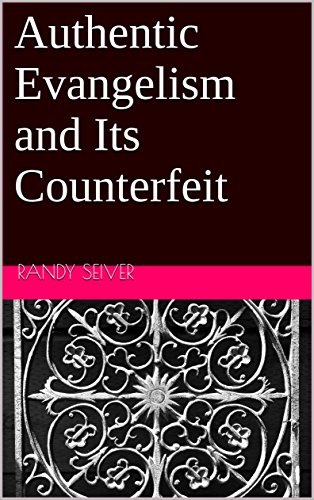
Authentic Evangelism and Its Counterfeit

Of all the charges we have been given by God, is there any more serious and important than the gospel? If we rightly believe that reconciliation of sinners with holy God is the most vital part of life, then the role given us by God in His grand redemptive plan must be worthy of our close attention. It is call to properly understanding and proclaiming that gospel our author strives to impress upon the reader in this fine book.

Seiver’s book is presented in 3 parts, focusing on the necessity of evangelism, the biblical pattern for evangelism, and the theological foundation for evangelism – which takes up the largest space in this book. This reflects what should be common knowledge among the children of God – our practice in all things related to our faith is informed and formed by what we think of ourselves and of God; our theology. This is why, for example, the first 11 chapters of Romans is a seminary in theology and the last 5 are how it works out in the lives of individuals and the local church.

One statement from the introduction that sticks out – the gospel “is not even primarily about sinners going to heaven when they die. It is about the manifestation of God’s glory in the contrivance and execution of the plan of redemption.” Being reconciled to God, being with Him in a state of being unable to sin, showing forth the glorious saving grace found only in Christ Jesus – that is the great prize. Since the Bible tells us (Mark 4 – parable of the seeds) that good soil will produce much fruit, and that the seed is the Word of God, we conclude two things that Randy puts before us: The Gospel is God’s message, not ours; and the fruit produced by our message will reflect its source. A false gospel will produce false converts – God promises to attend the proclamation of His Word, not the “wisdom of man”.

Part 1 defines Calvinism, Arminianism, and these views affect evangelism; about which he says, “We can define evangelism as the proclamation of the good news that God has universally published his terms of peace … this proffered pardon is not based in any sense on the sinner’s willingness to return to God or on his believing acceptance of the terms of peace. Pardon is based solely on Jesus’ redemptive accomplishments on the sinner’s behalf.” Our author bids us cast aside our traditions and concepts and jargon that is not found in the Bible; this should be solid ground but I have been amazed at how few people agree with the idea or with working it out to align with Scripture. This will be the rub for many who read this book. I would encourage anyone interested in the idea of biblical evangelism to take and read.

Bottom line from part 1: “People become effective evangelists when they are so filled with the knowledge of God’s glory and of his truth that they simply cannot be quiet.” That is what the Bible records and that is very good counsel.

Part 2 opens with this jewel: “Whenever we search for a biblical pattern for any aspect of the church’s life and ministry we need to understand that such a pattern is established in the didactic passages of the New Testament Scriptures, not in the historical and hortatory passages.” I dare say that many of the errors so prevalent in church life today are the result of normalizing narratives.  Combine that with the long ending of Mark and you have people handling snakes and drinking poison as if commanded to do so by God to demonstrate faith in Him.  As you read the chapters in this part, your thoughts of evangelism will likely be shaken, as many of the practices in our churches are not found in the Bible, but are established only as traditions of men.  Randy sums much of this section up with this: “the message preached to the unconverted included no call for them to believe that Jesus died for them. It simply demands that sinners leave their sin and their wicked and misguided thoughts about God and return to his way. It assures them that when they account God to be faithful to keep his promise, he will pardon them in Jesus’ name (by his authority and through his merit).”

Part 3 is the longest, focused on the proper theology behind evangelism. He spends time presenting a biblical view of God and tells us, “It is never right to conclude that God is unfair [unrighteous] because he did not act in a way that meets our standard of right and wrong.” It is OK for the Christian to admit he doesn’t understand something; it is flat out wrong to say something clearly taught as God’s will is not right. We are reminded of our main goal in life – the glorify our God, and our author highlights how ur gospel proclamation fits into this: “We preach the gospel because it is in line with God’s great purpose—that is, to make his glory known in the earth.” What can be more glorious than the displayed mercy of holy God as He redeems sinners and makes them fit for His house? If some do not hear our message, we do not lose heart – our goal is to be pleasing to our Savior. He bids us to sow the seed He has given to us, not to presume to know or determine the nature of the soil into which we sow.

This section of the book covers other topics, such as the authority of Scripture, the nature and purpose of salvation, God’s eternal purpose, repentance and faith, and conferring assurance.

You are likely to disagree with some of Mr. Seiver’s conclusions or the details of this or that. But unless you want to sit in judgment on God, you will find yourself in vigorous agreement with his over-arching thrust – salvation is of the Lord!

You can buy this book here.

Be Faithful

Many a man proclaims his own steadfast love, but a faithful man who can find? The righteous who walks in his integrity—blessed are his children after him!   ~Proverbs 20:6-7.

When I was a child, I was amazed at how many adults did not keep their word. They would promise, “One day, I’ll _________” but, alas, that day never came, and I would be disappointed.

When I was a teenager, my mom hired a man to tune our piano. I enjoyed watching him, and he talked to me as he worked. In the course of conversation, I mentioned that I like southern gospel music. He told me he would take me to a concert sometime. At that time, I’d lived long enough to know people often said things they didn’t mean so I didn’t figure I would ever see him again. A short time later, however, he called and asked if he could take my brother and me to a concert. This was over 25 years ago, and I still remember his kindness. He could have gone to the concert by himself, and I would never know, and I probably wouldn’t remember him but he took time to honor his word, which still blesses me today.

promise

It is sad to me how many young people walk away from the Lord or never embrace Christianity, even when they have grown up in church and in Godly homes. I’ve fought to understand why, in order to be able to stop this trend. I believe a big reason for this is due to the hypocrisy they see in their parents and others in the Church. I know this is not the only reason an adult child will rebel but I expect it is the case in many situations. Young people pick up on whether people are real or phony, honest or crafty.

Even as an adult, I want to surround myself with people I can trust. I get so tired of dishonesty, backbiting, double lives, etc. I pray often that God will help me to be faithful. I want to be dependable, loyal, and trustworthy. I want to be faithful to point others to the Lord, not only in word but also by example. I believe if the world saw more faithfulness in God’s people, they would desire to know this God as well.

Moving Forward

Hello Brothers and Sisters,

Of recent times, I have been doing much soul-searching in particular as it applies to Defending Contending. I have seriously considering everything from closing it down to transferring ownership to another person. However, the more I have considered this, the more tense I became. This was not because it has been mine for so long, but because this has been an opportunity that the Lord has used to help me to grow and to be able to share with others. I have been writing at Defending Contending for 9 years come the end of January 2017.

During that time, there have been things I have both read and written that I have cringed. There are posts written that have caused my heart to break before the Lord and I have had to seek repentance for my own stubbornness and lack of Christ-likeness. We have gained many viewers and lost more than we have gained. I believe that we are in a state of flux within evangelical Christianity and my heart has long been to reach out to our readers in a way that still point out the truth without being hateful, spiteful, or vitriolic in any manner even when we disagree with others.

With that in mind, I believe for the time being that a change in direction will be a profitable move. I want to lay these out just briefly.

climateoftruth

1. A new name – Truth In Grace — Reason is simply because we are truly called to preach and teach truth, but I believe we are called to do so with grace. The new picture on the website says, “Truth without grace is a prison; Grace without truth is chaos.”
2. A new tagline – “Sharing truth and faith in a spirit of love and grace.”
3. A new direction with posts
4. Additional contributors — I have just this evening reached out to two people that I believe could be a blessing to our readers.

I believe that this new direction, name change, and tagline are still very much in line with where The Pilgrim was going with the blog when he started it. Yes, we have all had to learn and I pray this will continue to reach others with a gracious spirit years in to the future.

However, I know that with the additions and changes, there will be other differences to deal with which is another reason for writing. Not all of us, even now, are in full agreement on every aspect of doctrine. I have no doubt that our differences are not salvific in nature, but I also understand that can be debated by some if they choose a hard line on some points.

For example, through the ages, men like Spurgeon, Sproul, MacArthur, Wilkerson, Conway, Baucham, Lloyd-Jones, etc. would have all agreed on many points of foundational truths that are unassailable, but they would have disagreed on some doctrines that, in my humble opinion, do not make a difference in whether a person is a true believer or not. Another example would be where Lloyd-Jones stood on the work and role of the Holy Spirit as compared to say Sproul or MacArthur. Yet, I have no doubt that they would have been gracious to each other and would have learned from each other.

Many of you know that I hold to the doctrines of grace, but it is not a drum that I have ever made a point of beating others up on. I can respectfully agree to disagree with another and still call them my brother or sister in Christ. I can disagree on things like family integrated or Sunday school, or in the style and meaning of missions, or in the version or music styles I choose to use and still call the other side of the coin a brother or sister in Christ.

Not everybody who has or who will write at DefCon are staunch Calvinists. Each of us are at different points in our Christian walk, and even one who is mature in the faith in many areas can still have much to learn as though they were a new believer. Brothers and sisters, as I get older, my heart’s desire is that my mind would be brought into closer communion with the Lord of glory. We will not be found in glory based on or divided into groups according to what we believed on certain issues. We will be in glory because of what Christ alone has done for us.

I know that each of you will have to make decisions as to what direction you will go into the future. As for me, this is where I believe the Lord would have me to walk. My issue will be that every post provides encouragement, edification, or exhortation according to the principles of God’s Word. Simply put, my intention is not to linger on one issue, one doctrine, or even appear as though we are nothing but a discernment blog. The new blog will be so much more, as the Lord blesses and is glorified.

If you have any questions, thoughts, or concerns, please feel free to reach back out to me.

I am so thankful for all we have been through down through each season that you have been part of our readership. My prayer is that this will continue for a long time, but it needs to move in a new direction effective immediately. You are my brothers and sisters in Christ even if we do not ultimately agree in the end. Thank you for your understanding.

In Christian love and grace,

Mark Anthony

My post-election thoughts.

Trigger warning: some brutal honesty ahead.


img_1214TO THE OVERPAID CELEBRITY HACKS
Oh, the horror! The end of the world is coming. Hurry, pack up and leave the country (like you promised you would).


TO THE SOCIAL JUSTICE WARRIORS
See above.


TO THE TRUMP SUPPORTERS
img_1028He better be as good as he claims to be (and you say he is).

If he really wants to break from the establishment, a nice place for him to start would be 1). Restoring the lost concept of liberty in a nation that boasts it as its foundation. 2). Preserving the sanctity of life in the womb AND in unnecessary foreign wars by bringing an end to both of these profit-making vehicles of death.

(I won’t be holding my breath.)


TO THE RANK AND FILE HILLARY SUPPORTERS
img_1218Now that the election is over, please, stop the fear mongering. It got old with all the frightful “What evils Trump might do if elected” rhetoric all the while conveniently ignoring “What evil Hillary did do during her entire criminal career.”

And relax. Trump will not be nearly as bad as you painted him over your past year-long effort to make Hillary look better. My advice for next time, nominate a candidate whose platform has some legitimate accomplishments instead of propping up your entire campaign on, “My opponent said a mean thing.”


img_1200TO THE CHRISTIAN VOTERS
It was nice for some of you to finally wake up and declare that politics is utterly corrupt, and for even considering voting for a third party candidate instead of whatever RINO was paraded out for you to vote for.

Unfortunately, many of you only came to this conclusion after your “saviors” Carson and Cruz fell from contention. Only time will tell if you crawl back to your political idols like a dog returns to its vomit. For those who will never go back, welcome! It’s nice to have you.


CONCLUSION
For the second presidential election in a row I have chosen to vote for a candidate based on his stance on the issues, instead of voting for the lesser of two evils. And although my guy didn’t win (or even come close), I feel good about my vote (not dirty like so many other voters said they felt yesterday).

img_1212So, how do I feel today? I’m glad to finally see an end to the Clinton crime family, it’s unabated corruption, and its shameful scandals.

Jezebel and Ahab have fallen. Good riddance.

The Sufficiency of Christ

Brian Hedges’ book, Christ All Sufficient, an Exposition of Colossians, is a welcomed book in 9781633421219any Christian’s library. It is widely recognized that Colossians is perhaps the most Christocentric book in the Bible; every preacher loves to preach from this text. Hedges’ book adds a rich tapestry of theology and doctrine to our understanding of this epistle that will cause the reader to rejoice and be in awe of his Savior.

Ten concise chapters bring out various themes from this letter in a consistent focus on our main goal in life – to glorify our God and King. Our author covers the gospel from three perspectives – the power of the gospel, the ministry of the gospel, and the mission of the gospel; all it very well presented and founded on the epistle being examined.

What thrills my soul the most and what ought to stir any saint to desire a deeper walk with Christ is the study of the nature and work of the Lord Jesus. In his chapter titled The Supremacy of Christ, Hedges reminds us that Jesus is “not only reveals to us God’s character and nature, he also perfectly bears the imago Dei as the Adam. He shows us what it means to be truly human.” (page 52) Since the first Adam, each of us has born the image of God in a twisted, marred manner as we were marked by sin from conception and every thought that followed. Jesus is the perfect image and He will be among us on the new earth. Hedges also reminds us of Jesus’ role in creation and in holding things together, as all things were created by Him and for Him. “The implications of this for believers is astounding … believers should never live in fear …” (page 54)

As Col 1:20 tells us Christ brings peace with the Father, our author rightly tells us “Peace is more than just a cease-fire in the conflict between God and humanity: it is the restoration of cosmic and relational harmony under the supreme lordship of Jesus Christ across all domains of existence.” (pages 57 & 58) There is nothing to fear in this life where all they can do is kill the body. Our refuge, our security is eternal and is more secure than anything all the armies of this age could provide.

In chapter V on the Sufficiency of Christ, we are encouraged to walk in obedience to our Lord with thanksgiving. We are complete in Christ, united with Him who is the fullness of God. Paul wrote that the ordinances against us were nailed to the His cross, a vivid word picture that communicates the imputation of sin onto Jesus. Horatio Spafford put this in lyrics that Hedges quotes and every Christian ought to love:

My sin, O the bliss of this glorious thought!

My sin, not in part, but the whole,

Is nailed to the cross, and I bear it no more,

Praise the Lord, praise the Lord, O my soul!

Addressing Col 2:15, Hedges tells us, “Paul here alludes to the victory parade following a Roman victory, an image also appearing in 2 Corinthians 2:14.” (page 86) and follows up with “The powers of darkness thus have no claim and can pose no threat to those who are in Christ.” (page 87” I think our author was channeling Martin Luther:

And though this world, with devils filled,

Should threaten to undo us,

We will not fear, for God hath willed

His truth to triumph through us.

The Prince of Darkness grim,

We tremble not for him.

His rage we can endure,

For lo, his doom is sure.

One little word shall fell him.

That one word, of course, is the person of Christ – none other. Confidence in Him, the one in whom there is salvation; that is what this book builds up. Colossians is God’s Word about the person and work of God’s Son. Brian Hedges’ book gives the reader an excellent look into some of the deeper, richer meanings of what the Spirit spoke through the apostle.

Two Kingdoms

It saddens me to see so many Christians get wrapped up in politics. We have virtually no sense of history (the early days of what used to 26822be a representative republic were far wilder than the current election cycle) and seem to have lost sight of the two kingdoms in play. Augustine likened them to Two Cities.

The Bible is clear – God created three units of government for this age: the family, the state, and the church. We do not read of any of the apostles nor the Lord trying to overthrow the Roman government, although that is the charge brought against Jesus by the Jewish leaders.

We are not selecting a theologian-in-chief this year. We have not had a solid Christian man in the White House in the past 100 years; all of them have put politics above Truth for the most part. We play into the hands of the world when we try make this country into the mold we imagine for it. But no matter how much we desire a secure temporal future under a God-fearing government, that is not where our security lies.

The best thing for this country would be political leaders who cling to the Constitution, just as the best thing for our local churches are men who cling to the Scripture.

The political machinery in D.C. all works together to consolidate power at the national level (the Whig Party lives in the policies of both current parties). No matter if your favorite President was Woodrow Wilson, Ronald Reagan, GW Bush, or Bill Clinton (all professing Christians) – none of those men were able to put this country on the foundation of Scripture. That is not the job of the President.

If your view is that you must vote for a truly godly person as President, how is your position different from the Jews who clamored for a king like the pagan nations had, discontent with having YHWH as their King?

A President who will work against the status-quo and try to push the national government back to it charter document will do this country good, no matter what you or I think of his theology.

Truth or Tradition?

Tevye, Jewish patriarch in Fiddler on the Roof… truth or tradition

It’s a very busy, tedious, hard-scratch life in Anatevka. And how do we keep our balance? That I can tell you in one word!             Tradition!

Because of our traditions, we’ve kept our balance for many, many years. Here in Anatevka, we have traditions for everything. How to sleep. How to eat. How to work. How to wear clothes. For instance, we always keep our heads covered, and always wear a little prayer shawl. This shows our constant devotion to God.

You may ask, how did this tradition get started? I’ll tell you. I don’t know.

But it’s a tradition. And because of our traditions, every one of us knows who he is and what God expects him to do. Without our traditions, our lives would be as shaky as,   As…  As a fiddler on the roof!

As his family responds to the various circumstances of life, they each tear apart Tevye’s sacred traditions bit by bit. His traditions were not transcendent; their foundation was uncertain.

What can we learn from this movie?

Most Baptists recognize that a major part of the errors embraced by Roman Catholicism are enshrined in extra-biblical traditions that are held up as church dogma. While it’s easy to see this in the Roman religion, do we carefully examine our own walk – as individuals and churches – to see if we are guilty as well? I am quite sure we all know the teaching of Scripture on this topic, as Christ quoted Isaiah in saying to the Jews, in vain do they worship me, teaching as doctrines the commandments of men.’  You leave the commandment of God and hold to the tradition of men.” And he said to them, “You have a fine way of rejecting the commandment of God in order to establish your tradition!” Are we Baptist excluded from this rebuke? My personal experience indicates otherwise. I pray these things are not true of you!

When I was first called as a deacon, it took 6 months of discussion to agree that tithing was not a requirement of that office. I was thankful the other deacons were willing to study this topic rather than merely throw me out. When I was in a seeker sensitive church I was ridiculed because I questioned this teaching, not seeing evangelism as inviting lost people to church, as I studied the Bible.

Baptists have traditions and, like Tevye, we often do not know or care where they came from.

While in a 1689 LBC church, I saw how traditions were to be supported without question, and I was looked down upon for not taking these positions on blind faith. The Decalogue is God’s moral law – why would anyone ask where that is taught in Scripture? The “Christian Sabbath” is binding on all people – why would anyone ask where in the Bible this is found?

In the two years since moving to SE Oklahoma, I’ve been exposed to several local Baptist churches and been intrigued by the extra-biblical traditions they embrace. Just as the other groups of Baptists, they are tenacious in the blind faith they have in their sacred traditions. It’s as if, as one church-man said about his “altar call” – “It’s the most important part of the worship service!” And it’s nowhere found in God’s Holy Word. What’s more, there is no altar in the New Covenant church other than the Lord Jesus Himself. Similar attachments are tied to children’s church (unsaved people have their own worship service!) and children parading through the gathered saints, begging for money to put in an offering plate, being applauded by the adults. I couldn’t help but think of Matthew 6:1-4:

Beware of practicing your righteousness before other people in order to be seen by them, for then you will have no reward from your Father who is in heaven. “Thus, when you give to the needy, sound no trumpet before you, as the hypocrites do in the synagogues and in the streets, that they may be praised by others. Truly, I say to you, they have received their reward. But when you give to the needy, do not let your left hand know what your right hand is doing, so that your giving may be in secret. And your Father who sees in secret will reward you.

In this passage we see that the praise of men is the only reward hypocrites have for their giving; it is not accepted by God as are the gifts from the saints on behalf of the saints (Philippians 4:14-18). The parading children played the part of the hypocrites in the passage cited above, with the adults playing the part of the “others” who praised the hypocrites. As with other acts of worship, giving as worship cannot be performed by those who are not clothed in the righteousness of Christ (Proverbs 21:27) and the money earned by sin should not be offered to God (Deuteronomy 23:18).

Celebration of birthdays and wedding anniversaries of all present in a worship service are the norm. Mothers and fathers are honored on those days so identified by the greeting card industry. Veterans and firemen, et al. are honored on Memorial Day as if these men are why we gather. I’ve seen the inside of a Baptist church building virtually clothed in American flags on July 4th weekend.

All of these practices displace the worship of God with lesser things, making man and his domain the focus of at least part of the time God’s people gather to supposedly worship Him.

The standard Baptist membership covenant from the 19th century requires members “abstain from the sale and use of intoxicating drinks as a beverage.” The Bible forbids getting drunk and warns about “strong wine” but does not prohibit the sale or use of alcohol for any but a few, such as Nazarites (Numbers 6:1-7). At the end of the time of his vow, the Nazarite was permitted to drink wine (Numbers 6:13-20).

Baptists call the church building “the house of God,” forgetting one lesson from John 4 – that in the New Covenant there are no sacred spaces and that the Bible clearly declares we are the house of God! The church building is not a sanctuary, it is, as an Anglican from New Zealand put it, a rain shelter. Our sanctuary is in heaven where our altar is – Christ Jesus is our all in all!

Baptist churches have sole “pastors,” “senior pastors,” “administrative pastors,” “executive pastors,” “worship pastors,” and the list goes on. All the while the Bible shows a plurality and equality of elders (“Pastor” not being a title found anywhere in Scripture).  Having two or more men who preach and teach provides several benefits, in addition to aligning with the examples and teachings from Scripture (Acts 11:27-30; 14:21-23; 20:7; Titus 1:5; James 5:14; et al.). Two or more men can sharpen one another and hold each other accountable, while the church sees the true Shepherd more clearly when they see Him work through more than one man. The church will see strengths and weaknesses in each man and those men will have the opportunity to be examples of how to serve in unity without letting egos derail the ministry. As they seek to identify others and train them for this service, more men will have opportunity to serve the saints in myriad ways. This is part of life in the body of Christ that is vital and often ignored or undervalued.

Each of these groups, and I pray, none of us, are what I call “white space theologians,” people who build their doctrine and practice on the white spaces in the Bible rather than the words God put there.

Many of these local churches have no statement of faith declaring to their members and interested saints what they believe; they accumulate their traditions along the way and new members find out by experience what’s important. This can be like walking through an unmarked minefield, and just as deadly.

We who are not of Rome tend to cling to our traditions as tightly as do the Roman Catholics. How can we defend this while rightly decrying their practice? Oh how I wish that Baptists would see the danger of our own traditions that are not based on Scripture and cry out for repentance! We were, once upon a time, called “people of the Book” for our tenacious grip on the Word of God. That name cannot, in good conscience, be applied to Baptists at large.

We protest, “Our traditions are not as bad as following Baal!” Yet search the Scriptures and see if you find any commendation for drifting away from God’s instruction in favor of any teaching of man.

My prayer is that each of us here would recognize the need we have to examine ourselves and our traditions – to see if there be any wicked ways therein. If we worship God according to our personal preferences rather than asking how does Scripture advise us to do so, we are in danger of drifting towards the black hole of Charles Finney.

D’Aubigne, in his History of the Reformation, observed, “Nothing terrifies the defenders of human traditions so much as the word of God.” He further recorded a scene in which a Cambridge professor named Bilney in the 16th century was tormented about his salvation and took the advice of Roman Catholic priests – abasing himself in myriad ways to make himself pleasing to God. He grew weak and wondered if the priests were more interested in themselves than in his salvation. He found a copy of the newly available Greek New Testament; he took it up and read 1 Tim 1:15 – The saying is trustworthy and deserving of full acceptance, that Christ Jesus came into the world to save sinners, of whom I am the foremost. He realized that Christ saves sinners and he was a great sinner who needed salvation. With joy in his soul he rose up from the Book and declared that Christ had cleansed and redeemed him, eliminating all doubt and despair. “I see it all,” said Bilney; “my vigils, my fasts, my pilgrimages, my purchase of masses and indulgences were destroying instead of saving me. All these efforts were, as St. Augustine says, a hasty running out of the right way.”

This is what traditions do, if they are not of God and are pressed down on people as if they are required in order to please Him or build up His people. It’s as Paul said, the letter kills but the Spirit gives life! Unhealthy traditions are a burden that many know not they carry; but they weigh down on them more and more until they lose sight of Christ all together, so consumed in seeing to it their sacred traditions are upheld.

God help us so this may NOT be said of us! Let us remember our Lord’s words: Let not the wise man boast in his wisdom, let not the mighty man boast in his might, let not the rich man boast in his riches, but let him who boasts boast in this, that he understands and knows me, that I am the LORD who practices steadfast love, justice, and righteousness in the earth. For in these things I delight, declares the LORD.” (Jer 9:24 & 25)

The Absurdity of Rome

In all the discussions I’ve tried to have with papists, I can count on one finger those who were willing to discuss the issues rather than merely put up a defensive shield constructed of Romish fables. One thing I try to do us show them from friendly sources how bizarre some of their beliefs are. They cannot see the truth unless YHWH opens their eyes. May He use the foolishness of His gospel and the outrageous errors of Satan to do so.

There is no peace with God other than by grace alone by faith alone in Christ alone. For He has told us there is no other name under heaven or on earth that can save men and there is only ONE mediator between God and man – the God-man Jesus Christ! There is no room for you or me – or for Mary.

Even IF she could undo all the knots.

Here are their words from the web site Mary Undoer of Knots.

This Novena is known around the world…..and can change your life.

Why a Novena? Why nine days? novena-booklet

Mary stayed during nine days surrounded by the apostles in the cenacle, praying for the presence of the Holy Spirit.
In this persevering type prayer, She taught us the constancy and ardour of faith, so that we do not get discouraged when direct a petition to God. The Mother of God prayed and gave courage to the apostles to pray for the duration of nine days, in order to receive the most important and precious treasure for human life – The Holy Spirit.

We need to learn to persevere because it is written in Ecclesiasticus 2,15-16, “Woe to them that are fainthearted, who believe not God; Woe to them that have lost patience” and James says, “But ask in faith, never doubting, for the one who doubts is like a wave of the sea driven and tossed by the wind; for the doubter, being double-minded and unstable in every way, must not expect to receive anything from the Lord.”
( James 1,6-8).

Prayer is man’s strenght which shakes the heart of God because “nothing is more powerful than a man who prays” (St. John Chrisostomus) for they are participating in God’s power.
James tells us again, “You ask and do not receive, because you ask wrongly” (James 4,3) and St. Basil says, “If you have asked and did not receive, is because you have asked wrongly, with no faith or superficially or you asked something you did not need or because you have abandoned the prayer.”
“All graces we desire need to be asked through Mary, She provides everything we need” (St. Alphonsus Ligori). “All gifts, virtues and graces are dispensed by Her hands to whom She wants, when She wants and how She wants” (St. Bernardin of Siena).

Look at the picture of Mary Undoer of Knots!

In this angelic court, two angels stand out. One of them holds on to a ribbon, the ribbon of our life, which is full of knots big and small, loose and tight. They are the knots of our life, the knots of anguish and despair of separated couples, the dissolution of the family, the knots of a drug addict son or daughter, sick or separated from home or God, knots of alcoholism, the practice of abortion, depression, unemployment, fear, solitude, etc.

The good hearted angel looks to our Queen and holding onto the ribbon of our life, presents to Mary, the Undoer of Knots and says, “We trust you, Mother; You can help us. Undo, then, the knots of this life!”
Then, Mary takes our life into Her compassionate hands and with her long fingers of mercy goes on to undo each knot, one after the other. Look at Her. Feel the attention, love and tenderness with which She does this, hearing our plea, the supplication of a beloved child!
See what happens?
This ribbon becomes free of any type of knot, reflecting all the mercy and freeing power of the holy hands of Mary Undoer of Knots.
Another angel comes over, then, and taking the ribbon of our life, freed of all knots, looks at us and seems to say, “See what She did. Look at what Mary, through her intercession can do again. Trust Her, place your problems and afflictions in Her hands!”

The power of this Novena is the unlimited hope which through our faith we put in our Mother’s hands.
What kind of mother would be insensitive to the screaming pain of her son? This Novena opens Mary’s heart ( compassionate and sensitive) to Her sons, because She wants to reconcile them with Her Son.
“Who hath continued in his commandment, and hath been forsaken? or who hath called upon him, and he despised him? (Ecclesiasticus 2,12)
Because the constant increase in the number of devotees to the Novena, we are convinced more and more of the line in Saint Bernard’s prayer: “Never was it known that anyone who fled to Your protection, implored your help, or sought Your intercession was left unaided.” (St. Bernard).

“Nothing is more powerful than a man who prays” (St. John Crisostomus)

Back to reality. Note that last statement, amidst all the heresy? The one who prays is more powerful than the one to whom he prays.  If that doesn’t clarify the nature of their god, I don’t know what will.

One Thing Atheists and Christians Can Agree On

One Thing Atheists and Christians Can Agree On


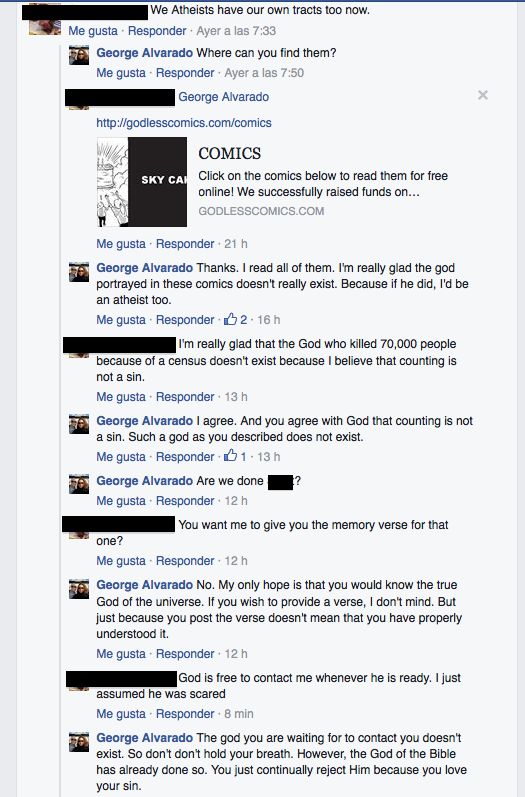
No doubt many have run into an atheist who is adamant about the non-existence of God (usually, in a more specific sense, the Judaeo-Christian God of the Bible). Whether it is all religions or just Christianity in general, they tend to reject what they believe is blind faith and fairy tales. Of course, they are entitled to their opinion. And there is no small shortage of satirical and philosophical rhetoric that some of them use to “refute” the existence of God. But, if you pay attention to the arguments they use to defame, blaspheme, and misalign God, there is one thing that Christians can agree with them on – the god they believe doesn’t exist really doesn’t.

A Strawman Argument is a logical fallacy that someone sets up as a misrepresentation, exaggeration, or complete fabrication of someone else’s position in order to make their own argument seem more reasonable. In this case, many atheists misrepresent their understanding of God/gods and portray them in such a way as to make their own argument seem reasonable, logical, and justified. But, in doing so, they not only set up a strawman, but they commit the most common and widely violated of all sins – idolatry. How? Well, it’s simple.

Anytime you hear an atheist speak, you will usually hear them mock God’s love in contrast to His justice (hell). Or misrepresent His “inability” to answer prayer. Or maybe you might hear how they don’t agree with Him creating intelligent human beings, yet require them to use “faith” to trust in Him (as if faith is absolutely blind). These are just a few of the many. But even if there is an answer to every misrepresentation they have about God, the most important thing is to reveal that although they don’t believe in God, they have inevitably made one up in their own mind! They have set up a divine strawman by which they can reason against over and over so that they can justify their suppression of the truth (Rom 1:8). So even though atheists may suppress the knowledge of God, and know that the true God of the Bible exists, in order for them to ease their conscience and justify their sin, they must create an image of god that suits themselves. A god that that they can deny, vilify, and reject by the approval of their own thoughts and imaginations. Most of their arguments do not work if they don’t do this. Whether you set up a idol to worship to go to war with, it is still idolatry.

Hopefully this strikes you as a much different approach then just providing scientific evidence for God’s existence. This is a mixed approach between revealing their sin and pressupostionally showing them another reason how and why they reject God. Next time you hear a false representation of God, you should disarm the atheist by telling them something like this, “Boy, I’m glad that the god that you are talking about doesn’t exist, because if he did, I would be an atheist too.” Because when you really get down to the nitty-gritty, what atheists do is exchange the truth of God for a lie (Rom 1:25) just like everyone else who does not know Him. And since eternal life is defined by knowing Christ intimately (John 17:3), other than the fact that the typical atheist is just suppressing the truth in unrighteousness, we must engage them by showing them that they are just like every other religion in the world (yes, atheism is a religion) that believes in false gods. Except theirs is just a deified punching bag that they can throw philosophical blows at in order to make themselves feel superior, more intelligent, and morally justified in their sin.

While other world religions offer sacrifice to their gods in order to appease them, atheists repeatedly sacrifice their false representation of God on the altar of reason, logic, and scientific method (systems of thinking our Lord Jesus Christ gave them) in order to appease themselves.  But hey, at least now when we speak to atheists, Christians can agree that the god they are talking about truly doesn’t exist. Because once they are introduced to the God of the Bible, Jesus Christ, and are regenerated by His Spirit, they will no longer speak defiantly, but devotedly; no longer with a heart of war, but of worship.

Let’s pray for the atheists that we witness to and bring the light of the gospel to them.

Below is an quick example on dealing with these kinds of atheists in conversation.

-Until we go home


Screen shot 2016-07-17 at 9.02.52 AM

Disclaimer: DefCon does not support Peter Kreeft. Only the quote used in the link window.

A lot to consider regarding our “little sins.”

The following article by Frank Powell gives us a lot to think about:

image9 Sins the Church Is Surprisingly OK With as Long as You Love Jesus

What if the big sins, you know the ones you try hardest to avoid, aren’t the greatest threat?

I was in an engineering class the first time I watched the tragic explosion of the Space Shuttle Challenger. Even though I wasn’t alive when it happened, I caught a glimpse of the horror thousands must have felt as the events unfolded.

And, the first question everyone wanted to know was, “What happened?”

After months of investigation, here’s what the Rogers Commission (the group commissioned to investigate the explosion) discovered: An o-ring seal in the right solid rocket booster failed at take-off. I won’t bore you with the details, but an o-ring is a small device relative to the size of a space shuttle. Very small.

It wasn’t something huge, like a puncture in the rocket booster or a hole in the cabin, that caused this disaster. It was a small, seemingly insignificant, o-ring failure.

I think there’s a lesson here for the church. What if the big sins, you know the ones you try hardest to avoid, aren’t the greatest threat to your joy and the church’s mission?

Maybe it’s the sins lying underneath, the ones considered normal or acceptable, the ones going undetected, that are affecting the church the most. I want to address nine of these sins.

Continue reading here.

A Light View of Sin

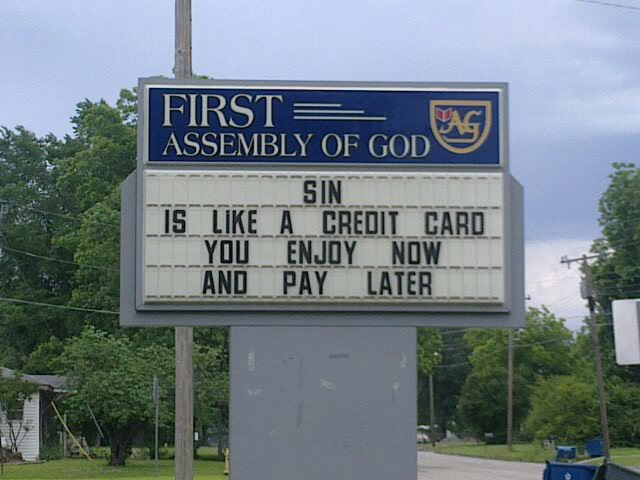
Each week day I drive through a small town on my to and from work. For the past month or more, this sign has been in the yard of a church building. Even with good content, having a message board can be more of a burden than a benefit – it takes work and diligence to keep truth in a short message updated often enough so people notice. But when the message is wretched, one wonders why it is there at all.

Sin like a credit card

While it’s true that sin can seem enjoyable – what value would temptation be to Satan if the end product was rightly portrayed? – it is a biblical fact that we are to hate sin, not enjoy it. Paul addressed this in teaching how abundant God’s grace to towards His children, far greater than our sin, and then asking the rhetorical question:  Romans 6:1-2 (HCSB)  What should we say then? Should we continue in sin so that grace may multiply?  Absolutely not! How can we who died to sin still live in it?

Does the apostle’s instruction seem more biblical than that of the church board in the picture? Again, the apostle –  2 Corinthians 5:21 (HCSB)  He made the One who did not know sin to be sin for us, so that we might become the righteousness of God in Him.

Knowing this, that Christ Jesus took our sin upon Himself, for them on the cross and was the object of God’s wrath that was due us, how can we abide a professing man of God who tells us to be cavalier towards sin?

Enjoy it now, pay for it later? It was PAID IN FULL on the cross! We add to the debt we owe Him every time we sin. It’s too often when we diligently seek to pursue Christ, how much more wretched would our track record be if we thought we were supposed to enjoy sin? Let the lyrics of this old hymn pierce your heart and mine. May we NO LONGER be at peace with our sin – or those who tell us to enjoy it! Let us not grow weary in well doing, but press on toward the prize that will not tarnish and be done with lesser things!

Stricken, smitten, and afflicted,
See Him dying on the tree!
’Tis the Christ by man rejected;
Yes, my soul, ’tis He, ’tis He!
’Tis the long expected prophet,
David’s Son, yet David’s Lord;
Proofs I see sufficient of it:
’Tis a true and faithful Word.

Tell me, ye who hear Him groaning,
Was there ever grief like His?
Friends through fear His cause disowning,
Foes insulting his distress:
Many hands were raised to wound Him,
None would interpose to save;
But the deepest stroke that pierced Him
Was the stroke that Justice gave.

Ye who think of sin but lightly,
Nor suppose the evil great,
Here may view its nature rightly,
Here its guilt may estimate.
Mark the Sacrifice appointed!
See Who bears the awful load!
’Tis the Word, the Lord’s Anointed,
Son of Man, and Son of God.

Here we have a firm foundation,
Here the refuge of the lost.
Christ the Rock of our salvation,
Christ the Name of which we boast.
Lamb of God for sinners wounded!
Sacrifice to cancel guilt!
None shall ever be confounded
Who on Him their hope have built.

Is Your Wife Your First Ministry?

Is Your Wife Your First Ministry?

At DefCon, we holistically support men who support their families. Men who make discipleship and love a priority for the home. The home is one of the central building blocks for a society, and the marriage is the sun by which everything in the home orbits. Having said this, there are many priorities that pastors, open air preachers, and everyday christian men have that may sometimes burden us. We can become anxious, stressed, and overwhelmed with the multiple obligations that we are to tend to. And yes, wives are included in this list of feelings. And the one thing that is not helpful are Christian cliches like, “Your wife is your first ministry.” It has a nice ring to it, and for the most part it is well meaning, but it does not properly convey the responsibilities and obligations a Christian may face on a day to day basis. It has also been abused by certain preachers that wish to exclude certain men from ministry.

I have attached a blogtalk episode that I and a pastor friend of mine recorded about this topic. My hope is that we would all take into consideration the biblical model of men not just in ministry, but just being men in general. All the material discussed in this episode may or may not reflect all the views of contributing bloggers here at DefCon. Here is the narrative and link of the episode below.

“On this exciting episode of G220 radio, George will be joined by Pastor Tom Shuck from Pilgrim Bible Church. Pastor Shuck is a graduate of Master’s Seminary and Columbia Evangelical Seminary and was a missionary to India for 12 years. He holds both a Masters of Divinity (MDiv.) and a Doctorate of Ministry (DMin.). He has been a pastor of Pilgrim Bible Church for 4 years and helped start a seminary in India as well as planted a church there. He enjoys sports, music, family trips, and George’s personal favorite, linguistics. He has evangelized in cities like Oakland, Orlando, Mumbai, Pune training believers how to evangelize, preach the gospel, and make disciples. His wife is Lisa Shuck and two children.”

“This episode we’ll explore the cliche “Your wife is your first ministry.” Is it Scriptural? Are there other primary biblical responsibilities? Can you make ministry your idol or mistress? What should a man who is called to preach do with this kind of cliche? What about missionaries and evangelists of old that we look up to that sacrificed much, even their marriages, for the gospel? What about Matthew 22:35-40, 1 Corinthians 7:32-34, Ephesians 5:22-33, and 1 Timothy 3:5?”

http://www.blogtalkradio.com/g220radionetwork/2016/05/10/ep-157-is-your-wife-your-first-ministry

-Until we go home


False Teachers

Three Common Errors of False Teachers

by Mike Gendron

November 9, 2015

  •  Since we are now living in the age of religious tolerance and ecumenical unity, there are some people who will immediately call this article unloving and divisive. Others will ask, “What right do you have to judge another religion?” The answer is given in Scripture. All God-fearing people are called to make right judgments, judgments that have already been established by the objective principles of God’s Word (John 7:24). There may be nothing more important than warning people who are being deceived about their eternal destiny. If we do not lovingly confront them with God’s Gospel, they may never know how to escape the eternal fire of God’s punishment. Clearly, the most unloving thing we can do is to ignore them and let them continue down the road to destruction. For this reason, I am always willing to offend people with the offense and exclusivity of the Gospel in the hopes that God may grant some of them repentance leading to a knowledge of the truth (2 Tim. 2: 25). Let us look at three fatal errors of false prophets and how to handle them.


False Teachers Usurp the Authority of God

  •  The supreme authority of the Bible is established both by its divine origin and inspiration (2 Pet. 1:21). It is the infallible Word of God, and it will accomplish God’s purpose (Isaiah 55:11). It is the very foundation upon which all Christian truths rest. For followers of the Lord Jesus Christ, the Bible is the final court of appeal in all matters pertaining to faith and godliness. “All Scripture is God-breathed and is useful for teaching, rebuking, correcting and training in righteousness” (2 Tim. 3:16). The divine authority of Scripture corrects and rebukes all false teaching because there is no higher authority or infallible source in which to appeal. It is the Word of God, and God cannot lie, cannot break His promise and cannot deceive.
  •  People fall into serious error and sin when they exalt their own authority over God’s authority or when they suppress the truth of God’s Word to promote their own self-serving agendas. The Roman Catholic religion has done this by establishing its traditions and teachings to be equal in authority with Scripture (Catechism of the Catholic Church [CCC] par. 82). In doing so, it has usurped the supreme authority of our sovereign God who alone has the right to rule and determine the eternal destinies of men. This fatal error has opened the flood gates to numerous other deadly heresies including: the preaching of another gospel, the worship of a counterfeit Jesus, the buying and selling of God’s grace through indulgences, the creation of a fictitious place called purgatory, the establishment of other mediators and praying to and for the dead. These errors are fatal because anyone who is embracing them when they take their last breath will experience eternal death.
  •  Catholics who are being deceived by these fatal errors must be told that the world has known only one infallible teacher. He is the Lord Jesus Christ, who was the personification of truth and every word He spoke was truth (John 14:617:17). Those who are seeking the truth need to look only to Christ and His Word. The Catholic religion has become corrupt the same way Judaism became corrupt – by following the traditions of men instead of the Word of God (Mark 7:13). The Pharisees taught much truth, but by mixing it with error, they “made the word of God of no effect.” We must never forget that the Bible is what God says and religion is what man says God says.

False Teachers Distort the Person of Christ

  •  Jesus Christ is God’s perfect man and man’s perfect God. He is the perfect High Priest who offered Himself – the perfect sacrifice – once for the sins of His people. This one sin offering has perfected for all time those who are sanctified (Heb. 10:14). For this reason there are no more offerings for sin (Heb. 10:18). The believer’s eternal sin debt was paid in full and their redemption was secured when God raised Jesus Christ from the dead (Rom. 4:25). Would there be false teachers who would deny this and steal away the honor and glory of our Savior?
  •  Yes, Paul even warned us that some would come preaching another Jesus. They will offer a counterfeit Jesus “whom we [the apostles] have not preached” (2 Cor. 11:4). Many of these false teachers are Roman Catholics who preach a “Jesus” who does not save sinners completely and forever. They say Catholics must do their part by expiating and making satisfaction for their own sins through penance (CCC, 1459). In this way they attain their own salvation through good works (CCC, 1477). The Catholic Jesus offers conditional life, not eternal life (CCC, 1035). This counterfeit Christ is said to return physically to Catholic altars over 200,000 times each day to be a sin offering for the living and the dead (CCC, 1367).


  •  Catholics must be warned of the consequences for not knowing and believing the true Jesus. This was made clear by Jesus when He said: “unless you believe that I am He, you shall die in your sins” (John 8:24). Whenever religion rejects God’s authority, it creates “another Jesus” which always leads to “another gospel.” Why? Because whenever the sufficiency of Christ is denied, another gospel must be concocted to instruct people what they must do to be saved.


False Teachers Pervert the Gospel of Christ

  •  The Gospel is the joyous proclamation of God’s redeeming work through Jesus Christ which saves His people from the punishment, power and ultimately, the presence of sin. It is the one and only message of redemption and the same message for every generation (Eph. 4:4-6Rev. 14:6). Since the Gospel is about one Savior, it is exclusive and thus declares that all other faiths and religions are false (John 14:6Mat. 7:13-14). This glorious Gospel declares that salvation is entirely of grace and those who add anything to it stand condemned (Gal. 1:6-9). It comes as no surprise that the most popular perversion of the Gospel is the fatal lie that good works or inherent righteousness are necessary to appease a holy God. Every religion in the world perpetrates this lie of the devil. However, Satan’s oldest and most deadly lie is “You surely shall not die” (Gen. 3:4). This lie is still spread in Catholicism (CCC, 1863).
  •  Why would any religious leader want to distort the glorious Gospel of grace? The primary reason is to control people by holding them captive in legalistic bondage. It is for this reason the Lord Jesus gave the mark of a true disciple. He said, “If you abide in My word…and you shall know the truth, and the truth shall make you free” (John 8:31-32). People in religious bondage can only be set free when they come to a knowledge of the truth found in Scripture.


  •  Roman Catholicism is not alone in perverting the Gospel of God. There are many cults and Protestant sects which do the same. Catholicism, however, not only deceives its people with a false gospel, but foolishly condemns those who believe the true Gospel. Over 100 condemnations from the Council of Trent are pronounced on Christians who believe the Lord Jesus is sufficient to save sinners completely and forever. The Catholic “gospel” emphasizes what man must DO to be saved instead of what Christ has DONE. This would include the necessity of doing good works (CCC, 2016), receiving sacraments (1129), attending meritorious masses (1405), keeping the law (2068), buying indulgences (1498) and purgatory (1030).


False Teachers Must Be Confronted

  •  We must never let doctrinal error go unabated because it dishonors God and deceives the unsuspecting. It defiles the conscience, corrupts the heart and destroys the soul. According to Scripture, that which flows from the lips of false teachers includes: “strange doctrines,” “commandments of men,” “doctrines of devils,” “damnable heresies,” “traditions of men,” “lies,” “falsehood,” “vain deceit” and “deceptive philosophy.” Lying lips are an abomination to the Lord at all times and in all cases (Prov. 12:22). Knowing the fruit of false teachers, we must earnestly contend against them. Peter and Paul said false teachers cause believers to fall from their steadfastness and pure devotion to Christ (2 Pet. 3:172 Cor. 11:3). They disagree with the words of Jesus and bring constant friction within the church (1 Tim. 6:4-5). They give rise to speculation and fruitless discussion which hinder the purposes of God (1 Tim. 1:4-6).


  •  Many who profess Christ are no longer embracing sound doctrine because they want their ears tickled and are seeking teachers who will do just that (2 Tim. 4:2). Using the Word of God, we must be ready to reprove, rebuke and exhort with great patience and instruction. Those who have been entrusted with the truth must take a stand against those who try to lead men astray. Even when Peter was not straightforward about the truth of the Gospel, Paul withstood him to his face, and rebuked him sharply (Gal. 2:11-14). Jude exhorted us to “earnestly contend for the faith once delivered to the saints” (Jude 3). Those who refuse to defend God’s truth are demonstrating their lack of passion for the truth. We must love the truth and hate every false way (Ps. 119:104). Let us never be intimidated by false teachers because “the fear of man brings a snare” (Prov. 29:25).


The Battle for Truth

  •  Let us be mindful of the words of A.W. Tozer, who wrote: “So skilled is error at imitating truth that the two are constantly being mistaken for each other. It is therefore critically important that the Christian take full advantage of every provision God has made to save him from delusion – prayer, faith, constant meditation of the Scriptures, obedience, humility and the illumination of the Holy Spirit” (That Incredible Christian).
  •  We need to ask God for courage and boldness as we rely on the power of His Word. May we all become more like the apostles who were strong, bold, fearless, dogmatic, unaccommodating of error, courageous, intolerant of sin, inflexible concerning the Gospel, controversial, willing to die for the truth and fully devoted to Christ. We are no longer to be children, tossed here and there by waves and carried about by the trickery of men, by craftiness in deceitful scheming (Eph. 4:14). During these times of great deception, the Body of Christ must respond with a theological, biblical worldview that defends the glory and honor of our Lord Jesus Christ. We must protect the purity of His Gospel for the sake of His elect.

Fifty Years in the Chuch of Rome

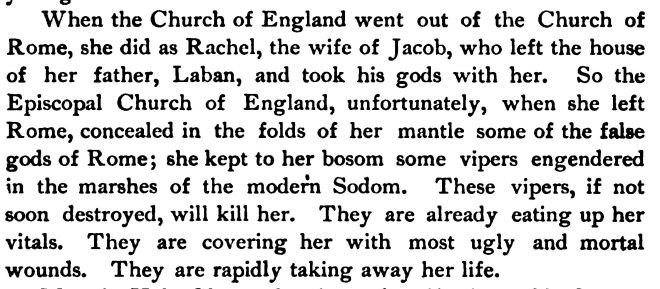
Most magisterial reformers took only a half-step from Rome. Much of what protestant churches hold to was learnt from Rome. Certain doctrines and practices clung to men like the sin that so easily entangles us. The following is from Charles Chiniquy’s book, Fifty Years in the Church of Rome, chapter 30; published in 1886.
Half-step from Rome
Later in the book, after describing the horrors women experienced in having their most secret sins pried from them by expertly crafted questions, the author reveals one of the vipers mentioned above.
586